
Khushboo Pasbola
M.Pharm (QAT)
SGRRITS
 Steam Sterilization under pressure is the
most efficient method of sterilization
 It is the method of choice when heat and
moisture is not a problem to the product
 Steam sterilization is carried out in an
autoclave
What is steam sterilization?
HOW DOES AN AUTOCLAVE WORK?
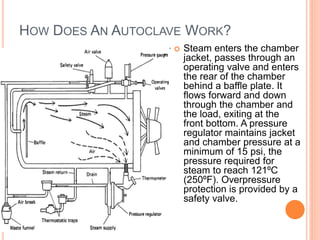
 Steam enters the chamber
jacket, passes through an
operating valve and enters
the rear of the chamber
behind a baffle plate. It
flows forward and down
through the chamber and
the load, exiting at the
front bottom. A pressure
regulator maintains jacket
and chamber pressure at a
minimum of 15 psi, the
pressure required for
steam to reach 121ºC
(250ºF). Overpressure
protection is provided by a
safety valve.
HOW TO VALIDATE?
Validation Involves
DESIGN
QUALIFICATION
INSTALLATION
QUALIFICATION
OPERATIONAL
QUALIFICATION
PERFORMANCE
QUALIFICATION
CYCLE DEVELOPMENT
 There are Several Factors that affect Sterilization
cycle e.g. Nature of load, type of sterilizer, container
and closure used
 If the material to be sterilized is heat stable , then
overkill approach may be employed.
 The material which can be sterilized by overkill
approach include filters, containers, closures, hoses
and other goods.
 Some soft goods such as gowns can also be
sterilized by overkill approach.
 Generally accepted probability of survival of
microorganisms is 10-6.
DESIGN QUALIFICATION
 The Purpose of design qualification is to demonstrate
that the sterilizer is designed properly and to
demonstrate that it perform according to its design
criteria.
 Modern sterilizer design is the result of several year
experience of the manufacturer of the sterilizers and the
users requirement
 Usually well designed steam sterilizer are available in
market.
 The Design can be modified by the manufacturer ,if
specified by the user
 The manufacturer of sterilizer can be asked for design
qualification document of the sterilizer.
INSTALLATION QUALIFICATION
IQ should include
 A brief description of sterilizer and its ancillary
equipment.
 A schematic drawing of the system
 List of other associated drawings like structural and
layout drawings and electrical schematics.
 List of detailed specifications
 Attestation sheets stating that the system has been
properly installed
 List of the equipment which make up the sterilizer
system
 List of system instruments specifying vendor,
model number and range
 Reference to calibration of instruments
 Manuals for operation and maintenance including
computer software, If the system is computer
controlled.
 List of spare parts.
 List of utility connections (e.g. clean steam, water
for injection)
FO VALUE:
 The F0 value is mentioned both in the USP and in the Current
Good Manufacturing Practices (CGMPs) for large volume
parentrals (LVPs).
 Both sources indicate that the steam sterilization process must
be sufficient to produce an F0 value of at least 8 min.
 This means that the coolest location in the sterilizer loading
configuration must be exposed to an equivalent time of at
least 8 min of exposure to a temperature of at least 121°C.
OPERATIONAL QUALIFICATION
 OQ of sterilizer is based on critical specifications
and variables of the sterilizer.
 These variables are measured under the operating
conditions and data are recorded.
 For range values both minimum and maximum
should be checked.
 There are two important devices which play a
pivotal role in validation of sterilizer :
THERMOCOUPLE and BIOLOGICAL
INDICATORS.
CHARACTERISTICS OF THERMOCOUPLE
 Thermocouple should be sufficiently durable for
repeated use.
 Accuracy of thermocouple should be (+ or –) 0.5o
C
 Thermocouple should be calibrated before and after
use in a validation program at two temperatures, O
and 125o C
 Temperature recorder should be capable of printing
temperature data in 0.1oC increment
CHARACTERISTICS OF BIOLOGOCAL
INDICATORS
 The most commonly used biological indicator is the
spores of B. Stearothermophilus in steam
sterilization validation.
 The Main Purpose of biological indicator is to
assure that a minimum Fo Value has been
achieved in the coolest location of the autoclave
load.
OPERATIONAL QUALIFICATION INVOLVES
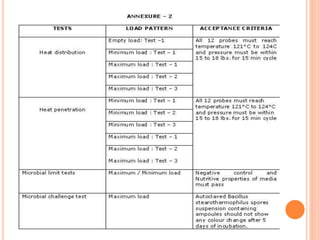
1. Heat distribution study
 Heat-distribution studies include two phases:
 heat distribution in an empty autoclave chamber
 heat distribution in a loaded autoclave chamber.
 Between 10 and 20 thermocouples should be used per
cycle.
 Thermocouples should be secured inside the chamber
according to a definite arrangement
 Teflon tape can be used to secure thermocouples
 One thermocouple each should remain in an ice bath
and high-temperature oil bath during each cycle for
reference when the temperature monitoring equipment
has the capability for electronically compensating each
temperature measurement against an internal reference.
 Heat-distribution studies following the initial study
may employ fewer thermocouples as the cool spot in
the chamber and in the load is identified.
 The key is to identify on a reproducible basis the
location of the cool spot and the effect of the load
size and/or configuration on the cool spot location.
 The difference in temperature between the coolest
spot and the mean chamber temperature should be
not greater than ±2.5°C
 Greater temperature differences may be indicative
of equipment malfunction.
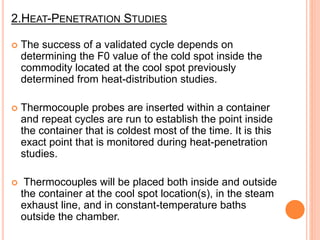
2.HEAT-PENETRATION STUDIES
 The success of a validated cycle depends on
determining the F0 value of the cold spot inside the
commodity located at the cool spot previously
determined from heat-distribution studies.
 Thermocouple probes are inserted within a container
and repeat cycles are run to establish the point inside
the container that is coldest most of the time. It is this
exact point that is monitored during heat-penetration
studies.
 Thermocouples will be placed both inside and outside
the container at the cool spot location(s), in the steam
exhaust line, and in constant-temperature baths
outside the chamber.
 The F0 value will be calculated based on the
temperature recorded by the thermocouple inside the
container at the coolest area of the load.
 Upon completion of the cycle, the F0 value will
indicate whether the cycle is adequate or if
alterations must be made.
 Following the attainment of the desired time–
temperature cycle, cycles are repeated until the user
is satisfied with the repeatability aspects of the cycle
validation process
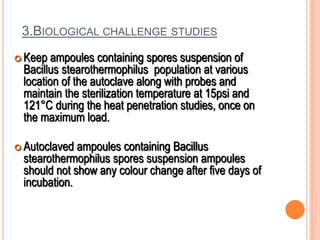
3.BIOLOGICAL CHALLENGE STUDIES
 Keep ampoules containing spores suspension of
Bacillus stearothermophilus population at various
location of the autoclave along with probes and
maintain the sterilization temperature at 15psi and
121°C during the heat penetration studies, once on
the maximum load.
 Autoclaved ampoules containing Bacillus
stearothermophilus spores suspension ampoules
should not show any colour change after five days of
incubation.
REFRENCES:
 P.P. SHARMA, Validation in pharmaceutical industry ,
Vandana publications pvt ltd, first edition 2007,page
no.294-301
 Robert A. Nash, Pharmaceutical Process Validation
Second Edition 1993.

Autoclave

  • 1.
  • 2.
     Steam Sterilizationunder pressure is the most efficient method of sterilization  It is the method of choice when heat and moisture is not a problem to the product  Steam sterilization is carried out in an autoclave What is steam sterilization?
  • 3.
    HOW DOES ANAUTOCLAVE WORK?  Steam enters the chamber jacket, passes through an operating valve and enters the rear of the chamber behind a baffle plate. It flows forward and down through the chamber and the load, exiting at the front bottom. A pressure regulator maintains jacket and chamber pressure at a minimum of 15 psi, the pressure required for steam to reach 121ºC (250ºF). Overpressure protection is provided by a safety valve.
  • 4.
    HOW TO VALIDATE? ValidationInvolves DESIGN QUALIFICATION INSTALLATION QUALIFICATION OPERATIONAL QUALIFICATION PERFORMANCE QUALIFICATION
  • 5.
    CYCLE DEVELOPMENT  Thereare Several Factors that affect Sterilization cycle e.g. Nature of load, type of sterilizer, container and closure used  If the material to be sterilized is heat stable , then overkill approach may be employed.  The material which can be sterilized by overkill approach include filters, containers, closures, hoses and other goods.  Some soft goods such as gowns can also be sterilized by overkill approach.  Generally accepted probability of survival of microorganisms is 10-6.
  • 6.
    DESIGN QUALIFICATION  ThePurpose of design qualification is to demonstrate that the sterilizer is designed properly and to demonstrate that it perform according to its design criteria.  Modern sterilizer design is the result of several year experience of the manufacturer of the sterilizers and the users requirement  Usually well designed steam sterilizer are available in market.  The Design can be modified by the manufacturer ,if specified by the user  The manufacturer of sterilizer can be asked for design qualification document of the sterilizer.
  • 7.
    INSTALLATION QUALIFICATION IQ shouldinclude  A brief description of sterilizer and its ancillary equipment.  A schematic drawing of the system  List of other associated drawings like structural and layout drawings and electrical schematics.  List of detailed specifications  Attestation sheets stating that the system has been properly installed
  • 8.
     List ofthe equipment which make up the sterilizer system  List of system instruments specifying vendor, model number and range  Reference to calibration of instruments  Manuals for operation and maintenance including computer software, If the system is computer controlled.  List of spare parts.  List of utility connections (e.g. clean steam, water for injection)
  • 9.
    FO VALUE:  TheF0 value is mentioned both in the USP and in the Current Good Manufacturing Practices (CGMPs) for large volume parentrals (LVPs).  Both sources indicate that the steam sterilization process must be sufficient to produce an F0 value of at least 8 min.  This means that the coolest location in the sterilizer loading configuration must be exposed to an equivalent time of at least 8 min of exposure to a temperature of at least 121°C.
  • 10.
    OPERATIONAL QUALIFICATION  OQof sterilizer is based on critical specifications and variables of the sterilizer.  These variables are measured under the operating conditions and data are recorded.  For range values both minimum and maximum should be checked.  There are two important devices which play a pivotal role in validation of sterilizer : THERMOCOUPLE and BIOLOGICAL INDICATORS.
  • 11.
    CHARACTERISTICS OF THERMOCOUPLE Thermocouple should be sufficiently durable for repeated use.  Accuracy of thermocouple should be (+ or –) 0.5o C  Thermocouple should be calibrated before and after use in a validation program at two temperatures, O and 125o C  Temperature recorder should be capable of printing temperature data in 0.1oC increment
  • 12.
    CHARACTERISTICS OF BIOLOGOCAL INDICATORS The most commonly used biological indicator is the spores of B. Stearothermophilus in steam sterilization validation.  The Main Purpose of biological indicator is to assure that a minimum Fo Value has been achieved in the coolest location of the autoclave load.
  • 13.
    OPERATIONAL QUALIFICATION INVOLVES 1.Heat distribution study  Heat-distribution studies include two phases:  heat distribution in an empty autoclave chamber  heat distribution in a loaded autoclave chamber.  Between 10 and 20 thermocouples should be used per cycle.  Thermocouples should be secured inside the chamber according to a definite arrangement  Teflon tape can be used to secure thermocouples  One thermocouple each should remain in an ice bath and high-temperature oil bath during each cycle for reference when the temperature monitoring equipment has the capability for electronically compensating each temperature measurement against an internal reference.
  • 14.
     Heat-distribution studiesfollowing the initial study may employ fewer thermocouples as the cool spot in the chamber and in the load is identified.  The key is to identify on a reproducible basis the location of the cool spot and the effect of the load size and/or configuration on the cool spot location.  The difference in temperature between the coolest spot and the mean chamber temperature should be not greater than ±2.5°C  Greater temperature differences may be indicative of equipment malfunction.
  • 15.
    2.HEAT-PENETRATION STUDIES  Thesuccess of a validated cycle depends on determining the F0 value of the cold spot inside the commodity located at the cool spot previously determined from heat-distribution studies.  Thermocouple probes are inserted within a container and repeat cycles are run to establish the point inside the container that is coldest most of the time. It is this exact point that is monitored during heat-penetration studies.  Thermocouples will be placed both inside and outside the container at the cool spot location(s), in the steam exhaust line, and in constant-temperature baths outside the chamber.
  • 16.
     The F0value will be calculated based on the temperature recorded by the thermocouple inside the container at the coolest area of the load.  Upon completion of the cycle, the F0 value will indicate whether the cycle is adequate or if alterations must be made.  Following the attainment of the desired time– temperature cycle, cycles are repeated until the user is satisfied with the repeatability aspects of the cycle validation process
  • 17.
    3.BIOLOGICAL CHALLENGE STUDIES Keep ampoules containing spores suspension of Bacillus stearothermophilus population at various location of the autoclave along with probes and maintain the sterilization temperature at 15psi and 121°C during the heat penetration studies, once on the maximum load.  Autoclaved ampoules containing Bacillus stearothermophilus spores suspension ampoules should not show any colour change after five days of incubation.
  • 19.
    REFRENCES:  P.P. SHARMA,Validation in pharmaceutical industry , Vandana publications pvt ltd, first edition 2007,page no.294-301  Robert A. Nash, Pharmaceutical Process Validation Second Edition 1993.