Introduction to
Pharmaceutical Microbiology
Mohamed Abo-Elgheit
Pharmaceutical Microbiology Expert
Quality System Supervisor in Egypt Otsuka Pharmaceuticals
Microbiology Supervisor in Egypt Otsuka Pharmaceuticals
BS. Microbiology, 2010 - TQM Diploma, 2018
Email: mhmd.aboelgheit@gmail.com
Aim of this lecture
• To understand the role of microbiology lab in the pharmaceutical
industry.
• To get an overview on what is conducted in the pharmaceutical
microbiology lab
• To be familiar with microbiological tests.
• To get to know career path and qualifications of the
pharmaceutical microbiologist.
Mohamed Aboelgheit mhmd.aboelgheit@gmail.com 2
Content
• PART 1: Microbiology Lab
• PART 2: Activities in Microbiology Lab
• PART 3: To be a Microbiologist.
Mohamed Aboelgheit mhmd.aboelgheit@gmail.com 3
PART 1: Microbiology Lab
• What is Microbiology?
• What is Pharmaceutical Microbiology?
• Pharmaceutical Microbiology Lab
• Aseptic Technique
Mohamed Aboelgheit mhmd.aboelgheit@gmail.com 4
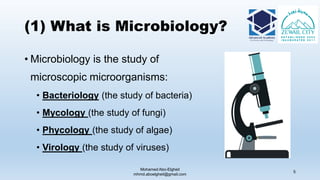
(1) What is Microbiology?
• Microbiology is the study of
microscopic microorganisms:
• Bacteriology (the study of bacteria)
• Mycology (the study of fungi)
• Phycology (the study of algae)
• Virology (the study of viruses)
Mohamed Abo-Elgheit
mhmd.aboelgheit@gmail.com
5
Microbiology in Tree of
Life
Mohamed Abo-Elgheit
mhmd.aboelgheit@gmail.com
6
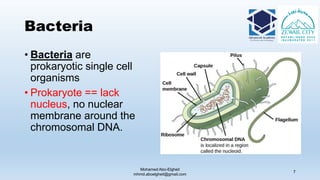
Bacteria
• Bacteria are
prokaryotic single cell
organisms
• Prokaryote == lack
nucleus, no nuclear
membrane around the
chromosomal DNA.
Mohamed Abo-Elgheit
mhmd.aboelgheit@gmail.com
7
Bacteria: Gram Stain and
Cell Wall
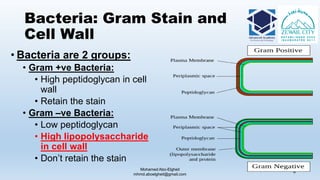
• Bacteria are 2 groups:
• Gram +ve Bacteria:
• High peptidoglycan in cell
wall
• Retain the stain
• Gram –ve Bacteria:
• Low peptidoglycan
• High lipopolysaccharide
in cell wall
• Don’t retain the stain
Mohamed Abo-Elgheit
mhmd.aboelgheit@gmail.com
8
Bacteria: Gram Stain and
Cell Wall
Mohamed Abo-Elgheit
mhmd.aboelgheit@gmail.com
9
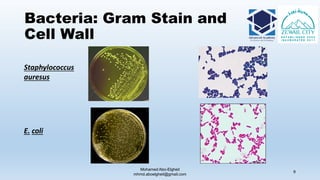
Staphylococcus
auresus
E. coli
Bacteria: Aerobic vs
Anaerobic
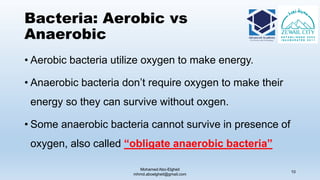
• Aerobic bacteria utilize oxygen to make energy.
• Anaerobic bacteria don’t require oxygen to make their
energy so they can survive without oxgen.
• Some anaerobic bacteria cannot survive in presence of
oxygen, also called “obligate anaerobic bacteria”
Mohamed Abo-Elgheit
mhmd.aboelgheit@gmail.com
10
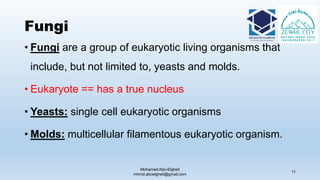
Fungi
• Fungi are a group of eukaryotic living organisms that
include, but not limited to, yeasts and molds.
• Eukaryote == has a true nucleus
• Yeasts: single cell eukaryotic organisms
• Molds: multicellular filamentous eukaryotic organism.
Mohamed Abo-Elgheit
mhmd.aboelgheit@gmail.com
11
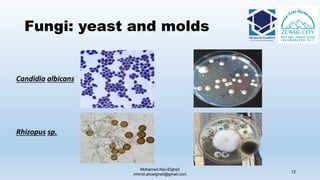
Fungi: yeast and molds
Mohamed Abo-Elgheit
mhmd.aboelgheit@gmail.com
12
Candidia albicans
Rhizopus sp.
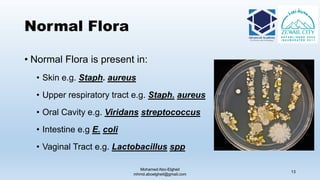
Normal Flora
• Normal Flora is present in:
• Skin e.g. Staph. aureus
• Upper respiratory tract e.g. Staph. aureus
• Oral Cavity e.g. Viridans streptococcus
• Intestine e.g E. coli
• Vaginal Tract e.g. Lactobacillus spp
Mohamed Abo-Elgheit
mhmd.aboelgheit@gmail.com
13
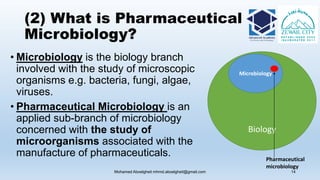
(2) What is Pharmaceutical
Microbiology?
• Microbiology is the biology branch
involved with the study of microscopic
organisms e.g. bacteria, fungi, algae,
viruses.
• Pharmaceutical Microbiology is an
applied sub-branch of microbiology
concerned with the study of
microorganisms associated with the
manufacture of pharmaceuticals.
Biology
Microbiology
Pharmaceutical
microbiology
Mohamed Aboelgheit mhmd.aboelgheit@gmail.com 14
Pharmaceutical
Microbiology Scope
• Study of microorganisms associated with the
industry:
• control and monitor microorganism through the process to
ensure the safe manufacturing of pharmaceutical products:
• Microbiological Analysis Tests
• Environmental monitoring
Mohamed Aboelgheit mhmd.aboelgheit@gmail.com 15
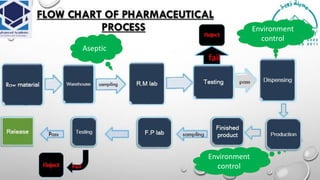
Flowchart of Pharmaceutical
Manufacturing
Mohamed Aboelgheit mhmd.aboelgheit@gmail.com 16
Aseptic
Environment
control
Environment
control
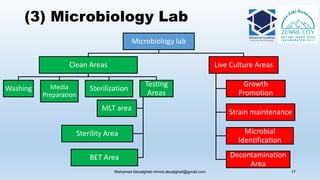
(3) Microbiology Lab
Microbiology lab
Clean Areas
Washing Media
Preparation
Sterilization
Testing
Areas
MLT area
Sterility Area
BET Area
Live Culture Areas
Growth
Promotion
Strain maintenance
Microbial
Identification
Decontamination
Area
Mohamed Aboelgheit mhmd.aboelgheit@gmail.com 17
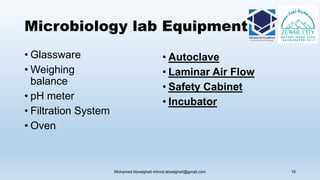
Microbiology lab Equipment
• Glassware
• Weighing
balance
• pH meter
• Filtration System
• Oven
Mohamed Aboelgheit mhmd.aboelgheit@gmail.com 18
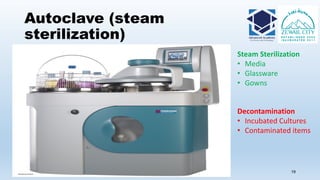
• Autoclave
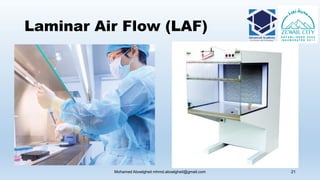
• Laminar Air Flow
• Safety Cabinet
• Incubator
Autoclave (steam
sterilization)
Mohamed Aboelgheit mhmd.aboelgheit@gmail.com 19
Steam Sterilization
• Media
• Glassware
• Gowns
Decontamination
• Incubated Cultures
• Contaminated items
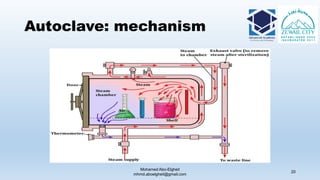
Autoclave: mechanism
Mohamed Abo-Elgheit
mhmd.aboelgheit@gmail.com
20
Laminar Air Flow (LAF)
Mohamed Aboelgheit mhmd.aboelgheit@gmail.com 21
Laminar Air Flow: air
direction
Mohamed Abo-Elgheit
mhmd.aboelgheit@gmail.com
22
Microbiological Incubators
Mohamed Aboelgheit mhmd.aboelgheit@gmail.com 23
Bench Incubator Walk-in Incubator
Good Manufacturing
Practices (GMP)
• Good Manufacturing Practices (GMP) are a set of
practices which ensures that pharmaceutical products
are consistently produced and controlled according to
the quality standards (WHO).
• Areas under GMP are: facilities, equipment,
production, process control, etc.
Mohamed Abo-Elgheit
mhmd.aboelgheit@gmail.com
24
Good Laboratory Practices
(GLP)
• Good Laboratory Practices (GMP) are a set of
practices which ensures reliability and reproducibility in
the lab.
• Areas under GLP: testing facilities, personnel training,
equipment, records, reports, etc.
Mohamed Abo-Elgheit
mhmd.aboelgheit@gmail.com
25
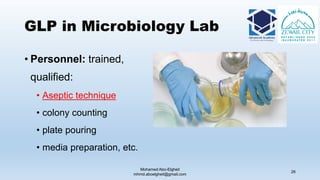
GLP in Microbiology Lab
• Personnel: trained,
qualified:
• Aseptic technique
• colony counting
• plate pouring
• media preparation, etc.
Mohamed Abo-Elgheit
mhmd.aboelgheit@gmail.com
26
GLP in Microbiology Lab
• Lab Environment:
• Separation of clean and dirty activities
• Dedicated spaces for samples, media, reference
microorganisms.
• Disinfection and sterilization can be effectively done
Mohamed Abo-Elgheit
mhmd.aboelgheit@gmail.com
27
(4) Aseptic Technique
• Bacteria are everywhere. It is important to take
measures to avoid contaminating your work with
undesired bacteria.
Disinfection of working areas, and hand sanitation
Use of flames to kill bacteria that may enter vessels
openings.
Mohamed Aboelgheit mhmd.aboelgheit@gmail.com 28
Aseptic Technique
Mohamed Aboelgheit mhmd.aboelgheit@gmail.com 29
PART 2: Activities in
Microbiology lab
• Media Preparation
• Media Growth Promotion
• Microbiological Analysis Tests:
• Microbial Limit Tests
• Sterility Test
• Bacterial Endotoxin Test
• Viable Environmental Monitoring
• Rapid Microbiological Methods
Mohamed Aboelgheit mhmd.aboelgheit@gmail.com 30
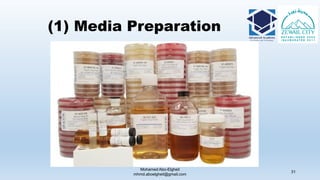
(1) Media Preparation
Mohamed Abo-Elgheit
mhmd.aboelgheit@gmail.com
31
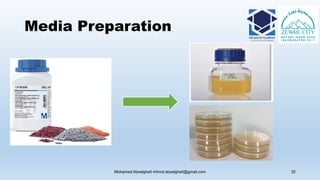
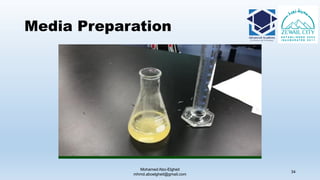
Media Preparation
Mohamed Aboelgheit mhmd.aboelgheit@gmail.com 32
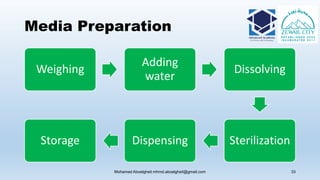
Media Preparation
Weighing
Adding
water
Dissolving
SterilizationDispensingStorage
Mohamed Aboelgheit mhmd.aboelgheit@gmail.com 33
Media Preparation
Mohamed Abo-Elgheit
mhmd.aboelgheit@gmail.com
34
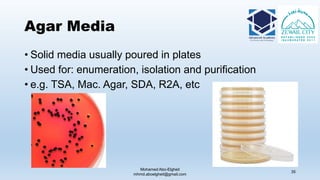
Agar Media
Mohamed Abo-Elgheit
mhmd.aboelgheit@gmail.com
35
• Solid media usually poured in plates
• Used for: enumeration, isolation and purification
• e.g. TSA, Mac. Agar, SDA, R2A, etc
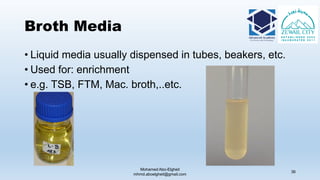
Broth Media
• Liquid media usually dispensed in tubes, beakers, etc.
• Used for: enrichment
• e.g. TSB, FTM, Mac. broth,..etc.
Mohamed Abo-Elgheit
mhmd.aboelgheit@gmail.com
36
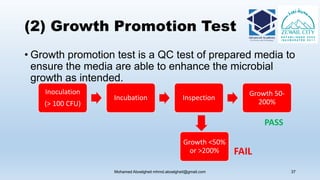
(2) Growth Promotion Test
• Growth promotion test is a QC test of prepared media to
ensure the media are able to enhance the microbial
growth as intended.
Mohamed Aboelgheit mhmd.aboelgheit@gmail.com 37
Inoculation
(> 100 CFU)
Incubation Inspection
Growth 50-
200%
Growth <50%
or >200%
PASS
FAIL
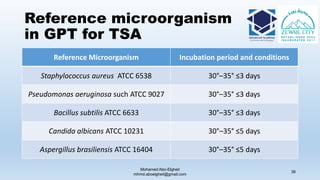
Reference microorganism
in GPT for TSA
Reference Microorganism Incubation period and conditions
Staphylococcus aureus ATCC 6538 30°–35° ≤3 days
Pseudomonas aeruginosa such ATCC 9027 30°–35° ≤3 days
Bacillus subtilis ATCC 6633 30°–35° ≤3 days
Candida albicans ATCC 10231 30°–35° ≤5 days
Aspergillus brasiliensis ATCC 16404 30°–35° ≤5 days
Mohamed Abo-Elgheit
mhmd.aboelgheit@gmail.com
38
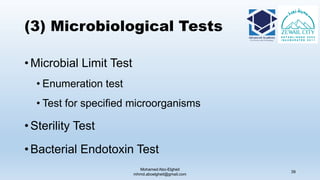
(3) Microbiological Tests
• Microbial Limit Test
• Enumeration test
• Test for specified microorganisms
• Sterility Test
• Bacterial Endotoxin Test
Mohamed Abo-Elgheit
mhmd.aboelgheit@gmail.com
39
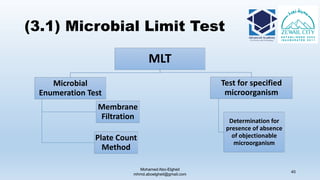
(3.1) Microbial Limit Test
MLT
Microbial
Enumeration Test
Membrane
Filtration
Plate Count
Method
Test for specified
microorganism
Determination for
presence of absence
of objectionable
microorganism
Mohamed Abo-Elgheit
mhmd.aboelgheit@gmail.com
40
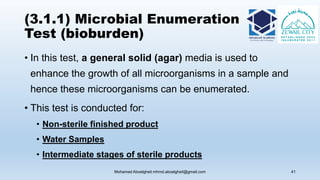
(3.1.1) Microbial Enumeration
Test (bioburden)
• In this test, a general solid (agar) media is used to
enhance the growth of all microorganisms in a sample and
hence these microorganisms can be enumerated.
• This test is conducted for:
• Non-sterile finished product
• Water Samples
• Intermediate stages of sterile products
Mohamed Aboelgheit mhmd.aboelgheit@gmail.com 41
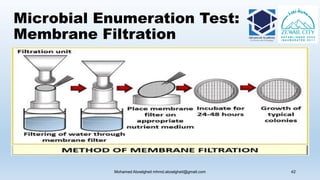
Microbial Enumeration Test:
Membrane Filtration
Mohamed Aboelgheit mhmd.aboelgheit@gmail.com 42
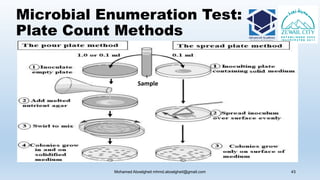
Microbial Enumeration Test:
Plate Count Methods
Mohamed Aboelgheit mhmd.aboelgheit@gmail.com 43
Sample
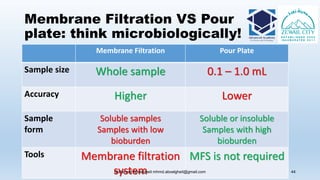
Membrane Filtration VS Pour
plate: think microbiologically!
Membrane Filtration Pour Plate
Sample size Whole sample 0.1 – 1.0 mL
Accuracy Higher Lower
Sample
form
Soluble samples
Samples with low
bioburden
Soluble or insoluble
Samples with high
bioburden
Tools Membrane filtration
system
MFS is not required
Mohamed Aboelgheit mhmd.aboelgheit@gmail.com 44
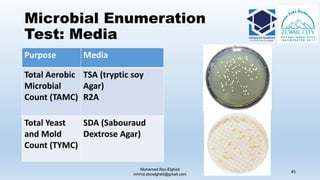
Microbial Enumeration
Test: Media
Mohamed Abo-Elgheit
mhmd.aboelgheit@gmail.com
45
Purpose Media
Total Aerobic
Microbial
Count (TAMC)
TSA (tryptic soy
Agar)
R2A
Total Yeast
and Mold
Count (TYMC)
SDA (Sabouraud
Dextrose Agar)
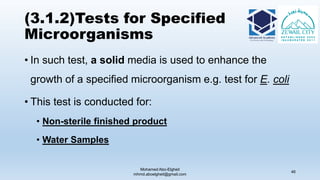
(3.1.2)Tests for Specified
Microorganisms
• In such test, a solid media is used to enhance the
growth of a specified microorganism e.g. test for E. coli
• This test is conducted for:
• Non-sterile finished product
• Water Samples
Mohamed Abo-Elgheit
mhmd.aboelgheit@gmail.com
46
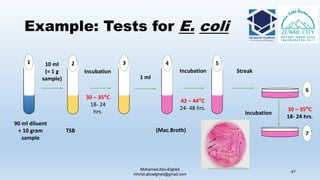
Example: Tests for E. coli
Mohamed Abo-Elgheit
mhmd.aboelgheit@gmail.com
47
90 ml diluent
+ 10 gram
sample
1
TSB
10 ml
(= 1 g
sample)
Incubation
2
30 – 35ᴼC
18- 24
hrs.
4
1 ml
(Mac.Broth)
Incubation
42 – 44ᴼC
24- 48 hrs.
5
Streak
Incubation
30 – 35ᴼC
18- 24 hrs.
6
7
3
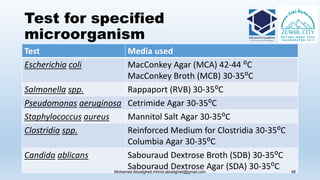
Test for specified
microorganism
Test Media used
Escherichia coli MacConkey Agar (MCA) 42-44 ⁰C
MacConkey Broth (MCB) 30-35⁰C
Salmonella spp. Rappaport (RVB) 30-35⁰C
Pseudomonas aeruginosa Cetrimide Agar 30-35⁰C
Staphylococcus aureus Mannitol Salt Agar 30-35⁰C
Clostridia spp. Reinforced Medium for Clostridia 30-35⁰C
Columbia Agar 30-35⁰C
Candida ablicans Sabouraud Dextrose Broth (SDB) 30-35⁰C
Sabouraud Dextrose Agar (SDA) 30-35⁰CMohamed Aboelgheit mhmd.aboelgheit@gmail.com 48
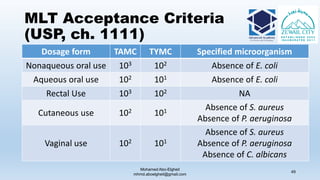
MLT Acceptance Criteria
(USP, ch. 1111)
Dosage form TAMC TYMC Specified microorganism
Nonaqueous oral use 103 102 Absence of E. coli
Aqueous oral use 102 101 Absence of E. coli
Rectal Use 103 102 NA
Cutaneous use 102 101 Absence of S. aureus
Absence of P. aeruginosa
Vaginal use 102 101
Absence of S. aureus
Absence of P. aeruginosa
Absence of C. albicans
Mohamed Abo-Elgheit
mhmd.aboelgheit@gmail.com
49
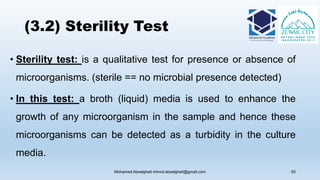
(3.2) Sterility Test
• Sterility test: is a qualitative test for presence or absence of
microorganisms. (sterile == no microbial presence detected)
• In this test: a broth (liquid) media is used to enhance the
growth of any microorganism in the sample and hence these
microorganisms can be detected as a turbidity in the culture
media.
Mohamed Aboelgheit mhmd.aboelgheit@gmail.com 50
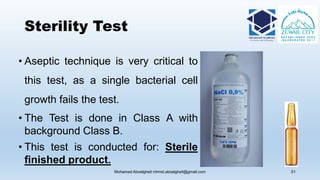
Sterility Test
• Aseptic technique is very critical to
this test, as a single bacterial cell
growth fails the test.
• The Test is done in Class A with
background Class B.
• This test is conducted for: Sterile
finished product.
Mohamed Aboelgheit mhmd.aboelgheit@gmail.com 51
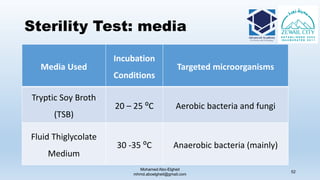
Sterility Test: media
Media Used
Incubation
Conditions
Targeted microorganisms
Tryptic Soy Broth
(TSB)
20 – 25 ⁰C Aerobic bacteria and fungi
Fluid Thiglycolate
Medium
30 -35 ⁰C Anaerobic bacteria (mainly)
Mohamed Abo-Elgheit
mhmd.aboelgheit@gmail.com
52
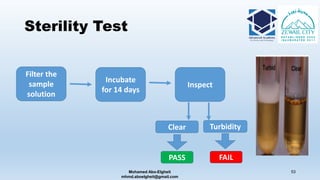
Sterility Test
Mohamed Abo-Elgheit
mhmd.aboelgheit@gmail.com
53
Filter the
sample
solution
Incubate
for 14 days
Inspect
Clear Turbidity
PASS FAIL
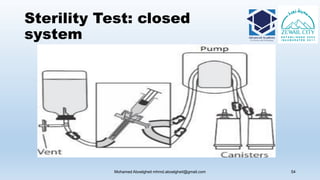
Sterility Test: closed
system
Mohamed Aboelgheit mhmd.aboelgheit@gmail.com 54
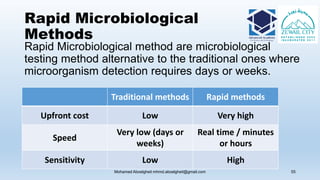
Rapid Microbiological
Methods
Rapid Microbiological method are microbiological
testing method alternative to the traditional ones where
microorganism detection requires days or weeks.
Mohamed Aboelgheit mhmd.aboelgheit@gmail.com 55
Traditional methods Rapid methods
Upfront cost Low Very high
Speed
Very low (days or
weeks)
Real time / minutes
or hours
Sensitivity Low High
(3.3)Bacterial Endotoxin
Test (BET)
• When gram negative bacteria are killed, the
disintegration of cell wall results in
lipopolysaccharides which cause fever if introduced
into the blood. This group of lipopolysaccharides
produced as byproduct of cell wall disintegration are
known as bacterial endotoxins.
Mohamed Aboelgheit mhmd.aboelgheit@gmail.com 56
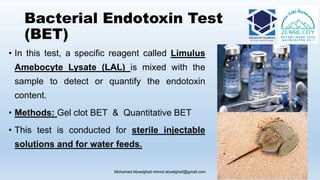
Bacterial Endotoxin Test
(BET)
• In this test, a specific reagent called Limulus
Amebocyte Lysate (LAL) is mixed with the
sample to detect or quantify the endotoxin
content.
• Methods: Gel clot BET & Quantitative BET
• This test is conducted for sterile injectable
solutions and for water feeds.
Mohamed Aboelgheit mhmd.aboelgheit@gmail.com 57
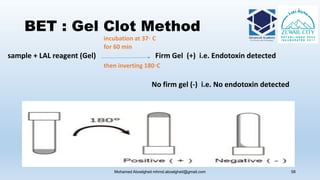
BET : Gel Clot Method
Mohamed Aboelgheit mhmd.aboelgheit@gmail.com 58
incubation at 37◦ C
for 60 min
sample + LAL reagent (Gel) Firm Gel (+) i.e. Endotoxin detected
then inverting 180◦C
No firm gel (-) i.e. No endotoxin detected
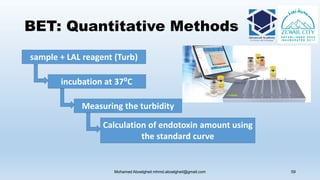
BET: Quantitative Methods
Mohamed Aboelgheit mhmd.aboelgheit@gmail.com 59
sample + LAL reagent (Turb)
incubation at 37⁰C
Measuring the turbidity
Calculation of endotoxin amount using
the standard curve
(4) Viable Environmental
Monitoring
Mohamed Aboelgheit mhmd.aboelgheit@gmail.com 60
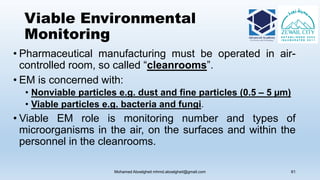
Viable Environmental
Monitoring
• Pharmaceutical manufacturing must be operated in air-
controlled room, so called “cleanrooms”.
• EM is concerned with:
• Nonviable particles e.g. dust and fine particles (0.5 – 5 µm)
• Viable particles e.g. bacteria and fungi.
• Viable EM role is monitoring number and types of
microorganisms in the air, on the surfaces and within the
personnel in the cleanrooms.
Mohamed Aboelgheit mhmd.aboelgheit@gmail.com 61
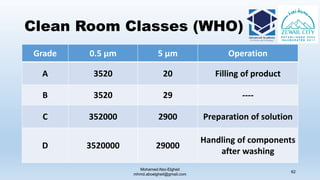
Clean Room Classes (WHO)
Grade 0.5 µm 5 µm Operation
A 3520 20 Filling of product
B 3520 29 ----
C 352000 2900 Preparation of solution
D 3520000 29000
Handling of components
after washing
Mohamed Abo-Elgheit
mhmd.aboelgheit@gmail.com
62
Viable Environmental
Monitoring
Mohamed Aboelgheit mhmd.aboelgheit@gmail.com 63
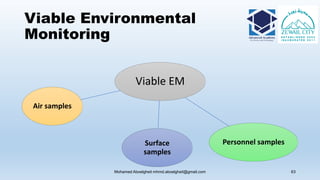
Viable EM
Air samples
Personnel samplesSurface
samples
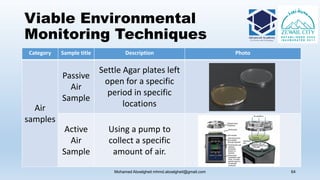
Viable Environmental
Monitoring Techniques
Category Sample title Description Photo
Air
samples
Passive
Air
Sample
Settle Agar plates left
open for a specific
period in specific
locations
Active
Air
Sample
Using a pump to
collect a specific
amount of air.
Mohamed Aboelgheit mhmd.aboelgheit@gmail.com 64
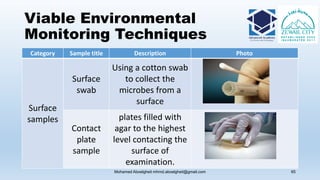
Viable Environmental
Monitoring Techniques
Category Sample title Description Photo
Surface
samples
Surface
swab
Using a cotton swab
to collect the
microbes from a
surface
Contact
plate
sample
plates filled with
agar to the highest
level contacting the
surface of
examination.
Mohamed Aboelgheit mhmd.aboelgheit@gmail.com 65
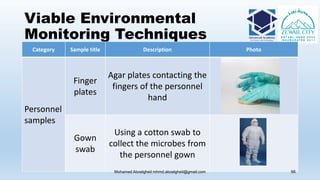
Viable Environmental
Monitoring Techniques
Category Sample title Description Photo
Personnel
samples
Finger
plates
Agar plates contacting the
fingers of the personnel
hand
Gown
swab
Using a cotton swab to
collect the microbes from
the personnel gown
Mohamed Aboelgheit mhmd.aboelgheit@gmail.com 66
PART 3: To be a
Microbiologist or Not to be
• to be a pharmaceutical microbiologist
• Pharmaceutical Microbiologist Career Path
Mohamed Aboelgheit mhmd.aboelgheit@gmail.com 67
To be a pharmaceutical
microbiologist
• You must have BSc. in Microbiology or in Pharmaceutical
Science or any relevant field.
• Love to work with microbes
• Detail-oriented
• Logical thinking
• Problem solving
Mohamed Aboelgheit mhmd.aboelgheit@gmail.com 68
Pharmaceutical
Microbiologist Career Path
• Lab Microbiologist
• Lab Supervisor/ Section Head/ Manager
• Microbiology Consultant
• Quality Control Manager
Mohamed Aboelgheit mhmd.aboelgheit@gmail.com 69
References
•WHO Technical report no. 961, 2011:
• Annex 2: WHO good practices for
pharmaceutical microbiology laboratories
• Annex 6: WHO good manufacturing
practices for sterile pharmaceutical
products
Mohamed Abo-Elgheit
mhmd.aboelgheit@gmail.com
70
References
• United States Pharmacopoeia USP :
• <1117> Microbiological Best Laboratory Practices
• <61> Microbiological Examination of Nonsterile
Products: Microbial Enumeration Tests
• <62> Microbiological Examination of Nonsterile
Products: Tests For Specified Microorganisms
• <71> Sterility Tests
• <1111> Microbiological Examination of Nonsterile
Products: Acceptance Criteria For Pharmaceutical
Preparations And Substances For Pharmaceutical Use
• <85> Bacterial Endotoxins Test
Mohamed Abo-Elgheit
mhmd.aboelgheit@gmail.com
71
Other references
• British Pharmacopoeia (BP)
• Japanese Pharmacopoeia (JP)
• European Pharmacopoeia (Ph.Eur.)
• ISO Standards
Mohamed Abo-Elgheit
mhmd.aboelgheit@gmail.com
72
Mohamed Aboelgheit mhmd.aboelgheit@gmail.com 73

Introduction to Pharmaceutical Microbiology

  • 1.
    Introduction to Pharmaceutical Microbiology MohamedAbo-Elgheit Pharmaceutical Microbiology Expert Quality System Supervisor in Egypt Otsuka Pharmaceuticals Microbiology Supervisor in Egypt Otsuka Pharmaceuticals BS. Microbiology, 2010 - TQM Diploma, 2018 Email: mhmd.aboelgheit@gmail.com
  • 2.
    Aim of thislecture • To understand the role of microbiology lab in the pharmaceutical industry. • To get an overview on what is conducted in the pharmaceutical microbiology lab • To be familiar with microbiological tests. • To get to know career path and qualifications of the pharmaceutical microbiologist. Mohamed Aboelgheit mhmd.aboelgheit@gmail.com 2
  • 3.
    Content • PART 1:Microbiology Lab • PART 2: Activities in Microbiology Lab • PART 3: To be a Microbiologist. Mohamed Aboelgheit mhmd.aboelgheit@gmail.com 3
  • 4.
    PART 1: MicrobiologyLab • What is Microbiology? • What is Pharmaceutical Microbiology? • Pharmaceutical Microbiology Lab • Aseptic Technique Mohamed Aboelgheit mhmd.aboelgheit@gmail.com 4
  • 5.
    (1) What isMicrobiology? • Microbiology is the study of microscopic microorganisms: • Bacteriology (the study of bacteria) • Mycology (the study of fungi) • Phycology (the study of algae) • Virology (the study of viruses) Mohamed Abo-Elgheit mhmd.aboelgheit@gmail.com 5
  • 6.
    Microbiology in Treeof Life Mohamed Abo-Elgheit mhmd.aboelgheit@gmail.com 6
  • 7.
    Bacteria • Bacteria are prokaryoticsingle cell organisms • Prokaryote == lack nucleus, no nuclear membrane around the chromosomal DNA. Mohamed Abo-Elgheit mhmd.aboelgheit@gmail.com 7
  • 8.
    Bacteria: Gram Stainand Cell Wall • Bacteria are 2 groups: • Gram +ve Bacteria: • High peptidoglycan in cell wall • Retain the stain • Gram –ve Bacteria: • Low peptidoglycan • High lipopolysaccharide in cell wall • Don’t retain the stain Mohamed Abo-Elgheit mhmd.aboelgheit@gmail.com 8
  • 9.
    Bacteria: Gram Stainand Cell Wall Mohamed Abo-Elgheit mhmd.aboelgheit@gmail.com 9 Staphylococcus auresus E. coli
  • 10.
    Bacteria: Aerobic vs Anaerobic •Aerobic bacteria utilize oxygen to make energy. • Anaerobic bacteria don’t require oxygen to make their energy so they can survive without oxgen. • Some anaerobic bacteria cannot survive in presence of oxygen, also called “obligate anaerobic bacteria” Mohamed Abo-Elgheit mhmd.aboelgheit@gmail.com 10
  • 11.
    Fungi • Fungi area group of eukaryotic living organisms that include, but not limited to, yeasts and molds. • Eukaryote == has a true nucleus • Yeasts: single cell eukaryotic organisms • Molds: multicellular filamentous eukaryotic organism. Mohamed Abo-Elgheit mhmd.aboelgheit@gmail.com 11
  • 12.
    Fungi: yeast andmolds Mohamed Abo-Elgheit mhmd.aboelgheit@gmail.com 12 Candidia albicans Rhizopus sp.
  • 13.
    Normal Flora • NormalFlora is present in: • Skin e.g. Staph. aureus • Upper respiratory tract e.g. Staph. aureus • Oral Cavity e.g. Viridans streptococcus • Intestine e.g E. coli • Vaginal Tract e.g. Lactobacillus spp Mohamed Abo-Elgheit mhmd.aboelgheit@gmail.com 13
  • 14.
    (2) What isPharmaceutical Microbiology? • Microbiology is the biology branch involved with the study of microscopic organisms e.g. bacteria, fungi, algae, viruses. • Pharmaceutical Microbiology is an applied sub-branch of microbiology concerned with the study of microorganisms associated with the manufacture of pharmaceuticals. Biology Microbiology Pharmaceutical microbiology Mohamed Aboelgheit mhmd.aboelgheit@gmail.com 14
  • 15.
    Pharmaceutical Microbiology Scope • Studyof microorganisms associated with the industry: • control and monitor microorganism through the process to ensure the safe manufacturing of pharmaceutical products: • Microbiological Analysis Tests • Environmental monitoring Mohamed Aboelgheit mhmd.aboelgheit@gmail.com 15
  • 16.
    Flowchart of Pharmaceutical Manufacturing MohamedAboelgheit mhmd.aboelgheit@gmail.com 16 Aseptic Environment control Environment control
  • 17.
    (3) Microbiology Lab Microbiologylab Clean Areas Washing Media Preparation Sterilization Testing Areas MLT area Sterility Area BET Area Live Culture Areas Growth Promotion Strain maintenance Microbial Identification Decontamination Area Mohamed Aboelgheit mhmd.aboelgheit@gmail.com 17
  • 18.
    Microbiology lab Equipment •Glassware • Weighing balance • pH meter • Filtration System • Oven Mohamed Aboelgheit mhmd.aboelgheit@gmail.com 18 • Autoclave • Laminar Air Flow • Safety Cabinet • Incubator
  • 19.
    Autoclave (steam sterilization) Mohamed Aboelgheitmhmd.aboelgheit@gmail.com 19 Steam Sterilization • Media • Glassware • Gowns Decontamination • Incubated Cultures • Contaminated items
  • 20.
  • 21.
    Laminar Air Flow(LAF) Mohamed Aboelgheit mhmd.aboelgheit@gmail.com 21
  • 22.
    Laminar Air Flow:air direction Mohamed Abo-Elgheit mhmd.aboelgheit@gmail.com 22
  • 23.
    Microbiological Incubators Mohamed Aboelgheitmhmd.aboelgheit@gmail.com 23 Bench Incubator Walk-in Incubator
  • 24.
    Good Manufacturing Practices (GMP) •Good Manufacturing Practices (GMP) are a set of practices which ensures that pharmaceutical products are consistently produced and controlled according to the quality standards (WHO). • Areas under GMP are: facilities, equipment, production, process control, etc. Mohamed Abo-Elgheit mhmd.aboelgheit@gmail.com 24
  • 25.
    Good Laboratory Practices (GLP) •Good Laboratory Practices (GMP) are a set of practices which ensures reliability and reproducibility in the lab. • Areas under GLP: testing facilities, personnel training, equipment, records, reports, etc. Mohamed Abo-Elgheit mhmd.aboelgheit@gmail.com 25
  • 26.
    GLP in MicrobiologyLab • Personnel: trained, qualified: • Aseptic technique • colony counting • plate pouring • media preparation, etc. Mohamed Abo-Elgheit mhmd.aboelgheit@gmail.com 26
  • 27.
    GLP in MicrobiologyLab • Lab Environment: • Separation of clean and dirty activities • Dedicated spaces for samples, media, reference microorganisms. • Disinfection and sterilization can be effectively done Mohamed Abo-Elgheit mhmd.aboelgheit@gmail.com 27
  • 28.
    (4) Aseptic Technique •Bacteria are everywhere. It is important to take measures to avoid contaminating your work with undesired bacteria. Disinfection of working areas, and hand sanitation Use of flames to kill bacteria that may enter vessels openings. Mohamed Aboelgheit mhmd.aboelgheit@gmail.com 28
  • 29.
    Aseptic Technique Mohamed Aboelgheitmhmd.aboelgheit@gmail.com 29
  • 30.
    PART 2: Activitiesin Microbiology lab • Media Preparation • Media Growth Promotion • Microbiological Analysis Tests: • Microbial Limit Tests • Sterility Test • Bacterial Endotoxin Test • Viable Environmental Monitoring • Rapid Microbiological Methods Mohamed Aboelgheit mhmd.aboelgheit@gmail.com 30
  • 31.
    (1) Media Preparation MohamedAbo-Elgheit mhmd.aboelgheit@gmail.com 31
  • 32.
    Media Preparation Mohamed Aboelgheitmhmd.aboelgheit@gmail.com 32
  • 33.
  • 34.
  • 35.
    Agar Media Mohamed Abo-Elgheit mhmd.aboelgheit@gmail.com 35 •Solid media usually poured in plates • Used for: enumeration, isolation and purification • e.g. TSA, Mac. Agar, SDA, R2A, etc
  • 36.
    Broth Media • Liquidmedia usually dispensed in tubes, beakers, etc. • Used for: enrichment • e.g. TSB, FTM, Mac. broth,..etc. Mohamed Abo-Elgheit mhmd.aboelgheit@gmail.com 36
  • 37.
    (2) Growth PromotionTest • Growth promotion test is a QC test of prepared media to ensure the media are able to enhance the microbial growth as intended. Mohamed Aboelgheit mhmd.aboelgheit@gmail.com 37 Inoculation (> 100 CFU) Incubation Inspection Growth 50- 200% Growth <50% or >200% PASS FAIL
  • 38.
    Reference microorganism in GPTfor TSA Reference Microorganism Incubation period and conditions Staphylococcus aureus ATCC 6538 30°–35° ≤3 days Pseudomonas aeruginosa such ATCC 9027 30°–35° ≤3 days Bacillus subtilis ATCC 6633 30°–35° ≤3 days Candida albicans ATCC 10231 30°–35° ≤5 days Aspergillus brasiliensis ATCC 16404 30°–35° ≤5 days Mohamed Abo-Elgheit mhmd.aboelgheit@gmail.com 38
  • 39.
    (3) Microbiological Tests •Microbial Limit Test • Enumeration test • Test for specified microorganisms • Sterility Test • Bacterial Endotoxin Test Mohamed Abo-Elgheit mhmd.aboelgheit@gmail.com 39
  • 40.
    (3.1) Microbial LimitTest MLT Microbial Enumeration Test Membrane Filtration Plate Count Method Test for specified microorganism Determination for presence of absence of objectionable microorganism Mohamed Abo-Elgheit mhmd.aboelgheit@gmail.com 40
  • 41.
    (3.1.1) Microbial Enumeration Test(bioburden) • In this test, a general solid (agar) media is used to enhance the growth of all microorganisms in a sample and hence these microorganisms can be enumerated. • This test is conducted for: • Non-sterile finished product • Water Samples • Intermediate stages of sterile products Mohamed Aboelgheit mhmd.aboelgheit@gmail.com 41
  • 42.
    Microbial Enumeration Test: MembraneFiltration Mohamed Aboelgheit mhmd.aboelgheit@gmail.com 42
  • 43.
    Microbial Enumeration Test: PlateCount Methods Mohamed Aboelgheit mhmd.aboelgheit@gmail.com 43 Sample
  • 44.
    Membrane Filtration VSPour plate: think microbiologically! Membrane Filtration Pour Plate Sample size Whole sample 0.1 – 1.0 mL Accuracy Higher Lower Sample form Soluble samples Samples with low bioburden Soluble or insoluble Samples with high bioburden Tools Membrane filtration system MFS is not required Mohamed Aboelgheit mhmd.aboelgheit@gmail.com 44
  • 45.
    Microbial Enumeration Test: Media MohamedAbo-Elgheit mhmd.aboelgheit@gmail.com 45 Purpose Media Total Aerobic Microbial Count (TAMC) TSA (tryptic soy Agar) R2A Total Yeast and Mold Count (TYMC) SDA (Sabouraud Dextrose Agar)
  • 46.
    (3.1.2)Tests for Specified Microorganisms •In such test, a solid media is used to enhance the growth of a specified microorganism e.g. test for E. coli • This test is conducted for: • Non-sterile finished product • Water Samples Mohamed Abo-Elgheit mhmd.aboelgheit@gmail.com 46
  • 47.
    Example: Tests forE. coli Mohamed Abo-Elgheit mhmd.aboelgheit@gmail.com 47 90 ml diluent + 10 gram sample 1 TSB 10 ml (= 1 g sample) Incubation 2 30 – 35ᴼC 18- 24 hrs. 4 1 ml (Mac.Broth) Incubation 42 – 44ᴼC 24- 48 hrs. 5 Streak Incubation 30 – 35ᴼC 18- 24 hrs. 6 7 3
  • 48.
    Test for specified microorganism TestMedia used Escherichia coli MacConkey Agar (MCA) 42-44 ⁰C MacConkey Broth (MCB) 30-35⁰C Salmonella spp. Rappaport (RVB) 30-35⁰C Pseudomonas aeruginosa Cetrimide Agar 30-35⁰C Staphylococcus aureus Mannitol Salt Agar 30-35⁰C Clostridia spp. Reinforced Medium for Clostridia 30-35⁰C Columbia Agar 30-35⁰C Candida ablicans Sabouraud Dextrose Broth (SDB) 30-35⁰C Sabouraud Dextrose Agar (SDA) 30-35⁰CMohamed Aboelgheit mhmd.aboelgheit@gmail.com 48
  • 49.
    MLT Acceptance Criteria (USP,ch. 1111) Dosage form TAMC TYMC Specified microorganism Nonaqueous oral use 103 102 Absence of E. coli Aqueous oral use 102 101 Absence of E. coli Rectal Use 103 102 NA Cutaneous use 102 101 Absence of S. aureus Absence of P. aeruginosa Vaginal use 102 101 Absence of S. aureus Absence of P. aeruginosa Absence of C. albicans Mohamed Abo-Elgheit mhmd.aboelgheit@gmail.com 49
  • 50.
    (3.2) Sterility Test •Sterility test: is a qualitative test for presence or absence of microorganisms. (sterile == no microbial presence detected) • In this test: a broth (liquid) media is used to enhance the growth of any microorganism in the sample and hence these microorganisms can be detected as a turbidity in the culture media. Mohamed Aboelgheit mhmd.aboelgheit@gmail.com 50
  • 51.
    Sterility Test • Aseptictechnique is very critical to this test, as a single bacterial cell growth fails the test. • The Test is done in Class A with background Class B. • This test is conducted for: Sterile finished product. Mohamed Aboelgheit mhmd.aboelgheit@gmail.com 51
  • 52.
    Sterility Test: media MediaUsed Incubation Conditions Targeted microorganisms Tryptic Soy Broth (TSB) 20 – 25 ⁰C Aerobic bacteria and fungi Fluid Thiglycolate Medium 30 -35 ⁰C Anaerobic bacteria (mainly) Mohamed Abo-Elgheit mhmd.aboelgheit@gmail.com 52
  • 53.
    Sterility Test Mohamed Abo-Elgheit mhmd.aboelgheit@gmail.com 53 Filterthe sample solution Incubate for 14 days Inspect Clear Turbidity PASS FAIL
  • 54.
    Sterility Test: closed system MohamedAboelgheit mhmd.aboelgheit@gmail.com 54
  • 55.
    Rapid Microbiological Methods Rapid Microbiologicalmethod are microbiological testing method alternative to the traditional ones where microorganism detection requires days or weeks. Mohamed Aboelgheit mhmd.aboelgheit@gmail.com 55 Traditional methods Rapid methods Upfront cost Low Very high Speed Very low (days or weeks) Real time / minutes or hours Sensitivity Low High
  • 56.
    (3.3)Bacterial Endotoxin Test (BET) •When gram negative bacteria are killed, the disintegration of cell wall results in lipopolysaccharides which cause fever if introduced into the blood. This group of lipopolysaccharides produced as byproduct of cell wall disintegration are known as bacterial endotoxins. Mohamed Aboelgheit mhmd.aboelgheit@gmail.com 56
  • 57.
    Bacterial Endotoxin Test (BET) •In this test, a specific reagent called Limulus Amebocyte Lysate (LAL) is mixed with the sample to detect or quantify the endotoxin content. • Methods: Gel clot BET & Quantitative BET • This test is conducted for sterile injectable solutions and for water feeds. Mohamed Aboelgheit mhmd.aboelgheit@gmail.com 57
  • 58.
    BET : GelClot Method Mohamed Aboelgheit mhmd.aboelgheit@gmail.com 58 incubation at 37◦ C for 60 min sample + LAL reagent (Gel) Firm Gel (+) i.e. Endotoxin detected then inverting 180◦C No firm gel (-) i.e. No endotoxin detected
  • 59.
    BET: Quantitative Methods MohamedAboelgheit mhmd.aboelgheit@gmail.com 59 sample + LAL reagent (Turb) incubation at 37⁰C Measuring the turbidity Calculation of endotoxin amount using the standard curve
  • 60.
    (4) Viable Environmental Monitoring MohamedAboelgheit mhmd.aboelgheit@gmail.com 60
  • 61.
    Viable Environmental Monitoring • Pharmaceuticalmanufacturing must be operated in air- controlled room, so called “cleanrooms”. • EM is concerned with: • Nonviable particles e.g. dust and fine particles (0.5 – 5 µm) • Viable particles e.g. bacteria and fungi. • Viable EM role is monitoring number and types of microorganisms in the air, on the surfaces and within the personnel in the cleanrooms. Mohamed Aboelgheit mhmd.aboelgheit@gmail.com 61
  • 62.
    Clean Room Classes(WHO) Grade 0.5 µm 5 µm Operation A 3520 20 Filling of product B 3520 29 ---- C 352000 2900 Preparation of solution D 3520000 29000 Handling of components after washing Mohamed Abo-Elgheit mhmd.aboelgheit@gmail.com 62
  • 63.
    Viable Environmental Monitoring Mohamed Aboelgheitmhmd.aboelgheit@gmail.com 63 Viable EM Air samples Personnel samplesSurface samples
  • 64.
    Viable Environmental Monitoring Techniques CategorySample title Description Photo Air samples Passive Air Sample Settle Agar plates left open for a specific period in specific locations Active Air Sample Using a pump to collect a specific amount of air. Mohamed Aboelgheit mhmd.aboelgheit@gmail.com 64
  • 65.
    Viable Environmental Monitoring Techniques CategorySample title Description Photo Surface samples Surface swab Using a cotton swab to collect the microbes from a surface Contact plate sample plates filled with agar to the highest level contacting the surface of examination. Mohamed Aboelgheit mhmd.aboelgheit@gmail.com 65
  • 66.
    Viable Environmental Monitoring Techniques CategorySample title Description Photo Personnel samples Finger plates Agar plates contacting the fingers of the personnel hand Gown swab Using a cotton swab to collect the microbes from the personnel gown Mohamed Aboelgheit mhmd.aboelgheit@gmail.com 66
  • 67.
    PART 3: Tobe a Microbiologist or Not to be • to be a pharmaceutical microbiologist • Pharmaceutical Microbiologist Career Path Mohamed Aboelgheit mhmd.aboelgheit@gmail.com 67
  • 68.
    To be apharmaceutical microbiologist • You must have BSc. in Microbiology or in Pharmaceutical Science or any relevant field. • Love to work with microbes • Detail-oriented • Logical thinking • Problem solving Mohamed Aboelgheit mhmd.aboelgheit@gmail.com 68
  • 69.
    Pharmaceutical Microbiologist Career Path •Lab Microbiologist • Lab Supervisor/ Section Head/ Manager • Microbiology Consultant • Quality Control Manager Mohamed Aboelgheit mhmd.aboelgheit@gmail.com 69
  • 70.
    References •WHO Technical reportno. 961, 2011: • Annex 2: WHO good practices for pharmaceutical microbiology laboratories • Annex 6: WHO good manufacturing practices for sterile pharmaceutical products Mohamed Abo-Elgheit mhmd.aboelgheit@gmail.com 70
  • 71.
    References • United StatesPharmacopoeia USP : • <1117> Microbiological Best Laboratory Practices • <61> Microbiological Examination of Nonsterile Products: Microbial Enumeration Tests • <62> Microbiological Examination of Nonsterile Products: Tests For Specified Microorganisms • <71> Sterility Tests • <1111> Microbiological Examination of Nonsterile Products: Acceptance Criteria For Pharmaceutical Preparations And Substances For Pharmaceutical Use • <85> Bacterial Endotoxins Test Mohamed Abo-Elgheit mhmd.aboelgheit@gmail.com 71
  • 72.
    Other references • BritishPharmacopoeia (BP) • Japanese Pharmacopoeia (JP) • European Pharmacopoeia (Ph.Eur.) • ISO Standards Mohamed Abo-Elgheit mhmd.aboelgheit@gmail.com 72
  • 73.