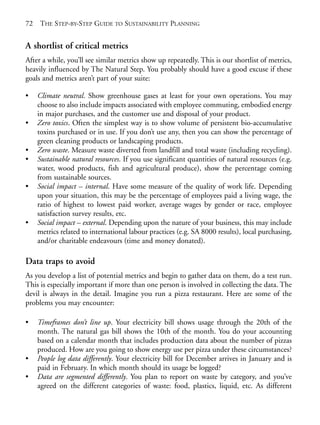
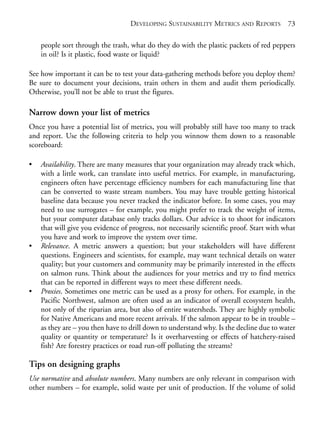
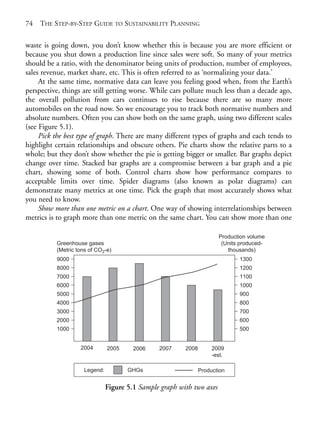
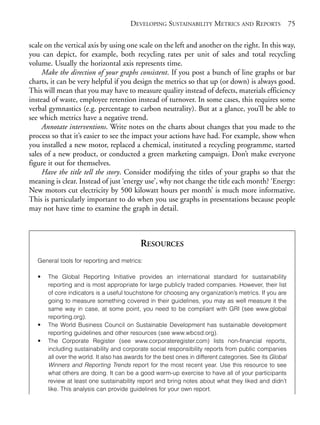
Prelims.qxd   10/1/2008   7:33 PM   Page i


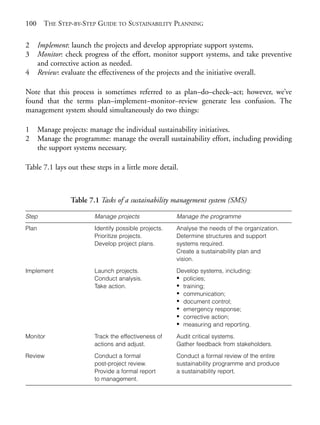
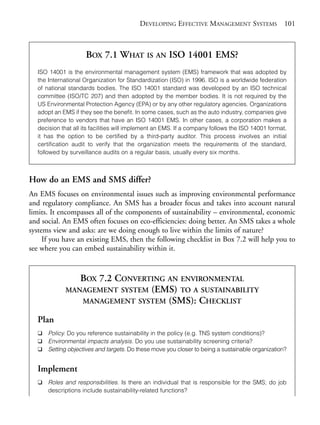
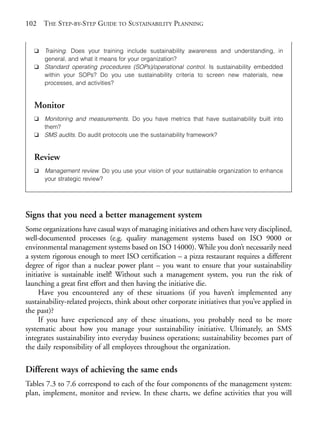
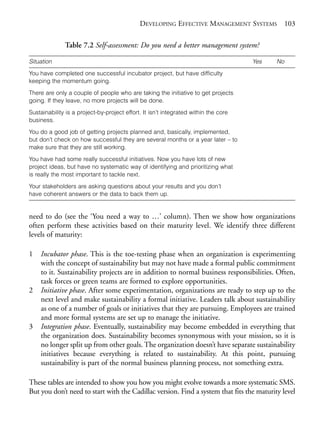
                 The Step-by-Step Guide to Sustainability Planning
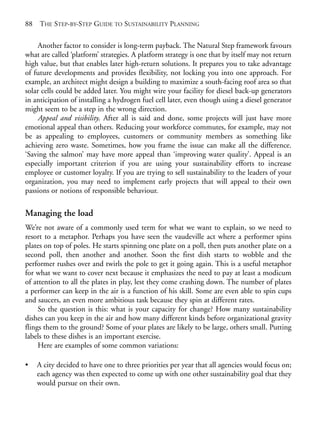
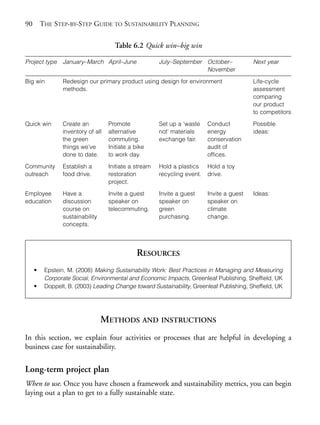
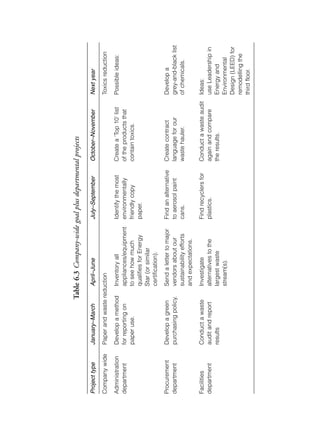
Prelims.qxd   10/1/2008   7:33 PM   Page ii
Prelims.qxd   10/1/2008   7:33 PM   Page iii


                      The Step-by-Step Guide
                     to Sustainability Planning
                 How to Create and Implement Sustainability Plans
                        in Any Business or Organization


                           Darcy Hitchcock and Marsha Willard
                                     with foreword by Alan AtKisson


                                       publishing for a sustainable future


                                               London • Sterling, VA
Prelims.qxd   10/1/2008      7:33 PM     Page iv


       First published by Earthscan in the UK and USA in 2008

       Copyright © Axis Performance Advisors, Inc., 2008

       All rights reserved

       ISBN: 978-1-84407-616-1

       Typeset by Domex e-Data Pvt. Ltd, India
       Printed and bound in the UK by TJ International, Padstow
       Cover design by Yvonne Booth

       For a full list of publications please contact:

       Earthscan
       Dunstan House, 14a St Cross Street
       London, EC1N 8XA, UK
       Tel: +44 (0)20 7841 1930
       Fax: +44 (0)20 7242 1474
       Email: earthinfo@earthscan.co.uk
       Web: www.earthscan.co.uk

       22883 Quicksilver Drive, Sterling, VA 20166-2012, USA

       Earthscan publishes in association with the International Institute for Environment and Development

       A catalogue record for this book is available from the British Library

       Library of Congress Cataloging-in-Publication Data
       Hitchcock, Darcy E.
        The step-by-step guide to sustainability planning: how to create and implement sustainability
       plans in any business or organization / Darcy Hitchcock and Marsha Willard ; with foreword by
       Alan AtKisson.
            p. cm.
         Includes bibliographical references.
         ISBN 978-1-84407-616-1 (pbk.)
        1. Management – Environmental aspects. 2. Sustainable development – Planning
        3. Business planning I. Willard, Marsha L. II. Title.
         HD30.255.H584 2008
         658.4’095–dc22
                                                        2008033048

       The paper used for this book is FSC certified. FSC
       (the Forest Stewardship Council) is an international
       network to promote responsible management of
       the world’s forests.
Prelims.qxd    10/1/2008    7:33 PM   Page v


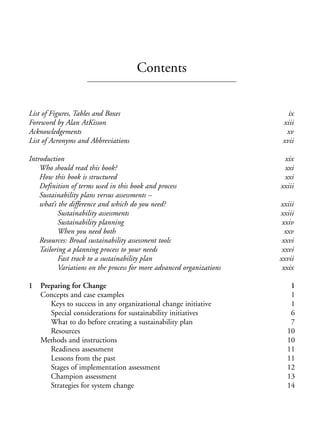
                                                    Contents


              List of Figures, Tables and Boxes                                         ix
              Foreword by Alan AtKisson                                               xiii
              Acknowledgements                                                         xv
              List of Acronyms and Abbreviations                                      xvii

              Introduction                                                            xix
                  Who should read this book?                                          xxi
                  How this book is structured                                         xxi
                  Definition of terms used in this book and process                  xxiii
                  Sustainability plans versus assessments –
                  what’s the difference and which do you need?                       xxiii
                         Sustainability assessments                                  xxiii
                         Sustainability planning                                      xxiv
                         When you need both                                            xxv
                  Resources: Broad sustainability assessment tools                    xxvi
                  Tailoring a planning process to your needs                          xxvi
                         Fast track to a sustainability plan                         xxvii
                         Variations on the process for more advanced organizations    xxix

              1   Preparing for Change                                                  1
                  Concepts and case examples                                            1
                     Keys to success in any organizational change initiative            1
                     Special considerations for sustainability initiatives              6
                     What to do before creating a sustainability plan                   7
                     Resources                                                         10
                  Methods and instructions                                             10
                     Readiness assessment                                              11
                     Lessons from the past                                             11
                     Stages of implementation assessment                               12
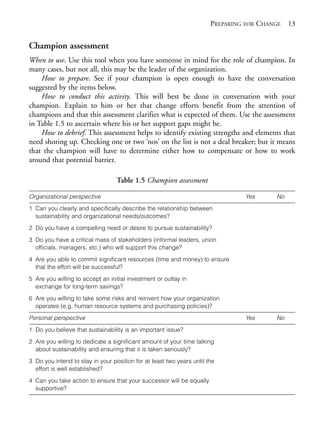
                     Champion assessment                                               13
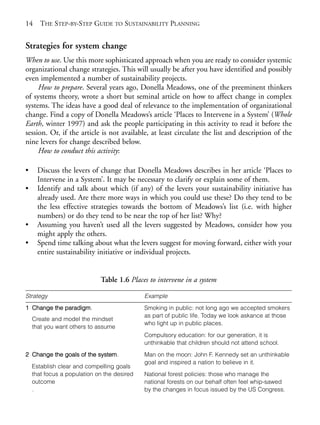
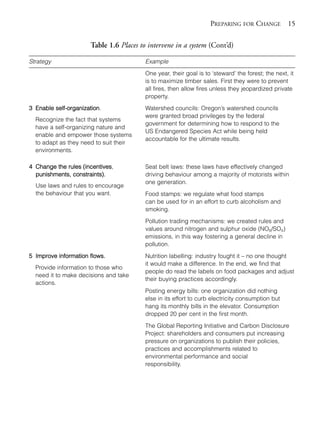
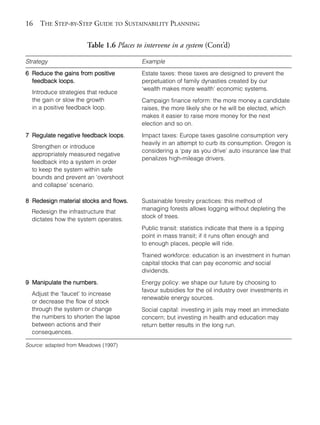
                     Strategies for system change                                      14
Prelims.qxd   10/1/2008   7:33 PM   Page vi


       vi THE STEP-BY-STEP GUIDE TO SUSTAINABILITY PLANNING

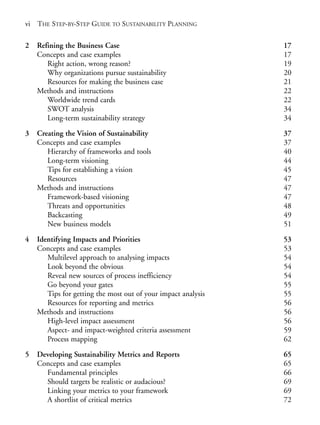
       2   Refining the Business Case                                 17
           Concepts and case examples                                 17
              Right action, wrong reason?                             19
              Why organizations pursue sustainability                 20
              Resources for making the business case                  21
           Methods and instructions                                   22
              Worldwide trend cards                                   22
              SWOT analysis                                           34
              Long-term sustainability strategy                       34

       3   Creating the Vision of Sustainability                      37
           Concepts and case examples                                 37
              Hierarchy of frameworks and tools                       40
              Long-term visioning                                     44
              Tips for establishing a vision                          45
              Resources                                               47
           Methods and instructions                                   47
              Framework-based visioning                               47
              Threats and opportunities                               48
              Backcasting                                             49
              New business models                                     51

       4   Identifying Impacts and Priorities                         53
           Concepts and case examples                                 53
              Multilevel approach to analysing impacts                54
              Look beyond the obvious                                 54
              Reveal new sources of process inefficiency              54
              Go beyond your gates                                    55
              Tips for getting the most out of your impact analysis   55
              Resources for reporting and metrics                     56
           Methods and instructions                                   56
              High-level impact assessment                            56
              Aspect- and impact-weighted criteria assessment         59
              Process mapping                                         62

       5   Developing Sustainability Metrics and Reports              65
           Concepts and case examples                                 65
             Fundamental principles                                   66
             Should targets be realistic or audacious?                69
             Linking your metrics to your framework                   69
             A shortlist of critical metrics                          72
Prelims.qxd   10/1/2008    7:33 PM   Page vii


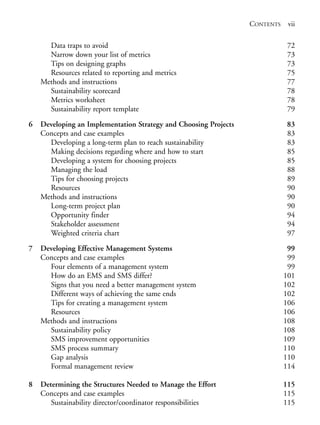
                                                                                CONTENTS    vii

                    Data traps to avoid                                                     72
                    Narrow down your list of metrics                                        73
                    Tips on designing graphs                                                73
                    Resources related to reporting and metrics                              75
                  Methods and instructions                                                  77
                    Sustainability scorecard                                                78
                    Metrics worksheet                                                       78
                    Sustainability report template                                          79

              6   Developing an Implementation Strategy and Choosing Projects              83
                  Concepts and case examples                                               83
                    Developing a long-term plan to reach sustainability                    83
                    Making decisions regarding where and how to start                      85
                    Developing a system for choosing projects                              85
                    Managing the load                                                      88
                    Tips for choosing projects                                             89
                    Resources                                                              90
                  Methods and instructions                                                 90
                    Long-term project plan                                                 90
                    Opportunity finder                                                     94
                    Stakeholder assessment                                                 94
                    Weighted criteria chart                                                97

              7   Developing Effective Management Systems                                   99
                  Concepts and case examples                                                99
                    Four elements of a management system                                    99
                    How do an EMS and SMS differ?                                          101
                    Signs that you need a better management system                         102
                    Different ways of achieving the same ends                              102
                    Tips for creating a management system                                  106
                    Resources                                                              106
                  Methods and instructions                                                 108
                    Sustainability policy                                                  108
                    SMS improvement opportunities                                          109
                    SMS process summary                                                    110
                    Gap analysis                                                           110
                    Formal management review                                               114

              8   Determining the Structures Needed to Manage the Effort                   115
                  Concepts and case examples                                               115
                     Sustainability director/coordinator responsibilities                  115
Prelims.qxd    10/1/2008   7:33 PM   Page viii


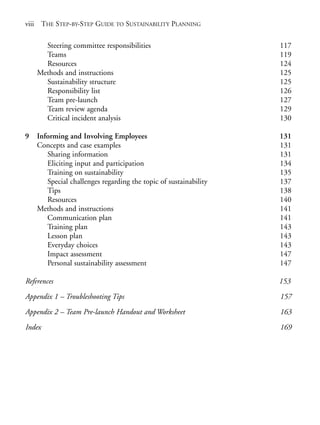
       viii THE STEP-BY-STEP GUIDE TO SUSTAINABILITY PLANNING

             Steering committee responsibilities                         117
             Teams                                                       119
             Resources                                                   124
           Methods and instructions                                      125
             Sustainability structure                                    125
             Responsibility list                                         126
             Team pre-launch                                             127
             Team review agenda                                          129
             Critical incident analysis                                  130

       9   Informing and Involving Employees                             131
           Concepts and case examples                                    131
              Sharing information                                        131
              Eliciting input and participation                          134
              Training on sustainability                                 135
              Special challenges regarding the topic of sustainability   137
              Tips                                                       138
              Resources                                                  140
           Methods and instructions                                      141
              Communication plan                                         141
              Training plan                                              143
              Lesson plan                                                143
              Everyday choices                                           143
              Impact assessment                                          147
              Personal sustainability assessment                         147

       References                                                        153

       Appendix 1 – Troubleshooting Tips                                 157

       Appendix 2 – Team Pre-launch Handout and Worksheet                163

       Index                                                             169
Prelims.qxd    10/1/2008   7:33 PM   Page ix


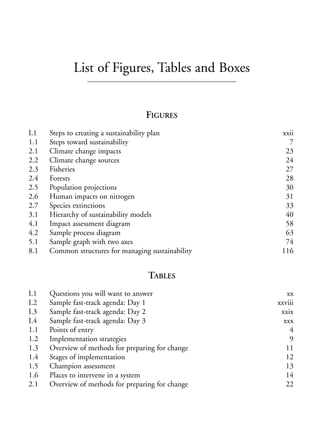
                            List of Figures, Tables and Boxes


                                                  FIGURES
              I.1   Steps to creating a sustainability plan          xxii
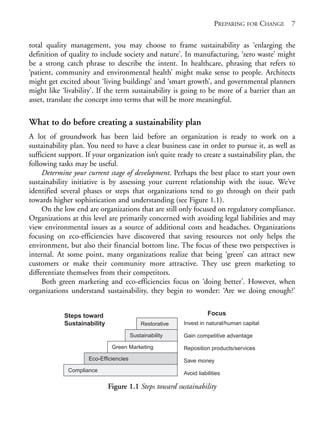
              1.1   Steps toward sustainability                        7
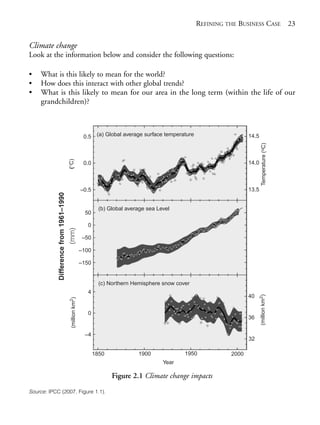
              2.1   Climate change impacts                            23
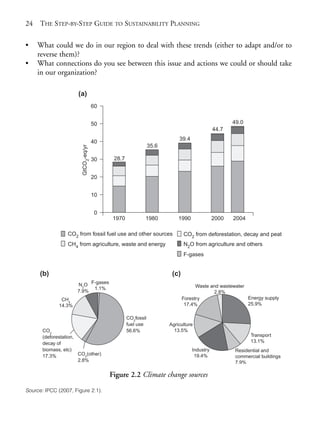
              2.2   Climate change sources                            24
              2.3   Fisheries                                         27
              2.4   Forests                                           28
              2.5   Population projections                            30
              2.6   Human impacts on nitrogen                         31
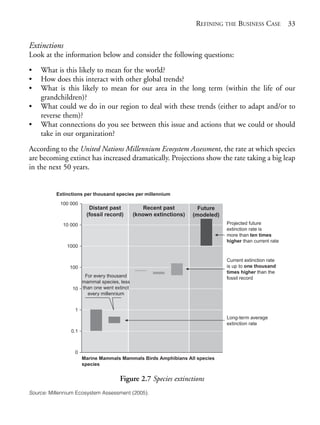
              2.7   Species extinctions                               33
              3.1   Hierarchy of sustainability models                40
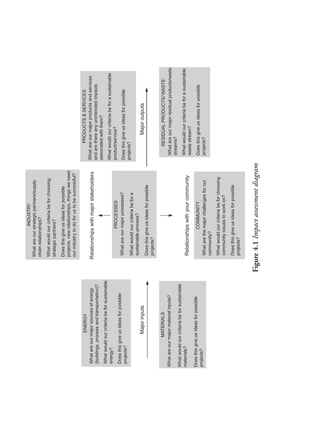
              4.1   Impact assessment diagram                         58
              4.2   Sample process diagram                            63
              5.1   Sample graph with two axes                        74
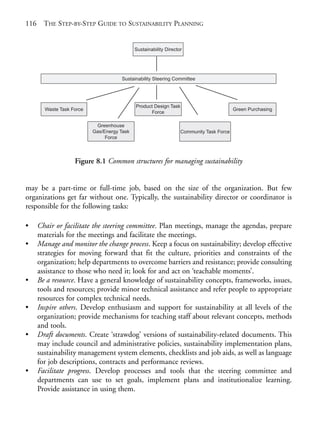
              8.1   Common structures for managing sustainability    116


                                                   TABLES
              I.1   Questions you will want to answer                  xx
              I.2   Sample fast-track agenda: Day 1                 xxviii
              I.3   Sample fast-track agenda: Day 2                  xxix
              I.4   Sample fast-track agenda: Day 3                   xxx
              1.1   Points of entry                                     4
              1.2   Implementation strategies                           9
              1.3   Overview of methods for preparing for change       11
              1.4   Stages of implementation                           12
              1.5   Champion assessment                                13
              1.6   Places to intervene in a system                    14
              2.1   Overview of methods for preparing for change       22
Prelims.qxd   10/1/2008   7:33 PM   Page x


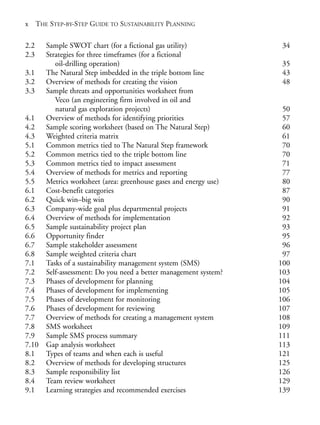
       x THE STEP-BY-STEP GUIDE TO SUSTAINABILITY PLANNING

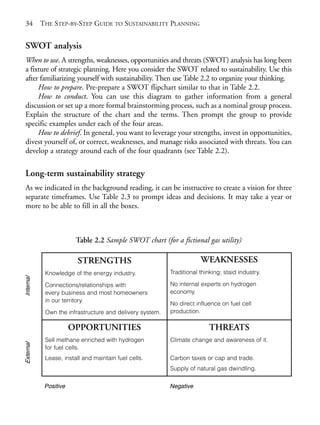
       2.2  Sample SWOT chart (for a fictional gas utility)             34
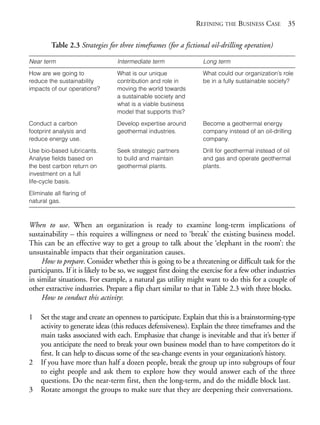
       2.3  Strategies for three timeframes (for a fictional
               oil-drilling operation)                                 35
       3.1 The Natural Step imbedded in the triple bottom line         43
       3.2 Overview of methods for creating the vision                 48
       3.3 Sample threats and opportunities worksheet from
               Veco (an engineering firm involved in oil and
               natural gas exploration projects)                        50
       4.1 Overview of methods for identifying priorities               57
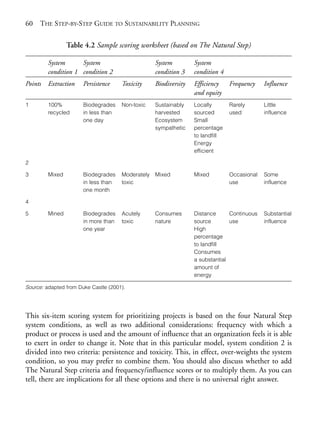
       4.2 Sample scoring worksheet (based on The Natural Step)         60
       4.3 Weighted criteria matrix                                     61
       5.1 Common metrics tied to The Natural Step framework            70
       5.2 Common metrics tied to the triple bottom line                70
       5.3 Common metrics tied to impact assessment                     71
       5.4 Overview of methods for metrics and reporting                77
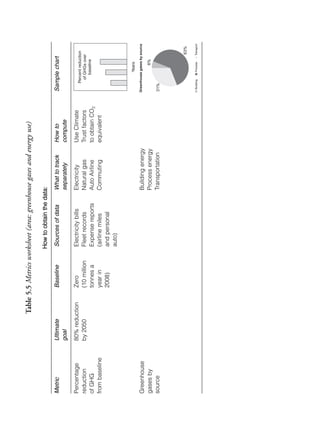
       5.5 Metrics worksheet (area: greenhouse gases and energy use)    80
       6.1 Cost-benefit categories                                      87
       6.2 Quick win–big win                                            90
       6.3 Company-wide goal plus departmental projects                 91
       6.4 Overview of methods for implementation                       92
       6.5 Sample sustainability project plan                           93
       6.6 Opportunity finder                                           95
       6.7 Sample stakeholder assessment                                96
       6.8 Sample weighted criteria chart                               97
       7.1 Tasks of a sustainability management system (SMS)           100
       7.2 Self-assessment: Do you need a better management system?    103
       7.3 Phases of development for planning                          104
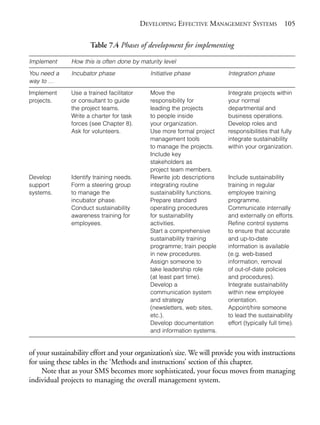
       7.4 Phases of development for implementing                      105
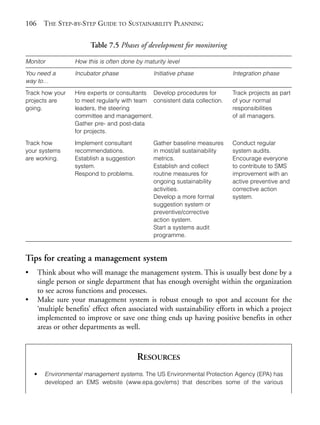
       7.5 Phases of development for monitoring                        106
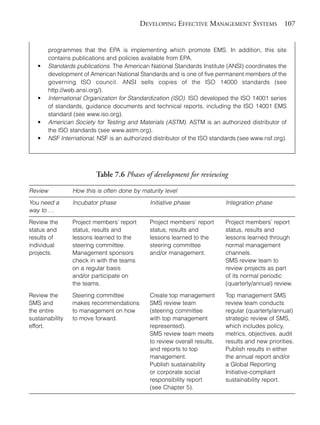
       7.6 Phases of development for reviewing                         107
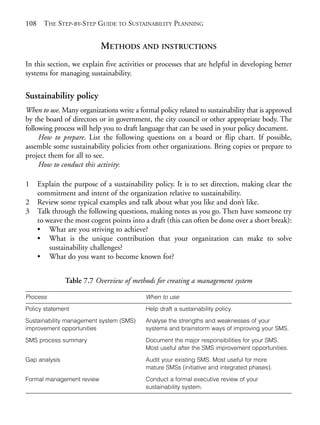
       7.7 Overview of methods for creating a management system        108
       7.8 SMS worksheet                                               109
       7.9 Sample SMS process summary                                  111
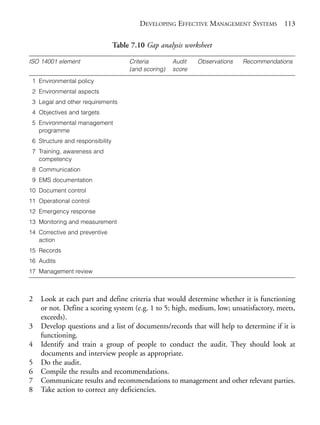
       7.10 Gap analysis worksheet                                     113
       8.1 Types of teams and when each is useful                      121
       8.2 Overview of methods for developing structures               125
       8.3 Sample responsibility list                                  126
       8.4 Team review worksheet                                       129
       9.1 Learning strategies and recommended exercises               139
Prelims.qxd    10/1/2008   7:33 PM   Page xi


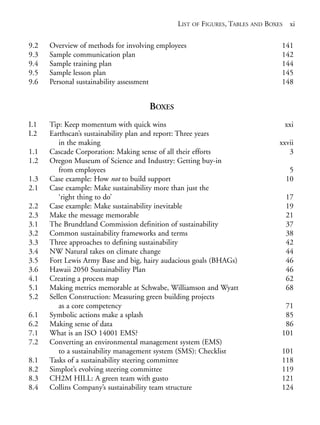
                                                            LIST OF FIGURES, TABLES AND BOXES    xi

              9.2   Overview of methods for involving employees                             141
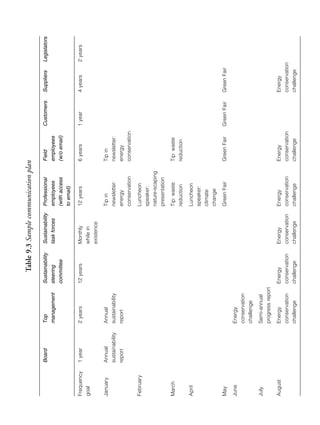
              9.3   Sample communication plan                                               142
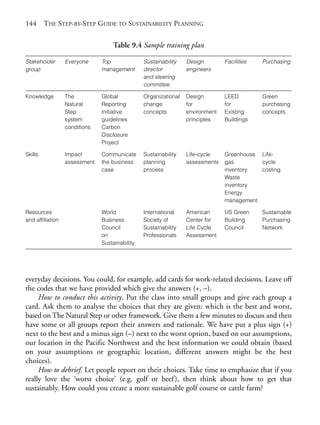
              9.4   Sample training plan                                                    144
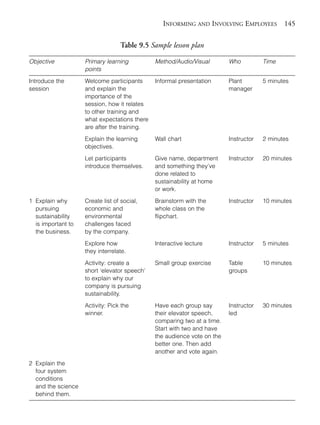
              9.5   Sample lesson plan                                                      145
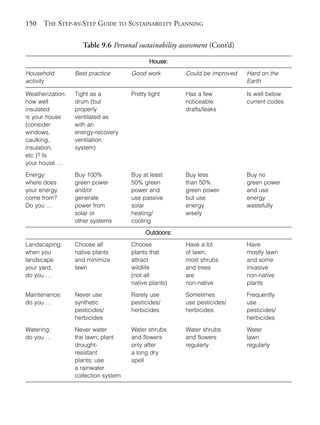
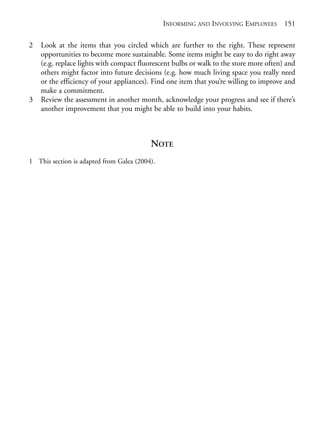
              9.6   Personal sustainability assessment                                      148


                                                   BOXES
              I.1   Tip: Keep momentum with quick wins                                          xxi
              I.2   Earthscan’s sustainability plan and report: Three years
                       in the making                                                        xxvii
              1.1   Cascade Corporation: Making sense of all their efforts                     3
              1.2   Oregon Museum of Science and Industry: Getting buy-in
                       from employees                                                            5
              1.3   Case example: How not to build support                                      10
              2.1   Case example: Make sustainability more than just the
                       ‘right thing to do’                                                      17
              2.2   Case example: Make sustainability inevitable                                19
              2.3   Make the message memorable                                                  21
              3.1   The Brundtland Commission definition of sustainability                      37
              3.2   Common sustainability frameworks and terms                                  38
              3.3   Three approaches to defining sustainability                                 42
              3.4   NW Natural takes on climate change                                          44
              3.5   Fort Lewis Army Base and big, hairy audacious goals (BHAGs)                 46
              3.6   Hawaii 2050 Sustainability Plan                                             46
              4.1   Creating a process map                                                      62
              5.1   Making metrics memorable at Schwabe, Williamson and Wyatt                   68
              5.2   Sellen Construction: Measuring green building projects
                       as a core competency                                                  71
              6.1   Symbolic actions make a splash                                           85
              6.2   Making sense of data                                                     86
              7.1   What is an ISO 14001 EMS?                                               101
              7.2   Converting an environmental management system (EMS)
                       to a sustainability management system (SMS): Checklist               101
              8.1   Tasks of a sustainability steering committee                            118
              8.2   Simplot’s evolving steering committee                                   119
              8.3   CH2M HILL: A green team with gusto                                      121
              8.4   Collins Company’s sustainability team structure                         124
Prelims.qxd   10/1/2008   7:33 PM   Page xii


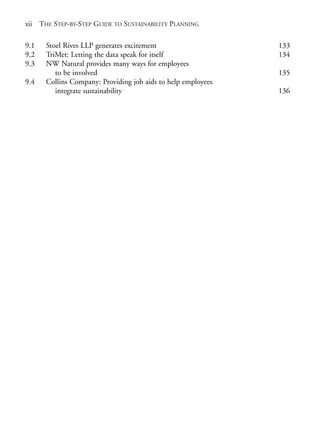
       xii THE STEP-BY-STEP GUIDE TO SUSTAINABILITY PLANNING

       9.1    Stoel Rives LLP generates excitement                    133
       9.2    TriMet: Letting the data speak for itself               134
       9.3    NW Natural provides many ways for employees
                 to be involved                                       135
       9.4    Collins Company: Providing job aids to help employees
                 integrate sustainability                             136
Prelims.qxd    10/1/2008    7:33 PM    Page xiii


                                                    Foreword

                                                      Alan AtKisson


              As a young man, I was literally afraid of cooking. It seemed like complex chemistry to me:
              one slip with the salt, and the kitchen would probably go up in smoke. Then I came into
              the possession of an unusually clear little guide called the Tassajara Cookbook. It provided
              almost no actual recipes; instead, it provided the most important general principles, some
              examples, lists of ingredients, the right sequences for putting ingredients together, and a lot
              of tips and tricks for making any kind of soup, pie, casserole, stew or whatever else you
              wanted to create. After reading it, my fear was gone. Suddenly I loved being in the kitchen
              because I knew something much better than how to follow a recipe: I knew how to cook.
                   The Step-by-Step Guide to Sustainability Planning is very much in the same wonderful
              tradition of clarity in guidance. If you do not already know how to create and manage a
              sustainability programme for your company, institution or organization, you soon will.
              And if you already work with such a programme, these authors have done you the
              inestimable service of assembling, between two covers, a vast storehouse of how to, when
              to and where to go for more.
                   To keep pushing the metaphor, doing sustainability work is very much like making
              stew. Many ingredients must come together to make a coherent, and tasty, whole. Virtually
              anything can go into it – but not everything should. Some things should be done first; other
              things get thrown in later. And certain things simply do not mix well together at all. There
              are no short cuts to making stew or to doing sustainability; but there are dead ends, bad
              choices and blind alleys that can slow you down. This book will help you to avoid these
              time wasters so that you can get on with the task of achieving results.
                   There is also no shortage of tools, methods and processes to blend into a basic
              sustainability programme. These are like spices in a stew, and you will find plenty of room
              for those here as well. But first one must know, in general, how to ‘cook up’ your
              organizational sustainability programme in practical terms. And this is the best such
              cookbook I have seen to date. Twenty years ago, when I was first starting out in
              professional sustainability work, there was not a cookbook in sight. We made it up as we
              went along. Today, the number of people working in sustainability (or wanting to) appears
              to be growing faster than the training programmes, certification standards and other
Prelims.qxd   10/1/2008    7:33 PM   Page xiv


       xiv THE STEP-BY-STEP GUIDE TO SUSTAINABILITY PLANNING

       institutional apparatus that normally support a profession. Guides like this book are
       therefore essential resources, helping to speed people up the learning curve to the point
       where they, and their organizations, can quickly start contributing to reduced waste,
       climate neutrality, better performance, increased social justice and the general
       improvement of well-being for everyone on our increasingly crowded planet. Share this
       book with as many people as you can.
            ‘But’, you might ask, ‘you also work as a sustainability consultant, and you have your
       own book coming out at just the same time, describing your own tools and methods. Why
       would you write a Foreword endorsing a group of competitors?’ First, because this is a very
       good book. Second, because I believe that all of us working as sustainability practitioners
       have a number of ethical responsibilities that are special to our profession. One of these
       involves putting cooperation ahead of competition: when it comes to rescuing the
       ecological, biological, economic and social systems of our planet from the all-too-real risk
       of cascading systems failure, we do not have the luxury of competing with each other. Like
       doctors in the emergency room, with different strengths and specialties, and even
       personality quirks, we must find ways to work together in order to save as many lives as
       possible. Darcy Hitchcock and Marsha Willard and the Axis Performance team are not my
       competitors; they are my colleagues and teammates.
            In an era of climate change, growing resource scarcity, food riots and more, we are all –
       together with you, dear reader – struggling to win the biggest competition of all: the
       ultimate race against time – the transition to a sustainable world.

       May 2008
       Stockholm, Sweden
Prelims.qxd    10/1/2008   7:33 PM   Page xv


                                        Acknowledgements


              We wish to thank the following people for reviewing this book and providing anecdotes.

              Jeanne Afuvia, Director of Public Policy, Hawaii Institute for Public Affairs
              Suhit Anatula, Department of Families and Communities, Government of South Australia
              Dorothy Atwood, Zero Waste Alliance
              Steve Bicker, NW Natural
              Jackie Drumheller, Alaska Airlines
              Bill Edmonds, NW Natural
              Sara Grigsby, NW Natural
              Scott Harris, Simplot
              Phil Moran, Stoel Rives
              Helen Rigg, Idaho GEMStars
              Jill Sughrue, Sustain Northwest
              Nancy Stueber, Oregon Museum of Science and Industry
              Rick Woodward, Coastwide Laboratories

              Thank you, as well, to Rob West at Earthscan for being an advocate for our work and for
              answering our never-ending questions!
Prelims.qxd   10/1/2008   7:33 PM   Page xvi
Prelims.qxd   10/1/2008   7:33 PM   Page xvii


                          List of Acronyms and Abbreviations


              AA                AccountAbility
              ANSI              American National Standards Institute
              ASTM              American Society for Testing and Materials
              BHAG              big, hairy audacious goal
              °C                degrees Celsius
              CEO               chief executive officer
              CERES             Coalition for Environmentally Responsible Economies
              CFO               chief financial officer
              CO2               carbon dioxide
              CSR               corporate social responsibility
              DDT               dichlorodiphenyltrichloroethane
              EMS               environmental management system(s)
              EPA               US Environmental Protection Agency
              EPEAT             Electronic Product Environmental Assessment Tool
              EPR               extended producer (or product) responsibility
              EuP               energy-using products
              °F                degrees Fahrenheit
              FSC               Forest Stewardship Council
              GHG               greenhouse gas
              GRI               Global Reporting Initiative
              ha                hectare
              ISO               International Organization for Standardization
              JTS               journey to sustainability
              kWh               kilowatt hours
              lb                pound
              LED               light-emitting diode
              LEED              Leadership in Energy and Environmental Design (green building
                                tool)
              LEED-EB           LEED for existing buildings
              MBDC              McDonough Braungart Design Chemistry
              MDG               United Nations Millennium Development Goal
Prelims.qxd   10/1/2008   7:33 PM   Page xviii


       xviii THE STEP-BY-STEP GUIDE TO SUSTAINABILITY PLANNING

       NGO                 non-governmental organization
       OMSI                Oregon Museum of Science and Industry
       PBDE                polybrominated diphenyl ether
       PCB                 polychlorinated biphenyl
       PDF                 portable document format
       PLA                 polylactic acid
       3 Rs                reduce, reuse and recycle
       REACH               Registration, Evaluation, Authorization and Restriction of Chemicals
       RFP                 request for proposal
       RoHS                European Union Restriction of Hazardous Substances Directive
       SA                  Social Accountability
       SC                  system condition from The Natural Step framework
       SCORE               Sustainability Competency and Opportunity Rating and Evaluation
       SFI                 Sustainable Forestry Initiative
       SMS                 sustainability management system
       SOP                 standard operating procedure
       SWOT                strengths, weaknesses, opportunities and threats
       TNS                 The Natural Step
       UK                  United Kingdom
       US                  United States
       VOC                 volatile organic compound
       WBCSD               World Business Council on Sustainable Development
       WCED                World Commission on Environment and Development
       WEEE                Waste Electrical and Electronic Equipment Directive
Prelims.qxd    10/1/2008    7:33 PM    Page xix


                                                  Introduction


              Sustainability is a hot business trend and many organizations are pursuing it, some with
              greater success than others. Years ago, you could just muddle along making random green
              efforts to earn a gold star in the marketplace. Now, however, as stakeholders have become
              more sophisticated, it’s important to undertake a formal process for approaching
              sustainability. Sustainability planning involves setting a strategy, figuring out what you need
              to work on, and orchestrating a series of projects over the long term to reach sustainability.
              A couple of years ago, one of our clients asked: ‘What should go into a sustainability plan?
              Isn’t there an accepted format?’ At the time, we had no good answer; there was no accepted
              standard or template for creating these plans. While the Global Reporting Initiative is
              intended to provide standardization for reporting, it exceeds what many organizations can
              or need to report. It also may not represent all you will want to track internally. The lack
              of a template has wasted resources. Everyone was reinventing the process. We decided to
              systematize it.
                   After working with a wide variety of organizations to develop these plans and reports,
              we have refined the process down to a systematic and easily replicated set of steps. Of
              course, this is not the only way to create a sustainability plan and report. But our process
              will provide you with a template for how to do your own. This book is a cookbook of sorts,
              providing you with a well-tested recipe for creating your own sustainability plan and
              report. You can substitute ingredients and customize the steps as you see fit. Like most
              cooks, you may prefer to follow the recipe closely the first time around; but as your
              familiarity grows, you can increasingly modify the recipe to suit your tastes.
                   It is now becoming standard practice for organizations to create a sustainability plan
              and report. Approximately 75 per cent of the largest corporations now produce a
              sustainability report or corporate social responsibility report and this trend has been
              accelerating. Increasingly, investors and other stakeholders expect to have access to this
              information. The Carbon Disclosure Project, for example, has put pressure on companies
              to report their climate-related risks. Others produce these reports to enhance their image.
              This practice is being pushed down into the supply chain as well. Similarly, many
              governmental agencies and departments are also being asked to create a sustainability plan
              and report on their progress.
                   Of course, some organizations still fly by the seat of their pants without a flight plan.
              For some period of time, they simply pursue the most obvious projects. There are risks in
Prelims.qxd   10/1/2008          7:33 PM   Page xx


       xx THE STEP-BY-STEP GUIDE TO SUSTAINABILITY PLANNING

       this approach, though. How do you know you’re working on the most important impacts?
       Are you confident that the changes you implement now won’t be dead ends? Are there
       blind spots in your approach that will come back to bite you later? How do you ensure that
       you are addressing the full definition of sustainability as opposed to window dressing in a
       few areas? Do you have the systems in place to support your effort so that it won’t fizzle
       out? The only way to get a good handle on what you should be working on is to do the
       analysis associated with a sustainability plan.
            In the broadest sense, sustainability planning revolves around two main questions:
       should we pursue sustainability and if so, how? You may think your organization has
       already committed to sustainability; but understanding the business case evolves over time.
       Certainly, if this is your organization’s first time in creating a sustainability plan, you
       should spend time on the first question. In future years, you may be able to gloss over it,
       just checking to see if your sustainability policy still captures your intent.
            This book will help you to answer these questions in a systematic way. We have created a
       set of electronic files to support this process called SPaRKTM, the Sustainability Planning and


                                     Table I.1 Questions you will want to answer

       Should we pursue (or continue to                        If yes, what will we do?
       pursue) sustainability?
       What is it about sustainability that makes sense        What would a fully sustainable vision for
       for us? What pressures are pushing us to do it?         our organization look like?
       What opportunities does it present? Are there
       certain issues within sustainability that are a         What frameworks will we use to define
       particular focus (e.g. climate change, e-waste          sustainability in our context?
       and international labour standards)?

       How does sustainability relate to other                 How will we measure our progress?
       organizational initiatives (e.g. lean
       manufacturing, environmental                            What projects will we undertake, now and
       management systems and product                          in the future to reach a sustainable state?
       certification)?

       Where should we start or implement                      What systems and structures will we
       sustainability next?                                    need to support our efforts?

       What are the likely challenges
       and how can we overcome them?

       What else do we need to know
       to make a decision?

       Is this the right time?
Prelims.qxd       10/1/2008    7:33 PM     Page xxi


                                                                                                INTRODUCTION xxi

              Reporting Kit. It includes an Excel file with spreadsheets for the most common analyses and
              metrics. This file is linked to an MS Word template for an internal sustainability plan
              and report such that the charts and graphs are automatically pulled into it. Please see our
              website for more information about this tool (www.axisperformance.com).


                                           WHO SHOULD READ                THIS BOOK?

              This book will be most helpful for people who must plan and lead an effort to create a
              sustainability plan and report. Individuals may include:

              •     city managers, council members and corporate executives who want to direct their
                    staff to create a sustainability plan and/or report;
              •     sustainability directors and coordinators;
              •     consultants who want to make sustainability planning part of their services;
              •     academics who want to teach their students how to develop a sustainability plan.

                                           HOW      THIS BOOK IS STRUCTURED

              Following a general chapter on organizational change principles (see Chapter 1), the
              chapters in this book each represent a major step in the process of creating a sustainability
              plan and report. Each chapter has two sections: background reading to prepare you to do
              the step and then a set of exercises you can use to perform the task. The chapters are laid
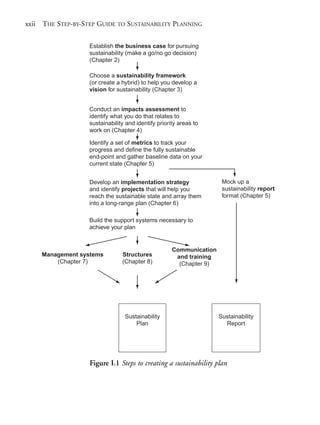
              out roughly in chronological or linear order; but as you can see in Figure I.1, some of the
              steps can be done in a different order. The real world isn’t linear; so use your judgement
              about where to start and the order in which you want to do the steps.


                              BOX I.1 TIP: KEEP MOMENTUM WITH QUICK WINS
                   People differ in their abilities and comfort with abstract cognitive tasks such as planning. When
                   we have clients with a preference for action, we may allocate a portion of the planning
                   meetings to identifying and acting on low-hanging fruit. One client identified a few small
                   projects that were no-brainers – reducing lighting levels by removing bulbs from fixtures and
                   improving their recycling system – which we addressed in parallel with the planning process.
                   This helped the participants to feel a sense of accomplishment and tangible results while we
                   worked on the longer-range plan.
Prelims.qxd   10/1/2008   7:33 PM   Page xxii


       xxii THE STEP-BY-STEP GUIDE TO SUSTAINABILITY PLANNING

                            Establish the business case for pursuing
                            sustainability (make a go/no go decision)
                            (Chapter 2)

                            Choose a sustainability framework
                            (or create a hybrid) to help you develop a
                            vision for sustainability (Chapter 3)


                            Conduct an impacts assessment to
                            identify what you do that relates to
                            sustainability and identify priority areas to
                            work on (Chapter 4)

                            Identify a set of metrics to track your
                            progress and define the fully sustainable
                            end-point and gather baseline data on your
                            current state (Chapter 5)


                            Develop an implementation strategy                 Mock up a
                            and identify projects that will help you           sustainability report
                            reach the sustainable state and array them         format (Chapter 5)
                            into a long-range plan (Chapter 6)

                            Build the support systems necessary to
                            achieve your plan


                                                              Communication
              Management systems         Structures            and training
                  (Chapter 7)            (Chapter 8)            (Chapter 9)


                                          Sustainability                      Sustainability
                                              Plan                              Report


                            Figure I.1 Steps to creating a sustainability plan
Prelims.qxd       10/1/2008   7:33 PM    Page xxiii


                                                                                        INTRODUCTION xxiii


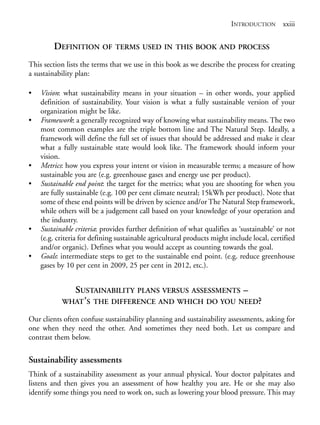
                        DEFINITION OF          TERMS USED IN THIS BOOK AND PROCESS

              This section lists the terms that we use in this book as we describe the process for creating
              a sustainability plan:

              •     Vision: what sustainability means in your situation – in other words, your applied
                    definition of sustainability. Your vision is what a fully sustainable version of your
                    organization might be like.
              •     Framework: a generally recognized way of knowing what sustainability means. The two
                    most common examples are the triple bottom line and The Natural Step. Ideally, a
                    framework will define the full set of issues that should be addressed and make it clear
                    what a fully sustainable state would look like. The framework should inform your
                    vision.
              •     Metrics: how you express your intent or vision in measurable terms; a measure of how
                    sustainable you are (e.g. greenhouse gases and energy use per product).
              •     Sustainable end point: the target for the metrics; what you are shooting for when you
                    are fully sustainable (e.g. 100 per cent climate neutral; 15kWh per product). Note that
                    some of these end points will be driven by science and/or The Natural Step framework,
                    while others will be a judgement call based on your knowledge of your operation and
                    the industry.
              •     Sustainable criteria: provides further definition of what qualifies as ‘sustainable’ or not
                    (e.g. criteria for defining sustainable agricultural products might include local, certified
                    and/or organic). Defines what you would accept as counting towards the goal.
              •     Goals: intermediate steps to get to the sustainable end point. (e.g. reduce greenhouse
                    gases by 10 per cent in 2009, 25 per cent in 2012, etc.).


                             SUSTAINABILITY PLANS VERSUS ASSESSMENTS –
                           WHAT ’S THE DIFFERENCE AND WHICH DO YOU NEED?

              Our clients often confuse sustainability planning and sustainability assessments, asking for
              one when they need the other. And sometimes they need both. Let us compare and
              contrast them below.

              Sustainability assessments
              Think of a sustainability assessment as your annual physical. Your doctor palpitates and
              listens and then gives you an assessment of how healthy you are. He or she may also
              identify some things you need to work on, such as lowering your blood pressure. This may
Prelims.qxd   10/1/2008   7:33 PM   Page xxiv


       xxiv THE STEP-BY-STEP GUIDE TO SUSTAINABILITY PLANNING

       lead to more detailed assessments (e.g. a cholesterol test). A handful of actions are
       identified, including entreaties to eat better and to try a new prescription. However, these
       recommendations are not, in themselves, likely to be all you need to address in order to
       live a good life.
            Similarly, sustainability assessments such as our SCORETM assessment give you a
       snapshot of how healthy your sustainability effort is and what you need to work on. While
       these assessments typically prescribe some next steps, they do not (nor does your annual
       physical) give you a detailed long-term plan for improving the state of affairs. Assessments
       often lead to more questions, which imply additional assessments. SCORETM, for example,
       measures the degree to which you have embedded sustainability within your business
       practices. Other types of assessments are often helpful. You may want to assess your
       strategic position in the marketplace, or evaluate levels of greenhouse gas emissions, energy
       consumed or waste.
            The assessments you choose determine the information you get; so select assessments
       wisely. Your blood pressure might be high because your marriage is in ruins; but the
       cholesterol test won’t show that, and many doctors won’t think to ask; they just whip out
       their prescription pad.
            In the context of sustainability, it’s important to do an overarching impact analysis so
       that you know what you are responsible for and what your priorities are. Do they include
       solid waste? Energy? Paper? International labour practices? Then you can conduct detailed
       assessments of these priority areas. Otherwise, you may risk wasting money gathering data
       on unimportant areas, and the data will become stale long before you need them.
            Assessments are useful after you have completed some initial steps, including clarifying
       the business case and undertaking initial projects. We had a client who asked to do
       SCORETM before they’d even made an organizational commitment to sustainability. We
       said that was like assessing your ability to play the violin before determining that you
       wanted to play one. It’s cruel to all involved to hold a recital before you have practised!
            Sustainability assessments, then, are useful when you:

       •   have decided to pursue sustainability;
       •   have undertaken at least some preliminary sustainability-related actions;
       •   need baseline data for those areas you have targeted for improvement;
       •   want a formal assessment of how you are doing and how far you have come;
       •   aren’t sure what to work on next.

       Sustainability planning
       If sustainability assessments are like your annual physical, then sustainability planning is
       analogous to life planning. It determines what’s important to you and builds a long-term
Prelims.qxd       10/1/2008   7:33 PM   Page xxv


                                                                                        INTRODUCTION xxv

              plan to get there. A life plan asks you to assess not only your physical health, but also the
              state of your relationships, finances, work life and spiritual development. You are prompted
              to define your mission in life, and you set goals and develop plans in all of these areas.
                   Similarly, sustainability planning, at least as we conceptualize it, involves clarifying the
              business case for pursuing sustainability and defining a vision for a fully sustainable version
              of your organization. It includes developing metrics for tracking your progress and a long-
              term plan to achieve your goals.
                   Sustainability planning is useful when you:

              •     have a clear organizational intention to pursue sustainability and want a systematic way
                    to approach its implementation;
              •     need to make overarching decisions that will help you to manage the sustainability
                    effort (e.g. define common metrics and frameworks that all parts of the organization
                    will use);
              •     need a shared understanding of what you are trying to achieve and why;
              •     lack a long-term plan for achieving your sustainability vision and goals.

              Sustainability planning is usually an iterative process where you revisit your goals and
              priorities, check on progress and revise the plan year after year. Sustainability assessments,
              on the other hand, tend to be episodic, occurring when you have reached a plateau or when
              you want a quantifiable progress check.

              When you need both
              Sustainability assessments can be part of a larger sustainability planning process. Some
              sustainability assessments, including an impact assessment, are core to our planning
              process. We explain a few such assessments in this book. However, we do not cover
              sustainability assessments in exhaustive detail here.
                  Other assessments, such as our SCORETM assessment, can be integrated within a
              sustainability process. They typically fit into the process in one of three places:

              1     At the beginning. Clients who have already undertaken some sustainability-related
                    initiatives may want to begin with an assessment that reveals their strengths and areas
                    for improvement. These insights can then catalyse a sustainability planning process if
                    they don’t already have one, or the insights can be integrated within an existing
                    sustainability plan.
              2     Before the impact assessment. A high-level assessment such as SCORETM can help you
                    to identify the parts of the impact assessment to focus on. For example, if purchasing
Prelims.qxd      10/1/2008    7:33 PM    Page xxvi


       xxvi THE STEP-BY-STEP GUIDE TO SUSTAINABILITY PLANNING

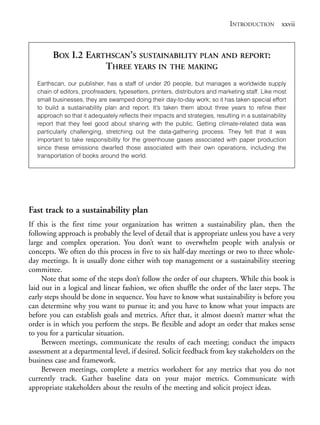
               comes up as a weak area, you can then get into more detail when you complete the
               materials portion of the impact assessment.
       3       During the data-gathering phase. Clients may want to include other sustainability
               assessments as data points. They can introduce other perspectives that should be
               incorporated within the planning process. SCORETM, for example, is a powerful
               educational tool, helping managers to understand what sustainability means in their
               context; and it provides quantifiable data that can be used as a baseline against which
               they compare progress year after year. You may also want to conduct other such
               assessments, including a systems audit, greenhouse gas inventory, social audit or waste
               assessment.


                                                   RESOURCES
           Broad sustainability assessment tools
           These assessment tools may be helpful to use as part of your planning process:

           •     SCORETM measures how well you have integrated sustainability within your business
                 practices (see www.axisperformance.com).
           •     STARS is a similar assessment for higher education, created by the Association for the
                 Advancement of Sustainability in Higher Education (see www.aashe.org).
           •     S-BAR is still under development at the time of writing, but should provide useful data,
                 comparable across businesses within a sector (see www.sustainabilityratings.com).


                        TAILORING A PLANNING PROCESS                   TO YOUR NEEDS

       Plan to deepen your sophistication over time. For organizations which are starting on the
       road to sustainability, our bias is to get through the planning process quickly so they can
       get onto tangible projects that demonstrate results. Think of this as a learning spiral. Each
       year, you will need to produce a sustainability plan; but as you become more sophisticated,
       so will your plan. As you read this book, do not assume that you have to do all the exercises
       in each chapter before moving on. Choose the ones that make sense for you now. Do a
       reasonable job of performing each step. Next year, add elements that push you to a deeper
       level. We provide a few sample approaches in the following sections to show you how to
       cluster these tasks into meetings.
Prelims.qxd    10/1/2008     7:33 PM     Page xxvii


                                                                                             INTRODUCTION xxvii


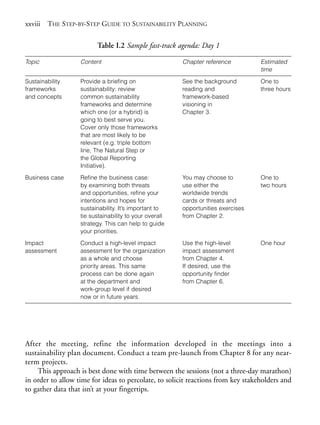
                       BOX I.2 EARTHSCAN’S SUSTAINABILITY PLAN AND REPORT:
                                   THREE YEARS IN THE MAKING
                 Earthscan, our publisher, has a staff of under 20 people, but manages a worldwide supply
                 chain of editors, proofreaders, typesetters, printers, distributors and marketing staff. Like most
                 small businesses, they are swamped doing their day-to-day work; so it has taken special effort
                 to build a sustainability plan and report. It’s taken them about three years to refine their
                 approach so that it adequately reflects their impacts and strategies, resulting in a sustainability
                 report that they feel good about sharing with the public. Getting climate-related data was
                 particularly challenging, stretching out the data-gathering process. They felt that it was
                 important to take responsibility for the greenhouse gases associated with paper production
                 since these emissions dwarfed those associated with their own operations, including the
                 transportation of books around the world.


              Fast track to a sustainability plan
              If this is the first time your organization has written a sustainability plan, then the
              following approach is probably the level of detail that is appropriate unless you have a very
              large and complex operation. You don’t want to overwhelm people with analysis or
              concepts. We often do this process in five to six half-day meetings or two to three whole-
              day meetings. It is usually done either with top management or a sustainability steering
              committee.
                   Note that some of the steps don’t follow the order of our chapters. While this book is
              laid out in a logical and linear fashion, we often shuffle the order of the later steps. The
              early steps should be done in sequence. You have to know what sustainability is before you
              can determine why you want to pursue it; and you have to know what your impacts are
              before you can establish goals and metrics. After that, it almost doesn’t matter what the
              order is in which you perform the steps. Be flexible and adopt an order that makes sense
              to you for a particular situation.
                   Between meetings, communicate the results of each meeting; conduct the impacts
              assessment at a departmental level, if desired. Solicit feedback from key stakeholders on the
              business case and framework.
                   Between meetings, complete a metrics worksheet for any metrics that you do not
              currently track. Gather baseline data on your major metrics. Communicate with
              appropriate stakeholders about the results of the meeting and solicit project ideas.
Prelims.qxd    10/1/2008   7:33 PM     Page xxviii


       xxviii THE STEP-BY-STEP GUIDE TO SUSTAINABILITY PLANNING

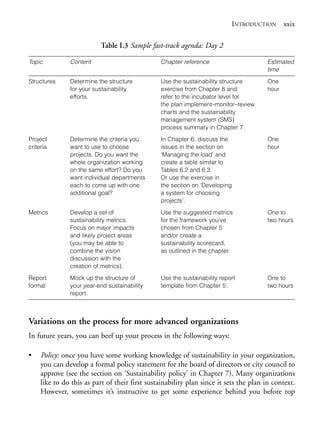
                                 Table I.2 Sample fast-track agenda: Day 1

       Topic               Content                              Chapter reference         Estimated
                                                                                          time
       Sustainability      Provide a briefing on                See the background        One to
       frameworks          sustainability: review               reading and               three hours
       and concepts        common sustainability                framework-based
                           frameworks and determine             visioning in
                           which one (or a hybrid) is           Chapter 3.
                           going to best serve you.
                           Cover only those frameworks
                           that are most likely to be
                           relevant (e.g. triple bottom
                           line, The Natural Step or
                           the Global Reporting
                           Initiative).

       Business case       Refine the business case:            You may choose to         One to
                           by examining both threats            use either the            two hours
                           and opportunities, refine your       worldwide trends
                           intentions and hopes for             cards or threats and
                           sustainability. It’s important to    opportunities exercises
                           tie sustainability to your overall   from Chapter 2.
                           strategy. This can help to guide
                           your priorities.

       Impact              Conduct a high-level impact          Use the high-level        One hour
       assessment          assessment for the organization      impact assessment
                           as a whole and choose                from Chapter 4.
                           priority areas. This same            If desired, use the
                           process can be done again            opportunity finder
                           at the department and                from Chapter 6.
                           work-group level if desired
                           now or in future years.


       After the meeting, refine the information developed in the meetings into a
       sustainability plan document. Conduct a team pre-launch from Chapter 8 for any near-
       term projects.
           This approach is best done with time between the sessions (not a three-day marathon)
       in order to allow time for ideas to percolate, to solicit reactions from key stakeholders and
       to gather data that isn’t at your fingertips.
Prelims.qxd       10/1/2008   7:33 PM    Page xxix


                                                                                          INTRODUCTION xxix

                                          Table I.3 Sample fast-track agenda: Day 2

              Topic           Content                          Chapter reference                      Estimated
                                                                                                      time
              Structures      Determine the structure          Use the sustainability structure       One
                              for your sustainability          exercise from Chapter 8 and            hour
                              efforts.                         refer to the incubator level for
                                                               the plan implement–monitor–review
                                                               charts and the sustainability
                                                               management system (SMS)
                                                               process summary in Chapter 7.

              Project         Determine the criteria you       In Chapter 6, discuss the              One
              criteria        want to use to choose            issues in the section on               hour
                              projects. Do you want the        ‘Managing the load’ and
                              whole organization working       create a table similar to
                              on the same effort? Do you       Tables 6.2 and 6.3.
                              want individual departments      Or use the exercise in
                              each to come up with one         the section on ‘Developing
                              additional goal?                 a system for choosing
                                                               projects’.

              Metrics         Develop a set of                 Use the suggested metrics              One to
                              sustainability metrics.          for the framework you’ve               two hours
                              Focus on major impacts           chosen from Chapter 5
                              and likely project areas         and/or create a
                              (you may be able to              sustainability scorecard,
                              combine the vision               as outlined in the chapter.
                              discussion with the
                              creation of metrics).

              Report          Mock up the structure of         Use the sustainability report          One to
              format          your year-end sustainability     template from Chapter 5.               two hours
                              report.


              Variations on the process for more advanced organizations
              In future years, you can beef up your process in the following ways:

              •     Policy: once you have some working knowledge of sustainability in your organization,
                    you can develop a formal policy statement for the board of directors or city council to
                    approve (see the section on ‘Sustainability policy’ in Chapter 7). Many organizations
                    like to do this as part of their first sustainability plan since it sets the plan in context.
                    However, sometimes it’s instructive to get some experience behind you before top
Prelims.qxd     10/1/2008    7:33 PM    Page xxx


       xxx THE STEP-BY-STEP GUIDE TO SUSTAINABILITY PLANNING

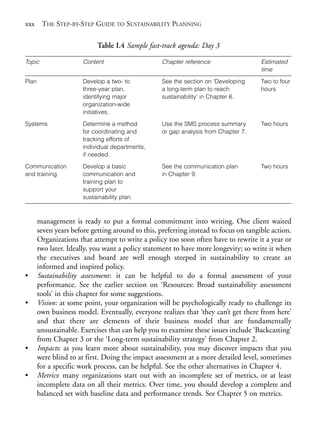
                                   Table I.4 Sample fast-track agenda: Day 3

       Topic                  Content                     Chapter reference                  Estimated
                                                                                             time
       Plan                   Develop a two- to           See the section on ‘Developing     Two to four
                              three-year plan,            a long-term plan to reach          hours
                              identifying major           sustainability’ in Chapter 6.
                              organization-wide
                              initiatives.

       Systems                Determine a method          Use the SMS process summary        Two hours
                              for coordinating and        or gap analysis from Chapter 7.
                              tracking efforts of
                              individual departments,
                              if needed.

       Communication          Develop a basic             See the communication plan         Two hours
       and training           communication and           in Chapter 9.
                              training plan to
                              support your
                              sustainability plan.


              management is ready to put a formal commitment into writing. One client waited
              seven years before getting around to this, preferring instead to focus on tangible action.
              Organizations that attempt to write a policy too soon often have to rewrite it a year or
              two later. Ideally, you want a policy statement to have more longevity; so write it when
              the executives and board are well enough steeped in sustainability to create an
              informed and inspired policy.
       •      Sustainability assessment : it can be helpful to do a formal assessment of your
              performance. See the earlier section on ‘Resources: Broad sustainability assessment
              tools’ in this chapter for some suggestions.
       •      Vision: at some point, your organization will be psychologically ready to challenge its
              own business model. Eventually, everyone realizes that ‘they can’t get there from here’
              and that there are elements of their business model that are fundamentally
              unsustainable. Exercises that can help you to examine these issues include ‘Backcasting’
              from Chapter 3 or the ‘Long-term sustainability strategy’ from Chapter 2.
       •      Impacts: as you learn more about sustainability, you may discover impacts that you
              were blind to at first. Doing the impact assessment at a more detailed level, sometimes
              for a specific work process, can be helpful. See the other alternatives in Chapter 4.
       •      Metrics: many organizations start out with an incomplete set of metrics, or at least
              incomplete data on all their metrics. Over time, you should develop a complete and
              balanced set with baseline data and performance trends. See Chapter 5 on metrics.
Prelims.qxd       10/1/2008   7:33 PM   Page xxxi


                                                                                      INTRODUCTION xxxi

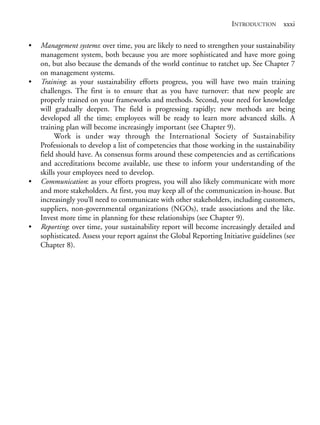
              •     Management systems: over time, you are likely to need to strengthen your sustainability
                    management system, both because you are more sophisticated and have more going
                    on, but also because the demands of the world continue to ratchet up. See Chapter 7
                    on management systems.
              •     Training: as your sustainability efforts progress, you will have two main training
                    challenges. The first is to ensure that as you have turnover: that new people are
                    properly trained on your frameworks and methods. Second, your need for knowledge
                    will gradually deepen. The field is progressing rapidly; new methods are being
                    developed all the time; employees will be ready to learn more advanced skills. A
                    training plan will become increasingly important (see Chapter 9).
                          Work is under way through the International Society of Sustainability
                    Professionals to develop a list of competencies that those working in the sustainability
                    field should have. As consensus forms around these competencies and as certifications
                    and accreditations become available, use these to inform your understanding of the
                    skills your employees need to develop.
              •     Communication: as your efforts progress, you will also likely communicate with more
                    and more stakeholders. At first, you may keep all of the communication in-house. But
                    increasingly you’ll need to communicate with other stakeholders, including customers,
                    suppliers, non-governmental organizations (NGOs), trade associations and the like.
                    Invest more time in planning for these relationships (see Chapter 9).
              •     Reporting: over time, your sustainability report will become increasingly detailed and
                    sophisticated. Assess your report against the Global Reporting Initiative guidelines (see
                    Chapter 8).
Prelims.qxd   10/1/2008   7:33 PM   Page xxxii
Chapter01.qxd   10/1/2008   4:54 PM    Page 1


                                                           1
                                       Preparing for Change


                                      CONCEPTS AND CASE EXAMPLES
            Before you embark on your sustainability planning process, we want to present you with
            some general concepts about change and the principles or conditions that contribute to
            successful implementation of new programmes in organizations. Introducing a change of
            any kind to an organization can be a delicate proposition. We have seen (and likely you
            have experienced) many failed initiatives. Our intent in this chapter is to arm you with
            information and strategies on organizational change so that your sustainability initiative
            will be largely protected from the common pitfalls of many change efforts.
                 Implementing a sustainability programme is, in many ways, the same as implementing
            any other change initiative. Perhaps your organization has been successful with past
            initiatives: re-engineering, total quality management, lean manufacturing, self-directed
            work teams or any other of the popular 20th-century management improvement strategies.
            There are valuable lessons to be learned (from both the successes and failures) that can be
            carried over and applied to your sustainability programme. Consider the general principles
            below that we have gleaned from over two decades of consulting with organizations.

            Keys to success in any organizational change initiative
            Every new initiative needs to be grounded in a solid business rationale. If it doesn’t make
            business sense to do – that is, if it doesn’t return some value to the organization – it will be
            difficult for people to make it a priority and likely to fall to the bottom of the list of things
            to do. Chapter 2 will help you to craft the business case in order to help ensure that it
            becomes and stays a priority for your organization. In addition, consider the following
            aspects as well.
                 Create a sense of urgency. There’s nothing like a ‘burning platform’ to incite enthusiasm,
            and it’s getting easier and easier to find one. A burning platform creates motivation to
            move forward because, in part, it makes it clear that the status quo is no longer viable. Does
            the recent spike in energy costs affect your business? Are your customers suspicious of your
            operations? What about the Kyoto Accord and climate change? One organization used
Chapter01.qxd   10/1/2008    4:54 PM    Page 2


       2   THE STEP-BY-STEP GUIDE TO SUSTAINABILITY PLANNING

       pictures of its employees’ children as the backdrop to its sustainability kick-off meeting to
       emphasize the impact that it will have on future generations.
            Find a champion and get leadership support. Ideally, you should find someone with
       some position of authority to champion your effort and to ensure that it gets the time,
       attention and resources it will require for a meaningful impact. The higher up in your
       organization your champion is, the greater the likelihood that your effort will have staying
       power. These people often go by the title of sustainability director or coordinator. In
       addition, you will eventually need top management support. We have never seen a change
       effort succeed and stick without leadership support. That doesn’t mean your effort has to
       start with leadership; but top management support and involvement are key to long-term
       success. This means that leaders need to not only talk about sustainability, but also back
       their words up with symbolic and substantive action.
            Find a logical starting point. Sometimes the place to begin is obvious. If you are
       constructing a new building, adding a new production line or making other decisions with
       long-term ramifications, then start there. Often, though, you will have to consider the
       general scope of your effort; whether to start in a portion of the organization or implement
       it across the whole business. Is there a department that is eager and ripe for this? Is there a
       problem you are trying to solve or risk you are trying to avoid? Do you need a safe place
       to experiment, far from the glaring lights of the media or your customers? Are there certain
       departments or people who are raring to go? Think strategically about how broad your
       effort should be. Is it better to begin small and nurture the initiative or to broadcast your
       intentions organization wide and roll the whole effort out with a bang?
            Sometimes, it’s best to start quietly, letting the effort evolve over time, starting by
       tucking sustainability into logical places, not making a big deal about it. This approach is
       appropriate when you don’t have a huge looming problem driving you to pursue
       sustainability and/or you don’t have top management support. This can also be a good
       approach if employees are jaded by past change initiatives and when your business case for
       pursuing sustainability is still developing.
            In other situations, it’s best to broadcast that you are doing something new and make
       a big splash. In this situation, sustainability is discussed explicitly as an objective; audacious
       goals are set; everyone is expected to rethink what they do through the lens of
       sustainability. This approach is appropriate when top management has made an enduring
       commitment to sustainability and when it is important to signal a significant change of
       corporate strategy (e.g. to disgruntled customers, shareholders or the public.) This can also
       be an appropriate approach if you are trying to use sustainability to create a new, more
       empowered and committed corporate culture.
            Attach your project to existing efforts. To avoid the ‘programme of the month’ cynicism,
       it can be helpful to explicitly link your sustainability efforts to familiar programmes in the
       organization. It’s often easier to add another consideration to an existing project than to
Chapter01.qxd   10/1/2008     4:54 PM    Page 3


                                                                                   PREPARING FOR CHANGE 3

            generate the interest and energy in starting something entirely new. You may already, for
            example, have lean manufacturing or quality teams. If so, ask them to include broader
            sustainability-related issues in the work that they do. If your organization already thinks in
            terms of corporate social responsibility, then just refine the definition to include criteria
            related to the limits of nature. Do you have an environmental management system that
            could be strengthened to be a sustainability management system? Is your organization a
            long-time advocate of total quality management, lean manufacturing or related efforts? Do
            you have a longstanding practice of empowering employee work teams? If so, perhaps you
            can show how sustainability is a logical extension of them.
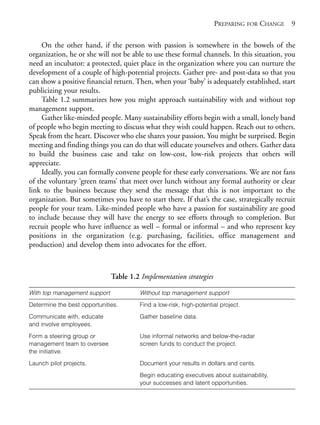
                 In Table 1.1, we list common existing organizational change initiatives and describe
            how sustainability can be dovetailed with them.
                 Communicate constantly. Once you are ready to ‘go public’ with your efforts, you will
            need to be diligent about keeping people informed of what’s going on. Sustainability will
            likely be a new concept for many in your organization, so in addition to the constant stream
            of communication about your progress, you may also need to continuously educate people
            about sustainability and why it is important. We’ve learned that your communication efforts
            should involve multiple media (email, presentations, discussion groups, etc.) and include
            opportunities for two-way communication in conversations and meetings.
                 Share your results. While many of your projects may leave people feeling good about
            what you have done, they will have much more value if you have hard data to support your
            claims of success. Tracking the impact will not only maintain enthusiasm, but will bolster
            your ability to sell additional projects down the line.
                 Create opportunities for involvement. Eventually you will also need fairly wide involvement
            across the organization. This usually implies forming teams or committees to contribute to
            both the planning and execution of your ideas. We’ve also learned that you don’t need


                                     BOX 1.1 CASCADE CORPORATION:
                                    MAKING SENSE OF ALL THEIR EFFORTS
                Cascade Corporation, an international manufacturer of forklifts, was a long-time advocate of
                empowerment and self-directed work teams. It deployed lean manufacturing principles to
                improve its efficiencies and to eliminate waste, and was already ISO 9000 certified and working
                on ISO 14001 at most sites. Its board cautioned the corporation to begin thinking more about
                social responsibility since its programmes appeared to be disconnected and disjointed. We
                showed Cascade how sustainability could be an umbrella to connect all of its efforts, while at
                the same time identifying additional blind spots that it should consider addressing.
Chapter01.qxd   10/1/2008     4:54 PM   Page 4


       4   THE STEP-BY-STEP GUIDE TO SUSTAINABILITY PLANNING

                                         Table 1.1 Points of entry

       Supply chain/purchasing          One way of becoming more sustainable is to begin choosing
                                        greener products, supporting greener vendors and reducing
                                        what you buy.
                                        Example projects: product substitution, purchasing audits and
                                        green building.

       Environmental management         If you have an EMS, you can embed sustainability criteria within
       system (EMS)                     your selection process for setting objectives and choosing
                                        projects.
                                        Example projects: expand eco-metrics to become a full set of
                                        sustainability metrics; develop a method for evaluating potential
                                        projects using a sustainability framework as a filter.
       Lean manufacturing/total         Sustainability is a logical fit with waste reduction and efficiency
       quality management               efforts.
                                        Example projects: zero waste, resource maximization,
                                        de-materialization and product redesign.

       Teams                            If you have a history of using teams (e.g. project teams or safety
                                        teams), you can assign sustainability-related projects to one or
                                        more teams.
                                        Example projects: finding more benign chemicals; reducing
                                        waste going to the landfill; improving resource efficiency.

       Strategic planning               One way of exposing executives to sustainability is to include it
                                        as one of many trends that they should examine during their
                                        strategic ‘environmental scan’.
                                        Example projects: site visits to sustainable competitors or
                                        customers, benchmarking and backcasting.

       Corporate social                 CSR is sometimes used as a synonym for sustainability; but
       responsibility (CSR)             often it omits important components. Is your CSR effort focused
                                        on social impacts without taking account of nature’s limits? Is it
                                        focused on protecting your image, but misses out on strategic
                                        opportunities? You can enlarge your definition of CSR to include
                                        all the elements of sustainability.
                                        Example projects: introduce a science-based framework such as
                                        The Natural Step. Assess your CSR report against the Global
                                        Reporting Initiative (GRI) and see where your holes are.


       absolutely everybody on board. Critical mass seems to be around 15 to 20 per cent of the
       members of the organization. If you have the active involvement of at least that many people,
       you will likely affect an organization-wide change.
Chapter01.qxd   10/1/2008     4:54 PM     Page 5


                                                                                    PREPARING FOR CHANGE 5


                      BOX 1.2 OREGON MUSEUM OF SCIENCE AND INDUSTRY:
                               GETTING BUY-IN FROM EMPLOYEES
                When Nancy Stueber was promoted to president of the Oregon Museum of Science and
                Industry (OMSI), she already knew she wanted to integrate sustainability within their operations.
                But her organization did not respond well to top-down edicts. Nancy needed to know if the
                employees would support this. So we helped her to form a diagonal-slice steering committee
                whose job was to study sustainability for a year, implement a couple of pilot efforts and then
                recommend a go–no-go decision. The steering committee, after analysing its opportunities,
                decided to focus on climate and waste. Since there was already an energy audit being
                conducted – which would have the largest impact on their greenhouse gases – they chose to
                focus on alternative commuting, in part because it would give employees a tangible way of
                participating in the efforts. This also helped them to address a local regulatory requirement for
                trip reductions. The zero-waste task force conducted a waste audit and provided data for each
                department and the organization over all. During the year, Nancy and the steering committee
                did a number of things to educate employees about sustainability and the organization’s efforts.
                After a year, the steering committee gave sustainability a thumb’s up. It is now one of OMSI’s
                strategic values, integral to its strategic planning efforts.


            Manage personal transitions. Since the changes implied by a move towards sustainability
            have broad impact across the organization, you will need to be prepared to handle the
            impact of that on employees and to manage the personal transitions of the people affected.
            Transition management theory posits that people go through three predictable stages: a
            stage of loss for the old way of doing things (even when the old way was problematic or
            undesirable); a period of adjustment where they start to see the possibilities in the new
            methods; and, finally, a stage of acceptance and integration. Develop strategies that are
            appropriate to these stages to ensure that people manage the transition smoothly.
                Manage external stakeholders. In addition to employee management, your initiative
            needs to take into account how the change will be experienced by your external stakeholders.
            Don’t forget to address the impact that might be felt by your vendors, your stockholders or
            your community. Each of these players has the ability to derail your efforts if sufficiently
            upset, as well as to contribute to its progress if they are involved and kept appraised.
                Work towards system integration. Lastly, remember that like any significant change, the
            principles and strategies related to your sustainability effort will eventually need to be
            integrated within the fabric of the organization. In the end, it may require adjusting or
            adapting your core business systems, like those that control hiring, compensation,
            purchasing, contracts, accounting processes and the like.
Chapter01.qxd   10/1/2008    4:54 PM    Page 6


       6   THE STEP-BY-STEP GUIDE TO SUSTAINABILITY PLANNING


       Special considerations for sustainability initiatives
       While sustainability initiatives share many of the same requirements for success as other
       change efforts, the topic of sustainability also brings its own special issues. Consider the
       following list of considerations and strategies for addressing them.
             Make sustainability understandable. First of all, sustainability can be an abstract concept
       that many people have difficulty understanding. It often results in a paradigm shift for
       people, creating a whole new way of looking at the world. Your training and
       communication efforts should take this into account by translating sustainability into
       meaningful language, providing examples and demonstrating direct applications.
             Manage both short and long term. The scale and timeframes associated with
       sustainability are also hard to grasp. The predicted 2° to 6° rise in global temperatures, for
       example, doesn’t sound like much to people who don’t understand the implications. In
       addition, the real impact of that change may not be felt for many years, perhaps long after
       some of us are gone. Typically, organizational change initiatives take two to five years to
       realize. With sustainability we talk in 10- to 20-year horizons. How many of your
       employees expect to be with your organization in 20 years? This highlights the importance
       of including quick wins in your sustainability plan to keep the effort alive and real to the
       people who will be implementing it.
             Stay above the details. Sustainability often also involves scientific or technical language
       and concepts. You can expect eyes to start glazing over when the conversation gets too
       technical. Some of the science that relates to sustainability issues is also still uncertain or
       not completely precise. This may contribute to debate within your organization about the
       need to address sustainability as well as the strategies for ensuring it. Keeping the focus on
       the broad concept and vision highlighting that sustainability is about health (economic,
       social and environmental) will help. In addition, remind people that not all problems can
       be solved with today’s thinking or technology and that the near future could open up new
       approaches and information.
             Manage the emotional impact. Sustainability can also be an emotionally charged topic.
       It’s easy to tap into the guilt people carry about our lifestyles and their impacts on the planet.
       For people with children, this can be especially so as they can have a strong visceral response
       to problems that future generations will inherit. There is also the baggage connected with
       the historical environmental movement: being an environmentalist often meant being anti-
       business or a granola-eating, tree-hugging radical. Chapter 2, which deals with the business
       case, will arm you to address this latter challenge. Dealing with the emotional issues is
       tougher. We’ve learned, though, that there is magic in empowering people to do something
       positive and to be sure that each person has the opportunity to contribute.
             Decide what you are going to call the effort. In some situations, more during the past
       than now, the term ‘sustainability’ was a liability. If your organization has a long history of
Chapter01.qxd   10/1/2008   4:54 PM      Page 7


                                                                                    PREPARING FOR CHANGE 7

            total quality management, you may choose to frame sustainability as ‘enlarging the
            definition of quality to include society and nature’. In manufacturing, ‘zero waste’ might
            be a strong catch phrase to describe the intent. In healthcare, phrasing that refers to
            ‘patient, community and environmental health’ might make sense to people. Architects
            might get excited about ‘living buildings’ and ‘smart growth’, and governmental planners
            might like ‘livability’. If the term sustainability is going to be more of a barrier than an
            asset, translate the concept into terms that will be more meaningful.

            What to do before creating a sustainability plan
            A lot of groundwork has been laid before an organization is ready to work on a
            sustainability plan. You need to have a clear business case in order to pursue it, as well as
            sufficient support. If your organization isn’t quite ready to create a sustainability plan, the
            following tasks may be useful.
                 Determine your current stage of development. Perhaps the best place to start your own
            sustainability initiative is by assessing your current relationship with the issue. We’ve
            identified several phases or steps that organizations tend to go through on their path
            towards higher sophistication and understanding (see Figure 1.1).
                 On the low end are organizations that are still only focused on regulatory compliance.
            Organizations at this level are primarily concerned with avoiding legal liabilities and may
            view environmental issues as a source of additional costs and headaches. Organizations
            focusing on eco-efficiencies have discovered that saving resources not only helps the
            environment, but also their financial bottom line. The focus of these two perspectives is
            internal. At some point, many organizations realize that being ‘green’ can attract new
            customers or make their community more attractive. They use green marketing to
            differentiate themselves from their competitors.
                 Both green marketing and eco-efficiencies focus on ‘doing better’. However, when
            organizations understand sustainability, they begin to wonder: ‘Are we doing enough?’


                        Steps toward                                             Focus
                        Sustainability                  Restorative   Invest in natural/human capital

                                                    Sustainability    Gain competitive advantage

                                          Green Marketing             Reposition products/services
                                 Eco-Efficiencies                     Save money
                         Compliance
                                                                      Avoid liabilities

                                         Figure 1.1 Steps toward sustainability
Chapter01.qxd   10/1/2008    4:54 PM   Page 8


       8   THE STEP-BY-STEP GUIDE TO SUSTAINABILITY PLANNING

       When organizations reach the level of sustainability, they understand in their hearts the
       need to significantly change what they’re doing and also understand in their heads the
       incredible business opportunity that this can afford. Some businesses are starting to talk
       about going beyond sustainability (which balances our demands with what nature can
       provide) to restoration, rebuilding what we have degraded.
            If your organization is focused on compliance, you may be able to convince people
       that achieving more than just compliance can save money (eco-efficiencies). If your
       organization understands eco-efficiencies, can you think of ways that you could leverage
       that better-than-compliance stance to impress others outside of your organization (green
       marketing)? If your organization understands the advantages of being ‘green’, maybe you
       can convince people of the competitive opportunities in becoming sustainable in order to
       push the envelope on what it means to be ‘green’. Don’t try to jump too many steps at one
       time.
            Plant the seed. Something has to nudge (or shove) an organization out of the status
       quo. Sometimes organizations are confronted with an immediate environmental or
       social issue and have to make a quick adjustment: a major customer refuses to buy a
       product because of toxic chemicals; a company is losing market share and needs a way
       to differentiate itself; new environmental regulations increase the costs associated with
       a major raw material; new scientific findings bring significant public pressure for
       change.
            If you are in a situation where your organization has a significant problem related to
       sustainability, you should find it relatively easy to get support for your efforts. It should
       be clear to all that change is necessary. Begin by selling the problem. Make sure everyone
       knows what the problem is and how it links to sustainability. The drawback to this
       situation is that you must often react quickly, under enormous pressure, which is usually
       more costly than if your organization had foreseen this problem. You may want to put
       together a swat team to work on designing solutions to the immediate problem; but also
       begin educating everyone about the need to pursue sustainability so that once the
       immediate problem is solved, you don’t become complacent and caught by surprise
       again.
            If you don’t have a pressing problem, then maybe you can tap into personal passion.
       In this situation, it’s important to understand who has that passion. Does the chief
       executive officer (CEO) or executive director have the passion or does it originate from
       somewhere in the middle of the organization? When top management grabs onto
       sustainability, they can use normal formal business channels to implement it. Their first
       challenge will be to inspire others to share their passion. Leaders need to offer both rational
       and emotional reasons for getting involved. This is the time for the ‘I have a dream’
       speeches that, like Martin Luther King’s famous oratory, paint a clear and compelling
       vision of a better future.
Chapter01.qxd   10/1/2008    4:54 PM    Page 9


                                                                                PREPARING FOR CHANGE 9

                 On the other hand, if the person with passion is somewhere in the bowels of the
            organization, he or she will not be able to use these formal channels. In this situation, you
            need an incubator: a protected, quiet place in the organization where you can nurture the
            development of a couple of high-potential projects. Gather pre- and post-data so that you
            can show a positive financial return. Then, when your ‘baby’ is adequately established, start
            publicizing your results.
                 Table 1.2 summarizes how you might approach sustainability with and without top
            management support.
                 Gather like-minded people. Many sustainability efforts begin with a small, lonely band
            of people who begin meeting to discuss what they wish could happen. Reach out to others.
            Speak from the heart. Discover who else shares your passion. You might be surprised. Begin
            meeting and finding things you can do that will educate yourselves and others. Gather data
            to build the business case and take on low-cost, low-risk projects that others will
            appreciate.
                 Ideally, you can formally convene people for these early conversations. We are not fans
            of the voluntary ‘green teams’ that meet over lunch without any formal authority or clear
            link to the business because they send the message that this is not important to the
            organization. But sometimes you have to start there. If that’s the case, strategically recruit
            people for your team. Like-minded people who have a passion for sustainability are good
            to include because they will have the energy to see efforts through to completion. But
            recruit people who have influence as well – formal or informal – and who represent key
            positions in the organization (e.g. purchasing, facilities, office management and
            production) and develop them into advocates for the effort.


                                          Table 1.2 Implementation strategies

            With top management support            Without top management support
            Determine the best opportunities.      Find a low-risk, high-potential project.

            Communicate with, educate              Gather baseline data.
            and involve employees.

            Form a steering group or               Use informal networks and below-the-radar
            management team to oversee             screen funds to conduct the project.
            the initiative.

            Launch pilot projects.                 Document your results in dollars and cents.

                                                   Begin educating executives about sustainability,
                                                   your successes and latent opportunities.
Chapter01.qxd      10/1/2008     4:54 PM     Page 10


       10       THE STEP-BY-STEP GUIDE TO SUSTAINABILITY PLANNING


                    BOX 1.3 CASE EXAMPLE: HOW NOT                          TO BUILD SUPPORT

            One of our clients employed a passionate individual who inadvertently created longstanding
            ill-will about the company’s sustainability effort. He dug through waste cans for recyclable
            materials and scolded people about their misdeeds. He wrote judgemental emails that were
            widely circulated. Eventually, he was tackled and muzzled; but his legacy lives on to this day. The
            moral to this story: make sustainability fun, inspiring and engaging, instead of a guilt-trip downer.


                                                     RESOURCES
            The following are other useful general resources on implementing sustainability, listed from the
            most recent to the oldest:

            •    AtKisson, A. (2008) The ISIS Agreement, Earthscan, London
            •    Blackburn, W. R. (2008) The Sustainability Handbook, Earthscan, London
            •    Epstein, M. (2008) Making Sustainability Work: Best Practices in Managing and Measuring
                 Corporate Social, Environmental and Economic Impacts, Greenleaf Publishing, Sheffield,
                 UK
            •    Axelrod, D. (2007) How to Get People to Care About What You Find Important,
                 www.everydayengagement.com
            •    Hitchcock, D. and Willard, M. (2006) The Business Guide to Sustainability, Earthscan,
                 London
            •    Doppelt, B. (2003) Leading Change toward Sustainability, Greenleaf Publishing, Sheffield,
                 UK
            •    Nattrass, B. and Altomare, M. (2002) Dancing with the Tiger, New Society Publishers,
                 Gabriola Island, BC, Canada
            •    Anderson, L. A. and Anderson, D. (2001) The Change Leader’s Roadmap, Jossey-
                 Bass/Pfeiffer, San Francisco, CA
            •    Senge, P. M., Kleiner, A., Roberts, C. and Roth, G. (1999) The Dance of Change: The
                 Challenges to Sustaining Momentum in Learning Organizations, Doubleday, New York
            •    Maurer, R. (1996) Beyond the Wall of Resistance, Bard Books, Austin, TX


                                      METHODS AND INSTRUCTIONS
       This section of each chapter includes specific and well-tested methods, exercises and tools that
       you can use within your organization. We provide an overview of the tools, as in Table 1.3.
       Choose the methods that most interest you and read the instructions which follow.
Chapter01.qxd   10/1/2008   4:54 PM    Page 11


                                                                              PREPARING FOR CHANGE 11

                               Table 1.3 Overview of methods for preparing for change

            Readiness assessment             Use this diagnostic to help you determine whether or not you
                                             are ready to take on a significant change effort.

            Lesson from the past             Use this to help you identify the change strategies that have
                                             worked (or failed) in the past.

            Stages of implementation         This assessment is appropriate if you have already begun
            assessment                       some efforts or projects.

            Champion assessment              Use this to help clarify what will be expected of your effort’s
                                             champion.

            Strategies for system change     Use this more sophisticated approach when you are ready to
                                             consider systemic organizational change strategies.


            Readiness assessment
            When to use. This is best done before starting any serious work on your sustainability plan.
                How to prepare. Determine who should participate in this assessment. Ideally you will
            want some leadership involvement.
                How to conduct this activity. Honest answers to these four key questions will form the
            foundation for all subsequent efforts. So, be honest and thorough!

            •   How aware and supportive is your organization of sustainability?
            •   How does sustainability relate to organizational goals, business threats and other
                priorities?
            •   How does sustainability relate to past organizational efforts?
            •   What makes you think this is the right time to move sustainability forward?

            How to debrief. Use your answers to design your initial strategy. Are you ready to move
            forward or is there foundation work that you need to do? Try to connect with or research
            organizations that have successful sustainability programmes and find out how they were
            able to build support and relevance.

            Lessons from the past
            When to use. This exercise can help you to identify organizational change strategies that
            work best in your organization. It is especially important to do if you have had some
            memorable failures.
Chapter01.qxd   10/1/2008     4:54 PM      Page 12


       12   THE STEP-BY-STEP GUIDE TO SUSTAINABILITY PLANNING

            How to prepare. Convene people with enough history or knowledge of past efforts to
       meaningfully assess them.
            How to conduct this activity. Hang two flip charts. Label one ‘worked well’ and the
       other ‘do differently’. Ask the group you convene to remember and describe past change
       efforts. These might include quality improvement initiatives, changes to processes or
       equipment, major lay-offs, etc. For each story or incident that is shared, ask the group to
       identify what worked well or contributed to the success of the effort and what didn’t or
       should have been handled differently. Collect their comments on the appropriate chart.
            How to debrief. Review the two lists together and see if there are any lessons to be
       gleaned from these past experiences. What will you want to be sure to remember and
       employ as you pursue your sustainability initiative?

       Stages of implementation assessment
       When to use. This assessment is appropriate to use when you have already started down the
       path towards sustainability. It will help you to determine where you are and what strategies
       will keep you moving along.
            How to prepare. Use the statements in each box as a checklist. Determine which list
       best describes your organization.
            How to debrief. Based on where your organization lands, discuss strategies that are most
       appropriate at that point in time. You may want to discuss past change efforts and what
       helped them progress from one phase to the next.


                                         Table 1.4 Stages of implementation

       Incubator phase                       Initiative phase                 Integrated phase

       O We have little support              O We have some                   O   Many of the efforts, to
       from leadership. They may             management support.              date, have become integrated
       know what we are doing or             O This has become a formal       within the systems of the
       have done but are not                 and recognized initiative.       organization. (e.g. new
       significantly involved                O There is an intent to          employee orientation includes
       themselves.                           involve the whole                briefing on sustainability;
       O  Our leaders do not                 organization.                    purchasing contracts
       have a full understanding of          O   We have some                 contain sustainability criteria).
       what sustainability is or             temporary                        O   Sustainability is evident
       means to our organization.            structures in place              in our culture; you see or
       O  We have only implemented           (e.g. steering committee or      hear of it everywhere.
       one or two small projects.            green teams) to support          O   Sustainability has become
       The effort is largely invisible       the effort.                      integral to the image of the
       to most of the organization.                                           organization.
Chapter01.qxd   10/1/2008     4:54 PM     Page 13


                                                                                   PREPARING FOR CHANGE 13


            Champion assessment
            When to use. Use this tool when you have someone in mind for the role of champion. In
            many cases, but not all, this may be the leader of the organization.
                How to prepare. See if your champion is open enough to have the conversation
            suggested by the items below.
                How to conduct this activity. This will best be done in conversation with your
            champion. Explain to him or her that change efforts benefit from the attention of
            champions and that this assessment clarifies what is expected of them. Use the assessment
            in Table 1.5 to ascertain where his or her support gaps might be.
                How to debrief. This assessment helps to identify existing strengths and elements that
            need shoring up. Checking one or two ‘nos’ on the list is not a deal breaker; but it means
            that the champion will have to determine either how to compensate or how to work
            around that potential barrier.

                                              Table 1.5 Champion assessment

            Organizational perspective                                                      Yes     No
            1 Can you clearly and specifically describe the relationship between
              sustainability and organizational needs/outcomes?

            2 Do you have a compelling need or desire to pursue sustainability?

            3 Do you have a critical mass of stakeholders (informal leaders, union
              officials, managers, etc.) who will support this change?

            4 Are you able to commit significant resources (time and money) to ensure
              that the effort will be successful?

            5 Are you willing to accept an initial investment or outlay in
              exchange for long-term savings?

            6 Are you willing to take some risks and reinvent how your organization
              operates (e.g. human resource systems and purchasing policies)?

            Personal perspective                                                            Yes     No
            1 Do you believe that sustainability is an important issue?

            2 Are you willing to dedicate a significant amount of your time talking
              about sustainability and ensuring that it is taken seriously?

            3 Do you intend to stay in your position for at least two years until the
              effort is well established?

            4 Can you take action to ensure that your successor will be equally
              supportive?
Chapter01.qxd     10/1/2008    4:54 PM      Page 14


       14     THE STEP-BY-STEP GUIDE TO SUSTAINABILITY PLANNING


       Strategies for system change
       When to use. Use this more sophisticated approach when you are ready to consider systemic
       organizational change strategies. This will usually be after you have identified and possibly
       even implemented a number of sustainability projects.
            How to prepare. Several years ago, Donella Meadows, one of the preeminent thinkers
       of systems theory, wrote a short but seminal article on how to affect change in complex
       systems. The ideas have a good deal of relevance to the implementation of organizational
       change. Find a copy of Donella Meadows’s article ‘Places to Intervene in a System’ (Whole
       Earth, winter 1997) and ask the people participating in this activity to read it before the
       session. Or, if the article is not available, at least circulate the list and description of the
       nine levers for change described below.
            How to conduct this activity:

       •     Discuss the levers of change that Donella Meadows describes in her article ‘Places to
             Intervene in a System’. It may be necessary to clarify or explain some of them.
       •     Identify and talk about which (if any) of the levers your sustainability initiative has
             already used. Are there more ways in which you could use these? Do they tend to be
             the less effective strategies towards the bottom of Meadows’s list (i.e. with higher
             numbers) or do they tend to be near the top of her list? Why?
       •     Assuming you haven’t used all the levers suggested by Meadows, consider how you
             might apply the others.
       •     Spend time talking about what the levers suggest for moving forward, either with your
             entire sustainability initiative or individual projects.


                                    Table 1.6 Places to intervene in a system

       Strategy                                       Example
       1 Change the paradigm.                         Smoking in public: not long ago we accepted smokers
                                                      as part of public life. Today we look askance at those
           Create and model the mindset
                                                      who light up in public places.
           that you want others to assume
                                                      Compulsory education: for our generation, it is
                                                      unthinkable that children should not attend school.
       2 Change the goals of the system.              Man on the moon: John F. Kennedy set an unthinkable
                                                      goal and inspired a nation to believe in it.
           Establish clear and compelling goals
           that focus a population on the desired     National forest policies: those who manage the
           outcome                                    national forests on our behalf often feel whip-sawed
           .                                          by the changes in focus issued by the US Congress.
Chapter01.qxd    10/1/2008    4:54 PM      Page 15


                                                                                 PREPARING FOR CHANGE 15

                                    Table 1.6 Places to intervene in a system (Cont’d)

            Strategy                                   Example
                                                       One year, their goal is to ‘steward’ the forest; the next, it
                                                       is to maximize timber sales. First they were to prevent
                                                       all fires, then allow fires unless they jeopardized private
                                                       property.
            3 Enable self-organization.                Watershed councils: Oregon’s watershed councils
                                                       were granted broad privileges by the federal
                Recognize the fact that systems
                                                       government for determining how to respond to the
                have a self-organizing nature and
                                                       US Endangered Species Act while being held
                enable and empower those systems
                                                       accountable for the ultimate results.
                to adapt as they need to suit their
                environments.

            4 Change the rules (incentives,            Seat belt laws: these laws have effectively changed
              punishments, constraints).               driving behaviour among a majority of motorists within
                                                       one generation.
                Use laws and rules to encourage
                the behaviour that you want.           Food stamps: we regulate what food stamps
                                                       can be used for in an effort to curb alcoholism and
                                                       smoking.

                                                       Pollution trading mechanisms: we created rules and
                                                       values around nitrogen and sulphur oxide (NOX/SOX)
                                                       emissions, in this way fostering a general decline in
                                                       pollution.
            5 Improve information flows.               Nutrition labelling: industry fought it – no one thought
                                                       it would make a difference. In the end, we find that
                Provide information to those who
                                                       people do read the labels on food packages and adjust
                need it to make decisions and take
                                                       their buying practices accordingly.
                actions.
                                                       Posting energy bills: one organization did nothing
                                                       else in its effort to curb electricity consumption but
                                                       hang its monthly bills in the elevator. Consumption
                                                       dropped 20 per cent in the first month.

                                                       The Global Reporting Initiative and Carbon Disclosure
                                                       Project: shareholders and consumers put increasing
                                                       pressure on organizations to publish their policies,
                                                       practices and accomplishments related to
                                                       environmental performance and social
                                                       responsibility.
Chapter01.qxd     10/1/2008   4:54 PM       Page 16


       16   THE STEP-BY-STEP GUIDE TO SUSTAINABILITY PLANNING

                              Table 1.6 Places to intervene in a system (Cont’d)

       Strategy                                       Example
       6 Reduce the gains from positive               Estate taxes: these taxes are designed to prevent the
         feedback loops.                              perpetuation of family dynasties created by our
                                                      ‘wealth makes more wealth’ economic systems.
         Introduce strategies that reduce
         the gain or slow the growth                  Campaign finance reform: the more money a candidate
         in a positive feedback loop.                 raises, the more likely she or he will be elected, which
                                                      makes it easier to raise more money for the next
                                                      election and so on.
       7 Regulate negative feedback loops.            Impact taxes: Europe taxes gasoline consumption very
                                                      heavily in an attempt to curb its consumption. Oregon is
         Strengthen or introduce
                                                      considering a ‘pay as you drive’ auto insurance law that
         appropriately measured negative
                                                      penalizes high-mileage drivers.
         feedback into a system in order
         to keep the system within safe
         bounds and prevent an ‘overshoot
         and collapse’ scenario.

       8 Redesign material stocks and flows.          Sustainable forestry practices: this method of
                                                      managing forests allows logging without depleting the
         Redesign the infrastructure that
                                                      stock of trees.
         dictates how the system operates.
                                                      Public transit: statistics indicate that there is a tipping
                                                      point in mass transit; if it runs often enough and
                                                      to enough places, people will ride.

                                                      Trained workforce: education is an investment in human
                                                      capital stocks that can pay economic and social
                                                      dividends.
       9 Manipulate the numbers.                      Energy policy: we shape our future by choosing to
                                                      favour subsidies for the oil industry over investments in
         Adjust the ‘faucet’ to increase
                                                      renewable energy sources.
         or decrease the flow of stock
         through the system or change                 Social capital: investing in jails may meet an immediate
         the numbers to shorten the lapse             concern; but investing in health and education may
         between actions and their                    return better results in the long run.
         consequences.

       Source: adapted from Meadows (1997)
Chapter02.qxd   9/17/2008      6:38 PM     Page 17


                                                                 2
                                    Refining the Business Case


                                          CONCEPTS AND CASE EXAMPLES
            In order for your sustainability effort to be sustainable, you need to have a clear business
            reason for pursuing it. While pursuing sustainability because ‘It’s the right thing to do’ may
            be enough to start your effort, eventually you need to get to the place where sustainability
            is not just nice to have, but crucial to your long-term success. At some point, your
            executives have to be able to explain – to themselves, their stakeholders and their
            employees – why this is worth the time, expense and effort.
                There are a number of different methods for doing this. Bob Willard, in his book The
            Sustainability Advantage (2002), shows you how to compute the bottom-line benefits of
            pursuing sustainability, everything from reduced expenses and increased market share to
            improved employee retention. In some situations, this is a useful exercise. However, a
            substantial number of organizational change efforts can claim to do many of these same
            things. You need a compelling reason why sustainability makes more sense than the
            others.
                This approach assumes that making and saving money are the primary reasons for
            pursuing sustainability. What we’ve found is that this financial analysis can help to support
            a decision to pursue sustainability; but the reasons for pursuing sustainability are often far
            more complex. For each organization and each person, you have to find the best hook.


                BOX 2.1 CASE EXAMPLE: MAKE SUSTAINABILITY MORE                                     THAN JUST
                                THE ‘RIGHT THING TO DO’

                We were consulting with a large legal firm that was pursuing sustainability. A few of the partners
                were on board; but we suspected others saw this as a distraction. When we asked their
                sustainability steering committee members why they were pursuing sustainability, we were told:
                ‘It’s just the right thing to do.’ There’s nothing wrong with that; it’s just not very compelling and
Chapter02.qxd      9/17/2008      6:38 PM     Page 18


       18       THE STEP-BY-STEP GUIDE TO SUSTAINABILITY PLANNING


            is sometimes off-putting to others. It also makes it easy to cut the programme when times get
            tough or workloads call. So, we started laying out other reasons why sustainability might be
            strategic to their business – namely:

            •    Many of their business clients were pursuing sustainability as a strategic initiative.
                 Shouldn’t they at least know what their clients were doing so that they could give them
                 good advice?
            •    Legal firms are in tough competition with each other for top talent. More and more young
                 professionals want to work for organizations that share their values. Instead of just
                 competing on wages, firms are appealing to recruits on the additional basis of their
                 practices.
            •    Sustainability helps you to understand where the world is headed and attorneys help
                 clients manage risk. Understanding sustainability could help them to show their clients how
                 to avoid future risks, not just the current ones.
            •    A significant amount of new regulation is coming out of regions such as the European
                 Union. If they had clients with an international business, they ought to know what new
                 regulations were coming down the pipeline.
            •    Whole new areas of law are emerging from sustainability, including renewable energy,
                 product stewardship and cap-and-trade systems for carbon. Did they want their firm to
                 expand their practice into some of these new areas or cede this ground to their
                 competitors? In fact, they had already created a name for themselves in one of these areas,
                 but hadn’t seen the other opportunities.
            •    Attorneys often create boundaries around what is considered possible. By providing
                 legal advice, they limit action that their clients are willing to take. So, attorneys can
                 inadvertently be a hindrance to progress in society if they don’t understand where the
                 world needs to head. For example, in the US, attorneys often give clients who want to
                 create a business several options for organizing, but routinely ignore employee-owned
                 co-operatives.
            •    Conversely, they can help clients – both business and government – to create policies that
                 circumvent unnecessary roadblocks to progress. For example, the state or city attorney
                 general may provide advice about how to word sustainability-related policies so that they
                 can be implemented.
            •    In the past, most major social changes were driven by, or at least supported by, lawyers.
                 Think about civil rights and women’s rights, along with anti-smoking and drink driving
                 campaigns. Isn’t it likely that there will be an important role for attorneys as sustainability
                 unfolds as well? Companies and other entities are already getting sued for their climate
                 impacts. Some believe that climate change will be the next tobacco, a legal
                 battleground.

            This conversation helped them to think beyond reducing paper and energy use to see the
            broader strategic opportunities for their firm. Within six months, the firm was publicly promoting
            its involvement with sustainability.
Chapter02.qxd   9/17/2008      6:38 PM     Page 19


                                                                              REFINING THE BUSINESS CASE 19


            Right action, wrong reason?
            We don’t much care why people want to jump on the sustainability train. Many are
            motivated by a belief that it’s the right thing to do and a reflection of moral values. Others
            might be worried about their corporate image, changing customer expectations or
            impending regulations. Some might be interested in specific incentives and financial
            programmes. Others might be excited about the prospects to profit from the challenges.
            Usually, businesses get involved because of a complex set of motivations. Don’t fall into the
            trap of wanting people to join for the right reasons. Help them to find their reasons.
                 Most of the early adopters pursued sustainability because they had a passion for the
            issue. As with most movements, that was a small percentage of the population. Now that
            sustainability is going mainstream, it’s easier to convince others to get on board the
            sustainability train, although the reasons are more diverse. It’s okay in our book if clients
            adopt the sustainability ethos because their customers are demanding it or their
            competitors are looking good because of it. Once sustainability issues begin to be talked
            about openly in the organization, you’ll be amazed by the heart-felt response from
            unexpected people.


                     BOX 2.2 CASE EXAMPLE: MAKE SUSTAINABILITY INEVITABLE
                We have been most successful with the current wave of sustainability recruits when we can
                paint sustainability as inevitable. The chief financial officer (CFO) of one of our clients was
                intrigued with sustainability; but the president of this closely held private business was
                planning to sell the company in the next few years. He had a short-timer attitude. It was also
                a small company that, like most, was running flat out just to keep up with orders. How could
                it be convinced to take time to look at this long-range, strategic issue when it was living day
                to day?
                      We asked for a short list of the company’s customers and suppliers. With that information,
                we were able to use the internet to find which of these companies were pursuing sustainability.
                We knew we’d hit the jackpot when Wal-Mart was on their list of customers. Wal-Mart is famous
                for leaning on its suppliers and, since 2006, it’s been on the sustainability bandwagon, pushing
                for reductions in packaging, energy use and greenhouse gases.
                      Our executive briefing was littered with stories from the company’s major customers,
                suppliers and competitors. Suddenly, it looked as if it was falling behind. Pursuing sustainability
                no longer appeared to be ‘fluff’. We told the staff that they could either get their act together
                before Wal-Mart came knocking or wait and be surprised. Ironically, their first letter from Wal-
                Mart arrived two weeks later. We didn’t have anything to do with it: honest!
Chapter02.qxd   9/17/2008    6:38 PM   Page 20


       20   THE STEP-BY-STEP GUIDE TO SUSTAINABILITY PLANNING


       Why organizations pursue sustainability
       PriceWaterhouse Coopers first did a study in 2002 to find out why businesses were
       pursuing sustainability. Its early research indicated that most organizations were pursuing
       sustainability to protect their image. This is one reason why the financial analysis approach
       is too narrow. Intangible risks are difficult to quantify. What does bad press cost you? How
       hard is it to attract and retain employees? What disaster might befall you that could expose
       your vulnerabilities? These risks, these expectations of stakeholders, don’t easily show up on
       a spreadsheet; but they are very real business reasons for pursuing sustainability.
            Here’s a partial listing of motivations to unearth.

       Business reasons:

       •    Customers are asking for it. A sustainability coordinator in a multinational engineering
            firm began tracking how many times requests for a proposal (RFPs) asked about its
            environmental management systems and sustainability. This data pushed the firm into
            the field.
       •    First mover advantage. Often, the first to market with an innovation gets the
            recognition, while others in the industry may match or surpass their efforts. BP gets
            most of the attention even though other oil companies have engaged in similar efforts.
            Interface Carpet gets the glory, while few know about Shaw and C&L Floorcoverings.
            Some companies and communities recognize the benefit of being known as the first
            and the best. For example, Portland, Oregon, was featured in a sustainability
            documentary, in part because it was the first city in the US to have a Climate Action
            Plan.
       •    Getting left behind. It only took a couple of years for LEED to become the de facto
            standard for commercial buildings. Architects who weren’t certified have been
            scrambling to catch up lest they look hopelessly out of touch.
       •    Logical extension of existing efforts. As mentioned in Chapter 1, Cascade Corporation,
            one of our manufacturing clients, a niche manufacturer with operations in a number
            of countries, was already pursuing lean manufacturing and employee empowerment
            strategies. Then its board asked the president to think about social responsibility. Its
            programmes were starting to feel like a jumble: quality, lean, corporate social
            responsibility (CSR), ISO 14001 and empowerment. We were able to demonstrate
            how sustainability could act as a unifying umbrella under which these different efforts
            could fall.
       •    Protecting one’s image. Nike became interested in sustainability after being lambasted
            for the treatment of workers in its suppliers’ operations. It asked the question: what
            might hit us next? Environmental sustainability was the answer.
Chapter02.qxd   9/17/2008    6:38 PM     Page 21


                                                                          REFINING THE BUSINESS CASE 21

            Personal reasons:

            •    Children. Perhaps the most common reason people have for an interest in sustainability
                 is their concern for the future of their children or grandchildren. The sustainability
                 director at Norm Thompson, a catalogue retailer, showed pictures of the employees’
                 own children in a kick-off meeting, and there was nary a dry eye in the house!
            •    Illness. Some people have a family member or friend with a disease that is suspected to be
                 related to environmental triggers (e.g. asthma, cancer, autism or non-Hodgkin lymphoma).
            •    Love of nature. Many who enjoy the outdoors may or may not identify themselves as
                 environmentalists (e.g. hunting, fishing, hiking, forestry, etc.).
            •    Personal experience. People may have been the recipient of discrimination or had other
                 experiences that left them feeling empathy for the plight of others.
            •    Travel. Often travellers return home with an appreciation of the world’s problems and
                 exposure to different ways of addressing societal challenges.

            Find the hook for each person and each organization. Help them to see that their values
            and their volunteer/charity efforts are part of this larger movement.


                                BOX 2.3 MAKE          THE MESSAGE MEMORABLE

                According to the authors of Made to Stick (Heath and Heath, 2007), stories can be more
                compelling than statistics. Stories engage the audience’s minds and curiosity. Like Aesop’s
                Fables, they provide memorable ways to retain important lessons. Gather stories that help to
                make important points about sustainability.
                      People’s identity may be more important to their decisions than their own personal
                self-interest.


                                                      RESOURCES
                Making the business case
                Bob Willard, author of The Sustainability Advantage (2002), has excellent resources for
                calculating and communicating hard-nosed bottom-line benefits. Go to his website to
                download free worksheets and a slide deck for communicating the business case (see
                www.sustainabilityadvantage.com/products/index.html). There is also information about his
                two books and a DVD on how to convince executives about the business case.
Chapter02.qxd    9/17/2008    6:38 PM      Page 22


       22   THE STEP-BY-STEP GUIDE TO SUSTAINABILITY PLANNING


                                   METHODS AND INSTRUCTIONS
       In this section, we explain three activities or processes that are helpful in developing a
       business case for sustainability.

       Worldwide trend cards
       Dorothy Atwood of the Zero Waste Alliance helped to develop this process. See the sample
       trend cards at the end of this section.
            When to use. Many people new to sustainability are oblivious to the trends that have
       been alarming people in this field. This activity exposes them to these trends and asks them
       to consider which are most likely to affect them and what they think could or should be
       done about them.
            How to prepare. Select the cards that you want to use. Put the information for each
       issue on a separate piece of paper and get the most recent and credible chart demonstrating
       the trend. Be sure to use the most credible sources. Feel free to create your own cards
       around issues related to your industry or geographic area. See the samples below.
            How to conduct the activity. Explain that there are a number of long-term trends that
       are likely to have widespread effects. Break into small groups (three to four people each)
       and give each group one or two trend cards. Ask them to read the cards and discuss the
       implications (for their business or community, as appropriate).
            How to debrief. Have each group explain the trend(s) that they were assigned and report
       on what they felt were the likely impacts upon their community or organization. After all
       groups have reported, discuss which trends seem the most relevant in your situation.


                         Table 2.1 Overview of methods for refining the business case

       Process                               When to use
       Worldwide trends cards                Familiarize people with the doom-and-gloom trends in the
                                             world. This is helpful for people who need a wake-up call
                                             because their ignorance of the issues is preventing a sense
                                             of urgency. This must be balanced, however, with a hopeful
                                             message of things that they can do.

       Strengths, weaknesses,                SWOT helps to organize ideas about an organization’s
       opportunities and                     internal and external positives and negatives. It is a
       threats (SWOT)                        common tool for strategic planning.

       Long-term sustainability strategy     A sustainability strategy highlights strategies and business
                                             models that will be necessary over time.
Chapter02.qxd   9/17/2008                                   6:38 PM           Page 23


                                                                                                                 REFINING THE BUSINESS CASE 23


            Climate change
            Look at the information below and consider the following questions:

            •   What is this likely to mean for the world?
            •   How does this interact with other global trends?
            •   What is this likely to mean for our area in the long term (within the life of our
                grandchildren)?


                                                                 0.5    (a) Global average surface temperature                    14.5


                                                                                                                                           Temperature (oC)
                                                    (°C)


                                                                 0.0                                                              14.0


                                                                –0.5                                                              13.5
                        Difference from 1961–1990


                                                                         (b) Global average sea Level
                                                                 50

                                                                  0
                                                    (mm)


                                                                 –50

                                                                –100

                                                                –150


                                                                         (c) Northern Hemisphere snow cover
                                                                  4
                                                                                                                                  40
                                                                                                                                         (million km2)
                                                    km2)
                                                     (million


                                                                   0
                                                                                                                                  36


                                                                  –4
                                                                                                                                  32

                                                                       1850             1900              1950             2000
                                                                                                  Year

                                                                               Figure 2.1 Climate change impacts

            Source: IPCC (2007, Figure 1.1).
Chapter02.qxd      9/17/2008          6:38 PM       Page 24


       24    THE STEP-BY-STEP GUIDE TO SUSTAINABILITY PLANNING

       •    What could we do in our region to deal with these trends (either to adapt and/or to
            reverse them)?
       •    What connections do you see between this issue and actions we could or should take
            in our organization?

                             (a)
                                             60


                                             50                                                           49.0
                                                                                                   44.7
                                                                                 39.4
                                             40
                                                                      35.6
                               GtCO2-eq/yr


                                             30    28.7


                                             20


                                             10


                                              0
                                                   1970           1980           1990              2000   2004

                         CO2 from fossil fuel use and other sources                 CO2 from deforestation, decay and peat
                         CH4 from agriculture, waste and energy                     N2O from agriculture and others
                                                                                    F-gases


             (b)                                                              (c)
                             N2O F-gases                                                  Waste and wastewater
                                  1.1%
                             7.9%                                                                2.8%
                      CH4                                                           Forestry                   Energy supply
                     14.3%                                                           17.4%                     25.9%

                                                          CO2fossil
                                                          fuel use           Agriculture
              CO2                                         56.6%                13.5%
              (deforestation,                                                                                    Transport
              decay of                                                                                           13.1%
              biomass, etc)                                                             Industry           Residential and
              17.3%           CO2(other)                                                 19.4%             commercial buildings
                              2.8%                                                                         7.9%

                                                  Figure 2.2 Climate change sources

       Source: IPCC (2007, Figure 2.1).
Chapter02.qxd   9/17/2008     6:38 PM     Page 25


                                                                                 REFINING THE BUSINESS CASE 25


            Water
            Look at the information below and consider the following questions:

            •   What is this likely to mean for the world?
            •   How does this interact with other global trends?
            •   What is this likely to mean for our area long term (within the life of our grandchildren)?
            •   What could we do in our region to deal with these trends (either to adapt and/or to
                reverse them)?
            •   What connections do you see between this issue and actions we could or should take
                in our organization?

            Water facts:

            •   Water withdrawals from rivers and lakes for irrigation, household and industrial use
                doubled in the last 40 years.
            •   Humans now use between 40 to 50 per cent of the freshwater running off land to
                which the majority of the population has access.
            •   In some regions, including the Middle East and North Africa, humans use 120 per cent
                of renewable supplies.
            •   Close to 20 per cent of the world’s population lacks access to safe drinking water
                (1.3 billion people).
            •   It’s not just developing countries. Europe and the US Midwest have nitrate pollution
                (from fertilizers).
            •   Water use by category: 69 per cent agriculture; 23 per cent industry; 8 per cent
                domestic.
            •   According to the World Resources Institute, water use is growing twice as fast as
                population.

            Source: The Millennium Ecosystem Services Assessment et al (2000).
Chapter02.qxd    9/17/2008      6:38 PM      Page 26


       26    THE STEP-BY-STEP GUIDE TO SUSTAINABILITY PLANNING


       Body burden
       Look at the information below and consider the following questions:

       •    What is this likely to mean for the world?
       •    How does this interact with other global trends?
       •    What is this likely to mean for our area long term (within the life of our
            grandchildren)?
       •    What could we do in our region to deal with these trends (either to adapt and/or to
            reverse them)?
       •    What connections do you see between this issue and actions we could or should take
            in our organization?

       Body burden facts:

       •    Women’s breast milk around the world is filled with toxic chemicals: pesticides, wood
            preservatives, industrial solvents, fire retardants, etc., which women then transmit to
            their babies during breastfeeding.
       •    Thanks to bio-magnification, breastfed babies ingest 50 times per pound of
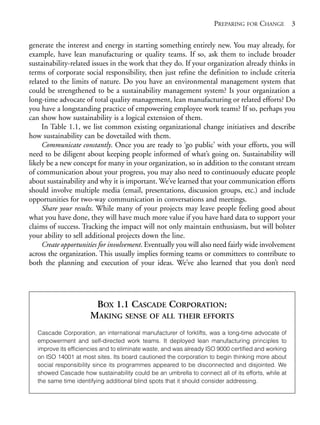
            polychlorinated biphenyls (PCBs) and dioxins than do their parents.
       •    A 2003 Centers for Disease Control study tested the blood and urine of 2500
            anonymous volunteers for 116 chemicals, with positive results found for 89 substances,
            including PCBs, dioxins, phthalates and pesticides (Centers for Disease Control and
            Prevention, 2003).
       •    In 1998, studies of Swedish breast milk showed that levels of flame retardants known
            as polybrominated diphenyl ethers (PBDEs) were doubling every two to five years.
       •    A study of 20 first-time mothers commissioned by the Washington-based
            Environmental Working Group found considerably higher PBDE levels in US women
            than those recorded in Sweden.
       •    Metabolic traces of some agricultural pesticides were noticeably higher in Mexican
            Americans than in African Americans or non-Hispanic whites, including several
            compounds now banned in the US, including DDT.
       Source: Centers for Disease Control and Prevention (2003); Steingraber (2001).
Chapter02.qxd   9/17/2008     6:38 PM     Page 27


                                                                            REFINING THE BUSINESS CASE 27


            Fisheries
            Look at the information below and consider the following questions:

            •   What is this likely to mean for the world?
            •   How does this interact with other global trends?
            •   What is this likely to mean for our area in the long term (within the life of our
                grandchildren)?
            •   What could we do in our region to deal with these trends (either to adapt and/or to
                reverse them)?
            •   What connections do you see between this issue and actions that we could or should
                take in our organization?

            Fish facts (according to the United Nations Millennium Ecosystem Assessment):

            •   At least one quarter of marine fish stocks are overharvested.
            •   The quantity of fish caught by humans was increasing until the 1980s, but now is
                decreasing due to the shortage of stocks.
            •   In some seas, the total weight of fish available to capture is less than one hundredth of
                that caught before industrial fishing operations.
            •   Inland fisheries have also declined due to overfishing, habitat degradation and water
                diversion; these are especially important sources of food for the poor.


                                            Million tons
                                            90
                                             80
                                             70

                                             60
                                             50

                                             40
                                             30
                                             20

                                             10
                                                 Global marine fish catches
                                              0
                                              1970 1975 1980 1985 1990 1995 2000

                                                     Figure 2.3 Fisheries
            Source: Millennium Ecosystem Assessment (2005).
Chapter02.qxd    9/17/2008       6:38 PM   Page 28


       28   THE STEP-BY-STEP GUIDE TO SUSTAINABILITY PLANNING


       Forests
       Look at the information below and consider the following questions:

       •    What is this likely to mean for the world?
       •    How does this interact with other global trends?


                             Forest area in million sq. kilometers
                            35


                            30


                                   Industrial
                                    regions
                            25


                            20    Developing
                                   regions


                            15


                            10


                                                         MA scenarios
                             5                               Order from Strength
                                                             Adapting Mosaic
                                                             TechnoGarden
                                                             Global Orchestration
                             0
                             1970 1980 1990 2000 2010 2020 2030 2040 2050

                                                 Figure 2.4 Forests

       Source: Millennium Ecosystem Assessment (2005).
Chapter02.qxd   9/17/2008   6:38 PM   Page 29


                                                                     REFINING THE BUSINESS CASE 29

            •   What is this likely to mean for our area in the long term (within the life of our
                grandchildren)?
            •   What could we do in our region to deal with these trends (either to adapt and/or to
                reverse them)?
            •   What connections do you see between this issue and actions that we could or should
                take in our organization?

            Forest facts
            According to a study by the World Resources Institute, almost one half of the Earth’s
            original forest cover is gone and only one fifth of the original cover remains as frontier
            forests – forests large enough to sustain substantial populations of indigenous species even
            when faced with natural disasters such as fire and storms (WRI, no date).
Chapter02.qxd   9/17/2008        6:38 PM     Page 30


       30   THE STEP-BY-STEP GUIDE TO SUSTAINABILITY PLANNING


       Population
       Look at the information below and consider the following questions:
       •    What is this likely to mean for the world?
       •    How does this interact with other global trends?
       •    What is this likely to mean for our area in the long term (within the life of our
            grandchildren)?
       •    What could we do in our region to deal with these trends (either to adapt and/or to
            reverse them)?
       •    What connections do you see between this issue and actions that we could or should
            take in our organization?
       Note: you may be able to get more current projections from the United Nations for your
       region from this website: http://esa.un.org/unpp/.


                           Teragrams of nitrogen per year
                           300

                                                                              Projected
                                                                             human input
                           250


                           200


                                           Range of terrestrial
                                                                           Total human input
                                            bacterial nitrogen
                           150              fixation (except in
                                            agroecosystems)

                                                                           Fertilizer and
                           100                                             industrial uses


                            50
                                                                           Nitrogen fixation
                                                                           in agroecosystems
                                                                           Fossil fuels

                             0
                             1900    1920       1940    1960      1980   2000                  2050

                                        Figure 2.5 Population projections
       Source: Millennium Ecosystem Assessment (2005).
Chapter02.qxd   9/17/2008     6:38 PM     Page 31


                                                                             REFINING THE BUSINESS CASE 31


            Nitrogen cycles
            Look at the information below and consider the following questions:

            •   What is this likely to mean for the world?
            •   How does this interact with other global trends?
            •   What is this likely to mean for our area in the long term (within the life of our
                grandchildren)?
            •   What could we do in our region to deal with these trends (either to adapt and/or to
                reverse them)?
            •   What connections do you see between this issue and actions that we could or should
                take in our organization?


                   Billion persons
                   14
                                                                                United Nations
                                                                                high scenario

                   12


                   10


                    8


                    6
                                                                                  United Nations
                                                                                   low scenario
                    4
                                                                            MA scenarios
                                                                                Order from Strength
                    2                                                           Adapting Mosaic
                                                                                TechnoGarden
                                                                                Global Orchestration
                    0
                    1900     1920    1940    1960     1980    2000   2020      2040    2060      2080   2100

                                         Figure 2.6 Human impacts on nitrogen
            Source: Millennium Ecosystem Assessment (2005).
Chapter02.qxd   9/17/2008    6:38 PM   Page 32


       32   THE STEP-BY-STEP GUIDE TO SUSTAINABILITY PLANNING

       Nitrogen facts:

       •    Humans now produce more biologically usable nitrogen than is produced by all
            natural processes.
       •    More than half of all the manufactured nitrogen fertilizer (first produced in 1913) has
            been applied since 1985.
       •    The flow of nitrogen into the oceans has doubled since 1860.
       •    Phosphorous has also increased in soils threefold between 1960 and 1990. The rate has
            declined a little since then; but phosphorous can remain in the soil for decades.
Chapter02.qxd   9/17/2008     6:38 PM      Page 33


                                                                               REFINING THE BUSINESS CASE 33


            Extinctions
            Look at the information below and consider the following questions:

            •   What is this likely to mean for the world?
            •   How does this interact with other global trends?
            •   What is this likely to mean for our area in the long term (within the life of our
                grandchildren)?
            •   What could we do in our region to deal with these trends (either to adapt and/or to
                reverse them)?
            •   What connections do you see between this issue and actions that we could or should
                take in our organization?

            According to the United Nations Millennium Ecosystem Assessment, the rate at which species
            are becoming extinct has increased dramatically. Projections show the rate taking a big leap
            in the next 50 years.


                      Extinctions per thousand species per millennium
                        100 000
                                    Distant past            Recent past         Future
                                   (fossil record)      (known extinctions)   (modeled)
                         10 000                                                           Projected future
                                                                                          extinction rate is
                                                                                          more than ten times
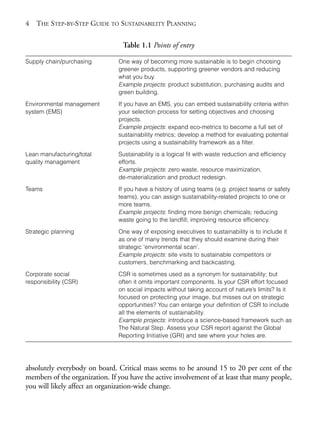
                                                                                          higher than current rate
                          1000

                                                                                          Current extinction rate
                            100                                                           is up to one thousand
                                                                                          times higher than the
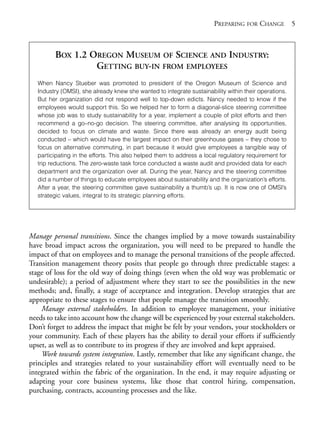
                                 For every thousand                                       fossil record
                                mammal species, less
                             10 than one went extinct
                                  every millennium


                              1
                                                                                          Long-term average
                                                                                          extinction rate
                            0.1


                              0
                                  Marine Mammals Mammals Birds Amphibians All species
                                  species


                                                Figure 2.7 Species extinctions
            Source: Millennium Ecosystem Assessment (2005).
Chapter02.qxd        9/17/2008     6:38 PM     Page 34


       34         THE STEP-BY-STEP GUIDE TO SUSTAINABILITY PLANNING


       SWOT analysis
       When to use. A strengths, weaknesses, opportunities and threats (SWOT) analysis has long been
       a fixture of strategic planning. Here you consider the SWOT related to sustainability. Use this
       after familiarizing yourself with sustainability. Then use Table 2.2 to organize your thinking.
            How to prepare. Pre-prepare a SWOT flipchart similar to that in Table 2.2.
            How to conduct. You can use this diagram to gather information from a general
       discussion or set up a more formal brainstorming process, such as a nominal group process.
       Explain the structure of the chart and the terms. Then prompt the group to provide
       specific examples under each of the four areas.
            How to debrief. In general, you want to leverage your strengths, invest in opportunities,
       divest yourself of, or correct, weaknesses, and manage risks associated with threats. You can
       develop a strategy around each of the four quadrants (see Table 2.2).

       Long-term sustainability strategy
       As we indicated in the background reading, it can be instructive to create a vision for three
       separate timeframes. Use Table 2.3 to prompt ideas and decisions. It may take a year or
       more to be able to fill in all the boxes.


                               Table 2.2 Sample SWOT chart (for a fictional gas utility)

                               STRENGTHS                                     WEAKNESSES
                   Knowledge of the energy industry.             Traditional thinking; staid industry.
       Internal


                   Connections/relationships with                No internal experts on hydrogen
                   every business and most homeowners            economy.
                   in our territory.
                                                                 No direct influence on fuel cell
                   Own the infrastructure and delivery system.   production.

                              OPPORTUNITIES                                     THREATS
                   Sell methane enriched with hydrogen           Climate change and awareness of it.
       External


                   for fuel cells.
                   Lease, install and maintain fuel cells.       Carbon taxes or cap and trade.
                                                                 Supply of natural gas dwindling.

                   Positive                                      Negative
Chapter02.qxd   9/17/2008      6:38 PM   Page 35


                                                                           REFINING THE BUSINESS CASE 35

                     Table 2.3 Strategies for three timeframes (for a fictional oil-drilling operation)

            Near term                        Intermediate term                Long term
            How are we going to              What is our unique               What could our organization’s role
            reduce the sustainability        contribution and role in         be in a fully sustainable society?
            impacts of our operations?       moving the world towards
                                             a sustainable society and
                                             what is a viable business
                                             model that supports this?

            Conduct a carbon                 Develop expertise around         Become a geothermal energy
            footprint analysis and           geothermal industries.           company instead of an oil-drilling
            reduce energy use.                                                company.
            Use bio-based lubricants.        Seek strategic partners          Drill for geothermal instead of oil
            Analyse fields based on          to build and maintain            and gas and operate geothermal
            the best carbon return on        geothermal plants.               plants.
            investment on a full
            life-cycle basis.

            Eliminate all flaring of
            natural gas.


            When to use. When an organization is ready to examine long-term implications of
            sustainability – this requires a willingness or need to ‘break’ the existing business model.
            This can be an effective way to get a group to talk about the ‘elephant in the room’: the
            unsustainable impacts that their organization causes.
                 How to prepare. Consider whether this is going to be a threatening or difficult task for the
            participants. If it is likely to be so, we suggest first doing the exercise for a few other industries
            in similar situations. For example, a natural gas utility might want to do this for a couple of
            other extractive industries. Prepare a flip chart similar to that in Table 2.3 with three blocks.
                 How to conduct this activity:

            1    Set the stage and create an openness to participate. Explain that this is a brainstorming-type
                 activity to generate ideas (this reduces defensiveness). Explain the three timeframes and the
                 main tasks associated with each. Emphasize that change is inevitable and that it’s better if
                 you anticipate the need to break your own business model than to have competitors do it
                 first. It can help to discuss some of the sea-change events in your organization’s history.
            2    If you have more than half a dozen people, break the group up into subgroups of four
                 to eight people and ask them to explore how they would answer each of the three
                 questions. Do the near-term first, then the long-term, and do the middle block last.
            3    Rotate amongst the groups to make sure that they are deepening their conversations.
Chapter02.qxd   9/17/2008   6:38 PM    Page 36


       36   THE STEP-BY-STEP GUIDE TO SUSTAINABILITY PLANNING

       How to debrief. Have each group report out. It’s often best to get all the near-term ideas on
       the flipchart from all groups. Then go back and gather the long-term ideas. Finally, get the
       intermediate-term ideas. Facilitate the free-wheeling conversation that usually ensues as
       radical ideas generate excitement or reaction. If desired, choose the ideas that generate the
       most excitement and flesh them out in more detail. What would be necessary to pull this
       off? What does this imply that you should be doing now? Who could help you?
Chapter03.qxd   9/17/2008     6:38 PM    Page 37


                                                             3
                         Creating the Vision of Sustainability


                                        CONCEPTS AND CASE EXAMPLES
            Until you know where you are going, it will be very difficult to get there. Once you have
            established the business case for pursuing sustainability, you need to create the vision of
            what a sustainable version of your organization will look like. The problem is that
            sustainability can be a confusing and ambiguous term. It seems that the more commonly
            it is bantered about, the more open to interpretation it becomes. While the most widely
            accepted definition from the Brundtland report makes intuitive sense to people, there
            seems to be general confusion when it comes to applying it to individual organizations
            (WCED, 1987).


                                BOX 3.1 THE BRUNDTLAND COMMISSION
                                        DEFINITION OF SUSTAINABILITY

                The Brundtland Commission, officially known as the World Commission on Environment and
                Development (WCED), but more commonly referred to by the name of its chair, Gro Harlem
                Brundtland, was convened by the United Nations in 1983. The commission was created to
                address a growing concern about the accelerating deterioration of the environment and the
                consequences of that deterioration on economic and social development. The report
                generated by the commission contains the most frequently quoted definition of sustainability:
                ‘Meeting the needs of the present generation without compromising the ability of future
                generations to meet their needs’ (WCED, 1987).


            Until the members of your organization have a common understanding of what you are
            trying to achieve, it will be very difficult to move your organization forward with a
            concerted effort. It is important, then, to begin your initiative with the selection or
            creation of a framework for sustainability – something that will define sustainability in
Chapter03.qxd       9/17/2008    6:38 PM    Page 38


       38       THE STEP-BY-STEP GUIDE TO SUSTAINABILITY PLANNING

       meaningful and actionable terms and help you to establish a shared vision of what you are
       trying to achieve. Specifically, a framework should fulfil these five needs:

       1        Provide a common language. You will certainly want everyone in the organization to
                understand the terms, concepts and the nuances involved in sustainable business
                practices.
       2        Inspire a future vision. Your framework will also help you to craft a vision for what
                your organization will look like in a sustainable future: what it will be doing and not
                doing, how it will be relating to its industry and community, and how its business
                model might change.
       3        Suggest standards and/or guidelines. A good framework will provide you with
                standards and principles that help you to translate the concept of sustainability into
                actionable ideas. The best ones help define what ‘there’ looks like and give you
                standards against which you can measure your progress.
       4        Outline priorities and approaches. While it is not always the case, many frameworks
                also outline strategies for progressing towards sustainability that will make an
                important contribution to the challenging task of prioritizing and scheduling your
                activities.
       5        Suggest metrics. Ultimately, you will want a set of high-level measures that will help
                you to track your progress. A good vision should help you know what to measure.

       The plethora of sustainability frameworks, guidelines, checklists and tools contribute to
       the general confusion about sustainability. While the intentions have been good, the
       resulting laundry list has only made it more difficult to share mental models and
       communicate. Unfortunately, when fields are new, there tends to be an explosion of
       approaches that coalesce over time.


                 BOX 3.2 COMMON SUSTAINABILITY FRAMEWORKS AND                               TERMS

            Frameworks include:

            •     The Natural Step;
            •     triple bottom line (sometimes referred to as economy, environment and community)/three
                  Es (economy, environment and social equity);
            •     corporate social responsibility (CSR)
            •     Herman Daly’s triangle.
Chapter03.qxd   9/17/2008     6:38 PM     Page 39


                                                               CREATING THE VISION OF SUSTAINABILITY 39


                Principles comprise:

                •   Earth Charter;
                •   Caux Roundtable for Business;
                •   Caux Roundtable for Government;
                •   Talloires Declaration;
                •   United Nations Global Compact;
                •   Equator Principles;
                •   Hannover Principles;
                •   Agenda 21;
                •   precautionary principle;
                •   product stewardship/extended producer (or product) responsibility (EPR)
                •   biomimicry;
                •   natural capitalism;
                •   industrial ecology;
                •   smart growth (as in urban planning);
                •   Coalition for Environmentally Responsible Economies (CERES)
                •   United Nations Millennium Development Goals (MDGs).

                Sector-specific standards, certification and eco-labelling are represented by:

                •   Leadership in Energy and Environmental Design (LEED);
                •   Food Alliance;
                •   organic farming/produce;
                •   biodynamics;
                •   Forest Stewardship Council;
                •   Sustainable Forestry Initiative (SFI);
                •   Marine Stewardship Council;
                •   Green Seal;
                •   Electronic Product Environmental Assessment Tool (EPEAT);
                •   environmental management systems/ISO 14000;
                •   Social Responsibility ISO 26000;
                •   Social Accountability (SA) 8000
                •   AccountAbility (AA) 1000
                •   energy-using products (EuP);
                •   Waste Electrical and Electronic Equipment Directive (WEEE);
                •   Registration, Evaluation, Authorization and Restriction of Chemicals (REACH);
                •   European Union Restriction of Hazardous Substances Directive (RoHS);
                •   Green Globe.

                Analytical strategies include:

                •   life-cycle assessment;
                •   life-cycle costing;
Chapter03.qxd      9/17/2008    6:38 PM    Page 40


       40       THE STEP-BY-STEP GUIDE TO SUSTAINABILITY PLANNING


            •    design for environment or eco-design;
            •    total cost assessment;
            •    ecological footprint;
            •    conservation economy.

            Reporting and measurement/metric tools comprise:

            •    Global Reporting Initiative (GRI);
            •    Genuine Progress Indicator;
            •    World Business Council on Sustainable Development (WBCSD) Greenhouse Gas Protocol.


       Hierarchy of frameworks and tools
       To help make sense of these frameworks, we’ve organized them into a hierarchy. Each level
       in the hierarchy serves a different function and each has its strengths and weaknesses with
       regard to its use as an organizing structure or set of principles.
            Laws of nature. At the top of the hierarchy are the immutable laws that nature imposes
       on us. They are unalterable and impossible to ignore. Gravity is a good example. It’s
       economically inconvenient when you think about it. Consider how much cheaper
       construction would be if our designs for buildings and bridges didn’t have to account for
       it. And air transportation would be a snap! No one is dumb enough to ignore this


                                                          Laws of
                                                          Nature


                                                     Frameworks


                                                         Principles


                                               Standards & Conventions


                                   Figure 3.1 Hierarchy of sustainability models
Chapter03.qxd   9/17/2008     6:38 PM    Page 41


                                                              CREATING THE VISION OF SUSTAINABILITY 41

            particular law, however, probably because the consequences of doing so are immediately
            felt. But we have chosen to ignore many of the other laws of nature as if they didn’t apply
            to us. We pretend, for instance, that many of the laws of thermodynamics don’t matter and
            that we can continue to use natural resources as if they are limitless (Law of Conservation
            of Mass and Energy) or throw toxins into our water bodies as if they will flow away and
            never come back (Law of Entropy). While we would all benefit from a better
            understanding of these laws, the sophistication of the science necessary makes them a bit
            unapproachable and difficult to interpret when it comes to making business decisions.
                  In addition to the laws that govern our physical environment, there are also laws of
            ‘human’ nature. These form the basis of human behaviour. While people are influenced by
            their cultures and locations, there is believed to be a common set of human needs that cuts
            across race, gender and geography. These human needs are in-born requirements that must
            be satisfied in order for people to remain healthy – physically, mentally and socially. When
            these basic needs are not met, our societies and economies become unsustainable. Manfred
            Max-Neef has perhaps done the best job of summarizing these needs by examining cultures
            around the world and identifying nine fundamental human requirements: subsistence;
            protection; affection; understanding; participation; recreation; creation; identity; and
            freedom. As with the physical laws of nature, we have discovered the unpleasant and often
            dangerous consequences of ignoring these basic social requirements.


                A number of sustainability books refer to Max-Neef’s work, including:

                •   Anielski, M. (2007) The Economics of Happiness: Building Genuine Wealth, New Society
                    Publishers, Gabriola Island, BC, Canada
                •   Hallsmith, G. (2003) The Key to Sustainable Cities: Meeting Human Needs, Transforming
                    Community Systems, New Society Publishers, Gabriola Island, BC, Canada


            Frameworks. Several conceptual frameworks have emerged to help us translate the laws of
            nature into understandable rules or constructs. Perhaps the clearest among them is The
            Natural Step framework that posits four system conditions that define the rules by which
            we need to live in order to be sustainable. They are written like commandments in that
            they describe the actions that we must not continue to do. They also benefit from scientific
            scrutiny, having been vetted by a rigorous process of scientific peer review. Organizations
            can fairly easily compare their processes and practices to the four system conditions and see
            specifically where they are with regards to violation.
                Similarly comprehensive, though not as thoroughly supported by science, are the
            frameworks based on the popular triple bottom line: social, economic and environmental
Chapter03.qxd      9/17/2008     6:38 PM     Page 42


       42       THE STEP-BY-STEP GUIDE TO SUSTAINABILITY PLANNING

       health. We have found that talking about sustainability from this frame makes intuitive
       sense to businesses and gives a specific and reassuring nod to the importance of economic
       viability to the concept of sustainability.
            Principles. The next level in the hierarchy contains a large collection of guidelines that
       have attempted to specify the actions needed in individual industries or sectors. These are
       an additional step removed from the laws of nature because they are someone’s
       interpretation of what should be done. They have the benefit of being easy to understand
       and specific to particular situations, but suffer from the dilution of interpretation.
       Sustainability is a systems issue and it is easy to get tunnelled into a few key issues, running
       the risk of missing the comprehensive picture.
            Standards and constructs. At the bottom of the hierarchy are the tools and strategies that
       are very useful when it comes to implementation. Included here are the standards against
       which industries can compare themselves (e.g. the organic standard for agriculture) and
       tools that help resolve specific problems (e.g. life-cycle assessments to help businesses root
       out the sources of pollution and waste). We also include reporting protocols (e.g. the
       Global Reporting Initiative) that provide specific directives to organizations. While they
       make an important and useful contribution, used in isolation they can contribute to a
       myopic approach to sustainability and obscure the big picture entirely.


                  BOX 3.3 THREE APPROACHES                    TO DEFINING SUSTAINABILITY

            There is no one right framework or set of principles with regards to sustainability; but there are
            those that are more or less appropriate or relevant to your organization. The three case studies
            that follow illustrate how organizations develop hybrid versions that fit their own cultures.
                  SERA Architects in Portland, Oregon, was an early convert to sustainability. It began its
            journey through its exposure to The Natural Step. While the framework seemed to fit the company’s
            needs generally, it adapted the language of the system conditions to speak more meaningfully to
            its employees. SERA Architects now define the four rules by which it operates as:

            1    Choose: are the choices I make fair and equitable?
            2    Take: can the Earth replace what I take?
            3    Make: am I poisoning the Earth, water or air?
            4    Respect: do I respect the biodiversity of flora and fauna?

            The Oregon Museum of Science and Industry liked The Natural Step, as well. As a science
            museum, the notions of the systems conditions spoke to the science mindset of the organization.
            It didn’t feel, however, that the four system conditions represented a balanced set of principles
            and therefore married the TNS framework with the triple bottom line framework. The museum uses
            three of the four system conditions as part of the way in which it defines its environmental vision
Chapter03.qxd     9/17/2008     6:38 PM     Page 43


                                                                  CREATING THE VISION OF SUSTAINABILITY 43


                  for the organization, but specifically added elements to the social realm and included explicit
                  mention of the economic to ensure that it didn’t lose focus on its mission to educate and the need
                  to stay financially stable. We encouraged the museum to identify both internal and external
                  elements within the triple bottom line. Otherwise, the economy often becomes interpreted
                  narrowly as profitability, ignoring other positive economic impacts that the organization can have
                  on the community in terms of jobs, new industry clusters and local purchasing. Table 3.1 shows
                  common metrics if you merge the triple bottom line and The Natural Step.


                               Table 3.1 The Natural Step imbedded in the triple bottom line

                                   Social                   Economic                         Environmental
                Internal           Employee                 Financial stability/             Energy efficiency
                                   satisfaction             profits                          Zero waste
                                                                                             Low toxicity

                External           TNS system               Sustainable economic             TNS system conditions
                                   condition 4:             development                      1 to 3: climate neutral
                                   human needs              Local purchasing                 Zero toxic emissions
                                                                                             Sourcing from
                                                                                             sustainable stocks


                  Stonyfield Farms, which makes yogurt in New Hampshire, is an organization that was founded
                  on socially responsible principles. For them, sustainability didn’t feel like something new or
                  different, just another way to express what they have been about all along. The logical
                  framework for them was to use their existing mission and values statements, adjusting the
                  language to ensure that they included the nuances of sustainability.
                        Stonyfield Farms’ Mission Statement:

                  •   Produce the very highest quality all natural and certified organic products that taste
                      incredible.
                  •   Educate consumers and producers about the value of protecting the environment and of
                      supporting family farmers and sustainable farming methods.
                  •   Serve as a model that environmentally and socially responsible businesses can also be
                      profitable.
                  •   Provide a healthful, productive and enjoyable workplace for all employees, with
                      opportunities to gain new skills and advance personal career goals.
                  •   Recognize our obligations to stockholders and lenders by providing an excellent return on
                      their investment (Gray and Balmer, 2004).

                  This mission has been honed to three principles: healthy food, healthy people and healthy
                  planet. Stonyfield developed metrics to track its impacts upon all of these areas.
Chapter03.qxd     9/17/2008      6:38 PM     Page 44


       44     THE STEP-BY-STEP GUIDE TO SUSTAINABILITY PLANNING


       Long-term visioning
       While there are many current and urgent issues (such as climate change) that may attract
       our immediate attention, sustainability requires systems thinking and keeping the long
       term in view. Considering too short a perspective leads us to implement strategies that are
       equivalent to rearranging the deck chairs on the Titanic. Once organizations understand
       sustainability and all that it entails, we present three different timeframes and ask them to
       grapple with the implications of each.
            Near term. This is where most organizations start (and, unfortunately, sometimes end).
       In this perspective, organizations hold their current practices up to their chosen framework
       and determine where they are out of alignment. This process (as described in more detail
       in Chapter 4) focuses primarily on the near term by assessing major impacts and
       identifying priorities for immediate action. While this is critical and necessary work, it’s
       important to remember that in the big picture it is likely insufficient. After all, doing the
       unsustainable thing more efficiently won’t get us to sustainability.
            Long term. At some point, every organization should grapple with its business model.
       People begin to see what it really means to be fully sustainable and this often requires major
       changes to the business model. As we tell our clients, better that you break your own business
       model in a planned way than have someone else do it for you! For most organizations, this
       vision won’t easily be attained for a decade or more. But the vision begs the questions: is what
       the organization does fundamentally sustainable? Is there a place for this product or service
       in a sustainable world? What will be the role of this organization in a sustainable society? The
       answers may suggest a radically new business model. No organization likes to think of itself
       as a dinosaur; but sustainability will upend many of our existing markets.
            The transition. The space between the immediate situation and the sustainable future in
       which the organization’s model could be in jeopardy is the area where real strategic planning
       takes place. This step contains the path forward: the connection between the existing
       business model and the one that fits a sustainable world. Later in this chapter we provide an
       exercise for navigating this transition and increasing the likelihood that the organization will
       have a place in our future (see also ‘Long-term sustainability strategy’ in Chapter 2).


                      BOX 3.4 NW NATURAL                   TAKES ON CLIMATE CHANGE

            Of all the industries that would want to take a see-no-evil approach to climate change, natural
            gas utilities would have to be near the top of the list. Unlike electric utilities or combined
            electricity and gas utilities, they can’t tout wind power or solar. But one of our clients, NW
            Natural, a natural gas utility, looked at its long-term vision and was brave enough to confront the
Chapter03.qxd   9/17/2008      6:38 PM     Page 45


                                                                 CREATING THE VISION OF SUSTAINABILITY 45


                fact that it sells a greenhouse gas (methane) for a living. Exploring that dilemma openly, talking
                about it with employees, has unleashed a wave of excitement and innovation. It seems that
                employees are relieved to have the topic out in the open and are eager to help find solutions.
                They are working to track the carbon dioxide (CO2) associated with the company’s operations
                and are developing programmes to reduce the climate impacts of their core product.
                      Like BP in the oil industry, NW Natural led natural gas utilities in the US to deal publicly
                with climate change. It catalysed a trend among natural gas utilities to decouple rates from
                usage, enabling them to promote energy efficiency without hurting their bottom line. NW
                Natural, then, was the first stand-alone natural gas utility to offer a carbon product: Smart
                Energy allows customers to offset the emissions associated with their gas use while helping to
                promote the use of biodigesters on dairy farms. Its nickname is cow power.
                      NW Natural has developed a nuanced intermediate strategy that helps its bottom line.
                Natural gas is the cleanest of the fossil fuels; in addition, when fuel is used at the source rather
                than to generate electricity, customers can reduce their greenhouse gas emissions by over
                20 per cent. Its ad campaign, which explains these concepts, has received national
                recognition. Its efforts to help its customers use less and then to offset what remains, using its
                Smart Energy programme, puts it in a conversation with its customers about efforts to reduce
                their carbon footprint. NW Natural has not yet figured out what variety of businesses it will be
                in long term; but it reminded its employees how many different businesses it’s been in its 148-
                year history, so it has confidence that it can find a way forward. It knows its current business
                model is unsustainable, but is eager to reinvent itself once again.


            Tips for establishing a vision
            •    If the list of framework options is too daunting to examine, consider basing your
                 conversation on the three most commonly used frameworks: triple bottom line, The
                 Natural Step or the Global Reporting Initiative (GRI). Many of our clients end up
                 using one or some combination of these three. The GRI is particularly relevant to large
                 international organizations that will be expected, at some point, to produce a
                 sustainability report for international audiences. The Natural Step is effective at
                 translating the science of sustainability into concepts that people understand, but
                 admittedly appears to be weighted towards environmental considerations.
            •    However you go about defining sustainability for your organization, be sure to maintain
                 a systems perspective and don’t fall prey to ‘tunnel’ vision. It’s easy to get caught up in
                 one or two important sustainability issues (e.g. climate change); but sustainability is
                 about more than the issue du jour. Make sure that you address the full definition of
                 sustainability and that you give equal weight to the three areas of consideration:
                 economic sustainability, environmental sustainability and social sustainability. Trading
                 any one off for the other two violates the basic premise behind the concept.
Chapter03.qxd     9/17/2008      6:38 PM      Page 46


       46     THE STEP-BY-STEP GUIDE TO SUSTAINABILITY PLANNING

       •     Imagining a sustainable version of your organization can frequently seem fantastic.
             Don’t let the seemingly impossible task of achieving true sustainability deter you from
             putting the necessary dramatic stake in the ground. You can be honest – that the vision
             is likely in the distant future (15 to 20 years); but it is critical to set the target high
             because that’s what it will take. We are all a long way from sustainability now; but
             what’s the alternative? We have to shoot high.
       •     Postpone the new business model conversation. Asking people to think about the
             fundamental premises of their businesses is daunting and often literally unthinkable at
             first. Eventually, once people come to truly understand sustainability, it becomes
             impossible to ignore and much easier to imagine.


                                 BOX 3.5 FORT LEWIS ARMY BASE
                            AND BIG, HAIRY AUDACIOUS GOALS (BHAGS)

            Fort Lewis Army Base in Washington State assembled a broad group of stakeholders to help
            them set goals related to sustainability as part of their environmental management system.
            What resulted were ambitious big, hairy audacious goals (BHAGs) grounded in natural laws:
            create zero net waste, recover all listed and candidate endangered species in the South Puget
            Sound region, reduce potable water use by 75 per cent and contribute zero pollutants to
            groundwater. Their sustainability programme has saved them over US$1 million dollars in direct
            cost savings or cost avoidance. They have also eliminated 89 tonnes of hazardous material
            and reduced their greenhouse gas emissions by 78 tonnes. Their forestland is now certified as
            sustainable by the Forest Stewardship Council.

            Source: Hitchcock and Willard (2006)


                            BOX 3.6 HAWAII 2050 SUSTAINABILITY PLAN
            In 2007, Hawaii engaged its community in a long-range planning process involving over
            10,000 residents. The process included web surveys, community meetings, public opinion
            polling and opportunities for youth involvement. Involving the public so extensively was time
            consuming and created a lot of work, but was worth it in the end. All of this public input is what
            makes the document alive. The final plan includes a list of nine priority actions with interim
            benchmark goals. At the time of writing, the plan is going through the legislative process to be
            codified into law and to create a sustainability council to ensure accountability. You can learn
            more about Hawaii’s plan and approach at www.hawaii2050.org.
Chapter03.qxd   9/17/2008       6:38 PM     Page 47


                                                                  CREATING THE VISION OF SUSTAINABILITY 47


                                                          RESOURCES
                Please see Appendix A of our last book, The Business Guide to Sustainability (Hitchcock and
                Willard, 2006) for a listing of common sustainability frameworks and when they are most useful.
                In addition, these resources may be helpful:

                •     Cook, D. (2004) The Natural Step: Towards a Sustainable Society, Green Books, Bristol,
                      UK;
                •     Edwards, A. R. (2005) The Sustainability Revolution: Portrait of a Paradigm Shift, New
                      Society Publishers, Gabriola Island, BC, Canada;
                •     EPA (2007). ‘State of the Environment (SoE) reporting frameworks’, Environmental
                      Protection Agency of South Australia, www.epa.sa.gov.au/soe_frame.html, accessed 26
                      August 2008.
                •     Robert, K. H., Schmidt-Blee, B., Aloisi de Larderel, J., Basile, G., Jansen, J. L., Keuhr, R.,
                      Price Thomas, P., Suzuki, M., Hawken, P. and Wackernagel, M. (2002) ‘Strategic
                      sustainable development: Selection, design and synergies of applied tools’, Journal of
                      Cleaner Production, vol 10, pp197–214.


                                            METHODS AND INSTRUCTIONS
            In this section, we explain four processes that can help you to clarify your vision for
            sustainability (see Table 3.2).

            Framework-based visioning
            When to use. This simple approach would be best if you have landed squarely on a clearly
            defined framework. If the framework by itself inspires a clear picture or definition, this
            exercise could quickly get you to the vision you need.
                How to prepare. Make sure that the people participating in this process have a clear and
            shared understanding of sustainability and the framework that you have chosen. This might
            require conducting a briefing or training session in advance of implementing the activity.
                How to conduct this activity:

            1       Explain the framework that you have chosen for your organization.
            2       Examine the model and add any criteria, issues or priorities that are relevant to your
                    organization or your situation. What criteria define sustainability for your
                    organization? Are there social/environmental/economic issues that have special
Chapter03.qxd    9/17/2008    6:38 PM    Page 48


       48   THE STEP-BY-STEP GUIDE TO SUSTAINABILITY PLANNING

                             Table 3.2 Overview of methods for creating the vision

       Process                            When to use
       Framework-based visioning          This simple approach would be best if you have landed
                                          squarely on a clearly defined framework. If the framework by
                                          itself inspires a clear picture or definition, this exercise could
                                          quickly get you to the vision you need.

       Threats and opportunities          Use this approach if you feel you might have trouble getting
                                          your colleagues to ‘think outside of the box’ and be truly creative
                                          and open to new ways of thinking about the organization.

       Backcasting                        Often part of The Natural Step framework, backcasting is useful
                                          for organizations that are ready to challenge their business
                                          model. Its strength is in defining the ‘end game’ so that you
                                          can more clearly distinguish between decisions that lead to
                                          greater possibilities versus those that lead to dead ends.

       New business model                 This activity is appropriate to use when you are ready to
                                          consider the possibility of a radically different future. Often,
                                          organizations find this too daunting to do at the very beginning;
                                          but at some point it may be necessary to consider a future in
                                          which your current business changes significantly.


            relevance or priority for your industry or business? Does the framework sufficiently
            reflect the values of your organization?
       3    Test the model/definition. Does it address all three aspects of sustainability? Are they
            appropriately or evenly weighted?
       4    Consider the implications of the framework to your organization both in terms of its
            internal operations and its relationship with the external world, including your
            customers, your community and your other key stakeholders. Ask what your
            organization will necessarily look like in 20 years when it is in complete alignment with
            the framework. What will you be doing and not doing?
       5    What do your answers to the previous set of questions imply about metrics you will
            track to determine your progress towards this vision?


       Threats and opportunities
       When to use. People often have difficulty thinking creatively about their own
       organizations. This activity loosens people up by asking them to examine the threats and
Chapter03.qxd   9/17/2008   6:38 PM   Page 49


                                                          CREATING THE VISION OF SUSTAINABILITY 49

            opportunities for other businesses first. If you include examples of businesses important to
            your region or supply chain, it can have the added benefit of examining trends that might
            indirectly affect your operation.
                 How to prepare. Make duplicates of the worksheet and put different organization or
            industry names at the top of each form. Choose industries that are important to your
            region or operation and ones that allow you to make certain points. For example, when
            doing this with a natural gas utility, we included a number of extractive industries. If the
            organization is not likely to be familiar to the audience, explain it as we have in this
            example. We typically use a company from high-tech, food service, retail, transportation
            and agriculture. The worksheets are based on The Natural Step framework, so you may
            want to change the questions if you choose another framework.
                 How to conduct the activity. If needed, remind the audience of The Natural Step’s
            system conditions (or whatever framework you have chosen). Break people into small
            groups (four to six people each) and give each group a worksheet. Go over the instructions
            and give them approximately 15 minutes to work through the questions. You may want to
            do this in two rounds. First, use the worksheets for other organizations and then do the
            same process for your own.
                 How to debrief the activity. Ask each group (or several groups if you don’t have time to
            do them all) to report on their biggest sustainability issue and best sustainability
            opportunities (one to three). If needed, stretch their thinking by engaging others in the
            audience. For example, with an extractive industry such as oil drilling, we often explain
            that your core competence is the ability to find special geological features and then drill
            really long holes to reach them. How else might you use this core competency to support
            rather than detract from sustainability? Answers often include developing expertise in
            geothermal energy and carbon sequestration. Often, if you engage the whole audience, you
            can quickly generate a handful of possible new business models for each organization. This
            is empowering: it leaves the audience with the impression that if they can come up with
            viable models for all of these other businesses, perhaps they can do it for themselves.
                 Based on your discussion of the questions in Table 3.3:

            •   What are the two most pressing sustainability issues facing this organization (in other
                words, what is the funnel wall going to look like for them)?
            •   What are the two most intriguing business opportunities that relate to sustainability?

            Backcasting
            When to use. Backcasting is a rigorous process that returns a well-tested approach to
            sustainability.
Chapter03.qxd   9/17/2008       6:38 PM   Page 50


       50   THE STEP-BY-STEP GUIDE TO SUSTAINABILITY PLANNING


                      Table 3.3 Sample threats and opportunities worksheet from Veco
                  (an engineering firm involved in oil and natural gas exploration projects)

       System condition 1:            How dependent is this organization upon fossil fuels or other
       from the crust                 materials from the Earth’s crust?

                                      How might climate change, or our response to it, affect this
                                      organization?

       System condition 2:            In what ways is this organization dependent upon toxic chemicals?
       human-made substances          What other human-made substances are important to its success?

       System condition 3:            What natural resources are important to this organization?
       productivity of nature         What is the current and likely future status of those resources?

       System condition 4:            What are the unintended human side effects from this organization
       human needs                    (internally, nationally and internationally?
                                      In what ways might this organization be affected by current and
                                      future social challenges (e.g. aging of the population, population
                                      growth and poverty)?


       How to prepare. Where possible, gather rough data that you might have about the
       organization’s current impacts. For example, purchasing records indicate general
       consumption of materials and utility bills, and travel records indicate energy consumption.
           How to conduct this activity. Backcasting is generally associated with The Natural Step
       process, where it is often referred to as the ABCD process. Instead of forecasting from the
       current state, backcasting involves envisioning a fully sustainable future and then working
       backwards to get to that positive future. The four steps in the ABCD process are:

       1    Awareness: provide training and education about sustainability and The Natural Step
            framework.
       2    Baseline mapping: map the organization’s ‘violations of the system conditions’. The
            simplest way to do this is to create a flip chart for each of the four system conditions
            and ask: ‘In what ways are we not living up to this rule yet?’
       3    Create a vision: describe the organization in a fully sustainable state, not worrying
            about the technology or cost to get there.
       4    Down to action: work back from the vision to define the incremental steps needed to
            get there.

       There are typically a number of steps and different processes that people use to do this
       backcasting process and, to some degree, they overlap with other steps in this book. Rather
Chapter03.qxd   9/17/2008   6:38 PM   Page 51


                                                          CREATING THE VISION OF SUSTAINABILITY 51

            than duplicate all of the material here, we refer you instead to the organization itself:
            www.naturalstep.org.

            New business models
            When to use. Use this approach when your organization is ready to consider the far-
            reaching impacts of sustainability and think creatively and openly about radically different
            business models.
                How to prepare. Where possible, research other organizations in different industries
            that have made dramatic changes to their business models to share as examples.
                How to conduct this activity. We suggest basing this planning process on three critical
            questions:

            1   What are the relevant trends that are likely to impact upon the organization’s viability?
                Climate change, resource depletion and carbon-related regulation, for example, will all
                have tremendous impacts upon the gas utility mentioned above (see Table 3.3). All
                three of these trends have sufficient momentum behind them that are unlikely to
                dissipate in the next decade. The utility’s job is to play these trends out and identify
                the threats and opportunities that they present, individually and collectively.
            2   What are the organization’s core competencies? This assessment is intended to reveal
                the assets that the organization has which it can leverage. For the utility mentioned (see
                Table 3.3), these assets include a mature gas distribution infrastructure, a loyal
                customer base and a solid hold on its niche in the energy market.
            3   What is the sustainable intersection between the competencies and the trends? An
                organization needs to discover a path between the current state and a sustainable future
                that leverages its assets and aligns with the conditions of a sustainable world. Our
                utility, for example, is in a good position to lease home fuel cells, which will likely be
                fuelled by natural gas (at least in the near future). This business model creates a path
                that leverages its competencies while evolving the business to one that has a solid
                footing in a sustainable economy.

            In order to help people with this last step, introduce them to four different strategies that
            might inspire new ideas:

            1   Product-to-service migration. If you are an organization that produces a tangible
                product, ask people to consider how that might be transformed into a service. For
                example, Interface Carpet realized that people don’t really want to own carpet. What
                they want is a comfortable and attractive surface on which to walk. This framing
Chapter03.qxd   9/17/2008    6:38 PM    Page 52


       52   THE STEP-BY-STEP GUIDE TO SUSTAINABILITY PLANNING

            helped them to create their carpet leasing programme in which they install and service
            carpet tiles in their customers’ buildings. Since the goal is to maximize the life of the
            carpet rather than encourage customers to replace their carpets frequently with new
            ones, the company minimizes its consumption of materials while still maintaining a
            profitable business model.
       2    Cradle-to-cradle design or strategies. Ask people to consider how their product or service
            might look or operate if it were part of a continuous loop of consumption. Your
            product or service would never end up in or contribute to the creation of waste as we
            know it and would make the fullest and most efficient use of materials already abundantly
            available in our biosphere.
       3    Biomimicry. Ask your participants to consider how nature would run your business. If
            you were forced to mimic natural cycles and technologies, what would it look like?
       4    Regeneration and restoration. Eventually being truly sustainable is not about being less
            bad. Ask your participants to consider how they might go about sustaining the
            economic success of the organization, while at the same time adding value to the
            natural systems.
Chapter04.qxd   9/17/2008   6:38 PM    Page 53


                                                          4
                            Identifying Impacts and Priorities


                                      CONCEPTS AND CASE EXAMPLES
            Chapter 3 coached you through the creation of a vision for a sustainable version of your
            organization. Once you are clear about where you are going – your goal state – you will
            need to take stock of how close or far you are from that vision. This taking stock, which
            we call an impact assessment, examines the relationship that your organization has with the
            environment, the society within which it operates, your suppliers, customers and other
            members of your industry. In short, it is an examination of what you take from the
            environment and society, what you do with what you take, and what you contribute in the
            end (both good and bad) to the environment, society and your industry.
                 Some organizations, especially those in the service or non-profit sector, don’t often
            think of themselves as having environmental or social impacts. After all, there are no
            belching smoke stacks on top of their offices, no trucks unloading precious resources at
            their doors, nor any raggedly dressed children working in the back office. Nonetheless,
            conducting an impact assessment, even on a service organization, can be very revealing.
            Every organization, for instance, makes use of energy and materials, moves documents and
            people and makes choices that have rippling effects beyond their office doors. Service
            organizations, in particular, shape the behaviour of the customers whom they serve.
            Insurance companies, for example, may not be the biggest consumers of natural resources,
            but they have a huge impact upon how sustainably their customers behave. They influence
            whether people locate homes in floodplains or fire zones, what kinds of cars people choose
            to drive and how they drive them, and what health-impacting lifestyle choices they make.
            All service-sector businesses (e.g. banks, architects, restaurants and law firms) influence the
            behaviour and choices of their customers and can, through their own practices and
            policies, determine whether or not people make more sustainable choices.
                 In addition, every organization participates in an industry sector (e.g. manufacturing,
            government, service and high tech). Many of its impacts are determined by the
            conventions and practices inherent to that industry. In addition to cleaning up its own act
            and helping its customers to behave more sustainably, an organization should consider how
            it can influence its industry to bring policies, practices and, where appropriate, legislation,
Chapter04.qxd   9/17/2008    6:38 PM    Page 54


       54   THE STEP-BY-STEP GUIDE TO SUSTAINABILITY PLANNING

       into alignment with the principles of sustainability. As an example, we discovered a law
       firm in New York City that was operating virtually without paper. This was only possible
       because conventions had evolved in their area of law to allow electronic signatures on
       binding contracts. If the profession truly wants to move towards paperless operations, then
       it will have to negotiate similar agreements across all the fields of law.

       Multilevel approach to analysing impacts
       An impact analysis can be done at several levels. If you are just beginning the process, we
       recommend starting with one of the high-level processes described below. These macro-
       level assessments take a broad look at your operations and identify the major categories of
       impacts. Once this is done, you will have a better idea of where you need to drill down a
       level to gather more specific data to support the educated guesses you make at the higher
       level, or gather baseline data in preparation for action items. As your sustainability efforts
       mature, you may find it useful or necessary to conduct a detailed life-cycle assessment of
       one or more of the products that you make or use. This level of analysis can give you the
       information you need to make choices for material procurement or product/service design.

       Look beyond the obvious
       Sometimes an activity has more of an impact than is immediately apparent. One of our
       clients, another legal firm, understood that it was a big consumer of paper (in fact, if you
       stacked the reams it used each year, the stack would be as tall as a 22-storey skyscraper!). It
       knew that paper consumption was one impact it could reduce through a variety of changes
       in employees’ work habits. Upon further investigation, however, it began to realize that
       saving paper was just the tip of the benefits iceberg. In addition to saving an estimated
       US$20,000 on paper purchases each year, the firm discovered that by migrating to
       electronic file management, it would save on rent (file cabinets take up a good deal of
       valuable real estate), support time (all of the staff hours dedicated to retrieving and re-filing
       documents after they passed through attorney hands) and process inefficiency (by working
       electronically, a file never got lost or was unavailable because it was checked out by a single
       person; in fact, multiple people could simultaneously work on an electronic file,
       magnifying everyone’s productivity).

       Reveal new sources of process inefficiency
       Viewing activities through the lens of sustainability also reveals waste that has gone
       unnoticed. An engineering firm also sought to reduce its paper consumption. When it
       examined its processes, it discovered that most of the printing was done in association with
Chapter04.qxd   9/17/2008   6:38 PM   Page 55


                                                              IDENTIFYING IMPACTS AND PRIORITIES 55

            the creation of ‘check sets’ – sets of documents that were printed for quality checks. Some
            projects went through as many as 35 check sets before the project was completed. This
            represented more than a waste of paper: it represented a process flaw and a lack of
            standardization around the points where it was necessary to check for accuracy. By
            establishing project conventions, the firm could save a good deal of billable staff time as
            well as paper by systematizing the process.

            Go beyond your gates
            When assessing their footprints, organizations often overlook the impact of their products
            after they are shipped to customers. In many cases, use and disposal of products dwarf
            manufacturing impacts. Electrolux, maker of home appliances, discovered this when
            conducting a life-cycle analysis of its washing machines. The biggest impact was not in
            production or delivery, but in the millions of gallons of water – much of it hot – that their
            machines used during their lifetime. While at first it may seem as if you don’t have control
            over how customers use your products, you actually have two opportunities to influence
            them. Consider the informational, educational or marketing strategies used by many
            manufacturers to influence the behaviour of their customers. For example, Charmin toilet
            paper uses its TV ad campaign to demonstrate (delicately, with animation) that it takes
            fewer sheets of its product than competitors to ‘get the job done’. Every communication
            you have with a customer (through instructions, marketing, advertising, etc.) is an
            opportunity to help them make best use of your product.
                 The biggest opportunity to diminish a product’s impact, however, is in design.
            Electrolux’s recognition of its washers’ impact led it to innovate its designs in order to
            create machines that use significantly less water. Not only did this reduce the product’s
            environmental footprint, but gave it a tremendous market advantage. Similarly, Nature
            Works, the Cargill subsidiary that makes polylactic acid (PLA) plastic, not only designed
            its product to make use of organic materials instead of petroleum, but can make much of
            the fact that unlike traditional plastic, its product will biodegrade.

            Tips for getting the most out of your impact analysis
            •   Involve a broad enough group of people in this process that you have all the major
                functions and operations of your organization represented. This will enable you to
                identify the most informed and comprehensive list of impacts. At a minimum,
                consider involving whomever manages your purchasing function, your facilities, your
                core manufacturing or service delivery operations, and your shipping and receiving.
            •   Use the framework you employed to create your vision to help you set the criteria for
                how each aspect of your operation should operate. In other words, translate your vision
Chapter04.qxd       9/17/2008    6:38 PM    Page 56


       56       THE STEP-BY-STEP GUIDE TO SUSTAINABILITY PLANNING

                into the specific actions and materials that your organization will need to employ in
                order to be sustainable.
       •        You will also need to decide how much of your organization to analyse: just your
                facility; just manufacturing or the office; the entire organization? If you choose to
                address your entire life cycle, you will necessarily have to consider customers and
                suppliers as well.
       •        Use existing data where you have it to inform your analysis. Purchasing records, for
                example, provide a rich source of information about consumption. If your records are
                not easily sorted by purchase types, ask your key vendors to provide summaries of your
                purchases for the year. If you reimburse employees for work-related trips, then you likely
                have a record of transportation energy consumption related to plane and car trips.


                                                   RESOURCES
            Reporting and metrics
            •     The International Society of Sustainability Professionals has a webinar recording on
                  Mapping Your Impacts that provides a demonstration on how to do impacts assessment
                  (see www.training.sustainabilityprofessionals.org).
            •     SPaRK™, the Sustainability Planning and Reporting Kit, includes an Excel version of the
                  high-level impacts assessment described below (see www.axisperformance.com for more
                  information).
            •     Lean and Environment Toolkit published by the US Environmental Protection Agency shows
                  how and where to integrate environmental factors in a process diagram (see www.epa.gov/
                  lean/toolkit/LeanEnviroToolkit.pdf).


                                      METHODS AND INSTRUCTIONS
       In this chapter we offer three ways of conducting an impact assessment (see Table 4.1).


       High-level impact assessment
       When to use. This high-level approach is a good way to quickly understand your
       organization’s major impact areas and to begin to see what pursuing sustainability would
       mean to your organization.
            How to prepare. Convene a cross-representational group from your organization so that
       all the critical functions are represented. Make sure that the members of this group have
Chapter04.qxd   9/17/2008   6:38 PM   Page 57


                                                                 IDENTIFYING IMPACTS AND PRIORITIES 57

                              Table 4.1 Overview of methods for identifying priorities

            Process                             When to use
            High-level impact assessment        This simple approach to conducting an impact analysis is
                                                quick and easy, while still resulting in the critical information
                                                that you need to launch a sustainability effort. This can also
                                                be a useful precursor to the aspects and impact process
                                                below.

            Aspect- and impact-weighted         This approach is useful when you want a more detailed
            criteria assessment                 approach to your impact analysis and when you are
                                                considering a large number of impacts. It will likely appeal to
                                                organizations with an environmental management system.
                                                Unlike the version above, it provides quantifiable results.

            Process mapping                     The process mapping approach is appropriate if you are
                                                focusing on your core processes and want to find efficiencies
                                                in addition to impacts.


            a good understanding of sustainability and are familiar with the framework or guiding
            principles that you have chosen for your organization.
                How to conduct this activity. Display or photocopy handouts of Figure 4.1 and explain
            what is implied or included in each of the ‘bubbles’:

            •   Energy includes all of the power (electricity, natural gas, propane, etc.) needed to run
                your operation, as well as the fuel used to transport people and products.
            •   Materials are all the inputs and products that go into your products and are consumed
                by your administrative functions.
            •   Processes refer to the major activities that occur within your organization. If you are a
                manufacturing organization, then certainly this includes your production processes. If
                you are a service organization, then at the very least this would likely include meetings,
                document creation, customer interactions and the like.
            •   Facilities refer to your physical plant or the buildings that you occupy.
            •   Employees are meant to include the work environment and your key human resources
                policies.
            •   Waste is all the ‘non-product’ that leaves your facility.
            •   Product or service is obviously what you deliver to your customers, along with any
                unintended side effects.
            •   Community refers to the relationship that you have with the community (local and or
                global) within which you operate.
            •   Industry is meant to address your involvement and influence over your industry.
INDUSTRY
                                                   What are our strategic partners/supply
                                                   chain relationships?
                                                                                                                                                  Chapter04.qxd


                                                   What would our criteria be for choosing
                                                   strategic partners?
                                                   Does this give us ideas for possible
                                                   projects, new relationships, things we need
                                                   our industry to do for us to be successful?
                                                                                                                                                  9/17/2008


                 ENERGY                                                                                  PRODUCTS & SERVICES
 What are our major sources of energy             Relationships with major stakeholders          What are our major products and services
 (buildings, process and transportation)?                                                        and are there any unintended impacts
                                                                                                 associated with them?
 What would our criteria be for sustainable
                                                                                                                                                  6:38 PM


 energy?                                                                                         What would our criteria be for a sustainable
                                                                PROCESSES                        product/service?
 Does this give us ideas for possible
                                                   What are our major processes?                 Does this give us ideas for possible
 projects?
                                                                                                 projects?
                                                   What would our criteria be for a
                                                   sustainable process?
                                                                                                                                                  Page 58


                Major inputs                                                                                 Major outputs
                                                   Does this give us ideas for possible
                                                   projects?

              MATERIALS                                                                                 RESIDUAL PRODUCTS/‘WASTE’
What are our major material inputs?                                                                What are our major residual products/waste
                                                                                                   streams?
What would our criteria be for sustainable
materials?                                                                                         What would our criteria be for a sustainable
                                                   Relationships with your community               waste stream?
Does this give us ideas for possible                           COMMUNITY                           Does this give us ideas for possible
projects?
                                                   What are the major challenges for our           projects?
                                                   community?
                                                   What would our criteria be for choosing
                                                   community issues to work on?
                                                   Does this give us ideas for possible
                                                   projects?


                                              Figure 4.1 Impact assessment diagram
Chapter04.qxd   9/17/2008   6:38 PM    Page 59


                                                              IDENTIFYING IMPACTS AND PRIORITIES 59

            Using Figure 4.1, lead your group through a discussion revolving around the following
            three questions, making notes on the diagram. We usually begin with the processes block in
            the middle of the diagram, then work on the inputs, the outputs and, last, relationships.
            Note that sometimes it can be easier to swap the order of step 1 and step 2, especially for
            groups who are more literal and get bogged down in abstract discussions:

            1   Criteria: what would a sustainable version of each area of the impact assessment
                diagram look like? What criteria would we use to define sustainability for this
                aspect? (This is a good place to make use of your chosen framework or guiding
                principles.)
            2   Specific examples: what currently happens in each of these areas? Where do we meet our
                sustainability criteria and where do we not?
            3   Ideas: what project ideas begin to emerge from this analysis? Where are our high-
                impact areas? Where would it make sense to begin our journey towards sustainability?

            How to debrief. Summarize your findings as a set of priorities to work on. What are your
            largest impacts? What are the most fruitful near-term projects? In a later meeting, use the
            results of the impacts assessment to build metrics and a long-term plan.

            Aspect- and impact-weighted criteria assessment
            When to use. This approach takes a more detailed look at your operation and involves the
            use of a weighted criteria chart that both identifies your impacts and helps you to
            simultaneously prioritize them. The time required to do this process varies significantly.
            You may be able to do a cursory analysis in an hour; a more rigorous approach will
            probably take two to three hours. This approach may be preferred by those with formal
            environmental management systems.
                 How to prepare. Before you convene the people who will participate in this process,
            determine the scope of your analysis. If you have multiple sites, will you take all of them
            into consideration or just a target few? How far upstream will you examine in terms of the
            materials that you use? What about end-of-life considerations for your products and
            services? Will you take into account the behaviours, priorities or positions of your key
            stakeholders, such as your customers or board of directors?
                 In addition, clarify the criteria you will use to assess your aspect and activities. When
            you assign ratings, it can be useful to have a worksheet such as in Table 4.2 that defines
            what each rating means. What does a 1 mean? What does a 5 mean? You can customize
            Table 4.2 to meet your needs. The columns should match the criteria that you are using in
            your impact assessment.
Chapter04.qxd    9/17/2008     6:38 PM       Page 60


       60   THE STEP-BY-STEP GUIDE TO SUSTAINABILITY PLANNING

                        Table 4.2 Sample scoring worksheet (based on The Natural Step)

                System      System                         System         System
                condition 1 condition 2                    condition 3    condition 4
       Points Extraction      Persistence     Toxicity     Biodiversity   Efficiency    Frequency    Influence
                                                                          and equity
       1        100%          Biodegrades     Non-toxic    Sustainably    Locally       Rarely       Little
                recycled      in less than                 harvested      sourced       used         influence
                              one day                      Ecosystem      Small
                                                           sympathetic    percentage
                                                                          to landfill
                                                                          Energy
                                                                          efficient

       2

       3        Mixed         Biodegrades     Moderately   Mixed          Mixed         Occasional   Some
                              in less than    toxic                                     use          influence
                              one month

       4

       5        Mined         Biodegrades     Acutely      Consumes       Distance      Continuous   Substantial
                              in more than    toxic        nature         source        use          influence
                              one year                                    High
                                                                          percentage
                                                                          to landfill
                                                                          Consumes
                                                                          a substantial
                                                                          amount of
                                                                          energy

       Source: adapted from Duke Castle (2001).


       This six-item scoring system for prioritizing projects is based on the four Natural Step
       system conditions, as well as two additional considerations: frequency with which a
       product or process is used and the amount of influence that an organization feels it is able
       to exert in order to change it. Note that in this particular model, system condition 2 is
       divided into two criteria: persistence and toxicity. This, in effect, over-weights the system
       condition, so you may prefer to combine them. You should also discuss whether to add
       The Natural Step criteria and frequency/influence scores or to multiply them. As you can
       tell, there are implications for all these options and there is no universal right answer.
Chapter04.qxd    9/17/2008      6:38 PM    Page 61


                                                                   IDENTIFYING IMPACTS AND PRIORITIES 61

                 How to conduct this activity. Once you are clear on your criteria, generate a list of your
            organization’s key activities and/or aspects. You can pull these from the high-level impact
            assessment diagram (see Figure 4.1), a process flow chart or, in simple operations, you can
            brainstorm them from scratch. You will need to determine the level of detail that you want
            to take with this analysis. Your list might be limited to the key activities of the organization
            and their biggest inputs, or you can drill down into each activity to identify the detailed
            aspects and sub-steps. If you are doing an impact assessment for the first time, it is
            probably sufficient to stay at a high level.
                 Create a matrix using your two lists: the list of your aspects and activities, and the list
            of your criteria. Enter the aspects and activities down the first column and the criteria in
            the fields across the first row. To give nuance to your analysis, consider whether all of the
            criteria you have chosen are of equal importance. If there are some that seem more
            important to you than others (either because of their impact or because of special relevance
            to your industry), assign a higher weight to them. For most organizations, we recommend
            keeping the rating system simple, using a scale of 1 to 3 (equivalent to a low/medium/high
            scale), with 3 being the most important or largest impact.
                 Now you are ready to conduct your analysis. For each aspect or activity listed in the
            first column, rate it based on how serious an impact it has – for example, a scale of 1 to 3
            or a scale of 1 to 5, as in Table 4.2’s scoring worksheet. If the aspect or activity is in extreme
            violation of the criterion, give it the highest number. If it doesn’t violate it at all, give it a
            1 or 0. Then multiply each rating by the weight for that criterion to obtain a score for entry
            into the cells in your matrix. You can then calculate a total score for each aspect to quickly
            arrive at high-priority issues. The example in Table 4.3 is a sample, abbreviated. It uses
            criteria derived from The Natural Step system conditions.


                                               Table 4.3 Weighted criteria matrix

            Criteria                 Carbon       Non-     Locally          Zero        Fair      Total score
                                     neutral      toxic    sourced          waste       labour
                                                           (within 200                  practices
                                                           miles/320km)
            Weight                     3            2          1               2          2

            Aspect or Activity
                Source ingredients     2            1          2               1          3           18
                for pizza

                Cook pizza             3            1          1               1          1           16

                Deliver pizza          3            3          1               2          1           22
Chapter04.qxd      9/17/2008    6:38 PM    Page 62


       62       THE STEP-BY-STEP GUIDE TO SUSTAINABILITY PLANNING

       Based on the hypothetical example above, the biggest impact is not in creating the pizza,
       but in its delivery. This would then suggest working to reduce the impacts associated with
       transportation through fuel-efficient vehicles, alternative fuels or improved logistics.
           How to debrief. Review the biggest impacts, those with the highest total scores,
       emphasizing that it is tentative until the assumptions are verified. Identify any data that
       need to be gathered or assumptions verified, and assign responsibility for following up. The
       next step will be to come up with ways of measuring and reducing these impacts.

       Process mapping
       When to use. This approach examines your key processes. If you already have a detailed
       process map created from an earlier project (e.g. a value stream map for lean
       manufacturing), you can get double duty from that work by using this approach. This
       approach is most appropriate for those organizations where it is clear that one or two
       processes have the biggest impact. It may also be helpful for particularly complex
       processes with many different steps, as is often the case in manufacturing. It is also useful
       for identifying process waste and inefficiency that, in addition to revealing ways of
       reducing your environmental and social footprint, also create opportunity for
       productivity gains. Manufacturing, for example, may want to initially ignore its support
       functions, such as administration and marketing, in order to focus on its primary
       manufacturing process.


                                  BOX 4.1 CREATING A PROCESS MAP
            If you do not already have a process map, you may choose to create one. Process mapping
            is a field unto its own that is beyond the scope of this book; however, in some cases, you may
            only need a simple process map that can be achieved by following these steps:

            1    Define the beginning and end points of your process.
            2    Then brainstorm steps on sticky-backed notes so that you can move them around until you
                 get them in the right order.
            3    Then go out onto the shop floor or wherever the work is done to observe the degree to
                 which your map matches the territory. Adjust it as appropriate.

            During the heyday of the Quality Revolution, a movement that transformed industry in the
            1980s, we used to say that there are three versions of the same process: what you think it is,
            what it really is and what it should be. Process mapping is a great tool for identifying
            inefficiencies; therefore, creating the map may itself yield important benefits.
Chapter04.qxd   9/17/2008    6:38 PM     Page 63


                                                                   IDENTIFYING IMPACTS AND PRIORITIES 63

                                                                     Food waste
                                                                     Plastic flatware


                                                                          In
                                                                      restaurant
                        Order                                                              Clean
                                           Make            Serve
                       supplies                                                          kitchen &
                                           pizzas           food                        restaurant

                                                                        Deliver
                              Transportation
                                                                                        Cleaning chemicals
                                                                                        Hot water
                                           Natural gas               Transportation
                  Pesticides               Refrigeration
                  Unfair labour practices/                          Pizza box–waste
                  migrant labour
                  Soil erosion

                                            Figure 4.2 Sample process diagram


            For an example of what this might look like, especially if you are already doing lean
            manufacturing, please refer to the Lean and Environment Toolkit, version 1, especially
            Figure 3 ‘Current state value stream map with environmental data’. The toolkit can be
            downloaded from www.epa.gov/lean/toolkit/LeanEnviroToolkit.pdf.
                We provide a simple process diagram in Figure 4.2.
                How to prepare. If you have a complicated manufacturing or work process, it is often
            helpful to work from a process diagram, identifying inputs and outputs for each step in the
            process. Check with your engineers to see if they have such a process flow diagram.
            Creating one from scratch is a lengthy process and is beyond the scope of this book.
                How to conduct this activity:

            1   Go through your process map and flag any steps that use a lot of energy, involve toxic
                chemicals or make heavy demands on natural resources, such as water.
            2   Identify the highest priority impacts based on a set of criteria that may include urgency
                (regulators are breathing down your neck or costs are escalating) and feasibility (fixes
                are available and cost effective).

            How to debrief. Review the priorities and do a gut check. Are these really the best things to
            focus on? Can you make a significant difference? Then build a plan to reduce the impacts
            that come to the top of your priority list.
Chapter04.qxd   9/17/2008   6:38 PM   Page 64
Chapter05.qxd   10/1/2008    4:55 PM    Page 65


                                                            5
                Developing Sustainability Metrics and Reports


                                       CONCEPTS AND CASE EXAMPLES
            There’s an old adage: what gets measured gets done. A robust set of metrics can be a
            powerful tool to focus attention and generate feedback. Metrics can help you to track your
            progress and celebrate successes.
                 There are, however, some important psychological dynamics that you should
            understand. Corporate enthusiasm for measuring performance can, in part, be linked back
            to behaviourism and the questionable application of that field of psychological research.
            Management theorists have seen metrics as either a source of feedback or, based on the
            behaviourists’ belief that these drive behaviour, the basis of rewards. And for a hungry
            pigeon or rat in a cage, this is certainly true. If they have to press a bar to get a food pellet,
            they will quickly learn to do so.
                 However, humans are decidedly more complex, and no one ever asked the rat or
            pigeon how they felt about this arrangement. When offered the freedom of an open cage
            door, they are far more likely to flee than remain on the food pellet assembly line. Alfie
            Kohn (1986, 1993) has convincingly written about the unintended consequences of
            rewards on humans and they include deflecting the attention from the task to the reward
            and devaluing the task. If you remove the reward, people, too, will often flee the task.
                 Employees resent feeling manipulated by metrics and other management control
            systems. We once knew a manager who had worked incredibly hard to develop a gain-
            sharing programme (where financial benefits are shared with the employees) – not an easy
            task in government – only to have his engineers shout back: ‘Don’t insult us! We do good
            work because it’s the right thing to do. Don’t think that by dangling a carrot in front of us
            you will change our performance.’
                 For these very reasons, some people often fear and resist metrics. Be prepared to answer
            questions about how the metrics will be used, who will see them and how they will be
            gathered. Be careful not to undermine such intrinsic motivators as pride in a job well done
            or excitement over improving an environmental or social impact. The following guidelines
            should help you to navigate the common pitfalls.
Chapter05.qxd   10/1/2008   4:55 PM    Page 66


       66   THE STEP-BY-STEP GUIDE TO SUSTAINABILITY PLANNING


       Fundamental principles
       Before you develop a set of metrics, consider a few fundamental principles.
            Use metrics for learning, not major consequences. Use metrics as a way of learning, not
       of meting out rewards or punishments. If you attach significant consequences (which may
       be something as seemingly insignificant as an executive talking up the results), people will
       game the system.
            Ensure a balanced set of metrics. What gets measured does tend to get done, sometimes
       at the expense of things you forgot to measure. If you focus just on greenhouse gases, you
       may inadvertently lead to increased natural resource depletion (e.g. rainforests being
       chopped down for palm oil plantations) or other unintended side effects. A focus on
       eliminating solid waste can lead to decisions to release the same waste to water or air. Be
       sure your system of metrics isn’t setting you up to trade one problem for another.
            Measure at the right scale. If you set metrics on too small a scale, you can set up
       employees to compete with one another when, in fact, you need them to cooperate. There
       are many systemic barriers to cooperation in organizations that stem from getting these
       boundaries wrong. The person managing the capital budget doesn’t want to spend extra on
       more energy-efficient equipment because the benefits would show up in the operations
       budget. The information technology manager doesn’t want to swap out old mainframes
       even though the energy savings alone would pay for it in a couple of years because it will
       create new work for him while the savings will show up on someone else’s budget.
       Alternatively, you should avoid measuring at too large a scale where people don’t feel like
       they can affect the outcome. Life-cycle costing and activity-based costing can help to
       allocate impacts down to a level that will make sense to employees. The proper scale is
       often determined by the thing you are measuring, whether or not you can control all of it.
       For example, outdoor air quality is largely a measure of the air shed, not just the emissions
       of your own building.
            Let those who need the information measure what matters. Measuring and reviewing the
       metrics takes time, so be sure that you are measuring things that will make a difference,
       not frivolous things. And, wherever possible, have the people who will use the data be the
       ones to gather them. Otherwise, you’ll spend all your time cajoling people to complete
       reports. You will also get a more immediate response since people who get real time
       feedback on performance tend to make real time adjustments and corrections.
            Limit the number of metrics needing attention at any one time. People can’t pay attention
       to 20 or 100 metrics or goals. Psychologists have shown that the human brain can hold
       approximately seven items simultaneously. So, narrowing down the metrics that any one
       person has to look at to a handful is a good idea. This may seem to violate the principle of
       having a full set of metrics; but there are ways around this problem:
Chapter05.qxd   10/1/2008    4:55 PM    Page 67


                                                  DEVELOPING SUSTAINABILITY METRICS AND REPORTS            67

            •   Nesting/indices. If you nest metrics so that they roll up to an index, you can track the
                index and only tunnel down into the sub-measures if needed – for example, water
                temperature, concentration of chemicals and turbidity can all roll up to a water quality
                index. Some organizations are experimenting with using our SCORE™ sustainability
                assessment as a way of rolling up their entire sustainability performance into one
                number that they can compare over time.
            •   Assignments. Ask different people to keep track of different measures. Periodically meet
                to discuss the interactions between the measures.
            •   Focus. Pick a couple of measures to focus on for a quarter or a year, rotating through a
                balanced set over time. You could, for example, focus on one Natural Step system
                condition during each quarter.
            •   Exceptions. Only look at metrics when they fall outside of acceptable ranges. You could,
                for example, call attention to recycling rates when they are lower or higher than
                expected.

            Combine leading and lagging metrics. Lagging metrics measure things in the past and
            leading metrics help you to predict the future. Energy use is a lagging metric; but
            investment in energy conservation is a leading indicator. Crime statistics are a lagging
            indicator, while teen pregnancies and the percentage of young unemployed men are
            leading indicators.
                 Define ongoing and project-specific metrics. Some of your metrics should be tracked over
            the long term so that you can compare results year after year. Others may only be tracked
            for a short period to assess the effectiveness of an initiative. Many organizations, for
            example, should track greenhouse gas emissions year after year. At AXIS, however, we have
            offset all of our identifiable greenhouse gas emissions for close to a decade, so that would
            make a very boring chart! Instead, we calculate our greenhouse gas emissions for the
            purpose of offsetting them, but we report on the percentage of trips we take using
            alternative transportation. Often, shorter-term metrics are tied to specific projects. For
            example, if you have a paper reduction goal for the year, you’ll want to report against your
            baseline; but you may not have a paper-use chart in every year’s sustainability report.
                 Draft your sustainability report before gathering data. It will save you a lot of wasted time
            if you mock up your sustainability report before you begin gathering data. Figure out what
            charts you’ll want to include, including the chart type and legend. Do you just want to
            show solid waste or do you want stacked bars showing the different types of waste in the
            waste stream? Figuring this out now will ensure that the data you do gather can actually
            produce the information you want.
                 Review the Global Reporting Initiative (GRI). Large publicly traded corporations should
            consider following the GRI. While the total number of corporations using this standard is
Chapter05.qxd     10/1/2008     4:55 PM     Page 68


       68     THE STEP-BY-STEP GUIDE TO SUSTAINABILITY PLANNING

       still small, we expect it to grow. The GRI is so detailed that it goes beyond the scope of
       what we can cover in this book (see www.globalreporting.org).
             Consider other reporting protocols. There are other reporting protocols that are being
       created that should be followed if you plan to make public claims. The Greenhouse Gas
       Protocol is an accepted standard for reporting climate impacts. The US federal government
       is currently updating guidelines for green marketing. If you plan to compare yourself or
       your products to those of competitors, or if you expect investors to be making financial
       decisions, in part, based on your sustainability report, a higher degree of rigor and
       transparency will be needed.
             Make them memorable. After a few zeros, numbers cease to be meaningful to most
       people. They know 1 trillion is more than 1 billion is more than 1 million. But the brain
       just registers ‘big number’. To make matters worse, many units of measurement are foreign
       to people. How big is a megawatt or a therm? What exactly is a metric tonne of CO2? To
       make people care about the numbers, you have to present them in ways that are meaningful
       in every day life. We often convert the greenhouse gas numbers into an estimate of
       forestland that they would have to maintain. In Portland, Oregon, Forest Park is a well-
       loved feature in our community of close to 5000 acres (2020ha), so when we tell clients


                              BOX 5.1 MAKING METRICS MEMORABLE
                              AT SCHWABE, WILLIAMSON AND WYATT

            Schwabe, Williamson and Wyatt, a large attorney firm in Portland, Oregon, requested a
            sustainability assessment. Paper was, not surprisingly, expected to be a major impact. We
            queried their director of operations to find out how much paper they consumed in the
            previous year. But we didn’t just report the number in dollars or cases. To make it more visual,
            we imagined the reams stacked one upon the other, and reported how many times the
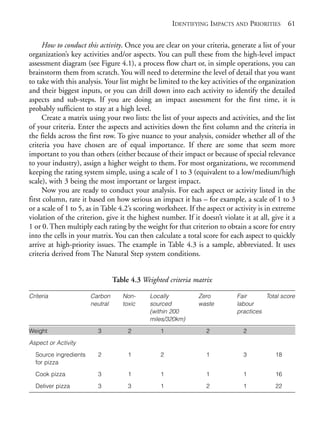
            height of their skyscraper their paper use represented. To make it personal, we also reported
            the usage per attorney: how many stories high the stack of paper was that each attorney
            used.
                  When we reported these results, there was a hoot and a snort in the audience. The
            metrics were so startling that it galvanized their efforts to implement serious paper
            reduction efforts. In the first year, they switched to recycled content letterhead and reduced
            their reams per attorney by 6 per cent, even though their workload increased. These changes
            alone represented an estimated saving of US$20,000 per year. They continue to work
            on developing an electronic document system, a project that was started before their
            sustainability initiative, which should radically reduce their paper use further while improving
            productivity.
Chapter05.qxd   10/1/2008   4:55 PM    Page 69


                                                 DEVELOPING SUSTAINABILITY METRICS AND REPORTS         69

            how many Forest Parks they’d have to buy, plant and maintain, they have a way of
            visualizing their greenhouse gas emissions.

            Should targets be realistic or audacious?
            There are two schools of thought about setting targets. The first is that goals or targets
            should be realistic and based on what is possible. For example, by upgrading lighting and
            improving insulation, we should expect to get X per cent improvement, so that is our goal.
            The advantage of this approach is that it is often easier for people to support because they
            can envision the steps necessary to accomplish it. The downside is that it only usually
            achieves incremental improvements.
                 To reach full sustainability, though, a quantum leap in performance is necessary, so some
            long-term radical stretch goals are needed. If you choose ‘zero waste’ as a goal for example,
            this will often generate more radical innovations than if you just strive for a 5 per cent
            reduction in waste every year. You often can’t get there just with incremental improvements.
            You have to rethink the design of the product or call into question your existing business
            model.
                 Radical stretch goals can lead to employee cynicism if the goals are not based on an
            external standard (e.g. the requirements of nature or the performance of the industry
            leader). But when presented well, radical stretch goals will often produce more significant
            improvements.
                 So think about your situation. Chances are, you’ll need some of both. With an existing
            facility or manufacturing process, you’ll probably mostly strive for incremental
            improvements. But whenever you design a new building or product or spend significant
            capital, this is the best time to set radical stretch goals.

            Linking your metrics to your framework
            Your sustainability framework(s) should influence your choice and organization of your
            metrics, as well as the type of work you do. Tables 5.1 and 5.2 list recommended metrics
            associated with two of the more common frameworks: The Natural Step and triple bottom
            line.
                 We often nest The Natural Step system conditions (system conditions 1 to 4) into the
            triple bottom line. We also like to distinguish between internal and external metrics. If you
            don’t do this, the ‘economy’ often becomes simply an internal profitability measure, a poor
            cousin to its larger purpose.
                 In our Sustainability Planning and Reporting Kit, we link metrics to each part of our
            impact assessment (see ‘High-level impact assessment’ in Chapter 4). We then provide
            spreadsheets to calculate each of these metrics.
Chapter05.qxd      10/1/2008     4:55 PM      Page 70


       70       THE STEP-BY-STEP GUIDE TO SUSTAINABILITY PLANNING

                          Table 5.1 Common metrics tied to The Natural Step framework

            System condition                             Possible metrics
            1    Substances from the Earth’s crust       Greenhouse gases: metric tonnes of CO2
                                                         equivalent (will necessarily include energy
                                                         use by type); may be measured over a
                                                         baseline such as Kyoto Protocol
                                                         Metals: recycling rate and also recycled content

            2    Human-made substances                   Persistent bio-accumulative toxins: volume
                                                         used
                                                         Cleaning products: percentage of green
                                                         cleaning products

            3    Productivity of nature                  Natural resources: percentage from a
                                                         certified sustainable source (including
                                                         paper and other wood products, agricultural
                                                         products, fish, etc.)
                                                         Water: conservation measured by reduction
                                                         of use over baseline

            4    Human needs                             Employee satisfaction: measured by annual
                                                         or biannual survey
                                                         International labour standards: measured
                                                         against SA 8000 or social audits


                              Table 5.2 Common metrics tied to the triple bottom line

                       Environmental                 Social                           Economic
                                                     (system condition 4)
       Internal        Energy conservation           Employee satisfaction            Profitability
                       (system condition 1)          Employee retention               Living wage
                       Green cleaning products
                       (system condition 2)
                       Water conservation
                       (system condition 3)
                       Green purchasing
                       (system condition 3)

       External        Greenhouse gases              Labour practices of suppliers    Sales of green/certified
                       (system condition 1)          Customer satisfaction            products (system
                       Toxic emissions               Charity (hours and dollars)      conditions 1 to 4)
                       (system condition 2)                                           Local purchases
                                                                                      Investments in
                                                                                      sustainable businesses
Chapter05.qxd   10/1/2008     4:55 PM    Page 71


                                                   DEVELOPING SUSTAINABILITY METRICS AND REPORTS             71

                                  Table 5.3 Common metrics tied to impact assessment

            Area                         Metrics
            Energy/climate               Greenhouse gases – climate neutral
                                         Energy efficiency – greenhouse gas (GHG)/$
            Materials                    Percentage of purchases from sustainable source
            Major processes              Percentage of employees paid living wage and benefits
                                         New buildings/remodels qualifying for Leadership in Energy and
                                         Environmental Design (LEED) Silver or better as a function of existing
                                         buildings (EB) points and/or floor space
            Products/services            Percentage of sales from sustainable/green products/services
            ‘Residual products’/waste    Percentage solid waste diverted from landfill
                                         Recycling rate as a percentage of total waste
            Strategic partners/          Percentage of major suppliers who have sustainability
            supply chain                 efforts under way
            Community                    Profits and time donated
                                         Local sourcing as a percentage of total purchases


                 BOX 5.2 SELLEN CONSTRUCTION: MEASURING GREEN BUILDING
                                        PROJECTS AS A CORE COMPETENCY

                In addition to measuring your internal impacts, you will also want to measure the
                sustainability of your core products and services: your mission-related impacts. Sellen
                Construction based in Seattle, Washington, is measuring their progress towards
                building more sustainable projects by tracking and forecasting their clients’ pursuit
                of Leadership in Energy and Environmental Design (LEED) projects. Yancy Wright,
                sustainable initiatives manager, said:

                        Many of our clients have recently adopted LEED Silver and in some cases
                        Gold as their standard project expectation. Tracking this trend is critical
                        for understanding the level of preparedness required to meet this surge in
                        green building requests. In 2005, only 7 per cent of our annual volume
                        accounted for projects aiming for LEED certification. In 2007, it was up
                        to 18 per cent and by 2010, we expect 91 per cent of our annual volume
                        to be projects in pursuit of LEED certification.
Chapter05.qxd   10/1/2008    4:55 PM    Page 72


       72   THE STEP-BY-STEP GUIDE TO SUSTAINABILITY PLANNING


       A shortlist of critical metrics
       After a while, you’ll see similar metrics show up repeatedly. This is our shortlist of metrics,
       heavily influenced by The Natural Step. You probably should have a good excuse if these
       goals and metrics aren’t part of your suite:

       •    Climate neutral. Show greenhouse gases at least for your own operations. You may
            choose to also include impacts associated with employee commuting, embodied energy
            in major purchases, and the customer use and disposal of your product.
       •    Zero toxics. Often the simplest way is to show volume of persistent bio-accumulative
            toxins purchased or in use. If you don’t use any, then you can show the percentage of
            green cleaning products or landscaping products.
       •    Zero waste. Measure waste diverted from landfill and total waste (including recycling).
       •    Sustainable natural resources. If you use significant quantities of natural resources (e.g.
            water, wood products, fish and agricultural produce), show the percentage coming
            from sustainable sources.
       •    Social impact – internal. Have some measure of the quality of work life. Depending
            upon your situation, this may be the percentage of employees paid a living wage, the
            ratio of highest to lowest paid worker, average wages by gender or race, employee
            satisfaction survey results, etc.
       •    Social impact – external. Depending upon the nature of your business, this may include
            metrics related to international labour practices (e.g. SA 8000 results), local purchasing,
            and/or charitable endeavours (time and money donated).

       Data traps to avoid
       As you develop a list of potential metrics and begin to gather data on them, do a test run.
       This is especially important if more than one person is involved in collecting the data. The
       devil is always in the detail. Imagine you run a pizza restaurant. Here are some of the
       problems you may encounter:

       •    Timeframes don’t line up. Your electricity bill shows usage through the 20th of the
            month. The natural gas bill shows the 10th of the month. You do your accounting
            based on a calendar month that includes production data about the number of pizzas
            produced. How are you going to show energy use per pizza under these circumstances?
       •    People log data differently. Your electricity bill for December arrives in January and is
            paid in February. In which month should its usage be logged?
       •    Data are segmented differently. You plan to report on waste by category, and you’ve
            agreed on the different categories of waste: food, plastics, liquid, etc. As different
Chapter05.qxd   10/1/2008   4:55 PM   Page 73


                                                DEVELOPING SUSTAINABILITY METRICS AND REPORTS          73

                people sort through the trash, what do they do with the plastic packets of red peppers
                in oil? Is it plastic, food waste or liquid?

            See how important it can be to test your data-gathering methods before you deploy them?
            Be sure to document your decisions, train others in them and audit them periodically.
            Otherwise, you’ll not be able to trust the figures.

            Narrow down your list of metrics
            Once you have a potential list of metrics, you will probably still have too many to track
            and report. Use the following criteria to help you winnow them down to a reasonable
            scoreboard:

            •   Availability. There are many measures that your organization may already track which,
                with a little work, can translate into useful metrics. For example, in manufacturing,
                engineers often have percentage efficiency numbers for each manufacturing line that
                can be converted to waste stream numbers. You may have trouble getting historical
                baseline data because you never tracked the indicator before. In some cases, you may
                need to use surrogates – for example, you might prefer to track the weight of items,
                but your computer database only tracks dollars. Our advice is to shoot for indicators
                that will give you evidence of progress, not necessarily scientific proof. Start with what
                you have and work to improve the system over time.
            •   Relevance. A metric answers a question; but your stakeholders will have different
                questions. Engineers and scientists, for example, may want technical details on water
                quality; but your customers and community may be primarily interested in the effects
                on salmon runs. Think about the audiences for your metrics and try to find metrics
                that can be reported in different ways to meet these different needs.
            •   Proxies. Sometimes one metric can be used as a proxy for others. For example, in the
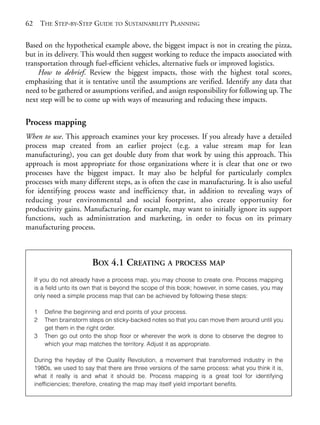
                Pacific Northwest, salmon are often used as an indicator of overall ecosystem health,
                not only of the riparian area, but also of entire watersheds. They are highly symbolic
                for Native Americans and more recent arrivals. If the salmon appear to be in trouble –
                as they are – you then have to drill down to understand why. Is the decline due to water
                quality or quantity or temperature? Is it overharvesting or effects of hatchery-raised
                fish? Are forestry practices or road run-off polluting the streams?

            Tips on designing graphs
            Use normative and absolute numbers. Many numbers are only relevant in comparison with
            other numbers – for example, solid waste per unit of production. If the volume of solid
Chapter05.qxd   10/1/2008     4:55 PM      Page 74


       74   THE STEP-BY-STEP GUIDE TO SUSTAINABILITY PLANNING

       waste is going down, you don’t know whether this is because you are more efficient or
       because you shut down a production line since sales were soft. So many of your metrics
       should be a ratio, with the denominator being units of production, number of employees,
       sales revenue, market share, etc. This is often referred to as ‘normalizing your data.’
            At the same time, normative data can leave you feeling good when, from the Earth’s
       perspective, things are still getting worse. While cars pollute much less than a decade ago,
       the overall pollution from cars continues to rise because there are so many more
       automobiles on the road now. So we encourage you to track both normative numbers and
       absolute numbers. Often you can show both on the same graph, using two different scales
       (see Figure 5.1).
            Pick the best type of graph. There are many different types of graphs and each tends to
       highlight certain relationships and obscure others. Pie charts show the relative parts to a
       whole; but they don’t show whether the pie is getting bigger or smaller. Bar graphs depict
       change over time. Stacked bar graphs are a compromise between a bar graph and a pie
       chart, showing some of both. Control charts show how performance compares to
       acceptable limits over time. Spider diagrams (also known as polar diagrams) can
       demonstrate many metrics at one time. Pick the graph that most accurately shows what
       you need to know.
            Show more than one metric on a chart. One way of showing interrelationships between
       metrics is to graph more than one metric on the same chart. You can show more than one

                                                                               Production volume
                 Greenhouse gases                                               (Units produced-
                 (Metric tons of CO2-e)                                           thousands)
                 9000                                                                 1300
                 8000                                                                 1200
                 7000                                                                 1100
                 6000                                                                 1000
                 5000                                                                 900
                 4000                                                                 800
                 3000                                                                 700
                 2000                                                                 600
                 1000                                                                 500


                            2004       2005     2006    2007     2008        2009
                                                                             -est.

                             Legend:          GHGs                      Production


                                       Figure 5.1 Sample graph with two axes
Chapter05.qxd   10/1/2008      4:55 PM     Page 75


                                                     DEVELOPING SUSTAINABILITY METRICS AND REPORTS                     75

            scale on the vertical axis by using one scale on the left and another on the right. In this way,
            you can depict, for example, both recycling rates per unit of sales and total recycling
            volume. Usually the horizontal axis represents time.
                 Make the direction of your graphs consistent. If you post a bunch of line graphs or bar
            charts, it can be very helpful if you design the metrics so that up (or down) is always good.
            This will mean that you may have to measure quality instead of defects, materials efficiency
            instead of waste, employee retention instead of turnover. In some cases, this requires some
            verbal gymnastics (e.g. percentage to carbon neutrality). But at a glance, you’ll be able to
            see which metrics have a negative trend.
                 Annotate interventions. Write notes on the charts about changes that you made to the
            process so that it’s easier to see the impact your actions have had. For example, show when
            you installed a new motor, replaced a chemical, instituted a recycling programme, started
            sales of a new product, or conducted a green marketing campaign. Don’t make everyone
            figure it out for themselves.
                 Have the title tell the story. Consider modifying the titles of your graphs so that the
            meaning is clear. Instead of just ‘energy use’, why not change the title each month? ‘Energy:
            New motors cut electricity by 500 kilowatt hours per month’ is much more informative.
            This is particularly important to do when you use graphs in presentations because people
            may not have time to examine the graph in detail.


                                                         RESOURCES
                General tools for reporting and metrics:

                •   The Global Reporting Initiative provides an international standard for sustainability
                    reporting and is most appropriate for large publicly traded companies. However, their list
                    of core indicators is a useful touchstone for choosing any organization’s metrics. If you are
                    going to measure something covered in their guidelines, you may as well measure it the
                    same way in case, at some point, you need to be compliant with GRI (see www.global
                    reporting.org).
                •   The World Business Council on Sustainable Development has sustainable development
                    reporting guidelines and other resources (see www.wbcsd.org).
                •   The Corporate Register (see www.corporateregister.com) lists non-financial reports,
                    including sustainability and corporate social responsibility reports from public companies
                    all over the world. It also has awards for the best ones in different categories. See its Global
                    Winners and Reporting Trends report for the most recent year. Use this resource to see
                    what others are doing. It can be a good warm-up exercise to have all of your participants
                    review at least one sustainability report and bring notes about what they liked and didn’t
                    like. This analysis can provide guidelines for your own report.
Chapter05.qxd         10/1/2008     4:55 PM     Page 76


       76       THE STEP-BY-STEP GUIDE TO SUSTAINABILITY PLANNING


            •       The Guide to Sustainable Community Indicators by Maureen Hart provides a number
                    of useful examples and resources for community-based metrics (see www.sustainable
                    measures.com).
            •       SPaRK™ is the Sustainability Planning and Reporting Kit developed by AXIS that includes
                    an MS Excel file of common metrics linked to an MS Word template for a sustainability plan
                    and internal report such that charts and graphs are pulled into the right places. This tool,
                    or at least the outline of the sections of the report template, may be helpful as you design
                    your report (see www.axisperformance.com for more information).
            •       GEMI SD Planner is an interactive webtool (see www.gemi.org/docs/PubTools.htm).


       Greenhouse gas tools:

       •        See the Greenhouse Gas Protocol for an international standard for reporting
                greenhouse gases (www.ghgprotocol.org).
       •        The World Resources Institute helped to create a number of free calculators that you
                can download, including ones for such common sources as commuting and facilities.
                They also have calculators for carbon-intensive sectors such as aluminium and cement
                production (see www.ghgprotocol.org/calculation-tools).
       •        For a concise booklet on reducing office climate impacts, see www.wri.org/publication/
                working-9-5-climate-change-office-guide.
       •        The US Environmental Protection Agency has a calculator for greenhouse gases (see
                www.epa.gov/cleanenergy/energy-resources/calculator.html).
       •        The US Environmental Protection Agency also has a web-based calculator that
                converts greenhouse gas emissions into everyday metrics (see www.epa.gov/
                cleanenergy/energy-resources/calculator.html). For example, it can convert into these
                units:
                •    driving a particular number of cars for a year;
                •    using a particular amount of gasoline or barrels of oil;
                •    using a particular number of tanker trucks’ worth of gasoline;
                •    providing energy to a particular number of homes for a year;
                •    growing trees across a particular number of acres for a year.
       •        The Climate Trust has calculators for businesses, events, employee commuting and
                citizens (see www.carboncounter.org).
       •        Calculators for air miles include Webflyer (see www.webflyer.com/travel/milemarker/)
                and Terrapass (see www.terrapass.com/flight/).
       •        If you want to understand carbon offsets/credits, read Voluntary Carbon Markets
                (Bayon et al, 2007).
Chapter05.qxd   10/1/2008     4:55 PM    Page 77


                                                   DEVELOPING SUSTAINABILITY METRICS AND REPORTS            77

            Solid waste resources:

            •   The California Integrated Waste Management Board provides conversion factors for
                volume and weight by material type (see www.ciwmb.ca.gov/LgLibrary/DSG/
                ApndxI.htm).

            Paper calculators and tools:

            •   Environmental Defense offers a paper calculator (see www.papercalculator.org/).
            •   The Environmental Paper Assessment Tool (www.epat.org) is more of a purchasing
                tool but would give you detailed information about various impacts associated with
                your paper purchases, down to the mill level.

            Toxics:

            •   Measuring the level of toxins in your process is a complicated endeavour. If you can’t
                find easy alternatives right off the bat (e.g. by specifying green cleaning products and
                landscape practices), you will likely have to complete a chemical inventory. Resources
                for this that we’re aware of include the following:
                • Dolphin Software has Green Product Selector, which helps you to identify safer
                     chemicals for particular purposes (www.dolphinsafesource.com).
            •   McDonough Braungart Design Chemistry (MBDC) is a consultancy focused on
                helping clients to implement cradle-to-cradle design (see www.mbdc.com/).


                                         METHODS AND INSTRUCTIONS
            Table 5.4 lists the tools related to metrics and reporting that are the focus of this section.


                                Table 5.4 Overview of methods for metrics and reporting

            Process                           When to use
            Sustainability scorecard          When you need to figure out what metrics you will measure.

            Metrics worksheet                 When you know which metrics you plan to track.

            Sustainability report template    When you need to decide what to include in a sustainability
                                              plan and how to organize it.
Chapter05.qxd   10/1/2008    4:55 PM    Page 78


       78   THE STEP-BY-STEP GUIDE TO SUSTAINABILITY PLANNING


       Sustainability scorecard
       When to use. Use this process to develop a system for gathering and reporting sustainability
       metrics.
            How to prepare. Post flip charts around the room with each element of your
       sustainability framework (e.g. The Natural Step system condition or social/economic/
       environmental). Print out possible metrics from any source you think relevant. You might,
       for example, print out the core indicators from the Global Reporting Initiative, metrics you
       already report, or metrics from other companies’ sustainability reports. You may also want
       to bring a listing of your major impacts, sustainability assessment results or sustainability
       goals. Also bring post-its and a marker.
            How to conduct this activity:

       1    Give each person some of the sample metrics that you gathered. Have each person look
            at the ones they have been provided and decide which, if any, might be good for the
            organization to track and report. Have them place those on the appropriate flip chart. If
            desired, assign different people varying stakeholders (management, customers, certain
            NGOs, investors, etc.). If you don’t have sample metrics, you can ask them to brainstorm
            metrics that they would hope to see in a sustainability report using post-it notes.
       2    Review the flip charts as a group. Eliminate duplicates. Nest metrics (e.g. electricity
            usage is nested under greenhouse gas emissions) by stacking them above or below one
            another. If you have glaring holes, fill them.
       3    Analyse the list and try to categorize them. Chances are, you’ll have too many metrics.
            Which ones are important to measure now? Which should you likely report on every
            year? Which are either too hard to gather or not worth the effort?

       Metrics worksheet
       When to use. Use this process to develop a system for gathering and reporting sustainability
       metrics.
           How to prepare. Create a chart similar to the worksheet below.
           How to conduct this activity. Take the metrics that made the cut from the previous
       exercise and assign clusters of metrics to small groups in order to complete the metrics
       worksheet. It can be helpful to do one metrics worksheet as a whole group so that everyone
       can understand the process. You can do this by framework element, impact area or metric:

       1    Name the metric area (framework element, impact area or metric cluster).
       2    Describe the fully sustainable state under ultimate goal. If you have it, also give the
            baseline.
Chapter05.qxd   10/1/2008   4:55 PM   Page 79


                                                DEVELOPING SUSTAINABILITY METRICS AND REPORTS         79

            3   Identify where you can get the data.
            4   Identify how you will want the data segmented under ‘What to track separately’ (see
                Table 5.5). For example, if your area is waste, do you want to segment the data by food
                waste, paper, construction debris, etc?
            5   Under ‘How to compute’ (see Table 5.5), indicate any calculations or sources of factors.
            6   Draw a sample chart that clearly shows the elements that the charts should contain. Is
                it a pie chart or a stacked bar chart? Do you want to show sales data on the same chart
                with energy use to put the numbers into context?
            7   Complete the ‘Responsibility and frequency’ (see Table 5.5) portion of the chart,
                indicating the tasks that must be completed to gather and report on the metric.
            8   Under ‘Action items’ (see Table 5.5), list any other tasks that must be done to be able
                to gather and report data. For example, someone may need to research greenhouse gas
                conversion factors. Perhaps someone needs to create a spreadsheet or work with
                accounting to add a field to the time sheet related to air travel.


            Sustainability report template
            When to use. As we indicated earlier, it’s helpful to mock up your sustainability report long
            before you plan to write one. This will give you a sense of what you want to include in the
            report and will define the metrics you will need to track. You can then use this document
            to store notes about accomplishments, testimonials and goals as the year progresses so that
            at the end of the year, you merely need to clean it up, incorporate the actual data and
            compute year-end statistics.
                 How to prepare. Before designing your own sustainability report, it is helpful to review
            a number of others. We often have students bring in samples of reports, suggesting that
            they choose a company they know either because they like them or dislike them; perhaps
            they buy their products; perhaps they work for them; maybe they revile them. In groups,
            students talk about what they liked and didn’t like. We recommend doing the same exercise
            in your organization. Go to www.corporateregister.com for a list of companies that
            produce non-financial reports.
                 How to conduct this activity. The following steps are best done with a group of people.
            You may need to include some executives, the public relations staff, someone from
            accounting or information technology if they automate the data collection, and the
            sustainability director. Alternatively, the sustainability steering committee may use this
            process to recommend a structure for the report:

            1   Decide on the audience or audiences for your sustainability report.
            2   Determine the media that you plan to use (web, print, etc.).
Table 5.5 Metrics worksheet (area: greenhouse gases and energy use)
                                                                                                                                           Chapter05.qxd


                                                  How to obtain the data:

Metric          Ultimate            Baseline      Sources of data      What to track     How to          Sample chart
                goal                                                   separately        compute

Percentage      80% reduction       Zero          Electricity bills    Electricity       Use Climate
                                                                                                                                           10/1/2008


                                                                                                              Percent reduction
reduction       by 2050             (10 million   Fleet records        Natural gas       Trust factors         of GHGs over
                                                                                                                  baseline
of GHG                              tonnes a      Expense reports      Auto Airline      to obtain CO2
from baseline                       year in       (airline miles       Commuting         equivalent
                                    2008)         and personal
                                                                                                                                           4:55 PM


                                                  auto)


                                                                                                                     Years
                                                                                                                                           Page 80


                                                                                                         Greenhouse gases by source
Greenhouse                                                             Building energy
gases by                                                               Process energy                                    6%

source                                                                 Transportation                    31%


                                                                                                                               63%

                                                                                                          Building   Process   Transport
Chapter05.qxd


                                                    Responsibility and frequency:

Who                       What                                                             When

Facility manager          Enters electricity and natural gas usage                         Monthly, when bills arrive
                          numbers into spreadsheet
                                                                                                                                      10/1/2008


Human resources           Conducts and compiles commuting survey                           Annually, in January
manager
                                                                                                                                      4:55 PM


Clerical team             Tracks and reports on air miles of everyone in their             Monthly, after timesheets are submitted
                          respective departments, entering data in the spreadsheet

Board of directors        Decides on the amount of carbon offsets                          Annually, in February
                          we can afford or need to purchase
                                                                                                                                      Page 81


Sustainability director   Compiles data and produces report                                Annually, in February Finalize metrics
                                                                                           in March after board decision on offsets
                                                            Action items:

What                                   Who                            When                                Notes

Add employee commuting                 Human resources                Before next survey
question to annual employee
survey, asking round trip
miles/kilometres and
average number of trips
per week
Chapter05.qxd   10/1/2008     4:55 PM   Page 82


       82    THE STEP-BY-STEP GUIDE TO SUSTAINABILITY PLANNING

       3    Based on your answers to questions 1 and 2, determine the parameters for your report.
            At a minimum, you’ll want to decide the maximum number of pages/screens. It’s also
            helpful to think through the general format. For example, if you want something to be
            on the web as well as in print, you may want to create a PDF document. Consider
            limitations. If you want something to be viewed on the screen, you’ll need to avoid
            newsprint-style columns. Will you be able to use colour or will the document need to
            be printed in black and white? These will all affect what you can include in your report.
            You may need to set different parameters for each audience; but seek ways to serve
            multiple masters with the same information. Perhaps, for example, the public four-
            page document also serves as the executive summary for your internal sustainability
            report to management.
       4    Use post-it notes to brainstorm different ideas or themes that you want to include. Use
            squiggles to indicate text that will need to be written, but write the headers. Carefully
            mock up the graphs and charts, specifying the type of graph, legend, timeframes, etc.
            Include metrics that you want to monitor year after year. Highlight important
            initiatives. Often there is a letter from the president at the front. If you need the report
            to be audited, leave room for that as well.
       5    Use blank copy paper or flip chart paper to represent the different pages or screens.
            Organize the post-it notes onto the pages, reorganizing as needed. If applicable, use
            colours or symbols to indicate which elements can also be used in other settings. For
            example, the written sustainability report might be your most complete version; but
            the website could highlight a handful of key elements.
                 Debrief. After you have a mock-up of the sustainability report, critique it from
            different points of view. You can pass it by different stakeholders for their reactions.
            Are we providing the type of information you want to see? Is it easy to find? You can
            also simulate this by assigning each person in the meeting with a different role and
            have them look at the mock-up from this point of view. After the meeting, create a
            template for the report.
Chapter06.qxd   10/1/2008   7:23 PM   Page 83


                                                        6
                    Developing an Implementation Strategy
                            and Choosing Projects


                                      CONCEPTS AND CASE EXAMPLES
           In Chapter 3, you developed a long-term vision and defined the end points. Now you must
           figure out how to get there in a timely fashion. There are several key decisions your
           organization will need to make in order to approach your efforts coherently. We’ve broken
           this chapter into three key steps:

           1    developing a long-term plan to reach sustainability;
           2    making decisions regarding where and how to start;
           3    developing a system for prioritizing and choosing projects.

           Make sure to refer back to Chapter 1, especially with regard to deciding where to begin
           your sustainability efforts and whom to involve.

           Developing a long-term plan to reach sustainability
           Some things can be done right away and others may be impossible in the near future
           because the technology doesn’t exist or other enabling factors are not yet in place. You may
           need to start with actions that are most likely to save you money so that you have a fund
           to invest in future improvements as they become more costly or difficult.
                You have to plan for two types of actions:

           1    how to manage the sustainability effort (process or management system);
           2    what to do to improve your sustainability performance (projects).

           We will cover some of the process steps in more detail in other chapters; but let us give you
           a thumbnail of what is involved now because you may want to include elements of these
           tasks in your plan.
Chapter06.qxd   10/1/2008    7:23 PM   Page 84


       84   THE STEP-BY-STEP GUIDE TO SUSTAINABILITY PLANNING

       Although every organization is unique, we have found that the following ten-step process
       applies in many situations:

        1   Form a steering committee.
        2   Educate yourselves about sustainability and frameworks.
        3   Examine the strategic business case for pursuing sustainability.
        4   Develop a plan with impacts, metrics and priorities.
        5   Mock up a sustainability report (including metrics).
        6   Gather baseline data and information about options.
        7   Implement the best ideas; monitor results.
        8   Conduct a formal evaluation of results and institutionalize lessons learned.
        9   Report to all relevant stakeholders.
       10   Deepen your understanding.

       Be sure to incorporate these steps within your implementation plan as appropriate.
           In order to plan what you’re going to work on, backcasting is a frequently used
       approach to create a comprehensive long-term plan. It forces you to keep your future vision
       in mind while you decide what to do in both the short and long term. Whatever planning
       process you use, you will want to lay out a schedule of activities that detail the major tasks,
       milestones and responsibilities that will ensure you achieve your vision.
           Most planning processes follow these three steps:

       1    Define the fully sustainable state (see Chapters 3 and 5) and estimate when you should
            be able to reach that state. Some goals, such as being climate neutral, are technically
            possible (through a combination of energy conservation, green power and carbon
            offsets) to do now, although you may want to ease into it over time. Other goals are
            technically not feasible now, but you may have reason to believe that new technologies
            or economic forces will eventually make them possible.
       2    Lay out goals incrementally for specific periods of time between the present and
            that end state. We typically use 1-, 3-, 5-, 10- and 20-year timeframes. Following
            the example above, you may decide that you can reduce your greenhouse gases by
            10 per cent per year over your current baseline with a goal of being carbon neutral
            in ten years.
       3    Identify the projects that will help you to reach these goals. Put most of your emphasis
            on identifying projects for the next few years; but see if there are some near-term
            projects that you should consider which will help you to reach your long-term goals.

       We’ve laid out several options for creating such a plan at the end of the chapter.
Chapter06.qxd   10/1/2008      7:23 PM     Page 85


                               DEVELOPING AN IMPLEMENTATION STRATEGY AND CHOOSING PROJECTS 85


           Making decisions regarding where and how to start
           In other chapters, we’ve identified a number of questions that you’ll want to answer,
           including what’s the business case for doing this and what framework(s) to use? There are
           a few more questions you’ll want to address that will inform your understanding about
           how best to get started or what to do next:

           •     How does sustainability relate to what you’ve already done?
           •     Where should you start?
           •     And who needs to be on board?

           How does sustainability relate to what you’ve already done? Sustainability efforts rarely emerge
           in a vacuum. To avoid the ‘programme of the month’ cynicism, it can be helpful to
           explicitly link your sustainability efforts to familiar programmes in the organization. Do
           you have an environmental management system that could be strengthened to be a
           sustainability management system? Is your organization a long-time advocate of total
           quality management, lean manufacturing or related efforts? Do you have a longstanding
           practice of empowering employee work teams? If so, perhaps you can show how
           sustainability is a logical extension of them.


                                BOX 6.1 SYMBOLIC ACTIONS MAKE A SPLASH
                Many organizations start their formal sustainability efforts with a symbolic action. Ashforth
                Pacific, a West Coast property management and construction firm, implemented a ‘cookies for
                trash cans’ project in which employees got cookies in exchange for agreeing to give up their
                trash cans and throwing all of their garbage away in a central bin. This simple project was easy
                for employees to participate in and saved the company 9000 plastic trashcan liners a year.

                Source: Oregon Natural Step Network (2002)


           Developing a system for choosing projects
           Sometimes the place to begin is obvious. If you are constructing a new building, adding a
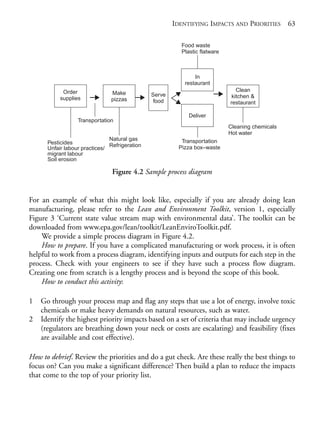
           new production line or making other decisions with long-term ramifications, then start
           there. Often, though, you will have to choose from among lots of interesting ideas. In these
           cases we recommend establishing criteria for selecting projects. Your decision-makers
           should have a good deal of input to this criteria set. We often begin our work with clients
           by asking the leadership a set of key questions:
Chapter06.qxd     10/1/2008     7:23 PM    Page 86


       86     THE STEP-BY-STEP GUIDE TO SUSTAINABILITY PLANNING

       •     What expectations do you have for the results of this effort?
       •     What priorities do you have either in terms of issues to address or problems to avoid?
             Have you been cited for violating an environmental regulation? Have your customers
             or shareholders been asking for social or environmental improvements?
       •     Are there any thresholds that projects must meet before they can be implemented?

       The answers to these questions help sustainability teams or steering committees to generate
       ideas that are more likely to have the backing of the decision-makers. We take the answers
       to those groups and then ask the committees to turn them into specific criteria for selecting
       projects. We help them think in terms of five categories to ensure that they have a full
       complement of decision-making information.
            Impact. Logically, the actions to consider first are those that will have the highest
       positive impact upon your triple bottom line (economy, environment and society). We
       start the list of criteria with environmental impact. Your impacts analysis, which typically
       precedes your project selection process, will have identified and prioritized your
       organization’s impact. Consider also balancing your choice of projects. We recommend
       picking both quick wins and big wins: projects that will provide you with quick success
       and projects that may take more time and effort, but will have a more lasting or significant
       impact. When considering projects with potential for quick success, think in terms of
       strategies that either provide a good financial return, create a positive public image or will
       stoke the enthusiasm and energy of your employees.
            Payback or return. Financial return is always an important consideration in business
       decisions. In the case of picking sustainability projects, however, sequence the choice of
       your projects so that paybacks are attractive enough to gain leadership support while at the
       same time garnering enough in savings or new earnings to fund future efforts. When
       considering the costs and potential return on investment from projects, be sure to examine
       all financial aspects, not just the obvious or immediate ones. There are at least five
       categories worth exploring as described in Table 6.1.


                                   BOX 6.2 MAKING SENSE OF DATA
            Dolphin Software has developed a tool to compare different chemicals (e.g., cleaning
            products, solvents, etc.) both in terms of their environmental characteristics on one axis and
            cost on the other. They graph these so it is easy to see which products have both a low
            environmental impact and a low cost. Similarly, Austin Energy is spearheading the creation of
            a system to help utilities compute a carbon return on investment, the cheapest methods for
            reducing the largest amount of greenhouse gases.
Chapter06.qxd   10/1/2008    7:23 PM   Page 87


                              DEVELOPING AN IMPLEMENTATION STRATEGY AND CHOOSING PROJECTS 87

                                           Table 6.1 Cost-benefit categories

           Cost category               Definition
           Direct financial benefits   These are costs, savings or additional revenues that are easy to
           or costs                    identify. These usually include material, labour, direct expenses or
                                       revenues that are usually allocated to a product or process
                                       (e.g. raw materials for production, paper costs for office activities, etc.).

           Hidden savings              These are expenses or revenues that are not easily allocated to
           or costs                    products or services but are, nonetheless, related. Do you spend
                                       time fending off angry non-profits? Do your chemicals require special
                                       training and handling? Do you need lots of quality assurance steps to
                                       maintain a safe workplace?
           Risk avoidance              These are costs or benefits that are derived from the occurrence of a
                                       possible future event (e.g. clean-up costs from materials spills, health
                                       costs from exposure, liability for litigation or other claims, etc.).

           Image or relationship       These are costs/benefits that are associated with your organization’s
                                       reputation in your community or with your customers or shareholders.
                                       These days, public corporations can derive more of their value from
                                       these intangibles than their physical plant and equipment.

           Externalities               These costs and benefits may be hard to estimate but represent the
                                       impacts for which the organization does not have to account.
                                       Is someone else breathing your pollution? Are your greenhouse gas
                                       emissions contributing to climate change? What is the value of
                                       restoring a watershed? You may be able to get paid for certain
                                       ecosystem service benefits associated with greenhouse gases,
                                       flood control, water temperature, endangered species, etc.


           It can be helpful to separate the sustainability benefits of your ideas from their costs and
           graph them.
                Feasibility. Some projects will just be easier to do than others. You will need to define
           for your own business what is feasible and what is not. This may necessitate clarifying up
           front what your organization’s tolerance is for possible disruption of business processes,
           changes in relationships with vendors or customers, or limits on capital expenditures. The
           sooner these criteria are identified, the more efficient your project selection process will be.
                Leverage. Consider your project options from the point of view of leverage or
           transferability. There might be a project that you are considering that at first sight doesn’t
           provide high return, but has potential for affecting efforts down the line. For example, let’s
           say you use solvents in many areas of your production. If you could find a more benign
           solvent for cleaning parts, that same solvent might be used in the other applications as well,
           solving many problems at once.
Chapter06.qxd   10/1/2008    7:23 PM    Page 88


       88   THE STEP-BY-STEP GUIDE TO SUSTAINABILITY PLANNING

            Another factor to consider is long-term payback. The Natural Step framework favours
       what are called ‘platform’ strategies. A platform strategy is one that by itself may not return
       high value, but that enables later high-return solutions. It prepares you to take advantage
       of future developments and provides flexibility, not locking you into one approach. For
       example, an architect might design a building to maximize a south-facing roof area so that
       solar cells could be added later. You might wire your facility for diesel back-up generators
       in anticipation of installing a hydrogen fuel cell later, even though using a diesel generator
       might seem to be a step in the wrong direction.
            Appeal and visibility. After all is said and done, some projects will just have more
       emotional appeal than others. Reducing your workforce commutes, for example, may not
       be as appealing to employees, customers or community members as something like
       achieving zero waste. Sometimes, how you frame the issue can make all the difference.
       ‘Saving the salmon’ may have more appeal than ‘improving water quality’. Appeal is an
       especially important criterion if you are using your sustainability efforts to increase
       employee or customer loyalty. If you are trying to sell sustainability to the leaders of your
       organization, you may need to implement early projects that will appeal to their own
       passions or notions of responsible behaviour.

       Managing the load
       We’re not aware of a commonly used term for what we want to explain, so we need to
       resort to a metaphor. Perhaps you have seen the vaudeville act where a performer spins
       plates on top of poles. He starts spinning one plate on a poll, then puts another plate on a
       second poll, then another and another. Soon the first dish starts to wobble and the
       performer rushes over and twirls the pole to get it going again. This is a useful metaphor
       for what we want to cover next because it emphasizes the need to pay at least a modicum
       of attention to all the plates in play, lest they come crashing down. The number of plates
       a performer can keep in the air is a function of his skill. Some are even able to spin cups
       and saucers, an even more ambitious task because they spin at different rates.
            So the question is this: what is your capacity for change? How many sustainability
       dishes can you keep in the air and how many different kinds before organizational gravity
       flings them to the ground? Some of your plates are likely to be large, others small. Putting
       labels to these dishes is an important exercise.
            Here are examples of some common variations:

       •    A city decided to have one to three priorities per year that all agencies would focus on;
            each agency was then expected to come up with one other sustainability goal that they
            would pursue on their own.
Chapter06.qxd   10/1/2008    7:23 PM   Page 89


                             DEVELOPING AN IMPLEMENTATION STRATEGY AND CHOOSING PROJECTS 89

           •    A county assembled a team of sustainability liaisons for every department and each
                quarter they picked a sustainability policy or metric to work on together.
           •    A museum chose different projects that, among them, would, first, make a significant
                environmental difference; second, educate and involve employees; and, third, be visible
                to and educational for visitors.
           •    A manufacturer formed a steering committee of executives that worked
                through a sustainability award programme, criterion by criterion, picking one
                thing to focus on each month (e.g. water conservation and elimination of
                aerosol cans).
           •    An insurance company decided to pursue a big win for the year, as well as a quick win
                and a community-focused charitable effort each quarter.

           You could also:

           •    Choose one issue such as climate change and have every department define what they
                can do to affect it.
           •    Focus on one ‘big win’ a year and have a list of ‘quick wins’ that you address one at a
                time.
           •    Address a different Natural Step system condition every quarter.

           You get the picture. There isn’t a universal right answer. The purpose is to make sure that
           you don’t take on too many projects or miss important selection criteria (e.g. having no
           projects during the year that are visible to employees). We often recommend thinking in
           terms of big wins/quick wins, as well as having at least one project that everyone can get
           behind (so you can roll out impressive results and build a sense of camaraderie), while also
           encouraging initiatives in individual departments.
               Ultimately, it’s helpful to build this into a table so that it’s clear whether you
           have the right number and types of plates. We provide a couple of examples in Tables
           6.2 to 6.3.


           Tips for choosing projects
           •    Go for quick wins and big wins.
           •    Choose a variety of projects that will allow everyone to find their place.
           •    Keep some projects under wraps until you have results to show.
           •    Use the savings created by some projects to fund the less financially feasible but
                important one.
Chapter06.qxd      10/1/2008      7:23 PM     Page 90


       90       THE STEP-BY-STEP GUIDE TO SUSTAINABILITY PLANNING

                                             Table 6.2 Quick win–big win

       Project type January–March April–June                   July–September October–             Next year
                                                                              November
       Big win          Redesign our primary product using design for environment                  Life-cycle
                        methods.                                                                   assessment
                                                                                                   comparing
                                                                                                   our product
                                                                                                   to competitors

       Quick win        Create an          Promote             Set up a ‘waste    Conduct          Possible
                        inventory of all   alternative         not’ materials     energy           ideas:
                        the green          commuting.          exchange fair.     conservation
                        things we’ve       Initiate a bike                        audit of
                        done to date.      to work day.                           offices.

       Community        Establish a        Initiate a stream   Hold a plastics    Hold a toy
       outreach         food drive.        restoration         recycling event.   drive.
                                           project.

       Employee         Have a             Invite a guest      Invite a guest     Invite a guest   Ideas:
       education        discussion         speaker on          speaker on         speaker on
                        course on          telecommuting.      green              climate
                        sustainability                         purchasing.        change.
                        concepts.


                                                      RESOURCES
            •    Epstein, M. (2008) Making Sustainability Work: Best Practices in Managing and Measuring
                 Corporate Social, Environmental and Economic Impacts, Greenleaf Publishing, Sheffield, UK
            •    Doppelt, B. (2003) Leading Change toward Sustainability, Greenleaf Publishing, Sheffield, UK


                                         METHODS AND INSTRUCTIONS
       In this section, we explain four activities or processes that are helpful in developing a
       business case for sustainability.

       Long-term project plan
       When to use. Once you have chosen a framework and sustainability metrics, you can begin
       laying out a plan to get to a fully sustainable state.
Chapter06.qxd
                                                                                                                                      10/1/2008


                                    Table 6.3 Company-wide goal plus departmental projects

Project type     January–March          April–June               July–September        October–November         Next year
                                                                                                                                      7:23 PM


Company wide     Paper and waste reduction                                                                      Toxics reduction

Administration   Develop a method       Inventory all            Identify the most     Create a ‘Top 10’ list   Possible ideas:
department       for reporting on       appliances/equipment     environmentally       of the products that
                                                                                                                                      Page 91


                 paper use.             to see how much          friendly copy         contain toxics.
                                        qualifies for Energy     paper.
                                        Star (or similar
                                        certification).

Procurement      Develop a green        Send a letter to major   Find an alternative   Create contract          Develop a
department       purchasing policy.     vendors about our        to aerosol paint      language for our         grey-and-black list
                                        sustainability efforts   cans.                 waste hauler.            of chemicals.
                                        and expectations.

Facilities       Conduct a waste        Investigate              Find recyclers for    Conduct a waste audit    Ideas:
department       audit and report       alternatives to the      plastics.             again and compare        use Leadership in
                 results                largest waste                                  the results.             Energy and
                                        stream(s).                                                              Environmental
                                                                                                                Design (LEED) for
                                                                                                                remodelling the
                                                                                                                third floor.
Chapter06.qxd    10/1/2008       7:23 PM   Page 92


       92   THE STEP-BY-STEP GUIDE TO SUSTAINABILITY PLANNING

                             Table 6.4 Overview of methods for implementation

       Purpose                       When to use
       Long-term project plan        Puts projects and goals into a long-term timeline.

       Opportunity finder            Identifies the best place to begin your sustainability effort where
                                     need intersects with readiness.

       Stakeholder assessment        Identifies strategies for getting the right people on board and
                                     properly positioned for moving forward.

       Weighted criteria chart       Compares project ideas against selection criteria.


       How to prepare. Create a chart similar to the one in Table 6.5. Feel free to choose timeframes

       other than the ones shown below. The structure in our example chart correlates with the
       impact assessment we introduced in Chapter 5 and we’ve provided a partially completed
       example for a pottery retailer. Depending upon the framework you choose, the categories
       down the left side may also be different. For example, if you are following the Global
       Reporting Initiative, you would likely use their structure. You could also list your major
       metrics or use the triple bottom line categories (social, economic and environmental).
           How to conduct this activity:

       1    Define the fully sustainable state (or transfer it from your vision) and write this in the
            long-term goal. Remind people that it may not be possible now. Some end states may
            be clearly dictated by an understanding of natural laws and science (e.g. The Natural
            Step system conditions or greenhouse gas reductions), where others may be more up
            to your organization to decide.
       2    Working backwards from this goal, identify the interim goals that are achievable and
            necessary to reach the goal. Note that you may be able to reach some end-state goals
            in a relatively short period of time; it might be possible, for example, to eliminate all
            toxic chemicals from your process. But others may take a long time to achieve.
       3    Develop a set of actions or project ideas that will lead you towards your goals over time.

       It may be best to go through steps 1 to 3 above for one row or criterion at a time. It may
       take several meetings to complete a plan for all of your critical impacts. You may choose to
       only build a plan for a few impacts in your first year and add in new components in future
       years.
           How to debrief. Once you have a draft plan for each of the impacts, review the plan as
       a whole:
Chapter06.qxd   10/1/2008   7:23 PM     Page 93


                            DEVELOPING AN IMPLEMENTATION STRATEGY AND CHOOSING PROJECTS 93

                                     Table 6.5 Sample Sustainability Project Plan

                            Project plan
           Area             1 Year                2–3 Year                4–5 Year            Long term
           ENERGY/          Goal: Get             Goal: Reduce            Goal: Reduce        Goal: Climate
           CLIMATE          baseline data         natural gas 24%         greenhouse          neutral
                            on greenhouse                                 gases by 75%
                            gas emissions                                 from baseline

                            Projects: Compute     Projects: Conduct       Projects: Install   Projects: Help
                            greenhouse gas        an energy audit.        new HVAC.           design a kiln that
                            emissions.            Install heat recovery   Buy green power.    works off solar
                            Conduct an            unit and new lights.    Purchase carbon     energy.
                            energy audit.                                 offsets for
                                                                          anything else.

           MATERIALS        Goal:                 Goal:                   Goal:               Goal:
                            Projects:             Projects:               Projects:           Projects:
           MAJOR            Goal:                 Goal:                   Goal:               Goal:
           PROCESSES        Projects:             Projects:               Projects:           Projects:
           PRODUCTS/        Goal:                 Goal:                   Goal:               Goal:
           SERVICES         Projects:             Projects:               Projects:           Projects:
           RESIDUAL         Goal:                 Goal:                   Goal:               Goal:
           PRODUCTS/        Projects:             Projects:               Projects:           Projects:
           “WASTE”
           STRATEGIC        Goal:                 Goal:                   Goal:               Goal:
           PARTNERS/        Projects:             Projects:               Projects:           Projects:
           SUPPLY CHAIN
           COMMUNITY        Goal:                 Goal:                   Goal:               Goal:
                            Projects:             Projects:               Projects:           Projects:


           •    Do a sanity check. Have you clustered too many projects into one time period? Have
                you exceeded your ability to ‘spin that many plates’?
           •    Do a sequencing check. Does it make sense to switch the order of certain projects so
                that the results of one can feed into another?
           •    Do a criteria check. Do you have, in each time period, the types of projects you
                wanted? For example, is there a big win and a quick win in each period? Do you have
                a project that will be visible and keep employees engaged?
Chapter06.qxd   10/1/2008    7:23 PM    Page 94


       94   THE STEP-BY-STEP GUIDE TO SUSTAINABILITY PLANNING


       Opportunity finder
       You have to start your sustainability initiative somewhere. How you begin can have a
       lasting effect. It will set the tone for your entire effort. It’s not just a matter of deciding
       logically where the biggest sustainability opportunities are. It’s also a matter of assessing the
       readiness of different parts of the organization to engage and manage the symbolism
       associated with your launch. You do not want to begin by forcing sustainability on those
       who aren’t ready to engage, even if that’s where the highest impact opportunities lie.
       Instead, try to make sustainability the most fun, cool, exciting, honouring and inspiring
       thing to do in your organization! You have to find where need and readiness intersect.
            To that end, we’ve developed what we’re calling an opportunity finder (see Table 6.6).
       This simple table should help you to root out the best place(s) to begin your sustainability
       effort. The top part of the table examines needs – in other words, where the major
       opportunities are to make a difference. The bottom section assesses readiness.
            When to use. This exercise is most useful for those trying to find their entry point for
       bringing sustainability into the organization as a formal initiative. It can also be used the
       first few times you do a sustainability plan or start one in a new division.
            How to prepare. Complete a chart similar to Table 6.6, listing your departments or
       divisions across the top.
            How to conduct this activity:

       1    Examine each department against the criteria in the left column. Make notes and
            check marks as appropriate.
       2    Analyse the chart to identify which departments or divisions might be the best place
            to start. Are all the parties ready to participate or are there more actions you should
            take to get them ready?

       In Table 6.6, we’ve filled in the cells for a fictional organization. Notice that while
       manufacturing has most of the needs, it’s not ready to engage, whereas the design engineers
       are probably the place to begin. This table will help you to choose where to begin and/or
       help you to identify where you should start investigating readiness.
            How to debrief. Based on your assessment, decide what your entry point should be.
       If all relevant stakeholders don’t have an X in the readiness section, decide what needs to
       be done to help them get ready. Build an action plan for moving forward.

       Stakeholder assessment
       If you have a diverse set of stakeholders, it can sometimes be helpful to analyse how
       supportive each stakeholder group is and where you need each to be. This stakeholder
Chapter06.qxd


                                                    Table 6.6 Opportunity finder

Need                             Notes about             Facilities   Field    Procurement   Manufacturing   Human     Design
                                 your situation                       repair                                 resources engineering
                                                                                                                                     10/1/2008


Do you have any major            Installing a new                                                 X                        X
capital projects planned?        product line
Are there certain sustainability Climate change              X          X                         X
issues that urgently need to be and energy costs
                                                                                                                                     7:23 PM


addressed (e.g. climate change,
toxics, natural resources
depletion and fair labour)?
                                                                                                                                     Page 95


What are your major              Greenhouse                  X                                    X                        X
sustainability impacts and       gases, toxic
where do they occur,             materials
or are they controlled?

Readiness                        Notes about             Facilities   Field    Procurement   Manufacturing   Human     Design
                                 your situation                       repair                                 resources engineering

Where is leadership coming       Kim                                                                             X         X
from? Who is interested in       Sally
sustainability and is well       Bill
placed to make a difference,     Rodrigo
either because of positional
authority or influence?

Where is there high awareness    Green team                                                                                X
and interest in sustainability
amongst employees?

Who has the capacity             Field workers just          X                      X                            X         X
to take on a change              coming from hostile
effort right now?                labour negotiations;
                                 this is not a good
                                 time for them
Chapter06.qxd    10/1/2008       7:23 PM   Page 96


       96   THE STEP-BY-STEP GUIDE TO SUSTAINABILITY PLANNING

       analysis comes from the total quality methods of the 1980s and it’s been around so long,
       we aren’t sure of the original source.
            When to use. This assessment is useful when you suspect that certain stakeholders need
       to be engaged before you can be successful or when you need a way of summarizing the
       relative support that you have from each stakeholder.
            How to prepare. Prepare a chart similar to that in Table 6.7 with just the first row
       completed.
            Draw up a chart like Table 6.7. Then follow these steps:

       1    List all of the important stakeholders down the left column.
       2    Indicate with an X where each is now on the scale from ‘make it happen’ to ‘stop it’.
       3    Then indicate where you need each person or group to be for sustainability to move
            forward. Indicate that with an arrow. Note that sometimes you need people to be less
            supportive (e.g. when they are playing too strong a leadership role when others need
            to lead the effort).
       4    For any group or individual whom you need to move, develop a strategy for doing so.

       How to debrief. Develop action items for pursuing the strategies.

                                     Table 6.7 Sample stakeholder assessment

       Individual or     Make it      Help it   Let it   Resist      Stop        Strategy
       group             happen       happen    happen   it from     it from
                                                         happening   happening
       Plant manager                              X                              Introduce him/her
                                                                                 to other executives
                                                                                 who are supportive
                                                                                 of sustainability,
                                                                                 especially customers

       Labour union          X                                                   Talk to union
                                                                                 president and coach
                                                                                 him or her to soften
                                                                                 their approach

       Florence in                                           X                   Give human
       human resources                                                           resources research
                                                                                 about the benefits of
                                                                                 sustainability in
                                                                                 attracting and
                                                                                 retaining talented
                                                                                 employees
Chapter06.qxd   10/1/2008   7:23 PM       Page 97


                             DEVELOPING AN IMPLEMENTATION STRATEGY AND CHOOSING PROJECTS 97


           Weighted criteria chart
           You are likely to have more project ideas than time and money to do them. At the same
           time, you also have multiple criteria that matter to you. The human brain gets overloaded
           when it has too many options and criteria to consider simultaneously. In these situations,
           you need a method for considering each option against the list of criteria and then seeing
           which one comes out on top.
                What follows is a description of a few options for doing this. The most common is a
           weighted criteria chart that allows you to score multiple options against multiple criteria.
           This can be used to rate project options. The Natural Step Scoring system is an example
           of how you can develop a simple scoring system tied to a specific sustainability framework.
           This can be used to identify high-impact problems to work on.
                When to use. This is appropriate when you want to use a numerical method for
           choosing projects and the importance of your criteria vary widely and you want to
           reflect this.
                How to prepare. Prepare a chart similar to Table 6.8 with your criteria listed along the
           left side. If you already have a list of possible projects, you can list these along the top.
           Otherwise, brainstorm possible projects to meet your goals in your meeting.


                                          Table 6.8 Sample weighted criteria chart
                                                                                     Compost
                                                                           Window
                                                     Panels


                                                               Variable


                                                                           glazing
                                                               motors
                                                                speed
                                                     Solar


                                                                                       bin


                                          WEIGHT


                                             3        2          3         3         1
                            Payback
                                                          6          9          9        3

                                                      2          3          2        3
                                             2
                            Feasibility
                                                          4          6          4        6

                                             3        1          3          1        1
                            Leverage
                                                          3          9          3        3

                                             1        3          2         1         2
                            Appeal
                                                          3          2          1        2

                            TOTAL                         16         26         17   14
Chapter06.qxd   10/1/2008     7:23 PM    Page 98


       98    THE STEP-BY-STEP GUIDE TO SUSTAINABILITY PLANNING

           How to conduct this activity. Weighted criteria charts allow you to analyse a number of
       options against numerous variables that may have different levels of importance. Note that
       you may have done step 1 before the meeting:

       1    In the left column, list your criteria. Along the top, list your options.
       2    If your criteria have different levels of importance, assign a number between 1 and 3
            (or 1 to 10) with the highest number being most important in the weight column and
            1 being least important. If all your criteria are equally important, you can skip this step.
       3    In the small boxes in each row, score each option on a 1 to 10 scale, indicating how
            well it meets the criteria, where 10 represents the best among the options for that
            criterion.
       4    Multiply each score by the weight and put the resulting number in the larger boxes.
       5    Add up these numbers in each column (the score times weight numbers).

       If you identified and weighted the criteria well, the options with the highest scores best
       meet your needs.
            How to debrief. Do a gut check on the results. Do they make sense? If your group has
       a strong negative reaction, it’s possible that you ignored an important criterion. Otherwise,
       choose the projects with the highest scores and begin building a plan around them.
Chapter07.qxd   9/17/2008   6:39 PM   Page 99


                                                         7
                 Developing Effective Management Systems1


                                      CONCEPTS AND CASE EXAMPLES
            When you implement sustainability or any other corporate initiative, you need a way of
            setting priorities, monitoring progress and reviewing the overall success of the effort. This
            process is often referred to as a ‘management system’. This chapter will help you to examine
            the ways in which you currently manage initiatives and adapt them to include
            sustainability. We will show you how to evolve towards more mature and sophisticated
            processes for managing your sustainability initiative, what we are calling a sustainability
            management system (SMS).
                 While we use environmental management systems (EMSs) as a template, we avoid
            requirements for massive documentation and other disincentives sometimes associated
            with these systems. We believe that you can, over time, become more systematic as your
            situation warrants.
                 An effective SMS provides many of the following benefits. It helps organizations to:

            •   ensure that sustainability initiatives survive after key individuals move on;
            •   provide for regular tracking and reporting;
            •   provide a systemic framework for moving towards sustainability;
            •   become more proactive rather than reactive;
            •   transfer learning from project to project;
            •   reduce risks and liabilities;
            •   reduce confusion and overlapping or conflicting projects and priorities.

            Four elements of a management system
            Like all effective management systems, an SMS has four elements:

            1   Plan: identify and select improvement projects.
Chapter07.qxd     9/17/2008   6:39 PM    Page 100


       100      THE STEP-BY-STEP GUIDE TO SUSTAINABILITY PLANNING

       2      Implement: launch the projects and develop appropriate support systems.
       3      Monitor: check progress of the effort, monitor support systems, and take preventive
              and corrective action as needed.
       4      Review: evaluate the effectiveness of the projects and the initiative overall.

       Note that this process is sometimes referred to as plan–do–check–act; however, we’ve
       found that the terms plan–implement–monitor–review generate less confusion. The
       management system should simultaneously do two things:

       1      Manage projects: manage the individual sustainability initiatives.
       2      Manage the programme: manage the overall sustainability effort, including providing
              the support systems necessary.

       Table 7.1 lays out these steps in a little more detail.


                        Table 7.1 Tasks of a sustainability management system (SMS)

       Step                     Manage projects               Manage the programme
       Plan                     Identify possible projects.   Analyse the needs of the organization.
                                Prioritize projects.          Determine structures and support
                                Develop project plans.        systems required.
                                                              Create a sustainability plan and
                                                              vision.

       Implement                Launch projects.              Develop systems, including:
                                Conduct analysis.             • policies;
                                Take action.                  • training;
                                                              • communication;
                                                              • document control;
                                                              • emergency response;
                                                              • corrective action;
                                                              • measuring and reporting.

       Monitor                  Track the effectiveness of    Audit critical systems.
                                actions and adjust.           Gather feedback from stakeholders.

       Review                   Conduct a formal              Conduct a formal review of the entire
                                post-project review.          sustainability programme and produce
                                Provide a formal report       a sustainability report.
                                to management.
Chapter07.qxd   9/17/2008     6:39 PM     Page 101


                                                        DEVELOPING EFFECTIVE MANAGEMENT SYSTEMS 101


                                   BOX 7.1 WHAT IS AN ISO 14001 EMS?
                ISO 14001 is the environmental management system (EMS) framework that was adopted by
                the International Organization for Standardization (ISO) in 1996. ISO is a worldwide federation
                of national standards bodies. The ISO 14001 standard was developed by an ISO technical
                committee (ISO/TC 207) and then adopted by the member bodies. It is not required by the
                US Environmental Protection Agency (EPA) or by any other regulatory agencies. Organizations
                adopt an EMS if they see the benefit. In some cases, such as the auto industry, companies give
                preference to vendors that have an ISO 14001 EMS. In other cases, a corporation makes a
                decision that all its facilities will implement an EMS. If a company follows the ISO 14001 format,
                it has the option to be certified by a third-party auditor. This process involves an initial
                certification audit to verify that the organization meets the requirements of the standard,
                followed by surveillance audits on a regular basis, usually every six months.


            How do an EMS and SMS differ?
            An EMS focuses on environmental issues such as improving environmental performance
            and regulatory compliance. An SMS has a broader focus and takes into account natural
            limits. It encompasses all of the components of sustainability – environmental, economic
            and social. An EMS often focuses on eco-efficiencies: doing better. An SMS takes a whole
            systems view and asks: are we doing enough to live within the limits of nature?
                 If you have an existing EMS, then the following checklist in Box 7.2 will help you to
            see where you can embed sustainability within it.


                             BOX 7.2 CONVERTING AN ENVIRONMENTAL
                          MANAGEMENT SYSTEM (EMS) TO A SUSTAINABILITY
                             MANAGEMENT SYSTEM (SMS): CHECKLIST

                Plan
                ❑   Policy. Do you reference sustainability in the policy (e.g. TNS system conditions)?
                ❑   Environmental impacts analysis. Do you use sustainability screening criteria?
                ❑   Setting objectives and targets. Do these move you closer to being a sustainable organization?


                Implement
                ❑   Roles and responsibilities. Is there an individual that is responsible for the SMS; do job
                    descriptions include sustainability-related functions?
Chapter07.qxd     9/17/2008    6:39 PM   Page 102


       102    THE STEP-BY-STEP GUIDE TO SUSTAINABILITY PLANNING


          ❑ Training. Does your training include sustainability awareness and understanding, in
            general, and what it means for your organization?
          ❑ Standard operating procedures (SOPs)/operational control. Is sustainability embedded
            within your SOPs? Do you use sustainability criteria to screen new materials, new
            processes, and activities?


          Monitor
          ❑     Monitoring and measurements. Do you have metrics that have sustainability built into
                them?
          ❑     SMS audits. Do audit protocols use the sustainability framework?


          Review
          ❑     Management review. Do you use your vision of your sustainable organization to enhance
                your strategic review?


       Signs that you need a better management system
       Some organizations have casual ways of managing initiatives and others have very disciplined,
       well-documented processes (e.g. quality management systems based on ISO 9000 or
       environmental management systems based on ISO 14000). While you don’t necessarily need
       a system rigorous enough to meet ISO certification – a pizza restaurant requires a different
       degree of rigor than a nuclear power plant – you want to ensure that your sustainability
       initiative is sustainable itself! Without such a management system, you run the risk of
       launching a great first effort and then having the initiative die.
            Have you encountered any of these situations (if you haven’t implemented any
       sustainability-related projects, think about other corporate initiatives that you’ve applied in
       the past)?
            If you have experienced any of these situations, you probably need to be more
       systematic about how you manage your sustainability initiative. Ultimately, an SMS
       integrates sustainability into everyday business operations; sustainability becomes part of
       the daily responsibility of all employees throughout the organization.

       Different ways of achieving the same ends
       Tables 7.3 to 7.6 correspond to each of the four components of the management system:
       plan, implement, monitor and review. In these charts, we define activities that you will
Chapter07.qxd   9/17/2008      6:39 PM     Page 103


                                                         DEVELOPING EFFECTIVE MANAGEMENT SYSTEMS 103

                          Table 7.2 Self-assessment: Do you need a better management system?

            Situation                                                                            Yes   No
            You have completed one successful incubator project, but have difficulty
            keeping the momentum going.

            There are only a couple of people who are taking the initiative to get projects
            going. If they leave, no more projects will be done.

            Sustainability is a project-by-project effort. It isn’t integrated within the core
            business.

            You do a good job of getting projects planned and, basically, implemented,
            but don’t check on how successful they are several months or a year later – to
            make sure that they are still working.

            You have had some really successful initiatives. Now you have lots of new
            project ideas, but have no systematic way of identifying and prioritizing what
            is really the most important to tackle next.

            Your stakeholders are asking questions about your results and you don’t
            have coherent answers or the data to back them up.


            need to do (see the ‘You need a way to …’ column). Then we show how organizations
            often perform these activities based on their maturity level. We identify three different
            levels of maturity:

            1   Incubator phase. This is the toe-testing phase when an organization is experimenting
                with the concept of sustainability but may not have made a formal public commitment
                to it. Sustainability projects are in addition to normal business responsibilities. Often,
                task forces or green teams are formed to explore opportunities.
            2   Initiative phase. After some experimentation, organizations are ready to step up to the
                next level and make sustainability a formal initiative. Leaders talk about sustainability
                as one of a number of goals or initiatives that they are pursuing. Employees are trained
                and more formal systems are set up to manage the initiative.
            3   Integration phase. Eventually, sustainability may become embedded in everything that
                the organization does. Sustainability becomes synonymous with your mission, so it is
                no longer split up from other goals. The organization doesn’t have separate sustainability
                initiatives because everything is related to sustainability. At this point, pursuing
                sustainability is part of the normal business planning process, not something extra.

            These tables are intended to show you how you might evolve towards a more systematic SMS.
            But you don’t need to start with the Cadillac version. Find a system that fits the maturity level
Chapter07.qxd      9/17/2008   6:39 PM     Page 104


       104    THE STEP-BY-STEP GUIDE TO SUSTAINABILITY PLANNING

                                 Table 7.3 Phases of development for planning

       Plan             How this is often done by maturity level
       You need         Incubator phase               Initiative phase                 Integration phase
       a way to …
       Identify         Look for project linked       Conduct systematic and           Define a clear,
       possible         to something currently        disciplined impact               compelling vision of
       projects.        planned (e.g. constructing    assessment.                      your organization’s
                        new buildings, developing     Review business                  role in a sustainable
                        a new product).               threats and                      world (see Chapter 3).
                        Conduct cursory               opportunities.                   Develop strategic
                        environmental impact          Review all legal/regulatory      initiatives that expand
                        assessment (see               requirements and                 your influence beyond
                        Chapter 4).                   performance against them.        the walls of your
                        Respond to a recent event     Look at audits findings.         organization.
                        (e.g. spike in energy         Take ideas from employee         Integrate within a core
                        prices, new regulation,       suggestion system.               business planning
                        non-compliance finding,       Use recommendations              process.
                        customer pressure).           from previous projects.          Reframe your products
                        Develop a list of             Maintain a list of               as services.
                        possible projects.            possible projects.               Regularly update and
                                                      Compare performance              review impact
                                                      versus your                      analysis.
                                                      environmental
                                                      policy and sustainability
                                                      targets (see Chapter 5).

       Prioritize and   Pick a quick win and a        Develop a systematic             All projects are put
       select the       potential big win             screening process using a        through the
       best projects.   (see Chapter 6).              holistic sustainability          sustainability screens.
                        Choose ones with              framework (e.g. The Natural      Use total cost
                        symbolic value.               Step) to select sustainability   accounting and
                        Select ones with              projects (see Chapter 3).        life-cycle assessment
                        educational value.                                             to internalize external
                                                                                       costs.

       Develop an       Identify a task force to      Build projects into the          Sustainability is so
       implementation   work on the projects,         departmental plans, not as       embedded within the
       plan for each    as well as a steering         something extra.                 organization that you
       project.         committee to oversee                                           can’t separate these
                        multiple team efforts                                          projects from any
                        (see Chapter 8).                                               others.
Chapter07.qxd   9/17/2008    6:39 PM     Page 105


                                                        DEVELOPING EFFECTIVE MANAGEMENT SYSTEMS 105

                                   Table 7.4 Phases of development for implementing

            Implement       How this is often done by maturity level
            You need a      Incubator phase               Initiative phase            Integration phase
            way to …
            Implement       Use a trained facilitator     Move the                    Integrate projects within
            projects.       or consultant to guide        responsibility for          your normal
                            the project teams.            leading the projects        departmental and
                            Write a charter for task      to people inside            business operations.
                            forces (see Chapter 8).       your organization.          Develop roles and
                            Ask for volunteers.           Use more formal project     responsibilities that fully
                                                          management tools            integrate sustainability
                                                          to manage the projects.     within your organization.
                                                          Include key
                                                          stakeholders as
                                                          project team members.
            Develop         Identify training needs.      Rewrite job descriptions    Include sustainability
            support         Form a steering group         integrating routine         training in regular
            systems.        to manage the                 sustainability functions.   employee training
                            incubator phase.              Prepare standard            programme.
                            Conduct sustainability        operating procedures        Communicate internally
                            awareness training for        for sustainability          and externally on efforts.
                            employees.                    activities.                 Refine control systems
                                                          Start a comprehensive       to ensure that accurate
                                                          sustainability training     and up-to-date
                                                          programme; train people     information is available
                                                          in new procedures.          (e.g. web-based
                                                          Assign someone to           information, removal
                                                          take leadership role        of out-of-date policies
                                                          (at least part time).       and procedures).
                                                          Develop a                   Integrate sustainability
                                                          communication system        within new employee
                                                          and strategy                orientation.
                                                          (newsletters, web sites,    Appoint/hire someone
                                                          etc.).                      to lead the sustainability
                                                          Develop documentation       effort (typically full time).
                                                          and information systems.


            of your sustainability effort and your organization’s size. We will provide you with instructions
            for using these tables in the ‘Methods and instructions’ section of this chapter.
                 Note that as your SMS becomes more sophisticated, your focus moves from managing
            individual projects to managing the overall management system.
Chapter07.qxd      9/17/2008    6:39 PM     Page 106


       106       THE STEP-BY-STEP GUIDE TO SUSTAINABILITY PLANNING

                                 Table 7.5 Phases of development for monitoring

       Monitor              How this is often done by maturity level
       You need a           Incubator phase               Initiative phase             Integration phase
       way to…
       Track how your       Hire experts or consultants Develop procedures for         Track projects as part
       projects are         to meet regularly with team consistent data collection.    of your normal
       going.               leaders, the steering                                      responsibilities
                            committee and management.                                  of all managers.
                            Gather pre- and post-data
                            for projects.

       Track how            Implement consultant          Gather baseline measures     Conduct regular
       your systems         recommendations.              in most/all sustainability   system audits.
       are working.         Establish a suggestion        metrics.                     Encourage everyone
                            system.                       Establish and collect        to contribute to SMS
                            Respond to problems.          routine measures for         improvement with an
                                                          ongoing sustainability       active preventive and
                                                          activities.                  corrective action
                                                          Develop a more formal        system.
                                                          suggestion system or
                                                          preventive/corrective
                                                          action system.
                                                          Start a systems audit
                                                          programme.


       Tips for creating a management system
       •       Think about who will manage the management system. This is usually best done by a
               single person or single department that has enough oversight within the organization
               to see across functions and processes.
       •       Make sure your management system is robust enough to spot and account for the
               ‘multiple benefits’ effect often associated with sustainability efforts in which a project
               implemented to improve or save one thing ends up having positive benefits in other
               areas or other departments as well.


                                                     RESOURCES
           •     Environmental management systems. The US Environmental Protection Agency (EPA) has
                 developed an EMS website (www.epa.gov/ems) that describes some of the various
Chapter07.qxd   9/17/2008      6:39 PM    Page 107


                                                        DEVELOPING EFFECTIVE MANAGEMENT SYSTEMS 107


                     programmes that the EPA is implementing which promote EMS. In addition, this site
                     contains publications and policies available from EPA.
                •    Standards publications. The American National Standards Institute (ANSI) coordinates the
                     development of American National Standards and is one of five permanent members of the
                     governing ISO council. ANSI sells copies of the ISO 14000 standards (see
                     http://web.ansi.org/).
                •    International Organization for Standardization (ISO). ISO developed the ISO 14001 series
                     of standards, guidance documents and technical reports, including the ISO 14001 EMS
                     standard (see www.iso.org).
                •    American Society for Testing and Materials (ASTM). ASTM is an authorized distributor of
                     the ISO standards (see www.astm.org).
                •    NSF International. NSF is an authorized distributor of the ISO standards (see www.nsf.org).


                                       Table 7.6 Phases of development for reviewing

            Review            How this is often done by maturity level
            You need a        Incubator phase              Initiative phase             Integration phase
            way to …
            Review the        Project members’ report      Project members’ report      Project members’ report
            status and        status, results and          status, results and          status, results and
            results of        lessons learned to the       lessons learned to the       lessons learned through
            individual        steering committee.          steering committee           normal management
            projects.         Management sponsors          and/or management.           channels.
                              check in with the teams                                   SMS review team to
                              on a regular basis                                        review projects as part
                              and/or participate on                                     of its normal periodic
                              the teams.                                                (quarterly/annual) review.

            Review the        Steering committee           Create top management        Top management SMS
            SMS and           makes recommendations        SMS review team              review team conducts
            the entire        to management on how         (steering committee          regular (quarterly/annual)
            sustainability    to move forward.             with top management          strategic review of SMS,
            effort.                                        represented).                which includes policy,
                                                           SMS review team meets        metrics, objectives, audit
                                                           to review overall results,   results and new priorities.
                                                           and reports to top           Publish results in either
                                                           management.                  the annual report and/or
                                                           Publish sustainability       a Global Reporting
                                                           or corporate social          Initiative-compliant
                                                           responsibility report        sustainability report.
                                                           (see Chapter 5).
Chapter07.qxd    9/17/2008    6:39 PM    Page 108


       108     THE STEP-BY-STEP GUIDE TO SUSTAINABILITY PLANNING


                                   METHODS AND INSTRUCTIONS
       In this section, we explain five activities or processes that are helpful in developing better
       systems for managing sustainability.

       Sustainability policy
       When to use. Many organizations write a formal policy related to sustainability that is approved
       by the board of directors or in government, the city council or other appropriate body. The
       following process will help you to draft language that can be used in your policy document.
            How to prepare. List the following questions on a board or flip chart. If possible,
       assemble some sustainability policies from other organizations. Bring copies or prepare to
       project them for all to see.
            How to conduct this activity:

       1     Explain the purpose of a sustainability policy. It is to set direction, making clear the
             commitment and intent of the organization relative to sustainability.
       2     Review some typical examples and talk about what you like and don’t like.
       3     Talk through the following questions, making notes as you go. Then have someone try
             to weave the most cogent points into a draft (this can often be done over a short break):
             • What are you striving to achieve?
             • What is the unique contribution that your organization can make to solve
                 sustainability challenges?
             • What do you want to become known for?


                      Table 7.7 Overview of methods for creating a management system

       Process                                      When to use
       Policy statement                             Help draft a sustainability policy.

       Sustainability management system (SMS)       Analyse the strengths and weaknesses of your
       improvement opportunities                    systems and brainstorm ways of improving your SMS.

       SMS process summary                          Document the major responsibilities for your SMS.
                                                    Most useful after the SMS improvement opportunities.

       Gap analysis                                 Audit your existing SMS. Most useful for more
                                                    mature SMSs (initiative and integrated phases).

       Formal management review                     Conduct a formal executive review of your
                                                    sustainability system.
Chapter07.qxd   9/17/2008     6:39 PM     Page 109


                                                     DEVELOPING EFFECTIVE MANAGEMENT SYSTEMS 109

                   •   Are there certain sustainability frameworks you intend to use?
                   •   Are there any existing corporate documents that you can link to this vision (e.g.
                       mission, values, strategic plans, etc.)?
                   • Is there a date by which you intend to be fully sustainable?
                   • Is there a ‘bumper-sticker’ phrase that would make your vision easy to remember?
            4      Find out reactions to the draft and refine it.
            5      Get formal approval for the policy from the appropriate management body after the
                   meeting.

            SMS improvement opportunities
            When to use. This exercise helps you to analyse the information in Tables 7.3 to 7.6.
               How to prepare. You may find the following SMS worksheet in Table 7.8 helpful.

                                               Table 7.8 SMS worksheet

            You need a way to …               How we did         Results   Problems   Next time   Timing/
                                              this in the past                                    frequency

            Plan
            Identify possible projects.

            Prioritize and select projects.

            Develop an implementation
            plan.

            Implement
            Implement projects.

            Develop support systems.

            Monitor
            Track how your projects are
            going.

            Track how your systems are
            working.
            Review
            Review the status of individual
            projects.

            Review the SMS and the entire
            sustainability effort.
Chapter07.qxd    9/17/2008    6:39 PM    Page 110


       110     THE STEP-BY-STEP GUIDE TO SUSTAINABILITY PLANNING

             How to conduct this activity:

       1     First, glance down the left column of Tables 7.3 to 7.6 to get a sense of the scope of an
             SMS ( ‘You need a way to …’ column).
       2     Then select the maturity level of your sustainability effort (incubator, initiative or
             integration) and review that column. If you’re just beginning, you’re probably in the
             incubator phase; if you have been working on sustainability-related projects for over a
             year, the initiative phase might be more appropriate. If you have had an ISO-compliant
             EMS, the integration column is most likely to suit your situation.
       3     Find at least one way of meeting each need (row). Check any practices that you have
             used in the past (for sustainability or any other improvement initiative). Circle any that
             look like good enhancements to your existing practices (you need to have at least one
             method in each row).
       4     Review the next column to the right, one maturity level up, to get ideas about longer-
             term improvements that you could make to your management system. Circle any that
             look like logical next steps.

       SMS process summary
       When to use. Use the worksheet in Table 7.9 to document your decisions about how your
       SMS should perform each of the tasks.
           How to prepare. Create a chart similar to the one in Table 7.9 with the top row and left
       column completed. Leave the rest of the chart blank. We provide a completed sample in
       Table 7.9. Note that we have shaded boxes that relate to managing the system (versus
       individual initiatives.)
           How to conduct this activity. Assemble the appropriate people and together complete
       the boxes in the ‘how’, ‘when’ and ‘who’ columns.

       Gap analysis
       When to use. When you want to assess the effectiveness of your SMS and make improvements.
           How to prepare. Bring a document that summarizes your existing SMS and create a
       chart as in Table 7.10.
           How to conduct this activity. Follow these steps to audit your systems:

       1     Divide the system up into logical parts. You may choose to use the structure in our
             tables in this chapter (You need a way to …) or you may choose to audit each element
             of ISO 14001. The gap analysis worksheet in Table 7.10 assumes the latter.
Chapter07.qxd


                                        Table 7.9 Sample SMS process summary

            What                          How                              When           Who

Plan        Gather ideas for              Solicit ideas from all           September      Steering committee; managers
                                                                                                                          9/17/2008


            action.                       employees.

            Decide what to                Review all ideas, including      October        Steering committee
            work on.                      those from the suggestion
                                          box, and use weighted
                                                                                                                          6:39 PM


                                          criteria chart to choose
                                          the best.

            Develop an implementation     Develop an annual                November       Steering committee;
                                                                                                                          Page 111


            plan for all significant      implementation plan with                        get approval from top
            projects/actions.             milestones.                                     management.

            Identify support systems      Develop an annual                November       Steering committee;
            that need to be developed     implementation plan with                        get approval from top
            or enhanced.                  milestones.                                     management

Implement   Charter teams or assign       Assign each project either to    January        Assigned individuals/
            responsibility.               an existing person/function                     departments and task forces
                                          or charter a task force.                        as appropriate

            Implement the                 Gather baseline data, identify   January–June   Assigned individuals/
            projects/actions.             options, choose the best                        departments and task forces
                                          options and implement.                          as appropriate

            Implement improvements        Assign each project either to    February       Assigned individuals/
            to support systems.           an existing person/function or                  departments and task forces
                                          charter a task force.                           as appropriate

Monitor     Monitor progress of           Have each task force and         March–         Steering committee along with
            sustainability projects.      assigned individual provide a    September      assigned individuals/
                                          verbal progress report to                       departments and task forces
                                          the steering committee.                         as appropriate
Chapter07.qxd


                                       Table 7.9 Sample SMS process summary (Cont’d)

         What                                How                               When            Who
                                                                                                                               9/17/2008


         Gather data and material            Assemble performance data         September       Steering committee
         for the annual sustainability       and produce the report.
         report.
                                                                                                                               6:39 PM


         Monitor the effectiveness           Quarterly, have each task         March, June     Steering committee along with
         of improvements to your             force and assigned individual     and September   assigned individuals/
         support systems.                    provide a verbal progress                         departments and task forces
                                             report to the steering                            as appropriate
                                             committee.
                                                                                                                               Page 112


Review   Conduct a formal review             Deliver to top management         October         Steering committee,
         of sustainability projects.         a report for this year and a                      Sustainability director
                                             plan for next year (note that
                                             this happens simultaneously       January–        Sustainability director
                                             with part of ‘planning’ above).   February
                                             Prepare a draft public
                                             sustainability report for
                                             executive approval.

         Incorporate lessons learned         Institutionalize lessons          November–       Managers as appropriate
         within policies and practices.      learned.                          December

         Audit the SMS.                      Plan and conduct the audit        November–       Sustainability director and
                                             and review findings.              December        employees trained as auditors

         Conduct a formal review             (Conducted at the same time
         of SMS                              as the formal review of
                                             sustainability projects.)
Chapter07.qxd     9/17/2008     6:39 PM     Page 113


                                                          DEVELOPING EFFECTIVE MANAGEMENT SYSTEMS 113

                                                 Table 7.10 Gap analysis worksheet

            ISO 14001 element                         Criteria        Audit   Observations   Recommendations
                                                      (and scoring)   score
                1 Environmental policy
                2 Environmental aspects
                3 Legal and other requirements
                4 Objectives and targets
                5 Environmental management
                  programme
                6 Structure and responsibility
                7 Training, awareness and
                  competency
                8 Communication
                9 EMS documentation
            10 Document control
            11 Operational control
            12 Emergency response
            13 Monitoring and measurement
            14 Corrective and preventive
               action
            15 Records
            16 Audits
            17 Management review


            2      Look at each part and define criteria that would determine whether it is functioning
                   or not. Define a scoring system (e.g. 1 to 5; high, medium, low; unsatisfactory, meets,
                   exceeds).
            3      Develop questions and a list of documents/records that will help to determine if it is
                   functioning.
            4      Identify and train a group of people to conduct the audit. They should look at
                   documents and interview people as appropriate.
            5      Do the audit.
            6      Compile the results and recommendations.
            7      Communicate results and recommendations to management and other relevant parties.
            8      Take action to correct any deficiencies.
Chapter07.qxd    9/17/2008   6:39 PM   Page 114


       114     THE STEP-BY-STEP GUIDE TO SUSTAINABILITY PLANNING


       Formal management review
       When to use. Management should conduct a strategic review of the sustainability effort on
       a regular basis. This involves reviewing the status and lessons from ongoing sustainability
       projects, as well as reflecting on the effectiveness of the SMS support systems that support
       these projects.
           How to prepare. Check in with all of those working on sustainability efforts to see if
       they have results or challenges that they’d like to share. Gather any necessary performance
       data and summarize progress on last year’s goals. If appropriate, prepare a short
       presentation or packet summarizing the results.
           How to conduct this activity. Use the following agenda to gather the pertinent review
       data:

       •     Follow up on items from the previous SMS review meeting.
       •     Review status of ongoing sustainability projects – objectives and targets.
       •     Evaluate the list of potential sustainability projects for possible new ones.
       •     Review the log of corrective and preventive action requests/suggestions.
       •     Review external communications and follow-ups.
       •     Review SMS audit findings.
       •     Evaluate the functioning of the overall management system – identify improvement
             opportunities.
       •     Assign action items and set the next meeting time.


                                                  NOTE
       1 This chapter is adapted from Hitchcock and Atwood (2002).
Chapter08.qxd   10/1/2008   5:18 PM    Page 115


                                                          8
                        Determining the Structures Needed
                              to Manage the Effort1


                                      CONCEPTS AND CASE EXAMPLES
            Now that you have a plan in place, it’s time to think about what structures will be needed
            to support the plan. In the ideal world, the management team would be ready and willing
            to integrate sustainability within their efforts; but this is not often the case starting out.
            Instead, organizations often need such ‘parallel’ management structures as steering
            committees to focus on a new initiative. In addition, since sustainability is about the
            whole system, organizations often need cross-functional task forces to work on
            sustainability issues that cross over typical organizational boundaries. Frequently,
            organizations create a new position (sustainability director or coordinator) and staff it
            with someone who can coordinate or direct the whole effort. Thinking through these
            structures also helps you to more effectively manage the stakeholders that need to be
            involved and ensure that there are easy ways for employees to become engaged. This
            chapter helps you to determine what kinds of structures will be most useful and what
            methods work best with each.
                 Most organizations migrate to a model that looks a bit like Figure 8.1.
                 A sustainability coordinator, executive sponsor or sustainability director heads the
            programme. This individual chairs a steering committee that oversees the implementation
            of sustainability. The steering committee often spawns temporary task forces (or sometimes
            sets up standing teams) that work on specific areas or projects.
                 Eventually, this temporary structure should evaporate as sustainability becomes part of
            the normal role of management and their staff. But this structure has worked successfully
            in many different organizational change initiatives.

            Sustainability director/coordinator responsibilities
            While everyone agrees that they want sustainability to be part of everyone’s job, the reality
            is that most organizations need someone whose job focuses on shepherding the effort. This
Chapter08.qxd     10/1/2008        5:18 PM    Page 116


       116     THE STEP-BY-STEP GUIDE TO SUSTAINABILITY PLANNING


                                                      Sustainability Director


                                               Sustainability Steering Committee


                                                      Product Design Task
                Waste Task Force                                                                   Green Purchasing
                                                            Force

                                     Greenhouse
                                    Gas/Energy Task                         Community Task Force
                                         Force


                            Figure 8.1 Common structures for managing sustainability


       may be a part-time or full-time job, based on the size of the organization. But few
       organizations get far without one. Typically, the sustainability director or coordinator is
       responsible for the following tasks:

       •     Chair or facilitate the steering committee. Plan meetings, manage the agendas, prepare
             materials for the meetings and facilitate the meetings.
       •     Manage and monitor the change process. Keep a focus on sustainability; develop effective
             strategies for moving forward that fit the culture, priorities and constraints of the
             organization; help departments to overcome barriers and resistance; provide consulting
             assistance to those who need it; look for and act on ‘teachable moments’.
       •     Be a resource. Have a general knowledge of sustainability concepts, frameworks, issues,
             tools and resources; provide minor technical assistance and refer people to appropriate
             resources for complex technical needs.
       •     Inspire others. Develop enthusiasm and support for sustainability at all levels of the
             organization; provide mechanisms for teaching staff about relevant concepts, methods
             and tools.
       •     Draft documents. Create ‘strawdog’ versions of sustainability-related documents. This
             may include council and administrative policies, sustainability implementation plans,
             sustainability management system elements, checklists and job aids, as well as language
             for job descriptions, contracts and performance reviews.
       •     Facilitate progress. Develop processes and tools that the steering committee and
             departments can use to set goals, implement plans and institutionalize learning.
             Provide assistance in using them.
Chapter08.qxd   10/1/2008    5:18 PM    Page 117


                                 DETERMINING THE STRUCTURES NEEDED TO MANAGE THE EFFORT                    117

            •   Ensure that the sustainability management system (SMS) is working. As the steering
                committee develops elements of a sustainability management system, ensure that plans
                are completed, reviews are conducted, goals are enacted, etc.
            •   Communicate. This may include updating the city’s website, writing articles for the
                Read and Recycle newsletters, speaking to groups internally and externally, and being
                the primary contact for sustainability issues, ideas and requests.
            •   Prepare the annual sustainability report. Develop a template for the sustainability report,
                solicit content, track sustainability metrics, produce the report and communicate results.

            While we would never argue against having a sustainability director, there are some things to
            watch for. As we learned during the last century in the Total Quality Management
            Movement, when organizations were learning to focus on product and service quality, vesting
            one person with the title of ‘sustainability director’ can leave the rest of the members of your
            organization feeling like someone else is taking care of the problem and that it is not their
            responsibility to attend to or participate in the initiative. Sustainability is a systems issue and,
            as such, is most effective when it is embedded within the fabric of the organization. As long
            as it resides in the sustainability director’s office, people might mistakenly assume that it’s not
            part of their job. The sustainability director needs to encourage and facilitate involvement,
            not try to do it all alone. It might, in some cases, be wise to frame the job as temporary, with
            the expectation of turning over responsibility for sustainability to the management team in
            five to ten years. We are too early into the evolution of sustainability to know whether this
            position will need to become a long-term executive job or a transitional one.

            Steering committee responsibilities
            Steering committees are parallel management structures commonly used to implement new
            corporate initiatives. They provide a way for organizations to strategize about implementation
            outside the formal management structure. Steering committees are usually sponsored by an
            executive and operate within that person’s span of influence. They set priorities, launch and
            oversee task forces, and make strategic decisions regarding the implementation of sustainability
            (e.g. what frameworks to use, where to begin and how to measure success). Eventually you
            want the work of the steering committee to migrate into the normal management channels.
                 Steering committees usually work best under the following circumstances:

            •   Their membership is designed carefully. Often they include a ‘diagonal slice’ of the
                organization; some members may be volunteers, but they often may include specific
                individuals whose position is key to the effort. For example, the facilities manager or
                purchasing manager may be crucial to the steering committee’s success. It is also important
                to have at least one member of the organization’s leadership or decision-making team.
Chapter08.qxd      10/1/2008    5:18 PM    Page 118


       118      THE STEP-BY-STEP GUIDE TO SUSTAINABILITY PLANNING

       •       They make use of a facilitator who has experience with sustainability steering
               committees and implementation.
       •       They actively communicate with and ask for input from their constituents.


                 BOX 8.1 TASKS OF A SUSTAINABILITY STEERING COMMITTEE
           Analysis. Typically, a steering committee will undertake many of the analytical tasks covered in
           this book. This may include the following:

           •     Take a whole systems view of the organization
           •     Refine the business case
           •     Decide on sustainability framework(s), language and definitions
           •     Analyze impacts
           •     Build a framework and systems for managing sustainability projects
           •     Conduct sustainability assessments

           Implementation. A steering committee is often helpful in guiding the decisions about when,
           where and how to begin the sustainability effort. These tasks may include the following:

           •     Decide where to start and what to link this to.
           •     Create a communication plan and process.
           •     Plan and offer sustainability-related education.
           •     Coach management to walk the talk and demonstrate their support.
           •     Recommend ways to embed sustainability within business systems.

           Recurrent tasks. Year after year, the steering committee typically manages the sustainability
           effort. While these tasks could be done by a sustainability director or coordinator, they would
           lack the organizational buy-in without the broad involvement that a steering committee can
           provide. These tasks usually include the following:

           •     Set priorities.
           •     Charter, launch and support task forces.
           •     Build and track sustainability metrics.
           •     Monitor and remove barriers to success.
           •     Develop a sustainability plan (short, intermediate and long term).
           •     Produce an annual sustainability report.
           •     Report to top management.
           •     Advise top management on sustainability developments and opportunities.
           •     Communicate results to appropriate stakeholders.
Chapter08.qxd   10/1/2008      5:18 PM     Page 119


                                   DETERMINING THE STRUCTURES NEEDED TO MANAGE THE EFFORT                         119


                         BOX 8.2 SIMPLOT’S EVOLVING STEERING COMMITTEE
                Roughly a decade ago the Don Plant in Pocatello, which produces agricultural feed
                compounds, began its pollution prevention efforts with a committee of over 20 people made
                up of representatives from each department. The committee was in some ways too large to be
                effective; but it was a way to provide involvement of all areas. The committee would pick an
                issue such as eliminating aerosol cans and then each member would go back to their area and
                explore with the workers how that goal might be accomplished.
                     The steering committee evolved from an unwieldy team to one with a handful of well-
                positioned individuals, including two of their five senior managers, a member of the lab
                (a research function), a purchasing agent, an environmental representative, and representatives
                from maintenance and planning. They also have seats for rank-and-file employees who rotate
                on and off the team. Together, when they decide to move in a direction, they have the clout to
                make it happen. As Scott Harris, laboratory analyst, explains, the team is made up of critical
                functions. The laboratory represents the design function; most of the impacts of anything are
                determined in the design phase. Purchasing controls what comes into the plant. Maintenance
                and planning decide how things get done and how waste is handled. The two senior managers
                act as a link pin to the senior management team, pushing through their recommendations at that
                level. Just like the former steering committee, this one sets priorities or goals and then actively
                solicits ideas from employees about how to improve operations. Scott says: ‘Many of the things
                we do are because they’re the right thing to do. But then, when we look back, we discover that
                we actually saved money doing it.’ Tracking and communicating those savings is crucial to
                maintaining management support. Scott can tell you how much they saved on eliminating
                aerosol cans and their variable frequency drives. Turning excess steam into energy has saved
                US$5 million per year, offsetting enough power to serve 8000 homes. To get around the plant,
                they use bicycles and motorized ‘mules’, reducing their fuel consumption by 35 per cent and
                potentially improving the health of employees.


            Teams
            Teams are a common way of involving a good number of employees in sustainability
            efforts. Most of these teams (with the possible exception of voluntary green teams) are
            formally sanctioned efforts by the organization, giving them legitimacy. Sustainable
            solutions often require an interdisciplinary multi-stakeholder approach, involving people
            from across the organization or even from multiple organizations. So, teams are the most
            common way of getting the right mix of people into a room together.
                 Any team effort will benefit from the following advice:

            •    Before you launch the team, think carefully about who should be on the team, what its
                 purpose is and what its boundaries are. Where possible, define the boundaries so clearly
Chapter08.qxd    10/1/2008    5:18 PM    Page 120


       120     THE STEP-BY-STEP GUIDE TO SUSTAINABILITY PLANNING

             that the team has the power to choose and implement at least some ideas. See the ‘Team
             pre-launch’ section in this chapter to create a clear team charter before forming any team.
       •     Since many people already feel overwhelmed with work, consult with managers to
             ensure that the team members are granted the time to participate in team meetings and
             do any other work associated with the team. Be clear up front about the time involved
             and the duration of the commitment.
       •     To get the most out of the meetings, provide a trained facilitator for the team meetings
             and make full use of group problem-solving and decision-making tools.
       •     Put in place a process for coordinating and evaluating the recommendations of the teams.
       •     Set the meeting length to match the needs of the work to be done. Teams that agree to
             meet, for example, one hour a week or month, typically lose momentum. Time is
             wasted in meetings recalling the results of the previous meeting. Members leave.
             Instead, think of the team meetings as a process. What are the main steps or tasks that
             will need to be done? Some meetings may need to be longer than others.

       In Table 8.1 we describe different types of teams and how they operate. Some teams are
       hybrids; but it’s important to understand which type of team you have and how it affects
       its membership and activities.
            All of these teams serve a useful function. It’s important to match your choice of team
       type with the readiness of your organization and the purpose you intend for it. It’s not
       uncommon for organizations to begin with a voluntary green team, which then evolves into
       a steering committee that fulfils a more strategic management-sanctioned role. When that
       happens, they often have to adjust the membership of the team as it is no longer enough to
       leave membership up to serendipity; certain key roles (e.g. purchasing, facilities or a union)
       may have to be represented. As your teams evolve, take time to consider how their role is
       changing and what impacts that may have on the team’s membership and operation.
            Voluntary teams. ‘Green teams’ often start out as voluntary teams that meet during off-
       work hours (e.g. over lunch). These teams frequently do not have much formal standing in
       the organization. However, they provide a way, typically early in the implementation of
       sustainability, for people who have enthusiasm to meet and explore possibilities. These teams
       can help to build support for sustainability within the organization. Usually, organizations
       transition from green teams to one of the more formal sanctioned team structures below.
            Green teams benefit from the following advice:

       •     Be sensitive to the readiness of your organization. Be careful not to come across as
             zealots. Work to frame your efforts in language that will make sense to the rest of the
             organization. Focus on bottom-line business results.
       •     Since membership is voluntary, spend some time clarifying shared expectations.
Chapter08.qxd   10/1/2008      5:18 PM     Page 121


                                   DETERMINING THE STRUCTURES NEEDED TO MANAGE THE EFFORT                         121

                                      Table 8.1 Types of teams and when each is useful

            Voluntary ‘green’ teams         Purpose: typically to expand awareness and build support for a more
                                            strategic effort. Often these teams host brownbag speakers’ series,
                                            green fairs and other awareness-building events. They may also
                                            attempt to change the operation of the organization, usually in small
                                            ways (e.g. eliminating Styrofoam cups in the lunch room).
                                            Membership: voluntary – whoever wants to join.
                                            Authority: very limited; the team is permitted by management often,
                                            in part, because the team meets during non-work time and has no
                                            budget.
            Task forces                     Purpose: to carry out a specific short-term project (e.g. conduct a
                                            waste audit, design a transportation incentive programme, etc.).
                                            Membership: often members are chosen based on their relevant
                                            knowledge for the particular task.
                                            Authority: have the power to decide or recommend improvements
                                            within their charter. They usually report to a steering committee or a
                                            management team.
            Standing teams                  Purpose: similar to a task force but they are ‘permanent’. They may
                                            be organized around specific aspects or impacts of an organization
                                            (water, energy, purchasing, etc.).
                                            Membership: often members rotate on and off these standing teams.
                                            Authority: typically recommend improvements to a steering
                                            committee or management team.


            •    Move quickly to find tangible tasks for the team to perform that are likely to be
                 approved by management.
            •    Often, the best role for the green team is outreach and to educate others about the
                 issues and solutions.


                          BOX 8.3 CH2M HILL: A GREEN                         TEAM WITH GUSTO

                Brandy Wilson and Betsy Roberts headed up a green team in the Boise, ID office for CH2M HILL,
                a large engineering firm, after being inspired by a similar effort in other offices. Membership was
                entirely voluntary and the team had no official authority to make decisions. Making time for the
                green team can be tough in the CH2M HILL culture, which emphasizes billable hours. Yet, they
                were still able to make a significant impact, in part by being strategic about their actions. They
                focused on initiatives that could save the office money, including initiatives around energy and
                waste. In their five years, they have done a lot! This is only a partial list:
Chapter08.qxd     10/1/2008     5:18 PM    Page 122


       122    THE STEP-BY-STEP GUIDE TO SUSTAINABILITY PLANNING


          •     Installed automatic sensor lights in common areas and conference rooms that shut off the
                lights when not in use.
          •     Installed higher-efficiency light bulbs and ballasts.
          •     Recycled white paper and coloured paper.
          •     Purchased only pale-yellow post-its because those can be recycled; bright colours cannot.
          •     Set printers in the office to default double-sided printing.
          •     Used alternative report delivery methods, such as web sites, CD-ROMs and other
                electronic means.
          •     Donated old computers and printers instead of ‘trashing’ them (e.g. to schools and
                programmes for disadvantaged kids).
          •     Collected batteries and light bulbs; they are taken to the solid waste collection facility
                instead of being thrown away.
          •     Installed recycled-material carpet squares throughout the building.
          •     Used low volatile organic compound (VOC) paints to reduce pollution and improve indoor
                air health.
          •     Cleaned and rebalanced the entire heating/air-conditioning system, which improved
                equipment efficiency, resulted in energy savings and enhanced the staff’s working
                environment.

          As part of building the business case for making pollution prevention a higher priority, one
          person tallied the number of times requests for proposals (RFPs) asked for evidence of an
          environmental management system. This data showed their management that their customers
          did care about ‘green’ efforts. They now have an organization-wide environmental management
          system (that Brandy now manages) with several years of data recorded and trended.
               The green team also found ways of involving people who didn’t come to meetings. For
          example, they hosted an event to ‘green’ the Christmas holiday. Employees who hadn’t
          attended a single meeting came prepared to teach people about little things they had done.
          One woman, for example, demonstrated how she took the scraps left over from peel-off label
          sheets to make gift tags. Another showed how to wrap presents with old topographic maps.
          This event gave employees a way to be involved and demonstrate their creativity and
          commitment to sustainability.
               The green team has also leveraged programmes that their customers have. For
          example, their local county government, one of their major clients, has a programme to
          encourage alternative transportation, so the green team has set a goal of beating the county
          at their own game! This is one way of demonstrating their alignment with the county’s goals
          and culture.


       Task forces. Task forces are temporary teams assembled to perform a specific task (e.g. to
       conduct a solid waste audit and recommend improvements or to create the sustainability
       metrics that will be included in sustainability reports). These task forces usually are created
       by and report to either a steering committee or management.
Chapter08.qxd   10/1/2008   5:18 PM   Page 123


                                DETERMINING THE STRUCTURES NEEDED TO MANAGE THE EFFORT                123

                Task forces benefit from the following advice:

            •   Before the task force is formed, the sponsors should create a carefully crafted charter
                for them. Why is the team being formed? What exactly is it expected to do and how
                will success be measured? What does the task force have authority to decide? What
                boundaries must their decisions and recommendations live within? Who needs to be
                on the team or how will membership be determined? See the ‘Team pre-launch’ section
                later in this chapter.
            •   It is helpful to make use of a facilitator who has experience with the task that the team
                has been given so they don’t waste time figuring out what to do.
            •   Task forces often work best when they allocate a few long meetings rather than meeting
                for just an hour a week. The timeframes should match the steps in their process. For
                example, a task force might have an hour-long formation meeting with their
                sponsor(s), and a four-hour meeting to analyse options and priorities. Then there may
                be a period when people investigate different options. The team members may share
                the results via email and then meet for another four hours to choose a course of action
                and develop a plan for action.
            •   Teams shouldn’t get too far down any path without checking with their sponsor(s) and
                appropriate stakeholders.
            •   Provide a way for employees to submit suggestions to the task force. Have a system for
                responding to all suggestions promptly.

            Standing teams. Standing teams are intended to be permanent (as permanent as anything is
            in our organizations these days!). Their purpose is to seek ways of continuously improving
            sustainability performance. Some organizations organize these teams around issues (e.g.
            climate change, solid waste, etc.). Others organize around processes (see Box 8.4). Other
            alternatives include organizing around job function (so that everyone who does a particular
            job meets periodically) or workgroup/department.
                 If you implement standing teams, keep these suggestions in mind:

            •   Choose a logical organization for the teams that makes sense for your organization,
                ensures that all-important areas of focus are covered, and has the potential to generate
                other benefits (e.g. convening people who do the same job in dispersed geographic
                locations may facilitate the exchange of many improvement ideas, not just those related
                to sustainability).
            •   Have a process and structure in place to manage the ideas that these teams generate.
                Recommendations should be reviewed by a management team or steering committee
                to ensure that scarce funds are used to the best advantage. This also ensures that actions
                taken by the teams fit into long-term plans for the organization.
Chapter08.qxd     10/1/2008     5:18 PM    Page 124


       124    THE STEP-BY-STEP GUIDE TO SUSTAINABILITY PLANNING


             BOX 8.4 COLLINS COMPANY’S SUSTAINABILITY                             TEAM STRUCTURE

          Collins Company is a vertically integrated forest/wood products business. They were the first
          in the US to have all of their forests Forest Stewardship Council (FSC) certified as sustainably
          harvested. They produce lumber and engineered wood products. When they implemented
          sustainability in their Klamath Falls, Oregon, plant, they quickly realized that just training people
          wasn’t enough to create action. So they organized standing teams around their work process.
               They formed a team for each of their primary inputs (energy and materials) and their major
          outputs (products and waste.). They also formed teams for their emissions (water and air), as
          well as their link to their community (e.g. through their Adopt a Highway programme).
               Once these standing teams were in place, tangible ideas for improvement began to flow
          that have saved the company millions of dollars per year. However, Collins quickly realized that
          they needed to link these teams to their formal management structure. Otherwise, these teams
          were making decisions unbeknownst to their plant manager! So now the teams report to a
          steering committee (what they call their core team) that includes key individuals in the
          management team. The core team requires a form to be completed for all capital projects.


                                                   RESOURCES
          •     One of AXIS Performance Advisors’ Sustainability Series™ booklets covers how to choose
                the type of team you’ll need and provides best practices for each. It also includes
                instructions on some of the most useful group process facilitation tools. Forming and
                Facilitating Sustainability Teams: Steering Committees to Task Forces is available from the
                AXIS website: www.axisperformance.com.
          •     About.com is a site full of articles and recommendations. Check out the pages devoted to
                human resource issues and green teams, in particular: http://humanresources.about
                .com/od/employeeinvolvement/qt/work_environs.htm

          Other good facilitation resources include:

          •     Hackett, D. W. and Martin, C. (1993) Crisp: Facilitation Skills for Team Leaders – Leading
                Organized Teams to Greater Productivity, Crisp Fifty-Minute Series, Crisp Learning,
                Mississauga, Ontario, Canada
          •     Justice, T. and Jamieson, D. (2006) The Facilitator’s Fieldbook, second edition, HRD Press,
                New York, NY
          •     Schwarz, R., Davidson, A., Carlson, P. and McKinney, S. (2005) The Skilled Facilitator
                Fieldbook, Jossey Bass, San Francisco, CA
Chapter08.qxd   10/1/2008         5:18 PM   Page 125


                                     DETERMINING THE STRUCTURES NEEDED TO MANAGE THE EFFORT                     125


                                            METHODS AND INSTRUCTIONS
            In this section, we explain five activities or processes that are helpful in designing structures
            and launching teams.

            Sustainability structure
            When to use. Follow these instructions to determine the best set of structures to help you
            manage your sustainability efforts.
                 How to prepare. Convene a group of people who have authority to affect the structure
            of the organization.
                 How to conduct this activity. This process tries to leverage existing roles that you already
            have in your organization but can easily be modified to start with a clean slate if this is
            more appropriate:

            1   Brainstorm tasks that will need to be done to support sustainability. Put one idea on
                each post-it note.
            2   Review the tasks and cluster them into logical groupings (where you’d want the same
                person or group to do them), eliminating duplicates as you go along. If needed, put
                simple labels on stacks of post-its, preferably starting with an action verb (decide,
                approve, implement, etc.).
            3   Diagram your existing structures on a flip chart or whiteboard that relate in some way
                to sustainability. These should include the management team and a sustainability

                                   Table 8.2 Overview of methods for developing structures

            Process                            When to use
            Sustainability structure           Determine the structures needed to support your sustainability
                                               efforts.

            Responsibility list                Clarify responsibilities, especially decision authority.

            Team pre-launch                    Before you start any new team.

            Team review agenda                 Conduct a formal team review. Use after the conclusion of any
                                               temporary team (e.g. project team or task force) or periodically for
                                               any permanent or longstanding team.

            Critical incident analysis         Uncover root causes and lessons learned from a specific incident
                                               or experience (good or bad). This is most often used to uncover
                                               the root causes of a problem that had far-reaching and/or
                                               emotional impacts.
Chapter08.qxd    10/1/2008      5:18 PM    Page 126


       126     THE STEP-BY-STEP GUIDE TO SUSTAINABILITY PLANNING

             director/coordinator if you have one. It may also include teams related to
             environmental management systems and existing steering committees, as well as,
             perhaps, pollution prevention or safety committees that might be directed to include
             sustainability in their mission. If you already know that you want to add certain
             structures, such as steering committees or task forces, add these to the chart. Use lines
             to show reporting relationships and any key individuals (e.g. executive sponsors).
       4     Move the post-its to the existing structures. Which person or group is well positioned,
             willing and able to do each set of tasks?
       5     Look at the tasks that are left. Can any be added to the existing structures? If not, discuss
             what type of entity might be appropriate to take on those tasks. If you create a new team
             or role, re-examine all of the other assignments to see if any should be moved around.
       6     Cross-check these tasks with your sustainability management system (in Chapter 7) to
             make sure that you haven’t forgotten anything.
       7     Create a diagram that clearly shows the roles, groups and major responsibilities.
       8     If needed, create a responsibility list (see below).

       Responsibility list
       When to use. Use this worksheet to clarify the responsibilities of each party involved in your
       sustainability effort (see Table 8.3).
           How to prepare. Create a chart that explains each of the levels of involvement.
       Use this legend:

       •     R = responsible;
       •     A = approve;
       •     I = have input.

                                        Table 8.3 Sample responsibility list

       Task/party                            Steering        Executive         Sustainability   Task
                                             committee       team              director         force(s)
       Set priorities for each year.
       Manage the employee                   R                                 I                I
       suggestion system, gathering
       ideas for action, working with
       employees to refine the ideas.
       Evaluate ideas and determine          R               A                 I
       priorities for next year.
Chapter08.qxd   10/1/2008   5:18 PM    Page 127


                                DETERMINING THE STRUCTURES NEEDED TO MANAGE THE EFFORT                  127

            How to conduct this activity. We provide a partially completed sample in Table 8.3:

            1   List the parties in the column headings.
            2   List the tasks in the left column.
            3   Determine the responsibilities for each task using the legend above.

            Team pre-launch
            When to use. This is appropriate at the launch of each of the teams or committees that you
            charter. One of the biggest mistakes that managers make regarding teams is to form them
            without careful thought. This leads to frustration and wasted time. We invented this team
            pre-launch process back when we were doing work with self-directed work teams; but it is
            just as valuable now.
                 How to prepare. When we tell a manager the process usually takes four hours, they are
            incredulous. How could such a simple act take so darn long? We always say that they’re
            probably more prepared than most and suggest that they block out four hours anyway. If
            we get done early, we tell them, all the better. Invariably, 3 hours and 45 minutes into the
            session, they are still scrambling to finish the process and have a much clearer
            understanding of the complexity involved.
                 How to conduct this activity. The pre-launch is basically a process for creating a team
            charter. Many people like to leave the process of creating a charter to those who come
            together on the team; but in organizations, this often leads to problems. Because form
            should follow function, we prefer to involve people who think a team is needed to define
            a charter, at least a preliminary one. People will know what they are being asked to join:

            1   Assemble the people who want to form a team, particularly the key executive/management
                sponsor and a few other key individuals. Do not try to assemble the individuals you expect
                to have on the team. Instead, invite key people who should be involved in determining
                the purpose of the team.
            2   Create a copy of the following principles and worksheets. Someone can use these to take
                notes as you facilitate the meeting. Create flipcharts as you go, set up in the same fashion.
            3   Explain the purpose of the meeting and review the principles upon which the process
                is based.
            4   Why do you need a team? You want to answer this question both from the
                organization’s perspective as well as the perspective of the individual team members.
                What is the background that led up to needing one? What’s in it for the organization?
                What’s in it for the team members too? You will use the organizational reasons for the
                team to explain the purpose. Use the insights about what team members might want
                to inform how you staff and operate the team. For example, if one of the reasons that
Chapter08.qxd    10/1/2008     5:18 PM    Page 128


       128     THE STEP-BY-STEP GUIDE TO SUSTAINABILITY PLANNING

             team members might want to participate is to expand their leadership skills, then you
             might provide opportunities for developing these skills on the team and mention this
             benefit when you invite people. You might decide to rotate responsibilities to facilitate
             team meetings, lead task forces or report to management.
       5     What? Here you want to provide both a simple description of their task and clarify
             expectations. Identify a measurable goal related to the team’s purpose (e.g. develop a
             plan that will reduce our solid waste to landfill by 50 per cent in three years). Don’t be
             afraid of setting radical stretch goals; but tie them to external factors (e.g. system
             conditions and customer requirements) – not management whims.
                  Next, define what they are to do. We find the best way to do this is often to list
             questions that they will need to answer. For example, what are our major sources of
             waste? What is the next best use for each of those waste streams? What options do we
             have to divert major waste categories from the landfill? What costs or savings could be
             involved? Describe measures of success. How would you know if the team was successful?
                  Clarify the boundary conditions: what powers the team has. We usually explain
             that we are trying to describe the ‘box’ within which the team must stay. If you define
             the boundaries well, you should be able to give the team the power to decide, not just
             recommend. A team can push on one of the walls of the box; but it doesn’t have the
             authority to make changes outside of the box. Often the best way to uncover these
             boundaries is to imagine that all of the stakeholders are around the table. What would
             each one say that would be unacceptable? Usually boundaries include such items as
             legal/regulatory demands, existing corporate systems, union agreements, spending/
             budget limits, etc.
       6     Who? Now that you know why the team is being formed and what it needs to do, you
             can turn your attention to membership. In some cases you may need to specify certain
             individuals (e.g. the facilities manager); in other situations you may be able to specify the
             characteristics of the individual (e.g. someone who knows how to operate the purchasing
             computer system). Don’t limit yourself to people inside the organization; sometimes
             customers and suppliers can be useful core or non-core team members. Decide how
             people will be selected or invited onto the team. For example, if each department is to
             send a representative, how will that selection process work and what advice or criteria do
             you want to give each department as they decide on their representative? If they are acting
             as representatives, be sure to discuss how to keep those represented informed and
             involved. Also be clear about the level of commitment you are expecting. How long will
             someone be expected to serve on the team and how much time will it take?
       7     When and where? Think about the logistics; how often/long should they meet? What
             milestones or deadlines do they have? Will they need access to facilities, people or
             budgets? Task forces seem to work best with short timeframes and intense work
             sessions (rather than meeting one hour per week for months, you may want to schedule
Chapter08.qxd   10/1/2008   5:18 PM    Page 129


                                DETERMINING THE STRUCTURES NEEDED TO MANAGE THE EFFORT                129

                two to three half-day meetings). Steering committees often need to meet monthly or
                at least quarterly.
            8   How? Establish expectations for effective meeting roles and processes, ground rules and
                communication processes. If the team is expected to report to the sponsor or other
                teams, be clear about how and how often they should do this. Discuss any assumptions
                about frameworks, assessments, tools, research and processes you expect that they use,
                as well as any other resources they may employ.

            Team review agenda
            When to use. After completing any project, the project team or task force should conduct
            a project review to distil their learning and verify completion of project goals. The insights
            from this review should be widely shared to promote organizational learning.
                 How to prepare. You can use the following agenda in Table 8.4 to conduct such a
            review. Send this out with your invitation to the team.
                 How to conduct. Lead the team through each of the following agenda items:

            1   Goals: review the original goals and expectations for the project.
            2   Successes and problems: compare the goals/expectations with the results/outcomes of
                the project. Sometimes this is framed as ‘proud’ and ‘sorry’. What are you most proud
                about? What do you wish might have been different? If desired, take time to recognize
                each team member, thanking each person for their contribution and asking each
                person how he or she grew by participating on the project.
            3   Lessons: distil the lessons from this experience in two areas:
                • content – what you learned from the focus of the project;
                • process – what you learned about working as a team.
            4   Recommendations: develop specific recommendations for management and other
                teams and discuss how to institutionalize them:
                • future sustainability projects;
                • improvements to processes for managing teams and projects.


                                             Table 8.4 Team review worksheet

                                  Team:                          Date of review:
                                  Goal(s):                       Results:

                                  Successes:                     Problems:

                                  Lessons:                       Recommendations:
Chapter08.qxd    10/1/2008     5:18 PM    Page 130


       130     THE STEP-BY-STEP GUIDE TO SUSTAINABILITY PLANNING


       Critical incident analysis
       When to use. It’s important for organizations to learn from their experience. This post
       mortem helps to get the most learning out of critical or noteworthy incidences. Conduct
       it as soon after the event as possible before memories fade. Note that if the outcome was
       negative, it can be very important to use a neutral facilitator.
            How to prepare. Gather any outcome data relevant to the incident being studied so that
       the group can make data-based assessments and plans.
            How to conduct this activity. Begin by establishing a set of ground rules. Then follow
       the steps below.
            Ground rules. Explain the assumptions behind a critical incident analysis, including the
       following:

       •     Assume positive intent. Don’t attribute nefarious intentions behind people’s actions.
             Assume that everyone is operating with goodwill unless proven otherwise.
       •     Speak for yourself. Tell the truth as you see it, describing behaviours, emotions and results.
       •     Focus on the system. The system in which we operate is often a powerful predictor of
             behaviour. Look for the root causes.
       •     Focus on understanding and learning. This is not about affixing blame or kudos. It’s
             about understanding what led to the outcome, positive or negative, so that the
             organization can become increasingly more effective.

       Then review the incident following these steps:

       1     Chronology: map out what happened when. Let each person involved speak
             uninterrupted, adding detail to the map.
       2     Analysis: compare this chronology and results to desired outcomes. Depending upon your
             purpose, this might involve analysing it against corporate values, customer requirements, a
             sustainability framework or corporate goals. Talk about what contributed to the outcome.
             It can help to organize the conversation into ‘helping forces’ and ‘hindering forces’.
       3     Future: distil the lessons learned for the future. If a similar situation comes up, what
             would bolster the helping forces and mitigate the hindering forces?
       4     Institutionalization: decide how best to integrate the lessons learned within the
             standard operating practices of the organization.


                                                     NOTE
       1 A few portions of this chapter were excerpted from a yet-unpublished manual we wrote for
         Idaho GEMStars, a voluntary environmental recognition programme.
Chapter09.qxd   9/17/2008   6:39 PM    Page 131


                                                       9
                       Informing and Involving Employees


                                      CONCEPTS AND CASE EXAMPLES
            Given how busy people are, you’ll want a comprehensive communication plan to keep
            sustainability at the forefront of people’s minds. Not only will a concerted
            communication effort maintain the momentum of your sustainability effort, it will help
            all stakeholders to understand the issues and frameworks related to sustainability and
            enable employees to see opportunities to reduce waste, costs and impacts, as well as
            discover innovations. Communicating with and training all employees also gives them a
            shared mental model, a way of organizing and talking about the issues, and facilitates
            cooperation across organizational boundaries. Helping people to understand the concepts
            and its application to an organization has also been shown to be a powerful motivator.
            Employees feel good about working for a company that wants to ensure a desirable future
            for their children.
                 In this chapter, we’ll share tips for:

            •   sharing information;
            •   involving employees;
            •   training employees.

            We’ll also explore some of the special challenges associated with teaching and
            communicating about sustainability.

            Sharing information
            Communication is crucial to any organizational change effort. At the beginning, you have
            to let employees know what you are pursuing and why. This inevitably unleashes a flood
            of questions, confusions and concerns, which, in turn, leads to a need for more
            communication. As your sustainability effort progresses, you have to maintain a sense of
            momentum by letting people know what you are doing and accomplishing. If you forget
Chapter09.qxd   9/17/2008   6:39 PM    Page 132


       132   THE STEP-BY-STEP GUIDE TO SUSTAINABILITY PLANNING

       to remind everyone that your organization is committed to sustainability, organizational
       inertia will set in; people will forget about it and go back to the old way of doing things.
       The risks of not communicating well are worse than just people being in the dark. You risk
       feeding the flavour-of-the-month cynicism, which is all too common in organizations. You
       want your communication to be inspiring and inviting as more and more employees get
       excited about contributing. You need your communication to touch all critical parties
       often enough to keep sustainability alive in their minds. This only happens with careful
       planning and disciplined execution.
            Your sustainability plan provides the starting place for thinking about your
       communication efforts. Scan your plan to identify the key audiences with whom you will
       want to communicate. Examine your project ideas for places to involve and inform
       employees. Be sure to let people know not only what the organization is doing, but how
       they can contribute and how much progress you are making as you go along.
            Consider the best media for your communication with each stakeholder group. Use a
       combination of print, email, displays and other tools. Leverage the media you already use.
       If you already have an organizational newsletter, for example, consider making updates on
       your sustainability efforts a regular feature so that people will get used to watching for
       sustainability news. If you don’t have a newsletter, perhaps you could begin a routine of
       regular e-blasts to keep your lines of communication open. Another useful venue for
       communication is any regularly occurring meeting. Staff meetings, management meetings,
       safety meetings all could be used to deliver updates on the effort. In addition to providing
       a viable medium for delivering information, talking about sustainability during a regular
       meeting sends the message that it is a business issue and has the constant attention of
       leadership.
            Use other existing events to get the sustainability message out. Informal events, such
       as holiday parties, can be used to share information or highlight aspects of sustainability by
       serving local and in-season produce and offering sustainable gifts. You can also use your
       sustainability efforts to create new events. Many organizations hold sustainability or green
       fairs, inviting vendors of green products to display their wares and local government and
       non-profit groups to share educational resources. Or offer study groups (a good example
       are the discussion courses offered through the Northwest Earth Institute) or brown bag
       sessions that feature presenters from other organizations.
            In addition to these venues, consider creating a ‘go-to source’ where people can seek
       out information in between your updates. A web page on your organization’s site is a
       logical mechanism for providing ongoing and up-to-date information. It is also a good
       mechanism for storing archived materials, such as past years’ sustainability reports or even
       shared files to which people can contribute. You may also want to create a hotline or
       suggestion system for people to share their concerns and ideas.
Chapter09.qxd   9/17/2008      6:39 PM     Page 133


                                                                 INFORMING AND INVOLVING EMPLOYEES                133

                 As you prepare your written and oral messages, keep these considerations in mind:

            •    Tailor the content and language to the audience. We are not implying that you tell
                 different stories to different people. Honesty, clarity and integrity are key! But do
                 consider the interests, concerns, biases and knowledge of your various audiences.
                 Determine which terms will resonate with employees and which will put them off.
                 Share stories and examples that will be meaningful and inspirational. Use easy-to-
                 understand language and avoid terms that might be confusing or considered
                 buzzwords. We often talk about the rules of The Natural Step, for example, instead of
                 using the less friendly term system conditions.
            •    Share many inspiring examples of what other organizations have done. At least some
                 of the examples should touch on relevant opportunities that your organization may
                 have; but be careful not to pick situations that are too close to your own or you’ll find
                 that people will interpret your examples as directives or throw up objections such as:
                 ‘That won’t work here because …’.
            •    Remember: not everyone is as concerned about the environment or social justice as you
                 are. So, keep your message factual. Focus on the opportunities rather than the scary
                 trends. Don’t push people too hard or you’ll push them away.


                          BOX 9.1 STOEL RIVES LLP GENERATES EXCITEMENT
                Stoel Rives, a law firm with 11 offices throughout the western US as well as in Minneapolis,
                Minnesota, has had a long history of environmental awareness beginning in the 1980s. During
                the last year or two, however, it has embraced sustainability and taken both its internal
                practices and external reputation to another level. The sustainability team spent nearly a year
                drafting a sustainability initiative and plan they called ‘Go Green’, quietly making changes in its
                internal practices. Although successful, it wanted to increase the level of awareness and
                involvement among employees and held a major event in April 2008. It was the first time the
                firm had ever held a meeting for all staff and attorneys in all of the offices. Using video
                conferencing technology, it convened nearly every one of the 850 employees for a presentation
                by the managing partner and the firm’s ‘Go Green’ sustainability team. The managing partner
                spoke about the importance of sustainability to the firm’s practice areas, its reputation in the
                market and its ability to recruit new talent. The sustainability team educated the staff on several
                sustainability-related efforts, including energy savings. Phil Moran, the firm’s administrative
                services manager, noticed that the meeting created a palpable change in office energy and
                facilitated the successful adoption of many of its latest initiatives (e.g. removal of desk-side
                waste baskets and the introduction of an office composting bin). There is a wider appreciation
                for what the firm is doing. Phil is convinced that their work has paid bonuses in morale and in
                the firm’s recruiting efforts. Next up: a bicycling commute competition among the 11 offices.
Chapter09.qxd    9/17/2008      6:39 PM     Page 134


       134     THE STEP-BY-STEP GUIDE TO SUSTAINABILITY PLANNING


                  BOX 9.2 TRIMET: LETTING                    THE DATA SPEAK FOR ITSELF

           Sometimes the data speaks for itself. TriMet, the transit authority for Portland, Oregon, during
           one month of high electricity use at its rail facility, posted the electricity bill in the elevator,
           without entreaties or comment. When employees saw how much they spent on energy, they
           modified their behaviour. Their electricity bill dropped by 20 per cent the next month! It turns
           out that just providing this feedback can sometimes be enough to get people to take action.


       Eliciting input and participation
       In addition to delivering information to people, you will want to create mechanisms for
       them to get involved. Before you communicate with or train employees, ensure that you
       have systems in place to manage the inevitable ideas that will ensue. We’ve seen too many
       organizations get ahead of themselves. More than one organization has trained all of its
       employees on sustainability, getting them excited about what can be done, but then had no
       mechanism for them to submit ideas or any system in place for reviewing and responding
       to their input. At the very least, create (or resurrect) an employee suggestion process. Make
       sure that people know how, when and what they should contribute. Explain the process for
       evaluating and responding to suggestions, as well as the process for determining which get
       implemented. Some of the considerations you should take into account include:

       •     how to make the system easy to use;
       •     how the ideas will be evaluated and how quickly they should be responded to;
       •     the criteria for evaluating the ideas;
       •     any recognition/rewards for the ideas that are implemented.

       By the way, the results of this process make natural fodder for the news updates described
       above!
            The team structure described in Chapter 8 is another way to manage two-way
       communications with staff. Make sure that employees know about the opportunities to
       join teams. Determine if you will accept all volunteers or if there are certain criteria that
       members need to meet in order to participate. In order to facilitate the communication
       among and between teams, coordinate their operating practices. Design a common
       reporting format and schedule, for example, so that the coordinators of the initiative have
       a manageable way to stay on top of what is going on. These reports can be fed into the
       steering committee or to the sustainability director to make for a smooth system for
       managing the effort.
Chapter09.qxd   9/17/2008     6:39 PM     Page 135


                                                                 INFORMING AND INVOLVING EMPLOYEES               135


                              BOX 9.3 NW NATURAL PROVIDES MANY WAYS
                                        FOR EMPLOYEES TO BE INVOLVED

                NW Natural, a gas utility in Portland, Oregon, developed a number of structures to involve
                employees. In addition to the small Environmental Policy and Sustainability Department, it also
                created a couple of other teams. SustainNet is what is known in the organizational
                development field as a community of practice. It’s an informal group that is officially sanctioned
                by management but not directed by management. SustainNet was a place for people with a
                passion for sustainability to meet, share ideas and explore ideas for expanding sustainability
                in the organization. NW Natural also identified Mavens and Mentors, people in individual
                departments who could provide a liaison with the organization. After a while, the firm decided
                that it also needed a steering committee to advise the Environmental Policy and Sustainability
                Department staff. Since the department doesn’t have position authority over all other
                departments, the steering committee adds a mechanism involving the departments in
                decisions that will affect them. All together, these structures give a significant percentage of
                employees a formal role in supporting sustainability.


            Training on sustainability
            Training is more complex than just sharing information. Training implies that you verify
            that people learned something and can do something new as a result of the training. It’s
            unrealistic, for example, to expect that a one-hour presentation on The Natural Step
            framework will be adequate to change behaviour. There’s a lot more to training than
            telling!
                 We know from many years of research that teaching adults involves leveraging what
            they already know and sometimes ‘unlearning’ concepts or habits that are no longer useful.
            Adults are motivated to learn when they have a compelling reason to need or use the
            information. They worry about looking stupid and don’t want to be embarrassed; they
            don’t like being tested. So when you design training, keep these concepts in mind:

            •    Explain up front why your employees need to learn what you are covering, and why
                 it’s important to your business and to them personally.
            •    Don’t give them more than they can absorb at one time. Do just-in-time training so
                 that they get the skills they need when they need them. During any training session,
                 change what you’re doing at least every 20 minutes to maintain attention. You might
                 give a 15-minute presentation, engage them in a discussion about it, and then give
                 them an exercise to apply the concepts.
Chapter09.qxd     9/17/2008     6:39 PM    Page 136


       136     THE STEP-BY-STEP GUIDE TO SUSTAINABILITY PLANNING

       •     Help your employees link what you are teaching to things they already know. Involve
             them in the training by asking many questions so that they can show off what they
             know and stay engaged.
       •     Provide learning activities that give you feedback about how much they are learning but
             are less threatening than tests. Exercises and instructional games can often accomplish
             this (see Galea, 2004, 2007, for sample exercises). Provide specific opportunities to
             apply what they have learned, as well, so that they can integrate the content within their
             everyday work.
       •     Give them a job aid: something that will help them remember and use the information.
             This may be a worksheet, a poster, a binder of materials, a step-by-step process, etc.
       •     You may want to call your sessions something other than training because people often
             associate training with artificial environments from which they return to the real
             world. Instead, consider embedding training within a task force meeting, briefing,
             working session, team meeting, etc. Find language that communicates that what you
             are covering relates directly to the work they should be doing.


                BOX 9.4 COLLINS COMPANY: PROVIDING JOB AIDS                               TO HELP
                               EMPLOYEES INTEGRATE SUSTAINABILITY

           The wood products company, Collins, developed several job aids to ensure that people were
           thinking about sustainability when they made major purchases as well as when they began
           projects. They didn’t want sustainability to be something extra that people did; instead, it was
           just an extra filter that people use when they make decisions. Here are two of their tools.


                               EXPENDITURE REQUISITION CHECKLIST
           PROJECT______________________________

           1    Will this project increase or decrease energy usage (i.e. electricity/steam) in comparison
                to the existing system?        Explain!
           2    Will this project require the use of chemicals? Y/N
                If yes, what type of chemicals, more or less than currently used, and how much per week,
                per month, per year?
           3    Will this project require the use of consumable supplies (i.e. packaging)? Y/N
                If yes, explain.
           4    Will this project affect air emissions, point source or fugitive, indoor or outdoor? Y/N
                If yes, can it be measured? Y/N
                If yes, explain.
Chapter09.qxd   9/17/2008     6:39 PM    Page 137


                                                              INFORMING AND INVOLVING EMPLOYEES            137


                5  Will this project require the use of water in any way? Y/N
                   If yes, explain.
                6 Will this project create or increase any form of waste? Y/N
                   If yes, explain.
                7 How will this project impact the 3 Rs, (reduce, reuse and recycle)? Whether you answer
                   yes or no, make sure you address them in the expenditure requisition (ER) narrative.
                8 Will this project affect the use of man-made chemicals and compounds? Y/N
                   If yes, explain.
                9 Will this project increase our use of materials extracted from the
                   Earth’s crust (i.e. metals)? Y/N
                   If yes, explain.
                10 Can construction be altered to minimize our use of natural resources,
                   minimize waste material and maximize the use of recycled materials? Y/N
                   Please explain.
                11 Will this project result in an increase in board production? Y/N
                   If yes, explain.


                              KLAMATH FALLS (SUSTAINABILITY PROJECT)
                            EVALUATION SUMMARY AND RECOMMENDATION
                PROJECT:__________________

                Does this project:           (circle one)
                Reduce dependence upon fossil fuels and mining?            Yes/Neutral/No
                Reduce dependence upon compounds produced by society
                    that can accumulate in nature?         Yes/Neutral/No
                Reduce dependence upon activities that intrude on productive parts of
                    nature (e.g. long road transports): paving over green surfaces?       Yes/Neutral/No
                Increase the efficiency with which resources are used?          Yes/Neutral/No
                This project is approved/not approved by the JTS team.
                Date:_________________


            Special challenges regarding the topic of sustainability1
            Teaching sustainability in business presents a number of unique challenges. The task is
            more complex than a typical corporate change effort because the goals are arguably more
            complex: to change how people see the world, to convince them that they can make a
            difference to a global problem and to give them tools that they can use in their daily lives.
Chapter09.qxd    9/17/2008    6:39 PM   Page 138


       138     THE STEP-BY-STEP GUIDE TO SUSTAINABILITY PLANNING

       You may have to manage high expectations because employees may become impatient
       with the pace of corporate change when they understand the magnitude of the problem.
       They must also plan the implementation so that the organization’s profitability is
       maintained while it researches and tries to develop new methods. The leaders of the
       organization must be able to envision the end game so that they do not invest in dead-
       end technologies. Few of us are adept at thinking at the scale and timeframes required for
       sustainability.
             Further complicating the process, people often become confused and overwhelmed by
       the honest and not-so-honest debate that swirls around many environmental issues. It’s also
       frequently difficult for people to grasp an abstract concept such as sustainability and to
       adopt the necessary systems perspective of business practices. Given that sustainability is
       still a new movement, you’ll have to overcome the inertia of a business community that is
       just now waking up to the strategic importance of sustainability.
             We’ve uncovered strategies that work (and have abandoned some that don’t) as we have
       worked with organizations to overcome these obstacles. In Table 9.1, we list common
       learning outcomes and suggest exercises that accomplish these objectives. Some of the
       exercises have already been presented in earlier chapters but are also useful in training
       sessions. We have added a couple of easy exercises at the end of this chapter and have also
       provided resources where you can obtain instructions for other exercises as well.

       Tips
       •     Base your training and communication plan on stakeholders’ needs. Make sure that the
             information you give them is appropriate to their situation, familiarity with the issues
             and points of view.
       •     Avoid ‘spray-and-pray’ training. Some organizations like to start by training all
             employees on sustainability. However, rarely are these organizations ready to launch
             sustainability simultaneously across the organization. One company found itself two
             years later with hundreds of employee suggestions that hadn’t been vetted or addressed.
             This is a major mistake. Instead, do just-in-time training. Train groups of people as
             they are likely to need it, and slowly, over time, deepen their knowledge.
       •     Use easily understood demonstrations, analogies and examples to help people
             understand any scientific principles. For example, you can refer to perfume to explain
             entropy: how everything spreads. If you want to explain tolerances and thresholds,
             many people are aware that different houseplants demonstrate wide variances in
             drought tolerance.
       •     Allow enough time to get to what people can do; don’t just leave people overwhelmed
             with the sad state of the world. Take time to let them think of tangible actions that
             they can take right away.
Chapter09.qxd   9/17/2008       6:39 PM    Page 139


                                                                 INFORMING AND INVOLVING EMPLOYEES              139

                                    Table 9.1 Learning strategies and recommended exercises

            Learning outcome            Suggested exercises
            Understanding the           Sustainability business simulation. We created a business simulation
            concepts and                that shows people how to do an impact assessment and derive
            science behind              common practices to become more sustainable.This simulation has
            sustainability and          a strong industrial ecology component. Industries represented include
            getting the passion         food processing, medical, small manufacturing and high-tech. The
                                        full instructions and materials are published in Teaching Business
                                        Sustainability (Galea, 2007).
                                        The Natural Step card activity. This exercise helps to anchor the
                                        science and systems conditions associated with The Natural Step
                                        framework. The materials are published in Teaching Business
                                        Sustainability (Galea, 2007).
                                        Worldwide trend cards. This exercise gets people to examine
                                        troublesome trends (see Chapter 2).
                                        Everyday choices exercise. This exercise helps people to apply a
                                        framework such as The Natural Step in everyday situations in order
                                        to make more sustainable decisions. Instructions are included at
                                        the end of this chapter.
            What it means to            Impact assessment. Conduct an impact assessment at the job or
            your job                    workgroup level using the process we presented in Chapter 4.
                                        SCORE™. Implement the SCORE™ assessment – see a version in
                                        The Business Guide to Sustainability (Hitchcock and Willard, 2006)
                                        and go to www.axisperformance.com for licensed assessors.
            Dealing with                Threats and opportunities. Use this exercise to build confidence
            the threat                  that your organization can find business opportunities, even if its
            reaction; dealing           current business model is clearly unsustainable. This exercise can
            with emotional              also help people to understand the business case for pursuing
            defences                    sustainability (see instructions in Chapter 2).
                                        Site visits and speakers. Take employees on visits to other organizations;
                                        invite guest speakers; share case studies. As much as possible, link
                                        people with near-peers: people who are a lot like them and do similar work.
                                        Joanna Macy has several creative exercises for helping people
                                        with the emotional transition (see Macy, 1998).
            Thinking creatively –       Sustainability business simulation. See description above.
            developing systems
            thinking; adopting          Backcasting. Envisioning your organization in a fully sustainable
            new mental models           state is a powerful visioning exercise (see Chapter 3).
                                        New Business Model. This activity helps people to get beyond the
                                        quick wins in order to understand how they can move towards a
                                        fully sustainable state (see Chapter 3).
Chapter09.qxd      9/17/2008     6:39 PM     Page 140


       140       THE STEP-BY-STEP GUIDE TO SUSTAINABILITY PLANNING

       •       Be careful not to let the discussion devolve into blaming. Pointing fingers and
               talking about what people should do will raise defensiveness. Sustainability shouldn’t
               be about not having what we want; it should be about having what we want
               sustainably.
       •       You, the instructor, don’t have to be the expert. If you don’t know the answer to a
               question, see if anyone else in the room does or offer to research it.
       •       Build basic concepts into your orientation. Too many organizations do an initial blitz
               of training and then forget that turnover happens. After a few years, a significant
               percentage of the employees may not have received the initial training. So, make sure
               every new employee gets the basics in their orientation.


                                                    RESOURCES
           Books and articles
           •     Galea, C. (ed) (2004) Teaching Business Sustainability, Volume 1: From Theory to Practice,
                 Greenleaf Publishing, Sheffield, UK
           •     Galea, C. (ed) (2007) Teaching Business Sustainability, Volume 2: Cases, Simulations and
                 Experiential Approaches, Greenleaf Publishing, Sheffield, UK
           •     Macy, J. (1998) Coming Back to Life, New Society Publisher, Gabriola Island, BC, Canada;
           •     Hitchcock, D. (1988) ‘Building instructional games’, TRAINING Magazine, March, pp33–39.


           Videos and DVDs
           Check out the fabulous film libraries at Public Broadcasting (www.shoppbs.org) and the BBC
           (in the UK: www.bbc.co.uk; in the US: www.bbcamericashop.com/video). For short clips, try
           YouTube.com.
                 Some specific videos we’ve liked include:

           •     Crude Impact (about the impacts of oil production), www.crudeimpact.com;
           •     Ella Baker Center: The First 10 Years (Van Jones; relates to social justice and green jobs),
                 http://ellabakercenter.org;
           •     The Next Industrial Revolution (Bill McDonough; relates to cradle-to-cradle design in
                 buildings and manufacturing), www.thenextindustrialrevolution.org;
           •     The Power of Community: How Cuba Survived Peak Oil (about peak oil), www.powerof
                 community.org.
Chapter09.qxd     9/17/2008     6:39 PM   Page 141


                                                                INFORMING AND INVOLVING EMPLOYEES            141


                                          METHODS AND INSTRUCTIONS
            In this section, we explain six activities or processes that are helpful in developing training
            and communication plans and events.

            Communication plan
            When to use. Always! Make sure that you are clear about how, when and what you will
            communicate to your stakeholders to keep your effort moving forward.
                How to prepare. We recommend making this part of your planning process. Once you
            have your sustainability plan drafted, use it to determine who, how and when you need to
            communicate.
                How to conduct this activity:

            1     List the stakeholders along the top row and the timeframes along the left side.
            2     Plug in the activities you already have planned. These may include monthly steering
                  committee meetings, reports at regular board meetings or training events.
            3     For each stakeholder group, set a goal for how many times you should communicate
                  with them about sustainability. For boards and customers, this might be only once a
                  year; but for employees it should be much more frequent.
            4     Brainstorm ways to ‘touch’ every stakeholder group. Be creative! You can post
                  informational signs on restroom doors, send out short sustainability factoids to an email
                  list or plan a Green Fair. A partially completed sample form is provided in Table 9.3.
                  Make it fun, quirky, inspiring, practical, and perhaps even controversial.

                                   Table 9.2 Overview of methods for involving employees

                Process                    When to use
                Communication plan         This is a good place to start organizing your communication effort.
                Training plan              A comprehensive approach to preparing the whole
                                           organization for change.
                Lesson plan                When you need to develop training.
                Impact assessment          This will help people to understand how sustainability
                                           applies to their individual jobs.
                Everyday choices           This quick activity is a fun way for people to test their
                                           knowledge of the principles of sustainability.
                Personal sustainability    This activity helps people to make commitments to
                assessment                 personal change.
Table 9.3 Sample communication plan
                                                                                                                                                           Chapter09.qxd


            Board            Top               Sustainability   Sustainability   Professional     Field          Customers    Suppliers      Legislators
                             management        steering         task forces      employees        employees
                                               committee                         (with access     (w/o email)
                                                                                 to email)
                                                                                                                                                           9/17/2008


Frequency   1 year           2 years           12 years         Monthly          12 years         6 years        1 year       4 years        2 years
goal                                                            while in
                                                                existence

January     Annual           Annual                                              Tip in           Tip in
                                                                                                                                                           6:39 PM


            sustainability   sustainability                                      newsletter:      newsletter:
            report           report                                              energy           energy
                                                                                 conservation     conservation

February                                                                         Luncheon
                                                                                                                                                           Page 142


                                                                                 speaker:
                                                                                 nature-scaping
                                                                                 presentation
March                                                                            Tip: waste       Tip: waste
                                                                                 reduction        reduction

April                                                                            Luncheon
                                                                                 speaker:
                                                                                 climate
                                                                                 change

May                                                                              Green Fair       Green Fair     Green Fair   Green Fair

June                         Energy
                             conservation
                             challenge

July                         Semi-annual
                             progress report

August                       Energy            Energy           Energy           Energy           Energy                      Energy
                             conservation      conservation     conservation     conservation     conservation                conservation
                             challenge         challenge        challenge        challenge        challenge                   challenge
Chapter09.qxd   9/17/2008   6:39 PM    Page 143


                                                           INFORMING AND INVOLVING EMPLOYEES          143


            Training plan
            When to use. If your organization and your sustainability effort are large enough, you will
            want to develop a thoughtful approach to ensuring that everyone is trained in the key
            concepts and activities of the effort.
                 How to prepare. Let your implementation plan be your guide. Look at your schedule
            and your project ideas and let them suggest what people will need to know and when they
            will need to know it.
                 How to conduct this activity. Use the form in Table 9.4 during one of your planning
            meetings. Start with your communication plan to see if any of the stakeholders need
            training and then add any special populations or departments within your organization.
            For each stakeholder ask the following:

            •   What do we want them to be able to do that they are not doing now (skills)?
            •   What will they need to know in order to demonstrate the behaviour you identified
                above. Or should they be able to explain to others in their departments (knowledge)?
            •   What materials or affiliations will help them to obtain this new knowledge and apply
                their new skills (resources and affiliations)?

            Lesson plan
            When to use. When you want to design a training event tailored to your organization’s
            particular needs.
                 How to prepare. Refer to your training plan for the specific learning objectives (skills
            and knowledge) that the participants are to achieve. Always begin with a clear end in mind.
            Ask: ‘What should the participants be able to do after this event?’ This will help you to
            design clear, focused and relevant training.
                 How to conduct this activity. Let the template in Table 9.5 be your guide for thinking
            through all the components critical to a learning event. As you lay out this plan, remember
            to allow time for breaks and questions/discussions.

            Everyday choices
            When to use. This is a general activity you can use to introduce the concepts of
            sustainability. It works well with adults as well as school-age children because it deals with
            everyday decisions.
                How to prepare. Lay out the examples listed below on cards, supplemented with
            pictures cut from magazines. We encourage you to make up your own cards with different
Chapter09.qxd     9/17/2008      6:39 PM    Page 144


       144      THE STEP-BY-STEP GUIDE TO SUSTAINABILITY PLANNING

                                           Table 9.4 Sample training plan

       Stakeholder       Everyone     Top              Sustainability   Design        Facilities   Purchasing
       group                          management       director         engineers
                                                       and steering
                                                       committee

       Knowledge         The          Global           Organizational   Design        LEED         Green
                         Natural      Reporting        change           for           for          purchasing
                         Step         Initiative       concepts         environment   Existing     concepts
                         system       guidelines                        principles    Buildings
                         conditions   Carbon
                                      Disclosure
                                      Project

       Skills            Impact       Communicate      Sustainability   Life-cycle    Greenhouse Life-
                         assessment   the business     planning         assessments   gas        cycle
                                      case             process                        inventory  costing
                                                                                      Waste
                                                                                      inventory
                                                                                      Energy
                                                                                      management

       Resources                      World            International    American      US Green     Sustainable
       and affiliation                Business         Society of       Center for    Building     Purchasing
                                      Council          Sustainability   Life Cycle    Council      Network
                                      on               Professionals    Assessment
                                      Sustainability


       everyday decisions. You could, for example, add cards for work-related decisions. Leave off
       the codes that we have provided which give the answers (+, –).
            How to conduct this activity. Put the class into small groups and give each group a
       card. Ask them to analyse the choices that they are given: which is the best and worst,
       based on The Natural Step or other framework. Give them a few minutes to discuss and then
       have some or all groups report their answers and rationale. We have put a plus sign (+)
       next to the best and a minus sign (–) next to the worst option, based on our assumptions,
       our location in the Pacific Northwest and the best information we could obtain (based
       on your assumptions or geographic location, different answers might be the best
       choices).
            How to debrief. Let people report on their choices. Take time to emphasize that if you
       really love the ‘worst choice’ (e.g. golf or beef ), then think about how to get that
       sustainably. How could you create a more sustainable golf course or cattle farm?
Chapter09.qxd   9/17/2008       6:39 PM   Page 145


                                                               INFORMING AND INVOLVING EMPLOYEES           145

                                                Table 9.5 Sample lesson plan

            Objective             Primary learning          Method/Audio/Visual        Who          Time
                                  points
            Introduce the         Welcome participants      Informal presentation      Plant        5 minutes
            session               and explain the                                      manager
                                  importance of the
                                  session, how it relates
                                  to other training and
                                  what expectations there
                                  are after the training.

                                  Explain the learning      Wall chart                 Instructor   2 minutes
                                  objectives.
                                  Let participants          Give name, department      Instructor   20 minutes
                                  introduce themselves.     and something they’ve
                                                            done related to
                                                            sustainability at home
                                                            or work.

            1 Explain why         Create list of social,    Brainstorm with the        Instructor   10 minutes
              pursuing            economic and              whole class on the
              sustainability      environmental             flipchart.
              is important to     challenges faced
              the business.       by the company.

                                  Explore how               Interactive lecture        Instructor   5 minutes
                                  they interrelate.

                                  Activity: create a        Small group exercise       Table        10 minutes
                                  short ‘elevator speech’                              groups
                                  to explain why our
                                  company is pursuing
                                  sustainability.

                                  Activity: Pick the        Have each group say        Instructor   30 minutes
                                  winner.                   their elevator speech,     led
                                                            comparing two at a time.
                                                            Start with two and have
                                                            the audience vote on the
                                                            better one. Then add
                                                            another and vote again.

            2 Explain the
              four system
              conditions
              and the science
              behind them.
Chapter09.qxd    9/17/2008   6:39 PM   Page 146


       146     THE STEP-BY-STEP GUIDE TO SUSTAINABILITY PLANNING

       •     You are at the grocery store to buy juice …
             • Buy frozen juice (–).
             • Buy fruit and make your own juice (+).
             • Buy fruit juice – not from concentrate.

       •     You are landscaping part of your yard …
             • Plant a western red cedar tree (+ for Pacific Northwest; replace with a native tree
                in your area).
             • Plant grass (–).
             • Plant a tulip tree.

       •     You are choosing a sport for exercise …
             • Play golf (–).
             • Play baseball.
             • Do snow shoeing (+) (if snow shoeing is possible nearby).

       •     Your family is deciding on a holiday …
             • Go on a canoe trip in the Cascades (+ for Pacific Northwest).
             • Fly to Hawaii.
             • Take a cruise (–).

       •     You are buying cleaning products …
             • Buy Orange Plus.
             • Buy Lysol in an aerosol can (–).
             • Buy 409 in a spray bottle.
             • Use baking soda and vinegar (+).

       •     You are thirsty …
             • Drink bottled water.
             • Grab a soft drink (–).
             • Get water from tap (+).

       •     You are choosing personal care products …
             • Buy Tom’s of Maine.
             • Buy Dry Idea.
             • Buy deodorant stone (+).

       •     You are picking what to eat at a restaurant …
             • Order beef: a steak or hamburger (–).
Chapter09.qxd   9/17/2008   6:39 PM    Page 147


                                                            INFORMING AND INVOLVING EMPLOYEES           147

                •   Order chicken.
                •   Order spaghetti with marinara sauce (+).

            •   You are choosing a hobby …
                • Get into digital photography (+)
                • Hike/backpack.
                • Go fishing in motorized boats (–).

            •   You’re at the checkout counter at the grocery store …
                • Ask for paper bags.
                • Ask for plastic bags (–).
                • Bring your own canvas bags (+).

            •   You want breakfast …
                • Eat oatmeal (+).
                • Eat cold cereal.
                • Eat a frozen waffle (–).

            Impact assessment
            Use the ‘High-level impact assessment’ from Chapter 4 at the workgroup or individual
            level. This helps to bring sustainability down to their level and identifies things that they
            can do.

            Personal sustainability assessment
            When to use. This is another general activity that encourages people to make personal
            commitments to change.
                How to prepare. Provide copies of the worksheets below (see Table 9.6).
                How to conduct this activity. Give each person a copy of the assessment. Either have
            participants complete the assessment in class or encourage them to take it home and go
            through it with their families. Ask each person to pick a short-term item for improvement
            (something they can affect right away) and a long-term one (which they might take into
            account the next time, for example, they have to purchase a durable good):

            1   Read through the assessment and circle the answers that most accurately reflect your
                household’s situation. A couple of the items may require that you track things for a
                week (e.g. waste) or do a little figuring (e.g. living space.) It’s best to gather real data;
                but use estimates if you need to.
Chapter09.qxd   9/17/2008    6:39 PM       Page 148


       148   THE STEP-BY-STEP GUIDE TO SUSTAINABILITY PLANNING

                                 Table 9.6 Personal sustainability assessment

                                                      Habits:

       Household         Best practice         Good work           Could be improved      Hard on the
       activity                                                                           Earth

       Transportation:   Bike/walk             Take public         Carpool                Drive
       do you most                             transportation                             alone
       often …

       Diet: do          Are vegetarian        Include fish        Include pork,          Include beef
       you most          from organic          or chicken          non-certified          and regularly
       often eat         and/or local          from certified      fish and poultry       include produce
       meals that …      sources               sources and                                from more than
                                               only occasionally                          1500 miles away
                                               include produce
                                               from more than
                                               500 miles away

       Household         Recycle and           Recycle most        Recycle only what      Put everything in
       waste: do         compost               things              you get paid for       the garbage
       you … .           everything                                (e.g. 5 cent returns
                         possible                                  on bottles)

       Waste: weigh      Less than             Between 0.25        Between 1 to 2lbs      > 2lbs per
       your garbage      0.25lbs per           to 1lb per          per person             person
       after one week.   person                person
       Is it …

       Bathing: do       Take showers          Take showers        Take showers           Take baths
       you usually …     that last less        that last 5 to 8    that last more         instead of
                         than 5 minutes        minutes with a      than 8 minutes         showers most of
                         with a low-flow       low-flow shower                            the time
                         shower head           head

       Purchases:        Use everything        Repair what is      Use shopping           Buy the latest
       do you …          until you wear it     cost effective;     as a form of           version (e.g.
                         out, repair it or     donate what         recreation, often      computer, sound
                         give it away to       you don’t need      buying things          system, etc.)
                         others; buy in                            you don’t need         or remodel even
                         bulk; consider                                                   though your
                         the packaging                                                    existing
                         in your purchase                                                 possessions
                         decision                                                         are still in good
                                                                                          shape
Chapter09.qxd   9/17/2008      6:39 PM     Page 149


                                                                 INFORMING AND INVOLVING EMPLOYEES         149

                                     Table 9.6 Personal sustainability assessment (Cont’d)

                                                             House:

            Household          Best                   Good              Could be             Hard on the
            activity           practice               work              improved             Earth
            Square             Less than              500 to            1000 to              Over 1500
            footage:           500 square             1000 square       1500 square          square feet
            divide the         feet                   feet              feet
            living space
            in your house
            (in square
            feet) by
            the number
            in your
            household.
            Is your
            square feet
            per person …
            Appliances:      All                      75%               50%                  25% or less
            how many
            of your
            appliances
            are energy
            and water
            efficient
            (refrigerator,
            washing machine,
            dish washer,
            furnace, etc.)?
            Lighting: how      All                    75%               50%                  25% or less
            many of
            the lights
            you use for
            more than
            two hours
            a day are
            energy-efficient
            fluorescents or
            light-emitting
            diodes (LEDs)?
            Heat/cooling:      66°F (19°C)            68°F (20°C)       70°F (21°C)          71°F (22°C)
            do you             or less; don’t         or less; don’t    or less; don’t       or more; use
            set your           use air                use air           use air              air conditioning
            thermostat to …    conditioning           conditioning      conditioning
Chapter09.qxd   9/17/2008    6:39 PM     Page 150


       150   THE STEP-BY-STEP GUIDE TO SUSTAINABILITY PLANNING

                            Table 9.6 Personal sustainability assessment (Cont’d)

                                                     House:

       Household         Best practice       Good work          Could be improved   Hard on the
       activity                                                                     Earth

       Weatherization:   Tight as a          Pretty tight       Has a few           Is well below
       how well          drum (but                              noticeable          current codes
       insulated         properly                               drafts/leaks
       is your house     ventilated as
       (consider         with an
       windows,          energy-recovery
       caulking,         ventilation
       insulation,       system)
       etc.)? Is
       your house …

       Energy:           Buy 100%            Buy at least       Buy less            Buy no
       where does        green power         50% green          than 50%            green power
       your energy       and/or              power and          green power         and use
       come from?        generate            use passive        but use             energy
       Do you …          power from          solar              energy              wastefully
                         solar or            heating/           wisely
                         other systems       cooling
                                                    Outdoors:

       Landscaping:      Choose all          Choose             Have a lot          Have
       when you          native plants       plants that        of lawn;            mostly lawn
       landscape         and minimize        attract            most shrubs         and some
       your yard,        lawn                wildlife           and trees           invasive
       do you …                              (not all           are                 non-native
                                             native plants)     non-native          plants

       Maintenance:      Never use           Rarely use         Sometimes           Frequently
       do you …          synthetic           pesticides/        use pesticides/     use
                         pesticides/         herbicides         herbicides          pesticides/
                         herbicides                                                 herbicides

       Watering:         Never water         Water shrubs       Water shrubs        Water
       do you …          the lawn; plant     and flowers        and flowers         lawn
                         drought-            only after         regularly           regularly
                         resistant           a long dry
                         plants; use         spell
                         a rainwater
                         collection system
Chapter09.qxd   9/17/2008   6:39 PM   Page 151


                                                           INFORMING AND INVOLVING EMPLOYEES        151

            2   Look at the items that you circled which are further to the right. These represent
                opportunities to become more sustainable. Some items might be easy to do right away
                (e.g. replace lights with compact fluorescent bulbs or walk to the store more often) and
                others might factor into future decisions (e.g. how much living space you really need
                or the efficiency of your appliances). Find one item that you’re willing to improve and
                make a commitment.
            3   Review the assessment in another month, acknowledge your progress and see if there’s
                another improvement that you might be able to build into your habits.


                                                      NOTE
            1 This section is adapted from Galea (2004).
Chapter09.qxd   9/17/2008   6:39 PM   Page 152
Reference.qxd   9/17/2008    6:39 PM    Page 153


                                                   References


                                                     CHAPTER 1
            Anderson, L. A. and Anderson, D. (2001) The Change Leader’s Roadmap, Jossey-Bass/Pfeiffer,
               San Francisco, CA
            AtKisson, A. (2008) The ISIS Agreement, Earthscan, London
            Axelrod, D. (2007) How to Get People to Care About What You Find Important, www.everyday
               engagement.com
            Blackburn, W. R. (2008) The Sustainability Handbook, Earthscan, London
            Doppelt, B. (2003) Leading Change toward Sustainability, Greenleaf Publishing, Sheffield, UK
            Epstein, M. (2008) Making Sustainability Work: Best Practices in Managing and Measuring Corporate
               Social, Environmental and Economic Impacts, Greenleaf Publishing, Sheffield, UK
            Hitchcock, D. and Willard, M. (2006) The Business Guide to Sustainability, Earthscan, London
            Maurer, R. (1996) Beyond the Wall of Resistance, Bard Books, Austin, TX
            Meadows, D. H. (1997) ‘Places to intervene in a system: in increasing order of effectiveness’, Whole
               Earth, Winter
            Nattrass, B. and Altomare, M. (2002) Dancing with the Tiger, New Society Publishers, Gabriola
               Island, BC, Canada
            Senge, P. M., Kleiner, A., Roberts, C. and Roth, G. (1999) The Dance of Change: The Challenges to
               Sustaining Momentum in Learning Organizations, Doubleday, New York


                                                     CHAPTER 2
            Centers for Disease Control and Prevention (2003) Second National Report on Human Exposure to
              Environmental Chemicals, Centers for Disease Control and Prevention
            Heath, C. and Heath, D. (2007) Made to Stick: Why Some Ideas Survive and Others Die, Random
              House, New York
            IPCC (Intergovernmental Panel on Climate Change) (2007) Climate Change 2007: Synthesis Report –
              Summary for Policy Makers, An Assessment of the Intergovernmental Panel on Climate Change,
              Fourth Assessment Report (AR4), IPCC Plenary XXVII, Valencia, Spain, 12–17 November
              2007
            MA (Millennium Assessment) (2005) Millennium Assessment Reports, available for download at
              www.millenniumassessment.org
Reference.qxd   9/17/2008     6:39 PM     Page 154


       154    THE STEP-BY-STEP GUIDE TO SUSTAINABILITY PLANNING

       Steingraber, S. (2001) Having Faith: An Ecologist’s Journey to Motherhood, Perseus Publishing,
          Cambridge, MA
       Wackernagel, M. (2000) Sharing Nature’s Interest: Ecological Footprints as an Indicator of
          Sustainability, Earthscan, London
       Willard, B. (2002) The Sustainability Advantage: Seven Business Case Benefits of a Triple Bottom Line,
          New Society Publishers, Gabriola Island, BC, Canada
       WRI (World Resources Institute) (no date) ‘Falling frontiers’, www.wri.org/publication/content/
          8276, accessed 26 August 2008


                                                 CHAPTER 3
       Anielski, M. (2007) The Economics of Happiness: Building Genuine Wealth, New Society Publishers,
          Gabriola Island, BC, Canada
       Cook, D. (2004) The Natural Step: Towards a Sustainable Society, Green Books, Bristol, UK
       Edwards, A. R. (2005) The Sustainability Revolution: Portrait of a Paradigm Shift, New Society
          Publishers, Gabriola Island, BC, Canada
       EPA (2007) ‘State of the Environment (SoE) reporting frameworks’, Environmental Protection
          Agency of South Australia, www.epa.sa.gov.au/soe_frame.html, accessed 26 August 2008
       Gray, E. R. and Balmer, J. M. (2004) Working Paper Series: The Sustainable Entrepreneur, Working
          Paper No 04/14, March, www.bradford.ac.uk/acad/management/external/pdf/workingpapers/
          2004/Booklet_04-14.pdf
       Hallsmith, G. (2003) The Key to Sustainable Cities: Meeting Human Needs, Transforming Community
          Systems, New Society Publishers, Gabriola Island, BC, Canada
       Hitchcock, D. and Willard, M. (2006) The Business Guide to Sustainability, Earthscan, London
       Robert, K. H., Schmidt-Blee, B., Aloisi de Larderel, J., Basile, G., Jansen, J. L., Keuhr, R., Price
          Thomas, P., Suzuki, M., Hawken, P. and Wackernagel, M. (2002) ‘Strategic sustainable
          development: Selection, design and synergies of applied tools’, Journal of Cleaner Production,
          vol 10, pp197–214
       WCED (World Commission on Environment and Development) (1987) Our Common Future, The
          Brundtland Report, Oxford University Press, Oxford


                                                 CHAPTER 4
       Duke Castle (2001) A Sustainability Vision for the Automotive Services Industry: Using The Natural
         Step Framework to Develop a Plan Toward Sustainability for Automotive Mechanical and Collision
         Repair Shops, Report prepared for Oregon Department of Environmental quality by Duke Castle
         of the Castle Group, Lake Oswego, Oregon, Funded by USEPA Region X Office Seattle,
         Washington Pollution Prevention Incentives for States Grant June 2001
       US Environmental Protection Agency (no date) Lean and Environment Toolkit, version 1, www.epa.
         gov/lean/toolkit/LeanEnviroToolkit.pdf
Reference.qxd   9/17/2008    6:39 PM     Page 155


                                                                                             REFERENCES 155


                                                      CHAPTER 5
            AXIS (2008) SPaRK™: Sustainability Planning and Reporting Kit, www.axisperformance.com
            Bayon, R., Hawn, A. and Hamilton, K. (2007) Voluntary Carbon Markets: An International Business
              Guide to What they Are and How they Work, Earthscan, London
            Corporate Register (2008) Global Winners and Reporting Trends, www.corporateregister.com
            Hart, M. (2006) Guide to Sustainable Community Indicators, Sustainable Measures, Hartford, CT,
              www.sustainablemeasures.com
            Kohn, Alfie (1986) No Contest: The Case against Competition, Houghton Mifflin, Boston, MA
            Kohn, Alfie (1993) Punished by Rewards: The Trouble with Gold Stars, Incentive Plans, A’s, Praise, and
              Other Bribes, Houghton Mifflin, Boston, MA
            WRI (World Resources Institute) (2002) Working 9 to 5 on Climate Change: An Office Guide,
              December, available for download from www.wri.org/publication/working-9-5-climate-change-
              office-guide, accessed 26 August 2008


                                                      CHAPTER 6
            Doppelt, B. (2003) Leading Change toward Sustainability, Greenleaf Publishing, Sheffield, UK
            Epstein, M. (2008) Making Sustainability Work: Best Practices in Managing and Measuring Corporate
              Social, Environmental and Economic Impacts, Greenleaf Publishing, Sheffield, UK
            Oregon Natural Step (2002) Oregon Natural Step Network Tool Kit, ‘Ashforth Pacific Case Study’,
              p2, www.ortns.org/documents/AshforthPacificupOct02.pdf, accessed 13 May 2008


                                                      CHAPTER 7
            Hitchcock, D. and Atwood, D. (2002) Developing Effective Systems for Managing Sustainability,
               Sustainability Series™, AXIS Performance Advisors, Portland, OR


                                                      CHAPTER 8
            AXIS Performance Advisors (2002) Forming and Facilitating Sustainability Teams: Steering
               Committees to Task Forces, www.axisperformance.com
            Hackett, D. W. and Martin, C. (1993) Crisp: Facilitation Skills for Team Leaders – Leading Organized
               Teams to Greater Productivity, Crisp Fifty-Minute Series, Crisp Learning, Mississauga, Ontario,
               Canada
            Justice, T. and Jamieson, D. (2006) The Facilitator’s Fieldbook, second edition, HRD Press,
               New York, NY
            Schwarz, R., Davidson, A., Carlson, P. and McKinney, S. (2005) The Skilled Facilitator Fieldbook,
               Jossey Bass, San Francisco, CA
Reference.qxd   9/17/2008     6:39 PM    Page 156


       156   THE STEP-BY-STEP GUIDE TO SUSTAINABILITY PLANNING


                                                 CHAPTER 9
       Galea, C. (ed) (2004) Teaching Business Sustainability, Volume 1: From Theory to Practice, Greenleaf
          Publishing, Sheffield, UK
       Galea, C. (ed) (2007) Teaching Business Sustainability, Volume 2: Cases, Simulations and Experiential
          Approaches, Greenleaf Publishing, Sheffield, UK
       Hitchcock, D. (1988) ‘Building instructional games’, TRAINING Magazine, March, pp33–39
       Hitchcock, D. and Willard, M. (2006) The Business Guide to Sustainability, Earthscan, London
       Macy, J. (1998) Coming Back to Life, New Society Publishers, Gabriola Island, BC, Canada
Appendix 1.qxd   9/17/2008    6:39 PM   Page 157


                                                    Appendix 1
                                        Troubleshooting Tips


            While having a solid, well-considered plan increases the likelihood that your
            implementation will be smooth and your success assured, we recognize that no plan is fool
            proof. Organizational change efforts are always unpredictable. We’ve added this appendix
            to share some of the common problems that we’ve seen organizations encounter along their
            path to sustainability and the strategies that have most often helped to resolve them.
                 Review the situations below. If you encounter one that is similar to problems that you
            are experiencing, then see if any of our suggestions fit your situation. We have organized
            the problems into four categories:

            1    People are resistant to the concept of sustainability.
            2    Sustainability is not seen as a strategic priority.
            3    Employees don’t see the relevance of sustainability in their jobs.
            4    It takes extra effort to do the ‘right thing’.


                   PEOPLE ARE RESISTANT            TO THE CONCEPT OF SUSTAINABILITY

            No matter how excited you are about sustainability, you will encounter resistance to it. The
            strategies that work best here are tied to the source of the resistance.
                 Provide information. Many people simply aren’t well informed about the importance of
            sustainability to the future of civilization and their organization. Think about what
            information they need and who might be a credible source for that information.
                 Correct misinformation. Some sustainability-related issues have been publicly debated.
            In an attempt to show ‘both sides of an issue’, the news media likes to quote someone who
            is for the issue and someone against, without any recognition that one of those two parties
            may represent the consensus of most scientists in the world, while the other may be paid
            by special interest groups. This breeds misinformation and confusion on the part of the
            public. You may have to refute some of the ‘facts’ that people know. Again, think about
            what information they need and who might be a credible source for that information.
            Always preserve the other person’s self esteem. Phrases such as: ‘I thought that too until
Appendix 1.qxd   9/17/2008    6:39 PM    Page 158


       158   THE STEP-BY-STEP GUIDE TO SUSTAINABILITY PLANNING

       I discovered ...’ or ‘I have heard that as well, but [a credible source] says ...’ may help to
       correct their information without leaving them feeling censured.
            Find the pay off. They may assume that doing the right thing for the environment is
       going to cost more (and sometimes it does). The trick here is to avoid per unit comparisons
       and look at total expenditures. You may be able to afford higher recycled-content paper if
       you start using both sides. Petroleum-based solvents may cost less per gallon; but because
       they may evaporate faster, they may cost more to use. It might cost you a little more to add
       green building features to your new construction project, but the energy savings might pay
       it back in a few years.
            Unpack the baggage. Some people don’t want to be associated with ‘environmentalists’.
       Perhaps they’ve been offended by the tactics of certain environmental groups or their
       family has been negatively affected by environmental regulations that reduced employment
       in forestry, fishing or other extractive industries. In these situations, be careful not to ‘push
       their buttons’. Avoid terms that are likely to link your efforts with what they might view
       as ‘tree huggers’. Focus on the benefits to them and the organization.
            Feed hope. For some people, the problems seem so insurmountable that they become
       despairing. Others deal with it through denial; they try not to think about it. One of the
       most important things you may need to do is to develop a sense of hopefulness. Rather
       than spending time spreading doom-and-gloom statistics, tell compelling stories about
       how other organizations have made a difference.
            Empower and take bite-sized pieces. Sadly, many people in organizations feel powerless
       to change the system in which they work. They’ve come to accept (but resent) that ‘there’s
       nothing I can do’. In these situations, start with small steps that they can control. They
       may not be able to rewrite the corporate purchasing policy, but they may be able to ask
       their vendors about their environmental performance. When they need the approval of
       others, help them to build a strong case and, if necessary, do some behind-the-scenes
       lobbying to ensure their success.


                  SUSTAINABILITY IS NOT SEEN AS A STRATEGIC PRIORITY
       Too often, sustainability initiatives are viewed predominately as something noble and nice
       to do for the planet. As long as this attitude prevails, it will always be perceived as
       something extra to do when there is spare time. It is leadership’s responsibility to frame
       sustainability as the business issue that it is. Employees need to understand the strategic
       case for pursuing sustainability both in terms of the threats associated with ignoring it as
       well as the opportunities it presents for business improvements.
           There are a number of ways, both subtle and explicit, in which leadership conveys the
       importance of sustainability to employees. Consider these strategies when launching your
       own effort.
Appendix 1.qxd   9/17/2008   6:39 PM    Page 159


                                                                                        APPENDIX 1     159

                  Craft the business case. Translate sustainability trends into business issues and help
            employees to see how the organization will be affected by issues such as climate change,
            resource scarcity, consumer preferences and the like. Incorporate sustainability targets
            within your strategic plan. Draw the link between sustainability and previous initiatives to
            underscore the notion of continuous improvement and dispel the perception of fad
            hopping. Clarify why sustainability is the next natural step for your organization by linking
            it to past or existing efforts.
                  Hold managers accountable for results. Incorporate these expectations within plans,
            metrics and performance reviews. Expect managers to continuously address sustainability
            and regularly review progress on sustainability projects.
                  Incorporate sustainability within job descriptions. As long as employees believe that
            sustainability is something ‘extra’ to do, something on top of the already full plate of duties
            that they have and not part of what they will be evaluated on, it is unlikely that anything
            meaningful will change. When given the choice between doing what their bosses expect
            and what is perceived as an extra ‘nice’ task, sustainability will always float to the bottom
            of the To Do list.
                  Create real opportunities for employee involvement. Launch teams and committees to
            work on sustainability projects. Give official sanction to sustainability teams by providing
            them with the resources that they need to be successful and by allowing them to meet on
            work time. Asking groups to meet on their own time sends the message that this is not
            integral to real work. These efforts should also be given visibility and public
            acknowledgement for the accomplishments that they achieve.
                  Take symbolic actions. Identify symbolic management actions that will demonstrate
            leadership’s commitment to the efforts. For example, when the president of the Oregon
            Museum of Science and Industry wanted to support the employee-driven effort to
            encourage commuting via alternative transportation, we suggested that she ride her bike to
            work and then, before cleaning up, make sure at least a dozen people saw her sweaty and
            still wearing her bike helmet.


             EMPLOYEES DON’T SEE            THE RELEVANCE OF SUSTAINABILITY TO THEIR
                                                INDIVIDUAL JOBS

            Often we find that employees get excited about sustainability but are at a loss as to what
            it means that they should do differently on a day-to-day basis. It’s important for
            organizations to make explicit the link between a sustainability initiative and each person’s
            job. For example, an environmental agency had code enforcement officials who thought
            their job was strictly to interpret and enforce the existing regulations. We helped them to
            examine their duties in light of sustainability. They uncovered opportunities to offer
            consulting services in conjunction with their code reviews, making suggestions to
Appendix 1.qxd   9/17/2008    6:39 PM    Page 160


       160   THE STEP-BY-STEP GUIDE TO SUSTAINABILITY PLANNING

       customers about how they might meet (and exceed) the code by applying principles of
       sustainability in their projects. They still fulfilled their original obligations, but added a
       valuable and educative service to customers at the same time. This improved their
       relationship with those whom they regulated and made them feel better about their work.
            Employees often know intuitively that what they are doing is not sustainable, but have
       trouble determining what to do differently. Below are a set of strategies that we have seen
       organizations employ to overcome this confusion.
            Conduct an impact assessment at the work group or individual job level. Help employees
       to explicitly map out their inputs, outputs and key activities. Then assess these impacts
       against your sustainability framework. This will enable them to see where their impacts are
       and expose opportunities for change and improvement (see Chapter 4).
            Do backcasting at the work group level. Help employees to break out of a day-to-day
       focus by thinking far into the future in the same way you do for your organization as a
       whole. Ask what their function would look like in 20 years if it were completely
       sustainable. What would they be doing and what would they not be doing? Working
       backwards from that distant vision, help them to see how tasks would evolve over time by
       asking what would they need to be doing in ten years in order to achieve that 20-year
       vision. And in order to implement the ten-year goals, what would they need to be doing
       in the next five years? Continue this backward chaining process until they identify the
       immediate tasks that will move them toward the vision of sustainability.
            Share inspiring stories. Another useful strategy is to share stories from other parts of the
       organization, or even other organizations, that illustrate how people are applying
       sustainability to similar functions. Whenever possible, use near-peers, people who are
       similar in level and type of work. We love telling office workers, for example, about the law
       firm we discovered that is virtually paperless. When people see for themselves what people
       in similar positions or sectors are doing, they can assess their own practices in a new light.
       Even better, take people on site visits or bring in speakers so that employees can hear the
       stories directly from the people involved.
            Employ a checklist or assessment tool. Some assessments translate the abstract notion of
       sustainability into terms, methods and actions for a particular industry or function. Two
       examples are the Leadership in Energy and Environmental Design (LEED) standard
       developed by the US Green Building Council and the Sustainability Competency and
       Opportunity Rating and Evaluation (SCORE) assessment developed by AXIS. Taking
       employees through instruments like these will help to translate the lofty principles of
       sustainability into day-to-day tasks. There are also certain sustainability frameworks that
       lay out principles for a specific industry. Examples include the Equator Principles for the
       financial industry, the Talloires Declaration for higher education and the Melbourne
       Principles for sustainable communities. You may be able to use these principles in the same
       manner.
Appendix 1.qxd   9/17/2008    6:39 PM   Page 161


                                                                                      APPENDIX 1     161


                         IT   TAKES EXTRA EFFORT TO DO THE RIGHT THING

            Some employees care enough to go out of their way to behave sustainably; but for many,
            you have to make sustainability easy or automatic. This requires embedding sustainability
            within the organization’s structures, policies and business systems. This is the ultimate
            form of integration: the point at which the sustainable option becomes the normal way of
            doing business. You want sustainability to be the default, not the exception.
                 Change the physical environment. Our physical environment has a big impact upon the
            way in which we behave. SERA Architects in Portland, Oregon, for example, removed all
            the waste bins under employees’ desks and replaced them with paper recycling bins. Now,
            if employees really want to throw something away, they have to cross the office to find the
            single office rubbish bin. Many changes to the physical environment can be subtler.
            Consider setting the default on all your printers and copiers to double-sided printing so
            that people don’t have to make the conscious choice. If you have automated purchasing
            systems, be sure the ‘green’ supplies come up first in the choice of options. When you are
            remodelling your office or planning a move, incorporate sustainable materials within your
            design and locate your office so that employees can take advantage of more sustainable
            transportation options.
                 Rewrite organizational policies. Policies determine behaviour as well. Rewrite your
            purchasing policies to reflect your commitment to sustainability. Include sustainability
            language in your vendor contracts and shift your 401K investments to socially responsible
            funds. Make sure that you are not inadvertently encouraging unsustainable behaviour with
            policies such as subsidizing parking or providing Styrofoam cups in your break rooms.
                 Adapt your management systems. Your performance management systems are probably the
            most powerful levers of behaviour change at your disposal. Adapt your systems for evaluating
            and rewarding employees to ensure that sustainability is truly integrated within their jobs.
            Fold sustainability criteria into hiring standards so that you are recruiting people who can
            understand and support your efforts. Promote people that take sustainability seriously or
            achieve sustainable results. And, above all, make sure that your performance metrics at the
            organizational, department and individual level are regularly reviewed and discussed.


                                                   CONCLUSION
            Sustainability is too important to the survival of our planet and our economy to risk poor
            implementation. We can take advantage of the lessons learned by the pioneers in this field
            to ensure that sustainable practices take hold in our organizations and prevent the ‘flavour
            of the month’ syndrome. Sustainability, after all, isn’t something extra people do; it is the
            new standard for the way in which things need to be done.
Appendix 1.qxd   9/17/2008   6:39 PM   Page 162
Appendix 2.qxd   10/1/2008    5:23 PM    Page 163


                                                       Appendix 2
                  Team Pre-launch Handout and Worksheet


                          TEAM PRE-LAUNCH: FIVE FOUNDATION CONCEPTS
            Involvement engenders support. Research has long shown that people are far more likely to
            support something they were involved in creating, even if it’s not in their own personal self-
            interest.

                   Moral: assign to the team those who have relevant perspectives, as well as people
                   who must understand and support the change.

            Cost of inefficient meetings. It’s well worth the time to plan the team charter carefully, as well
            as individual meetings, because one wasted hour can represent hundreds of dollars of staff
            time ... not to mention the frustration.

                   Moral: conduct a structured pre-launch and plan to spend as much time
                   planning each meeting as facilitating.

            Group process is the key to leveraging the brains in the room. Some will monopolize the
            meeting if you don’t have good methods for balancing participation, capturing ideas,
            coming to consensus and reiterating commitments. Well-managed teams can often make
            better decisions on complex issues than individuals.

                   Moral: use a skilled facilitator.

            Power is part of empowerment. Too often, managers ask teams to consider options and get
            back to them with recommendations. This sets up the frustration-inducing ‘that’s not what
            I meant’ response to proposals. But rights bring an equal level of responsibility to make
            decisions in the best interest of the organization.

                   Moral: be clear about your boundaries so that you can give the team the power
                   to decide, not recommend. And give the team responsibilities to implement, not
                   just plan.
Appendix 2.qxd   10/1/2008   5:23 PM   Page 164


       164   THE STEP-BY-STEP GUIDE TO SUSTAINABILITY PLANNING

       Clear fences make strong teams. Some managers think that they will disempower the team if
       they are too specific about what they want and expect. Instead, the opposite is the case.
       Research shows that clear boundaries encourage creativity and risk-taking.

             Moral: think long and hard about the boundary conditions for the team,
             representing all relevant stakeholder expectations and requirements. The team
             will know what they have the power to decide and what they can only
             recommend.
Appendix 2.qxd   10/1/2008     5:23 PM   Page 165


                                                                                          APPENDIX 2   165


                                         PRELIMINARY       TEAM CHARTER

            WHY

             Organization                                    Team members


            WHAT
             Description of the task:
             Questions to answer:                            Measures of success:


             Boundary conditions: What the team doesn’t have the authority to do


            WHO

             Representing                                    Individuals or process to get them


            WHEN/WHERE

             Step/timeframe


            HOW

             Givens                                          Hopes
Appendix 2.qxd    10/1/2008    5:23 PM     Page 166


       166     THE STEP-BY-STEP GUIDE TO SUSTAINABILITY PLANNING


                               FACILITATION PLAN: INITIAL MEETING
       This is a generic meeting agenda for the first team meeting.
        Meeting purpose: Clarify the team charter, roles and operational guidelines to ensure the
        team’s success.

        Date            Time            Location                Attendees and roles


        Time       Outcome                            Process and materials   Results/decisions/to do’s
                                                      (who)

                   Welcome members and
                   impress upon them the
                   importance of their
                   participation and the
                   organization’s gratitude.

                   Have members get to know
                   one another and begin to
                   develop trust.
                   Ensure that the purpose,
                   expectations and boundaries
                   are clear to all team members.

                   Identify concerns and needs
                   that the team may have to be
                   successful and decide on
                   solutions.
                   Get volunteers for needed
                   team roles.
                   Develop a schedule of
                   meetings.

                   Develop team guidelines for
                   operation.


                   Confirm to-do’s and next steps.
Appendix 2.qxd   10/1/2008    5:23 PM   Page 167


                                                                                       APPENDIX 2         167


                                             FACILITATION PLAN
            This is a template for future meetings.

            Meeting purpose:


            Date             Time         Location              Attendees


             Time      Outcome                        Process and materials   Results/decisions/to do’s
                                                      (who)
Appendix 2.qxd   10/1/2008   5:23 PM   Page 168
Index.qxd   10/1/2008   7:29 PM   Page 169


                                                Index


            ABCD process 50                           communication plan, employee
            Ashforth Pacific 85                            involvement 141–142
            Austin Energy 86                          corporate social responsibility
                                                           (CSR) 4
            backcasting, vision creation 49–51        cost-benefit categories 86–87
            biomimicry 52                             cradle-to-cradle design 52
            body burden, worldwide                    criteria chart, weighted 97–98
                trend cards 26                        critical incident analysis 125, 130
            Brundtland Commission 37
            business case                             Dolphin Software 86
              long-term sustainability strategy 22,
                   34–36                              Electrolux 55
              methods 22–36                           employee involvement 131–151
              reasons for change 17–21                  communication plan 141–142
              resources 21                              everyday choices 141, 143–147
              SWOT analysis 22, 34                      impact assessment 141, 147
              worldwide trend cards 22–33               learning strategies 138–139
                                                        lesson plan 141, 143, 145
            Cascade Corporation 3, 20                   methods 141–151
            CH2M HILL 121–122                           personal sustainability assessment
            champion assessment 11, 13                       141, 147–151
            Charmin toilet paper 55                     resources 140
            choosing projects 85–89                     special challenges 137–138
            climate change                              tips 138–140
               NW Natural 44–45                         training 135–137, 141, 143–144
               worldwide trend cards 23–24            entry points, sustainability
            Collins Company 124, 136–137                   planning 4
            communication, information                environmental management system
                sharing 131–133                            (EMS) 4, 99, 101–102
Index.qxd    10/1/2008   7:29 PM   Page 170


       170    THE STEP-BY-STEP GUIDE TO SUSTAINABILITY PLANNING


       everyday choices, employee                   choosing projects 85–89
            involvement 141, 143–147                getting started 85
       extinctions, worldwide trend cards 33        long-term plan 83–84
                                                    long-term project plan 90–93
       first mover advantage 20                     managing the load 88–91
       fisheries, worldwide trend cards 27          methods 90–98
       forests, worldwide trend cards 28–29         opportunity finder 92, 94–95
       formal management review 108, 114            resources 90
       Fort Lewis Army Base 46                      stakeholder assessment 92, 94–96
       frameworks                                   weighted criteria chart 92, 97–98
          metrics 69–71                           improvement opportunities,
          for sustainability 37–43, 47–48              sustainability management
                                                       system (SMS) 108–110
       gap analysis, sustainability management    information sharing 131–133
           system (SMS) 108, 110, 113             Interface Carpet 20, 51–52
       Global Reporting Initiative (GRI) 45,      ISO 14001 environmental management
           67–68                                       system 101, 113
       graphs, designing 73–75
       greenhouse gases, measuring 76             laws of nature, sustainability hierarchy
       Greenhouse Gas Protocol 68                      40–41
       green teams 120–122                        Leadership in Energy and Environmental
                                                       Design (LEED) 20, 71
       Hawaii 2050 sustainability plan 46         lean manufacturing 4
       hierarchy, sustainability frameworks       learning strategies, employee
            40–42                                      involvement 138–139
                                                  lesson plan, employee involvement
       impact assessment                               141, 143, 145
         aspect- and impact-weighted criteria     lessons from the past 11–12
             assessment 57, 59–62                 long-term plan, for sustainability
         concepts 53–56                                83–84
         employee involvement 141, 147            long-term project plan 90–93
         high-level impact assessment 56–59       long-term sustainability strategy 22,
         methods 56–63                                 34–36
         metrics 71                               long-term vision 44–45
         process mapping 57, 62–63
         resources 56                             management systems
       implementation strategy 83–98               assessment of 102–103
Index.qxd   10/1/2008   7:29 PM   Page 171


                                                                               INDEX 171

             converting EMS to SMS 101–102          impact assessment 60–61
             elements of 99–100                     metrics 69–70
             environmental management system        platform strategies 88
                  (EMS) 99, 101–102               Nature Works 55
             formal management review 108, 114    new business models, vision creation
             gap analysis 108, 110, 113                51–52
             implementing 105                     Nike 20
             improvement opportunities 108–110    nitrogen cycles, worldwide trend cards
             methods 108–114                           31–32
             monitoring 106                       Norm Thompson 21
             planning 104                         NW Natural 44–45, 135
             policy statement 108–109
             process summary 108, 110–112         opportunity finder 92, 94–95
             resources 106–107                    Oregon Museum of Science and
             reviewing 107                            Industry (OMSI) 5, 42–43
             sustainability management system
                  (SMS) 99–114                    paper
             tips for creating 106                  consumption reduction 54–55
            Max-Neef, Manfred 41                    measuring 77
            metrics                               participation, employees 134–135
             concepts 65–77                       personal reasons, for change 21
             data traps 72–73                     personal sustainability assessment 141,
             framework and 69–71                       147–151
             fundamental principles 66–69         policy statement, sustainability
             graph design 73–75                        policy 108–109
             impact assessment 71                 population, worldwide trend
             methods 77–82                             cards 30
             metrics worksheet 77–81              Portland, Oregon
             resources 75–77                        Climate Action Plan 20
             shortlist 72                           Forest Park 68–69
             sustainability report template 77,   preparing for change
                  79–82                             champion assessment 11, 13
             sustainability scorecard 77–78         considerations and strategies 6–7
             targets 69                             how not to do it 10
                                                    implementation strategies 9
            The Natural Step framework              keys to success 1–5
                (TNS) 41–43, 45, 49–50              lessons from the past 11–12
Index.qxd    10/1/2008   7:29 PM   Page 172


       172    THE STEP-BY-STEP GUIDE TO SUSTAINABILITY PLANNING


         management support 8–9                   strategic planning 4
         methods 10–16                            structures
         readiness assessment 11                     critical incident analysis 125, 130
         resources 10                                methods 125–130
         stages of implementation assessment         resources 124
              11–12                                  responsibility list 125–127
         steps towards 7–9                           steering committee 117–119
         strategies for system change 11, 14–16      sustainability director 115–117
       principles, sustainability hierarchy 42       for sustainability plan 115–130
       process mapping, impact assessment            sustainability structure 125–126
            57, 62–63                                team pre-launch 125, 127–129
       process summary, sustainability               team review agenda 125, 129
            management system (SMS) 108,             teams 119–124
            110–112                               supply chain 4
       product-to-service migration 51–52         sustainability, definition 37
       project plan, long-term 90–93              sustainability director 115–117
                                                  sustainability management system
       readiness assessment 11                          (SMS) 99–114
       reasons for sustainability 17–21              formal management review
       regeneration and restoration 52                    108, 114
       responsibility list 125–127                   gap analysis 108, 110, 113
                                                     improvement opportunities
       Schwabe, Williamson and Wyatt 68                   108–110
       SCORETM assessment 67                         policy statement 108–109
       Sellen Construction 71                        process summary 108, 110–112
       SERA Architects 42                         sustainability plans
       Simplot 119                                   business case for 17–36
       solid waste resources, measuring 77           frameworks 37–43, 47–48
       stages of implementation assessment           impact assessment 53–63
            11–12                                    implementation strategy 83–98
       stakeholder assessment 92, 94–96              informing and involving
       standards and constructs, sustainability           employees 131–151
            hierarchy 42                             management systems 99–114
       standing teams 121, 123                       metrics 65–82
       steering committee 117–119                    preparing for 1–16
       Stoel Rives 133                               structures 115–130
       Stonyfield Farms 43                           vision creation 37–52
Index.qxd   10/1/2008   7:29 PM   Page 173


                                                                            INDEX 173

            sustainability report template 77,     long-term 44–45
                 79–82                             methods 47–52
            sustainability scorecard 77–78         new business models 51–52
            SWOT (strengths, weaknesses,           resources 47
                 opportunities and threats)        sustainability frameworks 37–43
                 analysis 22, 34                   threats and opportunities 48–49
            symbolic actions 85                    tips for 45–46
            system change, strategies 11,        voluntary ‘green’ teams 120–122
                 14–16
                                                 Wal-Mart 19
            targets, setting of 69               water resources, worldwide trend cards
            task forces 121–123                       25
            teams 4, 119–124                     weighted criteria chart 92, 97–98
               team pre-launch 125, 127–129      Willard, Bob 17, 21
               team review agenda 125, 129       World Commission on Environment and
            total quality management 4                Development (WCED) 37
            toxins, measuring 77                 worldwide trend cards 22–33
            training                               body burden 26
               employees 135–137                   climate change 23–24
               plan 141, 143–144                   extinctions 33
            TriMet 134                             fisheries 27
            triple bottom line 41–43, 45           forests 28–29
               metrics 69–70                       nitrogen cycles 31–32
                                                   population 30
            vision creation                        water resources 25
               backcasting 49–51
               framework-based visioning 47–48   Zero Waste Alliance 22

Step by step guide to sustainability planning

  • 2.
    Prelims.qxd 10/1/2008 7:33 PM Page i The Step-by-Step Guide to Sustainability Planning
  • 3.
    Prelims.qxd 10/1/2008 7:33 PM Page ii
  • 4.
    Prelims.qxd 10/1/2008 7:33 PM Page iii The Step-by-Step Guide to Sustainability Planning How to Create and Implement Sustainability Plans in Any Business or Organization Darcy Hitchcock and Marsha Willard with foreword by Alan AtKisson publishing for a sustainable future London • Sterling, VA
  • 5.
    Prelims.qxd 10/1/2008 7:33 PM Page iv First published by Earthscan in the UK and USA in 2008 Copyright © Axis Performance Advisors, Inc., 2008 All rights reserved ISBN: 978-1-84407-616-1 Typeset by Domex e-Data Pvt. Ltd, India Printed and bound in the UK by TJ International, Padstow Cover design by Yvonne Booth For a full list of publications please contact: Earthscan Dunstan House, 14a St Cross Street London, EC1N 8XA, UK Tel: +44 (0)20 7841 1930 Fax: +44 (0)20 7242 1474 Email: earthinfo@earthscan.co.uk Web: www.earthscan.co.uk 22883 Quicksilver Drive, Sterling, VA 20166-2012, USA Earthscan publishes in association with the International Institute for Environment and Development A catalogue record for this book is available from the British Library Library of Congress Cataloging-in-Publication Data Hitchcock, Darcy E. The step-by-step guide to sustainability planning: how to create and implement sustainability plans in any business or organization / Darcy Hitchcock and Marsha Willard ; with foreword by Alan AtKisson. p. cm. Includes bibliographical references. ISBN 978-1-84407-616-1 (pbk.) 1. Management – Environmental aspects. 2. Sustainable development – Planning 3. Business planning I. Willard, Marsha L. II. Title. HD30.255.H584 2008 658.4’095–dc22 2008033048 The paper used for this book is FSC certified. FSC (the Forest Stewardship Council) is an international network to promote responsible management of the world’s forests.
  • 6.
    Prelims.qxd 10/1/2008 7:33 PM Page v Contents List of Figures, Tables and Boxes ix Foreword by Alan AtKisson xiii Acknowledgements xv List of Acronyms and Abbreviations xvii Introduction xix Who should read this book? xxi How this book is structured xxi Definition of terms used in this book and process xxiii Sustainability plans versus assessments – what’s the difference and which do you need? xxiii Sustainability assessments xxiii Sustainability planning xxiv When you need both xxv Resources: Broad sustainability assessment tools xxvi Tailoring a planning process to your needs xxvi Fast track to a sustainability plan xxvii Variations on the process for more advanced organizations xxix 1 Preparing for Change 1 Concepts and case examples 1 Keys to success in any organizational change initiative 1 Special considerations for sustainability initiatives 6 What to do before creating a sustainability plan 7 Resources 10 Methods and instructions 10 Readiness assessment 11 Lessons from the past 11 Stages of implementation assessment 12 Champion assessment 13 Strategies for system change 14
  • 7.
    Prelims.qxd 10/1/2008 7:33 PM Page vi vi THE STEP-BY-STEP GUIDE TO SUSTAINABILITY PLANNING 2 Refining the Business Case 17 Concepts and case examples 17 Right action, wrong reason? 19 Why organizations pursue sustainability 20 Resources for making the business case 21 Methods and instructions 22 Worldwide trend cards 22 SWOT analysis 34 Long-term sustainability strategy 34 3 Creating the Vision of Sustainability 37 Concepts and case examples 37 Hierarchy of frameworks and tools 40 Long-term visioning 44 Tips for establishing a vision 45 Resources 47 Methods and instructions 47 Framework-based visioning 47 Threats and opportunities 48 Backcasting 49 New business models 51 4 Identifying Impacts and Priorities 53 Concepts and case examples 53 Multilevel approach to analysing impacts 54 Look beyond the obvious 54 Reveal new sources of process inefficiency 54 Go beyond your gates 55 Tips for getting the most out of your impact analysis 55 Resources for reporting and metrics 56 Methods and instructions 56 High-level impact assessment 56 Aspect- and impact-weighted criteria assessment 59 Process mapping 62 5 Developing Sustainability Metrics and Reports 65 Concepts and case examples 65 Fundamental principles 66 Should targets be realistic or audacious? 69 Linking your metrics to your framework 69 A shortlist of critical metrics 72
  • 8.
    Prelims.qxd 10/1/2008 7:33 PM Page vii CONTENTS vii Data traps to avoid 72 Narrow down your list of metrics 73 Tips on designing graphs 73 Resources related to reporting and metrics 75 Methods and instructions 77 Sustainability scorecard 78 Metrics worksheet 78 Sustainability report template 79 6 Developing an Implementation Strategy and Choosing Projects 83 Concepts and case examples 83 Developing a long-term plan to reach sustainability 83 Making decisions regarding where and how to start 85 Developing a system for choosing projects 85 Managing the load 88 Tips for choosing projects 89 Resources 90 Methods and instructions 90 Long-term project plan 90 Opportunity finder 94 Stakeholder assessment 94 Weighted criteria chart 97 7 Developing Effective Management Systems 99 Concepts and case examples 99 Four elements of a management system 99 How do an EMS and SMS differ? 101 Signs that you need a better management system 102 Different ways of achieving the same ends 102 Tips for creating a management system 106 Resources 106 Methods and instructions 108 Sustainability policy 108 SMS improvement opportunities 109 SMS process summary 110 Gap analysis 110 Formal management review 114 8 Determining the Structures Needed to Manage the Effort 115 Concepts and case examples 115 Sustainability director/coordinator responsibilities 115
  • 9.
    Prelims.qxd 10/1/2008 7:33 PM Page viii viii THE STEP-BY-STEP GUIDE TO SUSTAINABILITY PLANNING Steering committee responsibilities 117 Teams 119 Resources 124 Methods and instructions 125 Sustainability structure 125 Responsibility list 126 Team pre-launch 127 Team review agenda 129 Critical incident analysis 130 9 Informing and Involving Employees 131 Concepts and case examples 131 Sharing information 131 Eliciting input and participation 134 Training on sustainability 135 Special challenges regarding the topic of sustainability 137 Tips 138 Resources 140 Methods and instructions 141 Communication plan 141 Training plan 143 Lesson plan 143 Everyday choices 143 Impact assessment 147 Personal sustainability assessment 147 References 153 Appendix 1 – Troubleshooting Tips 157 Appendix 2 – Team Pre-launch Handout and Worksheet 163 Index 169
  • 10.
    Prelims.qxd 10/1/2008 7:33 PM Page ix List of Figures, Tables and Boxes FIGURES I.1 Steps to creating a sustainability plan xxii 1.1 Steps toward sustainability 7 2.1 Climate change impacts 23 2.2 Climate change sources 24 2.3 Fisheries 27 2.4 Forests 28 2.5 Population projections 30 2.6 Human impacts on nitrogen 31 2.7 Species extinctions 33 3.1 Hierarchy of sustainability models 40 4.1 Impact assessment diagram 58 4.2 Sample process diagram 63 5.1 Sample graph with two axes 74 8.1 Common structures for managing sustainability 116 TABLES I.1 Questions you will want to answer xx I.2 Sample fast-track agenda: Day 1 xxviii I.3 Sample fast-track agenda: Day 2 xxix I.4 Sample fast-track agenda: Day 3 xxx 1.1 Points of entry 4 1.2 Implementation strategies 9 1.3 Overview of methods for preparing for change 11 1.4 Stages of implementation 12 1.5 Champion assessment 13 1.6 Places to intervene in a system 14 2.1 Overview of methods for preparing for change 22
  • 11.
    Prelims.qxd 10/1/2008 7:33 PM Page x x THE STEP-BY-STEP GUIDE TO SUSTAINABILITY PLANNING 2.2 Sample SWOT chart (for a fictional gas utility) 34 2.3 Strategies for three timeframes (for a fictional oil-drilling operation) 35 3.1 The Natural Step imbedded in the triple bottom line 43 3.2 Overview of methods for creating the vision 48 3.3 Sample threats and opportunities worksheet from Veco (an engineering firm involved in oil and natural gas exploration projects) 50 4.1 Overview of methods for identifying priorities 57 4.2 Sample scoring worksheet (based on The Natural Step) 60 4.3 Weighted criteria matrix 61 5.1 Common metrics tied to The Natural Step framework 70 5.2 Common metrics tied to the triple bottom line 70 5.3 Common metrics tied to impact assessment 71 5.4 Overview of methods for metrics and reporting 77 5.5 Metrics worksheet (area: greenhouse gases and energy use) 80 6.1 Cost-benefit categories 87 6.2 Quick win–big win 90 6.3 Company-wide goal plus departmental projects 91 6.4 Overview of methods for implementation 92 6.5 Sample sustainability project plan 93 6.6 Opportunity finder 95 6.7 Sample stakeholder assessment 96 6.8 Sample weighted criteria chart 97 7.1 Tasks of a sustainability management system (SMS) 100 7.2 Self-assessment: Do you need a better management system? 103 7.3 Phases of development for planning 104 7.4 Phases of development for implementing 105 7.5 Phases of development for monitoring 106 7.6 Phases of development for reviewing 107 7.7 Overview of methods for creating a management system 108 7.8 SMS worksheet 109 7.9 Sample SMS process summary 111 7.10 Gap analysis worksheet 113 8.1 Types of teams and when each is useful 121 8.2 Overview of methods for developing structures 125 8.3 Sample responsibility list 126 8.4 Team review worksheet 129 9.1 Learning strategies and recommended exercises 139
  • 12.
    Prelims.qxd 10/1/2008 7:33 PM Page xi LIST OF FIGURES, TABLES AND BOXES xi 9.2 Overview of methods for involving employees 141 9.3 Sample communication plan 142 9.4 Sample training plan 144 9.5 Sample lesson plan 145 9.6 Personal sustainability assessment 148 BOXES I.1 Tip: Keep momentum with quick wins xxi I.2 Earthscan’s sustainability plan and report: Three years in the making xxvii 1.1 Cascade Corporation: Making sense of all their efforts 3 1.2 Oregon Museum of Science and Industry: Getting buy-in from employees 5 1.3 Case example: How not to build support 10 2.1 Case example: Make sustainability more than just the ‘right thing to do’ 17 2.2 Case example: Make sustainability inevitable 19 2.3 Make the message memorable 21 3.1 The Brundtland Commission definition of sustainability 37 3.2 Common sustainability frameworks and terms 38 3.3 Three approaches to defining sustainability 42 3.4 NW Natural takes on climate change 44 3.5 Fort Lewis Army Base and big, hairy audacious goals (BHAGs) 46 3.6 Hawaii 2050 Sustainability Plan 46 4.1 Creating a process map 62 5.1 Making metrics memorable at Schwabe, Williamson and Wyatt 68 5.2 Sellen Construction: Measuring green building projects as a core competency 71 6.1 Symbolic actions make a splash 85 6.2 Making sense of data 86 7.1 What is an ISO 14001 EMS? 101 7.2 Converting an environmental management system (EMS) to a sustainability management system (SMS): Checklist 101 8.1 Tasks of a sustainability steering committee 118 8.2 Simplot’s evolving steering committee 119 8.3 CH2M HILL: A green team with gusto 121 8.4 Collins Company’s sustainability team structure 124
  • 13.
    Prelims.qxd 10/1/2008 7:33 PM Page xii xii THE STEP-BY-STEP GUIDE TO SUSTAINABILITY PLANNING 9.1 Stoel Rives LLP generates excitement 133 9.2 TriMet: Letting the data speak for itself 134 9.3 NW Natural provides many ways for employees to be involved 135 9.4 Collins Company: Providing job aids to help employees integrate sustainability 136
  • 14.
    Prelims.qxd 10/1/2008 7:33 PM Page xiii Foreword Alan AtKisson As a young man, I was literally afraid of cooking. It seemed like complex chemistry to me: one slip with the salt, and the kitchen would probably go up in smoke. Then I came into the possession of an unusually clear little guide called the Tassajara Cookbook. It provided almost no actual recipes; instead, it provided the most important general principles, some examples, lists of ingredients, the right sequences for putting ingredients together, and a lot of tips and tricks for making any kind of soup, pie, casserole, stew or whatever else you wanted to create. After reading it, my fear was gone. Suddenly I loved being in the kitchen because I knew something much better than how to follow a recipe: I knew how to cook. The Step-by-Step Guide to Sustainability Planning is very much in the same wonderful tradition of clarity in guidance. If you do not already know how to create and manage a sustainability programme for your company, institution or organization, you soon will. And if you already work with such a programme, these authors have done you the inestimable service of assembling, between two covers, a vast storehouse of how to, when to and where to go for more. To keep pushing the metaphor, doing sustainability work is very much like making stew. Many ingredients must come together to make a coherent, and tasty, whole. Virtually anything can go into it – but not everything should. Some things should be done first; other things get thrown in later. And certain things simply do not mix well together at all. There are no short cuts to making stew or to doing sustainability; but there are dead ends, bad choices and blind alleys that can slow you down. This book will help you to avoid these time wasters so that you can get on with the task of achieving results. There is also no shortage of tools, methods and processes to blend into a basic sustainability programme. These are like spices in a stew, and you will find plenty of room for those here as well. But first one must know, in general, how to ‘cook up’ your organizational sustainability programme in practical terms. And this is the best such cookbook I have seen to date. Twenty years ago, when I was first starting out in professional sustainability work, there was not a cookbook in sight. We made it up as we went along. Today, the number of people working in sustainability (or wanting to) appears to be growing faster than the training programmes, certification standards and other
  • 15.
    Prelims.qxd 10/1/2008 7:33 PM Page xiv xiv THE STEP-BY-STEP GUIDE TO SUSTAINABILITY PLANNING institutional apparatus that normally support a profession. Guides like this book are therefore essential resources, helping to speed people up the learning curve to the point where they, and their organizations, can quickly start contributing to reduced waste, climate neutrality, better performance, increased social justice and the general improvement of well-being for everyone on our increasingly crowded planet. Share this book with as many people as you can. ‘But’, you might ask, ‘you also work as a sustainability consultant, and you have your own book coming out at just the same time, describing your own tools and methods. Why would you write a Foreword endorsing a group of competitors?’ First, because this is a very good book. Second, because I believe that all of us working as sustainability practitioners have a number of ethical responsibilities that are special to our profession. One of these involves putting cooperation ahead of competition: when it comes to rescuing the ecological, biological, economic and social systems of our planet from the all-too-real risk of cascading systems failure, we do not have the luxury of competing with each other. Like doctors in the emergency room, with different strengths and specialties, and even personality quirks, we must find ways to work together in order to save as many lives as possible. Darcy Hitchcock and Marsha Willard and the Axis Performance team are not my competitors; they are my colleagues and teammates. In an era of climate change, growing resource scarcity, food riots and more, we are all – together with you, dear reader – struggling to win the biggest competition of all: the ultimate race against time – the transition to a sustainable world. May 2008 Stockholm, Sweden
  • 16.
    Prelims.qxd 10/1/2008 7:33 PM Page xv Acknowledgements We wish to thank the following people for reviewing this book and providing anecdotes. Jeanne Afuvia, Director of Public Policy, Hawaii Institute for Public Affairs Suhit Anatula, Department of Families and Communities, Government of South Australia Dorothy Atwood, Zero Waste Alliance Steve Bicker, NW Natural Jackie Drumheller, Alaska Airlines Bill Edmonds, NW Natural Sara Grigsby, NW Natural Scott Harris, Simplot Phil Moran, Stoel Rives Helen Rigg, Idaho GEMStars Jill Sughrue, Sustain Northwest Nancy Stueber, Oregon Museum of Science and Industry Rick Woodward, Coastwide Laboratories Thank you, as well, to Rob West at Earthscan for being an advocate for our work and for answering our never-ending questions!
  • 17.
    Prelims.qxd 10/1/2008 7:33 PM Page xvi
  • 18.
    Prelims.qxd 10/1/2008 7:33 PM Page xvii List of Acronyms and Abbreviations AA AccountAbility ANSI American National Standards Institute ASTM American Society for Testing and Materials BHAG big, hairy audacious goal °C degrees Celsius CEO chief executive officer CERES Coalition for Environmentally Responsible Economies CFO chief financial officer CO2 carbon dioxide CSR corporate social responsibility DDT dichlorodiphenyltrichloroethane EMS environmental management system(s) EPA US Environmental Protection Agency EPEAT Electronic Product Environmental Assessment Tool EPR extended producer (or product) responsibility EuP energy-using products °F degrees Fahrenheit FSC Forest Stewardship Council GHG greenhouse gas GRI Global Reporting Initiative ha hectare ISO International Organization for Standardization JTS journey to sustainability kWh kilowatt hours lb pound LED light-emitting diode LEED Leadership in Energy and Environmental Design (green building tool) LEED-EB LEED for existing buildings MBDC McDonough Braungart Design Chemistry MDG United Nations Millennium Development Goal
  • 19.
    Prelims.qxd 10/1/2008 7:33 PM Page xviii xviii THE STEP-BY-STEP GUIDE TO SUSTAINABILITY PLANNING NGO non-governmental organization OMSI Oregon Museum of Science and Industry PBDE polybrominated diphenyl ether PCB polychlorinated biphenyl PDF portable document format PLA polylactic acid 3 Rs reduce, reuse and recycle REACH Registration, Evaluation, Authorization and Restriction of Chemicals RFP request for proposal RoHS European Union Restriction of Hazardous Substances Directive SA Social Accountability SC system condition from The Natural Step framework SCORE Sustainability Competency and Opportunity Rating and Evaluation SFI Sustainable Forestry Initiative SMS sustainability management system SOP standard operating procedure SWOT strengths, weaknesses, opportunities and threats TNS The Natural Step UK United Kingdom US United States VOC volatile organic compound WBCSD World Business Council on Sustainable Development WCED World Commission on Environment and Development WEEE Waste Electrical and Electronic Equipment Directive
  • 20.
    Prelims.qxd 10/1/2008 7:33 PM Page xix Introduction Sustainability is a hot business trend and many organizations are pursuing it, some with greater success than others. Years ago, you could just muddle along making random green efforts to earn a gold star in the marketplace. Now, however, as stakeholders have become more sophisticated, it’s important to undertake a formal process for approaching sustainability. Sustainability planning involves setting a strategy, figuring out what you need to work on, and orchestrating a series of projects over the long term to reach sustainability. A couple of years ago, one of our clients asked: ‘What should go into a sustainability plan? Isn’t there an accepted format?’ At the time, we had no good answer; there was no accepted standard or template for creating these plans. While the Global Reporting Initiative is intended to provide standardization for reporting, it exceeds what many organizations can or need to report. It also may not represent all you will want to track internally. The lack of a template has wasted resources. Everyone was reinventing the process. We decided to systematize it. After working with a wide variety of organizations to develop these plans and reports, we have refined the process down to a systematic and easily replicated set of steps. Of course, this is not the only way to create a sustainability plan and report. But our process will provide you with a template for how to do your own. This book is a cookbook of sorts, providing you with a well-tested recipe for creating your own sustainability plan and report. You can substitute ingredients and customize the steps as you see fit. Like most cooks, you may prefer to follow the recipe closely the first time around; but as your familiarity grows, you can increasingly modify the recipe to suit your tastes. It is now becoming standard practice for organizations to create a sustainability plan and report. Approximately 75 per cent of the largest corporations now produce a sustainability report or corporate social responsibility report and this trend has been accelerating. Increasingly, investors and other stakeholders expect to have access to this information. The Carbon Disclosure Project, for example, has put pressure on companies to report their climate-related risks. Others produce these reports to enhance their image. This practice is being pushed down into the supply chain as well. Similarly, many governmental agencies and departments are also being asked to create a sustainability plan and report on their progress. Of course, some organizations still fly by the seat of their pants without a flight plan. For some period of time, they simply pursue the most obvious projects. There are risks in
  • 21.
    Prelims.qxd 10/1/2008 7:33 PM Page xx xx THE STEP-BY-STEP GUIDE TO SUSTAINABILITY PLANNING this approach, though. How do you know you’re working on the most important impacts? Are you confident that the changes you implement now won’t be dead ends? Are there blind spots in your approach that will come back to bite you later? How do you ensure that you are addressing the full definition of sustainability as opposed to window dressing in a few areas? Do you have the systems in place to support your effort so that it won’t fizzle out? The only way to get a good handle on what you should be working on is to do the analysis associated with a sustainability plan. In the broadest sense, sustainability planning revolves around two main questions: should we pursue sustainability and if so, how? You may think your organization has already committed to sustainability; but understanding the business case evolves over time. Certainly, if this is your organization’s first time in creating a sustainability plan, you should spend time on the first question. In future years, you may be able to gloss over it, just checking to see if your sustainability policy still captures your intent. This book will help you to answer these questions in a systematic way. We have created a set of electronic files to support this process called SPaRKTM, the Sustainability Planning and Table I.1 Questions you will want to answer Should we pursue (or continue to If yes, what will we do? pursue) sustainability? What is it about sustainability that makes sense What would a fully sustainable vision for for us? What pressures are pushing us to do it? our organization look like? What opportunities does it present? Are there certain issues within sustainability that are a What frameworks will we use to define particular focus (e.g. climate change, e-waste sustainability in our context? and international labour standards)? How does sustainability relate to other How will we measure our progress? organizational initiatives (e.g. lean manufacturing, environmental What projects will we undertake, now and management systems and product in the future to reach a sustainable state? certification)? Where should we start or implement What systems and structures will we sustainability next? need to support our efforts? What are the likely challenges and how can we overcome them? What else do we need to know to make a decision? Is this the right time?
  • 22.
    Prelims.qxd 10/1/2008 7:33 PM Page xxi INTRODUCTION xxi Reporting Kit. It includes an Excel file with spreadsheets for the most common analyses and metrics. This file is linked to an MS Word template for an internal sustainability plan and report such that the charts and graphs are automatically pulled into it. Please see our website for more information about this tool (www.axisperformance.com). WHO SHOULD READ THIS BOOK? This book will be most helpful for people who must plan and lead an effort to create a sustainability plan and report. Individuals may include: • city managers, council members and corporate executives who want to direct their staff to create a sustainability plan and/or report; • sustainability directors and coordinators; • consultants who want to make sustainability planning part of their services; • academics who want to teach their students how to develop a sustainability plan. HOW THIS BOOK IS STRUCTURED Following a general chapter on organizational change principles (see Chapter 1), the chapters in this book each represent a major step in the process of creating a sustainability plan and report. Each chapter has two sections: background reading to prepare you to do the step and then a set of exercises you can use to perform the task. The chapters are laid out roughly in chronological or linear order; but as you can see in Figure I.1, some of the steps can be done in a different order. The real world isn’t linear; so use your judgement about where to start and the order in which you want to do the steps. BOX I.1 TIP: KEEP MOMENTUM WITH QUICK WINS People differ in their abilities and comfort with abstract cognitive tasks such as planning. When we have clients with a preference for action, we may allocate a portion of the planning meetings to identifying and acting on low-hanging fruit. One client identified a few small projects that were no-brainers – reducing lighting levels by removing bulbs from fixtures and improving their recycling system – which we addressed in parallel with the planning process. This helped the participants to feel a sense of accomplishment and tangible results while we worked on the longer-range plan.
  • 23.
    Prelims.qxd 10/1/2008 7:33 PM Page xxii xxii THE STEP-BY-STEP GUIDE TO SUSTAINABILITY PLANNING Establish the business case for pursuing sustainability (make a go/no go decision) (Chapter 2) Choose a sustainability framework (or create a hybrid) to help you develop a vision for sustainability (Chapter 3) Conduct an impacts assessment to identify what you do that relates to sustainability and identify priority areas to work on (Chapter 4) Identify a set of metrics to track your progress and define the fully sustainable end-point and gather baseline data on your current state (Chapter 5) Develop an implementation strategy Mock up a and identify projects that will help you sustainability report reach the sustainable state and array them format (Chapter 5) into a long-range plan (Chapter 6) Build the support systems necessary to achieve your plan Communication Management systems Structures and training (Chapter 7) (Chapter 8) (Chapter 9) Sustainability Sustainability Plan Report Figure I.1 Steps to creating a sustainability plan
  • 24.
    Prelims.qxd 10/1/2008 7:33 PM Page xxiii INTRODUCTION xxiii DEFINITION OF TERMS USED IN THIS BOOK AND PROCESS This section lists the terms that we use in this book as we describe the process for creating a sustainability plan: • Vision: what sustainability means in your situation – in other words, your applied definition of sustainability. Your vision is what a fully sustainable version of your organization might be like. • Framework: a generally recognized way of knowing what sustainability means. The two most common examples are the triple bottom line and The Natural Step. Ideally, a framework will define the full set of issues that should be addressed and make it clear what a fully sustainable state would look like. The framework should inform your vision. • Metrics: how you express your intent or vision in measurable terms; a measure of how sustainable you are (e.g. greenhouse gases and energy use per product). • Sustainable end point: the target for the metrics; what you are shooting for when you are fully sustainable (e.g. 100 per cent climate neutral; 15kWh per product). Note that some of these end points will be driven by science and/or The Natural Step framework, while others will be a judgement call based on your knowledge of your operation and the industry. • Sustainable criteria: provides further definition of what qualifies as ‘sustainable’ or not (e.g. criteria for defining sustainable agricultural products might include local, certified and/or organic). Defines what you would accept as counting towards the goal. • Goals: intermediate steps to get to the sustainable end point. (e.g. reduce greenhouse gases by 10 per cent in 2009, 25 per cent in 2012, etc.). SUSTAINABILITY PLANS VERSUS ASSESSMENTS – WHAT ’S THE DIFFERENCE AND WHICH DO YOU NEED? Our clients often confuse sustainability planning and sustainability assessments, asking for one when they need the other. And sometimes they need both. Let us compare and contrast them below. Sustainability assessments Think of a sustainability assessment as your annual physical. Your doctor palpitates and listens and then gives you an assessment of how healthy you are. He or she may also identify some things you need to work on, such as lowering your blood pressure. This may
  • 25.
    Prelims.qxd 10/1/2008 7:33 PM Page xxiv xxiv THE STEP-BY-STEP GUIDE TO SUSTAINABILITY PLANNING lead to more detailed assessments (e.g. a cholesterol test). A handful of actions are identified, including entreaties to eat better and to try a new prescription. However, these recommendations are not, in themselves, likely to be all you need to address in order to live a good life. Similarly, sustainability assessments such as our SCORETM assessment give you a snapshot of how healthy your sustainability effort is and what you need to work on. While these assessments typically prescribe some next steps, they do not (nor does your annual physical) give you a detailed long-term plan for improving the state of affairs. Assessments often lead to more questions, which imply additional assessments. SCORETM, for example, measures the degree to which you have embedded sustainability within your business practices. Other types of assessments are often helpful. You may want to assess your strategic position in the marketplace, or evaluate levels of greenhouse gas emissions, energy consumed or waste. The assessments you choose determine the information you get; so select assessments wisely. Your blood pressure might be high because your marriage is in ruins; but the cholesterol test won’t show that, and many doctors won’t think to ask; they just whip out their prescription pad. In the context of sustainability, it’s important to do an overarching impact analysis so that you know what you are responsible for and what your priorities are. Do they include solid waste? Energy? Paper? International labour practices? Then you can conduct detailed assessments of these priority areas. Otherwise, you may risk wasting money gathering data on unimportant areas, and the data will become stale long before you need them. Assessments are useful after you have completed some initial steps, including clarifying the business case and undertaking initial projects. We had a client who asked to do SCORETM before they’d even made an organizational commitment to sustainability. We said that was like assessing your ability to play the violin before determining that you wanted to play one. It’s cruel to all involved to hold a recital before you have practised! Sustainability assessments, then, are useful when you: • have decided to pursue sustainability; • have undertaken at least some preliminary sustainability-related actions; • need baseline data for those areas you have targeted for improvement; • want a formal assessment of how you are doing and how far you have come; • aren’t sure what to work on next. Sustainability planning If sustainability assessments are like your annual physical, then sustainability planning is analogous to life planning. It determines what’s important to you and builds a long-term
  • 26.
    Prelims.qxd 10/1/2008 7:33 PM Page xxv INTRODUCTION xxv plan to get there. A life plan asks you to assess not only your physical health, but also the state of your relationships, finances, work life and spiritual development. You are prompted to define your mission in life, and you set goals and develop plans in all of these areas. Similarly, sustainability planning, at least as we conceptualize it, involves clarifying the business case for pursuing sustainability and defining a vision for a fully sustainable version of your organization. It includes developing metrics for tracking your progress and a long- term plan to achieve your goals. Sustainability planning is useful when you: • have a clear organizational intention to pursue sustainability and want a systematic way to approach its implementation; • need to make overarching decisions that will help you to manage the sustainability effort (e.g. define common metrics and frameworks that all parts of the organization will use); • need a shared understanding of what you are trying to achieve and why; • lack a long-term plan for achieving your sustainability vision and goals. Sustainability planning is usually an iterative process where you revisit your goals and priorities, check on progress and revise the plan year after year. Sustainability assessments, on the other hand, tend to be episodic, occurring when you have reached a plateau or when you want a quantifiable progress check. When you need both Sustainability assessments can be part of a larger sustainability planning process. Some sustainability assessments, including an impact assessment, are core to our planning process. We explain a few such assessments in this book. However, we do not cover sustainability assessments in exhaustive detail here. Other assessments, such as our SCORETM assessment, can be integrated within a sustainability process. They typically fit into the process in one of three places: 1 At the beginning. Clients who have already undertaken some sustainability-related initiatives may want to begin with an assessment that reveals their strengths and areas for improvement. These insights can then catalyse a sustainability planning process if they don’t already have one, or the insights can be integrated within an existing sustainability plan. 2 Before the impact assessment. A high-level assessment such as SCORETM can help you to identify the parts of the impact assessment to focus on. For example, if purchasing
  • 27.
    Prelims.qxd 10/1/2008 7:33 PM Page xxvi xxvi THE STEP-BY-STEP GUIDE TO SUSTAINABILITY PLANNING comes up as a weak area, you can then get into more detail when you complete the materials portion of the impact assessment. 3 During the data-gathering phase. Clients may want to include other sustainability assessments as data points. They can introduce other perspectives that should be incorporated within the planning process. SCORETM, for example, is a powerful educational tool, helping managers to understand what sustainability means in their context; and it provides quantifiable data that can be used as a baseline against which they compare progress year after year. You may also want to conduct other such assessments, including a systems audit, greenhouse gas inventory, social audit or waste assessment. RESOURCES Broad sustainability assessment tools These assessment tools may be helpful to use as part of your planning process: • SCORETM measures how well you have integrated sustainability within your business practices (see www.axisperformance.com). • STARS is a similar assessment for higher education, created by the Association for the Advancement of Sustainability in Higher Education (see www.aashe.org). • S-BAR is still under development at the time of writing, but should provide useful data, comparable across businesses within a sector (see www.sustainabilityratings.com). TAILORING A PLANNING PROCESS TO YOUR NEEDS Plan to deepen your sophistication over time. For organizations which are starting on the road to sustainability, our bias is to get through the planning process quickly so they can get onto tangible projects that demonstrate results. Think of this as a learning spiral. Each year, you will need to produce a sustainability plan; but as you become more sophisticated, so will your plan. As you read this book, do not assume that you have to do all the exercises in each chapter before moving on. Choose the ones that make sense for you now. Do a reasonable job of performing each step. Next year, add elements that push you to a deeper level. We provide a few sample approaches in the following sections to show you how to cluster these tasks into meetings.
  • 28.
    Prelims.qxd 10/1/2008 7:33 PM Page xxvii INTRODUCTION xxvii BOX I.2 EARTHSCAN’S SUSTAINABILITY PLAN AND REPORT: THREE YEARS IN THE MAKING Earthscan, our publisher, has a staff of under 20 people, but manages a worldwide supply chain of editors, proofreaders, typesetters, printers, distributors and marketing staff. Like most small businesses, they are swamped doing their day-to-day work; so it has taken special effort to build a sustainability plan and report. It’s taken them about three years to refine their approach so that it adequately reflects their impacts and strategies, resulting in a sustainability report that they feel good about sharing with the public. Getting climate-related data was particularly challenging, stretching out the data-gathering process. They felt that it was important to take responsibility for the greenhouse gases associated with paper production since these emissions dwarfed those associated with their own operations, including the transportation of books around the world. Fast track to a sustainability plan If this is the first time your organization has written a sustainability plan, then the following approach is probably the level of detail that is appropriate unless you have a very large and complex operation. You don’t want to overwhelm people with analysis or concepts. We often do this process in five to six half-day meetings or two to three whole- day meetings. It is usually done either with top management or a sustainability steering committee. Note that some of the steps don’t follow the order of our chapters. While this book is laid out in a logical and linear fashion, we often shuffle the order of the later steps. The early steps should be done in sequence. You have to know what sustainability is before you can determine why you want to pursue it; and you have to know what your impacts are before you can establish goals and metrics. After that, it almost doesn’t matter what the order is in which you perform the steps. Be flexible and adopt an order that makes sense to you for a particular situation. Between meetings, communicate the results of each meeting; conduct the impacts assessment at a departmental level, if desired. Solicit feedback from key stakeholders on the business case and framework. Between meetings, complete a metrics worksheet for any metrics that you do not currently track. Gather baseline data on your major metrics. Communicate with appropriate stakeholders about the results of the meeting and solicit project ideas.
  • 29.
    Prelims.qxd 10/1/2008 7:33 PM Page xxviii xxviii THE STEP-BY-STEP GUIDE TO SUSTAINABILITY PLANNING Table I.2 Sample fast-track agenda: Day 1 Topic Content Chapter reference Estimated time Sustainability Provide a briefing on See the background One to frameworks sustainability: review reading and three hours and concepts common sustainability framework-based frameworks and determine visioning in which one (or a hybrid) is Chapter 3. going to best serve you. Cover only those frameworks that are most likely to be relevant (e.g. triple bottom line, The Natural Step or the Global Reporting Initiative). Business case Refine the business case: You may choose to One to by examining both threats use either the two hours and opportunities, refine your worldwide trends intentions and hopes for cards or threats and sustainability. It’s important to opportunities exercises tie sustainability to your overall from Chapter 2. strategy. This can help to guide your priorities. Impact Conduct a high-level impact Use the high-level One hour assessment assessment for the organization impact assessment as a whole and choose from Chapter 4. priority areas. This same If desired, use the process can be done again opportunity finder at the department and from Chapter 6. work-group level if desired now or in future years. After the meeting, refine the information developed in the meetings into a sustainability plan document. Conduct a team pre-launch from Chapter 8 for any near- term projects. This approach is best done with time between the sessions (not a three-day marathon) in order to allow time for ideas to percolate, to solicit reactions from key stakeholders and to gather data that isn’t at your fingertips.
  • 30.
    Prelims.qxd 10/1/2008 7:33 PM Page xxix INTRODUCTION xxix Table I.3 Sample fast-track agenda: Day 2 Topic Content Chapter reference Estimated time Structures Determine the structure Use the sustainability structure One for your sustainability exercise from Chapter 8 and hour efforts. refer to the incubator level for the plan implement–monitor–review charts and the sustainability management system (SMS) process summary in Chapter 7. Project Determine the criteria you In Chapter 6, discuss the One criteria want to use to choose issues in the section on hour projects. Do you want the ‘Managing the load’ and whole organization working create a table similar to on the same effort? Do you Tables 6.2 and 6.3. want individual departments Or use the exercise in each to come up with one the section on ‘Developing additional goal? a system for choosing projects’. Metrics Develop a set of Use the suggested metrics One to sustainability metrics. for the framework you’ve two hours Focus on major impacts chosen from Chapter 5 and likely project areas and/or create a (you may be able to sustainability scorecard, combine the vision as outlined in the chapter. discussion with the creation of metrics). Report Mock up the structure of Use the sustainability report One to format your year-end sustainability template from Chapter 5. two hours report. Variations on the process for more advanced organizations In future years, you can beef up your process in the following ways: • Policy: once you have some working knowledge of sustainability in your organization, you can develop a formal policy statement for the board of directors or city council to approve (see the section on ‘Sustainability policy’ in Chapter 7). Many organizations like to do this as part of their first sustainability plan since it sets the plan in context. However, sometimes it’s instructive to get some experience behind you before top
  • 31.
    Prelims.qxd 10/1/2008 7:33 PM Page xxx xxx THE STEP-BY-STEP GUIDE TO SUSTAINABILITY PLANNING Table I.4 Sample fast-track agenda: Day 3 Topic Content Chapter reference Estimated time Plan Develop a two- to See the section on ‘Developing Two to four three-year plan, a long-term plan to reach hours identifying major sustainability’ in Chapter 6. organization-wide initiatives. Systems Determine a method Use the SMS process summary Two hours for coordinating and or gap analysis from Chapter 7. tracking efforts of individual departments, if needed. Communication Develop a basic See the communication plan Two hours and training communication and in Chapter 9. training plan to support your sustainability plan. management is ready to put a formal commitment into writing. One client waited seven years before getting around to this, preferring instead to focus on tangible action. Organizations that attempt to write a policy too soon often have to rewrite it a year or two later. Ideally, you want a policy statement to have more longevity; so write it when the executives and board are well enough steeped in sustainability to create an informed and inspired policy. • Sustainability assessment : it can be helpful to do a formal assessment of your performance. See the earlier section on ‘Resources: Broad sustainability assessment tools’ in this chapter for some suggestions. • Vision: at some point, your organization will be psychologically ready to challenge its own business model. Eventually, everyone realizes that ‘they can’t get there from here’ and that there are elements of their business model that are fundamentally unsustainable. Exercises that can help you to examine these issues include ‘Backcasting’ from Chapter 3 or the ‘Long-term sustainability strategy’ from Chapter 2. • Impacts: as you learn more about sustainability, you may discover impacts that you were blind to at first. Doing the impact assessment at a more detailed level, sometimes for a specific work process, can be helpful. See the other alternatives in Chapter 4. • Metrics: many organizations start out with an incomplete set of metrics, or at least incomplete data on all their metrics. Over time, you should develop a complete and balanced set with baseline data and performance trends. See Chapter 5 on metrics.
  • 32.
    Prelims.qxd 10/1/2008 7:33 PM Page xxxi INTRODUCTION xxxi • Management systems: over time, you are likely to need to strengthen your sustainability management system, both because you are more sophisticated and have more going on, but also because the demands of the world continue to ratchet up. See Chapter 7 on management systems. • Training: as your sustainability efforts progress, you will have two main training challenges. The first is to ensure that as you have turnover: that new people are properly trained on your frameworks and methods. Second, your need for knowledge will gradually deepen. The field is progressing rapidly; new methods are being developed all the time; employees will be ready to learn more advanced skills. A training plan will become increasingly important (see Chapter 9). Work is under way through the International Society of Sustainability Professionals to develop a list of competencies that those working in the sustainability field should have. As consensus forms around these competencies and as certifications and accreditations become available, use these to inform your understanding of the skills your employees need to develop. • Communication: as your efforts progress, you will also likely communicate with more and more stakeholders. At first, you may keep all of the communication in-house. But increasingly you’ll need to communicate with other stakeholders, including customers, suppliers, non-governmental organizations (NGOs), trade associations and the like. Invest more time in planning for these relationships (see Chapter 9). • Reporting: over time, your sustainability report will become increasingly detailed and sophisticated. Assess your report against the Global Reporting Initiative guidelines (see Chapter 8).
  • 33.
    Prelims.qxd 10/1/2008 7:33 PM Page xxxii
  • 34.
    Chapter01.qxd 10/1/2008 4:54 PM Page 1 1 Preparing for Change CONCEPTS AND CASE EXAMPLES Before you embark on your sustainability planning process, we want to present you with some general concepts about change and the principles or conditions that contribute to successful implementation of new programmes in organizations. Introducing a change of any kind to an organization can be a delicate proposition. We have seen (and likely you have experienced) many failed initiatives. Our intent in this chapter is to arm you with information and strategies on organizational change so that your sustainability initiative will be largely protected from the common pitfalls of many change efforts. Implementing a sustainability programme is, in many ways, the same as implementing any other change initiative. Perhaps your organization has been successful with past initiatives: re-engineering, total quality management, lean manufacturing, self-directed work teams or any other of the popular 20th-century management improvement strategies. There are valuable lessons to be learned (from both the successes and failures) that can be carried over and applied to your sustainability programme. Consider the general principles below that we have gleaned from over two decades of consulting with organizations. Keys to success in any organizational change initiative Every new initiative needs to be grounded in a solid business rationale. If it doesn’t make business sense to do – that is, if it doesn’t return some value to the organization – it will be difficult for people to make it a priority and likely to fall to the bottom of the list of things to do. Chapter 2 will help you to craft the business case in order to help ensure that it becomes and stays a priority for your organization. In addition, consider the following aspects as well. Create a sense of urgency. There’s nothing like a ‘burning platform’ to incite enthusiasm, and it’s getting easier and easier to find one. A burning platform creates motivation to move forward because, in part, it makes it clear that the status quo is no longer viable. Does the recent spike in energy costs affect your business? Are your customers suspicious of your operations? What about the Kyoto Accord and climate change? One organization used
  • 35.
    Chapter01.qxd 10/1/2008 4:54 PM Page 2 2 THE STEP-BY-STEP GUIDE TO SUSTAINABILITY PLANNING pictures of its employees’ children as the backdrop to its sustainability kick-off meeting to emphasize the impact that it will have on future generations. Find a champion and get leadership support. Ideally, you should find someone with some position of authority to champion your effort and to ensure that it gets the time, attention and resources it will require for a meaningful impact. The higher up in your organization your champion is, the greater the likelihood that your effort will have staying power. These people often go by the title of sustainability director or coordinator. In addition, you will eventually need top management support. We have never seen a change effort succeed and stick without leadership support. That doesn’t mean your effort has to start with leadership; but top management support and involvement are key to long-term success. This means that leaders need to not only talk about sustainability, but also back their words up with symbolic and substantive action. Find a logical starting point. Sometimes the place to begin is obvious. If you are constructing a new building, adding a new production line or making other decisions with long-term ramifications, then start there. Often, though, you will have to consider the general scope of your effort; whether to start in a portion of the organization or implement it across the whole business. Is there a department that is eager and ripe for this? Is there a problem you are trying to solve or risk you are trying to avoid? Do you need a safe place to experiment, far from the glaring lights of the media or your customers? Are there certain departments or people who are raring to go? Think strategically about how broad your effort should be. Is it better to begin small and nurture the initiative or to broadcast your intentions organization wide and roll the whole effort out with a bang? Sometimes, it’s best to start quietly, letting the effort evolve over time, starting by tucking sustainability into logical places, not making a big deal about it. This approach is appropriate when you don’t have a huge looming problem driving you to pursue sustainability and/or you don’t have top management support. This can also be a good approach if employees are jaded by past change initiatives and when your business case for pursuing sustainability is still developing. In other situations, it’s best to broadcast that you are doing something new and make a big splash. In this situation, sustainability is discussed explicitly as an objective; audacious goals are set; everyone is expected to rethink what they do through the lens of sustainability. This approach is appropriate when top management has made an enduring commitment to sustainability and when it is important to signal a significant change of corporate strategy (e.g. to disgruntled customers, shareholders or the public.) This can also be an appropriate approach if you are trying to use sustainability to create a new, more empowered and committed corporate culture. Attach your project to existing efforts. To avoid the ‘programme of the month’ cynicism, it can be helpful to explicitly link your sustainability efforts to familiar programmes in the organization. It’s often easier to add another consideration to an existing project than to
  • 36.
    Chapter01.qxd 10/1/2008 4:54 PM Page 3 PREPARING FOR CHANGE 3 generate the interest and energy in starting something entirely new. You may already, for example, have lean manufacturing or quality teams. If so, ask them to include broader sustainability-related issues in the work that they do. If your organization already thinks in terms of corporate social responsibility, then just refine the definition to include criteria related to the limits of nature. Do you have an environmental management system that could be strengthened to be a sustainability management system? Is your organization a long-time advocate of total quality management, lean manufacturing or related efforts? Do you have a longstanding practice of empowering employee work teams? If so, perhaps you can show how sustainability is a logical extension of them. In Table 1.1, we list common existing organizational change initiatives and describe how sustainability can be dovetailed with them. Communicate constantly. Once you are ready to ‘go public’ with your efforts, you will need to be diligent about keeping people informed of what’s going on. Sustainability will likely be a new concept for many in your organization, so in addition to the constant stream of communication about your progress, you may also need to continuously educate people about sustainability and why it is important. We’ve learned that your communication efforts should involve multiple media (email, presentations, discussion groups, etc.) and include opportunities for two-way communication in conversations and meetings. Share your results. While many of your projects may leave people feeling good about what you have done, they will have much more value if you have hard data to support your claims of success. Tracking the impact will not only maintain enthusiasm, but will bolster your ability to sell additional projects down the line. Create opportunities for involvement. Eventually you will also need fairly wide involvement across the organization. This usually implies forming teams or committees to contribute to both the planning and execution of your ideas. We’ve also learned that you don’t need BOX 1.1 CASCADE CORPORATION: MAKING SENSE OF ALL THEIR EFFORTS Cascade Corporation, an international manufacturer of forklifts, was a long-time advocate of empowerment and self-directed work teams. It deployed lean manufacturing principles to improve its efficiencies and to eliminate waste, and was already ISO 9000 certified and working on ISO 14001 at most sites. Its board cautioned the corporation to begin thinking more about social responsibility since its programmes appeared to be disconnected and disjointed. We showed Cascade how sustainability could be an umbrella to connect all of its efforts, while at the same time identifying additional blind spots that it should consider addressing.
  • 37.
    Chapter01.qxd 10/1/2008 4:54 PM Page 4 4 THE STEP-BY-STEP GUIDE TO SUSTAINABILITY PLANNING Table 1.1 Points of entry Supply chain/purchasing One way of becoming more sustainable is to begin choosing greener products, supporting greener vendors and reducing what you buy. Example projects: product substitution, purchasing audits and green building. Environmental management If you have an EMS, you can embed sustainability criteria within system (EMS) your selection process for setting objectives and choosing projects. Example projects: expand eco-metrics to become a full set of sustainability metrics; develop a method for evaluating potential projects using a sustainability framework as a filter. Lean manufacturing/total Sustainability is a logical fit with waste reduction and efficiency quality management efforts. Example projects: zero waste, resource maximization, de-materialization and product redesign. Teams If you have a history of using teams (e.g. project teams or safety teams), you can assign sustainability-related projects to one or more teams. Example projects: finding more benign chemicals; reducing waste going to the landfill; improving resource efficiency. Strategic planning One way of exposing executives to sustainability is to include it as one of many trends that they should examine during their strategic ‘environmental scan’. Example projects: site visits to sustainable competitors or customers, benchmarking and backcasting. Corporate social CSR is sometimes used as a synonym for sustainability; but responsibility (CSR) often it omits important components. Is your CSR effort focused on social impacts without taking account of nature’s limits? Is it focused on protecting your image, but misses out on strategic opportunities? You can enlarge your definition of CSR to include all the elements of sustainability. Example projects: introduce a science-based framework such as The Natural Step. Assess your CSR report against the Global Reporting Initiative (GRI) and see where your holes are. absolutely everybody on board. Critical mass seems to be around 15 to 20 per cent of the members of the organization. If you have the active involvement of at least that many people, you will likely affect an organization-wide change.
  • 38.
    Chapter01.qxd 10/1/2008 4:54 PM Page 5 PREPARING FOR CHANGE 5 BOX 1.2 OREGON MUSEUM OF SCIENCE AND INDUSTRY: GETTING BUY-IN FROM EMPLOYEES When Nancy Stueber was promoted to president of the Oregon Museum of Science and Industry (OMSI), she already knew she wanted to integrate sustainability within their operations. But her organization did not respond well to top-down edicts. Nancy needed to know if the employees would support this. So we helped her to form a diagonal-slice steering committee whose job was to study sustainability for a year, implement a couple of pilot efforts and then recommend a go–no-go decision. The steering committee, after analysing its opportunities, decided to focus on climate and waste. Since there was already an energy audit being conducted – which would have the largest impact on their greenhouse gases – they chose to focus on alternative commuting, in part because it would give employees a tangible way of participating in the efforts. This also helped them to address a local regulatory requirement for trip reductions. The zero-waste task force conducted a waste audit and provided data for each department and the organization over all. During the year, Nancy and the steering committee did a number of things to educate employees about sustainability and the organization’s efforts. After a year, the steering committee gave sustainability a thumb’s up. It is now one of OMSI’s strategic values, integral to its strategic planning efforts. Manage personal transitions. Since the changes implied by a move towards sustainability have broad impact across the organization, you will need to be prepared to handle the impact of that on employees and to manage the personal transitions of the people affected. Transition management theory posits that people go through three predictable stages: a stage of loss for the old way of doing things (even when the old way was problematic or undesirable); a period of adjustment where they start to see the possibilities in the new methods; and, finally, a stage of acceptance and integration. Develop strategies that are appropriate to these stages to ensure that people manage the transition smoothly. Manage external stakeholders. In addition to employee management, your initiative needs to take into account how the change will be experienced by your external stakeholders. Don’t forget to address the impact that might be felt by your vendors, your stockholders or your community. Each of these players has the ability to derail your efforts if sufficiently upset, as well as to contribute to its progress if they are involved and kept appraised. Work towards system integration. Lastly, remember that like any significant change, the principles and strategies related to your sustainability effort will eventually need to be integrated within the fabric of the organization. In the end, it may require adjusting or adapting your core business systems, like those that control hiring, compensation, purchasing, contracts, accounting processes and the like.
  • 39.
    Chapter01.qxd 10/1/2008 4:54 PM Page 6 6 THE STEP-BY-STEP GUIDE TO SUSTAINABILITY PLANNING Special considerations for sustainability initiatives While sustainability initiatives share many of the same requirements for success as other change efforts, the topic of sustainability also brings its own special issues. Consider the following list of considerations and strategies for addressing them. Make sustainability understandable. First of all, sustainability can be an abstract concept that many people have difficulty understanding. It often results in a paradigm shift for people, creating a whole new way of looking at the world. Your training and communication efforts should take this into account by translating sustainability into meaningful language, providing examples and demonstrating direct applications. Manage both short and long term. The scale and timeframes associated with sustainability are also hard to grasp. The predicted 2° to 6° rise in global temperatures, for example, doesn’t sound like much to people who don’t understand the implications. In addition, the real impact of that change may not be felt for many years, perhaps long after some of us are gone. Typically, organizational change initiatives take two to five years to realize. With sustainability we talk in 10- to 20-year horizons. How many of your employees expect to be with your organization in 20 years? This highlights the importance of including quick wins in your sustainability plan to keep the effort alive and real to the people who will be implementing it. Stay above the details. Sustainability often also involves scientific or technical language and concepts. You can expect eyes to start glazing over when the conversation gets too technical. Some of the science that relates to sustainability issues is also still uncertain or not completely precise. This may contribute to debate within your organization about the need to address sustainability as well as the strategies for ensuring it. Keeping the focus on the broad concept and vision highlighting that sustainability is about health (economic, social and environmental) will help. In addition, remind people that not all problems can be solved with today’s thinking or technology and that the near future could open up new approaches and information. Manage the emotional impact. Sustainability can also be an emotionally charged topic. It’s easy to tap into the guilt people carry about our lifestyles and their impacts on the planet. For people with children, this can be especially so as they can have a strong visceral response to problems that future generations will inherit. There is also the baggage connected with the historical environmental movement: being an environmentalist often meant being anti- business or a granola-eating, tree-hugging radical. Chapter 2, which deals with the business case, will arm you to address this latter challenge. Dealing with the emotional issues is tougher. We’ve learned, though, that there is magic in empowering people to do something positive and to be sure that each person has the opportunity to contribute. Decide what you are going to call the effort. In some situations, more during the past than now, the term ‘sustainability’ was a liability. If your organization has a long history of
  • 40.
    Chapter01.qxd 10/1/2008 4:54 PM Page 7 PREPARING FOR CHANGE 7 total quality management, you may choose to frame sustainability as ‘enlarging the definition of quality to include society and nature’. In manufacturing, ‘zero waste’ might be a strong catch phrase to describe the intent. In healthcare, phrasing that refers to ‘patient, community and environmental health’ might make sense to people. Architects might get excited about ‘living buildings’ and ‘smart growth’, and governmental planners might like ‘livability’. If the term sustainability is going to be more of a barrier than an asset, translate the concept into terms that will be more meaningful. What to do before creating a sustainability plan A lot of groundwork has been laid before an organization is ready to work on a sustainability plan. You need to have a clear business case in order to pursue it, as well as sufficient support. If your organization isn’t quite ready to create a sustainability plan, the following tasks may be useful. Determine your current stage of development. Perhaps the best place to start your own sustainability initiative is by assessing your current relationship with the issue. We’ve identified several phases or steps that organizations tend to go through on their path towards higher sophistication and understanding (see Figure 1.1). On the low end are organizations that are still only focused on regulatory compliance. Organizations at this level are primarily concerned with avoiding legal liabilities and may view environmental issues as a source of additional costs and headaches. Organizations focusing on eco-efficiencies have discovered that saving resources not only helps the environment, but also their financial bottom line. The focus of these two perspectives is internal. At some point, many organizations realize that being ‘green’ can attract new customers or make their community more attractive. They use green marketing to differentiate themselves from their competitors. Both green marketing and eco-efficiencies focus on ‘doing better’. However, when organizations understand sustainability, they begin to wonder: ‘Are we doing enough?’ Steps toward Focus Sustainability Restorative Invest in natural/human capital Sustainability Gain competitive advantage Green Marketing Reposition products/services Eco-Efficiencies Save money Compliance Avoid liabilities Figure 1.1 Steps toward sustainability
  • 41.
    Chapter01.qxd 10/1/2008 4:54 PM Page 8 8 THE STEP-BY-STEP GUIDE TO SUSTAINABILITY PLANNING When organizations reach the level of sustainability, they understand in their hearts the need to significantly change what they’re doing and also understand in their heads the incredible business opportunity that this can afford. Some businesses are starting to talk about going beyond sustainability (which balances our demands with what nature can provide) to restoration, rebuilding what we have degraded. If your organization is focused on compliance, you may be able to convince people that achieving more than just compliance can save money (eco-efficiencies). If your organization understands eco-efficiencies, can you think of ways that you could leverage that better-than-compliance stance to impress others outside of your organization (green marketing)? If your organization understands the advantages of being ‘green’, maybe you can convince people of the competitive opportunities in becoming sustainable in order to push the envelope on what it means to be ‘green’. Don’t try to jump too many steps at one time. Plant the seed. Something has to nudge (or shove) an organization out of the status quo. Sometimes organizations are confronted with an immediate environmental or social issue and have to make a quick adjustment: a major customer refuses to buy a product because of toxic chemicals; a company is losing market share and needs a way to differentiate itself; new environmental regulations increase the costs associated with a major raw material; new scientific findings bring significant public pressure for change. If you are in a situation where your organization has a significant problem related to sustainability, you should find it relatively easy to get support for your efforts. It should be clear to all that change is necessary. Begin by selling the problem. Make sure everyone knows what the problem is and how it links to sustainability. The drawback to this situation is that you must often react quickly, under enormous pressure, which is usually more costly than if your organization had foreseen this problem. You may want to put together a swat team to work on designing solutions to the immediate problem; but also begin educating everyone about the need to pursue sustainability so that once the immediate problem is solved, you don’t become complacent and caught by surprise again. If you don’t have a pressing problem, then maybe you can tap into personal passion. In this situation, it’s important to understand who has that passion. Does the chief executive officer (CEO) or executive director have the passion or does it originate from somewhere in the middle of the organization? When top management grabs onto sustainability, they can use normal formal business channels to implement it. Their first challenge will be to inspire others to share their passion. Leaders need to offer both rational and emotional reasons for getting involved. This is the time for the ‘I have a dream’ speeches that, like Martin Luther King’s famous oratory, paint a clear and compelling vision of a better future.
  • 42.
    Chapter01.qxd 10/1/2008 4:54 PM Page 9 PREPARING FOR CHANGE 9 On the other hand, if the person with passion is somewhere in the bowels of the organization, he or she will not be able to use these formal channels. In this situation, you need an incubator: a protected, quiet place in the organization where you can nurture the development of a couple of high-potential projects. Gather pre- and post-data so that you can show a positive financial return. Then, when your ‘baby’ is adequately established, start publicizing your results. Table 1.2 summarizes how you might approach sustainability with and without top management support. Gather like-minded people. Many sustainability efforts begin with a small, lonely band of people who begin meeting to discuss what they wish could happen. Reach out to others. Speak from the heart. Discover who else shares your passion. You might be surprised. Begin meeting and finding things you can do that will educate yourselves and others. Gather data to build the business case and take on low-cost, low-risk projects that others will appreciate. Ideally, you can formally convene people for these early conversations. We are not fans of the voluntary ‘green teams’ that meet over lunch without any formal authority or clear link to the business because they send the message that this is not important to the organization. But sometimes you have to start there. If that’s the case, strategically recruit people for your team. Like-minded people who have a passion for sustainability are good to include because they will have the energy to see efforts through to completion. But recruit people who have influence as well – formal or informal – and who represent key positions in the organization (e.g. purchasing, facilities, office management and production) and develop them into advocates for the effort. Table 1.2 Implementation strategies With top management support Without top management support Determine the best opportunities. Find a low-risk, high-potential project. Communicate with, educate Gather baseline data. and involve employees. Form a steering group or Use informal networks and below-the-radar management team to oversee screen funds to conduct the project. the initiative. Launch pilot projects. Document your results in dollars and cents. Begin educating executives about sustainability, your successes and latent opportunities.
  • 43.
    Chapter01.qxd 10/1/2008 4:54 PM Page 10 10 THE STEP-BY-STEP GUIDE TO SUSTAINABILITY PLANNING BOX 1.3 CASE EXAMPLE: HOW NOT TO BUILD SUPPORT One of our clients employed a passionate individual who inadvertently created longstanding ill-will about the company’s sustainability effort. He dug through waste cans for recyclable materials and scolded people about their misdeeds. He wrote judgemental emails that were widely circulated. Eventually, he was tackled and muzzled; but his legacy lives on to this day. The moral to this story: make sustainability fun, inspiring and engaging, instead of a guilt-trip downer. RESOURCES The following are other useful general resources on implementing sustainability, listed from the most recent to the oldest: • AtKisson, A. (2008) The ISIS Agreement, Earthscan, London • Blackburn, W. R. (2008) The Sustainability Handbook, Earthscan, London • Epstein, M. (2008) Making Sustainability Work: Best Practices in Managing and Measuring Corporate Social, Environmental and Economic Impacts, Greenleaf Publishing, Sheffield, UK • Axelrod, D. (2007) How to Get People to Care About What You Find Important, www.everydayengagement.com • Hitchcock, D. and Willard, M. (2006) The Business Guide to Sustainability, Earthscan, London • Doppelt, B. (2003) Leading Change toward Sustainability, Greenleaf Publishing, Sheffield, UK • Nattrass, B. and Altomare, M. (2002) Dancing with the Tiger, New Society Publishers, Gabriola Island, BC, Canada • Anderson, L. A. and Anderson, D. (2001) The Change Leader’s Roadmap, Jossey- Bass/Pfeiffer, San Francisco, CA • Senge, P. M., Kleiner, A., Roberts, C. and Roth, G. (1999) The Dance of Change: The Challenges to Sustaining Momentum in Learning Organizations, Doubleday, New York • Maurer, R. (1996) Beyond the Wall of Resistance, Bard Books, Austin, TX METHODS AND INSTRUCTIONS This section of each chapter includes specific and well-tested methods, exercises and tools that you can use within your organization. We provide an overview of the tools, as in Table 1.3. Choose the methods that most interest you and read the instructions which follow.
  • 44.
    Chapter01.qxd 10/1/2008 4:54 PM Page 11 PREPARING FOR CHANGE 11 Table 1.3 Overview of methods for preparing for change Readiness assessment Use this diagnostic to help you determine whether or not you are ready to take on a significant change effort. Lesson from the past Use this to help you identify the change strategies that have worked (or failed) in the past. Stages of implementation This assessment is appropriate if you have already begun assessment some efforts or projects. Champion assessment Use this to help clarify what will be expected of your effort’s champion. Strategies for system change Use this more sophisticated approach when you are ready to consider systemic organizational change strategies. Readiness assessment When to use. This is best done before starting any serious work on your sustainability plan. How to prepare. Determine who should participate in this assessment. Ideally you will want some leadership involvement. How to conduct this activity. Honest answers to these four key questions will form the foundation for all subsequent efforts. So, be honest and thorough! • How aware and supportive is your organization of sustainability? • How does sustainability relate to organizational goals, business threats and other priorities? • How does sustainability relate to past organizational efforts? • What makes you think this is the right time to move sustainability forward? How to debrief. Use your answers to design your initial strategy. Are you ready to move forward or is there foundation work that you need to do? Try to connect with or research organizations that have successful sustainability programmes and find out how they were able to build support and relevance. Lessons from the past When to use. This exercise can help you to identify organizational change strategies that work best in your organization. It is especially important to do if you have had some memorable failures.
  • 45.
    Chapter01.qxd 10/1/2008 4:54 PM Page 12 12 THE STEP-BY-STEP GUIDE TO SUSTAINABILITY PLANNING How to prepare. Convene people with enough history or knowledge of past efforts to meaningfully assess them. How to conduct this activity. Hang two flip charts. Label one ‘worked well’ and the other ‘do differently’. Ask the group you convene to remember and describe past change efforts. These might include quality improvement initiatives, changes to processes or equipment, major lay-offs, etc. For each story or incident that is shared, ask the group to identify what worked well or contributed to the success of the effort and what didn’t or should have been handled differently. Collect their comments on the appropriate chart. How to debrief. Review the two lists together and see if there are any lessons to be gleaned from these past experiences. What will you want to be sure to remember and employ as you pursue your sustainability initiative? Stages of implementation assessment When to use. This assessment is appropriate to use when you have already started down the path towards sustainability. It will help you to determine where you are and what strategies will keep you moving along. How to prepare. Use the statements in each box as a checklist. Determine which list best describes your organization. How to debrief. Based on where your organization lands, discuss strategies that are most appropriate at that point in time. You may want to discuss past change efforts and what helped them progress from one phase to the next. Table 1.4 Stages of implementation Incubator phase Initiative phase Integrated phase O We have little support O We have some O Many of the efforts, to from leadership. They may management support. date, have become integrated know what we are doing or O This has become a formal within the systems of the have done but are not and recognized initiative. organization. (e.g. new significantly involved O There is an intent to employee orientation includes themselves. involve the whole briefing on sustainability; O Our leaders do not organization. purchasing contracts have a full understanding of O We have some contain sustainability criteria). what sustainability is or temporary O Sustainability is evident means to our organization. structures in place in our culture; you see or O We have only implemented (e.g. steering committee or hear of it everywhere. one or two small projects. green teams) to support O Sustainability has become The effort is largely invisible the effort. integral to the image of the to most of the organization. organization.
  • 46.
    Chapter01.qxd 10/1/2008 4:54 PM Page 13 PREPARING FOR CHANGE 13 Champion assessment When to use. Use this tool when you have someone in mind for the role of champion. In many cases, but not all, this may be the leader of the organization. How to prepare. See if your champion is open enough to have the conversation suggested by the items below. How to conduct this activity. This will best be done in conversation with your champion. Explain to him or her that change efforts benefit from the attention of champions and that this assessment clarifies what is expected of them. Use the assessment in Table 1.5 to ascertain where his or her support gaps might be. How to debrief. This assessment helps to identify existing strengths and elements that need shoring up. Checking one or two ‘nos’ on the list is not a deal breaker; but it means that the champion will have to determine either how to compensate or how to work around that potential barrier. Table 1.5 Champion assessment Organizational perspective Yes No 1 Can you clearly and specifically describe the relationship between sustainability and organizational needs/outcomes? 2 Do you have a compelling need or desire to pursue sustainability? 3 Do you have a critical mass of stakeholders (informal leaders, union officials, managers, etc.) who will support this change? 4 Are you able to commit significant resources (time and money) to ensure that the effort will be successful? 5 Are you willing to accept an initial investment or outlay in exchange for long-term savings? 6 Are you willing to take some risks and reinvent how your organization operates (e.g. human resource systems and purchasing policies)? Personal perspective Yes No 1 Do you believe that sustainability is an important issue? 2 Are you willing to dedicate a significant amount of your time talking about sustainability and ensuring that it is taken seriously? 3 Do you intend to stay in your position for at least two years until the effort is well established? 4 Can you take action to ensure that your successor will be equally supportive?
  • 47.
    Chapter01.qxd 10/1/2008 4:54 PM Page 14 14 THE STEP-BY-STEP GUIDE TO SUSTAINABILITY PLANNING Strategies for system change When to use. Use this more sophisticated approach when you are ready to consider systemic organizational change strategies. This will usually be after you have identified and possibly even implemented a number of sustainability projects. How to prepare. Several years ago, Donella Meadows, one of the preeminent thinkers of systems theory, wrote a short but seminal article on how to affect change in complex systems. The ideas have a good deal of relevance to the implementation of organizational change. Find a copy of Donella Meadows’s article ‘Places to Intervene in a System’ (Whole Earth, winter 1997) and ask the people participating in this activity to read it before the session. Or, if the article is not available, at least circulate the list and description of the nine levers for change described below. How to conduct this activity: • Discuss the levers of change that Donella Meadows describes in her article ‘Places to Intervene in a System’. It may be necessary to clarify or explain some of them. • Identify and talk about which (if any) of the levers your sustainability initiative has already used. Are there more ways in which you could use these? Do they tend to be the less effective strategies towards the bottom of Meadows’s list (i.e. with higher numbers) or do they tend to be near the top of her list? Why? • Assuming you haven’t used all the levers suggested by Meadows, consider how you might apply the others. • Spend time talking about what the levers suggest for moving forward, either with your entire sustainability initiative or individual projects. Table 1.6 Places to intervene in a system Strategy Example 1 Change the paradigm. Smoking in public: not long ago we accepted smokers as part of public life. Today we look askance at those Create and model the mindset who light up in public places. that you want others to assume Compulsory education: for our generation, it is unthinkable that children should not attend school. 2 Change the goals of the system. Man on the moon: John F. Kennedy set an unthinkable goal and inspired a nation to believe in it. Establish clear and compelling goals that focus a population on the desired National forest policies: those who manage the outcome national forests on our behalf often feel whip-sawed . by the changes in focus issued by the US Congress.
  • 48.
    Chapter01.qxd 10/1/2008 4:54 PM Page 15 PREPARING FOR CHANGE 15 Table 1.6 Places to intervene in a system (Cont’d) Strategy Example One year, their goal is to ‘steward’ the forest; the next, it is to maximize timber sales. First they were to prevent all fires, then allow fires unless they jeopardized private property. 3 Enable self-organization. Watershed councils: Oregon’s watershed councils were granted broad privileges by the federal Recognize the fact that systems government for determining how to respond to the have a self-organizing nature and US Endangered Species Act while being held enable and empower those systems accountable for the ultimate results. to adapt as they need to suit their environments. 4 Change the rules (incentives, Seat belt laws: these laws have effectively changed punishments, constraints). driving behaviour among a majority of motorists within one generation. Use laws and rules to encourage the behaviour that you want. Food stamps: we regulate what food stamps can be used for in an effort to curb alcoholism and smoking. Pollution trading mechanisms: we created rules and values around nitrogen and sulphur oxide (NOX/SOX) emissions, in this way fostering a general decline in pollution. 5 Improve information flows. Nutrition labelling: industry fought it – no one thought it would make a difference. In the end, we find that Provide information to those who people do read the labels on food packages and adjust need it to make decisions and take their buying practices accordingly. actions. Posting energy bills: one organization did nothing else in its effort to curb electricity consumption but hang its monthly bills in the elevator. Consumption dropped 20 per cent in the first month. The Global Reporting Initiative and Carbon Disclosure Project: shareholders and consumers put increasing pressure on organizations to publish their policies, practices and accomplishments related to environmental performance and social responsibility.
  • 49.
    Chapter01.qxd 10/1/2008 4:54 PM Page 16 16 THE STEP-BY-STEP GUIDE TO SUSTAINABILITY PLANNING Table 1.6 Places to intervene in a system (Cont’d) Strategy Example 6 Reduce the gains from positive Estate taxes: these taxes are designed to prevent the feedback loops. perpetuation of family dynasties created by our ‘wealth makes more wealth’ economic systems. Introduce strategies that reduce the gain or slow the growth Campaign finance reform: the more money a candidate in a positive feedback loop. raises, the more likely she or he will be elected, which makes it easier to raise more money for the next election and so on. 7 Regulate negative feedback loops. Impact taxes: Europe taxes gasoline consumption very heavily in an attempt to curb its consumption. Oregon is Strengthen or introduce considering a ‘pay as you drive’ auto insurance law that appropriately measured negative penalizes high-mileage drivers. feedback into a system in order to keep the system within safe bounds and prevent an ‘overshoot and collapse’ scenario. 8 Redesign material stocks and flows. Sustainable forestry practices: this method of managing forests allows logging without depleting the Redesign the infrastructure that stock of trees. dictates how the system operates. Public transit: statistics indicate that there is a tipping point in mass transit; if it runs often enough and to enough places, people will ride. Trained workforce: education is an investment in human capital stocks that can pay economic and social dividends. 9 Manipulate the numbers. Energy policy: we shape our future by choosing to favour subsidies for the oil industry over investments in Adjust the ‘faucet’ to increase renewable energy sources. or decrease the flow of stock through the system or change Social capital: investing in jails may meet an immediate the numbers to shorten the lapse concern; but investing in health and education may between actions and their return better results in the long run. consequences. Source: adapted from Meadows (1997)
  • 50.
    Chapter02.qxd 9/17/2008 6:38 PM Page 17 2 Refining the Business Case CONCEPTS AND CASE EXAMPLES In order for your sustainability effort to be sustainable, you need to have a clear business reason for pursuing it. While pursuing sustainability because ‘It’s the right thing to do’ may be enough to start your effort, eventually you need to get to the place where sustainability is not just nice to have, but crucial to your long-term success. At some point, your executives have to be able to explain – to themselves, their stakeholders and their employees – why this is worth the time, expense and effort. There are a number of different methods for doing this. Bob Willard, in his book The Sustainability Advantage (2002), shows you how to compute the bottom-line benefits of pursuing sustainability, everything from reduced expenses and increased market share to improved employee retention. In some situations, this is a useful exercise. However, a substantial number of organizational change efforts can claim to do many of these same things. You need a compelling reason why sustainability makes more sense than the others. This approach assumes that making and saving money are the primary reasons for pursuing sustainability. What we’ve found is that this financial analysis can help to support a decision to pursue sustainability; but the reasons for pursuing sustainability are often far more complex. For each organization and each person, you have to find the best hook. BOX 2.1 CASE EXAMPLE: MAKE SUSTAINABILITY MORE THAN JUST THE ‘RIGHT THING TO DO’ We were consulting with a large legal firm that was pursuing sustainability. A few of the partners were on board; but we suspected others saw this as a distraction. When we asked their sustainability steering committee members why they were pursuing sustainability, we were told: ‘It’s just the right thing to do.’ There’s nothing wrong with that; it’s just not very compelling and
  • 51.
    Chapter02.qxd 9/17/2008 6:38 PM Page 18 18 THE STEP-BY-STEP GUIDE TO SUSTAINABILITY PLANNING is sometimes off-putting to others. It also makes it easy to cut the programme when times get tough or workloads call. So, we started laying out other reasons why sustainability might be strategic to their business – namely: • Many of their business clients were pursuing sustainability as a strategic initiative. Shouldn’t they at least know what their clients were doing so that they could give them good advice? • Legal firms are in tough competition with each other for top talent. More and more young professionals want to work for organizations that share their values. Instead of just competing on wages, firms are appealing to recruits on the additional basis of their practices. • Sustainability helps you to understand where the world is headed and attorneys help clients manage risk. Understanding sustainability could help them to show their clients how to avoid future risks, not just the current ones. • A significant amount of new regulation is coming out of regions such as the European Union. If they had clients with an international business, they ought to know what new regulations were coming down the pipeline. • Whole new areas of law are emerging from sustainability, including renewable energy, product stewardship and cap-and-trade systems for carbon. Did they want their firm to expand their practice into some of these new areas or cede this ground to their competitors? In fact, they had already created a name for themselves in one of these areas, but hadn’t seen the other opportunities. • Attorneys often create boundaries around what is considered possible. By providing legal advice, they limit action that their clients are willing to take. So, attorneys can inadvertently be a hindrance to progress in society if they don’t understand where the world needs to head. For example, in the US, attorneys often give clients who want to create a business several options for organizing, but routinely ignore employee-owned co-operatives. • Conversely, they can help clients – both business and government – to create policies that circumvent unnecessary roadblocks to progress. For example, the state or city attorney general may provide advice about how to word sustainability-related policies so that they can be implemented. • In the past, most major social changes were driven by, or at least supported by, lawyers. Think about civil rights and women’s rights, along with anti-smoking and drink driving campaigns. Isn’t it likely that there will be an important role for attorneys as sustainability unfolds as well? Companies and other entities are already getting sued for their climate impacts. Some believe that climate change will be the next tobacco, a legal battleground. This conversation helped them to think beyond reducing paper and energy use to see the broader strategic opportunities for their firm. Within six months, the firm was publicly promoting its involvement with sustainability.
  • 52.
    Chapter02.qxd 9/17/2008 6:38 PM Page 19 REFINING THE BUSINESS CASE 19 Right action, wrong reason? We don’t much care why people want to jump on the sustainability train. Many are motivated by a belief that it’s the right thing to do and a reflection of moral values. Others might be worried about their corporate image, changing customer expectations or impending regulations. Some might be interested in specific incentives and financial programmes. Others might be excited about the prospects to profit from the challenges. Usually, businesses get involved because of a complex set of motivations. Don’t fall into the trap of wanting people to join for the right reasons. Help them to find their reasons. Most of the early adopters pursued sustainability because they had a passion for the issue. As with most movements, that was a small percentage of the population. Now that sustainability is going mainstream, it’s easier to convince others to get on board the sustainability train, although the reasons are more diverse. It’s okay in our book if clients adopt the sustainability ethos because their customers are demanding it or their competitors are looking good because of it. Once sustainability issues begin to be talked about openly in the organization, you’ll be amazed by the heart-felt response from unexpected people. BOX 2.2 CASE EXAMPLE: MAKE SUSTAINABILITY INEVITABLE We have been most successful with the current wave of sustainability recruits when we can paint sustainability as inevitable. The chief financial officer (CFO) of one of our clients was intrigued with sustainability; but the president of this closely held private business was planning to sell the company in the next few years. He had a short-timer attitude. It was also a small company that, like most, was running flat out just to keep up with orders. How could it be convinced to take time to look at this long-range, strategic issue when it was living day to day? We asked for a short list of the company’s customers and suppliers. With that information, we were able to use the internet to find which of these companies were pursuing sustainability. We knew we’d hit the jackpot when Wal-Mart was on their list of customers. Wal-Mart is famous for leaning on its suppliers and, since 2006, it’s been on the sustainability bandwagon, pushing for reductions in packaging, energy use and greenhouse gases. Our executive briefing was littered with stories from the company’s major customers, suppliers and competitors. Suddenly, it looked as if it was falling behind. Pursuing sustainability no longer appeared to be ‘fluff’. We told the staff that they could either get their act together before Wal-Mart came knocking or wait and be surprised. Ironically, their first letter from Wal- Mart arrived two weeks later. We didn’t have anything to do with it: honest!
  • 53.
    Chapter02.qxd 9/17/2008 6:38 PM Page 20 20 THE STEP-BY-STEP GUIDE TO SUSTAINABILITY PLANNING Why organizations pursue sustainability PriceWaterhouse Coopers first did a study in 2002 to find out why businesses were pursuing sustainability. Its early research indicated that most organizations were pursuing sustainability to protect their image. This is one reason why the financial analysis approach is too narrow. Intangible risks are difficult to quantify. What does bad press cost you? How hard is it to attract and retain employees? What disaster might befall you that could expose your vulnerabilities? These risks, these expectations of stakeholders, don’t easily show up on a spreadsheet; but they are very real business reasons for pursuing sustainability. Here’s a partial listing of motivations to unearth. Business reasons: • Customers are asking for it. A sustainability coordinator in a multinational engineering firm began tracking how many times requests for a proposal (RFPs) asked about its environmental management systems and sustainability. This data pushed the firm into the field. • First mover advantage. Often, the first to market with an innovation gets the recognition, while others in the industry may match or surpass their efforts. BP gets most of the attention even though other oil companies have engaged in similar efforts. Interface Carpet gets the glory, while few know about Shaw and C&L Floorcoverings. Some companies and communities recognize the benefit of being known as the first and the best. For example, Portland, Oregon, was featured in a sustainability documentary, in part because it was the first city in the US to have a Climate Action Plan. • Getting left behind. It only took a couple of years for LEED to become the de facto standard for commercial buildings. Architects who weren’t certified have been scrambling to catch up lest they look hopelessly out of touch. • Logical extension of existing efforts. As mentioned in Chapter 1, Cascade Corporation, one of our manufacturing clients, a niche manufacturer with operations in a number of countries, was already pursuing lean manufacturing and employee empowerment strategies. Then its board asked the president to think about social responsibility. Its programmes were starting to feel like a jumble: quality, lean, corporate social responsibility (CSR), ISO 14001 and empowerment. We were able to demonstrate how sustainability could act as a unifying umbrella under which these different efforts could fall. • Protecting one’s image. Nike became interested in sustainability after being lambasted for the treatment of workers in its suppliers’ operations. It asked the question: what might hit us next? Environmental sustainability was the answer.
  • 54.
    Chapter02.qxd 9/17/2008 6:38 PM Page 21 REFINING THE BUSINESS CASE 21 Personal reasons: • Children. Perhaps the most common reason people have for an interest in sustainability is their concern for the future of their children or grandchildren. The sustainability director at Norm Thompson, a catalogue retailer, showed pictures of the employees’ own children in a kick-off meeting, and there was nary a dry eye in the house! • Illness. Some people have a family member or friend with a disease that is suspected to be related to environmental triggers (e.g. asthma, cancer, autism or non-Hodgkin lymphoma). • Love of nature. Many who enjoy the outdoors may or may not identify themselves as environmentalists (e.g. hunting, fishing, hiking, forestry, etc.). • Personal experience. People may have been the recipient of discrimination or had other experiences that left them feeling empathy for the plight of others. • Travel. Often travellers return home with an appreciation of the world’s problems and exposure to different ways of addressing societal challenges. Find the hook for each person and each organization. Help them to see that their values and their volunteer/charity efforts are part of this larger movement. BOX 2.3 MAKE THE MESSAGE MEMORABLE According to the authors of Made to Stick (Heath and Heath, 2007), stories can be more compelling than statistics. Stories engage the audience’s minds and curiosity. Like Aesop’s Fables, they provide memorable ways to retain important lessons. Gather stories that help to make important points about sustainability. People’s identity may be more important to their decisions than their own personal self-interest. RESOURCES Making the business case Bob Willard, author of The Sustainability Advantage (2002), has excellent resources for calculating and communicating hard-nosed bottom-line benefits. Go to his website to download free worksheets and a slide deck for communicating the business case (see www.sustainabilityadvantage.com/products/index.html). There is also information about his two books and a DVD on how to convince executives about the business case.
  • 55.
    Chapter02.qxd 9/17/2008 6:38 PM Page 22 22 THE STEP-BY-STEP GUIDE TO SUSTAINABILITY PLANNING METHODS AND INSTRUCTIONS In this section, we explain three activities or processes that are helpful in developing a business case for sustainability. Worldwide trend cards Dorothy Atwood of the Zero Waste Alliance helped to develop this process. See the sample trend cards at the end of this section. When to use. Many people new to sustainability are oblivious to the trends that have been alarming people in this field. This activity exposes them to these trends and asks them to consider which are most likely to affect them and what they think could or should be done about them. How to prepare. Select the cards that you want to use. Put the information for each issue on a separate piece of paper and get the most recent and credible chart demonstrating the trend. Be sure to use the most credible sources. Feel free to create your own cards around issues related to your industry or geographic area. See the samples below. How to conduct the activity. Explain that there are a number of long-term trends that are likely to have widespread effects. Break into small groups (three to four people each) and give each group one or two trend cards. Ask them to read the cards and discuss the implications (for their business or community, as appropriate). How to debrief. Have each group explain the trend(s) that they were assigned and report on what they felt were the likely impacts upon their community or organization. After all groups have reported, discuss which trends seem the most relevant in your situation. Table 2.1 Overview of methods for refining the business case Process When to use Worldwide trends cards Familiarize people with the doom-and-gloom trends in the world. This is helpful for people who need a wake-up call because their ignorance of the issues is preventing a sense of urgency. This must be balanced, however, with a hopeful message of things that they can do. Strengths, weaknesses, SWOT helps to organize ideas about an organization’s opportunities and internal and external positives and negatives. It is a threats (SWOT) common tool for strategic planning. Long-term sustainability strategy A sustainability strategy highlights strategies and business models that will be necessary over time.
  • 56.
    Chapter02.qxd 9/17/2008 6:38 PM Page 23 REFINING THE BUSINESS CASE 23 Climate change Look at the information below and consider the following questions: • What is this likely to mean for the world? • How does this interact with other global trends? • What is this likely to mean for our area in the long term (within the life of our grandchildren)? 0.5 (a) Global average surface temperature 14.5 Temperature (oC) (°C) 0.0 14.0 –0.5 13.5 Difference from 1961–1990 (b) Global average sea Level 50 0 (mm) –50 –100 –150 (c) Northern Hemisphere snow cover 4 40 (million km2) km2) (million 0 36 –4 32 1850 1900 1950 2000 Year Figure 2.1 Climate change impacts Source: IPCC (2007, Figure 1.1).
  • 57.
    Chapter02.qxd 9/17/2008 6:38 PM Page 24 24 THE STEP-BY-STEP GUIDE TO SUSTAINABILITY PLANNING • What could we do in our region to deal with these trends (either to adapt and/or to reverse them)? • What connections do you see between this issue and actions we could or should take in our organization? (a) 60 50 49.0 44.7 39.4 40 35.6 GtCO2-eq/yr 30 28.7 20 10 0 1970 1980 1990 2000 2004 CO2 from fossil fuel use and other sources CO2 from deforestation, decay and peat CH4 from agriculture, waste and energy N2O from agriculture and others F-gases (b) (c) N2O F-gases Waste and wastewater 1.1% 7.9% 2.8% CH4 Forestry Energy supply 14.3% 17.4% 25.9% CO2fossil fuel use Agriculture CO2 56.6% 13.5% (deforestation, Transport decay of 13.1% biomass, etc) Industry Residential and 17.3% CO2(other) 19.4% commercial buildings 2.8% 7.9% Figure 2.2 Climate change sources Source: IPCC (2007, Figure 2.1).
  • 58.
    Chapter02.qxd 9/17/2008 6:38 PM Page 25 REFINING THE BUSINESS CASE 25 Water Look at the information below and consider the following questions: • What is this likely to mean for the world? • How does this interact with other global trends? • What is this likely to mean for our area long term (within the life of our grandchildren)? • What could we do in our region to deal with these trends (either to adapt and/or to reverse them)? • What connections do you see between this issue and actions we could or should take in our organization? Water facts: • Water withdrawals from rivers and lakes for irrigation, household and industrial use doubled in the last 40 years. • Humans now use between 40 to 50 per cent of the freshwater running off land to which the majority of the population has access. • In some regions, including the Middle East and North Africa, humans use 120 per cent of renewable supplies. • Close to 20 per cent of the world’s population lacks access to safe drinking water (1.3 billion people). • It’s not just developing countries. Europe and the US Midwest have nitrate pollution (from fertilizers). • Water use by category: 69 per cent agriculture; 23 per cent industry; 8 per cent domestic. • According to the World Resources Institute, water use is growing twice as fast as population. Source: The Millennium Ecosystem Services Assessment et al (2000).
  • 59.
    Chapter02.qxd 9/17/2008 6:38 PM Page 26 26 THE STEP-BY-STEP GUIDE TO SUSTAINABILITY PLANNING Body burden Look at the information below and consider the following questions: • What is this likely to mean for the world? • How does this interact with other global trends? • What is this likely to mean for our area long term (within the life of our grandchildren)? • What could we do in our region to deal with these trends (either to adapt and/or to reverse them)? • What connections do you see between this issue and actions we could or should take in our organization? Body burden facts: • Women’s breast milk around the world is filled with toxic chemicals: pesticides, wood preservatives, industrial solvents, fire retardants, etc., which women then transmit to their babies during breastfeeding. • Thanks to bio-magnification, breastfed babies ingest 50 times per pound of polychlorinated biphenyls (PCBs) and dioxins than do their parents. • A 2003 Centers for Disease Control study tested the blood and urine of 2500 anonymous volunteers for 116 chemicals, with positive results found for 89 substances, including PCBs, dioxins, phthalates and pesticides (Centers for Disease Control and Prevention, 2003). • In 1998, studies of Swedish breast milk showed that levels of flame retardants known as polybrominated diphenyl ethers (PBDEs) were doubling every two to five years. • A study of 20 first-time mothers commissioned by the Washington-based Environmental Working Group found considerably higher PBDE levels in US women than those recorded in Sweden. • Metabolic traces of some agricultural pesticides were noticeably higher in Mexican Americans than in African Americans or non-Hispanic whites, including several compounds now banned in the US, including DDT. Source: Centers for Disease Control and Prevention (2003); Steingraber (2001).
  • 60.
    Chapter02.qxd 9/17/2008 6:38 PM Page 27 REFINING THE BUSINESS CASE 27 Fisheries Look at the information below and consider the following questions: • What is this likely to mean for the world? • How does this interact with other global trends? • What is this likely to mean for our area in the long term (within the life of our grandchildren)? • What could we do in our region to deal with these trends (either to adapt and/or to reverse them)? • What connections do you see between this issue and actions that we could or should take in our organization? Fish facts (according to the United Nations Millennium Ecosystem Assessment): • At least one quarter of marine fish stocks are overharvested. • The quantity of fish caught by humans was increasing until the 1980s, but now is decreasing due to the shortage of stocks. • In some seas, the total weight of fish available to capture is less than one hundredth of that caught before industrial fishing operations. • Inland fisheries have also declined due to overfishing, habitat degradation and water diversion; these are especially important sources of food for the poor. Million tons 90 80 70 60 50 40 30 20 10 Global marine fish catches 0 1970 1975 1980 1985 1990 1995 2000 Figure 2.3 Fisheries Source: Millennium Ecosystem Assessment (2005).
  • 61.
    Chapter02.qxd 9/17/2008 6:38 PM Page 28 28 THE STEP-BY-STEP GUIDE TO SUSTAINABILITY PLANNING Forests Look at the information below and consider the following questions: • What is this likely to mean for the world? • How does this interact with other global trends? Forest area in million sq. kilometers 35 30 Industrial regions 25 20 Developing regions 15 10 MA scenarios 5 Order from Strength Adapting Mosaic TechnoGarden Global Orchestration 0 1970 1980 1990 2000 2010 2020 2030 2040 2050 Figure 2.4 Forests Source: Millennium Ecosystem Assessment (2005).
  • 62.
    Chapter02.qxd 9/17/2008 6:38 PM Page 29 REFINING THE BUSINESS CASE 29 • What is this likely to mean for our area in the long term (within the life of our grandchildren)? • What could we do in our region to deal with these trends (either to adapt and/or to reverse them)? • What connections do you see between this issue and actions that we could or should take in our organization? Forest facts According to a study by the World Resources Institute, almost one half of the Earth’s original forest cover is gone and only one fifth of the original cover remains as frontier forests – forests large enough to sustain substantial populations of indigenous species even when faced with natural disasters such as fire and storms (WRI, no date).
  • 63.
    Chapter02.qxd 9/17/2008 6:38 PM Page 30 30 THE STEP-BY-STEP GUIDE TO SUSTAINABILITY PLANNING Population Look at the information below and consider the following questions: • What is this likely to mean for the world? • How does this interact with other global trends? • What is this likely to mean for our area in the long term (within the life of our grandchildren)? • What could we do in our region to deal with these trends (either to adapt and/or to reverse them)? • What connections do you see between this issue and actions that we could or should take in our organization? Note: you may be able to get more current projections from the United Nations for your region from this website: http://esa.un.org/unpp/. Teragrams of nitrogen per year 300 Projected human input 250 200 Range of terrestrial Total human input bacterial nitrogen 150 fixation (except in agroecosystems) Fertilizer and 100 industrial uses 50 Nitrogen fixation in agroecosystems Fossil fuels 0 1900 1920 1940 1960 1980 2000 2050 Figure 2.5 Population projections Source: Millennium Ecosystem Assessment (2005).
  • 64.
    Chapter02.qxd 9/17/2008 6:38 PM Page 31 REFINING THE BUSINESS CASE 31 Nitrogen cycles Look at the information below and consider the following questions: • What is this likely to mean for the world? • How does this interact with other global trends? • What is this likely to mean for our area in the long term (within the life of our grandchildren)? • What could we do in our region to deal with these trends (either to adapt and/or to reverse them)? • What connections do you see between this issue and actions that we could or should take in our organization? Billion persons 14 United Nations high scenario 12 10 8 6 United Nations low scenario 4 MA scenarios Order from Strength 2 Adapting Mosaic TechnoGarden Global Orchestration 0 1900 1920 1940 1960 1980 2000 2020 2040 2060 2080 2100 Figure 2.6 Human impacts on nitrogen Source: Millennium Ecosystem Assessment (2005).
  • 65.
    Chapter02.qxd 9/17/2008 6:38 PM Page 32 32 THE STEP-BY-STEP GUIDE TO SUSTAINABILITY PLANNING Nitrogen facts: • Humans now produce more biologically usable nitrogen than is produced by all natural processes. • More than half of all the manufactured nitrogen fertilizer (first produced in 1913) has been applied since 1985. • The flow of nitrogen into the oceans has doubled since 1860. • Phosphorous has also increased in soils threefold between 1960 and 1990. The rate has declined a little since then; but phosphorous can remain in the soil for decades.
  • 66.
    Chapter02.qxd 9/17/2008 6:38 PM Page 33 REFINING THE BUSINESS CASE 33 Extinctions Look at the information below and consider the following questions: • What is this likely to mean for the world? • How does this interact with other global trends? • What is this likely to mean for our area in the long term (within the life of our grandchildren)? • What could we do in our region to deal with these trends (either to adapt and/or to reverse them)? • What connections do you see between this issue and actions that we could or should take in our organization? According to the United Nations Millennium Ecosystem Assessment, the rate at which species are becoming extinct has increased dramatically. Projections show the rate taking a big leap in the next 50 years. Extinctions per thousand species per millennium 100 000 Distant past Recent past Future (fossil record) (known extinctions) (modeled) 10 000 Projected future extinction rate is more than ten times higher than current rate 1000 Current extinction rate 100 is up to one thousand times higher than the For every thousand fossil record mammal species, less 10 than one went extinct every millennium 1 Long-term average extinction rate 0.1 0 Marine Mammals Mammals Birds Amphibians All species species Figure 2.7 Species extinctions Source: Millennium Ecosystem Assessment (2005).
  • 67.
    Chapter02.qxd 9/17/2008 6:38 PM Page 34 34 THE STEP-BY-STEP GUIDE TO SUSTAINABILITY PLANNING SWOT analysis When to use. A strengths, weaknesses, opportunities and threats (SWOT) analysis has long been a fixture of strategic planning. Here you consider the SWOT related to sustainability. Use this after familiarizing yourself with sustainability. Then use Table 2.2 to organize your thinking. How to prepare. Pre-prepare a SWOT flipchart similar to that in Table 2.2. How to conduct. You can use this diagram to gather information from a general discussion or set up a more formal brainstorming process, such as a nominal group process. Explain the structure of the chart and the terms. Then prompt the group to provide specific examples under each of the four areas. How to debrief. In general, you want to leverage your strengths, invest in opportunities, divest yourself of, or correct, weaknesses, and manage risks associated with threats. You can develop a strategy around each of the four quadrants (see Table 2.2). Long-term sustainability strategy As we indicated in the background reading, it can be instructive to create a vision for three separate timeframes. Use Table 2.3 to prompt ideas and decisions. It may take a year or more to be able to fill in all the boxes. Table 2.2 Sample SWOT chart (for a fictional gas utility) STRENGTHS WEAKNESSES Knowledge of the energy industry. Traditional thinking; staid industry. Internal Connections/relationships with No internal experts on hydrogen every business and most homeowners economy. in our territory. No direct influence on fuel cell Own the infrastructure and delivery system. production. OPPORTUNITIES THREATS Sell methane enriched with hydrogen Climate change and awareness of it. External for fuel cells. Lease, install and maintain fuel cells. Carbon taxes or cap and trade. Supply of natural gas dwindling. Positive Negative
  • 68.
    Chapter02.qxd 9/17/2008 6:38 PM Page 35 REFINING THE BUSINESS CASE 35 Table 2.3 Strategies for three timeframes (for a fictional oil-drilling operation) Near term Intermediate term Long term How are we going to What is our unique What could our organization’s role reduce the sustainability contribution and role in be in a fully sustainable society? impacts of our operations? moving the world towards a sustainable society and what is a viable business model that supports this? Conduct a carbon Develop expertise around Become a geothermal energy footprint analysis and geothermal industries. company instead of an oil-drilling reduce energy use. company. Use bio-based lubricants. Seek strategic partners Drill for geothermal instead of oil Analyse fields based on to build and maintain and gas and operate geothermal the best carbon return on geothermal plants. plants. investment on a full life-cycle basis. Eliminate all flaring of natural gas. When to use. When an organization is ready to examine long-term implications of sustainability – this requires a willingness or need to ‘break’ the existing business model. This can be an effective way to get a group to talk about the ‘elephant in the room’: the unsustainable impacts that their organization causes. How to prepare. Consider whether this is going to be a threatening or difficult task for the participants. If it is likely to be so, we suggest first doing the exercise for a few other industries in similar situations. For example, a natural gas utility might want to do this for a couple of other extractive industries. Prepare a flip chart similar to that in Table 2.3 with three blocks. How to conduct this activity: 1 Set the stage and create an openness to participate. Explain that this is a brainstorming-type activity to generate ideas (this reduces defensiveness). Explain the three timeframes and the main tasks associated with each. Emphasize that change is inevitable and that it’s better if you anticipate the need to break your own business model than to have competitors do it first. It can help to discuss some of the sea-change events in your organization’s history. 2 If you have more than half a dozen people, break the group up into subgroups of four to eight people and ask them to explore how they would answer each of the three questions. Do the near-term first, then the long-term, and do the middle block last. 3 Rotate amongst the groups to make sure that they are deepening their conversations.
  • 69.
    Chapter02.qxd 9/17/2008 6:38 PM Page 36 36 THE STEP-BY-STEP GUIDE TO SUSTAINABILITY PLANNING How to debrief. Have each group report out. It’s often best to get all the near-term ideas on the flipchart from all groups. Then go back and gather the long-term ideas. Finally, get the intermediate-term ideas. Facilitate the free-wheeling conversation that usually ensues as radical ideas generate excitement or reaction. If desired, choose the ideas that generate the most excitement and flesh them out in more detail. What would be necessary to pull this off? What does this imply that you should be doing now? Who could help you?
  • 70.
    Chapter03.qxd 9/17/2008 6:38 PM Page 37 3 Creating the Vision of Sustainability CONCEPTS AND CASE EXAMPLES Until you know where you are going, it will be very difficult to get there. Once you have established the business case for pursuing sustainability, you need to create the vision of what a sustainable version of your organization will look like. The problem is that sustainability can be a confusing and ambiguous term. It seems that the more commonly it is bantered about, the more open to interpretation it becomes. While the most widely accepted definition from the Brundtland report makes intuitive sense to people, there seems to be general confusion when it comes to applying it to individual organizations (WCED, 1987). BOX 3.1 THE BRUNDTLAND COMMISSION DEFINITION OF SUSTAINABILITY The Brundtland Commission, officially known as the World Commission on Environment and Development (WCED), but more commonly referred to by the name of its chair, Gro Harlem Brundtland, was convened by the United Nations in 1983. The commission was created to address a growing concern about the accelerating deterioration of the environment and the consequences of that deterioration on economic and social development. The report generated by the commission contains the most frequently quoted definition of sustainability: ‘Meeting the needs of the present generation without compromising the ability of future generations to meet their needs’ (WCED, 1987). Until the members of your organization have a common understanding of what you are trying to achieve, it will be very difficult to move your organization forward with a concerted effort. It is important, then, to begin your initiative with the selection or creation of a framework for sustainability – something that will define sustainability in
  • 71.
    Chapter03.qxd 9/17/2008 6:38 PM Page 38 38 THE STEP-BY-STEP GUIDE TO SUSTAINABILITY PLANNING meaningful and actionable terms and help you to establish a shared vision of what you are trying to achieve. Specifically, a framework should fulfil these five needs: 1 Provide a common language. You will certainly want everyone in the organization to understand the terms, concepts and the nuances involved in sustainable business practices. 2 Inspire a future vision. Your framework will also help you to craft a vision for what your organization will look like in a sustainable future: what it will be doing and not doing, how it will be relating to its industry and community, and how its business model might change. 3 Suggest standards and/or guidelines. A good framework will provide you with standards and principles that help you to translate the concept of sustainability into actionable ideas. The best ones help define what ‘there’ looks like and give you standards against which you can measure your progress. 4 Outline priorities and approaches. While it is not always the case, many frameworks also outline strategies for progressing towards sustainability that will make an important contribution to the challenging task of prioritizing and scheduling your activities. 5 Suggest metrics. Ultimately, you will want a set of high-level measures that will help you to track your progress. A good vision should help you know what to measure. The plethora of sustainability frameworks, guidelines, checklists and tools contribute to the general confusion about sustainability. While the intentions have been good, the resulting laundry list has only made it more difficult to share mental models and communicate. Unfortunately, when fields are new, there tends to be an explosion of approaches that coalesce over time. BOX 3.2 COMMON SUSTAINABILITY FRAMEWORKS AND TERMS Frameworks include: • The Natural Step; • triple bottom line (sometimes referred to as economy, environment and community)/three Es (economy, environment and social equity); • corporate social responsibility (CSR) • Herman Daly’s triangle.
  • 72.
    Chapter03.qxd 9/17/2008 6:38 PM Page 39 CREATING THE VISION OF SUSTAINABILITY 39 Principles comprise: • Earth Charter; • Caux Roundtable for Business; • Caux Roundtable for Government; • Talloires Declaration; • United Nations Global Compact; • Equator Principles; • Hannover Principles; • Agenda 21; • precautionary principle; • product stewardship/extended producer (or product) responsibility (EPR) • biomimicry; • natural capitalism; • industrial ecology; • smart growth (as in urban planning); • Coalition for Environmentally Responsible Economies (CERES) • United Nations Millennium Development Goals (MDGs). Sector-specific standards, certification and eco-labelling are represented by: • Leadership in Energy and Environmental Design (LEED); • Food Alliance; • organic farming/produce; • biodynamics; • Forest Stewardship Council; • Sustainable Forestry Initiative (SFI); • Marine Stewardship Council; • Green Seal; • Electronic Product Environmental Assessment Tool (EPEAT); • environmental management systems/ISO 14000; • Social Responsibility ISO 26000; • Social Accountability (SA) 8000 • AccountAbility (AA) 1000 • energy-using products (EuP); • Waste Electrical and Electronic Equipment Directive (WEEE); • Registration, Evaluation, Authorization and Restriction of Chemicals (REACH); • European Union Restriction of Hazardous Substances Directive (RoHS); • Green Globe. Analytical strategies include: • life-cycle assessment; • life-cycle costing;
  • 73.
    Chapter03.qxd 9/17/2008 6:38 PM Page 40 40 THE STEP-BY-STEP GUIDE TO SUSTAINABILITY PLANNING • design for environment or eco-design; • total cost assessment; • ecological footprint; • conservation economy. Reporting and measurement/metric tools comprise: • Global Reporting Initiative (GRI); • Genuine Progress Indicator; • World Business Council on Sustainable Development (WBCSD) Greenhouse Gas Protocol. Hierarchy of frameworks and tools To help make sense of these frameworks, we’ve organized them into a hierarchy. Each level in the hierarchy serves a different function and each has its strengths and weaknesses with regard to its use as an organizing structure or set of principles. Laws of nature. At the top of the hierarchy are the immutable laws that nature imposes on us. They are unalterable and impossible to ignore. Gravity is a good example. It’s economically inconvenient when you think about it. Consider how much cheaper construction would be if our designs for buildings and bridges didn’t have to account for it. And air transportation would be a snap! No one is dumb enough to ignore this Laws of Nature Frameworks Principles Standards & Conventions Figure 3.1 Hierarchy of sustainability models
  • 74.
    Chapter03.qxd 9/17/2008 6:38 PM Page 41 CREATING THE VISION OF SUSTAINABILITY 41 particular law, however, probably because the consequences of doing so are immediately felt. But we have chosen to ignore many of the other laws of nature as if they didn’t apply to us. We pretend, for instance, that many of the laws of thermodynamics don’t matter and that we can continue to use natural resources as if they are limitless (Law of Conservation of Mass and Energy) or throw toxins into our water bodies as if they will flow away and never come back (Law of Entropy). While we would all benefit from a better understanding of these laws, the sophistication of the science necessary makes them a bit unapproachable and difficult to interpret when it comes to making business decisions. In addition to the laws that govern our physical environment, there are also laws of ‘human’ nature. These form the basis of human behaviour. While people are influenced by their cultures and locations, there is believed to be a common set of human needs that cuts across race, gender and geography. These human needs are in-born requirements that must be satisfied in order for people to remain healthy – physically, mentally and socially. When these basic needs are not met, our societies and economies become unsustainable. Manfred Max-Neef has perhaps done the best job of summarizing these needs by examining cultures around the world and identifying nine fundamental human requirements: subsistence; protection; affection; understanding; participation; recreation; creation; identity; and freedom. As with the physical laws of nature, we have discovered the unpleasant and often dangerous consequences of ignoring these basic social requirements. A number of sustainability books refer to Max-Neef’s work, including: • Anielski, M. (2007) The Economics of Happiness: Building Genuine Wealth, New Society Publishers, Gabriola Island, BC, Canada • Hallsmith, G. (2003) The Key to Sustainable Cities: Meeting Human Needs, Transforming Community Systems, New Society Publishers, Gabriola Island, BC, Canada Frameworks. Several conceptual frameworks have emerged to help us translate the laws of nature into understandable rules or constructs. Perhaps the clearest among them is The Natural Step framework that posits four system conditions that define the rules by which we need to live in order to be sustainable. They are written like commandments in that they describe the actions that we must not continue to do. They also benefit from scientific scrutiny, having been vetted by a rigorous process of scientific peer review. Organizations can fairly easily compare their processes and practices to the four system conditions and see specifically where they are with regards to violation. Similarly comprehensive, though not as thoroughly supported by science, are the frameworks based on the popular triple bottom line: social, economic and environmental
  • 75.
    Chapter03.qxd 9/17/2008 6:38 PM Page 42 42 THE STEP-BY-STEP GUIDE TO SUSTAINABILITY PLANNING health. We have found that talking about sustainability from this frame makes intuitive sense to businesses and gives a specific and reassuring nod to the importance of economic viability to the concept of sustainability. Principles. The next level in the hierarchy contains a large collection of guidelines that have attempted to specify the actions needed in individual industries or sectors. These are an additional step removed from the laws of nature because they are someone’s interpretation of what should be done. They have the benefit of being easy to understand and specific to particular situations, but suffer from the dilution of interpretation. Sustainability is a systems issue and it is easy to get tunnelled into a few key issues, running the risk of missing the comprehensive picture. Standards and constructs. At the bottom of the hierarchy are the tools and strategies that are very useful when it comes to implementation. Included here are the standards against which industries can compare themselves (e.g. the organic standard for agriculture) and tools that help resolve specific problems (e.g. life-cycle assessments to help businesses root out the sources of pollution and waste). We also include reporting protocols (e.g. the Global Reporting Initiative) that provide specific directives to organizations. While they make an important and useful contribution, used in isolation they can contribute to a myopic approach to sustainability and obscure the big picture entirely. BOX 3.3 THREE APPROACHES TO DEFINING SUSTAINABILITY There is no one right framework or set of principles with regards to sustainability; but there are those that are more or less appropriate or relevant to your organization. The three case studies that follow illustrate how organizations develop hybrid versions that fit their own cultures. SERA Architects in Portland, Oregon, was an early convert to sustainability. It began its journey through its exposure to The Natural Step. While the framework seemed to fit the company’s needs generally, it adapted the language of the system conditions to speak more meaningfully to its employees. SERA Architects now define the four rules by which it operates as: 1 Choose: are the choices I make fair and equitable? 2 Take: can the Earth replace what I take? 3 Make: am I poisoning the Earth, water or air? 4 Respect: do I respect the biodiversity of flora and fauna? The Oregon Museum of Science and Industry liked The Natural Step, as well. As a science museum, the notions of the systems conditions spoke to the science mindset of the organization. It didn’t feel, however, that the four system conditions represented a balanced set of principles and therefore married the TNS framework with the triple bottom line framework. The museum uses three of the four system conditions as part of the way in which it defines its environmental vision
  • 76.
    Chapter03.qxd 9/17/2008 6:38 PM Page 43 CREATING THE VISION OF SUSTAINABILITY 43 for the organization, but specifically added elements to the social realm and included explicit mention of the economic to ensure that it didn’t lose focus on its mission to educate and the need to stay financially stable. We encouraged the museum to identify both internal and external elements within the triple bottom line. Otherwise, the economy often becomes interpreted narrowly as profitability, ignoring other positive economic impacts that the organization can have on the community in terms of jobs, new industry clusters and local purchasing. Table 3.1 shows common metrics if you merge the triple bottom line and The Natural Step. Table 3.1 The Natural Step imbedded in the triple bottom line Social Economic Environmental Internal Employee Financial stability/ Energy efficiency satisfaction profits Zero waste Low toxicity External TNS system Sustainable economic TNS system conditions condition 4: development 1 to 3: climate neutral human needs Local purchasing Zero toxic emissions Sourcing from sustainable stocks Stonyfield Farms, which makes yogurt in New Hampshire, is an organization that was founded on socially responsible principles. For them, sustainability didn’t feel like something new or different, just another way to express what they have been about all along. The logical framework for them was to use their existing mission and values statements, adjusting the language to ensure that they included the nuances of sustainability. Stonyfield Farms’ Mission Statement: • Produce the very highest quality all natural and certified organic products that taste incredible. • Educate consumers and producers about the value of protecting the environment and of supporting family farmers and sustainable farming methods. • Serve as a model that environmentally and socially responsible businesses can also be profitable. • Provide a healthful, productive and enjoyable workplace for all employees, with opportunities to gain new skills and advance personal career goals. • Recognize our obligations to stockholders and lenders by providing an excellent return on their investment (Gray and Balmer, 2004). This mission has been honed to three principles: healthy food, healthy people and healthy planet. Stonyfield developed metrics to track its impacts upon all of these areas.
  • 77.
    Chapter03.qxd 9/17/2008 6:38 PM Page 44 44 THE STEP-BY-STEP GUIDE TO SUSTAINABILITY PLANNING Long-term visioning While there are many current and urgent issues (such as climate change) that may attract our immediate attention, sustainability requires systems thinking and keeping the long term in view. Considering too short a perspective leads us to implement strategies that are equivalent to rearranging the deck chairs on the Titanic. Once organizations understand sustainability and all that it entails, we present three different timeframes and ask them to grapple with the implications of each. Near term. This is where most organizations start (and, unfortunately, sometimes end). In this perspective, organizations hold their current practices up to their chosen framework and determine where they are out of alignment. This process (as described in more detail in Chapter 4) focuses primarily on the near term by assessing major impacts and identifying priorities for immediate action. While this is critical and necessary work, it’s important to remember that in the big picture it is likely insufficient. After all, doing the unsustainable thing more efficiently won’t get us to sustainability. Long term. At some point, every organization should grapple with its business model. People begin to see what it really means to be fully sustainable and this often requires major changes to the business model. As we tell our clients, better that you break your own business model in a planned way than have someone else do it for you! For most organizations, this vision won’t easily be attained for a decade or more. But the vision begs the questions: is what the organization does fundamentally sustainable? Is there a place for this product or service in a sustainable world? What will be the role of this organization in a sustainable society? The answers may suggest a radically new business model. No organization likes to think of itself as a dinosaur; but sustainability will upend many of our existing markets. The transition. The space between the immediate situation and the sustainable future in which the organization’s model could be in jeopardy is the area where real strategic planning takes place. This step contains the path forward: the connection between the existing business model and the one that fits a sustainable world. Later in this chapter we provide an exercise for navigating this transition and increasing the likelihood that the organization will have a place in our future (see also ‘Long-term sustainability strategy’ in Chapter 2). BOX 3.4 NW NATURAL TAKES ON CLIMATE CHANGE Of all the industries that would want to take a see-no-evil approach to climate change, natural gas utilities would have to be near the top of the list. Unlike electric utilities or combined electricity and gas utilities, they can’t tout wind power or solar. But one of our clients, NW Natural, a natural gas utility, looked at its long-term vision and was brave enough to confront the
  • 78.
    Chapter03.qxd 9/17/2008 6:38 PM Page 45 CREATING THE VISION OF SUSTAINABILITY 45 fact that it sells a greenhouse gas (methane) for a living. Exploring that dilemma openly, talking about it with employees, has unleashed a wave of excitement and innovation. It seems that employees are relieved to have the topic out in the open and are eager to help find solutions. They are working to track the carbon dioxide (CO2) associated with the company’s operations and are developing programmes to reduce the climate impacts of their core product. Like BP in the oil industry, NW Natural led natural gas utilities in the US to deal publicly with climate change. It catalysed a trend among natural gas utilities to decouple rates from usage, enabling them to promote energy efficiency without hurting their bottom line. NW Natural, then, was the first stand-alone natural gas utility to offer a carbon product: Smart Energy allows customers to offset the emissions associated with their gas use while helping to promote the use of biodigesters on dairy farms. Its nickname is cow power. NW Natural has developed a nuanced intermediate strategy that helps its bottom line. Natural gas is the cleanest of the fossil fuels; in addition, when fuel is used at the source rather than to generate electricity, customers can reduce their greenhouse gas emissions by over 20 per cent. Its ad campaign, which explains these concepts, has received national recognition. Its efforts to help its customers use less and then to offset what remains, using its Smart Energy programme, puts it in a conversation with its customers about efforts to reduce their carbon footprint. NW Natural has not yet figured out what variety of businesses it will be in long term; but it reminded its employees how many different businesses it’s been in its 148- year history, so it has confidence that it can find a way forward. It knows its current business model is unsustainable, but is eager to reinvent itself once again. Tips for establishing a vision • If the list of framework options is too daunting to examine, consider basing your conversation on the three most commonly used frameworks: triple bottom line, The Natural Step or the Global Reporting Initiative (GRI). Many of our clients end up using one or some combination of these three. The GRI is particularly relevant to large international organizations that will be expected, at some point, to produce a sustainability report for international audiences. The Natural Step is effective at translating the science of sustainability into concepts that people understand, but admittedly appears to be weighted towards environmental considerations. • However you go about defining sustainability for your organization, be sure to maintain a systems perspective and don’t fall prey to ‘tunnel’ vision. It’s easy to get caught up in one or two important sustainability issues (e.g. climate change); but sustainability is about more than the issue du jour. Make sure that you address the full definition of sustainability and that you give equal weight to the three areas of consideration: economic sustainability, environmental sustainability and social sustainability. Trading any one off for the other two violates the basic premise behind the concept.
  • 79.
    Chapter03.qxd 9/17/2008 6:38 PM Page 46 46 THE STEP-BY-STEP GUIDE TO SUSTAINABILITY PLANNING • Imagining a sustainable version of your organization can frequently seem fantastic. Don’t let the seemingly impossible task of achieving true sustainability deter you from putting the necessary dramatic stake in the ground. You can be honest – that the vision is likely in the distant future (15 to 20 years); but it is critical to set the target high because that’s what it will take. We are all a long way from sustainability now; but what’s the alternative? We have to shoot high. • Postpone the new business model conversation. Asking people to think about the fundamental premises of their businesses is daunting and often literally unthinkable at first. Eventually, once people come to truly understand sustainability, it becomes impossible to ignore and much easier to imagine. BOX 3.5 FORT LEWIS ARMY BASE AND BIG, HAIRY AUDACIOUS GOALS (BHAGS) Fort Lewis Army Base in Washington State assembled a broad group of stakeholders to help them set goals related to sustainability as part of their environmental management system. What resulted were ambitious big, hairy audacious goals (BHAGs) grounded in natural laws: create zero net waste, recover all listed and candidate endangered species in the South Puget Sound region, reduce potable water use by 75 per cent and contribute zero pollutants to groundwater. Their sustainability programme has saved them over US$1 million dollars in direct cost savings or cost avoidance. They have also eliminated 89 tonnes of hazardous material and reduced their greenhouse gas emissions by 78 tonnes. Their forestland is now certified as sustainable by the Forest Stewardship Council. Source: Hitchcock and Willard (2006) BOX 3.6 HAWAII 2050 SUSTAINABILITY PLAN In 2007, Hawaii engaged its community in a long-range planning process involving over 10,000 residents. The process included web surveys, community meetings, public opinion polling and opportunities for youth involvement. Involving the public so extensively was time consuming and created a lot of work, but was worth it in the end. All of this public input is what makes the document alive. The final plan includes a list of nine priority actions with interim benchmark goals. At the time of writing, the plan is going through the legislative process to be codified into law and to create a sustainability council to ensure accountability. You can learn more about Hawaii’s plan and approach at www.hawaii2050.org.
  • 80.
    Chapter03.qxd 9/17/2008 6:38 PM Page 47 CREATING THE VISION OF SUSTAINABILITY 47 RESOURCES Please see Appendix A of our last book, The Business Guide to Sustainability (Hitchcock and Willard, 2006) for a listing of common sustainability frameworks and when they are most useful. In addition, these resources may be helpful: • Cook, D. (2004) The Natural Step: Towards a Sustainable Society, Green Books, Bristol, UK; • Edwards, A. R. (2005) The Sustainability Revolution: Portrait of a Paradigm Shift, New Society Publishers, Gabriola Island, BC, Canada; • EPA (2007). ‘State of the Environment (SoE) reporting frameworks’, Environmental Protection Agency of South Australia, www.epa.sa.gov.au/soe_frame.html, accessed 26 August 2008. • Robert, K. H., Schmidt-Blee, B., Aloisi de Larderel, J., Basile, G., Jansen, J. L., Keuhr, R., Price Thomas, P., Suzuki, M., Hawken, P. and Wackernagel, M. (2002) ‘Strategic sustainable development: Selection, design and synergies of applied tools’, Journal of Cleaner Production, vol 10, pp197–214. METHODS AND INSTRUCTIONS In this section, we explain four processes that can help you to clarify your vision for sustainability (see Table 3.2). Framework-based visioning When to use. This simple approach would be best if you have landed squarely on a clearly defined framework. If the framework by itself inspires a clear picture or definition, this exercise could quickly get you to the vision you need. How to prepare. Make sure that the people participating in this process have a clear and shared understanding of sustainability and the framework that you have chosen. This might require conducting a briefing or training session in advance of implementing the activity. How to conduct this activity: 1 Explain the framework that you have chosen for your organization. 2 Examine the model and add any criteria, issues or priorities that are relevant to your organization or your situation. What criteria define sustainability for your organization? Are there social/environmental/economic issues that have special
  • 81.
    Chapter03.qxd 9/17/2008 6:38 PM Page 48 48 THE STEP-BY-STEP GUIDE TO SUSTAINABILITY PLANNING Table 3.2 Overview of methods for creating the vision Process When to use Framework-based visioning This simple approach would be best if you have landed squarely on a clearly defined framework. If the framework by itself inspires a clear picture or definition, this exercise could quickly get you to the vision you need. Threats and opportunities Use this approach if you feel you might have trouble getting your colleagues to ‘think outside of the box’ and be truly creative and open to new ways of thinking about the organization. Backcasting Often part of The Natural Step framework, backcasting is useful for organizations that are ready to challenge their business model. Its strength is in defining the ‘end game’ so that you can more clearly distinguish between decisions that lead to greater possibilities versus those that lead to dead ends. New business model This activity is appropriate to use when you are ready to consider the possibility of a radically different future. Often, organizations find this too daunting to do at the very beginning; but at some point it may be necessary to consider a future in which your current business changes significantly. relevance or priority for your industry or business? Does the framework sufficiently reflect the values of your organization? 3 Test the model/definition. Does it address all three aspects of sustainability? Are they appropriately or evenly weighted? 4 Consider the implications of the framework to your organization both in terms of its internal operations and its relationship with the external world, including your customers, your community and your other key stakeholders. Ask what your organization will necessarily look like in 20 years when it is in complete alignment with the framework. What will you be doing and not doing? 5 What do your answers to the previous set of questions imply about metrics you will track to determine your progress towards this vision? Threats and opportunities When to use. People often have difficulty thinking creatively about their own organizations. This activity loosens people up by asking them to examine the threats and
  • 82.
    Chapter03.qxd 9/17/2008 6:38 PM Page 49 CREATING THE VISION OF SUSTAINABILITY 49 opportunities for other businesses first. If you include examples of businesses important to your region or supply chain, it can have the added benefit of examining trends that might indirectly affect your operation. How to prepare. Make duplicates of the worksheet and put different organization or industry names at the top of each form. Choose industries that are important to your region or operation and ones that allow you to make certain points. For example, when doing this with a natural gas utility, we included a number of extractive industries. If the organization is not likely to be familiar to the audience, explain it as we have in this example. We typically use a company from high-tech, food service, retail, transportation and agriculture. The worksheets are based on The Natural Step framework, so you may want to change the questions if you choose another framework. How to conduct the activity. If needed, remind the audience of The Natural Step’s system conditions (or whatever framework you have chosen). Break people into small groups (four to six people each) and give each group a worksheet. Go over the instructions and give them approximately 15 minutes to work through the questions. You may want to do this in two rounds. First, use the worksheets for other organizations and then do the same process for your own. How to debrief the activity. Ask each group (or several groups if you don’t have time to do them all) to report on their biggest sustainability issue and best sustainability opportunities (one to three). If needed, stretch their thinking by engaging others in the audience. For example, with an extractive industry such as oil drilling, we often explain that your core competence is the ability to find special geological features and then drill really long holes to reach them. How else might you use this core competency to support rather than detract from sustainability? Answers often include developing expertise in geothermal energy and carbon sequestration. Often, if you engage the whole audience, you can quickly generate a handful of possible new business models for each organization. This is empowering: it leaves the audience with the impression that if they can come up with viable models for all of these other businesses, perhaps they can do it for themselves. Based on your discussion of the questions in Table 3.3: • What are the two most pressing sustainability issues facing this organization (in other words, what is the funnel wall going to look like for them)? • What are the two most intriguing business opportunities that relate to sustainability? Backcasting When to use. Backcasting is a rigorous process that returns a well-tested approach to sustainability.
  • 83.
    Chapter03.qxd 9/17/2008 6:38 PM Page 50 50 THE STEP-BY-STEP GUIDE TO SUSTAINABILITY PLANNING Table 3.3 Sample threats and opportunities worksheet from Veco (an engineering firm involved in oil and natural gas exploration projects) System condition 1: How dependent is this organization upon fossil fuels or other from the crust materials from the Earth’s crust? How might climate change, or our response to it, affect this organization? System condition 2: In what ways is this organization dependent upon toxic chemicals? human-made substances What other human-made substances are important to its success? System condition 3: What natural resources are important to this organization? productivity of nature What is the current and likely future status of those resources? System condition 4: What are the unintended human side effects from this organization human needs (internally, nationally and internationally? In what ways might this organization be affected by current and future social challenges (e.g. aging of the population, population growth and poverty)? How to prepare. Where possible, gather rough data that you might have about the organization’s current impacts. For example, purchasing records indicate general consumption of materials and utility bills, and travel records indicate energy consumption. How to conduct this activity. Backcasting is generally associated with The Natural Step process, where it is often referred to as the ABCD process. Instead of forecasting from the current state, backcasting involves envisioning a fully sustainable future and then working backwards to get to that positive future. The four steps in the ABCD process are: 1 Awareness: provide training and education about sustainability and The Natural Step framework. 2 Baseline mapping: map the organization’s ‘violations of the system conditions’. The simplest way to do this is to create a flip chart for each of the four system conditions and ask: ‘In what ways are we not living up to this rule yet?’ 3 Create a vision: describe the organization in a fully sustainable state, not worrying about the technology or cost to get there. 4 Down to action: work back from the vision to define the incremental steps needed to get there. There are typically a number of steps and different processes that people use to do this backcasting process and, to some degree, they overlap with other steps in this book. Rather
  • 84.
    Chapter03.qxd 9/17/2008 6:38 PM Page 51 CREATING THE VISION OF SUSTAINABILITY 51 than duplicate all of the material here, we refer you instead to the organization itself: www.naturalstep.org. New business models When to use. Use this approach when your organization is ready to consider the far- reaching impacts of sustainability and think creatively and openly about radically different business models. How to prepare. Where possible, research other organizations in different industries that have made dramatic changes to their business models to share as examples. How to conduct this activity. We suggest basing this planning process on three critical questions: 1 What are the relevant trends that are likely to impact upon the organization’s viability? Climate change, resource depletion and carbon-related regulation, for example, will all have tremendous impacts upon the gas utility mentioned above (see Table 3.3). All three of these trends have sufficient momentum behind them that are unlikely to dissipate in the next decade. The utility’s job is to play these trends out and identify the threats and opportunities that they present, individually and collectively. 2 What are the organization’s core competencies? This assessment is intended to reveal the assets that the organization has which it can leverage. For the utility mentioned (see Table 3.3), these assets include a mature gas distribution infrastructure, a loyal customer base and a solid hold on its niche in the energy market. 3 What is the sustainable intersection between the competencies and the trends? An organization needs to discover a path between the current state and a sustainable future that leverages its assets and aligns with the conditions of a sustainable world. Our utility, for example, is in a good position to lease home fuel cells, which will likely be fuelled by natural gas (at least in the near future). This business model creates a path that leverages its competencies while evolving the business to one that has a solid footing in a sustainable economy. In order to help people with this last step, introduce them to four different strategies that might inspire new ideas: 1 Product-to-service migration. If you are an organization that produces a tangible product, ask people to consider how that might be transformed into a service. For example, Interface Carpet realized that people don’t really want to own carpet. What they want is a comfortable and attractive surface on which to walk. This framing
  • 85.
    Chapter03.qxd 9/17/2008 6:38 PM Page 52 52 THE STEP-BY-STEP GUIDE TO SUSTAINABILITY PLANNING helped them to create their carpet leasing programme in which they install and service carpet tiles in their customers’ buildings. Since the goal is to maximize the life of the carpet rather than encourage customers to replace their carpets frequently with new ones, the company minimizes its consumption of materials while still maintaining a profitable business model. 2 Cradle-to-cradle design or strategies. Ask people to consider how their product or service might look or operate if it were part of a continuous loop of consumption. Your product or service would never end up in or contribute to the creation of waste as we know it and would make the fullest and most efficient use of materials already abundantly available in our biosphere. 3 Biomimicry. Ask your participants to consider how nature would run your business. If you were forced to mimic natural cycles and technologies, what would it look like? 4 Regeneration and restoration. Eventually being truly sustainable is not about being less bad. Ask your participants to consider how they might go about sustaining the economic success of the organization, while at the same time adding value to the natural systems.
  • 86.
    Chapter04.qxd 9/17/2008 6:38 PM Page 53 4 Identifying Impacts and Priorities CONCEPTS AND CASE EXAMPLES Chapter 3 coached you through the creation of a vision for a sustainable version of your organization. Once you are clear about where you are going – your goal state – you will need to take stock of how close or far you are from that vision. This taking stock, which we call an impact assessment, examines the relationship that your organization has with the environment, the society within which it operates, your suppliers, customers and other members of your industry. In short, it is an examination of what you take from the environment and society, what you do with what you take, and what you contribute in the end (both good and bad) to the environment, society and your industry. Some organizations, especially those in the service or non-profit sector, don’t often think of themselves as having environmental or social impacts. After all, there are no belching smoke stacks on top of their offices, no trucks unloading precious resources at their doors, nor any raggedly dressed children working in the back office. Nonetheless, conducting an impact assessment, even on a service organization, can be very revealing. Every organization, for instance, makes use of energy and materials, moves documents and people and makes choices that have rippling effects beyond their office doors. Service organizations, in particular, shape the behaviour of the customers whom they serve. Insurance companies, for example, may not be the biggest consumers of natural resources, but they have a huge impact upon how sustainably their customers behave. They influence whether people locate homes in floodplains or fire zones, what kinds of cars people choose to drive and how they drive them, and what health-impacting lifestyle choices they make. All service-sector businesses (e.g. banks, architects, restaurants and law firms) influence the behaviour and choices of their customers and can, through their own practices and policies, determine whether or not people make more sustainable choices. In addition, every organization participates in an industry sector (e.g. manufacturing, government, service and high tech). Many of its impacts are determined by the conventions and practices inherent to that industry. In addition to cleaning up its own act and helping its customers to behave more sustainably, an organization should consider how it can influence its industry to bring policies, practices and, where appropriate, legislation,
  • 87.
    Chapter04.qxd 9/17/2008 6:38 PM Page 54 54 THE STEP-BY-STEP GUIDE TO SUSTAINABILITY PLANNING into alignment with the principles of sustainability. As an example, we discovered a law firm in New York City that was operating virtually without paper. This was only possible because conventions had evolved in their area of law to allow electronic signatures on binding contracts. If the profession truly wants to move towards paperless operations, then it will have to negotiate similar agreements across all the fields of law. Multilevel approach to analysing impacts An impact analysis can be done at several levels. If you are just beginning the process, we recommend starting with one of the high-level processes described below. These macro- level assessments take a broad look at your operations and identify the major categories of impacts. Once this is done, you will have a better idea of where you need to drill down a level to gather more specific data to support the educated guesses you make at the higher level, or gather baseline data in preparation for action items. As your sustainability efforts mature, you may find it useful or necessary to conduct a detailed life-cycle assessment of one or more of the products that you make or use. This level of analysis can give you the information you need to make choices for material procurement or product/service design. Look beyond the obvious Sometimes an activity has more of an impact than is immediately apparent. One of our clients, another legal firm, understood that it was a big consumer of paper (in fact, if you stacked the reams it used each year, the stack would be as tall as a 22-storey skyscraper!). It knew that paper consumption was one impact it could reduce through a variety of changes in employees’ work habits. Upon further investigation, however, it began to realize that saving paper was just the tip of the benefits iceberg. In addition to saving an estimated US$20,000 on paper purchases each year, the firm discovered that by migrating to electronic file management, it would save on rent (file cabinets take up a good deal of valuable real estate), support time (all of the staff hours dedicated to retrieving and re-filing documents after they passed through attorney hands) and process inefficiency (by working electronically, a file never got lost or was unavailable because it was checked out by a single person; in fact, multiple people could simultaneously work on an electronic file, magnifying everyone’s productivity). Reveal new sources of process inefficiency Viewing activities through the lens of sustainability also reveals waste that has gone unnoticed. An engineering firm also sought to reduce its paper consumption. When it examined its processes, it discovered that most of the printing was done in association with
  • 88.
    Chapter04.qxd 9/17/2008 6:38 PM Page 55 IDENTIFYING IMPACTS AND PRIORITIES 55 the creation of ‘check sets’ – sets of documents that were printed for quality checks. Some projects went through as many as 35 check sets before the project was completed. This represented more than a waste of paper: it represented a process flaw and a lack of standardization around the points where it was necessary to check for accuracy. By establishing project conventions, the firm could save a good deal of billable staff time as well as paper by systematizing the process. Go beyond your gates When assessing their footprints, organizations often overlook the impact of their products after they are shipped to customers. In many cases, use and disposal of products dwarf manufacturing impacts. Electrolux, maker of home appliances, discovered this when conducting a life-cycle analysis of its washing machines. The biggest impact was not in production or delivery, but in the millions of gallons of water – much of it hot – that their machines used during their lifetime. While at first it may seem as if you don’t have control over how customers use your products, you actually have two opportunities to influence them. Consider the informational, educational or marketing strategies used by many manufacturers to influence the behaviour of their customers. For example, Charmin toilet paper uses its TV ad campaign to demonstrate (delicately, with animation) that it takes fewer sheets of its product than competitors to ‘get the job done’. Every communication you have with a customer (through instructions, marketing, advertising, etc.) is an opportunity to help them make best use of your product. The biggest opportunity to diminish a product’s impact, however, is in design. Electrolux’s recognition of its washers’ impact led it to innovate its designs in order to create machines that use significantly less water. Not only did this reduce the product’s environmental footprint, but gave it a tremendous market advantage. Similarly, Nature Works, the Cargill subsidiary that makes polylactic acid (PLA) plastic, not only designed its product to make use of organic materials instead of petroleum, but can make much of the fact that unlike traditional plastic, its product will biodegrade. Tips for getting the most out of your impact analysis • Involve a broad enough group of people in this process that you have all the major functions and operations of your organization represented. This will enable you to identify the most informed and comprehensive list of impacts. At a minimum, consider involving whomever manages your purchasing function, your facilities, your core manufacturing or service delivery operations, and your shipping and receiving. • Use the framework you employed to create your vision to help you set the criteria for how each aspect of your operation should operate. In other words, translate your vision
  • 89.
    Chapter04.qxd 9/17/2008 6:38 PM Page 56 56 THE STEP-BY-STEP GUIDE TO SUSTAINABILITY PLANNING into the specific actions and materials that your organization will need to employ in order to be sustainable. • You will also need to decide how much of your organization to analyse: just your facility; just manufacturing or the office; the entire organization? If you choose to address your entire life cycle, you will necessarily have to consider customers and suppliers as well. • Use existing data where you have it to inform your analysis. Purchasing records, for example, provide a rich source of information about consumption. If your records are not easily sorted by purchase types, ask your key vendors to provide summaries of your purchases for the year. If you reimburse employees for work-related trips, then you likely have a record of transportation energy consumption related to plane and car trips. RESOURCES Reporting and metrics • The International Society of Sustainability Professionals has a webinar recording on Mapping Your Impacts that provides a demonstration on how to do impacts assessment (see www.training.sustainabilityprofessionals.org). • SPaRK™, the Sustainability Planning and Reporting Kit, includes an Excel version of the high-level impacts assessment described below (see www.axisperformance.com for more information). • Lean and Environment Toolkit published by the US Environmental Protection Agency shows how and where to integrate environmental factors in a process diagram (see www.epa.gov/ lean/toolkit/LeanEnviroToolkit.pdf). METHODS AND INSTRUCTIONS In this chapter we offer three ways of conducting an impact assessment (see Table 4.1). High-level impact assessment When to use. This high-level approach is a good way to quickly understand your organization’s major impact areas and to begin to see what pursuing sustainability would mean to your organization. How to prepare. Convene a cross-representational group from your organization so that all the critical functions are represented. Make sure that the members of this group have
  • 90.
    Chapter04.qxd 9/17/2008 6:38 PM Page 57 IDENTIFYING IMPACTS AND PRIORITIES 57 Table 4.1 Overview of methods for identifying priorities Process When to use High-level impact assessment This simple approach to conducting an impact analysis is quick and easy, while still resulting in the critical information that you need to launch a sustainability effort. This can also be a useful precursor to the aspects and impact process below. Aspect- and impact-weighted This approach is useful when you want a more detailed criteria assessment approach to your impact analysis and when you are considering a large number of impacts. It will likely appeal to organizations with an environmental management system. Unlike the version above, it provides quantifiable results. Process mapping The process mapping approach is appropriate if you are focusing on your core processes and want to find efficiencies in addition to impacts. a good understanding of sustainability and are familiar with the framework or guiding principles that you have chosen for your organization. How to conduct this activity. Display or photocopy handouts of Figure 4.1 and explain what is implied or included in each of the ‘bubbles’: • Energy includes all of the power (electricity, natural gas, propane, etc.) needed to run your operation, as well as the fuel used to transport people and products. • Materials are all the inputs and products that go into your products and are consumed by your administrative functions. • Processes refer to the major activities that occur within your organization. If you are a manufacturing organization, then certainly this includes your production processes. If you are a service organization, then at the very least this would likely include meetings, document creation, customer interactions and the like. • Facilities refer to your physical plant or the buildings that you occupy. • Employees are meant to include the work environment and your key human resources policies. • Waste is all the ‘non-product’ that leaves your facility. • Product or service is obviously what you deliver to your customers, along with any unintended side effects. • Community refers to the relationship that you have with the community (local and or global) within which you operate. • Industry is meant to address your involvement and influence over your industry.
  • 91.
    INDUSTRY What are our strategic partners/supply chain relationships? Chapter04.qxd What would our criteria be for choosing strategic partners? Does this give us ideas for possible projects, new relationships, things we need our industry to do for us to be successful? 9/17/2008 ENERGY PRODUCTS & SERVICES What are our major sources of energy Relationships with major stakeholders What are our major products and services (buildings, process and transportation)? and are there any unintended impacts associated with them? What would our criteria be for sustainable 6:38 PM energy? What would our criteria be for a sustainable PROCESSES product/service? Does this give us ideas for possible What are our major processes? Does this give us ideas for possible projects? projects? What would our criteria be for a sustainable process? Page 58 Major inputs Major outputs Does this give us ideas for possible projects? MATERIALS RESIDUAL PRODUCTS/‘WASTE’ What are our major material inputs? What are our major residual products/waste streams? What would our criteria be for sustainable materials? What would our criteria be for a sustainable Relationships with your community waste stream? Does this give us ideas for possible COMMUNITY Does this give us ideas for possible projects? What are the major challenges for our projects? community? What would our criteria be for choosing community issues to work on? Does this give us ideas for possible projects? Figure 4.1 Impact assessment diagram
  • 92.
    Chapter04.qxd 9/17/2008 6:38 PM Page 59 IDENTIFYING IMPACTS AND PRIORITIES 59 Using Figure 4.1, lead your group through a discussion revolving around the following three questions, making notes on the diagram. We usually begin with the processes block in the middle of the diagram, then work on the inputs, the outputs and, last, relationships. Note that sometimes it can be easier to swap the order of step 1 and step 2, especially for groups who are more literal and get bogged down in abstract discussions: 1 Criteria: what would a sustainable version of each area of the impact assessment diagram look like? What criteria would we use to define sustainability for this aspect? (This is a good place to make use of your chosen framework or guiding principles.) 2 Specific examples: what currently happens in each of these areas? Where do we meet our sustainability criteria and where do we not? 3 Ideas: what project ideas begin to emerge from this analysis? Where are our high- impact areas? Where would it make sense to begin our journey towards sustainability? How to debrief. Summarize your findings as a set of priorities to work on. What are your largest impacts? What are the most fruitful near-term projects? In a later meeting, use the results of the impacts assessment to build metrics and a long-term plan. Aspect- and impact-weighted criteria assessment When to use. This approach takes a more detailed look at your operation and involves the use of a weighted criteria chart that both identifies your impacts and helps you to simultaneously prioritize them. The time required to do this process varies significantly. You may be able to do a cursory analysis in an hour; a more rigorous approach will probably take two to three hours. This approach may be preferred by those with formal environmental management systems. How to prepare. Before you convene the people who will participate in this process, determine the scope of your analysis. If you have multiple sites, will you take all of them into consideration or just a target few? How far upstream will you examine in terms of the materials that you use? What about end-of-life considerations for your products and services? Will you take into account the behaviours, priorities or positions of your key stakeholders, such as your customers or board of directors? In addition, clarify the criteria you will use to assess your aspect and activities. When you assign ratings, it can be useful to have a worksheet such as in Table 4.2 that defines what each rating means. What does a 1 mean? What does a 5 mean? You can customize Table 4.2 to meet your needs. The columns should match the criteria that you are using in your impact assessment.
  • 93.
    Chapter04.qxd 9/17/2008 6:38 PM Page 60 60 THE STEP-BY-STEP GUIDE TO SUSTAINABILITY PLANNING Table 4.2 Sample scoring worksheet (based on The Natural Step) System System System System condition 1 condition 2 condition 3 condition 4 Points Extraction Persistence Toxicity Biodiversity Efficiency Frequency Influence and equity 1 100% Biodegrades Non-toxic Sustainably Locally Rarely Little recycled in less than harvested sourced used influence one day Ecosystem Small sympathetic percentage to landfill Energy efficient 2 3 Mixed Biodegrades Moderately Mixed Mixed Occasional Some in less than toxic use influence one month 4 5 Mined Biodegrades Acutely Consumes Distance Continuous Substantial in more than toxic nature source use influence one year High percentage to landfill Consumes a substantial amount of energy Source: adapted from Duke Castle (2001). This six-item scoring system for prioritizing projects is based on the four Natural Step system conditions, as well as two additional considerations: frequency with which a product or process is used and the amount of influence that an organization feels it is able to exert in order to change it. Note that in this particular model, system condition 2 is divided into two criteria: persistence and toxicity. This, in effect, over-weights the system condition, so you may prefer to combine them. You should also discuss whether to add The Natural Step criteria and frequency/influence scores or to multiply them. As you can tell, there are implications for all these options and there is no universal right answer.
  • 94.
    Chapter04.qxd 9/17/2008 6:38 PM Page 61 IDENTIFYING IMPACTS AND PRIORITIES 61 How to conduct this activity. Once you are clear on your criteria, generate a list of your organization’s key activities and/or aspects. You can pull these from the high-level impact assessment diagram (see Figure 4.1), a process flow chart or, in simple operations, you can brainstorm them from scratch. You will need to determine the level of detail that you want to take with this analysis. Your list might be limited to the key activities of the organization and their biggest inputs, or you can drill down into each activity to identify the detailed aspects and sub-steps. If you are doing an impact assessment for the first time, it is probably sufficient to stay at a high level. Create a matrix using your two lists: the list of your aspects and activities, and the list of your criteria. Enter the aspects and activities down the first column and the criteria in the fields across the first row. To give nuance to your analysis, consider whether all of the criteria you have chosen are of equal importance. If there are some that seem more important to you than others (either because of their impact or because of special relevance to your industry), assign a higher weight to them. For most organizations, we recommend keeping the rating system simple, using a scale of 1 to 3 (equivalent to a low/medium/high scale), with 3 being the most important or largest impact. Now you are ready to conduct your analysis. For each aspect or activity listed in the first column, rate it based on how serious an impact it has – for example, a scale of 1 to 3 or a scale of 1 to 5, as in Table 4.2’s scoring worksheet. If the aspect or activity is in extreme violation of the criterion, give it the highest number. If it doesn’t violate it at all, give it a 1 or 0. Then multiply each rating by the weight for that criterion to obtain a score for entry into the cells in your matrix. You can then calculate a total score for each aspect to quickly arrive at high-priority issues. The example in Table 4.3 is a sample, abbreviated. It uses criteria derived from The Natural Step system conditions. Table 4.3 Weighted criteria matrix Criteria Carbon Non- Locally Zero Fair Total score neutral toxic sourced waste labour (within 200 practices miles/320km) Weight 3 2 1 2 2 Aspect or Activity Source ingredients 2 1 2 1 3 18 for pizza Cook pizza 3 1 1 1 1 16 Deliver pizza 3 3 1 2 1 22
  • 95.
    Chapter04.qxd 9/17/2008 6:38 PM Page 62 62 THE STEP-BY-STEP GUIDE TO SUSTAINABILITY PLANNING Based on the hypothetical example above, the biggest impact is not in creating the pizza, but in its delivery. This would then suggest working to reduce the impacts associated with transportation through fuel-efficient vehicles, alternative fuels or improved logistics. How to debrief. Review the biggest impacts, those with the highest total scores, emphasizing that it is tentative until the assumptions are verified. Identify any data that need to be gathered or assumptions verified, and assign responsibility for following up. The next step will be to come up with ways of measuring and reducing these impacts. Process mapping When to use. This approach examines your key processes. If you already have a detailed process map created from an earlier project (e.g. a value stream map for lean manufacturing), you can get double duty from that work by using this approach. This approach is most appropriate for those organizations where it is clear that one or two processes have the biggest impact. It may also be helpful for particularly complex processes with many different steps, as is often the case in manufacturing. It is also useful for identifying process waste and inefficiency that, in addition to revealing ways of reducing your environmental and social footprint, also create opportunity for productivity gains. Manufacturing, for example, may want to initially ignore its support functions, such as administration and marketing, in order to focus on its primary manufacturing process. BOX 4.1 CREATING A PROCESS MAP If you do not already have a process map, you may choose to create one. Process mapping is a field unto its own that is beyond the scope of this book; however, in some cases, you may only need a simple process map that can be achieved by following these steps: 1 Define the beginning and end points of your process. 2 Then brainstorm steps on sticky-backed notes so that you can move them around until you get them in the right order. 3 Then go out onto the shop floor or wherever the work is done to observe the degree to which your map matches the territory. Adjust it as appropriate. During the heyday of the Quality Revolution, a movement that transformed industry in the 1980s, we used to say that there are three versions of the same process: what you think it is, what it really is and what it should be. Process mapping is a great tool for identifying inefficiencies; therefore, creating the map may itself yield important benefits.
  • 96.
    Chapter04.qxd 9/17/2008 6:38 PM Page 63 IDENTIFYING IMPACTS AND PRIORITIES 63 Food waste Plastic flatware In restaurant Order Clean Make Serve supplies kitchen & pizzas food restaurant Deliver Transportation Cleaning chemicals Hot water Natural gas Transportation Pesticides Refrigeration Unfair labour practices/ Pizza box–waste migrant labour Soil erosion Figure 4.2 Sample process diagram For an example of what this might look like, especially if you are already doing lean manufacturing, please refer to the Lean and Environment Toolkit, version 1, especially Figure 3 ‘Current state value stream map with environmental data’. The toolkit can be downloaded from www.epa.gov/lean/toolkit/LeanEnviroToolkit.pdf. We provide a simple process diagram in Figure 4.2. How to prepare. If you have a complicated manufacturing or work process, it is often helpful to work from a process diagram, identifying inputs and outputs for each step in the process. Check with your engineers to see if they have such a process flow diagram. Creating one from scratch is a lengthy process and is beyond the scope of this book. How to conduct this activity: 1 Go through your process map and flag any steps that use a lot of energy, involve toxic chemicals or make heavy demands on natural resources, such as water. 2 Identify the highest priority impacts based on a set of criteria that may include urgency (regulators are breathing down your neck or costs are escalating) and feasibility (fixes are available and cost effective). How to debrief. Review the priorities and do a gut check. Are these really the best things to focus on? Can you make a significant difference? Then build a plan to reduce the impacts that come to the top of your priority list.
  • 97.
    Chapter04.qxd 9/17/2008 6:38 PM Page 64
  • 98.
    Chapter05.qxd 10/1/2008 4:55 PM Page 65 5 Developing Sustainability Metrics and Reports CONCEPTS AND CASE EXAMPLES There’s an old adage: what gets measured gets done. A robust set of metrics can be a powerful tool to focus attention and generate feedback. Metrics can help you to track your progress and celebrate successes. There are, however, some important psychological dynamics that you should understand. Corporate enthusiasm for measuring performance can, in part, be linked back to behaviourism and the questionable application of that field of psychological research. Management theorists have seen metrics as either a source of feedback or, based on the behaviourists’ belief that these drive behaviour, the basis of rewards. And for a hungry pigeon or rat in a cage, this is certainly true. If they have to press a bar to get a food pellet, they will quickly learn to do so. However, humans are decidedly more complex, and no one ever asked the rat or pigeon how they felt about this arrangement. When offered the freedom of an open cage door, they are far more likely to flee than remain on the food pellet assembly line. Alfie Kohn (1986, 1993) has convincingly written about the unintended consequences of rewards on humans and they include deflecting the attention from the task to the reward and devaluing the task. If you remove the reward, people, too, will often flee the task. Employees resent feeling manipulated by metrics and other management control systems. We once knew a manager who had worked incredibly hard to develop a gain- sharing programme (where financial benefits are shared with the employees) – not an easy task in government – only to have his engineers shout back: ‘Don’t insult us! We do good work because it’s the right thing to do. Don’t think that by dangling a carrot in front of us you will change our performance.’ For these very reasons, some people often fear and resist metrics. Be prepared to answer questions about how the metrics will be used, who will see them and how they will be gathered. Be careful not to undermine such intrinsic motivators as pride in a job well done or excitement over improving an environmental or social impact. The following guidelines should help you to navigate the common pitfalls.
  • 99.
    Chapter05.qxd 10/1/2008 4:55 PM Page 66 66 THE STEP-BY-STEP GUIDE TO SUSTAINABILITY PLANNING Fundamental principles Before you develop a set of metrics, consider a few fundamental principles. Use metrics for learning, not major consequences. Use metrics as a way of learning, not of meting out rewards or punishments. If you attach significant consequences (which may be something as seemingly insignificant as an executive talking up the results), people will game the system. Ensure a balanced set of metrics. What gets measured does tend to get done, sometimes at the expense of things you forgot to measure. If you focus just on greenhouse gases, you may inadvertently lead to increased natural resource depletion (e.g. rainforests being chopped down for palm oil plantations) or other unintended side effects. A focus on eliminating solid waste can lead to decisions to release the same waste to water or air. Be sure your system of metrics isn’t setting you up to trade one problem for another. Measure at the right scale. If you set metrics on too small a scale, you can set up employees to compete with one another when, in fact, you need them to cooperate. There are many systemic barriers to cooperation in organizations that stem from getting these boundaries wrong. The person managing the capital budget doesn’t want to spend extra on more energy-efficient equipment because the benefits would show up in the operations budget. The information technology manager doesn’t want to swap out old mainframes even though the energy savings alone would pay for it in a couple of years because it will create new work for him while the savings will show up on someone else’s budget. Alternatively, you should avoid measuring at too large a scale where people don’t feel like they can affect the outcome. Life-cycle costing and activity-based costing can help to allocate impacts down to a level that will make sense to employees. The proper scale is often determined by the thing you are measuring, whether or not you can control all of it. For example, outdoor air quality is largely a measure of the air shed, not just the emissions of your own building. Let those who need the information measure what matters. Measuring and reviewing the metrics takes time, so be sure that you are measuring things that will make a difference, not frivolous things. And, wherever possible, have the people who will use the data be the ones to gather them. Otherwise, you’ll spend all your time cajoling people to complete reports. You will also get a more immediate response since people who get real time feedback on performance tend to make real time adjustments and corrections. Limit the number of metrics needing attention at any one time. People can’t pay attention to 20 or 100 metrics or goals. Psychologists have shown that the human brain can hold approximately seven items simultaneously. So, narrowing down the metrics that any one person has to look at to a handful is a good idea. This may seem to violate the principle of having a full set of metrics; but there are ways around this problem:
  • 100.
    Chapter05.qxd 10/1/2008 4:55 PM Page 67 DEVELOPING SUSTAINABILITY METRICS AND REPORTS 67 • Nesting/indices. If you nest metrics so that they roll up to an index, you can track the index and only tunnel down into the sub-measures if needed – for example, water temperature, concentration of chemicals and turbidity can all roll up to a water quality index. Some organizations are experimenting with using our SCORE™ sustainability assessment as a way of rolling up their entire sustainability performance into one number that they can compare over time. • Assignments. Ask different people to keep track of different measures. Periodically meet to discuss the interactions between the measures. • Focus. Pick a couple of measures to focus on for a quarter or a year, rotating through a balanced set over time. You could, for example, focus on one Natural Step system condition during each quarter. • Exceptions. Only look at metrics when they fall outside of acceptable ranges. You could, for example, call attention to recycling rates when they are lower or higher than expected. Combine leading and lagging metrics. Lagging metrics measure things in the past and leading metrics help you to predict the future. Energy use is a lagging metric; but investment in energy conservation is a leading indicator. Crime statistics are a lagging indicator, while teen pregnancies and the percentage of young unemployed men are leading indicators. Define ongoing and project-specific metrics. Some of your metrics should be tracked over the long term so that you can compare results year after year. Others may only be tracked for a short period to assess the effectiveness of an initiative. Many organizations, for example, should track greenhouse gas emissions year after year. At AXIS, however, we have offset all of our identifiable greenhouse gas emissions for close to a decade, so that would make a very boring chart! Instead, we calculate our greenhouse gas emissions for the purpose of offsetting them, but we report on the percentage of trips we take using alternative transportation. Often, shorter-term metrics are tied to specific projects. For example, if you have a paper reduction goal for the year, you’ll want to report against your baseline; but you may not have a paper-use chart in every year’s sustainability report. Draft your sustainability report before gathering data. It will save you a lot of wasted time if you mock up your sustainability report before you begin gathering data. Figure out what charts you’ll want to include, including the chart type and legend. Do you just want to show solid waste or do you want stacked bars showing the different types of waste in the waste stream? Figuring this out now will ensure that the data you do gather can actually produce the information you want. Review the Global Reporting Initiative (GRI). Large publicly traded corporations should consider following the GRI. While the total number of corporations using this standard is
  • 101.
    Chapter05.qxd 10/1/2008 4:55 PM Page 68 68 THE STEP-BY-STEP GUIDE TO SUSTAINABILITY PLANNING still small, we expect it to grow. The GRI is so detailed that it goes beyond the scope of what we can cover in this book (see www.globalreporting.org). Consider other reporting protocols. There are other reporting protocols that are being created that should be followed if you plan to make public claims. The Greenhouse Gas Protocol is an accepted standard for reporting climate impacts. The US federal government is currently updating guidelines for green marketing. If you plan to compare yourself or your products to those of competitors, or if you expect investors to be making financial decisions, in part, based on your sustainability report, a higher degree of rigor and transparency will be needed. Make them memorable. After a few zeros, numbers cease to be meaningful to most people. They know 1 trillion is more than 1 billion is more than 1 million. But the brain just registers ‘big number’. To make matters worse, many units of measurement are foreign to people. How big is a megawatt or a therm? What exactly is a metric tonne of CO2? To make people care about the numbers, you have to present them in ways that are meaningful in every day life. We often convert the greenhouse gas numbers into an estimate of forestland that they would have to maintain. In Portland, Oregon, Forest Park is a well- loved feature in our community of close to 5000 acres (2020ha), so when we tell clients BOX 5.1 MAKING METRICS MEMORABLE AT SCHWABE, WILLIAMSON AND WYATT Schwabe, Williamson and Wyatt, a large attorney firm in Portland, Oregon, requested a sustainability assessment. Paper was, not surprisingly, expected to be a major impact. We queried their director of operations to find out how much paper they consumed in the previous year. But we didn’t just report the number in dollars or cases. To make it more visual, we imagined the reams stacked one upon the other, and reported how many times the height of their skyscraper their paper use represented. To make it personal, we also reported the usage per attorney: how many stories high the stack of paper was that each attorney used. When we reported these results, there was a hoot and a snort in the audience. The metrics were so startling that it galvanized their efforts to implement serious paper reduction efforts. In the first year, they switched to recycled content letterhead and reduced their reams per attorney by 6 per cent, even though their workload increased. These changes alone represented an estimated saving of US$20,000 per year. They continue to work on developing an electronic document system, a project that was started before their sustainability initiative, which should radically reduce their paper use further while improving productivity.
  • 102.
    Chapter05.qxd 10/1/2008 4:55 PM Page 69 DEVELOPING SUSTAINABILITY METRICS AND REPORTS 69 how many Forest Parks they’d have to buy, plant and maintain, they have a way of visualizing their greenhouse gas emissions. Should targets be realistic or audacious? There are two schools of thought about setting targets. The first is that goals or targets should be realistic and based on what is possible. For example, by upgrading lighting and improving insulation, we should expect to get X per cent improvement, so that is our goal. The advantage of this approach is that it is often easier for people to support because they can envision the steps necessary to accomplish it. The downside is that it only usually achieves incremental improvements. To reach full sustainability, though, a quantum leap in performance is necessary, so some long-term radical stretch goals are needed. If you choose ‘zero waste’ as a goal for example, this will often generate more radical innovations than if you just strive for a 5 per cent reduction in waste every year. You often can’t get there just with incremental improvements. You have to rethink the design of the product or call into question your existing business model. Radical stretch goals can lead to employee cynicism if the goals are not based on an external standard (e.g. the requirements of nature or the performance of the industry leader). But when presented well, radical stretch goals will often produce more significant improvements. So think about your situation. Chances are, you’ll need some of both. With an existing facility or manufacturing process, you’ll probably mostly strive for incremental improvements. But whenever you design a new building or product or spend significant capital, this is the best time to set radical stretch goals. Linking your metrics to your framework Your sustainability framework(s) should influence your choice and organization of your metrics, as well as the type of work you do. Tables 5.1 and 5.2 list recommended metrics associated with two of the more common frameworks: The Natural Step and triple bottom line. We often nest The Natural Step system conditions (system conditions 1 to 4) into the triple bottom line. We also like to distinguish between internal and external metrics. If you don’t do this, the ‘economy’ often becomes simply an internal profitability measure, a poor cousin to its larger purpose. In our Sustainability Planning and Reporting Kit, we link metrics to each part of our impact assessment (see ‘High-level impact assessment’ in Chapter 4). We then provide spreadsheets to calculate each of these metrics.
  • 103.
    Chapter05.qxd 10/1/2008 4:55 PM Page 70 70 THE STEP-BY-STEP GUIDE TO SUSTAINABILITY PLANNING Table 5.1 Common metrics tied to The Natural Step framework System condition Possible metrics 1 Substances from the Earth’s crust Greenhouse gases: metric tonnes of CO2 equivalent (will necessarily include energy use by type); may be measured over a baseline such as Kyoto Protocol Metals: recycling rate and also recycled content 2 Human-made substances Persistent bio-accumulative toxins: volume used Cleaning products: percentage of green cleaning products 3 Productivity of nature Natural resources: percentage from a certified sustainable source (including paper and other wood products, agricultural products, fish, etc.) Water: conservation measured by reduction of use over baseline 4 Human needs Employee satisfaction: measured by annual or biannual survey International labour standards: measured against SA 8000 or social audits Table 5.2 Common metrics tied to the triple bottom line Environmental Social Economic (system condition 4) Internal Energy conservation Employee satisfaction Profitability (system condition 1) Employee retention Living wage Green cleaning products (system condition 2) Water conservation (system condition 3) Green purchasing (system condition 3) External Greenhouse gases Labour practices of suppliers Sales of green/certified (system condition 1) Customer satisfaction products (system Toxic emissions Charity (hours and dollars) conditions 1 to 4) (system condition 2) Local purchases Investments in sustainable businesses
  • 104.
    Chapter05.qxd 10/1/2008 4:55 PM Page 71 DEVELOPING SUSTAINABILITY METRICS AND REPORTS 71 Table 5.3 Common metrics tied to impact assessment Area Metrics Energy/climate Greenhouse gases – climate neutral Energy efficiency – greenhouse gas (GHG)/$ Materials Percentage of purchases from sustainable source Major processes Percentage of employees paid living wage and benefits New buildings/remodels qualifying for Leadership in Energy and Environmental Design (LEED) Silver or better as a function of existing buildings (EB) points and/or floor space Products/services Percentage of sales from sustainable/green products/services ‘Residual products’/waste Percentage solid waste diverted from landfill Recycling rate as a percentage of total waste Strategic partners/ Percentage of major suppliers who have sustainability supply chain efforts under way Community Profits and time donated Local sourcing as a percentage of total purchases BOX 5.2 SELLEN CONSTRUCTION: MEASURING GREEN BUILDING PROJECTS AS A CORE COMPETENCY In addition to measuring your internal impacts, you will also want to measure the sustainability of your core products and services: your mission-related impacts. Sellen Construction based in Seattle, Washington, is measuring their progress towards building more sustainable projects by tracking and forecasting their clients’ pursuit of Leadership in Energy and Environmental Design (LEED) projects. Yancy Wright, sustainable initiatives manager, said: Many of our clients have recently adopted LEED Silver and in some cases Gold as their standard project expectation. Tracking this trend is critical for understanding the level of preparedness required to meet this surge in green building requests. In 2005, only 7 per cent of our annual volume accounted for projects aiming for LEED certification. In 2007, it was up to 18 per cent and by 2010, we expect 91 per cent of our annual volume to be projects in pursuit of LEED certification.
  • 105.
    Chapter05.qxd 10/1/2008 4:55 PM Page 72 72 THE STEP-BY-STEP GUIDE TO SUSTAINABILITY PLANNING A shortlist of critical metrics After a while, you’ll see similar metrics show up repeatedly. This is our shortlist of metrics, heavily influenced by The Natural Step. You probably should have a good excuse if these goals and metrics aren’t part of your suite: • Climate neutral. Show greenhouse gases at least for your own operations. You may choose to also include impacts associated with employee commuting, embodied energy in major purchases, and the customer use and disposal of your product. • Zero toxics. Often the simplest way is to show volume of persistent bio-accumulative toxins purchased or in use. If you don’t use any, then you can show the percentage of green cleaning products or landscaping products. • Zero waste. Measure waste diverted from landfill and total waste (including recycling). • Sustainable natural resources. If you use significant quantities of natural resources (e.g. water, wood products, fish and agricultural produce), show the percentage coming from sustainable sources. • Social impact – internal. Have some measure of the quality of work life. Depending upon your situation, this may be the percentage of employees paid a living wage, the ratio of highest to lowest paid worker, average wages by gender or race, employee satisfaction survey results, etc. • Social impact – external. Depending upon the nature of your business, this may include metrics related to international labour practices (e.g. SA 8000 results), local purchasing, and/or charitable endeavours (time and money donated). Data traps to avoid As you develop a list of potential metrics and begin to gather data on them, do a test run. This is especially important if more than one person is involved in collecting the data. The devil is always in the detail. Imagine you run a pizza restaurant. Here are some of the problems you may encounter: • Timeframes don’t line up. Your electricity bill shows usage through the 20th of the month. The natural gas bill shows the 10th of the month. You do your accounting based on a calendar month that includes production data about the number of pizzas produced. How are you going to show energy use per pizza under these circumstances? • People log data differently. Your electricity bill for December arrives in January and is paid in February. In which month should its usage be logged? • Data are segmented differently. You plan to report on waste by category, and you’ve agreed on the different categories of waste: food, plastics, liquid, etc. As different
  • 106.
    Chapter05.qxd 10/1/2008 4:55 PM Page 73 DEVELOPING SUSTAINABILITY METRICS AND REPORTS 73 people sort through the trash, what do they do with the plastic packets of red peppers in oil? Is it plastic, food waste or liquid? See how important it can be to test your data-gathering methods before you deploy them? Be sure to document your decisions, train others in them and audit them periodically. Otherwise, you’ll not be able to trust the figures. Narrow down your list of metrics Once you have a potential list of metrics, you will probably still have too many to track and report. Use the following criteria to help you winnow them down to a reasonable scoreboard: • Availability. There are many measures that your organization may already track which, with a little work, can translate into useful metrics. For example, in manufacturing, engineers often have percentage efficiency numbers for each manufacturing line that can be converted to waste stream numbers. You may have trouble getting historical baseline data because you never tracked the indicator before. In some cases, you may need to use surrogates – for example, you might prefer to track the weight of items, but your computer database only tracks dollars. Our advice is to shoot for indicators that will give you evidence of progress, not necessarily scientific proof. Start with what you have and work to improve the system over time. • Relevance. A metric answers a question; but your stakeholders will have different questions. Engineers and scientists, for example, may want technical details on water quality; but your customers and community may be primarily interested in the effects on salmon runs. Think about the audiences for your metrics and try to find metrics that can be reported in different ways to meet these different needs. • Proxies. Sometimes one metric can be used as a proxy for others. For example, in the Pacific Northwest, salmon are often used as an indicator of overall ecosystem health, not only of the riparian area, but also of entire watersheds. They are highly symbolic for Native Americans and more recent arrivals. If the salmon appear to be in trouble – as they are – you then have to drill down to understand why. Is the decline due to water quality or quantity or temperature? Is it overharvesting or effects of hatchery-raised fish? Are forestry practices or road run-off polluting the streams? Tips on designing graphs Use normative and absolute numbers. Many numbers are only relevant in comparison with other numbers – for example, solid waste per unit of production. If the volume of solid
  • 107.
    Chapter05.qxd 10/1/2008 4:55 PM Page 74 74 THE STEP-BY-STEP GUIDE TO SUSTAINABILITY PLANNING waste is going down, you don’t know whether this is because you are more efficient or because you shut down a production line since sales were soft. So many of your metrics should be a ratio, with the denominator being units of production, number of employees, sales revenue, market share, etc. This is often referred to as ‘normalizing your data.’ At the same time, normative data can leave you feeling good when, from the Earth’s perspective, things are still getting worse. While cars pollute much less than a decade ago, the overall pollution from cars continues to rise because there are so many more automobiles on the road now. So we encourage you to track both normative numbers and absolute numbers. Often you can show both on the same graph, using two different scales (see Figure 5.1). Pick the best type of graph. There are many different types of graphs and each tends to highlight certain relationships and obscure others. Pie charts show the relative parts to a whole; but they don’t show whether the pie is getting bigger or smaller. Bar graphs depict change over time. Stacked bar graphs are a compromise between a bar graph and a pie chart, showing some of both. Control charts show how performance compares to acceptable limits over time. Spider diagrams (also known as polar diagrams) can demonstrate many metrics at one time. Pick the graph that most accurately shows what you need to know. Show more than one metric on a chart. One way of showing interrelationships between metrics is to graph more than one metric on the same chart. You can show more than one Production volume Greenhouse gases (Units produced- (Metric tons of CO2-e) thousands) 9000 1300 8000 1200 7000 1100 6000 1000 5000 900 4000 800 3000 700 2000 600 1000 500 2004 2005 2006 2007 2008 2009 -est. Legend: GHGs Production Figure 5.1 Sample graph with two axes
  • 108.
    Chapter05.qxd 10/1/2008 4:55 PM Page 75 DEVELOPING SUSTAINABILITY METRICS AND REPORTS 75 scale on the vertical axis by using one scale on the left and another on the right. In this way, you can depict, for example, both recycling rates per unit of sales and total recycling volume. Usually the horizontal axis represents time. Make the direction of your graphs consistent. If you post a bunch of line graphs or bar charts, it can be very helpful if you design the metrics so that up (or down) is always good. This will mean that you may have to measure quality instead of defects, materials efficiency instead of waste, employee retention instead of turnover. In some cases, this requires some verbal gymnastics (e.g. percentage to carbon neutrality). But at a glance, you’ll be able to see which metrics have a negative trend. Annotate interventions. Write notes on the charts about changes that you made to the process so that it’s easier to see the impact your actions have had. For example, show when you installed a new motor, replaced a chemical, instituted a recycling programme, started sales of a new product, or conducted a green marketing campaign. Don’t make everyone figure it out for themselves. Have the title tell the story. Consider modifying the titles of your graphs so that the meaning is clear. Instead of just ‘energy use’, why not change the title each month? ‘Energy: New motors cut electricity by 500 kilowatt hours per month’ is much more informative. This is particularly important to do when you use graphs in presentations because people may not have time to examine the graph in detail. RESOURCES General tools for reporting and metrics: • The Global Reporting Initiative provides an international standard for sustainability reporting and is most appropriate for large publicly traded companies. However, their list of core indicators is a useful touchstone for choosing any organization’s metrics. If you are going to measure something covered in their guidelines, you may as well measure it the same way in case, at some point, you need to be compliant with GRI (see www.global reporting.org). • The World Business Council on Sustainable Development has sustainable development reporting guidelines and other resources (see www.wbcsd.org). • The Corporate Register (see www.corporateregister.com) lists non-financial reports, including sustainability and corporate social responsibility reports from public companies all over the world. It also has awards for the best ones in different categories. See its Global Winners and Reporting Trends report for the most recent year. Use this resource to see what others are doing. It can be a good warm-up exercise to have all of your participants review at least one sustainability report and bring notes about what they liked and didn’t like. This analysis can provide guidelines for your own report.
  • 109.
    Chapter05.qxd 10/1/2008 4:55 PM Page 76 76 THE STEP-BY-STEP GUIDE TO SUSTAINABILITY PLANNING • The Guide to Sustainable Community Indicators by Maureen Hart provides a number of useful examples and resources for community-based metrics (see www.sustainable measures.com). • SPaRK™ is the Sustainability Planning and Reporting Kit developed by AXIS that includes an MS Excel file of common metrics linked to an MS Word template for a sustainability plan and internal report such that charts and graphs are pulled into the right places. This tool, or at least the outline of the sections of the report template, may be helpful as you design your report (see www.axisperformance.com for more information). • GEMI SD Planner is an interactive webtool (see www.gemi.org/docs/PubTools.htm). Greenhouse gas tools: • See the Greenhouse Gas Protocol for an international standard for reporting greenhouse gases (www.ghgprotocol.org). • The World Resources Institute helped to create a number of free calculators that you can download, including ones for such common sources as commuting and facilities. They also have calculators for carbon-intensive sectors such as aluminium and cement production (see www.ghgprotocol.org/calculation-tools). • For a concise booklet on reducing office climate impacts, see www.wri.org/publication/ working-9-5-climate-change-office-guide. • The US Environmental Protection Agency has a calculator for greenhouse gases (see www.epa.gov/cleanenergy/energy-resources/calculator.html). • The US Environmental Protection Agency also has a web-based calculator that converts greenhouse gas emissions into everyday metrics (see www.epa.gov/ cleanenergy/energy-resources/calculator.html). For example, it can convert into these units: • driving a particular number of cars for a year; • using a particular amount of gasoline or barrels of oil; • using a particular number of tanker trucks’ worth of gasoline; • providing energy to a particular number of homes for a year; • growing trees across a particular number of acres for a year. • The Climate Trust has calculators for businesses, events, employee commuting and citizens (see www.carboncounter.org). • Calculators for air miles include Webflyer (see www.webflyer.com/travel/milemarker/) and Terrapass (see www.terrapass.com/flight/). • If you want to understand carbon offsets/credits, read Voluntary Carbon Markets (Bayon et al, 2007).
  • 110.
    Chapter05.qxd 10/1/2008 4:55 PM Page 77 DEVELOPING SUSTAINABILITY METRICS AND REPORTS 77 Solid waste resources: • The California Integrated Waste Management Board provides conversion factors for volume and weight by material type (see www.ciwmb.ca.gov/LgLibrary/DSG/ ApndxI.htm). Paper calculators and tools: • Environmental Defense offers a paper calculator (see www.papercalculator.org/). • The Environmental Paper Assessment Tool (www.epat.org) is more of a purchasing tool but would give you detailed information about various impacts associated with your paper purchases, down to the mill level. Toxics: • Measuring the level of toxins in your process is a complicated endeavour. If you can’t find easy alternatives right off the bat (e.g. by specifying green cleaning products and landscape practices), you will likely have to complete a chemical inventory. Resources for this that we’re aware of include the following: • Dolphin Software has Green Product Selector, which helps you to identify safer chemicals for particular purposes (www.dolphinsafesource.com). • McDonough Braungart Design Chemistry (MBDC) is a consultancy focused on helping clients to implement cradle-to-cradle design (see www.mbdc.com/). METHODS AND INSTRUCTIONS Table 5.4 lists the tools related to metrics and reporting that are the focus of this section. Table 5.4 Overview of methods for metrics and reporting Process When to use Sustainability scorecard When you need to figure out what metrics you will measure. Metrics worksheet When you know which metrics you plan to track. Sustainability report template When you need to decide what to include in a sustainability plan and how to organize it.
  • 111.
    Chapter05.qxd 10/1/2008 4:55 PM Page 78 78 THE STEP-BY-STEP GUIDE TO SUSTAINABILITY PLANNING Sustainability scorecard When to use. Use this process to develop a system for gathering and reporting sustainability metrics. How to prepare. Post flip charts around the room with each element of your sustainability framework (e.g. The Natural Step system condition or social/economic/ environmental). Print out possible metrics from any source you think relevant. You might, for example, print out the core indicators from the Global Reporting Initiative, metrics you already report, or metrics from other companies’ sustainability reports. You may also want to bring a listing of your major impacts, sustainability assessment results or sustainability goals. Also bring post-its and a marker. How to conduct this activity: 1 Give each person some of the sample metrics that you gathered. Have each person look at the ones they have been provided and decide which, if any, might be good for the organization to track and report. Have them place those on the appropriate flip chart. If desired, assign different people varying stakeholders (management, customers, certain NGOs, investors, etc.). If you don’t have sample metrics, you can ask them to brainstorm metrics that they would hope to see in a sustainability report using post-it notes. 2 Review the flip charts as a group. Eliminate duplicates. Nest metrics (e.g. electricity usage is nested under greenhouse gas emissions) by stacking them above or below one another. If you have glaring holes, fill them. 3 Analyse the list and try to categorize them. Chances are, you’ll have too many metrics. Which ones are important to measure now? Which should you likely report on every year? Which are either too hard to gather or not worth the effort? Metrics worksheet When to use. Use this process to develop a system for gathering and reporting sustainability metrics. How to prepare. Create a chart similar to the worksheet below. How to conduct this activity. Take the metrics that made the cut from the previous exercise and assign clusters of metrics to small groups in order to complete the metrics worksheet. It can be helpful to do one metrics worksheet as a whole group so that everyone can understand the process. You can do this by framework element, impact area or metric: 1 Name the metric area (framework element, impact area or metric cluster). 2 Describe the fully sustainable state under ultimate goal. If you have it, also give the baseline.
  • 112.
    Chapter05.qxd 10/1/2008 4:55 PM Page 79 DEVELOPING SUSTAINABILITY METRICS AND REPORTS 79 3 Identify where you can get the data. 4 Identify how you will want the data segmented under ‘What to track separately’ (see Table 5.5). For example, if your area is waste, do you want to segment the data by food waste, paper, construction debris, etc? 5 Under ‘How to compute’ (see Table 5.5), indicate any calculations or sources of factors. 6 Draw a sample chart that clearly shows the elements that the charts should contain. Is it a pie chart or a stacked bar chart? Do you want to show sales data on the same chart with energy use to put the numbers into context? 7 Complete the ‘Responsibility and frequency’ (see Table 5.5) portion of the chart, indicating the tasks that must be completed to gather and report on the metric. 8 Under ‘Action items’ (see Table 5.5), list any other tasks that must be done to be able to gather and report data. For example, someone may need to research greenhouse gas conversion factors. Perhaps someone needs to create a spreadsheet or work with accounting to add a field to the time sheet related to air travel. Sustainability report template When to use. As we indicated earlier, it’s helpful to mock up your sustainability report long before you plan to write one. This will give you a sense of what you want to include in the report and will define the metrics you will need to track. You can then use this document to store notes about accomplishments, testimonials and goals as the year progresses so that at the end of the year, you merely need to clean it up, incorporate the actual data and compute year-end statistics. How to prepare. Before designing your own sustainability report, it is helpful to review a number of others. We often have students bring in samples of reports, suggesting that they choose a company they know either because they like them or dislike them; perhaps they buy their products; perhaps they work for them; maybe they revile them. In groups, students talk about what they liked and didn’t like. We recommend doing the same exercise in your organization. Go to www.corporateregister.com for a list of companies that produce non-financial reports. How to conduct this activity. The following steps are best done with a group of people. You may need to include some executives, the public relations staff, someone from accounting or information technology if they automate the data collection, and the sustainability director. Alternatively, the sustainability steering committee may use this process to recommend a structure for the report: 1 Decide on the audience or audiences for your sustainability report. 2 Determine the media that you plan to use (web, print, etc.).
  • 113.
    Table 5.5 Metricsworksheet (area: greenhouse gases and energy use) Chapter05.qxd How to obtain the data: Metric Ultimate Baseline Sources of data What to track How to Sample chart goal separately compute Percentage 80% reduction Zero Electricity bills Electricity Use Climate 10/1/2008 Percent reduction reduction by 2050 (10 million Fleet records Natural gas Trust factors of GHGs over baseline of GHG tonnes a Expense reports Auto Airline to obtain CO2 from baseline year in (airline miles Commuting equivalent 2008) and personal 4:55 PM auto) Years Page 80 Greenhouse gases by source Greenhouse Building energy gases by Process energy 6% source Transportation 31% 63% Building Process Transport
  • 114.
    Chapter05.qxd Responsibility and frequency: Who What When Facility manager Enters electricity and natural gas usage Monthly, when bills arrive numbers into spreadsheet 10/1/2008 Human resources Conducts and compiles commuting survey Annually, in January manager 4:55 PM Clerical team Tracks and reports on air miles of everyone in their Monthly, after timesheets are submitted respective departments, entering data in the spreadsheet Board of directors Decides on the amount of carbon offsets Annually, in February we can afford or need to purchase Page 81 Sustainability director Compiles data and produces report Annually, in February Finalize metrics in March after board decision on offsets Action items: What Who When Notes Add employee commuting Human resources Before next survey question to annual employee survey, asking round trip miles/kilometres and average number of trips per week
  • 115.
    Chapter05.qxd 10/1/2008 4:55 PM Page 82 82 THE STEP-BY-STEP GUIDE TO SUSTAINABILITY PLANNING 3 Based on your answers to questions 1 and 2, determine the parameters for your report. At a minimum, you’ll want to decide the maximum number of pages/screens. It’s also helpful to think through the general format. For example, if you want something to be on the web as well as in print, you may want to create a PDF document. Consider limitations. If you want something to be viewed on the screen, you’ll need to avoid newsprint-style columns. Will you be able to use colour or will the document need to be printed in black and white? These will all affect what you can include in your report. You may need to set different parameters for each audience; but seek ways to serve multiple masters with the same information. Perhaps, for example, the public four- page document also serves as the executive summary for your internal sustainability report to management. 4 Use post-it notes to brainstorm different ideas or themes that you want to include. Use squiggles to indicate text that will need to be written, but write the headers. Carefully mock up the graphs and charts, specifying the type of graph, legend, timeframes, etc. Include metrics that you want to monitor year after year. Highlight important initiatives. Often there is a letter from the president at the front. If you need the report to be audited, leave room for that as well. 5 Use blank copy paper or flip chart paper to represent the different pages or screens. Organize the post-it notes onto the pages, reorganizing as needed. If applicable, use colours or symbols to indicate which elements can also be used in other settings. For example, the written sustainability report might be your most complete version; but the website could highlight a handful of key elements. Debrief. After you have a mock-up of the sustainability report, critique it from different points of view. You can pass it by different stakeholders for their reactions. Are we providing the type of information you want to see? Is it easy to find? You can also simulate this by assigning each person in the meeting with a different role and have them look at the mock-up from this point of view. After the meeting, create a template for the report.
  • 116.
    Chapter06.qxd 10/1/2008 7:23 PM Page 83 6 Developing an Implementation Strategy and Choosing Projects CONCEPTS AND CASE EXAMPLES In Chapter 3, you developed a long-term vision and defined the end points. Now you must figure out how to get there in a timely fashion. There are several key decisions your organization will need to make in order to approach your efforts coherently. We’ve broken this chapter into three key steps: 1 developing a long-term plan to reach sustainability; 2 making decisions regarding where and how to start; 3 developing a system for prioritizing and choosing projects. Make sure to refer back to Chapter 1, especially with regard to deciding where to begin your sustainability efforts and whom to involve. Developing a long-term plan to reach sustainability Some things can be done right away and others may be impossible in the near future because the technology doesn’t exist or other enabling factors are not yet in place. You may need to start with actions that are most likely to save you money so that you have a fund to invest in future improvements as they become more costly or difficult. You have to plan for two types of actions: 1 how to manage the sustainability effort (process or management system); 2 what to do to improve your sustainability performance (projects). We will cover some of the process steps in more detail in other chapters; but let us give you a thumbnail of what is involved now because you may want to include elements of these tasks in your plan.
  • 117.
    Chapter06.qxd 10/1/2008 7:23 PM Page 84 84 THE STEP-BY-STEP GUIDE TO SUSTAINABILITY PLANNING Although every organization is unique, we have found that the following ten-step process applies in many situations: 1 Form a steering committee. 2 Educate yourselves about sustainability and frameworks. 3 Examine the strategic business case for pursuing sustainability. 4 Develop a plan with impacts, metrics and priorities. 5 Mock up a sustainability report (including metrics). 6 Gather baseline data and information about options. 7 Implement the best ideas; monitor results. 8 Conduct a formal evaluation of results and institutionalize lessons learned. 9 Report to all relevant stakeholders. 10 Deepen your understanding. Be sure to incorporate these steps within your implementation plan as appropriate. In order to plan what you’re going to work on, backcasting is a frequently used approach to create a comprehensive long-term plan. It forces you to keep your future vision in mind while you decide what to do in both the short and long term. Whatever planning process you use, you will want to lay out a schedule of activities that detail the major tasks, milestones and responsibilities that will ensure you achieve your vision. Most planning processes follow these three steps: 1 Define the fully sustainable state (see Chapters 3 and 5) and estimate when you should be able to reach that state. Some goals, such as being climate neutral, are technically possible (through a combination of energy conservation, green power and carbon offsets) to do now, although you may want to ease into it over time. Other goals are technically not feasible now, but you may have reason to believe that new technologies or economic forces will eventually make them possible. 2 Lay out goals incrementally for specific periods of time between the present and that end state. We typically use 1-, 3-, 5-, 10- and 20-year timeframes. Following the example above, you may decide that you can reduce your greenhouse gases by 10 per cent per year over your current baseline with a goal of being carbon neutral in ten years. 3 Identify the projects that will help you to reach these goals. Put most of your emphasis on identifying projects for the next few years; but see if there are some near-term projects that you should consider which will help you to reach your long-term goals. We’ve laid out several options for creating such a plan at the end of the chapter.
  • 118.
    Chapter06.qxd 10/1/2008 7:23 PM Page 85 DEVELOPING AN IMPLEMENTATION STRATEGY AND CHOOSING PROJECTS 85 Making decisions regarding where and how to start In other chapters, we’ve identified a number of questions that you’ll want to answer, including what’s the business case for doing this and what framework(s) to use? There are a few more questions you’ll want to address that will inform your understanding about how best to get started or what to do next: • How does sustainability relate to what you’ve already done? • Where should you start? • And who needs to be on board? How does sustainability relate to what you’ve already done? Sustainability efforts rarely emerge in a vacuum. To avoid the ‘programme of the month’ cynicism, it can be helpful to explicitly link your sustainability efforts to familiar programmes in the organization. Do you have an environmental management system that could be strengthened to be a sustainability management system? Is your organization a long-time advocate of total quality management, lean manufacturing or related efforts? Do you have a longstanding practice of empowering employee work teams? If so, perhaps you can show how sustainability is a logical extension of them. BOX 6.1 SYMBOLIC ACTIONS MAKE A SPLASH Many organizations start their formal sustainability efforts with a symbolic action. Ashforth Pacific, a West Coast property management and construction firm, implemented a ‘cookies for trash cans’ project in which employees got cookies in exchange for agreeing to give up their trash cans and throwing all of their garbage away in a central bin. This simple project was easy for employees to participate in and saved the company 9000 plastic trashcan liners a year. Source: Oregon Natural Step Network (2002) Developing a system for choosing projects Sometimes the place to begin is obvious. If you are constructing a new building, adding a new production line or making other decisions with long-term ramifications, then start there. Often, though, you will have to choose from among lots of interesting ideas. In these cases we recommend establishing criteria for selecting projects. Your decision-makers should have a good deal of input to this criteria set. We often begin our work with clients by asking the leadership a set of key questions:
  • 119.
    Chapter06.qxd 10/1/2008 7:23 PM Page 86 86 THE STEP-BY-STEP GUIDE TO SUSTAINABILITY PLANNING • What expectations do you have for the results of this effort? • What priorities do you have either in terms of issues to address or problems to avoid? Have you been cited for violating an environmental regulation? Have your customers or shareholders been asking for social or environmental improvements? • Are there any thresholds that projects must meet before they can be implemented? The answers to these questions help sustainability teams or steering committees to generate ideas that are more likely to have the backing of the decision-makers. We take the answers to those groups and then ask the committees to turn them into specific criteria for selecting projects. We help them think in terms of five categories to ensure that they have a full complement of decision-making information. Impact. Logically, the actions to consider first are those that will have the highest positive impact upon your triple bottom line (economy, environment and society). We start the list of criteria with environmental impact. Your impacts analysis, which typically precedes your project selection process, will have identified and prioritized your organization’s impact. Consider also balancing your choice of projects. We recommend picking both quick wins and big wins: projects that will provide you with quick success and projects that may take more time and effort, but will have a more lasting or significant impact. When considering projects with potential for quick success, think in terms of strategies that either provide a good financial return, create a positive public image or will stoke the enthusiasm and energy of your employees. Payback or return. Financial return is always an important consideration in business decisions. In the case of picking sustainability projects, however, sequence the choice of your projects so that paybacks are attractive enough to gain leadership support while at the same time garnering enough in savings or new earnings to fund future efforts. When considering the costs and potential return on investment from projects, be sure to examine all financial aspects, not just the obvious or immediate ones. There are at least five categories worth exploring as described in Table 6.1. BOX 6.2 MAKING SENSE OF DATA Dolphin Software has developed a tool to compare different chemicals (e.g., cleaning products, solvents, etc.) both in terms of their environmental characteristics on one axis and cost on the other. They graph these so it is easy to see which products have both a low environmental impact and a low cost. Similarly, Austin Energy is spearheading the creation of a system to help utilities compute a carbon return on investment, the cheapest methods for reducing the largest amount of greenhouse gases.
  • 120.
    Chapter06.qxd 10/1/2008 7:23 PM Page 87 DEVELOPING AN IMPLEMENTATION STRATEGY AND CHOOSING PROJECTS 87 Table 6.1 Cost-benefit categories Cost category Definition Direct financial benefits These are costs, savings or additional revenues that are easy to or costs identify. These usually include material, labour, direct expenses or revenues that are usually allocated to a product or process (e.g. raw materials for production, paper costs for office activities, etc.). Hidden savings These are expenses or revenues that are not easily allocated to or costs products or services but are, nonetheless, related. Do you spend time fending off angry non-profits? Do your chemicals require special training and handling? Do you need lots of quality assurance steps to maintain a safe workplace? Risk avoidance These are costs or benefits that are derived from the occurrence of a possible future event (e.g. clean-up costs from materials spills, health costs from exposure, liability for litigation or other claims, etc.). Image or relationship These are costs/benefits that are associated with your organization’s reputation in your community or with your customers or shareholders. These days, public corporations can derive more of their value from these intangibles than their physical plant and equipment. Externalities These costs and benefits may be hard to estimate but represent the impacts for which the organization does not have to account. Is someone else breathing your pollution? Are your greenhouse gas emissions contributing to climate change? What is the value of restoring a watershed? You may be able to get paid for certain ecosystem service benefits associated with greenhouse gases, flood control, water temperature, endangered species, etc. It can be helpful to separate the sustainability benefits of your ideas from their costs and graph them. Feasibility. Some projects will just be easier to do than others. You will need to define for your own business what is feasible and what is not. This may necessitate clarifying up front what your organization’s tolerance is for possible disruption of business processes, changes in relationships with vendors or customers, or limits on capital expenditures. The sooner these criteria are identified, the more efficient your project selection process will be. Leverage. Consider your project options from the point of view of leverage or transferability. There might be a project that you are considering that at first sight doesn’t provide high return, but has potential for affecting efforts down the line. For example, let’s say you use solvents in many areas of your production. If you could find a more benign solvent for cleaning parts, that same solvent might be used in the other applications as well, solving many problems at once.
  • 121.
    Chapter06.qxd 10/1/2008 7:23 PM Page 88 88 THE STEP-BY-STEP GUIDE TO SUSTAINABILITY PLANNING Another factor to consider is long-term payback. The Natural Step framework favours what are called ‘platform’ strategies. A platform strategy is one that by itself may not return high value, but that enables later high-return solutions. It prepares you to take advantage of future developments and provides flexibility, not locking you into one approach. For example, an architect might design a building to maximize a south-facing roof area so that solar cells could be added later. You might wire your facility for diesel back-up generators in anticipation of installing a hydrogen fuel cell later, even though using a diesel generator might seem to be a step in the wrong direction. Appeal and visibility. After all is said and done, some projects will just have more emotional appeal than others. Reducing your workforce commutes, for example, may not be as appealing to employees, customers or community members as something like achieving zero waste. Sometimes, how you frame the issue can make all the difference. ‘Saving the salmon’ may have more appeal than ‘improving water quality’. Appeal is an especially important criterion if you are using your sustainability efforts to increase employee or customer loyalty. If you are trying to sell sustainability to the leaders of your organization, you may need to implement early projects that will appeal to their own passions or notions of responsible behaviour. Managing the load We’re not aware of a commonly used term for what we want to explain, so we need to resort to a metaphor. Perhaps you have seen the vaudeville act where a performer spins plates on top of poles. He starts spinning one plate on a poll, then puts another plate on a second poll, then another and another. Soon the first dish starts to wobble and the performer rushes over and twirls the pole to get it going again. This is a useful metaphor for what we want to cover next because it emphasizes the need to pay at least a modicum of attention to all the plates in play, lest they come crashing down. The number of plates a performer can keep in the air is a function of his skill. Some are even able to spin cups and saucers, an even more ambitious task because they spin at different rates. So the question is this: what is your capacity for change? How many sustainability dishes can you keep in the air and how many different kinds before organizational gravity flings them to the ground? Some of your plates are likely to be large, others small. Putting labels to these dishes is an important exercise. Here are examples of some common variations: • A city decided to have one to three priorities per year that all agencies would focus on; each agency was then expected to come up with one other sustainability goal that they would pursue on their own.
  • 122.
    Chapter06.qxd 10/1/2008 7:23 PM Page 89 DEVELOPING AN IMPLEMENTATION STRATEGY AND CHOOSING PROJECTS 89 • A county assembled a team of sustainability liaisons for every department and each quarter they picked a sustainability policy or metric to work on together. • A museum chose different projects that, among them, would, first, make a significant environmental difference; second, educate and involve employees; and, third, be visible to and educational for visitors. • A manufacturer formed a steering committee of executives that worked through a sustainability award programme, criterion by criterion, picking one thing to focus on each month (e.g. water conservation and elimination of aerosol cans). • An insurance company decided to pursue a big win for the year, as well as a quick win and a community-focused charitable effort each quarter. You could also: • Choose one issue such as climate change and have every department define what they can do to affect it. • Focus on one ‘big win’ a year and have a list of ‘quick wins’ that you address one at a time. • Address a different Natural Step system condition every quarter. You get the picture. There isn’t a universal right answer. The purpose is to make sure that you don’t take on too many projects or miss important selection criteria (e.g. having no projects during the year that are visible to employees). We often recommend thinking in terms of big wins/quick wins, as well as having at least one project that everyone can get behind (so you can roll out impressive results and build a sense of camaraderie), while also encouraging initiatives in individual departments. Ultimately, it’s helpful to build this into a table so that it’s clear whether you have the right number and types of plates. We provide a couple of examples in Tables 6.2 to 6.3. Tips for choosing projects • Go for quick wins and big wins. • Choose a variety of projects that will allow everyone to find their place. • Keep some projects under wraps until you have results to show. • Use the savings created by some projects to fund the less financially feasible but important one.
  • 123.
    Chapter06.qxd 10/1/2008 7:23 PM Page 90 90 THE STEP-BY-STEP GUIDE TO SUSTAINABILITY PLANNING Table 6.2 Quick win–big win Project type January–March April–June July–September October– Next year November Big win Redesign our primary product using design for environment Life-cycle methods. assessment comparing our product to competitors Quick win Create an Promote Set up a ‘waste Conduct Possible inventory of all alternative not’ materials energy ideas: the green commuting. exchange fair. conservation things we’ve Initiate a bike audit of done to date. to work day. offices. Community Establish a Initiate a stream Hold a plastics Hold a toy outreach food drive. restoration recycling event. drive. project. Employee Have a Invite a guest Invite a guest Invite a guest Ideas: education discussion speaker on speaker on speaker on course on telecommuting. green climate sustainability purchasing. change. concepts. RESOURCES • Epstein, M. (2008) Making Sustainability Work: Best Practices in Managing and Measuring Corporate Social, Environmental and Economic Impacts, Greenleaf Publishing, Sheffield, UK • Doppelt, B. (2003) Leading Change toward Sustainability, Greenleaf Publishing, Sheffield, UK METHODS AND INSTRUCTIONS In this section, we explain four activities or processes that are helpful in developing a business case for sustainability. Long-term project plan When to use. Once you have chosen a framework and sustainability metrics, you can begin laying out a plan to get to a fully sustainable state.
  • 124.
    Chapter06.qxd 10/1/2008 Table 6.3 Company-wide goal plus departmental projects Project type January–March April–June July–September October–November Next year 7:23 PM Company wide Paper and waste reduction Toxics reduction Administration Develop a method Inventory all Identify the most Create a ‘Top 10’ list Possible ideas: department for reporting on appliances/equipment environmentally of the products that Page 91 paper use. to see how much friendly copy contain toxics. qualifies for Energy paper. Star (or similar certification). Procurement Develop a green Send a letter to major Find an alternative Create contract Develop a department purchasing policy. vendors about our to aerosol paint language for our grey-and-black list sustainability efforts cans. waste hauler. of chemicals. and expectations. Facilities Conduct a waste Investigate Find recyclers for Conduct a waste audit Ideas: department audit and report alternatives to the plastics. again and compare use Leadership in results largest waste the results. Energy and stream(s). Environmental Design (LEED) for remodelling the third floor.
  • 125.
    Chapter06.qxd 10/1/2008 7:23 PM Page 92 92 THE STEP-BY-STEP GUIDE TO SUSTAINABILITY PLANNING Table 6.4 Overview of methods for implementation Purpose When to use Long-term project plan Puts projects and goals into a long-term timeline. Opportunity finder Identifies the best place to begin your sustainability effort where need intersects with readiness. Stakeholder assessment Identifies strategies for getting the right people on board and properly positioned for moving forward. Weighted criteria chart Compares project ideas against selection criteria. How to prepare. Create a chart similar to the one in Table 6.5. Feel free to choose timeframes other than the ones shown below. The structure in our example chart correlates with the impact assessment we introduced in Chapter 5 and we’ve provided a partially completed example for a pottery retailer. Depending upon the framework you choose, the categories down the left side may also be different. For example, if you are following the Global Reporting Initiative, you would likely use their structure. You could also list your major metrics or use the triple bottom line categories (social, economic and environmental). How to conduct this activity: 1 Define the fully sustainable state (or transfer it from your vision) and write this in the long-term goal. Remind people that it may not be possible now. Some end states may be clearly dictated by an understanding of natural laws and science (e.g. The Natural Step system conditions or greenhouse gas reductions), where others may be more up to your organization to decide. 2 Working backwards from this goal, identify the interim goals that are achievable and necessary to reach the goal. Note that you may be able to reach some end-state goals in a relatively short period of time; it might be possible, for example, to eliminate all toxic chemicals from your process. But others may take a long time to achieve. 3 Develop a set of actions or project ideas that will lead you towards your goals over time. It may be best to go through steps 1 to 3 above for one row or criterion at a time. It may take several meetings to complete a plan for all of your critical impacts. You may choose to only build a plan for a few impacts in your first year and add in new components in future years. How to debrief. Once you have a draft plan for each of the impacts, review the plan as a whole:
  • 126.
    Chapter06.qxd 10/1/2008 7:23 PM Page 93 DEVELOPING AN IMPLEMENTATION STRATEGY AND CHOOSING PROJECTS 93 Table 6.5 Sample Sustainability Project Plan Project plan Area 1 Year 2–3 Year 4–5 Year Long term ENERGY/ Goal: Get Goal: Reduce Goal: Reduce Goal: Climate CLIMATE baseline data natural gas 24% greenhouse neutral on greenhouse gases by 75% gas emissions from baseline Projects: Compute Projects: Conduct Projects: Install Projects: Help greenhouse gas an energy audit. new HVAC. design a kiln that emissions. Install heat recovery Buy green power. works off solar Conduct an unit and new lights. Purchase carbon energy. energy audit. offsets for anything else. MATERIALS Goal: Goal: Goal: Goal: Projects: Projects: Projects: Projects: MAJOR Goal: Goal: Goal: Goal: PROCESSES Projects: Projects: Projects: Projects: PRODUCTS/ Goal: Goal: Goal: Goal: SERVICES Projects: Projects: Projects: Projects: RESIDUAL Goal: Goal: Goal: Goal: PRODUCTS/ Projects: Projects: Projects: Projects: “WASTE” STRATEGIC Goal: Goal: Goal: Goal: PARTNERS/ Projects: Projects: Projects: Projects: SUPPLY CHAIN COMMUNITY Goal: Goal: Goal: Goal: Projects: Projects: Projects: Projects: • Do a sanity check. Have you clustered too many projects into one time period? Have you exceeded your ability to ‘spin that many plates’? • Do a sequencing check. Does it make sense to switch the order of certain projects so that the results of one can feed into another? • Do a criteria check. Do you have, in each time period, the types of projects you wanted? For example, is there a big win and a quick win in each period? Do you have a project that will be visible and keep employees engaged?
  • 127.
    Chapter06.qxd 10/1/2008 7:23 PM Page 94 94 THE STEP-BY-STEP GUIDE TO SUSTAINABILITY PLANNING Opportunity finder You have to start your sustainability initiative somewhere. How you begin can have a lasting effect. It will set the tone for your entire effort. It’s not just a matter of deciding logically where the biggest sustainability opportunities are. It’s also a matter of assessing the readiness of different parts of the organization to engage and manage the symbolism associated with your launch. You do not want to begin by forcing sustainability on those who aren’t ready to engage, even if that’s where the highest impact opportunities lie. Instead, try to make sustainability the most fun, cool, exciting, honouring and inspiring thing to do in your organization! You have to find where need and readiness intersect. To that end, we’ve developed what we’re calling an opportunity finder (see Table 6.6). This simple table should help you to root out the best place(s) to begin your sustainability effort. The top part of the table examines needs – in other words, where the major opportunities are to make a difference. The bottom section assesses readiness. When to use. This exercise is most useful for those trying to find their entry point for bringing sustainability into the organization as a formal initiative. It can also be used the first few times you do a sustainability plan or start one in a new division. How to prepare. Complete a chart similar to Table 6.6, listing your departments or divisions across the top. How to conduct this activity: 1 Examine each department against the criteria in the left column. Make notes and check marks as appropriate. 2 Analyse the chart to identify which departments or divisions might be the best place to start. Are all the parties ready to participate or are there more actions you should take to get them ready? In Table 6.6, we’ve filled in the cells for a fictional organization. Notice that while manufacturing has most of the needs, it’s not ready to engage, whereas the design engineers are probably the place to begin. This table will help you to choose where to begin and/or help you to identify where you should start investigating readiness. How to debrief. Based on your assessment, decide what your entry point should be. If all relevant stakeholders don’t have an X in the readiness section, decide what needs to be done to help them get ready. Build an action plan for moving forward. Stakeholder assessment If you have a diverse set of stakeholders, it can sometimes be helpful to analyse how supportive each stakeholder group is and where you need each to be. This stakeholder
  • 128.
    Chapter06.qxd Table 6.6 Opportunity finder Need Notes about Facilities Field Procurement Manufacturing Human Design your situation repair resources engineering 10/1/2008 Do you have any major Installing a new X X capital projects planned? product line Are there certain sustainability Climate change X X X issues that urgently need to be and energy costs 7:23 PM addressed (e.g. climate change, toxics, natural resources depletion and fair labour)? Page 95 What are your major Greenhouse X X X sustainability impacts and gases, toxic where do they occur, materials or are they controlled? Readiness Notes about Facilities Field Procurement Manufacturing Human Design your situation repair resources engineering Where is leadership coming Kim X X from? Who is interested in Sally sustainability and is well Bill placed to make a difference, Rodrigo either because of positional authority or influence? Where is there high awareness Green team X and interest in sustainability amongst employees? Who has the capacity Field workers just X X X X to take on a change coming from hostile effort right now? labour negotiations; this is not a good time for them
  • 129.
    Chapter06.qxd 10/1/2008 7:23 PM Page 96 96 THE STEP-BY-STEP GUIDE TO SUSTAINABILITY PLANNING analysis comes from the total quality methods of the 1980s and it’s been around so long, we aren’t sure of the original source. When to use. This assessment is useful when you suspect that certain stakeholders need to be engaged before you can be successful or when you need a way of summarizing the relative support that you have from each stakeholder. How to prepare. Prepare a chart similar to that in Table 6.7 with just the first row completed. Draw up a chart like Table 6.7. Then follow these steps: 1 List all of the important stakeholders down the left column. 2 Indicate with an X where each is now on the scale from ‘make it happen’ to ‘stop it’. 3 Then indicate where you need each person or group to be for sustainability to move forward. Indicate that with an arrow. Note that sometimes you need people to be less supportive (e.g. when they are playing too strong a leadership role when others need to lead the effort). 4 For any group or individual whom you need to move, develop a strategy for doing so. How to debrief. Develop action items for pursuing the strategies. Table 6.7 Sample stakeholder assessment Individual or Make it Help it Let it Resist Stop Strategy group happen happen happen it from it from happening happening Plant manager X Introduce him/her to other executives who are supportive of sustainability, especially customers Labour union X Talk to union president and coach him or her to soften their approach Florence in X Give human human resources resources research about the benefits of sustainability in attracting and retaining talented employees
  • 130.
    Chapter06.qxd 10/1/2008 7:23 PM Page 97 DEVELOPING AN IMPLEMENTATION STRATEGY AND CHOOSING PROJECTS 97 Weighted criteria chart You are likely to have more project ideas than time and money to do them. At the same time, you also have multiple criteria that matter to you. The human brain gets overloaded when it has too many options and criteria to consider simultaneously. In these situations, you need a method for considering each option against the list of criteria and then seeing which one comes out on top. What follows is a description of a few options for doing this. The most common is a weighted criteria chart that allows you to score multiple options against multiple criteria. This can be used to rate project options. The Natural Step Scoring system is an example of how you can develop a simple scoring system tied to a specific sustainability framework. This can be used to identify high-impact problems to work on. When to use. This is appropriate when you want to use a numerical method for choosing projects and the importance of your criteria vary widely and you want to reflect this. How to prepare. Prepare a chart similar to Table 6.8 with your criteria listed along the left side. If you already have a list of possible projects, you can list these along the top. Otherwise, brainstorm possible projects to meet your goals in your meeting. Table 6.8 Sample weighted criteria chart Compost Window Panels Variable glazing motors speed Solar bin WEIGHT 3 2 3 3 1 Payback 6 9 9 3 2 3 2 3 2 Feasibility 4 6 4 6 3 1 3 1 1 Leverage 3 9 3 3 1 3 2 1 2 Appeal 3 2 1 2 TOTAL 16 26 17 14
  • 131.
    Chapter06.qxd 10/1/2008 7:23 PM Page 98 98 THE STEP-BY-STEP GUIDE TO SUSTAINABILITY PLANNING How to conduct this activity. Weighted criteria charts allow you to analyse a number of options against numerous variables that may have different levels of importance. Note that you may have done step 1 before the meeting: 1 In the left column, list your criteria. Along the top, list your options. 2 If your criteria have different levels of importance, assign a number between 1 and 3 (or 1 to 10) with the highest number being most important in the weight column and 1 being least important. If all your criteria are equally important, you can skip this step. 3 In the small boxes in each row, score each option on a 1 to 10 scale, indicating how well it meets the criteria, where 10 represents the best among the options for that criterion. 4 Multiply each score by the weight and put the resulting number in the larger boxes. 5 Add up these numbers in each column (the score times weight numbers). If you identified and weighted the criteria well, the options with the highest scores best meet your needs. How to debrief. Do a gut check on the results. Do they make sense? If your group has a strong negative reaction, it’s possible that you ignored an important criterion. Otherwise, choose the projects with the highest scores and begin building a plan around them.
  • 132.
    Chapter07.qxd 9/17/2008 6:39 PM Page 99 7 Developing Effective Management Systems1 CONCEPTS AND CASE EXAMPLES When you implement sustainability or any other corporate initiative, you need a way of setting priorities, monitoring progress and reviewing the overall success of the effort. This process is often referred to as a ‘management system’. This chapter will help you to examine the ways in which you currently manage initiatives and adapt them to include sustainability. We will show you how to evolve towards more mature and sophisticated processes for managing your sustainability initiative, what we are calling a sustainability management system (SMS). While we use environmental management systems (EMSs) as a template, we avoid requirements for massive documentation and other disincentives sometimes associated with these systems. We believe that you can, over time, become more systematic as your situation warrants. An effective SMS provides many of the following benefits. It helps organizations to: • ensure that sustainability initiatives survive after key individuals move on; • provide for regular tracking and reporting; • provide a systemic framework for moving towards sustainability; • become more proactive rather than reactive; • transfer learning from project to project; • reduce risks and liabilities; • reduce confusion and overlapping or conflicting projects and priorities. Four elements of a management system Like all effective management systems, an SMS has four elements: 1 Plan: identify and select improvement projects.
  • 133.
    Chapter07.qxd 9/17/2008 6:39 PM Page 100 100 THE STEP-BY-STEP GUIDE TO SUSTAINABILITY PLANNING 2 Implement: launch the projects and develop appropriate support systems. 3 Monitor: check progress of the effort, monitor support systems, and take preventive and corrective action as needed. 4 Review: evaluate the effectiveness of the projects and the initiative overall. Note that this process is sometimes referred to as plan–do–check–act; however, we’ve found that the terms plan–implement–monitor–review generate less confusion. The management system should simultaneously do two things: 1 Manage projects: manage the individual sustainability initiatives. 2 Manage the programme: manage the overall sustainability effort, including providing the support systems necessary. Table 7.1 lays out these steps in a little more detail. Table 7.1 Tasks of a sustainability management system (SMS) Step Manage projects Manage the programme Plan Identify possible projects. Analyse the needs of the organization. Prioritize projects. Determine structures and support Develop project plans. systems required. Create a sustainability plan and vision. Implement Launch projects. Develop systems, including: Conduct analysis. • policies; Take action. • training; • communication; • document control; • emergency response; • corrective action; • measuring and reporting. Monitor Track the effectiveness of Audit critical systems. actions and adjust. Gather feedback from stakeholders. Review Conduct a formal Conduct a formal review of the entire post-project review. sustainability programme and produce Provide a formal report a sustainability report. to management.
  • 134.
    Chapter07.qxd 9/17/2008 6:39 PM Page 101 DEVELOPING EFFECTIVE MANAGEMENT SYSTEMS 101 BOX 7.1 WHAT IS AN ISO 14001 EMS? ISO 14001 is the environmental management system (EMS) framework that was adopted by the International Organization for Standardization (ISO) in 1996. ISO is a worldwide federation of national standards bodies. The ISO 14001 standard was developed by an ISO technical committee (ISO/TC 207) and then adopted by the member bodies. It is not required by the US Environmental Protection Agency (EPA) or by any other regulatory agencies. Organizations adopt an EMS if they see the benefit. In some cases, such as the auto industry, companies give preference to vendors that have an ISO 14001 EMS. In other cases, a corporation makes a decision that all its facilities will implement an EMS. If a company follows the ISO 14001 format, it has the option to be certified by a third-party auditor. This process involves an initial certification audit to verify that the organization meets the requirements of the standard, followed by surveillance audits on a regular basis, usually every six months. How do an EMS and SMS differ? An EMS focuses on environmental issues such as improving environmental performance and regulatory compliance. An SMS has a broader focus and takes into account natural limits. It encompasses all of the components of sustainability – environmental, economic and social. An EMS often focuses on eco-efficiencies: doing better. An SMS takes a whole systems view and asks: are we doing enough to live within the limits of nature? If you have an existing EMS, then the following checklist in Box 7.2 will help you to see where you can embed sustainability within it. BOX 7.2 CONVERTING AN ENVIRONMENTAL MANAGEMENT SYSTEM (EMS) TO A SUSTAINABILITY MANAGEMENT SYSTEM (SMS): CHECKLIST Plan ❑ Policy. Do you reference sustainability in the policy (e.g. TNS system conditions)? ❑ Environmental impacts analysis. Do you use sustainability screening criteria? ❑ Setting objectives and targets. Do these move you closer to being a sustainable organization? Implement ❑ Roles and responsibilities. Is there an individual that is responsible for the SMS; do job descriptions include sustainability-related functions?
  • 135.
    Chapter07.qxd 9/17/2008 6:39 PM Page 102 102 THE STEP-BY-STEP GUIDE TO SUSTAINABILITY PLANNING ❑ Training. Does your training include sustainability awareness and understanding, in general, and what it means for your organization? ❑ Standard operating procedures (SOPs)/operational control. Is sustainability embedded within your SOPs? Do you use sustainability criteria to screen new materials, new processes, and activities? Monitor ❑ Monitoring and measurements. Do you have metrics that have sustainability built into them? ❑ SMS audits. Do audit protocols use the sustainability framework? Review ❑ Management review. Do you use your vision of your sustainable organization to enhance your strategic review? Signs that you need a better management system Some organizations have casual ways of managing initiatives and others have very disciplined, well-documented processes (e.g. quality management systems based on ISO 9000 or environmental management systems based on ISO 14000). While you don’t necessarily need a system rigorous enough to meet ISO certification – a pizza restaurant requires a different degree of rigor than a nuclear power plant – you want to ensure that your sustainability initiative is sustainable itself! Without such a management system, you run the risk of launching a great first effort and then having the initiative die. Have you encountered any of these situations (if you haven’t implemented any sustainability-related projects, think about other corporate initiatives that you’ve applied in the past)? If you have experienced any of these situations, you probably need to be more systematic about how you manage your sustainability initiative. Ultimately, an SMS integrates sustainability into everyday business operations; sustainability becomes part of the daily responsibility of all employees throughout the organization. Different ways of achieving the same ends Tables 7.3 to 7.6 correspond to each of the four components of the management system: plan, implement, monitor and review. In these charts, we define activities that you will
  • 136.
    Chapter07.qxd 9/17/2008 6:39 PM Page 103 DEVELOPING EFFECTIVE MANAGEMENT SYSTEMS 103 Table 7.2 Self-assessment: Do you need a better management system? Situation Yes No You have completed one successful incubator project, but have difficulty keeping the momentum going. There are only a couple of people who are taking the initiative to get projects going. If they leave, no more projects will be done. Sustainability is a project-by-project effort. It isn’t integrated within the core business. You do a good job of getting projects planned and, basically, implemented, but don’t check on how successful they are several months or a year later – to make sure that they are still working. You have had some really successful initiatives. Now you have lots of new project ideas, but have no systematic way of identifying and prioritizing what is really the most important to tackle next. Your stakeholders are asking questions about your results and you don’t have coherent answers or the data to back them up. need to do (see the ‘You need a way to …’ column). Then we show how organizations often perform these activities based on their maturity level. We identify three different levels of maturity: 1 Incubator phase. This is the toe-testing phase when an organization is experimenting with the concept of sustainability but may not have made a formal public commitment to it. Sustainability projects are in addition to normal business responsibilities. Often, task forces or green teams are formed to explore opportunities. 2 Initiative phase. After some experimentation, organizations are ready to step up to the next level and make sustainability a formal initiative. Leaders talk about sustainability as one of a number of goals or initiatives that they are pursuing. Employees are trained and more formal systems are set up to manage the initiative. 3 Integration phase. Eventually, sustainability may become embedded in everything that the organization does. Sustainability becomes synonymous with your mission, so it is no longer split up from other goals. The organization doesn’t have separate sustainability initiatives because everything is related to sustainability. At this point, pursuing sustainability is part of the normal business planning process, not something extra. These tables are intended to show you how you might evolve towards a more systematic SMS. But you don’t need to start with the Cadillac version. Find a system that fits the maturity level
  • 137.
    Chapter07.qxd 9/17/2008 6:39 PM Page 104 104 THE STEP-BY-STEP GUIDE TO SUSTAINABILITY PLANNING Table 7.3 Phases of development for planning Plan How this is often done by maturity level You need Incubator phase Initiative phase Integration phase a way to … Identify Look for project linked Conduct systematic and Define a clear, possible to something currently disciplined impact compelling vision of projects. planned (e.g. constructing assessment. your organization’s new buildings, developing Review business role in a sustainable a new product). threats and world (see Chapter 3). Conduct cursory opportunities. Develop strategic environmental impact Review all legal/regulatory initiatives that expand assessment (see requirements and your influence beyond Chapter 4). performance against them. the walls of your Respond to a recent event Look at audits findings. organization. (e.g. spike in energy Take ideas from employee Integrate within a core prices, new regulation, suggestion system. business planning non-compliance finding, Use recommendations process. customer pressure). from previous projects. Reframe your products Develop a list of Maintain a list of as services. possible projects. possible projects. Regularly update and Compare performance review impact versus your analysis. environmental policy and sustainability targets (see Chapter 5). Prioritize and Pick a quick win and a Develop a systematic All projects are put select the potential big win screening process using a through the best projects. (see Chapter 6). holistic sustainability sustainability screens. Choose ones with framework (e.g. The Natural Use total cost symbolic value. Step) to select sustainability accounting and Select ones with projects (see Chapter 3). life-cycle assessment educational value. to internalize external costs. Develop an Identify a task force to Build projects into the Sustainability is so implementation work on the projects, departmental plans, not as embedded within the plan for each as well as a steering something extra. organization that you project. committee to oversee can’t separate these multiple team efforts projects from any (see Chapter 8). others.
  • 138.
    Chapter07.qxd 9/17/2008 6:39 PM Page 105 DEVELOPING EFFECTIVE MANAGEMENT SYSTEMS 105 Table 7.4 Phases of development for implementing Implement How this is often done by maturity level You need a Incubator phase Initiative phase Integration phase way to … Implement Use a trained facilitator Move the Integrate projects within projects. or consultant to guide responsibility for your normal the project teams. leading the projects departmental and Write a charter for task to people inside business operations. forces (see Chapter 8). your organization. Develop roles and Ask for volunteers. Use more formal project responsibilities that fully management tools integrate sustainability to manage the projects. within your organization. Include key stakeholders as project team members. Develop Identify training needs. Rewrite job descriptions Include sustainability support Form a steering group integrating routine training in regular systems. to manage the sustainability functions. employee training incubator phase. Prepare standard programme. Conduct sustainability operating procedures Communicate internally awareness training for for sustainability and externally on efforts. employees. activities. Refine control systems Start a comprehensive to ensure that accurate sustainability training and up-to-date programme; train people information is available in new procedures. (e.g. web-based Assign someone to information, removal take leadership role of out-of-date policies (at least part time). and procedures). Develop a Integrate sustainability communication system within new employee and strategy orientation. (newsletters, web sites, Appoint/hire someone etc.). to lead the sustainability Develop documentation effort (typically full time). and information systems. of your sustainability effort and your organization’s size. We will provide you with instructions for using these tables in the ‘Methods and instructions’ section of this chapter. Note that as your SMS becomes more sophisticated, your focus moves from managing individual projects to managing the overall management system.
  • 139.
    Chapter07.qxd 9/17/2008 6:39 PM Page 106 106 THE STEP-BY-STEP GUIDE TO SUSTAINABILITY PLANNING Table 7.5 Phases of development for monitoring Monitor How this is often done by maturity level You need a Incubator phase Initiative phase Integration phase way to… Track how your Hire experts or consultants Develop procedures for Track projects as part projects are to meet regularly with team consistent data collection. of your normal going. leaders, the steering responsibilities committee and management. of all managers. Gather pre- and post-data for projects. Track how Implement consultant Gather baseline measures Conduct regular your systems recommendations. in most/all sustainability system audits. are working. Establish a suggestion metrics. Encourage everyone system. Establish and collect to contribute to SMS Respond to problems. routine measures for improvement with an ongoing sustainability active preventive and activities. corrective action Develop a more formal system. suggestion system or preventive/corrective action system. Start a systems audit programme. Tips for creating a management system • Think about who will manage the management system. This is usually best done by a single person or single department that has enough oversight within the organization to see across functions and processes. • Make sure your management system is robust enough to spot and account for the ‘multiple benefits’ effect often associated with sustainability efforts in which a project implemented to improve or save one thing ends up having positive benefits in other areas or other departments as well. RESOURCES • Environmental management systems. The US Environmental Protection Agency (EPA) has developed an EMS website (www.epa.gov/ems) that describes some of the various
  • 140.
    Chapter07.qxd 9/17/2008 6:39 PM Page 107 DEVELOPING EFFECTIVE MANAGEMENT SYSTEMS 107 programmes that the EPA is implementing which promote EMS. In addition, this site contains publications and policies available from EPA. • Standards publications. The American National Standards Institute (ANSI) coordinates the development of American National Standards and is one of five permanent members of the governing ISO council. ANSI sells copies of the ISO 14000 standards (see http://web.ansi.org/). • International Organization for Standardization (ISO). ISO developed the ISO 14001 series of standards, guidance documents and technical reports, including the ISO 14001 EMS standard (see www.iso.org). • American Society for Testing and Materials (ASTM). ASTM is an authorized distributor of the ISO standards (see www.astm.org). • NSF International. NSF is an authorized distributor of the ISO standards (see www.nsf.org). Table 7.6 Phases of development for reviewing Review How this is often done by maturity level You need a Incubator phase Initiative phase Integration phase way to … Review the Project members’ report Project members’ report Project members’ report status and status, results and status, results and status, results and results of lessons learned to the lessons learned to the lessons learned through individual steering committee. steering committee normal management projects. Management sponsors and/or management. channels. check in with the teams SMS review team to on a regular basis review projects as part and/or participate on of its normal periodic the teams. (quarterly/annual) review. Review the Steering committee Create top management Top management SMS SMS and makes recommendations SMS review team review team conducts the entire to management on how (steering committee regular (quarterly/annual) sustainability to move forward. with top management strategic review of SMS, effort. represented). which includes policy, SMS review team meets metrics, objectives, audit to review overall results, results and new priorities. and reports to top Publish results in either management. the annual report and/or Publish sustainability a Global Reporting or corporate social Initiative-compliant responsibility report sustainability report. (see Chapter 5).
  • 141.
    Chapter07.qxd 9/17/2008 6:39 PM Page 108 108 THE STEP-BY-STEP GUIDE TO SUSTAINABILITY PLANNING METHODS AND INSTRUCTIONS In this section, we explain five activities or processes that are helpful in developing better systems for managing sustainability. Sustainability policy When to use. Many organizations write a formal policy related to sustainability that is approved by the board of directors or in government, the city council or other appropriate body. The following process will help you to draft language that can be used in your policy document. How to prepare. List the following questions on a board or flip chart. If possible, assemble some sustainability policies from other organizations. Bring copies or prepare to project them for all to see. How to conduct this activity: 1 Explain the purpose of a sustainability policy. It is to set direction, making clear the commitment and intent of the organization relative to sustainability. 2 Review some typical examples and talk about what you like and don’t like. 3 Talk through the following questions, making notes as you go. Then have someone try to weave the most cogent points into a draft (this can often be done over a short break): • What are you striving to achieve? • What is the unique contribution that your organization can make to solve sustainability challenges? • What do you want to become known for? Table 7.7 Overview of methods for creating a management system Process When to use Policy statement Help draft a sustainability policy. Sustainability management system (SMS) Analyse the strengths and weaknesses of your improvement opportunities systems and brainstorm ways of improving your SMS. SMS process summary Document the major responsibilities for your SMS. Most useful after the SMS improvement opportunities. Gap analysis Audit your existing SMS. Most useful for more mature SMSs (initiative and integrated phases). Formal management review Conduct a formal executive review of your sustainability system.
  • 142.
    Chapter07.qxd 9/17/2008 6:39 PM Page 109 DEVELOPING EFFECTIVE MANAGEMENT SYSTEMS 109 • Are there certain sustainability frameworks you intend to use? • Are there any existing corporate documents that you can link to this vision (e.g. mission, values, strategic plans, etc.)? • Is there a date by which you intend to be fully sustainable? • Is there a ‘bumper-sticker’ phrase that would make your vision easy to remember? 4 Find out reactions to the draft and refine it. 5 Get formal approval for the policy from the appropriate management body after the meeting. SMS improvement opportunities When to use. This exercise helps you to analyse the information in Tables 7.3 to 7.6. How to prepare. You may find the following SMS worksheet in Table 7.8 helpful. Table 7.8 SMS worksheet You need a way to … How we did Results Problems Next time Timing/ this in the past frequency Plan Identify possible projects. Prioritize and select projects. Develop an implementation plan. Implement Implement projects. Develop support systems. Monitor Track how your projects are going. Track how your systems are working. Review Review the status of individual projects. Review the SMS and the entire sustainability effort.
  • 143.
    Chapter07.qxd 9/17/2008 6:39 PM Page 110 110 THE STEP-BY-STEP GUIDE TO SUSTAINABILITY PLANNING How to conduct this activity: 1 First, glance down the left column of Tables 7.3 to 7.6 to get a sense of the scope of an SMS ( ‘You need a way to …’ column). 2 Then select the maturity level of your sustainability effort (incubator, initiative or integration) and review that column. If you’re just beginning, you’re probably in the incubator phase; if you have been working on sustainability-related projects for over a year, the initiative phase might be more appropriate. If you have had an ISO-compliant EMS, the integration column is most likely to suit your situation. 3 Find at least one way of meeting each need (row). Check any practices that you have used in the past (for sustainability or any other improvement initiative). Circle any that look like good enhancements to your existing practices (you need to have at least one method in each row). 4 Review the next column to the right, one maturity level up, to get ideas about longer- term improvements that you could make to your management system. Circle any that look like logical next steps. SMS process summary When to use. Use the worksheet in Table 7.9 to document your decisions about how your SMS should perform each of the tasks. How to prepare. Create a chart similar to the one in Table 7.9 with the top row and left column completed. Leave the rest of the chart blank. We provide a completed sample in Table 7.9. Note that we have shaded boxes that relate to managing the system (versus individual initiatives.) How to conduct this activity. Assemble the appropriate people and together complete the boxes in the ‘how’, ‘when’ and ‘who’ columns. Gap analysis When to use. When you want to assess the effectiveness of your SMS and make improvements. How to prepare. Bring a document that summarizes your existing SMS and create a chart as in Table 7.10. How to conduct this activity. Follow these steps to audit your systems: 1 Divide the system up into logical parts. You may choose to use the structure in our tables in this chapter (You need a way to …) or you may choose to audit each element of ISO 14001. The gap analysis worksheet in Table 7.10 assumes the latter.
  • 144.
    Chapter07.qxd Table 7.9 Sample SMS process summary What How When Who Plan Gather ideas for Solicit ideas from all September Steering committee; managers 9/17/2008 action. employees. Decide what to Review all ideas, including October Steering committee work on. those from the suggestion box, and use weighted 6:39 PM criteria chart to choose the best. Develop an implementation Develop an annual November Steering committee; Page 111 plan for all significant implementation plan with get approval from top projects/actions. milestones. management. Identify support systems Develop an annual November Steering committee; that need to be developed implementation plan with get approval from top or enhanced. milestones. management Implement Charter teams or assign Assign each project either to January Assigned individuals/ responsibility. an existing person/function departments and task forces or charter a task force. as appropriate Implement the Gather baseline data, identify January–June Assigned individuals/ projects/actions. options, choose the best departments and task forces options and implement. as appropriate Implement improvements Assign each project either to February Assigned individuals/ to support systems. an existing person/function or departments and task forces charter a task force. as appropriate Monitor Monitor progress of Have each task force and March– Steering committee along with sustainability projects. assigned individual provide a September assigned individuals/ verbal progress report to departments and task forces the steering committee. as appropriate
  • 145.
    Chapter07.qxd Table 7.9 Sample SMS process summary (Cont’d) What How When Who 9/17/2008 Gather data and material Assemble performance data September Steering committee for the annual sustainability and produce the report. report. 6:39 PM Monitor the effectiveness Quarterly, have each task March, June Steering committee along with of improvements to your force and assigned individual and September assigned individuals/ support systems. provide a verbal progress departments and task forces report to the steering as appropriate committee. Page 112 Review Conduct a formal review Deliver to top management October Steering committee, of sustainability projects. a report for this year and a Sustainability director plan for next year (note that this happens simultaneously January– Sustainability director with part of ‘planning’ above). February Prepare a draft public sustainability report for executive approval. Incorporate lessons learned Institutionalize lessons November– Managers as appropriate within policies and practices. learned. December Audit the SMS. Plan and conduct the audit November– Sustainability director and and review findings. December employees trained as auditors Conduct a formal review (Conducted at the same time of SMS as the formal review of sustainability projects.)
  • 146.
    Chapter07.qxd 9/17/2008 6:39 PM Page 113 DEVELOPING EFFECTIVE MANAGEMENT SYSTEMS 113 Table 7.10 Gap analysis worksheet ISO 14001 element Criteria Audit Observations Recommendations (and scoring) score 1 Environmental policy 2 Environmental aspects 3 Legal and other requirements 4 Objectives and targets 5 Environmental management programme 6 Structure and responsibility 7 Training, awareness and competency 8 Communication 9 EMS documentation 10 Document control 11 Operational control 12 Emergency response 13 Monitoring and measurement 14 Corrective and preventive action 15 Records 16 Audits 17 Management review 2 Look at each part and define criteria that would determine whether it is functioning or not. Define a scoring system (e.g. 1 to 5; high, medium, low; unsatisfactory, meets, exceeds). 3 Develop questions and a list of documents/records that will help to determine if it is functioning. 4 Identify and train a group of people to conduct the audit. They should look at documents and interview people as appropriate. 5 Do the audit. 6 Compile the results and recommendations. 7 Communicate results and recommendations to management and other relevant parties. 8 Take action to correct any deficiencies.
  • 147.
    Chapter07.qxd 9/17/2008 6:39 PM Page 114 114 THE STEP-BY-STEP GUIDE TO SUSTAINABILITY PLANNING Formal management review When to use. Management should conduct a strategic review of the sustainability effort on a regular basis. This involves reviewing the status and lessons from ongoing sustainability projects, as well as reflecting on the effectiveness of the SMS support systems that support these projects. How to prepare. Check in with all of those working on sustainability efforts to see if they have results or challenges that they’d like to share. Gather any necessary performance data and summarize progress on last year’s goals. If appropriate, prepare a short presentation or packet summarizing the results. How to conduct this activity. Use the following agenda to gather the pertinent review data: • Follow up on items from the previous SMS review meeting. • Review status of ongoing sustainability projects – objectives and targets. • Evaluate the list of potential sustainability projects for possible new ones. • Review the log of corrective and preventive action requests/suggestions. • Review external communications and follow-ups. • Review SMS audit findings. • Evaluate the functioning of the overall management system – identify improvement opportunities. • Assign action items and set the next meeting time. NOTE 1 This chapter is adapted from Hitchcock and Atwood (2002).
  • 148.
    Chapter08.qxd 10/1/2008 5:18 PM Page 115 8 Determining the Structures Needed to Manage the Effort1 CONCEPTS AND CASE EXAMPLES Now that you have a plan in place, it’s time to think about what structures will be needed to support the plan. In the ideal world, the management team would be ready and willing to integrate sustainability within their efforts; but this is not often the case starting out. Instead, organizations often need such ‘parallel’ management structures as steering committees to focus on a new initiative. In addition, since sustainability is about the whole system, organizations often need cross-functional task forces to work on sustainability issues that cross over typical organizational boundaries. Frequently, organizations create a new position (sustainability director or coordinator) and staff it with someone who can coordinate or direct the whole effort. Thinking through these structures also helps you to more effectively manage the stakeholders that need to be involved and ensure that there are easy ways for employees to become engaged. This chapter helps you to determine what kinds of structures will be most useful and what methods work best with each. Most organizations migrate to a model that looks a bit like Figure 8.1. A sustainability coordinator, executive sponsor or sustainability director heads the programme. This individual chairs a steering committee that oversees the implementation of sustainability. The steering committee often spawns temporary task forces (or sometimes sets up standing teams) that work on specific areas or projects. Eventually, this temporary structure should evaporate as sustainability becomes part of the normal role of management and their staff. But this structure has worked successfully in many different organizational change initiatives. Sustainability director/coordinator responsibilities While everyone agrees that they want sustainability to be part of everyone’s job, the reality is that most organizations need someone whose job focuses on shepherding the effort. This
  • 149.
    Chapter08.qxd 10/1/2008 5:18 PM Page 116 116 THE STEP-BY-STEP GUIDE TO SUSTAINABILITY PLANNING Sustainability Director Sustainability Steering Committee Product Design Task Waste Task Force Green Purchasing Force Greenhouse Gas/Energy Task Community Task Force Force Figure 8.1 Common structures for managing sustainability may be a part-time or full-time job, based on the size of the organization. But few organizations get far without one. Typically, the sustainability director or coordinator is responsible for the following tasks: • Chair or facilitate the steering committee. Plan meetings, manage the agendas, prepare materials for the meetings and facilitate the meetings. • Manage and monitor the change process. Keep a focus on sustainability; develop effective strategies for moving forward that fit the culture, priorities and constraints of the organization; help departments to overcome barriers and resistance; provide consulting assistance to those who need it; look for and act on ‘teachable moments’. • Be a resource. Have a general knowledge of sustainability concepts, frameworks, issues, tools and resources; provide minor technical assistance and refer people to appropriate resources for complex technical needs. • Inspire others. Develop enthusiasm and support for sustainability at all levels of the organization; provide mechanisms for teaching staff about relevant concepts, methods and tools. • Draft documents. Create ‘strawdog’ versions of sustainability-related documents. This may include council and administrative policies, sustainability implementation plans, sustainability management system elements, checklists and job aids, as well as language for job descriptions, contracts and performance reviews. • Facilitate progress. Develop processes and tools that the steering committee and departments can use to set goals, implement plans and institutionalize learning. Provide assistance in using them.
  • 150.
    Chapter08.qxd 10/1/2008 5:18 PM Page 117 DETERMINING THE STRUCTURES NEEDED TO MANAGE THE EFFORT 117 • Ensure that the sustainability management system (SMS) is working. As the steering committee develops elements of a sustainability management system, ensure that plans are completed, reviews are conducted, goals are enacted, etc. • Communicate. This may include updating the city’s website, writing articles for the Read and Recycle newsletters, speaking to groups internally and externally, and being the primary contact for sustainability issues, ideas and requests. • Prepare the annual sustainability report. Develop a template for the sustainability report, solicit content, track sustainability metrics, produce the report and communicate results. While we would never argue against having a sustainability director, there are some things to watch for. As we learned during the last century in the Total Quality Management Movement, when organizations were learning to focus on product and service quality, vesting one person with the title of ‘sustainability director’ can leave the rest of the members of your organization feeling like someone else is taking care of the problem and that it is not their responsibility to attend to or participate in the initiative. Sustainability is a systems issue and, as such, is most effective when it is embedded within the fabric of the organization. As long as it resides in the sustainability director’s office, people might mistakenly assume that it’s not part of their job. The sustainability director needs to encourage and facilitate involvement, not try to do it all alone. It might, in some cases, be wise to frame the job as temporary, with the expectation of turning over responsibility for sustainability to the management team in five to ten years. We are too early into the evolution of sustainability to know whether this position will need to become a long-term executive job or a transitional one. Steering committee responsibilities Steering committees are parallel management structures commonly used to implement new corporate initiatives. They provide a way for organizations to strategize about implementation outside the formal management structure. Steering committees are usually sponsored by an executive and operate within that person’s span of influence. They set priorities, launch and oversee task forces, and make strategic decisions regarding the implementation of sustainability (e.g. what frameworks to use, where to begin and how to measure success). Eventually you want the work of the steering committee to migrate into the normal management channels. Steering committees usually work best under the following circumstances: • Their membership is designed carefully. Often they include a ‘diagonal slice’ of the organization; some members may be volunteers, but they often may include specific individuals whose position is key to the effort. For example, the facilities manager or purchasing manager may be crucial to the steering committee’s success. It is also important to have at least one member of the organization’s leadership or decision-making team.
  • 151.
    Chapter08.qxd 10/1/2008 5:18 PM Page 118 118 THE STEP-BY-STEP GUIDE TO SUSTAINABILITY PLANNING • They make use of a facilitator who has experience with sustainability steering committees and implementation. • They actively communicate with and ask for input from their constituents. BOX 8.1 TASKS OF A SUSTAINABILITY STEERING COMMITTEE Analysis. Typically, a steering committee will undertake many of the analytical tasks covered in this book. This may include the following: • Take a whole systems view of the organization • Refine the business case • Decide on sustainability framework(s), language and definitions • Analyze impacts • Build a framework and systems for managing sustainability projects • Conduct sustainability assessments Implementation. A steering committee is often helpful in guiding the decisions about when, where and how to begin the sustainability effort. These tasks may include the following: • Decide where to start and what to link this to. • Create a communication plan and process. • Plan and offer sustainability-related education. • Coach management to walk the talk and demonstrate their support. • Recommend ways to embed sustainability within business systems. Recurrent tasks. Year after year, the steering committee typically manages the sustainability effort. While these tasks could be done by a sustainability director or coordinator, they would lack the organizational buy-in without the broad involvement that a steering committee can provide. These tasks usually include the following: • Set priorities. • Charter, launch and support task forces. • Build and track sustainability metrics. • Monitor and remove barriers to success. • Develop a sustainability plan (short, intermediate and long term). • Produce an annual sustainability report. • Report to top management. • Advise top management on sustainability developments and opportunities. • Communicate results to appropriate stakeholders.
  • 152.
    Chapter08.qxd 10/1/2008 5:18 PM Page 119 DETERMINING THE STRUCTURES NEEDED TO MANAGE THE EFFORT 119 BOX 8.2 SIMPLOT’S EVOLVING STEERING COMMITTEE Roughly a decade ago the Don Plant in Pocatello, which produces agricultural feed compounds, began its pollution prevention efforts with a committee of over 20 people made up of representatives from each department. The committee was in some ways too large to be effective; but it was a way to provide involvement of all areas. The committee would pick an issue such as eliminating aerosol cans and then each member would go back to their area and explore with the workers how that goal might be accomplished. The steering committee evolved from an unwieldy team to one with a handful of well- positioned individuals, including two of their five senior managers, a member of the lab (a research function), a purchasing agent, an environmental representative, and representatives from maintenance and planning. They also have seats for rank-and-file employees who rotate on and off the team. Together, when they decide to move in a direction, they have the clout to make it happen. As Scott Harris, laboratory analyst, explains, the team is made up of critical functions. The laboratory represents the design function; most of the impacts of anything are determined in the design phase. Purchasing controls what comes into the plant. Maintenance and planning decide how things get done and how waste is handled. The two senior managers act as a link pin to the senior management team, pushing through their recommendations at that level. Just like the former steering committee, this one sets priorities or goals and then actively solicits ideas from employees about how to improve operations. Scott says: ‘Many of the things we do are because they’re the right thing to do. But then, when we look back, we discover that we actually saved money doing it.’ Tracking and communicating those savings is crucial to maintaining management support. Scott can tell you how much they saved on eliminating aerosol cans and their variable frequency drives. Turning excess steam into energy has saved US$5 million per year, offsetting enough power to serve 8000 homes. To get around the plant, they use bicycles and motorized ‘mules’, reducing their fuel consumption by 35 per cent and potentially improving the health of employees. Teams Teams are a common way of involving a good number of employees in sustainability efforts. Most of these teams (with the possible exception of voluntary green teams) are formally sanctioned efforts by the organization, giving them legitimacy. Sustainable solutions often require an interdisciplinary multi-stakeholder approach, involving people from across the organization or even from multiple organizations. So, teams are the most common way of getting the right mix of people into a room together. Any team effort will benefit from the following advice: • Before you launch the team, think carefully about who should be on the team, what its purpose is and what its boundaries are. Where possible, define the boundaries so clearly
  • 153.
    Chapter08.qxd 10/1/2008 5:18 PM Page 120 120 THE STEP-BY-STEP GUIDE TO SUSTAINABILITY PLANNING that the team has the power to choose and implement at least some ideas. See the ‘Team pre-launch’ section in this chapter to create a clear team charter before forming any team. • Since many people already feel overwhelmed with work, consult with managers to ensure that the team members are granted the time to participate in team meetings and do any other work associated with the team. Be clear up front about the time involved and the duration of the commitment. • To get the most out of the meetings, provide a trained facilitator for the team meetings and make full use of group problem-solving and decision-making tools. • Put in place a process for coordinating and evaluating the recommendations of the teams. • Set the meeting length to match the needs of the work to be done. Teams that agree to meet, for example, one hour a week or month, typically lose momentum. Time is wasted in meetings recalling the results of the previous meeting. Members leave. Instead, think of the team meetings as a process. What are the main steps or tasks that will need to be done? Some meetings may need to be longer than others. In Table 8.1 we describe different types of teams and how they operate. Some teams are hybrids; but it’s important to understand which type of team you have and how it affects its membership and activities. All of these teams serve a useful function. It’s important to match your choice of team type with the readiness of your organization and the purpose you intend for it. It’s not uncommon for organizations to begin with a voluntary green team, which then evolves into a steering committee that fulfils a more strategic management-sanctioned role. When that happens, they often have to adjust the membership of the team as it is no longer enough to leave membership up to serendipity; certain key roles (e.g. purchasing, facilities or a union) may have to be represented. As your teams evolve, take time to consider how their role is changing and what impacts that may have on the team’s membership and operation. Voluntary teams. ‘Green teams’ often start out as voluntary teams that meet during off- work hours (e.g. over lunch). These teams frequently do not have much formal standing in the organization. However, they provide a way, typically early in the implementation of sustainability, for people who have enthusiasm to meet and explore possibilities. These teams can help to build support for sustainability within the organization. Usually, organizations transition from green teams to one of the more formal sanctioned team structures below. Green teams benefit from the following advice: • Be sensitive to the readiness of your organization. Be careful not to come across as zealots. Work to frame your efforts in language that will make sense to the rest of the organization. Focus on bottom-line business results. • Since membership is voluntary, spend some time clarifying shared expectations.
  • 154.
    Chapter08.qxd 10/1/2008 5:18 PM Page 121 DETERMINING THE STRUCTURES NEEDED TO MANAGE THE EFFORT 121 Table 8.1 Types of teams and when each is useful Voluntary ‘green’ teams Purpose: typically to expand awareness and build support for a more strategic effort. Often these teams host brownbag speakers’ series, green fairs and other awareness-building events. They may also attempt to change the operation of the organization, usually in small ways (e.g. eliminating Styrofoam cups in the lunch room). Membership: voluntary – whoever wants to join. Authority: very limited; the team is permitted by management often, in part, because the team meets during non-work time and has no budget. Task forces Purpose: to carry out a specific short-term project (e.g. conduct a waste audit, design a transportation incentive programme, etc.). Membership: often members are chosen based on their relevant knowledge for the particular task. Authority: have the power to decide or recommend improvements within their charter. They usually report to a steering committee or a management team. Standing teams Purpose: similar to a task force but they are ‘permanent’. They may be organized around specific aspects or impacts of an organization (water, energy, purchasing, etc.). Membership: often members rotate on and off these standing teams. Authority: typically recommend improvements to a steering committee or management team. • Move quickly to find tangible tasks for the team to perform that are likely to be approved by management. • Often, the best role for the green team is outreach and to educate others about the issues and solutions. BOX 8.3 CH2M HILL: A GREEN TEAM WITH GUSTO Brandy Wilson and Betsy Roberts headed up a green team in the Boise, ID office for CH2M HILL, a large engineering firm, after being inspired by a similar effort in other offices. Membership was entirely voluntary and the team had no official authority to make decisions. Making time for the green team can be tough in the CH2M HILL culture, which emphasizes billable hours. Yet, they were still able to make a significant impact, in part by being strategic about their actions. They focused on initiatives that could save the office money, including initiatives around energy and waste. In their five years, they have done a lot! This is only a partial list:
  • 155.
    Chapter08.qxd 10/1/2008 5:18 PM Page 122 122 THE STEP-BY-STEP GUIDE TO SUSTAINABILITY PLANNING • Installed automatic sensor lights in common areas and conference rooms that shut off the lights when not in use. • Installed higher-efficiency light bulbs and ballasts. • Recycled white paper and coloured paper. • Purchased only pale-yellow post-its because those can be recycled; bright colours cannot. • Set printers in the office to default double-sided printing. • Used alternative report delivery methods, such as web sites, CD-ROMs and other electronic means. • Donated old computers and printers instead of ‘trashing’ them (e.g. to schools and programmes for disadvantaged kids). • Collected batteries and light bulbs; they are taken to the solid waste collection facility instead of being thrown away. • Installed recycled-material carpet squares throughout the building. • Used low volatile organic compound (VOC) paints to reduce pollution and improve indoor air health. • Cleaned and rebalanced the entire heating/air-conditioning system, which improved equipment efficiency, resulted in energy savings and enhanced the staff’s working environment. As part of building the business case for making pollution prevention a higher priority, one person tallied the number of times requests for proposals (RFPs) asked for evidence of an environmental management system. This data showed their management that their customers did care about ‘green’ efforts. They now have an organization-wide environmental management system (that Brandy now manages) with several years of data recorded and trended. The green team also found ways of involving people who didn’t come to meetings. For example, they hosted an event to ‘green’ the Christmas holiday. Employees who hadn’t attended a single meeting came prepared to teach people about little things they had done. One woman, for example, demonstrated how she took the scraps left over from peel-off label sheets to make gift tags. Another showed how to wrap presents with old topographic maps. This event gave employees a way to be involved and demonstrate their creativity and commitment to sustainability. The green team has also leveraged programmes that their customers have. For example, their local county government, one of their major clients, has a programme to encourage alternative transportation, so the green team has set a goal of beating the county at their own game! This is one way of demonstrating their alignment with the county’s goals and culture. Task forces. Task forces are temporary teams assembled to perform a specific task (e.g. to conduct a solid waste audit and recommend improvements or to create the sustainability metrics that will be included in sustainability reports). These task forces usually are created by and report to either a steering committee or management.
  • 156.
    Chapter08.qxd 10/1/2008 5:18 PM Page 123 DETERMINING THE STRUCTURES NEEDED TO MANAGE THE EFFORT 123 Task forces benefit from the following advice: • Before the task force is formed, the sponsors should create a carefully crafted charter for them. Why is the team being formed? What exactly is it expected to do and how will success be measured? What does the task force have authority to decide? What boundaries must their decisions and recommendations live within? Who needs to be on the team or how will membership be determined? See the ‘Team pre-launch’ section later in this chapter. • It is helpful to make use of a facilitator who has experience with the task that the team has been given so they don’t waste time figuring out what to do. • Task forces often work best when they allocate a few long meetings rather than meeting for just an hour a week. The timeframes should match the steps in their process. For example, a task force might have an hour-long formation meeting with their sponsor(s), and a four-hour meeting to analyse options and priorities. Then there may be a period when people investigate different options. The team members may share the results via email and then meet for another four hours to choose a course of action and develop a plan for action. • Teams shouldn’t get too far down any path without checking with their sponsor(s) and appropriate stakeholders. • Provide a way for employees to submit suggestions to the task force. Have a system for responding to all suggestions promptly. Standing teams. Standing teams are intended to be permanent (as permanent as anything is in our organizations these days!). Their purpose is to seek ways of continuously improving sustainability performance. Some organizations organize these teams around issues (e.g. climate change, solid waste, etc.). Others organize around processes (see Box 8.4). Other alternatives include organizing around job function (so that everyone who does a particular job meets periodically) or workgroup/department. If you implement standing teams, keep these suggestions in mind: • Choose a logical organization for the teams that makes sense for your organization, ensures that all-important areas of focus are covered, and has the potential to generate other benefits (e.g. convening people who do the same job in dispersed geographic locations may facilitate the exchange of many improvement ideas, not just those related to sustainability). • Have a process and structure in place to manage the ideas that these teams generate. Recommendations should be reviewed by a management team or steering committee to ensure that scarce funds are used to the best advantage. This also ensures that actions taken by the teams fit into long-term plans for the organization.
  • 157.
    Chapter08.qxd 10/1/2008 5:18 PM Page 124 124 THE STEP-BY-STEP GUIDE TO SUSTAINABILITY PLANNING BOX 8.4 COLLINS COMPANY’S SUSTAINABILITY TEAM STRUCTURE Collins Company is a vertically integrated forest/wood products business. They were the first in the US to have all of their forests Forest Stewardship Council (FSC) certified as sustainably harvested. They produce lumber and engineered wood products. When they implemented sustainability in their Klamath Falls, Oregon, plant, they quickly realized that just training people wasn’t enough to create action. So they organized standing teams around their work process. They formed a team for each of their primary inputs (energy and materials) and their major outputs (products and waste.). They also formed teams for their emissions (water and air), as well as their link to their community (e.g. through their Adopt a Highway programme). Once these standing teams were in place, tangible ideas for improvement began to flow that have saved the company millions of dollars per year. However, Collins quickly realized that they needed to link these teams to their formal management structure. Otherwise, these teams were making decisions unbeknownst to their plant manager! So now the teams report to a steering committee (what they call their core team) that includes key individuals in the management team. The core team requires a form to be completed for all capital projects. RESOURCES • One of AXIS Performance Advisors’ Sustainability Series™ booklets covers how to choose the type of team you’ll need and provides best practices for each. It also includes instructions on some of the most useful group process facilitation tools. Forming and Facilitating Sustainability Teams: Steering Committees to Task Forces is available from the AXIS website: www.axisperformance.com. • About.com is a site full of articles and recommendations. Check out the pages devoted to human resource issues and green teams, in particular: http://humanresources.about .com/od/employeeinvolvement/qt/work_environs.htm Other good facilitation resources include: • Hackett, D. W. and Martin, C. (1993) Crisp: Facilitation Skills for Team Leaders – Leading Organized Teams to Greater Productivity, Crisp Fifty-Minute Series, Crisp Learning, Mississauga, Ontario, Canada • Justice, T. and Jamieson, D. (2006) The Facilitator’s Fieldbook, second edition, HRD Press, New York, NY • Schwarz, R., Davidson, A., Carlson, P. and McKinney, S. (2005) The Skilled Facilitator Fieldbook, Jossey Bass, San Francisco, CA
  • 158.
    Chapter08.qxd 10/1/2008 5:18 PM Page 125 DETERMINING THE STRUCTURES NEEDED TO MANAGE THE EFFORT 125 METHODS AND INSTRUCTIONS In this section, we explain five activities or processes that are helpful in designing structures and launching teams. Sustainability structure When to use. Follow these instructions to determine the best set of structures to help you manage your sustainability efforts. How to prepare. Convene a group of people who have authority to affect the structure of the organization. How to conduct this activity. This process tries to leverage existing roles that you already have in your organization but can easily be modified to start with a clean slate if this is more appropriate: 1 Brainstorm tasks that will need to be done to support sustainability. Put one idea on each post-it note. 2 Review the tasks and cluster them into logical groupings (where you’d want the same person or group to do them), eliminating duplicates as you go along. If needed, put simple labels on stacks of post-its, preferably starting with an action verb (decide, approve, implement, etc.). 3 Diagram your existing structures on a flip chart or whiteboard that relate in some way to sustainability. These should include the management team and a sustainability Table 8.2 Overview of methods for developing structures Process When to use Sustainability structure Determine the structures needed to support your sustainability efforts. Responsibility list Clarify responsibilities, especially decision authority. Team pre-launch Before you start any new team. Team review agenda Conduct a formal team review. Use after the conclusion of any temporary team (e.g. project team or task force) or periodically for any permanent or longstanding team. Critical incident analysis Uncover root causes and lessons learned from a specific incident or experience (good or bad). This is most often used to uncover the root causes of a problem that had far-reaching and/or emotional impacts.
  • 159.
    Chapter08.qxd 10/1/2008 5:18 PM Page 126 126 THE STEP-BY-STEP GUIDE TO SUSTAINABILITY PLANNING director/coordinator if you have one. It may also include teams related to environmental management systems and existing steering committees, as well as, perhaps, pollution prevention or safety committees that might be directed to include sustainability in their mission. If you already know that you want to add certain structures, such as steering committees or task forces, add these to the chart. Use lines to show reporting relationships and any key individuals (e.g. executive sponsors). 4 Move the post-its to the existing structures. Which person or group is well positioned, willing and able to do each set of tasks? 5 Look at the tasks that are left. Can any be added to the existing structures? If not, discuss what type of entity might be appropriate to take on those tasks. If you create a new team or role, re-examine all of the other assignments to see if any should be moved around. 6 Cross-check these tasks with your sustainability management system (in Chapter 7) to make sure that you haven’t forgotten anything. 7 Create a diagram that clearly shows the roles, groups and major responsibilities. 8 If needed, create a responsibility list (see below). Responsibility list When to use. Use this worksheet to clarify the responsibilities of each party involved in your sustainability effort (see Table 8.3). How to prepare. Create a chart that explains each of the levels of involvement. Use this legend: • R = responsible; • A = approve; • I = have input. Table 8.3 Sample responsibility list Task/party Steering Executive Sustainability Task committee team director force(s) Set priorities for each year. Manage the employee R I I suggestion system, gathering ideas for action, working with employees to refine the ideas. Evaluate ideas and determine R A I priorities for next year.
  • 160.
    Chapter08.qxd 10/1/2008 5:18 PM Page 127 DETERMINING THE STRUCTURES NEEDED TO MANAGE THE EFFORT 127 How to conduct this activity. We provide a partially completed sample in Table 8.3: 1 List the parties in the column headings. 2 List the tasks in the left column. 3 Determine the responsibilities for each task using the legend above. Team pre-launch When to use. This is appropriate at the launch of each of the teams or committees that you charter. One of the biggest mistakes that managers make regarding teams is to form them without careful thought. This leads to frustration and wasted time. We invented this team pre-launch process back when we were doing work with self-directed work teams; but it is just as valuable now. How to prepare. When we tell a manager the process usually takes four hours, they are incredulous. How could such a simple act take so darn long? We always say that they’re probably more prepared than most and suggest that they block out four hours anyway. If we get done early, we tell them, all the better. Invariably, 3 hours and 45 minutes into the session, they are still scrambling to finish the process and have a much clearer understanding of the complexity involved. How to conduct this activity. The pre-launch is basically a process for creating a team charter. Many people like to leave the process of creating a charter to those who come together on the team; but in organizations, this often leads to problems. Because form should follow function, we prefer to involve people who think a team is needed to define a charter, at least a preliminary one. People will know what they are being asked to join: 1 Assemble the people who want to form a team, particularly the key executive/management sponsor and a few other key individuals. Do not try to assemble the individuals you expect to have on the team. Instead, invite key people who should be involved in determining the purpose of the team. 2 Create a copy of the following principles and worksheets. Someone can use these to take notes as you facilitate the meeting. Create flipcharts as you go, set up in the same fashion. 3 Explain the purpose of the meeting and review the principles upon which the process is based. 4 Why do you need a team? You want to answer this question both from the organization’s perspective as well as the perspective of the individual team members. What is the background that led up to needing one? What’s in it for the organization? What’s in it for the team members too? You will use the organizational reasons for the team to explain the purpose. Use the insights about what team members might want to inform how you staff and operate the team. For example, if one of the reasons that
  • 161.
    Chapter08.qxd 10/1/2008 5:18 PM Page 128 128 THE STEP-BY-STEP GUIDE TO SUSTAINABILITY PLANNING team members might want to participate is to expand their leadership skills, then you might provide opportunities for developing these skills on the team and mention this benefit when you invite people. You might decide to rotate responsibilities to facilitate team meetings, lead task forces or report to management. 5 What? Here you want to provide both a simple description of their task and clarify expectations. Identify a measurable goal related to the team’s purpose (e.g. develop a plan that will reduce our solid waste to landfill by 50 per cent in three years). Don’t be afraid of setting radical stretch goals; but tie them to external factors (e.g. system conditions and customer requirements) – not management whims. Next, define what they are to do. We find the best way to do this is often to list questions that they will need to answer. For example, what are our major sources of waste? What is the next best use for each of those waste streams? What options do we have to divert major waste categories from the landfill? What costs or savings could be involved? Describe measures of success. How would you know if the team was successful? Clarify the boundary conditions: what powers the team has. We usually explain that we are trying to describe the ‘box’ within which the team must stay. If you define the boundaries well, you should be able to give the team the power to decide, not just recommend. A team can push on one of the walls of the box; but it doesn’t have the authority to make changes outside of the box. Often the best way to uncover these boundaries is to imagine that all of the stakeholders are around the table. What would each one say that would be unacceptable? Usually boundaries include such items as legal/regulatory demands, existing corporate systems, union agreements, spending/ budget limits, etc. 6 Who? Now that you know why the team is being formed and what it needs to do, you can turn your attention to membership. In some cases you may need to specify certain individuals (e.g. the facilities manager); in other situations you may be able to specify the characteristics of the individual (e.g. someone who knows how to operate the purchasing computer system). Don’t limit yourself to people inside the organization; sometimes customers and suppliers can be useful core or non-core team members. Decide how people will be selected or invited onto the team. For example, if each department is to send a representative, how will that selection process work and what advice or criteria do you want to give each department as they decide on their representative? If they are acting as representatives, be sure to discuss how to keep those represented informed and involved. Also be clear about the level of commitment you are expecting. How long will someone be expected to serve on the team and how much time will it take? 7 When and where? Think about the logistics; how often/long should they meet? What milestones or deadlines do they have? Will they need access to facilities, people or budgets? Task forces seem to work best with short timeframes and intense work sessions (rather than meeting one hour per week for months, you may want to schedule
  • 162.
    Chapter08.qxd 10/1/2008 5:18 PM Page 129 DETERMINING THE STRUCTURES NEEDED TO MANAGE THE EFFORT 129 two to three half-day meetings). Steering committees often need to meet monthly or at least quarterly. 8 How? Establish expectations for effective meeting roles and processes, ground rules and communication processes. If the team is expected to report to the sponsor or other teams, be clear about how and how often they should do this. Discuss any assumptions about frameworks, assessments, tools, research and processes you expect that they use, as well as any other resources they may employ. Team review agenda When to use. After completing any project, the project team or task force should conduct a project review to distil their learning and verify completion of project goals. The insights from this review should be widely shared to promote organizational learning. How to prepare. You can use the following agenda in Table 8.4 to conduct such a review. Send this out with your invitation to the team. How to conduct. Lead the team through each of the following agenda items: 1 Goals: review the original goals and expectations for the project. 2 Successes and problems: compare the goals/expectations with the results/outcomes of the project. Sometimes this is framed as ‘proud’ and ‘sorry’. What are you most proud about? What do you wish might have been different? If desired, take time to recognize each team member, thanking each person for their contribution and asking each person how he or she grew by participating on the project. 3 Lessons: distil the lessons from this experience in two areas: • content – what you learned from the focus of the project; • process – what you learned about working as a team. 4 Recommendations: develop specific recommendations for management and other teams and discuss how to institutionalize them: • future sustainability projects; • improvements to processes for managing teams and projects. Table 8.4 Team review worksheet Team: Date of review: Goal(s): Results: Successes: Problems: Lessons: Recommendations:
  • 163.
    Chapter08.qxd 10/1/2008 5:18 PM Page 130 130 THE STEP-BY-STEP GUIDE TO SUSTAINABILITY PLANNING Critical incident analysis When to use. It’s important for organizations to learn from their experience. This post mortem helps to get the most learning out of critical or noteworthy incidences. Conduct it as soon after the event as possible before memories fade. Note that if the outcome was negative, it can be very important to use a neutral facilitator. How to prepare. Gather any outcome data relevant to the incident being studied so that the group can make data-based assessments and plans. How to conduct this activity. Begin by establishing a set of ground rules. Then follow the steps below. Ground rules. Explain the assumptions behind a critical incident analysis, including the following: • Assume positive intent. Don’t attribute nefarious intentions behind people’s actions. Assume that everyone is operating with goodwill unless proven otherwise. • Speak for yourself. Tell the truth as you see it, describing behaviours, emotions and results. • Focus on the system. The system in which we operate is often a powerful predictor of behaviour. Look for the root causes. • Focus on understanding and learning. This is not about affixing blame or kudos. It’s about understanding what led to the outcome, positive or negative, so that the organization can become increasingly more effective. Then review the incident following these steps: 1 Chronology: map out what happened when. Let each person involved speak uninterrupted, adding detail to the map. 2 Analysis: compare this chronology and results to desired outcomes. Depending upon your purpose, this might involve analysing it against corporate values, customer requirements, a sustainability framework or corporate goals. Talk about what contributed to the outcome. It can help to organize the conversation into ‘helping forces’ and ‘hindering forces’. 3 Future: distil the lessons learned for the future. If a similar situation comes up, what would bolster the helping forces and mitigate the hindering forces? 4 Institutionalization: decide how best to integrate the lessons learned within the standard operating practices of the organization. NOTE 1 A few portions of this chapter were excerpted from a yet-unpublished manual we wrote for Idaho GEMStars, a voluntary environmental recognition programme.
  • 164.
    Chapter09.qxd 9/17/2008 6:39 PM Page 131 9 Informing and Involving Employees CONCEPTS AND CASE EXAMPLES Given how busy people are, you’ll want a comprehensive communication plan to keep sustainability at the forefront of people’s minds. Not only will a concerted communication effort maintain the momentum of your sustainability effort, it will help all stakeholders to understand the issues and frameworks related to sustainability and enable employees to see opportunities to reduce waste, costs and impacts, as well as discover innovations. Communicating with and training all employees also gives them a shared mental model, a way of organizing and talking about the issues, and facilitates cooperation across organizational boundaries. Helping people to understand the concepts and its application to an organization has also been shown to be a powerful motivator. Employees feel good about working for a company that wants to ensure a desirable future for their children. In this chapter, we’ll share tips for: • sharing information; • involving employees; • training employees. We’ll also explore some of the special challenges associated with teaching and communicating about sustainability. Sharing information Communication is crucial to any organizational change effort. At the beginning, you have to let employees know what you are pursuing and why. This inevitably unleashes a flood of questions, confusions and concerns, which, in turn, leads to a need for more communication. As your sustainability effort progresses, you have to maintain a sense of momentum by letting people know what you are doing and accomplishing. If you forget
  • 165.
    Chapter09.qxd 9/17/2008 6:39 PM Page 132 132 THE STEP-BY-STEP GUIDE TO SUSTAINABILITY PLANNING to remind everyone that your organization is committed to sustainability, organizational inertia will set in; people will forget about it and go back to the old way of doing things. The risks of not communicating well are worse than just people being in the dark. You risk feeding the flavour-of-the-month cynicism, which is all too common in organizations. You want your communication to be inspiring and inviting as more and more employees get excited about contributing. You need your communication to touch all critical parties often enough to keep sustainability alive in their minds. This only happens with careful planning and disciplined execution. Your sustainability plan provides the starting place for thinking about your communication efforts. Scan your plan to identify the key audiences with whom you will want to communicate. Examine your project ideas for places to involve and inform employees. Be sure to let people know not only what the organization is doing, but how they can contribute and how much progress you are making as you go along. Consider the best media for your communication with each stakeholder group. Use a combination of print, email, displays and other tools. Leverage the media you already use. If you already have an organizational newsletter, for example, consider making updates on your sustainability efforts a regular feature so that people will get used to watching for sustainability news. If you don’t have a newsletter, perhaps you could begin a routine of regular e-blasts to keep your lines of communication open. Another useful venue for communication is any regularly occurring meeting. Staff meetings, management meetings, safety meetings all could be used to deliver updates on the effort. In addition to providing a viable medium for delivering information, talking about sustainability during a regular meeting sends the message that it is a business issue and has the constant attention of leadership. Use other existing events to get the sustainability message out. Informal events, such as holiday parties, can be used to share information or highlight aspects of sustainability by serving local and in-season produce and offering sustainable gifts. You can also use your sustainability efforts to create new events. Many organizations hold sustainability or green fairs, inviting vendors of green products to display their wares and local government and non-profit groups to share educational resources. Or offer study groups (a good example are the discussion courses offered through the Northwest Earth Institute) or brown bag sessions that feature presenters from other organizations. In addition to these venues, consider creating a ‘go-to source’ where people can seek out information in between your updates. A web page on your organization’s site is a logical mechanism for providing ongoing and up-to-date information. It is also a good mechanism for storing archived materials, such as past years’ sustainability reports or even shared files to which people can contribute. You may also want to create a hotline or suggestion system for people to share their concerns and ideas.
  • 166.
    Chapter09.qxd 9/17/2008 6:39 PM Page 133 INFORMING AND INVOLVING EMPLOYEES 133 As you prepare your written and oral messages, keep these considerations in mind: • Tailor the content and language to the audience. We are not implying that you tell different stories to different people. Honesty, clarity and integrity are key! But do consider the interests, concerns, biases and knowledge of your various audiences. Determine which terms will resonate with employees and which will put them off. Share stories and examples that will be meaningful and inspirational. Use easy-to- understand language and avoid terms that might be confusing or considered buzzwords. We often talk about the rules of The Natural Step, for example, instead of using the less friendly term system conditions. • Share many inspiring examples of what other organizations have done. At least some of the examples should touch on relevant opportunities that your organization may have; but be careful not to pick situations that are too close to your own or you’ll find that people will interpret your examples as directives or throw up objections such as: ‘That won’t work here because …’. • Remember: not everyone is as concerned about the environment or social justice as you are. So, keep your message factual. Focus on the opportunities rather than the scary trends. Don’t push people too hard or you’ll push them away. BOX 9.1 STOEL RIVES LLP GENERATES EXCITEMENT Stoel Rives, a law firm with 11 offices throughout the western US as well as in Minneapolis, Minnesota, has had a long history of environmental awareness beginning in the 1980s. During the last year or two, however, it has embraced sustainability and taken both its internal practices and external reputation to another level. The sustainability team spent nearly a year drafting a sustainability initiative and plan they called ‘Go Green’, quietly making changes in its internal practices. Although successful, it wanted to increase the level of awareness and involvement among employees and held a major event in April 2008. It was the first time the firm had ever held a meeting for all staff and attorneys in all of the offices. Using video conferencing technology, it convened nearly every one of the 850 employees for a presentation by the managing partner and the firm’s ‘Go Green’ sustainability team. The managing partner spoke about the importance of sustainability to the firm’s practice areas, its reputation in the market and its ability to recruit new talent. The sustainability team educated the staff on several sustainability-related efforts, including energy savings. Phil Moran, the firm’s administrative services manager, noticed that the meeting created a palpable change in office energy and facilitated the successful adoption of many of its latest initiatives (e.g. removal of desk-side waste baskets and the introduction of an office composting bin). There is a wider appreciation for what the firm is doing. Phil is convinced that their work has paid bonuses in morale and in the firm’s recruiting efforts. Next up: a bicycling commute competition among the 11 offices.
  • 167.
    Chapter09.qxd 9/17/2008 6:39 PM Page 134 134 THE STEP-BY-STEP GUIDE TO SUSTAINABILITY PLANNING BOX 9.2 TRIMET: LETTING THE DATA SPEAK FOR ITSELF Sometimes the data speaks for itself. TriMet, the transit authority for Portland, Oregon, during one month of high electricity use at its rail facility, posted the electricity bill in the elevator, without entreaties or comment. When employees saw how much they spent on energy, they modified their behaviour. Their electricity bill dropped by 20 per cent the next month! It turns out that just providing this feedback can sometimes be enough to get people to take action. Eliciting input and participation In addition to delivering information to people, you will want to create mechanisms for them to get involved. Before you communicate with or train employees, ensure that you have systems in place to manage the inevitable ideas that will ensue. We’ve seen too many organizations get ahead of themselves. More than one organization has trained all of its employees on sustainability, getting them excited about what can be done, but then had no mechanism for them to submit ideas or any system in place for reviewing and responding to their input. At the very least, create (or resurrect) an employee suggestion process. Make sure that people know how, when and what they should contribute. Explain the process for evaluating and responding to suggestions, as well as the process for determining which get implemented. Some of the considerations you should take into account include: • how to make the system easy to use; • how the ideas will be evaluated and how quickly they should be responded to; • the criteria for evaluating the ideas; • any recognition/rewards for the ideas that are implemented. By the way, the results of this process make natural fodder for the news updates described above! The team structure described in Chapter 8 is another way to manage two-way communications with staff. Make sure that employees know about the opportunities to join teams. Determine if you will accept all volunteers or if there are certain criteria that members need to meet in order to participate. In order to facilitate the communication among and between teams, coordinate their operating practices. Design a common reporting format and schedule, for example, so that the coordinators of the initiative have a manageable way to stay on top of what is going on. These reports can be fed into the steering committee or to the sustainability director to make for a smooth system for managing the effort.
  • 168.
    Chapter09.qxd 9/17/2008 6:39 PM Page 135 INFORMING AND INVOLVING EMPLOYEES 135 BOX 9.3 NW NATURAL PROVIDES MANY WAYS FOR EMPLOYEES TO BE INVOLVED NW Natural, a gas utility in Portland, Oregon, developed a number of structures to involve employees. In addition to the small Environmental Policy and Sustainability Department, it also created a couple of other teams. SustainNet is what is known in the organizational development field as a community of practice. It’s an informal group that is officially sanctioned by management but not directed by management. SustainNet was a place for people with a passion for sustainability to meet, share ideas and explore ideas for expanding sustainability in the organization. NW Natural also identified Mavens and Mentors, people in individual departments who could provide a liaison with the organization. After a while, the firm decided that it also needed a steering committee to advise the Environmental Policy and Sustainability Department staff. Since the department doesn’t have position authority over all other departments, the steering committee adds a mechanism involving the departments in decisions that will affect them. All together, these structures give a significant percentage of employees a formal role in supporting sustainability. Training on sustainability Training is more complex than just sharing information. Training implies that you verify that people learned something and can do something new as a result of the training. It’s unrealistic, for example, to expect that a one-hour presentation on The Natural Step framework will be adequate to change behaviour. There’s a lot more to training than telling! We know from many years of research that teaching adults involves leveraging what they already know and sometimes ‘unlearning’ concepts or habits that are no longer useful. Adults are motivated to learn when they have a compelling reason to need or use the information. They worry about looking stupid and don’t want to be embarrassed; they don’t like being tested. So when you design training, keep these concepts in mind: • Explain up front why your employees need to learn what you are covering, and why it’s important to your business and to them personally. • Don’t give them more than they can absorb at one time. Do just-in-time training so that they get the skills they need when they need them. During any training session, change what you’re doing at least every 20 minutes to maintain attention. You might give a 15-minute presentation, engage them in a discussion about it, and then give them an exercise to apply the concepts.
  • 169.
    Chapter09.qxd 9/17/2008 6:39 PM Page 136 136 THE STEP-BY-STEP GUIDE TO SUSTAINABILITY PLANNING • Help your employees link what you are teaching to things they already know. Involve them in the training by asking many questions so that they can show off what they know and stay engaged. • Provide learning activities that give you feedback about how much they are learning but are less threatening than tests. Exercises and instructional games can often accomplish this (see Galea, 2004, 2007, for sample exercises). Provide specific opportunities to apply what they have learned, as well, so that they can integrate the content within their everyday work. • Give them a job aid: something that will help them remember and use the information. This may be a worksheet, a poster, a binder of materials, a step-by-step process, etc. • You may want to call your sessions something other than training because people often associate training with artificial environments from which they return to the real world. Instead, consider embedding training within a task force meeting, briefing, working session, team meeting, etc. Find language that communicates that what you are covering relates directly to the work they should be doing. BOX 9.4 COLLINS COMPANY: PROVIDING JOB AIDS TO HELP EMPLOYEES INTEGRATE SUSTAINABILITY The wood products company, Collins, developed several job aids to ensure that people were thinking about sustainability when they made major purchases as well as when they began projects. They didn’t want sustainability to be something extra that people did; instead, it was just an extra filter that people use when they make decisions. Here are two of their tools. EXPENDITURE REQUISITION CHECKLIST PROJECT______________________________ 1 Will this project increase or decrease energy usage (i.e. electricity/steam) in comparison to the existing system? Explain! 2 Will this project require the use of chemicals? Y/N If yes, what type of chemicals, more or less than currently used, and how much per week, per month, per year? 3 Will this project require the use of consumable supplies (i.e. packaging)? Y/N If yes, explain. 4 Will this project affect air emissions, point source or fugitive, indoor or outdoor? Y/N If yes, can it be measured? Y/N If yes, explain.
  • 170.
    Chapter09.qxd 9/17/2008 6:39 PM Page 137 INFORMING AND INVOLVING EMPLOYEES 137 5 Will this project require the use of water in any way? Y/N If yes, explain. 6 Will this project create or increase any form of waste? Y/N If yes, explain. 7 How will this project impact the 3 Rs, (reduce, reuse and recycle)? Whether you answer yes or no, make sure you address them in the expenditure requisition (ER) narrative. 8 Will this project affect the use of man-made chemicals and compounds? Y/N If yes, explain. 9 Will this project increase our use of materials extracted from the Earth’s crust (i.e. metals)? Y/N If yes, explain. 10 Can construction be altered to minimize our use of natural resources, minimize waste material and maximize the use of recycled materials? Y/N Please explain. 11 Will this project result in an increase in board production? Y/N If yes, explain. KLAMATH FALLS (SUSTAINABILITY PROJECT) EVALUATION SUMMARY AND RECOMMENDATION PROJECT:__________________ Does this project: (circle one) Reduce dependence upon fossil fuels and mining? Yes/Neutral/No Reduce dependence upon compounds produced by society that can accumulate in nature? Yes/Neutral/No Reduce dependence upon activities that intrude on productive parts of nature (e.g. long road transports): paving over green surfaces? Yes/Neutral/No Increase the efficiency with which resources are used? Yes/Neutral/No This project is approved/not approved by the JTS team. Date:_________________ Special challenges regarding the topic of sustainability1 Teaching sustainability in business presents a number of unique challenges. The task is more complex than a typical corporate change effort because the goals are arguably more complex: to change how people see the world, to convince them that they can make a difference to a global problem and to give them tools that they can use in their daily lives.
  • 171.
    Chapter09.qxd 9/17/2008 6:39 PM Page 138 138 THE STEP-BY-STEP GUIDE TO SUSTAINABILITY PLANNING You may have to manage high expectations because employees may become impatient with the pace of corporate change when they understand the magnitude of the problem. They must also plan the implementation so that the organization’s profitability is maintained while it researches and tries to develop new methods. The leaders of the organization must be able to envision the end game so that they do not invest in dead- end technologies. Few of us are adept at thinking at the scale and timeframes required for sustainability. Further complicating the process, people often become confused and overwhelmed by the honest and not-so-honest debate that swirls around many environmental issues. It’s also frequently difficult for people to grasp an abstract concept such as sustainability and to adopt the necessary systems perspective of business practices. Given that sustainability is still a new movement, you’ll have to overcome the inertia of a business community that is just now waking up to the strategic importance of sustainability. We’ve uncovered strategies that work (and have abandoned some that don’t) as we have worked with organizations to overcome these obstacles. In Table 9.1, we list common learning outcomes and suggest exercises that accomplish these objectives. Some of the exercises have already been presented in earlier chapters but are also useful in training sessions. We have added a couple of easy exercises at the end of this chapter and have also provided resources where you can obtain instructions for other exercises as well. Tips • Base your training and communication plan on stakeholders’ needs. Make sure that the information you give them is appropriate to their situation, familiarity with the issues and points of view. • Avoid ‘spray-and-pray’ training. Some organizations like to start by training all employees on sustainability. However, rarely are these organizations ready to launch sustainability simultaneously across the organization. One company found itself two years later with hundreds of employee suggestions that hadn’t been vetted or addressed. This is a major mistake. Instead, do just-in-time training. Train groups of people as they are likely to need it, and slowly, over time, deepen their knowledge. • Use easily understood demonstrations, analogies and examples to help people understand any scientific principles. For example, you can refer to perfume to explain entropy: how everything spreads. If you want to explain tolerances and thresholds, many people are aware that different houseplants demonstrate wide variances in drought tolerance. • Allow enough time to get to what people can do; don’t just leave people overwhelmed with the sad state of the world. Take time to let them think of tangible actions that they can take right away.
  • 172.
    Chapter09.qxd 9/17/2008 6:39 PM Page 139 INFORMING AND INVOLVING EMPLOYEES 139 Table 9.1 Learning strategies and recommended exercises Learning outcome Suggested exercises Understanding the Sustainability business simulation. We created a business simulation concepts and that shows people how to do an impact assessment and derive science behind common practices to become more sustainable.This simulation has sustainability and a strong industrial ecology component. Industries represented include getting the passion food processing, medical, small manufacturing and high-tech. The full instructions and materials are published in Teaching Business Sustainability (Galea, 2007). The Natural Step card activity. This exercise helps to anchor the science and systems conditions associated with The Natural Step framework. The materials are published in Teaching Business Sustainability (Galea, 2007). Worldwide trend cards. This exercise gets people to examine troublesome trends (see Chapter 2). Everyday choices exercise. This exercise helps people to apply a framework such as The Natural Step in everyday situations in order to make more sustainable decisions. Instructions are included at the end of this chapter. What it means to Impact assessment. Conduct an impact assessment at the job or your job workgroup level using the process we presented in Chapter 4. SCORE™. Implement the SCORE™ assessment – see a version in The Business Guide to Sustainability (Hitchcock and Willard, 2006) and go to www.axisperformance.com for licensed assessors. Dealing with Threats and opportunities. Use this exercise to build confidence the threat that your organization can find business opportunities, even if its reaction; dealing current business model is clearly unsustainable. This exercise can with emotional also help people to understand the business case for pursuing defences sustainability (see instructions in Chapter 2). Site visits and speakers. Take employees on visits to other organizations; invite guest speakers; share case studies. As much as possible, link people with near-peers: people who are a lot like them and do similar work. Joanna Macy has several creative exercises for helping people with the emotional transition (see Macy, 1998). Thinking creatively – Sustainability business simulation. See description above. developing systems thinking; adopting Backcasting. Envisioning your organization in a fully sustainable new mental models state is a powerful visioning exercise (see Chapter 3). New Business Model. This activity helps people to get beyond the quick wins in order to understand how they can move towards a fully sustainable state (see Chapter 3).
  • 173.
    Chapter09.qxd 9/17/2008 6:39 PM Page 140 140 THE STEP-BY-STEP GUIDE TO SUSTAINABILITY PLANNING • Be careful not to let the discussion devolve into blaming. Pointing fingers and talking about what people should do will raise defensiveness. Sustainability shouldn’t be about not having what we want; it should be about having what we want sustainably. • You, the instructor, don’t have to be the expert. If you don’t know the answer to a question, see if anyone else in the room does or offer to research it. • Build basic concepts into your orientation. Too many organizations do an initial blitz of training and then forget that turnover happens. After a few years, a significant percentage of the employees may not have received the initial training. So, make sure every new employee gets the basics in their orientation. RESOURCES Books and articles • Galea, C. (ed) (2004) Teaching Business Sustainability, Volume 1: From Theory to Practice, Greenleaf Publishing, Sheffield, UK • Galea, C. (ed) (2007) Teaching Business Sustainability, Volume 2: Cases, Simulations and Experiential Approaches, Greenleaf Publishing, Sheffield, UK • Macy, J. (1998) Coming Back to Life, New Society Publisher, Gabriola Island, BC, Canada; • Hitchcock, D. (1988) ‘Building instructional games’, TRAINING Magazine, March, pp33–39. Videos and DVDs Check out the fabulous film libraries at Public Broadcasting (www.shoppbs.org) and the BBC (in the UK: www.bbc.co.uk; in the US: www.bbcamericashop.com/video). For short clips, try YouTube.com. Some specific videos we’ve liked include: • Crude Impact (about the impacts of oil production), www.crudeimpact.com; • Ella Baker Center: The First 10 Years (Van Jones; relates to social justice and green jobs), http://ellabakercenter.org; • The Next Industrial Revolution (Bill McDonough; relates to cradle-to-cradle design in buildings and manufacturing), www.thenextindustrialrevolution.org; • The Power of Community: How Cuba Survived Peak Oil (about peak oil), www.powerof community.org.
  • 174.
    Chapter09.qxd 9/17/2008 6:39 PM Page 141 INFORMING AND INVOLVING EMPLOYEES 141 METHODS AND INSTRUCTIONS In this section, we explain six activities or processes that are helpful in developing training and communication plans and events. Communication plan When to use. Always! Make sure that you are clear about how, when and what you will communicate to your stakeholders to keep your effort moving forward. How to prepare. We recommend making this part of your planning process. Once you have your sustainability plan drafted, use it to determine who, how and when you need to communicate. How to conduct this activity: 1 List the stakeholders along the top row and the timeframes along the left side. 2 Plug in the activities you already have planned. These may include monthly steering committee meetings, reports at regular board meetings or training events. 3 For each stakeholder group, set a goal for how many times you should communicate with them about sustainability. For boards and customers, this might be only once a year; but for employees it should be much more frequent. 4 Brainstorm ways to ‘touch’ every stakeholder group. Be creative! You can post informational signs on restroom doors, send out short sustainability factoids to an email list or plan a Green Fair. A partially completed sample form is provided in Table 9.3. Make it fun, quirky, inspiring, practical, and perhaps even controversial. Table 9.2 Overview of methods for involving employees Process When to use Communication plan This is a good place to start organizing your communication effort. Training plan A comprehensive approach to preparing the whole organization for change. Lesson plan When you need to develop training. Impact assessment This will help people to understand how sustainability applies to their individual jobs. Everyday choices This quick activity is a fun way for people to test their knowledge of the principles of sustainability. Personal sustainability This activity helps people to make commitments to assessment personal change.
  • 175.
    Table 9.3 Samplecommunication plan Chapter09.qxd Board Top Sustainability Sustainability Professional Field Customers Suppliers Legislators management steering task forces employees employees committee (with access (w/o email) to email) 9/17/2008 Frequency 1 year 2 years 12 years Monthly 12 years 6 years 1 year 4 years 2 years goal while in existence January Annual Annual Tip in Tip in 6:39 PM sustainability sustainability newsletter: newsletter: report report energy energy conservation conservation February Luncheon Page 142 speaker: nature-scaping presentation March Tip: waste Tip: waste reduction reduction April Luncheon speaker: climate change May Green Fair Green Fair Green Fair Green Fair June Energy conservation challenge July Semi-annual progress report August Energy Energy Energy Energy Energy Energy conservation conservation conservation conservation conservation conservation challenge challenge challenge challenge challenge challenge
  • 176.
    Chapter09.qxd 9/17/2008 6:39 PM Page 143 INFORMING AND INVOLVING EMPLOYEES 143 Training plan When to use. If your organization and your sustainability effort are large enough, you will want to develop a thoughtful approach to ensuring that everyone is trained in the key concepts and activities of the effort. How to prepare. Let your implementation plan be your guide. Look at your schedule and your project ideas and let them suggest what people will need to know and when they will need to know it. How to conduct this activity. Use the form in Table 9.4 during one of your planning meetings. Start with your communication plan to see if any of the stakeholders need training and then add any special populations or departments within your organization. For each stakeholder ask the following: • What do we want them to be able to do that they are not doing now (skills)? • What will they need to know in order to demonstrate the behaviour you identified above. Or should they be able to explain to others in their departments (knowledge)? • What materials or affiliations will help them to obtain this new knowledge and apply their new skills (resources and affiliations)? Lesson plan When to use. When you want to design a training event tailored to your organization’s particular needs. How to prepare. Refer to your training plan for the specific learning objectives (skills and knowledge) that the participants are to achieve. Always begin with a clear end in mind. Ask: ‘What should the participants be able to do after this event?’ This will help you to design clear, focused and relevant training. How to conduct this activity. Let the template in Table 9.5 be your guide for thinking through all the components critical to a learning event. As you lay out this plan, remember to allow time for breaks and questions/discussions. Everyday choices When to use. This is a general activity you can use to introduce the concepts of sustainability. It works well with adults as well as school-age children because it deals with everyday decisions. How to prepare. Lay out the examples listed below on cards, supplemented with pictures cut from magazines. We encourage you to make up your own cards with different
  • 177.
    Chapter09.qxd 9/17/2008 6:39 PM Page 144 144 THE STEP-BY-STEP GUIDE TO SUSTAINABILITY PLANNING Table 9.4 Sample training plan Stakeholder Everyone Top Sustainability Design Facilities Purchasing group management director engineers and steering committee Knowledge The Global Organizational Design LEED Green Natural Reporting change for for purchasing Step Initiative concepts environment Existing concepts system guidelines principles Buildings conditions Carbon Disclosure Project Skills Impact Communicate Sustainability Life-cycle Greenhouse Life- assessment the business planning assessments gas cycle case process inventory costing Waste inventory Energy management Resources World International American US Green Sustainable and affiliation Business Society of Center for Building Purchasing Council Sustainability Life Cycle Council Network on Professionals Assessment Sustainability everyday decisions. You could, for example, add cards for work-related decisions. Leave off the codes that we have provided which give the answers (+, –). How to conduct this activity. Put the class into small groups and give each group a card. Ask them to analyse the choices that they are given: which is the best and worst, based on The Natural Step or other framework. Give them a few minutes to discuss and then have some or all groups report their answers and rationale. We have put a plus sign (+) next to the best and a minus sign (–) next to the worst option, based on our assumptions, our location in the Pacific Northwest and the best information we could obtain (based on your assumptions or geographic location, different answers might be the best choices). How to debrief. Let people report on their choices. Take time to emphasize that if you really love the ‘worst choice’ (e.g. golf or beef ), then think about how to get that sustainably. How could you create a more sustainable golf course or cattle farm?
  • 178.
    Chapter09.qxd 9/17/2008 6:39 PM Page 145 INFORMING AND INVOLVING EMPLOYEES 145 Table 9.5 Sample lesson plan Objective Primary learning Method/Audio/Visual Who Time points Introduce the Welcome participants Informal presentation Plant 5 minutes session and explain the manager importance of the session, how it relates to other training and what expectations there are after the training. Explain the learning Wall chart Instructor 2 minutes objectives. Let participants Give name, department Instructor 20 minutes introduce themselves. and something they’ve done related to sustainability at home or work. 1 Explain why Create list of social, Brainstorm with the Instructor 10 minutes pursuing economic and whole class on the sustainability environmental flipchart. is important to challenges faced the business. by the company. Explore how Interactive lecture Instructor 5 minutes they interrelate. Activity: create a Small group exercise Table 10 minutes short ‘elevator speech’ groups to explain why our company is pursuing sustainability. Activity: Pick the Have each group say Instructor 30 minutes winner. their elevator speech, led comparing two at a time. Start with two and have the audience vote on the better one. Then add another and vote again. 2 Explain the four system conditions and the science behind them.
  • 179.
    Chapter09.qxd 9/17/2008 6:39 PM Page 146 146 THE STEP-BY-STEP GUIDE TO SUSTAINABILITY PLANNING • You are at the grocery store to buy juice … • Buy frozen juice (–). • Buy fruit and make your own juice (+). • Buy fruit juice – not from concentrate. • You are landscaping part of your yard … • Plant a western red cedar tree (+ for Pacific Northwest; replace with a native tree in your area). • Plant grass (–). • Plant a tulip tree. • You are choosing a sport for exercise … • Play golf (–). • Play baseball. • Do snow shoeing (+) (if snow shoeing is possible nearby). • Your family is deciding on a holiday … • Go on a canoe trip in the Cascades (+ for Pacific Northwest). • Fly to Hawaii. • Take a cruise (–). • You are buying cleaning products … • Buy Orange Plus. • Buy Lysol in an aerosol can (–). • Buy 409 in a spray bottle. • Use baking soda and vinegar (+). • You are thirsty … • Drink bottled water. • Grab a soft drink (–). • Get water from tap (+). • You are choosing personal care products … • Buy Tom’s of Maine. • Buy Dry Idea. • Buy deodorant stone (+). • You are picking what to eat at a restaurant … • Order beef: a steak or hamburger (–).
  • 180.
    Chapter09.qxd 9/17/2008 6:39 PM Page 147 INFORMING AND INVOLVING EMPLOYEES 147 • Order chicken. • Order spaghetti with marinara sauce (+). • You are choosing a hobby … • Get into digital photography (+) • Hike/backpack. • Go fishing in motorized boats (–). • You’re at the checkout counter at the grocery store … • Ask for paper bags. • Ask for plastic bags (–). • Bring your own canvas bags (+). • You want breakfast … • Eat oatmeal (+). • Eat cold cereal. • Eat a frozen waffle (–). Impact assessment Use the ‘High-level impact assessment’ from Chapter 4 at the workgroup or individual level. This helps to bring sustainability down to their level and identifies things that they can do. Personal sustainability assessment When to use. This is another general activity that encourages people to make personal commitments to change. How to prepare. Provide copies of the worksheets below (see Table 9.6). How to conduct this activity. Give each person a copy of the assessment. Either have participants complete the assessment in class or encourage them to take it home and go through it with their families. Ask each person to pick a short-term item for improvement (something they can affect right away) and a long-term one (which they might take into account the next time, for example, they have to purchase a durable good): 1 Read through the assessment and circle the answers that most accurately reflect your household’s situation. A couple of the items may require that you track things for a week (e.g. waste) or do a little figuring (e.g. living space.) It’s best to gather real data; but use estimates if you need to.
  • 181.
    Chapter09.qxd 9/17/2008 6:39 PM Page 148 148 THE STEP-BY-STEP GUIDE TO SUSTAINABILITY PLANNING Table 9.6 Personal sustainability assessment Habits: Household Best practice Good work Could be improved Hard on the activity Earth Transportation: Bike/walk Take public Carpool Drive do you most transportation alone often … Diet: do Are vegetarian Include fish Include pork, Include beef you most from organic or chicken non-certified and regularly often eat and/or local from certified fish and poultry include produce meals that … sources sources and from more than only occasionally 1500 miles away include produce from more than 500 miles away Household Recycle and Recycle most Recycle only what Put everything in waste: do compost things you get paid for the garbage you … . everything (e.g. 5 cent returns possible on bottles) Waste: weigh Less than Between 0.25 Between 1 to 2lbs > 2lbs per your garbage 0.25lbs per to 1lb per per person person after one week. person person Is it … Bathing: do Take showers Take showers Take showers Take baths you usually … that last less that last 5 to 8 that last more instead of than 5 minutes minutes with a than 8 minutes showers most of with a low-flow low-flow shower the time shower head head Purchases: Use everything Repair what is Use shopping Buy the latest do you … until you wear it cost effective; as a form of version (e.g. out, repair it or donate what recreation, often computer, sound give it away to you don’t need buying things system, etc.) others; buy in you don’t need or remodel even bulk; consider though your the packaging existing in your purchase possessions decision are still in good shape
  • 182.
    Chapter09.qxd 9/17/2008 6:39 PM Page 149 INFORMING AND INVOLVING EMPLOYEES 149 Table 9.6 Personal sustainability assessment (Cont’d) House: Household Best Good Could be Hard on the activity practice work improved Earth Square Less than 500 to 1000 to Over 1500 footage: 500 square 1000 square 1500 square square feet divide the feet feet feet living space in your house (in square feet) by the number in your household. Is your square feet per person … Appliances: All 75% 50% 25% or less how many of your appliances are energy and water efficient (refrigerator, washing machine, dish washer, furnace, etc.)? Lighting: how All 75% 50% 25% or less many of the lights you use for more than two hours a day are energy-efficient fluorescents or light-emitting diodes (LEDs)? Heat/cooling: 66°F (19°C) 68°F (20°C) 70°F (21°C) 71°F (22°C) do you or less; don’t or less; don’t or less; don’t or more; use set your use air use air use air air conditioning thermostat to … conditioning conditioning conditioning
  • 183.
    Chapter09.qxd 9/17/2008 6:39 PM Page 150 150 THE STEP-BY-STEP GUIDE TO SUSTAINABILITY PLANNING Table 9.6 Personal sustainability assessment (Cont’d) House: Household Best practice Good work Could be improved Hard on the activity Earth Weatherization: Tight as a Pretty tight Has a few Is well below how well drum (but noticeable current codes insulated properly drafts/leaks is your house ventilated as (consider with an windows, energy-recovery caulking, ventilation insulation, system) etc.)? Is your house … Energy: Buy 100% Buy at least Buy less Buy no where does green power 50% green than 50% green power your energy and/or power and green power and use come from? generate use passive but use energy Do you … power from solar energy wastefully solar or heating/ wisely other systems cooling Outdoors: Landscaping: Choose all Choose Have a lot Have when you native plants plants that of lawn; mostly lawn landscape and minimize attract most shrubs and some your yard, lawn wildlife and trees invasive do you … (not all are non-native native plants) non-native plants Maintenance: Never use Rarely use Sometimes Frequently do you … synthetic pesticides/ use pesticides/ use pesticides/ herbicides herbicides pesticides/ herbicides herbicides Watering: Never water Water shrubs Water shrubs Water do you … the lawn; plant and flowers and flowers lawn drought- only after regularly regularly resistant a long dry plants; use spell a rainwater collection system
  • 184.
    Chapter09.qxd 9/17/2008 6:39 PM Page 151 INFORMING AND INVOLVING EMPLOYEES 151 2 Look at the items that you circled which are further to the right. These represent opportunities to become more sustainable. Some items might be easy to do right away (e.g. replace lights with compact fluorescent bulbs or walk to the store more often) and others might factor into future decisions (e.g. how much living space you really need or the efficiency of your appliances). Find one item that you’re willing to improve and make a commitment. 3 Review the assessment in another month, acknowledge your progress and see if there’s another improvement that you might be able to build into your habits. NOTE 1 This section is adapted from Galea (2004).
  • 185.
    Chapter09.qxd 9/17/2008 6:39 PM Page 152
  • 186.
    Reference.qxd 9/17/2008 6:39 PM Page 153 References CHAPTER 1 Anderson, L. A. and Anderson, D. (2001) The Change Leader’s Roadmap, Jossey-Bass/Pfeiffer, San Francisco, CA AtKisson, A. (2008) The ISIS Agreement, Earthscan, London Axelrod, D. (2007) How to Get People to Care About What You Find Important, www.everyday engagement.com Blackburn, W. R. (2008) The Sustainability Handbook, Earthscan, London Doppelt, B. (2003) Leading Change toward Sustainability, Greenleaf Publishing, Sheffield, UK Epstein, M. (2008) Making Sustainability Work: Best Practices in Managing and Measuring Corporate Social, Environmental and Economic Impacts, Greenleaf Publishing, Sheffield, UK Hitchcock, D. and Willard, M. (2006) The Business Guide to Sustainability, Earthscan, London Maurer, R. (1996) Beyond the Wall of Resistance, Bard Books, Austin, TX Meadows, D. H. (1997) ‘Places to intervene in a system: in increasing order of effectiveness’, Whole Earth, Winter Nattrass, B. and Altomare, M. (2002) Dancing with the Tiger, New Society Publishers, Gabriola Island, BC, Canada Senge, P. M., Kleiner, A., Roberts, C. and Roth, G. (1999) The Dance of Change: The Challenges to Sustaining Momentum in Learning Organizations, Doubleday, New York CHAPTER 2 Centers for Disease Control and Prevention (2003) Second National Report on Human Exposure to Environmental Chemicals, Centers for Disease Control and Prevention Heath, C. and Heath, D. (2007) Made to Stick: Why Some Ideas Survive and Others Die, Random House, New York IPCC (Intergovernmental Panel on Climate Change) (2007) Climate Change 2007: Synthesis Report – Summary for Policy Makers, An Assessment of the Intergovernmental Panel on Climate Change, Fourth Assessment Report (AR4), IPCC Plenary XXVII, Valencia, Spain, 12–17 November 2007 MA (Millennium Assessment) (2005) Millennium Assessment Reports, available for download at www.millenniumassessment.org
  • 187.
    Reference.qxd 9/17/2008 6:39 PM Page 154 154 THE STEP-BY-STEP GUIDE TO SUSTAINABILITY PLANNING Steingraber, S. (2001) Having Faith: An Ecologist’s Journey to Motherhood, Perseus Publishing, Cambridge, MA Wackernagel, M. (2000) Sharing Nature’s Interest: Ecological Footprints as an Indicator of Sustainability, Earthscan, London Willard, B. (2002) The Sustainability Advantage: Seven Business Case Benefits of a Triple Bottom Line, New Society Publishers, Gabriola Island, BC, Canada WRI (World Resources Institute) (no date) ‘Falling frontiers’, www.wri.org/publication/content/ 8276, accessed 26 August 2008 CHAPTER 3 Anielski, M. (2007) The Economics of Happiness: Building Genuine Wealth, New Society Publishers, Gabriola Island, BC, Canada Cook, D. (2004) The Natural Step: Towards a Sustainable Society, Green Books, Bristol, UK Edwards, A. R. (2005) The Sustainability Revolution: Portrait of a Paradigm Shift, New Society Publishers, Gabriola Island, BC, Canada EPA (2007) ‘State of the Environment (SoE) reporting frameworks’, Environmental Protection Agency of South Australia, www.epa.sa.gov.au/soe_frame.html, accessed 26 August 2008 Gray, E. R. and Balmer, J. M. (2004) Working Paper Series: The Sustainable Entrepreneur, Working Paper No 04/14, March, www.bradford.ac.uk/acad/management/external/pdf/workingpapers/ 2004/Booklet_04-14.pdf Hallsmith, G. (2003) The Key to Sustainable Cities: Meeting Human Needs, Transforming Community Systems, New Society Publishers, Gabriola Island, BC, Canada Hitchcock, D. and Willard, M. (2006) The Business Guide to Sustainability, Earthscan, London Robert, K. H., Schmidt-Blee, B., Aloisi de Larderel, J., Basile, G., Jansen, J. L., Keuhr, R., Price Thomas, P., Suzuki, M., Hawken, P. and Wackernagel, M. (2002) ‘Strategic sustainable development: Selection, design and synergies of applied tools’, Journal of Cleaner Production, vol 10, pp197–214 WCED (World Commission on Environment and Development) (1987) Our Common Future, The Brundtland Report, Oxford University Press, Oxford CHAPTER 4 Duke Castle (2001) A Sustainability Vision for the Automotive Services Industry: Using The Natural Step Framework to Develop a Plan Toward Sustainability for Automotive Mechanical and Collision Repair Shops, Report prepared for Oregon Department of Environmental quality by Duke Castle of the Castle Group, Lake Oswego, Oregon, Funded by USEPA Region X Office Seattle, Washington Pollution Prevention Incentives for States Grant June 2001 US Environmental Protection Agency (no date) Lean and Environment Toolkit, version 1, www.epa. gov/lean/toolkit/LeanEnviroToolkit.pdf
  • 188.
    Reference.qxd 9/17/2008 6:39 PM Page 155 REFERENCES 155 CHAPTER 5 AXIS (2008) SPaRK™: Sustainability Planning and Reporting Kit, www.axisperformance.com Bayon, R., Hawn, A. and Hamilton, K. (2007) Voluntary Carbon Markets: An International Business Guide to What they Are and How they Work, Earthscan, London Corporate Register (2008) Global Winners and Reporting Trends, www.corporateregister.com Hart, M. (2006) Guide to Sustainable Community Indicators, Sustainable Measures, Hartford, CT, www.sustainablemeasures.com Kohn, Alfie (1986) No Contest: The Case against Competition, Houghton Mifflin, Boston, MA Kohn, Alfie (1993) Punished by Rewards: The Trouble with Gold Stars, Incentive Plans, A’s, Praise, and Other Bribes, Houghton Mifflin, Boston, MA WRI (World Resources Institute) (2002) Working 9 to 5 on Climate Change: An Office Guide, December, available for download from www.wri.org/publication/working-9-5-climate-change- office-guide, accessed 26 August 2008 CHAPTER 6 Doppelt, B. (2003) Leading Change toward Sustainability, Greenleaf Publishing, Sheffield, UK Epstein, M. (2008) Making Sustainability Work: Best Practices in Managing and Measuring Corporate Social, Environmental and Economic Impacts, Greenleaf Publishing, Sheffield, UK Oregon Natural Step (2002) Oregon Natural Step Network Tool Kit, ‘Ashforth Pacific Case Study’, p2, www.ortns.org/documents/AshforthPacificupOct02.pdf, accessed 13 May 2008 CHAPTER 7 Hitchcock, D. and Atwood, D. (2002) Developing Effective Systems for Managing Sustainability, Sustainability Series™, AXIS Performance Advisors, Portland, OR CHAPTER 8 AXIS Performance Advisors (2002) Forming and Facilitating Sustainability Teams: Steering Committees to Task Forces, www.axisperformance.com Hackett, D. W. and Martin, C. (1993) Crisp: Facilitation Skills for Team Leaders – Leading Organized Teams to Greater Productivity, Crisp Fifty-Minute Series, Crisp Learning, Mississauga, Ontario, Canada Justice, T. and Jamieson, D. (2006) The Facilitator’s Fieldbook, second edition, HRD Press, New York, NY Schwarz, R., Davidson, A., Carlson, P. and McKinney, S. (2005) The Skilled Facilitator Fieldbook, Jossey Bass, San Francisco, CA
  • 189.
    Reference.qxd 9/17/2008 6:39 PM Page 156 156 THE STEP-BY-STEP GUIDE TO SUSTAINABILITY PLANNING CHAPTER 9 Galea, C. (ed) (2004) Teaching Business Sustainability, Volume 1: From Theory to Practice, Greenleaf Publishing, Sheffield, UK Galea, C. (ed) (2007) Teaching Business Sustainability, Volume 2: Cases, Simulations and Experiential Approaches, Greenleaf Publishing, Sheffield, UK Hitchcock, D. (1988) ‘Building instructional games’, TRAINING Magazine, March, pp33–39 Hitchcock, D. and Willard, M. (2006) The Business Guide to Sustainability, Earthscan, London Macy, J. (1998) Coming Back to Life, New Society Publishers, Gabriola Island, BC, Canada
  • 190.
    Appendix 1.qxd 9/17/2008 6:39 PM Page 157 Appendix 1 Troubleshooting Tips While having a solid, well-considered plan increases the likelihood that your implementation will be smooth and your success assured, we recognize that no plan is fool proof. Organizational change efforts are always unpredictable. We’ve added this appendix to share some of the common problems that we’ve seen organizations encounter along their path to sustainability and the strategies that have most often helped to resolve them. Review the situations below. If you encounter one that is similar to problems that you are experiencing, then see if any of our suggestions fit your situation. We have organized the problems into four categories: 1 People are resistant to the concept of sustainability. 2 Sustainability is not seen as a strategic priority. 3 Employees don’t see the relevance of sustainability in their jobs. 4 It takes extra effort to do the ‘right thing’. PEOPLE ARE RESISTANT TO THE CONCEPT OF SUSTAINABILITY No matter how excited you are about sustainability, you will encounter resistance to it. The strategies that work best here are tied to the source of the resistance. Provide information. Many people simply aren’t well informed about the importance of sustainability to the future of civilization and their organization. Think about what information they need and who might be a credible source for that information. Correct misinformation. Some sustainability-related issues have been publicly debated. In an attempt to show ‘both sides of an issue’, the news media likes to quote someone who is for the issue and someone against, without any recognition that one of those two parties may represent the consensus of most scientists in the world, while the other may be paid by special interest groups. This breeds misinformation and confusion on the part of the public. You may have to refute some of the ‘facts’ that people know. Again, think about what information they need and who might be a credible source for that information. Always preserve the other person’s self esteem. Phrases such as: ‘I thought that too until
  • 191.
    Appendix 1.qxd 9/17/2008 6:39 PM Page 158 158 THE STEP-BY-STEP GUIDE TO SUSTAINABILITY PLANNING I discovered ...’ or ‘I have heard that as well, but [a credible source] says ...’ may help to correct their information without leaving them feeling censured. Find the pay off. They may assume that doing the right thing for the environment is going to cost more (and sometimes it does). The trick here is to avoid per unit comparisons and look at total expenditures. You may be able to afford higher recycled-content paper if you start using both sides. Petroleum-based solvents may cost less per gallon; but because they may evaporate faster, they may cost more to use. It might cost you a little more to add green building features to your new construction project, but the energy savings might pay it back in a few years. Unpack the baggage. Some people don’t want to be associated with ‘environmentalists’. Perhaps they’ve been offended by the tactics of certain environmental groups or their family has been negatively affected by environmental regulations that reduced employment in forestry, fishing or other extractive industries. In these situations, be careful not to ‘push their buttons’. Avoid terms that are likely to link your efforts with what they might view as ‘tree huggers’. Focus on the benefits to them and the organization. Feed hope. For some people, the problems seem so insurmountable that they become despairing. Others deal with it through denial; they try not to think about it. One of the most important things you may need to do is to develop a sense of hopefulness. Rather than spending time spreading doom-and-gloom statistics, tell compelling stories about how other organizations have made a difference. Empower and take bite-sized pieces. Sadly, many people in organizations feel powerless to change the system in which they work. They’ve come to accept (but resent) that ‘there’s nothing I can do’. In these situations, start with small steps that they can control. They may not be able to rewrite the corporate purchasing policy, but they may be able to ask their vendors about their environmental performance. When they need the approval of others, help them to build a strong case and, if necessary, do some behind-the-scenes lobbying to ensure their success. SUSTAINABILITY IS NOT SEEN AS A STRATEGIC PRIORITY Too often, sustainability initiatives are viewed predominately as something noble and nice to do for the planet. As long as this attitude prevails, it will always be perceived as something extra to do when there is spare time. It is leadership’s responsibility to frame sustainability as the business issue that it is. Employees need to understand the strategic case for pursuing sustainability both in terms of the threats associated with ignoring it as well as the opportunities it presents for business improvements. There are a number of ways, both subtle and explicit, in which leadership conveys the importance of sustainability to employees. Consider these strategies when launching your own effort.
  • 192.
    Appendix 1.qxd 9/17/2008 6:39 PM Page 159 APPENDIX 1 159 Craft the business case. Translate sustainability trends into business issues and help employees to see how the organization will be affected by issues such as climate change, resource scarcity, consumer preferences and the like. Incorporate sustainability targets within your strategic plan. Draw the link between sustainability and previous initiatives to underscore the notion of continuous improvement and dispel the perception of fad hopping. Clarify why sustainability is the next natural step for your organization by linking it to past or existing efforts. Hold managers accountable for results. Incorporate these expectations within plans, metrics and performance reviews. Expect managers to continuously address sustainability and regularly review progress on sustainability projects. Incorporate sustainability within job descriptions. As long as employees believe that sustainability is something ‘extra’ to do, something on top of the already full plate of duties that they have and not part of what they will be evaluated on, it is unlikely that anything meaningful will change. When given the choice between doing what their bosses expect and what is perceived as an extra ‘nice’ task, sustainability will always float to the bottom of the To Do list. Create real opportunities for employee involvement. Launch teams and committees to work on sustainability projects. Give official sanction to sustainability teams by providing them with the resources that they need to be successful and by allowing them to meet on work time. Asking groups to meet on their own time sends the message that this is not integral to real work. These efforts should also be given visibility and public acknowledgement for the accomplishments that they achieve. Take symbolic actions. Identify symbolic management actions that will demonstrate leadership’s commitment to the efforts. For example, when the president of the Oregon Museum of Science and Industry wanted to support the employee-driven effort to encourage commuting via alternative transportation, we suggested that she ride her bike to work and then, before cleaning up, make sure at least a dozen people saw her sweaty and still wearing her bike helmet. EMPLOYEES DON’T SEE THE RELEVANCE OF SUSTAINABILITY TO THEIR INDIVIDUAL JOBS Often we find that employees get excited about sustainability but are at a loss as to what it means that they should do differently on a day-to-day basis. It’s important for organizations to make explicit the link between a sustainability initiative and each person’s job. For example, an environmental agency had code enforcement officials who thought their job was strictly to interpret and enforce the existing regulations. We helped them to examine their duties in light of sustainability. They uncovered opportunities to offer consulting services in conjunction with their code reviews, making suggestions to
  • 193.
    Appendix 1.qxd 9/17/2008 6:39 PM Page 160 160 THE STEP-BY-STEP GUIDE TO SUSTAINABILITY PLANNING customers about how they might meet (and exceed) the code by applying principles of sustainability in their projects. They still fulfilled their original obligations, but added a valuable and educative service to customers at the same time. This improved their relationship with those whom they regulated and made them feel better about their work. Employees often know intuitively that what they are doing is not sustainable, but have trouble determining what to do differently. Below are a set of strategies that we have seen organizations employ to overcome this confusion. Conduct an impact assessment at the work group or individual job level. Help employees to explicitly map out their inputs, outputs and key activities. Then assess these impacts against your sustainability framework. This will enable them to see where their impacts are and expose opportunities for change and improvement (see Chapter 4). Do backcasting at the work group level. Help employees to break out of a day-to-day focus by thinking far into the future in the same way you do for your organization as a whole. Ask what their function would look like in 20 years if it were completely sustainable. What would they be doing and what would they not be doing? Working backwards from that distant vision, help them to see how tasks would evolve over time by asking what would they need to be doing in ten years in order to achieve that 20-year vision. And in order to implement the ten-year goals, what would they need to be doing in the next five years? Continue this backward chaining process until they identify the immediate tasks that will move them toward the vision of sustainability. Share inspiring stories. Another useful strategy is to share stories from other parts of the organization, or even other organizations, that illustrate how people are applying sustainability to similar functions. Whenever possible, use near-peers, people who are similar in level and type of work. We love telling office workers, for example, about the law firm we discovered that is virtually paperless. When people see for themselves what people in similar positions or sectors are doing, they can assess their own practices in a new light. Even better, take people on site visits or bring in speakers so that employees can hear the stories directly from the people involved. Employ a checklist or assessment tool. Some assessments translate the abstract notion of sustainability into terms, methods and actions for a particular industry or function. Two examples are the Leadership in Energy and Environmental Design (LEED) standard developed by the US Green Building Council and the Sustainability Competency and Opportunity Rating and Evaluation (SCORE) assessment developed by AXIS. Taking employees through instruments like these will help to translate the lofty principles of sustainability into day-to-day tasks. There are also certain sustainability frameworks that lay out principles for a specific industry. Examples include the Equator Principles for the financial industry, the Talloires Declaration for higher education and the Melbourne Principles for sustainable communities. You may be able to use these principles in the same manner.
  • 194.
    Appendix 1.qxd 9/17/2008 6:39 PM Page 161 APPENDIX 1 161 IT TAKES EXTRA EFFORT TO DO THE RIGHT THING Some employees care enough to go out of their way to behave sustainably; but for many, you have to make sustainability easy or automatic. This requires embedding sustainability within the organization’s structures, policies and business systems. This is the ultimate form of integration: the point at which the sustainable option becomes the normal way of doing business. You want sustainability to be the default, not the exception. Change the physical environment. Our physical environment has a big impact upon the way in which we behave. SERA Architects in Portland, Oregon, for example, removed all the waste bins under employees’ desks and replaced them with paper recycling bins. Now, if employees really want to throw something away, they have to cross the office to find the single office rubbish bin. Many changes to the physical environment can be subtler. Consider setting the default on all your printers and copiers to double-sided printing so that people don’t have to make the conscious choice. If you have automated purchasing systems, be sure the ‘green’ supplies come up first in the choice of options. When you are remodelling your office or planning a move, incorporate sustainable materials within your design and locate your office so that employees can take advantage of more sustainable transportation options. Rewrite organizational policies. Policies determine behaviour as well. Rewrite your purchasing policies to reflect your commitment to sustainability. Include sustainability language in your vendor contracts and shift your 401K investments to socially responsible funds. Make sure that you are not inadvertently encouraging unsustainable behaviour with policies such as subsidizing parking or providing Styrofoam cups in your break rooms. Adapt your management systems. Your performance management systems are probably the most powerful levers of behaviour change at your disposal. Adapt your systems for evaluating and rewarding employees to ensure that sustainability is truly integrated within their jobs. Fold sustainability criteria into hiring standards so that you are recruiting people who can understand and support your efforts. Promote people that take sustainability seriously or achieve sustainable results. And, above all, make sure that your performance metrics at the organizational, department and individual level are regularly reviewed and discussed. CONCLUSION Sustainability is too important to the survival of our planet and our economy to risk poor implementation. We can take advantage of the lessons learned by the pioneers in this field to ensure that sustainable practices take hold in our organizations and prevent the ‘flavour of the month’ syndrome. Sustainability, after all, isn’t something extra people do; it is the new standard for the way in which things need to be done.
  • 195.
    Appendix 1.qxd 9/17/2008 6:39 PM Page 162
  • 196.
    Appendix 2.qxd 10/1/2008 5:23 PM Page 163 Appendix 2 Team Pre-launch Handout and Worksheet TEAM PRE-LAUNCH: FIVE FOUNDATION CONCEPTS Involvement engenders support. Research has long shown that people are far more likely to support something they were involved in creating, even if it’s not in their own personal self- interest. Moral: assign to the team those who have relevant perspectives, as well as people who must understand and support the change. Cost of inefficient meetings. It’s well worth the time to plan the team charter carefully, as well as individual meetings, because one wasted hour can represent hundreds of dollars of staff time ... not to mention the frustration. Moral: conduct a structured pre-launch and plan to spend as much time planning each meeting as facilitating. Group process is the key to leveraging the brains in the room. Some will monopolize the meeting if you don’t have good methods for balancing participation, capturing ideas, coming to consensus and reiterating commitments. Well-managed teams can often make better decisions on complex issues than individuals. Moral: use a skilled facilitator. Power is part of empowerment. Too often, managers ask teams to consider options and get back to them with recommendations. This sets up the frustration-inducing ‘that’s not what I meant’ response to proposals. But rights bring an equal level of responsibility to make decisions in the best interest of the organization. Moral: be clear about your boundaries so that you can give the team the power to decide, not recommend. And give the team responsibilities to implement, not just plan.
  • 197.
    Appendix 2.qxd 10/1/2008 5:23 PM Page 164 164 THE STEP-BY-STEP GUIDE TO SUSTAINABILITY PLANNING Clear fences make strong teams. Some managers think that they will disempower the team if they are too specific about what they want and expect. Instead, the opposite is the case. Research shows that clear boundaries encourage creativity and risk-taking. Moral: think long and hard about the boundary conditions for the team, representing all relevant stakeholder expectations and requirements. The team will know what they have the power to decide and what they can only recommend.
  • 198.
    Appendix 2.qxd 10/1/2008 5:23 PM Page 165 APPENDIX 2 165 PRELIMINARY TEAM CHARTER WHY Organization Team members WHAT Description of the task: Questions to answer: Measures of success: Boundary conditions: What the team doesn’t have the authority to do WHO Representing Individuals or process to get them WHEN/WHERE Step/timeframe HOW Givens Hopes
  • 199.
    Appendix 2.qxd 10/1/2008 5:23 PM Page 166 166 THE STEP-BY-STEP GUIDE TO SUSTAINABILITY PLANNING FACILITATION PLAN: INITIAL MEETING This is a generic meeting agenda for the first team meeting. Meeting purpose: Clarify the team charter, roles and operational guidelines to ensure the team’s success. Date Time Location Attendees and roles Time Outcome Process and materials Results/decisions/to do’s (who) Welcome members and impress upon them the importance of their participation and the organization’s gratitude. Have members get to know one another and begin to develop trust. Ensure that the purpose, expectations and boundaries are clear to all team members. Identify concerns and needs that the team may have to be successful and decide on solutions. Get volunteers for needed team roles. Develop a schedule of meetings. Develop team guidelines for operation. Confirm to-do’s and next steps.
  • 200.
    Appendix 2.qxd 10/1/2008 5:23 PM Page 167 APPENDIX 2 167 FACILITATION PLAN This is a template for future meetings. Meeting purpose: Date Time Location Attendees Time Outcome Process and materials Results/decisions/to do’s (who)
  • 201.
    Appendix 2.qxd 10/1/2008 5:23 PM Page 168
  • 202.
    Index.qxd 10/1/2008 7:29 PM Page 169 Index ABCD process 50 communication plan, employee Ashforth Pacific 85 involvement 141–142 Austin Energy 86 corporate social responsibility (CSR) 4 backcasting, vision creation 49–51 cost-benefit categories 86–87 biomimicry 52 cradle-to-cradle design 52 body burden, worldwide criteria chart, weighted 97–98 trend cards 26 critical incident analysis 125, 130 Brundtland Commission 37 business case Dolphin Software 86 long-term sustainability strategy 22, 34–36 Electrolux 55 methods 22–36 employee involvement 131–151 reasons for change 17–21 communication plan 141–142 resources 21 everyday choices 141, 143–147 SWOT analysis 22, 34 impact assessment 141, 147 worldwide trend cards 22–33 learning strategies 138–139 lesson plan 141, 143, 145 Cascade Corporation 3, 20 methods 141–151 CH2M HILL 121–122 personal sustainability assessment champion assessment 11, 13 141, 147–151 Charmin toilet paper 55 resources 140 choosing projects 85–89 special challenges 137–138 climate change tips 138–140 NW Natural 44–45 training 135–137, 141, 143–144 worldwide trend cards 23–24 entry points, sustainability Collins Company 124, 136–137 planning 4 communication, information environmental management system sharing 131–133 (EMS) 4, 99, 101–102
  • 203.
    Index.qxd 10/1/2008 7:29 PM Page 170 170 THE STEP-BY-STEP GUIDE TO SUSTAINABILITY PLANNING everyday choices, employee choosing projects 85–89 involvement 141, 143–147 getting started 85 extinctions, worldwide trend cards 33 long-term plan 83–84 long-term project plan 90–93 first mover advantage 20 managing the load 88–91 fisheries, worldwide trend cards 27 methods 90–98 forests, worldwide trend cards 28–29 opportunity finder 92, 94–95 formal management review 108, 114 resources 90 Fort Lewis Army Base 46 stakeholder assessment 92, 94–96 frameworks weighted criteria chart 92, 97–98 metrics 69–71 improvement opportunities, for sustainability 37–43, 47–48 sustainability management system (SMS) 108–110 gap analysis, sustainability management information sharing 131–133 system (SMS) 108, 110, 113 Interface Carpet 20, 51–52 Global Reporting Initiative (GRI) 45, ISO 14001 environmental management 67–68 system 101, 113 graphs, designing 73–75 greenhouse gases, measuring 76 laws of nature, sustainability hierarchy Greenhouse Gas Protocol 68 40–41 green teams 120–122 Leadership in Energy and Environmental Design (LEED) 20, 71 Hawaii 2050 sustainability plan 46 lean manufacturing 4 hierarchy, sustainability frameworks learning strategies, employee 40–42 involvement 138–139 lesson plan, employee involvement impact assessment 141, 143, 145 aspect- and impact-weighted criteria lessons from the past 11–12 assessment 57, 59–62 long-term plan, for sustainability concepts 53–56 83–84 employee involvement 141, 147 long-term project plan 90–93 high-level impact assessment 56–59 long-term sustainability strategy 22, methods 56–63 34–36 metrics 71 long-term vision 44–45 process mapping 57, 62–63 resources 56 management systems implementation strategy 83–98 assessment of 102–103
  • 204.
    Index.qxd 10/1/2008 7:29 PM Page 171 INDEX 171 converting EMS to SMS 101–102 impact assessment 60–61 elements of 99–100 metrics 69–70 environmental management system platform strategies 88 (EMS) 99, 101–102 Nature Works 55 formal management review 108, 114 new business models, vision creation gap analysis 108, 110, 113 51–52 implementing 105 Nike 20 improvement opportunities 108–110 nitrogen cycles, worldwide trend cards methods 108–114 31–32 monitoring 106 Norm Thompson 21 planning 104 NW Natural 44–45, 135 policy statement 108–109 process summary 108, 110–112 opportunity finder 92, 94–95 resources 106–107 Oregon Museum of Science and reviewing 107 Industry (OMSI) 5, 42–43 sustainability management system (SMS) 99–114 paper tips for creating 106 consumption reduction 54–55 Max-Neef, Manfred 41 measuring 77 metrics participation, employees 134–135 concepts 65–77 personal reasons, for change 21 data traps 72–73 personal sustainability assessment 141, framework and 69–71 147–151 fundamental principles 66–69 policy statement, sustainability graph design 73–75 policy 108–109 impact assessment 71 population, worldwide trend methods 77–82 cards 30 metrics worksheet 77–81 Portland, Oregon resources 75–77 Climate Action Plan 20 shortlist 72 Forest Park 68–69 sustainability report template 77, preparing for change 79–82 champion assessment 11, 13 sustainability scorecard 77–78 considerations and strategies 6–7 targets 69 how not to do it 10 implementation strategies 9 The Natural Step framework keys to success 1–5 (TNS) 41–43, 45, 49–50 lessons from the past 11–12
  • 205.
    Index.qxd 10/1/2008 7:29 PM Page 172 172 THE STEP-BY-STEP GUIDE TO SUSTAINABILITY PLANNING management support 8–9 strategic planning 4 methods 10–16 structures readiness assessment 11 critical incident analysis 125, 130 resources 10 methods 125–130 stages of implementation assessment resources 124 11–12 responsibility list 125–127 steps towards 7–9 steering committee 117–119 strategies for system change 11, 14–16 sustainability director 115–117 principles, sustainability hierarchy 42 for sustainability plan 115–130 process mapping, impact assessment sustainability structure 125–126 57, 62–63 team pre-launch 125, 127–129 process summary, sustainability team review agenda 125, 129 management system (SMS) 108, teams 119–124 110–112 supply chain 4 product-to-service migration 51–52 sustainability, definition 37 project plan, long-term 90–93 sustainability director 115–117 sustainability management system readiness assessment 11 (SMS) 99–114 reasons for sustainability 17–21 formal management review regeneration and restoration 52 108, 114 responsibility list 125–127 gap analysis 108, 110, 113 improvement opportunities Schwabe, Williamson and Wyatt 68 108–110 SCORETM assessment 67 policy statement 108–109 Sellen Construction 71 process summary 108, 110–112 SERA Architects 42 sustainability plans Simplot 119 business case for 17–36 solid waste resources, measuring 77 frameworks 37–43, 47–48 stages of implementation assessment impact assessment 53–63 11–12 implementation strategy 83–98 stakeholder assessment 92, 94–96 informing and involving standards and constructs, sustainability employees 131–151 hierarchy 42 management systems 99–114 standing teams 121, 123 metrics 65–82 steering committee 117–119 preparing for 1–16 Stoel Rives 133 structures 115–130 Stonyfield Farms 43 vision creation 37–52
  • 206.
    Index.qxd 10/1/2008 7:29 PM Page 173 INDEX 173 sustainability report template 77, long-term 44–45 79–82 methods 47–52 sustainability scorecard 77–78 new business models 51–52 SWOT (strengths, weaknesses, resources 47 opportunities and threats) sustainability frameworks 37–43 analysis 22, 34 threats and opportunities 48–49 symbolic actions 85 tips for 45–46 system change, strategies 11, voluntary ‘green’ teams 120–122 14–16 Wal-Mart 19 targets, setting of 69 water resources, worldwide trend cards task forces 121–123 25 teams 4, 119–124 weighted criteria chart 92, 97–98 team pre-launch 125, 127–129 Willard, Bob 17, 21 team review agenda 125, 129 World Commission on Environment and total quality management 4 Development (WCED) 37 toxins, measuring 77 worldwide trend cards 22–33 training body burden 26 employees 135–137 climate change 23–24 plan 141, 143–144 extinctions 33 TriMet 134 fisheries 27 triple bottom line 41–43, 45 forests 28–29 metrics 69–70 nitrogen cycles 31–32 population 30 vision creation water resources 25 backcasting 49–51 framework-based visioning 47–48 Zero Waste Alliance 22