"Stem Cell
Research"
By group 4
This Photo by Unknown author is licensed under CC BY.
Group Members
• Noor Ul Ain- History and
Introduction
• Shahneela Rafee- Types and
Cultivation Process
• Sania Akram- Stem Cell Cloning
and the Potential Uses
• Kanwal Javed- Conclusion and the
ethical debate
History and Introduction
of the Stem Cell Research
Noor ul Ain
19-Arid-1401
This Photo by Unknown author is licensed under CC BY-SA-NC.
Introduction
• Today living in the 21st century,
we still do not have proper
treatments for many diseases
like diabetes, Parkinson's
Disease, Alzheimer's Disease etc.
• Some light of hope for the
treatment of these incurable
diseases is - the Stem Cells.
Introduction
• Research on stem cells is advancing
• How an organism develops from a single
cell and how healthy cells replace
damaged cells in adult organisms.
• This promising area of science -
investigates the possibility of cell-based
therapies to treat disease, which is often
referred to as regenerative or reparative
medicine.
History of
Human Stem
Cell
• In 1968, the first bone marrow transplant
was successfully used in treatment of Severe
Combined Immunodeficiency
• Since the 1970s, bone marrow transplants
have been used for treatment of
immunodeficiencies and leukemias
History of Human
Embryonic Stem Cell
• In 1998, James Thomson (University of
Wisconsin-Madison) isolated cells from the
inner cell mass of the early embryo and
developed the first human embryonic stem
cell lines. History of Human Embryonic Stem
Cell Research
• In 1998, John Gearhart (Johns Hopkins
University)
derived human embryonic germ cells from
cells
in fetal gonadal tissue (primordial germ
cells).
• Pluripotent stem cell “lines”
were developed from both sources.
History of Human SC
1999
First Successful human transplant
of insulin- making cells from
cadavers
2001
First cloned human embryos (only
to six cell stage) created by
Advanced Cell Technology (USA)
2004
Harvard researchers grow stem
cells from embryos
History of Cloning
2001 – Cat cloned
2002 – Rabbits cloned
2003 – Mule clone
2004 – Bull cloned
2005 – Dog cloned
Stem Cell – Definition
Cell that could
continuously divide and
differentiate into various other
kind(s) of cells/tissues.
Properties of Stem Cell
All stem cells—regardless
of their source have
three general properties
• They are capable of dividing
and renewing themselves for
long periods
• They are unspecialized
• They can give rise to
specialized cell types
Self - Renewal (Regeneration)
• Stem cells can dividing & renew
themselves for long periods.
• This is unlike muscle, blood or nerve
cells-which do not normally
replicate themselves.
• These cells are capable
of long-term self-renewal.
Un-
specialization
Stem Cells are
unspecialized – They do
not have any tissue-
specific structures that
allow for specialized
function.
Specialization
of Stem Cells:
Differentiatio
n
Unspecialized stem cells give rise to
specialized (differentiated) cells in
response to external and internal
chemical signals.
Internal signals:
• specific genes causing differential
gene expression.
External signals :
• Chemicals secreted by other cells
such as growth factors, cytokines, etc.
• Physical contact with neighboring
cells
Types and sources
and cultivation process of
stem cells
Shahneela Rafee
19-ARID-1411
This Photo by Unknown author is licensed under CC BY-SA-NC.
Types of stem
cells
 Totipotent: These stem cells can differentiate into all
possible cell types. The first few cells that appear as
the zygote starts to divide are totipotent.
 Pluripotent: These cells can turn into almost any cell.
Cells from the early embryo are pluripotent.
 Multipotent: These cells can differentiate into a
closely related family of cells. Adult hematopoietic
stem cells, for example, can become red and white
blood cells or platelets.
 Oligo-potent: These can differentiate into a few
different cell types. Adult lymphoid or myeloid stem
cells can do this.
 Uni-potent: These can only produce cells of one kind,
which is their own type. However, they are still stem
cells because they can renew themselves. Examples
include adult muscle stem cells.
Sources of stem
cells
Adult stem cells
• The cells are in a non-specific state, but they are
more specialized than embryonic stem cells.
• present inside different types of tissue including:
the brain, bone marrow, blood and blood vessels,
skeletal muscles, skin and the liver.
Embryonic stem cells
• The blastocyst contains stem cells and will later
implant in the womb.
• Embryonic stem cells come from a blastocyst that
is 4–5 days old.
Mesenchymal stem cells (MSCs)
• MSCs come from the connective tissue or stroma
that surrounds the body’s organs and other tissues.
Induced pluripotent stem cells (IPS)
• Scientists create these in a lab, using skin cells and other tissue-specific
cells.
• These cells behave in a similar way to embryonic stem cells, so they could
be useful for developing a range of therapies.
• To grow stem cells, scientists first extract samples from adult tissue or an
embryo.
• They then place these cells in a controlled culture where they will divide
and reproduce but not specialize further.
Culture of Stem
Cells
• The culture conditions and types of media
used for stem cell culture depend on the
type of stem cell.
• Protocols and products are available for both
maintaining stem cells in an undifferentiated
state
differentiating them into different lineages
and cell types.
Contd.
• Isolate & transfer of inner cell mass into plastic culture dish
that contains culture medium.
• Cells divide and spread over the dish.
• Inner surface of culture dish is coated with mouse embryonic
skin cells that have been treated so they will not divide. This
coating is called a feeder layer.
• Feeder cells provide ES cells with a sticky surface for
attachment. Feeder cells release nutrients.
• After several days the inner cell mass proliferates and begin to
crowd the culture dish.
• They are then gently removed and plated into several fresh
culture dishes.
Contd.
• The process of plating the cells is
repeated several times and for many
months and is called sub-culturing.
• Each cycle of sub-culturing is referred to
as a passage.
• After six months or more the inner cell
mass yield millions of embryonic stem
cells.
• These cells are Pluripotent and appear
genetically normal
Growth of embryonic stem cells in vitro
Dissect out the uterine
horns
• briefly rinse in 70 ethanol.
• place into a falcon with PBS.
• separate each embryo from
placenta and embryonic sac.
1
Dissect head and red
organs
• wash in PBS
2
place all embryos in a
clean petri dish
3
Contd.
• Finely mince the tissue using a sterile razor blade until it becomes Pipette-able.
1. add trypsin and DNase.
2. incubate for 15minutes at 37-degree centigrade.
3. pipet up and down after each 5 minutes incubation
4. inactivate-trypsin by adding MEF medium
5. centrifuge at 300xg. 5minutes
6. remove the supernatant
7. resuspend cell pellet
8. Freeze the cells after implant
Stem Cell Cloning
& Potential Uses
Sania Akram
19-Arid-1410
Types of Stem Cells
1. Totipotent is capable of producing 200 different cell
types in the human body.
• The blastocyst is the totipotent stem cell.
2. Pluripotent stem cell forms all tissue cell types.
• Pancreatic Islet cells, Hematopoietic Cells,
Cardiomyocytes, Neurons.
3. Multipotent stem cells are more restricted.
• Hematopoietic stem cells are multipotent.
• They give rise to monocytes, Lymphocytes,
Dendritic Cells, NK cells, Platelets.
• Unipotent stem cells are specialized and undifferentiated.
Totipotent
Pluripotent
Multipotent
Unipotent
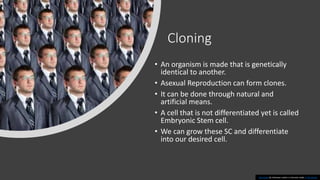
Cloning
• An organism is made that is genetically
identical to another.
• Asexual Reproduction can form clones.
• It can be done through natural and
artificial means.
• A cell that is not differentiated yet is called
Embryonic Stem cell.
• We can grow these SC and differentiate
into our desired cell.
This Photo by Unknown author is licensed under CC BY-SA-NC.
Types of Cloning
• Reproductive Cloning
• Therapeutic Cloning
Reproductive
Cloning
The purpose is to create the exact copy of the
organism.
It can be plant and animal.
It is used to breed specific organism which has the
characteristics required by the person.
It is also used to make unique organisms.
It is also used to repopulate endangered organisms.
The reproductive cloning in animals rejects in 99
percent of all the attempts.
Recipe of
Cloning
DOLLY-THE
SHEEP
• She was the first cloned Animal.
• Born in the Year 1996.
• Made from the Adult SC. Of a sheep.
• She had three mothers.
1. One mother was Adult Egg Cell Donor.
2. Somatic nucleus of second was isolated.
3. Surrogate mother.
• Identical to the mother who
contributed to the nucleus.
• Lived up to 7 years.
• She also gave birth.
This Photo by Unknown author is licensed under CC BY-SA.
Milestone in the
History of Cloning
• In 1997, A biotechnology company
created the first cloned calf named
GENE.
• It was made from the non-embryonic
SC.
• In 2001, Scientists at the advanced cell
technology announced the birth of
cloned baby bull named NOAH .
• It was the first endangered animal to
be cloned.
Therapeutic
Cloning
• Most of the diseases are because of faulty
cells.
• Type 1 Diabetes- Damage to the
pancreatic cells that produce insulin
• Sickle Cell Anemia- Caused by irregular
shape of RBCs.
• Paralysis- Sometimes caused by
the damaged. nerve cells.
The Process
Extract
• Extract the
embryonic SC
from early
embryo.
Grow
• Grow them in a
laboratory
Stimulate
• Stimulate them
to differentiate
into whichever
type of
specialized that
you want.
Give
• Then give that
to the
patients to
repair the faulty
cells.
Stem cell therapy
Ethical issues
Conclusion
By: Kanwal Javaid
19-Arid-1388
This Photo by Unknown author is licensed under CC BY-NC-ND.
Stem Cell
Therapy
• Stem cell therapy is introduction of new
adult stem cells into damaged tissue in order
to treat disease or injury.
• The ability of stem cells to self-renew and
give rise to different cells, that can potentially
replace diseased and damaged areas in the
body, with minimal risk of rejection and side
effects.
• A number of stem cell therapies exist, but
most are at experimental stages, costly or
controversial.
What
Diseases
Can be
Cured by
Stem Cell
Therapies?
►Any disease in which there
is tissue degeneration can be a
potential candidate for stem
cell therapies
• Alzheimer’s disease
• Parkinson’s disease
• Spinal cord injury
• Heart disease
• Severe burns
• Diabetes
Tissue Repair
• Regenerate spinal cord, heart
tissue or any other major tissue
in the body.
Heart Disease
• Adult bone marrow stem cells
injected into the hearts are
believed to improve cardiac
function in victims of heart failure
or heart attack
Leukemia and
Cancer
• Leukemia patients
treated with stem cells
emerge free of disease.
• Stem cells have also
reduces pancreatic
cancers in some
patients. Proliferation of
white cells
Rheumatoid
Arthritis
• • Adult Stem Cells may be
helpful in starting repair
of eroded cartilage.
Type I Diabetes
• • Embryonic Stems Cells might be
trained to become pancreatic
islets cells needed to secrete
insulin.
Challenges to Stem Cell
Research
• Source - Cell lines may have mutations
• Delivery to target areas
• Prevention of rejection
• Suppressing tumors
• Stem Cell regenerated tissue viability
• Political and religious obstructions
• Inability to obtain source material due to ethical concerns
Embryonic
Stem Cell
Controversy
• There is wide-spread controversy over the use of
human embryonic stem cells. This controversy
primarily targets the techniques used to derive new
embryonic stem cell lines, which often requires the
destruction of the blastocyst.
• At present, there are alternative sources for stem
cells which have achieved considerable success when
used as medical therapies. These alternatives do not
require the destruction of an embryo, such as the use
of umbilical cord blood, milky teeth stem cells, bone
marrow stem cells or using induced pluripotent stem
cells.
• However, non-embryonic stem cells may have
limitations.
The Ethical Debate :
In favor of ESCR:
• Embryonic stem cell research (ESCR)
fulfills
the ethical obligation to alleviate human
suffering.
• Since excess IVF embryos will be
discarded
anyway, isn’t it better that they be used
in valuable research?
• SCNT (Therapeutic Cloning) produces
cells in a petri dish, not a pregnancy.
Against ESCR:
• In ESCR, stem cells are taken from a human
blastocyst, which is then destroyed. This amounts to
“murder.”
• There is a risk of commercial exploitation of the
human participants in ESCR.
• ESCR will lead to reproductive cloning.
This Photo by Unknown author is licensed under CC BY-SA.
Stem Cell Ethics
• This is an ethical issue.
• Science is designed to tell us what is possible – what we can do.
• Science is not designed to tell us what is right – what we should do.
• To evaluate this technology one must employ some ethical
system that comes from outside of science.
Stem Cell
Ethics
• Stem Cell Ethics • “Can we” vs.
“Should we”
• – Dramatic advances of modern
• molecular genetics
• – Should we ask the morality
• questions before attempting
• the “can we” questions?
Stem Cell Ethics
• Encourage development of sound research and therapy.
• Prevent any misuse of human embryos and fetuses.
• Protect patients from fraudulent treatments in the name of stem cell research
Conclusions
Stem cells show great promise for regenerative medicine
There is enormous potential in human stem cell research Both adult and
embryonic stem cells should be studied
Much research needed before therapies are realized
Ethical concerns need to be taken into account
Proper guidelines are needed to ensure appropriate conduct of the research
THANK YOU!
STEM CELLS CAN CREATE
MIRACLES… GIVE HOPE
TO THE HOPELESS…
REWRITE MEDICAL
SCIENCE &
COULD MAKE LIFE
IMMORTAL!!!
Any Question?
This Photo by Unknown author is licensed under CC BY-NC.

Stem Cell Research.pptx

  • 1.
    "Stem Cell Research" By group4 This Photo by Unknown author is licensed under CC BY.
  • 2.
    Group Members • NoorUl Ain- History and Introduction • Shahneela Rafee- Types and Cultivation Process • Sania Akram- Stem Cell Cloning and the Potential Uses • Kanwal Javed- Conclusion and the ethical debate
  • 3.
    History and Introduction ofthe Stem Cell Research Noor ul Ain 19-Arid-1401 This Photo by Unknown author is licensed under CC BY-SA-NC.
  • 4.
    Introduction • Today livingin the 21st century, we still do not have proper treatments for many diseases like diabetes, Parkinson's Disease, Alzheimer's Disease etc. • Some light of hope for the treatment of these incurable diseases is - the Stem Cells.
  • 5.
    Introduction • Research onstem cells is advancing • How an organism develops from a single cell and how healthy cells replace damaged cells in adult organisms. • This promising area of science - investigates the possibility of cell-based therapies to treat disease, which is often referred to as regenerative or reparative medicine.
  • 6.
    History of Human Stem Cell •In 1968, the first bone marrow transplant was successfully used in treatment of Severe Combined Immunodeficiency • Since the 1970s, bone marrow transplants have been used for treatment of immunodeficiencies and leukemias
  • 7.
    History of Human EmbryonicStem Cell • In 1998, James Thomson (University of Wisconsin-Madison) isolated cells from the inner cell mass of the early embryo and developed the first human embryonic stem cell lines. History of Human Embryonic Stem Cell Research • In 1998, John Gearhart (Johns Hopkins University) derived human embryonic germ cells from cells in fetal gonadal tissue (primordial germ cells). • Pluripotent stem cell “lines” were developed from both sources.
  • 8.
    History of HumanSC 1999 First Successful human transplant of insulin- making cells from cadavers 2001 First cloned human embryos (only to six cell stage) created by Advanced Cell Technology (USA) 2004 Harvard researchers grow stem cells from embryos
  • 9.
    History of Cloning 2001– Cat cloned 2002 – Rabbits cloned 2003 – Mule clone 2004 – Bull cloned 2005 – Dog cloned
  • 10.
    Stem Cell –Definition Cell that could continuously divide and differentiate into various other kind(s) of cells/tissues.
  • 11.
    Properties of StemCell All stem cells—regardless of their source have three general properties • They are capable of dividing and renewing themselves for long periods • They are unspecialized • They can give rise to specialized cell types
  • 12.
    Self - Renewal(Regeneration) • Stem cells can dividing & renew themselves for long periods. • This is unlike muscle, blood or nerve cells-which do not normally replicate themselves. • These cells are capable of long-term self-renewal.
  • 13.
    Un- specialization Stem Cells are unspecialized– They do not have any tissue- specific structures that allow for specialized function.
  • 14.
    Specialization of Stem Cells: Differentiatio n Unspecializedstem cells give rise to specialized (differentiated) cells in response to external and internal chemical signals. Internal signals: • specific genes causing differential gene expression. External signals : • Chemicals secreted by other cells such as growth factors, cytokines, etc. • Physical contact with neighboring cells
  • 15.
    Types and sources andcultivation process of stem cells Shahneela Rafee 19-ARID-1411 This Photo by Unknown author is licensed under CC BY-SA-NC.
  • 16.
    Types of stem cells Totipotent: These stem cells can differentiate into all possible cell types. The first few cells that appear as the zygote starts to divide are totipotent.  Pluripotent: These cells can turn into almost any cell. Cells from the early embryo are pluripotent.  Multipotent: These cells can differentiate into a closely related family of cells. Adult hematopoietic stem cells, for example, can become red and white blood cells or platelets.  Oligo-potent: These can differentiate into a few different cell types. Adult lymphoid or myeloid stem cells can do this.  Uni-potent: These can only produce cells of one kind, which is their own type. However, they are still stem cells because they can renew themselves. Examples include adult muscle stem cells.
  • 17.
    Sources of stem cells Adultstem cells • The cells are in a non-specific state, but they are more specialized than embryonic stem cells. • present inside different types of tissue including: the brain, bone marrow, blood and blood vessels, skeletal muscles, skin and the liver. Embryonic stem cells • The blastocyst contains stem cells and will later implant in the womb. • Embryonic stem cells come from a blastocyst that is 4–5 days old. Mesenchymal stem cells (MSCs) • MSCs come from the connective tissue or stroma that surrounds the body’s organs and other tissues.
  • 18.
    Induced pluripotent stemcells (IPS) • Scientists create these in a lab, using skin cells and other tissue-specific cells. • These cells behave in a similar way to embryonic stem cells, so they could be useful for developing a range of therapies. • To grow stem cells, scientists first extract samples from adult tissue or an embryo. • They then place these cells in a controlled culture where they will divide and reproduce but not specialize further.
  • 19.
    Culture of Stem Cells •The culture conditions and types of media used for stem cell culture depend on the type of stem cell. • Protocols and products are available for both maintaining stem cells in an undifferentiated state differentiating them into different lineages and cell types.
  • 20.
    Contd. • Isolate &transfer of inner cell mass into plastic culture dish that contains culture medium. • Cells divide and spread over the dish. • Inner surface of culture dish is coated with mouse embryonic skin cells that have been treated so they will not divide. This coating is called a feeder layer. • Feeder cells provide ES cells with a sticky surface for attachment. Feeder cells release nutrients. • After several days the inner cell mass proliferates and begin to crowd the culture dish. • They are then gently removed and plated into several fresh culture dishes.
  • 21.
    Contd. • The processof plating the cells is repeated several times and for many months and is called sub-culturing. • Each cycle of sub-culturing is referred to as a passage. • After six months or more the inner cell mass yield millions of embryonic stem cells. • These cells are Pluripotent and appear genetically normal
  • 22.
    Growth of embryonicstem cells in vitro Dissect out the uterine horns • briefly rinse in 70 ethanol. • place into a falcon with PBS. • separate each embryo from placenta and embryonic sac. 1 Dissect head and red organs • wash in PBS 2 place all embryos in a clean petri dish 3
  • 23.
    Contd. • Finely mincethe tissue using a sterile razor blade until it becomes Pipette-able. 1. add trypsin and DNase. 2. incubate for 15minutes at 37-degree centigrade. 3. pipet up and down after each 5 minutes incubation 4. inactivate-trypsin by adding MEF medium 5. centrifuge at 300xg. 5minutes 6. remove the supernatant 7. resuspend cell pellet 8. Freeze the cells after implant
  • 24.
    Stem Cell Cloning &Potential Uses Sania Akram 19-Arid-1410
  • 26.
    Types of StemCells 1. Totipotent is capable of producing 200 different cell types in the human body. • The blastocyst is the totipotent stem cell. 2. Pluripotent stem cell forms all tissue cell types. • Pancreatic Islet cells, Hematopoietic Cells, Cardiomyocytes, Neurons. 3. Multipotent stem cells are more restricted. • Hematopoietic stem cells are multipotent. • They give rise to monocytes, Lymphocytes, Dendritic Cells, NK cells, Platelets. • Unipotent stem cells are specialized and undifferentiated. Totipotent Pluripotent Multipotent Unipotent
  • 27.
    Cloning • An organismis made that is genetically identical to another. • Asexual Reproduction can form clones. • It can be done through natural and artificial means. • A cell that is not differentiated yet is called Embryonic Stem cell. • We can grow these SC and differentiate into our desired cell. This Photo by Unknown author is licensed under CC BY-SA-NC.
  • 28.
    Types of Cloning •Reproductive Cloning • Therapeutic Cloning
  • 29.
    Reproductive Cloning The purpose isto create the exact copy of the organism. It can be plant and animal. It is used to breed specific organism which has the characteristics required by the person. It is also used to make unique organisms. It is also used to repopulate endangered organisms. The reproductive cloning in animals rejects in 99 percent of all the attempts.
  • 30.
  • 31.
    DOLLY-THE SHEEP • She wasthe first cloned Animal. • Born in the Year 1996. • Made from the Adult SC. Of a sheep. • She had three mothers. 1. One mother was Adult Egg Cell Donor. 2. Somatic nucleus of second was isolated. 3. Surrogate mother. • Identical to the mother who contributed to the nucleus. • Lived up to 7 years. • She also gave birth. This Photo by Unknown author is licensed under CC BY-SA.
  • 32.
    Milestone in the Historyof Cloning • In 1997, A biotechnology company created the first cloned calf named GENE. • It was made from the non-embryonic SC. • In 2001, Scientists at the advanced cell technology announced the birth of cloned baby bull named NOAH . • It was the first endangered animal to be cloned.
  • 33.
    Therapeutic Cloning • Most ofthe diseases are because of faulty cells. • Type 1 Diabetes- Damage to the pancreatic cells that produce insulin • Sickle Cell Anemia- Caused by irregular shape of RBCs. • Paralysis- Sometimes caused by the damaged. nerve cells.
  • 34.
    The Process Extract • Extractthe embryonic SC from early embryo. Grow • Grow them in a laboratory Stimulate • Stimulate them to differentiate into whichever type of specialized that you want. Give • Then give that to the patients to repair the faulty cells.
  • 36.
    Stem cell therapy Ethicalissues Conclusion By: Kanwal Javaid 19-Arid-1388 This Photo by Unknown author is licensed under CC BY-NC-ND.
  • 37.
    Stem Cell Therapy • Stemcell therapy is introduction of new adult stem cells into damaged tissue in order to treat disease or injury. • The ability of stem cells to self-renew and give rise to different cells, that can potentially replace diseased and damaged areas in the body, with minimal risk of rejection and side effects. • A number of stem cell therapies exist, but most are at experimental stages, costly or controversial.
  • 38.
    What Diseases Can be Cured by StemCell Therapies? ►Any disease in which there is tissue degeneration can be a potential candidate for stem cell therapies • Alzheimer’s disease • Parkinson’s disease • Spinal cord injury • Heart disease • Severe burns • Diabetes
  • 39.
    Tissue Repair • Regeneratespinal cord, heart tissue or any other major tissue in the body.
  • 40.
    Heart Disease • Adultbone marrow stem cells injected into the hearts are believed to improve cardiac function in victims of heart failure or heart attack
  • 41.
    Leukemia and Cancer • Leukemiapatients treated with stem cells emerge free of disease. • Stem cells have also reduces pancreatic cancers in some patients. Proliferation of white cells
  • 42.
    Rheumatoid Arthritis • • AdultStem Cells may be helpful in starting repair of eroded cartilage.
  • 43.
    Type I Diabetes •• Embryonic Stems Cells might be trained to become pancreatic islets cells needed to secrete insulin.
  • 44.
    Challenges to StemCell Research • Source - Cell lines may have mutations • Delivery to target areas • Prevention of rejection • Suppressing tumors • Stem Cell regenerated tissue viability • Political and religious obstructions • Inability to obtain source material due to ethical concerns
  • 45.
    Embryonic Stem Cell Controversy • Thereis wide-spread controversy over the use of human embryonic stem cells. This controversy primarily targets the techniques used to derive new embryonic stem cell lines, which often requires the destruction of the blastocyst. • At present, there are alternative sources for stem cells which have achieved considerable success when used as medical therapies. These alternatives do not require the destruction of an embryo, such as the use of umbilical cord blood, milky teeth stem cells, bone marrow stem cells or using induced pluripotent stem cells. • However, non-embryonic stem cells may have limitations.
  • 46.
    The Ethical Debate: In favor of ESCR: • Embryonic stem cell research (ESCR) fulfills the ethical obligation to alleviate human suffering. • Since excess IVF embryos will be discarded anyway, isn’t it better that they be used in valuable research? • SCNT (Therapeutic Cloning) produces cells in a petri dish, not a pregnancy.
  • 47.
    Against ESCR: • InESCR, stem cells are taken from a human blastocyst, which is then destroyed. This amounts to “murder.” • There is a risk of commercial exploitation of the human participants in ESCR. • ESCR will lead to reproductive cloning. This Photo by Unknown author is licensed under CC BY-SA.
  • 48.
    Stem Cell Ethics •This is an ethical issue. • Science is designed to tell us what is possible – what we can do. • Science is not designed to tell us what is right – what we should do. • To evaluate this technology one must employ some ethical system that comes from outside of science.
  • 49.
    Stem Cell Ethics • StemCell Ethics • “Can we” vs. “Should we” • – Dramatic advances of modern • molecular genetics • – Should we ask the morality • questions before attempting • the “can we” questions?
  • 50.
    Stem Cell Ethics •Encourage development of sound research and therapy. • Prevent any misuse of human embryos and fetuses. • Protect patients from fraudulent treatments in the name of stem cell research
  • 51.
    Conclusions Stem cells showgreat promise for regenerative medicine There is enormous potential in human stem cell research Both adult and embryonic stem cells should be studied Much research needed before therapies are realized Ethical concerns need to be taken into account Proper guidelines are needed to ensure appropriate conduct of the research
  • 52.
    THANK YOU! STEM CELLSCAN CREATE MIRACLES… GIVE HOPE TO THE HOPELESS… REWRITE MEDICAL SCIENCE & COULD MAKE LIFE IMMORTAL!!!
  • 53.
    Any Question? This Photoby Unknown author is licensed under CC BY-NC.