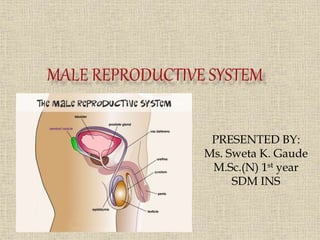
PRESENTED BY:
Ms. Sweta K. Gaude
M.Sc.(N) 1st year
SDM INS
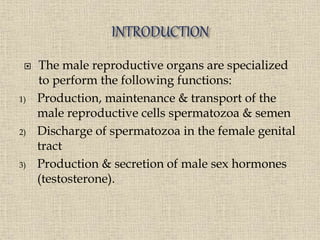
 The male reproductive organs are specialized
to perform the following functions:
1) Production, maintenance & transport of the
male reproductive cells spermatozoa & semen
2) Discharge of spermatozoa in the female genital
tract
3) Production & secretion of male sex hormones
(testosterone).
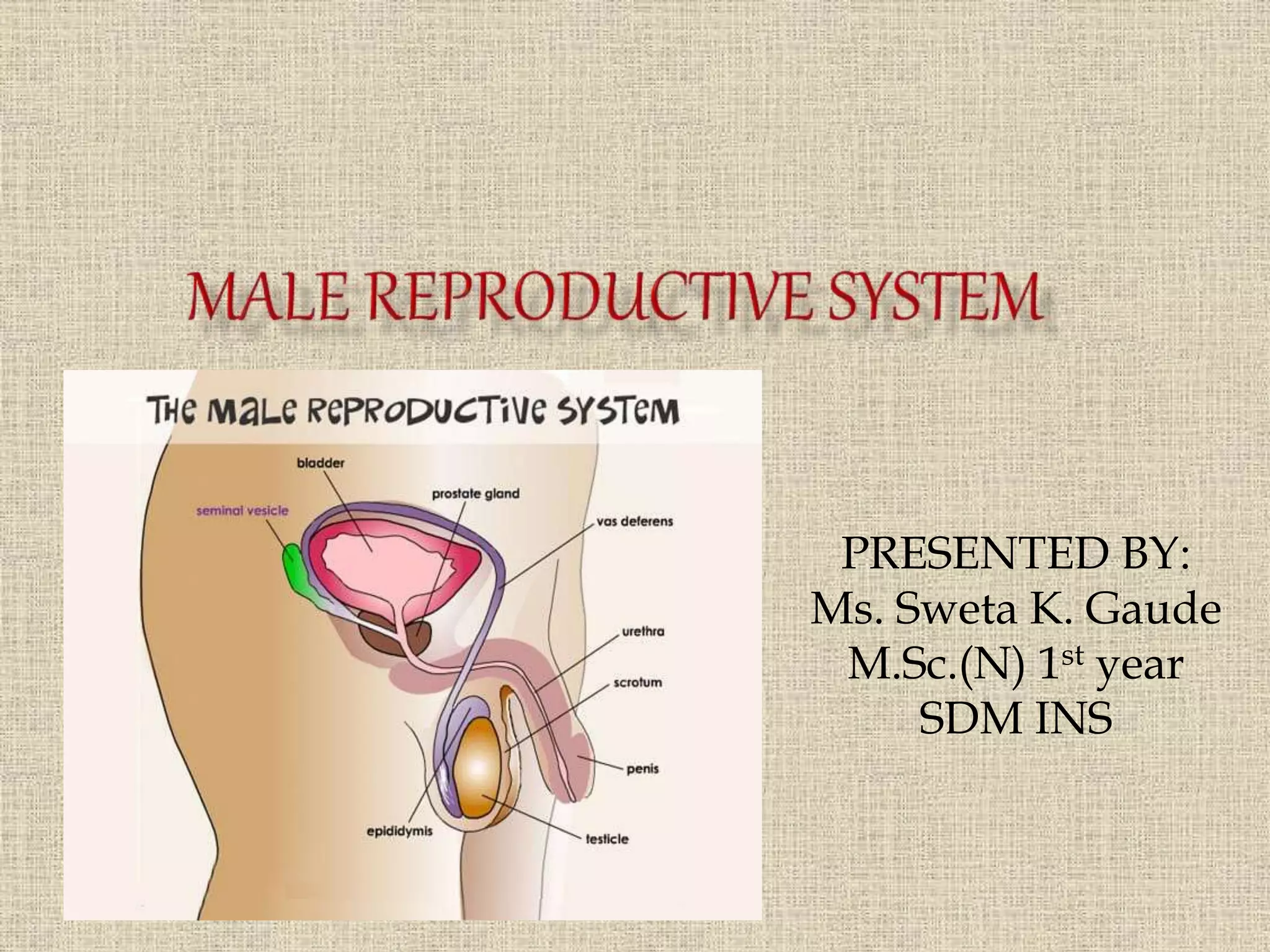
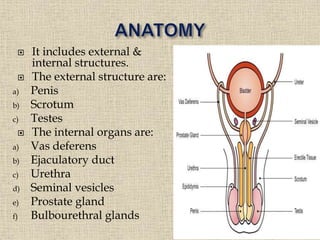
 It includes external &
internal structures.
 The external structure are:
a) Penis
b) Scrotum
c) Testes
 The internal organs are:
a) Vas deferens
b) Ejaculatory duct
c) Urethra
d) Seminal vesicles
e) Prostate gland
f) Bulbourethral glands
 The penis is the male organ for coitus.
 It is about 10cm long, 4cm broad & consist of
three parts: the root attached to the wall of the
abdomen; the body or shaft; & the glans; the
cone-shaped end of the penis.
 The glans is covered with a loose layer of skin
called foreskin or prepuce which is removed in
operation of circumcision.
 Urethral, the tube transporting semen & urine,
opens at its tip.
 Glans is very sensitive due to number of
sensitive nerve endings.
 The penile body is cylindrical in shape &
consist of three internal columns, two lateral
corpora cavernosa & one posterior corpus
spongiosum through which urethra traverses.
 These tissues are made up of special, sponge
like erectile tissue with thousands of empty
spaces which fill with blood during sexual
excitation.
 The filling of blood makes penis rigid & erect
to enable it to undergo changes in its size
during erection.
 It is the loose pouch like sac of skin behind the
penis & has testes, many nerves & blood
vessels in it.
 It provides protection & temperature
regulation for the testes as spermiogenosis
requires cooler temperature in the testes.
 The two testes are olive shaped (4x3 cm) oval
organs that lie in the scrotum & produce
spermatozoa (male gametes) & testosterone
hormone, the primary male sex hormone.
 Each testes is enclosed by a tough, white fibrous
sheath named tunica albuginea.
 The testes contain numerous coiled tubes called
seminiferous tubules where spermatogenesis takes
place.
 The seminiferous tubules join together to form
channels that leads to the epididymis.
 Interstial cells of testes between seminiferous
tubules secrete testosterone.
 The epididymis is about 50 cm long, comma
shaped coiled tube situated on the backside of
each testes.
 Its main function is to transport & store the
sperm cells that are produced in the testes.
 It also helps, in their maturation to make them
capable of fertilization.
 During sexual arousal sperms enter into the
vas deferens.
 Spermatic cord: The spermatic cord is made of
vas deferens, testicular blood vessels & nerves.
 The cord transverses upward through the
inguinal canal from where the vas deferens
continuous upwards over the pubis & curls
backward beside the bladder.
 Each vas deferens is a 45cm long, 3mm in
diameter, muscular tube in spermatic cord.
 It travels from the epididymis into the pelvic
cavity, to just behind the bladder.
 The vas deferens empties into the ejaculatory
duct & passes through prostate gland.
 These are two small muscular ducts formed by the
merger of the vas deferens & the seminal vesicles.
 They carry seminal fluid into the urethra.
URETHRA:
 The urethra is a tube that connects bladder to
outside of the body.
 It is a passage for urine & semen.
 The erect penis during coitus, blocks the flow of
urine from the urethra, so that only semen is
ejaculated during orgasm.
 The seminal vesicles are two sac like pouches
attaching to the vas deferens near the bladder
base.
 They secrete fructose rich fluid to provide
nutrition to the sperms & enhance their
motility.
 Their fluid constitute most of the volume of a
man’s ejaculatory fluid, or ejaculate.
 The prostate gland (single) 4x3x2 cm in
dimensions is a walnut-sized structure that
surrounds the urethra at the base of urinary
bladder in front of the rectum.
 It secretes a milky alkaline lubricating fluid to
nourish the sperms & to protect the sperms
against acid conditions of the vagina.
 The bulbourethral glands or Cowper’s glands
(two in number) are pea sized structures
situated on either side of urethra below the
prostate gland.
 They secrete a thick, clear mucus for
lubrication.
 The basic hormones involved in the
functioning of the male reproductive system
are follicle-stimulating hormone (FSH),
luteinizing hormone (LH) & testosterone.
 The hypothalamus produces gonadotropin
releasing factors which stimulate the anterior
pituitary gland to produce FSH & LH.
 FSH is necessary for sperm production
(spermatogenesis) by acting on seminiferous
tubules.
 LH stimulates the production of testosterone
by acting on interstitial cells of tests which is
necessary to continue the process of
spermatogenesis.
 Testosterone is also responsible in the
development of male secondary sex
characteristics like deepening of voice, hair
growth on face, pubis axilla & chest.
 It also helps in attaining muscle mass &
strength, fat distribution, bone mass & sex dive
in men.
MALE REPRODUCTIVE SYSTEM.pptx

MALE REPRODUCTIVE SYSTEM.pptx

  • 1.
    PRESENTED BY: Ms. SwetaK. Gaude M.Sc.(N) 1st year SDM INS
  • 2.
     The malereproductive organs are specialized to perform the following functions: 1) Production, maintenance & transport of the male reproductive cells spermatozoa & semen 2) Discharge of spermatozoa in the female genital tract 3) Production & secretion of male sex hormones (testosterone).
  • 3.
     It includesexternal & internal structures.  The external structure are: a) Penis b) Scrotum c) Testes  The internal organs are: a) Vas deferens b) Ejaculatory duct c) Urethra d) Seminal vesicles e) Prostate gland f) Bulbourethral glands
  • 4.
     The penisis the male organ for coitus.  It is about 10cm long, 4cm broad & consist of three parts: the root attached to the wall of the abdomen; the body or shaft; & the glans; the cone-shaped end of the penis.  The glans is covered with a loose layer of skin called foreskin or prepuce which is removed in operation of circumcision.  Urethral, the tube transporting semen & urine, opens at its tip.  Glans is very sensitive due to number of sensitive nerve endings.
  • 5.
     The penilebody is cylindrical in shape & consist of three internal columns, two lateral corpora cavernosa & one posterior corpus spongiosum through which urethra traverses.  These tissues are made up of special, sponge like erectile tissue with thousands of empty spaces which fill with blood during sexual excitation.  The filling of blood makes penis rigid & erect to enable it to undergo changes in its size during erection.
  • 6.
     It isthe loose pouch like sac of skin behind the penis & has testes, many nerves & blood vessels in it.  It provides protection & temperature regulation for the testes as spermiogenosis requires cooler temperature in the testes.
  • 7.
     The twotestes are olive shaped (4x3 cm) oval organs that lie in the scrotum & produce spermatozoa (male gametes) & testosterone hormone, the primary male sex hormone.  Each testes is enclosed by a tough, white fibrous sheath named tunica albuginea.  The testes contain numerous coiled tubes called seminiferous tubules where spermatogenesis takes place.  The seminiferous tubules join together to form channels that leads to the epididymis.  Interstial cells of testes between seminiferous tubules secrete testosterone.
  • 8.
     The epididymisis about 50 cm long, comma shaped coiled tube situated on the backside of each testes.  Its main function is to transport & store the sperm cells that are produced in the testes.  It also helps, in their maturation to make them capable of fertilization.  During sexual arousal sperms enter into the vas deferens.
  • 9.
     Spermatic cord:The spermatic cord is made of vas deferens, testicular blood vessels & nerves.  The cord transverses upward through the inguinal canal from where the vas deferens continuous upwards over the pubis & curls backward beside the bladder.
  • 10.
     Each vasdeferens is a 45cm long, 3mm in diameter, muscular tube in spermatic cord.  It travels from the epididymis into the pelvic cavity, to just behind the bladder.  The vas deferens empties into the ejaculatory duct & passes through prostate gland.
  • 11.
     These aretwo small muscular ducts formed by the merger of the vas deferens & the seminal vesicles.  They carry seminal fluid into the urethra. URETHRA:  The urethra is a tube that connects bladder to outside of the body.  It is a passage for urine & semen.  The erect penis during coitus, blocks the flow of urine from the urethra, so that only semen is ejaculated during orgasm.
  • 12.
     The seminalvesicles are two sac like pouches attaching to the vas deferens near the bladder base.  They secrete fructose rich fluid to provide nutrition to the sperms & enhance their motility.  Their fluid constitute most of the volume of a man’s ejaculatory fluid, or ejaculate.
  • 13.
     The prostategland (single) 4x3x2 cm in dimensions is a walnut-sized structure that surrounds the urethra at the base of urinary bladder in front of the rectum.  It secretes a milky alkaline lubricating fluid to nourish the sperms & to protect the sperms against acid conditions of the vagina.
  • 14.
     The bulbourethralglands or Cowper’s glands (two in number) are pea sized structures situated on either side of urethra below the prostate gland.  They secrete a thick, clear mucus for lubrication.
  • 15.
     The basichormones involved in the functioning of the male reproductive system are follicle-stimulating hormone (FSH), luteinizing hormone (LH) & testosterone.  The hypothalamus produces gonadotropin releasing factors which stimulate the anterior pituitary gland to produce FSH & LH.  FSH is necessary for sperm production (spermatogenesis) by acting on seminiferous tubules.
  • 16.
     LH stimulatesthe production of testosterone by acting on interstitial cells of tests which is necessary to continue the process of spermatogenesis.  Testosterone is also responsible in the development of male secondary sex characteristics like deepening of voice, hair growth on face, pubis axilla & chest.  It also helps in attaining muscle mass & strength, fat distribution, bone mass & sex dive in men.