Stem cells migration
Stem cells Stem cells - the hierarchy of special cells of living organisms, each of which is able to subsequently differentiate   a special way, that is to specialize and continue to develop as a normal cell.
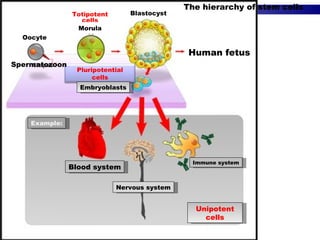
The hierarchy of stem cells Human fetus Oocyte Embryoblasts Spermatozoon Totipotent cells Morula Blastocyst Example: Blood system Nervous system Immune system Unipotent cells Pluripotential cells
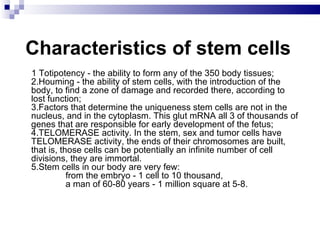
Characteristics of stem cells 1 Totipotency  - the ability to form any of the 350 body tissues;  2.Houming - the ability  of stem  cells, with the introduction of the body, to find a zone of damage and recorded there, according to lost function;  3.Factors that determine the uniqueness  stem  cells are not in the nucleus, and in the cytoplasm. This glut mRNA all 3 of thousands of genes that are responsible for early development of the fetus;  4.TELOMERASE activity. In the stem, sex and tumor cells have TELOMERASE activity, the ends of their chromosomes are built, that is, those cells can be potentially an infinite number of cell divisions, they are immortal.  5.Stem cells in our body are very few:                from the embryo - 1 cell to 10 thousand,                a man of 60-80 years - 1 million square at 5-8.
 
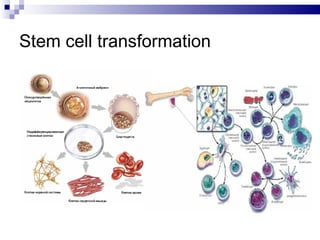
Stem cell transformation
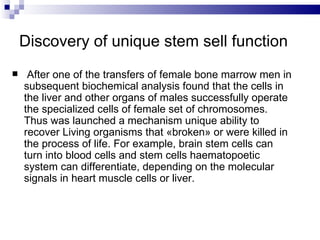
Discovery of unique   stem sell function After one of the transfers of female bone marrow men in subsequent biochemical analysis found that the cells in the liver and other organs of males successfully operate the specialized cells of female set of chromosomes. Thus was launched a mechanism unique ability to recover Living organisms that «broken» or were killed in the process of life. For example, brain stem cells can turn into blood cells and stem cells haematopoetic system can differentiate, depending on the molecular signals in heart muscle cells or liver .
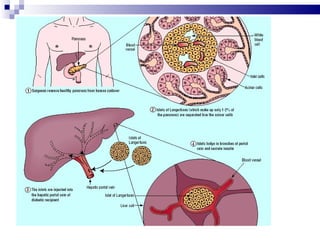
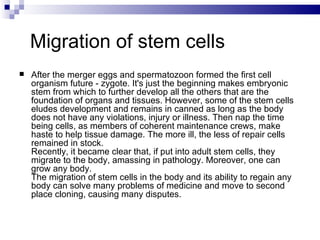
M igration of stem cells After the merger eggs and spermatozo on  formed the first cell organism future - zygote. It's just the beginning makes embryonic stem from which to further develop all the others that are the foundation of organs and tissues. However, some of the stem cells eludes development and remains in  canned  as long as the body does not have any violations, injury or illness. Then nap the time being cells, as members of coherent maintenance crews, make haste to help tissue damage. The more ill, the less of repair cells remained in stock . Recently, it became clear that, if put into adult stem cells, they migrate to the body,  amassing  in pathology. Moreover, one can grow any body.  The migration of stem cells in the body and its ability to regain any body can solve many problems of medicine and move to second place cloning, causing many disputes .
Mesenchymal stem cells It’s  best source of stem cells for the regeneration of a bone marrow cells which have the undeniable advantage over embryonic stem cells. They keep an information on the structure of tissues and organs, as a kind of universal «bank» memory.  W hen the patient's body receives a signal SOS, bone marrow stem cells immediately begin to share and become the desired cell type to replace. For example, if the liver is destroyed, the stem cells come from bone marrow and blood fall into the liver, becoming liver cells .

Stem Cell Migration

  • 1.
  • 2.
    Stem cells Stemcells - the hierarchy of special cells of living organisms, each of which is able to subsequently differentiate a special way, that is to specialize and continue to develop as a normal cell.
  • 3.
    The hierarchy ofstem cells Human fetus Oocyte Embryoblasts Spermatozoon Totipotent cells Morula Blastocyst Example: Blood system Nervous system Immune system Unipotent cells Pluripotential cells
  • 4.
    Characteristics of stemcells 1 Totipotency - the ability to form any of the 350 body tissues; 2.Houming - the ability of stem cells, with the introduction of the body, to find a zone of damage and recorded there, according to lost function; 3.Factors that determine the uniqueness stem cells are not in the nucleus, and in the cytoplasm. This glut mRNA all 3 of thousands of genes that are responsible for early development of the fetus; 4.TELOMERASE activity. In the stem, sex and tumor cells have TELOMERASE activity, the ends of their chromosomes are built, that is, those cells can be potentially an infinite number of cell divisions, they are immortal. 5.Stem cells in our body are very few:               from the embryo - 1 cell to 10 thousand,               a man of 60-80 years - 1 million square at 5-8.
  • 5.
  • 6.
  • 7.
    Discovery of unique stem sell function After one of the transfers of female bone marrow men in subsequent biochemical analysis found that the cells in the liver and other organs of males successfully operate the specialized cells of female set of chromosomes. Thus was launched a mechanism unique ability to recover Living organisms that «broken» or were killed in the process of life. For example, brain stem cells can turn into blood cells and stem cells haematopoetic system can differentiate, depending on the molecular signals in heart muscle cells or liver .
  • 8.
    M igration ofstem cells After the merger eggs and spermatozo on formed the first cell organism future - zygote. It's just the beginning makes embryonic stem from which to further develop all the others that are the foundation of organs and tissues. However, some of the stem cells eludes development and remains in canned as long as the body does not have any violations, injury or illness. Then nap the time being cells, as members of coherent maintenance crews, make haste to help tissue damage. The more ill, the less of repair cells remained in stock . Recently, it became clear that, if put into adult stem cells, they migrate to the body, amassing in pathology. Moreover, one can grow any body. The migration of stem cells in the body and its ability to regain any body can solve many problems of medicine and move to second place cloning, causing many disputes .
  • 9.
    Mesenchymal stem cellsIt’s best source of stem cells for the regeneration of a bone marrow cells which have the undeniable advantage over embryonic stem cells. They keep an information on the structure of tissues and organs, as a kind of universal «bank» memory. W hen the patient's body receives a signal SOS, bone marrow stem cells immediately begin to share and become the desired cell type to replace. For example, if the liver is destroyed, the stem cells come from bone marrow and blood fall into the liver, becoming liver cells .