


INTRODUCTION
Inhalation is the process of entry of air into the
alveoli through the airway from the external
environment.
Today, inhalation represents the route of choice for
the delivery of drugs to treat various respiratory
disorders.
With this therapy, drugs are delivered directly to
the site of action of the lungs for localized effect
at lower doses for getting a rapid response with
fewer adverse effects compared to systemic
administration of the same agent.
DEFINITION
Inhalation therapies are a group of respiratory
treatments designed to help restore or improve
breathing function in patients with a variety of
disease.
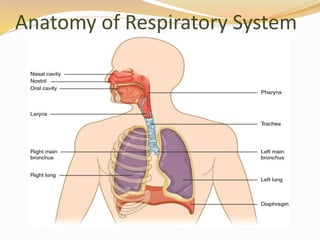
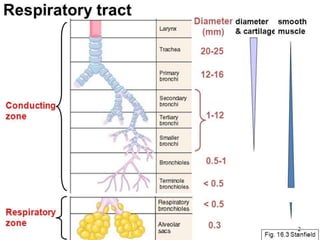
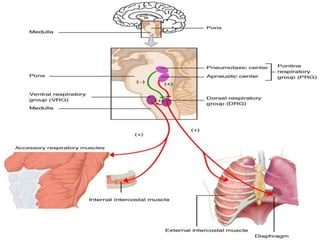
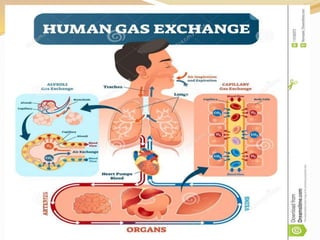
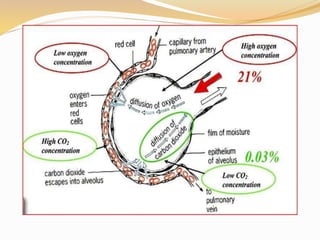
Anatomy of Respiratory System
TYPES OF INHALATIONS
1.Moist/ wet inhalation-
 Steam inhalation
 Nebulization
2.Metered dose inhaler
3.Dry inhalation-Aerosol inhalers
PARTICLE SIZE
 <1 micrometer reach upto the alveoli
 0.5-5 micrometer beyond the 10th generation of
bronchi
 >5 micrometer oropharynx
INHALANT DRUGS
 Antiallergic agents- budesonide (glucocorticoids)
 Bronchodilaters- Salbutamol (beta-2 agonist)
 Anaesthetics- opioids
 Mucolytic agents- Acetylcysteine
 Antimicrobials- tobramycin (antibacterial)
pentamidine(antifungal)
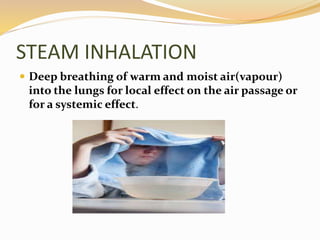
STEAM INHALATION
 Deep breathing of warm and moist air(vapour)
into the lungs for local effect on the air passage or
for a systemic effect.
PURPOSE-
 To relieve inflammation and congestion of the
mucous membranes of respiratory tract and
paranasal sinuses.
 To soften thick tenacious mucous
 To prevent dryness of the mucous membrane
following tracheostomy.
 To relieve spastic conditions of larynx and
bronchi.
 To provide antiseptic action on the respiratory
tract.
INDICATIONS-
 Sinusitis
 Edema of larynx
 Thick mucous in the chest
 Whooping cough
 Acute bronchitis
 After tracheostomy
 Spasm of mucous membrane of larynx
CONTRAINDICATIONS-
 Carcinoma of lungs
 Very young and very old patients
 High fever patients
 Patients with severe headache
DRUGS USED
 Eucalyptus 2 ml per 500 ml of boiling
water
 Methyl salicylate few drops per 500ml of
boiling water
 Menthol few crystals per 500 ml of
boiling water
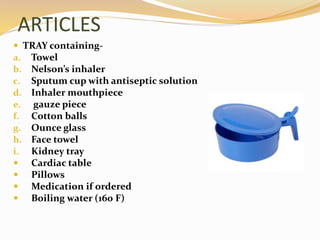
ARTICLES
 TRAY containing-
a. Towel
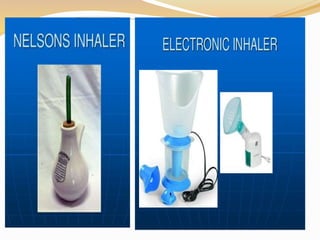
b. Nelson’s inhaler
c. Sputum cup with antiseptic solution
d. Inhaler mouthpiece
e. gauze piece
f. Cotton balls
g. Ounce glass
h. Face towel
i. Kidney tray
 Cardiac table
 Pillows
 Medication if ordered
 Boiling water (160 F)
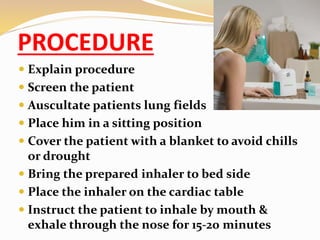
PROCEDURE
 Explain procedure
 Screen the patient
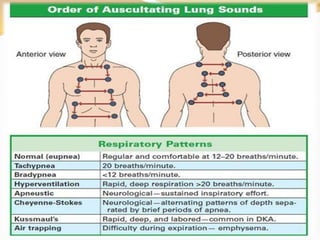
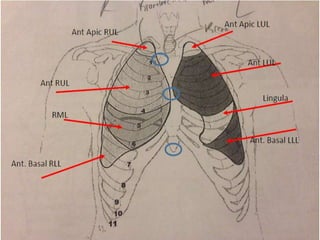
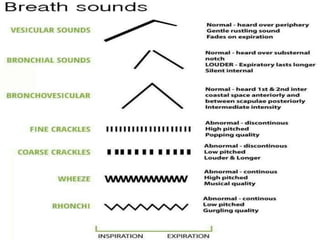
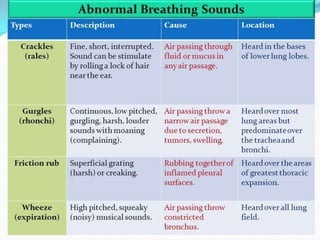
 Auscultate patients lung fields
 Place him in a sitting position
 Cover the patient with a blanket to avoid chills
or drought
 Bring the prepared inhaler to bed side
 Place the inhaler on the cardiac table
 Instruct the patient to inhale by mouth &
exhale through the nose for 15-20 minutes
 Keep a sputum cup & face towel near patient
 Remove the inhaler, keep the patient in a
comfortable position & well covered for an
hour
 Wash the mouth piece of the inhaler with a
swab & running water
 Replace all the articles & record it.
POINTS TO REMEMBER
 Avoid spilling & prevent scalding the
patient
 Never leave babies or a helpless patient
along with inhaler
 Check the inhaler & mouth piece for
cracks & leakages before use
 Give treatment regularly as ordered
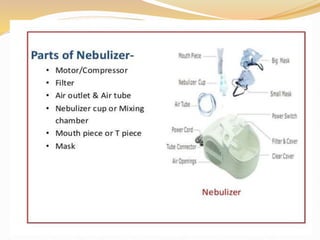
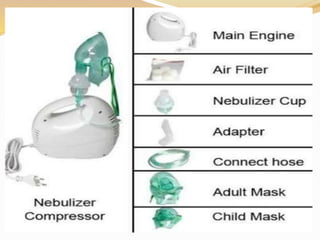
NEBULIZATION
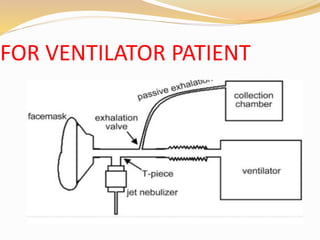
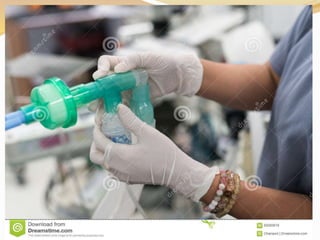
Means of administering drugs by inhalation.
The equalizer breaks the solution to be inhaled into
fine droplets which are then suspended in a steam
of gas and the patient actively inhales this gas
steam containing the drug.
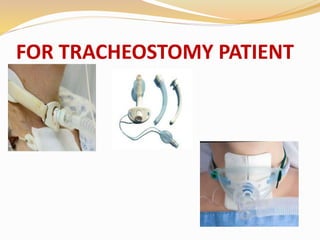
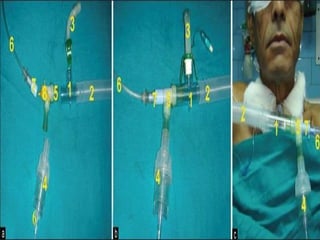
FOR TRACHEOSTOMY PATIENT
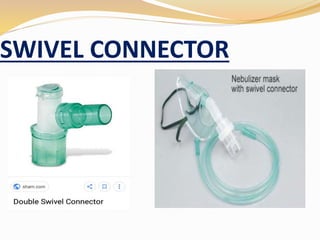
SWIVEL CONNECTOR
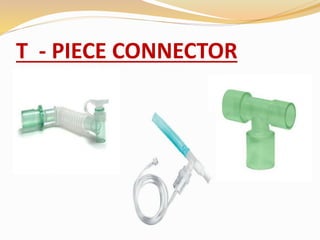
T - PIECE CONNECTOR
FOR VENTILATOR PATIENT
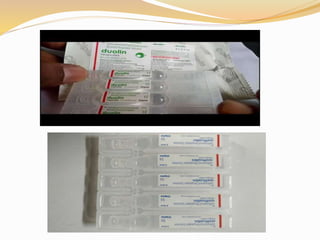
Respules
 Levolin- levosalbutamol inhalation solution
 Budecort-Budesonide
 Asthalin- salbutamol
 Ipravent- ipratropium bromide
 Duolin/Iprazest-Levosalbutamol and ipratropium
bromide respirator solution
PURPOSE
 Delivery of bronchodilators in patients with acute
asthma attack and dyspnoea.
 Administration of antibiotics and antifungal
agents.
 To aid in expectoration
 Local analgesia to relieve dyspnoea in terminally
ill pts.
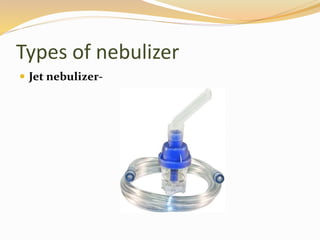
Types of nebulizer
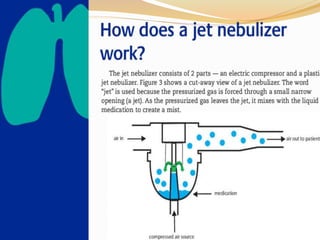
 Jet nebulizer-
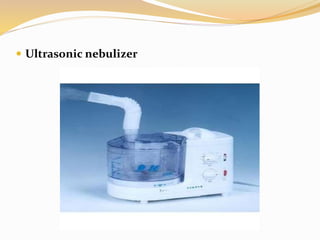
 Ultrasonic nebulizer
 Ultrazonic nebulizer is a humidifier using high
frequency electricity to power a transducer and
divides water up into 0.5-3 mcm particles in its
nebulizing chamber used in inhalation therapy
 The use of this ultrazonic nebulizer benefits the
user because the medicated water mist can be
deposited deep inside the respiratory tract,which
achieves more effective treatment of asthma and
other respiratory ailments
ARTICLES
 Air compressor
 Connecting tube
 Nebulizer
 Medication and saline solution
 Sterile water
 Cotton balls
 Sputum cup with disinfectant
 Kidney tray
PROCEDURE
 Identify the patient
 Monitor heart rate before & after the treatment
for patients using bronchodilator drugs
 Explain procedure to the patient
 Place the patient in semi fowlers position
 Add the prescribed medication or saline or sterile
water to the nebulizer
 Place mask on patients face to cover his mouth &
nose & instruct him to inhale deeply & slowly
through mouth , hold breath & then exhale
several times
Continue…………..
 Observe expansion of chest to ascertain that
patient is taking deep breaths
 Instruct the patient to breathe slowly & deeply
until all the medication is nebulized
 On completion of the treatment encourage the
patient to cough after several deep breaths and for
facilitating cough chest physiotherapy can be
done
 Observe patient for any adverse reactions
Continue….
 Record medication used and descriptios of
secretions expectorated
 Disassemble and clear nebulizer after each
use,keep the equipment in patients room.the
tubing is changed every 24 hours
 Wash hands
 Special consideration ; if indicated provide
nebulization using oxygen source
Care And Maintenance Of Nebulizer
 Nebulizer should be cleaned using warm water .
 Soak the device mouthpiece or mask in warm
soapy water for minimum 5 mins.
 Rinse thoroughly (using boiled then cooled
water)and allow parts to dry
 Should be done atleast once daily
 Nebulizer must be replaced every 6 months to
ensure optimum functioning and decrease
chances of colonization.
METERED – DOSE INHALERS
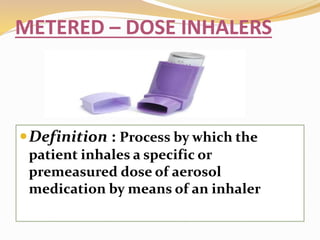
Definition : Process by which the
patient inhales a specific or
premeasured dose of aerosol
medication by means of an inhaler
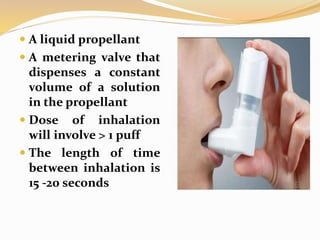
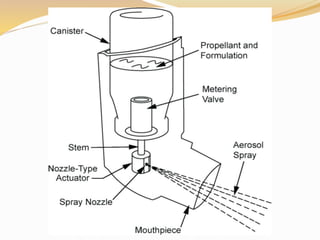
 A liquid propellant
 A metering valve that
dispenses a constant
volume of a solution
in the propellant
 Dose of inhalation
will involve > 1 puff
 The length of time
between inhalation is
15 -20 seconds
PURPOSES
 To relieve inflammation and congestion
of mucous membrane
 To improve clearance of pulmonary
secretions
 To act as a bronchodilator and mucolytic
agent
ARTICLES
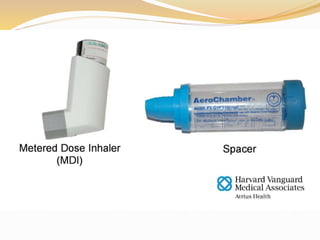
MDI (METERED DOSE
INHALER
Facial tissues
PROCEDURE
Identify the patient
Assess the patients ability to hold and
manipulate inhaler
Instruct the patient to be in a
comfortable environment by sitting in
a chair
Explain to the patient & demonstrate to
the patient how to use this
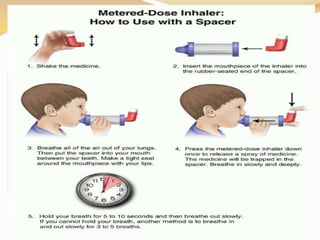
 Remove cap & hold inhaler upright, grasping
it with thumb and first two fingers
 Shake inhaler
 Tilt head back slightly and breath out
 Position inhaler.
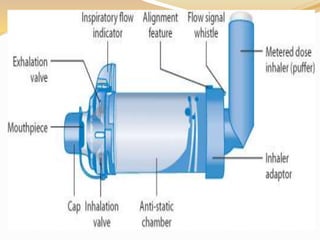
 hold the inhaler .5-1 inch / attach spacer to
mouthpiece of inhaler /place the mouthpiece
or spacer in mouth
Continue………..
 Press down on inhaler to release medication
while inhaling slowly
 Breath in slowly for 2-3 seconds
 Hold breath for approximately for 10 seconds
 Repeat puffs as ordered, waiting 1 minute
between puffs
Procedure continues………
 If two inhaled medications are prescribed wait 5-
10minutes between inhalations as ordered by
physician
 Explain patient may feel gagging sensation in
throat caused by droplets of medication on
pharynx or tongue
 Instruct patient in removing medication canister
and cleaning inhaler in warm water
Cleansing and maintenance
 It is essential to keep plastic mouthpiece clean to
ensure proper functioning of inhaler. Clean the
inhaler at least once in a week as follows-
1. Gently pull the metal canister out of the plastic body
of the inhaler. Remove the mouthpiece cover.
2. Immerse the plastic body and the mouthpiece cover
in warm water. Do not put the metal cannister in the
water.
3. Next, wash the plastic body and mouthpiece cover in
running tape water.
4. Shake well to remove excess water. Leave to dry.
Avoid the use of heat to dry the parts.
5. When the plastic body is dry replace the canister an
the mouthpiece cover correctly.
SPECIAL CONSIDERATIONS
Gargle with plain water after steroid
inhalations to reduce chances of
infections
Do not put inhaler in water.
The metal cannister is pressurized so
do not puncture or burn it even when
empty.
Keep away from eyes.
Keep away from children.
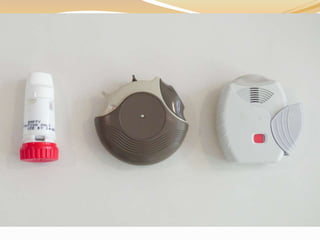
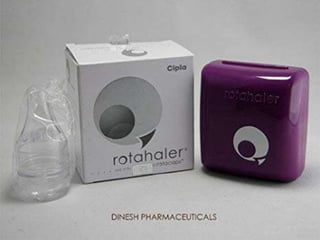
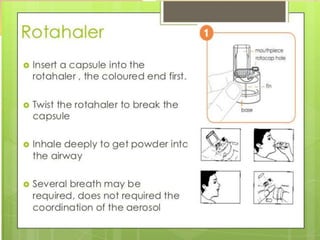
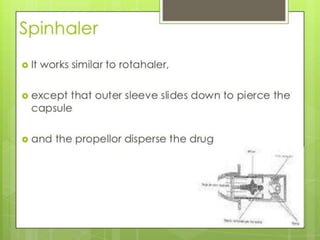
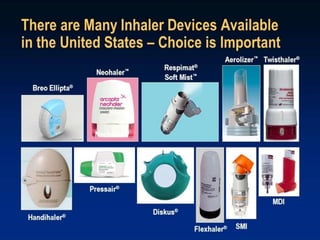
DRY POWDER INHALER
 No propellant
 Breath activated and patient coordination is not
an important issue
 The drug is formulated in a filler and contained in
a capsule that is placed in the device and
punctured to release the powder
Inhalations
Inhalations
Inhalations
Inhalations
Inhalations
Inhalations
Inhalations

Inhalations

  • 2.
    INTRODUCTION Inhalation is theprocess of entry of air into the alveoli through the airway from the external environment. Today, inhalation represents the route of choice for the delivery of drugs to treat various respiratory disorders. With this therapy, drugs are delivered directly to the site of action of the lungs for localized effect at lower doses for getting a rapid response with fewer adverse effects compared to systemic administration of the same agent.
  • 3.
    DEFINITION Inhalation therapies area group of respiratory treatments designed to help restore or improve breathing function in patients with a variety of disease.
  • 4.
  • 16.
    TYPES OF INHALATIONS 1.Moist/wet inhalation-  Steam inhalation  Nebulization 2.Metered dose inhaler 3.Dry inhalation-Aerosol inhalers
  • 17.
    PARTICLE SIZE  <1micrometer reach upto the alveoli  0.5-5 micrometer beyond the 10th generation of bronchi  >5 micrometer oropharynx
  • 18.
    INHALANT DRUGS  Antiallergicagents- budesonide (glucocorticoids)  Bronchodilaters- Salbutamol (beta-2 agonist)  Anaesthetics- opioids  Mucolytic agents- Acetylcysteine  Antimicrobials- tobramycin (antibacterial) pentamidine(antifungal)
  • 19.
    STEAM INHALATION  Deepbreathing of warm and moist air(vapour) into the lungs for local effect on the air passage or for a systemic effect.
  • 21.
    PURPOSE-  To relieveinflammation and congestion of the mucous membranes of respiratory tract and paranasal sinuses.  To soften thick tenacious mucous  To prevent dryness of the mucous membrane following tracheostomy.  To relieve spastic conditions of larynx and bronchi.  To provide antiseptic action on the respiratory tract.
  • 22.
    INDICATIONS-  Sinusitis  Edemaof larynx  Thick mucous in the chest  Whooping cough  Acute bronchitis  After tracheostomy  Spasm of mucous membrane of larynx
  • 23.
    CONTRAINDICATIONS-  Carcinoma oflungs  Very young and very old patients  High fever patients  Patients with severe headache
  • 24.
    DRUGS USED  Eucalyptus2 ml per 500 ml of boiling water  Methyl salicylate few drops per 500ml of boiling water  Menthol few crystals per 500 ml of boiling water
  • 25.
    ARTICLES  TRAY containing- a.Towel b. Nelson’s inhaler c. Sputum cup with antiseptic solution d. Inhaler mouthpiece e. gauze piece f. Cotton balls g. Ounce glass h. Face towel i. Kidney tray  Cardiac table  Pillows  Medication if ordered  Boiling water (160 F)
  • 26.
    PROCEDURE  Explain procedure Screen the patient  Auscultate patients lung fields  Place him in a sitting position  Cover the patient with a blanket to avoid chills or drought  Bring the prepared inhaler to bed side  Place the inhaler on the cardiac table  Instruct the patient to inhale by mouth & exhale through the nose for 15-20 minutes
  • 27.
     Keep asputum cup & face towel near patient  Remove the inhaler, keep the patient in a comfortable position & well covered for an hour  Wash the mouth piece of the inhaler with a swab & running water  Replace all the articles & record it.
  • 28.
    POINTS TO REMEMBER Avoid spilling & prevent scalding the patient  Never leave babies or a helpless patient along with inhaler  Check the inhaler & mouth piece for cracks & leakages before use  Give treatment regularly as ordered
  • 29.
    NEBULIZATION Means of administeringdrugs by inhalation. The equalizer breaks the solution to be inhaled into fine droplets which are then suspended in a steam of gas and the patient actively inhales this gas steam containing the drug.
  • 32.
  • 33.
  • 34.
    T - PIECECONNECTOR
  • 35.
  • 38.
    Respules  Levolin- levosalbutamolinhalation solution  Budecort-Budesonide  Asthalin- salbutamol  Ipravent- ipratropium bromide  Duolin/Iprazest-Levosalbutamol and ipratropium bromide respirator solution
  • 40.
    PURPOSE  Delivery ofbronchodilators in patients with acute asthma attack and dyspnoea.  Administration of antibiotics and antifungal agents.  To aid in expectoration  Local analgesia to relieve dyspnoea in terminally ill pts.
  • 41.
    Types of nebulizer Jet nebulizer-
  • 43.
  • 44.
     Ultrazonic nebulizeris a humidifier using high frequency electricity to power a transducer and divides water up into 0.5-3 mcm particles in its nebulizing chamber used in inhalation therapy  The use of this ultrazonic nebulizer benefits the user because the medicated water mist can be deposited deep inside the respiratory tract,which achieves more effective treatment of asthma and other respiratory ailments
  • 45.
    ARTICLES  Air compressor Connecting tube  Nebulizer  Medication and saline solution  Sterile water  Cotton balls  Sputum cup with disinfectant  Kidney tray
  • 46.
    PROCEDURE  Identify thepatient  Monitor heart rate before & after the treatment for patients using bronchodilator drugs  Explain procedure to the patient  Place the patient in semi fowlers position  Add the prescribed medication or saline or sterile water to the nebulizer  Place mask on patients face to cover his mouth & nose & instruct him to inhale deeply & slowly through mouth , hold breath & then exhale several times
  • 47.
    Continue…………..  Observe expansionof chest to ascertain that patient is taking deep breaths  Instruct the patient to breathe slowly & deeply until all the medication is nebulized  On completion of the treatment encourage the patient to cough after several deep breaths and for facilitating cough chest physiotherapy can be done  Observe patient for any adverse reactions
  • 48.
    Continue….  Record medicationused and descriptios of secretions expectorated  Disassemble and clear nebulizer after each use,keep the equipment in patients room.the tubing is changed every 24 hours  Wash hands  Special consideration ; if indicated provide nebulization using oxygen source
  • 49.
    Care And MaintenanceOf Nebulizer  Nebulizer should be cleaned using warm water .  Soak the device mouthpiece or mask in warm soapy water for minimum 5 mins.  Rinse thoroughly (using boiled then cooled water)and allow parts to dry  Should be done atleast once daily  Nebulizer must be replaced every 6 months to ensure optimum functioning and decrease chances of colonization.
  • 50.
    METERED – DOSEINHALERS Definition : Process by which the patient inhales a specific or premeasured dose of aerosol medication by means of an inhaler
  • 51.
     A liquidpropellant  A metering valve that dispenses a constant volume of a solution in the propellant  Dose of inhalation will involve > 1 puff  The length of time between inhalation is 15 -20 seconds
  • 53.
    PURPOSES  To relieveinflammation and congestion of mucous membrane  To improve clearance of pulmonary secretions  To act as a bronchodilator and mucolytic agent
  • 54.
  • 55.
    PROCEDURE Identify the patient Assessthe patients ability to hold and manipulate inhaler Instruct the patient to be in a comfortable environment by sitting in a chair Explain to the patient & demonstrate to the patient how to use this
  • 56.
     Remove cap& hold inhaler upright, grasping it with thumb and first two fingers  Shake inhaler  Tilt head back slightly and breath out  Position inhaler.  hold the inhaler .5-1 inch / attach spacer to mouthpiece of inhaler /place the mouthpiece or spacer in mouth
  • 57.
    Continue………..  Press downon inhaler to release medication while inhaling slowly  Breath in slowly for 2-3 seconds  Hold breath for approximately for 10 seconds  Repeat puffs as ordered, waiting 1 minute between puffs
  • 58.
    Procedure continues………  Iftwo inhaled medications are prescribed wait 5- 10minutes between inhalations as ordered by physician  Explain patient may feel gagging sensation in throat caused by droplets of medication on pharynx or tongue  Instruct patient in removing medication canister and cleaning inhaler in warm water
  • 62.
    Cleansing and maintenance It is essential to keep plastic mouthpiece clean to ensure proper functioning of inhaler. Clean the inhaler at least once in a week as follows- 1. Gently pull the metal canister out of the plastic body of the inhaler. Remove the mouthpiece cover. 2. Immerse the plastic body and the mouthpiece cover in warm water. Do not put the metal cannister in the water. 3. Next, wash the plastic body and mouthpiece cover in running tape water. 4. Shake well to remove excess water. Leave to dry. Avoid the use of heat to dry the parts. 5. When the plastic body is dry replace the canister an the mouthpiece cover correctly.
  • 63.
    SPECIAL CONSIDERATIONS Gargle withplain water after steroid inhalations to reduce chances of infections Do not put inhaler in water. The metal cannister is pressurized so do not puncture or burn it even when empty. Keep away from eyes. Keep away from children.
  • 65.
    DRY POWDER INHALER No propellant  Breath activated and patient coordination is not an important issue  The drug is formulated in a filler and contained in a capsule that is placed in the device and punctured to release the powder