SEXUALLY TRANSMITTED
DISEASE(STDs)
PRESENTED BY- MANISH
BSC NURSING 4th YEAR
Ch.sughar Singh nursing
& paramedical College
INTRODUCTION
• Sexually transmitted diseases(STD’s)are infections
spread from Person to person through sexual contact.
• STD’s are also known as sexually transmitted
infections(STI’s).
• STD’s are communicable diseases that can be easily
transmitted From one person to another.
• Change in name from venereal disease to STD
DEFINITION
•The sexually transmitted disease (STD)
are a group of communicable disease
that are transmitted predominantly by
sexual contact and caused by a wide
range of bacterial, viral, protozoal and
fungal agents.
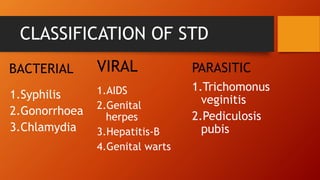
CLASSIFICATION OF STD
VIRAL
1.AIDS
2.Genital
herpes
3.Hepatitis-B
4.Genital warts
BACTERIAL
1.Syphilis
2.Gonorrhoea
3.Chlamydia
PARASITIC
1.Trichomonus
veginitis
2.Pediculosis
pubis
SYPHILIS
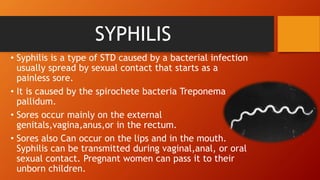
• Syphilis is a type of STD caused by a bacterial infection
usually spread by sexual contact that starts as a
painless sore.
• It is caused by the spirochete bacteria Treponema
pallidum.
• Sores occur mainly on the external
genitals,vagina,anus,or in the rectum.
• Sores also Can occur on the lips and in the mouth.
Syphilis can be transmitted during vaginal,anal, or oral
sexual contact. Pregnant women can pass it to their
unborn children.
TRANSMISSION
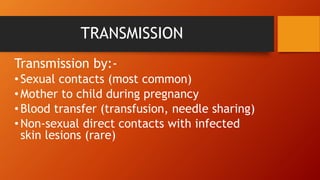
Transmission by:-
•Sexual contacts (most common)
•Mother to child during pregnancy
•Blood transfer (transfusion, needle sharing)
•Non-sexual direct contacts with infected
skin lesions (rare)
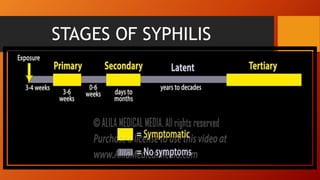
STAGES OF SYPHILIS
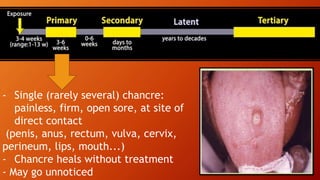
- Single (rarely several) chancre:
painless, firm, open sore, at site of
direct contact
(penis, anus, rectum, vulva, cervix,
perineum, lips, mouth...)
- Chancre heals without treatment
- May go unnoticed
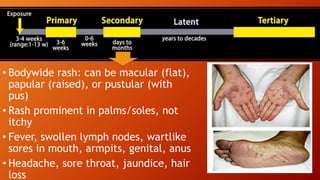
• Bodywide rash: can be macular (flat),
papular (raised), or pustular (with
pus)
• Rash prominent in palms/soles, not
itchy
• Fever, swollen lymph nodes, wartlike
sores in mouth, armpits, genital, anus
• Headache, sore throat, jaundice, hair
loss
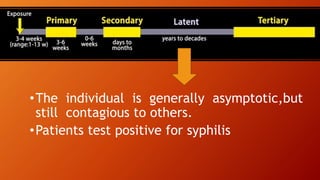
•The individual is generally asymptotic,but
still contagious to others.
•Patients test positive for syphilis
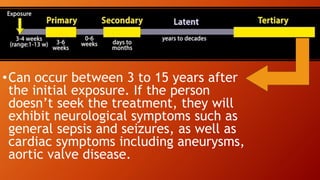
•Can occur between 3 to 15 years after
the initial exposure. If the person
doesn’t seek the treatment, they will
exhibit neurological symptoms such as
general sepsis and seizures, as well as
cardiac symptoms including aneurysms,
aortic valve disease.
DIAGNOSTIC
EVALUATION
DIAGNOSIS
•VDRL ( venereal disease research
laboratory)
•A blood test is the most common way to
determine if someone has syphilis.
•Some doctors can diagnose syphilis by
examining material from a syphilis sore
using a special microscope.
TREATMENT
•No home remedies or over-the-counter
drugs will cure syphilis, but syphilis is
simple to cure with appropriate
antibiotics. Treatment will kill the
syphilis bacterium and prevent
further damage,
•but it will not repair damage already
done.
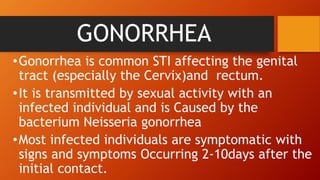
GONORRHEA
•Gonorrhea is common STI affecting the genital
tract (especially the Cervix)and rectum.
•It is transmitted by sexual activity with an
infected individual and is Caused by the
bacterium Neisseria gonorrhea
•Most infected individuals are symptomatic with
signs and symptoms Occurring 2-10days after the
initial contact.
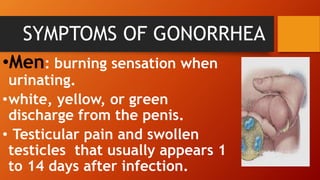
SYMPTOMS OF GONORRHEA
•Men: burning sensation when
urinating.
•white, yellow, or green
discharge from the penis.
• Testicular pain and swollen
testicles that usually appears 1
to 14 days after infection.
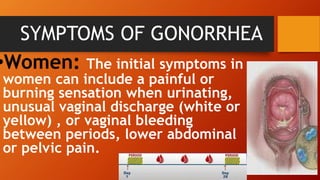
SYMPTOMS OF GONORRHEA
•Women: The initial symptoms in
women can include a painful or
burning sensation when urinating,
unusual vaginal discharge (white or
yellow) , or vaginal bleeding
between periods, lower abdominal
or pelvic pain.
DIAGNOSIS
•Nucleic acid amplification
testing(NAAT)of urine or endocervical
Discharge done.
• In the acute phase,secretions form the
urethra,Bartholin’s gland and endocervix
are collected from gram stain and culture.
TREATMENT
•Preventive:-
•To avoid multiple sex partner.
•To use condom till both the sexual partners are
free from disease.
•Don’t have sex with someone who has gonorrhea
symptoms.
TREATMENT
•Curative:-
•The specific treatment for gonorrhea is single
dose regimen of any one Of the following
drugs:
•·Ceftriaxone-125 mg IM
•·Ciprofloxacin-500mg PO
•·Ofloxacin-400mg PO
•Cefixime-400mg PO
Chlamydia
CHLAMYDIA
• It is most commonly diagnosed STI, especially in under 25-
year-olds, And is caused by the bacterium Chlamydia
trachomatis
• Between 70-80%of women affected by chlamydia are
asymptomatic. The organism affect the Genitourinary
tract.The infection is mostly localized in the urethra,
Bartholin’s gland and cervix.
• Incubation period is 6-14days.
SYMPTOMS
Chlamydia is known as a ’silent’ infection because most infected
people have no symptoms of the STD
Men-
• cloudy discharge from tip of penis.
• Burning sensation when urinating.
• Pain and swelling in one or both testicles
Women-
• Abnormal vaginal discharge
• burning sensation when urinating.
• Untreated infections can spread Upward to the uterus and fallopian
tubes causing PID.
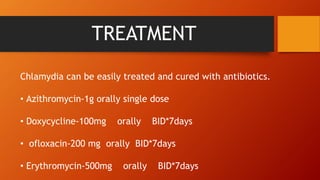
TREATMENT
Chlamydia can be easily treated and cured with antibiotics.
• Azithromycin-1g orally single dose
• Doxycycline-100mg orally BID*7days
• ofloxacin-200 mg orally BID*7days
• Erythromycin-500mg orally BID*7days
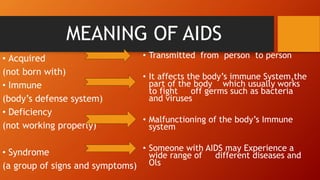
MEANING OF AIDS
• Acquired
(not born with)
• Immune
(body’s defense system)
• Deficiency
(not working properly)
• Syndrome
(a group of signs and symptoms)
• Transmitted from person to person
• It affects the body’s immune System,the
part of the body which usually works
to fight off germs such as bacteria
and viruses
• Malfunctioning of the body’s Immune
system
• Someone with AIDS may Experience a
wide range of different diseases and
Ols
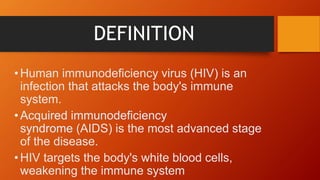
DEFINITION
•Human immunodeficiency virus (HIV) is an
infection that attacks the body's immune
system.
•Acquired immunodeficiency
syndrome (AIDS) is the most advanced stage
of the disease.
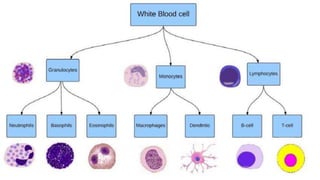
•HIV targets the body's white blood cells,
weakening the immune system
INCUBATION PERIOD:-
•6MONTH
TO 6YEAR
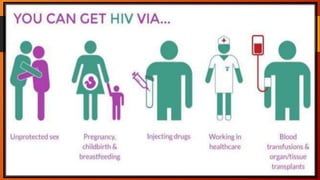
MODE OF TRANSMISSION
•Blood and blood products transmission
•Sexual contact
•Transmission via fluids such as vaginal
secretion amniotic fluid and breast milk
•Needle and syringe used by infected
individual
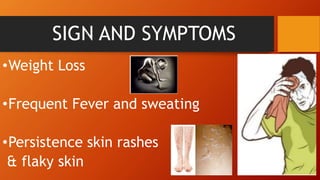
SIGN AND SYMPTOMS
•Weight Loss
•Frequent Fever and sweating
•Persistence skin rashes
& flaky skin
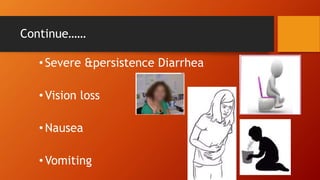
Continue……
•Severe &persistence Diarrhea
•Vision loss
•Nausea
•Vomiting
DIAGNOSTIC EVALUATION
•History collection
•VDRL Test
•Blood examination
•ELISA test
•CD4 T-cell count drops below 200 cells/mm^3
(The CD4 count normal range is 500 to 1500
cell/mm^3)
PREVENTIONS
• Increase safe sexual contact including use of condom.
• Early diagnosis & assessment
• HIV testing & treatment
• Never share needles & use sterile needles
• Early treatment of HIV infected pregnant women
• Avoid unprotected sex
• HIV infected mothers should feed their baby formula
milk
DRUG TREATMENT
The drug treatment of HIV disease can
be classified as:
1) Management of opportunistic
infections (OIs)
2) Antiretroviral therapy.
3)Symptom control.
STI/STD: True or False?
1. You CANNOT get an STI from oral sex.
2. Birth control protects against pregnancy and STIs.
3. Once you’ve had an STI, you CANNOT get it again.
4. You CANNOT get an STI if your partner is a virgin.
5. You CANNOT have two STIs at once.
6. You can get an STI from a toilet seat.

sexually transmitted disease,STD,STI. Manish .ppt

  • 1.
    SEXUALLY TRANSMITTED DISEASE(STDs) PRESENTED BY-MANISH BSC NURSING 4th YEAR Ch.sughar Singh nursing & paramedical College
  • 2.
    INTRODUCTION • Sexually transmitteddiseases(STD’s)are infections spread from Person to person through sexual contact. • STD’s are also known as sexually transmitted infections(STI’s). • STD’s are communicable diseases that can be easily transmitted From one person to another. • Change in name from venereal disease to STD
  • 3.
    DEFINITION •The sexually transmitteddisease (STD) are a group of communicable disease that are transmitted predominantly by sexual contact and caused by a wide range of bacterial, viral, protozoal and fungal agents.
  • 4.
    CLASSIFICATION OF STD VIRAL 1.AIDS 2.Genital herpes 3.Hepatitis-B 4.Genitalwarts BACTERIAL 1.Syphilis 2.Gonorrhoea 3.Chlamydia PARASITIC 1.Trichomonus veginitis 2.Pediculosis pubis
  • 6.
    SYPHILIS • Syphilis isa type of STD caused by a bacterial infection usually spread by sexual contact that starts as a painless sore. • It is caused by the spirochete bacteria Treponema pallidum. • Sores occur mainly on the external genitals,vagina,anus,or in the rectum. • Sores also Can occur on the lips and in the mouth. Syphilis can be transmitted during vaginal,anal, or oral sexual contact. Pregnant women can pass it to their unborn children.
  • 7.
    TRANSMISSION Transmission by:- •Sexual contacts(most common) •Mother to child during pregnancy •Blood transfer (transfusion, needle sharing) •Non-sexual direct contacts with infected skin lesions (rare)
  • 8.
  • 9.
    - Single (rarelyseveral) chancre: painless, firm, open sore, at site of direct contact (penis, anus, rectum, vulva, cervix, perineum, lips, mouth...) - Chancre heals without treatment - May go unnoticed
  • 10.
    • Bodywide rash:can be macular (flat), papular (raised), or pustular (with pus) • Rash prominent in palms/soles, not itchy • Fever, swollen lymph nodes, wartlike sores in mouth, armpits, genital, anus • Headache, sore throat, jaundice, hair loss
  • 11.
    •The individual isgenerally asymptotic,but still contagious to others. •Patients test positive for syphilis
  • 12.
    •Can occur between3 to 15 years after the initial exposure. If the person doesn’t seek the treatment, they will exhibit neurological symptoms such as general sepsis and seizures, as well as cardiac symptoms including aneurysms, aortic valve disease.
  • 13.
  • 14.
    DIAGNOSIS •VDRL ( venerealdisease research laboratory) •A blood test is the most common way to determine if someone has syphilis. •Some doctors can diagnose syphilis by examining material from a syphilis sore using a special microscope.
  • 15.
    TREATMENT •No home remediesor over-the-counter drugs will cure syphilis, but syphilis is simple to cure with appropriate antibiotics. Treatment will kill the syphilis bacterium and prevent further damage, •but it will not repair damage already done.
  • 17.
    GONORRHEA •Gonorrhea is commonSTI affecting the genital tract (especially the Cervix)and rectum. •It is transmitted by sexual activity with an infected individual and is Caused by the bacterium Neisseria gonorrhea •Most infected individuals are symptomatic with signs and symptoms Occurring 2-10days after the initial contact.
  • 18.
    SYMPTOMS OF GONORRHEA •Men:burning sensation when urinating. •white, yellow, or green discharge from the penis. • Testicular pain and swollen testicles that usually appears 1 to 14 days after infection.
  • 19.
    SYMPTOMS OF GONORRHEA •Women:The initial symptoms in women can include a painful or burning sensation when urinating, unusual vaginal discharge (white or yellow) , or vaginal bleeding between periods, lower abdominal or pelvic pain.
  • 20.
    DIAGNOSIS •Nucleic acid amplification testing(NAAT)ofurine or endocervical Discharge done. • In the acute phase,secretions form the urethra,Bartholin’s gland and endocervix are collected from gram stain and culture.
  • 21.
    TREATMENT •Preventive:- •To avoid multiplesex partner. •To use condom till both the sexual partners are free from disease. •Don’t have sex with someone who has gonorrhea symptoms.
  • 22.
    TREATMENT •Curative:- •The specific treatmentfor gonorrhea is single dose regimen of any one Of the following drugs: •·Ceftriaxone-125 mg IM •·Ciprofloxacin-500mg PO •·Ofloxacin-400mg PO •Cefixime-400mg PO
  • 23.
  • 24.
    CHLAMYDIA • It ismost commonly diagnosed STI, especially in under 25- year-olds, And is caused by the bacterium Chlamydia trachomatis • Between 70-80%of women affected by chlamydia are asymptomatic. The organism affect the Genitourinary tract.The infection is mostly localized in the urethra, Bartholin’s gland and cervix. • Incubation period is 6-14days.
  • 25.
    SYMPTOMS Chlamydia is knownas a ’silent’ infection because most infected people have no symptoms of the STD Men- • cloudy discharge from tip of penis. • Burning sensation when urinating. • Pain and swelling in one or both testicles Women- • Abnormal vaginal discharge • burning sensation when urinating. • Untreated infections can spread Upward to the uterus and fallopian tubes causing PID.
  • 26.
    TREATMENT Chlamydia can beeasily treated and cured with antibiotics. • Azithromycin-1g orally single dose • Doxycycline-100mg orally BID*7days • ofloxacin-200 mg orally BID*7days • Erythromycin-500mg orally BID*7days
  • 28.
    MEANING OF AIDS •Acquired (not born with) • Immune (body’s defense system) • Deficiency (not working properly) • Syndrome (a group of signs and symptoms) • Transmitted from person to person • It affects the body’s immune System,the part of the body which usually works to fight off germs such as bacteria and viruses • Malfunctioning of the body’s Immune system • Someone with AIDS may Experience a wide range of different diseases and Ols
  • 29.
    DEFINITION •Human immunodeficiency virus(HIV) is an infection that attacks the body's immune system. •Acquired immunodeficiency syndrome (AIDS) is the most advanced stage of the disease. •HIV targets the body's white blood cells, weakening the immune system
  • 31.
  • 32.
    MODE OF TRANSMISSION •Bloodand blood products transmission •Sexual contact •Transmission via fluids such as vaginal secretion amniotic fluid and breast milk •Needle and syringe used by infected individual
  • 35.
    SIGN AND SYMPTOMS •WeightLoss •Frequent Fever and sweating •Persistence skin rashes & flaky skin
  • 36.
  • 37.
    DIAGNOSTIC EVALUATION •History collection •VDRLTest •Blood examination •ELISA test •CD4 T-cell count drops below 200 cells/mm^3 (The CD4 count normal range is 500 to 1500 cell/mm^3)
  • 38.
    PREVENTIONS • Increase safesexual contact including use of condom. • Early diagnosis & assessment • HIV testing & treatment • Never share needles & use sterile needles • Early treatment of HIV infected pregnant women • Avoid unprotected sex • HIV infected mothers should feed their baby formula milk
  • 39.
    DRUG TREATMENT The drugtreatment of HIV disease can be classified as: 1) Management of opportunistic infections (OIs) 2) Antiretroviral therapy. 3)Symptom control.
  • 41.
    STI/STD: True orFalse? 1. You CANNOT get an STI from oral sex. 2. Birth control protects against pregnancy and STIs. 3. Once you’ve had an STI, you CANNOT get it again. 4. You CANNOT get an STI if your partner is a virgin. 5. You CANNOT have two STIs at once. 6. You can get an STI from a toilet seat.