State-Space Modeling
David W. Graham
EE 327
2
State-Space Modeling
• Alternative method of modeling a system
than
– Differential / difference equations
– Transfer functions
• Uses matrices and vectors to represent
the system parameters and variables
3
Motivation for State-Space Modeling
• Easier for computers to perform matrix algebra
– e.g. MATLAB does all computations as matrix math
• Handles multiple inputs and outputs
• Provides more information about the system
– Provides knowledge of internal variables (states)
⇒Primarily used in complicated, large-scale
systems
4
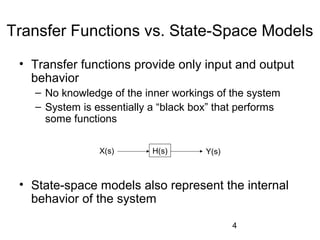
Transfer Functions vs. State-Space Models
• Transfer functions provide only input and output
behavior
– No knowledge of the inner workings of the system
– System is essentially a “black box” that performs
some functions
• State-space models also represent the internal
behavior of the system
H(s)X(s) Y(s)
5
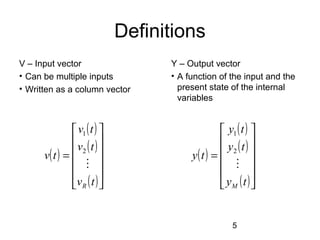
Definitions
V – Input vector
• Can be multiple inputs
• Written as a column vector
( )
( )
( )
( )











=
tv
tv
tv
tv
R

2
1
Y – Output vector
• A function of the input and the
present state of the internal
variables
( )
( )
( )
( )











=
ty
ty
ty
ty
M

2
1
6
Definitions
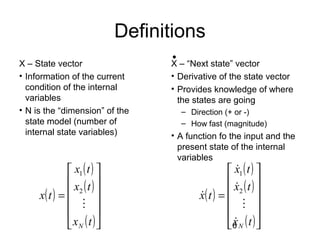
X – State vector
• Information of the current
condition of the internal
variables
• N is the “dimension” of the
state model (number of
internal state variables)
( )
( )
( )
( )











=
tx
tx
tx
tx
N

2
1
X – “Next state” vector
• Derivative of the state vector
• Provides knowledge of where
the states are going
– Direction (+ or -)
– How fast (magnitude)
• A function fo the input and the
present state of the internal
variables
( )
( )
( )
( )











=
tx
tx
tx
tx
N




 2
1
7
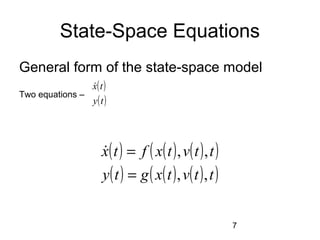
State-Space Equations
General form of the state-space model
Two equations –
( )
( )ty
tx
( ) ( ) ( )( )
( ) ( ) ( )( )ttvtxgty
ttvtxftx
,,
,,
=
=
8
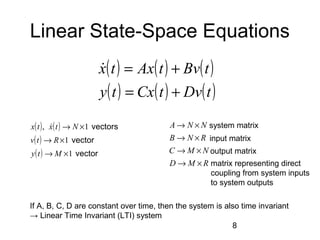
Linear State-Space Equations
( ) ( ) ( )
( ) ( ) ( )tDvtCxty
tBvtAxtx
+=
+=
( ) ( )
( )
( ) vector
vector
vectors
1
1
1,
×→
×→
×→
Mty
Rtv
Ntxtx 
RMD
NMC
RNB
NNA
×→
×→
×→
×→ system matrix
input matrix
output matrix
matrix representing direct
coupling from system inputs
to system outputs
If A, B, C, D are constant over time, then the system is also time invariant
→ Linear Time Invariant (LTI) system
9
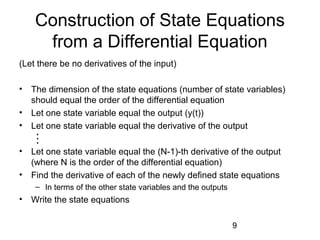
Construction of State Equations
from a Differential Equation
(Let there be no derivatives of the input)
• The dimension of the state equations (number of state variables)
should equal the order of the differential equation
• Let one state variable equal the output (y(t))
• Let one state variable equal the derivative of the output
• Let one state variable equal the (N-1)-th derivative of the output
(where N is the order of the differential equation)
• Find the derivative of each of the newly defined state equations
– In terms of the other state variables and the outputs
• Write the state equations

9
Construction of State Equations
from a Differential Equation
(Let there be no derivatives of the input)
• The dimension of the state equations (number of state variables)
should equal the order of the differential equation
• Let one state variable equal the output (y(t))
• Let one state variable equal the derivative of the output
• Let one state variable equal the (N-1)-th derivative of the output
(where N is the order of the differential equation)
• Find the derivative of each of the newly defined state equations
– In terms of the other state variables and the outputs
• Write the state equations


State space modeling_introduction

  • 1.
  • 2.
    2 State-Space Modeling • Alternativemethod of modeling a system than – Differential / difference equations – Transfer functions • Uses matrices and vectors to represent the system parameters and variables
  • 3.
    3 Motivation for State-SpaceModeling • Easier for computers to perform matrix algebra – e.g. MATLAB does all computations as matrix math • Handles multiple inputs and outputs • Provides more information about the system – Provides knowledge of internal variables (states) ⇒Primarily used in complicated, large-scale systems
  • 4.
    4 Transfer Functions vs.State-Space Models • Transfer functions provide only input and output behavior – No knowledge of the inner workings of the system – System is essentially a “black box” that performs some functions • State-space models also represent the internal behavior of the system H(s)X(s) Y(s)
  • 5.
    5 Definitions V – Inputvector • Can be multiple inputs • Written as a column vector ( ) ( ) ( ) ( )            = tv tv tv tv R  2 1 Y – Output vector • A function of the input and the present state of the internal variables ( ) ( ) ( ) ( )            = ty ty ty ty M  2 1
  • 6.
    6 Definitions X – Statevector • Information of the current condition of the internal variables • N is the “dimension” of the state model (number of internal state variables) ( ) ( ) ( ) ( )            = tx tx tx tx N  2 1 X – “Next state” vector • Derivative of the state vector • Provides knowledge of where the states are going – Direction (+ or -) – How fast (magnitude) • A function fo the input and the present state of the internal variables ( ) ( ) ( ) ( )            = tx tx tx tx N      2 1
  • 7.
    7 State-Space Equations General formof the state-space model Two equations – ( ) ( )ty tx ( ) ( ) ( )( ) ( ) ( ) ( )( )ttvtxgty ttvtxftx ,, ,, = =
  • 8.
    8 Linear State-Space Equations () ( ) ( ) ( ) ( ) ( )tDvtCxty tBvtAxtx += += ( ) ( ) ( ) ( ) vector vector vectors 1 1 1, ×→ ×→ ×→ Mty Rtv Ntxtx  RMD NMC RNB NNA ×→ ×→ ×→ ×→ system matrix input matrix output matrix matrix representing direct coupling from system inputs to system outputs If A, B, C, D are constant over time, then the system is also time invariant → Linear Time Invariant (LTI) system
  • 9.
    9 Construction of StateEquations from a Differential Equation (Let there be no derivatives of the input) • The dimension of the state equations (number of state variables) should equal the order of the differential equation • Let one state variable equal the output (y(t)) • Let one state variable equal the derivative of the output • Let one state variable equal the (N-1)-th derivative of the output (where N is the order of the differential equation) • Find the derivative of each of the newly defined state equations – In terms of the other state variables and the outputs • Write the state equations 
  • 10.
    9 Construction of StateEquations from a Differential Equation (Let there be no derivatives of the input) • The dimension of the state equations (number of state variables) should equal the order of the differential equation • Let one state variable equal the output (y(t)) • Let one state variable equal the derivative of the output • Let one state variable equal the (N-1)-th derivative of the output (where N is the order of the differential equation) • Find the derivative of each of the newly defined state equations – In terms of the other state variables and the outputs • Write the state equations 