Chapter 7Chapter 7
sortingsorting
01/31/18 BY MS. SHAISTA QADIR 1
PRESENTED BY
Shaista Qadir
Lecturer king khalid university
ContentsContents sorting
 neeD For sorting
 insertion sort
 illustration oF insertion sort
 insertion sort algorithm
 CoDe For insertion sort
 aDvantages & DisaDvantages oF insertion
sort
 best Case anD worst Case oF insertion sort
 seleCtion sort
 illustration oF seleCtion sort
 seleCtion sort algorithm
 CoDe For seleCtion sort
 worst Case For seleCtion sort
01/31/18 BY MS. SHAISTA QADIR 2
ContentsContents
 bubble sort
 illustration oF bubble sort
 bubble sort algorithm
 CoDe For bubble sort
 best, average anD worst Case For bubble
sort
 DisaDvantages oF insertion sort
 merge sort
 illustration oF merge sort
 example oF merge sort
 merge sort algorithm
01/31/18 BY MS. SHAISTA QADIR 3
sortingsorting
01/31/18 BY MS. SHAISTA QADIR 4
 Sorting refers to the process of arranging the elements of
an Array in increasing
 order or decreasing order.
 i.e., A[0]< A[1]< A[2]<………< A[N-1] or
 A[0]> A[1]> A[2]>………> A[N-1]
 SORTING ELEMENTS OF AN ARRAY:
 Here N is the number of elements in the Array.
 Eg: If Array A is
 After sorting array A becomes
neeD For sortingneeD For sorting
01/31/18 BY MS. SHAISTA QADIR 5
 Data handling efficiency increases if they are Sorted
according to some ordering criteria.
 If telephone directory is not properly ordered, it is very
difficult to find a name from it.
 Examples of sorted data: Telephone directory,
 Payroll
 Students list
 Book Index
neeD For sortingneeD For sorting
01/31/18 BY MS. SHAISTA QADIR 6
 There are many types of sorting algorithms.
1) Bubble sort
2) Linear/Sequential sort
3) Selection sort
4) Insertion sort
5) Shell sort
6) Merge sort
7) Quick sort
8) Heap sort, etc.,
neeD For sortingneeD For sorting
01/31/18 BY MS. SHAISTA QADIR 7
 Sorting is categorized in 2 types:
◦ Elementary Sorting Algorithm (Insertion Sort, Selection
Sort and Bubble Sort etc.)
◦ Efficient Sorting Algorithm (Quick Sort, Merge Sort etc.).
insertion sortinsertion sort
01/31/18 BY MS. SHAISTA QADIR 8
 Insertion Sort
◦ An insertion sort starts by considering the first two
elements of array data[0] and data[1].
◦ If they are out of order, i.e., if data [1] < data [0], change
their positions.
◦ Then the third element, data [2], is considered and
compared with the previous data elements in positions 1
and 0.
 if data [2] < data [1] and data[0],
 change the positions of
insertion sortinsertion sort
01/31/18 BY MS. SHAISTA QADIR 9
 Insertion Sort
 data [1] to position 2 and
 data[0] to position 1 and
 insert data[2] to position 0.
◦ if data [2] < data [1] only,
◦ change the positions of
 data[1] to position 2 and
 insert data[2] to position 1.
◦ if data[2]> data [1] and data [0]
◦ do not change the position of data[2]
illustration oF insertionillustration oF insertion
sortsort
01/31/18 BY MS. SHAISTA QADIR 10
 Each element in data[i] is inserted is inserted in proper position j
such that 0 <= j <= i and all elements greater than data [i] are
moved by one position.
 Illustration
InsertIon sort algorIthmInsertIon sort algorIthm
01/31/18 BY MS. SHAISTA QADIR 11
 Algorithm to sort elements of an array A using Insertion Sort
whose number of elements is len.
◦ Step:1 Set i=1
◦ Step:2 Repeat 3 to 9 until i<len
◦ Step:3 Copy the content of array A in position i to a
variable copy
◦ Step:4 Set j=i
◦ Step:5 Repeat 6 and 7 until j>0 and while A[j-1]> copy.
◦ Step:6 A[j]=A[j-1]
◦ Step:7 Decrement j
◦ Step:8 A[j]=copy
◦ Step:9 Increment i
◦ Step:10 Exit
code forcode for InsertIon sortInsertIon sort
01/31/18 BY MS. SHAISTA QADIR 12
 Code for Insertion Sort whose number of elements is len.
public void insertionsort()
{
int i, j;
for(i=1; i<arr.length; i++)
{
int copy = arr[i];
for(j=i; j>0 && copy < arr[j-1]; j--)
arr[j] = arr[j-1];
arr[j] = copy;
}}
advantages &advantages &
dIsadvantages of InsertIondIsadvantages of InsertIon
sortsort
01/31/18 BY MS. SHAISTA QADIR 13
 ADVANTAGE of Insertion sort:
◦ It sorts the array only when it is really necessary.
◦ If the array is already in order, no substantial moves are
made.
 DISADVANTGE:
◦ If an item is begin inserted, all elements greater than the one
begin inserted have to be moved.
best case and worst case ofbest case and worst case of
InsertIon sortInsertIon sort
01/31/18 BY MS. SHAISTA QADIR 14
 BEST CASE:
◦ best case is when the data are already in order.
◦ only one comparison is to be made for each position.
◦ so there are n-1 comparisons. (n=len in previous
algorithm)
◦ The best time is of the order of n
 WORST CASE:
◦ The worst case is when the data are in reverse order.
◦ For each i, the item data[i] is less than every item data
[0] … data[i-1] and each of them is moved by one
position.
selectIon sortselectIon sort
01/31/18 BY MS. SHAISTA QADIR 15
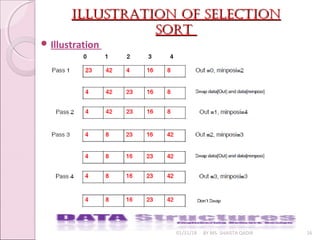
 Selection Sort
◦ An selection sort finds the first smallest element in the
array and puts in the first position of array.
◦ Then it finds the second smallest number and puts in the
second position and so on.
IllustratIon of selectIonIllustratIon of selectIon
sortsort
01/31/18 BY MS. SHAISTA QADIR 16
 Illustration
selectIon sort algorIthmselectIon sort algorIthm
01/31/18 BY MS. SHAISTA QADIR 17
 Algorithm to sort elements of an array A using Selection
Sort whose number of elements is len.
◦ Step:1 Set out=0
◦ Step:2 Repeat 3 to 5 until out<len-1
◦ Step:3 Find position, minposi of minimum element from
the elements A[out],….., A[len-1]
◦ Step:4 Swap A[out] and A[minposi]
◦ Step:5 Increment out
◦ Step:6 Exit
code forcode for selectIon sortselectIon sort
01/31/18 BY MS. SHAISTA QADIR 18
 Code for Insertion Sort whose number of elements is len.
public void selectionsort()
{
int out, in, minposi;
for(out=0; out<arr.length-1; out++)
{
minposi = out;
for(in=out+1; in<arr.length; in++)
if(arr[in] < arr[minposi] )
minposi = in;
swap(out, minposi);
}}
worst case forworst case for selectIonselectIon
sortsort
01/31/18 BY MS. SHAISTA QADIR 19
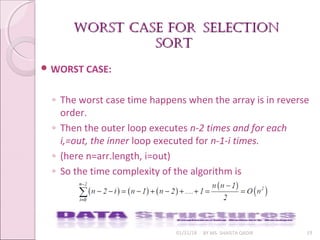
 WORST CASE:
◦ The worst case time happens when the array is in reverse
order.
◦ Then the outer loop executes n-2 times and for each
i,=out, the inner loop executed for n-1-i times.
◦ (here n=arr.length, i=out)
◦ So the time complexity of the algorithm is
bubble sortbubble sort
01/31/18 BY MS. SHAISTA QADIR 20
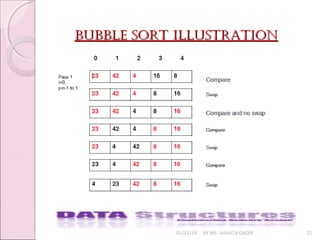
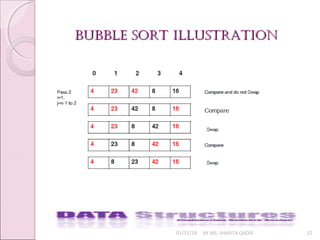
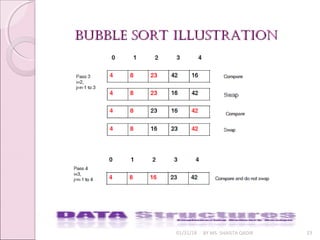
 A Bubble sort bubbles the smallest element to the top.
 It compares data[N-1] and data[N-2] and arrange them in
order such that data[N-2]< data[N-1].
 Then compare data[N-3] and data[N-2] and arrange such
that data [N-3]< data [N-2].
 Continue this until data [0]<data[1]. This pass bubbles out
the smallest number in position 0.
 Repeat this comparison with the elements from data[N-1]
to data [1] and so on
bubble Sort illuStrationbubble Sort illuStration
01/31/18 BY MS. SHAISTA QADIR 21
bubble Sort illuStrationbubble Sort illuStration
01/31/18 BY MS. SHAISTA QADIR 22
bubble Sort illuStrationbubble Sort illuStration
01/31/18 BY MS. SHAISTA QADIR 23
bubble Sort algorithmbubble Sort algorithm
01/31/18 BY MS. SHAISTA QADIR 24
 Algorithm to sort elements of an array A using Bubble Sort
whose number of elements is n.
◦ Step:1 Set i=0
◦ Step:2 Repeat 3 to 7 until i<n-1
◦ Step:3 Set j=n-1
◦ Step:4 Repeat 5 to 6 until j>i
◦ Step:5 If data[j]<data[j-1], swap (data[j], data[j-1])
◦ Step:6 Decrement j
◦ Step: 7Increment i
◦ Step:8 Exit
bubble Sort algorithmbubble Sort algorithm
01/31/18 BY MS. SHAISTA QADIR 25
 Algorithm to sort elements of an array A using Bubble Sort
whose number of elements is n.
◦ Step:1 Set i=0
◦ Step:2 Repeat 3 to 7 until i<n-1
◦ Step:3 Set j=n-1
◦ Step:4 Repeat 5 to 6 until j>i
◦ Step:5 If data[j]<data[j-1], swap (data[j], data[j-1])
◦ Step:6 Decrement j
◦ Step: 7Increment i
◦ Step:8 Exit
code Segment forcode Segment for bubblebubble
SortSort
01/31/18 BY MS. SHAISTA QADIR 26
 Code for Bubble Sort
public void bubblesort()
{
int i,n,j;
for(i=0;i<n-1;i++)
{
for(j=n-1;j>i;--j)
if(data[j] < data[j-1])
swap(j,j-1);
}
}
beSt, average andbeSt, average and
WorSt caSe forWorSt caSe for bubble Sortbubble Sort
01/31/18 BY MS. SHAISTA QADIR 27
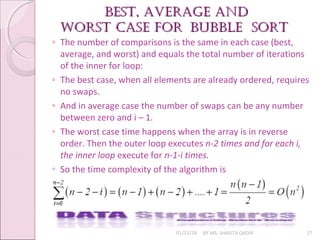
◦ The number of comparisons is the same in each case (best,
average, and worst) and equals the total number of iterations
of the inner for loop:
◦ The best case, when all elements are already ordered, requires
no swaps.
◦ And in average case the number of swaps can be any number
between zero and i – 1.
◦ The worst case time happens when the array is in reverse
order. Then the outer loop executes n-2 times and for each i,
the inner loop execute for n-1-i times.
◦ So the time complexity of the algorithm is
diSadvantage of bubble SortdiSadvantage of bubble Sort
01/31/18 BY MS. SHAISTA QADIR 28
 The main disadvantage of bubble sort is if an element has to be
moved from the bottom to the top, it is exchanged with every
element in the array. It does not skip them as selection sort did.
merge Sortmerge Sort
01/31/18 BY MS. SHAISTA QADIR 29
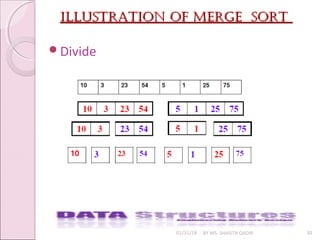
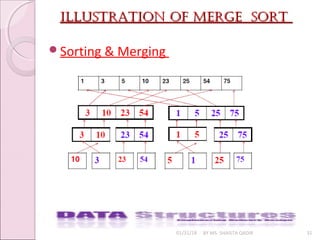
 MERGE SORT (Divide and Conquer)
 Merge Sort divides the unsorted array into half repeatedly
until arrays with one element each is obtained.
 Then the divided parts are sorted and then the sorted right
and left parts are merged together.
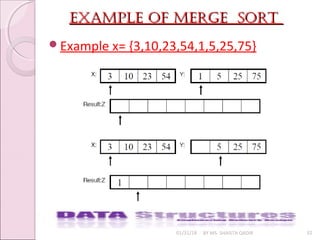
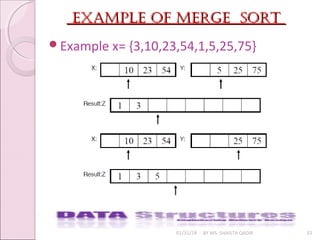
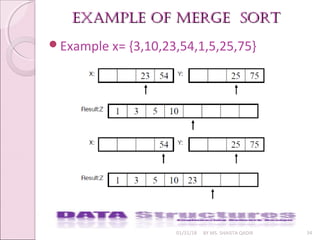
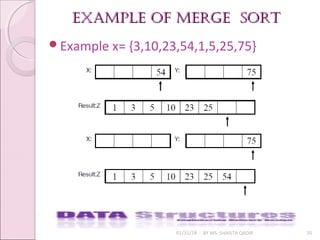
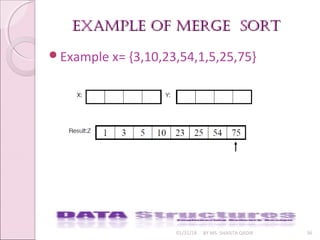
 The key to Merge Sort is merging two sorted arrays into
one, such that
◦ if you have two arrays X (x1 < x2 < … < xm) and Y(y1 < y2 < … < yn)
◦ the resulting list is Z(z1 < z2 < … < zm+n).
illuStration of merge SortilluStration of merge Sort
01/31/18 BY MS. SHAISTA QADIR 30
Divide
illustration of merge sortillustration of merge sort
01/31/18 BY MS. SHAISTA QADIR 31
Sorting & Merging
example of merge sortexample of merge sort
01/31/18 BY MS. SHAISTA QADIR 32
Example x= {3,10,23,54,1,5,25,75}
example of merge sortexample of merge sort
01/31/18 BY MS. SHAISTA QADIR 33
Example x= {3,10,23,54,1,5,25,75}
example of merge sortexample of merge sort
01/31/18 BY MS. SHAISTA QADIR 34
Example x= {3,10,23,54,1,5,25,75}
example of merge sortexample of merge sort
01/31/18 BY MS. SHAISTA QADIR 35
Example x= {3,10,23,54,1,5,25,75}
example of merge sortexample of merge sort
01/31/18 BY MS. SHAISTA QADIR 36
Example x= {3,10,23,54,1,5,25,75}
merge sort algorithmmerge sort algorithm
01/31/18 BY MS. SHAISTA QADIR 37
 Algorithm to sort elements of sorted arrays X of size m and Y of
size n using Merge Sort in to another array of size m+n.
◦ Step:1 Set i=0, j=0,k=0
◦ Step:2 If x[i]<=y[j] Go to Step:3 else Go to Step:5
◦ Step:3 Set z[k]=x[i], k=k+1, i=i+1, if i<=m, Go to Step:2
◦ Step:4 Set z[k],……,z[m+n]=y[j],….y[n]
◦ Step:5 Set z[k]=y[j], k=k+1, j=j=j+1, if j<=n, Go to Step:2
◦ Step:6 Set z[k],……,z[m+n]=x[i],….x[m]
◦ Step:7 Exit
01/31/18 BY MS. SHAISTA QADIR 38
THANK YOUTHANK YOU

Sorting

  • 1.
    Chapter 7Chapter 7 sortingsorting 01/31/18BY MS. SHAISTA QADIR 1 PRESENTED BY Shaista Qadir Lecturer king khalid university
  • 2.
    ContentsContents sorting  neeDFor sorting  insertion sort  illustration oF insertion sort  insertion sort algorithm  CoDe For insertion sort  aDvantages & DisaDvantages oF insertion sort  best Case anD worst Case oF insertion sort  seleCtion sort  illustration oF seleCtion sort  seleCtion sort algorithm  CoDe For seleCtion sort  worst Case For seleCtion sort 01/31/18 BY MS. SHAISTA QADIR 2
  • 3.
    ContentsContents  bubble sort illustration oF bubble sort  bubble sort algorithm  CoDe For bubble sort  best, average anD worst Case For bubble sort  DisaDvantages oF insertion sort  merge sort  illustration oF merge sort  example oF merge sort  merge sort algorithm 01/31/18 BY MS. SHAISTA QADIR 3
  • 4.
    sortingsorting 01/31/18 BY MS.SHAISTA QADIR 4  Sorting refers to the process of arranging the elements of an Array in increasing  order or decreasing order.  i.e., A[0]< A[1]< A[2]<………< A[N-1] or  A[0]> A[1]> A[2]>………> A[N-1]  SORTING ELEMENTS OF AN ARRAY:  Here N is the number of elements in the Array.  Eg: If Array A is  After sorting array A becomes
  • 5.
    neeD For sortingneeDFor sorting 01/31/18 BY MS. SHAISTA QADIR 5  Data handling efficiency increases if they are Sorted according to some ordering criteria.  If telephone directory is not properly ordered, it is very difficult to find a name from it.  Examples of sorted data: Telephone directory,  Payroll  Students list  Book Index
  • 6.
    neeD For sortingneeDFor sorting 01/31/18 BY MS. SHAISTA QADIR 6  There are many types of sorting algorithms. 1) Bubble sort 2) Linear/Sequential sort 3) Selection sort 4) Insertion sort 5) Shell sort 6) Merge sort 7) Quick sort 8) Heap sort, etc.,
  • 7.
    neeD For sortingneeDFor sorting 01/31/18 BY MS. SHAISTA QADIR 7  Sorting is categorized in 2 types: ◦ Elementary Sorting Algorithm (Insertion Sort, Selection Sort and Bubble Sort etc.) ◦ Efficient Sorting Algorithm (Quick Sort, Merge Sort etc.).
  • 8.
    insertion sortinsertion sort 01/31/18BY MS. SHAISTA QADIR 8  Insertion Sort ◦ An insertion sort starts by considering the first two elements of array data[0] and data[1]. ◦ If they are out of order, i.e., if data [1] < data [0], change their positions. ◦ Then the third element, data [2], is considered and compared with the previous data elements in positions 1 and 0.  if data [2] < data [1] and data[0],  change the positions of
  • 9.
    insertion sortinsertion sort 01/31/18BY MS. SHAISTA QADIR 9  Insertion Sort  data [1] to position 2 and  data[0] to position 1 and  insert data[2] to position 0. ◦ if data [2] < data [1] only, ◦ change the positions of  data[1] to position 2 and  insert data[2] to position 1. ◦ if data[2]> data [1] and data [0] ◦ do not change the position of data[2]
  • 10.
    illustration oF insertionillustrationoF insertion sortsort 01/31/18 BY MS. SHAISTA QADIR 10  Each element in data[i] is inserted is inserted in proper position j such that 0 <= j <= i and all elements greater than data [i] are moved by one position.  Illustration
  • 11.
    InsertIon sort algorIthmInsertIonsort algorIthm 01/31/18 BY MS. SHAISTA QADIR 11  Algorithm to sort elements of an array A using Insertion Sort whose number of elements is len. ◦ Step:1 Set i=1 ◦ Step:2 Repeat 3 to 9 until i<len ◦ Step:3 Copy the content of array A in position i to a variable copy ◦ Step:4 Set j=i ◦ Step:5 Repeat 6 and 7 until j>0 and while A[j-1]> copy. ◦ Step:6 A[j]=A[j-1] ◦ Step:7 Decrement j ◦ Step:8 A[j]=copy ◦ Step:9 Increment i ◦ Step:10 Exit
  • 12.
    code forcode forInsertIon sortInsertIon sort 01/31/18 BY MS. SHAISTA QADIR 12  Code for Insertion Sort whose number of elements is len. public void insertionsort() { int i, j; for(i=1; i<arr.length; i++) { int copy = arr[i]; for(j=i; j>0 && copy < arr[j-1]; j--) arr[j] = arr[j-1]; arr[j] = copy; }}
  • 13.
    advantages &advantages & dIsadvantagesof InsertIondIsadvantages of InsertIon sortsort 01/31/18 BY MS. SHAISTA QADIR 13  ADVANTAGE of Insertion sort: ◦ It sorts the array only when it is really necessary. ◦ If the array is already in order, no substantial moves are made.  DISADVANTGE: ◦ If an item is begin inserted, all elements greater than the one begin inserted have to be moved.
  • 14.
    best case andworst case ofbest case and worst case of InsertIon sortInsertIon sort 01/31/18 BY MS. SHAISTA QADIR 14  BEST CASE: ◦ best case is when the data are already in order. ◦ only one comparison is to be made for each position. ◦ so there are n-1 comparisons. (n=len in previous algorithm) ◦ The best time is of the order of n  WORST CASE: ◦ The worst case is when the data are in reverse order. ◦ For each i, the item data[i] is less than every item data [0] … data[i-1] and each of them is moved by one position.
  • 15.
    selectIon sortselectIon sort 01/31/18BY MS. SHAISTA QADIR 15  Selection Sort ◦ An selection sort finds the first smallest element in the array and puts in the first position of array. ◦ Then it finds the second smallest number and puts in the second position and so on.
  • 16.
    IllustratIon of selectIonIllustratIonof selectIon sortsort 01/31/18 BY MS. SHAISTA QADIR 16  Illustration
  • 17.
    selectIon sort algorIthmselectIonsort algorIthm 01/31/18 BY MS. SHAISTA QADIR 17  Algorithm to sort elements of an array A using Selection Sort whose number of elements is len. ◦ Step:1 Set out=0 ◦ Step:2 Repeat 3 to 5 until out<len-1 ◦ Step:3 Find position, minposi of minimum element from the elements A[out],….., A[len-1] ◦ Step:4 Swap A[out] and A[minposi] ◦ Step:5 Increment out ◦ Step:6 Exit
  • 18.
    code forcode forselectIon sortselectIon sort 01/31/18 BY MS. SHAISTA QADIR 18  Code for Insertion Sort whose number of elements is len. public void selectionsort() { int out, in, minposi; for(out=0; out<arr.length-1; out++) { minposi = out; for(in=out+1; in<arr.length; in++) if(arr[in] < arr[minposi] ) minposi = in; swap(out, minposi); }}
  • 19.
    worst case forworstcase for selectIonselectIon sortsort 01/31/18 BY MS. SHAISTA QADIR 19  WORST CASE: ◦ The worst case time happens when the array is in reverse order. ◦ Then the outer loop executes n-2 times and for each i,=out, the inner loop executed for n-1-i times. ◦ (here n=arr.length, i=out) ◦ So the time complexity of the algorithm is
  • 20.
    bubble sortbubble sort 01/31/18BY MS. SHAISTA QADIR 20  A Bubble sort bubbles the smallest element to the top.  It compares data[N-1] and data[N-2] and arrange them in order such that data[N-2]< data[N-1].  Then compare data[N-3] and data[N-2] and arrange such that data [N-3]< data [N-2].  Continue this until data [0]<data[1]. This pass bubbles out the smallest number in position 0.  Repeat this comparison with the elements from data[N-1] to data [1] and so on
  • 21.
    bubble Sort illuStrationbubbleSort illuStration 01/31/18 BY MS. SHAISTA QADIR 21
  • 22.
    bubble Sort illuStrationbubbleSort illuStration 01/31/18 BY MS. SHAISTA QADIR 22
  • 23.
    bubble Sort illuStrationbubbleSort illuStration 01/31/18 BY MS. SHAISTA QADIR 23
  • 24.
    bubble Sort algorithmbubbleSort algorithm 01/31/18 BY MS. SHAISTA QADIR 24  Algorithm to sort elements of an array A using Bubble Sort whose number of elements is n. ◦ Step:1 Set i=0 ◦ Step:2 Repeat 3 to 7 until i<n-1 ◦ Step:3 Set j=n-1 ◦ Step:4 Repeat 5 to 6 until j>i ◦ Step:5 If data[j]<data[j-1], swap (data[j], data[j-1]) ◦ Step:6 Decrement j ◦ Step: 7Increment i ◦ Step:8 Exit
  • 25.
    bubble Sort algorithmbubbleSort algorithm 01/31/18 BY MS. SHAISTA QADIR 25  Algorithm to sort elements of an array A using Bubble Sort whose number of elements is n. ◦ Step:1 Set i=0 ◦ Step:2 Repeat 3 to 7 until i<n-1 ◦ Step:3 Set j=n-1 ◦ Step:4 Repeat 5 to 6 until j>i ◦ Step:5 If data[j]<data[j-1], swap (data[j], data[j-1]) ◦ Step:6 Decrement j ◦ Step: 7Increment i ◦ Step:8 Exit
  • 26.
    code Segment forcodeSegment for bubblebubble SortSort 01/31/18 BY MS. SHAISTA QADIR 26  Code for Bubble Sort public void bubblesort() { int i,n,j; for(i=0;i<n-1;i++) { for(j=n-1;j>i;--j) if(data[j] < data[j-1]) swap(j,j-1); } }
  • 27.
    beSt, average andbeSt,average and WorSt caSe forWorSt caSe for bubble Sortbubble Sort 01/31/18 BY MS. SHAISTA QADIR 27 ◦ The number of comparisons is the same in each case (best, average, and worst) and equals the total number of iterations of the inner for loop: ◦ The best case, when all elements are already ordered, requires no swaps. ◦ And in average case the number of swaps can be any number between zero and i – 1. ◦ The worst case time happens when the array is in reverse order. Then the outer loop executes n-2 times and for each i, the inner loop execute for n-1-i times. ◦ So the time complexity of the algorithm is
  • 28.
    diSadvantage of bubbleSortdiSadvantage of bubble Sort 01/31/18 BY MS. SHAISTA QADIR 28  The main disadvantage of bubble sort is if an element has to be moved from the bottom to the top, it is exchanged with every element in the array. It does not skip them as selection sort did.
  • 29.
    merge Sortmerge Sort 01/31/18BY MS. SHAISTA QADIR 29  MERGE SORT (Divide and Conquer)  Merge Sort divides the unsorted array into half repeatedly until arrays with one element each is obtained.  Then the divided parts are sorted and then the sorted right and left parts are merged together.  The key to Merge Sort is merging two sorted arrays into one, such that ◦ if you have two arrays X (x1 < x2 < … < xm) and Y(y1 < y2 < … < yn) ◦ the resulting list is Z(z1 < z2 < … < zm+n).
  • 30.
    illuStration of mergeSortilluStration of merge Sort 01/31/18 BY MS. SHAISTA QADIR 30 Divide
  • 31.
    illustration of mergesortillustration of merge sort 01/31/18 BY MS. SHAISTA QADIR 31 Sorting & Merging
  • 32.
    example of mergesortexample of merge sort 01/31/18 BY MS. SHAISTA QADIR 32 Example x= {3,10,23,54,1,5,25,75}
  • 33.
    example of mergesortexample of merge sort 01/31/18 BY MS. SHAISTA QADIR 33 Example x= {3,10,23,54,1,5,25,75}
  • 34.
    example of mergesortexample of merge sort 01/31/18 BY MS. SHAISTA QADIR 34 Example x= {3,10,23,54,1,5,25,75}
  • 35.
    example of mergesortexample of merge sort 01/31/18 BY MS. SHAISTA QADIR 35 Example x= {3,10,23,54,1,5,25,75}
  • 36.
    example of mergesortexample of merge sort 01/31/18 BY MS. SHAISTA QADIR 36 Example x= {3,10,23,54,1,5,25,75}
  • 37.
    merge sort algorithmmergesort algorithm 01/31/18 BY MS. SHAISTA QADIR 37  Algorithm to sort elements of sorted arrays X of size m and Y of size n using Merge Sort in to another array of size m+n. ◦ Step:1 Set i=0, j=0,k=0 ◦ Step:2 If x[i]<=y[j] Go to Step:3 else Go to Step:5 ◦ Step:3 Set z[k]=x[i], k=k+1, i=i+1, if i<=m, Go to Step:2 ◦ Step:4 Set z[k],……,z[m+n]=y[j],….y[n] ◦ Step:5 Set z[k]=y[j], k=k+1, j=j=j+1, if j<=n, Go to Step:2 ◦ Step:6 Set z[k],……,z[m+n]=x[i],….x[m] ◦ Step:7 Exit
  • 38.
    01/31/18 BY MS.SHAISTA QADIR 38 THANK YOUTHANK YOU