TOPIC 1:
Introduction to Start-Up
Small Business Start-up
 Locally owned Business
 Small number of employees
 No plans to become
corporation
 Low Risk
 Low Reward Businesses
 Very seldom grow into
something bigger
 Fine being small, stable and
profitable
 Small but dream big
 Motivation is money , popularity
and success
 Dedication
 Start-up wants to change the
world
Small Business vs Start-up
Comparison between small business and start-up
Start-up meaning
creating something new
and innovative
 Small but dream big
 Motivation is money , popularity and success
 Dedication
 Start-up wants to change the world
Search for a repeatable and scalable business model and ensuring the profit multiplies
What is Start-Up?
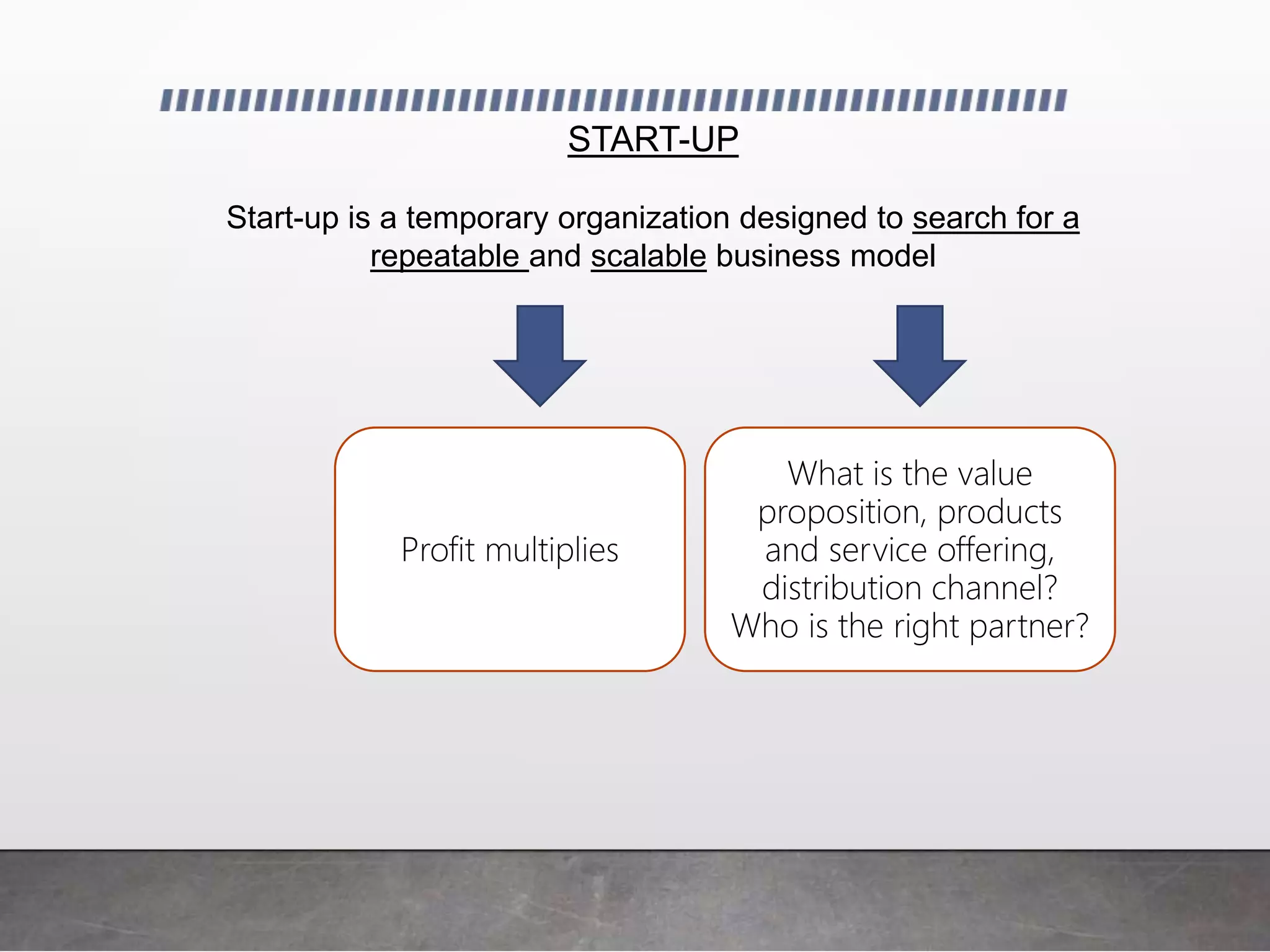
START-UP
Start-up is a temporary organization designed to search for a
repeatable and scalable business model
What is the value
proposition, products
and service offering,
distribution channel?
Who is the right partner?
Profit multiplies
STARTUP
New Market
― Cheaper
― Create new class of
customer
― Innovative/Never
existed before
Clone Market
― Local Adaptation
― Misjudge local
needs
― Customers known
Existing Market
― Known Users
― Better
― High End
Re-segmented
Market
― Niche
― Cheaper
― Low end
― Customer Needs -
Fit
Market segments for Start-up
Why Start-Up Failed?
• Failure to achieve Product/Market fit – Start-up failed because of developing products
or services that will not satisfy the market or meet user needs.
• Start-up fail to understand the customers needs or requirements and developing
products or services that will not help users’ issues.
• Lack of Focus – Majority of start-up focus too much on marketing rather and not
focusing on creating the right products or services.
• Being a one-person team – Unable to find the right members to join the team or
having the members not supporting in managing the start-up may be the reason or
failure.
• Pre-mature scaling – Scaling up too early without lack of preparation fails the start-up.
Example; scaling up before internal processes are established, the existing
technology cannot support expansion or funding may not be sufficient.
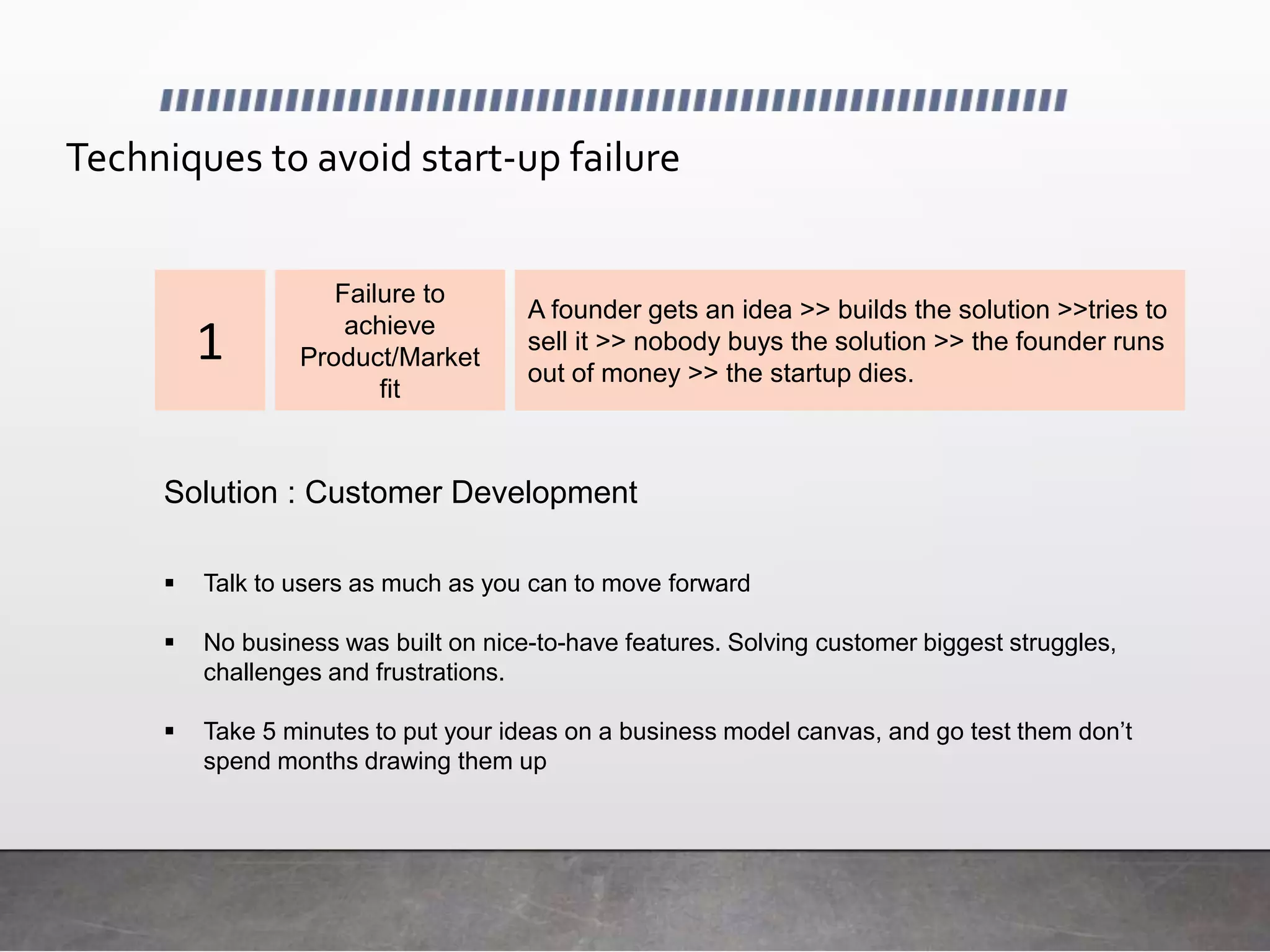
Failure to
achieve
Product/Market
fit
A founder gets an idea >> builds the solution >>tries to
sell it >> nobody buys the solution >> the founder runs
out of money >> the startup dies.
 Talk to users as much as you can to move forward
 No business was built on nice-to-have features. Solving customer biggest struggles,
challenges and frustrations.
 Take 5 minutes to put your ideas on a business model canvas, and go test them don’t
spend months drawing them up
Solution : Customer Development
1
Techniques to avoid start-up failure
Lack of Focus
Recruiting a board of advisors >> Doing partnerships without proof
of extra revenue >> Spending time on PR and social media before
knowing you’ve got the right product for the right customer >>
Going to conferences
 The only way to stay on track as a startup is to develop the product and talk to users.
 Reduce time to get caught up in other things.
Solution : Focus on Users and Product
2
Techniques to avoid start-up failure
Being a One-
Person Team
Do not have the right team >> lack of support to fulfill
the objective >> lack of communication
 Hiring the right people
 Creating a good and open communication; top-down, bottom-up
Solution : Building the right team
3
Techniques to avoid start-up failure
Pre-mature
scaling
Assuming doing everything right >> Start scaling,
hiring, you’re funded, you’re growing.
 Problem-solution fit : figuring out who your primary customer is, what problem they
want you to solve and how you’re going to monetize on this customer.
 Product-market fit. The second phase is about creating an in-demand product that
services a large enough market for your startup to grow.
 Channel fit. The third phase is about lowering acquisition costs and increasing
revenue so you can reach profit.
Solution : Scale up when you are ready
4
Techniques to avoid start-up failure

Start-Up

  • 1.
  • 2.
    Small Business Start-up Locally owned Business  Small number of employees  No plans to become corporation  Low Risk  Low Reward Businesses  Very seldom grow into something bigger  Fine being small, stable and profitable  Small but dream big  Motivation is money , popularity and success  Dedication  Start-up wants to change the world Small Business vs Start-up Comparison between small business and start-up
  • 3.
    Start-up meaning creating somethingnew and innovative  Small but dream big  Motivation is money , popularity and success  Dedication  Start-up wants to change the world Search for a repeatable and scalable business model and ensuring the profit multiplies What is Start-Up?
  • 4.
    START-UP Start-up is atemporary organization designed to search for a repeatable and scalable business model What is the value proposition, products and service offering, distribution channel? Who is the right partner? Profit multiplies
  • 5.
    STARTUP New Market ― Cheaper ―Create new class of customer ― Innovative/Never existed before Clone Market ― Local Adaptation ― Misjudge local needs ― Customers known Existing Market ― Known Users ― Better ― High End Re-segmented Market ― Niche ― Cheaper ― Low end ― Customer Needs - Fit Market segments for Start-up
  • 6.
    Why Start-Up Failed? •Failure to achieve Product/Market fit – Start-up failed because of developing products or services that will not satisfy the market or meet user needs. • Start-up fail to understand the customers needs or requirements and developing products or services that will not help users’ issues. • Lack of Focus – Majority of start-up focus too much on marketing rather and not focusing on creating the right products or services. • Being a one-person team – Unable to find the right members to join the team or having the members not supporting in managing the start-up may be the reason or failure. • Pre-mature scaling – Scaling up too early without lack of preparation fails the start-up. Example; scaling up before internal processes are established, the existing technology cannot support expansion or funding may not be sufficient.
  • 7.
    Failure to achieve Product/Market fit A foundergets an idea >> builds the solution >>tries to sell it >> nobody buys the solution >> the founder runs out of money >> the startup dies.  Talk to users as much as you can to move forward  No business was built on nice-to-have features. Solving customer biggest struggles, challenges and frustrations.  Take 5 minutes to put your ideas on a business model canvas, and go test them don’t spend months drawing them up Solution : Customer Development 1 Techniques to avoid start-up failure
  • 8.
    Lack of Focus Recruitinga board of advisors >> Doing partnerships without proof of extra revenue >> Spending time on PR and social media before knowing you’ve got the right product for the right customer >> Going to conferences  The only way to stay on track as a startup is to develop the product and talk to users.  Reduce time to get caught up in other things. Solution : Focus on Users and Product 2 Techniques to avoid start-up failure
  • 9.
    Being a One- PersonTeam Do not have the right team >> lack of support to fulfill the objective >> lack of communication  Hiring the right people  Creating a good and open communication; top-down, bottom-up Solution : Building the right team 3 Techniques to avoid start-up failure
  • 10.
    Pre-mature scaling Assuming doing everythingright >> Start scaling, hiring, you’re funded, you’re growing.  Problem-solution fit : figuring out who your primary customer is, what problem they want you to solve and how you’re going to monetize on this customer.  Product-market fit. The second phase is about creating an in-demand product that services a large enough market for your startup to grow.  Channel fit. The third phase is about lowering acquisition costs and increasing revenue so you can reach profit. Solution : Scale up when you are ready 4 Techniques to avoid start-up failure