Sean Chen
CEO, xFuture Inc.
Serial Entrepreneur
2012/11
1, Why Start-ups?
2, Why not start-ups?
3, What is the business idea in your mind?
4, 5 steps of preparing your startups
- Building a winning team
- Access market and target customers
- Define Product
- Prepare business plan
- Funding plan
5, Do-it and beyond.
 Labor side:
◦ Two questions:
 Which part of the income statement are you in?
 Which side of the balance sheet are you in?
 Board member side:
◦ Which part of the financial statement are they in?
 Everyone is a disposal resource, except the
board
 Different way of seeing things
 Change your life by switch roles
 As good as revolution
 Slave vs. Freedom
 Money is not the thing, but if you are stuck on it,
it become the thing
 Four way to become financial independence
before 30
◦ Marry it
◦ Inherit it
◦ Win lottery
◦ Start up your own business
 3 ways of creating your own future
◦ Work hard, and make money from employment
◦ Invest hard, and make money from money
◦ Startup hard, create your stock like printing money
 Change your destiny, create your own life
 The facts:
◦ There are only very few people can be CEO
◦ No one really care what you want and what you think
◦ Only Power and Money talks
◦ You are not in control of your life
◦ Things typically do not happen as you wish
◦ Even if it happened as you wished, bad things always come with good
things.
◦ Whatever you think you have done a great work, your boss always think
that’s just your job
 Wake up:
◦ There is no fair game: 1% vs. 90% income, Top 400 vs. 150M fortune, 1%
vs. 99% success
◦ Step outside of the wall and grow up
 When changes or unreasonable requests happened:
◦ Would you just accept it?
◦ Or Fight back?
◦ Or ask the questions “why do you think this change will help?”
◦ Always ask “Why me?”
 Not ready?
 No good topic?
 Too young (or too old)?
 Afraid of uncertainty?
 Parents want you to have a PhD?
 Finding a job is normal, right?
 Accepting failure?
 Long-term commitment?
 Ready for suck all your time and efforts in here?
 Money is not the only thing?
 Assuming you take a strange new flavor of bottle drink
with purple color, sticky, not clear on what it made of, to
the below places. What is the percentage people would like
to try it out?
◦ Kindergarten
◦ Elementary school
◦ High School
◦ University
◦ Office building
 The answer might be 40%, 30%, 20% 10%, then 0%
 The fact is that the older the people get, the lesser risk
they would take.
 So, if you are suitable to starting up, start the plan now,
act now.
 If you are not a risk taker, stay where you are, don’t do the
startups just because you want to do it.
 Examine your idea by 3 steps
1. Product positioning
2. Target customer and market
3. Roadmap to success
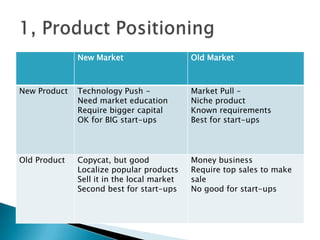
New Market Old Market
New Product Technology Push -
Need market education
Require bigger capital
OK for BIG start-ups
Market Pull –
Niche product
Known requirements
Best for start-ups
Old Product Copycat, but good
Localize popular products
Sell it in the local market
Second best for start-ups
Money business
Require top sales to make
sale
No good for start-ups
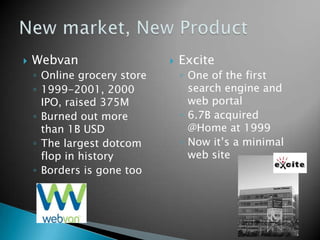
 Webvan
◦ Online grocery store
◦ 1999-2001, 2000
IPO, raised 375M
◦ Burned out more
than 1B USD
◦ The largest dotcom
flop in history
◦ Borders is gone too
 Excite
◦ One of the first
search engine and
web portal
◦ 6.7B acquired
@Home at 1999
◦ Now it’s a minimal
web site
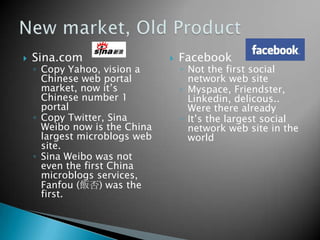
 Sina.com
◦ Copy Yahoo, vision a
Chinese web portal
market, now it’s
Chinese number 1
portal
◦ Copy Twitter, Sina
Weibo now is the China
largest microblogs web
site.
◦ Sina Weibo was not
even the first China
microblogs services,
Fanfou (飯否) was the
first.
 Facebook
◦ Not the first social
network web site
◦ Myspace, Friendster,
Linkedin, delicous..
Were there already
◦ It’s the largest social
network web site in the
world
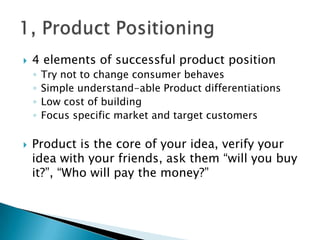
 4 elements of successful product position
◦ Try not to change consumer behaves
◦ Simple understand-able Product differentiations
◦ Low cost of building
◦ Focus specific market and target customers
 Product is the core of your idea, verify your
idea with your friends, ask them “will you buy
it?”, “Who will pay the money?”
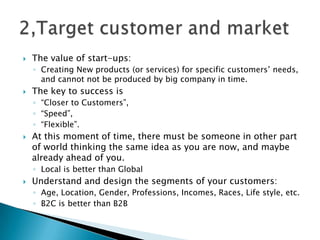
 The value of start-ups:
◦ Creating New products (or services) for specific customers’ needs,
and cannot not be produced by big company in time.
 The key to success is
◦ “Closer to Customers”,
◦ “Speed”,
◦ “Flexible”.
 At this moment of time, there must be someone in other part
of world thinking the same idea as you are now, and maybe
already ahead of you.
◦ Local is better than Global
 Understand and design the segments of your customers:
◦ Age, Location, Gender, Professions, Incomes, Races, Life style, etc.
◦ B2C is better than B2B
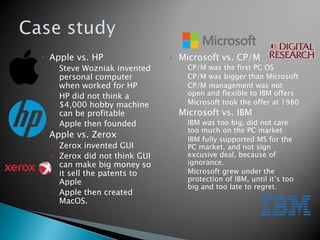
 Apple vs. HP
 Steve Wozniak invented
personal computer
when worked for HP
 HP did not think a
$4,000 hobby machine
can be profitable
 Apple then founded
 Apple vs. Zerox
 Zerox invented GUI
 Zerox did not think GUI
can make big money so
it sell the patents to
Apple
 Apple then created
MacOS.
 Microsoft vs. CP/M
◦ CP/M was the first PC OS
◦ CP/M was bigger than Microsoft
◦ CP/M management was not
open and flexible to IBM offers
◦ Microsoft took the offer at 1980
 Microsoft vs. IBM
◦ IBM was too big, did not care
too much on the PC market
◦ IBM fully supported MS for the
PC market, and not sign
excusive deal, because of
ignorance.
◦ Microsoft grew under the
protection of IBM, until it’s too
big and too late to regret.
 Sony start-up story
◦ Founder Morita Akio (盛田 昭夫)
◦ Founded at 1946, funding ¥ 190K
◦ 2012 revenue ¥6.395 trillion
 Morita San was not happy for
the sales of his first invention,
a electronic voice recorder
 He did not understand why
people would buy useless
things like antique. Rather to
buy useful like voice recorder.
 He realized that customer felt
“value”, when buying antique,
so he need to find customers
felt “value” for Sony’s voice
recorder.
 The first customer is Tokyo
court, for the reason of lacking
staff for fast typing note taker.
 The basic principle of creating new start-ups,
is the term “VALUE”
 The necessity of existence of start-ups is
based on:
◦ For a specific market, and a specific set of
customers, can feel the “value” of the products you
produced. So they will buy the product from you.
And your company eventually is profitable.
 Ask yourself the following questions:
◦ What is the roadmap in your mind, for your company to be
successful? Or,
◦ 3 Years from now, what is the company position in your target
market? What percentage of the market share from your products?
 According to GE’s research, a company with 30% market
share are always profitable, with 15% less market share are
always in loss.
 The market is not a overall market, it’s the specific target
market.
 “Profitable” is the key for start-ups to survive. But “Grow”
is where the start-ups can be successful.
 Start-ups should always use the fastest speed to grow to
certain market shares, then use its loyal customers
network, to grow even bigger.
5 steps of preparing your startups
- Building a winning team
- Access market and target customers
- Define Product
- Prepare business plan
- Funding plan
 “Location, location, location” is for good house
 “People, People, People” is for good start-ups
 #1 important thing for start-ups: Good people
◦ People is the key to make start-ups to work. Idea, product, market,
business plan can all go wrong, but the right people can correct it and
make it to work.
 Understand yourself first
◦ Logical or Sensational, Sales dog/social network animal or Nerd / Geek,
Management experience, Decisive, Thoughtfulness, Preciseness, Flexibility,
Friendly, Team work…
◦ Find your partners/managers/staffs/board by fill up your weakness, in
terms of Personality, not by Skills
 As a company you need to build
 Founding team
 Management team
 Company staffs
 Board of Directors
 Advisory board
 Most of the first-time startup founders got into
troubles here
◦ Friendship broken
◦ Law suit
 Finding the right partners
◦ You need to work with your partner before, colleagues or
classmate are good
◦ Integrity first – smartness is much less important than
personality
◦ There is only one in the team can be the leader
◦ Don’t force it, like marriage
◦ Do not have too many people in the founding team, 2-3
are good, too many typically means you cannot
distinguish 1) investors 2)first employee from founders
◦ Trust your instincts
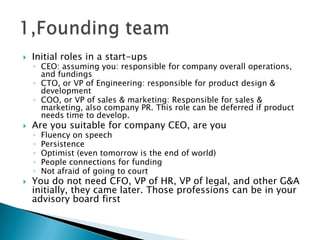
 Initial roles in a start-ups
◦ CEO: assuming you: responsible for company overall operations,
and fundings
◦ CTO, or VP of Engineering: responsible for product design &
development
◦ COO, or VP of sales & marketing: Responsible for sales &
marketing, also company PR. This role can be deferred if product
needs time to develop.
 Are you suitable for company CEO, are you
◦ Fluency on speech
◦ Persistence
◦ Optimist (even tomorrow is the end of world)
◦ People connections for funding
◦ Not afraid of going to court
 You do not need CFO, VP of HR, VP of legal, and other G&A
initially, they came later. Those professions can be in your
advisory board first
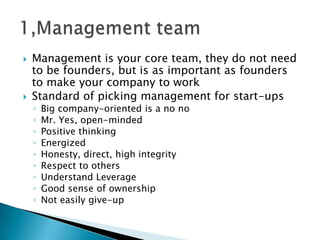
 Management is your core team, they do not need
to be founders, but is as important as founders
to make your company to work
 Standard of picking management for start-ups
◦ Big company-oriented is a no no
◦ Mr. Yes, open-minded
◦ Positive thinking
◦ Energized
◦ Honesty, direct, high integrity
◦ Respect to others
◦ Understand Leverage
◦ Good sense of ownership
◦ Not easily give-up
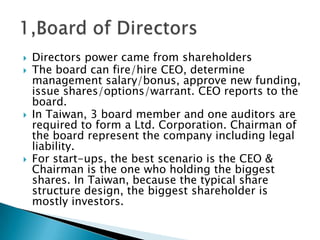
 Directors power came from shareholders
 The board can fire/hire CEO, determine
management salary/bonus, approve new funding,
issue shares/options/warrant. CEO reports to the
board.
 In Taiwan, 3 board member and one auditors are
required to form a Ltd. Corporation. Chairman of
the board represent the company including legal
liability.
 For start-ups, the best scenario is the CEO &
Chairman is the one who holding the biggest
shares. In Taiwan, because the typical share
structure design, the biggest shareholder is
mostly investors.
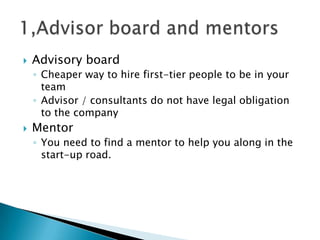
 Advisory board
◦ Cheaper way to hire first-tier people to be in your
team
◦ Advisor / consultants do not have legal obligation
to the company
 Mentor
◦ You need to find a mentor to help you along in the
start-up road.
 Right market is the second most important for the success
of a start-ups
 Right market is more important than right product idea
◦ Ex. Yield improvement project
 Growing market is suitable for start-ups
◦ Ex. Mobile, apps, internet, biotech..
 Highly integrated market is deadly for start-ups
◦ Ex. Cable business, Telco
 Understand market needs and estimated size
◦ Estimated volume
◦ Growth rate
◦ Market segments
 Low key, grow silently, survive and wait for your
opportunity
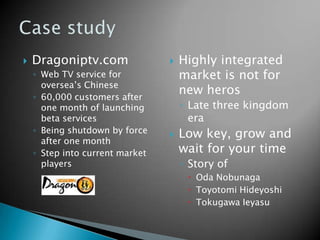
 Dragoniptv.com
◦ Web TV service for
oversea’s Chinese
◦ 60,000 customers after
one month of launching
beta services
◦ Being shutdown by force
after one month
◦ Step into current market
players
 Highly integrated
market is not for
new heros
◦ Late three kingdom
era
 Low key, grow and
wait for your time
◦ Story of
 Oda Nobunaga
 Toyotomi Hideyoshi
 Tokugawa Ieyasu
 Product vs. Services
 The “Value”
◦ B2C: sense of security, sense of owning, Feeling, Vanity,
home sickness, hope..
◦ B2B: Financial, Political, Strategic related topics
 You need to really understand the “needs”
◦ You or the team have to be the target customers
◦ You like to use on what you have created
 Opportunity driven vs. Demands driven
 Market survey
◦ The expensive way –Markey survey, Gartner/IDC/IEK/MIC..
◦ The start-ups way – Use own eyes, feet, hands, ears,
talking to TA, doing your own survey. Using google, FB,
Weibo to get the data you want
 Always ask – Why customers would pay?
 B2C: Pricing model, conversion rate, Channel
cost
 B2B: Direct sales, Indirect sales
 B2B2C, B2C2B…
 In reality, business model are always
changing, “the planned” typically is not “the
actual” business model.
 Not to challenge the existent consumer buying behaves
 Understand the total spending budget for your target
customers
 Whoever win the mob, Win the war
◦ Ex. Internet, Facebook
◦ Ex. Oracle vs. Salesforce.com
◦ Ex. Why black market, why bidding web site fails, why not
gambling?
 Perception is everything – product differentiations
 Low cost, high value
 Stickiness
 Easy product description
 Good User interface
 Simple software engineering, only focus on spec define
and testing sheet.
 Business plan is needed, the process of
creating BP is even more important than the
actual outputs
 Reviewing the Team, product, market,
business model, financial forecast, during the
BP writing process
 BP is a promotional documents, to sell your
idea to investors
 BP can be words or PPT, but cannot be both.
 BP is a constant changing document, need to
custom made per investors
 Product it service intro
 Business model and growth strategy
 Market size, rate of growth and market segments
 Competition analysis
 How to acquire customers
 Sales, Channel planning, and sales forecast
 Management team and profiles
 Development capacity and experience
 Manufacturing capacity and experience
 HR planning and reward system
 Financial outlooks and milestones
 Cash flow estimation
 Share structure
 Funding plan: Amount&Terms, Post money capital structure, Use
of Proceed
 Investors will focus on
◦ Passionate and experienced team
◦ Right market segment and growth potentials
◦ Unique and/or killer apps or technology
◦ Way to be successful – Execution plan
◦ Good ROI
 Some will also see
◦ Company Vision
◦ Founding team commitment
◦ Highly focused execution plan
◦ Money Exit strategy
 There are also “must-ask” questions /
Answers
◦ Entry barrier, how to stop others to copy your idea
◦ What is the content of your entry barrier,
technology, market uniqueness, patents or people?
◦ What is the competitor market share and pricing
strategy?
◦ Whether founding team worked together before?
◦ When do you expect to break even?
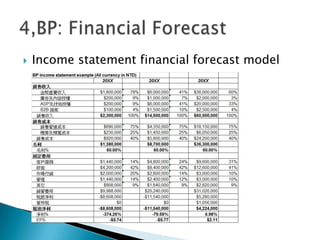
 Income statement financial forecast model
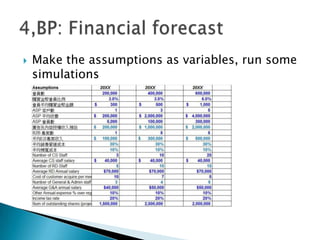
 Make the assumptions as variables, run some
simulations
 Money is not the most important thing for start-
ups, but without money, you cannot do a thing.
 Funding, the first real challenge for start-ups
◦ Always Chicken-egg problem
 How much money do you need to start your own
business?
◦ Use the least amount of money to start your business
◦ Calculate the minimal cost for two year, including staffs,
outsourcing, rental, utility, IDC.. – your start-up cost
 Lean Start-up is also great too
 Save, Save, Save
 Share structure design
◦ Taiwan – NTD10, simple and easy, favor to
investors
◦ US – flexible, and complicated, favor to seasoned
entrepreneur
 Step-up funding plan
◦ Seed financing - Self
◦ Startup financing – Friend & Family (&Fool)
◦ Expansion financing – Investors, VC, corporate
investor, may need multiple rounds.
◦ IPO or M&A
 Physiological side of investment
 Understand term sheet
 The process of Due Diligence (DD)
 Company valuation
 Government funding - SBIR
 Why people join start-ups?
◦ For better financial rewards
 Human nature
◦ Desire, Selfish, Lazy, Vanity-> Fame, Money
 The system – “Rewards immediately for hard
working with results, otherwise none”
◦ Founder share plan
◦ Contracts
◦ Investment Terms
 Force people to do good thing to the company
 All in writings
 Sean Chen
 cschen1@yahoo.com
 http://startup20.wordpress.com

Start up-manual-for-engineers

  • 1.
    Sean Chen CEO, xFutureInc. Serial Entrepreneur 2012/11
  • 2.
    1, Why Start-ups? 2,Why not start-ups? 3, What is the business idea in your mind? 4, 5 steps of preparing your startups - Building a winning team - Access market and target customers - Define Product - Prepare business plan - Funding plan 5, Do-it and beyond.
  • 3.
     Labor side: ◦Two questions:  Which part of the income statement are you in?  Which side of the balance sheet are you in?  Board member side: ◦ Which part of the financial statement are they in?  Everyone is a disposal resource, except the board  Different way of seeing things  Change your life by switch roles  As good as revolution
  • 4.
     Slave vs.Freedom  Money is not the thing, but if you are stuck on it, it become the thing  Four way to become financial independence before 30 ◦ Marry it ◦ Inherit it ◦ Win lottery ◦ Start up your own business  3 ways of creating your own future ◦ Work hard, and make money from employment ◦ Invest hard, and make money from money ◦ Startup hard, create your stock like printing money  Change your destiny, create your own life
  • 5.
     The facts: ◦There are only very few people can be CEO ◦ No one really care what you want and what you think ◦ Only Power and Money talks ◦ You are not in control of your life ◦ Things typically do not happen as you wish ◦ Even if it happened as you wished, bad things always come with good things. ◦ Whatever you think you have done a great work, your boss always think that’s just your job  Wake up: ◦ There is no fair game: 1% vs. 90% income, Top 400 vs. 150M fortune, 1% vs. 99% success ◦ Step outside of the wall and grow up  When changes or unreasonable requests happened: ◦ Would you just accept it? ◦ Or Fight back? ◦ Or ask the questions “why do you think this change will help?” ◦ Always ask “Why me?”
  • 6.
     Not ready? No good topic?  Too young (or too old)?  Afraid of uncertainty?  Parents want you to have a PhD?  Finding a job is normal, right?  Accepting failure?  Long-term commitment?  Ready for suck all your time and efforts in here?  Money is not the only thing?
  • 7.
     Assuming youtake a strange new flavor of bottle drink with purple color, sticky, not clear on what it made of, to the below places. What is the percentage people would like to try it out? ◦ Kindergarten ◦ Elementary school ◦ High School ◦ University ◦ Office building  The answer might be 40%, 30%, 20% 10%, then 0%  The fact is that the older the people get, the lesser risk they would take.  So, if you are suitable to starting up, start the plan now, act now.  If you are not a risk taker, stay where you are, don’t do the startups just because you want to do it.
  • 8.
     Examine youridea by 3 steps 1. Product positioning 2. Target customer and market 3. Roadmap to success
  • 9.
    New Market OldMarket New Product Technology Push - Need market education Require bigger capital OK for BIG start-ups Market Pull – Niche product Known requirements Best for start-ups Old Product Copycat, but good Localize popular products Sell it in the local market Second best for start-ups Money business Require top sales to make sale No good for start-ups
  • 10.
     Webvan ◦ Onlinegrocery store ◦ 1999-2001, 2000 IPO, raised 375M ◦ Burned out more than 1B USD ◦ The largest dotcom flop in history ◦ Borders is gone too  Excite ◦ One of the first search engine and web portal ◦ 6.7B acquired @Home at 1999 ◦ Now it’s a minimal web site
  • 11.
     Sina.com ◦ CopyYahoo, vision a Chinese web portal market, now it’s Chinese number 1 portal ◦ Copy Twitter, Sina Weibo now is the China largest microblogs web site. ◦ Sina Weibo was not even the first China microblogs services, Fanfou (飯否) was the first.  Facebook ◦ Not the first social network web site ◦ Myspace, Friendster, Linkedin, delicous.. Were there already ◦ It’s the largest social network web site in the world
  • 12.
     4 elementsof successful product position ◦ Try not to change consumer behaves ◦ Simple understand-able Product differentiations ◦ Low cost of building ◦ Focus specific market and target customers  Product is the core of your idea, verify your idea with your friends, ask them “will you buy it?”, “Who will pay the money?”
  • 13.
     The valueof start-ups: ◦ Creating New products (or services) for specific customers’ needs, and cannot not be produced by big company in time.  The key to success is ◦ “Closer to Customers”, ◦ “Speed”, ◦ “Flexible”.  At this moment of time, there must be someone in other part of world thinking the same idea as you are now, and maybe already ahead of you. ◦ Local is better than Global  Understand and design the segments of your customers: ◦ Age, Location, Gender, Professions, Incomes, Races, Life style, etc. ◦ B2C is better than B2B
  • 14.
     Apple vs.HP  Steve Wozniak invented personal computer when worked for HP  HP did not think a $4,000 hobby machine can be profitable  Apple then founded  Apple vs. Zerox  Zerox invented GUI  Zerox did not think GUI can make big money so it sell the patents to Apple  Apple then created MacOS.  Microsoft vs. CP/M ◦ CP/M was the first PC OS ◦ CP/M was bigger than Microsoft ◦ CP/M management was not open and flexible to IBM offers ◦ Microsoft took the offer at 1980  Microsoft vs. IBM ◦ IBM was too big, did not care too much on the PC market ◦ IBM fully supported MS for the PC market, and not sign excusive deal, because of ignorance. ◦ Microsoft grew under the protection of IBM, until it’s too big and too late to regret.
  • 15.
     Sony start-upstory ◦ Founder Morita Akio (盛田 昭夫) ◦ Founded at 1946, funding ¥ 190K ◦ 2012 revenue ¥6.395 trillion  Morita San was not happy for the sales of his first invention, a electronic voice recorder  He did not understand why people would buy useless things like antique. Rather to buy useful like voice recorder.  He realized that customer felt “value”, when buying antique, so he need to find customers felt “value” for Sony’s voice recorder.  The first customer is Tokyo court, for the reason of lacking staff for fast typing note taker.
  • 16.
     The basicprinciple of creating new start-ups, is the term “VALUE”  The necessity of existence of start-ups is based on: ◦ For a specific market, and a specific set of customers, can feel the “value” of the products you produced. So they will buy the product from you. And your company eventually is profitable.
  • 17.
     Ask yourselfthe following questions: ◦ What is the roadmap in your mind, for your company to be successful? Or, ◦ 3 Years from now, what is the company position in your target market? What percentage of the market share from your products?  According to GE’s research, a company with 30% market share are always profitable, with 15% less market share are always in loss.  The market is not a overall market, it’s the specific target market.  “Profitable” is the key for start-ups to survive. But “Grow” is where the start-ups can be successful.  Start-ups should always use the fastest speed to grow to certain market shares, then use its loyal customers network, to grow even bigger.
  • 18.
    5 steps ofpreparing your startups - Building a winning team - Access market and target customers - Define Product - Prepare business plan - Funding plan
  • 19.
     “Location, location,location” is for good house  “People, People, People” is for good start-ups  #1 important thing for start-ups: Good people ◦ People is the key to make start-ups to work. Idea, product, market, business plan can all go wrong, but the right people can correct it and make it to work.  Understand yourself first ◦ Logical or Sensational, Sales dog/social network animal or Nerd / Geek, Management experience, Decisive, Thoughtfulness, Preciseness, Flexibility, Friendly, Team work… ◦ Find your partners/managers/staffs/board by fill up your weakness, in terms of Personality, not by Skills  As a company you need to build  Founding team  Management team  Company staffs  Board of Directors  Advisory board
  • 20.
     Most ofthe first-time startup founders got into troubles here ◦ Friendship broken ◦ Law suit  Finding the right partners ◦ You need to work with your partner before, colleagues or classmate are good ◦ Integrity first – smartness is much less important than personality ◦ There is only one in the team can be the leader ◦ Don’t force it, like marriage ◦ Do not have too many people in the founding team, 2-3 are good, too many typically means you cannot distinguish 1) investors 2)first employee from founders ◦ Trust your instincts
  • 21.
     Initial rolesin a start-ups ◦ CEO: assuming you: responsible for company overall operations, and fundings ◦ CTO, or VP of Engineering: responsible for product design & development ◦ COO, or VP of sales & marketing: Responsible for sales & marketing, also company PR. This role can be deferred if product needs time to develop.  Are you suitable for company CEO, are you ◦ Fluency on speech ◦ Persistence ◦ Optimist (even tomorrow is the end of world) ◦ People connections for funding ◦ Not afraid of going to court  You do not need CFO, VP of HR, VP of legal, and other G&A initially, they came later. Those professions can be in your advisory board first
  • 22.
     Management isyour core team, they do not need to be founders, but is as important as founders to make your company to work  Standard of picking management for start-ups ◦ Big company-oriented is a no no ◦ Mr. Yes, open-minded ◦ Positive thinking ◦ Energized ◦ Honesty, direct, high integrity ◦ Respect to others ◦ Understand Leverage ◦ Good sense of ownership ◦ Not easily give-up
  • 23.
     Directors powercame from shareholders  The board can fire/hire CEO, determine management salary/bonus, approve new funding, issue shares/options/warrant. CEO reports to the board.  In Taiwan, 3 board member and one auditors are required to form a Ltd. Corporation. Chairman of the board represent the company including legal liability.  For start-ups, the best scenario is the CEO & Chairman is the one who holding the biggest shares. In Taiwan, because the typical share structure design, the biggest shareholder is mostly investors.
  • 24.
     Advisory board ◦Cheaper way to hire first-tier people to be in your team ◦ Advisor / consultants do not have legal obligation to the company  Mentor ◦ You need to find a mentor to help you along in the start-up road.
  • 25.
     Right marketis the second most important for the success of a start-ups  Right market is more important than right product idea ◦ Ex. Yield improvement project  Growing market is suitable for start-ups ◦ Ex. Mobile, apps, internet, biotech..  Highly integrated market is deadly for start-ups ◦ Ex. Cable business, Telco  Understand market needs and estimated size ◦ Estimated volume ◦ Growth rate ◦ Market segments  Low key, grow silently, survive and wait for your opportunity
  • 26.
     Dragoniptv.com ◦ WebTV service for oversea’s Chinese ◦ 60,000 customers after one month of launching beta services ◦ Being shutdown by force after one month ◦ Step into current market players  Highly integrated market is not for new heros ◦ Late three kingdom era  Low key, grow and wait for your time ◦ Story of  Oda Nobunaga  Toyotomi Hideyoshi  Tokugawa Ieyasu
  • 27.
     Product vs.Services  The “Value” ◦ B2C: sense of security, sense of owning, Feeling, Vanity, home sickness, hope.. ◦ B2B: Financial, Political, Strategic related topics  You need to really understand the “needs” ◦ You or the team have to be the target customers ◦ You like to use on what you have created  Opportunity driven vs. Demands driven  Market survey ◦ The expensive way –Markey survey, Gartner/IDC/IEK/MIC.. ◦ The start-ups way – Use own eyes, feet, hands, ears, talking to TA, doing your own survey. Using google, FB, Weibo to get the data you want
  • 28.
     Always ask– Why customers would pay?  B2C: Pricing model, conversion rate, Channel cost  B2B: Direct sales, Indirect sales  B2B2C, B2C2B…  In reality, business model are always changing, “the planned” typically is not “the actual” business model.
  • 29.
     Not tochallenge the existent consumer buying behaves  Understand the total spending budget for your target customers  Whoever win the mob, Win the war ◦ Ex. Internet, Facebook ◦ Ex. Oracle vs. Salesforce.com ◦ Ex. Why black market, why bidding web site fails, why not gambling?  Perception is everything – product differentiations  Low cost, high value  Stickiness  Easy product description  Good User interface  Simple software engineering, only focus on spec define and testing sheet.
  • 30.
     Business planis needed, the process of creating BP is even more important than the actual outputs  Reviewing the Team, product, market, business model, financial forecast, during the BP writing process  BP is a promotional documents, to sell your idea to investors  BP can be words or PPT, but cannot be both.  BP is a constant changing document, need to custom made per investors
  • 31.
     Product itservice intro  Business model and growth strategy  Market size, rate of growth and market segments  Competition analysis  How to acquire customers  Sales, Channel planning, and sales forecast  Management team and profiles  Development capacity and experience  Manufacturing capacity and experience  HR planning and reward system  Financial outlooks and milestones  Cash flow estimation  Share structure  Funding plan: Amount&Terms, Post money capital structure, Use of Proceed
  • 32.
     Investors willfocus on ◦ Passionate and experienced team ◦ Right market segment and growth potentials ◦ Unique and/or killer apps or technology ◦ Way to be successful – Execution plan ◦ Good ROI  Some will also see ◦ Company Vision ◦ Founding team commitment ◦ Highly focused execution plan ◦ Money Exit strategy
  • 33.
     There arealso “must-ask” questions / Answers ◦ Entry barrier, how to stop others to copy your idea ◦ What is the content of your entry barrier, technology, market uniqueness, patents or people? ◦ What is the competitor market share and pricing strategy? ◦ Whether founding team worked together before? ◦ When do you expect to break even?
  • 34.
     Income statementfinancial forecast model
  • 35.
     Make theassumptions as variables, run some simulations
  • 36.
     Money isnot the most important thing for start- ups, but without money, you cannot do a thing.  Funding, the first real challenge for start-ups ◦ Always Chicken-egg problem  How much money do you need to start your own business? ◦ Use the least amount of money to start your business ◦ Calculate the minimal cost for two year, including staffs, outsourcing, rental, utility, IDC.. – your start-up cost  Lean Start-up is also great too  Save, Save, Save
  • 37.
     Share structuredesign ◦ Taiwan – NTD10, simple and easy, favor to investors ◦ US – flexible, and complicated, favor to seasoned entrepreneur  Step-up funding plan ◦ Seed financing - Self ◦ Startup financing – Friend & Family (&Fool) ◦ Expansion financing – Investors, VC, corporate investor, may need multiple rounds. ◦ IPO or M&A
  • 38.
     Physiological sideof investment  Understand term sheet  The process of Due Diligence (DD)  Company valuation  Government funding - SBIR
  • 39.
     Why peoplejoin start-ups? ◦ For better financial rewards  Human nature ◦ Desire, Selfish, Lazy, Vanity-> Fame, Money  The system – “Rewards immediately for hard working with results, otherwise none” ◦ Founder share plan ◦ Contracts ◦ Investment Terms  Force people to do good thing to the company  All in writings
  • 41.
     Sean Chen cschen1@yahoo.com  http://startup20.wordpress.com