
MSc. Morning Applied Chemistry
Subject Title: Seminar
Course Code: ACH-679
Submitted To: Dr.M.Naveed Anjum
Submitted By: khalid mehmood
Roll No: 9316
What is Starch??
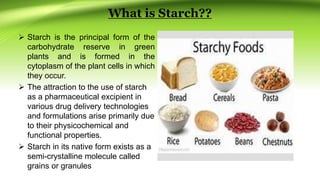
 Starch is the principal form of the
carbohydrate reserve in green
plants and is formed in the
cytoplasm of the plant cells in which
they occur.
 The attraction to the use of starch
as a pharmaceutical excipient in
various drug delivery technologies
and formulations arise primarily due
to their physicochemical and
functional properties.
 Starch in its native form exists as a
semi-crystalline molecule called
grains or granules
CHEMICAL STRACTURE OF STARCH
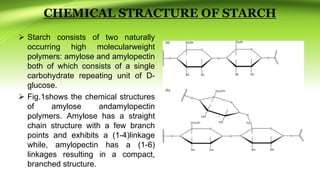
 Starch consists of two naturally
occurring high molecularweight
polymers: amylose and amylopectin
both of which consists of a single
carbohydrate repeating unit of D-
glucose.
 Fig.1shows the chemical structures
of amylose andamylopectin
polymers. Amylose has a straight
chain structure with a few branch
points and exhibits a (1-4)linkage
while, amylopectin has a (1-6)
linkages resulting in a compact,
branched structure.
Morphology Of Starch
Starch granule morphology is
an important parameter used
to identify and differentiate
starch from different botanical
origin. The general
presentation, shape and sizes
of starch granules from
different botanical origin are
typical.
The SEM photomicrographs
of some commonly available
starches in Nigeria are
presented in Fig
Solubilty of starch
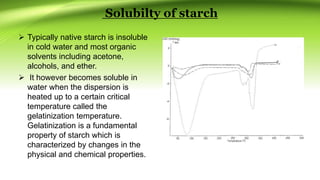
 Typically native starch is insoluble
in cold water and most organic
solvents including acetone,
alcohols, and ether.
 It however becomes soluble in
water when the dispersion is
heated up to a certain critical
temperature called the
gelatinization temperature.
Gelatinization is a fundamental
property of starch which is
characterized by changes in the
physical and chemical properties.
Binder properties:
 Freshly made starch mucilage prepared to gel by heat treatment of the starch
dispersion in water has been used extensively as binder in tablets and
capsules production using the wet granulation technique.
 The starch mucilage is incorporated as a gel and functions as a glue to
provide the necessary binding force that holds the powder particles together
to form the required agglomerates.
 This also serves to ensure a uniform distribution and controllable release of
the active pharmaceutical ingredient (API).
 When the agglomerates are compressed under optimal load, stable robust
tablets are formed .
 Another important attribute of starch when used as binder is its compatibility
with other adjuncts and APIs used in many conventional and novel
formulations.
Starch as a pharmaceutical excipient
 Excipients are increasingly being recognized as important components of
conventional and novel drug products, providing specific functions in aiding the
formulation of optimally elegant, stable, safe, and active drug products.
 Starch in its native and modified forms has been widely used as
pharmaceutical excipient.
 Starch-based excipients have been shown to offer numerous advantages in
drug production in terms of lower cost, safety, and product quality.
 It has also been evaluated and used as drug carriers in controlled drug
delivery systems.
 Native starch has traditionally been used for bulk granules, capsules, and
tablets production. It has multifunctional uses in the different physical forms
serving as binder, disintegrant, diluents, glidant, and lubricant.
Starch in drug delivery
Polymeric nanoparticles for controlled delivery of drugs andnimaging agents
have attracted tremendous interests in recent years because of their
numerous advantages. Nanoparticles can protect drugs from in vivo
degradation, provide controlled and targeted drug release, accumulate in
tumor by passive and active targeting mechanisms, and load multiple drugs
and imaging agents.
Colon cancer is one of the most pervasive cancers worldwide, causing high
mortality. This type of cancer is considered to be the fourth most frequent
cause of cancer-related death With the increasing incidence rate of colon
cancer and the problems associated with traditional chemotherapy oral colon
drug delivery systems (OCDDSs) have been widely studied. OCDDSs can
be generally classified into the following five types based on various
mechanisms of action: time-lag, pH-dependent, enzyme-dependent,
microbiota-triggered and pressure-controlled. Local targeted and sustained
release drug delivery systems can expose tumor cells to a suitable
 Porous starch (PS) is a typical modified starch that has been studied for a long
time. PS can be prepared by an enzymatic hydrolysis method or a solvent
exchange method PS has many applications in foods and other industries due to
its high adsorption capacity, specific surface area and biodegradability.
 Interestingly, PS has been utilized to encapsulate many substances such as
bioactive compounds, drugs, microorganisms and preservatives that have the
characteristics of low hydrophilicity, unpleasant odor, low pH resistance or
tendency to be readily oxidized.
 Starch-coated magnetic nanoparticles labelled with the chemotherapeutic agent
mitoxantrone were given intraarterially into the tumorsupplying artery of tumor-
bearing rabbits (VX2 squamous cell carcinoma) and focused in the tumor region
with an external magnetic field. With this delivery system, total tumor remission
without negative side-effects could be accomplished using only 20% and 50% of
the regular systemic chemotherapeutic dosage. The nanoparticles in this study
consisted of iron oxides covered by starch polymers for colloidal stabilization.
 This study aims to demonstrate the feasibility of using zein and high amylose
starch/zein mixed coatings in colon-targetted drug delivery systems via assessmentof
their resistance to release in the upper GI tract. It has been found that heat treatment
of high amylose starch generates a retrograded form that is more resistant to
pancreatic α-amylases, yet susceptible to those present in the colon.
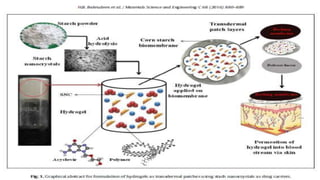
 The constructions of hydrogels with the support of SNCs as filler materials
prepared from different sources of starch have building bricks to grow a stable
pharmaceutical formulation. The SNC's nanocrystals has reinforced and formed as
good biomembrane with support of biopolymers, thereby elute perfect
stabilitywithin the systems for longer durations time at proper storage conditions.
 The surface modifications of SNCs can act as binding sites for active agents in
drug delivery systems or for toxins in purifying and treatment systems. The surface
modifications may also be able to inter diffuse, upon heating, to form the polymer
matrix phase [7] (see Fig. 1 brief descriptions about the formulation of hydrogels.)
The present work mainly deals with the preparation of SNCs as a drug carrier for
the formulation of hydrogels using different polymers for transdermal drug delivery
system (TDDS).
 inorganic starch esters. The starch phosphate is onekind of the inorganic
starch ester, one kind of anionic starch. Incomparison with the native starch,
starch phosphate possesses higher viscosity, glueyness and transparency,
so it can be used as adhesive, thickener, stabilizer, drug bulking agent and
so on.
 Magnetic nanoparticles, composed of a magnetic (e.g. iron oxide/magnetite)
core and a biocompatible polymeric shell (e.g. dextran, starch), offer a
potential method for tumor drug delivery with benefits that extend beyond the
EPR effect.
 Thus, to reach the colon, the drug delivery systems should be based on
polymeric materials that are insoluble in both acidic and neutral
environments and not digestible by pancreatic enzymes. A potential
alternative to commonly used coatings is ingested starch that escapes
digestion in the small intestine and reaches the large bowel
 Starch-based polymers have been studied and proposed in the last decade
by Reis and coworkers for several biomedical applications, such as drug
delivery carrier systems, hydrogels and partially degradable bone cements,
materials for bone replacement/fixation or fillers for bone defects, and
porous structures to be used as scaffolds in tissue engineering of bone and
cartilage. These materials were found to be biocompatible noncytotoxic,
biodegradable and have shown a great processing versatility.
 An area of usefulness for resistant starch is its use in targeted drug delivery
which may aid the effectiveness of CRC chemotherapy approaches. Both
small and large compounds can be taken per orum and delivered to the
bowel using resistant starch acetate coating .The thickness and composition
of the coating can be changed to achieve targeted drug release which
carries important ramifications for CRC treatment.
Advaced drug delivery:
 Starch has been investigated as a conventional excipient and special
carrier for various molecules in novel drug delivery systems. Variants
of native maize starch has been evaluated as an effective film coat for
tablets and has also shown potential to retard dissolution and confer
controlled release activity. Nanoparticles and matrix systems to deliver
drugs to specific sites has also been fabricated with starch.
 Drug delivery to the lungs via the nasal pathway and other specific
sites such as to cancer cells and colons has also been evaluated .The
objective of using starch-based nanoparticles as a ligand to target
cancer cells was aimed potentially to reduce the dose of the toxic
anticancer molecules while maintaining its therapeutic effect. Starch
nanoparticles have been fabricated by carboxylation and oxidation of
the granules [75]. Assam Bora rice starch has been evaluated as a drug
carrier for bioadhesive and matrix system to controlled drug delivery to
the colon.
References:
[1] Moorthy, S. N., Physicochemical and functional properties of
tropical tuber starches: A Review. Starch/Starke 2002, 54,
559–592.
[2] Madrigal-Aldana, D. L., Tovar-Gómez, B., Mata-Montes
de Oca, M., Sáyago-Ayerdi, S. G., et al., Isolation and
characterization of Mexican jackfruit (Artocarpus heterophyllus
L) seeds starchintwo mature stages. Starch/St€arke
2011, 63, 364–372.
[3] Rowe, R. C., Sheskey, P. J., Owen, S. C., Handbook of
Pharmaceutical Excipients, 5th edn., American Pharmacists
Association, Washington DC, USA 2003.
[4] Tester, R. F., Karkalas, J., Qi, X., Starch-composition, fine
structure and architecture. J. Cereal Sci. 2004, 39, 151-166
5-Manek, R. V., Kunle, O. O., Emeje, M. O., Builders, P. F., et al., Physical,
thermal and sorption profile of starch obtained from Tacca leontopetaloides.
Starch/St€arke 2005, 57, 55–61.
6-Shimelis, E., Meaza, M., Rakshit, S., Physico-chemical properties, pasting
behavior and functional characteristics of flours and starches from improved
bean (Phaseolus vulgaris L.) varieties grown in East Africa. Agricultural
Engineering International: the CIGR E.J. Manuscript FP 05 015, VIII, 2006.
7-[70] Gold, G.,Duval, R.N., Palermo, B. T., Slater, J.G., Powder flow studies III.
Factors affecting the flow of lactose granules. J. Pharm. Sci. 1968, 57, 667–
671.
8- Palviainen, P., Hein€am€aki, J., Myll€arinen, P., Lahtinen, R.,et al., Corn
starches as film formers in aqueous-based film coating. Pharm. Dev. Technol.
2001, 6, 353–361.
9-Krogars, K., Antikainen, O., Hein€am€aki, J., Laitinen, N.,Yliruusi, J., Tablet
film-coating with amylose-rich maize starch. Eur. J. Pharm. Sci. 2002, 17, 23–
30.
10-Santander-Ortega, M. J., Stauner, T., Loretz, B., Ortega-Vinuesa, J. L., et
al., Nanoparticles made from novel starch derivatives for transdermal drug
delivery. J. Controlled Release 2010, 141, 85–92.
11-Garr, G. S. M., Bangudu, A. B., Evaluation of sorghum starch as a tablet
excipient. Drug Dev. Ind. Pharm. 1991,17, 1–6.
12-Boonme, P., Pichayakorn, W., Prapruit, P., Boromthanarat,S., Application of
sago starchincosmetic formulations. 2nd ASEAN Sago Symposium 2012,
UNIMAS, Kota Samarahan Advances in Sago Research and Development
2012.
13-Carbohydrate polymers: Applications and recent advances in delivering
drugs to the colon Raj Kumar Shukla∗, Akanksha Tiwari,2011
14-Electrospun starch nanofibers: Recent advances, challenges,and strategies
for potential pharmaceutical applications Guodong Liu abc Zhengbiao Gu abc
Yan Hong abc* Li Cheng abc Caiming Li abc,2017
15-Design of pH-responsive nanoparticles of terpolymer of poly(methacrylic
acid),polysorbate 80 and starch for delivery of doxorubicin Alireza Shalviri a, Ho
Ka Chana, Gaurav Ravala, Mohammad J. Abdekhodaiea,b, Qiang Liuc, et al
16-Microparticles based on carboxymethyl starch/chitosan polyelectrolyte
complex as vehicles
for drug delivery systems Rafael F.N. Quadrado, Andre´ R. Fajardo * 2018
17-Microparticles based on carboxymethyl starch/chitosan polyelectrolyte
complex as vehicles for drug delivery systems Rafael F. N. Quadrado, André R.
Fajardo,2018
18-Novel Starch-PVA Polymer for Microparticle Preparation and Optimization
Using Factorial Design Study Helen Chattopadhyay, Amit Kumar De, and
Sriparna Datta,2014
19-Starch-based microspheres for sustained-release of curcumin: Preparation
and cytotoxic effect on tumor cells Antonio G.B. Pereiraa,∗, André R. Fajardoa,
Samara Nocchib, Celso V. Nakamurab, Adley F. Rubiraa, Edvani C. Muniza,2013
20-Preparation of a New Fe3O4/Starch-g-Polyester Nanocomposite Hydrogel and
a Study on Swelling and Drug Delivery Properties ,Author: Hooshang Hamidian
Tayebeh Tavakoli,2016
21-Starch nanocrystals based hydrogel: Construction, characterizations and
transdermal application
Haja Bava Bakrudeen, C. Sudarvizhi, B.S.R. Reddy ⁎,2016
22-Carboxymethyl starch and lecithin complex as matrix for targeted drug
delivery: I. Monolithic Mesalamine forms for colon delivery Maria Mihaela Friciu,
Tien Canh Le, Pompilia Ispas-Szabo, Mircea Alexandru Mateescu ,2013

Starch Based biopolymer

  • 1.
    MSc. Morning AppliedChemistry Subject Title: Seminar Course Code: ACH-679 Submitted To: Dr.M.Naveed Anjum Submitted By: khalid mehmood Roll No: 9316
  • 2.
    What is Starch?? Starch is the principal form of the carbohydrate reserve in green plants and is formed in the cytoplasm of the plant cells in which they occur.  The attraction to the use of starch as a pharmaceutical excipient in various drug delivery technologies and formulations arise primarily due to their physicochemical and functional properties.  Starch in its native form exists as a semi-crystalline molecule called grains or granules
  • 3.
    CHEMICAL STRACTURE OFSTARCH  Starch consists of two naturally occurring high molecularweight polymers: amylose and amylopectin both of which consists of a single carbohydrate repeating unit of D- glucose.  Fig.1shows the chemical structures of amylose andamylopectin polymers. Amylose has a straight chain structure with a few branch points and exhibits a (1-4)linkage while, amylopectin has a (1-6) linkages resulting in a compact, branched structure.
  • 4.
    Morphology Of Starch Starchgranule morphology is an important parameter used to identify and differentiate starch from different botanical origin. The general presentation, shape and sizes of starch granules from different botanical origin are typical. The SEM photomicrographs of some commonly available starches in Nigeria are presented in Fig
  • 5.
    Solubilty of starch Typically native starch is insoluble in cold water and most organic solvents including acetone, alcohols, and ether.  It however becomes soluble in water when the dispersion is heated up to a certain critical temperature called the gelatinization temperature. Gelatinization is a fundamental property of starch which is characterized by changes in the physical and chemical properties.
  • 6.
    Binder properties:  Freshlymade starch mucilage prepared to gel by heat treatment of the starch dispersion in water has been used extensively as binder in tablets and capsules production using the wet granulation technique.  The starch mucilage is incorporated as a gel and functions as a glue to provide the necessary binding force that holds the powder particles together to form the required agglomerates.  This also serves to ensure a uniform distribution and controllable release of the active pharmaceutical ingredient (API).  When the agglomerates are compressed under optimal load, stable robust tablets are formed .  Another important attribute of starch when used as binder is its compatibility with other adjuncts and APIs used in many conventional and novel formulations.
  • 7.
    Starch as apharmaceutical excipient  Excipients are increasingly being recognized as important components of conventional and novel drug products, providing specific functions in aiding the formulation of optimally elegant, stable, safe, and active drug products.  Starch in its native and modified forms has been widely used as pharmaceutical excipient.  Starch-based excipients have been shown to offer numerous advantages in drug production in terms of lower cost, safety, and product quality.  It has also been evaluated and used as drug carriers in controlled drug delivery systems.  Native starch has traditionally been used for bulk granules, capsules, and tablets production. It has multifunctional uses in the different physical forms serving as binder, disintegrant, diluents, glidant, and lubricant.
  • 8.
    Starch in drugdelivery Polymeric nanoparticles for controlled delivery of drugs andnimaging agents have attracted tremendous interests in recent years because of their numerous advantages. Nanoparticles can protect drugs from in vivo degradation, provide controlled and targeted drug release, accumulate in tumor by passive and active targeting mechanisms, and load multiple drugs and imaging agents. Colon cancer is one of the most pervasive cancers worldwide, causing high mortality. This type of cancer is considered to be the fourth most frequent cause of cancer-related death With the increasing incidence rate of colon cancer and the problems associated with traditional chemotherapy oral colon drug delivery systems (OCDDSs) have been widely studied. OCDDSs can be generally classified into the following five types based on various mechanisms of action: time-lag, pH-dependent, enzyme-dependent, microbiota-triggered and pressure-controlled. Local targeted and sustained release drug delivery systems can expose tumor cells to a suitable
  • 9.
     Porous starch(PS) is a typical modified starch that has been studied for a long time. PS can be prepared by an enzymatic hydrolysis method or a solvent exchange method PS has many applications in foods and other industries due to its high adsorption capacity, specific surface area and biodegradability.  Interestingly, PS has been utilized to encapsulate many substances such as bioactive compounds, drugs, microorganisms and preservatives that have the characteristics of low hydrophilicity, unpleasant odor, low pH resistance or tendency to be readily oxidized.  Starch-coated magnetic nanoparticles labelled with the chemotherapeutic agent mitoxantrone were given intraarterially into the tumorsupplying artery of tumor- bearing rabbits (VX2 squamous cell carcinoma) and focused in the tumor region with an external magnetic field. With this delivery system, total tumor remission without negative side-effects could be accomplished using only 20% and 50% of the regular systemic chemotherapeutic dosage. The nanoparticles in this study consisted of iron oxides covered by starch polymers for colloidal stabilization.
  • 10.
     This studyaims to demonstrate the feasibility of using zein and high amylose starch/zein mixed coatings in colon-targetted drug delivery systems via assessmentof their resistance to release in the upper GI tract. It has been found that heat treatment of high amylose starch generates a retrograded form that is more resistant to pancreatic α-amylases, yet susceptible to those present in the colon.  The constructions of hydrogels with the support of SNCs as filler materials prepared from different sources of starch have building bricks to grow a stable pharmaceutical formulation. The SNC's nanocrystals has reinforced and formed as good biomembrane with support of biopolymers, thereby elute perfect stabilitywithin the systems for longer durations time at proper storage conditions.  The surface modifications of SNCs can act as binding sites for active agents in drug delivery systems or for toxins in purifying and treatment systems. The surface modifications may also be able to inter diffuse, upon heating, to form the polymer matrix phase [7] (see Fig. 1 brief descriptions about the formulation of hydrogels.) The present work mainly deals with the preparation of SNCs as a drug carrier for the formulation of hydrogels using different polymers for transdermal drug delivery system (TDDS).
  • 12.
     inorganic starchesters. The starch phosphate is onekind of the inorganic starch ester, one kind of anionic starch. Incomparison with the native starch, starch phosphate possesses higher viscosity, glueyness and transparency, so it can be used as adhesive, thickener, stabilizer, drug bulking agent and so on.  Magnetic nanoparticles, composed of a magnetic (e.g. iron oxide/magnetite) core and a biocompatible polymeric shell (e.g. dextran, starch), offer a potential method for tumor drug delivery with benefits that extend beyond the EPR effect.  Thus, to reach the colon, the drug delivery systems should be based on polymeric materials that are insoluble in both acidic and neutral environments and not digestible by pancreatic enzymes. A potential alternative to commonly used coatings is ingested starch that escapes digestion in the small intestine and reaches the large bowel
  • 13.
     Starch-based polymershave been studied and proposed in the last decade by Reis and coworkers for several biomedical applications, such as drug delivery carrier systems, hydrogels and partially degradable bone cements, materials for bone replacement/fixation or fillers for bone defects, and porous structures to be used as scaffolds in tissue engineering of bone and cartilage. These materials were found to be biocompatible noncytotoxic, biodegradable and have shown a great processing versatility.  An area of usefulness for resistant starch is its use in targeted drug delivery which may aid the effectiveness of CRC chemotherapy approaches. Both small and large compounds can be taken per orum and delivered to the bowel using resistant starch acetate coating .The thickness and composition of the coating can be changed to achieve targeted drug release which carries important ramifications for CRC treatment.
  • 14.
    Advaced drug delivery: Starch has been investigated as a conventional excipient and special carrier for various molecules in novel drug delivery systems. Variants of native maize starch has been evaluated as an effective film coat for tablets and has also shown potential to retard dissolution and confer controlled release activity. Nanoparticles and matrix systems to deliver drugs to specific sites has also been fabricated with starch.  Drug delivery to the lungs via the nasal pathway and other specific sites such as to cancer cells and colons has also been evaluated .The objective of using starch-based nanoparticles as a ligand to target cancer cells was aimed potentially to reduce the dose of the toxic anticancer molecules while maintaining its therapeutic effect. Starch nanoparticles have been fabricated by carboxylation and oxidation of the granules [75]. Assam Bora rice starch has been evaluated as a drug carrier for bioadhesive and matrix system to controlled drug delivery to the colon.
  • 15.
    References: [1] Moorthy, S.N., Physicochemical and functional properties of tropical tuber starches: A Review. Starch/Starke 2002, 54, 559–592. [2] Madrigal-Aldana, D. L., Tovar-Gómez, B., Mata-Montes de Oca, M., Sáyago-Ayerdi, S. G., et al., Isolation and characterization of Mexican jackfruit (Artocarpus heterophyllus L) seeds starchintwo mature stages. Starch/St€arke 2011, 63, 364–372. [3] Rowe, R. C., Sheskey, P. J., Owen, S. C., Handbook of Pharmaceutical Excipients, 5th edn., American Pharmacists Association, Washington DC, USA 2003. [4] Tester, R. F., Karkalas, J., Qi, X., Starch-composition, fine structure and architecture. J. Cereal Sci. 2004, 39, 151-166
  • 16.
    5-Manek, R. V.,Kunle, O. O., Emeje, M. O., Builders, P. F., et al., Physical, thermal and sorption profile of starch obtained from Tacca leontopetaloides. Starch/St€arke 2005, 57, 55–61. 6-Shimelis, E., Meaza, M., Rakshit, S., Physico-chemical properties, pasting behavior and functional characteristics of flours and starches from improved bean (Phaseolus vulgaris L.) varieties grown in East Africa. Agricultural Engineering International: the CIGR E.J. Manuscript FP 05 015, VIII, 2006. 7-[70] Gold, G.,Duval, R.N., Palermo, B. T., Slater, J.G., Powder flow studies III. Factors affecting the flow of lactose granules. J. Pharm. Sci. 1968, 57, 667– 671. 8- Palviainen, P., Hein€am€aki, J., Myll€arinen, P., Lahtinen, R.,et al., Corn starches as film formers in aqueous-based film coating. Pharm. Dev. Technol. 2001, 6, 353–361. 9-Krogars, K., Antikainen, O., Hein€am€aki, J., Laitinen, N.,Yliruusi, J., Tablet film-coating with amylose-rich maize starch. Eur. J. Pharm. Sci. 2002, 17, 23– 30.
  • 17.
    10-Santander-Ortega, M. J.,Stauner, T., Loretz, B., Ortega-Vinuesa, J. L., et al., Nanoparticles made from novel starch derivatives for transdermal drug delivery. J. Controlled Release 2010, 141, 85–92. 11-Garr, G. S. M., Bangudu, A. B., Evaluation of sorghum starch as a tablet excipient. Drug Dev. Ind. Pharm. 1991,17, 1–6. 12-Boonme, P., Pichayakorn, W., Prapruit, P., Boromthanarat,S., Application of sago starchincosmetic formulations. 2nd ASEAN Sago Symposium 2012, UNIMAS, Kota Samarahan Advances in Sago Research and Development 2012. 13-Carbohydrate polymers: Applications and recent advances in delivering drugs to the colon Raj Kumar Shukla∗, Akanksha Tiwari,2011 14-Electrospun starch nanofibers: Recent advances, challenges,and strategies for potential pharmaceutical applications Guodong Liu abc Zhengbiao Gu abc Yan Hong abc* Li Cheng abc Caiming Li abc,2017 15-Design of pH-responsive nanoparticles of terpolymer of poly(methacrylic acid),polysorbate 80 and starch for delivery of doxorubicin Alireza Shalviri a, Ho Ka Chana, Gaurav Ravala, Mohammad J. Abdekhodaiea,b, Qiang Liuc, et al
  • 18.
    16-Microparticles based oncarboxymethyl starch/chitosan polyelectrolyte complex as vehicles for drug delivery systems Rafael F.N. Quadrado, Andre´ R. Fajardo * 2018 17-Microparticles based on carboxymethyl starch/chitosan polyelectrolyte complex as vehicles for drug delivery systems Rafael F. N. Quadrado, André R. Fajardo,2018 18-Novel Starch-PVA Polymer for Microparticle Preparation and Optimization Using Factorial Design Study Helen Chattopadhyay, Amit Kumar De, and Sriparna Datta,2014 19-Starch-based microspheres for sustained-release of curcumin: Preparation and cytotoxic effect on tumor cells Antonio G.B. Pereiraa,∗, André R. Fajardoa, Samara Nocchib, Celso V. Nakamurab, Adley F. Rubiraa, Edvani C. Muniza,2013 20-Preparation of a New Fe3O4/Starch-g-Polyester Nanocomposite Hydrogel and a Study on Swelling and Drug Delivery Properties ,Author: Hooshang Hamidian Tayebeh Tavakoli,2016
  • 19.
    21-Starch nanocrystals basedhydrogel: Construction, characterizations and transdermal application Haja Bava Bakrudeen, C. Sudarvizhi, B.S.R. Reddy ⁎,2016 22-Carboxymethyl starch and lecithin complex as matrix for targeted drug delivery: I. Monolithic Mesalamine forms for colon delivery Maria Mihaela Friciu, Tien Canh Le, Pompilia Ispas-Szabo, Mircea Alexandru Mateescu ,2013