Presented by – Boby Kumar
NIT Hamirpur (h.p)
Chemical engineering department
Content
 Definition
 Classification
 Sodium alginate
 Property of hydrogels
 Environment-Sensitive Hydrogels
 Advantage of hydrogels
 Disadvantage of hydrogels
 Application of hydrogels
 Conclusion
Definition
 Hydrogels are three-dimensional network of hydrophilic cross-linked
polymer that do not dissolve but can swell in water or can respond to the
fluctuations of the environmental stimuli
 Hydrogels are highly absorbent (they can contain over 90% water) natural
or synthetic polymeric networks
 Hydrogels also possess a degree of flexibility very similar to natural tissue,
due to their significant water content
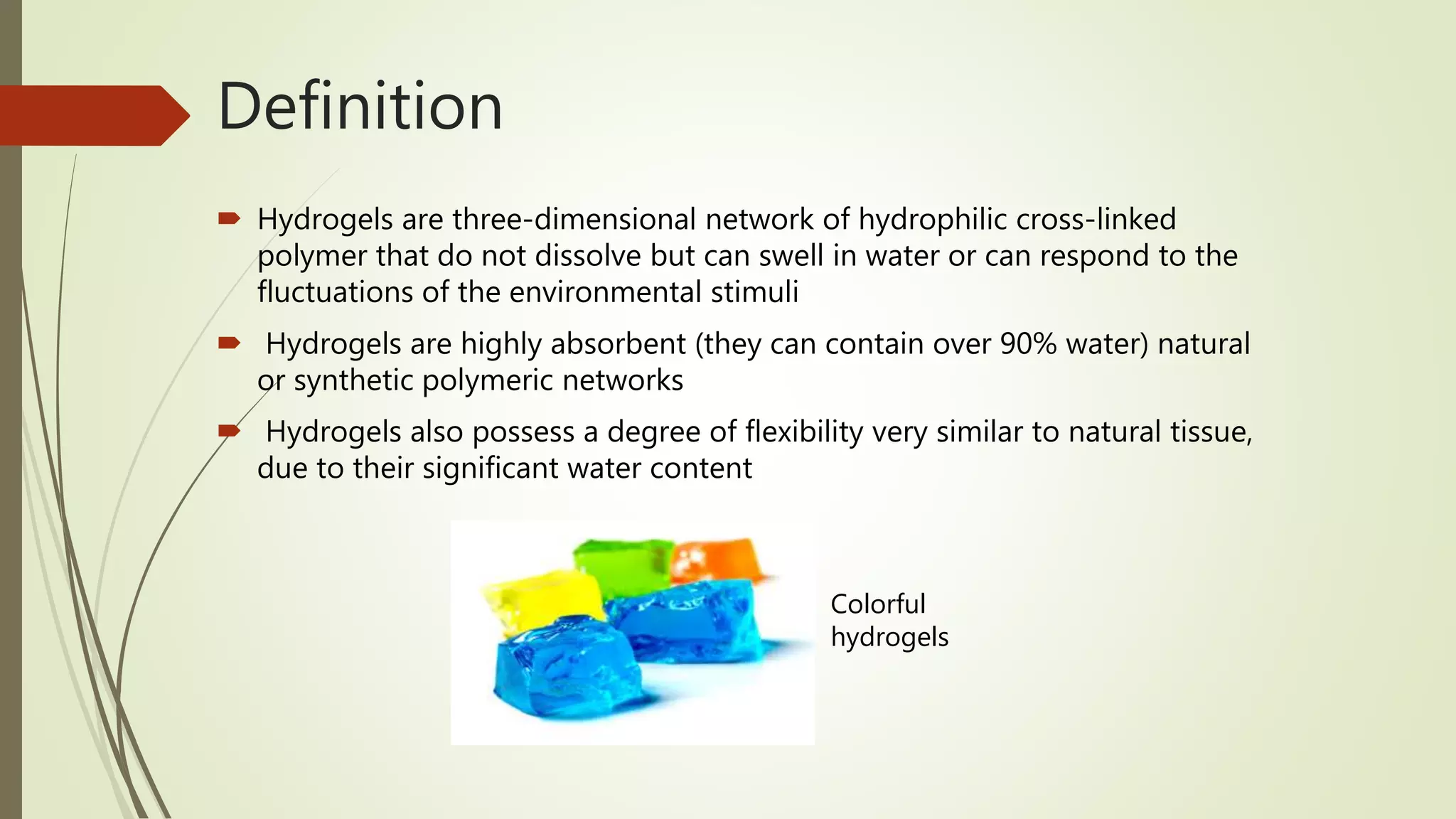
Colorful
hydrogels
Hydrogels
 both solid like and liquid like properties
 high biocompatibility
 Can trap large quantity of water in the network structure (“hydro”)
 Shrink when dried
 environmental stimuli respondent
- various criteria for the classification of hydrogels
Classification
Classification
On the basis of Preparation
 homo-polymer
 copolymer
 Semi-interpenetrating network
 interpenetrating network
On the basis of cross linking
 Chemical hydrogels
 Physical hydrogels
Homo-polymer
 Homopolymers are referred to polymer networks derived from single species of
monomer
 It is the basic structural unit and comprising of any polymer network
 Homopolymers may have cross-linked skeletal structure depending on the nature
of the monomer and polymerization technique
 Cross linked homopolymers are used in drug delivery system and in contact lenses
 Polyetheleneglycol (PEG) based hydrogels are responsive towards external stimuli
and hence these smart hydrogels are widely used in drug delivery system
Co-polymeric hydrogel
 Co-polymeric hydrogels are composed of two types of monomer in which at least
one is hydrophilic in nature
 synthesized the biodegradable triblock poly(ethylene glycol)-poly(caprolactone)-
poly(ethylene glycol) (PEG) co-polymeric hydrogel for the development of drug
delivery system
 The mechanism involve here is the ring-opening copolymerization of caprolactone
(Nylon 6)
Semi- Inter Penetrating Network (Semi-IPN)
 If one polymer is linear and penetrates another cross-linked network without any
other chemical bonds between them, it is called a semi-inter penetrating network
 Semi-IPNs can more effectively preserve rapid kinetic response rates to pH or
temperature due to the absence of restricting interpenetrating elastic network
 while still providing the benefits like modified pore size & slow drug release etc.
 This pH sensitive semi-IPN was synthesized by co-polymerization in the presence
of N, N′-methylene bisacrylamide as a cross-linking agent
 The network contained both covalent and ionic bonds
 The covalent bonds retained the three-dimensional structure of hydrogel and the
ionic bonds imparted the hydrogel with higher mechanical strength and pH
responsive reversibility
Inter Penetrating Network (IPN)
 IPNs are conventionally defined as intimate combination of two polymers, at least
one of which is synthesized or cross-linked in the immediate presence of the other
 This is typically done by immersing a pre-polymerized hydrogel into a solution of
monomers and a polymerization initiator
 IPN method can overcome thermodynamic incompatibility occurs due to the
permanent interlocking of network segments and limited phase separation can be
obtained
 The main advantages of IPNs are relatively dense hydrogel matrices can be
produced which feature stiffer and tougher mechanical properties, controllable
physical properties and more efficient drug loading compared to other hydrogels
HYDROGEL FABRICATION
Chemical hydrogels Physical hydrogels
▪ Hydrogen bonding
▪ hydrophobic interaction
▪ stereo complex formation
▪ ionic complexation
 Covalently cross linked  Noncovalently crosslinked
 Thermoset hydrogels  Thermoplastic hydrogels
 Volume phase transition  Sol-gel phase transition
 Reliable shape stability and
memory
 Limited shape stability and
memory
HYDROGEL FABRICATION
+
Monomer Cross linker
Vinyl group-containing water-soluble polymers
Copolymerization
Polymerization Hydrogel network
Polymerization of water soluble monomers in the presence
of bi- or multifunctional cross-linking agent
or
Chemical cross linking
HYDROGEL FABRICATION
Physical crosslinking
 Ionic hydrogel
Chemical and Physical
crosslinking
 Cross-linking without chemical
reaction
 ionic interaction, hydrogen
bonding, antigen-antibody
interaction, supramolecular
association
Sodium alginate
 One of the components of the hydrogel that will be synthesized by chemical
crosslinking
 Long chain polymer – covalently bonded
 Sodium ions (Na+) ionically bonded to chain
Properties of Hydrogels
Rs = (Ws-Wd) / Wd
Rs = swelling ratio
Ws = weight of swollen hydrogels
Wd = weight of dried hydrogels
 Swelling property: hydrogels are the swollen polymeric networks,
interior of which is occupied by drug molecules, therefore, release studies
are carried out to understand the mechanism of release over a period of
application
Swelling property is influenced by:
• type and composition of monomers
• other environmental factors such as :
temperature, pH, ionic strength
• cross-linking (mechanical strength and permeability)
Properties of Hydrogels
 Mechanical properties of hydrogels are very important for pharmaceutical
applications. For example property of maintaining its physical texture during the
application of drug delivery
 Changing the degree of crosslinking has been utilized to achieve the desired
mechanical property of the hydrogel
 Biocompatible properties It is important for the hydrogels to be biocompatible
and nontoxic in order to make it applicable in biomedical field
 Cell culture methods, also known as cytotoxicity tests, can be used to evaluate
the toxicity of hydrogels
 respond to environmental change
: temperature, pH, specific molecule
 reversible volume phase transition or sol-gel phase
transition
 “intelligent” or “smart” hydrogel
Drug-loaded
hydrogelChange in pH for
gel swelling
Drug release through
the swollen network
Drug release by the
squeezing action
Change in temperature
for gel collapse
Environment-Sensitive Hydrogels
Hydrogels will provide new
and improved methods of
regenerative medicine,
biotechnology, pharmacology,
and biosensors in the near
future
Hydrogels can
influence cell behavior
by mimicking the
extracellular matrix
Hydrogels can influence the
cell behavior and its
biochemical and biophysical
processes
Applications of Hydrogels
 Hydrogels
 Polymer chains that are typically
hydrophilic, usually highly absorbent
and very flexible
 Hold potential in biomedical field
due to water-carrying capacity
 Can hold up to 600x their weight in
water!
Can hold
many times
there weight
and flexible!
Can be used
in contact
lenses
Numerous applications
Stem Cells
Tissue Engineering
Cell Therapy
Contact Lenses
Cancer Treatment
Applications of Hydrogels
Applications of Hydrogels in Drug Delivery
 Benefits of controlled drug delivery
• more effective therapies with reduced side effects
• the maintenance of effective drug concentration levels in the blood
• patient’s convenience as medicines hence increased patient
compliance
 Hydrogels that are responsive to specific molecules, such as glucose or
antigens, can be used as biosensors as well as drug delivery systems
 Sensitive hydrogels like temperature, pH sensitive, which are used for the
targeted delivery of proteins to colon, and chemotherapeutic agents to
tumors
Advantages of Hydrogels
 Hydrogels possess a degree of flexibility very similar to natural tissue, due to their
significant water content
 Entrapment of microbial cells within Hydrogel beads has the advantage of low
toxicity
 Environmentally sensitive Hydrogels have the ability to sense changes of pH,
temperature, or the concentration of metabolite and release their load as result of
such a change
 Timed release of growth factors and other nutrients to ensure proper tissue
growth
 Hydrogels have good transport properties
 Hydrogels are Biocompatible
 Hydrogels can be injected
 Hydrogels are easy to modify
21
Disadvantages of Hydrogels
 Hydrogels are expensive
 Hydrogels causes sensation felt by movement of the maggots
 The surgical risk associated with the device implantation and retrieval
 Hydrogels are non-adherent, they may need to be secured by a secondary
dressing
 Hydrogels used as contact lenses causes lens deposition, hypoxia,
dehydration and red eye reactions
 Hydrogels have low mechanical strength
 Difficulty in handling
 Difficulty in loading
Conclusion
 Recent developments in the field of polymer science and technology has led to the
development of various stimuli sensitive hydrogels like pH, temperature sensitive
hydrogels
 A new way to create hydrogels has been developed by immobilizing different
proteins at the same time
 Hydrogels with novel properties will continue to play important role in drug
delivery
 New synthetic methods have been used to prepare homo- and co-polymeric
hydrogels for a wide range of drugs, peptides, and protein delivery applications
 Hydrogels are also used in regenerating human tissue cells
thank you

Hydrogels

  • 1.
    Presented by –Boby Kumar NIT Hamirpur (h.p) Chemical engineering department
  • 2.
    Content  Definition  Classification Sodium alginate  Property of hydrogels  Environment-Sensitive Hydrogels  Advantage of hydrogels  Disadvantage of hydrogels  Application of hydrogels  Conclusion
  • 3.
    Definition  Hydrogels arethree-dimensional network of hydrophilic cross-linked polymer that do not dissolve but can swell in water or can respond to the fluctuations of the environmental stimuli  Hydrogels are highly absorbent (they can contain over 90% water) natural or synthetic polymeric networks  Hydrogels also possess a degree of flexibility very similar to natural tissue, due to their significant water content Colorful hydrogels
  • 4.
    Hydrogels  both solidlike and liquid like properties  high biocompatibility  Can trap large quantity of water in the network structure (“hydro”)  Shrink when dried  environmental stimuli respondent
  • 5.
    - various criteriafor the classification of hydrogels Classification
  • 6.
    Classification On the basisof Preparation  homo-polymer  copolymer  Semi-interpenetrating network  interpenetrating network On the basis of cross linking  Chemical hydrogels  Physical hydrogels
  • 7.
    Homo-polymer  Homopolymers arereferred to polymer networks derived from single species of monomer  It is the basic structural unit and comprising of any polymer network  Homopolymers may have cross-linked skeletal structure depending on the nature of the monomer and polymerization technique  Cross linked homopolymers are used in drug delivery system and in contact lenses  Polyetheleneglycol (PEG) based hydrogels are responsive towards external stimuli and hence these smart hydrogels are widely used in drug delivery system
  • 8.
    Co-polymeric hydrogel  Co-polymerichydrogels are composed of two types of monomer in which at least one is hydrophilic in nature  synthesized the biodegradable triblock poly(ethylene glycol)-poly(caprolactone)- poly(ethylene glycol) (PEG) co-polymeric hydrogel for the development of drug delivery system  The mechanism involve here is the ring-opening copolymerization of caprolactone (Nylon 6)
  • 9.
    Semi- Inter PenetratingNetwork (Semi-IPN)  If one polymer is linear and penetrates another cross-linked network without any other chemical bonds between them, it is called a semi-inter penetrating network  Semi-IPNs can more effectively preserve rapid kinetic response rates to pH or temperature due to the absence of restricting interpenetrating elastic network  while still providing the benefits like modified pore size & slow drug release etc.  This pH sensitive semi-IPN was synthesized by co-polymerization in the presence of N, N′-methylene bisacrylamide as a cross-linking agent  The network contained both covalent and ionic bonds  The covalent bonds retained the three-dimensional structure of hydrogel and the ionic bonds imparted the hydrogel with higher mechanical strength and pH responsive reversibility
  • 10.
    Inter Penetrating Network(IPN)  IPNs are conventionally defined as intimate combination of two polymers, at least one of which is synthesized or cross-linked in the immediate presence of the other  This is typically done by immersing a pre-polymerized hydrogel into a solution of monomers and a polymerization initiator  IPN method can overcome thermodynamic incompatibility occurs due to the permanent interlocking of network segments and limited phase separation can be obtained  The main advantages of IPNs are relatively dense hydrogel matrices can be produced which feature stiffer and tougher mechanical properties, controllable physical properties and more efficient drug loading compared to other hydrogels
  • 11.
    HYDROGEL FABRICATION Chemical hydrogelsPhysical hydrogels ▪ Hydrogen bonding ▪ hydrophobic interaction ▪ stereo complex formation ▪ ionic complexation  Covalently cross linked  Noncovalently crosslinked  Thermoset hydrogels  Thermoplastic hydrogels  Volume phase transition  Sol-gel phase transition  Reliable shape stability and memory  Limited shape stability and memory
  • 12.
    HYDROGEL FABRICATION + Monomer Crosslinker Vinyl group-containing water-soluble polymers Copolymerization Polymerization Hydrogel network Polymerization of water soluble monomers in the presence of bi- or multifunctional cross-linking agent or Chemical cross linking
  • 13.
    HYDROGEL FABRICATION Physical crosslinking Ionic hydrogel Chemical and Physical crosslinking  Cross-linking without chemical reaction  ionic interaction, hydrogen bonding, antigen-antibody interaction, supramolecular association
  • 14.
    Sodium alginate  Oneof the components of the hydrogel that will be synthesized by chemical crosslinking  Long chain polymer – covalently bonded  Sodium ions (Na+) ionically bonded to chain
  • 15.
    Properties of Hydrogels Rs= (Ws-Wd) / Wd Rs = swelling ratio Ws = weight of swollen hydrogels Wd = weight of dried hydrogels  Swelling property: hydrogels are the swollen polymeric networks, interior of which is occupied by drug molecules, therefore, release studies are carried out to understand the mechanism of release over a period of application Swelling property is influenced by: • type and composition of monomers • other environmental factors such as : temperature, pH, ionic strength • cross-linking (mechanical strength and permeability)
  • 16.
    Properties of Hydrogels Mechanical properties of hydrogels are very important for pharmaceutical applications. For example property of maintaining its physical texture during the application of drug delivery  Changing the degree of crosslinking has been utilized to achieve the desired mechanical property of the hydrogel  Biocompatible properties It is important for the hydrogels to be biocompatible and nontoxic in order to make it applicable in biomedical field  Cell culture methods, also known as cytotoxicity tests, can be used to evaluate the toxicity of hydrogels
  • 17.
     respond toenvironmental change : temperature, pH, specific molecule  reversible volume phase transition or sol-gel phase transition  “intelligent” or “smart” hydrogel Drug-loaded hydrogelChange in pH for gel swelling Drug release through the swollen network Drug release by the squeezing action Change in temperature for gel collapse Environment-Sensitive Hydrogels
  • 18.
    Hydrogels will providenew and improved methods of regenerative medicine, biotechnology, pharmacology, and biosensors in the near future Hydrogels can influence cell behavior by mimicking the extracellular matrix Hydrogels can influence the cell behavior and its biochemical and biophysical processes Applications of Hydrogels
  • 19.
     Hydrogels  Polymerchains that are typically hydrophilic, usually highly absorbent and very flexible  Hold potential in biomedical field due to water-carrying capacity  Can hold up to 600x their weight in water! Can hold many times there weight and flexible! Can be used in contact lenses Numerous applications Stem Cells Tissue Engineering Cell Therapy Contact Lenses Cancer Treatment Applications of Hydrogels
  • 20.
    Applications of Hydrogelsin Drug Delivery  Benefits of controlled drug delivery • more effective therapies with reduced side effects • the maintenance of effective drug concentration levels in the blood • patient’s convenience as medicines hence increased patient compliance  Hydrogels that are responsive to specific molecules, such as glucose or antigens, can be used as biosensors as well as drug delivery systems  Sensitive hydrogels like temperature, pH sensitive, which are used for the targeted delivery of proteins to colon, and chemotherapeutic agents to tumors
  • 21.
    Advantages of Hydrogels Hydrogels possess a degree of flexibility very similar to natural tissue, due to their significant water content  Entrapment of microbial cells within Hydrogel beads has the advantage of low toxicity  Environmentally sensitive Hydrogels have the ability to sense changes of pH, temperature, or the concentration of metabolite and release their load as result of such a change  Timed release of growth factors and other nutrients to ensure proper tissue growth  Hydrogels have good transport properties  Hydrogels are Biocompatible  Hydrogels can be injected  Hydrogels are easy to modify 21
  • 22.
    Disadvantages of Hydrogels Hydrogels are expensive  Hydrogels causes sensation felt by movement of the maggots  The surgical risk associated with the device implantation and retrieval  Hydrogels are non-adherent, they may need to be secured by a secondary dressing  Hydrogels used as contact lenses causes lens deposition, hypoxia, dehydration and red eye reactions  Hydrogels have low mechanical strength  Difficulty in handling  Difficulty in loading
  • 23.
    Conclusion  Recent developmentsin the field of polymer science and technology has led to the development of various stimuli sensitive hydrogels like pH, temperature sensitive hydrogels  A new way to create hydrogels has been developed by immobilizing different proteins at the same time  Hydrogels with novel properties will continue to play important role in drug delivery  New synthetic methods have been used to prepare homo- and co-polymeric hydrogels for a wide range of drugs, peptides, and protein delivery applications  Hydrogels are also used in regenerating human tissue cells thank you