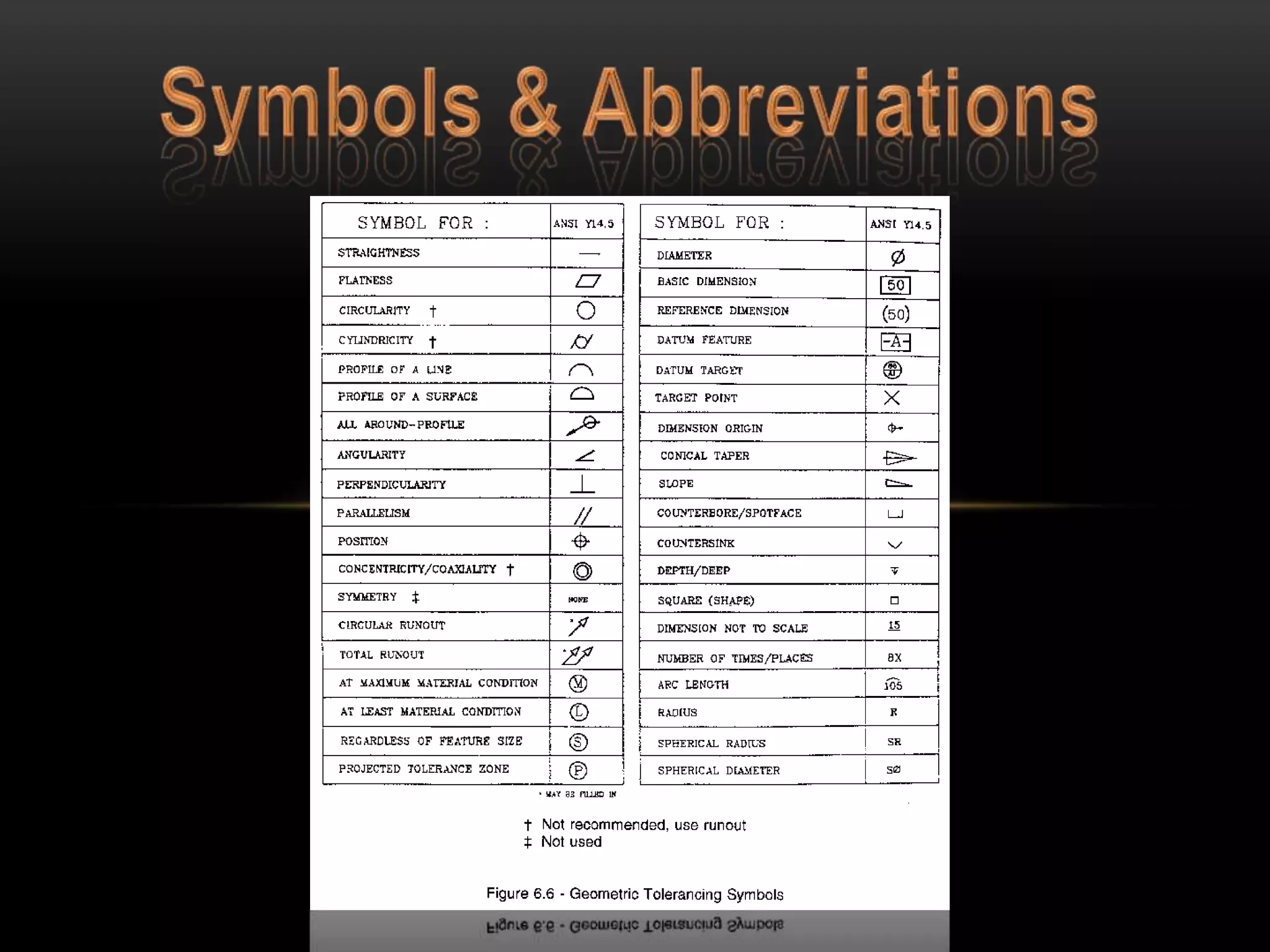
• There are many, many, symbols and abbreviations that are used in engineering 
• Their purpose is to simplify the production process 
• By looking at a symbol you can tell a great deal of things, from the material type, to the 
projection that the drawing is done from 
• The American Standards Association issued the first American standards (1935), entitled 
“Drawing and Drafting Room Practices” 
• BSI (British Standards Institution: 308) set guidelines, the first part published in 1984, the 
second in 1985, and then third 1990. These lay the standard out for our country 
• ISO (International Standard Organisation), these standards are agreed on internationally 
• BSI revisions are being updated progressively so that they should be in line with the ISO 
standard
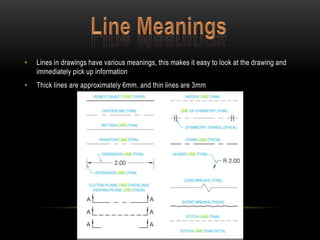
• Lines in drawings have various meanings, this makes it easy to look at the drawing and 
immediately pick up information 
• Thick lines are approximately 6mm, and thin lines are 3mm
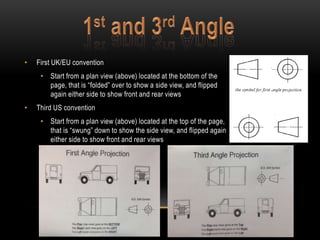
• First UK/EU convention 
• Start from a plan view (above) located at the bottom of the 
page, that is “folded” over to show a side view, and flipped 
again either side to show front and rear views 
• Third US convention 
• Start from a plan view (above) located at the top of the page, 
that is “swung” down to show the side view, and flipped again 
either side to show front and rear views
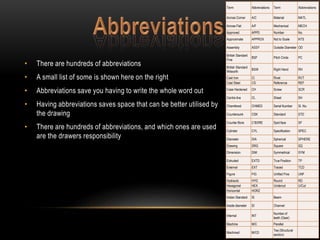
• There are hundreds of abbreviations 
• A small list of some is shown here on the right 
• Abbreviations save you having to write the whole word out 
• Having abbreviations saves space that can be better utilised by 
the drawing 
• There are hundreds of abbreviations, and which ones are used 
are the drawers responsibility 
Term Abbreviations Term Abbreviations 
Across Corner A/C Material MATL 
Across Flat A/F Mechanical MECH 
Approved APPD Number No. 
Approximate APPROX Not to Scale NTS 
Assembly ASSY Outside Diameter OD 
British Standard 
Fine 
BSF Pitch Circle PC 
British Standard 
Witworth 
BSW Right Hand RH 
Cast Iron CI Rivet RVT 
Cast Steel CS Reference REF 
Case Hardened CH Screw SCR 
Centre line CL Sheet SH 
Chamfered CHMED Serial Number Sl. No. 
Countersunk CSK Standard STD 
Counter Bore C’BORE Spot face SF 
Cylinder CYL Specification SPEC 
Diameter DIA Spherical SPHERE 
Drawing DRG Square SQ 
Dimension DIM Symmetrical SYM 
Extruded EXTD True Position TP 
External EXT Traced TCD 
Figure FIG Unified Fine UNF 
Hydraulic HYD Round RD 
Hexagonal HEX Undercut U/Cut 
Horizontal HORZ 
Indian Standard IS Beam 
Inside diameter ID Channel 
Internal INT 
Number of 
teeth (Gear) 
Machine M/C Parallel 
Machined M/CD 
Tee (Structural 
section)
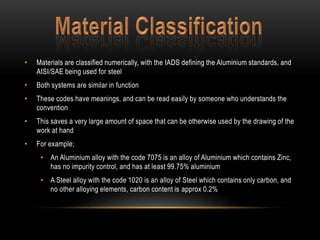
• Materials are classified numerically, with the IADS defining the Aluminium standards, and 
AISI/SAE being used for steel 
• Both systems are similar in function 
• These codes have meanings, and can be read easily by someone who understands the 
convention 
• This saves a very large amount of space that can be otherwise used by the drawing of the 
work at hand 
• For example; 
• An Aluminium alloy with the code 7075 is an alloy of Aluminium which contains Zinc, 
has no impurity control, and has at least 99.75% aluminium 
• A Steel alloy with the code 1020 is an alloy of Steel which contains only carbon, and 
no other alloying elements, carbon content is approx 0.2%
• They are coded using the the International Alloy Designation System (IADS) standard 
• The digit "1" as in 1xxx designates alloy free (no alloys) and is at least 99% Aluminium. 
• The Digit is interchangeable, and depending on it’s value, it means there is a different 
alloy that is also within the aluminium, some contain multiple major alloys, they are as 
follows: 
• “2” for Copper (Cu), “3” for Manganese (Mn), “4” for Silicon (Si), “5” for Magnesium, “6” for 
Magnesium and Silicon (Mg and Si), “7” for Zinc (Zn), “8” for an unspecified alloy 
(including Lithium [Li]) 
• The second part x0xx denotes the purity control of the Aluminium, where “0” is no control, 
and “1-9” are different controls set at the mill, these levels are set by AIDS 
• The final part is the minimum Aluminium percentage above 99%. So xx25 means “99.25% 
minimum Aluminium content”
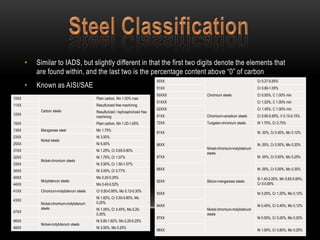
• Similar to IADS, but slightly different in that the first two digits denote the elements that 
are found within, and the last two is the percentage content above “0” of carbon 
• Known as AISI/SAE 
10XX 
Carbon steels 
Plain carbon, Mn 1.00% max 
11XX Resulfurized free machining 
12XX 
Resulfurized / rephosphorized free 
machining 
15XX Plain carbon, Mn 1.00-1.65% 
13XX Manganese steel Mn 1.75% 
23XX 
Nickel steels 
Ni 3.50% 
25XX Ni 5.00% 
31XX 
Nickel-chromium steels 
Ni 1.25%, Cr 0.65-0.80% 
32XX Ni 1.75%, Cr 1.07% 
33XX Ni 3.50%, Cr 1.50-1.57% 
34XX Ni 3.00%, Cr 0.77% 
40XX 
Molybdenum steels 
Mo 0.20-0.25% 
44XX Mo 0.40-0.52% 
41XX Chromium-molybdenum steels Cr 0.50-0.95%, Mo 0.12-0.30% 
43XX 
Nickel-chromium-molybdenum 
steels 
Ni 1.82%, Cr 0.50-0.80%, Mo 
0.25% 
47XX 
Ni 1.05%, Cr 0.45%, Mo 0.20- 
0.35% 
46XX 
Nickel-molybdenum steels 
Ni 0.85-1.82%, Mo 0.20-0.25% 
48XX Ni 3.50%, Mo 0.25% 
50XX 
Chromium steels 
Cr 0.27-0.65% 
51XX Cr 0.80-1.05% 
50XXX Cr 0.50%, C 1.00% min 
51XXX Cr 1.02%, C 1.00% min 
52XXX Cr 1.45%, C 1.00% min 
61XX Chromium-vanadium steels Cr 0.60-0.95%, V 0.10-0.15% 
72XX Tungsten-chromium steels W 1.75%, Cr 0.75% 
81XX 
Nickel-chromium-molybdenum 
steels 
Ni .30%, Cr 0.40%, Mo 0.12% 
86XX Ni .55%, Cr 0.50%, Mo 0.20% 
87XX Ni .55%, Cr 0.50%, Mo 0.25% 
88XX Ni .55%, Cr 0.50%, Mo 0.35% 
92XX Silicon-manganese steels 
Si 1.40-2.00%, Mn 0.65-0.85%, 
Cr 0-0.65% 
93XX 
Nickel-chromium-molybdenum 
steels 
Ni 3.25%, Cr 1.20%, Mo 0.12% 
94XX Ni 0.45%, Cr 0.40%, Mo 0.12% 
97XX Ni 0.55%, Cr 0.20%, Mo 0.20% 
98XX Ni 1.00%, Cr 0.80%, Mo 0.25%
Symbols and abbreviations

Symbols and abbreviations

  • 2.
    • There aremany, many, symbols and abbreviations that are used in engineering • Their purpose is to simplify the production process • By looking at a symbol you can tell a great deal of things, from the material type, to the projection that the drawing is done from • The American Standards Association issued the first American standards (1935), entitled “Drawing and Drafting Room Practices” • BSI (British Standards Institution: 308) set guidelines, the first part published in 1984, the second in 1985, and then third 1990. These lay the standard out for our country • ISO (International Standard Organisation), these standards are agreed on internationally • BSI revisions are being updated progressively so that they should be in line with the ISO standard
  • 3.
    • Lines indrawings have various meanings, this makes it easy to look at the drawing and immediately pick up information • Thick lines are approximately 6mm, and thin lines are 3mm
  • 4.
    • First UK/EUconvention • Start from a plan view (above) located at the bottom of the page, that is “folded” over to show a side view, and flipped again either side to show front and rear views • Third US convention • Start from a plan view (above) located at the top of the page, that is “swung” down to show the side view, and flipped again either side to show front and rear views
  • 5.
    • There arehundreds of abbreviations • A small list of some is shown here on the right • Abbreviations save you having to write the whole word out • Having abbreviations saves space that can be better utilised by the drawing • There are hundreds of abbreviations, and which ones are used are the drawers responsibility Term Abbreviations Term Abbreviations Across Corner A/C Material MATL Across Flat A/F Mechanical MECH Approved APPD Number No. Approximate APPROX Not to Scale NTS Assembly ASSY Outside Diameter OD British Standard Fine BSF Pitch Circle PC British Standard Witworth BSW Right Hand RH Cast Iron CI Rivet RVT Cast Steel CS Reference REF Case Hardened CH Screw SCR Centre line CL Sheet SH Chamfered CHMED Serial Number Sl. No. Countersunk CSK Standard STD Counter Bore C’BORE Spot face SF Cylinder CYL Specification SPEC Diameter DIA Spherical SPHERE Drawing DRG Square SQ Dimension DIM Symmetrical SYM Extruded EXTD True Position TP External EXT Traced TCD Figure FIG Unified Fine UNF Hydraulic HYD Round RD Hexagonal HEX Undercut U/Cut Horizontal HORZ Indian Standard IS Beam Inside diameter ID Channel Internal INT Number of teeth (Gear) Machine M/C Parallel Machined M/CD Tee (Structural section)
  • 6.
    • Materials areclassified numerically, with the IADS defining the Aluminium standards, and AISI/SAE being used for steel • Both systems are similar in function • These codes have meanings, and can be read easily by someone who understands the convention • This saves a very large amount of space that can be otherwise used by the drawing of the work at hand • For example; • An Aluminium alloy with the code 7075 is an alloy of Aluminium which contains Zinc, has no impurity control, and has at least 99.75% aluminium • A Steel alloy with the code 1020 is an alloy of Steel which contains only carbon, and no other alloying elements, carbon content is approx 0.2%
  • 7.
    • They arecoded using the the International Alloy Designation System (IADS) standard • The digit "1" as in 1xxx designates alloy free (no alloys) and is at least 99% Aluminium. • The Digit is interchangeable, and depending on it’s value, it means there is a different alloy that is also within the aluminium, some contain multiple major alloys, they are as follows: • “2” for Copper (Cu), “3” for Manganese (Mn), “4” for Silicon (Si), “5” for Magnesium, “6” for Magnesium and Silicon (Mg and Si), “7” for Zinc (Zn), “8” for an unspecified alloy (including Lithium [Li]) • The second part x0xx denotes the purity control of the Aluminium, where “0” is no control, and “1-9” are different controls set at the mill, these levels are set by AIDS • The final part is the minimum Aluminium percentage above 99%. So xx25 means “99.25% minimum Aluminium content”
  • 8.
    • Similar toIADS, but slightly different in that the first two digits denote the elements that are found within, and the last two is the percentage content above “0” of carbon • Known as AISI/SAE 10XX Carbon steels Plain carbon, Mn 1.00% max 11XX Resulfurized free machining 12XX Resulfurized / rephosphorized free machining 15XX Plain carbon, Mn 1.00-1.65% 13XX Manganese steel Mn 1.75% 23XX Nickel steels Ni 3.50% 25XX Ni 5.00% 31XX Nickel-chromium steels Ni 1.25%, Cr 0.65-0.80% 32XX Ni 1.75%, Cr 1.07% 33XX Ni 3.50%, Cr 1.50-1.57% 34XX Ni 3.00%, Cr 0.77% 40XX Molybdenum steels Mo 0.20-0.25% 44XX Mo 0.40-0.52% 41XX Chromium-molybdenum steels Cr 0.50-0.95%, Mo 0.12-0.30% 43XX Nickel-chromium-molybdenum steels Ni 1.82%, Cr 0.50-0.80%, Mo 0.25% 47XX Ni 1.05%, Cr 0.45%, Mo 0.20- 0.35% 46XX Nickel-molybdenum steels Ni 0.85-1.82%, Mo 0.20-0.25% 48XX Ni 3.50%, Mo 0.25% 50XX Chromium steels Cr 0.27-0.65% 51XX Cr 0.80-1.05% 50XXX Cr 0.50%, C 1.00% min 51XXX Cr 1.02%, C 1.00% min 52XXX Cr 1.45%, C 1.00% min 61XX Chromium-vanadium steels Cr 0.60-0.95%, V 0.10-0.15% 72XX Tungsten-chromium steels W 1.75%, Cr 0.75% 81XX Nickel-chromium-molybdenum steels Ni .30%, Cr 0.40%, Mo 0.12% 86XX Ni .55%, Cr 0.50%, Mo 0.20% 87XX Ni .55%, Cr 0.50%, Mo 0.25% 88XX Ni .55%, Cr 0.50%, Mo 0.35% 92XX Silicon-manganese steels Si 1.40-2.00%, Mn 0.65-0.85%, Cr 0-0.65% 93XX Nickel-chromium-molybdenum steels Ni 3.25%, Cr 1.20%, Mo 0.12% 94XX Ni 0.45%, Cr 0.40%, Mo 0.12% 97XX Ni 0.55%, Cr 0.20%, Mo 0.20% 98XX Ni 1.00%, Cr 0.80%, Mo 0.25%