STANDARDIZATION OF RATES 
Halyna Lugova, MD, PhD October 8, 2014
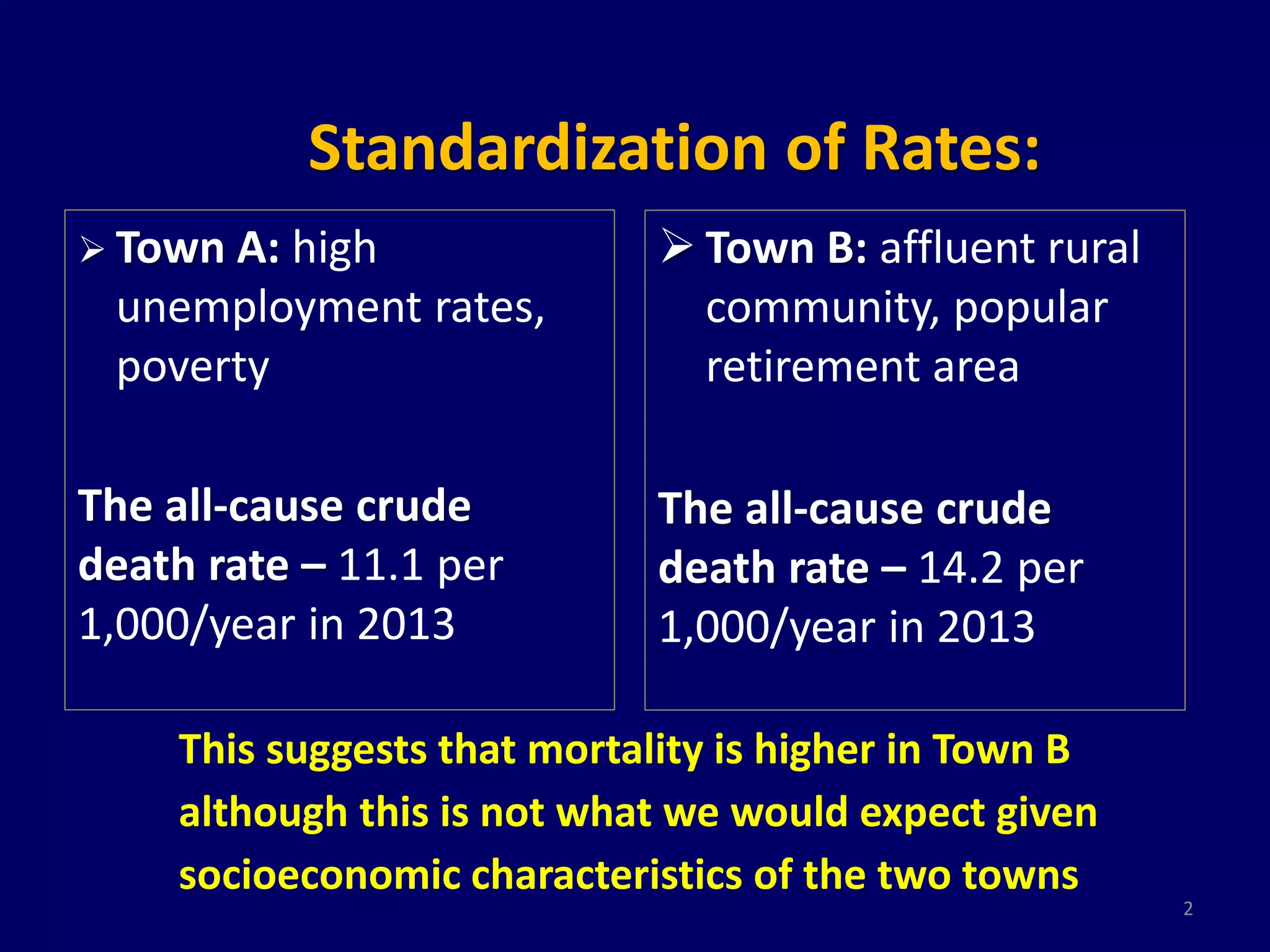
Standardization of Rates: 
Town B: affluent rural community, popular retirement area 
The all-cause crude death rate – 14.2 per 1,000/year in 2013 
2 
Town A: high unemployment rates, poverty 
The all-cause crude death rate – 11.1 per 1,000/year in 2013 
This suggests that mortality is higher in Town B although this is not what we would expect given socioeconomic characteristics of the two towns
Standardization of Rates: Age distribution for two populations 
3 
0 
5 
10 
15 
20 
25 
30 
35 
40 
45 
0-4 
5-14 
15-24 
25-34 
35-44 
45-54 
55-64 
65-74 
75-84 
85 and 
over 
Town A 
Town B 
X 1,000 population 
age
Standardization of Rates 
4 
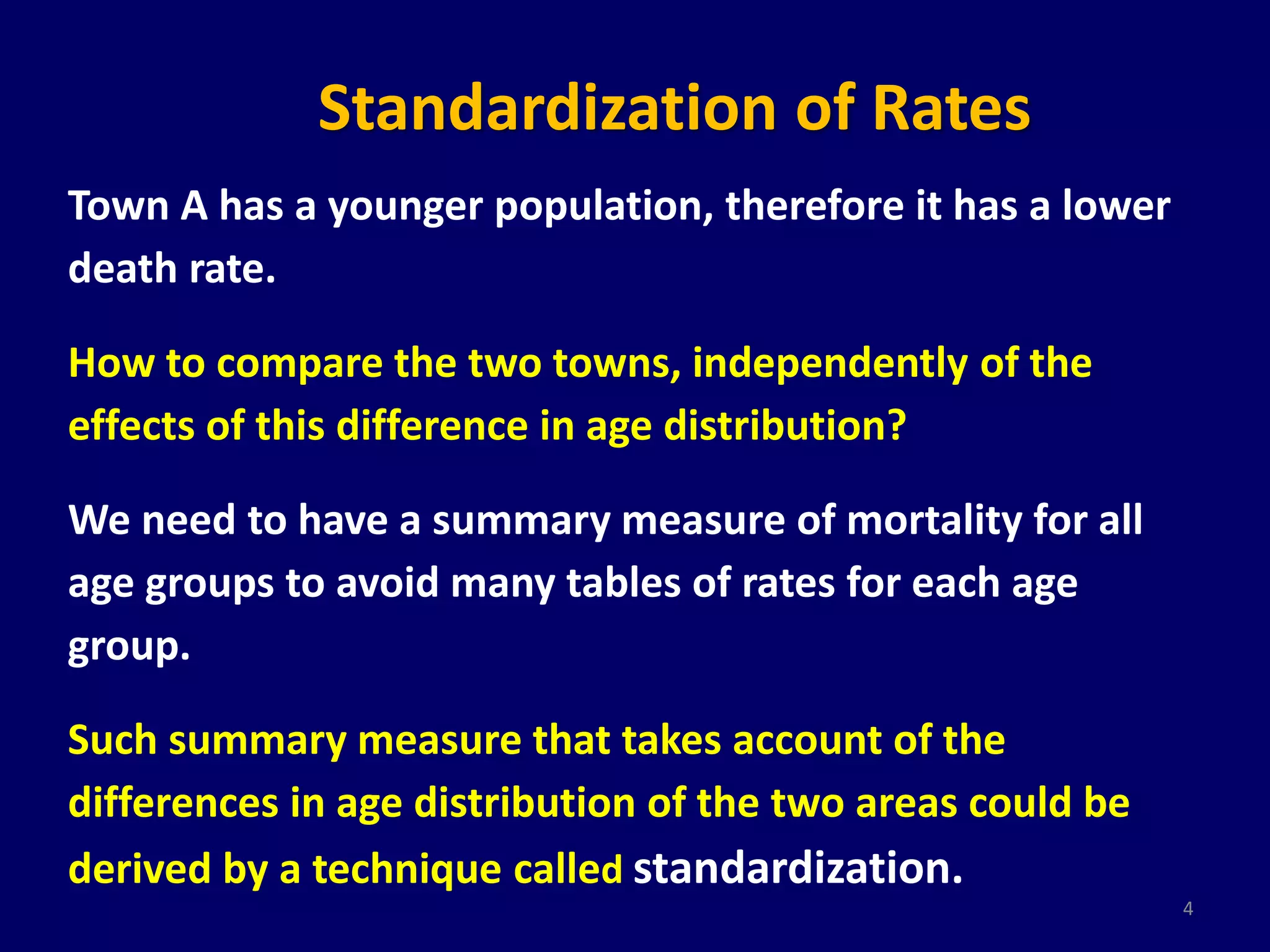
Town A has a younger population, therefore it has a lower death rate. 
How to compare the two towns, independently of the effects of this difference in age distribution? 
We need to have a summary measure of mortality for all age groups to avoid many tables of rates for each age group. 
Such summary measure that takes account of the differences in age distribution of the two areas could be derived by a technique called standardization.
Standardization of Rates 
1.The indirect method provides standardized mortality ratio (SMR) and indirectly standardized rates 
2.The direct method provides directly standardized rates 
3.For indirect method we need to select standard population, e.g. country population, or one of the ‘standard populations’ (not real) created to represent population structure: World standard population, European standard population, etc. 
5
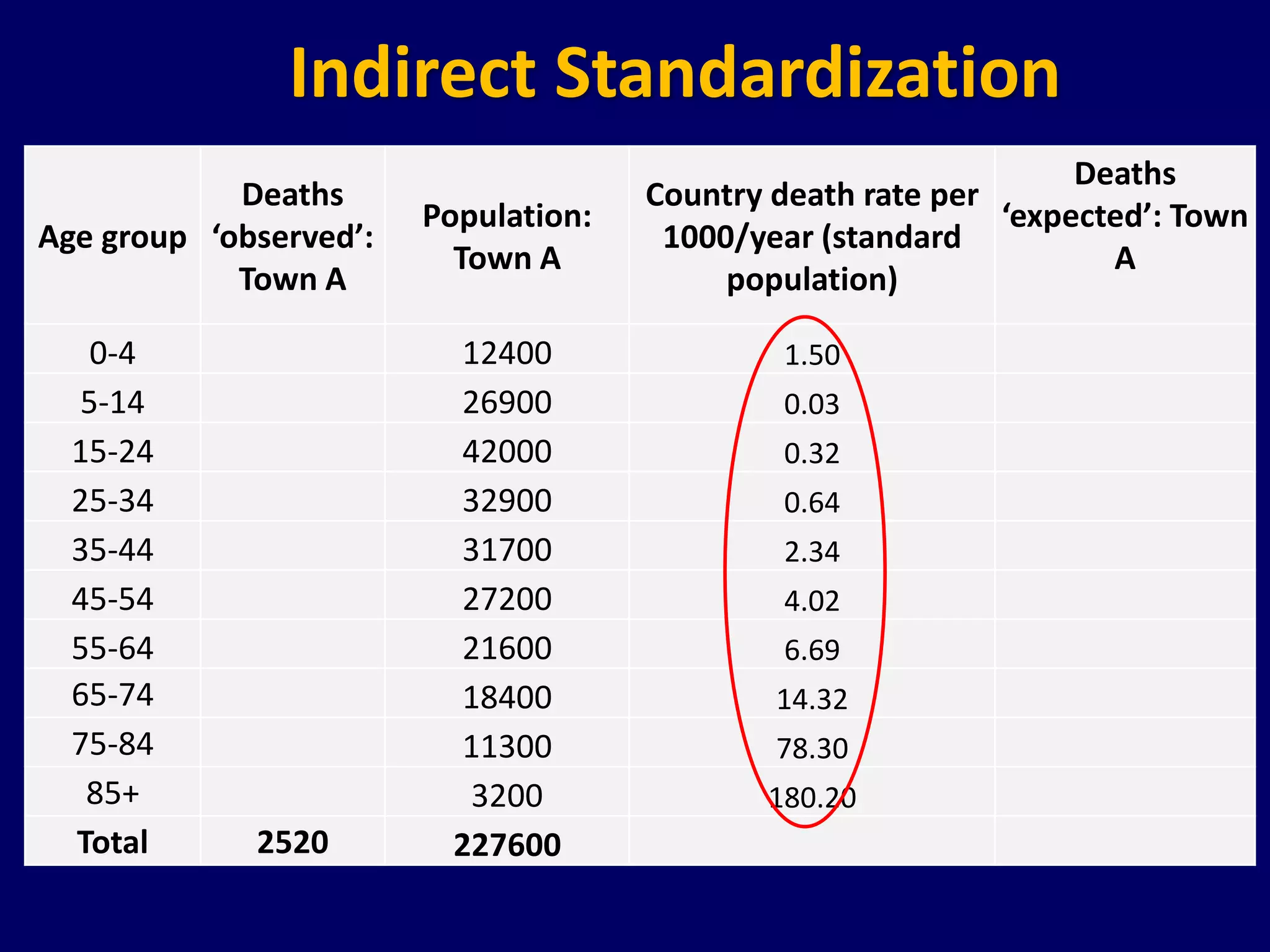
Indirect Standardization 
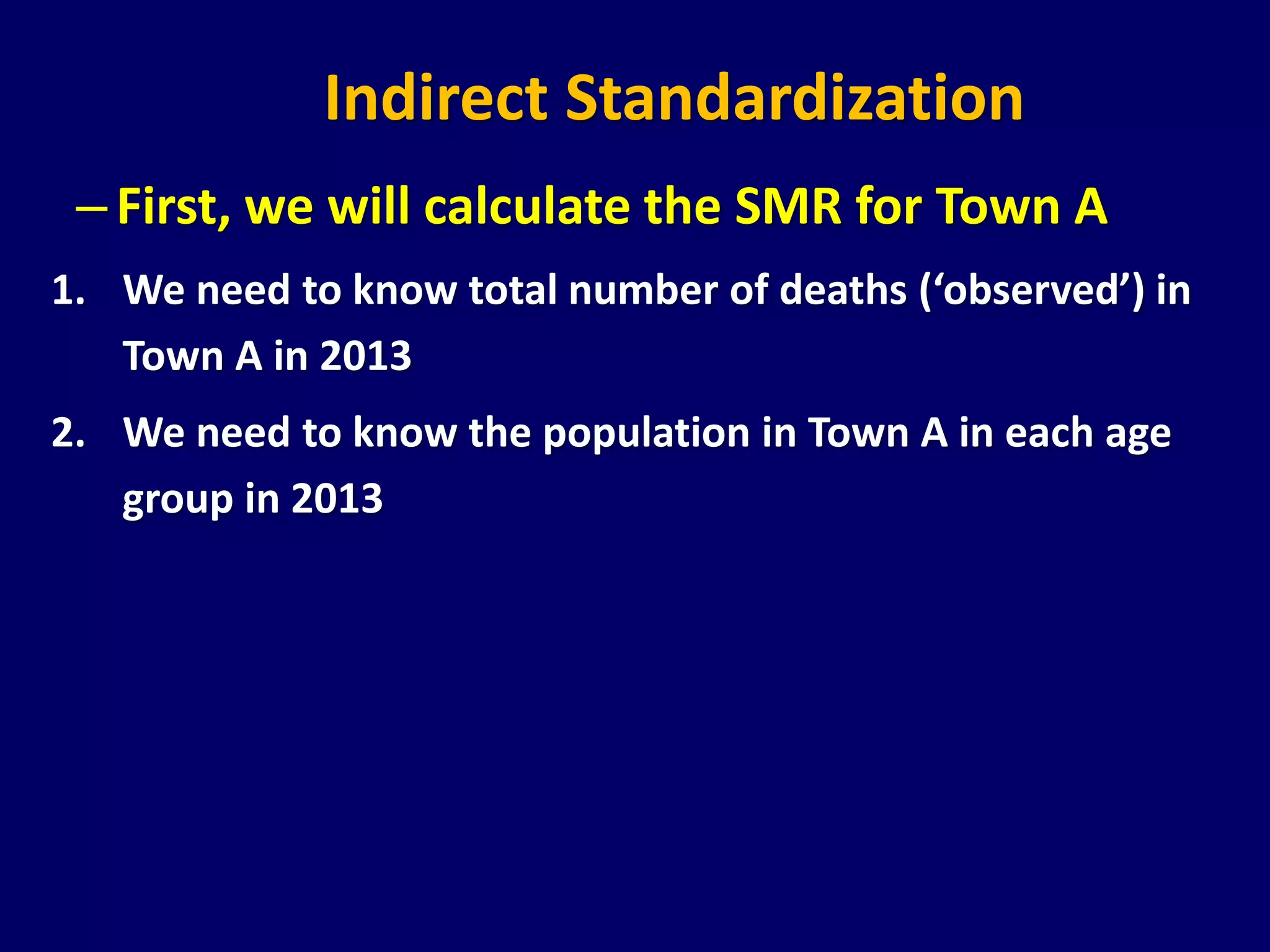
–First, we will calculate the SMR for Town A 
1.We need to know total number of deaths (‘observed’) in Town A in 2013 
2.We need to know the population in Town A in each age group in 2013
Indirect Standardization 
Age group 
Deaths ‘observed’: Town A 
Population: 
Town A 
Country death rate per 1000/year 
(standard population) 
Deaths ‘expected’: Town A 
0-4 
12400 
5-14 
26900 
15-24 
42000 
25-34 
32900 
35-44 
31700 
45-54 
27200 
55-64 
21600 
65-74 
18400 
75-84 
11300 
85+ 
3200 
Total 
2520 
227600
Indirect Standardization 
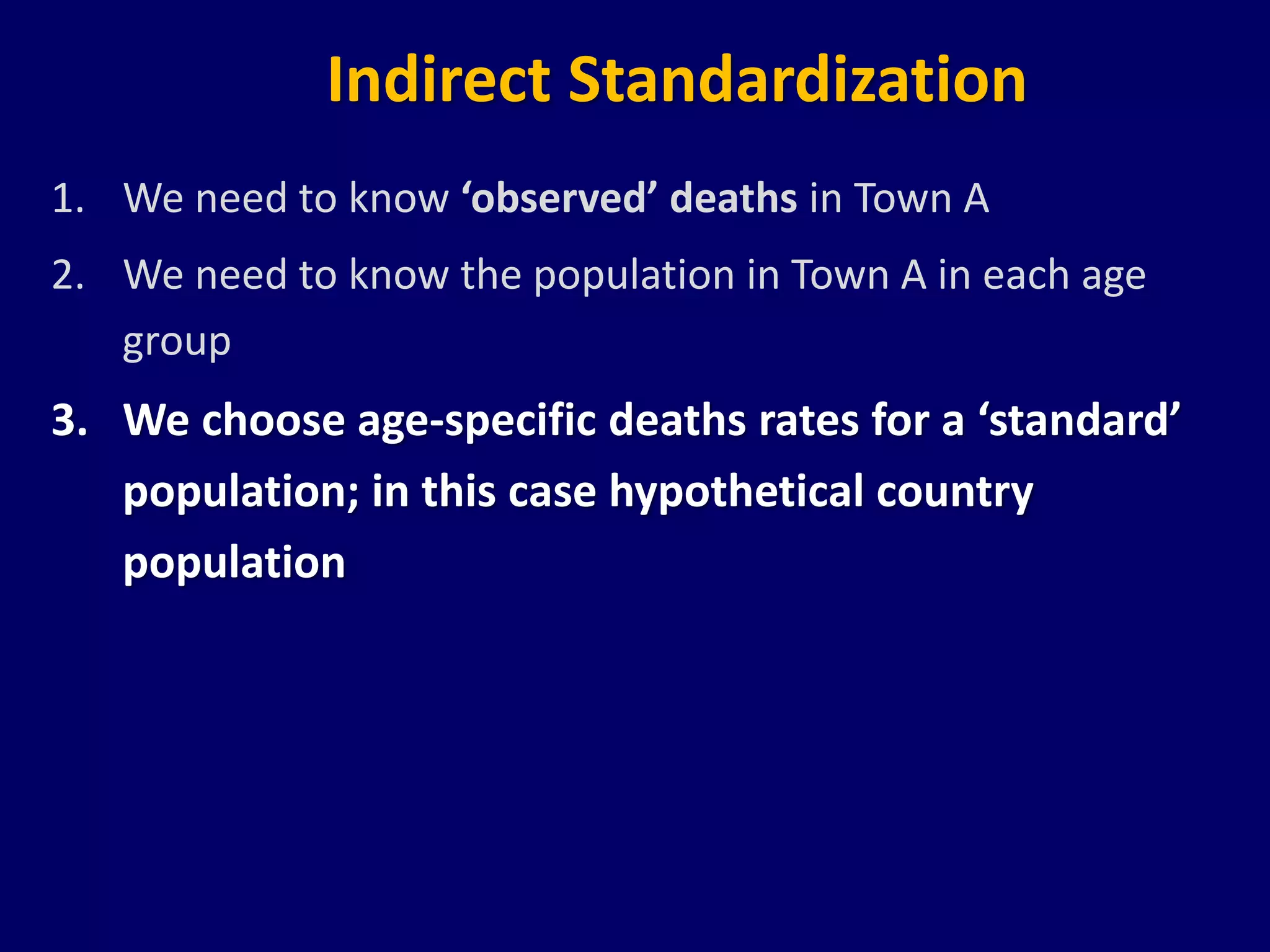
1.We need to know ‘observed’ deaths in Town A 
2.We need to know the population in Town A in each age group 
3.We choose age-specific deaths rates for a ‘standard’ population; in this case hypothetical country population
Indirect Standardization 
Age group 
Deaths ‘observed’: Town A 
Population: 
Town A 
Country death rate per 1000/year (standard population) 
Deaths ‘expected’: Town A 
0-4 
12400 
1.50 
5-14 
26900 
0.03 
15-24 
42000 
0.32 
25-34 
32900 
0.64 
35-44 
31700 
2.34 
45-54 
27200 
4.02 
55-64 
21600 
6.69 
65-74 
18400 
14.32 
75-84 
11300 
78.30 
85+ 
3200 
180.20 
Total 
2520 
227600
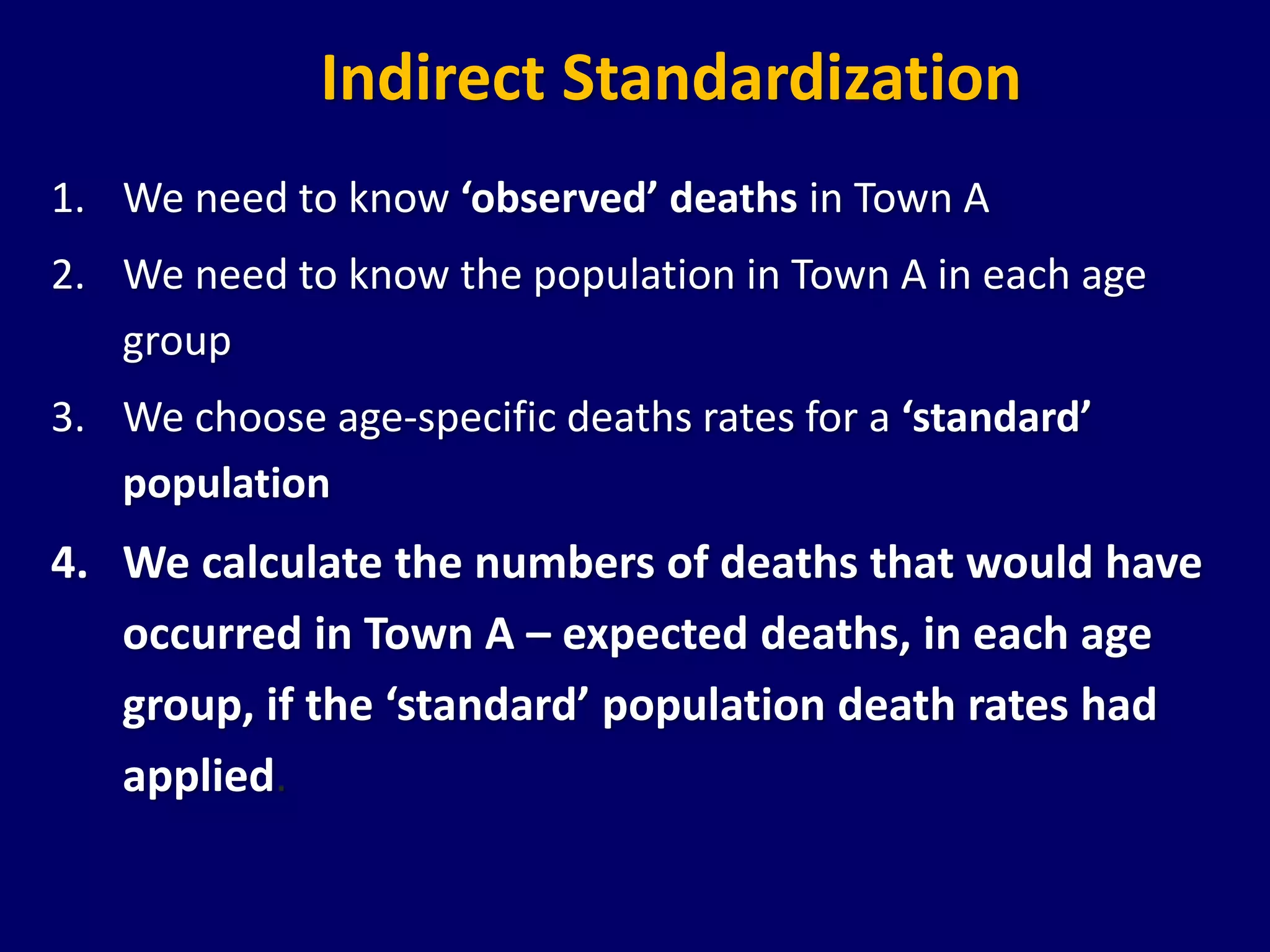
Indirect Standardization 
1.We need to know ‘observed’ deaths in Town A 
2.We need to know the population in Town A in each age group 
3.We choose age-specific deaths rates for a ‘standard’ population 
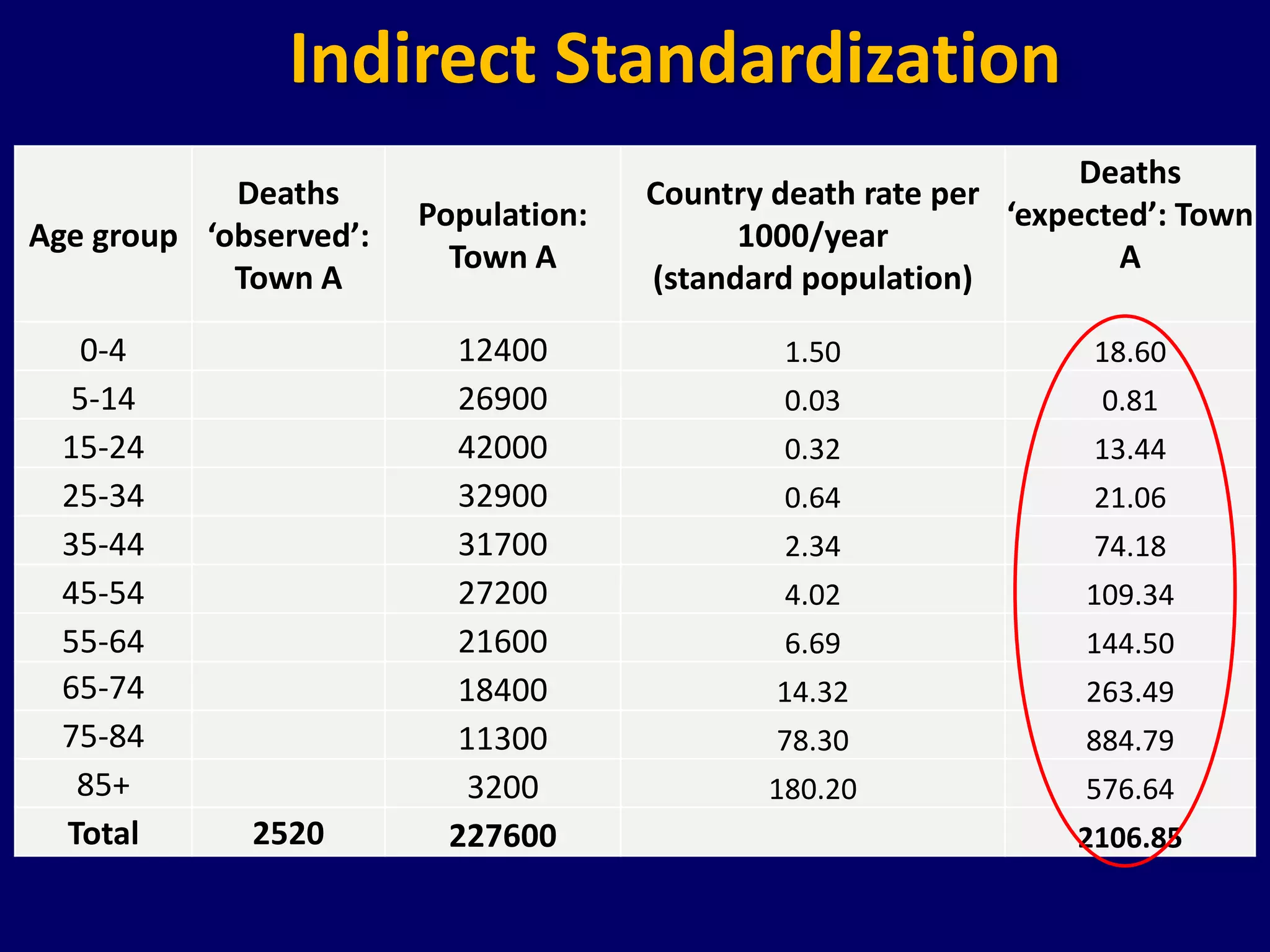
4.We calculate the numbers of deaths that would have occurred in Town A – expected deaths, in each age group, if the ‘standard’ population death rates had applied.
Indirect Standardization 
•For that, we need to multiply the country rate (column 4) by the Town A population (column 3) in the same age group 
For example, for the 0-4 age group: ퟏ.ퟓ풙ퟏퟐퟒퟎퟎ ퟏퟎퟎퟎ = 18.6 
•Finally, add up all the age-specific expected deaths to obtain total number of expected deaths
Indirect Standardization 
Age group 
Deaths ‘observed’: Town A 
Population: 
Town A 
Country death rate per 1000/year 
(standard population) 
Deaths ‘expected’: Town A 
0-4 
12400 
1.50 
18.60 
5-14 
26900 
0.03 
0.81 
15-24 
42000 
0.32 
13.44 
25-34 
32900 
0.64 
21.06 
35-44 
31700 
2.34 
74.18 
45-54 
27200 
4.02 
109.34 
55-64 
21600 
6.69 
144.50 
65-74 
18400 
14.32 
263.49 
75-84 
11300 
78.30 
884.79 
85+ 
3200 
180.20 
576.64 
Total 
2520 
227600 
2106.85
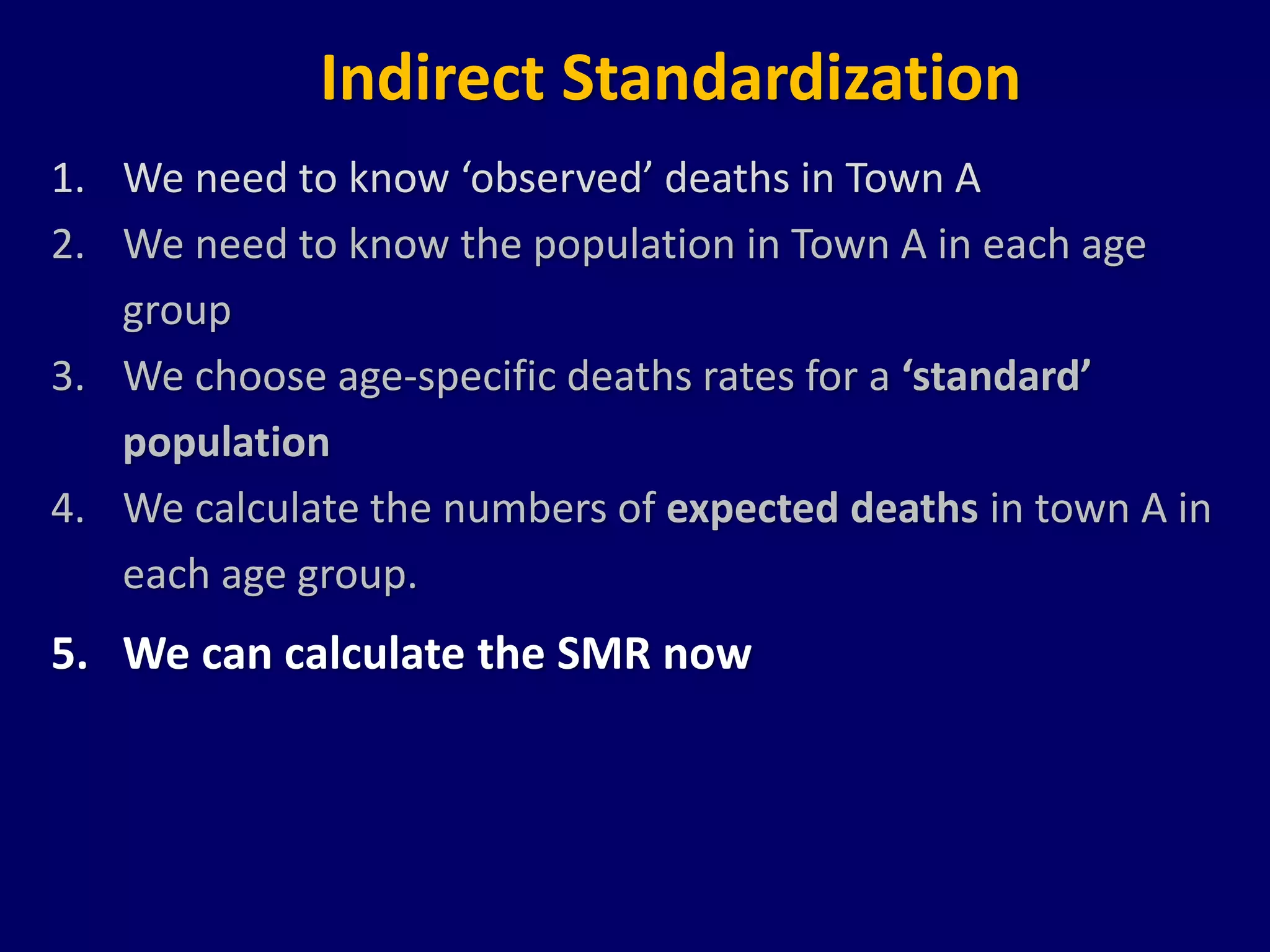
Indirect Standardization 
1.We need to know ‘observed’ deaths in Town A 
2.We need to know the population in Town A in each age group 
3.We choose age-specific deaths rates for a ‘standard’ population 
4.We calculate the numbers of expected deaths in town A in each age group. 
5.We can calculate the SMR now
Indirect Standardization 
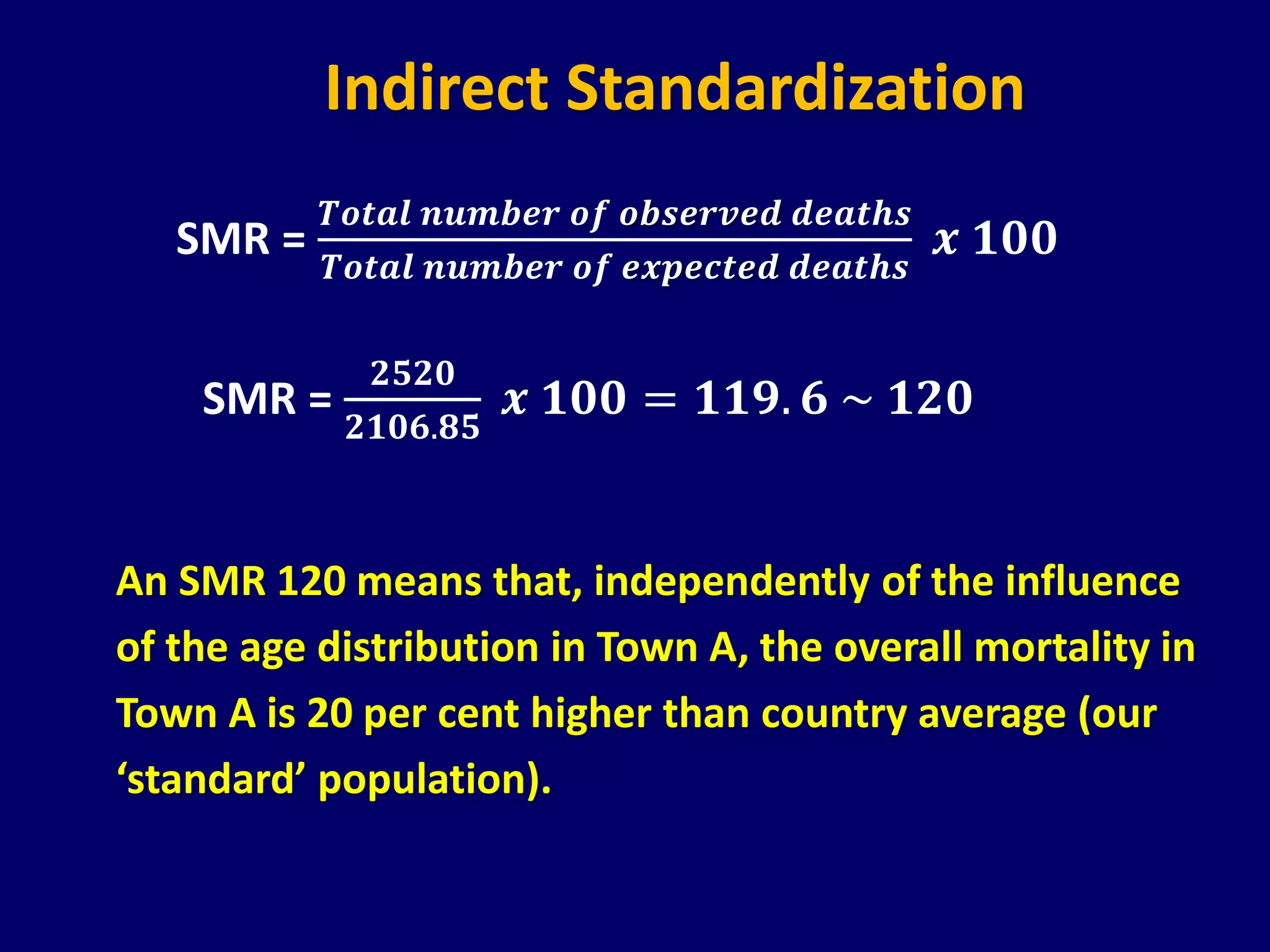
An SMR 120 means that, independently of the influence of the age distribution in Town A, the overall mortality in Town A is 20 per cent higher than country average (our ‘standard’ population). 
SMR = 푻풐풕풂풍 풏풖풎풃풆풓 풐풇 풐풃풔풆풓풗풆풅 풅풆풂풕풉풔 푻풐풕풂풍 풏풖풎풃풆풓 풐풇 풆풙풑풆풄풕풆풅 풅풆풂풕풉풔 풙 ퟏퟎퟎ 
SMR = ퟐퟓퟐퟎ ퟐퟏퟎퟔ.ퟖퟓ 풙 ퟏퟎퟎ=ퟏퟏퟗ.ퟔ ~ ퟏퟐퟎ
Indirect Standardization 
–Interpretation of SMR 
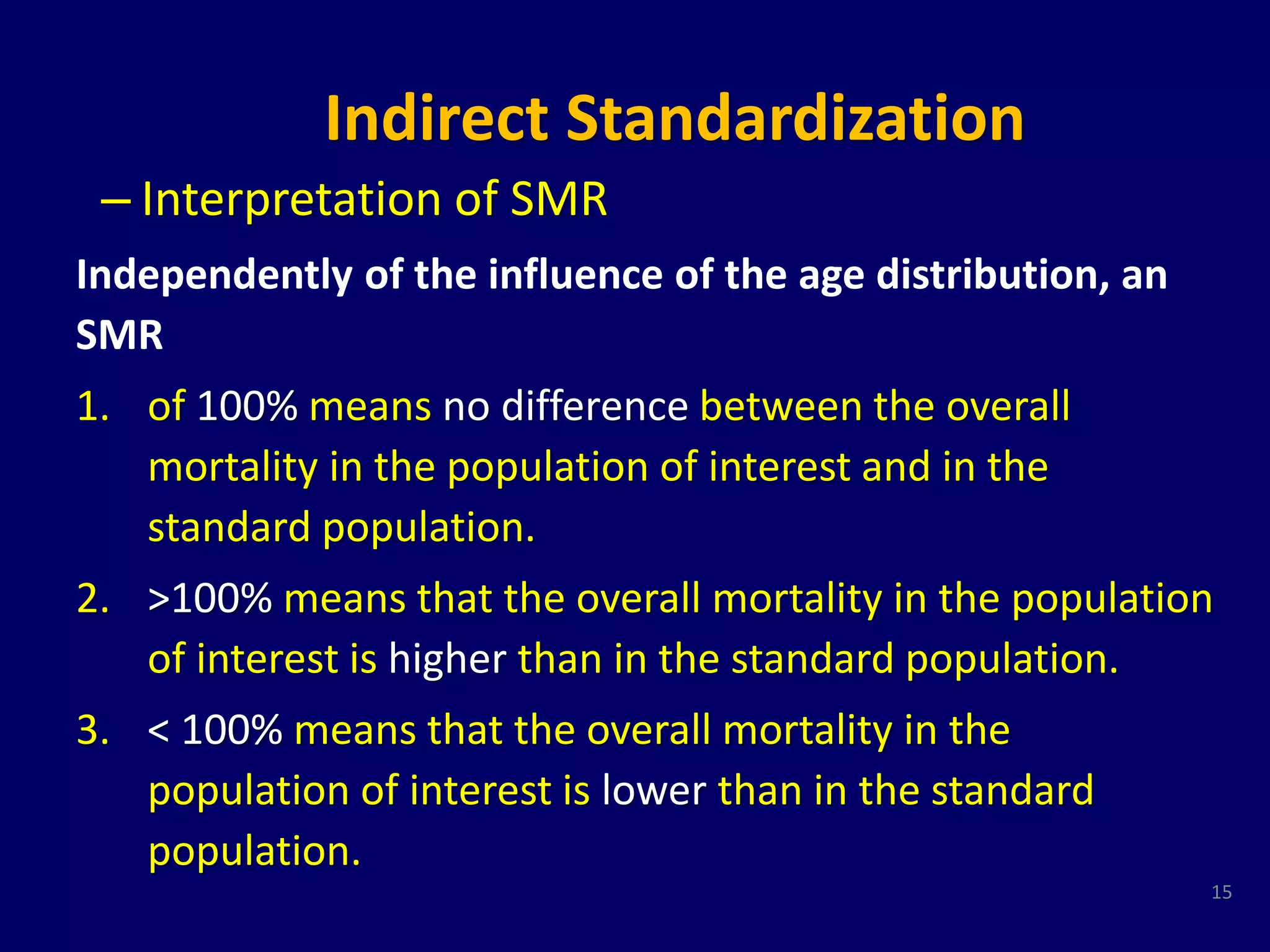
Independently of the influence of the age distribution, an SMR 
1.of 100% means no difference between the overall mortality in the population of interest and in the standard population. 
2.>100% means that the overall mortality in the population of interest is higher than in the standard population. 
3.< 100% means that the overall mortality in the population of interest is lower than in the standard population. 
15
Indirect Standardization 
•To calculate SMR we need to know: 
•Age-specific index population data 
•Total number of deaths in the index population 
•Age-specific deaths rates of the standard population 
•SMR can be calculated if the numbers of deaths in each age group are not available 
16
Indirect Standardization Now, we will calculate the SMR for Town B 
Age group 
Deaths ‘observed’: Town B 
Population: 
Town B 
Country death rate per 1000/year (standard population) 
Deaths ‘expected’: Town B 
0-4 
5200 
1.50 
7.80 
5-14 
15100 
0.03 
0.45 
15-24 
11300 
0.32 
3.62 
25-34 
11100 
0.64 
7.10 
35-44 
16600 
2.34 
38.84 
45-54 
15400 
4.02 
61.91 
55-64 
14900 
6.69 
99.68 
65-74 
12700 
14.32 
181.86 
75-84 
8800 
78.30 
689.04 
85+ 
3100 
180.20 
558.62 
Total 
1626 
114200 
1648.93
Indirect Standardization 
–We will calculate the SMR for Town B 
An SMR 99 means that, independently of the influence of the age distribution in Town B, the overall mortality in Town B does not differ significantly (very close to 100) from that for the ‘standard’ population. 
SMR = 푻풐풕풂풍 풏풖풎풃풆풓 풐풇 풐풃풔풆풓풗풆풅 풅풆풂풕풉풔 푻풐풕풂풍 풏풖풎풃풆풓 풐풇 풆풙풑풆풄풕풆풅 풅풆풂풕풉풔 풙 ퟏퟎퟎ 
SMR = ퟏퟔퟐퟔ ퟏퟔퟒퟖ.ퟗퟑ 풙 ퟏퟎퟎ=ퟗퟖ.ퟔ ~ ퟗퟗ
Indirect Standardization 
–Comparison of SMRs 
We cannot compare SMRs between two populations, e.g. Town A and Town B - only to the standard population – because the age-specific rate have been applied to two different populations 
What we can state, is that mortality in Town A is 20 per cent higher than the country average. For Town B, mortality does not differ significantly from the country level (very close to 100). 
19
Direct Standardization 
–Direct standardization allows direct comparison between two populations 
20
Direct Standardization 
–We will use population of Town A as the standard and standardize population of Town B against it 
–We will first look at crude death rate for people aged 65 and over 
Town A (standard) 
No. of 
population 
Deaths observed 
Age specific rate/1000 
per year 
65-74 
18400 
75-84 
11300 
85+ 
320 
30020 
297 
9.89 
Town B 
No. of 
population 
Deaths observed 
Age specific rate/1000 
per year 
65-74 
12700 
45 
75-84 
880 
93 
85+ 
310 
220 
13890 
358 
25.77
Direct Standardization 
–Now, we will calculate age-specific rates for Town B 
Town A (standard) 
No. of 
population 
Deaths observed 
Age specific rate/1000 
per year 
65-74 
18400 
75-84 
11300 
85+ 
320 
30020 
297 
9.89 
Town B 
No. of 
population 
Deaths observed 
Age specific rate/1000 
per year 
65-74 
12700 
45 
3.54 
75-84 
880 
93 
105.68 
85+ 
310 
220 
709.68 
13890 
358 
25.77
Direct Standardization 
–Standardize the Town B rate to the Town A: 
1.Apply age-specific rates of Town B to the age-specific groups of Town A to calculate the expected numbers in each group 
23 
Age-specific rate for Town B 
Town A (standard) population 
Expected deaths for Town B 
65-74 
3.54 
18400 
65.20 
75-84 
105.68 
11300 
1194.20 
85+ 
709.68 
320 
227.10 
30020
Direct Standardization 
–Standardize the Town B rate to the Town A: 
2.Add up the expected deaths to obtain the total 
3.Divide the total expected cases by the total Town A (standard ) population to obtain the age-standardized death rate (x 1,000) 
24 
Age-adjusted rate for Town B 
Town A (standard) population 
Expected deaths for Town B 
65-74 
3.54 
18400 
65.20 
75-84 
105.68 
11300 
1194.20 
85+ 
709.68 
320 
227.10 
49.52 
30020 
1486.50
Direct Standardization 
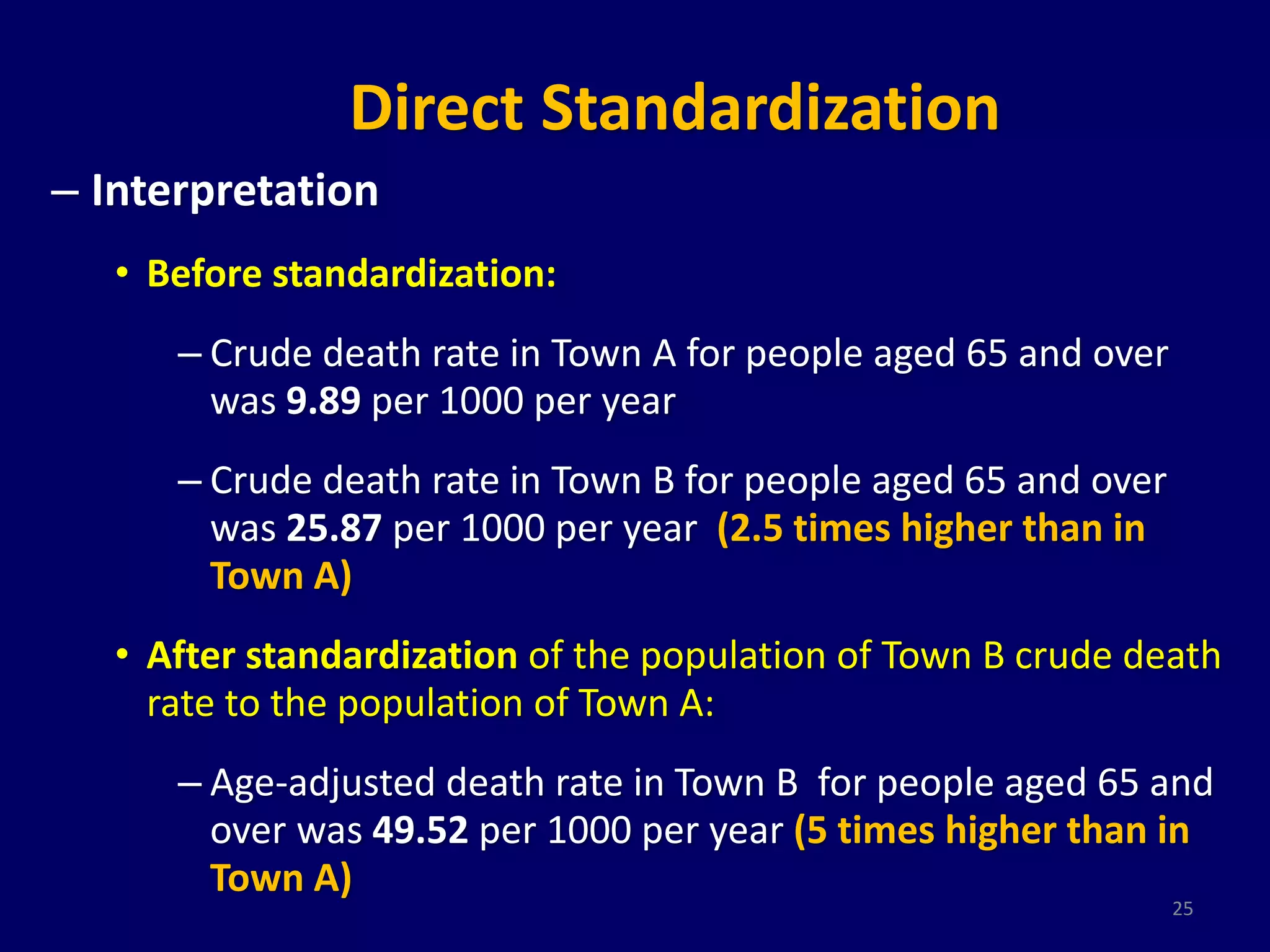
–Interpretation 
•Before standardization: 
–Crude death rate in Town A for people aged 65 and over was 9.89 per 1000 per year 
–Crude death rate in Town B for people aged 65 and over was 25.87 per 1000 per year (2.5 times higher than in Town A) 
•After standardization of the population of Town B crude death rate to the population of Town A: 
–Age-adjusted death rate in Town B for people aged 65 and over was 49.52 per 1000 per year (5 times higher than in Town A) 
25
Direct Standardization 
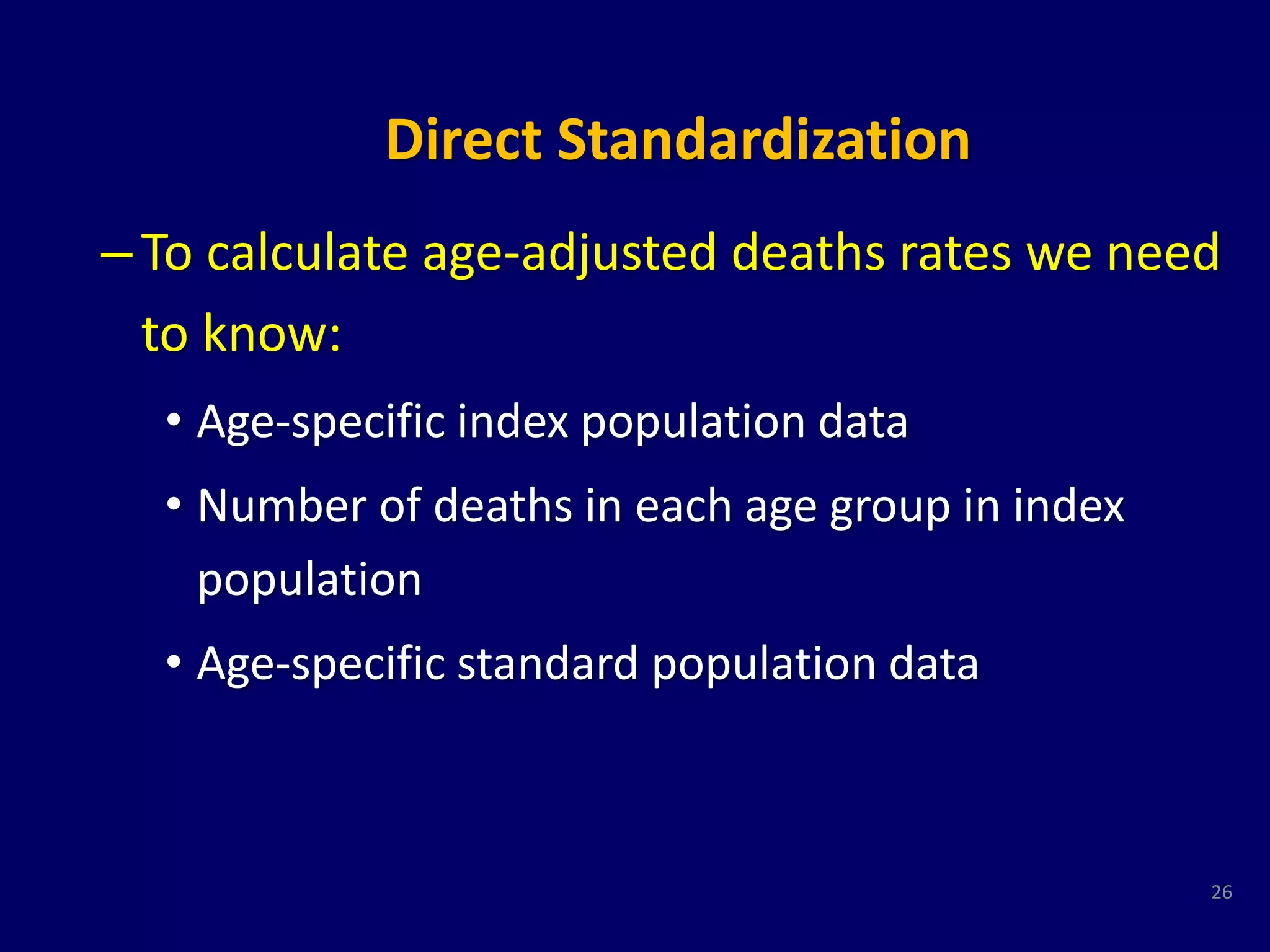
–To calculate age-adjusted deaths rates we need to know: 
•Age-specific index population data 
•Number of deaths in each age group in index population 
•Age-specific standard population data 
26
SUMMARY 
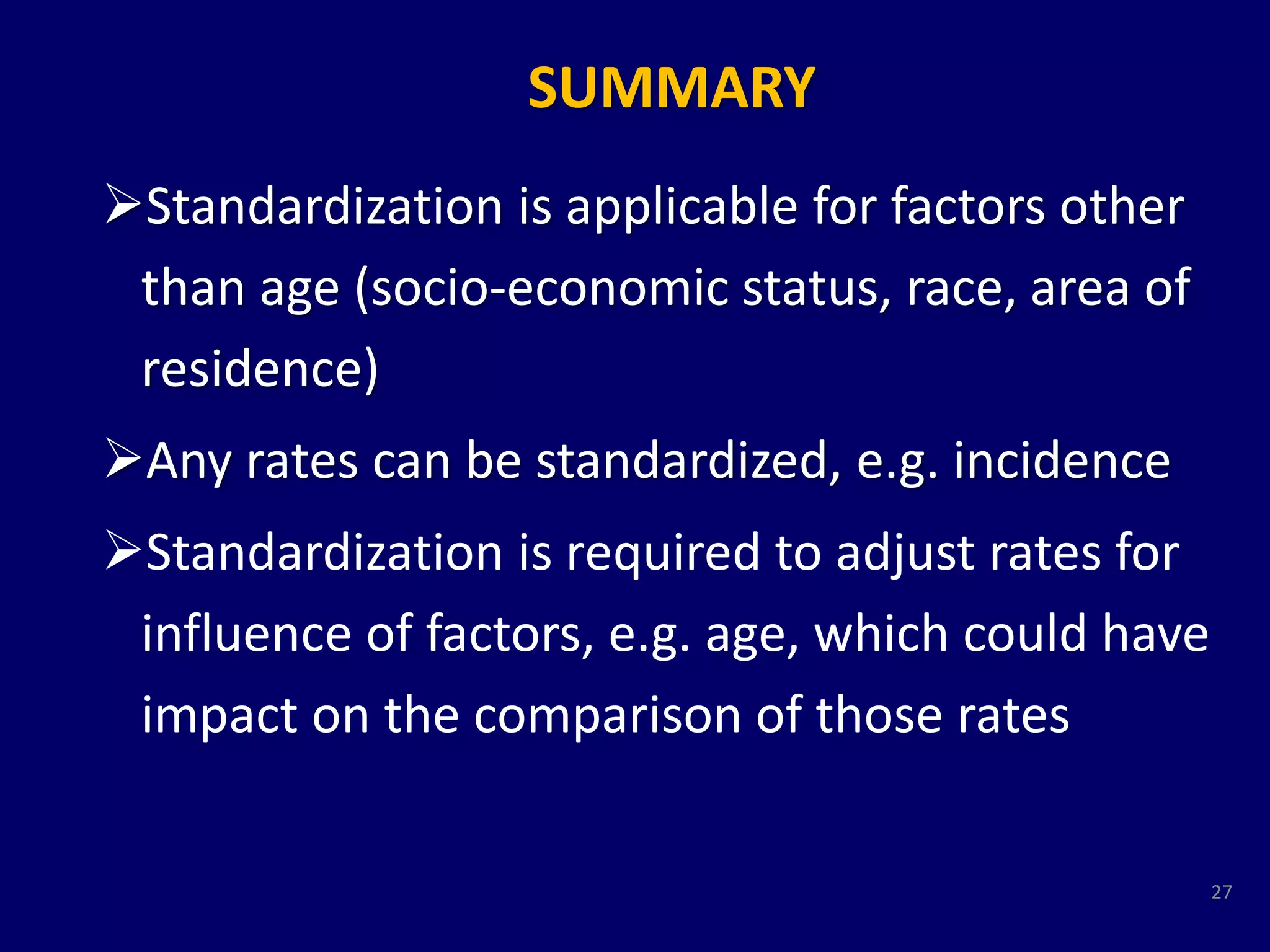
Standardization is applicable for factors other than age (socio-economic status, race, area of residence) 
Any rates can be standardized, e.g. incidence 
Standardization is required to adjust rates for influence of factors, e.g. age, which could have impact on the comparison of those rates 
27
SUMMARY 
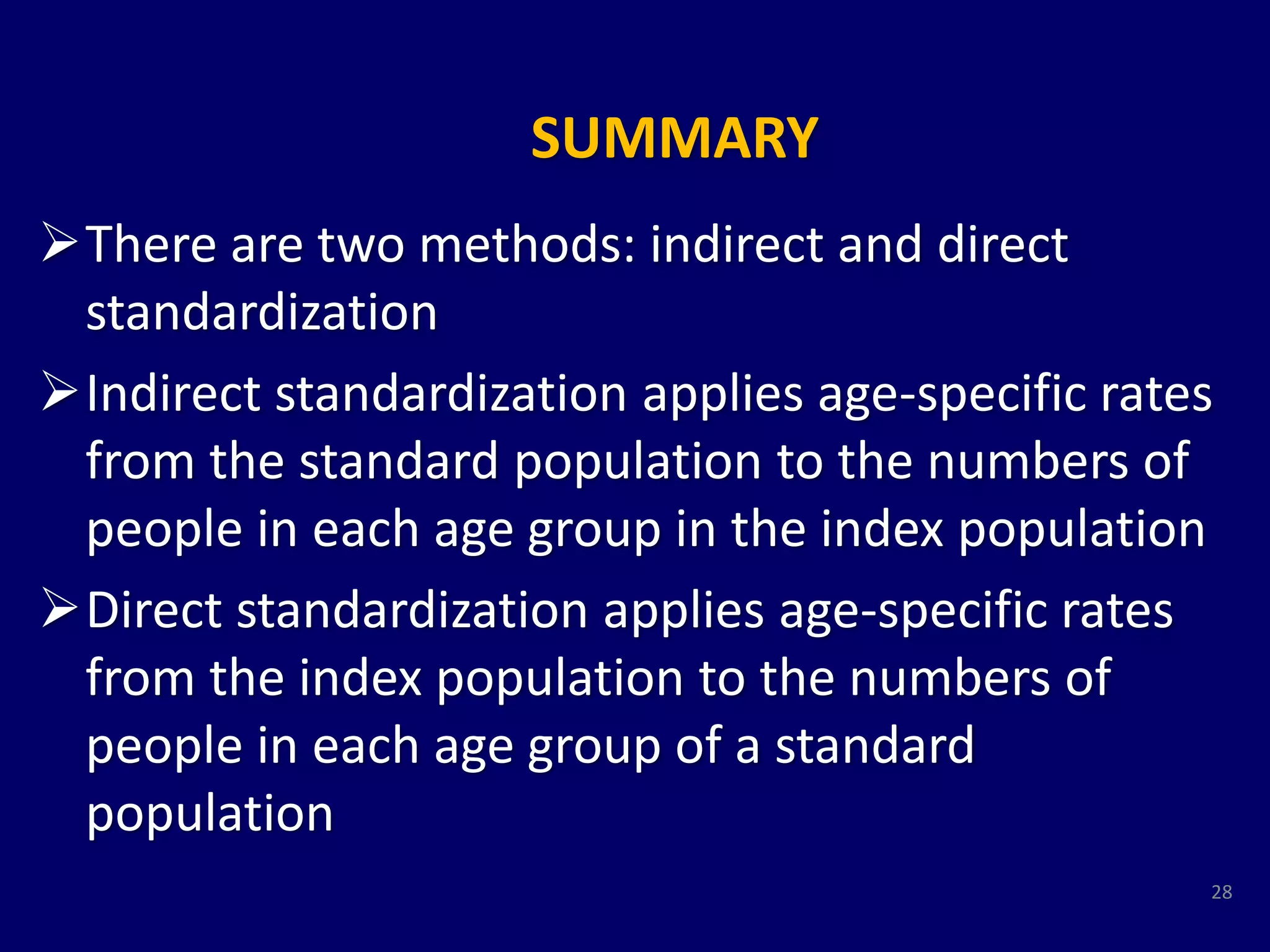
There are two methods: indirect and direct standardization 
Indirect standardization applies age-specific rates from the standard population to the numbers of people in each age group in the index population 
Direct standardization applies age-specific rates from the index population to the numbers of people in each age group of a standard population 
28
SUMMARY 
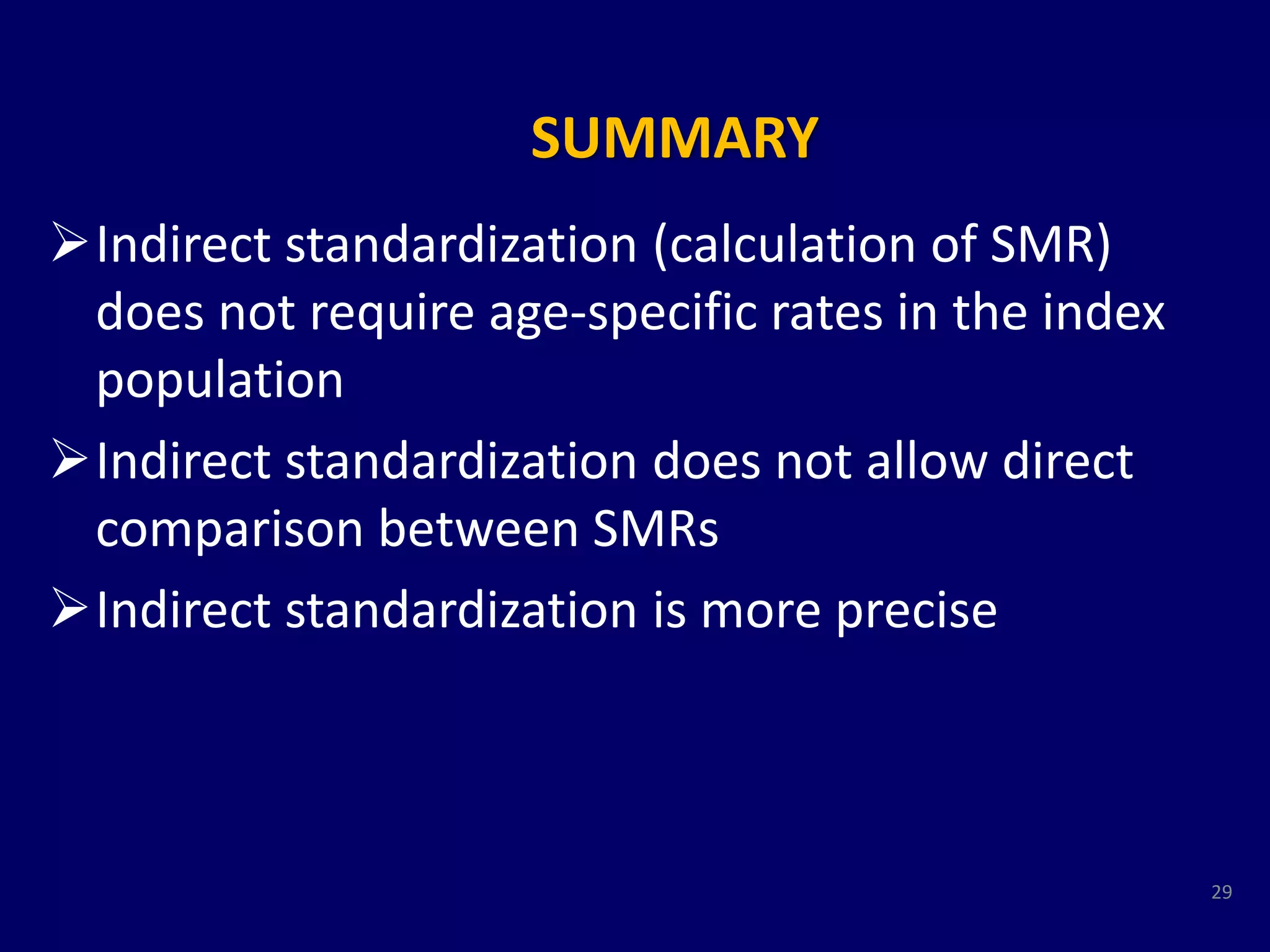
Indirect standardization (calculation of SMR) does not require age-specific rates in the index population 
Indirect standardization does not allow direct comparison between SMRs 
Indirect standardization is more precise 
29

Standardization of rates

  • 1.
    STANDARDIZATION OF RATES Halyna Lugova, MD, PhD October 8, 2014
  • 2.
    Standardization of Rates: Town B: affluent rural community, popular retirement area The all-cause crude death rate – 14.2 per 1,000/year in 2013 2 Town A: high unemployment rates, poverty The all-cause crude death rate – 11.1 per 1,000/year in 2013 This suggests that mortality is higher in Town B although this is not what we would expect given socioeconomic characteristics of the two towns
  • 3.
    Standardization of Rates:Age distribution for two populations 3 0 5 10 15 20 25 30 35 40 45 0-4 5-14 15-24 25-34 35-44 45-54 55-64 65-74 75-84 85 and over Town A Town B X 1,000 population age
  • 4.
    Standardization of Rates 4 Town A has a younger population, therefore it has a lower death rate. How to compare the two towns, independently of the effects of this difference in age distribution? We need to have a summary measure of mortality for all age groups to avoid many tables of rates for each age group. Such summary measure that takes account of the differences in age distribution of the two areas could be derived by a technique called standardization.
  • 5.
    Standardization of Rates 1.The indirect method provides standardized mortality ratio (SMR) and indirectly standardized rates 2.The direct method provides directly standardized rates 3.For indirect method we need to select standard population, e.g. country population, or one of the ‘standard populations’ (not real) created to represent population structure: World standard population, European standard population, etc. 5
  • 6.
    Indirect Standardization –First,we will calculate the SMR for Town A 1.We need to know total number of deaths (‘observed’) in Town A in 2013 2.We need to know the population in Town A in each age group in 2013
  • 7.
    Indirect Standardization Agegroup Deaths ‘observed’: Town A Population: Town A Country death rate per 1000/year (standard population) Deaths ‘expected’: Town A 0-4 12400 5-14 26900 15-24 42000 25-34 32900 35-44 31700 45-54 27200 55-64 21600 65-74 18400 75-84 11300 85+ 3200 Total 2520 227600
  • 8.
    Indirect Standardization 1.Weneed to know ‘observed’ deaths in Town A 2.We need to know the population in Town A in each age group 3.We choose age-specific deaths rates for a ‘standard’ population; in this case hypothetical country population
  • 9.
    Indirect Standardization Agegroup Deaths ‘observed’: Town A Population: Town A Country death rate per 1000/year (standard population) Deaths ‘expected’: Town A 0-4 12400 1.50 5-14 26900 0.03 15-24 42000 0.32 25-34 32900 0.64 35-44 31700 2.34 45-54 27200 4.02 55-64 21600 6.69 65-74 18400 14.32 75-84 11300 78.30 85+ 3200 180.20 Total 2520 227600
  • 10.
    Indirect Standardization 1.Weneed to know ‘observed’ deaths in Town A 2.We need to know the population in Town A in each age group 3.We choose age-specific deaths rates for a ‘standard’ population 4.We calculate the numbers of deaths that would have occurred in Town A – expected deaths, in each age group, if the ‘standard’ population death rates had applied.
  • 11.
    Indirect Standardization •Forthat, we need to multiply the country rate (column 4) by the Town A population (column 3) in the same age group For example, for the 0-4 age group: ퟏ.ퟓ풙ퟏퟐퟒퟎퟎ ퟏퟎퟎퟎ = 18.6 •Finally, add up all the age-specific expected deaths to obtain total number of expected deaths
  • 12.
    Indirect Standardization Agegroup Deaths ‘observed’: Town A Population: Town A Country death rate per 1000/year (standard population) Deaths ‘expected’: Town A 0-4 12400 1.50 18.60 5-14 26900 0.03 0.81 15-24 42000 0.32 13.44 25-34 32900 0.64 21.06 35-44 31700 2.34 74.18 45-54 27200 4.02 109.34 55-64 21600 6.69 144.50 65-74 18400 14.32 263.49 75-84 11300 78.30 884.79 85+ 3200 180.20 576.64 Total 2520 227600 2106.85
  • 13.
    Indirect Standardization 1.Weneed to know ‘observed’ deaths in Town A 2.We need to know the population in Town A in each age group 3.We choose age-specific deaths rates for a ‘standard’ population 4.We calculate the numbers of expected deaths in town A in each age group. 5.We can calculate the SMR now
  • 14.
    Indirect Standardization AnSMR 120 means that, independently of the influence of the age distribution in Town A, the overall mortality in Town A is 20 per cent higher than country average (our ‘standard’ population). SMR = 푻풐풕풂풍 풏풖풎풃풆풓 풐풇 풐풃풔풆풓풗풆풅 풅풆풂풕풉풔 푻풐풕풂풍 풏풖풎풃풆풓 풐풇 풆풙풑풆풄풕풆풅 풅풆풂풕풉풔 풙 ퟏퟎퟎ SMR = ퟐퟓퟐퟎ ퟐퟏퟎퟔ.ퟖퟓ 풙 ퟏퟎퟎ=ퟏퟏퟗ.ퟔ ~ ퟏퟐퟎ
  • 15.
    Indirect Standardization –Interpretationof SMR Independently of the influence of the age distribution, an SMR 1.of 100% means no difference between the overall mortality in the population of interest and in the standard population. 2.>100% means that the overall mortality in the population of interest is higher than in the standard population. 3.< 100% means that the overall mortality in the population of interest is lower than in the standard population. 15
  • 16.
    Indirect Standardization •Tocalculate SMR we need to know: •Age-specific index population data •Total number of deaths in the index population •Age-specific deaths rates of the standard population •SMR can be calculated if the numbers of deaths in each age group are not available 16
  • 17.
    Indirect Standardization Now,we will calculate the SMR for Town B Age group Deaths ‘observed’: Town B Population: Town B Country death rate per 1000/year (standard population) Deaths ‘expected’: Town B 0-4 5200 1.50 7.80 5-14 15100 0.03 0.45 15-24 11300 0.32 3.62 25-34 11100 0.64 7.10 35-44 16600 2.34 38.84 45-54 15400 4.02 61.91 55-64 14900 6.69 99.68 65-74 12700 14.32 181.86 75-84 8800 78.30 689.04 85+ 3100 180.20 558.62 Total 1626 114200 1648.93
  • 18.
    Indirect Standardization –Wewill calculate the SMR for Town B An SMR 99 means that, independently of the influence of the age distribution in Town B, the overall mortality in Town B does not differ significantly (very close to 100) from that for the ‘standard’ population. SMR = 푻풐풕풂풍 풏풖풎풃풆풓 풐풇 풐풃풔풆풓풗풆풅 풅풆풂풕풉풔 푻풐풕풂풍 풏풖풎풃풆풓 풐풇 풆풙풑풆풄풕풆풅 풅풆풂풕풉풔 풙 ퟏퟎퟎ SMR = ퟏퟔퟐퟔ ퟏퟔퟒퟖ.ퟗퟑ 풙 ퟏퟎퟎ=ퟗퟖ.ퟔ ~ ퟗퟗ
  • 19.
    Indirect Standardization –Comparisonof SMRs We cannot compare SMRs between two populations, e.g. Town A and Town B - only to the standard population – because the age-specific rate have been applied to two different populations What we can state, is that mortality in Town A is 20 per cent higher than the country average. For Town B, mortality does not differ significantly from the country level (very close to 100). 19
  • 20.
    Direct Standardization –Directstandardization allows direct comparison between two populations 20
  • 21.
    Direct Standardization –Wewill use population of Town A as the standard and standardize population of Town B against it –We will first look at crude death rate for people aged 65 and over Town A (standard) No. of population Deaths observed Age specific rate/1000 per year 65-74 18400 75-84 11300 85+ 320 30020 297 9.89 Town B No. of population Deaths observed Age specific rate/1000 per year 65-74 12700 45 75-84 880 93 85+ 310 220 13890 358 25.77
  • 22.
    Direct Standardization –Now,we will calculate age-specific rates for Town B Town A (standard) No. of population Deaths observed Age specific rate/1000 per year 65-74 18400 75-84 11300 85+ 320 30020 297 9.89 Town B No. of population Deaths observed Age specific rate/1000 per year 65-74 12700 45 3.54 75-84 880 93 105.68 85+ 310 220 709.68 13890 358 25.77
  • 23.
    Direct Standardization –Standardizethe Town B rate to the Town A: 1.Apply age-specific rates of Town B to the age-specific groups of Town A to calculate the expected numbers in each group 23 Age-specific rate for Town B Town A (standard) population Expected deaths for Town B 65-74 3.54 18400 65.20 75-84 105.68 11300 1194.20 85+ 709.68 320 227.10 30020
  • 24.
    Direct Standardization –Standardizethe Town B rate to the Town A: 2.Add up the expected deaths to obtain the total 3.Divide the total expected cases by the total Town A (standard ) population to obtain the age-standardized death rate (x 1,000) 24 Age-adjusted rate for Town B Town A (standard) population Expected deaths for Town B 65-74 3.54 18400 65.20 75-84 105.68 11300 1194.20 85+ 709.68 320 227.10 49.52 30020 1486.50
  • 25.
    Direct Standardization –Interpretation •Before standardization: –Crude death rate in Town A for people aged 65 and over was 9.89 per 1000 per year –Crude death rate in Town B for people aged 65 and over was 25.87 per 1000 per year (2.5 times higher than in Town A) •After standardization of the population of Town B crude death rate to the population of Town A: –Age-adjusted death rate in Town B for people aged 65 and over was 49.52 per 1000 per year (5 times higher than in Town A) 25
  • 26.
    Direct Standardization –Tocalculate age-adjusted deaths rates we need to know: •Age-specific index population data •Number of deaths in each age group in index population •Age-specific standard population data 26
  • 27.
    SUMMARY Standardization isapplicable for factors other than age (socio-economic status, race, area of residence) Any rates can be standardized, e.g. incidence Standardization is required to adjust rates for influence of factors, e.g. age, which could have impact on the comparison of those rates 27
  • 28.
    SUMMARY There aretwo methods: indirect and direct standardization Indirect standardization applies age-specific rates from the standard population to the numbers of people in each age group in the index population Direct standardization applies age-specific rates from the index population to the numbers of people in each age group of a standard population 28
  • 29.
    SUMMARY Indirect standardization(calculation of SMR) does not require age-specific rates in the index population Indirect standardization does not allow direct comparison between SMRs Indirect standardization is more precise 29