EPIDEMIOLOGY-3
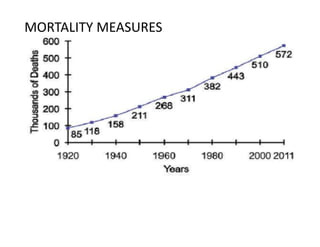
MORTALITY MEASURES
MORTALITY RATES
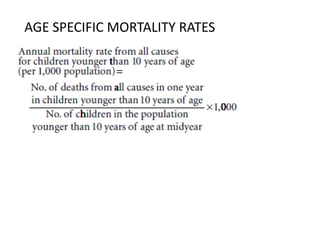
AGE SPECIFIC MORTALITY RATES
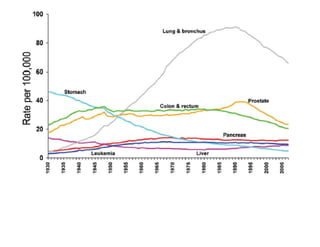
CAUSE SPECIFIC MORTALITY RATES
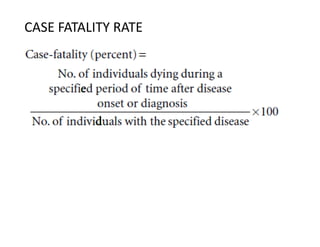
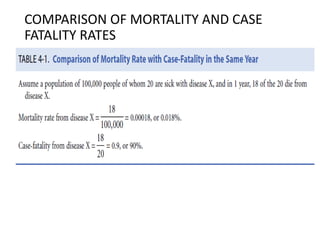
CASE FATALITY RATE
COMPARISON OF MORTALITY AND CASE
FATALITY RATES
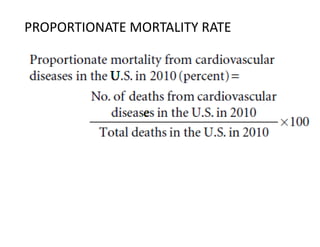
PROPORTIONATE MORTALITY RATE
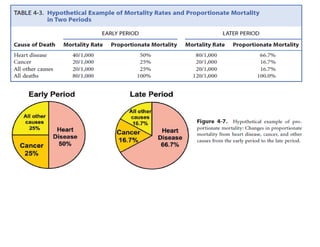
COMPARISON OF MORTALITY RATE VS
PROPORTIONATE MORTALITY
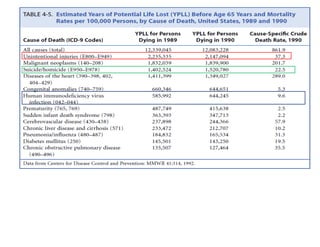
YPLL-YEARS OF POTENTIAL LIFE LOST
• measure of premature mortality or early death
• Death occurring in same person at a younger age –
greater loss of future productive years than death occurring at an
older age
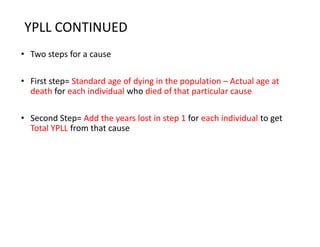
YPLL CONTINUED
• Two steps for a cause
• First step= Standard age of dying in the population – Actual age at
death for each individual who died of that particular cause
• Second Step= Add the years lost in step 1 for each individual to get
Total YPLL from that cause
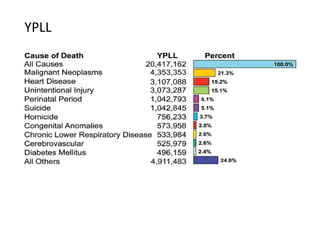
YPLL
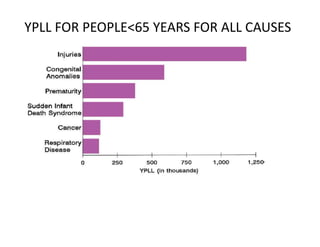
YPLL FOR PEOPLE<65 YEARS FOR ALL CAUSES
WHY USE MORTALITY DATA
• Index of severity of disease
• Easier to obtain than incidence data
• However, if disease is mild/not fatal, mortality data is of no use.
• It is good when: CFR is high, Duration/Survival of disease is short
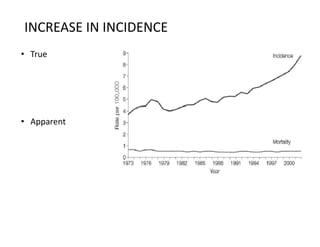
INCREASE IN INCIDENCE
• True
• Apparent
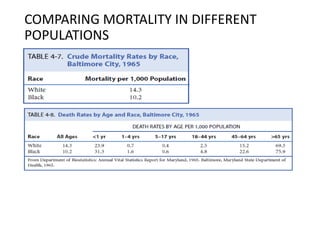
COMPARING MORTALITY IN DIFFERENT
POPULATIONS
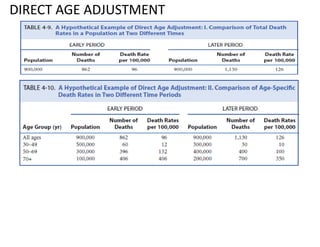
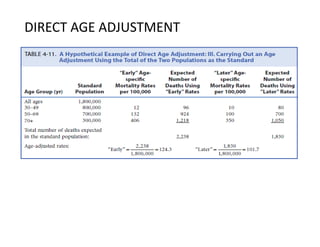
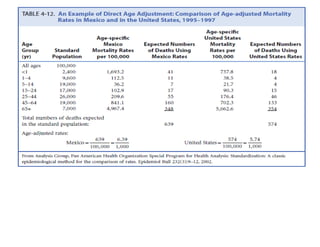
DIRECT AGE ADJUSTMENT
• Hypothetical Standard Population is created and used in order to
eliminate the effect of differences in age structure between two or
more populations
• Both death rates are applied to the standard population in each age
group
REAL LIFE EXAMPLE
• When mortality in the United States and in Mexico was compared for
1995 to 1997, the crude mortality rate for all ages in the United
States was 8.7 per 1,000 population and in Mexico only 4.7 per 1,000
population.
• But for each age group, the age-specific mortality rate was higher in
Mexico than in the United States (aside from the over 65 group in
which the rates were similar).
REAL LIFE EXAMPLE
• Could the considerably higher crude mortality rate in the United
States be due to the fact that there was a difference in the age
distributions of the two populations, in that the U.S. population had
a greater proportion of older individuals than did the population in
Mexico?
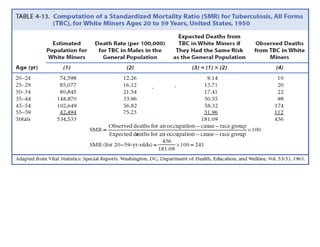
INDIRECT AGE ADJUSTMENT
• To study Mortality when age specific death rates are not available
• Also used for mortality in occupationally exposed population
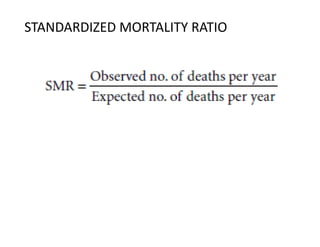
STANDARDIZED MORTALITY RATIO
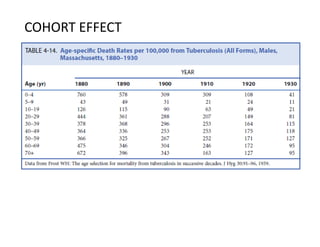
COHORT EFFECT
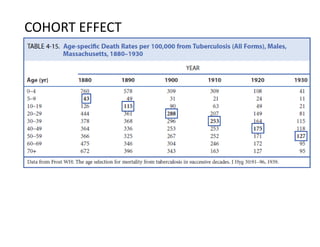
COHORT EFFECT
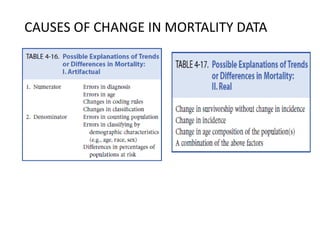
CAUSES OF CHANGE IN MORTALITY DATA

EPIDEMIOLOGY-3 community medicine.pptx.PDF