AESTHETICS
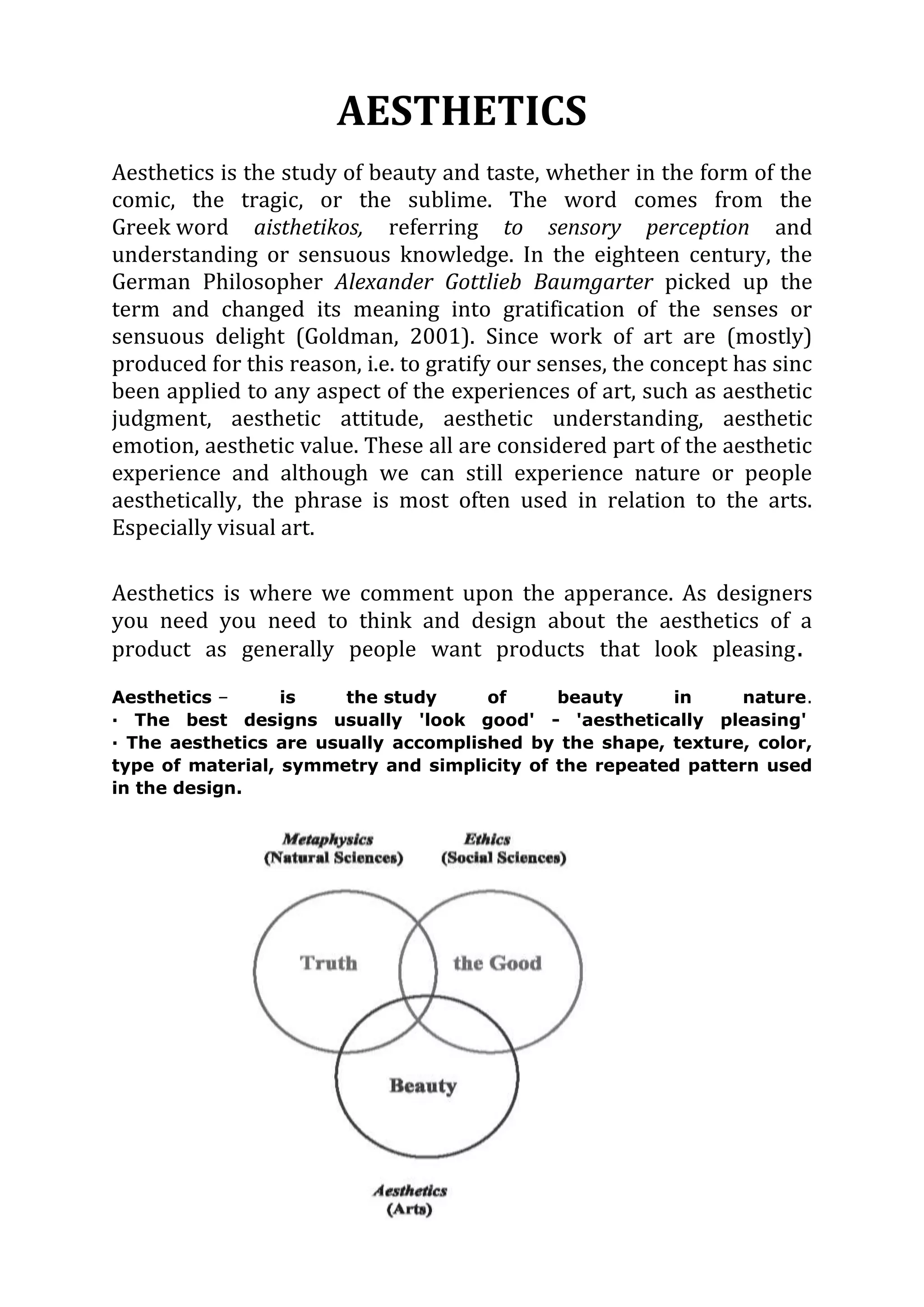
Aesthetics is the study of beauty and taste, whether in the form of the
comic, the tragic, or the sublime. The word comes from the
Greek word aisthetikos, referring to sensory perception and
understanding or sensuous knowledge. In the eighteen century, the
German Philosopher Alexander Gottlieb Baumgarter picked up the
term and changed its meaning into gratification of the senses or
sensuous delight (Goldman, 2001). Since work of art are (mostly)
produced for this reason, i.e. to gratify our senses, the concept has sinc
been applied to any aspect of the experiences of art, such as aesthetic
judgment, aesthetic attitude, aesthetic understanding, aesthetic
emotion, aesthetic value. These all are considered part of the aesthetic
experience and although we can still experience nature or people
aesthetically, the phrase is most often used in relation to the arts.
Especially visual art.

Aesthetics is where we comment upon the apperance. As designers
you need you need to think and design about the aesthetics of a
product as generally people want products that look pleasing.

Aesthetics –      is    the study     of     beauty     in      nature.
· The best designs usually 'look good' - 'aesthetically pleasing'
· The aesthetics are usually accomplished by the shape, texture, color,
type of material, symmetry and simplicity of the repeated pattern used
in the design.
Indian aesthetics
Indian art evolved with an emphasis on inducing special spiritual
or philosophical states in the audience, or with representing them
symbolically. According to Kapila Vatsyayan, Classical Indian
architecture, Indian sculpture, Indian painting, Indian
literature (kaavya), Indian music, and Indian dance "evolved their
own rules conditioned by their respective media, but they shared
with one another not only the underlying spiritual beliefs of the
Indian religio-philosophic mind, but also the procedures by which
the relationships of the symbol and the spiritual states were
worked out in detail."


History of aesthetics

Ancient aesthetics
We have examples of pre-historic art, but they are rare, and the
context of their production and use is not very clear, so we can
little more than guess at the aesthetic doctrines that guided their
production and interpretation.

Ancient art was largely, but not entirely, based on the seven great
ancient civilizations: Egypt, Mesopotamia, Greece, Rome, Persia,
India and China. Each of these centers of early civilization
developed a unique and characteristic style in its art. Greece had
the most influence on the development of aesthetics in the West.
This period of Greek art saw a veneration of the human physical
form and the development of corresponding skills to show
musculature, poise, beauty and anatomically correct proportions.
Furthermore, in many Western and Eastern cultures alike, traits
such as body hair are rarely depicted in art that addresses
physical beauty. More in contrast with this Greek-Western
aesthetic taste is the genre of grotesque.
Aesthetics in art
    Of course art appreciation is in the eyes of the beholder, although
    there are certain elements that we can define across a group of
    paintings that can be generalized or delineated, and hence
    discussed and analyzed on their own merits.Generally, art adheres
    to the aesthetic principles of symmetry/asymmetry, focal
    point, pattern,      contrast, perspective, 3D      dimensionality,
    movement, unity/Gestalt, and proportion.


Aesthetics in music
  Music has the ability to affect our emotions, intellect, and
  our psychology; lyrics can assuage our loneliness or incite our
  passions. As such, music is a powerful art form whose aesthetic
  appeal is highly dependent upon the culture in which it is practiced.


Aesthetics in architecture
  Applying aesthetics to buildings and related architectural structures
  is complex, as factors extrinsic to visual design (such as structural
  integrity, cost, the nature of building materials, and the functional
  utility of the building) contribute heavily to the design process.


Aesthetics in the performing arts
  Performing artists appeals to our aesthetics of storytelling, grace,
  balance,    class,   timing,   strength,   shock, humor, costume,
  irony,beauty, and sensuality.


Aesthetics in literature
  Encompassing poetry, short stories, novels and non-fiction, authors
  use a variety of techniques to appeal to our aesthetic values.
  Depending on the type of writing an author may employ rhythm,
  illustrations, structure, time shifting, juxtaposition, dualism,
  imagery, fantasy, suspense, analysis, humor/cynicism, and thinking
  aloud.
Aesthetics in landscape design
  Landscape designers employ design elements such as axis, line,
  landform, horizontal and vertical planes, texture, and scale to
  create variations of landscape space and aesthetics.


Culinary aesthetics
  Although food is a basic and frequently experienced commodity,
  careful attention to the aesthetic possibilities of foodstuffs can turn
  eating into dining. Chefs inspire our gastronomy with regionalism,
  spices, diversity/contrast, anticipation, seduction, and decoration/
  garnishes.


Aesthetics in information technology
  The push to make all aspects of information technology as user-
  friendly as possible has led to a number of advances during the
  study of human-computer interaction.


Meanings:
 a philosophical theory as to what is beautiful
   "he despised the esthetic of minimalism"
 concerning or characterized by an appreciation of beauty or good
 taste
   "the illustrations made the book an aesthetic success"
   “what an aesthetic beauty konark temple is”
 relating to or dealing with the subject of aesthetics
   “From the aesthetic point of view, it was a beautiful design”

   “The beautiful sculpture was a mirror image of the carver's aethetic
   values”.

 aesthetically pleasing
   "an artistic flower arrangement"
Definition : Aesthetics is the study of beauty and taste, whether in the form of the
comic, the tragic, or the sublime. The word derives from the Greek aisthetikos,
meaning "of sense perception."


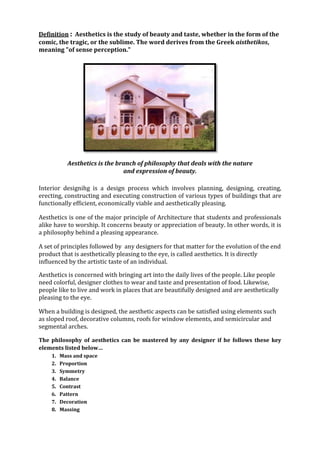
           Aesthetics is the branch of philosophy that deals with the nature
                               and expression of beauty.

Interior designihg is a design process which involves planning, designing, creating,
erecting, constructing and executing construction of various types of buildings that are
functionally efficient, economically viable and aesthetically pleasing.

Aesthetics is one of the major principle of Architecture that students and professionals
alike have to worship. It concerns beauty or appreciation of beauty. In other words, it is
a philosophy behind a pleasing appearance.

A set of principles followed by any designers for that matter for the evolution of the end
product that is aesthetically pleasing to the eye, is called aesthetics. It is directly
influenced by the artistic taste of an individual.

Aesthetics is concerned with bringing art into the daily lives of the people. Like people
need colorful, designer clothes to wear and taste and presentation of food. Likewise,
people like to live and work in places that are beautifully designed and are aesthetically
pleasing to the eye.

When a building is designed, the aesthetic aspects can be satisfied using elements such
as sloped roof, decorative columns, roofs for window elements, and semicircular and
segmental arches.

The philosophy of aesthetics can be mastered by any designer if he follows these key
elements listed below…
    1.   Mass and space
    2.   Proportion
    3.   Symmetry
    4.   Balance
    5.   Contrast
    6.   Pattern
    7.   Decoration
    8.   Massing
Aesthetic Qualities
  Aesthetic qualities may be sub-divided into a number of basic elements…
     1. Unity
     2. Proportion
     3. Scale
     4. Balance
     5. Symmetry
     6. Rhythm

  All these qualities are collectively important, and can have an important
  impact on the design. Designers bend these rules all the time. We all know
  about Organic Architecture and Deconstructivism. Beauty lies in the eyes of
  the beholder. It is just a perception of the person viewing them. If your
  design is functionally efficient and aesthetically good, and the client likes it,
  then you don’t need to worry about anything.

  The term 'aesthetics' concerns our senses and our responses to an object. If
  something is aesthetically pleasing to you, it is 'pleasurable' and you like it.
  If it is aesthetically displeasing to you, it is 'displeasurable' and you don't
  like it. Aesthetics involves all of your senses - vision, hearing, touch, taste,
  and smell - and your emotions.


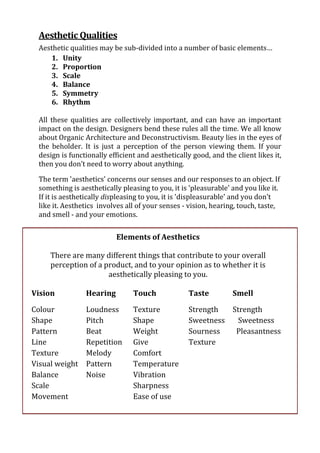
                           Elements of Aesthetics

     There are many different things that contribute to your overall
     perception of a product, and to your opinion as to whether it is
                      aesthetically pleasing to you.

Vision           Hearing         Touch              Taste         Smell

Colour           Loudness        Texture            Strength  Strength
Shape            Pitch           Shape              Sweetness   Sweetness
Pattern          Beat            Weight             Sourness   Pleasantness
Line             Repetition      Give               Texture
Texture          Melody          Comfort
Visual weight    Pattern         Temperature
Balance          Noise           Vibration
Scale                            Sharpness
Movement                         Ease of use
Our opinion about a product may also be influenced by certain
associations that are important to us, such as:

       how fashionable it is
       whether it is a novelty, or an old favourite
       whether it is a symbol of wealth or love
       how much danger or risk is involved
       if it provides a link with your past

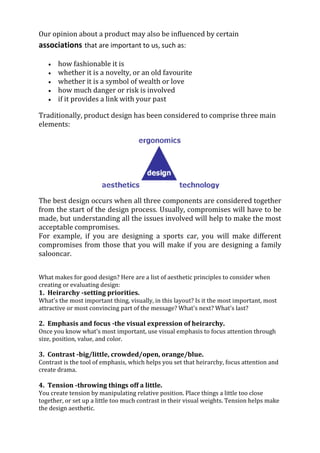
Traditionally, product design has been considered to comprise three main
elements:


The best design occurs when all three components are considered together
from the start of the design process. Usually, compromises will have to be
made, but understanding all the issues involved will help to make the most
acceptable compromises.
For example, if you are designing a sports car, you will make different
compromises from those that you will make if you are designing a family
salooncar.


What makes for good design? Here are a list of aesthetic principles to consider when
creating or evaluating design:
1. Heirarchy -setting priorities.
What's the most important thing, visually, in this layout? Is it the most important, most
attractive or most convincing part of the message? What's next? What's last?

2. Emphasis and focus -the visual expression of heirarchy.
Once you know what's most important, use visual emphasis to focus attention through
size, position, value, and color.

3. Contrast -big/little, crowded/open, orange/blue.
Contrast is the tool of emphasis, which helps you set that heirarchy, focus attention and
create drama.

4. Tension -throwing things off a little.
You create tension by manipulating relative position. Place things a little too close
together, or set up a little too much contrast in their visual weights. Tension helps make
the design aesthetic.
5. Balance -creating a gravitational axis.
Balance doesn't have to be symmetry. By opposing dense detail with open space, or
heavy elements with lighter ones, balance can be asymmetric and, again, athletic.

6. Rhythm -variety and pattern.
Variety relieves the eye, and pattern helps the mind make sense of it. In multipage
works, rhythm creates pacing across the whole.

7. Flow -leading the eye across the surface.
This should happen in a desired sequence.

8. Depth -leading the eye beyond the surface, or making things jump out
from the surface.
Depth is the most inherently contradictory illusion of 2D design, and therfore, one of the
most compelling.

9. Scale -the illusion of size.
The size of elements relative to one another is important, of course, but the size of
things in relation to the format and the size of the format itself are also worth
considering.

10. Movement -the illusion of physical interaction among elements.
Usually figurative -with elements angled or poised like bodies in motion -movement can
also be created with such optical effects as linear repetition, visual vortexes and the like.
Used deliberately, suggested movement can have a marked emotional and physical
impact on a viewer.

11. Unity -that which holds the piece together.
Color can unify a design, as can a grid, visuals that represent related subjects or a
consistant style of imagery. In an age of over-stimulation and cacophony, unity is often
underrated.


Aesthetics in interior designing
         A general definition of beauty and aesthetic excellence would be difficult,
but fortunately there are a number of generally accepted principles that can be used
to achieve an understanding of the aesthetic considerations in design. One must
note, however, that such understanding requires exposure and learning; an
appreciation of any form of art needs such a background.

          A thorough appreciation of design must go beyond the first impression.
Thefirst impression of the interior of a Gothic cathedral might be that it is somewhat
dark or gloomy, but, by the time the visitor senses its .

         Interior design is an extremely important element of decorating any home.
Those with an eye for style and a good use of space can often help people to make
their home look interesting and inviting. So, Aesthetics plays very vital role in
interior designing.
Aesthetics design principles make it possible for anyone to create a home
that's beautiful, warm and welcoming, a genuine sanctuary from the stresses of
contemporary life.

          As someone who wants to change up their house and shake things up a
little, what you need to know about is how you are going to be able to maximise that
theme and make a perfect fit into the house that you are interested in. Maximising
space is like putting on a good suit…

          Where we live, work, and play greatly influences our moods.
Some environments make you feel alive, while others drain energy right
out of the air. Interior designers bring an environment into harmony with
its purpose by manipulating the aesthetic and physical nature of a space.
They study how private and public spaces impact the health, safety, and
welfare of those occupying the space.


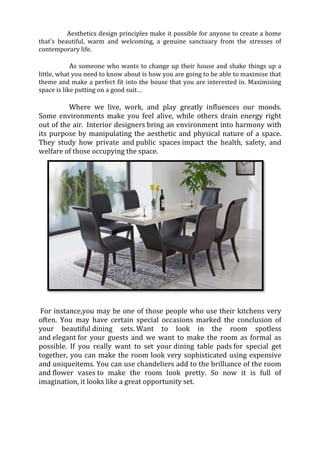
 For instance,you may be one of those people who use their kitchens very
often. You may have certain special occasions marked the conclusion of
your beautiful dining sets. Want to look in the room spotless
and elegant for your guests and we want to make the room as formal as
possible. If you really want to set your dining table pads for special get
together, you can make the room look very sophisticated using expensive
and uniqueitems. You can use chandeliers add to the brilliance of the room
and flower vases to make the room look pretty. So now it is full of
imagination, it looks like a great opportunity set.

Aesthetics

  • 1.
    AESTHETICS Aesthetics is thestudy of beauty and taste, whether in the form of the comic, the tragic, or the sublime. The word comes from the Greek word aisthetikos, referring to sensory perception and understanding or sensuous knowledge. In the eighteen century, the German Philosopher Alexander Gottlieb Baumgarter picked up the term and changed its meaning into gratification of the senses or sensuous delight (Goldman, 2001). Since work of art are (mostly) produced for this reason, i.e. to gratify our senses, the concept has sinc been applied to any aspect of the experiences of art, such as aesthetic judgment, aesthetic attitude, aesthetic understanding, aesthetic emotion, aesthetic value. These all are considered part of the aesthetic experience and although we can still experience nature or people aesthetically, the phrase is most often used in relation to the arts. Especially visual art. Aesthetics is where we comment upon the apperance. As designers you need you need to think and design about the aesthetics of a product as generally people want products that look pleasing. Aesthetics – is the study of beauty in nature. · The best designs usually 'look good' - 'aesthetically pleasing' · The aesthetics are usually accomplished by the shape, texture, color, type of material, symmetry and simplicity of the repeated pattern used in the design.
  • 2.
    Indian aesthetics Indian artevolved with an emphasis on inducing special spiritual or philosophical states in the audience, or with representing them symbolically. According to Kapila Vatsyayan, Classical Indian architecture, Indian sculpture, Indian painting, Indian literature (kaavya), Indian music, and Indian dance "evolved their own rules conditioned by their respective media, but they shared with one another not only the underlying spiritual beliefs of the Indian religio-philosophic mind, but also the procedures by which the relationships of the symbol and the spiritual states were worked out in detail." History of aesthetics Ancient aesthetics We have examples of pre-historic art, but they are rare, and the context of their production and use is not very clear, so we can little more than guess at the aesthetic doctrines that guided their production and interpretation. Ancient art was largely, but not entirely, based on the seven great ancient civilizations: Egypt, Mesopotamia, Greece, Rome, Persia, India and China. Each of these centers of early civilization developed a unique and characteristic style in its art. Greece had the most influence on the development of aesthetics in the West. This period of Greek art saw a veneration of the human physical form and the development of corresponding skills to show musculature, poise, beauty and anatomically correct proportions. Furthermore, in many Western and Eastern cultures alike, traits such as body hair are rarely depicted in art that addresses physical beauty. More in contrast with this Greek-Western aesthetic taste is the genre of grotesque.
  • 3.
    Aesthetics in art Of course art appreciation is in the eyes of the beholder, although there are certain elements that we can define across a group of paintings that can be generalized or delineated, and hence discussed and analyzed on their own merits.Generally, art adheres to the aesthetic principles of symmetry/asymmetry, focal point, pattern, contrast, perspective, 3D dimensionality, movement, unity/Gestalt, and proportion. Aesthetics in music Music has the ability to affect our emotions, intellect, and our psychology; lyrics can assuage our loneliness or incite our passions. As such, music is a powerful art form whose aesthetic appeal is highly dependent upon the culture in which it is practiced. Aesthetics in architecture Applying aesthetics to buildings and related architectural structures is complex, as factors extrinsic to visual design (such as structural integrity, cost, the nature of building materials, and the functional utility of the building) contribute heavily to the design process. Aesthetics in the performing arts Performing artists appeals to our aesthetics of storytelling, grace, balance, class, timing, strength, shock, humor, costume, irony,beauty, and sensuality. Aesthetics in literature Encompassing poetry, short stories, novels and non-fiction, authors use a variety of techniques to appeal to our aesthetic values. Depending on the type of writing an author may employ rhythm, illustrations, structure, time shifting, juxtaposition, dualism, imagery, fantasy, suspense, analysis, humor/cynicism, and thinking aloud.
  • 4.
    Aesthetics in landscapedesign Landscape designers employ design elements such as axis, line, landform, horizontal and vertical planes, texture, and scale to create variations of landscape space and aesthetics. Culinary aesthetics Although food is a basic and frequently experienced commodity, careful attention to the aesthetic possibilities of foodstuffs can turn eating into dining. Chefs inspire our gastronomy with regionalism, spices, diversity/contrast, anticipation, seduction, and decoration/ garnishes. Aesthetics in information technology The push to make all aspects of information technology as user- friendly as possible has led to a number of advances during the study of human-computer interaction. Meanings: a philosophical theory as to what is beautiful "he despised the esthetic of minimalism" concerning or characterized by an appreciation of beauty or good taste "the illustrations made the book an aesthetic success" “what an aesthetic beauty konark temple is” relating to or dealing with the subject of aesthetics “From the aesthetic point of view, it was a beautiful design” “The beautiful sculpture was a mirror image of the carver's aethetic values”. aesthetically pleasing "an artistic flower arrangement"
  • 5.
    Definition : Aestheticsis the study of beauty and taste, whether in the form of the comic, the tragic, or the sublime. The word derives from the Greek aisthetikos, meaning "of sense perception." Aesthetics is the branch of philosophy that deals with the nature and expression of beauty. Interior designihg is a design process which involves planning, designing, creating, erecting, constructing and executing construction of various types of buildings that are functionally efficient, economically viable and aesthetically pleasing. Aesthetics is one of the major principle of Architecture that students and professionals alike have to worship. It concerns beauty or appreciation of beauty. In other words, it is a philosophy behind a pleasing appearance. A set of principles followed by any designers for that matter for the evolution of the end product that is aesthetically pleasing to the eye, is called aesthetics. It is directly influenced by the artistic taste of an individual. Aesthetics is concerned with bringing art into the daily lives of the people. Like people need colorful, designer clothes to wear and taste and presentation of food. Likewise, people like to live and work in places that are beautifully designed and are aesthetically pleasing to the eye. When a building is designed, the aesthetic aspects can be satisfied using elements such as sloped roof, decorative columns, roofs for window elements, and semicircular and segmental arches. The philosophy of aesthetics can be mastered by any designer if he follows these key elements listed below… 1. Mass and space 2. Proportion 3. Symmetry 4. Balance 5. Contrast 6. Pattern 7. Decoration 8. Massing
  • 6.
    Aesthetic Qualities Aesthetic qualities may be sub-divided into a number of basic elements… 1. Unity 2. Proportion 3. Scale 4. Balance 5. Symmetry 6. Rhythm All these qualities are collectively important, and can have an important impact on the design. Designers bend these rules all the time. We all know about Organic Architecture and Deconstructivism. Beauty lies in the eyes of the beholder. It is just a perception of the person viewing them. If your design is functionally efficient and aesthetically good, and the client likes it, then you don’t need to worry about anything. The term 'aesthetics' concerns our senses and our responses to an object. If something is aesthetically pleasing to you, it is 'pleasurable' and you like it. If it is aesthetically displeasing to you, it is 'displeasurable' and you don't like it. Aesthetics involves all of your senses - vision, hearing, touch, taste, and smell - and your emotions. Elements of Aesthetics There are many different things that contribute to your overall perception of a product, and to your opinion as to whether it is aesthetically pleasing to you. Vision Hearing Touch Taste Smell Colour Loudness Texture Strength Strength Shape Pitch Shape Sweetness Sweetness Pattern Beat Weight Sourness Pleasantness Line Repetition Give Texture Texture Melody Comfort Visual weight Pattern Temperature Balance Noise Vibration Scale Sharpness Movement Ease of use
  • 7.
    Our opinion abouta product may also be influenced by certain associations that are important to us, such as: how fashionable it is whether it is a novelty, or an old favourite whether it is a symbol of wealth or love how much danger or risk is involved if it provides a link with your past Traditionally, product design has been considered to comprise three main elements: The best design occurs when all three components are considered together from the start of the design process. Usually, compromises will have to be made, but understanding all the issues involved will help to make the most acceptable compromises. For example, if you are designing a sports car, you will make different compromises from those that you will make if you are designing a family salooncar. What makes for good design? Here are a list of aesthetic principles to consider when creating or evaluating design: 1. Heirarchy -setting priorities. What's the most important thing, visually, in this layout? Is it the most important, most attractive or most convincing part of the message? What's next? What's last? 2. Emphasis and focus -the visual expression of heirarchy. Once you know what's most important, use visual emphasis to focus attention through size, position, value, and color. 3. Contrast -big/little, crowded/open, orange/blue. Contrast is the tool of emphasis, which helps you set that heirarchy, focus attention and create drama. 4. Tension -throwing things off a little. You create tension by manipulating relative position. Place things a little too close together, or set up a little too much contrast in their visual weights. Tension helps make the design aesthetic.
  • 8.
    5. Balance -creatinga gravitational axis. Balance doesn't have to be symmetry. By opposing dense detail with open space, or heavy elements with lighter ones, balance can be asymmetric and, again, athletic. 6. Rhythm -variety and pattern. Variety relieves the eye, and pattern helps the mind make sense of it. In multipage works, rhythm creates pacing across the whole. 7. Flow -leading the eye across the surface. This should happen in a desired sequence. 8. Depth -leading the eye beyond the surface, or making things jump out from the surface. Depth is the most inherently contradictory illusion of 2D design, and therfore, one of the most compelling. 9. Scale -the illusion of size. The size of elements relative to one another is important, of course, but the size of things in relation to the format and the size of the format itself are also worth considering. 10. Movement -the illusion of physical interaction among elements. Usually figurative -with elements angled or poised like bodies in motion -movement can also be created with such optical effects as linear repetition, visual vortexes and the like. Used deliberately, suggested movement can have a marked emotional and physical impact on a viewer. 11. Unity -that which holds the piece together. Color can unify a design, as can a grid, visuals that represent related subjects or a consistant style of imagery. In an age of over-stimulation and cacophony, unity is often underrated. Aesthetics in interior designing A general definition of beauty and aesthetic excellence would be difficult, but fortunately there are a number of generally accepted principles that can be used to achieve an understanding of the aesthetic considerations in design. One must note, however, that such understanding requires exposure and learning; an appreciation of any form of art needs such a background. A thorough appreciation of design must go beyond the first impression. Thefirst impression of the interior of a Gothic cathedral might be that it is somewhat dark or gloomy, but, by the time the visitor senses its . Interior design is an extremely important element of decorating any home. Those with an eye for style and a good use of space can often help people to make their home look interesting and inviting. So, Aesthetics plays very vital role in interior designing.
  • 9.
    Aesthetics design principlesmake it possible for anyone to create a home that's beautiful, warm and welcoming, a genuine sanctuary from the stresses of contemporary life. As someone who wants to change up their house and shake things up a little, what you need to know about is how you are going to be able to maximise that theme and make a perfect fit into the house that you are interested in. Maximising space is like putting on a good suit… Where we live, work, and play greatly influences our moods. Some environments make you feel alive, while others drain energy right out of the air. Interior designers bring an environment into harmony with its purpose by manipulating the aesthetic and physical nature of a space. They study how private and public spaces impact the health, safety, and welfare of those occupying the space. For instance,you may be one of those people who use their kitchens very often. You may have certain special occasions marked the conclusion of your beautiful dining sets. Want to look in the room spotless and elegant for your guests and we want to make the room as formal as possible. If you really want to set your dining table pads for special get together, you can make the room look very sophisticated using expensive and uniqueitems. You can use chandeliers add to the brilliance of the room and flower vases to make the room look pretty. So now it is full of imagination, it looks like a great opportunity set.