Digital Storytelling Basics
• Finding stories
• Examples
• Shaping stories: structure and point of view
• Narratives of different story types
• Synopsis
First assignment: develop a story
• Develop a storyline that will drive future class projects.
Remember you will produce Projects like audio slide show
and video story, and include them in a website.
• Do research and brainstorming.
• Select a topic or theme.
• Shape the story.
• Write a blueprint as a one-page synopsis (due Sept. 15)
• Present to others why that project is worthwhile (Sep. 20)
What we are looking for:
• You already know how to tell a story. Everyone has stories.
• Stories come from a variety of places: yourself, your community, your
country, or even international issues. If you are doing a story about
yourself, it can come either from your past or present/future.
• Throughout history, storytelling has been used to share knowledge,
wisdom, and values. Stories have taken many different forms. Stories
have been adapted to each successive medium that has emerged, from
the circle of the campfire to the silver screen, and now the computer
screen.
• Digital Storytelling is just “a modern expression of the ancient art of
storytelling” (www.storycenter.org).
Where to look for stories.
1. Yourself:
Family, Identity, Relationship…
2. Community:
On campus, your sports team, home town, ….
3. Causes and issues
National issues, activism, your organization,
4. International issues
Family story example: 1890 Stories by Natalia
Anglin
• What visual elements
were used in this
project?
• What audio elements
were used?
• How did the images
move?
• When you plan this
type of story, be noted
that you have pecific
deadlines.
Identity stories: Running to Ozone, Caroline Pari
• What visual and audio
elements would you
have included in this
project?
• What did you think of
the beginning and
ending?
• A more sophisticated
example.
Sofa by Wayne Richard
Relationships: Daddy’s girl
• Perhaps one of the most
common project topics
for students.
• This project is a focused
one. But would not get a
good grade from me. You
will need live image and
audio element.
• One of our own student
projects. Paul.
Community examples.
Examples on campus
• On campus events that specifically
attract students
• You and your sports/ activities (dance,
gymnastics, rugby, golf….)
• Campus issues such as crime,
residency, hate speech etc.
• Boilermaker sports (but you cannot
just preview games and/or show you
and your friend watching games)
• Christian life or religion on campus
• Ecology on campus
• Politics on campus
Examples of hometown
• Local attraction and story behind it.
• Community shelters
• Animal shelter
• Local attraction
• NGO’s
• History
Student example:
Awareness on campus
Be aware of your audience. W
More instructions about how
to find stories: How can you tell
a story about large issues like
national and international
issues?
Tips: Localize and personalize large issues
• Example story: Robert Krulwich and Will Hoffman, NPR Online
• To tell the complicated story of health care for NPR Online, Krulwich
and Hoffman zeroed in on the personal tales of a few individuals.
• http://www.npr.org/sections/krulwich/2011/06/01/121158190/a-
locksmith-s-tale-and-other-health-care-stories
Shaping stories: You may find ideas but they are
not stories .
• Structure: Stories are presented in narrative styles. Typically they have
beginning –middle – end.
• Set up: characters, location, time and other elements.
-in a way that allows events to unfold so that audience wants to know more and
more about it
-tell how are your characters are affected
-how they develop a solution (or not) and finally where they go from there.
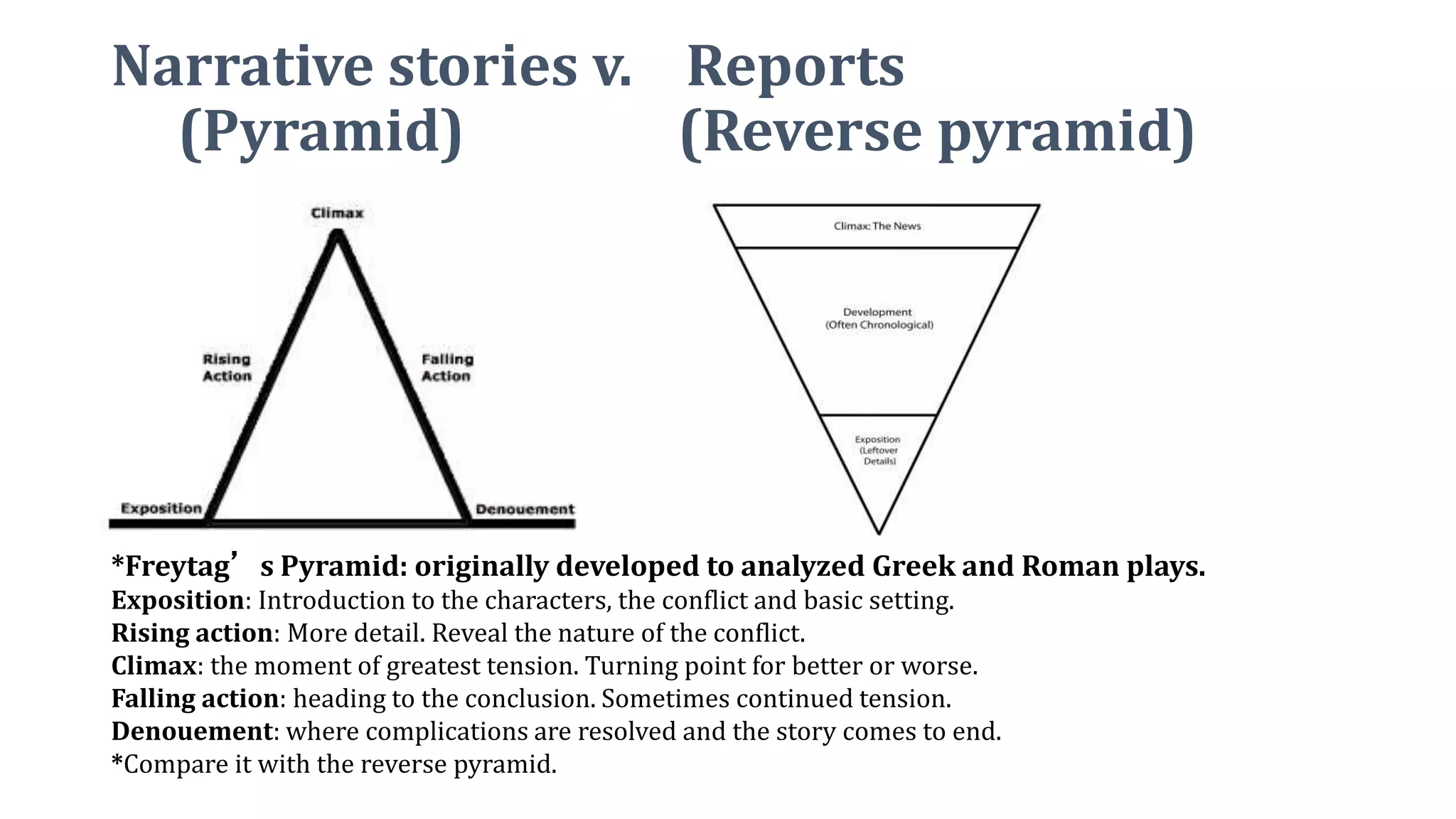
Narrative stories v. Reports
(Pyramid) (Reverse pyramid)
*Freytag’s Pyramid: originally developed to analyzed Greek and Roman plays.
Exposition: Introduction to the characters, the conflict and basic setting.
Rising action: More detail. Reveal the nature of the conflict.
Climax: the moment of greatest tension. Turning point for better or worse.
Falling action: heading to the conclusion. Sometimes continued tension.
Denouement: where complications are resolved and the story comes to end.
*Compare it with the reverse pyramid.
In our projects most stories will be
shaped according to 3 act principle.
Storytellers think of story structure as three act play (Means
recommended by the instructor).
Act 1. Introduce your characters. Let us meet them. Show location
and time. Give a reason why we should care about them.
Act 2. Reveal the complication. Usually the longest part of the story.
Let the complication intensify.
Act 3. Resolve the complication. And finish the story in a satisfying
way. What choices were made in the crisis?
Point of view (POV)
• First-person POV: e.g. Greys anatomy. Many of bio videos.
• Second-person POV: Direct address by the actors to the audience.
e.g. Think of on-spot TV anchors.
• Third-person POV: Most common in storytelling. Audience are
detached observers.
• Character POV: One character is dominant in a series of stories. e.g.
sit com Seinfeld.
• Conflicting POV: Mixture of different point of view.
Exercise: identifying structure and POV
• “Hungry: Living with the Prader-Willi Syndrome”
Identify the three part acts.
https://vimeo.com/5717103
https://www.youtube.com/watch?v=H5BSpxvqL2A
• Sofa by Wayne Richard
https://www.youtube.com/watch?v=VPrnDD51Y5s&list=PL7AC307C5
535EF045
Next step: plan the storytelling.
• As a producer, once you have a concept, you need to find a way to
finance its production.
1. determine the essential content and structure of the story and the
best way to treat the story
2. determine the best audience/market for your story
3. develop a sales presentation for the story – this is THE PITCH.
How to write a synopsis, prepare pitch
• Students write, rewrite, and continue the writing process through
multiple drafts. In most cases, this writing takes the form of a
personal narrative about a particular story from a student’s life.
• The pitch itself is a highly condensed presentation of the story.
Lasting usually no more than two or three minutes. The best way
to begin to develop a pitch is to create a synopsis of the story.
• Tips for writing one page synopses are posted on the blackboard
and class blog.
Tips: Visualize a long history
• Manage a long time period with digital story telling. You cannot tell the whole
story with writing or just still photos.
• But mix them with interviews, graphics, archival footage makes them manageable.
• Gather the materials and edit them, you can take audience back in time. Think of
the great story book chapters.
• Video: mix A roll and B roll.
• Photos: new and old.
• Audio: music, narration and interviews
• Example
• Take care Media Storm
• http://mediastorm.com/training/take-care
Tips: Generalize what you see around you
• Example story: Age of Uncertainty
• https://vimeo.com/1229405
• Photo by Josh Meltzer, Roanoke Times
• The photographer saw a woman who assists her fellow church
members. A colleague encouraged him to think more broadly about
what this lady did a story on caring for elderly people in general.
Narratives of video stories
by topics (Video)
Examples for writing narratives for video project.
From Josh Meltzer’s instruction book.
1. Contests & Sports
• Competitions has natural built in story arcs
• Conflict is obvious
• Easy to find narratives
• Example: two men using competitive narratives. Content is about
their resolution to win.
• https://vimeo.com/9865278
2. Recovery
• Also provides natural narrative
• Give the suspense of unknown results. Build up tension.
Remember what you learned from storytelling structure.
• Get inspiring quotes
• http://www.latimes.com/local/la-me-jewish-addict-ss-
htmlstory.html
3. Changing a life
• Journey style
• Follow the same subject.
• Getting the natural narrative is the key.
• http://lens.blogs.nytimes.com//2009/06/16/showcase-7/
4. Death or Dying
• Audience are naturally drawn
• Death is a universal experience of all people.
• Powerful as it is. Do not over-dramatize.
• http://www.theconcentra.org/en/nominees/2010/casey-
kauffman-baby-feras/
5. Localizing/humanizing a national
problem
• Use ordinary people for a highly reported cases.
• Often present different cases.
• Sometimes require time and skill
• https://www.youtube.com/watch?v=7mFcGJyUxJk
6. Humor
• Multimedia are built for humor
• Much easier to make others laugh with a photo or video than with
words
• http://kylegreen.photoshelter.com/#!/video
7. The unusual amidst the ordinary
• Everyone has a story. But not all story are appealing.
• Often takes on a form of series or omnibus
• http://www.nytimes.com/packages/html/nyregion/1-in-8-
million/index.html#/stefanie_rinza

09 05-16 storytelling basics

  • 1.
    Digital Storytelling Basics •Finding stories • Examples • Shaping stories: structure and point of view • Narratives of different story types • Synopsis
  • 2.
    First assignment: developa story • Develop a storyline that will drive future class projects. Remember you will produce Projects like audio slide show and video story, and include them in a website. • Do research and brainstorming. • Select a topic or theme. • Shape the story. • Write a blueprint as a one-page synopsis (due Sept. 15) • Present to others why that project is worthwhile (Sep. 20)
  • 3.
    What we arelooking for: • You already know how to tell a story. Everyone has stories. • Stories come from a variety of places: yourself, your community, your country, or even international issues. If you are doing a story about yourself, it can come either from your past or present/future. • Throughout history, storytelling has been used to share knowledge, wisdom, and values. Stories have taken many different forms. Stories have been adapted to each successive medium that has emerged, from the circle of the campfire to the silver screen, and now the computer screen. • Digital Storytelling is just “a modern expression of the ancient art of storytelling” (www.storycenter.org).
  • 4.
    Where to lookfor stories. 1. Yourself: Family, Identity, Relationship… 2. Community: On campus, your sports team, home town, …. 3. Causes and issues National issues, activism, your organization, 4. International issues
  • 5.
    Family story example:1890 Stories by Natalia Anglin • What visual elements were used in this project? • What audio elements were used? • How did the images move? • When you plan this type of story, be noted that you have pecific deadlines.
  • 6.
    Identity stories: Runningto Ozone, Caroline Pari • What visual and audio elements would you have included in this project? • What did you think of the beginning and ending? • A more sophisticated example. Sofa by Wayne Richard
  • 7.
    Relationships: Daddy’s girl •Perhaps one of the most common project topics for students. • This project is a focused one. But would not get a good grade from me. You will need live image and audio element. • One of our own student projects. Paul.
  • 8.
    Community examples. Examples oncampus • On campus events that specifically attract students • You and your sports/ activities (dance, gymnastics, rugby, golf….) • Campus issues such as crime, residency, hate speech etc. • Boilermaker sports (but you cannot just preview games and/or show you and your friend watching games) • Christian life or religion on campus • Ecology on campus • Politics on campus Examples of hometown • Local attraction and story behind it. • Community shelters • Animal shelter • Local attraction • NGO’s • History Student example: Awareness on campus Be aware of your audience. W
  • 9.
    More instructions abouthow to find stories: How can you tell a story about large issues like national and international issues?
  • 10.
    Tips: Localize andpersonalize large issues • Example story: Robert Krulwich and Will Hoffman, NPR Online • To tell the complicated story of health care for NPR Online, Krulwich and Hoffman zeroed in on the personal tales of a few individuals. • http://www.npr.org/sections/krulwich/2011/06/01/121158190/a- locksmith-s-tale-and-other-health-care-stories
  • 11.
    Shaping stories: Youmay find ideas but they are not stories . • Structure: Stories are presented in narrative styles. Typically they have beginning –middle – end. • Set up: characters, location, time and other elements. -in a way that allows events to unfold so that audience wants to know more and more about it -tell how are your characters are affected -how they develop a solution (or not) and finally where they go from there.
  • 12.
    Narrative stories v.Reports (Pyramid) (Reverse pyramid) *Freytag’s Pyramid: originally developed to analyzed Greek and Roman plays. Exposition: Introduction to the characters, the conflict and basic setting. Rising action: More detail. Reveal the nature of the conflict. Climax: the moment of greatest tension. Turning point for better or worse. Falling action: heading to the conclusion. Sometimes continued tension. Denouement: where complications are resolved and the story comes to end. *Compare it with the reverse pyramid.
  • 13.
    In our projectsmost stories will be shaped according to 3 act principle. Storytellers think of story structure as three act play (Means recommended by the instructor). Act 1. Introduce your characters. Let us meet them. Show location and time. Give a reason why we should care about them. Act 2. Reveal the complication. Usually the longest part of the story. Let the complication intensify. Act 3. Resolve the complication. And finish the story in a satisfying way. What choices were made in the crisis?
  • 14.
    Point of view(POV) • First-person POV: e.g. Greys anatomy. Many of bio videos. • Second-person POV: Direct address by the actors to the audience. e.g. Think of on-spot TV anchors. • Third-person POV: Most common in storytelling. Audience are detached observers. • Character POV: One character is dominant in a series of stories. e.g. sit com Seinfeld. • Conflicting POV: Mixture of different point of view.
  • 15.
    Exercise: identifying structureand POV • “Hungry: Living with the Prader-Willi Syndrome” Identify the three part acts. https://vimeo.com/5717103 https://www.youtube.com/watch?v=H5BSpxvqL2A • Sofa by Wayne Richard https://www.youtube.com/watch?v=VPrnDD51Y5s&list=PL7AC307C5 535EF045
  • 16.
    Next step: planthe storytelling. • As a producer, once you have a concept, you need to find a way to finance its production. 1. determine the essential content and structure of the story and the best way to treat the story 2. determine the best audience/market for your story 3. develop a sales presentation for the story – this is THE PITCH.
  • 17.
    How to writea synopsis, prepare pitch • Students write, rewrite, and continue the writing process through multiple drafts. In most cases, this writing takes the form of a personal narrative about a particular story from a student’s life. • The pitch itself is a highly condensed presentation of the story. Lasting usually no more than two or three minutes. The best way to begin to develop a pitch is to create a synopsis of the story. • Tips for writing one page synopses are posted on the blackboard and class blog.
  • 18.
    Tips: Visualize along history • Manage a long time period with digital story telling. You cannot tell the whole story with writing or just still photos. • But mix them with interviews, graphics, archival footage makes them manageable. • Gather the materials and edit them, you can take audience back in time. Think of the great story book chapters. • Video: mix A roll and B roll. • Photos: new and old. • Audio: music, narration and interviews • Example • Take care Media Storm • http://mediastorm.com/training/take-care
  • 19.
    Tips: Generalize whatyou see around you • Example story: Age of Uncertainty • https://vimeo.com/1229405 • Photo by Josh Meltzer, Roanoke Times • The photographer saw a woman who assists her fellow church members. A colleague encouraged him to think more broadly about what this lady did a story on caring for elderly people in general.
  • 20.
    Narratives of videostories by topics (Video) Examples for writing narratives for video project. From Josh Meltzer’s instruction book.
  • 21.
    1. Contests &Sports • Competitions has natural built in story arcs • Conflict is obvious • Easy to find narratives • Example: two men using competitive narratives. Content is about their resolution to win. • https://vimeo.com/9865278
  • 22.
    2. Recovery • Alsoprovides natural narrative • Give the suspense of unknown results. Build up tension. Remember what you learned from storytelling structure. • Get inspiring quotes • http://www.latimes.com/local/la-me-jewish-addict-ss- htmlstory.html
  • 23.
    3. Changing alife • Journey style • Follow the same subject. • Getting the natural narrative is the key. • http://lens.blogs.nytimes.com//2009/06/16/showcase-7/
  • 24.
    4. Death orDying • Audience are naturally drawn • Death is a universal experience of all people. • Powerful as it is. Do not over-dramatize. • http://www.theconcentra.org/en/nominees/2010/casey- kauffman-baby-feras/
  • 25.
    5. Localizing/humanizing anational problem • Use ordinary people for a highly reported cases. • Often present different cases. • Sometimes require time and skill • https://www.youtube.com/watch?v=7mFcGJyUxJk
  • 26.
    6. Humor • Multimediaare built for humor • Much easier to make others laugh with a photo or video than with words • http://kylegreen.photoshelter.com/#!/video
  • 27.
    7. The unusualamidst the ordinary • Everyone has a story. But not all story are appealing. • Often takes on a form of series or omnibus • http://www.nytimes.com/packages/html/nyregion/1-in-8- million/index.html#/stefanie_rinza