STAGES OF HUMAN
DEVELOPMENT :
SIGNIFICANCE AND
CHARACTERISTICS OF
CHILDHOOD
Manjunath .M.P
M.Ed student kuvmpu university
STAGES OF HUMAN DEVELOPMENT :
SIGNIFICANCE AND CHARACTERISTICS
OF CHILDHOOD
INTRODUCTION
Childhood begins when the relative dependency of babyhood is over at
approximately the age of two years and extends to time when the child
becomes sexually mature at approximately twelve years for girls and
thirteen years for boys.
In development psychology, childhood is divided up into the development
stages of early childhood (pre school age) , later/post childhood (school
age) and adolescence.
Today it is widely recognized that childhood should be subdivided into
separate periods to tw0
1. Early childhood (2years to 6 years)
2. Later/post childhood(6 years to 12 years)
DEFINITION
According to Kilpatrick: childhood is a period
of rivalry socialization .
According to ross: childhood is pseudo
maturity stage.
According to Cole and Bruce: childhood is a
unique stage of emotional development.
EARLY CHILDHOOD (2 YEARS - 6 YEARS) :
It is referred as preschool age/ nursery age/ toys age/ rhymes age.
Early childhood is a time of remarkable physical, cognitive, social and
emotional development.
Infants enter the world with a limited range of skills and abilities watching
a child develop new motor, cognitive, language and social skills is a source
of wonder for parents and caregivers.
Early childhood development refers to the many skills and milestone that
children are expected to reach the time they reach the age of five.
In this first two years a child develops physically at a faster rate than at any
time in her/his life.
LATER CHILDHOOD (6 YEARS-12 YEARS)
The period of later childhood ranges from to the attainment of sexual
maturity/puberty, around 12-13 years.
The marked by the conditions that profoundly affect child’s personnel and social
adjustment.
This stage referred as gang age/ pre adolescence age/ school age.
It is the period required proper guidance, counselling , love and affecting by both
parents and teachers.
During this stage children develop marked negativism and because of their desire for
independence seldom obey the parents.
The child begins going to school and learns of the rudiments of knowledge essential
for successful adult life.
It is a period slow and steady growth and is influenced by health, nutrition,
immunization and sex.
The peer group has great importance in this period.
CHARACTERISTICS OF EARLY AND LATER
CHILDHOOD
Early childhood Later childhood
• It is a toy age because most of the time
children are engaged with their toys.
• It is a called the gang age, because children
are interested in activities with their peers
and want to belong to gang.
• Some behavioral problems occur in this
period such as obstinacy, stubbornness,
disobedience, negativistic and antagonistic.
• It is also called age of conformity because
children are willing to group approved standards
in terms of appearance; speech and behavior.
• Many psychologist refer to early childhood as
the exploratory age.
• It is also referred as creative age, while the
foundations of creative expressions are laid in
early childhood, the ability to use these
foundations for original activities is generally well
developed in later childhood.
• one common way of exploring in early
childhood is by asking questions thus this
period is often referred as questioning age.
• Children are able to exercise control over their
overt emotions and express then in appropriate
and socially approved ways.
• It is also known as imitative age. • There is a rapid increase in understanding and in
the accuracy , increased intelligence and partly as
a result of increased learning opportunities
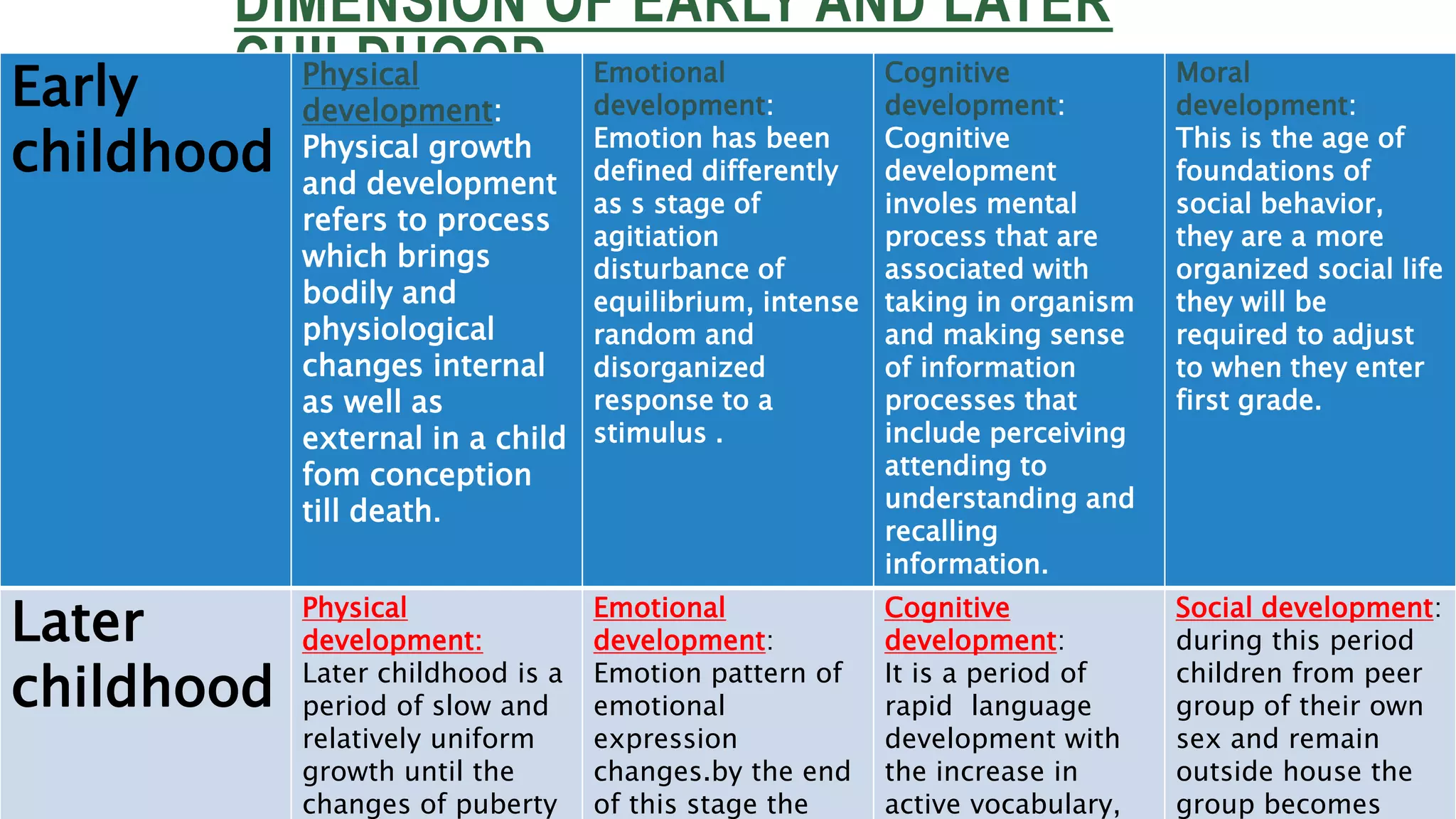
DIMENSION OF EARLY AND LATER
CHILDHOOD
Early
childhood
Physical
development:
Physical growth
and development
refers to process
which brings
bodily and
physiological
changes internal
as well as
external in a child
fom conception
till death.
Emotional
development:
Emotion has been
defined differently
as s stage of
agitiation
disturbance of
equilibrium, intense
random and
disorganized
response to a
stimulus .
Cognitive
development:
Cognitive
development
involes mental
process that are
associated with
taking in organism
and making sense
of information
processes that
include perceiving
attending to
understanding and
recalling
information.
Moral
development:
This is the age of
foundations of
social behavior,
they are a more
organized social life
they will be
required to adjust
to when they enter
first grade.
Later
childhood
Physical
development:
Later childhood is a
period of slow and
relatively uniform
growth until the
changes of puberty
Emotional
development:
Emotion pattern of
emotional
expression
changes.by the end
of this stage the
Cognitive
development:
It is a period of
rapid language
development with
the increase in
active vocabulary,
Social development:
during this period
children from peer
group of their own
sex and remain
outside house the
group becomes
SIGNIFICANCE OF EDUCATION IN
CHILDHOOD
Perceptions and concept formation are the basis of intellectual development.
Therefore variety experience should provided to the students.
In order to develop emotional maturity and social competence in children, co
curricular activities should be planned carefully.
According to Piaget children during later childhood begin to develop moral and social
values . Teachers should make on effort to help and guide children in developing
desirable moral and social values.
As soon as the children develop the ability to read they want to know more about
world and its people.
SIGNIFICANCE OF CHILDHOOD
Cooperation :During this phase, children learn to share cooperate take
turns an to get your child to cooperate and more time enjoying each other’s
company.
Enthusiasm : Children will develop a hunger for learning if they are taught
through fun and exciting activities like playing music dancing singing,
construction, cooking etc.
Respect : The safe environment helps children learn to become civil
towards one another and they start to become that the concept of respect.
Patience : children should be trained to handle situation for the future.
Experiences such as sharing the attention of the teacher, waiting for their
turn etc., will help development.
CONCLUSION
Children is bridge between infancy and
adolescence, childhood is a crucial to how
a person develops later his life.
In which the responsibility of parents and
teachers increase in this stage, children
are more social and are In the stage of
development process.

Stages of human development 1.pptx

  • 1.
    STAGES OF HUMAN DEVELOPMENT: SIGNIFICANCE AND CHARACTERISTICS OF CHILDHOOD Manjunath .M.P M.Ed student kuvmpu university
  • 2.
    STAGES OF HUMANDEVELOPMENT : SIGNIFICANCE AND CHARACTERISTICS OF CHILDHOOD
  • 3.
    INTRODUCTION Childhood begins whenthe relative dependency of babyhood is over at approximately the age of two years and extends to time when the child becomes sexually mature at approximately twelve years for girls and thirteen years for boys. In development psychology, childhood is divided up into the development stages of early childhood (pre school age) , later/post childhood (school age) and adolescence. Today it is widely recognized that childhood should be subdivided into separate periods to tw0 1. Early childhood (2years to 6 years) 2. Later/post childhood(6 years to 12 years)
  • 4.
    DEFINITION According to Kilpatrick:childhood is a period of rivalry socialization . According to ross: childhood is pseudo maturity stage. According to Cole and Bruce: childhood is a unique stage of emotional development.
  • 5.
    EARLY CHILDHOOD (2YEARS - 6 YEARS) : It is referred as preschool age/ nursery age/ toys age/ rhymes age. Early childhood is a time of remarkable physical, cognitive, social and emotional development. Infants enter the world with a limited range of skills and abilities watching a child develop new motor, cognitive, language and social skills is a source of wonder for parents and caregivers. Early childhood development refers to the many skills and milestone that children are expected to reach the time they reach the age of five. In this first two years a child develops physically at a faster rate than at any time in her/his life.
  • 6.
    LATER CHILDHOOD (6YEARS-12 YEARS) The period of later childhood ranges from to the attainment of sexual maturity/puberty, around 12-13 years. The marked by the conditions that profoundly affect child’s personnel and social adjustment. This stage referred as gang age/ pre adolescence age/ school age. It is the period required proper guidance, counselling , love and affecting by both parents and teachers. During this stage children develop marked negativism and because of their desire for independence seldom obey the parents. The child begins going to school and learns of the rudiments of knowledge essential for successful adult life. It is a period slow and steady growth and is influenced by health, nutrition, immunization and sex. The peer group has great importance in this period.
  • 7.
    CHARACTERISTICS OF EARLYAND LATER CHILDHOOD Early childhood Later childhood • It is a toy age because most of the time children are engaged with their toys. • It is a called the gang age, because children are interested in activities with their peers and want to belong to gang. • Some behavioral problems occur in this period such as obstinacy, stubbornness, disobedience, negativistic and antagonistic. • It is also called age of conformity because children are willing to group approved standards in terms of appearance; speech and behavior. • Many psychologist refer to early childhood as the exploratory age. • It is also referred as creative age, while the foundations of creative expressions are laid in early childhood, the ability to use these foundations for original activities is generally well developed in later childhood. • one common way of exploring in early childhood is by asking questions thus this period is often referred as questioning age. • Children are able to exercise control over their overt emotions and express then in appropriate and socially approved ways. • It is also known as imitative age. • There is a rapid increase in understanding and in the accuracy , increased intelligence and partly as a result of increased learning opportunities
  • 8.
    DIMENSION OF EARLYAND LATER CHILDHOOD Early childhood Physical development: Physical growth and development refers to process which brings bodily and physiological changes internal as well as external in a child fom conception till death. Emotional development: Emotion has been defined differently as s stage of agitiation disturbance of equilibrium, intense random and disorganized response to a stimulus . Cognitive development: Cognitive development involes mental process that are associated with taking in organism and making sense of information processes that include perceiving attending to understanding and recalling information. Moral development: This is the age of foundations of social behavior, they are a more organized social life they will be required to adjust to when they enter first grade. Later childhood Physical development: Later childhood is a period of slow and relatively uniform growth until the changes of puberty Emotional development: Emotion pattern of emotional expression changes.by the end of this stage the Cognitive development: It is a period of rapid language development with the increase in active vocabulary, Social development: during this period children from peer group of their own sex and remain outside house the group becomes
  • 9.
    SIGNIFICANCE OF EDUCATIONIN CHILDHOOD Perceptions and concept formation are the basis of intellectual development. Therefore variety experience should provided to the students. In order to develop emotional maturity and social competence in children, co curricular activities should be planned carefully. According to Piaget children during later childhood begin to develop moral and social values . Teachers should make on effort to help and guide children in developing desirable moral and social values. As soon as the children develop the ability to read they want to know more about world and its people.
  • 10.
    SIGNIFICANCE OF CHILDHOOD Cooperation:During this phase, children learn to share cooperate take turns an to get your child to cooperate and more time enjoying each other’s company. Enthusiasm : Children will develop a hunger for learning if they are taught through fun and exciting activities like playing music dancing singing, construction, cooking etc. Respect : The safe environment helps children learn to become civil towards one another and they start to become that the concept of respect. Patience : children should be trained to handle situation for the future. Experiences such as sharing the attention of the teacher, waiting for their turn etc., will help development.
  • 11.
    CONCLUSION Children is bridgebetween infancy and adolescence, childhood is a crucial to how a person develops later his life. In which the responsibility of parents and teachers increase in this stage, children are more social and are In the stage of development process.