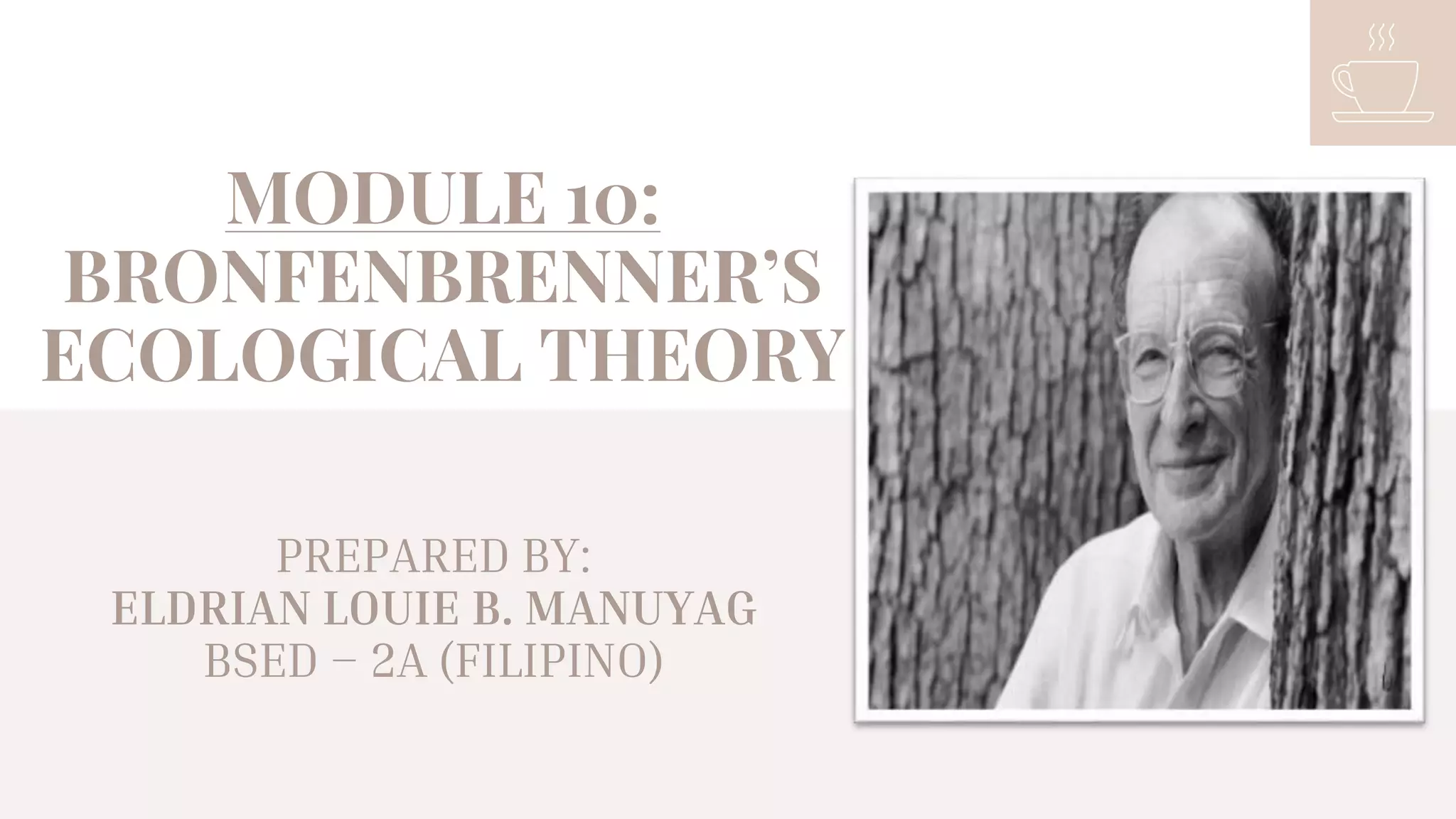


MODULE 10:
BRONFENBRENNER’S
ECOLOGICAL THEORY
PREPARED BY:
ELDRIAN LOUIE B. MANUYAG
BSED – 2A (FILIPINO)
“ INTRODUCTION
Bronfenbrenner came up with a simple yet
useful paradigm showing the different factors
that exert influence on an individual’s
development. It points out the ever widening
spheres of influence that shape very
individual, from his/her immediate family to
the neighbourhood, the country, even the
world!
2
BRONFENBRENNER’S
MODEL or
BIO-ECOLOGICAL
SYSTEM
Let’s start the discussion!
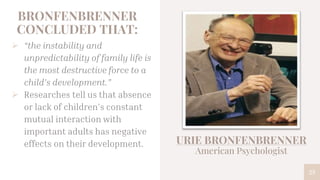
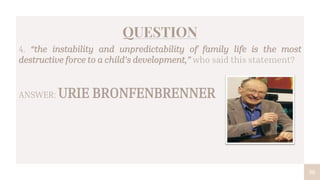
URIE BRONFENBRENNER
American Psychologist
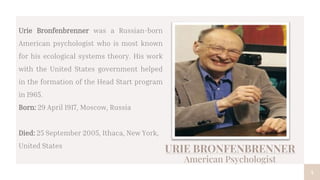
Urie Bronfenbrenner was a Russian-born
American psychologist who is most known
for his ecological systems theory. His work
with the United States government helped
in the formation of the Head Start program
in 1965.
Born: 29 April 1917, Moscow, Russia
Died: 25 September 2005, Ithaca, New York,
United States
4
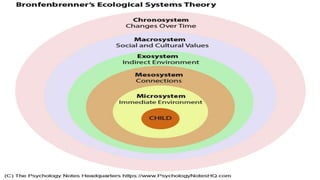
Bronfenbrenner’s Model also known as the Bioecological
System theory presents child development within the
context of relationship system that comprise the child’s
environment. It describes multipart layers of environment
that has an effect on the development of the child. Each
layer is further made up of different structures. The term
“bioecological” points out that a child’s own biological
make-up impacts as a key factor in one’s development.
▫
5
Through the child’s growing and developing body and the
interplay between his immediate family/community
environment, and the societal landscape fuels and steers his
development. Changes and conflict in any one layer will ripple
throughout other layers. To study a child’s development then,
we must look not only at a child and her immediate
environment, but also in the interaction of the larger
environment as well.
6
BRONFENBRENNER’S
BIOECOLOGICAL MODEL:
STRUCTURE OF
ENVIRONMENT
7
8
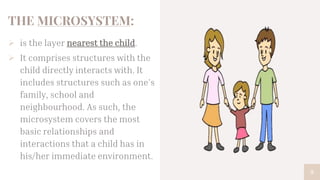
THE MICROSYSTEM:
 is the layer nearest the child.
 It comprises structures with the
child directly interacts with. It
includes structures such as one’s
family, school and
neighbourhood. As such, the
microsystem covers the most
basic relationships and
interactions that a child has in
his/her immediate environment.
9
10
 Does the child have strong and nurturing relationship with the parents and family? Are
his/her needs met? in this layer, relationship effects happens in two directions – both away
from the child and toward the child. This means that the child is affected by people with
whom he interacts, and in turn this people are also affected by the child. For example, a
mother’s deep affection for her child moves her to answer to the baby’s need and keep the
baby safe. In turn the baby’s smiles and coos bring the mother feelings of warmth and an
affirmation that indeed she is a good mother. The child is affected by the behavior and belief
of the parents, however, the child also affects the behavior and beliefs of the parent.
 Bronfenbrenner calls these bi-directional influences, and he shows how they occur among all
levels of environment. This is quite similar to what Erikson termed as “mutuality” in his
psychosocial theory.
 Bronfenbrenner’s theory looks into the interaction of structures within a layer and
interactions of structures between layers. At the microsystem level, the child is most affected
by these bi-directional influences. However, interactions at outer layers still influence the
structures of the microsystem.
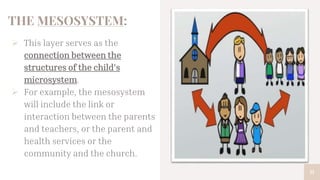
THE MESOSYSTEM:
 This layer serves as the
connection between the
structures of the child’s
microsystem.
 For example, the mesosystem
will include the link or
interaction between the parents
and teachers, or the parent and
health services or the
community and the church.
11
LET’S CONTINUE!
ELDRIAN LOUIE B. MANUYAG
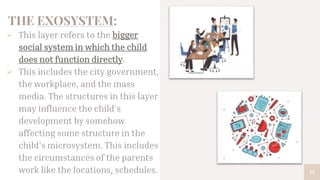
THE EXOSYSTEM:
 This layer refers to the bigger
social system in which the child
does not function directly.
 This includes the city government,
the workplace, and the mass
media. The structures in this layer
may influence the child’s
development by somehow
affecting some structure in the
child’s microsystem. This includes
the circumstances of the parents
work like the locations, schedules. 13
14
 We see a change in the children’s routine when for example the
mother works in a call center. That was seen in that burger chain
commercial where the mom and the children meet up at the fast-
food for breakfast just before the children go to school and the
mom going home from work in a call center.
 The child may not interact directly with what is in the exosystem,
but he is likely feel the positive or negative impact this system
creates as it interacts with the child’s own system.
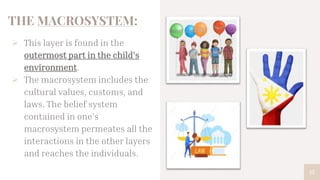
THE MACROSYSTEM:
 This layer is found in the
outermost part in the child’s
environment.
 The macrosystem includes the
cultural values, customs, and
laws. The belief system
contained in one’s
macrosystem permeates all the
interactions in the other layers
and reaches the individuals.
15
16
 For example, in western countries like the US, most of the young
people are expected to be more independent by the time they end
their teen-age years, while in Asian countries like ours, parents
are expected to support or at least want to support their children
for a longer period of time. It is not uncommon to see even
married children still living with their parents. In china and also
in other parts of the world, sons are more valuable than
daughters. This may pose challenges for girls as they are growing
up. Because the differences in beliefs and customs, children from
different parts of the world experience different child-rearing
practices and therefore differences in development as well.
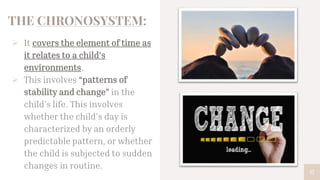
THE CHRONOSYSTEM:
 It covers the element of time as
it relates to a child’s
environments.
 This involves “patterns of
stability and change” in the
child’s life. This involves
whether the child’s day is
characterized by an orderly
predictable pattern, or whether
the child is subjected to sudden
changes in routine.
17
18
 We can also look into the pace of the child’s everyday life. Is it a
hurried or relaxed pace? This system can affect or influence the
child externally, like the time of other siblings coming or the
timing of parental separation or even death. Effect can also be
internal, like in the bodily changes that occur within the
developing child , like the timing of menstrual onset for girls. As
children get older, they may react differently to environmental
changes. The children may have also acquired the ability to cope
and decide to what extent they will allow changes around them to
affect them.
NO LONGER NATURE VS. NURTURE
19
 The long debate may be coming to an end. For decades, if not for centuries,
there was a long drawn debate on which had more impact on child
development, nature or nurture. Another way of putting it is, is it
hereditary or environment that influences child development more. More
and more research now point out that both a child’s biology and his
environment play a role in the child’s growth and development.
Development theories now stress on the role played by each and the
extent to which they interact in on-going development.
20
 The ecological system theory focuses on the quality and context of the
child’s environment. Bronfenbrenner pointed out that as a child develops,
the interplay within the layers of environment system becomes more
complex. This dynamic interaction of the systems happens meantime,
while the child’s physical and cognitive structures also grow and mature.
This bio ecological theory helps us determine how the different
circumstances , conditions and relationships in the world affect the child as
he or she goes through the more or else predictable sequence of natural
growth and development.
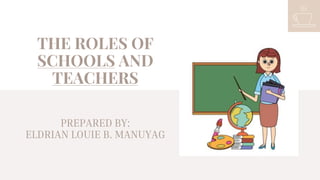
THE ROLES OF
SCHOOLS AND
TEACHERS
PREPARED BY:
ELDRIAN LOUIE B. MANUYAG
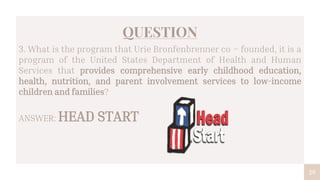
HEAD START
 Bronfenbrenner co-founded Head Start,
the publicly-funded early childhood
program in the US.
 Head Start is a program of the United
States Department of Health and Human
Services that provides comprehensive
early childhood education, health,
nutrition, and parent involvement
services to low-income children and
families.
22
BRONFENBRENNER
CONCLUDED THAT:
 “the instability and
unpredictability of family life is
the most destructive force to a
child’s development.”
 Researches tell us that absence
or lack of children’s constant
mutual interaction with
important adults has negative
effects on their development.
23
URIE BRONFENBRENNER
American Psychologist
24
 According to the biological theory, “if the relationships in the immediate
microsystem break down, the child will not have the tools to explore other
parts of his environment. Children looking for the affirmations that should
be present in the child/parent (or child/other important adult) relationship
look for attention in inappropriate places. These deficiencies show
themselves especially in adolescence as anti-social behavior, lack of self-
discipline, and inability to provide self-direction.”
.
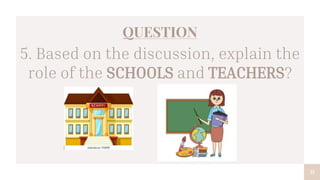
THE ROLES OF SCHOOLS
AND TEACHERS
 Bronfenbrenner’s theory
reminds the school and the
teachers of their very
important role.
 If there is a lack of support, care
and affection from the home, if
there is a serious breakdown of
the basic relationships in a
child’s life, what can the school,
the teachers in particular do?
25
26
 This theory helps teachers look into every child’s environmental system in
order to understand more about the characteristics and needs of each
child, each learner. The schools and the teachers can contribute stability
and long-term relationships, but only to support and not replace the
relationships in the home.
 Bronfenbrenner believes that, “the primary relationships needs to be with
someone who can provide a sense of caring that is meant to last a lifetime.
This relationship must be fostered by a person or people within the
immediate sphere of the child’s influence.”
“Schools and teachers’ crucial role is not to
replace the lack in the home if such exist, but to
work so that the school becomes an
environment that welcomes and nurtures
families. Bronfenbrenner also stressed that
society should value work done on behalf of
children at all levels, and consequently value
parents, teachers, extended family, mentors,
work supervisors, legislators,
27
28
QUESTIONS
1. In BRONFENBRENNER’S BIOECOLOGICAL MODEL: STRUCTURE OF
ENVIRONMENT, what do you call the layer that can be found in the
outermost part in the child’s environment?
ANSWER: MACROSYTEM
2. What layer involves “patterns of stability and change” in the child’s
life?
ANSWER: CHRONOSYSTEM
29
QUESTION
3. What is the program that Urie Bronfenbrenner co – founded, it is a
program of the United States Department of Health and Human
Services that provides comprehensive early childhood education,
health, nutrition, and parent involvement services to low-income
children and families?
ANSWER: HEAD START
30
QUESTION
4. “the instability and unpredictability of family life is the most
destructive force to a child’s development,” who said this statement?
ANSWER: URIE BRONFENBRENNER
31
QUESTION
5. Based on the discussion, explain the
role of the SCHOOLS and TEACHERS?
THANK YOU
FOR
LISTENING.
GOD BLESS US ALWAYS!
32
CREDITS:
Special thanks to all the people who made
and released these awesome resources for
free:
▫ Presentation template by
SlidesCarnival
33
OTHER
RESOURCES:
▫ https://www.firstdiscoverers.co.uk/wp-content/uploads/2018/09/UrieBronfenbrenner.jpg
▫ https://news.cornell.edu/sites/default/files/styles/breakout/public/2020-
01/bronfenbrenner.jpg?itok=AaaLILrE
▫ https://www.psychologynoteshq.com/wp-content/uploads/2013/11/bronfenbrenner-01.png
▫ https://www.nicepng.com/png/detail/0-273_ aunt-clipart-family-cartoon-family-of-3.png
▫ https://study.com/cimages/videopreview/screenshot1_ 113489.jpg
▫ https://thumbs.dreamstime.com/z/modern-office-workplace-scene-diverse-business-men-
women-brainstorming-meeting-flat-cartoon-characters-working-159878179.jpg
▫ https://images.squarespace-cdn.com/content/v1/5dc4628b8b0f251be08ca080/1573744196403-
VD906G8OQIVUW8A6QYOI/KS2-BALLOON-GROUP-FINAL.png
▫ https://www.kwintessential.co.uk/wp-content/uploads/2018/11/philippines-handflag.png
▫ https://previews.123rf.com/images/unitonevector/unitonevector1904/unitonevector190404294/1
22869004-lawyer-legal-advisor-holding-gavel-flat-character-cartoon-attorney-with-law-
symbols-human-rights-def.jpg
▫ https://images.squarespace-cdn.com/content/v1/5986733bd2b857274d15bb3a/1523269296187-
MDOI1A3I9FARICMY9UE4/image-asset.jpeg?format=1500w
▫ https://s21763.pcdn.co/wp-content/uploads/2018/09/Change.jpg
▫ https://cdn1.vectorstock.com/i/1000x1000/16/60/school-teacher-cartoon-vector-23981660.jpg
▫ https://image.shutterstock.com/image-vector/vector-illustration-school-building-cartoon-
260nw-579295987.jpg
▫ https://wcmcahs.com/wp-content/uploads/2020/06/hs-logo-white-shadow2.png 34

Bronfenbrenner’s Ecological Theory

  • 1.
    MODULE 10: BRONFENBRENNER’S ECOLOGICAL THEORY PREPAREDBY: ELDRIAN LOUIE B. MANUYAG BSED – 2A (FILIPINO)
  • 2.
    “ INTRODUCTION Bronfenbrenner cameup with a simple yet useful paradigm showing the different factors that exert influence on an individual’s development. It points out the ever widening spheres of influence that shape very individual, from his/her immediate family to the neighbourhood, the country, even the world! 2
  • 3.
  • 4.
    URIE BRONFENBRENNER American Psychologist UrieBronfenbrenner was a Russian-born American psychologist who is most known for his ecological systems theory. His work with the United States government helped in the formation of the Head Start program in 1965. Born: 29 April 1917, Moscow, Russia Died: 25 September 2005, Ithaca, New York, United States 4
  • 5.
    Bronfenbrenner’s Model alsoknown as the Bioecological System theory presents child development within the context of relationship system that comprise the child’s environment. It describes multipart layers of environment that has an effect on the development of the child. Each layer is further made up of different structures. The term “bioecological” points out that a child’s own biological make-up impacts as a key factor in one’s development. ▫ 5
  • 6.
    Through the child’sgrowing and developing body and the interplay between his immediate family/community environment, and the societal landscape fuels and steers his development. Changes and conflict in any one layer will ripple throughout other layers. To study a child’s development then, we must look not only at a child and her immediate environment, but also in the interaction of the larger environment as well. 6
  • 7.
  • 8.
  • 9.
    THE MICROSYSTEM:  isthe layer nearest the child.  It comprises structures with the child directly interacts with. It includes structures such as one’s family, school and neighbourhood. As such, the microsystem covers the most basic relationships and interactions that a child has in his/her immediate environment. 9
  • 10.
    10  Does thechild have strong and nurturing relationship with the parents and family? Are his/her needs met? in this layer, relationship effects happens in two directions – both away from the child and toward the child. This means that the child is affected by people with whom he interacts, and in turn this people are also affected by the child. For example, a mother’s deep affection for her child moves her to answer to the baby’s need and keep the baby safe. In turn the baby’s smiles and coos bring the mother feelings of warmth and an affirmation that indeed she is a good mother. The child is affected by the behavior and belief of the parents, however, the child also affects the behavior and beliefs of the parent.  Bronfenbrenner calls these bi-directional influences, and he shows how they occur among all levels of environment. This is quite similar to what Erikson termed as “mutuality” in his psychosocial theory.  Bronfenbrenner’s theory looks into the interaction of structures within a layer and interactions of structures between layers. At the microsystem level, the child is most affected by these bi-directional influences. However, interactions at outer layers still influence the structures of the microsystem.
  • 11.
    THE MESOSYSTEM:  Thislayer serves as the connection between the structures of the child’s microsystem.  For example, the mesosystem will include the link or interaction between the parents and teachers, or the parent and health services or the community and the church. 11
  • 12.
  • 13.
    THE EXOSYSTEM:  Thislayer refers to the bigger social system in which the child does not function directly.  This includes the city government, the workplace, and the mass media. The structures in this layer may influence the child’s development by somehow affecting some structure in the child’s microsystem. This includes the circumstances of the parents work like the locations, schedules. 13
  • 14.
    14  We seea change in the children’s routine when for example the mother works in a call center. That was seen in that burger chain commercial where the mom and the children meet up at the fast- food for breakfast just before the children go to school and the mom going home from work in a call center.  The child may not interact directly with what is in the exosystem, but he is likely feel the positive or negative impact this system creates as it interacts with the child’s own system.
  • 15.
    THE MACROSYSTEM:  Thislayer is found in the outermost part in the child’s environment.  The macrosystem includes the cultural values, customs, and laws. The belief system contained in one’s macrosystem permeates all the interactions in the other layers and reaches the individuals. 15
  • 16.
    16  For example,in western countries like the US, most of the young people are expected to be more independent by the time they end their teen-age years, while in Asian countries like ours, parents are expected to support or at least want to support their children for a longer period of time. It is not uncommon to see even married children still living with their parents. In china and also in other parts of the world, sons are more valuable than daughters. This may pose challenges for girls as they are growing up. Because the differences in beliefs and customs, children from different parts of the world experience different child-rearing practices and therefore differences in development as well.
  • 17.
    THE CHRONOSYSTEM:  Itcovers the element of time as it relates to a child’s environments.  This involves “patterns of stability and change” in the child’s life. This involves whether the child’s day is characterized by an orderly predictable pattern, or whether the child is subjected to sudden changes in routine. 17
  • 18.
    18  We canalso look into the pace of the child’s everyday life. Is it a hurried or relaxed pace? This system can affect or influence the child externally, like the time of other siblings coming or the timing of parental separation or even death. Effect can also be internal, like in the bodily changes that occur within the developing child , like the timing of menstrual onset for girls. As children get older, they may react differently to environmental changes. The children may have also acquired the ability to cope and decide to what extent they will allow changes around them to affect them.
  • 19.
    NO LONGER NATUREVS. NURTURE 19  The long debate may be coming to an end. For decades, if not for centuries, there was a long drawn debate on which had more impact on child development, nature or nurture. Another way of putting it is, is it hereditary or environment that influences child development more. More and more research now point out that both a child’s biology and his environment play a role in the child’s growth and development. Development theories now stress on the role played by each and the extent to which they interact in on-going development.
  • 20.
    20  The ecologicalsystem theory focuses on the quality and context of the child’s environment. Bronfenbrenner pointed out that as a child develops, the interplay within the layers of environment system becomes more complex. This dynamic interaction of the systems happens meantime, while the child’s physical and cognitive structures also grow and mature. This bio ecological theory helps us determine how the different circumstances , conditions and relationships in the world affect the child as he or she goes through the more or else predictable sequence of natural growth and development.
  • 21.
    THE ROLES OF SCHOOLSAND TEACHERS PREPARED BY: ELDRIAN LOUIE B. MANUYAG
  • 22.
    HEAD START  Bronfenbrennerco-founded Head Start, the publicly-funded early childhood program in the US.  Head Start is a program of the United States Department of Health and Human Services that provides comprehensive early childhood education, health, nutrition, and parent involvement services to low-income children and families. 22
  • 23.
    BRONFENBRENNER CONCLUDED THAT:  “theinstability and unpredictability of family life is the most destructive force to a child’s development.”  Researches tell us that absence or lack of children’s constant mutual interaction with important adults has negative effects on their development. 23 URIE BRONFENBRENNER American Psychologist
  • 24.
    24  According tothe biological theory, “if the relationships in the immediate microsystem break down, the child will not have the tools to explore other parts of his environment. Children looking for the affirmations that should be present in the child/parent (or child/other important adult) relationship look for attention in inappropriate places. These deficiencies show themselves especially in adolescence as anti-social behavior, lack of self- discipline, and inability to provide self-direction.” .
  • 25.
    THE ROLES OFSCHOOLS AND TEACHERS  Bronfenbrenner’s theory reminds the school and the teachers of their very important role.  If there is a lack of support, care and affection from the home, if there is a serious breakdown of the basic relationships in a child’s life, what can the school, the teachers in particular do? 25
  • 26.
    26  This theoryhelps teachers look into every child’s environmental system in order to understand more about the characteristics and needs of each child, each learner. The schools and the teachers can contribute stability and long-term relationships, but only to support and not replace the relationships in the home.  Bronfenbrenner believes that, “the primary relationships needs to be with someone who can provide a sense of caring that is meant to last a lifetime. This relationship must be fostered by a person or people within the immediate sphere of the child’s influence.”
  • 27.
    “Schools and teachers’crucial role is not to replace the lack in the home if such exist, but to work so that the school becomes an environment that welcomes and nurtures families. Bronfenbrenner also stressed that society should value work done on behalf of children at all levels, and consequently value parents, teachers, extended family, mentors, work supervisors, legislators, 27
  • 28.
    28 QUESTIONS 1. In BRONFENBRENNER’SBIOECOLOGICAL MODEL: STRUCTURE OF ENVIRONMENT, what do you call the layer that can be found in the outermost part in the child’s environment? ANSWER: MACROSYTEM 2. What layer involves “patterns of stability and change” in the child’s life? ANSWER: CHRONOSYSTEM
  • 29.
    29 QUESTION 3. What isthe program that Urie Bronfenbrenner co – founded, it is a program of the United States Department of Health and Human Services that provides comprehensive early childhood education, health, nutrition, and parent involvement services to low-income children and families? ANSWER: HEAD START
  • 30.
    30 QUESTION 4. “the instabilityand unpredictability of family life is the most destructive force to a child’s development,” who said this statement? ANSWER: URIE BRONFENBRENNER
  • 31.
    31 QUESTION 5. Based onthe discussion, explain the role of the SCHOOLS and TEACHERS?
  • 32.
  • 33.
    CREDITS: Special thanks toall the people who made and released these awesome resources for free: ▫ Presentation template by SlidesCarnival 33
  • 34.
    OTHER RESOURCES: ▫ https://www.firstdiscoverers.co.uk/wp-content/uploads/2018/09/UrieBronfenbrenner.jpg ▫ https://news.cornell.edu/sites/default/files/styles/breakout/public/2020- 01/bronfenbrenner.jpg?itok=AaaLILrE ▫https://www.psychologynoteshq.com/wp-content/uploads/2013/11/bronfenbrenner-01.png ▫ https://www.nicepng.com/png/detail/0-273_ aunt-clipart-family-cartoon-family-of-3.png ▫ https://study.com/cimages/videopreview/screenshot1_ 113489.jpg ▫ https://thumbs.dreamstime.com/z/modern-office-workplace-scene-diverse-business-men- women-brainstorming-meeting-flat-cartoon-characters-working-159878179.jpg ▫ https://images.squarespace-cdn.com/content/v1/5dc4628b8b0f251be08ca080/1573744196403- VD906G8OQIVUW8A6QYOI/KS2-BALLOON-GROUP-FINAL.png ▫ https://www.kwintessential.co.uk/wp-content/uploads/2018/11/philippines-handflag.png ▫ https://previews.123rf.com/images/unitonevector/unitonevector1904/unitonevector190404294/1 22869004-lawyer-legal-advisor-holding-gavel-flat-character-cartoon-attorney-with-law- symbols-human-rights-def.jpg ▫ https://images.squarespace-cdn.com/content/v1/5986733bd2b857274d15bb3a/1523269296187- MDOI1A3I9FARICMY9UE4/image-asset.jpeg?format=1500w ▫ https://s21763.pcdn.co/wp-content/uploads/2018/09/Change.jpg ▫ https://cdn1.vectorstock.com/i/1000x1000/16/60/school-teacher-cartoon-vector-23981660.jpg ▫ https://image.shutterstock.com/image-vector/vector-illustration-school-building-cartoon- 260nw-579295987.jpg ▫ https://wcmcahs.com/wp-content/uploads/2020/06/hs-logo-white-shadow2.png 34