สรุปเนื้อหาช่วยจา - ภาษาอังกฤษ ม. ปลาย
สรุปโครงสร้างในประโยคภาษาอังกฤษที่มักสับสน
Verb ที่มีกฎข ้อบังคับต่าง ๆ
Tense - Present, Past and Future tense
Condition (If cause) and unreal past
การเรียงคาคุณศัพท์ (Adjective)
การใช ้คาบุพบท (Preposition)
สานวนที่น่าจา เจอบ่อย !!
เทคนิคการทาข ้อสอบอังกฤษ O-NET
สรุปโครงสร้างในประโยคภาษาอังกฤษที่มักสับสน
1.
Kind
Type + of + sing.n. + V
Sort
This kind of car is economical.
Kinds
Types + of + pl.n. + V (pl.)
Sorts
These kinds of cars are economical.
2. Hundreds of …
Thousands of …
Millions of …
Dozens of …
Millions of animals are used in medical experiment each year.
hundred (of)
(Numberals) thousand (of)
Several +
Many million (of)
Dozen (of)
Two / Many hundred students were marching along the street.
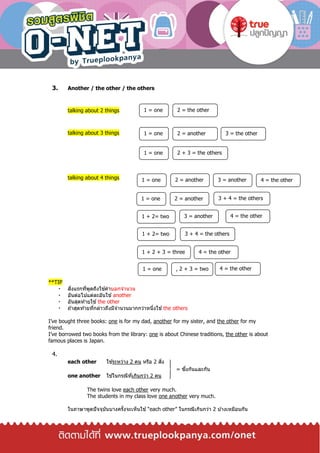
3. Another / the other / the others
talking about 2 things
talking about 3 things
talking about 4 things
**TIP
สิ่งแรกที่พูดถึงใช ้คาบอกจานวน
อันต่อไปแต่ละอันใช ้another
อันสุดท ้ายใช ้the other
ถ ้าสุดท ้ายที่กล่าวถึงมีจานวนมากกว่าหนึ่งใช ้the others
I’ve bought three books: one is for my dad, another for my sister, and the other for my
friend.
I’ve borrowed two books from the library: one is about Chinese traditions, the other is about
famous places is Japan.
4.
each other ใช ้ระหว่าง 2 คน หรือ 2 สิ่ง
= ซึ่งกันและกัน
one another ใช ้ในกรณีที่เกินกว่า 2 คน
The twins love each other very much.
The students in my class love one another very much.
ในภาษาพูดปัจจุบันบางครั้งจะเห็นใช ้“each other” ในกรณีเกินกว่า 2 บ ้างเหมือนกัน
1 = one 2 = the other
1 = one 2 = another 3 = the other
1 = one 2 + 3 = the others
1 = one 2 = another 3 = another 4 = the other
1 = one 2 = another 3 + 4 = the others
1 + 2= two 3 = another 4 = the other
1 + 2= two 3 + 4 = the others
1 + 2 + 3 = three 4 = the other
1 = one , 2 + 3 = two 4 = the other
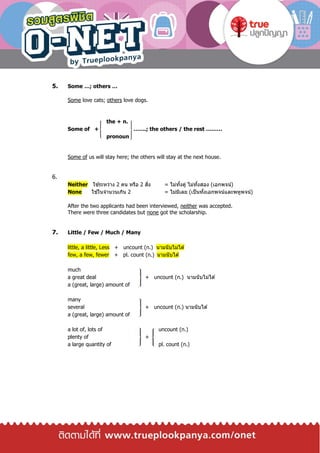
5. Some …; others …
Some love cats; others love dogs.
the + n.
Some of + …….; the others / the rest ………
pronoun
Some of us will stay here; the others will stay at the next house.
6.
Neither ใช ้ระหว่าง 2 คน หรือ 2 สิ่ง = ไม่ทั้งคู่ ไม่ทั้งสอง (เอกพจน์)
None ใช ้ในจานวนเกิน 2 = ไม่มีเลย (เป็นทั้งเอกพจน์และพหูพจน์)
After the two applicants had been interviewed, neither was accepted.
There were three candidates but none got the scholarship.
7. Little / Few / Much / Many
little, a little, Less + uncount (n.) นามนับไม่ได ้
few, a few, fewer + pl. count (n.) นามนับได ้
much
a great deal + uncount (n.) นามนับไม่ได ้
a (great, large) amount of
many
several + uncount (n.) นามนับได ้
a (great, large) amount of
a lot of, lots of uncount (n.)
plenty of +
a large quantity of pl. count (n.)
Verb ที่มีกฏข้อบังคับต่างๆ
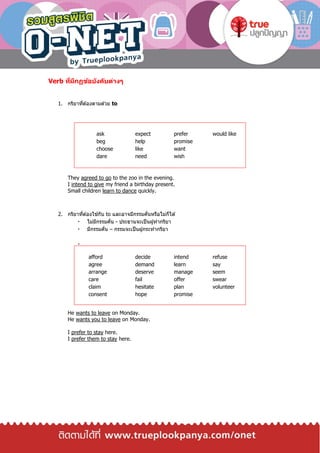
1. กริยาที่ต ้องตามด ้วย to
They agreed to go to the zoo in the evening.
I intend to give my friend a birthday present.
Small children learn to dance quickly.
2. กริยาที่ต ้องใช ้กับ to และอาจมีกรรมคั่นหรือไม่ก็ได ้
ไม่มีกรรมคั่น - ประธานจะเป็นผู้ทากริยา
มีกรรมคั่น – กรรมจะเป็นผู้กระทากริยา
He wants to leave on Monday.
He wants you to leave on Monday.
I prefer to stay here.
I prefer them to stay here.
ask expect prefer would like
beg help promise
choose like want
dare need wish
afford decide intend refuse
agree demand learn say
arrange deserve manage seem
care fail offer swear
claim hesitate plan volunteer
consent hope promise
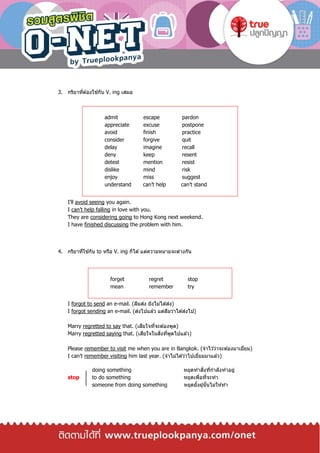
3. กริยาที่ต ้องใช ้กับ V. ing เสมอ
I’ll avoid seeing you again.
I can’t help falling in love with you.
They are considering going to Hong Kong next weekend.
I have finished discussing the problem with him.
4. กริยาที่ใช ้กับ to หรือ V. ing ก็ได ้แต่ความหมายจะต่างกัน
I forgot to send an e-mail. (ลืมส่ง ยังไม่ได ้ส่ง)
I forgot sending an e-mail. (ส่งไปแล ้ว แต่ลืมว่าได ้ส่งไป)
Marry regretted to say that. (เสียใจที่จะต ้องพูด)
Marry regretted saying that. (เสียใจในสิ่งที่พูดไปแล ้ว)
Please remember to visit me when you are in Bangkok. (จาไว ้ว่าจะต ้องมาเยี่ยม)
I can’t remember visiting him last year. (จาไม่ได ้ว่าไปเยี่ยมมาแล ้ว)
doing something หยุดทาสิ่งที่กาลังทาอยู่
stop to do something หยุดเพื่อที่จะทา
someone from doing something หยุดยั้งผู้นั้นไม่ให ้ทา
admit escape pardon
appreciate excuse postpone
avoid finish practice
consider forgive quit
delay imagine recall
deny keep resent
detest mention resist
dislike mind risk
enjoy miss suggest
understand can’t help can’t stand
forget regret stop
mean remember try
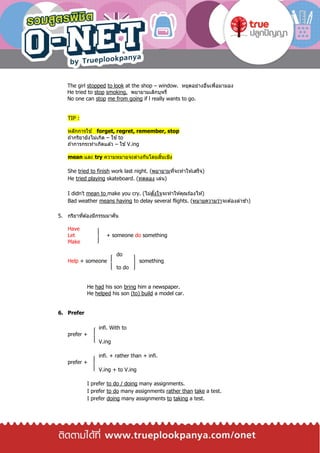
The girl stopped to look at the shop – window. หยุดอย่างอื่นเพื่อมามอง
He tried to stop smoking. พยายามเลิกบุหรี่
No one can stop me from going if l really wants to go.
TIP :
หลักการใช ้ forget, regret, remember, stop
ถ ้ากริยายังไม่เกิด – ใช ้to
ถ ้าการกระทาเกิดแล ้ว – ใช ้V.ing
mean และ try ความหมายจะต่างกันโดยสิ้นเชิง
She tried to finish work last night. (พยายามที่จะทาให ้เสร็จ)
He tried playing skateboard. (ทดลอง เล่น)
I didn’t mean to make you cry. (ไม่ตั้งใจจะทาให ้คุณร ้องไห ้)
Bad weather means having to delay several flights. (หมายความว่าจะต ้องล่าช ้า)
5. กริยาที่ต ้องมีกรรมมาคั่น
Have
Let + someone do something
Make
do
Help + someone something
to do
He had his son bring him a newspaper.
He helped his son (to) build a model car.
6. Prefer
infi. With to
prefer +
V.ing
infi. + rather than + infi.
prefer +
V.ing + to V.ing
I prefer to do / doing many assignments.
I prefer to do many assignments rather than take a test.
I prefer doing many assignments to taking a test.
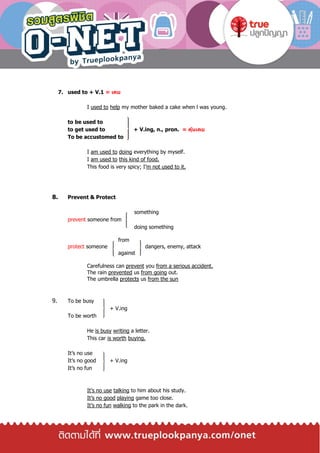
7. used to + V.1 = เคย
I used to help my mother baked a cake when l was young.
to be used to
to get used to + V.ing, n., pron. = คุ้นเคย
To be accustomed to
I am used to doing everything by myself.
I am used to this kind of food.
This food is very spicy; I’m not used to it.
8. Prevent & Protect
something
prevent someone from
doing something
from
protect someone dangers, enemy, attack
against
Carefulness can prevent you from a serious accident.
The rain prevented us from going out.
The umbrella protects us from the sun
9. To be busy
+ V.ing
To be worth
He is busy writing a letter.
This car is worth buying.
It’s no use
It’s no good + V.ing
It’s no fun
It’s no use talking to him about his study.
It’s no good playing game too close.
It’s no fun walking to the park in the dark.
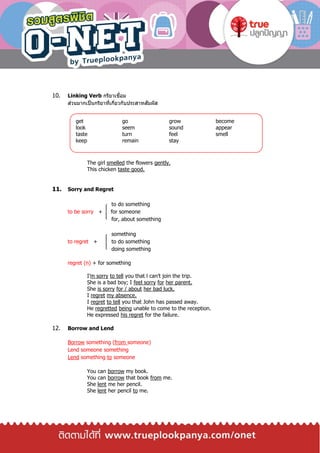
10. Linking Verb กริยาเชื่อม
ส่วนมากเป็นกริยาที่เกี่ยวกับประสาทสัมผัส
The girl smelled the flowers gently.
This chicken taste good.
11. Sorry and Regret
to do something
to be sorry + for someone
for, about something
something
to regret + to do something
doing something
regret (n) + for something
I’m sorry to tell you that l can’t join the trip.
She is a bad boy; I feel sorry for her parent.
She is sorry for / about her bad luck.
I regret my absence.
I regret to tell you that John has passed away.
He regretted being unable to come to the reception.
He expressed his regret for the failure.
12. Borrow and Lend
Borrow something (from someone)
Lend someone something
Lend something to someone
You can borrow my book.
You can borrow that book from me.
She lent me her pencil.
She lent her pencil to me.
get go grow become
look seem sound appear
taste turn feel smell
keep remain stay
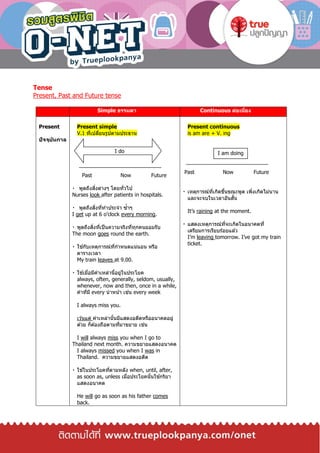
Tense
Present, Past and Future tense
Simple ธรรมดา Continuous ต่อเนื่อง
Present
ปัจจุบันกาล
Present simple
V.1 ที่เปลี่ยนรูปตามประธาน
Past Now Future
พูดถึงสิ่งต่างๆ โดยทั่วไป
Nurses look after patients in hospitals.
พูดถึงสิ่งที่ทาประจา ซ้าๆ
I get up at 6 o’clock every morning.
พูดถึงสิ่งที่เป็นความจริงที่ทุกคนยอมรับ
The moon goes round the earth.
ใช ้กับเหตุการณ์ที่กาหนดแน่นอน หรือ
ตารางเวลา
My train leaves at 9.00.
ใช ้เมื่อมีคาเหล่านี้อยู่ในประโยค
always, often, generally, seldom, usually,
whenever, now and then, once in a while,
คาที่มี every นาหน้า เช่น every week
I always miss you.
เว ้นแต่ คาเหล่านั้นมีแสดงอดีตหรืออนาคตอยู่
ด ้วย ก็ต ้องถือตามที่มาขยาย เช่น
I will always miss you when I go to
Thailand next month. ความขยายแสดงอนาคต
I always missed you when I was in
Thailand. ความขยายแสดงอดีต
ใช ้ในประโยคที่ตามหลัง when, until, after,
as soon as, unless เมื่อประโยคนั้นใช ้กริยา
แสดงอนาคต
He will go as soon as his father comes
back.
Present continuous
is am are + V. ing
Past Now Future
เหตุการณ์ที่เกิดขึ้นขณะพูด เพิ่งเกิดไม่นาน
และจะจบในเวลาอันสั้น
It’s raining at the moment.
แสดงเหตุการณ์ที่จะเกิดในอนาคตที่
เตรียมการเรียบร้อยแล ้ว
I’m leaving tomorrow. I’ve got my train
ticket.
I do I am doing
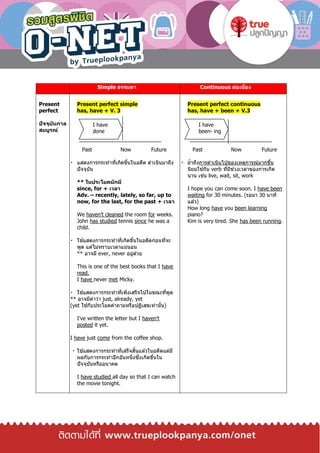
Simple ธรรมดา Continuous ต่อเนื่อง
Present
perfect
ปัจจุบันกาล
สมบูรณ์
Present perfect simple
has, have + V. 3
Past Now Future
แสดงการกระทาที่เกิดขึ้นในอดีต ดาเนินมาถึง
ปัจจุบัน
** ในประโยคมักมี
since, for + เวลา
Adv. – recently, lately, so far, up to
now, for the last, for the past + เวลา
We haven’t cleaned the room for weeks.
John has studied tennis since he was a
child.
ใช ้แสดงการกระทาที่เกิดขึ้นในอดีตก่อนที่จะ
พูด แต่ไม่ทราบเวลาแน่นอน
** อาจมี ever, never อยู่ด ้วย
This is one of the best books that I have
read.
I have never met Micky.
ใช ้แสดงการกระทาที่เพิ่งเสร็จไปในขณะที่พูด
** อาจมีคาว่า just, already, yet
(yet ใช ้กับประโยคคาถามหรือปฏิเสธเท่านั้น)
I’ve written the letter but I haven’t
posted it yet.
I have just come from the coffee shop.
ใช ้แสดงการกระทาที่เสร็จสิ้นแล ้วในอดีตแต่มี
ผลกับการกระทาอีกอันหนึ่งซึ่งเกิดขึ้นใน
ปัจจุบันหรืออนาคต
I have studied all day so that I can watch
the movie tonight.
Present perfect continuous
has, have + been + V.3
Past Now Future
ย้าถึงการดาเนินไปของเหตุการณ์มากขึ้น
นิยมใช ้กับ verb ที่มีช่วงเวลาของการเกิด
นาน เช่น live, wait, sit, work
I hope you can come soon. I have been
waiting for 30 minutes. (รอมา 30 นาที
แล ้ว)
How long have you been learning
piano?
Kim is very tired. She has been running.
I have
done
I have
been- ing
Simple ธรรมดา Continuous ต่อเนื่อง
Past
อดีตกาล
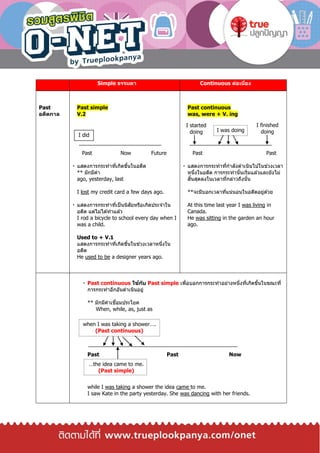
Past simple
V.2
Past Now Future
แสดงการกระทาที่เกิดขึ้นในอดีต
** มักมีคา
ago, yesterday, last
I lost my credit card a few days ago.
แสดงการกระทาที่เป็นนิสัยหรือเกิดประจาใน
อดีต แต่ไม่ได ้ทาแล ้ว
I rod a bicycle to school every day when I
was a child.
Used to + V.1
แสดงการกระทาที่เกิดขึ้นในช่วงเวลาหนึ่งใน
อดีต
He used to be a designer years ago.
Past continuous
was, were + V. ing
Past Past
แสดงการกระทาที่กาลังดาเนินไปในช่วงเวลา
หนึ่งในอดีต การกระทานั้นเริ่มแล ้วและยังไม่
สิ้นสุดลงในเวลาที่กล่าวถึงนั้น
**จะมีบอกเวลาที่แน่นอนในอดีตอยู่ด ้วย
At this time last year I was living in
Canada.
He was sitting in the garden an hour
ago.
Past continuous ใช้กับ Past simple เพื่อบอกการกระทาอย่างหนึ่งที่เกิดขึ้นในขณะที่
การกระทาอีกอันดาเนินอยู่
** มักมีคาเชื่อมประโยค
When, while, as, just as
Past Past Now
while I was taking a shower the idea came to me.
I saw Kate in the party yesterday. She was dancing with her friends.
I did
I was doing
I started
doing
I finished
doing
when I was taking a shower….
(Past continuous)
…the idea came to me.
(Past simple)
Simple ธรรมดา Continuous ต่อเนื่อง
Past
perfect
อดีตกาล
สมบูรณ์
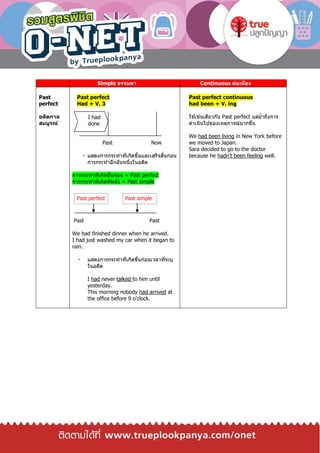
Past perfect
Had + V. 3
Past Now
แสดงการกระทาที่เกิดขึ้นและเสร็จสิ้นก่อน
การกระทาอีกอันหนึ่งในอดีต
การกระทาที่เกิดขึ้นก่อน = Past perfect
การกระทาที่เกิดทีหลัง = Past simple
Past Past
We had finished dinner when he arrived.
I had just washed my car when it began to
rain.
แสดงการกระทาที่เกิดขึ้นก่อนเวลาที่ระบุ
ในอดีต
I had never talked to him until
yesterday.
This morning nobody had arrived at
the office before 9 o’clock.
Past perfect continuous
had been + V. ing
ใช ้เช่นเดียวกับ Past perfect แต่ย้าถึงการ
ดาเนินไปของเหตุการณ์มากขึ้น
We had been living in New York before
we moved to Japan.
Sara decided to go to the doctor
because he hadn’t been feeling well.
I had
done
Past perfect Past simple
Simple ธรรมดา Continuous ต่อเนื่อง
Future
Simple
อนาคตกาล
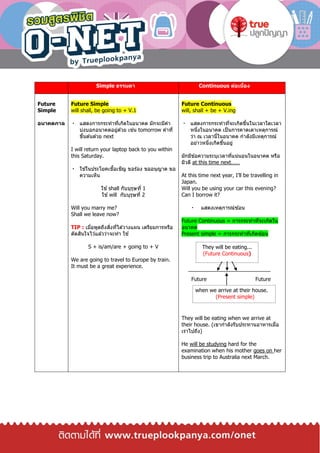
Future Simple
will shall, be going to + V.1
แสดงการกระทาที่เกิดในอนาคต มักจะมีคา
บ่งบอกอนาคตอยู่ด ้วย เช่น tomorrow คาที่
ขึ้นต ้นด ้วย next
I will return your laptop back to you within
this Saturday.
ใช ้ในประโยคเชื้อเชิญ ขอร้อง ขออนุญาต ขอ
ความเห็น
ใช ้shall กับบุรุษที่ 1
ใช ้will กับบุรุษที่ 2
Will you marry me?
Shall we leave now?
TIP : เมื่อพูดถึงสิ่งที่ได ้วางแผน เตรียมการหรือ
ตัดสินใจไว ้แล ้วว่าจะทา ใช ้
S + is/am/are + going to + V
We are going to travel to Europe by train.
It must be a great experience.
Future Continuous
will, shall + be + V.ing
แสดงการกระทาที่จะเกิดขึ้นในเวลาใดเวลา
หนึ่งในอนาคต เป็นการคาดเดาเหตุการณ์
ว่า ณ เวลานี้ในอนาคต กาลังมีเหตุการณ์
อย่าวหนึ่งเกิดขึ้นอยู่
มักมีข ้อความระบุเวลาที่แน่นอนในอนาคต หรือ
มีวลี at this time next……
At this time next year, I’ll be travelling in
Japan.
Will you be using your car this evening?
Can I borrow it?
แสดงเหตุการณ์ซ ้อน
Future Continuous = การกระทาที่จะเกิดใน
อนาคต
Present simple = การกระทาที่เกิดซ ้อน
Future Future
They will be eating when we arrive at
their house. (เขากาลังรับประทานอาหารเมื่อ
เราไปถึง)
He will be studying hard for the
examination when his mother goes on her
business trip to Australia next March.
They will be eating...
(Future Continuous)
when we arrive at their house.
(Present simple)
Simple ธรรมดา Continuous ต่อเนื่อง
Future
perfect
อนาคตกาล
สมบูรณ์
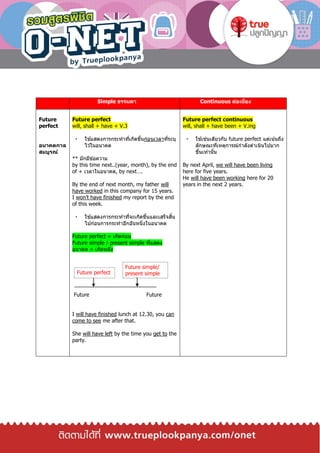
Future perfect
will, shall + have + V.3
ใช ้แสดงการกระทาที่เกิดขึ้นก่อนเวลาที่ระบุ
ไว ้ในอนาคต
** มักมีข ้อความ
by this time next..(year, month), by the end
of + เวลาในอนาคต, by next….
By the end of next month, my father will
have worked in this company for 15 years.
I won’t have finished my report by the end
of this week.
ใช ้แสดงการกระทาที่จะเกิดขึ้นและเสร็จสิ้น
ไปก่อนการกระทาอีกอันหนึ่งในอนาคต
Future perfect = เกิดก่อน
Future simple / present simple ที่แสดง
อนาคต = เกิดหลัง
Future Future
I will have finished lunch at 12.30, you can
come to see me after that.
She will have left by the time you get to the
party.
Future perfect continuous
will, shall + have been + V.ing
ใช ้เช่นเดียวกับ future perfect แต่เน้นถึง
ลักษณะที่เหตุการณ์กาลังดาเนินไปมาก
ขึ้นเท่านั้น
By next April, we will have been living
here for five years.
He will have been working here for 20
years in the next 2 years.
Future perfect
Future simple/
present simple
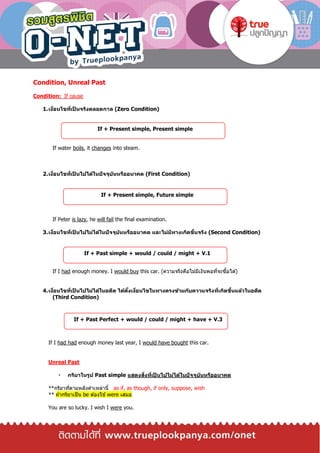
Condition, Unreal Past
Condition: If cause
1.เงื่อนไขที่เป็ นจริงตลอดกาล (Zero Condition)
If water boils, it changes into steam.
2.เงื่อนไขที่เป็ นไปได้ในปัจจุบันหรืออนาคต (First Condition)
If Peter is lazy, he will fail the final examination.
3.เงื่อนไขที่เป็ นไปไม่ได้ในปัจจุบันหรืออนาคต และไม่มีทางเกิดขึ้นจริง (Second Condition)
If I had enough money. I would buy this car. (ความจริงคือไม่มีเงินพอที่จะซื้อได ้)
4.เงื่อนไขที่เป็ นไปไม่ได้ในอดีต ได้ตั้งเงื่อนไขในทางตรงข้ามกับความจริงที่เกิดขึ้นแล้วในอดีต
(Third Condition)
If I had had enough money last year, I would have bought this car.
Unreal Past
กริยาในรูป Past simple แสดงสิ่งที่เป็ นไปไม่ได้ในปัจจุบันหรืออนาคต
**กริยาที่ตามหลังคาเหล่านี้ as if, as though, if only, suppose, wish
** ถ ้ากริยาเป็น be ต ้องใช ้were เสมอ
You are so lucky. I wish I were you.
If + Present simple, Present simple
If + Present simple, Future simple
If + Past simple + would / could / might + V.1
If + Past Perfect + would / could / might + have + V.3
He works as if he were a machine.
I wish you joined us more often.
กริยาในรูป Past perfect แสดงถึงสิ่งที่เป็ นไปไม่ได้ในอดีต
If you had come yesterday, I would have gone with you.
I wish he had visited us in Bangkok last week.
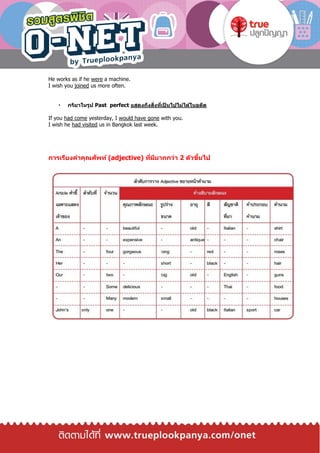
การเรียงคาคุณศัพท์ (adjective) ที่มีมากกว่า 2 ตัวขึ้นไป
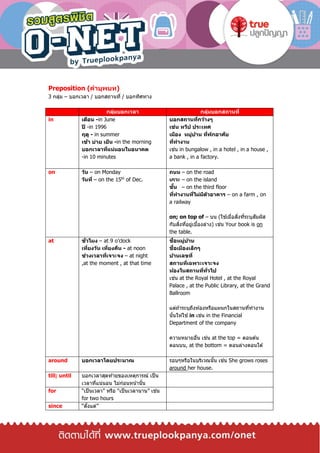
Preposition (คาบุพบท)
3 กลุ่ม – บอกเวลา / บอกสถานที่ / บอกทิศทาง
กลุ่มบอกเวลา กลุ่มบอกสถานที่
in เดือน -in June
ปี -in 1996
ฤดู - in summer
เช้า บ่าย เย็น -in the morning
บอกเวลาที่แน่นอนในอนาคต
-in 10 minutes
บอกสถานที่กว้างๆ
เช่น ทวีป ประเทศ
เมือง หมู่บ้าน ที่พักอาศัย
ที่ทางาน
เช่น in bungalow , in a hotel , in a house ,
a bank , in a factory.
on วัน – on Monday
วันที่ – on the 15th
of Dec.
ถนน – on the road
เกาะ – on the island
ชั้น – on the third floor
ที่ทางานที่ไม่มีตัวอาคาร – on a farm , on
a railway
on; on top of – บน (ใช ้เมื่อสิ่งที่ระบุสัมผัส
กับสิ่งที่อยู่เบื้องล่าง) เช่น Your book is on
the table.
at ชั่วโมง – at 9 o’clock
เที่ยงวัน เที่ยงคืน - at noon
ช่วงเวลาที่เจาะจง – at night
,at the moment , at that time
ชื่อหมู่บ้าน
ชื่อเมืองเล็กๆ
บ้านเลขที่
สถานที่เฉพาะเจาะจง
ห้องในสถานที่ทั่วไป
เช่น at the Royal Hotel , at the Royal
Palace , at the Public Library, at the Grand
Ballroom
แต่ถ ้าระบุถึงห ้องหรือแผนกในสถานที่ทางาน
นั้นให ้ใช ้in เช่น in the Financial
Department of the company
ความหมายอื่น เช่น at the top = ตอนต ้น
ตอนบน, at the bottom = ตอนล่างตอนใต ้
around บอกเวลาโดยประมาณ รอบๆหรือในบริเวณนั้น เช่น She grows roses
around her house.
till; until บอกเวลาสุดท ้ายของเหตุการณ์ เป็น
เวลาที่แน่นอน ไม่ก่อนหน้านั้น
for “เป็นเวลา” หรือ “เป็นเวลานาน” เช่น
for two hours
since “ตั้งแต่”
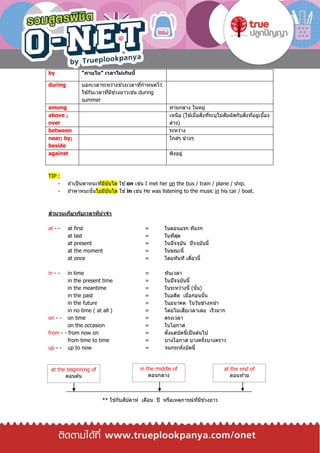
by “ภายใน” เวลาไม่เกินนี้
during บอกเวลาระหว่างช่วงเวลาที่กาหนดไว ้
ใช ้กับเวลาที่มีช่วงยาวเช่น during
summer
among ท่ามกลาง ในหมู่
above ;
over
เหนือ (ใช ้เมื่อสิ่งที่ระบุไม่สัมผัสกับสิ่งที่อยู่เบื้อง
ล่าง)
between ระหว่าง
near; by;
beside
ใกล ้ๆ ข ้างๆ
against พิงอยู่
TIP :
- ถ ้าเป็นพาหนะที่มีบันได ใช ้on เช่น I met her on the bus / train / plane / ship.
- ถ ้าพาหนะนั้นไม่มีบันได ใช ้in เช่น He was listening to the music in his car / boat.
สานวนเกี่ยวกับเวลาที่น่าจา
at - - at first = ในตอนแรก ทีแรก
at last = ในที่สุด
at present = ในปัจจุบัน ปัจจุบันนี้
at the moment = ในขณะนี้
at once = โดยทันที เดี๋ยวนี้
in - - in time = ทันเวลา
in the present time = ในปัจจุบันนี้
in the meantime = ในระหว่างนี้ (นั้น)
in the past = ในอดีต เมื่อก่อนนั้น
in the future = ในอนาคต ในวันข ้างหน้า
in no time ( at all ) = โดยไม่เสียเวลาเลย เร็วมาก
on - - on time = ตรงเวลา
on the occasion = ในโอกาส
from - - from now on = ตั้งแต่บัดนี้เป็นต ้นไป
from time to time = บางโอกาส บางครั้งบางคราว
up - - up to now = จนกระทั่งบัดนี้
** ใช ้กับสัปดาห์ เดือน ปี หรือเหตุการณ์ที่มีช่วงยาว
at the beginning of
ตอนต ้น
in the middle of
ตอนกลาง
at the end of
ตอนท ้าย
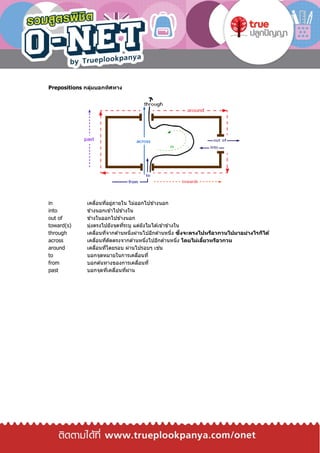
Prepositions กลุ่มบอกทิศทาง
in เคลื่อนที่อยู่ภายใน ไม่ออกไปข ้างนอก
into ข ้างนอกเข ้าไปข ้างใน
out of ข ้างในออกไปข ้างนอก
toward(s) มุ่งตรงไปยังจุดที่ระบุ แต่ยังไมได ้เข ้าข ้างใน
through เคลื่อนที่จากด ้านหนึ่งผ่านไปอีกด ้านหนึ่ง ซึ่งจะตรงไปหรือวกวนไปมาอย่างไรก็ได้
across เคลื่อนที่ตัดตรงจากด ้านหนึ่งไปอีกด ้านหนึ่ง โดยไม่เลี้ยวหรือวกวน
around เคลื่อนที่โดยรอบ ผ่านไปรอบๆ เช่น
to บอกจุดหมายในการเคลื่อนที่
from บอกต ้นทางของการเคลื่อนที่
past บอกจุดที่เคลื่อนที่ผ่าน
สานวนที่น่าจา เจอบ่อย !!
สานวนเกี่ยวกับเวลา
all along = from the very first (ตั้งแต่ต ้นมา)
for a while = for a short time (สักครู่หนึ่ง)
in a minute = soon (สักครู่เดียว)
in the same breath = at the same time (ในเวลาเดียวกัน)
round the clock = all day and all night (ทั้งวันทั้งคืน)
up-to-date = modern (ทันสมัย)
out of date = obsolete ; old-fashioned (ล ้าสมัย)
stay up late = not go to bed until late at night (อยู่ดึก)
take one’s time = need not hurry (ทาตามสบาย ไม่ต ้องรีบ)
สานวนน่าจาอื่นๆ
all in all = in total (รวมทั้งหมด)
back up = support; approve (สนับสนุน)
cut a class / a lecture = be absent from a class / a lecture (โดดเรียน)
down to earth = return to reality (อยู่ในโลกของความเป็นจริง)
for one thing = for one reason (เหตุผลประการหนึ่งคือ)
get sb. in trouble = cause sb. to be in trouble
(สร้างความยุ่งยากให ้สร้างปัญหาให ้)
give / lend sb. a hand = help (ช่วย)
give sb. a lift / ride = offer sb. a ride in a car or other vehicles
(ชวนขึ้นรถไปด ้วย)
go window-shopping = look at goods displayed in shop-window
(เดินดูของที่ตั้งโชว์โดยอาจไม่ตั้งใจจะซื้ออะไร)
good for nothing = worthless (ไม่มีค่า ไร้ประโยชน์)
have nothing to do with = have no dealing with (ไม่มีอะไรเกี่ยวข ้องกับ)
here and there = in various (ทั้งที่นั้นที่นี่ หลายแห่ง)
in common = similar (คล ้ายกัน)
in the clouds = day-dreaming (ฝันกลางวัน ใจลอย)
it doesn’t matter = it makes no difference (ไม่แตกต่าง ไม่มีผลอะไร)
jack of all trades = Person who can do anything (คนที่รู้สารพัดเรื่อง
คนที่ทางานได ้สารพัดอย่าง)
keep an eye on = watch over closely (เฝ้าดู จับตา)
learn sth. by heart = memorize it (ท่องจาได ้)
let sb. or sth. down = disappoint; fail to help (ทาให ้ผิดหวัง ไม่ช่วยเหลือ)
more or less = about (ประมาณ)
no end = very much or many (มากมาย)
no kidding = be honest; not deceive (พูดจริง ไม่ล ้อเล่น ไม่หลอก)
no wonder = not surprising (ไม่น่าแปลกใจ)
not bad /not so bad / not half bad= quite good (ไม่เลว ดีทีเดียว)
on one’s own = alone (ลาพังคนเดียว)
once more = again ; one more time (อีกครั้งหนึ่ง)
out of order = mechanically deficient (เสีย ขัดข ้อง)
out of use = no longer use (เลิกใช ้แล ้ว)
out of the common = unusual (ไม่ธรรมดา)
out of the ordinary = unusual (ไม่ปกติ ไม่ธรรมดา)
pick someone up = collect a person (or thing) in a car (รับขึ้นรถ)
pull one ’s leg = try to make sb. believe sth. That is untrue,
usually for a joke (หลอกเล่น)
read between the lines = find more meaning than the words appear to
express (เข ้าใจความหมายที่แฝงอยู่)
run out of sth. = sth. Is all used up, no more left (ใช ้หมด)
sleep like a log / top = sleep very soundly (หลับสนิท)
stand up for someone = support (สนับสนุน)
step by step = gradually (ทีละน้อย ทีละขั้น)
take advantage of sb. = deceive sb. ; play a trick on sb. (เอาเปรียบ)
take part (in) = have a share (in) (มีส่วนร่วม)
take turns (at, about) = do it in turn (ผลัดกันทา)
white lie = lie considered to be harmless
(การพูดปดโดยไม่มีเจตนาร้าย ส่วนมากเพื่อให ้ผู้ฟัง
เกิดความสบายใจ)
เทคนิคการทาข้อสอบอังกฤษ O-NET ม.6
Conversation /Reading
อ่านให ้เห็นภาพกว ้าง ๆ
ตัด Choice ที่คิดว่าไม่ใช่ออกไป
Reading พวก graph, chart พวกพยายามดูตัวเลข ข ้อมูล และไปดูคาตอบใน choice
ไม่จาเป็นต ้องทาเรียงข ้อ ข ้อที่ทาได ้ง่ายก่อน คือ ข ้อที่ถามพวกตัวเลข
ไม่ต ้องแปลทุกตัว พยายามเก็บ keywords ที่สาคัญ
อ่านคาถาม > ตอบตัวเองก่อน > ไล่ดูตัวเลือกที่ตรงใจ
Writing – เติมคาที่เหมาะสมในประโยค
จาสานวนต่างๆ / active voice หรือ passive voice เป็นผู้กระทาหรือถูกกระทา / tense ต่างๆ
หาประธานและกริยา และส่วนขยายของประโยค
Error Recognition
อ่านให ้เห็นภาพกว ้าง ๆ
พยายามแยกประโยค - หาประธานและกริยา และส่วนขยายของประโยค
ดูพวกคาที่ไม่ได ้ขีดเส ้นใต ้เป็นตัวช่วยเดา
ตัด Choice ที่คิดว่าไม่ใช่ออกไป
ถ ้าคาถามเกี่ยวกับเหตุการณ์เฉพาะ ควรจะใช ้past tense ถ ้าคาถามเกี่ยวกับเหตุการณ์ทั่วไปควร
จะใช ้present tense
ถ ้าคิดว่าทุกอย่างเหมือนจะถูกหมดแล ้ว ให ้มาเชคคาบุพบท ( preposition)
Vocabulary
มี 2 ส่วน คือ
1. Meaning in context เว ้นช่อง เติมคา เลือกศัพท์ให ้เหมาะสม
2. Meaning recognition ให ้หาคาศัพท์ที่มีความหมายเหมือนกับคาที่เค ้าขีดเส ้นมาให ้
อ่านให ้เห็นภาพกว ้าง ๆ
จาศัพท์ให ้ได ้ในระดับหนึ่ง ไม่ต ้องรู้ศัพท์ทุกตัว พยายามเดาและตัด Choice ที่คิดว่า
ไม่ใช่ออกไป
มองหาคาที่คล ้ายๆ กันในประโยค หรือส่วนประกอบของประโยคข ้างๆ เอามาเดา
ความหมายได ้

สรุปภาษาอังกฤษ

  • 1.
    สรุปเนื้อหาช่วยจา - ภาษาอังกฤษม. ปลาย สรุปโครงสร้างในประโยคภาษาอังกฤษที่มักสับสน Verb ที่มีกฎข ้อบังคับต่าง ๆ Tense - Present, Past and Future tense Condition (If cause) and unreal past การเรียงคาคุณศัพท์ (Adjective) การใช ้คาบุพบท (Preposition) สานวนที่น่าจา เจอบ่อย !! เทคนิคการทาข ้อสอบอังกฤษ O-NET สรุปโครงสร้างในประโยคภาษาอังกฤษที่มักสับสน 1. Kind Type + of + sing.n. + V Sort This kind of car is economical. Kinds Types + of + pl.n. + V (pl.) Sorts These kinds of cars are economical. 2. Hundreds of … Thousands of … Millions of … Dozens of … Millions of animals are used in medical experiment each year. hundred (of) (Numberals) thousand (of) Several + Many million (of) Dozen (of) Two / Many hundred students were marching along the street.
  • 2.
    3. Another /the other / the others talking about 2 things talking about 3 things talking about 4 things **TIP สิ่งแรกที่พูดถึงใช ้คาบอกจานวน อันต่อไปแต่ละอันใช ้another อันสุดท ้ายใช ้the other ถ ้าสุดท ้ายที่กล่าวถึงมีจานวนมากกว่าหนึ่งใช ้the others I’ve bought three books: one is for my dad, another for my sister, and the other for my friend. I’ve borrowed two books from the library: one is about Chinese traditions, the other is about famous places is Japan. 4. each other ใช ้ระหว่าง 2 คน หรือ 2 สิ่ง = ซึ่งกันและกัน one another ใช ้ในกรณีที่เกินกว่า 2 คน The twins love each other very much. The students in my class love one another very much. ในภาษาพูดปัจจุบันบางครั้งจะเห็นใช ้“each other” ในกรณีเกินกว่า 2 บ ้างเหมือนกัน 1 = one 2 = the other 1 = one 2 = another 3 = the other 1 = one 2 + 3 = the others 1 = one 2 = another 3 = another 4 = the other 1 = one 2 = another 3 + 4 = the others 1 + 2= two 3 = another 4 = the other 1 + 2= two 3 + 4 = the others 1 + 2 + 3 = three 4 = the other 1 = one , 2 + 3 = two 4 = the other
  • 3.
    5. Some …;others … Some love cats; others love dogs. the + n. Some of + …….; the others / the rest ……… pronoun Some of us will stay here; the others will stay at the next house. 6. Neither ใช ้ระหว่าง 2 คน หรือ 2 สิ่ง = ไม่ทั้งคู่ ไม่ทั้งสอง (เอกพจน์) None ใช ้ในจานวนเกิน 2 = ไม่มีเลย (เป็นทั้งเอกพจน์และพหูพจน์) After the two applicants had been interviewed, neither was accepted. There were three candidates but none got the scholarship. 7. Little / Few / Much / Many little, a little, Less + uncount (n.) นามนับไม่ได ้ few, a few, fewer + pl. count (n.) นามนับได ้ much a great deal + uncount (n.) นามนับไม่ได ้ a (great, large) amount of many several + uncount (n.) นามนับได ้ a (great, large) amount of a lot of, lots of uncount (n.) plenty of + a large quantity of pl. count (n.)
  • 4.
    Verb ที่มีกฏข้อบังคับต่างๆ 1. กริยาที่ต้องตามด ้วย to They agreed to go to the zoo in the evening. I intend to give my friend a birthday present. Small children learn to dance quickly. 2. กริยาที่ต ้องใช ้กับ to และอาจมีกรรมคั่นหรือไม่ก็ได ้ ไม่มีกรรมคั่น - ประธานจะเป็นผู้ทากริยา มีกรรมคั่น – กรรมจะเป็นผู้กระทากริยา He wants to leave on Monday. He wants you to leave on Monday. I prefer to stay here. I prefer them to stay here. ask expect prefer would like beg help promise choose like want dare need wish afford decide intend refuse agree demand learn say arrange deserve manage seem care fail offer swear claim hesitate plan volunteer consent hope promise
  • 5.
    3. กริยาที่ต ้องใช้กับ V. ing เสมอ I’ll avoid seeing you again. I can’t help falling in love with you. They are considering going to Hong Kong next weekend. I have finished discussing the problem with him. 4. กริยาที่ใช ้กับ to หรือ V. ing ก็ได ้แต่ความหมายจะต่างกัน I forgot to send an e-mail. (ลืมส่ง ยังไม่ได ้ส่ง) I forgot sending an e-mail. (ส่งไปแล ้ว แต่ลืมว่าได ้ส่งไป) Marry regretted to say that. (เสียใจที่จะต ้องพูด) Marry regretted saying that. (เสียใจในสิ่งที่พูดไปแล ้ว) Please remember to visit me when you are in Bangkok. (จาไว ้ว่าจะต ้องมาเยี่ยม) I can’t remember visiting him last year. (จาไม่ได ้ว่าไปเยี่ยมมาแล ้ว) doing something หยุดทาสิ่งที่กาลังทาอยู่ stop to do something หยุดเพื่อที่จะทา someone from doing something หยุดยั้งผู้นั้นไม่ให ้ทา admit escape pardon appreciate excuse postpone avoid finish practice consider forgive quit delay imagine recall deny keep resent detest mention resist dislike mind risk enjoy miss suggest understand can’t help can’t stand forget regret stop mean remember try
  • 6.
    The girl stoppedto look at the shop – window. หยุดอย่างอื่นเพื่อมามอง He tried to stop smoking. พยายามเลิกบุหรี่ No one can stop me from going if l really wants to go. TIP : หลักการใช ้ forget, regret, remember, stop ถ ้ากริยายังไม่เกิด – ใช ้to ถ ้าการกระทาเกิดแล ้ว – ใช ้V.ing mean และ try ความหมายจะต่างกันโดยสิ้นเชิง She tried to finish work last night. (พยายามที่จะทาให ้เสร็จ) He tried playing skateboard. (ทดลอง เล่น) I didn’t mean to make you cry. (ไม่ตั้งใจจะทาให ้คุณร ้องไห ้) Bad weather means having to delay several flights. (หมายความว่าจะต ้องล่าช ้า) 5. กริยาที่ต ้องมีกรรมมาคั่น Have Let + someone do something Make do Help + someone something to do He had his son bring him a newspaper. He helped his son (to) build a model car. 6. Prefer infi. With to prefer + V.ing infi. + rather than + infi. prefer + V.ing + to V.ing I prefer to do / doing many assignments. I prefer to do many assignments rather than take a test. I prefer doing many assignments to taking a test.
  • 7.
    7. used to+ V.1 = เคย I used to help my mother baked a cake when l was young. to be used to to get used to + V.ing, n., pron. = คุ้นเคย To be accustomed to I am used to doing everything by myself. I am used to this kind of food. This food is very spicy; I’m not used to it. 8. Prevent & Protect something prevent someone from doing something from protect someone dangers, enemy, attack against Carefulness can prevent you from a serious accident. The rain prevented us from going out. The umbrella protects us from the sun 9. To be busy + V.ing To be worth He is busy writing a letter. This car is worth buying. It’s no use It’s no good + V.ing It’s no fun It’s no use talking to him about his study. It’s no good playing game too close. It’s no fun walking to the park in the dark.
  • 8.
    10. Linking Verbกริยาเชื่อม ส่วนมากเป็นกริยาที่เกี่ยวกับประสาทสัมผัส The girl smelled the flowers gently. This chicken taste good. 11. Sorry and Regret to do something to be sorry + for someone for, about something something to regret + to do something doing something regret (n) + for something I’m sorry to tell you that l can’t join the trip. She is a bad boy; I feel sorry for her parent. She is sorry for / about her bad luck. I regret my absence. I regret to tell you that John has passed away. He regretted being unable to come to the reception. He expressed his regret for the failure. 12. Borrow and Lend Borrow something (from someone) Lend someone something Lend something to someone You can borrow my book. You can borrow that book from me. She lent me her pencil. She lent her pencil to me. get go grow become look seem sound appear taste turn feel smell keep remain stay
  • 9.
    Tense Present, Past andFuture tense Simple ธรรมดา Continuous ต่อเนื่อง Present ปัจจุบันกาล Present simple V.1 ที่เปลี่ยนรูปตามประธาน Past Now Future พูดถึงสิ่งต่างๆ โดยทั่วไป Nurses look after patients in hospitals. พูดถึงสิ่งที่ทาประจา ซ้าๆ I get up at 6 o’clock every morning. พูดถึงสิ่งที่เป็นความจริงที่ทุกคนยอมรับ The moon goes round the earth. ใช ้กับเหตุการณ์ที่กาหนดแน่นอน หรือ ตารางเวลา My train leaves at 9.00. ใช ้เมื่อมีคาเหล่านี้อยู่ในประโยค always, often, generally, seldom, usually, whenever, now and then, once in a while, คาที่มี every นาหน้า เช่น every week I always miss you. เว ้นแต่ คาเหล่านั้นมีแสดงอดีตหรืออนาคตอยู่ ด ้วย ก็ต ้องถือตามที่มาขยาย เช่น I will always miss you when I go to Thailand next month. ความขยายแสดงอนาคต I always missed you when I was in Thailand. ความขยายแสดงอดีต ใช ้ในประโยคที่ตามหลัง when, until, after, as soon as, unless เมื่อประโยคนั้นใช ้กริยา แสดงอนาคต He will go as soon as his father comes back. Present continuous is am are + V. ing Past Now Future เหตุการณ์ที่เกิดขึ้นขณะพูด เพิ่งเกิดไม่นาน และจะจบในเวลาอันสั้น It’s raining at the moment. แสดงเหตุการณ์ที่จะเกิดในอนาคตที่ เตรียมการเรียบร้อยแล ้ว I’m leaving tomorrow. I’ve got my train ticket. I do I am doing
  • 10.
    Simple ธรรมดา Continuousต่อเนื่อง Present perfect ปัจจุบันกาล สมบูรณ์ Present perfect simple has, have + V. 3 Past Now Future แสดงการกระทาที่เกิดขึ้นในอดีต ดาเนินมาถึง ปัจจุบัน ** ในประโยคมักมี since, for + เวลา Adv. – recently, lately, so far, up to now, for the last, for the past + เวลา We haven’t cleaned the room for weeks. John has studied tennis since he was a child. ใช ้แสดงการกระทาที่เกิดขึ้นในอดีตก่อนที่จะ พูด แต่ไม่ทราบเวลาแน่นอน ** อาจมี ever, never อยู่ด ้วย This is one of the best books that I have read. I have never met Micky. ใช ้แสดงการกระทาที่เพิ่งเสร็จไปในขณะที่พูด ** อาจมีคาว่า just, already, yet (yet ใช ้กับประโยคคาถามหรือปฏิเสธเท่านั้น) I’ve written the letter but I haven’t posted it yet. I have just come from the coffee shop. ใช ้แสดงการกระทาที่เสร็จสิ้นแล ้วในอดีตแต่มี ผลกับการกระทาอีกอันหนึ่งซึ่งเกิดขึ้นใน ปัจจุบันหรืออนาคต I have studied all day so that I can watch the movie tonight. Present perfect continuous has, have + been + V.3 Past Now Future ย้าถึงการดาเนินไปของเหตุการณ์มากขึ้น นิยมใช ้กับ verb ที่มีช่วงเวลาของการเกิด นาน เช่น live, wait, sit, work I hope you can come soon. I have been waiting for 30 minutes. (รอมา 30 นาที แล ้ว) How long have you been learning piano? Kim is very tired. She has been running. I have done I have been- ing
  • 11.
    Simple ธรรมดา Continuousต่อเนื่อง Past อดีตกาล Past simple V.2 Past Now Future แสดงการกระทาที่เกิดขึ้นในอดีต ** มักมีคา ago, yesterday, last I lost my credit card a few days ago. แสดงการกระทาที่เป็นนิสัยหรือเกิดประจาใน อดีต แต่ไม่ได ้ทาแล ้ว I rod a bicycle to school every day when I was a child. Used to + V.1 แสดงการกระทาที่เกิดขึ้นในช่วงเวลาหนึ่งใน อดีต He used to be a designer years ago. Past continuous was, were + V. ing Past Past แสดงการกระทาที่กาลังดาเนินไปในช่วงเวลา หนึ่งในอดีต การกระทานั้นเริ่มแล ้วและยังไม่ สิ้นสุดลงในเวลาที่กล่าวถึงนั้น **จะมีบอกเวลาที่แน่นอนในอดีตอยู่ด ้วย At this time last year I was living in Canada. He was sitting in the garden an hour ago. Past continuous ใช้กับ Past simple เพื่อบอกการกระทาอย่างหนึ่งที่เกิดขึ้นในขณะที่ การกระทาอีกอันดาเนินอยู่ ** มักมีคาเชื่อมประโยค When, while, as, just as Past Past Now while I was taking a shower the idea came to me. I saw Kate in the party yesterday. She was dancing with her friends. I did I was doing I started doing I finished doing when I was taking a shower…. (Past continuous) …the idea came to me. (Past simple)
  • 12.
    Simple ธรรมดา Continuousต่อเนื่อง Past perfect อดีตกาล สมบูรณ์ Past perfect Had + V. 3 Past Now แสดงการกระทาที่เกิดขึ้นและเสร็จสิ้นก่อน การกระทาอีกอันหนึ่งในอดีต การกระทาที่เกิดขึ้นก่อน = Past perfect การกระทาที่เกิดทีหลัง = Past simple Past Past We had finished dinner when he arrived. I had just washed my car when it began to rain. แสดงการกระทาที่เกิดขึ้นก่อนเวลาที่ระบุ ในอดีต I had never talked to him until yesterday. This morning nobody had arrived at the office before 9 o’clock. Past perfect continuous had been + V. ing ใช ้เช่นเดียวกับ Past perfect แต่ย้าถึงการ ดาเนินไปของเหตุการณ์มากขึ้น We had been living in New York before we moved to Japan. Sara decided to go to the doctor because he hadn’t been feeling well. I had done Past perfect Past simple
  • 13.
    Simple ธรรมดา Continuousต่อเนื่อง Future Simple อนาคตกาล Future Simple will shall, be going to + V.1 แสดงการกระทาที่เกิดในอนาคต มักจะมีคา บ่งบอกอนาคตอยู่ด ้วย เช่น tomorrow คาที่ ขึ้นต ้นด ้วย next I will return your laptop back to you within this Saturday. ใช ้ในประโยคเชื้อเชิญ ขอร้อง ขออนุญาต ขอ ความเห็น ใช ้shall กับบุรุษที่ 1 ใช ้will กับบุรุษที่ 2 Will you marry me? Shall we leave now? TIP : เมื่อพูดถึงสิ่งที่ได ้วางแผน เตรียมการหรือ ตัดสินใจไว ้แล ้วว่าจะทา ใช ้ S + is/am/are + going to + V We are going to travel to Europe by train. It must be a great experience. Future Continuous will, shall + be + V.ing แสดงการกระทาที่จะเกิดขึ้นในเวลาใดเวลา หนึ่งในอนาคต เป็นการคาดเดาเหตุการณ์ ว่า ณ เวลานี้ในอนาคต กาลังมีเหตุการณ์ อย่าวหนึ่งเกิดขึ้นอยู่ มักมีข ้อความระบุเวลาที่แน่นอนในอนาคต หรือ มีวลี at this time next…… At this time next year, I’ll be travelling in Japan. Will you be using your car this evening? Can I borrow it? แสดงเหตุการณ์ซ ้อน Future Continuous = การกระทาที่จะเกิดใน อนาคต Present simple = การกระทาที่เกิดซ ้อน Future Future They will be eating when we arrive at their house. (เขากาลังรับประทานอาหารเมื่อ เราไปถึง) He will be studying hard for the examination when his mother goes on her business trip to Australia next March. They will be eating... (Future Continuous) when we arrive at their house. (Present simple)
  • 14.
    Simple ธรรมดา Continuousต่อเนื่อง Future perfect อนาคตกาล สมบูรณ์ Future perfect will, shall + have + V.3 ใช ้แสดงการกระทาที่เกิดขึ้นก่อนเวลาที่ระบุ ไว ้ในอนาคต ** มักมีข ้อความ by this time next..(year, month), by the end of + เวลาในอนาคต, by next…. By the end of next month, my father will have worked in this company for 15 years. I won’t have finished my report by the end of this week. ใช ้แสดงการกระทาที่จะเกิดขึ้นและเสร็จสิ้น ไปก่อนการกระทาอีกอันหนึ่งในอนาคต Future perfect = เกิดก่อน Future simple / present simple ที่แสดง อนาคต = เกิดหลัง Future Future I will have finished lunch at 12.30, you can come to see me after that. She will have left by the time you get to the party. Future perfect continuous will, shall + have been + V.ing ใช ้เช่นเดียวกับ future perfect แต่เน้นถึง ลักษณะที่เหตุการณ์กาลังดาเนินไปมาก ขึ้นเท่านั้น By next April, we will have been living here for five years. He will have been working here for 20 years in the next 2 years. Future perfect Future simple/ present simple
  • 15.
    Condition, Unreal Past Condition:If cause 1.เงื่อนไขที่เป็ นจริงตลอดกาล (Zero Condition) If water boils, it changes into steam. 2.เงื่อนไขที่เป็ นไปได้ในปัจจุบันหรืออนาคต (First Condition) If Peter is lazy, he will fail the final examination. 3.เงื่อนไขที่เป็ นไปไม่ได้ในปัจจุบันหรืออนาคต และไม่มีทางเกิดขึ้นจริง (Second Condition) If I had enough money. I would buy this car. (ความจริงคือไม่มีเงินพอที่จะซื้อได ้) 4.เงื่อนไขที่เป็ นไปไม่ได้ในอดีต ได้ตั้งเงื่อนไขในทางตรงข้ามกับความจริงที่เกิดขึ้นแล้วในอดีต (Third Condition) If I had had enough money last year, I would have bought this car. Unreal Past กริยาในรูป Past simple แสดงสิ่งที่เป็ นไปไม่ได้ในปัจจุบันหรืออนาคต **กริยาที่ตามหลังคาเหล่านี้ as if, as though, if only, suppose, wish ** ถ ้ากริยาเป็น be ต ้องใช ้were เสมอ You are so lucky. I wish I were you. If + Present simple, Present simple If + Present simple, Future simple If + Past simple + would / could / might + V.1 If + Past Perfect + would / could / might + have + V.3
  • 16.
    He works asif he were a machine. I wish you joined us more often. กริยาในรูป Past perfect แสดงถึงสิ่งที่เป็ นไปไม่ได้ในอดีต If you had come yesterday, I would have gone with you. I wish he had visited us in Bangkok last week. การเรียงคาคุณศัพท์ (adjective) ที่มีมากกว่า 2 ตัวขึ้นไป
  • 17.
    Preposition (คาบุพบท) 3 กลุ่ม– บอกเวลา / บอกสถานที่ / บอกทิศทาง กลุ่มบอกเวลา กลุ่มบอกสถานที่ in เดือน -in June ปี -in 1996 ฤดู - in summer เช้า บ่าย เย็น -in the morning บอกเวลาที่แน่นอนในอนาคต -in 10 minutes บอกสถานที่กว้างๆ เช่น ทวีป ประเทศ เมือง หมู่บ้าน ที่พักอาศัย ที่ทางาน เช่น in bungalow , in a hotel , in a house , a bank , in a factory. on วัน – on Monday วันที่ – on the 15th of Dec. ถนน – on the road เกาะ – on the island ชั้น – on the third floor ที่ทางานที่ไม่มีตัวอาคาร – on a farm , on a railway on; on top of – บน (ใช ้เมื่อสิ่งที่ระบุสัมผัส กับสิ่งที่อยู่เบื้องล่าง) เช่น Your book is on the table. at ชั่วโมง – at 9 o’clock เที่ยงวัน เที่ยงคืน - at noon ช่วงเวลาที่เจาะจง – at night ,at the moment , at that time ชื่อหมู่บ้าน ชื่อเมืองเล็กๆ บ้านเลขที่ สถานที่เฉพาะเจาะจง ห้องในสถานที่ทั่วไป เช่น at the Royal Hotel , at the Royal Palace , at the Public Library, at the Grand Ballroom แต่ถ ้าระบุถึงห ้องหรือแผนกในสถานที่ทางาน นั้นให ้ใช ้in เช่น in the Financial Department of the company ความหมายอื่น เช่น at the top = ตอนต ้น ตอนบน, at the bottom = ตอนล่างตอนใต ้ around บอกเวลาโดยประมาณ รอบๆหรือในบริเวณนั้น เช่น She grows roses around her house. till; until บอกเวลาสุดท ้ายของเหตุการณ์ เป็น เวลาที่แน่นอน ไม่ก่อนหน้านั้น for “เป็นเวลา” หรือ “เป็นเวลานาน” เช่น for two hours since “ตั้งแต่”
  • 18.
    by “ภายใน” เวลาไม่เกินนี้ duringบอกเวลาระหว่างช่วงเวลาที่กาหนดไว ้ ใช ้กับเวลาที่มีช่วงยาวเช่น during summer among ท่ามกลาง ในหมู่ above ; over เหนือ (ใช ้เมื่อสิ่งที่ระบุไม่สัมผัสกับสิ่งที่อยู่เบื้อง ล่าง) between ระหว่าง near; by; beside ใกล ้ๆ ข ้างๆ against พิงอยู่ TIP : - ถ ้าเป็นพาหนะที่มีบันได ใช ้on เช่น I met her on the bus / train / plane / ship. - ถ ้าพาหนะนั้นไม่มีบันได ใช ้in เช่น He was listening to the music in his car / boat. สานวนเกี่ยวกับเวลาที่น่าจา at - - at first = ในตอนแรก ทีแรก at last = ในที่สุด at present = ในปัจจุบัน ปัจจุบันนี้ at the moment = ในขณะนี้ at once = โดยทันที เดี๋ยวนี้ in - - in time = ทันเวลา in the present time = ในปัจจุบันนี้ in the meantime = ในระหว่างนี้ (นั้น) in the past = ในอดีต เมื่อก่อนนั้น in the future = ในอนาคต ในวันข ้างหน้า in no time ( at all ) = โดยไม่เสียเวลาเลย เร็วมาก on - - on time = ตรงเวลา on the occasion = ในโอกาส from - - from now on = ตั้งแต่บัดนี้เป็นต ้นไป from time to time = บางโอกาส บางครั้งบางคราว up - - up to now = จนกระทั่งบัดนี้ ** ใช ้กับสัปดาห์ เดือน ปี หรือเหตุการณ์ที่มีช่วงยาว at the beginning of ตอนต ้น in the middle of ตอนกลาง at the end of ตอนท ้าย
  • 19.
    Prepositions กลุ่มบอกทิศทาง in เคลื่อนที่อยู่ภายในไม่ออกไปข ้างนอก into ข ้างนอกเข ้าไปข ้างใน out of ข ้างในออกไปข ้างนอก toward(s) มุ่งตรงไปยังจุดที่ระบุ แต่ยังไมได ้เข ้าข ้างใน through เคลื่อนที่จากด ้านหนึ่งผ่านไปอีกด ้านหนึ่ง ซึ่งจะตรงไปหรือวกวนไปมาอย่างไรก็ได้ across เคลื่อนที่ตัดตรงจากด ้านหนึ่งไปอีกด ้านหนึ่ง โดยไม่เลี้ยวหรือวกวน around เคลื่อนที่โดยรอบ ผ่านไปรอบๆ เช่น to บอกจุดหมายในการเคลื่อนที่ from บอกต ้นทางของการเคลื่อนที่ past บอกจุดที่เคลื่อนที่ผ่าน
  • 20.
    สานวนที่น่าจา เจอบ่อย !! สานวนเกี่ยวกับเวลา allalong = from the very first (ตั้งแต่ต ้นมา) for a while = for a short time (สักครู่หนึ่ง) in a minute = soon (สักครู่เดียว) in the same breath = at the same time (ในเวลาเดียวกัน) round the clock = all day and all night (ทั้งวันทั้งคืน) up-to-date = modern (ทันสมัย) out of date = obsolete ; old-fashioned (ล ้าสมัย) stay up late = not go to bed until late at night (อยู่ดึก) take one’s time = need not hurry (ทาตามสบาย ไม่ต ้องรีบ) สานวนน่าจาอื่นๆ all in all = in total (รวมทั้งหมด) back up = support; approve (สนับสนุน) cut a class / a lecture = be absent from a class / a lecture (โดดเรียน) down to earth = return to reality (อยู่ในโลกของความเป็นจริง) for one thing = for one reason (เหตุผลประการหนึ่งคือ) get sb. in trouble = cause sb. to be in trouble (สร้างความยุ่งยากให ้สร้างปัญหาให ้) give / lend sb. a hand = help (ช่วย) give sb. a lift / ride = offer sb. a ride in a car or other vehicles (ชวนขึ้นรถไปด ้วย) go window-shopping = look at goods displayed in shop-window (เดินดูของที่ตั้งโชว์โดยอาจไม่ตั้งใจจะซื้ออะไร) good for nothing = worthless (ไม่มีค่า ไร้ประโยชน์) have nothing to do with = have no dealing with (ไม่มีอะไรเกี่ยวข ้องกับ) here and there = in various (ทั้งที่นั้นที่นี่ หลายแห่ง) in common = similar (คล ้ายกัน) in the clouds = day-dreaming (ฝันกลางวัน ใจลอย) it doesn’t matter = it makes no difference (ไม่แตกต่าง ไม่มีผลอะไร) jack of all trades = Person who can do anything (คนที่รู้สารพัดเรื่อง คนที่ทางานได ้สารพัดอย่าง) keep an eye on = watch over closely (เฝ้าดู จับตา) learn sth. by heart = memorize it (ท่องจาได ้) let sb. or sth. down = disappoint; fail to help (ทาให ้ผิดหวัง ไม่ช่วยเหลือ) more or less = about (ประมาณ) no end = very much or many (มากมาย) no kidding = be honest; not deceive (พูดจริง ไม่ล ้อเล่น ไม่หลอก) no wonder = not surprising (ไม่น่าแปลกใจ) not bad /not so bad / not half bad= quite good (ไม่เลว ดีทีเดียว) on one’s own = alone (ลาพังคนเดียว) once more = again ; one more time (อีกครั้งหนึ่ง)
  • 21.
    out of order= mechanically deficient (เสีย ขัดข ้อง) out of use = no longer use (เลิกใช ้แล ้ว) out of the common = unusual (ไม่ธรรมดา) out of the ordinary = unusual (ไม่ปกติ ไม่ธรรมดา) pick someone up = collect a person (or thing) in a car (รับขึ้นรถ) pull one ’s leg = try to make sb. believe sth. That is untrue, usually for a joke (หลอกเล่น) read between the lines = find more meaning than the words appear to express (เข ้าใจความหมายที่แฝงอยู่) run out of sth. = sth. Is all used up, no more left (ใช ้หมด) sleep like a log / top = sleep very soundly (หลับสนิท) stand up for someone = support (สนับสนุน) step by step = gradually (ทีละน้อย ทีละขั้น) take advantage of sb. = deceive sb. ; play a trick on sb. (เอาเปรียบ) take part (in) = have a share (in) (มีส่วนร่วม) take turns (at, about) = do it in turn (ผลัดกันทา) white lie = lie considered to be harmless (การพูดปดโดยไม่มีเจตนาร้าย ส่วนมากเพื่อให ้ผู้ฟัง เกิดความสบายใจ)
  • 22.
    เทคนิคการทาข้อสอบอังกฤษ O-NET ม.6 Conversation/Reading อ่านให ้เห็นภาพกว ้าง ๆ ตัด Choice ที่คิดว่าไม่ใช่ออกไป Reading พวก graph, chart พวกพยายามดูตัวเลข ข ้อมูล และไปดูคาตอบใน choice ไม่จาเป็นต ้องทาเรียงข ้อ ข ้อที่ทาได ้ง่ายก่อน คือ ข ้อที่ถามพวกตัวเลข ไม่ต ้องแปลทุกตัว พยายามเก็บ keywords ที่สาคัญ อ่านคาถาม > ตอบตัวเองก่อน > ไล่ดูตัวเลือกที่ตรงใจ Writing – เติมคาที่เหมาะสมในประโยค จาสานวนต่างๆ / active voice หรือ passive voice เป็นผู้กระทาหรือถูกกระทา / tense ต่างๆ หาประธานและกริยา และส่วนขยายของประโยค Error Recognition อ่านให ้เห็นภาพกว ้าง ๆ พยายามแยกประโยค - หาประธานและกริยา และส่วนขยายของประโยค ดูพวกคาที่ไม่ได ้ขีดเส ้นใต ้เป็นตัวช่วยเดา ตัด Choice ที่คิดว่าไม่ใช่ออกไป ถ ้าคาถามเกี่ยวกับเหตุการณ์เฉพาะ ควรจะใช ้past tense ถ ้าคาถามเกี่ยวกับเหตุการณ์ทั่วไปควร จะใช ้present tense ถ ้าคิดว่าทุกอย่างเหมือนจะถูกหมดแล ้ว ให ้มาเชคคาบุพบท ( preposition) Vocabulary มี 2 ส่วน คือ 1. Meaning in context เว ้นช่อง เติมคา เลือกศัพท์ให ้เหมาะสม 2. Meaning recognition ให ้หาคาศัพท์ที่มีความหมายเหมือนกับคาที่เค ้าขีดเส ้นมาให ้ อ่านให ้เห็นภาพกว ้าง ๆ จาศัพท์ให ้ได ้ในระดับหนึ่ง ไม่ต ้องรู้ศัพท์ทุกตัว พยายามเดาและตัด Choice ที่คิดว่า ไม่ใช่ออกไป มองหาคาที่คล ้ายๆ กันในประโยค หรือส่วนประกอบของประโยคข ้างๆ เอามาเดา ความหมายได ้