ประโยคและศัพททั่วไป 1
ไวยากรณภาษาอังกฤษเบื้องตน
พ.ท.หญิง วันดี โตสุวรรณ
๕ พ.ค.๔๙
ถึงแมวาการพูดภาษาอังกฤษอาจจะไมตองคํานึงถึงไวยากรณมากนัก แตหลักในการใชภาษาและ
การเขียนโครงสรางของประโยคภาษาอังกฤษที่ถูกตองก็ยังมีความสําคัญเชนกัน โดยเฉพาะในการ
เขียนจดหมายราชการ การเขียนรายงาน ขาวสารที่สําคัญๆ เปนตน ดิฉันไดอานหนังสือแบบเรียน
ภาษาอังกฤษของมหาวิทยาลัยรามคําแหงเกี่ยวกับประโยคและศัพททั่วไป ถือวาเปนหนังสือที่ดีมากและ
ราคาถูกดวย และเห็นขาราชการกลาโหมหลายคน กําลังศึกษาภาษาอังกฤษที่มหาวิทยาลัยรามคําแหง
ดิฉันจึงจัดทําสรุปงายๆ ในแตละบท พรอมแบบฝกหัดทายบท มาใหเพื่อนๆ ทหารมาทบทวนไวยากรณ
ภาษาอังกฤษเบื้องตน บางคนอาจจะเรียนมานานแลวและอาจจะลืมบางก็ลองมาทบทวนกันนะคะ
หากมีคําถามสงอีเมลมาถามไดนะคะ wandeeditc@yahoo.com
บทที่ 1 Article: a, an, the คําศัพท
บทที่ 2 Simple Present Tense กริยาชวย to be, to have, todoคําศัพท
บทที่ 3 Simple Pat Tense คําศัพท
บทที่ 4 Present Continuous Tense กริยาชวย should, ought toคําศัพท
บทที่ 5 Past Continuous Tense คําศัพท
บทที่ 6 Present Perfect Tense, Present Perfect Continuous Tense
กริยาชวย can, be able to, may คําศัพท
บทที่ 7 Past Perfect Tense , Past Perfect Continuous Tense คําศัพท
บทที่ 8 Future Simple Tense, กริยาชวย must, have to คําศัพท
บทที่ 9 Adjective คําศัพท
บทที่ 10 Comparisonof Adjectives and Adverbs คําศัพท
บทที่ 11 Conditional Clauses คําศัพท
บทที่ 12 Subjunctive Clauses คําศัพท
บทที่ 13 Modals, Auxiliary Verbs, Helping Verbs
ประโยคและศัพททั่วไป 2
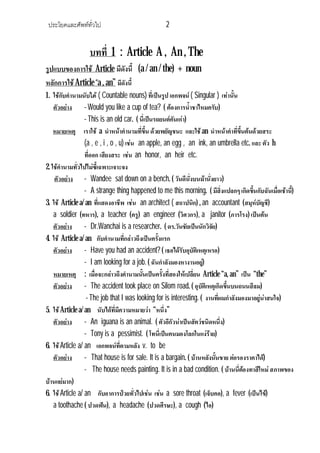
บทที่ 1 : Article A , An , The
รูปแบบของการใช Article มีดังนี้ (a / an / the) + noun
หลักการใช Article “a , an” มีดังนี้
1. ใชกับคํานามนับได ( Countable nouns) ที่เปนรูป เอกพจน ( Singular ) เทานั้น
ตัวอยาง - Would you like a cup of tea? ( ตองการน้ําชาไหมครับ)
- This is an old car. ( นี่เปนรถยนตคันเกา)
หมายเหตุ เราใช a นําหนาคํานามที่ขึ้น ดวยพยัญชนะ และใชan นําหนาคําที่ขึ้นตนดวยสระ
(a , e , i , o , u) เชน an apple, an egg , an ink, an umbrella etc. และ ตัว h
ที่ออก เสียงสระ เชน an honor, an heir etc.
2. ใชคํานามทั่วไปไมซี้เฉพาะเจาะจง
ตัวอยาง - Wandee sat down on a bench. ( วันดีนั่งบนมานั่งยาว)
- A strange thing happened to me this morning. ( มีสิ่งแปลกๆ เกิดขึ้นกับฉันเมื่อเชานี้)
3. ใช Article a/ an ที่แสดงอาชีพ เชน an architect ( สถาปนิก) , an accountant (สมุหบัญชี)
a soldier (ทหาร), a teacher (ครู) an engineer (วิศวกร), a janitor (ภารโรง) เปนตน
ตัวอยาง - Dr.Wanchai is a researcher. ( ดร.วันชัยเปนนักวิจัย)
4. ใช Article a/ an กับคํานามที่กลาวถึงเปนครั้งแรก
ตัวอยาง - Have you had an accident? ( เธอไดรับอุบัติเหตุเหรอ)
- I am looking for a job. ( ฉันกําลังมองหางานอยู)
หมายเหตุ : เมื่อจะกลาวถึงคํานามนั้นเปนครั้งที่สองใหเปลี่ยน Article “a, an” เปน “the”
ตัวอยาง - The accident took place on Silom road. ( อุบัติเหตุเกิดขึ้นบนถนนสีลม)
- The job that I was looking for is interesting. ( งานที่ผมกําลังมองมาอยูนาสนใจ)
5. ใช Article a/ an นับไดที่มีความหมายวา “หนึ่ง”
ตัวอยาง - An iguana is an animal. ( ตัวอีกัวนาเปนสัตวชนิดหนึ่ง)
- Tony is a pessimist. ( โทนี่เปนคนมองโลกในแงราย)
6. ใชArticle a/ an เอกพจนที่ตามหลัง v. to be
ตัวอยาง - That house is for sale. It is a bargain. ( บานหลังนั้นขาย ตอรองราคาได)
- The house needs painting. It is in a bad condition. ( บานนี่ตองทาสีใหม สภาพของ
บานแยมาก)
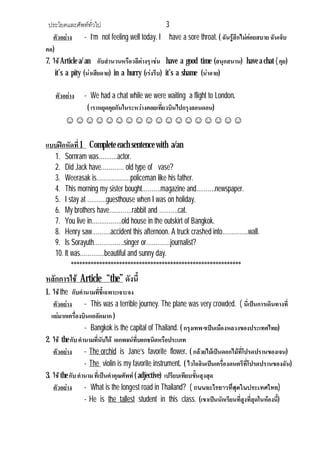
6. ใชArticle a/ an กับอาการปวยทั่วไปเชน เชน a sore throat (เจ็บคอ), a fever (เปนไข)
a toothache ( ปวดฟน), a headache (ปวดศีรษะ), a cough (ไอ)
ประโยคและศัพททั่วไป 3
ตัวอยาง - I’m not feeling well today. I have a sore throat. ( ฉันรูสึกไมคอยสบาย ฉันเจ็บ
คอ)
7. ใช Article a/ an กับสํานวนหรือวลีตางๆ เชน have a good time (สนุกสนาน) have a chat ( คุย)
it’s a pity (นาเสียดาย) in a hurry (เรงรีบ) it’s a shame (นาอาย)
ตัวอยาง - We had a chat while we were waiting a flight to London.
( เราหยุดคุยกันในระหวางคอยเที่ยวบินไปกรุงลอนดอน)
☺☺☺☺☺☺☺☺☺☺☺☺☺☺☺☺☺☺
แบบฝกหัดที่1 Complete each sentence with a/an
1. Sornram was……….actor.
2. Did Jack have………… old type of vase?
3. Weerasak is………………policeman like his father.
4. This morning my sister bought……….magazine and……….newspaper.
5. I stay at ……….guesthouse when I was on holiday.
6. My brothers have…………rabbit and ……….cat.
7. You live in…………….old house in the outskirt of Bangkok.
8. Henry saw……….accident this afternoon. A truck crashed into…………..wall.
9. Is Sorayuth…………….singer or………….journalist?
10. It was………….beautiful and sunny day.
************************************************************
หลักการใช Article “the” ดังนี้
1. ใชthe กับคํานามที่ชี้เฉพาะเจาะจง
ตัวอยาง - This was a terrible journey. The plane was very crowded. ( นี่เปนการเดินทางที่
แยมากเครื่องบินแออัดมาก )
- Bangkok is the capital of Thailand. ( กรุงเทพฯเปนเมืองหลวงของประเทศไทย)
2. ใช theกับคํานามที่นับได เอกพจนที่บอกชนิดหรือประเภท
ตัวอยาง - The orchid is Jane’s favorite flower. ( กลวยไมเปนดอกไมที่โปรดปรานของเจน)
- The violin is my favorite instrument. ( ไวโอลินเปนเครื่องดนตรีที่โปรดปรานของฉัน)
3. ใช theกับคํานามที่เปนคําคุณศัพท ( adjective) เปรียบเทียบขั้นสุงสุด
ตัวอยาง - What is the longest road in Thailand? ( ถนนอะไรยาวที่สุดในประเทศไทย)
- He is the tallest student in this class. (เขาเปนนักเรียนที่สูงที่สุดในหองนี้)
ประโยคและศัพททั่วไป 4
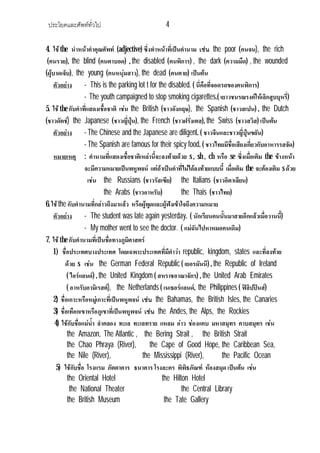
4. ใชthe นําหนาคําคุณศัพท (adjective) ซึ่งทําหนาที่เปนคํานาม เชน the poor (คนจน), the rich
(คนรวย), the blind (คนตาบอด) , the disabled (คนพิการ) , the dark (ความมืด) , the wounded
(ผูบาดเจ็บ), the young (คนหนุมสาว), the dead (คนตาย) เปนตน
ตัวอยาง - This is the parking lot t for the disabled. ( นี่คือที่จอดรถของคนพิการ)
- The youth campaigned to stop smoking cigarettes.( เยาวชนรณรงคใหเลิกสูบบุหรี่)
5. ใชthe กับคําที่แสดงเชื้อชาติ เชน the British (ชาวอังกฤษ), the Spanish (ชาวสเปน) , the Dutch
(ชาวดัตช) the Japanese (ชาวญี่ปุน), the French (ชาวฝรั่งเศส), the Swiss (ชาวสวิส) เปนตน
ตัวอยาง - The Chinese and the Japanese are diligent. ( ชาวจีนและชาวญี่ปุนขยัน)
- The Spanish are famous for their spicy food. ( ชาวไทยมีชื่อเสียงเกี่ยวกับอาหารรสจัด)
หมายเหตุ : คํานามที่แสดงเชื้อชาติเหลานี้จะลงทายดวย s , sh , ch หรือ se ซึ่งเมื่อเติม the ขางหนา
จะมีความหมายเปนพหูพจน แตถาเปนคําที่ไมไดลงทายแบบนี้ เมื่อเติม the จะตองเติม sดวย
เชน the Russians (ชาวรัสเซีย) the Italians (ชาวอิตาเลียน)
the Arabs (ชาวอาหรับ) the Thais (ชาวไทย)
6. ใชthe กับคํานามที่กลาวถึงมาแลว หรือผูพูดและผูฟงเขาใจถึงความหมาย
ตัวอยาง - The student was late again yesterday. ( นักเรียนคนนั้นมาสายอีกแลวเมื่อวานนี้)
- My mother went to see the doctor. ( แมฉันไปหาหมอคนเดิม)
7. ใชthe กับคํานามที่เปนชื่อทางภูมิศาสตร
1) ชื่อประเทศบางประเทศ โดยเฉพาะประเทศที่มีคําวา republic, kingdom, states และที่ลงทาย
ดวย s เชน the German Federal Republic ( เยอรมันนี) , the Republic of Ireland
( ไอรแลนด) , the United Kingdom ( สหราชอาณาจักร) , the United Arab Emirates
( อาหรับอามิเรสต), the Netherlands ( เนเธอรแลนด, the Philippines ( ฟลิปปนส)
2) ชื่อเกาะหรือหมูเกาะที่เปนพหูพจน เชน the Bahamas, the British Isles, the Canaries
3) ชื่อเทือกเขาหรือภูเขาที่เปนพหูพจน เชน the Andes, the Alps, the Rockies
4) ใชกับชื่อแมน้ํา ลําคลอง ทะเล ทะเลทราย แหลม อาว ชองแคบ มหาสมุทร คาบสมุทร เชน
the Amazon, The Atlantic , the Bering Strait , the British Strait
the Chao Phraya (River), the Cape of Good Hope, the Caribbean Sea,
the Nile (River), the Mississippi (River), the Pacific Ocean
5) ใชกับชื่อ โรงแรม ภัตตาคาร ธนาคาร โรงละคร พิพิธภัณฑ หองสมุด เปนตน เชน
the Oriental Hotel the Hilton Hotel
the National Theater the Central Library
the British Museum the Tate Gallery
ประโยคและศัพททั่วไป 5
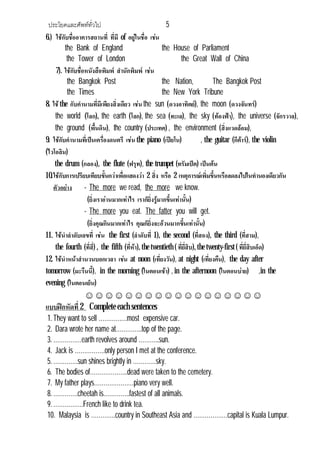
6.) ใชกับชื่ออาคารสถานที่ ที่มี of อยูในชื่อ เชน
the Bank of England the House of Parliament
the Tower of London the Great Wall of China
7). ใชกับชื่อหนังสือพิมพ สํานักพิมพ เชน
the Bangkok Post the Nation, The Bangkok Post
the Times the New York Tribune
8. ใชthe กับคํานามที่มีเพียงสิ่งเดียว เชน the sun (ดวงอาทิตย), the moon (ดวงจันทร)
the world (โลก), the earth (โลก), the sea (ทะเล), the sky (ทองฟา), the universe (จักรวาล),
the ground (พื้นดิน), the country (ประเทศ) , the environment (สิ่งแวดลอม),
9. ใชกับคํานามที่เปนเครื่องดนตรี เชน the piano (เปยโน) , the guitar (กีตาร), the violin
(ไวโอลิน)
the drum (กลอง), the flute (ฟรุท), the trumpet (ทรัมเปต) เปนตน
10.ใชกับการเปรียบเทียบขั้นกวาเพื่อแสดงวา 2 สิ่ง หรือ 2 เหตุการณเพิ่มขึ้นหรือลดลงไปในทํานองเดียวกัน
ตัวอยาง - The more we read, the more we know.
(ยิ่งเราอานมากเทาไร เราก็ยิ่งรูมากขึ้นเทานั้น)
- The more you eat. The fatter you will get.
(ยิ่งคุณกินมากเทาไร คุณก็ยิ่งจะอวนมากขึ้นเทานั้น)
11. ใชนําลําดับเลขที่ เชน the first (ลําดับที่ 1), the second (ที่สอง), the third (ที่สาม),
the fourth (ที่สี่) , the fifth (ที่หา), the twentieth (ที่ยี่สิบ),the twenty-first ( ที่ยี่สิบเอ็ด)
12. ใชนําหนาสํานวนบอกเวลา เชน at noon (เที่ยงวัน), at night (เที่ยงคืน), the day after
tomorrow (มะรืนนี้), in the morning (ในตอนเชา) , in the afternoon (ในตอนบาย) ,in the
evening (ในตอนเย็น)
☺☺☺☺☺☺☺☺☺☺☺☺☺☺☺☺☺☺
แบบฝกหัดที่2 Complete each sentences
1.They want to sell ……………most expensive car.
2. Dara wrote her name at…………..top of the page.
3.……………earth revolves around ………..sun.
4. Jack is …………….only person I met at the conference.
5.………….sun shines brightly in …………sky.
6. The bodies of………………..dead were taken to the cemetery.
7. My father plays…………………piano very well.
8.………….cheetah is…………..fastest of all animals.
9.…………….French like to drink tea.
10. Malaysia is ………….country in Southeast Asia and ………………capital is Kuala Lumpur.
ประโยคและศัพททั่วไป 6
การละ Article
1. ไมใสหนา คํานามนับไมได (Uncountable Nouns) เชน silk( ผาไหม)ม, tea ( น้ําชา ) , Paper (
กระดาษ) pepper (พริกไทย), blood (เลือด), money (เงิน), hair ( ผม), experience
( ประสพการณ) อยางไรก็ตาม สามารถใสthe , some, any , much, this, his ได
ตัวอยาง - Jongin wanted to buy some gold. ( จงจินตตองการซื้อทอง)
- We bought some paper. ( พวกเราซื้อกระดาษ)
หมายเหตุ ในบางกรณี นามที่นับไมได อาจจะมี Article a,an นําหนา เพราะมีความหมายแตกตางกันออกไป
เชน - a paper ( หนังสือพิมพ) # some paper ( กระดาษจํานวนหนึ่ง)
She bought a paper. # She bought some paper.
- a hair ( เสนผมเสนหนึ่ง) # hair ( ผมบนศรีษะ)
There was a hair in my porridge. # Jinny has beautiful hair.
( มีเสนผมอยูในขาวตมฉัน) / เจนนี่มีผมสวย
2. ไมใสหนาArticle the หนาคํานามพหูพจนที่กลาวถึงทั่ว ๆ ไป
ตัวอยาง - Children learn from playing and observing.( เด็กๆ เรียนรูจากการเลนและการสังเกต)
- Students should obey teachers and their parents. (นักเรียนควรเชื่อฟงครูและพอแม)
หมายเหตุ เปรียบเทียบในเมื่อมีการชี้เฉพาะ เจาะจง ตองใสthe เชน
- The children in this community can speak English and Chinese fluently.
- ( เด็กๆ ในชุมชนนี้สามารถพูดภาษาอังกฤษและภาษาจีนไดอยางคลองแคลว
- The students in my class like playing tennis.
- ( นักเรียนในหองเรียนของผมชอบเลนเทนนิส)
3. ไมใส the นําหนาคํานามที่เกี่ยวกับสถานที่ที่มีความหมายเพื่อกิจกรรมอันเปนปกติวิสัย เชน
hospital (ไปโรงพยาบาลเพื่อรักษาโรค) , prison , (ถูกจับขังคุก) , school ( ไปโรงเรียนเพื่อเรียนหนังสือ),
college , university ไปวิทยาลัยหรือ มหาวิทยาลัยเพื่อศึกษา แตถามี “the” หนาคําเหลานี้แสดงวาไมได
มีความหมายตามกิจกรรมเฉพาะเหมือนความหมายที่กลาวมา
ตัวอยาง John goes to church on Sunday. ( จอหนไปโบสถเพื่อสวดมนตทุกวันอาทิตย)
Somsri goes to the church to see her friends.( สมศรีไปที่โบสถเพื่อไปพบเพื่อนๆ)
4. ไมใสthe หนาสํานวนตอไปนี้ go to (ไปนอน), be in bed (เขานอน), go to work (ไปทํางาน)
be at work ( อยูที่ทํางาน), start work (เริ่มงาน) , finish work (เลิกงาน), go home (ไปบาน),
get home (เขาบาน), stay at home (อยูบาน) be at home (อยูที่บาน), go to sea ( ไปเที่ยวทะเล)
ตัวอยาง - I am sleepy, I’m going to bed. ( ฉันงวงแลวฉันจะไปนอน)
- My boss will be at work around 9 o’clock. ( เจานายของฉันจะอยูที่ทํางานประมาณ9 โมง)
ประโยคและศัพททั่วไป 7
หมายเหตุ: เราไมใสthe หนามื้ออาหารหลัก breakfast , lunch,brunch,dinnerแตสามารถใส a
กับคําวา meal ( มื้ออาหารแตละมื้อ ได)
ตัวอยาง - Michael invited me to dinner. ( ไมเคิลเชิญฉันรับประทานอาหารเย็น)
แต - I had a wonderful meal in a restaurant. (เรารับประทานอาหารที่อรอยมากที่
รานแหงหนึ่ง)
5. ไมใสthe หนาชื่อทางภูมิศาสตร
1) ชื่อ หมูบาน เมือง ประเทศ รัฐ ทวีป เชน Bangkok, New York, Paris, Thailand ยกเวน
The Hague, the Philippines เปนตน
2) ชื่อเกาะเดี่ยว ๆ เชน Phuket Sicily
3) ชื่อภูเขาเดี่ยวๆ เชน Doi Inthanon Mount Everest
4) ชื่อทะเลสาบ เชน Lake Constance, Lake Superior
5) ชื่อถนน สี่แยก วงเวียน เชน Regent Street, Fifth Avenue, Silom Road,
6) ชื่อสนามบิน สถานีรถไฟ โรงเรียน มหาวิทยาลัย หรือสถานที่ที่เปนชื่อเฉพาะ เชน
Kennedy Airport Don Muang Airport Cambridge University
Chulalongkorn University Hyde Park London Zoo
7). ชื่อภัตตาคารหรือโรงแรมที่เปนชื่อเฉพาะ เชน
Krung Thai Bank, MacDonald’s ,Harrods, Selfridges
6. ไมใสหนา คํานามที่ตามหลัง ‘s หรือ n. ที่แสดงความเปนเจาของ เชน
Mr. Somchai's house , my brother’s room, the city’s new theater
The world’s population, a good night’s sleep a week’s holiday
7. ไมใส the หนา คํานามที่มี แสดงความเปนเจาของ (my, your, our, her, his, its, their) หรือ
คํานามที่มี ‘s แสดงความเปนเจาของคําคุณศัพท( adjective) นําหนาคํานาม(this, that, these,
those), some, any, few, a few, most ฯลฯ อยูขางหนา
ตัวอยาง - This room is dirty . ( หองนี้สกปรก)
- Could you find any students in the meeting room?
คุณเห็นนักเรียนสักคนในหองประชุมหรือไม
8. ไมใสthe หนาชื่อเดือน – วัน นอกจากวาเดือน – วันนั้น ๆ มีลักษณะชี้เฉพาะ
ตัวอยาง - James and Catharine were married in 2004. (เจมสและแคทรีนแตงงานไปในป 2547)
- James and Catharine married in the July of 2004.
( เจมสและแคทรีนแตงงานไปเมื่อเดือนกรกฏาคมในป 2547 ที่ผานมา)
ประโยคและศัพททั่วไป 8
9. ไมใส the หนาชื่อเกมสหรือกีฬาตาง ๆ เชน soccer (ฟุตบอล), football (ฟุตบอล)
tennis (เทนนิส), basketball (บาสเกตบอล), badminton (แบตมินตัน), chess (หมากรุก)
ตัวอยาง - Basketball is my favorite sports. ([บาสเกตบอลเปนกีฬาที่ฉันชอบ)
10.ไมใสthe ชื่อวิชา, ภาษา เชน
algebra (พีชคณิต), engineering (วิศวกรรมศาสตร) , mathematics (คณิตศาสตร),
history (ประวัติศาสตร), economics (เศรษฐศาสตร), English (ภาษาอังกฤษ), geometry (เรขาคณิต),
French (ภาษาฝรั่งเศส), linguistics (ภาษาศาสตร) , statistics (สถิติ), arithmetic (เลขาคณิต),
science (วิทยาศาสตร), biology (ชีววิทยา) , physics (ฟสิกส)
หมายเหตุ : คํานามที่เปนชื่อภาษา ถานําไปใชเปนคําคุณศัพทขยายคํานามตองมี “the” นําหนา
ตัวอยาง - The Thai language is more difficult than the English language.
(ภาษาไทยยากกวาภาษาอังกฤษ )
11. ไมใสthe หนาชื่อโรค เชน
mumps (โรคคางทูม) cholera (อหิวาตกโรค) cancer (โรคมะเร็ง)
malaria (โรคไขจับสั่น) epilepsy (โรคลมชัก) influenza (ไขหวัด
ใหญ)
measles (โรคหัด) rheumatism (โรคปวด
ขอ)
tuberculosis (วัณโรค)
ตัวอยาง - Most children in Africa died of cholera ( เด็กๆ สวนใหญในอัฟริกาเสียชีวิตดวยโรค
อหิวาตกโรค)
แบบฝกหัดที่3 Complete each sentences
1. Did he see the football match on ………………..television?
2. Boonchoo got……………..big feet.
3. Supan and Sopin have……………..lovely children.
4. Do you enjoy going to………………… Japanese concert?
5. My best friend is looking for…………………work.
***********************************************************************************************************
ประโยคและศัพททั่วไป 9
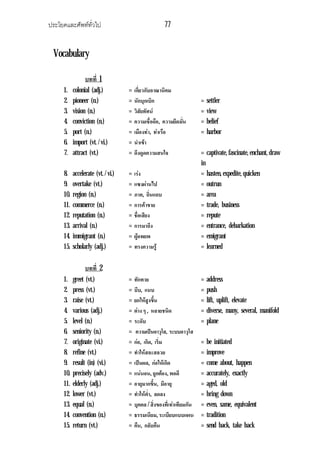
ภาคคําศัพท: (Vocabulary)
คําศัพท:
บทที่ 1
ความหมาย
(Meaning)
คําเหมือน
( Synonym)
1. colonial (adj.) = เกี่ยวกับอาณานิคม regal
2. pioneer (n.) = นักบุกเบิก settler
3. vision (n.) = วิสัยทัศน view
4. conviction (n.) = ความเชื่อถือ, ความยึดมั่น Belief, principle, faith
5. port (n.) = เมืองทา, ทาเรือ Harbor, docks, haven
6. import (vt. / vi.) = นําเขา Trade in
7. attract (vt.) = ดึงดูดความสนใจ Captivate , fascinate, enchant, draw in
8. accelerate (vt. / vi.) = เรง hasten, expedite, quicken
9. overtake (vt.) = แซงผานไป outrun
10. region (n.) = ภาค, ถิ่นแถบ area
11. commerce (n.) = การคาขาย trade, business
12. reputation (n.) = ชื่อเสียง repute
13. arrival (n.) = การมาถึง entrance, debarkation
14. immigrant (n.) = ผูอพยพ emigrant
15. scholarly (adj.) = ทรงความรู learned
แบบฝกหัดที่ 4: Translate into Thai
1. Her vision brings success to her country.
2. Her bright red skirt attracts the audiences.
3. Malaysia imports many goods from abroad.
4. Nobody respected Joey because his corruption destroyed his reputation.
5. The immigrants stayed in the temporary camp.
☻☺☻☺☻☺☻☺☻☺☻☺☻☺☻☺☻☺☻☺☻☺☻☺☻☺☻
☺
ประโยคและศัพททั่วไป 10
บทที่ 2 : Simple Present Tense กาลในปจจุบัน
อนุเฉทเรื่อง“ การทักทายดวยการไหว (Greeting with a wai) ”
1. Sawasdi is the Thai word of greeting. ( สวัสดีคือคําในภาษาไทยใชสําหรับการทักทาย)
2. The wai originated in india but the Indians keep their wai to just one levels. ( การไหวมี
ตนกําเนิดมาจากประเทศอินเดีย แตชาวอินเดียจะไหวอยูในระดับเดียว)
3. It is a convention that a greeting must be returned. ( เปนธรรมเนียมที่จะตองทักทาย
กลับ)
4. To greet our equals, there is no need to bow the head. ( ในการทักทายคนระดับเดียวกัน
ไมจําเปนตองกมศรีษะ
( จากอนุเฉท Greeting with a wai. บทที่ ๒ ประโยคคําศัพท EN 102 มหาวิทยาลัยรามคําแหง)
รูปแบบของ Simple Present มีดังนี้
1.ถาประธานเปนเอกพจนบุรุษที่3 ไดแกHe, She, It, ชื่อคน สัตว หรือ สิ่งของเพียงหนึ่งเดียว เชน Suda,
Malee, the girl จะใชกริยาชองที่ และ เติม s. หรือ es กริยาที่ลงทายดวย ss, sh, ch, x, o และ y ที่
ตองเปลี่ยนเปน i กอนจะเติม es
ตัวอยาง - He goes to university everyday. (เขาไปมหาวิทยาลัยทุกวัน)
- The dog barks almost every night. ( สุนัขเหาเกือบทุกคืน)
- John always watches television . (จอหนดูโทรทัศนเสมอ)
- Dellah copies a letter. ( เดลาหสําเนาจดหมาย)
2 .ถาประธานเปนพหูพจน คือ คน ๒ คน ขึ้นไป หรือหลายคน หลายสิ่ง คือ I , You, We, They กริยาจะไม
เติมs, หรือ es เชน
- Thomas and Francoise speak French. ( โทมัสและฟรองซัวรพูด
- You and I have a meeting at 10 o’clock.( คุณกับผมมีประชุมเวลา10 นาฬิกา)
3. เมื่อใชกับกริยาVerb to be จะมีรูปเฉพาะคือ is ใชประธานเอกพจนบุรุษที่3 เชน He, She, It. Mary etc./
am ใชกับประธานเอกพจนบุรุษที่1 และ ใชกับประธานพหูพจนบุรุษที่1,2, 3 เชน You, We ,they
Jack and Jill เปนตน และเมื่อประโยคปฏิเสธใหใสnot ขางหลังกริยา
ตัวอยาง - Thaksin is the prime minister of Thailand.( ทักษิณเปนนายกรัฐมนตรีของประเทศไทย)
- Henry is not working for the children foundation. ( เฮนรี่ไมไดทํางานอยูที่มูลนิธิ
เด็ก)
- My brothers and I are interested in politics. ( พี่ชายฉันและฉันสนใจในการเมือง)
Subject + verb.1
ตาม s.)
ประโยคและศัพททั่วไป 11
4. รูปแบบของ Simple Present Tense ในประโยค บอกเลาปฏิเสธและ คําถาม
4.1.การทําประโยค Simple Present เปนประโยคปฏิเสธ
- ประโยคที่มีปฏิเสธและประโยคคําถาม ประเภท Yes / No Question จะตองใชกริยาVerb to do
มาชวยมี2 รูป คือ do ใชกับประธานพหูพจนบุรุษที่1,2, 3, เชน I, We, You, They และ does ใชประธาน
เอกพจนบุรุษที่3 เชน He, She, It. Mary etc. มาสังเกตตามตารางตอไปนี้
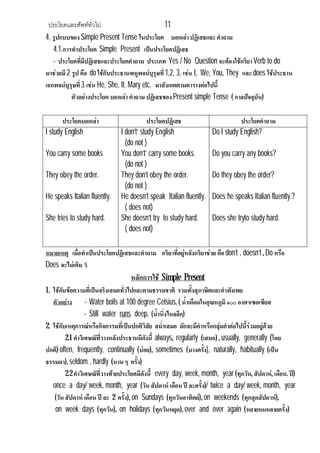
ตัวอยางประโยค บอกเลา คําถาม ปฏิเสธของ Present simple Tense ( กาลปจจุบัน)
ประโยคบอกเลา ประโยคปฏิเสธ ประโยคคําถาม
I study English
You carry some books
They obey the order.
He speaks Italian fluently.
She tries to study hard.
I don’t’ study English
(do not )
You don’t’ carry some books.
(do not )
They don’t obey the order.
(do not )
He doesn’t speak Italian fluently.
( does not)
She doesn’t try to study hard.
( does not)
Do I study English?
Do you carry any books?
Do they obey the order?
Does he speaks Italian fluently.?
Does she tryto study hard.
หมายเหตุ เมื่อทําเปนประโยคปฏิเสธและคําถาม กริยาที่อยูหลังกริยาชวย คือ don’t , doesn’t , Do หรือ
Does จะไมเติม s
หลักการใช Simple Present
1. ใชกับขอความที่เปนจริงเสมอทั่วไปและตามธรรมชาติ รวมทั้งสุภาษิตและคําพังเพย
ตัวอยาง - Water boils at 100 degree Celsius. ( น้ําเดือดในอุณหภูมิ ๑๐๐ องศาเซลเซียส
- Still water runs deep. (น้ํานิ่งไหลลึก)
2. ใชกับเหตุการณหรือกิจกรรมที่เปนปกติวิสัย สม่ําเสมอ มักจะมีคําหรือกลุมคําตอไปนี้รวมอยูดวย
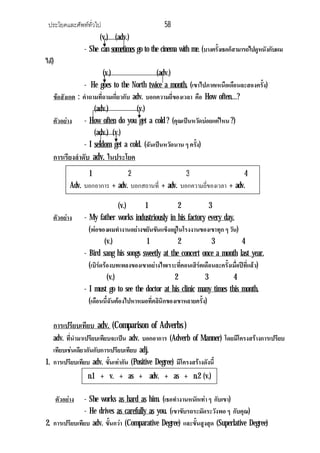
2.1 คําวิเศษณัที่วางหลังประธานมีดังนี้ always, regularly (เสมอ) , usually, generally (โดย
ปกติ) often, frequently, continually (บอย), sometimes (บางครั้ง), naturally, habitually (เปน
ธรรมดา), seldom , hardly (นาน ๆ ครั้ง)
2.2 คําวิเศษณัที่วางทายประโยคมีดังนี้ every day, week, month, year (ทุกวัน, สัปดาห, เดือน.ป)
once a day/ week, month, year (วัน สัปดาหเดือน ป ละครั้ง)/ twice a day/ week, month, year
(วัน สัปดาห เดือน ปละ 2 ครั้ง), on Sundays (ทุกวันอาทิตย), on weekends (ทุกสุดสัปดาห),
on week days (ทุกวัน), on holidays (ทุกวันหยุด), over and over again (หลายหนหลายครั้ง)
ประโยคและศัพททั่วไป 12
ตัวอยาง - She frequently visits her parents . (เธอจะเยี่ยมพอแมบอยๆ )
- Kanya goes to Pattaya twice a year. ( กัลยาจะไปพัทยาปละสองครั้ง)
3. ใชความเปนจริงในปจจุบัน
ตัวอยาง - Bangkok is the capital of Thailand. (เขาอาศัยอยูในชนบท)
- The position of the wai shows that your hands are empty of weapons.
( ตําแหนงของการไหวเปนการแสดงวามือคุณไมไดถืออาวุธอยูในมือ)
- Mostly Thais prefer to eat in groups. ( สวนใหญคนไทยชอบกินอาหารเปนกลุมๆ)
4. ใชกับประโยคอุทาน
ตัวอยาง - Here comes the van! (รถตูมาแลว)
- Here is his luxury car ! ( นี่คือรถคันหรูของเขา)
5. ใชกับประโยคที่มีบอกเวลา when, as soon as, before, after, until อยูขางหนา
ตัวอยาง- We will talk to Jetsada about the party when he comes. ( เราจะคุยกับเจษฎาเมื่อเขามา)
- She goes straight to the kitchen as soon as she arrives home.
( หลอนตรงไปยังหองครัวทันทีเมื่อหลอนถึงบาน)
6. ใชกับประโยคที่แสดงเงื่อนไข If – Clause เชน If, Provided that ( ถามี) Unless ( ถาไม)
(1) เงื่อนไขที่อาจเปนไปไดในปจจุบันหรือเปนการดําเนินชีวิตประจําวัน โดยมีโครงสรางดังนี้
If + Subject+ v1, subject +v1 หรือ Subject+ v1 if subject +v1
I have breakfast if I am hungry. หรือ If I am hungry, I have breakfast..
(2) เงื่อนไขที่อาจเปนไปไดในอนาคต
If + Subject+ v1, subject +will, shall +v1 หรือ Subject+will/shall+ v1 if subject +v1
ตัวอยาง - If it rains heavily, we will cancel the picnic. ( ถาฝนตกหนักเราจะยกเลิกปคนิค)
- I will lend you some money unless you tell me a lie.( ฉันจะใหคุณยืมเงินถาคุณไม
พูดโกหก)
7. ใชกับประโยคเหตุการณในอนาคต มักจะเปนตารางเวลาหรือตารางอื่น ๆ มีคําบอกเวลา เชน
ตัวอยาง - Panya leaves for Pattaya tonight. ( ปญญาจะไปพัทยาคืนนี้)
- The train leaves in a few minutes.( รถเมลกําลังจะออกภายใน ๒-๓ นาที)
ประโยคและศัพททั่วไป 13
แบบฝกหัด 1
1. Damrong usually ( drink)………………………a glass of orange juice.
2. This tank (contain)……………………about 4,000 litres.
3. My brothers frequently ( play)…………………….tennis every Saturday.
4. Today Sodsai (wear)………………………her new dress.
5. She had better go right now because she,(be),,,,,,,,,,,,,,,,,,,in a hurry.
6. Winai and Winit sometimes ( have)……………a long conversation.
7. Who (belong)…………this computer?
8. The last train ( leave)………………at 730 p.m.
9. Here ( be) …………our best friends.
10. Soldiers ( have) ………………to keep peace for the nation.
11. Kanya ( grow)………….plants in the garden.
12. Catholics often (go)………………..to church on Sundays.
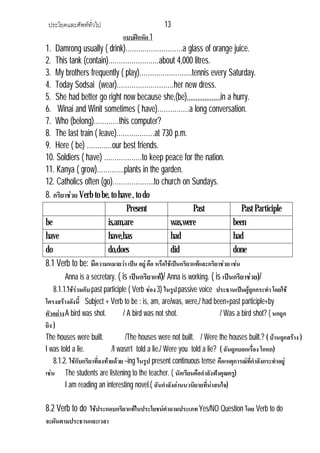
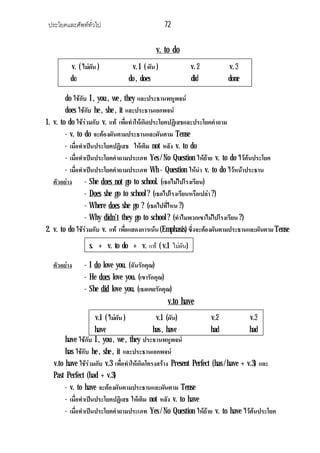
8. กริยาชวย Verb to be, to have , to do
Present Past Past Participle
be is,am,are was,were been
have have,has had had
do do,does did done
8.1 Verb to be: มีความหมายวา เปน อยูคือ หรือใชเปนกริยาแทและกริยาชวย เชน
Anna is a secretary. ( is เปนกริยาแท)/ Anna is working. ( is เปนกริยาชวย)/
8.1.1.ใชรวมกับ past participle ( Verb ชอง 3) ในรูป passive voice ประธานเปนผูถูกกระทํา โดยใช
โครงสรางดังนี้ Subject + Verb to be : is, am, are/was, were,/ had been+past participle+by
ตัวอยางA bird was shot. / A bird was not shot. / Was a bird shot? ( นกถูก
ยิง )
The houses were built. /The houses were not built. / Were the houses built.? ( บานถูกสราง )
I was told a lie. /I wasn’t told a lie./ Were you told a lie? ( ฉันถูกบอกเรื่อง โกหก)
8.1.2. ใชกับกริยาที่ลงทายดวย –ing ในรูป present continuous tense คือเหตุการณที่กําลังกระทําอยู
เชน The students are listening to the teacher. ( นักเรียนคือกําลังฟงคุณครู)
I am reading an interesting novel.( ฉันกําลังอานนวนิยายที่นาสนใจ)
8.2 Verb to do ใชประกอบกริยาแทในประโยชนคําถามประเภทYes/NO Question โดย Verb to do
จะผันตามประธานและเวลา
ประโยคและศัพททั่วไป 14
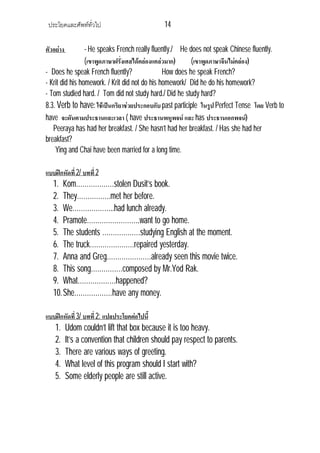
ตัวอยาง - He speaks French really fluently./ He does not speak Chinese fluently.
(เขาพูดภาษาฝรั่งเศสไดคลองแคลวมาก) (เขาพูดภาษาจีนไมคลอง)
- Does he speak French fluently? How does he speak French?
- Krit did his homework. / Krit did not do his homework/ Did he do his homework?
- Tom studied hard. / Tom did not study hard./ Did he study hard?
8.3. Verb to have: ใชเปนกริยาชวยประกอบกับ past participle ในรูป Perfect Tense โดย Verb to
have จะผันตามประธานและเวลา ( have ประธานพหูพจน และ has ประธานเอกพจน)
Peeraya has had her breakfast. / She hasn’t had her breakfast. / Has she had her
breakfast?
Ying and Chai have been married for a long time.
แบบฝกหัดที่2/ บทที่ 2
1. Kom………………stolen Dusit’s book.
2. They…………….met her before.
3. We………………..had lunch already.
4. Pramote…………………….want to go home.
5. The students ………………studying English at the moment.
6. The truck…………………repaired yesterday.
7. Anna and Greg…………………already seen this movie twice.
8. This song……………composed by Mr.Yod Rak.
9. What………………happened?
10.She………………have any money.
แบบฝกหัดที่3/ บทที่ 2: แปลประโยคตอไปนี้
1. Udom couldn’t lift that box because it is too heavy.
2. It’s a convention that children should pay respect to parents.
3. There are various ways of greeting.
4. What level of this program should I start with?
5. Some elderly people are still active.
ประโยคและศัพททั่วไป 15
ภาคคําศัพท : ( Vocabulary)
บทที่ 2 ความหมาย
(Meaning)
คําเหมือน
( Synonym)
1. greet (vt.) = ทักทาย = address
2. press (vt.) = บีบ, แนบ = push
3. raise (vt.) = ยกใหสูงขึ้น = lift, uplift, elevate
4. various (adj.) = ตาง ๆ , หลายชนิด = diverse, many, several,
manifold
5. level (n.) = ระดับ = plane
6. seniority (n.) = ความเปนอาวุโส, ระบบ
อาวุโส
= superiority
7. originate (vi.) = กอ, เกิด, เริ่ม = be initiated
8. refine (vt.) = ทําใหสละสลวย = improve
9. result (in) (vi.) = เปนผล, กอใหเกิด = come about, happen
10. precisely (adv.) = แนนอน, ถูกตอง, พอดี = accurately, exactly
11. elderly (adj.) = อายุมากขึ้น, มีอายุ = aged, old
12. lower (vt.) = ทําใหต่ํา, ลดลง = bring down
13. equal (n.) = บุคคล / สิ่งของที่เทาเทียม
กัน
= even, same, equivalent
14. convention (n.) = ธรรมเนียม, ระเบียบแบบ
แผน
= tradition
15. return (vt.) = คืน, กลับคืน = send back, take back
ประโยคและศัพททั่วไป 16
บทที่ 3: Simple Past Tense
อนุเฉทเรื่องTussaud, Madame (1761 -1850): Swiss Founder waxworks Museum
1. Over many years she modeled many famous people.
( หลายปที่ผานมาหลอนไดปนหุนของคนมีชื่อเสียงมากมาย)
1. Seven years later she moved to London.
( เจ็ดปตอมา หลอยยายมาอยูที่ลอนดอน)
3. The exhibition was very successful. ( นิทรรศการประสบความสําเร็จมาก)
( จากอนุเฉทเรื่อง Tussaud, Madame (1761 -1850): บทที่ ๓ประโยคคําศัพท EN 102 มหาวิทยาลัยรามคําแหง)
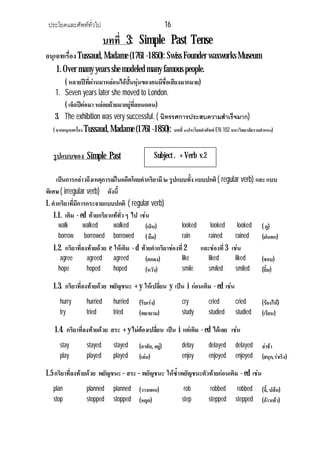
รูปแบบของ Simple Past
เปนการกลาวถึงเหตุการณในอดีตโดยคํากริยามี ๒ รูปแบบทั้ง แบบปกติ( regular verb) และ แบบ
พิเศษ ( irregular verb) ดังนี้
1. คํากริยาที่มีการกระจายแบบปกติ ( regular verb)
1.1. เติม - ed ทายกริยาแททั่ว ๆ ไป เชน
walk walked walked (เดิน) looked looked looked ( ดู)
borrow borrowed borrowed ( ยืม) rain rained rained (ฝนตก)
1.2. กริยาที่ลงทายดวย e ใหเติม - d ทายคํากริยาชองที่2 และชองที่3 เชน
agree agreed agreed (ตกลง) like liked liked (ชอบ)
hope hoped hoped (หวัง) smile smiled smiled (ยิ้ม)
1.3. กริยาที่ลงทายดวย พยัญชนะ + y ใหเปลี่ยน y เปน i กอนเติม - ed เชน
hurry hurried hurried (รีบเรง) cry cried cried (รองไห)
try tried tried (พยายาม) study studied studied (เรียน)
1.4. กริยาที่ลงทายดวย สระ + y ไมตองเปลี่ยน เปน i แตเติม - ed ไดเลย เชน
stay stayed stayed (อาศัย, อยู) delay delayed delayed ลาชา
play played played (เลน) enjoy enjoyed enjoyed (สนุก,ราเริง)
1.5 กริยาที่ลงทายดวย พยัญชนะ – สระ – พยัญชนะ ใหซ้ําพยัญชนะตัวทายกอนเติม - ed เชน
plan planned planned (วางแผน) rob robbed robbed (จี้, ปลน)
stop stopped stopped (หยุด) step stepped stepped (กาวเทา)
Subject . + Verb v.2
ประโยคและศัพททั่วไป 17
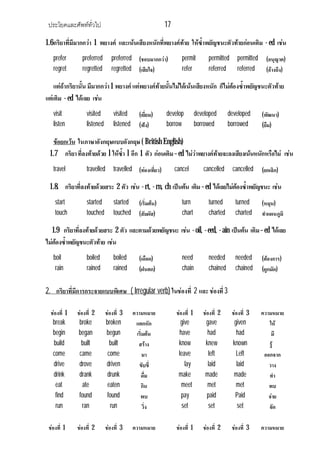
1.6กริยาที่มีมากกวา 1 พยางค และเนนเสียงหนักที่พยางคทาย ใหซ้ําพยัญชนะตัวทายกอนเติม - ed เชน
prefer preferred preferred (ชอบมากกวา) permit permitted permitted (อนุญาต)
regret regretted regretted (เสียใจ) refer referred referred (อางถึง)
แตถากริยานั้น มีมากกวา1 พยางคแตพยางคทายนั้นไมไดเนนเสียงหนัก ก็ไมตองซ้ําพยัญชนะตัวทาย
แตเติม - ed ไดเลย เชน
visit visited visited (เยี่ยม) develop developed developed (พัฒนา)
listen listened listened (ฟง) borrow borrowed borrowed (ยืม)
ขอยกเวน ในภาษาอังกฤษแบบอังกฤษ ( British English)
1.7 กริยาที่ลงทายดวย l ใหซ้ํา l อีก 1 ตัว กอนเติม–ed ไมวาพยางคทายจะลงเสียงเนนหนักหรือไม เชน
travel travelled travelled (ทองเที่ยว) cancel cancelled cancelled (ยกเลิก)
1.8. กริยาที่ลงทายดวยสระ 2 ตัว เชน -rt, -rn, ch เปนตน เติม–ed ไดเลยไมตองซ้ําพยัญชนะ เชน
start started started (เริ่มตน) turn turned turned (หมุน)
touch touched touched (สัมผัส) chart charted charted ทําแผนภูมิ
1.9 กริยาที่ลงทายดวยสระ 2 ตัว และตามดวยพยัญชนะ เชน -oil, -eed, -ain เปนตน เติม–ed ไดเลย
ไมตองซ้ําพยัญชนะตัวทาย เชน
boil boiled boiled (เดือด) need needed needed (ตองการ)
rain rained rained (ฝนตก) chain chained chained (ผูกมัด)
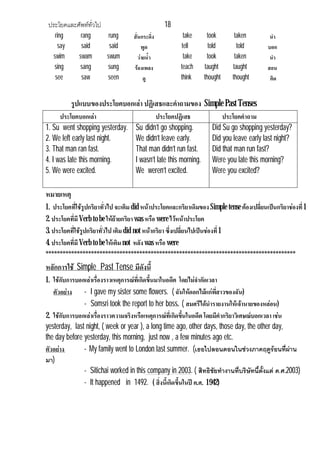
2. กริยาที่มีการกระจายแบบพิเศษ ( Irregular verb) ในชองที่ 2 และ ชองที่3
ชองที่ 1 ชองที่ 2 ชองที่ 3 ความหมาย ชองที่ 1 ชองที่ 2 ชองที่ 3 ความหมาย
break broke broken แตกหัก give gave given ให
begin began begun เริ่มตน have had had มี
build built built สราง know knew known รู
come came come มา leave left Left ออกจาก
drive drove driven ขับขี่ lay laid laid วาง
drink drank drunk ดื่ม make made made ทํา
eat ate eaten กิน meet met met พบ
find found found พบ pay paid Paid จาย
run ran run วิ่ง set set set จัด
ชองที่ 1 ชองที่ 2 ชองที่ 3 ความหมาย ชองที่ 1 ชองที่ 2 ชองที่ 3 ความหมาย
ประโยคและศัพททั่วไป 18
ring rang rung สั่นกระดิ่ง take took taken นํา
say said said พูด tell told told บอก
swim swam swum วายน้ํา take took taken นํา
sing sang sung รองเพลง teach taught taught สอน
see saw seen ดู think thought thought คิด
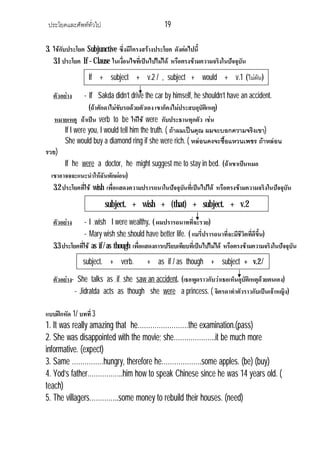
รูปแบบของประโยคบอกเลา ปฏิเสธและคําถามของ Simple Past Tenses
ประโยคบอกเลา ประโยคปฏิเสธ ประโยคคําถาม
1. Su went shopping yesterday.
2. We left early last night.
3. That man ran fast.
4. I was late this morning.
5. We were excited.
Su didn’t go shopping.
We didn’t leave early.
That man didn’t run fast.
I wasn’t late this morning.
We weren’t excited.
Did Su go shopping yesterday?
Did you leave early last night?
Did that man run fast?
Were you late this morning?
Were you excited?
หมายเหตุ
1. ประโยคที่ใชรูปกริยาทั่วไป จะเติมdid หนาประโยคและกริยาเดิมของ Simple tense ตองเปลี่ยนเปนกริยาชองที่1
2. ประโยคที่มีVerb to be ใหยายกริยาwas หรือ were ไวหนาประโยค
3. ประโยคที่ใชรูปกริยาทั่วไป เติมdid not หนากริยา ซึ่งเปลี่ยนไปเปนชองที่1
4. ประโยคที่มีVerb to be ใหเติมnot หลัง was หรือ were
****************************************************************************************
หลักการใช Simple Past Tense มีดังนี้
1. ใชกับการบอกเลาเรื่องราวเหตุการณที่เกิดขึ้นมาในอดีต โดยไมจํากัดเวลา
ตัวอยาง - I gave my sister some flowers. ( ฉันใหดอกไมแกพี่สาวของฉัน)
- Somsri took the report to her boss. ( สมศรีไดนํารายงานใหเจานายของหลอน)
2. ใชกับการบอกเลาเรื่องราวความจริงหรือเหตุการณที่เกิดขึ้นในอดีตโดยมีคํากริยาวิเศษณบอกเวลา เชน
yesterday, last night, ( week or year ), a long time ago, other days, those day, the other day,
the day before yesterday, this morning, just now , a few minutes ago etc.
ตัวอยาง - My family went to London last summer. (เธอไปลอนดอนในชวงภาคฤดูรอนที่ผาน
มา)
- Sitichai worked in this company in 2003. ( สิทธิชัยทํางานที่บริษัทนี้ตั้งแต ค.ศ.2003)
- It happened in 1492. ( สิ่งนี้เกิดขึ้นในป ค.ศ. 1942)
ประโยคและศัพททั่วไป 19
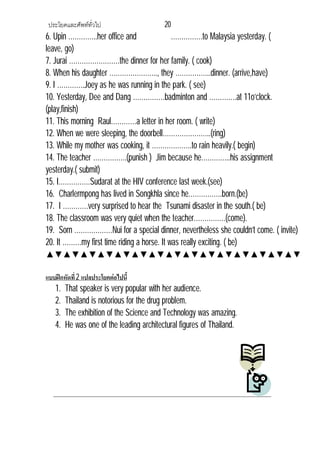
3. ใชกับประโยค Subjunctive ซึ่งมีโครงสรางประโยค ดังตอไปนี้
3.1 ประโยค If – Clause ในเงื่อนไขที่เปนไปไมได หรือตรงขามความจริงในปจจุบัน
ตัวอยาง - If Sakda didn’t drive the car by himself, he shouldn’t have an accident.
(ถาศักดาไมขับรถดวยตัวเอง เขาก็คงไมประสบอุบัติเหตุ)
หมายเหตุ ถาเปน verb to be ใหใช were กับประธานทุกตัว เชน
If I were you, I would tell him the truth. ( ถาผมเปนคุณ ผมจะบอกความจริงเขา)
She would buy a diamond ring if she were rich. ( หลอนคงจะซื้อแหวนเพชร ถาหลอน
รวย)
If he were a doctor, he might suggest me to stay in bed. (ถาเขาเปนหมอ
เขาอาจจจะแนะนําใหฉันพักผอน)
3.2 ประโยคที่ใช wish เพื่อแสดงความปรารถนาในปจจุบันที่เปนไปได หรือตรงขามความจริงในปจจุบัน
ตัวอยาง - I wish I were wealthy. ( ผมปรารถนาทที่จะรวย)
- Mary wish she should have better life. ( แมรี่ปรารถนาที่จะมีชีวิตที่ดีขึ้น)
3.3ประโยคที่ใช as if/as though เพื่อแสดงการเปรียบเทียบที่เปนไปไมได หรือตรงขามความจริงในปจจุบัน
ตัวอยาง- She talks as if she saw an accident. (เธอพูดราวกับวาเธอเห็นอุบัติเหตุดวยตนเอง)
- Jidratda acts as though she were a princess. ( จิตรดาทําตัวราวกับเปนเจาหญิง)
แบบฝกหัด 1/ บทที่ 3
1. It was really amazing that he……………………the examination.(pass)
2. She was disappointed with the movie; she………………..it be much more
informative. (expect)
3. Same ……………hungry, therefore he……………….some apples. (be) (buy)
4. Yod’s father……………..him how to speak Chinese since he was 14 years old. (
teach)
5. The villagers…………..some money to rebuild their houses. (need)
If + subject + v.2 / , subject + would + v.1 (ไมผัน)
subject. + wish + (that) + subject. + v.2
subject. + verb. + as if / as though + subject + v.2 /
ประโยคและศัพททั่วไป 20
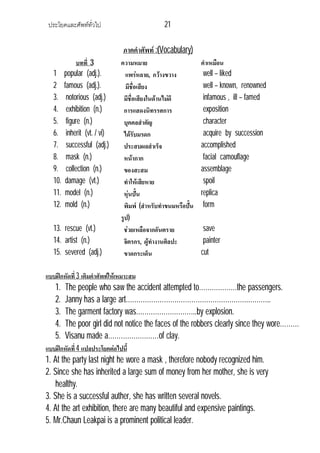
6. Upin …………..her office and ……………to Malaysia yesterday. (
leave, go)
7. Jurai ……………………the dinner for her family. ( cook)
8. When his daughter ………………….., they ……………..dinner. (arrive,have)
9. I ………….Joey as he was running in the park. ( see)
10. Yesterday, Dee and Dang ……………badminton and ………….at 11o’clock.
(play,finish)
11. This morning Raul…………a letter in her room. ( write)
12. When we were sleeping, the doorbell…………………..(ring)
13. While my mother was cooking, it ……………….to rain heavily.( begin)
14. The teacher …………….(punish ) Jim because he…………..his assignment
yesterday.( submit)
15. I……………Sudarat at the HIV conference last week.(see)
16. Charlermpong has lived in Songkhla since he…………….born.(be)
17. I …………very surprised to hear the Tsunami disaster in the south.( be)
18. The classroom was very quiet when the teacher……………(come).
19. Sorn ………………Nui for a special dinner, nevertheless she couldn’t come. ( invite)
20. It ………my first time riding a horse. It was really exciting. ( be)
▲▼▲▼▲▼▲▼▲▼▲▼▲▼▲▼▲▼▲▼▲▼▲▼▲▼▲▼▲▼
แบบฝกหัดที่2 แปลประโยคตอไปนี้
1. That speaker is very popular with her audience.
2. Thailand is notorious for the drug problem.
3. The exhibition of the Science and Technology was amazing.
4. He was one of the leading architectural figures of Thailand.
ประโยคและศัพททั่วไป 21
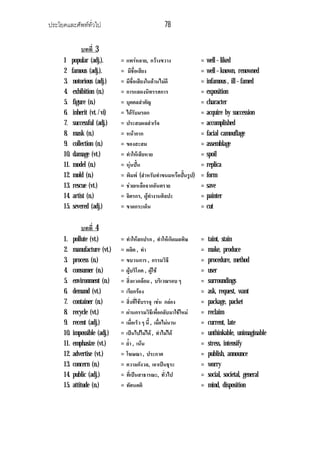
ภาคคําศัพท :(Vocabulary)
บทที่ 3 ความหมาย คําเหมือน
1 popular (adj.). แพรหลาย, กวางขวาง well – liked
2 famous (adj.). มีชื่อเสียง well – known, renowned
3. notorious (adj.) มีชื่อเสียงในดานไมดี infamous , ill – famed
4. exhibition (n.) การแสดงนิทรรศการ exposition
5. figure (n.) บุคคลสําคัญ character
6. inherit (vt. / vi) ไดรับมรดก acquire by succession
7. successful (adj.) ประสบผลสําเร็จ accomplished
8. mask (n.) หนากาก facial camouflage
9. collection (n.) ของสะสม assemblage
10. damage (vt.) ทําใหเสียหาย spoil
11. model (n.) หุนปน replica
12. mold (n.) พิมพ (สําหรับทําขนมหรือปน
รูป)
form
13. rescue (vt.) ชวยเหลือจากอันตราย save
14. artist (n.) จิตรกร, ผูทํางานศิลปะ painter
15. severed (adj.) ขาดกระเด็น cut
แบบฝกหัดที่3 เติมคําศัพทใหเหมาะสม
1. The people who saw the accident attempted to………………the passengers.
2. Janny has a large art………………………………………………….………..
3. The garment factory was………………………..by explosion.
4. The poor girl did not notice the faces of the robbers clearly since they wore………
5. Visanu made a……………………of clay.
แบบฝกหัดที่4 แปลประโยคตอไปนี้
1. At the party last night he wore a mask , therefore nobody recognized him.
2. Since she has inherited a large sum of money from her mother, she is very
healthy.
3. She is a successful auther, she has written several novels.
4. At the art exhibition, there are many beautiful and expensive paintings.
5. Mr.Chaun Leakpai is a prominent political leader.
ประโยคและศัพททั่วไป 22
บทที่ 4 : Present Continuous Tense
อนุเฉทเรื่อง Business Goes Green
1. More and more consumers are choosing “ green” and demanding that the products they buy are
safe for the environment. ( ผูบริโภคจํานวนมากขึ้นเลือกและตองการซื้อสิ้นคาที่ปลอดภัยตอสภาพแวดลอม)
2. The environment concern is making companies rethink how they do business. ( ความหวงใยตอ
สิ่งแวดลอมกําลังทําใหบริษัทตางๆ ทบทวนเกี่ยวกับการธุรกิจ)
3. The storm is approaching. ( พายุกําลังเขา)
รูปแบบของ Present Continuous
1. ประธานเปนเอกพจนบุรุษที่3 เชน He, She,It, Apichart, Sinjai ใช is
He is driving a car. / He is not driving a car./ Is he driving a car?
2. ประธานเปนพหูพจนบุรุษที่3 เชน They, Apichart and Pimporn ใช are
They are sleeping. / They are not sleeping. / Are they sleeping?
3. ประธานเปนเอกพจนบุรุษที่1 คือ I ใช am: หรือ we ใช กับ are
I am listening to the radio./ I am not listening to the radio. / Am I listening to the radio?
We are working. / We are not working. / Are we working?
4. ประธานเปนพจนบุรุษที่2 คือ You ใชare:
You are studying. / You are not studying. / Are you studying?
หลักการเติม - ing ทาย v.
กริยาที่ลงทายดวย e ตัวเดียว ใหตัด e ออก แลวเติม - ing เชน have – having, write –writing.
forgive- forgiving, drive -driving แตมีกริยาบางตัว แมลงทายดวย e สามารถใส– ing ไดเลย ไมตอง
ตัด e ออก เพราะถาตัด e ออก ความหมายของคําจะเปลี่ยนไป เชน age – ageing / dye –dyeing
2. กริยาที่ลงทายดวย ee ใหเติม - ing ไดเลย เชน see –seeing/ agree - agreeing
3. กริยาพยางคเดียวที่ลงทายดวย สระ + พยัญชนะ ใหซ้ําพยัญชนะทายกอนเติม - ing เชน sit –sitting,
stop-stopping,
4. กริยาตั้งแต2 พยางคขึ้นไป โดยพยางคทายมีสระตัวเดียวและลงทายดวยพยัญชนะตัวเดียวใหเพิ่ม
พยัญชนะอีกตัวกอนเติมing. ยกเวน กริยาที่ลงเสียงหนักที่พยางคแรก ใหเติมing ไดเลย เชน begin –
beginning/ prefer-preferring/ propel – propelling/ ยกเวน enjoy-enjoying / listen – listening/
5. กริยาที่ลงทายดวย y ใหเติม - ing ไดเลย เชน enjoy – enjoying, play – playing, study - studying
6. กริยาที่ลงทายดวย ie ตัด e ออก แลวเปลี่ยน i เปน y กอนเติม - ing เชน die –dying, lie -lying
subject + Verb to be( is / am / are) + v. ing
ประโยคและศัพททั่วไป 23
หลักการใช Present Continuous
ใชในเหตุการณที่กําลังกระทําอยูในขณะนั้น โดยอาจมีกริยาวิเศษณที่บอกเวลา (Adverb of Time) ที่กําลัง
กระทําอยูเชน now (เดี๋ยวนี้, ขณะนี้), at the / this time (ในเวลานี้), at the present (ปจจุบัน
นี้) right now (เดี๋ยวนี้), at the / this moment (ในขณะนี้) , at the present time (ในชวงเวลา
ปจจุบัน)
ตัวอยาง - We are studying EN102 right now. ( เรากําลังเรียน EN102อยูตอนนี้)
- At the moment, Jurairat is staring out of the window. She is daydreaming.
( ขณะนี้จุไรรัตนกําลังมองออกไปนอกหนาตาง หลอนกําลังฝนกลางวันอยู)
ใชในเหตุการณที่กําลังเกิดขึ้นแบบซ้ําแลวซ้ําเลา โดยมักจะมีคําวิเศษณที่บอกเวลา (Adverb of Time)
อยางเชน always (เสมอ)
ตัวอยาง- Wanburin is always complaining on the food. ( วันบุรินทรมักจะบนเกี่ยวกับอาหาร)
- My friends are always asking me about my job. ( เพื่อนชอบถามฉันเกี่ยวกับเรื่องงาน)
3. ใชในเหตุการณที่จะเกิดขึ้นในอนาคตอันใกลและคอนขางแนนอน
ตัวอยาง – Loy Krathong festival is coming soon. ( ประเพณีวันลอยกระทงใกลเขามาแลว)
- I am having an appointment with Yuthana today. ( ฉันมีนัดกับคุณยุทธนาวันนี้)
4. .ใชแสดงความสัมพันธระหวางเหตุการณที่เขามาแทรกกับเหตุการณหนึ่งกําลังดําเนินอยูในปจจุบัน
- เหตุการณหนึ่งที่กําลังดําเนินอยู ใช Present Continuous และ เหตุการหนึ่งที่เขามาแทรกใช
Simple Present
ตัวอยาง - My mothe is cooking when the phone rings. ( แมกําลังทําอาหารเมื่อโทรศัพทดังขึ้น )
- Preeraya is singing when we arrive. ( พีรญากําลังรองเพลงตอนที่เรามาถึง)
หมายเหตุ: มีกริยาจํานวนหนึ่งที่เราไมสามารถใชในรูปของ Present Continuous ได ไดแก
1. กริยาที่เกี่ยวกับการรับรู ความรูสึกทางใจและทางประสาท เชน feel (รูสึก), hear (ไดยิน), notice
(สังเกต), recognize (จําได), see (เห็น), smell (ไดกลิ่น), taste (ชิมรส), observe (สังเกต), sound
(ออกเสียง), look (มอง, ดู), dislike (เกลียด), love (รัก),hate (เกลียด), prefer (ชอบ), seem (ดูเหมือน)
เปนตน เชน
- Tom Yum is originally Thai soup. It tastes really spicy. ( ตมยําเปนซุปดั้งเดิมของไทย รสชาดจัด
มาก)
2. กริยาที่เกี่ยวกับจิตใจ ( Verbs of mental activity) เชน agree (เห็นดวย) , appreciate (เขาใจ),
assume (สมบัติ) believe (เชื่อ) consider (พิจารณา) doubt (สงสัย) expect (คาดคิด) forget (ลืม)
know (รู) perceive (เขาใจ) realize (สํานึก) recall (ระลึก) see (เขาใจ) เปนตน
- I appreciate the Brown’s hospitality. ( ฉันซาบซึ้งกับการตอนรับของครอบครัวบราวน)
กริยาที่แสดงความเปนเจาของ เชน have (มี) belong (เปนของ) owe (เปนหนี้) own (เปนเจาของ)
possess (เปนเจาของ) เชน That white house belongs to Mr.Tawat. ( บานหลังนั้นเปนของคุณตะวัน)
ประโยคและศัพททั่วไป 24
3. กริยายกเวนตัวอื่น ๆ เชน concern (กังวล) consist (ประกอบดวย), contain (บรรจุ) ,fit (ประกอบ)
hold (บรรจุ) ,keep (เก็บ, รักษา) ,matter (เกิดขึ้น) ,suit (ทําตาม) เปนตน
- The shocking news concerns my parents. ( ขาวที่นาตกใจทําใหพอแมฉันกังวล)
☻☺☻☺☻☺☻☺☻☺☻☺☻☺☻☺☻☺☻☺☻☺☻☺☻☺☻
☺
แบบฝกหัดที่1
1. While Wanchai………………..to the radio, Wanna is singing. ( listen)
2. Listen, someone……………………….(cry)
3. Mary …………….for her sunglasses. ( look)
4. The sun………………(set) It wil get dark soon.
5. Next month my brother………..london. ( go)
6. Are you ready? The bus ……………..(come)
7. Sonthi is a boring person because he…………always………………about his routine life. (complain).
8. The new mall …………….tomorrow.( open)
9. Hurry up. The taxi ……………………for us at the moment. ( wait)
10. While Suchart……………..a cup ot coffee,he………………….to himself. ( make,sing)
11. Where are Charlie and Angina? ………………..they………..a meeting? (have)
12. I am afraid that we can’t go out right now. It……………(rain)
13. I ………………a newspaper in the living room. ( read)
14. Nakrob …………always………… Nobody wants to work with him. ( grumble)
15. Who ……………to this nice jacket? ( belong)
16. Thitinant ……………….me 2,000 baht. ( owe)
17. The sudden flood……………everybody. ( concern)
18. As Yodchai…………..his homework, Jack…………………(do, arrive)
19. This food……………………….great. I really like it. ( taste)
20. The brand new car……………………of leather seats. ( consist)
ประโยคและศัพททั่วไป 25
ภาคคําศัพท : (Vocabulary)
บทที่ 4 ความหมาย คําเหมือน
1. pollute (vt.) = ทําใหสกปรก , ทําใหเกิดมลพิษ = taint, stain
2. manufacture (vt.) = ผลิต , ทํา = make, produce
3. process (n.) = ขบวนการ , กรรมวิธี = procedure, method
4. consumer (n.) = ผูบริโภค, ผูใช = user
5. environment (n.) = สิ่งแวดลอม, บริเวณรอบ ๆ = surroundings
6. demand (vt.) = เรียกรอง = ask, request, want
7. container (n.) = สิ่งที่ใชบรรจุ เชน กลอง = package, packet
8. recycle (vt.) = ผานกรรมวิธีเพื่อกลับมาใชใหม = reclaim
9. recent (adj.) = เมื่อเร็ว ๆ นี้, เมื่อไมนาน = current, late
10. impossible (adj.) = เปนไปไมได, ทําไมได = unthinkable, unimaginable
11. emphasize (vt.) = ย้ํา , เนน = stress, intensify
12. advertise (vt.) = โฆษณา , ประกาศ = publish, announce
13. concern (n.) = ความกังวล, เอาเปนธุระ = worry
14. public (adj.) = ที่เปนสาธารณะ, ทั่วไป = social, societal, general
15. attitude (n.) = ทัศนคติ = mind, disposition
แบบฝกหัดที่2 เลือกคํามาเติมในชองวาง
Green manufacture polluted attitude advertisement concerns
concern public strike advertisement
1. At the present, a lot of companies begin to have …………….for a safer and cleaner
environment.
2. Too many areas around the world are now…………………………………………………………
3. We can search for a job in the Bangkok Post Classified…………………………………………
4. This is my own opinion, not a……………….one.
5. The German wil………………more products next year.
6. The ……………….. is informative. It can catch everyone’s attention.
7. Prompong has had a lof of …………….. He couldn’t sleep well.
8. Most of the workers of the autobile are asking for increasing salary. They are on …………….
9. Students have a negaitive……………………towards Thai. They ignored the lesson.
10. It is difficult to find………………..products nowadays.
ประโยคและศัพททั่วไป 26
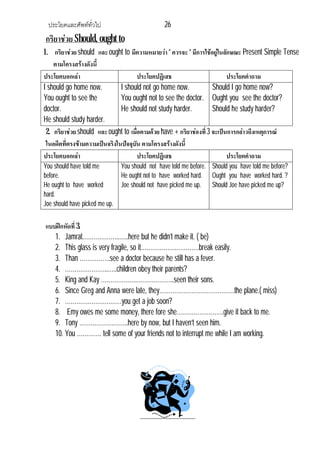
กริยาชวย Should, ought to
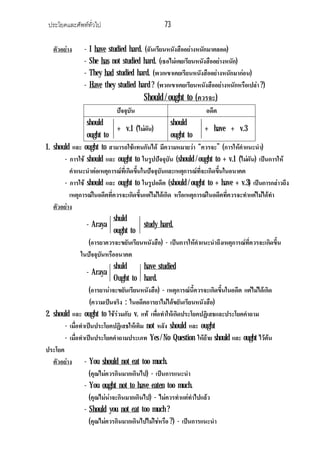
1. กริยาชวย should และought to มีความหมายวา“ ควรจะ “ มีการใชอยูในลักษณะ Present Simple Tense
ตามโครงสรางดังนี้
ประโยคบอกเลา ประโยคปฏิเสธ ประโยคคําถาม
I should go home now.
You ought to see the
doctor.
He should study harder.
I should not go home now.
You ought not to see the doctor.
He should not study harder.
Should I go home now?
Ought you see the doctor?
Should he study harder?
2. กริยาชวย should และought to เมื่อตามดวย have + กริยาชองที่3 จะเปนการกลาวถึงเหตุการณ
ในอดีตที่ตรงขามความเปนจริงในปจจุบัน ตามโครงสรางดังนี้
ประโยคบอกเลา ประโยคปฏิเสธ ประโยคคําถาม
You should have told me
before.
He ought to have worked
hard.
Joe should have picked me up.
You should not have told me before.
He ought not to have worked hard.
Joe should not have picked me up.
Should you have told me before?
Ought you have worked hard. ?
Should Joe have picked me up?
แบบฝกหัดที่3.
1. Jamrat………………..…..here but he didn’t make it. ( be)
2. This glass is very fragile, so it……………….…………break easily.
3. Than …………….see a doctor because he still has a fever.
4. …………………..…..children obey their parents?
5. King and Kay ……………….………………..seen their sons.
6. Since Greg and Anna were late, they………………………………….the plane.( miss)
7. …………………………you get a job soon?
8. Emy owes me some money, there fore she…………………….give it back to me.
9. Tony ……………………..here by now, but I haven’t seen him.
10. You …………. tell some of your friends not to interrupt me while I am working.
ประโยคและศัพททั่วไป 27
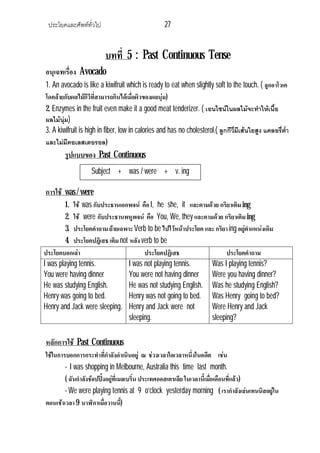
บทที่ 5 : Past Continuous Tense
อนุเฉทเรื่อง Avocado
1. An avocado is like a kiwifruit which is ready to eat when slightly soft to the touch. ( ลูกอาโวเค
โดคลายกับผลไมกีวีที่สามารถกินไดเมื่อผิวของผลนุม)
2. Enzymes in the fruit even make it a good meat tenderizer. ( เอนไซนในผลไมจะทําใหเนื้อ
ผลไมนุม)
3. A kiwifruit is high in fiber, low in calories and has no cholesterol.( ลูกกีวี่มีเสนใยสูง แคลอรี่ต่ํา
และไมมีคอเลสเตอรอล)
รูปแบบของ Past Continuous
การใช was / were
1. ใช was กับประธานเอกพจน คือ I, he she, it และตามดวย กริยาเติมing
2. ใช were กับประธานพหูพจน คือ You, We, they และตามดวย กริยาเติมing
3. ประโยคคําถาม ยายเฉพาะVerb to be ไปไวหนาประโยค และ กริยาing อยูตําแหนงเดิม
4. ประโยคปฎิเสธ เติมnot หลัง verb to be
ประโยคบอกเลา ประโยคปฏิเสธ ประโยคคําถาม
I was playing tennis.
You were having dinner
He was studying English.
Henry was going to bed.
Henry and Jack were sleeping.
I was not playing tennis.
You were not having dinner
He was not studying English.
Henry was not going to bed.
Henry and Jack were not
sleeping.
Was I playing tennis?
Were you having dinner?
Was he studying English?
Was Henry going to bed?
Were Henry and Jack
sleeping?
หลักการใช Past Continuous
ใชในการบอกการกระทําที่กําลังดําเนินอยู ณ ชวงเวลาใดเวลาหนึ่งในอดีต เชน
- I was shopping in Melbourne, Australia this time last month.
( ฉันกําลังชอปปงอยูที่เมลเบริ์น ประเทศออสเตรเลีย ในเวลานี้เมื่อเดือนที่แลว)
- We were playing tennis at 9 o’clock yesterday morning ( เรากําลังเลนเทนนิสอยูใน
ตอนเชาเวลา9 นาฬิกาเมื่อวานนี้)
Subject + was / were + v. ing
ประโยคและศัพททั่วไป 28
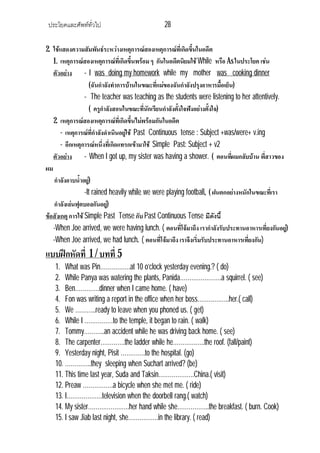
2. ใชแสดงความสัมพันธระหวางเหตุการณสองเหตุการณที่เกิดขึ้นในอดีต
1. เหตุการณสองเหตุการณที่เกิดขึ้นพรอมๆ กันในอดีตนิยมใชWhile หรือ As ในประโยค เชน
ตัวอยาง - I was doing my homework while my mother was cooking dinner
(ฉันกําลังทําการบานในขณะที่แมของฉันกําลังปรุงอาหารมื้อเย็น)
- The teacher was teaching as the students were listening to her attentively.
( ครูกําลังสอนในขณะที่นักเรียนกําลังตั้งใจฟงอยางตั้งใจ)
2. เหตุการณสองเหตุการณที่เกิดขึ้นไมพรอมกันในอดีต
- เหตุการณที่กําลังดําเนินอยูใช Past Continuous tense : Subject +was/were+ v.ing
- อีกเหตุการณหนึ่งที่เกิดแทรกเขามาใช Simple Past: Subject + v2
ตัวอยาง - When I got up, my sister was having a shower. ( ตอนที่ผมกลับบาน พี่สาวของ
ผม
กําลังอาบน้ําอยู)
-It rained heavily while we were playing football. ( ฝนตกอยางหนักในขณะที่เรา
กําลังเลนฟุตบอลกันอยู)
ขอสังเกตุการใชSimple Past Tense กับ Past Continuous Tense มีดังนี้
-When Joe arrived, we were having lunch. ( ตอนที่โจมาถึง เรากําลังรับประทานอาหารเที่ยงกันอยู)
-When Joe arrived, we had lunch. ( ตอนที่โจมาถึง เราจึงเริ่มรับประทานอาหารเที่ยงกัน)
แบบฝกหัดที่ 1 / บทที่ 5
1. What was Pin…………….at 10 o’clock yesterday evening.? ( do)
2. While Panya was watering the plants, Panida………………….a squirrel. ( see)
3. Ben………….dinner when I came home. ( have)
4. Fon was writing a report in the office when her boss……………..her.( call)
5. We ………..ready to leave when you phoned us. ( get)
6. While I ……………to the temple, it began to rain. ( walk)
7. Tommy………..an accident while he was driving back home. ( see)
8. The carpenter………….the ladder while he……………..the roof. (fall/paint)
9. Yesterday night, Pisit ………….to the hospital. (go)
10. …………..they sleeping when Suchart arrived? (be)
11. This time last year, Suda and Taksin……………….China.( visit)
12. Preaw …………….a bicycle when she met me. ( ride)
13. I……………….television when the doorbell rang.( watch)
14. My sister………………….her hand while she……………..the breakfast. ( burn. Cook)
15. I saw Jiab last night, she…………….in the library. ( read)
ประโยคและศัพททั่วไป 29
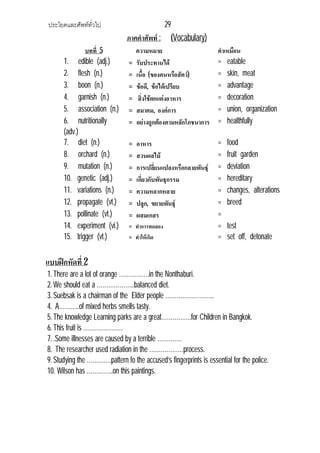
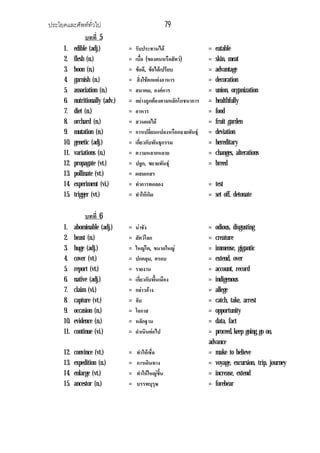
ภาคคําศัพท : (Vocabulary)
บทที่ 5 ความหมาย คําเหมือน
1. edible (adj.) = รับประทานได = eatable
2. flesh (n.) = เนื้อ (ของคนหรือสัตว) = skin, meat
3. boon (n.) = ขอดี, ขอไดเปรียบ = advantage
4. garnish (n.) = สิ่งใชตกแตงอาหาร = decoration
5. association (n.) = สมาคม, องคการ = union, organization
6. nutritionally
(adv.)
= อยางถูกตองตามหลักโภชนาการ = healthfully
7. diet (n.) = อาหาร = food
8. orchard (n.) = สวนผลไม = fruit garden
9. mutation (n.) = การเปลี่ยนแปลงหรือกลายพันธุ = deviation
10. genetic (adj.) = เกี่ยวกับพันธุกรรม = hereditary
11. variations (n.) = ความหลากหลาย = changes, alterations
12. propagate (vt.) = ปลูก, ขยายพันธุ = breed
13. pollinate (vt.) = ผสมเกสร =
14. experiment (vi.) = ทําการทดลอง = test
15. trigger (vt.) = ทําใหเกิด = set off, detonate
แบบฝกหัดที่ 2
1.There are a lot of orange …………….in the Nonthaburi.
2.We should eat a ………………..balanced diet.
3.Suebsak is a chairman of the Elder people ……………………..
4. A………..of mixed herbs smells tasty.
5.The knowledge Learning parks are a great…………….for Children in Bangkok.
6.This fruit is …………………
7..Some illnesses are caused by a terrible ………….
8. The researcher used radiation in the ………………process.
9.Studying the ………….pattern fo the accused’s fingerprints is essential for the police.
10. Wilson has …………..on this paintings.
ประโยคและศัพททั่วไป 30
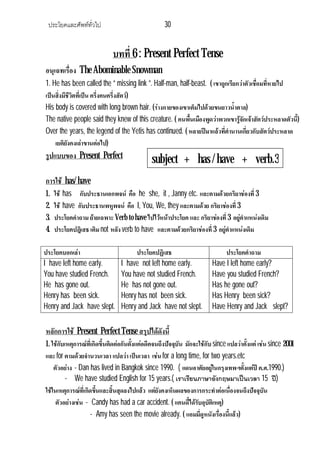
บทที่ 6 : Present Perfect Tense
อนุเฉทเรื่อง The Abominable Snowman
1. He has been called the “ missing link ”. Half-man, half-beast. ( เขาถูกเรียกวาตัวเชื่อมที่หายไป
เปนสิ่งมีชีวิตที่เปน ครึ่งคนครึ่งสัตว)
His body is covered with long brown hair. (รางกายของเขาเต็มไปดวยขนยาวน้ําตาล)
The native people said they knew of this creature. ( คนพื้นเมืองพูดวาพวกเขารูจักเจาสัตวประหลาดตัวนี้)
Over the years, the legend of the Yetis has continued. ( หลายปมาแลวที่ตํานานเกี่ยวกับสัตวประหลาด
เยติยังคงเลาขานตอไป)
รูปแบบของ Present Perfect
การใช has/ have
1. ใช has กับประธานเอกพจน คือ he she, it , Janny etc. และตามดวยกริยาชองที่3
2. ใช have กับประธานพหูพจน คือ I, You, We, they และตามดวย กริยาชองที่3
3. ประโยคคําถาม ยายเฉพาะVerb to have ไปไวหนาประโยค และ กริยาชองที่3 อยูตําแหนงเดิม
4. ประโยคปฎิเสธ เติมnot หลัง verb to have และตามดวยกริยาชองที่3 อยูตําแหนงเดิม
ประโยคบอกเลา ประโยคปฏิเสธ ประโยคคําถาม
I have left home early.
You have studied French.
He has gone out.
Henry has been sick.
Henry and Jack have slept.
I have not left home early.
You have not studied French.
He has not gone out.
Henry has not been sick.
Henry and Jack have not slept.
Have I left home early?
Have you studied French?
Has he gone out?
Has Henry been sick?
Have Henry and Jack slept?
หลักการใช Present Perfect Tense สรุปไดดังนี้
1. ใชกับเหตุการณที่เกิดขึ้นติดตอกันตั้งแตอดีตจนถึงปจจุบัน มักจะใชกับ since แปลวาตั้งแต เชน since 2001
และ for ตามดวยจํานวนเวลา แปลวาเปนเวลา เชน for a long time, for two years.etc
ตัวอยาง - Dan has lived in Bangkok since 1990. ( แดนอาศัยอยูในกรุงเทพฯตั้งแตป ค.ศ.1990.)
- We have studied English for 15 years.( เราเรียนภาษาอังกฤษมาเปนเวลา 15 ป)
ใชในเหตุการณที่เกิดขึ้นและสิ้นสุดลงไปแลว แตยังคงเห็นผลของการกระทําตอเนื่องจนถึงปจจุบัน
ตัวอยางเชน - Candy has had a car accident. ( แคนดี้ไดรับอุบัติเหตุ)
- Amy has seen the movie already. ( แอมมี่ดูหนังเรื่องนี้แลว)
subject + has / have + verb.3
ประโยคและศัพททั่วไป 31
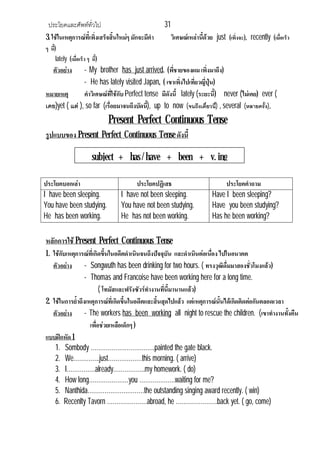
3. ใชในเหตุการณที๋เพิ่งเสร็จสิ้นใหมๆ มักจะมีคํา วิเศษณเหลานี้ดวย just (เพิ่งจะ), recently (เมื่อเร็ว
ๆ นี้)
lately (เมื่อเร็ว ๆ นี้)
ตัวอยาง - My brother has just arrived. (พี่ชายของผมเพิ่งมาถึง)
- He has lately visited Japan. ( เขาเพิ่งไปเที่ยวญี่ปุน)
หมายเหตุ คําวิเศษณที่ใชกับ Perfect tense มีดังนี้ lately (ระยะนี้) never (ไมเคย) ever (
เคย)yet ( แต ), so far (เรื่อยมาจนถึงบัดนี้), up to now (จนถึงเดี๋ยวนี้) , several (หลายครั้ง),
Present Perfect Continuous Tense
รูปแบบของ Present Perfect Continuous Tense ดังนี้
ประโยคบอกเลา ประโยคปฏิเสธ ประโยคคําถาม
I have been sleeping.
You have been studying.
He has been working.
I have not been sleeping.
You have not been studying.
He has not been working.
Have I been sleeping?
Have you been studying?
Has he been working?
หลักการใช Present Perfect Continuous Tense
1. ใชกับเหตุการณที่เกิดขึ้นในอดีตดําเนินจนถึงปจจุบัน และดําเนินตอเนื่อง ไปในอนาคต
ตัวอยาง - Songwuth has been drinking for two hours. ( ทรงวุฒิดื่มมาสองชั่วโมงแลว)
- Thomas and Francoise have been working here for a long time.
( โทมัสและฟรังซัวรทํางานที่นี้มานานแลว)
2. ใชในการย้ําถึงเหตุการณที่เกิดขึ้นในอดีตและสิ้นสุดไปแลว แตเหตุการณนั้นไดเกิดติดตอกันตลอดเวลา
ตัวอยาง - The workers has been working all night to rescue the children. (เขาทํางานทั้งคืน
เพื่อชวยเหลือเด็กๆ )
แบบฝกหัด 1
1. Sombody …………………………….painted the gate black.
2. We…………..just………………this morning. ( arrive)
3. I……………already……………..my homework. ( do)
4. How long…………………you ……………….waiting for me?
5. Nanthida…………………………the outstanding singing award recently. ( win)
6. Recenlty Tavorn …………………abroad, he ………………….back yet. ( go, come)
subject + has / have + been + v. ing
ประโยคและศัพททั่วไป 32
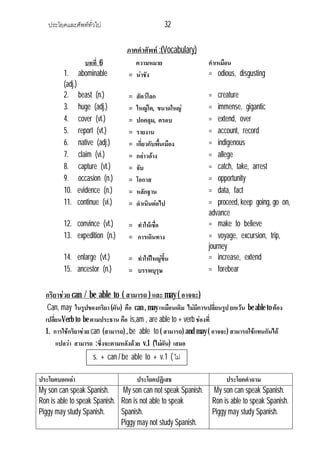
ภาคคําศัพท :(Vocabulary)
บทที่ 6 ความหมาย คําเหมือน
1. abominable
(adj.)
= นาชัง = odious, disgusting
2. beast (n.) = สัตวโลก = creature
3. huge (adj.) = ใหญโต, ขนาดใหญ = immense, gigantic
4. cover (vt.) = ปกคลุม, ครอบ = extend, over
5. report (vt.) = รายงาน = account, record
6. native (adj.) = เกี่ยวกับพื้นเมือง = indigenous
7. claim (vi.) = กลาวอาง = allege
8. capture (vt.) = จับ = catch, take, arrest
9. occasion (n.) = โอกาส = opportunity
10. evidence (n.) = หลักฐาน = data, fact
11. continue (vi.) = ดําเนินตอไป = proceed, keep going, go on,
advance
12. convince (vt.) = ทําใหเชื่อ = make to believe
13. expedition (n.) = การเดินทาง = voyage, excursion, trip,
journey
14. enlarge (vt.) = ทําใหใหญขึ้น = increase, extend
15. ancestor (n.) = บรรพบุรุษ = forebear
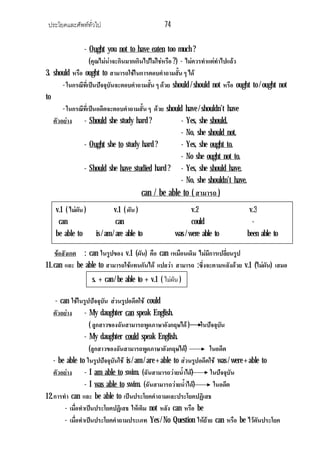
กริยาชวย can / be able to ( สามารถ ) และ may ( อาจจะ)
Can, may ในรูปของกริยา (ผัน) คือ can , mayเหมือนเดิม ไมมีการเปลี่ยนรูป ยกเวน be able toตอง
เปลี่ยนVerb to be ตามประธาน คือ is,am , are able to + verb ชองที่
1. การใชกริยาชวย can (สามารถ) , be able to ( สามารถ) and may( อาจจะ) สามารถใชแทนกันได
แปลวา สามารถ :ซึ่งจะตามหลังดวย v.1 (ไมผัน) เสมอ
ประโยคบอกเลา ประโยคปฏิเสธ ประโยคคําถาม
My son can speak Spanish.
Ron is able to speak Spanish.
Piggy may study Spanish.
My son can not speak Spanish.
Ron is not able to speak
Spanish.
Piggy may not study Spanish.
My son can speak Spanish.
Ron is able to speak Spanish.
Piggy may study Spanish.
s. + can / be able to + v.1 ( ไม
ประโยคและศัพททั่วไป 33
แบบฝกหัด 2:
1. Lions are four-
footed……………………………………………………………………………………..
2. The cottage is ……………with snow.
3. Wanchai is not a Spanish ………………………..speaker.
4. Compared to other birds, ostriches are………………………………….
5. Everyone…………………….that Banharn had a right to apply for this election.
6. The prirates …………………..three Thai fishermen as hostages.
7. On this auspicious………………………….., we wish you all good luck.
8. We have to ……………………..to help women and youths affected from domestic violences.
9. I ……………………….Pokin to donate some money to the poor children.
10. During his long……………………….., Philip stopped to visit Thailand.
11. Thais are proud of our…………………who keep the territory and independence for our country.
12. I …………….the letter in order that my mother could read it easily.
13. We can use a magnifiying glass to ……………….this thing.
14. The photographers have made many………………….to pinpoint the Yetis.
15. The Abominable snowman is half-man, half………………………………………………………..
******************************************************************************************************************
แบบฝกหัด 3:
1………………Henry able to join the party tomorrow night?
2. Edward………………..pass the English test last year.
3. He………………………out this evening. He is not sure.
4. Sornram…………………marry Nuisri because he was not ready.
5. We…………………….university at 1700 this afternoon.
6. It seems to me that it…………………………rain tonight.
7. It…………………..be raining in Songkhla at the moment.
8. Miss Jackarine ……………swim, so she sunk.
9. ………………you ……………to play the piano?
10.……………..the workers work out all night?
ประโยคและศัพททั่วไป 34
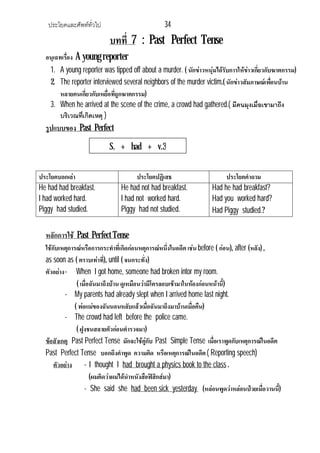
บทที่ 7 : Past Perfect Tense
อนุเฉทเรื่อง A young reporter
1. A young reporter was tipped off about a murder. ( นักขาวหนุมไดรับการใหขาวเกี่ยวกับฆาตกรรม)
2. The reporter interviewed several neighbors of the murder victim.( นักขาวสัมภาษณเพื่อนบาน
หลายคนเกี่ยวกับเหยื่อที่ถูกฆาตกรรม)
3. When he arrived at the scene of the crime, a crowd had gathered.( มีคนมุงเมื่อเขามาถึง
บริเวณที่เกิดเหตุ )
รูปแบบของ Past Perfect
ประโยคบอกเลา ประโยคปฏิเสธ ประโยคคําถาม
He had had breakfast.
I had worked hard.
Piggy had studied.
He had not had breakfast.
I had not worked hard.
Piggy had not studied.
Had he had breakfast?
Had you worked hard?
Had Piggy studied.?
หลักการใช Past Perfect Tense
ใชกับเหตุการณหรือการกระทําที่เกิดกอนหตุการณหนึ่งในอดีตเชน before ( กอน), after (หลัง) ,
as soon as ( ตราบเทาที่), until ( จนกระทั่ง)
ตัวอยาง- When I got home, someone had broken intor my room.
( เมื่อฉันมาถึงบาน ดูเหมือนวามีโครลอบเขามาในหองกอนหนานี้)
- My parents had already slept when I arrived home last night.
( พอแมของฉันนอนหลับแลวเมื่อฉันมาถึงมาบานเมื่อคืน)
- The crowd had left before the police came.
( ฝูงชนสลายตัวกอนตํารวจมา)
ขอสังเกตุ Past Perfect Tense มักจะใชคูกับ Past Simple Tense เมื่อเราพูดกับเหตุการณในอดีต
Past Perfect Tense บอกถึงคําพูด ความคิด หรือเหตุการณในอดีต( Reporting speech)
ตัวอยาง - I thought I had brought a physics book to the class .
(ผมคิดวาผมไดนําหนังสือฟสิกสมา)
- She said she had been sick yesterday (หลอนพูดวาหลอนปวยเมื่อวานนี้)
S. + had + v.3
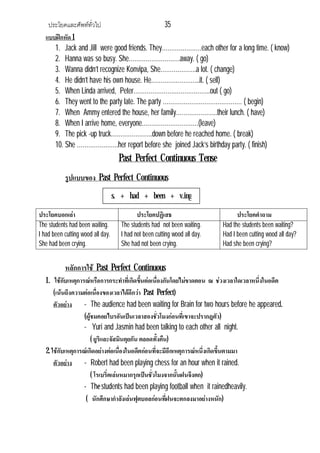
ประโยคและศัพททั่วไป 35
แบบฝกหัด 1
1. Jack and Jill were good friends. They…………………each other for a long time. ( know)
2. Hanna was so busy. She………………………away. ( go)
3. Wanna didn’t recognize Konvipa, She……………….a lot. ( change)
4. He didn’t have his own house. He……………………..it. ( sell)
5. When Linda arrived, Peter…………………………………..out ( go)
6. They went to the party late. The party …………………………………… ( begin)
7. When Ammy entered the house, her family………………….their lunch. ( have)
8. When I arrive home, everyone…………………………(leave)
9. The pick -up truck………………….down before he reached home. ( break)
10. She ………………….her report before she joined Jack’s birthday party. ( finish)
Past Perfect Continuous Tense
รูปแบบของ Past Perfect Continuous
ประโยคบอกเลา ประโยคปฏิเสธ ประโยคคําถาม
The students had been waiting.
I had been cutting wood all day.
She had been crying.
The students had not been waiting.
I had not been cutting wood all day.
She had not been crying.
Had the students been waiting?
Had I been cutting wood all day?
Had she been crying?
หลักการใช Past Perfect Continuous
1. ใชกับเหตุการณหรือการกระทําที่เกิดขึ้นตอเนื่องกันโดยไมขาดตอน ณ ชวงเวลาใดเวลาหนึ่งในอดีต
(เนนถึงความตอเนื่องของเวลาไดดีกวา Past Perfect)
ตัวอยาง - The audience had been waiting for Brain for two hours before he appeared.
(ผูชมคอยไบรอันเปนเวลาสองชั่วโมงกอนที่เขาจะปรากฎตัว)
- Yuri and Jasmin had been talking to each other all night.
( ยูริและจัสมินคุยกัน ตลอดทั้งคืน)
2. ใชกับเหตุการณเกิดอยางตอเนื่องในอดีตกอนที่จะมีอีกเหตุการณหนึ่งเกิดขึ้นตามมา
ตัวอยาง - Robert had been playing chess for an hour when it rained.
( โรเบริ์ตเลนหมากรุกเปนชั่วโมงจากนั้นฝนจึงตก)
- The students had been playing football when it rainedheavily.
( นักศึกษากําลังเลนฟุตบอลกอนที่ฝนจะตกลงมาอยางหนัก)
s. + had + been + v.ing
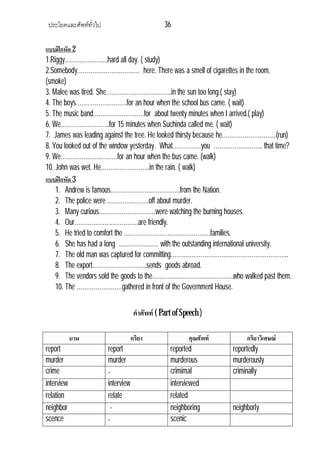
ประโยคและศัพททั่วไป 36
แบบฝกหัด 2
1.Riggy…………………..hard all day. ( study)
2.Somebody…………………………… here. There was a smell of cigarettes in the room.
(smoke)
3. Malee was tired. She……………………………..in the sun too long.( stay)
4. The boys………………………for an hour when the school bus came. ( wait)
5. The music band………………………for about twenty minutes when I arrived.( play)
6. We……………………..for 15 minutes when Suchinda called me. ( wait)
7. James was leading against the tree. He looked thirsty because he………………………..(run)
8. You looked out of the window yesterday. What……………you …………………….. that time?
9. We…………………………for an hour when the bus came. (walk)
10. John was wet. He……………………..in the rain. ( walk)
แบบฝกหัด 3
1. Andrew is famous……………………………….from the Nation.
2. The police were ………………….off about murder.
3. Many curious…………………………were watching the burning houses.
4. Our…………………………….are friendly.
5. He tried to comfort the ……………………………………….families.
6. She has had a long ………………… with the outstanding international university.
7. The old man was captured for committing……………………………………………………...
8. The export………………………..sends goods abroad.
9. The vendors sold the goods to the…………………………………….who walked past them.
10. The ……………………gathered in front of the Government House.
คําศัพท ( Part of Speech )
นาม กริยา คุณศัพท กริยาวิเศษณ
report report reported reportedly
murder murder murderous murderously
crime - crimimal criminally
interview interview interviewed
relation relate related
neighbor - neighboring neighborly
scence - scenic
ประโยคและศัพททั่วไป 37
crowd crowd crowded
victim victimize
bereavement - bereaved
active - active activity
connection connect connected
ภาคคําศํพท :(Vocabulary)
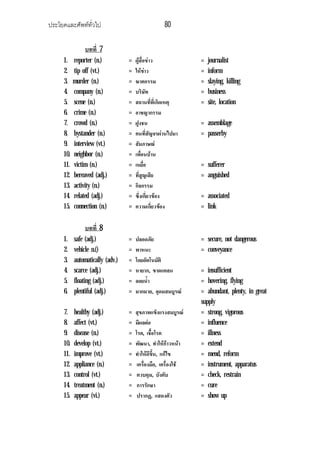
บทที่ 7 ความหมาย คําเหมือน
1. reporter (n.) = ผูสื่อขาว = journalist
2. tip off (vt.) = ใหขาว = inform
3. murder (n.) = ฆาตกรรม = slaying, killing
4. company (n.) = บริษัท = business
5. scene (n.) = สถานที่ที่เกิดเหตุ = site, location
6. crime (n.) = อาชญากรรม = wrongdoing
7. crowd (n.) = ฝูงชน = assemblage
8. bystander (n.) = คนที่สัญจรผานไปมา = passerby
9. interview (vt.) = สัมภาษณ = interrogate
10. neighbor (n.) = เพื่อนบาน
11. victim (n.) = เหยื่อ = sufferer
12. bereaved (adj.) = ที่สูญเสีย = anguished
13. activity (n.) = กิจกรรม = action
14. related (adj.) = ซึ่งเกี่ยวของ = associated
15. connection (n.) = ความเกี่ยวของ = link
ประโยคและศัพททั่วไป 38
บทที่ 8 : Future Simple Tense
อนุเฉทเรื่อง Get Ready for the future
1. People will live on the upper level, the lower level will be used for traffic , parking and
factories. ( คนจะอาศัยอยูในที่สูง สวนพื้นที่ระดับต่ําจะถูกใจสําหรับจราจร ที่จอดรถและโรงงาน)
2. Biotechnology will make food more plentiful and healthy. ( เทคโนโลยีชีวภาพจะทําใหอาหาร
มีหลากหลายและมีสุขภาพ)
รูปแบบของ Future Simple Tense: มีโครงสรางคือ subject + will, shall, be going to + v.1
ประโยคบอกเลา ประโยคปฏิเสธ ประโยคคําถาม
You will travel to Paris.
We shall visit our parents soon.
She is going to repair the roof.
You will not travel to Paris.
We shall not visit our parents soon.
She is not going to repair the roof.
Will you travel to Paris ?
Shall we visit our parents soon?
Is she going to repair the roof?
หลักการใช Future Simple Tense
1. ใชกับเหตุการณที่จะเกิดขึ้นในอนาคต โดยมีจะมีคํากริยาวิเศษณ ตอไปนี้ later (ตอมา), Today (วันนี้),
the day after tomorrow (วันมะรืนนี้), next week (สัปดาหหนา) ,next month (เดือนหนา), tonight (คืนนี้), soon
(ในไมชา)
ตัวอยาง It will be winter soon. ( ใกลจะถึงฤดูหนาวแลว)
Will England win the next football World cup? ( อังกฤษจะชนะการแขงฟุตบอลครั้งหนาหรือไม)
I shall be there in a few minutes. ( ฉันจะไปที่นั่นอีกไมกี่นาที)
2. ใชกับประโยคที่แสดงการขอรองหรือขออนุญาต
ตัวอยาง - Will you open the window please ? (กรุณาเปดหนาตางหนอยไดไหม?)
- Shall we go for a walk? ( เราไปเดินเลนกันไหม)
หมายเหตุ Shall ใชกับประธานคือ we , I เทานั้น
3. ใชกับประโยคที่แสดงอนาคตที่ประกอบดวยเหตุการณสองเหตุการณ ในรูปเงื่อนไข ที่มี คําวา
If, unless, until , when เหตุการณที่อยูในอนุประโยคหลักจะใช Future Simple และ เหตุการณที่อยู
ใน
อนุประโยครองใช Present Simple หรือ Present Perfect คําเชื่อมที่นํามาใชเชื่อมสองเหตุการณใน
อนาคต ไดแก I don’t’ know if I will be there. ( ผมไมรูวาผมจะอยูที่นั้นหรือไม)
They haven’t said when it will be ready. ( พวกเขาไมไดพูดอะไรวาเมื่อไหรจะพรอม)
When will I see you again? ( เมื่อไหรจะเจอคุณอีก)
I will give up smoking if it will make you happy.( ผมจะเลิกสูบบุหรี่ถาทําใหคุณสบายใจ)
ประโยคและศัพททั่วไป 39
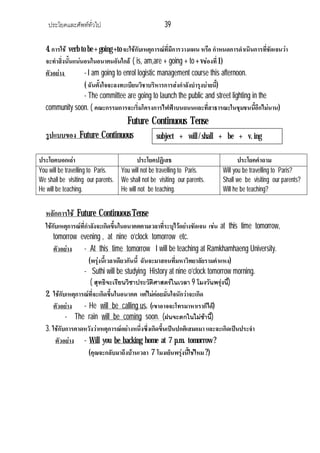
4. การใช verb to be + going +toจะใชกับเหตุการณที่มีการวางแผน หรือ กําหนดการดําเนินการที่ชัดเจนวา
จะทําสิ่งนั้นแนนอนในอนาคนอันใกล ( is, am,are + going + to + vชองที่1)
ตัวอยาง - I am going to enrol logistic management course this afternoon.
( ฉันตั้งใจจะลงทะเบียนวิชาบริหารการสงกําลังบํารุงบายนี้)
- The committee are going to launch the public and street lighting in the
community soon. ( คณะกรรมการจะเริ่มโครงการไฟฟาบนถนนและที่สาธารณะในชุมชนนี้อีกไมนาน)
Future Continuous Tense
รูปแบบของ Future Continuous
ประโยคบอกเลา ประโยคปฏิเสธ ประโยคคําถาม
You will be travelling to Paris.
We shall be visiting our parents.
He will be teaching.
You will not be travelling to Paris.
We shall not be visiting our parents.
He will not be teaching.
Will you be travelling to Paris?
Shall we be visiting our parents?
Will he be teaching?
หลักการใช Future Continuous Tense
ใชกับเหตุการณที่กําลังจะเกิดขึ้นในอนาคตตามเวลาที่ระบุไวอยางชัดเจน เชน at this time tomorrow,
tomorrow evening , at nine o’clock tomorrow etc.
ตัวอยาง - At this time tomorrow I will be teaching at Ramkhamhaeng University.
(พรุงนี้เวลาเดียวกันนี้ ฉันจะมาสอนที่มหาวิทยาลัยรามคําแหง)
- Suthi will be studying History at nine o’clock tomorrow morning.
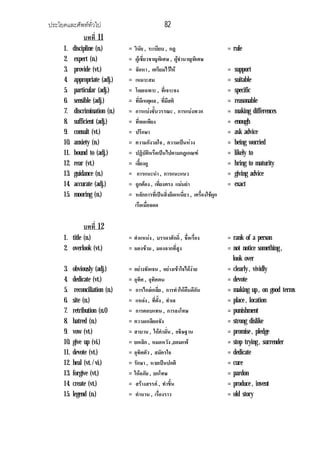
( สุทธิจะเรียนวิชาประวัติศาสตรในเวลา 9 โมงวันพรุงนี้)
2. ใชกับเหตุการณที่จะเกิดขึ้นในอนาคต แตไมคอยมั่นใจนักวาจะเกิด
ตัวอยาง - He will be calling us. (เขาอาจจะโทรมาหาเราก็ได)
- The rain will be coming soon. (ฝนจะตกในไมชานี้)
3. ใชกับการคาดหวังวาเหตุการณอยางหนึ่งซึ่งเกิดขึ้นเปนปกติเสมอมา และจะเกิดเปนประจํา
ตัวอยาง - Will you be backing home at 7 p.m. tomorrow ?
(คุณจะกลับมาถึงบานเวลา 7 โมงเย็นพรุงนี้ใชไหม?)
subject + will / shall + be + v. ing
ประโยคและศัพททั่วไป 40
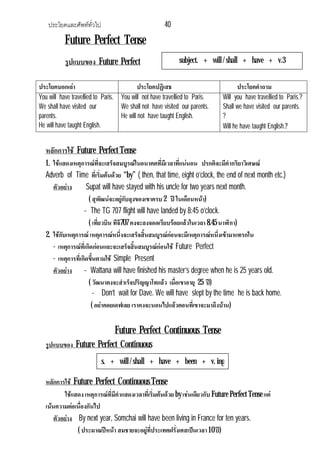
Future Perfect Tense
รูปแบบของ Future Perfect
ประโยคบอกเลา ประโยคปฏิเสธ ประโยคคําถาม
You will have travellied to Paris.
We shall have visited our
parents.
He will have taught English.
You will not have travellied to Paris.
We shall not have visited our parents.
He will not have taught English.
Will you have travellied to Paris.?
Shall we have visited our parents.
?
Will he have taught English.?
หลักการใช Future Perfect Tense
1. ใชแสดงเหตุการณที่จะเสร็จสมบูรณในอนาคตที่มีเวลาที่แนนอน ปรกติจะมีคํากริยาวิเศษณ
Adverb of Time ที่เริ่มตนดวย “by” ( then, that time, eight o’clock, the end of next month etc.)
ตัวอยาง Supat will have stayed with his uncle for two years next month.
( สุพัฒนจะอยูกับลุงของเขาครบ 2 ป ในเดือนหนา)
- The TG 707 flight will have landed by 8:45 o’clock.
( เที่ยวบิน ทีจี707 คงจะลงจอดเรียบรอยแลวในเวลา8.45 นาฬิกา)
2. ใชกับเหตุการณ เหตุการณหนึ่งจะเสร็จสิ้นสมบูรณกอนจะมีเหตุการณหนึ่งเขามาแทรกใน
- เหตุการณที่เกิดกอนและจะเสร็จสิ้นสมบูรณกอนใช Future Perfect
- เหตุการที่เกิดขึ้นตามใช Simple Present
ตัวอยาง - Wattana will have finished his master’s degree when he is 25 years old.
( วัฒนาคงจะสําเร็จปริญญาโทแลว เมื่อเขาอายุ 25 ป)
- Don’t wait for Dave. We will have slept by the time he is back home.
( อยาคอยเดฟเลย เราคงจะนอนไปแลวตอนที่เขาจะมาถึงบาน)
Future Perfect Continuous Tense
รูปแบบของ Future Perfect Continuous
หลักการใช Future Perfect Continuous Tense
ใชแสดง เหตุการณที่มีคําแสดงเวลาที่เริ่มตนดวย byเชนเดียวกับ Future Perfect Tense แต
เนนความตอเนื่องกันไป
ตัวอยาง By next year, Somchai will have been living in France for ten years.
( ประมาณปหนา สมชายจะอยูที่ประเทศฝรั่งเศสเปนเวลา10 ป)
subject. + will / shall + have + v.3
s. + will / shall + have + been + v. ing
ประโยคและศัพททั่วไป 41
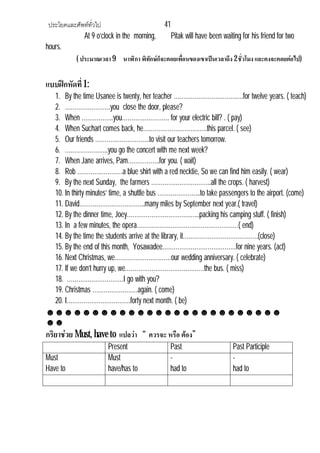
At 9 o’clock in the morning, Pitak will have been waiting for his friend for two
hours.
( ประมาณเวลา9 นาฬิกา พิทักษก็จะคอยเพื่อนของเขาเปนเวลาถึง 2 ชั่วโมง และคงจะคอยตอไป)
แบบฝกหัดที่ 1:
1. By the time Usanee is twenty, her teacher ……………………………….for twelve years. ( teach)
2. ……………………you close the door, please?
3. When ……………..you……………………. for your electric bill? . ( pay)
4. When Suchart comes back, he…………………………….this parcel. ( see)
5. Our friends ………………………..to visit our teachers tomorrow.
6. …………………..you go the concert with me next week?
7. When Jane arrives, Pam……………..for you. ( wait)
8. Rob ……………………a blue shirt with a red necktie, So we can find him easily. ( wear)
9. By the next Sunday, the farmers …………………………..all the crops. ( harvest)
10. In thirty minutes’ time, a shuttle bus …………………..to take passengers to the airport. (come)
11. David……………………………..many miles by September next year.( travel)
12. By the dinner time, Joey…………………………….…..packing his camping stuff. ( finish)
13. In a few minutes, the opera………………………………………………( end)
14. By the time the students arrive at the library, it………………………………….(close)
15. By the end of this month, Yosawadee…………………………………for nine years. (act)
16. Next Christmas, we…………………………our wedding anniversary. ( celebrate)
17. If we don’t hurry up, we……………………………………the bus. ( miss)
18. …………………………I go with you?
19. Christmas ……………………again. ( come)
20. I…………………………….forty next month. ( be)
☻☻☻☻☻☻☻☻☻☻☻☻☻☻☻☻☻☻☻☻☻☻☻☻☻☻
☻☻
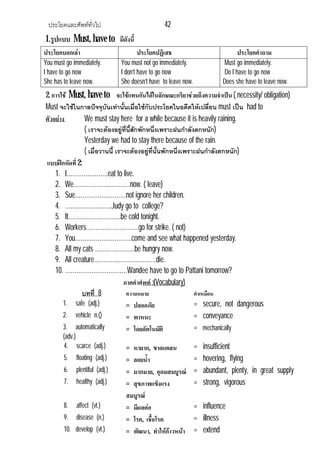
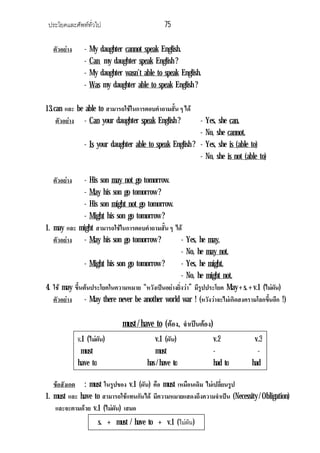
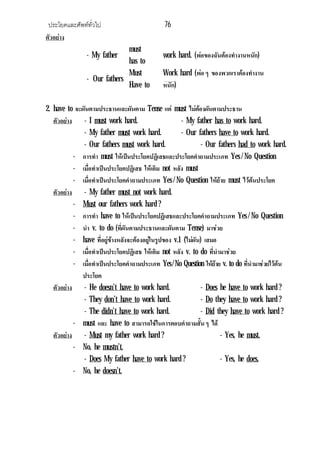
กริยาชวย Must, have to แปลวา “ ควรจะ หรือ ตอง”
Present Past Past Participle
Must
Have to
Must
have/has to
-
had to
-
had to
ประโยคและศัพททั่วไป 42
1.รูปแบบ Must, have to มีดังนี้
ประโยคบอกเลา ประโยคปฏิเสธ ประโยคคําถาม
You must go immediately.
I have to go now
She has to leave now.
You must not go immediately.
I don’t have to go now
She doesn’t have to leave now.
Must go immediately.
Do I have to go now
Does she have to leave now.
2. การใช Must, have to จะใชแทนกันไดในลักษณะกริยาชวยถึงความจําเปน ( necessity/ obligation)
Must จะใชในกาลปจจุบันเทานั้นเมื่อใชกับประโยคในอดีตใหเปลี่ยน must เปน had to
ตัวอยาง We must stay here for a while because it is heavily raining.
( เราจะตองอยูที่นี้สักพักหนึ่งเพราะฝนกําลังตกหนัก)
Yesterday we had to stay there because of the rain.
( เมื่อวานนี้ เราจะตองอยูที่นั้นพักหนึ่งเพราะฝนกําลังตกหนัก)
แบบฝกหัดที่2:
1. I………………….eat to live.
2. We…………………………now. ( leave)
3. Sue………………………not ignore her children.
4. …………………….Judy go to college?
5. It……………………….be cold tonight.
6. Workers……………………….go for strike. ( not)
7. You…………………………come and see what happened yesterday.
8. All my cats …………………be hungry now.
9. All creature……………………………die.
10. ……………………………Wandee have to go to Pattani tomorrow?
ภาคคําศํพท :(Vocabulary)
บทที่ 8 ความหมาย คําเหมือน
1. safe (adj.) = ปลอดภัย = secure, not dangerous
2. vehicle n.() = พาหนะ = conveyance
3. automatically
(adv.)
= โดยอัตโนมัติ = mechanically
4. scarce (adj.) = หายาก, ขาดแคลน = insufficient
5. floating (adj.) = ลอยน้ํา = hovering, flying
6. plentiful (adj.) = มากมาย, อุดมสมบูรณ = abundant, plenty, in great supply
7. healthy (adj.) = สุขภาพแข็งแรง
สมบูรณ
= strong, vigorous
8. affect (vt.) = มีผลตอ = influence
9. disease (n.) = โรค, เชื้อโรค = illness
10. develop (vt.) = พัฒนา, ทําใหกาวหนา = extend
ประโยคและศัพททั่วไป 43
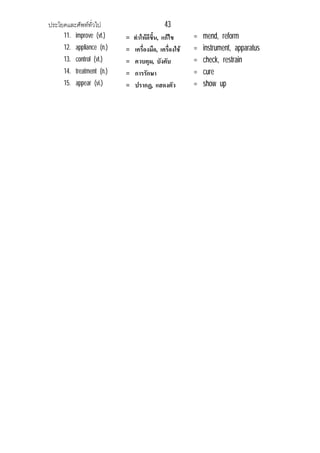
11. improve (vt.) = ทําใหดีขึ้น, แกไข = mend, reform
12. appliance (n.) = เครื่องมือ, เครื่องใช = instrument, apparatus
13. control (vt.) = ควบคุม, บังคับ = check, restrain
14. treatment (n.) = การรักษา = cure
15. appear (vi.) = ปรากฏ, แสดงตัว = show up
ประโยคและศัพททั่วไป 44
บทที่ 9 : Adjective (คําคุณศัพท)
Adjective (คําคุณศัพท) คือ คําที่ใชขยายนามหรือบอกลักษณะรูปราง ขนาด สี อายุของ นาม
Adjective หลายชนิดเมื่อใชในนําหนานามจะตองเรียงลําดัชนิดตางๆ
1.โดยวางไวหนาคํานามa conference hall ( หองประชุม) , a brick building ( อาคารทําดวยอิฐ),
a cold night ( คืนที่เหน็บหนาว), a beautiful woman ( ผูหญิงสวย), a black dog.( สุนัขตัวสีดํา)
ตัวอยาง - She is an intelligent student (เธอเปนเด็กผูหญิวที่ฉลาด )
- He is a famous actor. ( เขาเปนนักแสดงที่มีชื่อเสียง)
2. คําคณศัพทที่ขยายประธานของประโยค จะตองตามดวยกริยาVerb tobe : is, am, are,was, were,been
หรือ Linking verb เชน look (มองดู), seem (ดูเหมือน) , appear (ปรากฏ) , grow (เติบโต),
prove (พิสูจน) , show (แสดง), become (กลายเปน) , keep (เก็บ, รักษา) , remain (คงอยู)
sound (ออกเสียง) , feel (รูสึก) , turn (หมุน, กลับ) , get (ไดรับ) make (ทําให ) , smell (ไดกลิ่น)
taste (ชิมรส)
ตัวอยาง - Kobsak is very generous. Kobsak looks generous. (กอบศักดิ์เปนคนโอบออมอารี)
- He is good at mathematics. ( เขาเกงในวิชาคณิตศาสตร)
- That policeman is so calm. That policeman remain so calm. ( ตํารวจคนนั้นสุขุม)
3. คําคุณศัพทจะไมวางอยูหนาบุรุษสรรพนาม ทั้งที่ทําหนาที่เปนประธาน เชน I , you , we, they, he.
She,it ยกเวนสรรพนาม one และ ones แตจะอยูหลังคําตอไปนี้ someone ,somebody (บางคน)
everyone,everybody ( ทุกคน), anyone , anybody (คนใดคนหนึ่ง), no one, nobody(ไมมีใครสักคน)
something (บางสิ่ง) everything (ทุกๆสิ่ง), anything (สิ่งใดสิ่งหนึ่ง) , nothing (ไมมีอะไรเลย)
ตัวอยาง - There are many sorts of books, the most interesting ones have been sold out.
(มีหนังสือที่อยูหลายประเภทแตหนังสือที่นาสนใจมากที่สุดขายไปหมดแลว)
- The party today may have something special for the guests.
(งานเลี้ยงคืนนี้คงมีอะไรพิเศษสําหรับแขก)
4. คําคุณศัพทมีหลายชนิด จะไมเปลี่ยนพจนตามคํานามที่มันขยาย แตคุณศัพทที่บอกจํานวนตอไปนี้จะตอง
เลือกใชตามพจนของคํานามที่ขยาย
4.1. adj. บอกจํานวนเอกพจนที่ใชขยายคํานามนับไดเอกพจนกริยาที่ตามหลัง
ประธานจะเปนกริยาเอกพจนเชน is, was, has, had หรือ กริยาอื่นๆ เติมs/es เชน teaches, studies,
gives เปนตน หรือรูปอดีตกริยาชอง 2 กับทุกประธาน หรือ กริยารูป infinitive เชน will be, คําคุณศัพทที่
บอกจํานวนเอกพจนไดแก a / an , this ( นี่) / that (นั่น), another ( อีกอันหนึ่ง) each (แตละ),
every ( ทุกๆ), one (แตละคน)
ตัวอยาง - Each student likes studying Thai History. (เด็กนักเรียนแตละคนชอบเรียนวิชาประวัติศาสตรไทย
- Every person has a right to protect himself. (ทุกคนมีสิทธิ์ในการปกปองตนเอง)
ประโยคและศัพททั่วไป 45
4.2.คําคุณศัพทที่บอกจํานวนพหูพจน ขยายเฉพาะคํานามที่นับไปพหูพจนกริยาที่ตามหลัง
ประธานจะเปนกริยาพหูพจนเชน are, were,have, had หรือ กริยาอื่นๆ ไมเติมs/es เชน teach, study,
give เปนตนหรือรูปอดีตกริยาชอง 2 เชน taught, studied, gave คําคุณศัพทไดแก few ,a few
(2-3 ชิ้น), fewer than, these,those , two / three / four / five , a number of , a large
number of a great number of (จํานวนมาก)
ตัวอยาง - Those birds are from Australia. ( นกเหลานี้มาจากประเทศออสเตรเลีย)
- A large number of applicants are waiting for interview. ( ผูสมัครจํานวนมากําลังรอ
การสัมภาษณ)
4.3. คําคุณศัพทบอกจํานวนเอกพจนและจะใชขยายคํานามนับไมได ซึ่งเปนเอกพจนเสมอ
กริยาจะเปนเอกพจนเชน much, little , a little (เล็กนอย) , a great deal of, a good deal of,
a large amount เปนตน
ตัวอยาง - A great deal of rice is exported from Thailand.
( ขาวจํานวนมากสงออกจากประเทศไทย)
- There is a little sugar left in the bowl. (มีน้ําตาลเหลืออยูนิดหนอยในถวย)
4.4 คําคุณศัพทบางคําใชขยายทั้งคํานามที่นับได ทั้งเอกพจนและพหูพจน และนามที่นับ
ไมไดเอกพจนกริยาที่พจนสอดคลองกับพจนของประธาน คําคุณศัพทนี้ ไดแกa lot of, plenty of, the
any, some, some of , the none of the , any of the เปนตน
ตัวอยาง - Plenty of animals in the big cities are starving ( สัตวจํานวนมากในเมืองใหญๆ
อดตาย)
- A lot of milk is turning sour. (นมจํานวนมากเริ่มมีเปรี้ยว)
- Most of the chicken in this farm are killed. ( ไกจํานวนมากในฟารมนี้ถูกฆาทิ้ง)
4.5 กริยาในรูปทิ่เติม+ ing (Present Participle) มักจะวางอยูหนาคํานามที่หมายถึง
กําลังกระทําเชน a crying baby , a runnin man, a standing boy, walking soldiers , a sleeping
princess เปนตน
ตัวอยาง- The crying girl wants to go home. ( เด็กผูหญิงที่กําลังรองไหตองการจะกลับบาน)
- I might have met that standing man somewhere I couldn’t remember.
(ฉันนาจะเจอผูชายคนที่กําลังยืนอยูตรงนั้นมากอนแตฉันนึกไมออก)
นอกจากนี้ยังเปนการแสดงถึงหนาที่หรือการใชทั่ว ๆ ไปของคํานามนั้น
ตัวอยาง- My grandmother has to use a walking stick. ( ยาของฉันตองใชไมเทา)
- Baan Saen Saran has a lot of swimming pools. (บานแสนสราญมีสระวายน้ําหลายสระ)
4.6 กริยาชองที่3 (Past Participle) มีความหมายถึงประธานถูกกระทํา มักจะวางอยูหนาคํานามที่
ประโยคและศัพททั่วไป 46
ขยาย เชน a broken glass ( แกวแตก) , a fallen tree ( ตนไมที่โคนลม) , an injured passenger (
ผูโดยสารที่ไดรับบาดเจ็บ) , written paper ( กระดาษที่เขียน) เปนตน
ตัวอยาง - The injured passengers were taken to the hospital. ( ผูโดยสารที่ไดรับบาดเจ็บถูกนําสง
โรงพยาบาล)
- It is necessary to submit the written letter to the court.
( มีความจําเปนอยางยิ่งที่จะตองสงหนังสือที่มีลายลักษณอักษรเสนอตอศาล
4.7 กริยาพิเศษที่บอกลักษณะ แสดงความรูสึกทางอารมณและมีโครงสรางที่แตกตางกัน
โครงสรางในการใชประโยคจะใชกับ Verb tobe : +past participle มีความหมายวา“ รูสึก ”
ตัวอยาง - - I am bored. ( ฉันรูสึกเบื่อ) The children were disappointed. (เด็กๆ รูสึกผิดหวัง)
acquainted คุนเคย (with) ,annoyed รําคาญ (with) amazed ประหลาดใจ (at)
amused เพลิดเพลิน (at / with /by) astonished พิศวง (at) bored เบื่อ (by)
confused สับสน (with) convinced เชื่อมั่น (of) delighted ดีใจ (by)
disturbed กวนใจ (by) disappointed ผิดหวัง (in / with) embarrassed ขวยเขิน (by)
excited ตื่นเตน (about) exhausted เหนื่อย (from) fascinated หลงใหล (with / by)
interested สนใจ ( in) involved เกี่ยวของ (in) pleased พอใจ (with)
satisfied พอใจ (with) scared กลัว ( of, by) terrified ย่ําแย ( of, by)
tired เหนื่อย (of) worried (about) opposed คัดคาน (to)
4.8 กริยาพิเศษใชกับรูป present participle ( V.ing )จะเปนคําคุณศัพทบอกถึงลักษณะ
ของคํานามตามความคิดของสวนบุคคล โดยทั่วไปนิยมแปลวา “ นา………………” เชน
ตัวอยาง - The film is amusing. (ภาพยนตรนาเพลิดเพลิน)
- This subject is confusing. (วิชานี้นาสับสน)
annoying รําคาญ amazing ประหลาดใจ amusing เพลิดเพลิน
astonishing พิศวง boring เบื่อ confusing สับสน convincing เชื่อมั่น
delighting ดีใจ disturbing กวนใจ disappointing ผิดหวัง embarrassing ขวยเขิน
exciting ตื่นเตน exhausting เหนื่อย fascinating หลงใหล interesting สนใจ
involving เกี่ยวของ pleasing พอใจ satisfying พอใจ scarying กลัว
terrifying ย่ําแย tiring เหนื่อย worrying กังวัล
ประโยคและศัพททั่วไป 47
9. n. ประสม (Compound Nouns) และ n. ที่ทํานาที่เสมือน adj. ขยาย n. โดย n. ที่ทําหนาขยายนั้น
จะมีรูปเปนเอกพจนเสมอ
n. ประสม (Compound Nouns) เชน
sunglasses (แวนกันแดด) raincoat (เสื้อกันฝน) trademark (เครื่องหมาย
การคา)
railway (ทางรถไฟ) businessman (นักธุรกิจ) birthday (วันเกิด)
bookstore (รานขาย
หนังสือ)
drugstore (รานขายยา) wallpaper (กระดาษติดฝาผนัง)
lifeboat (เรือชวยชีวิต) mailbox (ตูรับจดหมาย) doorman (คนเฝาประตู)
ตัวอยาง - He looks like a countryman. (เขาดูเหมือนเปนคนชนบท)
- The moonlight makes me happy. (แสงจันทรทําใหฉันมีความสุข)
n. ที่ทําหนาที่เสมือน adj. ขยาย n. เชน
picnic basket (ตะกราปกนิก) mango tree (ตนมะมวง) football game (กีฬา
ฟุตบอล)
leather wallet (กระเปาสตางคหนัง traffic sign (ปายจราจร) flower garden (สวนดอกไม)
garden flowers (ดอกไมจาก
สวน)
stone wall (กําแพงหิน) kitchen knife (มีดที่ใชใน
ครัว)
government official (ขาราชการ) soap factory (โรงงานทําสบู) beer bottle (ขวดเบียร)
chocolate milk (นมรส
ช็อกโกแลต)
desk lamp (โคมไฟตั้งโตะ) sugar cane (ตนออย)
diamond chokers (สรอยคอ
เพชร)
leather shoes (รองเทาหนัง) rose garden (สวนกุหลาบ)
football match (การแขงขัน
ฟุตบอล)
street car (รถรางที่วิ่งตาม
ถนน)
ตัวอยาง - Don’t cross that old railway bridge. ( อยาขามสะพานรถไฟเกาๆ สะพานนั้น )
- The cat is sitting on the hot tin roof. ( แมวกําลังนั่งอยูบนหลังคาสังกะสีรอน ๆ )
10. รวมกันเปน adj. คําเดียว โดยมีเครื่องหมาย
Hyphen ( - ) ขีดคั้นกลาง
ถา adj. ประสมที่เกิดจากคําหลังเปน n. หรือเปนอวัยวะของรางกาย ตองเติม - d / - ed หลัง n. นั้น
a middle - aged man (ชายวัยกลางคน) an old - fashioned idea (ความคิดลาสมัย)
a black - haired boy (เด็กผูชายผมสี
ดํา)
a short - sighted girl (เด็กผูหญิงสายตาสั้น)
a broken - hearted man (ชายอกหัก) an absent - minded man (คนใจลอย)
a long - necked man (มนุษยคอยาว) long - legged dad (คุณพอขายาว)
ประโยคและศัพททั่วไป 48
ถา adj. ประสมที่เกิดจากคําหลังเปน v. ในความหมายวา n. ที่ถูกขยายเปนผูกระทํา v. นั้นตองอยูใน
รูปของ v. ing
an ear - rising boy (เด็กผูชายที่นอนตื่นเชา)
a man - eating tiger (เสือที่กินคน)
rice - growing farmers (เกษตรกรที่ปลูกขาว)
a good - looking man (ผูชายที่ทาทางดูดี)
a quickly - growing child (เด็กที่เจริญเติบโตเร็ว)
a well - learning student (นักเรียนเรียนดี)
ถา adj. ประสมที่เกิดจากคําหลังเปน v. ในความหมายวา n. ที่ถูกขยายเปนผูถูกกระทํา v. นั้นตองอยู
ในรูปของ v.3
hand - made silk (ผาไหมที่ทอดวยมือ)
snow - covered mountains (ภูเขาที่ปกคลุมดวยหิมะ)
a badly - written report (รายงานที่เขียนไมดี)
a well - trained worker (คนงานที่ฝกฝนมาอยางดี)
a well - known teacher (ครูชึ่งเปนที่รูจักกันดี)
a Swiss - made watch (นาฬิกาที่ทําในประเทศสวิส)
adj. ผสมรูปอื่น ๆ ไดแก
an up - to - date radio (วิทยุที่ทันสมัย)
a fifty - page report (รายงานหาสิบหนา)
an eight - hour work / an eight hours’ work (การทํางาน8ชั่วโมง)
a two - week holiday / a two weeks’ holiday (ชวงวันหยุดนานสองสัปดาห)
a ten - minute conversation / a ten minutes’ conversation (การสนทนากินเวลา 10 นาที)
a dynasty - style mansion (คฤหาสนแบบราชวงศ)
a seven - story building (อาคาร 7 ชั้น)
a ranch - type house (บานแบบที่มีฟารมปศุสัตว)
a five - minute walk (การเดิน 5 นาที)
ประโยคและศัพททั่วไป 49
การเรียงลําดับ adj.
เมื่อมี adj. หลาย ๆ คําขยาย n. ตองวางเรียงตามลําดับดังนี้
adj. กํากับ n. มีดั้งนี้ - Articles ไดแก a , an , the
- adj. แสดงความเปนเจาของ ไดแก my , your , our , his , her , its ,
their
- adj. ชี้เฉพาะ ไดแก this , that , these , those
- adj. แสดงจํานวนชี้เฉพาะ เชน
- one (of the / these / those) - all (of the / these / those)
- most (of the / these / those) - both (of the / these / those)
- some (of the / these / those) - any (of the / these / those)
- none (of the / these / those) - either (of the / these / those)
- neither (of the / these / those) - several (of the / these / those)
adj. แสดงลักษณะหรือคุณภาพ เชน old , young , good , bad , beautiful , rich , poor etc.
adj. แสดงขนาด เชน big , large , huge , tall , small , short , little etc.
adj. แสดงสี เชน purple , blue , green , yellow , orange , red etc.
adj. แสดงเชื้อชาติ เชน Thai , American , English , Japanese , French etc.
n. ที่ทําหนาที่เสมือน adj. ขยาย n. เชน boy friend , dream team , sound engineer , office
boy , diamond ring , shop assistant etc.
ตัวอยางการเรียงลําดับ adj.
- My mother bought a beautiful flower vase yesterday afternoon.
[ article + adj. แสดงลักษณะ + n. ขยาย + n. หลัก ]
(บายวานนี้แมของฉันชื้อแจกันดอกไมสวยมาใบหนึ่ง)
- She does not like your black leather jacket.
[ adj. แสดงความเปนเจาของ + adj. แสดงสี+ n. ขยาย + n. หลัก ]
(เธอไมชอบเสื้อแจ็คเก็ตหนังสีดําของคุณ)
- The beautiful Chinese flower vase is broken.
[ article + adj. แสดงลักษณะ + adj. แสดงเชื้อชาติ + n. ขยาย + n. หลัก ]
(แจกันดอกไมจากประเทศจีนที่สวยแตก)
- That green American T – shirt in my drawer is for your sister.
[ adj. กํากับนาม (that) +adj. แสดงสี + adj. แสดงเชื้อชาติ + n. หลัก ]
(เสื้อยืดอเมริกันสีเขียวในลิ้นชักฉันตัวนั้นสําหรับนองสาวของคุณ)
กํากับนาม + จํานวน + ลักษณะ + ขนาด + สี + เชื้อชาติ + n. ขยาย + n.
หลัก
ประโยคและศัพททั่วไป 50
- I like her expensive red Persian carpet.
[adj. แสดงความเปนเจาของ + adj. แสดงลักษณะ + adj. แสดงสี + adj. แสดงเชื้อชาติ +
n. หลัก ]
(ฉันชอบพรมเปอรเชียสีแดงราคาแพงของเธอ)
- We must do something for these three poor men.
[ adj. กํากับนาม (these) + adj. แสดงจํานวน + adj. แสดงลักษณะ + n. หลัก ]
(เราตองทําอะไรบางอยางใหกับผูชายที่นาสงสารสามคนนี้)
- Most of these twenty red apples are good.
[adj. แสดงจํานวนชี้เฉพาะ (most of these) + adj. แสดงจํานวน+adj. แสดงสี+n.หลัก]
(สวนใหญของแอปเปลสีแดงยี่สิบลูกเหลานี้เปนแอปเปลที่ดี)
บทที่ 9
1. imagine (vt. / vi.) = นึกคิด, นึกเอาเอง, คาดการณ = suppose, guess, think
2. choker (n,) = เครื่องประดับเพชรพลอยที่สวมติดคอ
3. galore (adv.) = จํานวนมาก, อุดมสมบูรณ = in abundance
4. don (vt.) = สวมเสื้อผาชนิดพิเศษ = put on
5. rare (adj.) = หายาก, ไมคอยมี, นอย = uncommon
6. tycoon (n.) = นักธุรกิจที่ร่ํารวยและมีอิทธิพล = magnate
7. remote (adj.) = ไกล, อยูหางออกไปจากชุมชน = distant
8. parlay (vt.) = ลงทุนลงแรงเพื่อสิ่งที่ตองการ
9. piddle (vt. / vi. ) = ทําเลน ๆ ไมจริงจัง, เกียจคราน = dawdle
10. discount (n.) = การลดราคา, การลดสวน = deduction
11. rustic (adj.) = มีลักษณะเปนชนบท, เซอซา = old – fashioned as if
from a farm
12. opulent (adj.) = มั่งคั่ง, มากมาย, หรูหรา = sumptuous
13. romp (vi.) = วิ่งเลน, สนุกสนาน, ครื้นเครง = lively play
14. spy (vt.) = มองเห็น, สืบ, สอดแนม = spot
15. letdown (n.) = ผิดหวัง, ไมสบอารมณ = disappointment
ประโยคและศัพททั่วไป 51
บทที่ 10 : การเปรียบเทียบคําคุณศัพทและคําวิเศษณ
( Comparison of Adjectives and Adverbs)
การเปรียบเทียบ adj. ( Comparison of Adjectives )
1. การเปรียบเทียบ adj. ขั้นเทากัน ( Positive Degree )
การเปรียบเทียบขั้นเทากันมีโครงสรางดังนี้
ตัวอยาง - I am not as rich as you are. (ผมไมรวยเทากับคุณ)
- Your house is not so large as mine. (บานคุณไมใหญโตเทากับบานฉัน)
หมายเหตุ : ประโยคที่ใชโครงสรางการเปรียบเทียบขั้นเทากัน จะใช v. to be หรือ Linking
Verb เปน v. หลักของประโยค
: as as ใชไดทั้งประโยคบอกเลา , ปฏิเสธ และคําถาม
: so as ใชกับประโยคปฏิเสธเทานั้น (การเปรียบเทียบความไมเทากัน)
2. การเปรียบเทียบ adj. ขั้นกวา (Comparative Degree) และขั้นสูงสุด (Superlative Degree)
1. adj. พยางคเดียว ใหเติม -er ในขั้นกวา และเติม -est ในขั้นสูงสุด และถามีสระเสียงสั้น ใหเพิ่ม
พยัญชนะสะกดอีก 1 ตัวกอนเติม -er หรือ -est ถา adj. นั้นลงทายดวย e ใหเติมเพียง -r ใน
ขั้นกวา และเติม -st ในขั้นสูงสุด เชน
Positive Comparative Superlative
short (สั้น) shorter shortest
large (กวาง) larger largest
big (ใหญ) bigger biggest
hot (รอน) hotter hottest
old (แก) older oldest
2. adj. 2พยางค ใหเติม - er ในขั้นกวา และเติม - est ในขั้นสูงสุด ถา adj. ลงทายดวย - e อยู
แลวใหเติมเฉพาะ - r ในขั้นกวา และเติม - st ในขั้นสูงสุด และถา adj. ลงทายดวย - y และหนา
- y เปนพยัญชนะ ใหเปลี่ยน - y เปน I เสียกอน แลวจึงเติม - er ในขั้นกวา และเติม - est ใน
ขั้นสูงสุด เชน
Positive Comparative Superlative
simple (งาย) simpler simplest
clever (ฉลาด) cleverer cleverest
narrow (แคบ) narrower narrowest
happy (มีความสุข) happier happiest
n.1 + be / linking v. + as + adj. + as + n.2
ประโยคและศัพททั่วไป 52
merry (ราเริง) merrier merriest
friendly (เปนมิตร) friendlier friendliest
3. adj. ตั้งแต 3 พยางคขึ้นไป ใหเติม more ในขั้นกวา และ most ในขั้นสูงสุดหนา adj. นั้น โดย
ไมตองเติม - er ทาคํา adj. ในขั้นกวา และไมตองเติม - est ทายคํา adj. ในขั้นสูงสุด เชน
Positive Comparative Superlative
Useful (เปนประโยชน) more useful most useful
Beautiful (สวย) more beautiful most beautiful
Expensive (แพง) more expensive most expensive
Dangerous (อันตราย) more dangerous most dangerous
Important (สําคัญ) more important most important
Diligent (ขยัน) more diligent most diligent
Severe (เขมงวด) more severe most severe
4. adj. ตอไปนี้ไมเติม -er ในขั้นกวา และไมเติม -est ในขั้นสูงสุด แตจะมีการเปลี่ยนแปลงรูปคํา
แบบพิเศษ เชน
Positive Comparative Superlative
good / well (ดี) better best
bad (เลว) worse worst
many / much (มาก) more most
little (นอย) less least
far (ไกล) farther / further farthest / furthest
old (เกา, แก) older / elder oldest / eldest
3. adj. ที่ไมมีการเปรียบเทียบ เพราะมีความหมายสมบูรณในตัวเองแลว (Absolute Meaning) เชน
perfect (สมบูรณ) final (สิ้นสุด) correct (ถูกตอง)
right (ถูกตอง) dead (ตาย) true (จริง)
empty (วางเปลา) chief (สําคัญ) full (เต็ม)
unique (มีเอกลักษณ) infinite (ไมมีสิ้นสุด) circular (กลม)
wrong (ผิด) permanent (ถาวร) extreme (จัด, สุด)
supreme (สูงสุด) single (หนึ่งเดียว) preferable (ดียิ่ง
กวา)
universal (เปนสากล) square (เปนสี่เหลี่ยม)
ประโยคและศัพททั่วไป 53
การเปรียบเทียบ adj. ในขั้นกวามีโครงสรางดังนี้
ตัวอยางประโยคการเปรียบเทียบ adj. ในขั้นกวา
- My homework is easier than yours. (การบานของฉันงายกวาการบานของคุณ)
- His car is more expensive than mine. (รถยนตของเขาราคาแพงกวารถยนตของผม)
ขอสังเกต : ในการเปรียบเทียบขั้นกวาจะมี than ระหวาง adj. ขั้นกวากับ n. ที่นํามาเปรียบเทียบ
: ไมใช more หนา adj. ขั้นกวาที่เติม - er อยูแลว
หมายเหตุ : ใช much นําหนา adj. ขั้นกวาไดในความหมายวา “(…กวา) มาก”
ตัวอยาง - New York is much larger than Bangkok. (นิวยอรกใหญกวากรุงเทพ ฯ มาก)
- That brown shirt is much more expensive than this gray shirt.
(เสื้อตัวสีน้ําตาลแพงกวาตัวสีเทามาก)
การเปรียบเทียบ adj. ในขั้นสูงสุด
ตัวอยางประโยคการเปรียบเทียบ adj. ในขั้นสูงสุด
- His son is the wisest boy in that classroom. (ลูกชายเขาเปนเด็กที่ฉลาดที่สุดในชั้นเรียน
นั้น)
- It is the most dangerous to drive in this town. (มันอันตรายที่สุดที่จะขับรถในเมืองนี้)
ขอสังเกต : จะมี the นําหนา adj. ที่เปนการเปรียบเทียบขั้นสูงสุดเสมอ
หมายเหตุ : ใช the กับการเปรียบเทียบขั้นกวาได เมื่อมีการเนนถึงบุคคล 2 คน หรือสิ่ง 2 สิ่งที่
ชัดเจนในขณะที่พูด หรือเปนที่เขาใจกันดีระหวางผูพูดกับผูฟง โดยสิ่งหนึ่งหรือบุคคลหนึ่ง
ที่ชัดเจนนั้นแสดงการเปรียบเทียบขั้นกวากับอีกสิ่งหนึ่ง
ตัวอยาง - Winai is the more intelligent of the two students.
(วินัยฉลาดกวาในบรรดาเด็กนักเรียนสองคนนี้)
- Of these two books, the red one is the better for Winai.
(ในบรรดาหนังสือสองเลมนี้ เลมสีแดงดีกวาสําหรับวินัย)
: ใช the กับการเปรียบเทียบขั้นกวาได เพื่อแสดงวา 2 เหตุการณเพิ่มขึ้นหรือลดลงไปใน
ทํานองเดียวกัน ดังมีโครงสรางดังนี้
n. 1 + be / linking v. + adj. + er / more + adj. + than + n.
n. 1 + be /linking v. + the + adj. + est / most + adj. + in
The + ขั้นกวา ……, the + ขั้นกวา ……
ประโยคและศัพททั่วไป 54
ตัวอยาง - The more he travels, the wiser he becomes.
(ยิ่งเขาเดินทางมากขึ้นเทาไร เขาก็ฉลาดมากขึ้นเทานั้น)
- The quicker we finish, the sooner we will go home.
(เราเสร็จงานเร็วขึ้นเทาไร เราก็จะไดกลับบานเร็วขึ้นเทานั้น)
4. การเปรียบเทียบ adj. ในขั้นนอยกวาและขั้นนอยที่สุด
1. การเปรียบเทียบขั้นนอยกวามีโครงสราง 2 แบบ คือ
และ
ตัวอยาง - Our game is lese enjoyable than theirs. (เกมของเราสนุกนอยกวาของพวกเขา)
- Our game is not as enjoyable as theirs. (เกมของเราไมสนุกเทากับของพวกเขา)
2. การเปรียบเทียบขั้นนอยที่สุดมีโครงสราง คือ
ตัวอยาง - Chai is the least smart boy in the class. (ชัยเปนเด็กผูชายที่ฉลาดนอยที่สุดใน
หอง)
- Chom is the least handsome in the class. (ชมหลอนอยที่สุดในหอง)
คําวิเศษณ (Adverbs)
หนาที่ของ adv.
1. ขยาย v.
ตัวอยาง - She works hard every day. (เธอทํางานหนักทุกวัน)
(v.) (adv.)
- He lived alone in a small town. (เขาอยูตามลําพังในเมืองเล็ก ๆ แหงหนึ่ง)
(v.) (adv.)
2. ขยาย adj.
ตัวอยาง - His house is very expensive. (บานของเขาราคาแพงมาก)
(adv.) (adj.)
- She is stupid enough to do something like that. (เธอไมฉลาดพอที่จะทําเชนนั้น)
(adj.) (adv.
n.1 + v. to be + less + adj. + than + n.2
n.1 + v. to be + not + so / as + adj. + as + n.2
n.1 + v. to be + the lest + adj. + in place / in time
ประโยคและศัพททั่วไป 55
3. ขยาย adv. ดวยกันเอง
ตัวอยาง - My father droves very carefully. (พอของฉันขับรถระมัดระวังมาก)
- His friend speaks so rudely. (เพื่อนของเขาพูดจาหยาบคายเหลือเกิน)
หมายเหตุ : adv. ที่ขยาย adj. และ adv. เชน
very (มาก) so (เหลือเกิน) too (เกินไป, ดวย) almost (เกือบ)
rather
(คอนขาง)
quite (ทีเดียว) enough (เพียงพอ) somewhat (คอนขาง)
nearly (เกือบ) extremely (อยางยิ่ง, อยางที่สุด) fairly (ทีเดียว)
ขอสังเกต : คําถามที่ถามเกี่ยวกับ adv. พวกนี้คือ To what extent …… ? หรือ How …… ?
ตัวอยาง - To what extent was the man tired ? (ผูชายเหนื่อยอยางไร)
- How tired was the man ? (ผูชายเหนื่อยอยางไร)
- The man was extremely tired. (ผูชายเหนื่อยอยางที่สุด)
ชนิดของ adv.
1. Adverb of Manner (adv. บอกอาการ) มีรูปมาจาก adj. โดยการเติม - ly หลัง adj. เชน
Adjective Adverb of Manner
bad badly
slow slowly
careful carefully
busy busily
happy happily
หมายเหตุ : adv. บอกอาการบางคํามีรูปเดียวกันกับ adj. กลาวคือ ไมเติม - ly เมื่อเปน adv. ไดแก
หรืออาจเปนกลุมคําโดยมีรูปมาจาก Preposition + n. เชน
deep (ลึก) ill (ปวย) quick (เร็ว)
fair (สุภาพ) last (สุดทาย) right (ขวา)
fast (เร็ว) late (สาย) sharp (ฉลาด)
first (กอน) long (ยาว) very (มาก)
hard (หนัก) loud (ดัง) wide (กวาง)
high (สูง) low (ต่ํา) wrong (ผิด)
by car (ทางรถยนต) by boat (ทางเรือ)
by train (ทางรถไฟ) by bicycle (ทางจักรยาน)
by tricycle (ทางรถ 3 ลอ) by plane (ทางเครื่องบิน)
by heart (ดวยหัวใจ) with a car (ดวยรถยนต)
with eagerness (ดวยความทะเยอทะยาน) with enthusiasm (ดวยความกระตือรือรน)
with a slow motion (ดวยภาพชา ๆ)
ประโยคและศัพททั่วไป 56
ตําแหนงของ adv. บอกอาการจะอยูหนาหรือหลัง v. ที่ขยาย
ตัวอยาง - He wrote a letter quickly to his friend. (เขาเขียนจดหมายถึงเพื่อนอยางรวดเร็ว)
(v.) (adv.)
- He slowly wrote a letter to his friend. (เขาเขียนจดหมายถึงเพื่อนของเขาอยางชา ๆ)
(adv.) (v.)
2. Adverb of Place (adv. บอกสถานที่) นอกจากจะเปนคําคําเดียวแลว ยังเปนกลุมคําที่เกิดมาจาก
Preposition + n. ดวย เชน
ตําแหนงของ Adverb of Place (adv. บอกสถานที่) จะอยูตําแหนงใดของประโยคก็ได
ตัวอยาง - Here is the baby you are looking for. (เด็กนอยที่คุณกําลังมองหาอยู อยูนี่ไง)
(adv.) (v.)
- I want to leave it outside. (ฉันตองการจะทิ้งมันไวขางนอก)
(v.) (adv.)
ขอสังเกต : คําถามที่ถามเกี่ยวกับ adv. บอกสถานที่ คือ Where …… ?
ตัวอยาง - Where does Joe live ? (โจอยูที่ไหน ?)
(adv.) (v.)
- Joe lives near my house. (โจอยูใกลบานของฉัน)
(v.) (adv.)
3. Adverb of Time (adv. บอกเวลา) เชน
now (เดี๋ยวนี้) lately (เมื่อเร็ว ๆ นี้) on Wednesday (ในวันพุธ)
then (จากนั้น) recently (เมื่อเร็ว ๆ นี้) on my birthday (ในวันเกิดของฉัน)
soon (ในไมชา) previously (แตกอน) at eleven o’clock (เวลา 11 นาฬิกา)
today (วันนี้) in + ป (ในป ……) last year (ปที่แลว)
here (ที่นี่) there (ที่นั้น)
inside (ขางใน) outside (ขางนอก)
upstairs (ชั้นบน) downstairs (ชั้นลาง)
abroad (บนเครื่องบิน) in the city (ในเมือง)
on the road (บนถนน) at the crossroads (ตรงทางแยก)
near my house (ใกลบานของฉัน) in front of the door (หนาประตู)
beside the window (ขางหนาตาง) between the two cars (ระหวางรถ 2 คัน)
by the river (ทางแมน้ํา) over the wall (เหนือกําแพง)
behind the mountain (หลังภูเขา) around the world (รอบโลก)
ประโยคและศัพททั่วไป 57
tomorrow (พรุงนี้) in December (ในเดือน
ธันวาคม)
next month (เดือนหนา)
yesterday (เมื่อวานนี้) in the evening (ในตอนเย็น) every Tuesday (ทุกวันอังคาร)
ตําแหนงของ adv. บอกเวลาจะอยูหนาหรือหลังประโยคก็ได
(adv.) (v.)
ตัวอยาง - Last year my uncle worked in America.
(v.) (adv.)
- My uncle worked in America last year.
(เมื่อปที่แลวลุงของผมทํางานอยูในอเมริกา)
ขอสังเกต : คําถามที่ถามเกี่ยวกับ adv. บอกเวลา คือ When…….?
ตัวอยาง - When were you born ? (คุณเกิดเมื่อไร?)
- I was born in 1978. (ฉันเกิดในป ค. ศ. 1978)
4. Adverb of Frequency (adv. บอกความถี่ของเวลา) เชน
หมายเหตุ : never , hardly , scarcely , seldom มีความหมายเปนปฏิเสธ
ตําแหนงของ adv. บอกความถี่ของเวลา
1.วางหลัง v. to be 2. วางหนา v. แท
3. วางหลัง v. ชวย 4. ถาเปนวลีจะวางอยูทายประโยค
(v.) (adv.) (adv.)
ตัวอยาง - My mother is always at home on Saturdays. (แมของฉันจะอยูบานทุกวันเสาร
เสมอ)
(adv.) (v.)
- His sister often gives me a smile when she sees me.
(นองสาวของเขามักจะยิ้มใหผมบอย ๆ เมื่อเธอเห็นผม)
always (เสมอ) often (บอย ๆ) frequently (บอย ๆ) ever (เสมอมา)
never (ไมเคย) seldom (นาน ๆ ครั้ง) hardly (เกือบไม) rarely (ไมบอย)
scarcely (เกือบจะไม) generally (ปกติ) usually (โดยปกติ) sometimes (บางครั้ง)
occasionally (บางครั้งบางคราว) now and again (บางครั้งบางคราว)
now and then (บางครั้งบางคราว) on Sundays (ทุกวันอาทิตย)
every day (ทุกวัน) every week (ทุกสัปดาห) every month (ทุกเดือน) every year (ทุกป)
once a day (วันละครั้ง) once a week (สัปดาหละครั้ง)
once a month (เดือนละครั้ง) once a year (ปละครั้ง)
ประโยคและศัพททั่วไป 58
(v.) (adv.)
- She can sometimes go to the cinema with me. (บางครั้งเธอก็สามารถไปดูหนังกับผม
ได)
(v.) (adv.)
- He goes to the North twice a month. (เขาไปภาคเหนือเดือนละสองครั้ง)
ขอสังเกต : คําถามที่ถามเกี่ยวกับ adv. บอกความถี่ของเวลา คือ How often…?
(adv.) (v.)
ตัวอยาง - How often do you get a cold ? (คุณเปนหวัดบอยแคไหน ?)
(adv.) (v.)
- I seldom get a cold. (ฉันเปนหวัดนาน ๆ ครั้ง)
การเรียงลําดับ adv. ในประโยค
(v.) 1 2 3
ตัวอยาง - My father works industriously in his factory every day.
(พอของผมทํางานอยางขยันขันแข็งอยูในโรงงานของเขาทุก ๆ วัน)
(v.) 1 2 3 4
- Bird sang his songs sweetly at the concert once a month last year.
(เบิรดรองบทเพลงของเขาอยางไพเราะที่คอนเสิรตเดือนละครั้งเมื่อปที่แลว)
(v.) 2 3 4
- I must go to see the doctor at his clinic many times this month.
(เดือนนี้ฉันตองไปหาหมอที่คลินิกของเขาหลายครั้ง)
การเปรียบเทียบ adv. (Comparison of Adverbs )
adv. ที่นํามาเปรียบเทียบจะเปน adv. บอกอาการ (Adverb of Manner) โดยมีโครงสรางการเปรียบ
เทียบเชนเดียวกันกับการเปรียบเทียบ adj.
1. การเปรียบเทียบ adv. ขั้นเทากัน (Positive Degree) มีโครงสรางดังนี้
ตัวอยาง - She works as hard as him. (เธอทํางานหนักเทาๆ กับเขา)
- He drives as carefully as you. (เขาขับรถระมัดระวังพอ ๆ กับคุณ)
2. การเปรียบเทียบ adv. ขั้นกวา (Comparative Degree) และขั้นสูงสุด (Superlative Degree)
1 2 3 4
Adv. บอกอาการ + adv. บอกสถานที่ + adv. บอกความถี่ของเวลา + adv.
บอกเวลา
n.1 + v. + as + adv. + as + n.2 (v.)
ประโยคและศัพททั่วไป 59
1. adv. บางคํามีการเปลี่ยนแปลงรูปคํา โดยไมเติม - er เมื่อเปนการเปรียบเทียบขั้นกวา และไม
เติม
- est เมื่อเปนการเปรียบเทียบขั้นสูงสุด ไดแก
Positive Comparative Superlative
well (อยางดี) better best
badly (อยางเลว) worse worst
little (อยางเล็กนอย) less least
much (อยางมากมาย) more most
far (ไกล) father / further farthest / furthest
2. adv. ที่ไมลงทายดวย - ly ใหเติม - er เมื่อเปนการเปรียบเทียบขั้นกวา และใหเติม -est เมื่อ
เปนการเปรียบเทียบขั้นสูงสุด แตถา adv. นั้นลงทายดวย e ใหเติม– r ในขั้นกวา และเติม
- st ในขั้นสูงสุด
Positive Comparative Superlative
deep (อยางลึก) deeper deepest
fast (อยางเร็ว) faster fastest
hard (อยางหนัก) harder hardest
high (อยางสูง) higher highest
late (ชา , สาย) later latest
3. adv. ที่ลงทายดวย - ly ใหใช more เมื่อเปนการเปรียบเทียบขั้นกวา และ most เมื่อเปนการ
เปรียบเทียบขั้นสูงสุด ไดแก
Positive Comparative Superlative
bravely (อยางกลาหาญ) more bravely most bravely
actively (อยางกระตือรือรน) more actively most actively
beautifully (อยางสวยงาม) more
beautifully
most beautifully
carefully (อยางระมัดระวัง) more carefully most carefully
happily (อยางมีความสุข) more happily most happily
การเปรียบเทียบ adv. ในขั้นกวา มีโครงสรางดังนี้
n.1 + v. + adv. + er / more + adv. + than + n.2 (v.)
ประโยคและศัพททั่วไป 60
ตัวอยาง- She can speak English better than her brother.
(เธอพูดภาษาอังกฤษไดดีกวานองชายของเธอ)
- He answers the questions more carefully than he did before.
(เขาตอบคําถามรอบคอบมากกวาที่เขาเคยทํามากอน)
การเปรียบเทียบ adv. ในขั้นสูงสุด มีโครงสรางดังนี้
ขอสังเกต : จะมี “the” นําหนา adv. ในการเปรียบเทียบขั้นสูงสุดหรือไมก็ได
ตัวอยาง - I work (the) best in the morning.
(ในตอนเชาผมจะทํางานไดดีที่สุด)
- He answers the questions (the) most carelessly of all the students in the class.
(เขาตอบคําถามไมรอบคอบมากที่สุดในบรรดานักเรียนทั้งหลายในชั้นเรียนนี้)
3. การเปรียบเทียบ adv. ในขั้นนอยกวาและขั้นนอยที่สุด
1. การเปรียบเทียบขั้นนอยกวามีโครงสราง 2 แบบ ดังนี้
ตัวอยาง - Vipa laughed less loudly than she did before.
(วิพาหัวเราะเสียงดังนอยกวาที่เธอเคยหัวเราะมากอน)
- I did not come to class so (as) early as Sila. (ฉันเขาหองเรียนไมเร็วเทาศิลา)
2. การเปรียบเทียบขั้นนอยที่สุดมีโครงสราง ดังนี้
ตัวอยาง - Peter studies (the) least hard of all the students in the class.
(ปเตอรขยันเรียนนอยที่สุดในบรรดานักเรียนทั้งหมดในหองเรียน)
- Of all the member our family, my sister played (the) least carefully.
(ในบรรดาสมาชิกของครอบครัวเรา นองสาวของฉันเลนระมัดระวังนอยที่สุด)
ขอสังเกต : จะมี “the” นําหนา adv. ในการเปรียบเทียบขั้นนอยที่สุดหรือไมก็ได
n.1 + v. + (the) + adv. + est / most + adv. + in place / in
time
n.1 + v. + less + adv. + than + n.2 (v.)
n.1 + v. to do / v. ชวย + not + v. + so / as + adv. + as +
n.1 + v. + (the) + least + adv. + in place / in time
ประโยคและศัพททั่วไป 61
บทที่ 10
1. ruins (n.) = ซากปรักหักพัง = the remains of fallen
buildings
2. gnarled (adj.) = มีปุมปม, ผิวหนังเหี่ยวยน = old and twisted
3. twisted (adj.) = คดงอ, โคง = warped
4. prehistoric (adj.) = สมัยกอนประวัติศาสตร
5. tendril (n.) = กิ่งกานที่เลื้อยของไมเลื้อย
6. grasp (vt.) = ยึด, จับ, กําแนน = hold
7. weathered (adj.) = ผุกรอนไปตามสภาพอากาศ = wear away , change
color
8. carve (vt.) = แกะสลัก, ตัด, เฉือน
9. grip (n.) = การจับ, การยึด, เครื่องยึด = holding fast
10. crush (vt.) = บดขยี้ = break
11. crack (crack (vt.
/ vi.)
= แตกออก, แยกออก = break
12. separate (vt.) = แยกออกจากกัน = divide
13. remains (n.) = สิ่งที่เหลืออยู, ซากหักพัง,
ซากศพ
= what is left after
destruction
14. monument (n.) = อนุสาวรีย
15. legacy (n.) = มรดก
ประโยคและศัพททั่วไป 62
บทที่ 11 : ประโยคเงื่อนไข (Conditional Clauses)
ประโยคเงื่อนไข (Conditional Clauses) ประกอบดวยประโยคหลัก (Main Clause) กับประโยค
ยอย
(Adverb Clause) ที่มี “if” เปนคําขึ้นตน Clause ดังมีโครงสรางดังนี้
การใชประโยคเงื่อนไข (Conditional Clauses)
เงื่อนไขที่ 1 : แสดงถึงขอเท็จจริงทั่วๆ ไป แสดงถึงผลที่ไดจะตองเกิดขึ้นแนนอน หรือความเปนจริง
ที่อาจเปนไปไดในชีวิตประจําวัน
หรือ
ตัวอยาง - If water boils, it changes into stream. (ถาน้ําเดือด มันก็จะกลายเปนไอ)
- If she work hard, she gets good grades. (ถาเธอขยันเรียน เธอจะไดคะแนนดี)
เงื่อนไขที่ 2 : แสดงถึงความเปนไปไดที่จะเกิดขึ้นใสอนาคต โดยมีความหมายเปนปจจุบันหรือ
อนาคต
หรือ
ตัวอยาง - If Mary comes, I will be glad. (ถาแมรี่มา ฉันจะดีใจ)
- I’m going to sing a Thai song for you if you like to hear it.
(ฉันจะรองเพลงไทยใหคุณ ถาคุณชอบฟง)
เงื่อนไขที่ 3 : แสดงถึงความเปนไปไดในปจจุบัน (ตรงขามกับความเปนจริงในปจจุบัน) โดยมี
มีความหมายเปนปจจุบันหรืออนาคต
แบบที่ 1 : If…………… , ……………
แบบที่ 2 : …………… if ……………
If + s. + v.1 (ผันตาม s.) , s. + v.1 (ผันตาม s.)
s. + v.1 (ผันตาม s.) + if + s. + v.1 (ผันตาม s.)
If + s. + v.1 (ผันตาม s.) , s. + will / shall / is, am, are going to +
s. + will / shall / is, am, are going to + v.1 (ไมผัน) + if + s. +
If + s. + v.2, s. + would + v.1 (ไมผัน)
ประโยคและศัพททั่วไป 63
หรือ
หมายเหตุ : ในตําแหนงของ v.2 ถาเปน v. to be ใหใช were กับประธานทุกตัวในความหมายวา
“เปน, อยู, คือ” และใช were to ในความหมายวา “จําเปนตอง” กับประธานทุกตัวเชนกัน
: ในตําแหนงของ would อาจใชกริยาชวยรูปอื่น เชน should, could, might แทนได
ตัวอยาง - If I had enough money, I would go to study aboard.
(ถาผมมีเงินเพียงพอ ผมจะไปเรียนตางประเทศ)
- If my mother were rich, she could buy this expensive modern building.
(ถาแมของผมรวย ทานจะสามารถซื้อตึกสมัยใหมราคาแพงหลังนั้นได)
- If you were to answer that question, you might make a mistake.
(ถาคุณจําเปนตองตอบคําถามนั้น คุณอาจจะตอบผิด)
เงื่อนไขที่ 4 : แสดงถึงเหตุการณที่เปนไปไมไดในอดีต ทําใหไมบรรลุจุดมุงหมายที่วางไว (ตรง
ขามกับความเปนจริงในอดีต)
หรือ
หมายเหตุ : ในตําแหนงของ would อาจใช v. ชวยรูปอื่น เชน should, cloud, might แทนได
ตัวอยาง - If had known her address, I could have visited her.
(ถาผมทราบที่อยูของเธอ ผมคงจะสามารถไปเยี่ยมเธอได)
- If she had gone there yesterday, she would have seen you.
(ถาเธอไดไปที่นั่นเมื่อวานนี้ เธอคงจะไดพบคุณแลว)
การใช Unless
Unless มีความหมายเหมือนกับ if …… not (ถา …… ไม) (เขียนประโยคบอกเลา แตมีความหมาย
เปนปฏิเสธ) ดังนี้
เงื่อนไขที่ 1 : แสดงถึงขอเท็จจริงทั่ว ๆ ไป แสดงถึงผลที่ไดจะตองเกิดขึ้นแนนอน หรือความเปน
จริงที่อาจเปนไปไดในชีวิตประจําวัน
ตัวอยาง - Unless there is some rain, the crops die during the drought.
- If there is not some rain, the crops die during the drought.
(ถาฝนไมตก พืชผลจะตายในขณะที่เกิดความแหงแลง)
- You are healthy unless you smoke a cigarette.
- You are healthy if you do not smoke a cigarette.
s. + would + v.1 (ไมผัน) + if + s. + v.2
If + s. + had + v.3 , s. + would + have + v.3
s. + would + have + v.3 + if + s. + had + v.3
ประโยคและศัพททั่วไป 64
(คุณจะมีสุขภาพดี ถาคุณไมสูบบุหรี่)
เงื่อนไขที่ 2 : แสดงถึงความเปนไปไดที่จะเกิดขึ้นในอนาคต โดยมีความหมายเปนปจจุบันหรือ
อนาคต
ตัวอยาง - Unless Praderm hurries, he will miss the train.
= If Praderm does not hurry, he will miss the train.
(ถาประเดิมไมรีบ เขาจะพลาดรถไฟ)
- I will not come unless I have time.
= I will not come if I do not have time.
(ผมจะไมมา ถาผมไมมีเวลา)
เงื่อนไขที่ 3 : แสดงถึงความเปนไปไมไดในปจจุบัน (ตรงขามกับความเปนจริงในปจจุบัน)
ตัวอยาง - Unless it were so late, she would telephone me.
= If it were not so late, she would telephone me.
(ถาไมสายเกินไป เธอก็คงโทรศัพทไปหาผมแลว)
- They would tell me unless they came here.
= They would tell me if they did not come here.
(พวกเขาคงบอกผม ถาพวกเขาไมมาที่นี่)
เงื่อนไขที่ 4 : แสดงถึงเหตุการณที่เปนไปไมไดในอดีต ทําใหไมบรรลุจุดมุงหมายที่วางไว (ตรงขาม
กับความเปนจริงในอดีต)
ตัวอยาง - Unless the employees had been paid, they would have gone on a strike.
= If the employees had not been paid, they would have gone on a strike.
(ถาพวกลูกจางไมไดรับคาแรง พวกเขาจะนัดหยุดงาน)
- He would have failed unless he had studied harder.
= He would have failed if he had not studied harder.
(เขาจะสอบตก ถาเขาไมขยันเรียนใหมากกวานี้)
การละ If ในประโยค If – Clause
1. การละ If ในประโยคแสดงเงื่อนไขแบบที่3 (ตรงขามกับความเปนจริงในปจจุบัน) โดยการใช Were
(เปน อยู คือ) หรือ Were to (จําเปนตอง) ขึ้นตนในประโยคยอยแทน If
ตัวอยาง - If the house were to be burnt down, I would buy a new one.
= Were the house to be burnt down, I would buy a new one.
(ถาบานหลังนี้ตองถูกไฟไหม ฉันจะชื้อบานหลังใหม)
- If I were a bird, I would fly so far.
= Were I a bird, I would fly so far.
(ถาฉันเปนนก ฉันจะบินไปใหไกล)
ประโยคและศัพททั่วไป 65
2. การละ If ในประโยคแสดงเงื่อนไขแบบที่4 (ตรงขามกับความเปนจริงในอดีต) โดยการใช Had
ขึ้นตนในประโยคยอยแทน If
ตัวอยาง - If I had gone to the party last night, I would have met Somchai.
= Had I gone to the party last night, I would have met Somchai.
(ถาฉันไปงานเลี้ยงเมื่อคืนนี้ ฉันคงจะพบสมชาย)
- If you had told the facts, you might have been able to help Nida.
= Had you told the facts, you might have been able to help Nida.
(ถาคุณพูดความจริง คุณคงจะสามารถชวยนิดาได)
บทที่ 11
1. discipline (n.) = วินัย , ระเบียบ , กฎ = rule
2. expert (n.) = ผูเชี่ยวชาญพิเศษ , ผูชํานาญพิเศษ
3. provide (vt.) = จัดหา, เตรียมไวให = support
4. appropriate
(adj.)
= เหมาะสม = suitable
5. particular (adj.) = โดยเฉพาะ, ที่เจาะจง = specific
6. sensible (adj.) = ที่มีเหตุผล , ที่มีสติ = reasonable
7. discrimination
(n.)
= การแบงชั้นวรรณะ , การแบงพวก = making differences
8. sufficient (adj.) = ที่พอเพียง = enough
9. consult (vt.) = ปรึกษา = ask advice
10. anxiety (n.) = ความกังวลใจ, ความเปนหวง = being worried
11. bound to (adj.) = ปฏิบัติหรือเปนไปตามกฎเกณฑ = likely to
12. rear (vt.) = เลี้ยงดู = bring to maturity
13. guidance (n.) = การแนะนํา, การแนะแนว = giving advice
14. accurate (adj.) = ถูกตอง , เที่ยงตรง แมนยํา = exact
15. mooring (n.) = หลักการที่เปนสิ่งยึดเหนี่ยว,
เครื่องใชผูก
เรือเมื่อจอด
ประโยคและศัพททั่วไป 66
บทที่ 12 : Subjunctive Clauses
ประโยค Subjunctive ใชเพื่อสื่อความหมายที่ไมเปนความจริง การคาดคะเน การตั้ง
ความปรารถนา ความไมมั่นใจหรือสงสัย
โครงสรางของประโยค Subjunctive โดยสวนใหญจะประกอบดวย ประโยคหลัก (Main
Clause) และ ประโยคยอย (Subordinate Clause) ซึ่ง v. ในประโยคยอย (Subordinate Clause) มี
ความสําคัญสําหรับประโยคที่ใชโครงสรางลักษณะนี้
ประโยคที่ใชโครงสราง Subjunctive มีดังนี้
1. ประโยคเงื่อนไข (If – Clause) ที่เปนการสมมุติเหตุการณที่เปนไปไมไดหรือไมไดเปนจริง
- ประโยคแสดงเงื่อนไขที่เปนไปไมไดในปจจุบัน (ตรงขามกับความเปนจริงในปจจุบัน) โดยมี
ความหมายเปนปจจุบันหรืออนาคต
[v. ในประโยคยอยใช Past Simple (v.2 / were) ประโยคหลักใช would, could, might,
should + v.1 (ไมผัน)]
ตัวอยาง - If I were a thief, I would break into that big beautiful house.
(ถาผมเปนขโมย ผมจะไปในบานสวยหลังใหญหลังนั้น)
- If I had time now, I would help you. (ถาตอนนั้นฉันมีเวลา ฉันจะชวยเหลือคุณ)
- ประโยคแสดงเงื่อนไขที่เปนไปไมไดในอดีต ทําใหไมบรรลุจุดมุงหมายที่วางไว (ตรงขามกับ
ความเปนจริงในอดีต)
[v. ในประโยคยอยใช Past Perfect (had + v.3) ประโยคหลักใช would, could, might,
should + have + v.3]
ตัวอยาง - If I had known her address, I could have visited her.
(ถาผมทราบที่อยูของเธอ ผมคงจะสามารถไปเยี่ยมเธอได)
- If she had gone there yesterday, she would have seen you.
(ถาเธอไดไปที่นั่นเมื่อวานนี้ เธอคงจะไดพบคุณแลว)
1. ประโยคที่ใช as if หรือ as though (ราวกับวา) แสดงการเปรียบเทียบที่ไมเปนจริง
- ประโยคแสดงการเปรียบเทียบที่ไมเปนจริงในปจจุบัน
[v. ในประโยคยอยใช Past Simple (v.2 / were) หรือ past Continuous (were + v.ing)]
ตัวอยาง - She acts as though she knew him well. (เธอทําราวกับวาเธอรูจักเขาดี)
- She laughs as if she were watching cartoons. (เธอหัวเราะราวกับวาเห็นตัวตัว
การตูน)
- ประโยคแสดงการเปรียบเทียบที่ไมเปนจริงในอดีต
[v. ในประโยคยอยใช Past Perfect (had + v.3) หรือ Past Simple (v.2 / were)]
ประโยคและศัพททั่วไป 67
ตัวอยาง - He talked as if it had rained very hard yesterday.
(เขาพุดราวกับวาเมื่อวานนี้ฝนตกหนัก)
- She talked to me as tough she had known me for years.
(เธอพูดกับผมราวกับวาเธอรูจักผมมาหลายปแลว)
สรุปโครงสราง v. ในประโยคที่ใช as it / as though :
ประโยคหลัก ประโยคยอย
ไมเปนจริงในปจจุบัน s. + v.1 (ผันตาม
s.)
as if / s. + v.2 (were) / were + v. ing
ไมเปนจริงในอดีต s. + v.2 (were) as though s. + v.2 / had + v.3
Past Continuous และ Past Simple ที่เปน v. to be ใหใช “were” กับประธานทุกตัว
3. ประโยคที่ใช wish (ปรารถนา) แสดงความปรารถนาที่เปนไปไมได
- ประโยคที่แสดงความปรารถนาในปจจุบัน และอยากใหเกิดขึ้นในปจจุบันแตไมเปนจริง
[v. ในประโยคยอยใช Past Simple (v,2 /were)]
ตัวอยาง - I wish I were a policeman now. (ผมอยากจะใหผมเปนตํารวจเวลานี้)
- He wishes he had a bigger house. (เขาปรารถนาจะมีบานที่ใหญกวาเดิมสักหลัง)
- ประโยคที่แสดงความปรารถนาในปจจุบัน แตอยากใหเหตุการณเปนจริงในอดีต เปนการแสดง
ความไมสมหวังตอเหตุการณในอดีต
[v. ในประโยคยอยใช Past Perfect (had + v.3)]
ตัวอยาง - He wishes his father had been here yesterday.
(เขาอยากจะใหัพอของเขาไดมาอยูที่นี่เมื่อวานนี้)
- She wishes she had not come to the party last night.
(เธออยากจะใหเธอไมไดมาในงานเลี้ยงเมื่อคืนนี้)
- ประโยคที่แสดงความปรารถนาในอดีตที่อยากใหเหตุการณนั้นเกิดขึ้นในอดีต แตไมไดเกิดขึ้น
[v. ในประโยคยอยใช Perfect in the past (could / would / should / might + have + v.3)]
ตัวอยาง - I wished you would have called yesterday. (ผมหวังวาคุณจะโทรศัพทมาเมื่อวาน
นี้)
- They wished they could have arrived there in time.
(พวกเขาอยากไปถึงที่นั่นใหทันเวลา)
- ประโยคที่แสดงความปรารถนาในปจจุบัน และอยากใหเหตุการณเกิดขึ้นในอนาคต แตเปนไปไมได
[v. ในประโยคยอยใช Future in the past (could / would / should / might + v.1 (ไมผัน))]
ตัวอยาง - I wish I would be there tomorrow. (ฉันปรารถนาจะอยูที่นั่นในวันพรุงนี้)
- She wished he could come next week. (เธอหวังวาเขาจะมาไดสัปดาหหนา)
ประโยคและศัพททั่วไป 68
สรุปโครงสราง v. ในประโยคที่ใช wish :
ปรารถนาในปจจุบัน และอยากใหปจจุบันเปนจริง s. + wish (es) + s. + v.2 (were)
ปรารถนาในปจจุบัน อยากใหอนาคตเปนจริง s. + wish (es) + s. + would / could / should / might + v.1 (ไม
ผัน)
ปรารถนาในปจจุบัน แตอยากใหอดีตเปนจริง s. + wish (es) + s + had + v.3
ปรารถนาในอดีต และอยากใหอดีตเปนจริง s. + wish (es) + s + would / could / should / might + have +
v.3
4. ใชโครงสราง Subjunctive กับคํา วลี หรือประโยคตอไปนี้ ทําให v. ในประโยคยอยเปน Past Simple
If only (ถา)
s. + would (d) rather (……อยากจะ)
It is time (that)
It is high time (that) (ถึงเวลาแลว)
It is about time (that)
s. + think it would be a good idea if
(……คิดวาเปนสิ่งที่ดีถา)
+ s. + v.2 (were)
ตัวอยาง - It is time you turned over a new leaf. (ถึงเวลาแลวที่คุณจะกลับเนื้อกลับตัวเสีย
ใหม)
- It is about time I began to work. (ถึงเวลาแลวที่ฉันจะเริ่มทํางานเสียที)
- I think it would be a good idea if you wore a uniform.
(ฉันคิดวาเปนสิ่งที่ดีถาคุณสวมเครื่องแบบ)
หมายเหตุ : v.2 ถาเปน v.to be ใหใช “were” กับประธานทุกตัว
5. ใชโครงสราง Present Subjunctive (v.1 ไมผัน) เมื่อประโยคมีประธานเปน
ตัวอยาง - Heaven forbid ! (สวรรคหามมิใหกระทําเชนนั้น !)
- God preserve us all. (พระเจาทรงคุมครองพวกเราทุกคน)
- The Lord bless and preserve thee. (พระเจาทรงใหพรและทรงคุมครองคุณ)
6. ใชโครงสราง Present Subjunctive (v.1 ไมผัน) กับความปรารถนาดีตอพระเจาแผนดินหรือความหวัง
ทั่ว ๆ ไป
ตัวอยาง - Long live the King. (ขอใหพระองคทรงพระเจริญ)
- Money be hanged ! (ขออยาใหเงินตราเปนพระเจาเลย)
God (พระเจา) The Lord (พระเจา) Heaven (สวรรค)
ประโยคและศัพททั่วไป 69
-
- ใชโครงสราง Present Subjunctive ในประโยคที่มี v. พิเศษตอไปนี้อยูในประโยคหลัก v. ใน
ประโยคยอย
จะอยูในรูปของ v.1 (ไมผัน)
โครงสรางประโยค :
หมายเหตุ : v. ชวย เชน should , could , might
: that และ v. ชวย สามารถละออกได
: ถา v. ในประโยคยอยเปนปฏิเสธ ใหเติม not หนา v. 1 (ไมผัน)
ตัวอยาง - She required that I arrive at 8:00 a.m. (เธอเรียกรองวาผมควรจะมาถึง 8 โมง
เชา)
- He suggests she not go there alone. (ผมแนะนําวา เธอไมควรไปที่นั้นคนเดียว)
ขอสังเกต : v. พิเศษในประโยคหลักจะเปน tense อะไรก็ได
8. ใชโครงสราง Present Subjunctive ในประโยคที่มี adj. พิเศษตอไปนี้อยูในประโยคหลัก v. ใน
ประโยคยอยจะอยูในรูปของ v. 1 (ไมผัน)
โครงสรางของประโยค :
หมายเหตุ : that สามารถละออกได
: ถา v. ในประโยคยอยเปนปฏิเสธ ใหเติม not หนา v. นั้น
ตัวอยาง - It is essential his son use more care. (จําเปนอยางยิ่งที่ลูกชายเขาควรระวังใหมากขึ้น)
- It is important the students come on time. (มันสําคัญที่นักเรียนควรจะมาใหตรงเวลา)
- It is imperative that everyone not violate laws.
(มันจําเปนที่ทุกคนไมควรฝาฝนกฎหมาย)
ask (ขอรอง) suggest (แนะนํา) propose (เสนอ) beg (ขอรอง)
urge (แนะนํา) move (เสนอ) request (ขอรอง) recommend
(แนะนํา)
ordain (บัญชา) require (ขอรอง) advise (แนะนํา) order (สั่ง)
s. + v. พิเศษ + ( that ) + s. + (v. ชวย) + v. 1 (ไมผัน)
essential (จําเปน) urgent (จําเปน) crucial (สําคัญ)
necessary (จําเปน)
It + is / was + adj. พิเศษ + ( that ) + s. + v. 1 ( ไมผัน )
)
ประโยคและศัพททั่วไป 70
9. การใช Suppose หรือ Supposing (สมมุติวา) ขึ้นตนประโยค
สมมุติเหตุการณในปจจุบัน Suppose / Supposing + s. + v. 2
(were)
สมมุติเหตุการณในอดีต Suppose / Supposing + s. + had + v. 3
ตัวอยาง - Suppose Ann were interested in this topic. (สมมุติวาแอนสนใจหัวขอเรื่องนี้)
- Supposing John had not finished his his work. (สมมุติวาจอหนยังทํางานไม
เสร็จ)
บทที่ 12
1. title (n.) = ตําแหนง , บรรดาศักดิ์, ชื่อเรื่อง = rank of a person
2. overlook (vt.) = มองขาม, มองจากที่สูง = not notice something ,
look over
3. obviously (adj.) = อยางชัดเจน , อยางเขาใจไดงาย = clearly , vividly
4. dedicate (vt.) = อุทิศ , อุทิศตน = devote
5. reconciliation
(n.)
= การไกลเกลี่ย , การทําใหคืนดีกัน = making up , on good
terms
6. site (n.) = แหลง , ที่ตั้ง , ทําเล = place , location
7. retribution (n.0 = การตอบแทน , การลงโทษ = punishment
8. hatred (n.) = ความเกลียดชัง = strong dislike
9. vow (vt.) = สาบาน , ใหคํามั่น , อธิษฐาน = promise , pledge
10. give up (vi.) = ยกเลิก , หมดหวัง ,ยอมแพ = stop trying , surrender
11. devote (vt.) = อุทิศตัว, สมัครใจ = dedicate
12. heal (vt. / vi.) = รักษา, หายเปนปกติ = cure
13. forgive (vt.) = ใหอภัย , ยกโทษ = pardon
14. create (vt.) = สรางสรรค , ทําขึ้น = produce , invent
15. legend (n.) = ตํานาน , เรื่องราว = old story
ประโยคและศัพททั่วไป 71
บทที่ 13 : กริยาชวย
(Modals , Auxiliary Verbs , Helping Verbs)
v. to be
is ใชกับ he , she , it และประธานเอกพจน
are ใชกับ you , we , they และประธานพหูพจน
am ใชกับ I
was ใชกับ I , he , she , it และประธานเอกพจน
were ใชกับ you , we , they และประธานพหูพจน
แตในประโยค If - Clause และ Subjunctive ใช were กับประธานทุกตัว
1. v. to be ใชรวมกับ v. 3 ในโครงสราง Passive Voice ( ประธานเปนผูถูกกระทํา )
- v. to be จะตองผันตามประธานและผันตาม Tense
- เมื่อทําเปนประโยคปฏิเสธ ใหเติม not หลัง v. to be
- เมื่อทําเปนประโยคคําถามประเภท Yes / No Question ใหยาย v. to be ไวตนประโยค
ตัวอยาง - The boy was punished. (เด็กผูชายคนนั้นถูกทําโทษ)
- The boy was not punished. (เด็กผูชายคนนั้นไมไดถูกทําโทษ)
- Was the boy punished ? (เด็กผูชายคนนั้นถูกทําโทษใชไหม?)
2. v. to be ใชรวมกับ v. ing ในโครงสราง Progressive Form หรือ Continuous Tense เพื่อแสดงวา
v.นั้นกําลังดําเนินอยู
- v. to be จะตองผันตามประธานและผันตาม Tense
- เมื่อทําเปนประโยคปฏิเสธ ใหเติม not หลัง v. to be
- เมื่อทําเปนประโยคคําถามประเภท Yes / No Question ใหยาย v. to be ไวตนประโยค
ตัวอยาง - My son was swimming. (ลูกชายของฉันกําลังวายน้ํา)
- My son is not swimming. (ลูกชายของฉันไมไดกําลังวายน้ํา)
- Is my son swimming ? (ลูกชายของฉันกําลังวายน้ําอยูใชไหม?)
v. 1 ( ไมผัน ) v. 1 ( ผัน ) v. 2 v. 3
be is , am , are was , were been
s. + v. to be + v. 3
s. + v. to be + v. ing
ประโยคและศัพททั่วไป 72
v. to do
do ใชกับ I , you , we , they และประธานพหูพจน
does ใชกับ he , she , it และประธานเอกพจน
1. v. to do ใชรวมกับ v. แท เพื่อทําใหเกิดประโยคปฏิเสธและประโยคคําถาม
- v. to do จะตองผันตามประธานและผันตาม Tense
- เมื่อทําเปนประโยคปฏิเสธ ใหเติม not หลัง v. to do
- เมื่อทําเปนประโยคคําถามประเภท Yes / No Question ใหยาย v. to do ไวตนประโยค
- เมื่อทําเปนประโยคคําถามประเภท Wh - Question ใหนํา v. to do ไวหนาประธาน
ตัวอยาง - She does not go to school. (เธอไมไปโรงเรียน)
- Does she go to school ? (เธอไปโรงเรียนหรือเปลา ?)
- Where does she go ? (เธอไปที่ไหน ?)
- Why didn’t they go to school ? (ทําไมพวกเขาไมไปโรงเรียน ?)
2. v. to do ใชรวมกับ v. แท เพื่อแสดงการเนน (Emphasis) ซึ่งจะตองผันตามประธานและผันตามTense
ตัวอยาง - I do love you. (ฉันรักคุณ)
- He does love you. (เขารักคุณ)
- She did love you. (เธอเคยรักคุณ)
v.to have
have ใชกับ I , you , we , they ประธานพหูพจน
has ใชกับ he , she , it และประธานเอกพจน
v.to have ใชรวมกับ v.3 เพื่อทําใหเกิดโครงสราง Present Perfect (has /have + v.3) และ
Past Perfect (had + v.3)
- v. to have จะตองผันตามประธานและผันตาม Tense
- เมื่อทําเปนประโยคปฏิเสธ ใหเติม not หลัง v. to have
- เมื่อทําเปนประโยคคําถามประเภท Yes / No Question ใหยาย v. to have ไวตนประโยค
v. ( ไมผัน ) v. 1 ( ผัน ) v. 2 v. 3
do do , does did done
s. + v. to do + v. แท ( v.1 ไมผัน)
v.1 ( ไมผัน ) v.1 (ผัน) v.2 v.3
have has , have had had
ประโยคและศัพททั่วไป 73
ตัวอยาง - I have studied hard. (ฉันเรียนหนังสืออยางหนักมาตลอด)
- She has not studied hard. (เธอไมเคยเรียนหนังสืออยางหนัก)
- They had studied hard. (พวกเขาเคยเรียนหนังสืออยางหนักมากอน)
- Have they studied hard ? (พวกเขาเคยเรียนหนังสืออยางหนักหรือเปลา?)
Should / ought to (ควรจะ)
ปจจุบัน อดีต
should should
ought to
+ v.1 (ไมผัน)
ought to
+ have + v.3
1. should และ ought to สามารถใชแทนกันได มีความหมายวา “ควรจะ” (การใหคําแนะนํา)
- การใช should และ ought to ในรูปปจจุบัน (should /ought to + v.1 (ไมผัน) เปนการให
คําแนะนําตอเหตุการณที่เกิดขึ้นในปจจุบันและเหตุการณที่จะเกิดขึ้นในอนาคต
- การใช should และ ought to ในรูปอดีต (should / ought to + have + v.3) เปนการกลาวถึง
เหตุการณในอดีตที่ควรจะเกิดขึ้นแตไมไดเกิด หรือเหตุการณในอดีตที่ควรจะทําแตไมไดทํา
ตัวอยาง
shuld
- Araya
ought to
study hard.
(อารยาควรจะขยันเรียนหนังสือ) - เปนการใหคําแนะนําถึงเหตุการณที่ควรจะเกิดขึ้น
ในปจจุบันหรืออนาคต
shuld
- Araya
Ought to
have studied
hard.
(อารยานาจะขยันเรียนหนังสือ) - เหตุการณนี้ควรจะเกิดขึ้นในอดีต แตไมไดเกิด
(ความเปนจริง : ในอดีตอารยาไมไดขยันเรียนหนังสือ)
2. should และ ought to ใชรวมกับ v. แท เพื่อทําใหเกิดประโยคปฏิเสธและประโยคคําถาม
- เมื่อทําเปนประโยคปฏิเสธใหเติม not หลัง should และ ought
- เมื่อทําเปนประโยคคําถามประเภท Yes / No Question ใหยาย should และ ought ไวตน
ประโยค
ตัวอยาง - You should not eat too much.
(คุณไมควรกินมากเกินไป) - เปนการแนะนํา
- You ought not to have eaten too much.
(คุณไมนาจะกินมากเกินไป) - ไมควรทําแตทําไปแลว
- Should you not eat too much ?
(คุณไมควรกินมากเกินไปไมใชหรือ ?) - เปนการแนะนํา
ประโยคและศัพททั่วไป 74
- Ought you not to have eaten too much ?
(คุณไมนาจะกินมากเกินไปไมใชหรือ ?) - ไมควรทําแตทําไปแลว
3. should หรือ ought to สามารถใชในการตอบคําถามสั้น ๆ ได
- ในกรณีที่เปนปจจุบันจะตอบคําถามสั้น ๆ ดวย should / should not หรือ ought to / ought not
to
- ในกรณีที่เปนอดีตจะตอบคําถามสั้น ๆ ดวย should have / shouldn’t have
ตัวอยาง - Should she study hard ? - Yes, she should.
- No, she should not.
- Ought she to study hard ? - Yes, she ought to.
- No she ought not to.
- Should she have studied hard ? - Yes, she should have.
- No, she shouldn’t have.
can / be able to ( สามารถ )
ขอสังเกต : can ในรูปของ v.1 (ผัน) คือ can เหมือนเดิม ไมมีการเปลี่ยนรูป
11.can และ be able to สามารถใชแทนกันได แปลวา สามารถ :ซึ่งจะตามหลังดวย v.1 (ไมผัน) เสมอ
- can ใชในรูปปจจุบัน สวนรูปอดีตใช could
ตัวอยาง - My daughter can speak English.
( ลูกสาวของฉันสามารถพูดภาษาอังกฤษได ) ในปจจุบัน
- My daughter could speak English.
(ลูกสาวของฉันสามารถพูดภาษาอังกฤษได) ในอดีต
- be able to ในรูปปจจุบันใช is / am / are + able to สวนรูปอดีตใช was / were + able to
ตัวอยาง - I am able to swim. (ฉันสามารถวายน้ําได) ในปจจุบัน
- I was able to swim. (ฉันสามารถวายน้ําได) ในอดีต
12.การทํา can และ be able to เปนประโยคคําถามและประโยคปฏิเสธ
- เมื่อทําเปนประโยคปฏิเสธ ใหเติม not หลัง can หรือ be
- เมื่อทําเปนประโยคคําถามประเภท Yes / No Question ใหยาย can หรือ be ไวตันประโยค
v.1 ( ไมผัน ) v.1 ( ผัน ) v.2 v.3
can can could -
be able to is / am / are able to was / were able to been able to
s. + can / be able to + v.1 ( ไมผัน )
ประโยคและศัพททั่วไป 75
ตัวอยาง - My daughter cannot speak English.
- Can my daughter speak English ?
- My daughter wasn’t able to speak English.
- Was my daughter able to speak English ?
13.can และ be able to สามารถใชในการตอบคําถามสั้น ๆ ได
ตัวอยาง - Can your daughter speak English ? - Yes, she can.
- No, she cannot.
- Is your daughter able to speak English ? - Yes, she is (able to)
- No, she is not (able to)
ตัวอยาง - His son may not go tomorrow.
- May his son go tomorrow ?
- His son might not go tomorrow.
- Might his son go tomorrow ?
1. may และ might สามารถใชในการตอบคําถามสั้น ๆ ได
ตัวอยาง - May his son go tomorrow ? - Yes, he may.
- No, he may not.
- Might his son go tomorrow ? - Yes, he might.
- No, he might not.
4. ใช may ขึ้นตนประโยคในความหมาย “หวังเปนอยางยิ่งวา” มีรูปประโยค May + s. + v.1 (ไมผัน)
ตัวอยาง - May there never be another world war ! (หวังวาจะไมเกิดสงครามโลกขึ้นอีก !)
must / have to (ตอง, จําเปนตอง)
ขอสังเกต : must ในรูปของ v.1 (ผัน) คือ must เหมือนเดิม ไมเปลี่ยนรูป
1. must และ have to สามารถใชแทนกันได มีความหมายแสดงถึงความจําเปน (Necessity / Obligation)
และจะตามดวย v.1 (ไมผัน) เสมอ
v.1 (ไมผัน) v.1 (ผัน) v.2 v.3
must must - -
have to has / have to had to had
s. + must / have to + v.1 (ไมผัน)
ประโยคและศัพททั่วไป 76
ตัวอยาง
must
- My father
has to
work hard. (พอของฉันตองทํางานหนัก)
Must
- Our fathers
Have to
Work hard (พอ ๆ ของพวกเราตองทํางาน
หนัก)
2. have to จะผันตามประธานและผันตาม Tense แต must ไมตองผันตามประธาน
ตัวอยาง - I must work hard. - My father has to work hard.
- My father must work hard. - Our fathers have to work hard.
- Our fathers must work hard. - Our fathers had to work hard.
- การทํา must ใหเปนประโยคปฏิเสธและประโยคคําถามประเภท Yes / No Question
- เมื่อทําเปนประโยคปฏิเสธ ใหเติม not หลัง must
- เมื่อทําเปนประโยคคําถามประเภท Yes / No Question ใหยาย must ไวตนประโยค
ตัวอยาง - My father must not work hard.
- Must our fathers work hard ?
- การทํา have to ใหเปนประโยคปฏิเสธและประโยคคําถามประเภท Yes / No Question
- นํา v. to do (ที่ผันตามประธานและผันตาม Tense) มาชวย
- have ที่อยูขางหลังจะตองอยูในรูปของ v.1 (ไมผัน) เสมอ
- เมื่อทําเปนประโยคปฏิเสธ ใหเติม not หลัง v. to do ที่นํามาชวย
- เมื่อทําเปนประโยคคําถามประเภท Yes/No Question ใหยาย v. to do ที่นํามาชวยไวตน
ประโยค
ตัวอยาง - He doesn’t have to work hard. - Does he have to work hard ?
- They don’t have to work hard. - Do they have to work hard ?
- The didn’t have to work hard. - Did they have to work hard ?
- must และ have to สามารถใชในการตอบคําถามสั้น ๆ ได
ตัวอยาง - Must my father work hard ? - Yes, he must.
- No, he mustn’t.
- Does My father have to work hard ? - Yes, he does.
- No, he doesn’t.
ประโยคและศัพททั่วไป 77
Vocabulary
บทที่ 1
1. colonial (adj.) = เกี่ยวกับอาณานิคม
2. pioneer (n.) = นักบุกเบิก = settler
3. vision (n.) = วิสัยทัศน = view
4. conviction (n.) = ความเชื่อถือ, ความยึดมั่น = belief
5. port (n.) = เมืองทา, ทาเรือ = harbor
6. import (vt. / vi.) = นําเขา
7. attract (vt.) = ดึงดูดความสนใจ = captivate, fascinate, enchant, draw
in
8. accelerate (vt. / vi.) = เรง = hasten, expedite, quicken
9. overtake (vt.) = แซงผานไป = outrun
10. region (n.) = ภาค, ถิ่นแถบ = area
11. commerce (n.) = การคาขาย = trade, business
12. reputation (n.) = ชื่อเสียง = repute
13. arrival (n.) = การมาถึง = entrance, debarkation
14. immigrant (n.) = ผูอพยพ = emigrant
15. scholarly (adj.) = ทรงความรู = learned
บทที่ 2
1. greet (vt.) = ทักทาย = address
2. press (vt.) = บีบ, แนบ = push
3. raise (vt.) = ยกใหสูงขึ้น = lift, uplift, elevate
4. various (adj.) = ตาง ๆ , หลายชนิด = diverse, many, several, manifold
5. level (n.) = ระดับ = plane
6. seniority (n.) = ความเปนอาวุโส, ระบบอาวุโส
7. originate (vi.) = กอ, เกิด, เริ่ม = be initiated
8. refine (vt.) = ทําใหสละสลวย = improve
9. result (in) (vi.) = เปนผล, กอใหเกิด = come about, happen
10. precisely (adv.) = แนนอน, ถูกตอง, พอดี = accurately, exactly
11. elderly (adj.) = อายุมากขึ้น, มีอายุ = aged, old
12. lower (vt.) = ทําใหต่ํา, ลดลง = bring down
13. equal (n.) = บุคคล / สิ่งของที่เทาเทียมกัน = even, same, equivalent
14. convention (n.) = ธรรมเนียม, ระเบียบแบบแผน = tradition
15. return (vt.) = คืน, กลับคืน = send back, take back
ประโยคและศัพททั่วไป 78
บทที่ 3
1 popular (adj.). = แพรหลาย, กวางขวาง = well – liked
2 famous (adj.). = มีชื่อเสียง = well – known, renowned
3. notorious (adj.) = มีชื่อเสียงในดานไมดี = infamous , ill – famed
4. exhibition (n.) = การแสดงนิทรรศการ = exposition
5. figure (n.) = บุคคลสําคัญ = character
6. inherit (vt. / vi) = ไดรับมรดก = acquire by succession
7. successful (adj.) = ประสบผลสําเร็จ = accomplished
8. mask (n.) = หนากาก = facial camouflage
9. collection (n.) = ของสะสม = assemblage
10. damage (vt.) = ทําใหเสียหาย = spoil
11. model (n.) = หุนปน = replica
12. mold (n.) = พิมพ (สําหรับทําขนมหรือปนรูป) = form
13. rescue (vt.) = ชวยเหลือจากอันตราย = save
14. artist (n.) = จิตรกร, ผูทํางานศิลปะ = painter
15. severed (adj.) = ขาดกระเด็น = cut
บทที่ 4
1. pollute (vt.) = ทําใหสกปรก , ทําใหเกิดมลพิษ = taint, stain
2. manufacture (vt.) = ผลิต , ทํา = make, produce
3. process (n.) = ขบวนการ , กรรมวิธี = procedure, method
4. consumer (n.) = ผูบริโภค , ผูใช = user
5. environment (n.) = สิ่งแวดลอม , บริเวณรอบ ๆ = surroundings
6. demand (vt.) = เรียกรอง = ask, request, want
7. container (n.) = สิ่งที่ใชบรรจุ เชน กลอง = package, packet
8. recycle (vt.) = ผานกรรมวิธีเพื่อกลับมาใชใหม = reclaim
9. recent (adj.) = เมื่อเร็ว ๆ นี้ , เมื่อไมนาน = current, late
10. impossible (adj.) = เปนไปไมได , ทําไมได = unthinkable, unimaginable
11. emphasize (vt.) = ย้ํา , เนน = stress, intensify
12. advertise (vt.) = โฆษณา , ประกาศ = publish, announce
13. concern (n.) = ความกังวล, เอาเปนธุระ = worry
14. public (adj.) = ที่เปนสาธารณะ, ทั่วไป = social, societal, general
15. attitude (n.) = ทัศนคติ = mind, disposition
ประโยคและศัพททั่วไป 79
บทที่ 5
1. edible (adj.) = รับประทานได = eatable
2. flesh (n.) = เนื้อ (ของคนหรือสัตว) = skin, meat
3. boon (n.) = ขอดี, ขอไดเปรียบ = advantage
4. garnish (n.) = สิ่งใชตกแตงอาหาร = decoration
5. association (n.) = สมาคม, องคการ = union, organization
6. nutritionally (adv.) = อยางถูกตองตามหลักโภชนาการ = healthfully
7. diet (n.) = อาหาร = food
8. orchard (n.) = สวนผลไม = fruit garden
9. mutation (n.) = การเปลี่ยนแปลงหรือกลายพันธุ = deviation
10. genetic (adj.) = เกี่ยวกับพันธุกรรม = hereditary
11. variations (n.) = ความหลากหลาย = changes, alterations
12. propagate (vt.) = ปลูก, ขยายพันธุ = breed
13. pollinate (vt.) = ผสมเกสร
14. experiment (vi.) = ทําการทดลอง = test
15. trigger (vt.) = ทําใหเกิด = set off, detonate
บทที่ 6
1. abominable (adj.) = นาชัง = odious, disgusting
2. beast (n.) = สัตวโลก = creature
3. huge (adj.) = ใหญโต, ขนาดใหญ = immense, gigantic
4. cover (vt.) = ปกคลุม, ครอบ = extend, over
5. report (vt.) = รายงาน = account, record
6. native (adj.) = เกี่ยวกับพื้นเมือง = indigenous
7. claim (vi.) = กลาวอาง = allege
8. capture (vt.) = จับ = catch, take, arrest
9. occasion (n.) = โอกาส = opportunity
10. evidence (n.) = หลักฐาน = data, fact
11. continue (vi.) = ดําเนินตอไป = proceed, keep going,go on,
advance
12. convince (vt.) = ทําใหเชื่อ = make to believe
13. expedition (n.) = การเดินทาง = voyage, excursion, trip, journey
14. enlarge (vt.) = ทําใหใหญขึ้น = increase, extend
15. ancestor (n.) = บรรพบุรุษ = forebear
ประโยคและศัพททั่วไป 80
บทที่ 7
1. reporter (n.) = ผูสื่อขาว = journalist
2. tip off (vt.) = ใหขาว = inform
3. murder (n.) = ฆาตกรรม = slaying, killing
4. company (n.) = บริษัท = business
5. scene (n.) = สถานที่ที่เกิดเหตุ = site, location
6. crime (n.) = อาชญากรรม
7. crowd (n.) = ฝูงชน = assemblage
8. bystander (n.) = คนที่สัญจรผานไปมา = passerby
9. interview (vt.) = สัมภาษณ
10. neighbor (n.) = เพื่อนบาน
11. victim (n.) = เหยื่อ = sufferer
12. bereaved (adj.) = ที่สูญเสีย = anguished
13. activity (n.) = กิจกรรม
14. related (adj.) = ซึ่งเกี่ยวของ = associated
15. connection (n.) = ความเกี่ยวของ = link
บทที่ 8
1. safe (adj.) = ปลอดภัย = secure, not dangerous
2. vehicle n.() = พาหนะ = conveyance
3. automatically (adv.) = โดยอัตโนมัติ
4. scarce (adj.) = หายาก, ขาดแคลน = insufficient
5. floating (adj.) = ลอยน้ํา = hovering, flying
6. plentiful (adj.) = มากมาย, อุดมสมบูรณ = abundant, plenty, in great
supply
7. healthy (adj.) = สุขภาพแข็งแรงสมบูรณ = strong, vigorous
8. affect (vt.) = มีผลตอ = influence
9. disease (n.) = โรค, เชื้อโรค = illness
10. develop (vt.) = พัฒนา, ทําใหกาวหนา = extend
11. improve (vt.) = ทําใหดีขึ้น, แกไข = mend, reform
12. appliance (n.) = เครื่องมือ, เครื่องใช = instrument, apparatus
13. control (vt.) = ควบคุม, บังคับ = check, restrain
14. treatment (n.) = การรักษา = cure
15. appear (vi.) = ปรากฏ, แสดงตัว = show up
ประโยคและศัพททั่วไป 81
บทที่ 9
1. imagine (vt. / vi.) = นึกคิด, นึกเอาเอง, คาดการณ = suppose, guess, think
2. choker (n,) = เครื่องประดับเพชรพลอยที่สวมติดคอ
3. galore (adv.) = จํานวนมาก, อุดมสมบูรณ = in abundance
4. don (vt.) = สวมเสื้อผาชนิดพิเศษ = put on
5. rare (adj.) = หายาก, ไมคอยมี, นอย = uncommon
6. tycoon (n.) = นักธุรกิจที่ร่ํารวยและมีอิทธิพล = magnate
7. remote (adj.) = ไกล, อยูหางออกไปจากชุมชน = distant
8. parlay (vt.) = ลงทุนลงแรงเพื่อสิ่งที่ตองการ
9. piddle (vt. / vi. ) = ทําเลน ๆ ไมจริงจัง, เกียจคราน = dawdle
10. discount (n.) = การลดราคา, การลดสวน = deduction
11. rustic (adj.) = มีลักษณะเปนชนบท, เซอซา = old – fashioned as if from a
farm
12. opulent (adj.) = มั่งคั่ง, มากมาย, หรูหรา = sumptuous
13. romp (vi.) = วิ่งเลน, สนุกสนาน, ครื้นเครง = lively play
14. spy (vt.) = มองเห็น, สืบ, สอดแนม = spot
15. letdown (n.) = ผิดหวัง, ไมสบอารมณ = disappointment
บทที่ 10
1. ruins (n.) = ซากปรักหักพัง = the remains of fallen buildings
2. gnarled (adj.) = มีปุมปม, ผิวหนังเหี่ยวยน = old and twisted
3. twisted (adj.) = คดงอ, โคง = warped
4. prehistoric (adj.) = สมัยกอนประวัติศาสตร
5. tendril (n.) = กิ่งกานที่เลื้อยของไมเลื้อย
6. grasp (vt.) = ยึด, จับ, กําแนน = hold
7. weathered (adj.) = ผุกรอนไปตามสภาพอากาศ = wear away , change color
8. carve (vt.) = แกะสลัก, ตัด, เฉือน
9. grip (n.) = การจับ, การยึด, เครื่องยึด = holding fast
10. crush (vt.) = บดขยี้ = break
11. crack (crack (vt. / vi.) = แตกออก, แยกออก = break
12. separate (vt.) = แยกออกจากกัน = divide
13. remains (n.) = สิ่งที่เหลืออยู, ซากหักพัง, ซากศพ = what is left after destruction
14. monument (n.) = อนุสาวรีย
15. legacy (n.) = มรดก
ประโยคและศัพททั่วไป 82
บทที่ 11
1. discipline (n.) = วินัย , ระเบียบ , กฎ = rule
2. expert (n.) = ผูเชี่ยวชาญพิเศษ , ผูชํานาญพิเศษ
3. provide (vt.) = จัดหา , เตรียมไวให = support
4. appropriate (adj.) = เหมาะสม = suitable
5. particular (adj.) = โดยเฉพาะ , ที่เจาะจง = specific
6. sensible (adj.) = ที่มีเหตุผล , ที่มีสติ = reasonable
7. discrimination (n.) = การแบงชั้นวรรณะ , การแบงพวก = making differences
8. sufficient (adj.) = ที่พอเพียง = enough
9. consult (vt.) = ปรึกษา = ask advice
10. anxiety (n.) = ความกังวลใจ , ความเปนหวง = being worried
11. bound to (adj.) = ปฏิบัติหรือเปนไปตามกฎเกณฑ = likely to
12. rear (vt.) = เลี้ยงดู = bring to maturity
13. guidance (n.) = การแนะนํา , การแนะแนว = giving advice
14. accurate (adj.) = ถูกตอง , เที่ยงตรง แมนยํา = exact
15. mooring (n.) = หลักการที่เปนสิ่งยึดเหนี่ยว , เครื่องใชผูก
เรือเมื่อจอด
บทที่ 12
1. title (n.) = ตําแหนง , บรรดาศักดิ์ , ชื่อเรื่อง = rank of a person
2. overlook (vt.) = มองขาม , มองจากที่สูง = not notice something ,
look over
3. obviously (adj.) = อยางชัดเจน , อยางเขาใจไดงาย = clearly , vividly
4. dedicate (vt.) = อุทิศ , อุทิศตน = devote
5. reconciliation (n.) = การไกลเกลี่ย , การทําใหคืนดีกัน = making up , on good terms
6. site (n.) = แหลง , ที่ตั้ง , ทําเล = place , location
7. retribution (n.0 = การตอบแทน , การลงโทษ = punishment
8. hatred (n.) = ความเกลียดชัง = strong dislike
9. vow (vt.) = สาบาน , ใหคํามั่น , อธิษฐาน = promise , pledge
10. give up (vi.) = ยกเลิก , หมดหวัง ,ยอมแพ = stop trying , surrender
11. devote (vt.) = อุทิศตัว , สมัครใจ = dedicate
12. heal (vt. / vi.) = รักษา , หายเปนปกติ = cure
13. forgive (vt.) = ใหอภัย , ยกโทษ = pardon
14. create (vt.) = สรางสรรค , ทําขึ้น = produce , invent
15. legend (n.) = ตํานาน , เรื่องราว = old story

Gram

  • 1.
    ประโยคและศัพททั่วไป 1 ไวยากรณภาษาอังกฤษเบื้องตน พ.ท.หญิง วันดีโตสุวรรณ ๕ พ.ค.๔๙ ถึงแมวาการพูดภาษาอังกฤษอาจจะไมตองคํานึงถึงไวยากรณมากนัก แตหลักในการใชภาษาและ การเขียนโครงสรางของประโยคภาษาอังกฤษที่ถูกตองก็ยังมีความสําคัญเชนกัน โดยเฉพาะในการ เขียนจดหมายราชการ การเขียนรายงาน ขาวสารที่สําคัญๆ เปนตน ดิฉันไดอานหนังสือแบบเรียน ภาษาอังกฤษของมหาวิทยาลัยรามคําแหงเกี่ยวกับประโยคและศัพททั่วไป ถือวาเปนหนังสือที่ดีมากและ ราคาถูกดวย และเห็นขาราชการกลาโหมหลายคน กําลังศึกษาภาษาอังกฤษที่มหาวิทยาลัยรามคําแหง ดิฉันจึงจัดทําสรุปงายๆ ในแตละบท พรอมแบบฝกหัดทายบท มาใหเพื่อนๆ ทหารมาทบทวนไวยากรณ ภาษาอังกฤษเบื้องตน บางคนอาจจะเรียนมานานแลวและอาจจะลืมบางก็ลองมาทบทวนกันนะคะ หากมีคําถามสงอีเมลมาถามไดนะคะ wandeeditc@yahoo.com บทที่ 1 Article: a, an, the คําศัพท บทที่ 2 Simple Present Tense กริยาชวย to be, to have, todoคําศัพท บทที่ 3 Simple Pat Tense คําศัพท บทที่ 4 Present Continuous Tense กริยาชวย should, ought toคําศัพท บทที่ 5 Past Continuous Tense คําศัพท บทที่ 6 Present Perfect Tense, Present Perfect Continuous Tense กริยาชวย can, be able to, may คําศัพท บทที่ 7 Past Perfect Tense , Past Perfect Continuous Tense คําศัพท บทที่ 8 Future Simple Tense, กริยาชวย must, have to คําศัพท บทที่ 9 Adjective คําศัพท บทที่ 10 Comparisonof Adjectives and Adverbs คําศัพท บทที่ 11 Conditional Clauses คําศัพท บทที่ 12 Subjunctive Clauses คําศัพท บทที่ 13 Modals, Auxiliary Verbs, Helping Verbs
  • 2.
    ประโยคและศัพททั่วไป 2 บทที่ 1: Article A , An , The รูปแบบของการใช Article มีดังนี้ (a / an / the) + noun หลักการใช Article “a , an” มีดังนี้ 1. ใชกับคํานามนับได ( Countable nouns) ที่เปนรูป เอกพจน ( Singular ) เทานั้น ตัวอยาง - Would you like a cup of tea? ( ตองการน้ําชาไหมครับ) - This is an old car. ( นี่เปนรถยนตคันเกา) หมายเหตุ เราใช a นําหนาคํานามที่ขึ้น ดวยพยัญชนะ และใชan นําหนาคําที่ขึ้นตนดวยสระ (a , e , i , o , u) เชน an apple, an egg , an ink, an umbrella etc. และ ตัว h ที่ออก เสียงสระ เชน an honor, an heir etc. 2. ใชคํานามทั่วไปไมซี้เฉพาะเจาะจง ตัวอยาง - Wandee sat down on a bench. ( วันดีนั่งบนมานั่งยาว) - A strange thing happened to me this morning. ( มีสิ่งแปลกๆ เกิดขึ้นกับฉันเมื่อเชานี้) 3. ใช Article a/ an ที่แสดงอาชีพ เชน an architect ( สถาปนิก) , an accountant (สมุหบัญชี) a soldier (ทหาร), a teacher (ครู) an engineer (วิศวกร), a janitor (ภารโรง) เปนตน ตัวอยาง - Dr.Wanchai is a researcher. ( ดร.วันชัยเปนนักวิจัย) 4. ใช Article a/ an กับคํานามที่กลาวถึงเปนครั้งแรก ตัวอยาง - Have you had an accident? ( เธอไดรับอุบัติเหตุเหรอ) - I am looking for a job. ( ฉันกําลังมองหางานอยู) หมายเหตุ : เมื่อจะกลาวถึงคํานามนั้นเปนครั้งที่สองใหเปลี่ยน Article “a, an” เปน “the” ตัวอยาง - The accident took place on Silom road. ( อุบัติเหตุเกิดขึ้นบนถนนสีลม) - The job that I was looking for is interesting. ( งานที่ผมกําลังมองมาอยูนาสนใจ) 5. ใช Article a/ an นับไดที่มีความหมายวา “หนึ่ง” ตัวอยาง - An iguana is an animal. ( ตัวอีกัวนาเปนสัตวชนิดหนึ่ง) - Tony is a pessimist. ( โทนี่เปนคนมองโลกในแงราย) 6. ใชArticle a/ an เอกพจนที่ตามหลัง v. to be ตัวอยาง - That house is for sale. It is a bargain. ( บานหลังนั้นขาย ตอรองราคาได) - The house needs painting. It is in a bad condition. ( บานนี่ตองทาสีใหม สภาพของ บานแยมาก) 6. ใชArticle a/ an กับอาการปวยทั่วไปเชน เชน a sore throat (เจ็บคอ), a fever (เปนไข) a toothache ( ปวดฟน), a headache (ปวดศีรษะ), a cough (ไอ)
  • 3.
    ประโยคและศัพททั่วไป 3 ตัวอยาง -I’m not feeling well today. I have a sore throat. ( ฉันรูสึกไมคอยสบาย ฉันเจ็บ คอ) 7. ใช Article a/ an กับสํานวนหรือวลีตางๆ เชน have a good time (สนุกสนาน) have a chat ( คุย) it’s a pity (นาเสียดาย) in a hurry (เรงรีบ) it’s a shame (นาอาย) ตัวอยาง - We had a chat while we were waiting a flight to London. ( เราหยุดคุยกันในระหวางคอยเที่ยวบินไปกรุงลอนดอน) ☺☺☺☺☺☺☺☺☺☺☺☺☺☺☺☺☺☺ แบบฝกหัดที่1 Complete each sentence with a/an 1. Sornram was……….actor. 2. Did Jack have………… old type of vase? 3. Weerasak is………………policeman like his father. 4. This morning my sister bought……….magazine and……….newspaper. 5. I stay at ……….guesthouse when I was on holiday. 6. My brothers have…………rabbit and ……….cat. 7. You live in…………….old house in the outskirt of Bangkok. 8. Henry saw……….accident this afternoon. A truck crashed into…………..wall. 9. Is Sorayuth…………….singer or………….journalist? 10. It was………….beautiful and sunny day. ************************************************************ หลักการใช Article “the” ดังนี้ 1. ใชthe กับคํานามที่ชี้เฉพาะเจาะจง ตัวอยาง - This was a terrible journey. The plane was very crowded. ( นี่เปนการเดินทางที่ แยมากเครื่องบินแออัดมาก ) - Bangkok is the capital of Thailand. ( กรุงเทพฯเปนเมืองหลวงของประเทศไทย) 2. ใช theกับคํานามที่นับได เอกพจนที่บอกชนิดหรือประเภท ตัวอยาง - The orchid is Jane’s favorite flower. ( กลวยไมเปนดอกไมที่โปรดปรานของเจน) - The violin is my favorite instrument. ( ไวโอลินเปนเครื่องดนตรีที่โปรดปรานของฉัน) 3. ใช theกับคํานามที่เปนคําคุณศัพท ( adjective) เปรียบเทียบขั้นสุงสุด ตัวอยาง - What is the longest road in Thailand? ( ถนนอะไรยาวที่สุดในประเทศไทย) - He is the tallest student in this class. (เขาเปนนักเรียนที่สูงที่สุดในหองนี้)
  • 4.
    ประโยคและศัพททั่วไป 4 4. ใชtheนําหนาคําคุณศัพท (adjective) ซึ่งทําหนาที่เปนคํานาม เชน the poor (คนจน), the rich (คนรวย), the blind (คนตาบอด) , the disabled (คนพิการ) , the dark (ความมืด) , the wounded (ผูบาดเจ็บ), the young (คนหนุมสาว), the dead (คนตาย) เปนตน ตัวอยาง - This is the parking lot t for the disabled. ( นี่คือที่จอดรถของคนพิการ) - The youth campaigned to stop smoking cigarettes.( เยาวชนรณรงคใหเลิกสูบบุหรี่) 5. ใชthe กับคําที่แสดงเชื้อชาติ เชน the British (ชาวอังกฤษ), the Spanish (ชาวสเปน) , the Dutch (ชาวดัตช) the Japanese (ชาวญี่ปุน), the French (ชาวฝรั่งเศส), the Swiss (ชาวสวิส) เปนตน ตัวอยาง - The Chinese and the Japanese are diligent. ( ชาวจีนและชาวญี่ปุนขยัน) - The Spanish are famous for their spicy food. ( ชาวไทยมีชื่อเสียงเกี่ยวกับอาหารรสจัด) หมายเหตุ : คํานามที่แสดงเชื้อชาติเหลานี้จะลงทายดวย s , sh , ch หรือ se ซึ่งเมื่อเติม the ขางหนา จะมีความหมายเปนพหูพจน แตถาเปนคําที่ไมไดลงทายแบบนี้ เมื่อเติม the จะตองเติม sดวย เชน the Russians (ชาวรัสเซีย) the Italians (ชาวอิตาเลียน) the Arabs (ชาวอาหรับ) the Thais (ชาวไทย) 6. ใชthe กับคํานามที่กลาวถึงมาแลว หรือผูพูดและผูฟงเขาใจถึงความหมาย ตัวอยาง - The student was late again yesterday. ( นักเรียนคนนั้นมาสายอีกแลวเมื่อวานนี้) - My mother went to see the doctor. ( แมฉันไปหาหมอคนเดิม) 7. ใชthe กับคํานามที่เปนชื่อทางภูมิศาสตร 1) ชื่อประเทศบางประเทศ โดยเฉพาะประเทศที่มีคําวา republic, kingdom, states และที่ลงทาย ดวย s เชน the German Federal Republic ( เยอรมันนี) , the Republic of Ireland ( ไอรแลนด) , the United Kingdom ( สหราชอาณาจักร) , the United Arab Emirates ( อาหรับอามิเรสต), the Netherlands ( เนเธอรแลนด, the Philippines ( ฟลิปปนส) 2) ชื่อเกาะหรือหมูเกาะที่เปนพหูพจน เชน the Bahamas, the British Isles, the Canaries 3) ชื่อเทือกเขาหรือภูเขาที่เปนพหูพจน เชน the Andes, the Alps, the Rockies 4) ใชกับชื่อแมน้ํา ลําคลอง ทะเล ทะเลทราย แหลม อาว ชองแคบ มหาสมุทร คาบสมุทร เชน the Amazon, The Atlantic , the Bering Strait , the British Strait the Chao Phraya (River), the Cape of Good Hope, the Caribbean Sea, the Nile (River), the Mississippi (River), the Pacific Ocean 5) ใชกับชื่อ โรงแรม ภัตตาคาร ธนาคาร โรงละคร พิพิธภัณฑ หองสมุด เปนตน เชน the Oriental Hotel the Hilton Hotel the National Theater the Central Library the British Museum the Tate Gallery
  • 5.
    ประโยคและศัพททั่วไป 5 6.) ใชกับชื่ออาคารสถานที่ที่มี of อยูในชื่อ เชน the Bank of England the House of Parliament the Tower of London the Great Wall of China 7). ใชกับชื่อหนังสือพิมพ สํานักพิมพ เชน the Bangkok Post the Nation, The Bangkok Post the Times the New York Tribune 8. ใชthe กับคํานามที่มีเพียงสิ่งเดียว เชน the sun (ดวงอาทิตย), the moon (ดวงจันทร) the world (โลก), the earth (โลก), the sea (ทะเล), the sky (ทองฟา), the universe (จักรวาล), the ground (พื้นดิน), the country (ประเทศ) , the environment (สิ่งแวดลอม), 9. ใชกับคํานามที่เปนเครื่องดนตรี เชน the piano (เปยโน) , the guitar (กีตาร), the violin (ไวโอลิน) the drum (กลอง), the flute (ฟรุท), the trumpet (ทรัมเปต) เปนตน 10.ใชกับการเปรียบเทียบขั้นกวาเพื่อแสดงวา 2 สิ่ง หรือ 2 เหตุการณเพิ่มขึ้นหรือลดลงไปในทํานองเดียวกัน ตัวอยาง - The more we read, the more we know. (ยิ่งเราอานมากเทาไร เราก็ยิ่งรูมากขึ้นเทานั้น) - The more you eat. The fatter you will get. (ยิ่งคุณกินมากเทาไร คุณก็ยิ่งจะอวนมากขึ้นเทานั้น) 11. ใชนําลําดับเลขที่ เชน the first (ลําดับที่ 1), the second (ที่สอง), the third (ที่สาม), the fourth (ที่สี่) , the fifth (ที่หา), the twentieth (ที่ยี่สิบ),the twenty-first ( ที่ยี่สิบเอ็ด) 12. ใชนําหนาสํานวนบอกเวลา เชน at noon (เที่ยงวัน), at night (เที่ยงคืน), the day after tomorrow (มะรืนนี้), in the morning (ในตอนเชา) , in the afternoon (ในตอนบาย) ,in the evening (ในตอนเย็น) ☺☺☺☺☺☺☺☺☺☺☺☺☺☺☺☺☺☺ แบบฝกหัดที่2 Complete each sentences 1.They want to sell ……………most expensive car. 2. Dara wrote her name at…………..top of the page. 3.……………earth revolves around ………..sun. 4. Jack is …………….only person I met at the conference. 5.………….sun shines brightly in …………sky. 6. The bodies of………………..dead were taken to the cemetery. 7. My father plays…………………piano very well. 8.………….cheetah is…………..fastest of all animals. 9.…………….French like to drink tea. 10. Malaysia is ………….country in Southeast Asia and ………………capital is Kuala Lumpur.
  • 6.
    ประโยคและศัพททั่วไป 6 การละ Article 1.ไมใสหนา คํานามนับไมได (Uncountable Nouns) เชน silk( ผาไหม)ม, tea ( น้ําชา ) , Paper ( กระดาษ) pepper (พริกไทย), blood (เลือด), money (เงิน), hair ( ผม), experience ( ประสพการณ) อยางไรก็ตาม สามารถใสthe , some, any , much, this, his ได ตัวอยาง - Jongin wanted to buy some gold. ( จงจินตตองการซื้อทอง) - We bought some paper. ( พวกเราซื้อกระดาษ) หมายเหตุ ในบางกรณี นามที่นับไมได อาจจะมี Article a,an นําหนา เพราะมีความหมายแตกตางกันออกไป เชน - a paper ( หนังสือพิมพ) # some paper ( กระดาษจํานวนหนึ่ง) She bought a paper. # She bought some paper. - a hair ( เสนผมเสนหนึ่ง) # hair ( ผมบนศรีษะ) There was a hair in my porridge. # Jinny has beautiful hair. ( มีเสนผมอยูในขาวตมฉัน) / เจนนี่มีผมสวย 2. ไมใสหนาArticle the หนาคํานามพหูพจนที่กลาวถึงทั่ว ๆ ไป ตัวอยาง - Children learn from playing and observing.( เด็กๆ เรียนรูจากการเลนและการสังเกต) - Students should obey teachers and their parents. (นักเรียนควรเชื่อฟงครูและพอแม) หมายเหตุ เปรียบเทียบในเมื่อมีการชี้เฉพาะ เจาะจง ตองใสthe เชน - The children in this community can speak English and Chinese fluently. - ( เด็กๆ ในชุมชนนี้สามารถพูดภาษาอังกฤษและภาษาจีนไดอยางคลองแคลว - The students in my class like playing tennis. - ( นักเรียนในหองเรียนของผมชอบเลนเทนนิส) 3. ไมใส the นําหนาคํานามที่เกี่ยวกับสถานที่ที่มีความหมายเพื่อกิจกรรมอันเปนปกติวิสัย เชน hospital (ไปโรงพยาบาลเพื่อรักษาโรค) , prison , (ถูกจับขังคุก) , school ( ไปโรงเรียนเพื่อเรียนหนังสือ), college , university ไปวิทยาลัยหรือ มหาวิทยาลัยเพื่อศึกษา แตถามี “the” หนาคําเหลานี้แสดงวาไมได มีความหมายตามกิจกรรมเฉพาะเหมือนความหมายที่กลาวมา ตัวอยาง John goes to church on Sunday. ( จอหนไปโบสถเพื่อสวดมนตทุกวันอาทิตย) Somsri goes to the church to see her friends.( สมศรีไปที่โบสถเพื่อไปพบเพื่อนๆ) 4. ไมใสthe หนาสํานวนตอไปนี้ go to (ไปนอน), be in bed (เขานอน), go to work (ไปทํางาน) be at work ( อยูที่ทํางาน), start work (เริ่มงาน) , finish work (เลิกงาน), go home (ไปบาน), get home (เขาบาน), stay at home (อยูบาน) be at home (อยูที่บาน), go to sea ( ไปเที่ยวทะเล) ตัวอยาง - I am sleepy, I’m going to bed. ( ฉันงวงแลวฉันจะไปนอน) - My boss will be at work around 9 o’clock. ( เจานายของฉันจะอยูที่ทํางานประมาณ9 โมง)
  • 7.
    ประโยคและศัพททั่วไป 7 หมายเหตุ: เราไมใสtheหนามื้ออาหารหลัก breakfast , lunch,brunch,dinnerแตสามารถใส a กับคําวา meal ( มื้ออาหารแตละมื้อ ได) ตัวอยาง - Michael invited me to dinner. ( ไมเคิลเชิญฉันรับประทานอาหารเย็น) แต - I had a wonderful meal in a restaurant. (เรารับประทานอาหารที่อรอยมากที่ รานแหงหนึ่ง) 5. ไมใสthe หนาชื่อทางภูมิศาสตร 1) ชื่อ หมูบาน เมือง ประเทศ รัฐ ทวีป เชน Bangkok, New York, Paris, Thailand ยกเวน The Hague, the Philippines เปนตน 2) ชื่อเกาะเดี่ยว ๆ เชน Phuket Sicily 3) ชื่อภูเขาเดี่ยวๆ เชน Doi Inthanon Mount Everest 4) ชื่อทะเลสาบ เชน Lake Constance, Lake Superior 5) ชื่อถนน สี่แยก วงเวียน เชน Regent Street, Fifth Avenue, Silom Road, 6) ชื่อสนามบิน สถานีรถไฟ โรงเรียน มหาวิทยาลัย หรือสถานที่ที่เปนชื่อเฉพาะ เชน Kennedy Airport Don Muang Airport Cambridge University Chulalongkorn University Hyde Park London Zoo 7). ชื่อภัตตาคารหรือโรงแรมที่เปนชื่อเฉพาะ เชน Krung Thai Bank, MacDonald’s ,Harrods, Selfridges 6. ไมใสหนา คํานามที่ตามหลัง ‘s หรือ n. ที่แสดงความเปนเจาของ เชน Mr. Somchai's house , my brother’s room, the city’s new theater The world’s population, a good night’s sleep a week’s holiday 7. ไมใส the หนา คํานามที่มี แสดงความเปนเจาของ (my, your, our, her, his, its, their) หรือ คํานามที่มี ‘s แสดงความเปนเจาของคําคุณศัพท( adjective) นําหนาคํานาม(this, that, these, those), some, any, few, a few, most ฯลฯ อยูขางหนา ตัวอยาง - This room is dirty . ( หองนี้สกปรก) - Could you find any students in the meeting room? คุณเห็นนักเรียนสักคนในหองประชุมหรือไม 8. ไมใสthe หนาชื่อเดือน – วัน นอกจากวาเดือน – วันนั้น ๆ มีลักษณะชี้เฉพาะ ตัวอยาง - James and Catharine were married in 2004. (เจมสและแคทรีนแตงงานไปในป 2547) - James and Catharine married in the July of 2004. ( เจมสและแคทรีนแตงงานไปเมื่อเดือนกรกฏาคมในป 2547 ที่ผานมา)
  • 8.
    ประโยคและศัพททั่วไป 8 9. ไมใสthe หนาชื่อเกมสหรือกีฬาตาง ๆ เชน soccer (ฟุตบอล), football (ฟุตบอล) tennis (เทนนิส), basketball (บาสเกตบอล), badminton (แบตมินตัน), chess (หมากรุก) ตัวอยาง - Basketball is my favorite sports. ([บาสเกตบอลเปนกีฬาที่ฉันชอบ) 10.ไมใสthe ชื่อวิชา, ภาษา เชน algebra (พีชคณิต), engineering (วิศวกรรมศาสตร) , mathematics (คณิตศาสตร), history (ประวัติศาสตร), economics (เศรษฐศาสตร), English (ภาษาอังกฤษ), geometry (เรขาคณิต), French (ภาษาฝรั่งเศส), linguistics (ภาษาศาสตร) , statistics (สถิติ), arithmetic (เลขาคณิต), science (วิทยาศาสตร), biology (ชีววิทยา) , physics (ฟสิกส) หมายเหตุ : คํานามที่เปนชื่อภาษา ถานําไปใชเปนคําคุณศัพทขยายคํานามตองมี “the” นําหนา ตัวอยาง - The Thai language is more difficult than the English language. (ภาษาไทยยากกวาภาษาอังกฤษ ) 11. ไมใสthe หนาชื่อโรค เชน mumps (โรคคางทูม) cholera (อหิวาตกโรค) cancer (โรคมะเร็ง) malaria (โรคไขจับสั่น) epilepsy (โรคลมชัก) influenza (ไขหวัด ใหญ) measles (โรคหัด) rheumatism (โรคปวด ขอ) tuberculosis (วัณโรค) ตัวอยาง - Most children in Africa died of cholera ( เด็กๆ สวนใหญในอัฟริกาเสียชีวิตดวยโรค อหิวาตกโรค) แบบฝกหัดที่3 Complete each sentences 1. Did he see the football match on ………………..television? 2. Boonchoo got……………..big feet. 3. Supan and Sopin have……………..lovely children. 4. Do you enjoy going to………………… Japanese concert? 5. My best friend is looking for…………………work. ***********************************************************************************************************
  • 9.
    ประโยคและศัพททั่วไป 9 ภาคคําศัพท: (Vocabulary) คําศัพท: บทที่1 ความหมาย (Meaning) คําเหมือน ( Synonym) 1. colonial (adj.) = เกี่ยวกับอาณานิคม regal 2. pioneer (n.) = นักบุกเบิก settler 3. vision (n.) = วิสัยทัศน view 4. conviction (n.) = ความเชื่อถือ, ความยึดมั่น Belief, principle, faith 5. port (n.) = เมืองทา, ทาเรือ Harbor, docks, haven 6. import (vt. / vi.) = นําเขา Trade in 7. attract (vt.) = ดึงดูดความสนใจ Captivate , fascinate, enchant, draw in 8. accelerate (vt. / vi.) = เรง hasten, expedite, quicken 9. overtake (vt.) = แซงผานไป outrun 10. region (n.) = ภาค, ถิ่นแถบ area 11. commerce (n.) = การคาขาย trade, business 12. reputation (n.) = ชื่อเสียง repute 13. arrival (n.) = การมาถึง entrance, debarkation 14. immigrant (n.) = ผูอพยพ emigrant 15. scholarly (adj.) = ทรงความรู learned แบบฝกหัดที่ 4: Translate into Thai 1. Her vision brings success to her country. 2. Her bright red skirt attracts the audiences. 3. Malaysia imports many goods from abroad. 4. Nobody respected Joey because his corruption destroyed his reputation. 5. The immigrants stayed in the temporary camp. ☻☺☻☺☻☺☻☺☻☺☻☺☻☺☻☺☻☺☻☺☻☺☻☺☻☺☻ ☺
  • 10.
    ประโยคและศัพททั่วไป 10 บทที่ 2: Simple Present Tense กาลในปจจุบัน อนุเฉทเรื่อง“ การทักทายดวยการไหว (Greeting with a wai) ” 1. Sawasdi is the Thai word of greeting. ( สวัสดีคือคําในภาษาไทยใชสําหรับการทักทาย) 2. The wai originated in india but the Indians keep their wai to just one levels. ( การไหวมี ตนกําเนิดมาจากประเทศอินเดีย แตชาวอินเดียจะไหวอยูในระดับเดียว) 3. It is a convention that a greeting must be returned. ( เปนธรรมเนียมที่จะตองทักทาย กลับ) 4. To greet our equals, there is no need to bow the head. ( ในการทักทายคนระดับเดียวกัน ไมจําเปนตองกมศรีษะ ( จากอนุเฉท Greeting with a wai. บทที่ ๒ ประโยคคําศัพท EN 102 มหาวิทยาลัยรามคําแหง) รูปแบบของ Simple Present มีดังนี้ 1.ถาประธานเปนเอกพจนบุรุษที่3 ไดแกHe, She, It, ชื่อคน สัตว หรือ สิ่งของเพียงหนึ่งเดียว เชน Suda, Malee, the girl จะใชกริยาชองที่ และ เติม s. หรือ es กริยาที่ลงทายดวย ss, sh, ch, x, o และ y ที่ ตองเปลี่ยนเปน i กอนจะเติม es ตัวอยาง - He goes to university everyday. (เขาไปมหาวิทยาลัยทุกวัน) - The dog barks almost every night. ( สุนัขเหาเกือบทุกคืน) - John always watches television . (จอหนดูโทรทัศนเสมอ) - Dellah copies a letter. ( เดลาหสําเนาจดหมาย) 2 .ถาประธานเปนพหูพจน คือ คน ๒ คน ขึ้นไป หรือหลายคน หลายสิ่ง คือ I , You, We, They กริยาจะไม เติมs, หรือ es เชน - Thomas and Francoise speak French. ( โทมัสและฟรองซัวรพูด - You and I have a meeting at 10 o’clock.( คุณกับผมมีประชุมเวลา10 นาฬิกา) 3. เมื่อใชกับกริยาVerb to be จะมีรูปเฉพาะคือ is ใชประธานเอกพจนบุรุษที่3 เชน He, She, It. Mary etc./ am ใชกับประธานเอกพจนบุรุษที่1 และ ใชกับประธานพหูพจนบุรุษที่1,2, 3 เชน You, We ,they Jack and Jill เปนตน และเมื่อประโยคปฏิเสธใหใสnot ขางหลังกริยา ตัวอยาง - Thaksin is the prime minister of Thailand.( ทักษิณเปนนายกรัฐมนตรีของประเทศไทย) - Henry is not working for the children foundation. ( เฮนรี่ไมไดทํางานอยูที่มูลนิธิ เด็ก) - My brothers and I are interested in politics. ( พี่ชายฉันและฉันสนใจในการเมือง) Subject + verb.1 ตาม s.)
  • 11.
    ประโยคและศัพททั่วไป 11 4. รูปแบบของSimple Present Tense ในประโยค บอกเลาปฏิเสธและ คําถาม 4.1.การทําประโยค Simple Present เปนประโยคปฏิเสธ - ประโยคที่มีปฏิเสธและประโยคคําถาม ประเภท Yes / No Question จะตองใชกริยาVerb to do มาชวยมี2 รูป คือ do ใชกับประธานพหูพจนบุรุษที่1,2, 3, เชน I, We, You, They และ does ใชประธาน เอกพจนบุรุษที่3 เชน He, She, It. Mary etc. มาสังเกตตามตารางตอไปนี้ ตัวอยางประโยค บอกเลา คําถาม ปฏิเสธของ Present simple Tense ( กาลปจจุบัน) ประโยคบอกเลา ประโยคปฏิเสธ ประโยคคําถาม I study English You carry some books They obey the order. He speaks Italian fluently. She tries to study hard. I don’t’ study English (do not ) You don’t’ carry some books. (do not ) They don’t obey the order. (do not ) He doesn’t speak Italian fluently. ( does not) She doesn’t try to study hard. ( does not) Do I study English? Do you carry any books? Do they obey the order? Does he speaks Italian fluently.? Does she tryto study hard. หมายเหตุ เมื่อทําเปนประโยคปฏิเสธและคําถาม กริยาที่อยูหลังกริยาชวย คือ don’t , doesn’t , Do หรือ Does จะไมเติม s หลักการใช Simple Present 1. ใชกับขอความที่เปนจริงเสมอทั่วไปและตามธรรมชาติ รวมทั้งสุภาษิตและคําพังเพย ตัวอยาง - Water boils at 100 degree Celsius. ( น้ําเดือดในอุณหภูมิ ๑๐๐ องศาเซลเซียส - Still water runs deep. (น้ํานิ่งไหลลึก) 2. ใชกับเหตุการณหรือกิจกรรมที่เปนปกติวิสัย สม่ําเสมอ มักจะมีคําหรือกลุมคําตอไปนี้รวมอยูดวย 2.1 คําวิเศษณัที่วางหลังประธานมีดังนี้ always, regularly (เสมอ) , usually, generally (โดย ปกติ) often, frequently, continually (บอย), sometimes (บางครั้ง), naturally, habitually (เปน ธรรมดา), seldom , hardly (นาน ๆ ครั้ง) 2.2 คําวิเศษณัที่วางทายประโยคมีดังนี้ every day, week, month, year (ทุกวัน, สัปดาห, เดือน.ป) once a day/ week, month, year (วัน สัปดาหเดือน ป ละครั้ง)/ twice a day/ week, month, year (วัน สัปดาห เดือน ปละ 2 ครั้ง), on Sundays (ทุกวันอาทิตย), on weekends (ทุกสุดสัปดาห), on week days (ทุกวัน), on holidays (ทุกวันหยุด), over and over again (หลายหนหลายครั้ง)
  • 12.
    ประโยคและศัพททั่วไป 12 ตัวอยาง -She frequently visits her parents . (เธอจะเยี่ยมพอแมบอยๆ ) - Kanya goes to Pattaya twice a year. ( กัลยาจะไปพัทยาปละสองครั้ง) 3. ใชความเปนจริงในปจจุบัน ตัวอยาง - Bangkok is the capital of Thailand. (เขาอาศัยอยูในชนบท) - The position of the wai shows that your hands are empty of weapons. ( ตําแหนงของการไหวเปนการแสดงวามือคุณไมไดถืออาวุธอยูในมือ) - Mostly Thais prefer to eat in groups. ( สวนใหญคนไทยชอบกินอาหารเปนกลุมๆ) 4. ใชกับประโยคอุทาน ตัวอยาง - Here comes the van! (รถตูมาแลว) - Here is his luxury car ! ( นี่คือรถคันหรูของเขา) 5. ใชกับประโยคที่มีบอกเวลา when, as soon as, before, after, until อยูขางหนา ตัวอยาง- We will talk to Jetsada about the party when he comes. ( เราจะคุยกับเจษฎาเมื่อเขามา) - She goes straight to the kitchen as soon as she arrives home. ( หลอนตรงไปยังหองครัวทันทีเมื่อหลอนถึงบาน) 6. ใชกับประโยคที่แสดงเงื่อนไข If – Clause เชน If, Provided that ( ถามี) Unless ( ถาไม) (1) เงื่อนไขที่อาจเปนไปไดในปจจุบันหรือเปนการดําเนินชีวิตประจําวัน โดยมีโครงสรางดังนี้ If + Subject+ v1, subject +v1 หรือ Subject+ v1 if subject +v1 I have breakfast if I am hungry. หรือ If I am hungry, I have breakfast.. (2) เงื่อนไขที่อาจเปนไปไดในอนาคต If + Subject+ v1, subject +will, shall +v1 หรือ Subject+will/shall+ v1 if subject +v1 ตัวอยาง - If it rains heavily, we will cancel the picnic. ( ถาฝนตกหนักเราจะยกเลิกปคนิค) - I will lend you some money unless you tell me a lie.( ฉันจะใหคุณยืมเงินถาคุณไม พูดโกหก) 7. ใชกับประโยคเหตุการณในอนาคต มักจะเปนตารางเวลาหรือตารางอื่น ๆ มีคําบอกเวลา เชน ตัวอยาง - Panya leaves for Pattaya tonight. ( ปญญาจะไปพัทยาคืนนี้) - The train leaves in a few minutes.( รถเมลกําลังจะออกภายใน ๒-๓ นาที)
  • 13.
    ประโยคและศัพททั่วไป 13 แบบฝกหัด 1 1.Damrong usually ( drink)………………………a glass of orange juice. 2. This tank (contain)……………………about 4,000 litres. 3. My brothers frequently ( play)…………………….tennis every Saturday. 4. Today Sodsai (wear)………………………her new dress. 5. She had better go right now because she,(be),,,,,,,,,,,,,,,,,,,in a hurry. 6. Winai and Winit sometimes ( have)……………a long conversation. 7. Who (belong)…………this computer? 8. The last train ( leave)………………at 730 p.m. 9. Here ( be) …………our best friends. 10. Soldiers ( have) ………………to keep peace for the nation. 11. Kanya ( grow)………….plants in the garden. 12. Catholics often (go)………………..to church on Sundays. 8. กริยาชวย Verb to be, to have , to do Present Past Past Participle be is,am,are was,were been have have,has had had do do,does did done 8.1 Verb to be: มีความหมายวา เปน อยูคือ หรือใชเปนกริยาแทและกริยาชวย เชน Anna is a secretary. ( is เปนกริยาแท)/ Anna is working. ( is เปนกริยาชวย)/ 8.1.1.ใชรวมกับ past participle ( Verb ชอง 3) ในรูป passive voice ประธานเปนผูถูกกระทํา โดยใช โครงสรางดังนี้ Subject + Verb to be : is, am, are/was, were,/ had been+past participle+by ตัวอยางA bird was shot. / A bird was not shot. / Was a bird shot? ( นกถูก ยิง ) The houses were built. /The houses were not built. / Were the houses built.? ( บานถูกสราง ) I was told a lie. /I wasn’t told a lie./ Were you told a lie? ( ฉันถูกบอกเรื่อง โกหก) 8.1.2. ใชกับกริยาที่ลงทายดวย –ing ในรูป present continuous tense คือเหตุการณที่กําลังกระทําอยู เชน The students are listening to the teacher. ( นักเรียนคือกําลังฟงคุณครู) I am reading an interesting novel.( ฉันกําลังอานนวนิยายที่นาสนใจ) 8.2 Verb to do ใชประกอบกริยาแทในประโยชนคําถามประเภทYes/NO Question โดย Verb to do จะผันตามประธานและเวลา
  • 14.
    ประโยคและศัพททั่วไป 14 ตัวอยาง -He speaks French really fluently./ He does not speak Chinese fluently. (เขาพูดภาษาฝรั่งเศสไดคลองแคลวมาก) (เขาพูดภาษาจีนไมคลอง) - Does he speak French fluently? How does he speak French? - Krit did his homework. / Krit did not do his homework/ Did he do his homework? - Tom studied hard. / Tom did not study hard./ Did he study hard? 8.3. Verb to have: ใชเปนกริยาชวยประกอบกับ past participle ในรูป Perfect Tense โดย Verb to have จะผันตามประธานและเวลา ( have ประธานพหูพจน และ has ประธานเอกพจน) Peeraya has had her breakfast. / She hasn’t had her breakfast. / Has she had her breakfast? Ying and Chai have been married for a long time. แบบฝกหัดที่2/ บทที่ 2 1. Kom………………stolen Dusit’s book. 2. They…………….met her before. 3. We………………..had lunch already. 4. Pramote…………………….want to go home. 5. The students ………………studying English at the moment. 6. The truck…………………repaired yesterday. 7. Anna and Greg…………………already seen this movie twice. 8. This song……………composed by Mr.Yod Rak. 9. What………………happened? 10.She………………have any money. แบบฝกหัดที่3/ บทที่ 2: แปลประโยคตอไปนี้ 1. Udom couldn’t lift that box because it is too heavy. 2. It’s a convention that children should pay respect to parents. 3. There are various ways of greeting. 4. What level of this program should I start with? 5. Some elderly people are still active.
  • 15.
    ประโยคและศัพททั่วไป 15 ภาคคําศัพท :( Vocabulary) บทที่ 2 ความหมาย (Meaning) คําเหมือน ( Synonym) 1. greet (vt.) = ทักทาย = address 2. press (vt.) = บีบ, แนบ = push 3. raise (vt.) = ยกใหสูงขึ้น = lift, uplift, elevate 4. various (adj.) = ตาง ๆ , หลายชนิด = diverse, many, several, manifold 5. level (n.) = ระดับ = plane 6. seniority (n.) = ความเปนอาวุโส, ระบบ อาวุโส = superiority 7. originate (vi.) = กอ, เกิด, เริ่ม = be initiated 8. refine (vt.) = ทําใหสละสลวย = improve 9. result (in) (vi.) = เปนผล, กอใหเกิด = come about, happen 10. precisely (adv.) = แนนอน, ถูกตอง, พอดี = accurately, exactly 11. elderly (adj.) = อายุมากขึ้น, มีอายุ = aged, old 12. lower (vt.) = ทําใหต่ํา, ลดลง = bring down 13. equal (n.) = บุคคล / สิ่งของที่เทาเทียม กัน = even, same, equivalent 14. convention (n.) = ธรรมเนียม, ระเบียบแบบ แผน = tradition 15. return (vt.) = คืน, กลับคืน = send back, take back
  • 16.
    ประโยคและศัพททั่วไป 16 บทที่ 3:Simple Past Tense อนุเฉทเรื่องTussaud, Madame (1761 -1850): Swiss Founder waxworks Museum 1. Over many years she modeled many famous people. ( หลายปที่ผานมาหลอนไดปนหุนของคนมีชื่อเสียงมากมาย) 1. Seven years later she moved to London. ( เจ็ดปตอมา หลอยยายมาอยูที่ลอนดอน) 3. The exhibition was very successful. ( นิทรรศการประสบความสําเร็จมาก) ( จากอนุเฉทเรื่อง Tussaud, Madame (1761 -1850): บทที่ ๓ประโยคคําศัพท EN 102 มหาวิทยาลัยรามคําแหง) รูปแบบของ Simple Past เปนการกลาวถึงเหตุการณในอดีตโดยคํากริยามี ๒ รูปแบบทั้ง แบบปกติ( regular verb) และ แบบ พิเศษ ( irregular verb) ดังนี้ 1. คํากริยาที่มีการกระจายแบบปกติ ( regular verb) 1.1. เติม - ed ทายกริยาแททั่ว ๆ ไป เชน walk walked walked (เดิน) looked looked looked ( ดู) borrow borrowed borrowed ( ยืม) rain rained rained (ฝนตก) 1.2. กริยาที่ลงทายดวย e ใหเติม - d ทายคํากริยาชองที่2 และชองที่3 เชน agree agreed agreed (ตกลง) like liked liked (ชอบ) hope hoped hoped (หวัง) smile smiled smiled (ยิ้ม) 1.3. กริยาที่ลงทายดวย พยัญชนะ + y ใหเปลี่ยน y เปน i กอนเติม - ed เชน hurry hurried hurried (รีบเรง) cry cried cried (รองไห) try tried tried (พยายาม) study studied studied (เรียน) 1.4. กริยาที่ลงทายดวย สระ + y ไมตองเปลี่ยน เปน i แตเติม - ed ไดเลย เชน stay stayed stayed (อาศัย, อยู) delay delayed delayed ลาชา play played played (เลน) enjoy enjoyed enjoyed (สนุก,ราเริง) 1.5 กริยาที่ลงทายดวย พยัญชนะ – สระ – พยัญชนะ ใหซ้ําพยัญชนะตัวทายกอนเติม - ed เชน plan planned planned (วางแผน) rob robbed robbed (จี้, ปลน) stop stopped stopped (หยุด) step stepped stepped (กาวเทา) Subject . + Verb v.2
  • 17.
    ประโยคและศัพททั่วไป 17 1.6กริยาที่มีมากกวา 1พยางค และเนนเสียงหนักที่พยางคทาย ใหซ้ําพยัญชนะตัวทายกอนเติม - ed เชน prefer preferred preferred (ชอบมากกวา) permit permitted permitted (อนุญาต) regret regretted regretted (เสียใจ) refer referred referred (อางถึง) แตถากริยานั้น มีมากกวา1 พยางคแตพยางคทายนั้นไมไดเนนเสียงหนัก ก็ไมตองซ้ําพยัญชนะตัวทาย แตเติม - ed ไดเลย เชน visit visited visited (เยี่ยม) develop developed developed (พัฒนา) listen listened listened (ฟง) borrow borrowed borrowed (ยืม) ขอยกเวน ในภาษาอังกฤษแบบอังกฤษ ( British English) 1.7 กริยาที่ลงทายดวย l ใหซ้ํา l อีก 1 ตัว กอนเติม–ed ไมวาพยางคทายจะลงเสียงเนนหนักหรือไม เชน travel travelled travelled (ทองเที่ยว) cancel cancelled cancelled (ยกเลิก) 1.8. กริยาที่ลงทายดวยสระ 2 ตัว เชน -rt, -rn, ch เปนตน เติม–ed ไดเลยไมตองซ้ําพยัญชนะ เชน start started started (เริ่มตน) turn turned turned (หมุน) touch touched touched (สัมผัส) chart charted charted ทําแผนภูมิ 1.9 กริยาที่ลงทายดวยสระ 2 ตัว และตามดวยพยัญชนะ เชน -oil, -eed, -ain เปนตน เติม–ed ไดเลย ไมตองซ้ําพยัญชนะตัวทาย เชน boil boiled boiled (เดือด) need needed needed (ตองการ) rain rained rained (ฝนตก) chain chained chained (ผูกมัด) 2. กริยาที่มีการกระจายแบบพิเศษ ( Irregular verb) ในชองที่ 2 และ ชองที่3 ชองที่ 1 ชองที่ 2 ชองที่ 3 ความหมาย ชองที่ 1 ชองที่ 2 ชองที่ 3 ความหมาย break broke broken แตกหัก give gave given ให begin began begun เริ่มตน have had had มี build built built สราง know knew known รู come came come มา leave left Left ออกจาก drive drove driven ขับขี่ lay laid laid วาง drink drank drunk ดื่ม make made made ทํา eat ate eaten กิน meet met met พบ find found found พบ pay paid Paid จาย run ran run วิ่ง set set set จัด ชองที่ 1 ชองที่ 2 ชองที่ 3 ความหมาย ชองที่ 1 ชองที่ 2 ชองที่ 3 ความหมาย
  • 18.
    ประโยคและศัพททั่วไป 18 ring rangrung สั่นกระดิ่ง take took taken นํา say said said พูด tell told told บอก swim swam swum วายน้ํา take took taken นํา sing sang sung รองเพลง teach taught taught สอน see saw seen ดู think thought thought คิด รูปแบบของประโยคบอกเลา ปฏิเสธและคําถามของ Simple Past Tenses ประโยคบอกเลา ประโยคปฏิเสธ ประโยคคําถาม 1. Su went shopping yesterday. 2. We left early last night. 3. That man ran fast. 4. I was late this morning. 5. We were excited. Su didn’t go shopping. We didn’t leave early. That man didn’t run fast. I wasn’t late this morning. We weren’t excited. Did Su go shopping yesterday? Did you leave early last night? Did that man run fast? Were you late this morning? Were you excited? หมายเหตุ 1. ประโยคที่ใชรูปกริยาทั่วไป จะเติมdid หนาประโยคและกริยาเดิมของ Simple tense ตองเปลี่ยนเปนกริยาชองที่1 2. ประโยคที่มีVerb to be ใหยายกริยาwas หรือ were ไวหนาประโยค 3. ประโยคที่ใชรูปกริยาทั่วไป เติมdid not หนากริยา ซึ่งเปลี่ยนไปเปนชองที่1 4. ประโยคที่มีVerb to be ใหเติมnot หลัง was หรือ were **************************************************************************************** หลักการใช Simple Past Tense มีดังนี้ 1. ใชกับการบอกเลาเรื่องราวเหตุการณที่เกิดขึ้นมาในอดีต โดยไมจํากัดเวลา ตัวอยาง - I gave my sister some flowers. ( ฉันใหดอกไมแกพี่สาวของฉัน) - Somsri took the report to her boss. ( สมศรีไดนํารายงานใหเจานายของหลอน) 2. ใชกับการบอกเลาเรื่องราวความจริงหรือเหตุการณที่เกิดขึ้นในอดีตโดยมีคํากริยาวิเศษณบอกเวลา เชน yesterday, last night, ( week or year ), a long time ago, other days, those day, the other day, the day before yesterday, this morning, just now , a few minutes ago etc. ตัวอยาง - My family went to London last summer. (เธอไปลอนดอนในชวงภาคฤดูรอนที่ผาน มา) - Sitichai worked in this company in 2003. ( สิทธิชัยทํางานที่บริษัทนี้ตั้งแต ค.ศ.2003) - It happened in 1492. ( สิ่งนี้เกิดขึ้นในป ค.ศ. 1942)
  • 19.
    ประโยคและศัพททั่วไป 19 3. ใชกับประโยคSubjunctive ซึ่งมีโครงสรางประโยค ดังตอไปนี้ 3.1 ประโยค If – Clause ในเงื่อนไขที่เปนไปไมได หรือตรงขามความจริงในปจจุบัน ตัวอยาง - If Sakda didn’t drive the car by himself, he shouldn’t have an accident. (ถาศักดาไมขับรถดวยตัวเอง เขาก็คงไมประสบอุบัติเหตุ) หมายเหตุ ถาเปน verb to be ใหใช were กับประธานทุกตัว เชน If I were you, I would tell him the truth. ( ถาผมเปนคุณ ผมจะบอกความจริงเขา) She would buy a diamond ring if she were rich. ( หลอนคงจะซื้อแหวนเพชร ถาหลอน รวย) If he were a doctor, he might suggest me to stay in bed. (ถาเขาเปนหมอ เขาอาจจจะแนะนําใหฉันพักผอน) 3.2 ประโยคที่ใช wish เพื่อแสดงความปรารถนาในปจจุบันที่เปนไปได หรือตรงขามความจริงในปจจุบัน ตัวอยาง - I wish I were wealthy. ( ผมปรารถนาทที่จะรวย) - Mary wish she should have better life. ( แมรี่ปรารถนาที่จะมีชีวิตที่ดีขึ้น) 3.3ประโยคที่ใช as if/as though เพื่อแสดงการเปรียบเทียบที่เปนไปไมได หรือตรงขามความจริงในปจจุบัน ตัวอยาง- She talks as if she saw an accident. (เธอพูดราวกับวาเธอเห็นอุบัติเหตุดวยตนเอง) - Jidratda acts as though she were a princess. ( จิตรดาทําตัวราวกับเปนเจาหญิง) แบบฝกหัด 1/ บทที่ 3 1. It was really amazing that he……………………the examination.(pass) 2. She was disappointed with the movie; she………………..it be much more informative. (expect) 3. Same ……………hungry, therefore he……………….some apples. (be) (buy) 4. Yod’s father……………..him how to speak Chinese since he was 14 years old. ( teach) 5. The villagers…………..some money to rebuild their houses. (need) If + subject + v.2 / , subject + would + v.1 (ไมผัน) subject. + wish + (that) + subject. + v.2 subject. + verb. + as if / as though + subject + v.2 /
  • 20.
    ประโยคและศัพททั่วไป 20 6. Upin…………..her office and ……………to Malaysia yesterday. ( leave, go) 7. Jurai ……………………the dinner for her family. ( cook) 8. When his daughter ………………….., they ……………..dinner. (arrive,have) 9. I ………….Joey as he was running in the park. ( see) 10. Yesterday, Dee and Dang ……………badminton and ………….at 11o’clock. (play,finish) 11. This morning Raul…………a letter in her room. ( write) 12. When we were sleeping, the doorbell…………………..(ring) 13. While my mother was cooking, it ……………….to rain heavily.( begin) 14. The teacher …………….(punish ) Jim because he…………..his assignment yesterday.( submit) 15. I……………Sudarat at the HIV conference last week.(see) 16. Charlermpong has lived in Songkhla since he…………….born.(be) 17. I …………very surprised to hear the Tsunami disaster in the south.( be) 18. The classroom was very quiet when the teacher……………(come). 19. Sorn ………………Nui for a special dinner, nevertheless she couldn’t come. ( invite) 20. It ………my first time riding a horse. It was really exciting. ( be) ▲▼▲▼▲▼▲▼▲▼▲▼▲▼▲▼▲▼▲▼▲▼▲▼▲▼▲▼▲▼ แบบฝกหัดที่2 แปลประโยคตอไปนี้ 1. That speaker is very popular with her audience. 2. Thailand is notorious for the drug problem. 3. The exhibition of the Science and Technology was amazing. 4. He was one of the leading architectural figures of Thailand.
  • 21.
    ประโยคและศัพททั่วไป 21 ภาคคําศัพท :(Vocabulary) บทที่3 ความหมาย คําเหมือน 1 popular (adj.). แพรหลาย, กวางขวาง well – liked 2 famous (adj.). มีชื่อเสียง well – known, renowned 3. notorious (adj.) มีชื่อเสียงในดานไมดี infamous , ill – famed 4. exhibition (n.) การแสดงนิทรรศการ exposition 5. figure (n.) บุคคลสําคัญ character 6. inherit (vt. / vi) ไดรับมรดก acquire by succession 7. successful (adj.) ประสบผลสําเร็จ accomplished 8. mask (n.) หนากาก facial camouflage 9. collection (n.) ของสะสม assemblage 10. damage (vt.) ทําใหเสียหาย spoil 11. model (n.) หุนปน replica 12. mold (n.) พิมพ (สําหรับทําขนมหรือปน รูป) form 13. rescue (vt.) ชวยเหลือจากอันตราย save 14. artist (n.) จิตรกร, ผูทํางานศิลปะ painter 15. severed (adj.) ขาดกระเด็น cut แบบฝกหัดที่3 เติมคําศัพทใหเหมาะสม 1. The people who saw the accident attempted to………………the passengers. 2. Janny has a large art………………………………………………….……….. 3. The garment factory was………………………..by explosion. 4. The poor girl did not notice the faces of the robbers clearly since they wore……… 5. Visanu made a……………………of clay. แบบฝกหัดที่4 แปลประโยคตอไปนี้ 1. At the party last night he wore a mask , therefore nobody recognized him. 2. Since she has inherited a large sum of money from her mother, she is very healthy. 3. She is a successful auther, she has written several novels. 4. At the art exhibition, there are many beautiful and expensive paintings. 5. Mr.Chaun Leakpai is a prominent political leader.
  • 22.
    ประโยคและศัพททั่วไป 22 บทที่ 4: Present Continuous Tense อนุเฉทเรื่อง Business Goes Green 1. More and more consumers are choosing “ green” and demanding that the products they buy are safe for the environment. ( ผูบริโภคจํานวนมากขึ้นเลือกและตองการซื้อสิ้นคาที่ปลอดภัยตอสภาพแวดลอม) 2. The environment concern is making companies rethink how they do business. ( ความหวงใยตอ สิ่งแวดลอมกําลังทําใหบริษัทตางๆ ทบทวนเกี่ยวกับการธุรกิจ) 3. The storm is approaching. ( พายุกําลังเขา) รูปแบบของ Present Continuous 1. ประธานเปนเอกพจนบุรุษที่3 เชน He, She,It, Apichart, Sinjai ใช is He is driving a car. / He is not driving a car./ Is he driving a car? 2. ประธานเปนพหูพจนบุรุษที่3 เชน They, Apichart and Pimporn ใช are They are sleeping. / They are not sleeping. / Are they sleeping? 3. ประธานเปนเอกพจนบุรุษที่1 คือ I ใช am: หรือ we ใช กับ are I am listening to the radio./ I am not listening to the radio. / Am I listening to the radio? We are working. / We are not working. / Are we working? 4. ประธานเปนพจนบุรุษที่2 คือ You ใชare: You are studying. / You are not studying. / Are you studying? หลักการเติม - ing ทาย v. กริยาที่ลงทายดวย e ตัวเดียว ใหตัด e ออก แลวเติม - ing เชน have – having, write –writing. forgive- forgiving, drive -driving แตมีกริยาบางตัว แมลงทายดวย e สามารถใส– ing ไดเลย ไมตอง ตัด e ออก เพราะถาตัด e ออก ความหมายของคําจะเปลี่ยนไป เชน age – ageing / dye –dyeing 2. กริยาที่ลงทายดวย ee ใหเติม - ing ไดเลย เชน see –seeing/ agree - agreeing 3. กริยาพยางคเดียวที่ลงทายดวย สระ + พยัญชนะ ใหซ้ําพยัญชนะทายกอนเติม - ing เชน sit –sitting, stop-stopping, 4. กริยาตั้งแต2 พยางคขึ้นไป โดยพยางคทายมีสระตัวเดียวและลงทายดวยพยัญชนะตัวเดียวใหเพิ่ม พยัญชนะอีกตัวกอนเติมing. ยกเวน กริยาที่ลงเสียงหนักที่พยางคแรก ใหเติมing ไดเลย เชน begin – beginning/ prefer-preferring/ propel – propelling/ ยกเวน enjoy-enjoying / listen – listening/ 5. กริยาที่ลงทายดวย y ใหเติม - ing ไดเลย เชน enjoy – enjoying, play – playing, study - studying 6. กริยาที่ลงทายดวย ie ตัด e ออก แลวเปลี่ยน i เปน y กอนเติม - ing เชน die –dying, lie -lying subject + Verb to be( is / am / are) + v. ing
  • 23.
    ประโยคและศัพททั่วไป 23 หลักการใช PresentContinuous ใชในเหตุการณที่กําลังกระทําอยูในขณะนั้น โดยอาจมีกริยาวิเศษณที่บอกเวลา (Adverb of Time) ที่กําลัง กระทําอยูเชน now (เดี๋ยวนี้, ขณะนี้), at the / this time (ในเวลานี้), at the present (ปจจุบัน นี้) right now (เดี๋ยวนี้), at the / this moment (ในขณะนี้) , at the present time (ในชวงเวลา ปจจุบัน) ตัวอยาง - We are studying EN102 right now. ( เรากําลังเรียน EN102อยูตอนนี้) - At the moment, Jurairat is staring out of the window. She is daydreaming. ( ขณะนี้จุไรรัตนกําลังมองออกไปนอกหนาตาง หลอนกําลังฝนกลางวันอยู) ใชในเหตุการณที่กําลังเกิดขึ้นแบบซ้ําแลวซ้ําเลา โดยมักจะมีคําวิเศษณที่บอกเวลา (Adverb of Time) อยางเชน always (เสมอ) ตัวอยาง- Wanburin is always complaining on the food. ( วันบุรินทรมักจะบนเกี่ยวกับอาหาร) - My friends are always asking me about my job. ( เพื่อนชอบถามฉันเกี่ยวกับเรื่องงาน) 3. ใชในเหตุการณที่จะเกิดขึ้นในอนาคตอันใกลและคอนขางแนนอน ตัวอยาง – Loy Krathong festival is coming soon. ( ประเพณีวันลอยกระทงใกลเขามาแลว) - I am having an appointment with Yuthana today. ( ฉันมีนัดกับคุณยุทธนาวันนี้) 4. .ใชแสดงความสัมพันธระหวางเหตุการณที่เขามาแทรกกับเหตุการณหนึ่งกําลังดําเนินอยูในปจจุบัน - เหตุการณหนึ่งที่กําลังดําเนินอยู ใช Present Continuous และ เหตุการหนึ่งที่เขามาแทรกใช Simple Present ตัวอยาง - My mothe is cooking when the phone rings. ( แมกําลังทําอาหารเมื่อโทรศัพทดังขึ้น ) - Preeraya is singing when we arrive. ( พีรญากําลังรองเพลงตอนที่เรามาถึง) หมายเหตุ: มีกริยาจํานวนหนึ่งที่เราไมสามารถใชในรูปของ Present Continuous ได ไดแก 1. กริยาที่เกี่ยวกับการรับรู ความรูสึกทางใจและทางประสาท เชน feel (รูสึก), hear (ไดยิน), notice (สังเกต), recognize (จําได), see (เห็น), smell (ไดกลิ่น), taste (ชิมรส), observe (สังเกต), sound (ออกเสียง), look (มอง, ดู), dislike (เกลียด), love (รัก),hate (เกลียด), prefer (ชอบ), seem (ดูเหมือน) เปนตน เชน - Tom Yum is originally Thai soup. It tastes really spicy. ( ตมยําเปนซุปดั้งเดิมของไทย รสชาดจัด มาก) 2. กริยาที่เกี่ยวกับจิตใจ ( Verbs of mental activity) เชน agree (เห็นดวย) , appreciate (เขาใจ), assume (สมบัติ) believe (เชื่อ) consider (พิจารณา) doubt (สงสัย) expect (คาดคิด) forget (ลืม) know (รู) perceive (เขาใจ) realize (สํานึก) recall (ระลึก) see (เขาใจ) เปนตน - I appreciate the Brown’s hospitality. ( ฉันซาบซึ้งกับการตอนรับของครอบครัวบราวน) กริยาที่แสดงความเปนเจาของ เชน have (มี) belong (เปนของ) owe (เปนหนี้) own (เปนเจาของ) possess (เปนเจาของ) เชน That white house belongs to Mr.Tawat. ( บานหลังนั้นเปนของคุณตะวัน)
  • 24.
    ประโยคและศัพททั่วไป 24 3. กริยายกเวนตัวอื่นๆ เชน concern (กังวล) consist (ประกอบดวย), contain (บรรจุ) ,fit (ประกอบ) hold (บรรจุ) ,keep (เก็บ, รักษา) ,matter (เกิดขึ้น) ,suit (ทําตาม) เปนตน - The shocking news concerns my parents. ( ขาวที่นาตกใจทําใหพอแมฉันกังวล) ☻☺☻☺☻☺☻☺☻☺☻☺☻☺☻☺☻☺☻☺☻☺☻☺☻☺☻ ☺ แบบฝกหัดที่1 1. While Wanchai………………..to the radio, Wanna is singing. ( listen) 2. Listen, someone……………………….(cry) 3. Mary …………….for her sunglasses. ( look) 4. The sun………………(set) It wil get dark soon. 5. Next month my brother………..london. ( go) 6. Are you ready? The bus ……………..(come) 7. Sonthi is a boring person because he…………always………………about his routine life. (complain). 8. The new mall …………….tomorrow.( open) 9. Hurry up. The taxi ……………………for us at the moment. ( wait) 10. While Suchart……………..a cup ot coffee,he………………….to himself. ( make,sing) 11. Where are Charlie and Angina? ………………..they………..a meeting? (have) 12. I am afraid that we can’t go out right now. It……………(rain) 13. I ………………a newspaper in the living room. ( read) 14. Nakrob …………always………… Nobody wants to work with him. ( grumble) 15. Who ……………to this nice jacket? ( belong) 16. Thitinant ……………….me 2,000 baht. ( owe) 17. The sudden flood……………everybody. ( concern) 18. As Yodchai…………..his homework, Jack…………………(do, arrive) 19. This food……………………….great. I really like it. ( taste) 20. The brand new car……………………of leather seats. ( consist)
  • 25.
    ประโยคและศัพททั่วไป 25 ภาคคําศัพท :(Vocabulary) บทที่ 4 ความหมาย คําเหมือน 1. pollute (vt.) = ทําใหสกปรก , ทําใหเกิดมลพิษ = taint, stain 2. manufacture (vt.) = ผลิต , ทํา = make, produce 3. process (n.) = ขบวนการ , กรรมวิธี = procedure, method 4. consumer (n.) = ผูบริโภค, ผูใช = user 5. environment (n.) = สิ่งแวดลอม, บริเวณรอบ ๆ = surroundings 6. demand (vt.) = เรียกรอง = ask, request, want 7. container (n.) = สิ่งที่ใชบรรจุ เชน กลอง = package, packet 8. recycle (vt.) = ผานกรรมวิธีเพื่อกลับมาใชใหม = reclaim 9. recent (adj.) = เมื่อเร็ว ๆ นี้, เมื่อไมนาน = current, late 10. impossible (adj.) = เปนไปไมได, ทําไมได = unthinkable, unimaginable 11. emphasize (vt.) = ย้ํา , เนน = stress, intensify 12. advertise (vt.) = โฆษณา , ประกาศ = publish, announce 13. concern (n.) = ความกังวล, เอาเปนธุระ = worry 14. public (adj.) = ที่เปนสาธารณะ, ทั่วไป = social, societal, general 15. attitude (n.) = ทัศนคติ = mind, disposition แบบฝกหัดที่2 เลือกคํามาเติมในชองวาง Green manufacture polluted attitude advertisement concerns concern public strike advertisement 1. At the present, a lot of companies begin to have …………….for a safer and cleaner environment. 2. Too many areas around the world are now………………………………………………………… 3. We can search for a job in the Bangkok Post Classified………………………………………… 4. This is my own opinion, not a……………….one. 5. The German wil………………more products next year. 6. The ……………….. is informative. It can catch everyone’s attention. 7. Prompong has had a lof of …………….. He couldn’t sleep well. 8. Most of the workers of the autobile are asking for increasing salary. They are on ……………. 9. Students have a negaitive……………………towards Thai. They ignored the lesson. 10. It is difficult to find………………..products nowadays.
  • 26.
    ประโยคและศัพททั่วไป 26 กริยาชวย Should,ought to 1. กริยาชวย should และought to มีความหมายวา“ ควรจะ “ มีการใชอยูในลักษณะ Present Simple Tense ตามโครงสรางดังนี้ ประโยคบอกเลา ประโยคปฏิเสธ ประโยคคําถาม I should go home now. You ought to see the doctor. He should study harder. I should not go home now. You ought not to see the doctor. He should not study harder. Should I go home now? Ought you see the doctor? Should he study harder? 2. กริยาชวย should และought to เมื่อตามดวย have + กริยาชองที่3 จะเปนการกลาวถึงเหตุการณ ในอดีตที่ตรงขามความเปนจริงในปจจุบัน ตามโครงสรางดังนี้ ประโยคบอกเลา ประโยคปฏิเสธ ประโยคคําถาม You should have told me before. He ought to have worked hard. Joe should have picked me up. You should not have told me before. He ought not to have worked hard. Joe should not have picked me up. Should you have told me before? Ought you have worked hard. ? Should Joe have picked me up? แบบฝกหัดที่3. 1. Jamrat………………..…..here but he didn’t make it. ( be) 2. This glass is very fragile, so it……………….…………break easily. 3. Than …………….see a doctor because he still has a fever. 4. …………………..…..children obey their parents? 5. King and Kay ……………….………………..seen their sons. 6. Since Greg and Anna were late, they………………………………….the plane.( miss) 7. …………………………you get a job soon? 8. Emy owes me some money, there fore she…………………….give it back to me. 9. Tony ……………………..here by now, but I haven’t seen him. 10. You …………. tell some of your friends not to interrupt me while I am working.
  • 27.
    ประโยคและศัพททั่วไป 27 บทที่ 5: Past Continuous Tense อนุเฉทเรื่อง Avocado 1. An avocado is like a kiwifruit which is ready to eat when slightly soft to the touch. ( ลูกอาโวเค โดคลายกับผลไมกีวีที่สามารถกินไดเมื่อผิวของผลนุม) 2. Enzymes in the fruit even make it a good meat tenderizer. ( เอนไซนในผลไมจะทําใหเนื้อ ผลไมนุม) 3. A kiwifruit is high in fiber, low in calories and has no cholesterol.( ลูกกีวี่มีเสนใยสูง แคลอรี่ต่ํา และไมมีคอเลสเตอรอล) รูปแบบของ Past Continuous การใช was / were 1. ใช was กับประธานเอกพจน คือ I, he she, it และตามดวย กริยาเติมing 2. ใช were กับประธานพหูพจน คือ You, We, they และตามดวย กริยาเติมing 3. ประโยคคําถาม ยายเฉพาะVerb to be ไปไวหนาประโยค และ กริยาing อยูตําแหนงเดิม 4. ประโยคปฎิเสธ เติมnot หลัง verb to be ประโยคบอกเลา ประโยคปฏิเสธ ประโยคคําถาม I was playing tennis. You were having dinner He was studying English. Henry was going to bed. Henry and Jack were sleeping. I was not playing tennis. You were not having dinner He was not studying English. Henry was not going to bed. Henry and Jack were not sleeping. Was I playing tennis? Were you having dinner? Was he studying English? Was Henry going to bed? Were Henry and Jack sleeping? หลักการใช Past Continuous ใชในการบอกการกระทําที่กําลังดําเนินอยู ณ ชวงเวลาใดเวลาหนึ่งในอดีต เชน - I was shopping in Melbourne, Australia this time last month. ( ฉันกําลังชอปปงอยูที่เมลเบริ์น ประเทศออสเตรเลีย ในเวลานี้เมื่อเดือนที่แลว) - We were playing tennis at 9 o’clock yesterday morning ( เรากําลังเลนเทนนิสอยูใน ตอนเชาเวลา9 นาฬิกาเมื่อวานนี้) Subject + was / were + v. ing
  • 28.
    ประโยคและศัพททั่วไป 28 2. ใชแสดงความสัมพันธระหวางเหตุการณสองเหตุการณที่เกิดขึ้นในอดีต 1.เหตุการณสองเหตุการณที่เกิดขึ้นพรอมๆ กันในอดีตนิยมใชWhile หรือ As ในประโยค เชน ตัวอยาง - I was doing my homework while my mother was cooking dinner (ฉันกําลังทําการบานในขณะที่แมของฉันกําลังปรุงอาหารมื้อเย็น) - The teacher was teaching as the students were listening to her attentively. ( ครูกําลังสอนในขณะที่นักเรียนกําลังตั้งใจฟงอยางตั้งใจ) 2. เหตุการณสองเหตุการณที่เกิดขึ้นไมพรอมกันในอดีต - เหตุการณที่กําลังดําเนินอยูใช Past Continuous tense : Subject +was/were+ v.ing - อีกเหตุการณหนึ่งที่เกิดแทรกเขามาใช Simple Past: Subject + v2 ตัวอยาง - When I got up, my sister was having a shower. ( ตอนที่ผมกลับบาน พี่สาวของ ผม กําลังอาบน้ําอยู) -It rained heavily while we were playing football. ( ฝนตกอยางหนักในขณะที่เรา กําลังเลนฟุตบอลกันอยู) ขอสังเกตุการใชSimple Past Tense กับ Past Continuous Tense มีดังนี้ -When Joe arrived, we were having lunch. ( ตอนที่โจมาถึง เรากําลังรับประทานอาหารเที่ยงกันอยู) -When Joe arrived, we had lunch. ( ตอนที่โจมาถึง เราจึงเริ่มรับประทานอาหารเที่ยงกัน) แบบฝกหัดที่ 1 / บทที่ 5 1. What was Pin…………….at 10 o’clock yesterday evening.? ( do) 2. While Panya was watering the plants, Panida………………….a squirrel. ( see) 3. Ben………….dinner when I came home. ( have) 4. Fon was writing a report in the office when her boss……………..her.( call) 5. We ………..ready to leave when you phoned us. ( get) 6. While I ……………to the temple, it began to rain. ( walk) 7. Tommy………..an accident while he was driving back home. ( see) 8. The carpenter………….the ladder while he……………..the roof. (fall/paint) 9. Yesterday night, Pisit ………….to the hospital. (go) 10. …………..they sleeping when Suchart arrived? (be) 11. This time last year, Suda and Taksin……………….China.( visit) 12. Preaw …………….a bicycle when she met me. ( ride) 13. I……………….television when the doorbell rang.( watch) 14. My sister………………….her hand while she……………..the breakfast. ( burn. Cook) 15. I saw Jiab last night, she…………….in the library. ( read)
  • 29.
    ประโยคและศัพททั่วไป 29 ภาคคําศัพท :(Vocabulary) บทที่ 5 ความหมาย คําเหมือน 1. edible (adj.) = รับประทานได = eatable 2. flesh (n.) = เนื้อ (ของคนหรือสัตว) = skin, meat 3. boon (n.) = ขอดี, ขอไดเปรียบ = advantage 4. garnish (n.) = สิ่งใชตกแตงอาหาร = decoration 5. association (n.) = สมาคม, องคการ = union, organization 6. nutritionally (adv.) = อยางถูกตองตามหลักโภชนาการ = healthfully 7. diet (n.) = อาหาร = food 8. orchard (n.) = สวนผลไม = fruit garden 9. mutation (n.) = การเปลี่ยนแปลงหรือกลายพันธุ = deviation 10. genetic (adj.) = เกี่ยวกับพันธุกรรม = hereditary 11. variations (n.) = ความหลากหลาย = changes, alterations 12. propagate (vt.) = ปลูก, ขยายพันธุ = breed 13. pollinate (vt.) = ผสมเกสร = 14. experiment (vi.) = ทําการทดลอง = test 15. trigger (vt.) = ทําใหเกิด = set off, detonate แบบฝกหัดที่ 2 1.There are a lot of orange …………….in the Nonthaburi. 2.We should eat a ………………..balanced diet. 3.Suebsak is a chairman of the Elder people …………………….. 4. A………..of mixed herbs smells tasty. 5.The knowledge Learning parks are a great…………….for Children in Bangkok. 6.This fruit is ………………… 7..Some illnesses are caused by a terrible …………. 8. The researcher used radiation in the ………………process. 9.Studying the ………….pattern fo the accused’s fingerprints is essential for the police. 10. Wilson has …………..on this paintings.
  • 30.
    ประโยคและศัพททั่วไป 30 บทที่ 6: Present Perfect Tense อนุเฉทเรื่อง The Abominable Snowman 1. He has been called the “ missing link ”. Half-man, half-beast. ( เขาถูกเรียกวาตัวเชื่อมที่หายไป เปนสิ่งมีชีวิตที่เปน ครึ่งคนครึ่งสัตว) His body is covered with long brown hair. (รางกายของเขาเต็มไปดวยขนยาวน้ําตาล) The native people said they knew of this creature. ( คนพื้นเมืองพูดวาพวกเขารูจักเจาสัตวประหลาดตัวนี้) Over the years, the legend of the Yetis has continued. ( หลายปมาแลวที่ตํานานเกี่ยวกับสัตวประหลาด เยติยังคงเลาขานตอไป) รูปแบบของ Present Perfect การใช has/ have 1. ใช has กับประธานเอกพจน คือ he she, it , Janny etc. และตามดวยกริยาชองที่3 2. ใช have กับประธานพหูพจน คือ I, You, We, they และตามดวย กริยาชองที่3 3. ประโยคคําถาม ยายเฉพาะVerb to have ไปไวหนาประโยค และ กริยาชองที่3 อยูตําแหนงเดิม 4. ประโยคปฎิเสธ เติมnot หลัง verb to have และตามดวยกริยาชองที่3 อยูตําแหนงเดิม ประโยคบอกเลา ประโยคปฏิเสธ ประโยคคําถาม I have left home early. You have studied French. He has gone out. Henry has been sick. Henry and Jack have slept. I have not left home early. You have not studied French. He has not gone out. Henry has not been sick. Henry and Jack have not slept. Have I left home early? Have you studied French? Has he gone out? Has Henry been sick? Have Henry and Jack slept? หลักการใช Present Perfect Tense สรุปไดดังนี้ 1. ใชกับเหตุการณที่เกิดขึ้นติดตอกันตั้งแตอดีตจนถึงปจจุบัน มักจะใชกับ since แปลวาตั้งแต เชน since 2001 และ for ตามดวยจํานวนเวลา แปลวาเปนเวลา เชน for a long time, for two years.etc ตัวอยาง - Dan has lived in Bangkok since 1990. ( แดนอาศัยอยูในกรุงเทพฯตั้งแตป ค.ศ.1990.) - We have studied English for 15 years.( เราเรียนภาษาอังกฤษมาเปนเวลา 15 ป) ใชในเหตุการณที่เกิดขึ้นและสิ้นสุดลงไปแลว แตยังคงเห็นผลของการกระทําตอเนื่องจนถึงปจจุบัน ตัวอยางเชน - Candy has had a car accident. ( แคนดี้ไดรับอุบัติเหตุ) - Amy has seen the movie already. ( แอมมี่ดูหนังเรื่องนี้แลว) subject + has / have + verb.3
  • 31.
    ประโยคและศัพททั่วไป 31 3. ใชในเหตุการณที๋เพิ่งเสร็จสิ้นใหมๆมักจะมีคํา วิเศษณเหลานี้ดวย just (เพิ่งจะ), recently (เมื่อเร็ว ๆ นี้) lately (เมื่อเร็ว ๆ นี้) ตัวอยาง - My brother has just arrived. (พี่ชายของผมเพิ่งมาถึง) - He has lately visited Japan. ( เขาเพิ่งไปเที่ยวญี่ปุน) หมายเหตุ คําวิเศษณที่ใชกับ Perfect tense มีดังนี้ lately (ระยะนี้) never (ไมเคย) ever ( เคย)yet ( แต ), so far (เรื่อยมาจนถึงบัดนี้), up to now (จนถึงเดี๋ยวนี้) , several (หลายครั้ง), Present Perfect Continuous Tense รูปแบบของ Present Perfect Continuous Tense ดังนี้ ประโยคบอกเลา ประโยคปฏิเสธ ประโยคคําถาม I have been sleeping. You have been studying. He has been working. I have not been sleeping. You have not been studying. He has not been working. Have I been sleeping? Have you been studying? Has he been working? หลักการใช Present Perfect Continuous Tense 1. ใชกับเหตุการณที่เกิดขึ้นในอดีตดําเนินจนถึงปจจุบัน และดําเนินตอเนื่อง ไปในอนาคต ตัวอยาง - Songwuth has been drinking for two hours. ( ทรงวุฒิดื่มมาสองชั่วโมงแลว) - Thomas and Francoise have been working here for a long time. ( โทมัสและฟรังซัวรทํางานที่นี้มานานแลว) 2. ใชในการย้ําถึงเหตุการณที่เกิดขึ้นในอดีตและสิ้นสุดไปแลว แตเหตุการณนั้นไดเกิดติดตอกันตลอดเวลา ตัวอยาง - The workers has been working all night to rescue the children. (เขาทํางานทั้งคืน เพื่อชวยเหลือเด็กๆ ) แบบฝกหัด 1 1. Sombody …………………………….painted the gate black. 2. We…………..just………………this morning. ( arrive) 3. I……………already……………..my homework. ( do) 4. How long…………………you ……………….waiting for me? 5. Nanthida…………………………the outstanding singing award recently. ( win) 6. Recenlty Tavorn …………………abroad, he ………………….back yet. ( go, come) subject + has / have + been + v. ing
  • 32.
    ประโยคและศัพททั่วไป 32 ภาคคําศัพท :(Vocabulary) บทที่6 ความหมาย คําเหมือน 1. abominable (adj.) = นาชัง = odious, disgusting 2. beast (n.) = สัตวโลก = creature 3. huge (adj.) = ใหญโต, ขนาดใหญ = immense, gigantic 4. cover (vt.) = ปกคลุม, ครอบ = extend, over 5. report (vt.) = รายงาน = account, record 6. native (adj.) = เกี่ยวกับพื้นเมือง = indigenous 7. claim (vi.) = กลาวอาง = allege 8. capture (vt.) = จับ = catch, take, arrest 9. occasion (n.) = โอกาส = opportunity 10. evidence (n.) = หลักฐาน = data, fact 11. continue (vi.) = ดําเนินตอไป = proceed, keep going, go on, advance 12. convince (vt.) = ทําใหเชื่อ = make to believe 13. expedition (n.) = การเดินทาง = voyage, excursion, trip, journey 14. enlarge (vt.) = ทําใหใหญขึ้น = increase, extend 15. ancestor (n.) = บรรพบุรุษ = forebear กริยาชวย can / be able to ( สามารถ ) และ may ( อาจจะ) Can, may ในรูปของกริยา (ผัน) คือ can , mayเหมือนเดิม ไมมีการเปลี่ยนรูป ยกเวน be able toตอง เปลี่ยนVerb to be ตามประธาน คือ is,am , are able to + verb ชองที่ 1. การใชกริยาชวย can (สามารถ) , be able to ( สามารถ) and may( อาจจะ) สามารถใชแทนกันได แปลวา สามารถ :ซึ่งจะตามหลังดวย v.1 (ไมผัน) เสมอ ประโยคบอกเลา ประโยคปฏิเสธ ประโยคคําถาม My son can speak Spanish. Ron is able to speak Spanish. Piggy may study Spanish. My son can not speak Spanish. Ron is not able to speak Spanish. Piggy may not study Spanish. My son can speak Spanish. Ron is able to speak Spanish. Piggy may study Spanish. s. + can / be able to + v.1 ( ไม
  • 33.
    ประโยคและศัพททั่วไป 33 แบบฝกหัด 2: 1.Lions are four- footed…………………………………………………………………………………….. 2. The cottage is ……………with snow. 3. Wanchai is not a Spanish ………………………..speaker. 4. Compared to other birds, ostriches are…………………………………. 5. Everyone…………………….that Banharn had a right to apply for this election. 6. The prirates …………………..three Thai fishermen as hostages. 7. On this auspicious………………………….., we wish you all good luck. 8. We have to ……………………..to help women and youths affected from domestic violences. 9. I ……………………….Pokin to donate some money to the poor children. 10. During his long……………………….., Philip stopped to visit Thailand. 11. Thais are proud of our…………………who keep the territory and independence for our country. 12. I …………….the letter in order that my mother could read it easily. 13. We can use a magnifiying glass to ……………….this thing. 14. The photographers have made many………………….to pinpoint the Yetis. 15. The Abominable snowman is half-man, half……………………………………………………….. ****************************************************************************************************************** แบบฝกหัด 3: 1………………Henry able to join the party tomorrow night? 2. Edward………………..pass the English test last year. 3. He………………………out this evening. He is not sure. 4. Sornram…………………marry Nuisri because he was not ready. 5. We…………………….university at 1700 this afternoon. 6. It seems to me that it…………………………rain tonight. 7. It…………………..be raining in Songkhla at the moment. 8. Miss Jackarine ……………swim, so she sunk. 9. ………………you ……………to play the piano? 10.……………..the workers work out all night?
  • 34.
    ประโยคและศัพททั่วไป 34 บทที่ 7: Past Perfect Tense อนุเฉทเรื่อง A young reporter 1. A young reporter was tipped off about a murder. ( นักขาวหนุมไดรับการใหขาวเกี่ยวกับฆาตกรรม) 2. The reporter interviewed several neighbors of the murder victim.( นักขาวสัมภาษณเพื่อนบาน หลายคนเกี่ยวกับเหยื่อที่ถูกฆาตกรรม) 3. When he arrived at the scene of the crime, a crowd had gathered.( มีคนมุงเมื่อเขามาถึง บริเวณที่เกิดเหตุ ) รูปแบบของ Past Perfect ประโยคบอกเลา ประโยคปฏิเสธ ประโยคคําถาม He had had breakfast. I had worked hard. Piggy had studied. He had not had breakfast. I had not worked hard. Piggy had not studied. Had he had breakfast? Had you worked hard? Had Piggy studied.? หลักการใช Past Perfect Tense ใชกับเหตุการณหรือการกระทําที่เกิดกอนหตุการณหนึ่งในอดีตเชน before ( กอน), after (หลัง) , as soon as ( ตราบเทาที่), until ( จนกระทั่ง) ตัวอยาง- When I got home, someone had broken intor my room. ( เมื่อฉันมาถึงบาน ดูเหมือนวามีโครลอบเขามาในหองกอนหนานี้) - My parents had already slept when I arrived home last night. ( พอแมของฉันนอนหลับแลวเมื่อฉันมาถึงมาบานเมื่อคืน) - The crowd had left before the police came. ( ฝูงชนสลายตัวกอนตํารวจมา) ขอสังเกตุ Past Perfect Tense มักจะใชคูกับ Past Simple Tense เมื่อเราพูดกับเหตุการณในอดีต Past Perfect Tense บอกถึงคําพูด ความคิด หรือเหตุการณในอดีต( Reporting speech) ตัวอยาง - I thought I had brought a physics book to the class . (ผมคิดวาผมไดนําหนังสือฟสิกสมา) - She said she had been sick yesterday (หลอนพูดวาหลอนปวยเมื่อวานนี้) S. + had + v.3
  • 35.
    ประโยคและศัพททั่วไป 35 แบบฝกหัด 1 1.Jack and Jill were good friends. They…………………each other for a long time. ( know) 2. Hanna was so busy. She………………………away. ( go) 3. Wanna didn’t recognize Konvipa, She……………….a lot. ( change) 4. He didn’t have his own house. He……………………..it. ( sell) 5. When Linda arrived, Peter…………………………………..out ( go) 6. They went to the party late. The party …………………………………… ( begin) 7. When Ammy entered the house, her family………………….their lunch. ( have) 8. When I arrive home, everyone…………………………(leave) 9. The pick -up truck………………….down before he reached home. ( break) 10. She ………………….her report before she joined Jack’s birthday party. ( finish) Past Perfect Continuous Tense รูปแบบของ Past Perfect Continuous ประโยคบอกเลา ประโยคปฏิเสธ ประโยคคําถาม The students had been waiting. I had been cutting wood all day. She had been crying. The students had not been waiting. I had not been cutting wood all day. She had not been crying. Had the students been waiting? Had I been cutting wood all day? Had she been crying? หลักการใช Past Perfect Continuous 1. ใชกับเหตุการณหรือการกระทําที่เกิดขึ้นตอเนื่องกันโดยไมขาดตอน ณ ชวงเวลาใดเวลาหนึ่งในอดีต (เนนถึงความตอเนื่องของเวลาไดดีกวา Past Perfect) ตัวอยาง - The audience had been waiting for Brain for two hours before he appeared. (ผูชมคอยไบรอันเปนเวลาสองชั่วโมงกอนที่เขาจะปรากฎตัว) - Yuri and Jasmin had been talking to each other all night. ( ยูริและจัสมินคุยกัน ตลอดทั้งคืน) 2. ใชกับเหตุการณเกิดอยางตอเนื่องในอดีตกอนที่จะมีอีกเหตุการณหนึ่งเกิดขึ้นตามมา ตัวอยาง - Robert had been playing chess for an hour when it rained. ( โรเบริ์ตเลนหมากรุกเปนชั่วโมงจากนั้นฝนจึงตก) - The students had been playing football when it rainedheavily. ( นักศึกษากําลังเลนฟุตบอลกอนที่ฝนจะตกลงมาอยางหนัก) s. + had + been + v.ing
  • 36.
    ประโยคและศัพททั่วไป 36 แบบฝกหัด 2 1.Riggy…………………..hardall day. ( study) 2.Somebody…………………………… here. There was a smell of cigarettes in the room. (smoke) 3. Malee was tired. She……………………………..in the sun too long.( stay) 4. The boys………………………for an hour when the school bus came. ( wait) 5. The music band………………………for about twenty minutes when I arrived.( play) 6. We……………………..for 15 minutes when Suchinda called me. ( wait) 7. James was leading against the tree. He looked thirsty because he………………………..(run) 8. You looked out of the window yesterday. What……………you …………………….. that time? 9. We…………………………for an hour when the bus came. (walk) 10. John was wet. He……………………..in the rain. ( walk) แบบฝกหัด 3 1. Andrew is famous……………………………….from the Nation. 2. The police were ………………….off about murder. 3. Many curious…………………………were watching the burning houses. 4. Our…………………………….are friendly. 5. He tried to comfort the ……………………………………….families. 6. She has had a long ………………… with the outstanding international university. 7. The old man was captured for committing……………………………………………………... 8. The export………………………..sends goods abroad. 9. The vendors sold the goods to the…………………………………….who walked past them. 10. The ……………………gathered in front of the Government House. คําศัพท ( Part of Speech ) นาม กริยา คุณศัพท กริยาวิเศษณ report report reported reportedly murder murder murderous murderously crime - crimimal criminally interview interview interviewed relation relate related neighbor - neighboring neighborly scence - scenic
  • 37.
    ประโยคและศัพททั่วไป 37 crowd crowdcrowded victim victimize bereavement - bereaved active - active activity connection connect connected ภาคคําศํพท :(Vocabulary) บทที่ 7 ความหมาย คําเหมือน 1. reporter (n.) = ผูสื่อขาว = journalist 2. tip off (vt.) = ใหขาว = inform 3. murder (n.) = ฆาตกรรม = slaying, killing 4. company (n.) = บริษัท = business 5. scene (n.) = สถานที่ที่เกิดเหตุ = site, location 6. crime (n.) = อาชญากรรม = wrongdoing 7. crowd (n.) = ฝูงชน = assemblage 8. bystander (n.) = คนที่สัญจรผานไปมา = passerby 9. interview (vt.) = สัมภาษณ = interrogate 10. neighbor (n.) = เพื่อนบาน 11. victim (n.) = เหยื่อ = sufferer 12. bereaved (adj.) = ที่สูญเสีย = anguished 13. activity (n.) = กิจกรรม = action 14. related (adj.) = ซึ่งเกี่ยวของ = associated 15. connection (n.) = ความเกี่ยวของ = link
  • 38.
    ประโยคและศัพททั่วไป 38 บทที่ 8: Future Simple Tense อนุเฉทเรื่อง Get Ready for the future 1. People will live on the upper level, the lower level will be used for traffic , parking and factories. ( คนจะอาศัยอยูในที่สูง สวนพื้นที่ระดับต่ําจะถูกใจสําหรับจราจร ที่จอดรถและโรงงาน) 2. Biotechnology will make food more plentiful and healthy. ( เทคโนโลยีชีวภาพจะทําใหอาหาร มีหลากหลายและมีสุขภาพ) รูปแบบของ Future Simple Tense: มีโครงสรางคือ subject + will, shall, be going to + v.1 ประโยคบอกเลา ประโยคปฏิเสธ ประโยคคําถาม You will travel to Paris. We shall visit our parents soon. She is going to repair the roof. You will not travel to Paris. We shall not visit our parents soon. She is not going to repair the roof. Will you travel to Paris ? Shall we visit our parents soon? Is she going to repair the roof? หลักการใช Future Simple Tense 1. ใชกับเหตุการณที่จะเกิดขึ้นในอนาคต โดยมีจะมีคํากริยาวิเศษณ ตอไปนี้ later (ตอมา), Today (วันนี้), the day after tomorrow (วันมะรืนนี้), next week (สัปดาหหนา) ,next month (เดือนหนา), tonight (คืนนี้), soon (ในไมชา) ตัวอยาง It will be winter soon. ( ใกลจะถึงฤดูหนาวแลว) Will England win the next football World cup? ( อังกฤษจะชนะการแขงฟุตบอลครั้งหนาหรือไม) I shall be there in a few minutes. ( ฉันจะไปที่นั่นอีกไมกี่นาที) 2. ใชกับประโยคที่แสดงการขอรองหรือขออนุญาต ตัวอยาง - Will you open the window please ? (กรุณาเปดหนาตางหนอยไดไหม?) - Shall we go for a walk? ( เราไปเดินเลนกันไหม) หมายเหตุ Shall ใชกับประธานคือ we , I เทานั้น 3. ใชกับประโยคที่แสดงอนาคตที่ประกอบดวยเหตุการณสองเหตุการณ ในรูปเงื่อนไข ที่มี คําวา If, unless, until , when เหตุการณที่อยูในอนุประโยคหลักจะใช Future Simple และ เหตุการณที่อยู ใน อนุประโยครองใช Present Simple หรือ Present Perfect คําเชื่อมที่นํามาใชเชื่อมสองเหตุการณใน อนาคต ไดแก I don’t’ know if I will be there. ( ผมไมรูวาผมจะอยูที่นั้นหรือไม) They haven’t said when it will be ready. ( พวกเขาไมไดพูดอะไรวาเมื่อไหรจะพรอม) When will I see you again? ( เมื่อไหรจะเจอคุณอีก) I will give up smoking if it will make you happy.( ผมจะเลิกสูบบุหรี่ถาทําใหคุณสบายใจ)
  • 39.
    ประโยคและศัพททั่วไป 39 4. การใชverb to be + going +toจะใชกับเหตุการณที่มีการวางแผน หรือ กําหนดการดําเนินการที่ชัดเจนวา จะทําสิ่งนั้นแนนอนในอนาคนอันใกล ( is, am,are + going + to + vชองที่1) ตัวอยาง - I am going to enrol logistic management course this afternoon. ( ฉันตั้งใจจะลงทะเบียนวิชาบริหารการสงกําลังบํารุงบายนี้) - The committee are going to launch the public and street lighting in the community soon. ( คณะกรรมการจะเริ่มโครงการไฟฟาบนถนนและที่สาธารณะในชุมชนนี้อีกไมนาน) Future Continuous Tense รูปแบบของ Future Continuous ประโยคบอกเลา ประโยคปฏิเสธ ประโยคคําถาม You will be travelling to Paris. We shall be visiting our parents. He will be teaching. You will not be travelling to Paris. We shall not be visiting our parents. He will not be teaching. Will you be travelling to Paris? Shall we be visiting our parents? Will he be teaching? หลักการใช Future Continuous Tense ใชกับเหตุการณที่กําลังจะเกิดขึ้นในอนาคตตามเวลาที่ระบุไวอยางชัดเจน เชน at this time tomorrow, tomorrow evening , at nine o’clock tomorrow etc. ตัวอยาง - At this time tomorrow I will be teaching at Ramkhamhaeng University. (พรุงนี้เวลาเดียวกันนี้ ฉันจะมาสอนที่มหาวิทยาลัยรามคําแหง) - Suthi will be studying History at nine o’clock tomorrow morning. ( สุทธิจะเรียนวิชาประวัติศาสตรในเวลา 9 โมงวันพรุงนี้) 2. ใชกับเหตุการณที่จะเกิดขึ้นในอนาคต แตไมคอยมั่นใจนักวาจะเกิด ตัวอยาง - He will be calling us. (เขาอาจจะโทรมาหาเราก็ได) - The rain will be coming soon. (ฝนจะตกในไมชานี้) 3. ใชกับการคาดหวังวาเหตุการณอยางหนึ่งซึ่งเกิดขึ้นเปนปกติเสมอมา และจะเกิดเปนประจํา ตัวอยาง - Will you be backing home at 7 p.m. tomorrow ? (คุณจะกลับมาถึงบานเวลา 7 โมงเย็นพรุงนี้ใชไหม?) subject + will / shall + be + v. ing
  • 40.
    ประโยคและศัพททั่วไป 40 Future PerfectTense รูปแบบของ Future Perfect ประโยคบอกเลา ประโยคปฏิเสธ ประโยคคําถาม You will have travellied to Paris. We shall have visited our parents. He will have taught English. You will not have travellied to Paris. We shall not have visited our parents. He will not have taught English. Will you have travellied to Paris.? Shall we have visited our parents. ? Will he have taught English.? หลักการใช Future Perfect Tense 1. ใชแสดงเหตุการณที่จะเสร็จสมบูรณในอนาคตที่มีเวลาที่แนนอน ปรกติจะมีคํากริยาวิเศษณ Adverb of Time ที่เริ่มตนดวย “by” ( then, that time, eight o’clock, the end of next month etc.) ตัวอยาง Supat will have stayed with his uncle for two years next month. ( สุพัฒนจะอยูกับลุงของเขาครบ 2 ป ในเดือนหนา) - The TG 707 flight will have landed by 8:45 o’clock. ( เที่ยวบิน ทีจี707 คงจะลงจอดเรียบรอยแลวในเวลา8.45 นาฬิกา) 2. ใชกับเหตุการณ เหตุการณหนึ่งจะเสร็จสิ้นสมบูรณกอนจะมีเหตุการณหนึ่งเขามาแทรกใน - เหตุการณที่เกิดกอนและจะเสร็จสิ้นสมบูรณกอนใช Future Perfect - เหตุการที่เกิดขึ้นตามใช Simple Present ตัวอยาง - Wattana will have finished his master’s degree when he is 25 years old. ( วัฒนาคงจะสําเร็จปริญญาโทแลว เมื่อเขาอายุ 25 ป) - Don’t wait for Dave. We will have slept by the time he is back home. ( อยาคอยเดฟเลย เราคงจะนอนไปแลวตอนที่เขาจะมาถึงบาน) Future Perfect Continuous Tense รูปแบบของ Future Perfect Continuous หลักการใช Future Perfect Continuous Tense ใชแสดง เหตุการณที่มีคําแสดงเวลาที่เริ่มตนดวย byเชนเดียวกับ Future Perfect Tense แต เนนความตอเนื่องกันไป ตัวอยาง By next year, Somchai will have been living in France for ten years. ( ประมาณปหนา สมชายจะอยูที่ประเทศฝรั่งเศสเปนเวลา10 ป) subject. + will / shall + have + v.3 s. + will / shall + have + been + v. ing
  • 41.
    ประโยคและศัพททั่วไป 41 At 9o’clock in the morning, Pitak will have been waiting for his friend for two hours. ( ประมาณเวลา9 นาฬิกา พิทักษก็จะคอยเพื่อนของเขาเปนเวลาถึง 2 ชั่วโมง และคงจะคอยตอไป) แบบฝกหัดที่ 1: 1. By the time Usanee is twenty, her teacher ……………………………….for twelve years. ( teach) 2. ……………………you close the door, please? 3. When ……………..you……………………. for your electric bill? . ( pay) 4. When Suchart comes back, he…………………………….this parcel. ( see) 5. Our friends ………………………..to visit our teachers tomorrow. 6. …………………..you go the concert with me next week? 7. When Jane arrives, Pam……………..for you. ( wait) 8. Rob ……………………a blue shirt with a red necktie, So we can find him easily. ( wear) 9. By the next Sunday, the farmers …………………………..all the crops. ( harvest) 10. In thirty minutes’ time, a shuttle bus …………………..to take passengers to the airport. (come) 11. David……………………………..many miles by September next year.( travel) 12. By the dinner time, Joey…………………………….…..packing his camping stuff. ( finish) 13. In a few minutes, the opera………………………………………………( end) 14. By the time the students arrive at the library, it………………………………….(close) 15. By the end of this month, Yosawadee…………………………………for nine years. (act) 16. Next Christmas, we…………………………our wedding anniversary. ( celebrate) 17. If we don’t hurry up, we……………………………………the bus. ( miss) 18. …………………………I go with you? 19. Christmas ……………………again. ( come) 20. I…………………………….forty next month. ( be) ☻☻☻☻☻☻☻☻☻☻☻☻☻☻☻☻☻☻☻☻☻☻☻☻☻☻ ☻☻ กริยาชวย Must, have to แปลวา “ ควรจะ หรือ ตอง” Present Past Past Participle Must Have to Must have/has to - had to - had to
  • 42.
    ประโยคและศัพททั่วไป 42 1.รูปแบบ Must,have to มีดังนี้ ประโยคบอกเลา ประโยคปฏิเสธ ประโยคคําถาม You must go immediately. I have to go now She has to leave now. You must not go immediately. I don’t have to go now She doesn’t have to leave now. Must go immediately. Do I have to go now Does she have to leave now. 2. การใช Must, have to จะใชแทนกันไดในลักษณะกริยาชวยถึงความจําเปน ( necessity/ obligation) Must จะใชในกาลปจจุบันเทานั้นเมื่อใชกับประโยคในอดีตใหเปลี่ยน must เปน had to ตัวอยาง We must stay here for a while because it is heavily raining. ( เราจะตองอยูที่นี้สักพักหนึ่งเพราะฝนกําลังตกหนัก) Yesterday we had to stay there because of the rain. ( เมื่อวานนี้ เราจะตองอยูที่นั้นพักหนึ่งเพราะฝนกําลังตกหนัก) แบบฝกหัดที่2: 1. I………………….eat to live. 2. We…………………………now. ( leave) 3. Sue………………………not ignore her children. 4. …………………….Judy go to college? 5. It……………………….be cold tonight. 6. Workers……………………….go for strike. ( not) 7. You…………………………come and see what happened yesterday. 8. All my cats …………………be hungry now. 9. All creature……………………………die. 10. ……………………………Wandee have to go to Pattani tomorrow? ภาคคําศํพท :(Vocabulary) บทที่ 8 ความหมาย คําเหมือน 1. safe (adj.) = ปลอดภัย = secure, not dangerous 2. vehicle n.() = พาหนะ = conveyance 3. automatically (adv.) = โดยอัตโนมัติ = mechanically 4. scarce (adj.) = หายาก, ขาดแคลน = insufficient 5. floating (adj.) = ลอยน้ํา = hovering, flying 6. plentiful (adj.) = มากมาย, อุดมสมบูรณ = abundant, plenty, in great supply 7. healthy (adj.) = สุขภาพแข็งแรง สมบูรณ = strong, vigorous 8. affect (vt.) = มีผลตอ = influence 9. disease (n.) = โรค, เชื้อโรค = illness 10. develop (vt.) = พัฒนา, ทําใหกาวหนา = extend
  • 43.
    ประโยคและศัพททั่วไป 43 11. improve(vt.) = ทําใหดีขึ้น, แกไข = mend, reform 12. appliance (n.) = เครื่องมือ, เครื่องใช = instrument, apparatus 13. control (vt.) = ควบคุม, บังคับ = check, restrain 14. treatment (n.) = การรักษา = cure 15. appear (vi.) = ปรากฏ, แสดงตัว = show up
  • 44.
    ประโยคและศัพททั่วไป 44 บทที่ 9: Adjective (คําคุณศัพท) Adjective (คําคุณศัพท) คือ คําที่ใชขยายนามหรือบอกลักษณะรูปราง ขนาด สี อายุของ นาม Adjective หลายชนิดเมื่อใชในนําหนานามจะตองเรียงลําดัชนิดตางๆ 1.โดยวางไวหนาคํานามa conference hall ( หองประชุม) , a brick building ( อาคารทําดวยอิฐ), a cold night ( คืนที่เหน็บหนาว), a beautiful woman ( ผูหญิงสวย), a black dog.( สุนัขตัวสีดํา) ตัวอยาง - She is an intelligent student (เธอเปนเด็กผูหญิวที่ฉลาด ) - He is a famous actor. ( เขาเปนนักแสดงที่มีชื่อเสียง) 2. คําคณศัพทที่ขยายประธานของประโยค จะตองตามดวยกริยาVerb tobe : is, am, are,was, were,been หรือ Linking verb เชน look (มองดู), seem (ดูเหมือน) , appear (ปรากฏ) , grow (เติบโต), prove (พิสูจน) , show (แสดง), become (กลายเปน) , keep (เก็บ, รักษา) , remain (คงอยู) sound (ออกเสียง) , feel (รูสึก) , turn (หมุน, กลับ) , get (ไดรับ) make (ทําให ) , smell (ไดกลิ่น) taste (ชิมรส) ตัวอยาง - Kobsak is very generous. Kobsak looks generous. (กอบศักดิ์เปนคนโอบออมอารี) - He is good at mathematics. ( เขาเกงในวิชาคณิตศาสตร) - That policeman is so calm. That policeman remain so calm. ( ตํารวจคนนั้นสุขุม) 3. คําคุณศัพทจะไมวางอยูหนาบุรุษสรรพนาม ทั้งที่ทําหนาที่เปนประธาน เชน I , you , we, they, he. She,it ยกเวนสรรพนาม one และ ones แตจะอยูหลังคําตอไปนี้ someone ,somebody (บางคน) everyone,everybody ( ทุกคน), anyone , anybody (คนใดคนหนึ่ง), no one, nobody(ไมมีใครสักคน) something (บางสิ่ง) everything (ทุกๆสิ่ง), anything (สิ่งใดสิ่งหนึ่ง) , nothing (ไมมีอะไรเลย) ตัวอยาง - There are many sorts of books, the most interesting ones have been sold out. (มีหนังสือที่อยูหลายประเภทแตหนังสือที่นาสนใจมากที่สุดขายไปหมดแลว) - The party today may have something special for the guests. (งานเลี้ยงคืนนี้คงมีอะไรพิเศษสําหรับแขก) 4. คําคุณศัพทมีหลายชนิด จะไมเปลี่ยนพจนตามคํานามที่มันขยาย แตคุณศัพทที่บอกจํานวนตอไปนี้จะตอง เลือกใชตามพจนของคํานามที่ขยาย 4.1. adj. บอกจํานวนเอกพจนที่ใชขยายคํานามนับไดเอกพจนกริยาที่ตามหลัง ประธานจะเปนกริยาเอกพจนเชน is, was, has, had หรือ กริยาอื่นๆ เติมs/es เชน teaches, studies, gives เปนตน หรือรูปอดีตกริยาชอง 2 กับทุกประธาน หรือ กริยารูป infinitive เชน will be, คําคุณศัพทที่ บอกจํานวนเอกพจนไดแก a / an , this ( นี่) / that (นั่น), another ( อีกอันหนึ่ง) each (แตละ), every ( ทุกๆ), one (แตละคน) ตัวอยาง - Each student likes studying Thai History. (เด็กนักเรียนแตละคนชอบเรียนวิชาประวัติศาสตรไทย - Every person has a right to protect himself. (ทุกคนมีสิทธิ์ในการปกปองตนเอง)
  • 45.
    ประโยคและศัพททั่วไป 45 4.2.คําคุณศัพทที่บอกจํานวนพหูพจน ขยายเฉพาะคํานามที่นับไปพหูพจนกริยาที่ตามหลัง ประธานจะเปนกริยาพหูพจนเชนare, were,have, had หรือ กริยาอื่นๆ ไมเติมs/es เชน teach, study, give เปนตนหรือรูปอดีตกริยาชอง 2 เชน taught, studied, gave คําคุณศัพทไดแก few ,a few (2-3 ชิ้น), fewer than, these,those , two / three / four / five , a number of , a large number of a great number of (จํานวนมาก) ตัวอยาง - Those birds are from Australia. ( นกเหลานี้มาจากประเทศออสเตรเลีย) - A large number of applicants are waiting for interview. ( ผูสมัครจํานวนมากําลังรอ การสัมภาษณ) 4.3. คําคุณศัพทบอกจํานวนเอกพจนและจะใชขยายคํานามนับไมได ซึ่งเปนเอกพจนเสมอ กริยาจะเปนเอกพจนเชน much, little , a little (เล็กนอย) , a great deal of, a good deal of, a large amount เปนตน ตัวอยาง - A great deal of rice is exported from Thailand. ( ขาวจํานวนมากสงออกจากประเทศไทย) - There is a little sugar left in the bowl. (มีน้ําตาลเหลืออยูนิดหนอยในถวย) 4.4 คําคุณศัพทบางคําใชขยายทั้งคํานามที่นับได ทั้งเอกพจนและพหูพจน และนามที่นับ ไมไดเอกพจนกริยาที่พจนสอดคลองกับพจนของประธาน คําคุณศัพทนี้ ไดแกa lot of, plenty of, the any, some, some of , the none of the , any of the เปนตน ตัวอยาง - Plenty of animals in the big cities are starving ( สัตวจํานวนมากในเมืองใหญๆ อดตาย) - A lot of milk is turning sour. (นมจํานวนมากเริ่มมีเปรี้ยว) - Most of the chicken in this farm are killed. ( ไกจํานวนมากในฟารมนี้ถูกฆาทิ้ง) 4.5 กริยาในรูปทิ่เติม+ ing (Present Participle) มักจะวางอยูหนาคํานามที่หมายถึง กําลังกระทําเชน a crying baby , a runnin man, a standing boy, walking soldiers , a sleeping princess เปนตน ตัวอยาง- The crying girl wants to go home. ( เด็กผูหญิงที่กําลังรองไหตองการจะกลับบาน) - I might have met that standing man somewhere I couldn’t remember. (ฉันนาจะเจอผูชายคนที่กําลังยืนอยูตรงนั้นมากอนแตฉันนึกไมออก) นอกจากนี้ยังเปนการแสดงถึงหนาที่หรือการใชทั่ว ๆ ไปของคํานามนั้น ตัวอยาง- My grandmother has to use a walking stick. ( ยาของฉันตองใชไมเทา) - Baan Saen Saran has a lot of swimming pools. (บานแสนสราญมีสระวายน้ําหลายสระ) 4.6 กริยาชองที่3 (Past Participle) มีความหมายถึงประธานถูกกระทํา มักจะวางอยูหนาคํานามที่
  • 46.
    ประโยคและศัพททั่วไป 46 ขยาย เชนa broken glass ( แกวแตก) , a fallen tree ( ตนไมที่โคนลม) , an injured passenger ( ผูโดยสารที่ไดรับบาดเจ็บ) , written paper ( กระดาษที่เขียน) เปนตน ตัวอยาง - The injured passengers were taken to the hospital. ( ผูโดยสารที่ไดรับบาดเจ็บถูกนําสง โรงพยาบาล) - It is necessary to submit the written letter to the court. ( มีความจําเปนอยางยิ่งที่จะตองสงหนังสือที่มีลายลักษณอักษรเสนอตอศาล 4.7 กริยาพิเศษที่บอกลักษณะ แสดงความรูสึกทางอารมณและมีโครงสรางที่แตกตางกัน โครงสรางในการใชประโยคจะใชกับ Verb tobe : +past participle มีความหมายวา“ รูสึก ” ตัวอยาง - - I am bored. ( ฉันรูสึกเบื่อ) The children were disappointed. (เด็กๆ รูสึกผิดหวัง) acquainted คุนเคย (with) ,annoyed รําคาญ (with) amazed ประหลาดใจ (at) amused เพลิดเพลิน (at / with /by) astonished พิศวง (at) bored เบื่อ (by) confused สับสน (with) convinced เชื่อมั่น (of) delighted ดีใจ (by) disturbed กวนใจ (by) disappointed ผิดหวัง (in / with) embarrassed ขวยเขิน (by) excited ตื่นเตน (about) exhausted เหนื่อย (from) fascinated หลงใหล (with / by) interested สนใจ ( in) involved เกี่ยวของ (in) pleased พอใจ (with) satisfied พอใจ (with) scared กลัว ( of, by) terrified ย่ําแย ( of, by) tired เหนื่อย (of) worried (about) opposed คัดคาน (to) 4.8 กริยาพิเศษใชกับรูป present participle ( V.ing )จะเปนคําคุณศัพทบอกถึงลักษณะ ของคํานามตามความคิดของสวนบุคคล โดยทั่วไปนิยมแปลวา “ นา………………” เชน ตัวอยาง - The film is amusing. (ภาพยนตรนาเพลิดเพลิน) - This subject is confusing. (วิชานี้นาสับสน) annoying รําคาญ amazing ประหลาดใจ amusing เพลิดเพลิน astonishing พิศวง boring เบื่อ confusing สับสน convincing เชื่อมั่น delighting ดีใจ disturbing กวนใจ disappointing ผิดหวัง embarrassing ขวยเขิน exciting ตื่นเตน exhausting เหนื่อย fascinating หลงใหล interesting สนใจ involving เกี่ยวของ pleasing พอใจ satisfying พอใจ scarying กลัว terrifying ย่ําแย tiring เหนื่อย worrying กังวัล
  • 47.
    ประโยคและศัพททั่วไป 47 9. n.ประสม (Compound Nouns) และ n. ที่ทํานาที่เสมือน adj. ขยาย n. โดย n. ที่ทําหนาขยายนั้น จะมีรูปเปนเอกพจนเสมอ n. ประสม (Compound Nouns) เชน sunglasses (แวนกันแดด) raincoat (เสื้อกันฝน) trademark (เครื่องหมาย การคา) railway (ทางรถไฟ) businessman (นักธุรกิจ) birthday (วันเกิด) bookstore (รานขาย หนังสือ) drugstore (รานขายยา) wallpaper (กระดาษติดฝาผนัง) lifeboat (เรือชวยชีวิต) mailbox (ตูรับจดหมาย) doorman (คนเฝาประตู) ตัวอยาง - He looks like a countryman. (เขาดูเหมือนเปนคนชนบท) - The moonlight makes me happy. (แสงจันทรทําใหฉันมีความสุข) n. ที่ทําหนาที่เสมือน adj. ขยาย n. เชน picnic basket (ตะกราปกนิก) mango tree (ตนมะมวง) football game (กีฬา ฟุตบอล) leather wallet (กระเปาสตางคหนัง traffic sign (ปายจราจร) flower garden (สวนดอกไม) garden flowers (ดอกไมจาก สวน) stone wall (กําแพงหิน) kitchen knife (มีดที่ใชใน ครัว) government official (ขาราชการ) soap factory (โรงงานทําสบู) beer bottle (ขวดเบียร) chocolate milk (นมรส ช็อกโกแลต) desk lamp (โคมไฟตั้งโตะ) sugar cane (ตนออย) diamond chokers (สรอยคอ เพชร) leather shoes (รองเทาหนัง) rose garden (สวนกุหลาบ) football match (การแขงขัน ฟุตบอล) street car (รถรางที่วิ่งตาม ถนน) ตัวอยาง - Don’t cross that old railway bridge. ( อยาขามสะพานรถไฟเกาๆ สะพานนั้น ) - The cat is sitting on the hot tin roof. ( แมวกําลังนั่งอยูบนหลังคาสังกะสีรอน ๆ ) 10. รวมกันเปน adj. คําเดียว โดยมีเครื่องหมาย Hyphen ( - ) ขีดคั้นกลาง ถา adj. ประสมที่เกิดจากคําหลังเปน n. หรือเปนอวัยวะของรางกาย ตองเติม - d / - ed หลัง n. นั้น a middle - aged man (ชายวัยกลางคน) an old - fashioned idea (ความคิดลาสมัย) a black - haired boy (เด็กผูชายผมสี ดํา) a short - sighted girl (เด็กผูหญิงสายตาสั้น) a broken - hearted man (ชายอกหัก) an absent - minded man (คนใจลอย) a long - necked man (มนุษยคอยาว) long - legged dad (คุณพอขายาว)
  • 48.
    ประโยคและศัพททั่วไป 48 ถา adj.ประสมที่เกิดจากคําหลังเปน v. ในความหมายวา n. ที่ถูกขยายเปนผูกระทํา v. นั้นตองอยูใน รูปของ v. ing an ear - rising boy (เด็กผูชายที่นอนตื่นเชา) a man - eating tiger (เสือที่กินคน) rice - growing farmers (เกษตรกรที่ปลูกขาว) a good - looking man (ผูชายที่ทาทางดูดี) a quickly - growing child (เด็กที่เจริญเติบโตเร็ว) a well - learning student (นักเรียนเรียนดี) ถา adj. ประสมที่เกิดจากคําหลังเปน v. ในความหมายวา n. ที่ถูกขยายเปนผูถูกกระทํา v. นั้นตองอยู ในรูปของ v.3 hand - made silk (ผาไหมที่ทอดวยมือ) snow - covered mountains (ภูเขาที่ปกคลุมดวยหิมะ) a badly - written report (รายงานที่เขียนไมดี) a well - trained worker (คนงานที่ฝกฝนมาอยางดี) a well - known teacher (ครูชึ่งเปนที่รูจักกันดี) a Swiss - made watch (นาฬิกาที่ทําในประเทศสวิส) adj. ผสมรูปอื่น ๆ ไดแก an up - to - date radio (วิทยุที่ทันสมัย) a fifty - page report (รายงานหาสิบหนา) an eight - hour work / an eight hours’ work (การทํางาน8ชั่วโมง) a two - week holiday / a two weeks’ holiday (ชวงวันหยุดนานสองสัปดาห) a ten - minute conversation / a ten minutes’ conversation (การสนทนากินเวลา 10 นาที) a dynasty - style mansion (คฤหาสนแบบราชวงศ) a seven - story building (อาคาร 7 ชั้น) a ranch - type house (บานแบบที่มีฟารมปศุสัตว) a five - minute walk (การเดิน 5 นาที)
  • 49.
    ประโยคและศัพททั่วไป 49 การเรียงลําดับ adj. เมื่อมีadj. หลาย ๆ คําขยาย n. ตองวางเรียงตามลําดับดังนี้ adj. กํากับ n. มีดั้งนี้ - Articles ไดแก a , an , the - adj. แสดงความเปนเจาของ ไดแก my , your , our , his , her , its , their - adj. ชี้เฉพาะ ไดแก this , that , these , those - adj. แสดงจํานวนชี้เฉพาะ เชน - one (of the / these / those) - all (of the / these / those) - most (of the / these / those) - both (of the / these / those) - some (of the / these / those) - any (of the / these / those) - none (of the / these / those) - either (of the / these / those) - neither (of the / these / those) - several (of the / these / those) adj. แสดงลักษณะหรือคุณภาพ เชน old , young , good , bad , beautiful , rich , poor etc. adj. แสดงขนาด เชน big , large , huge , tall , small , short , little etc. adj. แสดงสี เชน purple , blue , green , yellow , orange , red etc. adj. แสดงเชื้อชาติ เชน Thai , American , English , Japanese , French etc. n. ที่ทําหนาที่เสมือน adj. ขยาย n. เชน boy friend , dream team , sound engineer , office boy , diamond ring , shop assistant etc. ตัวอยางการเรียงลําดับ adj. - My mother bought a beautiful flower vase yesterday afternoon. [ article + adj. แสดงลักษณะ + n. ขยาย + n. หลัก ] (บายวานนี้แมของฉันชื้อแจกันดอกไมสวยมาใบหนึ่ง) - She does not like your black leather jacket. [ adj. แสดงความเปนเจาของ + adj. แสดงสี+ n. ขยาย + n. หลัก ] (เธอไมชอบเสื้อแจ็คเก็ตหนังสีดําของคุณ) - The beautiful Chinese flower vase is broken. [ article + adj. แสดงลักษณะ + adj. แสดงเชื้อชาติ + n. ขยาย + n. หลัก ] (แจกันดอกไมจากประเทศจีนที่สวยแตก) - That green American T – shirt in my drawer is for your sister. [ adj. กํากับนาม (that) +adj. แสดงสี + adj. แสดงเชื้อชาติ + n. หลัก ] (เสื้อยืดอเมริกันสีเขียวในลิ้นชักฉันตัวนั้นสําหรับนองสาวของคุณ) กํากับนาม + จํานวน + ลักษณะ + ขนาด + สี + เชื้อชาติ + n. ขยาย + n. หลัก
  • 50.
    ประโยคและศัพททั่วไป 50 - Ilike her expensive red Persian carpet. [adj. แสดงความเปนเจาของ + adj. แสดงลักษณะ + adj. แสดงสี + adj. แสดงเชื้อชาติ + n. หลัก ] (ฉันชอบพรมเปอรเชียสีแดงราคาแพงของเธอ) - We must do something for these three poor men. [ adj. กํากับนาม (these) + adj. แสดงจํานวน + adj. แสดงลักษณะ + n. หลัก ] (เราตองทําอะไรบางอยางใหกับผูชายที่นาสงสารสามคนนี้) - Most of these twenty red apples are good. [adj. แสดงจํานวนชี้เฉพาะ (most of these) + adj. แสดงจํานวน+adj. แสดงสี+n.หลัก] (สวนใหญของแอปเปลสีแดงยี่สิบลูกเหลานี้เปนแอปเปลที่ดี) บทที่ 9 1. imagine (vt. / vi.) = นึกคิด, นึกเอาเอง, คาดการณ = suppose, guess, think 2. choker (n,) = เครื่องประดับเพชรพลอยที่สวมติดคอ 3. galore (adv.) = จํานวนมาก, อุดมสมบูรณ = in abundance 4. don (vt.) = สวมเสื้อผาชนิดพิเศษ = put on 5. rare (adj.) = หายาก, ไมคอยมี, นอย = uncommon 6. tycoon (n.) = นักธุรกิจที่ร่ํารวยและมีอิทธิพล = magnate 7. remote (adj.) = ไกล, อยูหางออกไปจากชุมชน = distant 8. parlay (vt.) = ลงทุนลงแรงเพื่อสิ่งที่ตองการ 9. piddle (vt. / vi. ) = ทําเลน ๆ ไมจริงจัง, เกียจคราน = dawdle 10. discount (n.) = การลดราคา, การลดสวน = deduction 11. rustic (adj.) = มีลักษณะเปนชนบท, เซอซา = old – fashioned as if from a farm 12. opulent (adj.) = มั่งคั่ง, มากมาย, หรูหรา = sumptuous 13. romp (vi.) = วิ่งเลน, สนุกสนาน, ครื้นเครง = lively play 14. spy (vt.) = มองเห็น, สืบ, สอดแนม = spot 15. letdown (n.) = ผิดหวัง, ไมสบอารมณ = disappointment
  • 51.
    ประโยคและศัพททั่วไป 51 บทที่ 10: การเปรียบเทียบคําคุณศัพทและคําวิเศษณ ( Comparison of Adjectives and Adverbs) การเปรียบเทียบ adj. ( Comparison of Adjectives ) 1. การเปรียบเทียบ adj. ขั้นเทากัน ( Positive Degree ) การเปรียบเทียบขั้นเทากันมีโครงสรางดังนี้ ตัวอยาง - I am not as rich as you are. (ผมไมรวยเทากับคุณ) - Your house is not so large as mine. (บานคุณไมใหญโตเทากับบานฉัน) หมายเหตุ : ประโยคที่ใชโครงสรางการเปรียบเทียบขั้นเทากัน จะใช v. to be หรือ Linking Verb เปน v. หลักของประโยค : as as ใชไดทั้งประโยคบอกเลา , ปฏิเสธ และคําถาม : so as ใชกับประโยคปฏิเสธเทานั้น (การเปรียบเทียบความไมเทากัน) 2. การเปรียบเทียบ adj. ขั้นกวา (Comparative Degree) และขั้นสูงสุด (Superlative Degree) 1. adj. พยางคเดียว ใหเติม -er ในขั้นกวา และเติม -est ในขั้นสูงสุด และถามีสระเสียงสั้น ใหเพิ่ม พยัญชนะสะกดอีก 1 ตัวกอนเติม -er หรือ -est ถา adj. นั้นลงทายดวย e ใหเติมเพียง -r ใน ขั้นกวา และเติม -st ในขั้นสูงสุด เชน Positive Comparative Superlative short (สั้น) shorter shortest large (กวาง) larger largest big (ใหญ) bigger biggest hot (รอน) hotter hottest old (แก) older oldest 2. adj. 2พยางค ใหเติม - er ในขั้นกวา และเติม - est ในขั้นสูงสุด ถา adj. ลงทายดวย - e อยู แลวใหเติมเฉพาะ - r ในขั้นกวา และเติม - st ในขั้นสูงสุด และถา adj. ลงทายดวย - y และหนา - y เปนพยัญชนะ ใหเปลี่ยน - y เปน I เสียกอน แลวจึงเติม - er ในขั้นกวา และเติม - est ใน ขั้นสูงสุด เชน Positive Comparative Superlative simple (งาย) simpler simplest clever (ฉลาด) cleverer cleverest narrow (แคบ) narrower narrowest happy (มีความสุข) happier happiest n.1 + be / linking v. + as + adj. + as + n.2
  • 52.
    ประโยคและศัพททั่วไป 52 merry (ราเริง)merrier merriest friendly (เปนมิตร) friendlier friendliest 3. adj. ตั้งแต 3 พยางคขึ้นไป ใหเติม more ในขั้นกวา และ most ในขั้นสูงสุดหนา adj. นั้น โดย ไมตองเติม - er ทาคํา adj. ในขั้นกวา และไมตองเติม - est ทายคํา adj. ในขั้นสูงสุด เชน Positive Comparative Superlative Useful (เปนประโยชน) more useful most useful Beautiful (สวย) more beautiful most beautiful Expensive (แพง) more expensive most expensive Dangerous (อันตราย) more dangerous most dangerous Important (สําคัญ) more important most important Diligent (ขยัน) more diligent most diligent Severe (เขมงวด) more severe most severe 4. adj. ตอไปนี้ไมเติม -er ในขั้นกวา และไมเติม -est ในขั้นสูงสุด แตจะมีการเปลี่ยนแปลงรูปคํา แบบพิเศษ เชน Positive Comparative Superlative good / well (ดี) better best bad (เลว) worse worst many / much (มาก) more most little (นอย) less least far (ไกล) farther / further farthest / furthest old (เกา, แก) older / elder oldest / eldest 3. adj. ที่ไมมีการเปรียบเทียบ เพราะมีความหมายสมบูรณในตัวเองแลว (Absolute Meaning) เชน perfect (สมบูรณ) final (สิ้นสุด) correct (ถูกตอง) right (ถูกตอง) dead (ตาย) true (จริง) empty (วางเปลา) chief (สําคัญ) full (เต็ม) unique (มีเอกลักษณ) infinite (ไมมีสิ้นสุด) circular (กลม) wrong (ผิด) permanent (ถาวร) extreme (จัด, สุด) supreme (สูงสุด) single (หนึ่งเดียว) preferable (ดียิ่ง กวา) universal (เปนสากล) square (เปนสี่เหลี่ยม)
  • 53.
    ประโยคและศัพททั่วไป 53 การเปรียบเทียบ adj.ในขั้นกวามีโครงสรางดังนี้ ตัวอยางประโยคการเปรียบเทียบ adj. ในขั้นกวา - My homework is easier than yours. (การบานของฉันงายกวาการบานของคุณ) - His car is more expensive than mine. (รถยนตของเขาราคาแพงกวารถยนตของผม) ขอสังเกต : ในการเปรียบเทียบขั้นกวาจะมี than ระหวาง adj. ขั้นกวากับ n. ที่นํามาเปรียบเทียบ : ไมใช more หนา adj. ขั้นกวาที่เติม - er อยูแลว หมายเหตุ : ใช much นําหนา adj. ขั้นกวาไดในความหมายวา “(…กวา) มาก” ตัวอยาง - New York is much larger than Bangkok. (นิวยอรกใหญกวากรุงเทพ ฯ มาก) - That brown shirt is much more expensive than this gray shirt. (เสื้อตัวสีน้ําตาลแพงกวาตัวสีเทามาก) การเปรียบเทียบ adj. ในขั้นสูงสุด ตัวอยางประโยคการเปรียบเทียบ adj. ในขั้นสูงสุด - His son is the wisest boy in that classroom. (ลูกชายเขาเปนเด็กที่ฉลาดที่สุดในชั้นเรียน นั้น) - It is the most dangerous to drive in this town. (มันอันตรายที่สุดที่จะขับรถในเมืองนี้) ขอสังเกต : จะมี the นําหนา adj. ที่เปนการเปรียบเทียบขั้นสูงสุดเสมอ หมายเหตุ : ใช the กับการเปรียบเทียบขั้นกวาได เมื่อมีการเนนถึงบุคคล 2 คน หรือสิ่ง 2 สิ่งที่ ชัดเจนในขณะที่พูด หรือเปนที่เขาใจกันดีระหวางผูพูดกับผูฟง โดยสิ่งหนึ่งหรือบุคคลหนึ่ง ที่ชัดเจนนั้นแสดงการเปรียบเทียบขั้นกวากับอีกสิ่งหนึ่ง ตัวอยาง - Winai is the more intelligent of the two students. (วินัยฉลาดกวาในบรรดาเด็กนักเรียนสองคนนี้) - Of these two books, the red one is the better for Winai. (ในบรรดาหนังสือสองเลมนี้ เลมสีแดงดีกวาสําหรับวินัย) : ใช the กับการเปรียบเทียบขั้นกวาได เพื่อแสดงวา 2 เหตุการณเพิ่มขึ้นหรือลดลงไปใน ทํานองเดียวกัน ดังมีโครงสรางดังนี้ n. 1 + be / linking v. + adj. + er / more + adj. + than + n. n. 1 + be /linking v. + the + adj. + est / most + adj. + in The + ขั้นกวา ……, the + ขั้นกวา ……
  • 54.
    ประโยคและศัพททั่วไป 54 ตัวอยาง -The more he travels, the wiser he becomes. (ยิ่งเขาเดินทางมากขึ้นเทาไร เขาก็ฉลาดมากขึ้นเทานั้น) - The quicker we finish, the sooner we will go home. (เราเสร็จงานเร็วขึ้นเทาไร เราก็จะไดกลับบานเร็วขึ้นเทานั้น) 4. การเปรียบเทียบ adj. ในขั้นนอยกวาและขั้นนอยที่สุด 1. การเปรียบเทียบขั้นนอยกวามีโครงสราง 2 แบบ คือ และ ตัวอยาง - Our game is lese enjoyable than theirs. (เกมของเราสนุกนอยกวาของพวกเขา) - Our game is not as enjoyable as theirs. (เกมของเราไมสนุกเทากับของพวกเขา) 2. การเปรียบเทียบขั้นนอยที่สุดมีโครงสราง คือ ตัวอยาง - Chai is the least smart boy in the class. (ชัยเปนเด็กผูชายที่ฉลาดนอยที่สุดใน หอง) - Chom is the least handsome in the class. (ชมหลอนอยที่สุดในหอง) คําวิเศษณ (Adverbs) หนาที่ของ adv. 1. ขยาย v. ตัวอยาง - She works hard every day. (เธอทํางานหนักทุกวัน) (v.) (adv.) - He lived alone in a small town. (เขาอยูตามลําพังในเมืองเล็ก ๆ แหงหนึ่ง) (v.) (adv.) 2. ขยาย adj. ตัวอยาง - His house is very expensive. (บานของเขาราคาแพงมาก) (adv.) (adj.) - She is stupid enough to do something like that. (เธอไมฉลาดพอที่จะทําเชนนั้น) (adj.) (adv. n.1 + v. to be + less + adj. + than + n.2 n.1 + v. to be + not + so / as + adj. + as + n.2 n.1 + v. to be + the lest + adj. + in place / in time
  • 55.
    ประโยคและศัพททั่วไป 55 3. ขยายadv. ดวยกันเอง ตัวอยาง - My father droves very carefully. (พอของฉันขับรถระมัดระวังมาก) - His friend speaks so rudely. (เพื่อนของเขาพูดจาหยาบคายเหลือเกิน) หมายเหตุ : adv. ที่ขยาย adj. และ adv. เชน very (มาก) so (เหลือเกิน) too (เกินไป, ดวย) almost (เกือบ) rather (คอนขาง) quite (ทีเดียว) enough (เพียงพอ) somewhat (คอนขาง) nearly (เกือบ) extremely (อยางยิ่ง, อยางที่สุด) fairly (ทีเดียว) ขอสังเกต : คําถามที่ถามเกี่ยวกับ adv. พวกนี้คือ To what extent …… ? หรือ How …… ? ตัวอยาง - To what extent was the man tired ? (ผูชายเหนื่อยอยางไร) - How tired was the man ? (ผูชายเหนื่อยอยางไร) - The man was extremely tired. (ผูชายเหนื่อยอยางที่สุด) ชนิดของ adv. 1. Adverb of Manner (adv. บอกอาการ) มีรูปมาจาก adj. โดยการเติม - ly หลัง adj. เชน Adjective Adverb of Manner bad badly slow slowly careful carefully busy busily happy happily หมายเหตุ : adv. บอกอาการบางคํามีรูปเดียวกันกับ adj. กลาวคือ ไมเติม - ly เมื่อเปน adv. ไดแก หรืออาจเปนกลุมคําโดยมีรูปมาจาก Preposition + n. เชน deep (ลึก) ill (ปวย) quick (เร็ว) fair (สุภาพ) last (สุดทาย) right (ขวา) fast (เร็ว) late (สาย) sharp (ฉลาด) first (กอน) long (ยาว) very (มาก) hard (หนัก) loud (ดัง) wide (กวาง) high (สูง) low (ต่ํา) wrong (ผิด) by car (ทางรถยนต) by boat (ทางเรือ) by train (ทางรถไฟ) by bicycle (ทางจักรยาน) by tricycle (ทางรถ 3 ลอ) by plane (ทางเครื่องบิน) by heart (ดวยหัวใจ) with a car (ดวยรถยนต) with eagerness (ดวยความทะเยอทะยาน) with enthusiasm (ดวยความกระตือรือรน) with a slow motion (ดวยภาพชา ๆ)
  • 56.
    ประโยคและศัพททั่วไป 56 ตําแหนงของ adv.บอกอาการจะอยูหนาหรือหลัง v. ที่ขยาย ตัวอยาง - He wrote a letter quickly to his friend. (เขาเขียนจดหมายถึงเพื่อนอยางรวดเร็ว) (v.) (adv.) - He slowly wrote a letter to his friend. (เขาเขียนจดหมายถึงเพื่อนของเขาอยางชา ๆ) (adv.) (v.) 2. Adverb of Place (adv. บอกสถานที่) นอกจากจะเปนคําคําเดียวแลว ยังเปนกลุมคําที่เกิดมาจาก Preposition + n. ดวย เชน ตําแหนงของ Adverb of Place (adv. บอกสถานที่) จะอยูตําแหนงใดของประโยคก็ได ตัวอยาง - Here is the baby you are looking for. (เด็กนอยที่คุณกําลังมองหาอยู อยูนี่ไง) (adv.) (v.) - I want to leave it outside. (ฉันตองการจะทิ้งมันไวขางนอก) (v.) (adv.) ขอสังเกต : คําถามที่ถามเกี่ยวกับ adv. บอกสถานที่ คือ Where …… ? ตัวอยาง - Where does Joe live ? (โจอยูที่ไหน ?) (adv.) (v.) - Joe lives near my house. (โจอยูใกลบานของฉัน) (v.) (adv.) 3. Adverb of Time (adv. บอกเวลา) เชน now (เดี๋ยวนี้) lately (เมื่อเร็ว ๆ นี้) on Wednesday (ในวันพุธ) then (จากนั้น) recently (เมื่อเร็ว ๆ นี้) on my birthday (ในวันเกิดของฉัน) soon (ในไมชา) previously (แตกอน) at eleven o’clock (เวลา 11 นาฬิกา) today (วันนี้) in + ป (ในป ……) last year (ปที่แลว) here (ที่นี่) there (ที่นั้น) inside (ขางใน) outside (ขางนอก) upstairs (ชั้นบน) downstairs (ชั้นลาง) abroad (บนเครื่องบิน) in the city (ในเมือง) on the road (บนถนน) at the crossroads (ตรงทางแยก) near my house (ใกลบานของฉัน) in front of the door (หนาประตู) beside the window (ขางหนาตาง) between the two cars (ระหวางรถ 2 คัน) by the river (ทางแมน้ํา) over the wall (เหนือกําแพง) behind the mountain (หลังภูเขา) around the world (รอบโลก)
  • 57.
    ประโยคและศัพททั่วไป 57 tomorrow (พรุงนี้)in December (ในเดือน ธันวาคม) next month (เดือนหนา) yesterday (เมื่อวานนี้) in the evening (ในตอนเย็น) every Tuesday (ทุกวันอังคาร) ตําแหนงของ adv. บอกเวลาจะอยูหนาหรือหลังประโยคก็ได (adv.) (v.) ตัวอยาง - Last year my uncle worked in America. (v.) (adv.) - My uncle worked in America last year. (เมื่อปที่แลวลุงของผมทํางานอยูในอเมริกา) ขอสังเกต : คําถามที่ถามเกี่ยวกับ adv. บอกเวลา คือ When…….? ตัวอยาง - When were you born ? (คุณเกิดเมื่อไร?) - I was born in 1978. (ฉันเกิดในป ค. ศ. 1978) 4. Adverb of Frequency (adv. บอกความถี่ของเวลา) เชน หมายเหตุ : never , hardly , scarcely , seldom มีความหมายเปนปฏิเสธ ตําแหนงของ adv. บอกความถี่ของเวลา 1.วางหลัง v. to be 2. วางหนา v. แท 3. วางหลัง v. ชวย 4. ถาเปนวลีจะวางอยูทายประโยค (v.) (adv.) (adv.) ตัวอยาง - My mother is always at home on Saturdays. (แมของฉันจะอยูบานทุกวันเสาร เสมอ) (adv.) (v.) - His sister often gives me a smile when she sees me. (นองสาวของเขามักจะยิ้มใหผมบอย ๆ เมื่อเธอเห็นผม) always (เสมอ) often (บอย ๆ) frequently (บอย ๆ) ever (เสมอมา) never (ไมเคย) seldom (นาน ๆ ครั้ง) hardly (เกือบไม) rarely (ไมบอย) scarcely (เกือบจะไม) generally (ปกติ) usually (โดยปกติ) sometimes (บางครั้ง) occasionally (บางครั้งบางคราว) now and again (บางครั้งบางคราว) now and then (บางครั้งบางคราว) on Sundays (ทุกวันอาทิตย) every day (ทุกวัน) every week (ทุกสัปดาห) every month (ทุกเดือน) every year (ทุกป) once a day (วันละครั้ง) once a week (สัปดาหละครั้ง) once a month (เดือนละครั้ง) once a year (ปละครั้ง)
  • 58.
    ประโยคและศัพททั่วไป 58 (v.) (adv.) -She can sometimes go to the cinema with me. (บางครั้งเธอก็สามารถไปดูหนังกับผม ได) (v.) (adv.) - He goes to the North twice a month. (เขาไปภาคเหนือเดือนละสองครั้ง) ขอสังเกต : คําถามที่ถามเกี่ยวกับ adv. บอกความถี่ของเวลา คือ How often…? (adv.) (v.) ตัวอยาง - How often do you get a cold ? (คุณเปนหวัดบอยแคไหน ?) (adv.) (v.) - I seldom get a cold. (ฉันเปนหวัดนาน ๆ ครั้ง) การเรียงลําดับ adv. ในประโยค (v.) 1 2 3 ตัวอยาง - My father works industriously in his factory every day. (พอของผมทํางานอยางขยันขันแข็งอยูในโรงงานของเขาทุก ๆ วัน) (v.) 1 2 3 4 - Bird sang his songs sweetly at the concert once a month last year. (เบิรดรองบทเพลงของเขาอยางไพเราะที่คอนเสิรตเดือนละครั้งเมื่อปที่แลว) (v.) 2 3 4 - I must go to see the doctor at his clinic many times this month. (เดือนนี้ฉันตองไปหาหมอที่คลินิกของเขาหลายครั้ง) การเปรียบเทียบ adv. (Comparison of Adverbs ) adv. ที่นํามาเปรียบเทียบจะเปน adv. บอกอาการ (Adverb of Manner) โดยมีโครงสรางการเปรียบ เทียบเชนเดียวกันกับการเปรียบเทียบ adj. 1. การเปรียบเทียบ adv. ขั้นเทากัน (Positive Degree) มีโครงสรางดังนี้ ตัวอยาง - She works as hard as him. (เธอทํางานหนักเทาๆ กับเขา) - He drives as carefully as you. (เขาขับรถระมัดระวังพอ ๆ กับคุณ) 2. การเปรียบเทียบ adv. ขั้นกวา (Comparative Degree) และขั้นสูงสุด (Superlative Degree) 1 2 3 4 Adv. บอกอาการ + adv. บอกสถานที่ + adv. บอกความถี่ของเวลา + adv. บอกเวลา n.1 + v. + as + adv. + as + n.2 (v.)
  • 59.
    ประโยคและศัพททั่วไป 59 1. adv.บางคํามีการเปลี่ยนแปลงรูปคํา โดยไมเติม - er เมื่อเปนการเปรียบเทียบขั้นกวา และไม เติม - est เมื่อเปนการเปรียบเทียบขั้นสูงสุด ไดแก Positive Comparative Superlative well (อยางดี) better best badly (อยางเลว) worse worst little (อยางเล็กนอย) less least much (อยางมากมาย) more most far (ไกล) father / further farthest / furthest 2. adv. ที่ไมลงทายดวย - ly ใหเติม - er เมื่อเปนการเปรียบเทียบขั้นกวา และใหเติม -est เมื่อ เปนการเปรียบเทียบขั้นสูงสุด แตถา adv. นั้นลงทายดวย e ใหเติม– r ในขั้นกวา และเติม - st ในขั้นสูงสุด Positive Comparative Superlative deep (อยางลึก) deeper deepest fast (อยางเร็ว) faster fastest hard (อยางหนัก) harder hardest high (อยางสูง) higher highest late (ชา , สาย) later latest 3. adv. ที่ลงทายดวย - ly ใหใช more เมื่อเปนการเปรียบเทียบขั้นกวา และ most เมื่อเปนการ เปรียบเทียบขั้นสูงสุด ไดแก Positive Comparative Superlative bravely (อยางกลาหาญ) more bravely most bravely actively (อยางกระตือรือรน) more actively most actively beautifully (อยางสวยงาม) more beautifully most beautifully carefully (อยางระมัดระวัง) more carefully most carefully happily (อยางมีความสุข) more happily most happily การเปรียบเทียบ adv. ในขั้นกวา มีโครงสรางดังนี้ n.1 + v. + adv. + er / more + adv. + than + n.2 (v.)
  • 60.
    ประโยคและศัพททั่วไป 60 ตัวอยาง- Shecan speak English better than her brother. (เธอพูดภาษาอังกฤษไดดีกวานองชายของเธอ) - He answers the questions more carefully than he did before. (เขาตอบคําถามรอบคอบมากกวาที่เขาเคยทํามากอน) การเปรียบเทียบ adv. ในขั้นสูงสุด มีโครงสรางดังนี้ ขอสังเกต : จะมี “the” นําหนา adv. ในการเปรียบเทียบขั้นสูงสุดหรือไมก็ได ตัวอยาง - I work (the) best in the morning. (ในตอนเชาผมจะทํางานไดดีที่สุด) - He answers the questions (the) most carelessly of all the students in the class. (เขาตอบคําถามไมรอบคอบมากที่สุดในบรรดานักเรียนทั้งหลายในชั้นเรียนนี้) 3. การเปรียบเทียบ adv. ในขั้นนอยกวาและขั้นนอยที่สุด 1. การเปรียบเทียบขั้นนอยกวามีโครงสราง 2 แบบ ดังนี้ ตัวอยาง - Vipa laughed less loudly than she did before. (วิพาหัวเราะเสียงดังนอยกวาที่เธอเคยหัวเราะมากอน) - I did not come to class so (as) early as Sila. (ฉันเขาหองเรียนไมเร็วเทาศิลา) 2. การเปรียบเทียบขั้นนอยที่สุดมีโครงสราง ดังนี้ ตัวอยาง - Peter studies (the) least hard of all the students in the class. (ปเตอรขยันเรียนนอยที่สุดในบรรดานักเรียนทั้งหมดในหองเรียน) - Of all the member our family, my sister played (the) least carefully. (ในบรรดาสมาชิกของครอบครัวเรา นองสาวของฉันเลนระมัดระวังนอยที่สุด) ขอสังเกต : จะมี “the” นําหนา adv. ในการเปรียบเทียบขั้นนอยที่สุดหรือไมก็ได n.1 + v. + (the) + adv. + est / most + adv. + in place / in time n.1 + v. + less + adv. + than + n.2 (v.) n.1 + v. to do / v. ชวย + not + v. + so / as + adv. + as + n.1 + v. + (the) + least + adv. + in place / in time
  • 61.
    ประโยคและศัพททั่วไป 61 บทที่ 10 1.ruins (n.) = ซากปรักหักพัง = the remains of fallen buildings 2. gnarled (adj.) = มีปุมปม, ผิวหนังเหี่ยวยน = old and twisted 3. twisted (adj.) = คดงอ, โคง = warped 4. prehistoric (adj.) = สมัยกอนประวัติศาสตร 5. tendril (n.) = กิ่งกานที่เลื้อยของไมเลื้อย 6. grasp (vt.) = ยึด, จับ, กําแนน = hold 7. weathered (adj.) = ผุกรอนไปตามสภาพอากาศ = wear away , change color 8. carve (vt.) = แกะสลัก, ตัด, เฉือน 9. grip (n.) = การจับ, การยึด, เครื่องยึด = holding fast 10. crush (vt.) = บดขยี้ = break 11. crack (crack (vt. / vi.) = แตกออก, แยกออก = break 12. separate (vt.) = แยกออกจากกัน = divide 13. remains (n.) = สิ่งที่เหลืออยู, ซากหักพัง, ซากศพ = what is left after destruction 14. monument (n.) = อนุสาวรีย 15. legacy (n.) = มรดก
  • 62.
    ประโยคและศัพททั่วไป 62 บทที่ 11: ประโยคเงื่อนไข (Conditional Clauses) ประโยคเงื่อนไข (Conditional Clauses) ประกอบดวยประโยคหลัก (Main Clause) กับประโยค ยอย (Adverb Clause) ที่มี “if” เปนคําขึ้นตน Clause ดังมีโครงสรางดังนี้ การใชประโยคเงื่อนไข (Conditional Clauses) เงื่อนไขที่ 1 : แสดงถึงขอเท็จจริงทั่วๆ ไป แสดงถึงผลที่ไดจะตองเกิดขึ้นแนนอน หรือความเปนจริง ที่อาจเปนไปไดในชีวิตประจําวัน หรือ ตัวอยาง - If water boils, it changes into stream. (ถาน้ําเดือด มันก็จะกลายเปนไอ) - If she work hard, she gets good grades. (ถาเธอขยันเรียน เธอจะไดคะแนนดี) เงื่อนไขที่ 2 : แสดงถึงความเปนไปไดที่จะเกิดขึ้นใสอนาคต โดยมีความหมายเปนปจจุบันหรือ อนาคต หรือ ตัวอยาง - If Mary comes, I will be glad. (ถาแมรี่มา ฉันจะดีใจ) - I’m going to sing a Thai song for you if you like to hear it. (ฉันจะรองเพลงไทยใหคุณ ถาคุณชอบฟง) เงื่อนไขที่ 3 : แสดงถึงความเปนไปไดในปจจุบัน (ตรงขามกับความเปนจริงในปจจุบัน) โดยมี มีความหมายเปนปจจุบันหรืออนาคต แบบที่ 1 : If…………… , …………… แบบที่ 2 : …………… if …………… If + s. + v.1 (ผันตาม s.) , s. + v.1 (ผันตาม s.) s. + v.1 (ผันตาม s.) + if + s. + v.1 (ผันตาม s.) If + s. + v.1 (ผันตาม s.) , s. + will / shall / is, am, are going to + s. + will / shall / is, am, are going to + v.1 (ไมผัน) + if + s. + If + s. + v.2, s. + would + v.1 (ไมผัน)
  • 63.
    ประโยคและศัพททั่วไป 63 หรือ หมายเหตุ :ในตําแหนงของ v.2 ถาเปน v. to be ใหใช were กับประธานทุกตัวในความหมายวา “เปน, อยู, คือ” และใช were to ในความหมายวา “จําเปนตอง” กับประธานทุกตัวเชนกัน : ในตําแหนงของ would อาจใชกริยาชวยรูปอื่น เชน should, could, might แทนได ตัวอยาง - If I had enough money, I would go to study aboard. (ถาผมมีเงินเพียงพอ ผมจะไปเรียนตางประเทศ) - If my mother were rich, she could buy this expensive modern building. (ถาแมของผมรวย ทานจะสามารถซื้อตึกสมัยใหมราคาแพงหลังนั้นได) - If you were to answer that question, you might make a mistake. (ถาคุณจําเปนตองตอบคําถามนั้น คุณอาจจะตอบผิด) เงื่อนไขที่ 4 : แสดงถึงเหตุการณที่เปนไปไมไดในอดีต ทําใหไมบรรลุจุดมุงหมายที่วางไว (ตรง ขามกับความเปนจริงในอดีต) หรือ หมายเหตุ : ในตําแหนงของ would อาจใช v. ชวยรูปอื่น เชน should, cloud, might แทนได ตัวอยาง - If had known her address, I could have visited her. (ถาผมทราบที่อยูของเธอ ผมคงจะสามารถไปเยี่ยมเธอได) - If she had gone there yesterday, she would have seen you. (ถาเธอไดไปที่นั่นเมื่อวานนี้ เธอคงจะไดพบคุณแลว) การใช Unless Unless มีความหมายเหมือนกับ if …… not (ถา …… ไม) (เขียนประโยคบอกเลา แตมีความหมาย เปนปฏิเสธ) ดังนี้ เงื่อนไขที่ 1 : แสดงถึงขอเท็จจริงทั่ว ๆ ไป แสดงถึงผลที่ไดจะตองเกิดขึ้นแนนอน หรือความเปน จริงที่อาจเปนไปไดในชีวิตประจําวัน ตัวอยาง - Unless there is some rain, the crops die during the drought. - If there is not some rain, the crops die during the drought. (ถาฝนไมตก พืชผลจะตายในขณะที่เกิดความแหงแลง) - You are healthy unless you smoke a cigarette. - You are healthy if you do not smoke a cigarette. s. + would + v.1 (ไมผัน) + if + s. + v.2 If + s. + had + v.3 , s. + would + have + v.3 s. + would + have + v.3 + if + s. + had + v.3
  • 64.
    ประโยคและศัพททั่วไป 64 (คุณจะมีสุขภาพดี ถาคุณไมสูบบุหรี่) เงื่อนไขที่2 : แสดงถึงความเปนไปไดที่จะเกิดขึ้นในอนาคต โดยมีความหมายเปนปจจุบันหรือ อนาคต ตัวอยาง - Unless Praderm hurries, he will miss the train. = If Praderm does not hurry, he will miss the train. (ถาประเดิมไมรีบ เขาจะพลาดรถไฟ) - I will not come unless I have time. = I will not come if I do not have time. (ผมจะไมมา ถาผมไมมีเวลา) เงื่อนไขที่ 3 : แสดงถึงความเปนไปไมไดในปจจุบัน (ตรงขามกับความเปนจริงในปจจุบัน) ตัวอยาง - Unless it were so late, she would telephone me. = If it were not so late, she would telephone me. (ถาไมสายเกินไป เธอก็คงโทรศัพทไปหาผมแลว) - They would tell me unless they came here. = They would tell me if they did not come here. (พวกเขาคงบอกผม ถาพวกเขาไมมาที่นี่) เงื่อนไขที่ 4 : แสดงถึงเหตุการณที่เปนไปไมไดในอดีต ทําใหไมบรรลุจุดมุงหมายที่วางไว (ตรงขาม กับความเปนจริงในอดีต) ตัวอยาง - Unless the employees had been paid, they would have gone on a strike. = If the employees had not been paid, they would have gone on a strike. (ถาพวกลูกจางไมไดรับคาแรง พวกเขาจะนัดหยุดงาน) - He would have failed unless he had studied harder. = He would have failed if he had not studied harder. (เขาจะสอบตก ถาเขาไมขยันเรียนใหมากกวานี้) การละ If ในประโยค If – Clause 1. การละ If ในประโยคแสดงเงื่อนไขแบบที่3 (ตรงขามกับความเปนจริงในปจจุบัน) โดยการใช Were (เปน อยู คือ) หรือ Were to (จําเปนตอง) ขึ้นตนในประโยคยอยแทน If ตัวอยาง - If the house were to be burnt down, I would buy a new one. = Were the house to be burnt down, I would buy a new one. (ถาบานหลังนี้ตองถูกไฟไหม ฉันจะชื้อบานหลังใหม) - If I were a bird, I would fly so far. = Were I a bird, I would fly so far. (ถาฉันเปนนก ฉันจะบินไปใหไกล)
  • 65.
    ประโยคและศัพททั่วไป 65 2. การละIf ในประโยคแสดงเงื่อนไขแบบที่4 (ตรงขามกับความเปนจริงในอดีต) โดยการใช Had ขึ้นตนในประโยคยอยแทน If ตัวอยาง - If I had gone to the party last night, I would have met Somchai. = Had I gone to the party last night, I would have met Somchai. (ถาฉันไปงานเลี้ยงเมื่อคืนนี้ ฉันคงจะพบสมชาย) - If you had told the facts, you might have been able to help Nida. = Had you told the facts, you might have been able to help Nida. (ถาคุณพูดความจริง คุณคงจะสามารถชวยนิดาได) บทที่ 11 1. discipline (n.) = วินัย , ระเบียบ , กฎ = rule 2. expert (n.) = ผูเชี่ยวชาญพิเศษ , ผูชํานาญพิเศษ 3. provide (vt.) = จัดหา, เตรียมไวให = support 4. appropriate (adj.) = เหมาะสม = suitable 5. particular (adj.) = โดยเฉพาะ, ที่เจาะจง = specific 6. sensible (adj.) = ที่มีเหตุผล , ที่มีสติ = reasonable 7. discrimination (n.) = การแบงชั้นวรรณะ , การแบงพวก = making differences 8. sufficient (adj.) = ที่พอเพียง = enough 9. consult (vt.) = ปรึกษา = ask advice 10. anxiety (n.) = ความกังวลใจ, ความเปนหวง = being worried 11. bound to (adj.) = ปฏิบัติหรือเปนไปตามกฎเกณฑ = likely to 12. rear (vt.) = เลี้ยงดู = bring to maturity 13. guidance (n.) = การแนะนํา, การแนะแนว = giving advice 14. accurate (adj.) = ถูกตอง , เที่ยงตรง แมนยํา = exact 15. mooring (n.) = หลักการที่เปนสิ่งยึดเหนี่ยว, เครื่องใชผูก เรือเมื่อจอด
  • 66.
    ประโยคและศัพททั่วไป 66 บทที่ 12: Subjunctive Clauses ประโยค Subjunctive ใชเพื่อสื่อความหมายที่ไมเปนความจริง การคาดคะเน การตั้ง ความปรารถนา ความไมมั่นใจหรือสงสัย โครงสรางของประโยค Subjunctive โดยสวนใหญจะประกอบดวย ประโยคหลัก (Main Clause) และ ประโยคยอย (Subordinate Clause) ซึ่ง v. ในประโยคยอย (Subordinate Clause) มี ความสําคัญสําหรับประโยคที่ใชโครงสรางลักษณะนี้ ประโยคที่ใชโครงสราง Subjunctive มีดังนี้ 1. ประโยคเงื่อนไข (If – Clause) ที่เปนการสมมุติเหตุการณที่เปนไปไมไดหรือไมไดเปนจริง - ประโยคแสดงเงื่อนไขที่เปนไปไมไดในปจจุบัน (ตรงขามกับความเปนจริงในปจจุบัน) โดยมี ความหมายเปนปจจุบันหรืออนาคต [v. ในประโยคยอยใช Past Simple (v.2 / were) ประโยคหลักใช would, could, might, should + v.1 (ไมผัน)] ตัวอยาง - If I were a thief, I would break into that big beautiful house. (ถาผมเปนขโมย ผมจะไปในบานสวยหลังใหญหลังนั้น) - If I had time now, I would help you. (ถาตอนนั้นฉันมีเวลา ฉันจะชวยเหลือคุณ) - ประโยคแสดงเงื่อนไขที่เปนไปไมไดในอดีต ทําใหไมบรรลุจุดมุงหมายที่วางไว (ตรงขามกับ ความเปนจริงในอดีต) [v. ในประโยคยอยใช Past Perfect (had + v.3) ประโยคหลักใช would, could, might, should + have + v.3] ตัวอยาง - If I had known her address, I could have visited her. (ถาผมทราบที่อยูของเธอ ผมคงจะสามารถไปเยี่ยมเธอได) - If she had gone there yesterday, she would have seen you. (ถาเธอไดไปที่นั่นเมื่อวานนี้ เธอคงจะไดพบคุณแลว) 1. ประโยคที่ใช as if หรือ as though (ราวกับวา) แสดงการเปรียบเทียบที่ไมเปนจริง - ประโยคแสดงการเปรียบเทียบที่ไมเปนจริงในปจจุบัน [v. ในประโยคยอยใช Past Simple (v.2 / were) หรือ past Continuous (were + v.ing)] ตัวอยาง - She acts as though she knew him well. (เธอทําราวกับวาเธอรูจักเขาดี) - She laughs as if she were watching cartoons. (เธอหัวเราะราวกับวาเห็นตัวตัว การตูน) - ประโยคแสดงการเปรียบเทียบที่ไมเปนจริงในอดีต [v. ในประโยคยอยใช Past Perfect (had + v.3) หรือ Past Simple (v.2 / were)]
  • 67.
    ประโยคและศัพททั่วไป 67 ตัวอยาง -He talked as if it had rained very hard yesterday. (เขาพุดราวกับวาเมื่อวานนี้ฝนตกหนัก) - She talked to me as tough she had known me for years. (เธอพูดกับผมราวกับวาเธอรูจักผมมาหลายปแลว) สรุปโครงสราง v. ในประโยคที่ใช as it / as though : ประโยคหลัก ประโยคยอย ไมเปนจริงในปจจุบัน s. + v.1 (ผันตาม s.) as if / s. + v.2 (were) / were + v. ing ไมเปนจริงในอดีต s. + v.2 (were) as though s. + v.2 / had + v.3 Past Continuous และ Past Simple ที่เปน v. to be ใหใช “were” กับประธานทุกตัว 3. ประโยคที่ใช wish (ปรารถนา) แสดงความปรารถนาที่เปนไปไมได - ประโยคที่แสดงความปรารถนาในปจจุบัน และอยากใหเกิดขึ้นในปจจุบันแตไมเปนจริง [v. ในประโยคยอยใช Past Simple (v,2 /were)] ตัวอยาง - I wish I were a policeman now. (ผมอยากจะใหผมเปนตํารวจเวลานี้) - He wishes he had a bigger house. (เขาปรารถนาจะมีบานที่ใหญกวาเดิมสักหลัง) - ประโยคที่แสดงความปรารถนาในปจจุบัน แตอยากใหเหตุการณเปนจริงในอดีต เปนการแสดง ความไมสมหวังตอเหตุการณในอดีต [v. ในประโยคยอยใช Past Perfect (had + v.3)] ตัวอยาง - He wishes his father had been here yesterday. (เขาอยากจะใหัพอของเขาไดมาอยูที่นี่เมื่อวานนี้) - She wishes she had not come to the party last night. (เธออยากจะใหเธอไมไดมาในงานเลี้ยงเมื่อคืนนี้) - ประโยคที่แสดงความปรารถนาในอดีตที่อยากใหเหตุการณนั้นเกิดขึ้นในอดีต แตไมไดเกิดขึ้น [v. ในประโยคยอยใช Perfect in the past (could / would / should / might + have + v.3)] ตัวอยาง - I wished you would have called yesterday. (ผมหวังวาคุณจะโทรศัพทมาเมื่อวาน นี้) - They wished they could have arrived there in time. (พวกเขาอยากไปถึงที่นั่นใหทันเวลา) - ประโยคที่แสดงความปรารถนาในปจจุบัน และอยากใหเหตุการณเกิดขึ้นในอนาคต แตเปนไปไมได [v. ในประโยคยอยใช Future in the past (could / would / should / might + v.1 (ไมผัน))] ตัวอยาง - I wish I would be there tomorrow. (ฉันปรารถนาจะอยูที่นั่นในวันพรุงนี้) - She wished he could come next week. (เธอหวังวาเขาจะมาไดสัปดาหหนา)
  • 68.
    ประโยคและศัพททั่วไป 68 สรุปโครงสราง v.ในประโยคที่ใช wish : ปรารถนาในปจจุบัน และอยากใหปจจุบันเปนจริง s. + wish (es) + s. + v.2 (were) ปรารถนาในปจจุบัน อยากใหอนาคตเปนจริง s. + wish (es) + s. + would / could / should / might + v.1 (ไม ผัน) ปรารถนาในปจจุบัน แตอยากใหอดีตเปนจริง s. + wish (es) + s + had + v.3 ปรารถนาในอดีต และอยากใหอดีตเปนจริง s. + wish (es) + s + would / could / should / might + have + v.3 4. ใชโครงสราง Subjunctive กับคํา วลี หรือประโยคตอไปนี้ ทําให v. ในประโยคยอยเปน Past Simple If only (ถา) s. + would (d) rather (……อยากจะ) It is time (that) It is high time (that) (ถึงเวลาแลว) It is about time (that) s. + think it would be a good idea if (……คิดวาเปนสิ่งที่ดีถา) + s. + v.2 (were) ตัวอยาง - It is time you turned over a new leaf. (ถึงเวลาแลวที่คุณจะกลับเนื้อกลับตัวเสีย ใหม) - It is about time I began to work. (ถึงเวลาแลวที่ฉันจะเริ่มทํางานเสียที) - I think it would be a good idea if you wore a uniform. (ฉันคิดวาเปนสิ่งที่ดีถาคุณสวมเครื่องแบบ) หมายเหตุ : v.2 ถาเปน v.to be ใหใช “were” กับประธานทุกตัว 5. ใชโครงสราง Present Subjunctive (v.1 ไมผัน) เมื่อประโยคมีประธานเปน ตัวอยาง - Heaven forbid ! (สวรรคหามมิใหกระทําเชนนั้น !) - God preserve us all. (พระเจาทรงคุมครองพวกเราทุกคน) - The Lord bless and preserve thee. (พระเจาทรงใหพรและทรงคุมครองคุณ) 6. ใชโครงสราง Present Subjunctive (v.1 ไมผัน) กับความปรารถนาดีตอพระเจาแผนดินหรือความหวัง ทั่ว ๆ ไป ตัวอยาง - Long live the King. (ขอใหพระองคทรงพระเจริญ) - Money be hanged ! (ขออยาใหเงินตราเปนพระเจาเลย) God (พระเจา) The Lord (พระเจา) Heaven (สวรรค)
  • 69.
    ประโยคและศัพททั่วไป 69 - - ใชโครงสรางPresent Subjunctive ในประโยคที่มี v. พิเศษตอไปนี้อยูในประโยคหลัก v. ใน ประโยคยอย จะอยูในรูปของ v.1 (ไมผัน) โครงสรางประโยค : หมายเหตุ : v. ชวย เชน should , could , might : that และ v. ชวย สามารถละออกได : ถา v. ในประโยคยอยเปนปฏิเสธ ใหเติม not หนา v. 1 (ไมผัน) ตัวอยาง - She required that I arrive at 8:00 a.m. (เธอเรียกรองวาผมควรจะมาถึง 8 โมง เชา) - He suggests she not go there alone. (ผมแนะนําวา เธอไมควรไปที่นั้นคนเดียว) ขอสังเกต : v. พิเศษในประโยคหลักจะเปน tense อะไรก็ได 8. ใชโครงสราง Present Subjunctive ในประโยคที่มี adj. พิเศษตอไปนี้อยูในประโยคหลัก v. ใน ประโยคยอยจะอยูในรูปของ v. 1 (ไมผัน) โครงสรางของประโยค : หมายเหตุ : that สามารถละออกได : ถา v. ในประโยคยอยเปนปฏิเสธ ใหเติม not หนา v. นั้น ตัวอยาง - It is essential his son use more care. (จําเปนอยางยิ่งที่ลูกชายเขาควรระวังใหมากขึ้น) - It is important the students come on time. (มันสําคัญที่นักเรียนควรจะมาใหตรงเวลา) - It is imperative that everyone not violate laws. (มันจําเปนที่ทุกคนไมควรฝาฝนกฎหมาย) ask (ขอรอง) suggest (แนะนํา) propose (เสนอ) beg (ขอรอง) urge (แนะนํา) move (เสนอ) request (ขอรอง) recommend (แนะนํา) ordain (บัญชา) require (ขอรอง) advise (แนะนํา) order (สั่ง) s. + v. พิเศษ + ( that ) + s. + (v. ชวย) + v. 1 (ไมผัน) essential (จําเปน) urgent (จําเปน) crucial (สําคัญ) necessary (จําเปน) It + is / was + adj. พิเศษ + ( that ) + s. + v. 1 ( ไมผัน ) )
  • 70.
    ประโยคและศัพททั่วไป 70 9. การใชSuppose หรือ Supposing (สมมุติวา) ขึ้นตนประโยค สมมุติเหตุการณในปจจุบัน Suppose / Supposing + s. + v. 2 (were) สมมุติเหตุการณในอดีต Suppose / Supposing + s. + had + v. 3 ตัวอยาง - Suppose Ann were interested in this topic. (สมมุติวาแอนสนใจหัวขอเรื่องนี้) - Supposing John had not finished his his work. (สมมุติวาจอหนยังทํางานไม เสร็จ) บทที่ 12 1. title (n.) = ตําแหนง , บรรดาศักดิ์, ชื่อเรื่อง = rank of a person 2. overlook (vt.) = มองขาม, มองจากที่สูง = not notice something , look over 3. obviously (adj.) = อยางชัดเจน , อยางเขาใจไดงาย = clearly , vividly 4. dedicate (vt.) = อุทิศ , อุทิศตน = devote 5. reconciliation (n.) = การไกลเกลี่ย , การทําใหคืนดีกัน = making up , on good terms 6. site (n.) = แหลง , ที่ตั้ง , ทําเล = place , location 7. retribution (n.0 = การตอบแทน , การลงโทษ = punishment 8. hatred (n.) = ความเกลียดชัง = strong dislike 9. vow (vt.) = สาบาน , ใหคํามั่น , อธิษฐาน = promise , pledge 10. give up (vi.) = ยกเลิก , หมดหวัง ,ยอมแพ = stop trying , surrender 11. devote (vt.) = อุทิศตัว, สมัครใจ = dedicate 12. heal (vt. / vi.) = รักษา, หายเปนปกติ = cure 13. forgive (vt.) = ใหอภัย , ยกโทษ = pardon 14. create (vt.) = สรางสรรค , ทําขึ้น = produce , invent 15. legend (n.) = ตํานาน , เรื่องราว = old story
  • 71.
    ประโยคและศัพททั่วไป 71 บทที่ 13: กริยาชวย (Modals , Auxiliary Verbs , Helping Verbs) v. to be is ใชกับ he , she , it และประธานเอกพจน are ใชกับ you , we , they และประธานพหูพจน am ใชกับ I was ใชกับ I , he , she , it และประธานเอกพจน were ใชกับ you , we , they และประธานพหูพจน แตในประโยค If - Clause และ Subjunctive ใช were กับประธานทุกตัว 1. v. to be ใชรวมกับ v. 3 ในโครงสราง Passive Voice ( ประธานเปนผูถูกกระทํา ) - v. to be จะตองผันตามประธานและผันตาม Tense - เมื่อทําเปนประโยคปฏิเสธ ใหเติม not หลัง v. to be - เมื่อทําเปนประโยคคําถามประเภท Yes / No Question ใหยาย v. to be ไวตนประโยค ตัวอยาง - The boy was punished. (เด็กผูชายคนนั้นถูกทําโทษ) - The boy was not punished. (เด็กผูชายคนนั้นไมไดถูกทําโทษ) - Was the boy punished ? (เด็กผูชายคนนั้นถูกทําโทษใชไหม?) 2. v. to be ใชรวมกับ v. ing ในโครงสราง Progressive Form หรือ Continuous Tense เพื่อแสดงวา v.นั้นกําลังดําเนินอยู - v. to be จะตองผันตามประธานและผันตาม Tense - เมื่อทําเปนประโยคปฏิเสธ ใหเติม not หลัง v. to be - เมื่อทําเปนประโยคคําถามประเภท Yes / No Question ใหยาย v. to be ไวตนประโยค ตัวอยาง - My son was swimming. (ลูกชายของฉันกําลังวายน้ํา) - My son is not swimming. (ลูกชายของฉันไมไดกําลังวายน้ํา) - Is my son swimming ? (ลูกชายของฉันกําลังวายน้ําอยูใชไหม?) v. 1 ( ไมผัน ) v. 1 ( ผัน ) v. 2 v. 3 be is , am , are was , were been s. + v. to be + v. 3 s. + v. to be + v. ing
  • 72.
    ประโยคและศัพททั่วไป 72 v. todo do ใชกับ I , you , we , they และประธานพหูพจน does ใชกับ he , she , it และประธานเอกพจน 1. v. to do ใชรวมกับ v. แท เพื่อทําใหเกิดประโยคปฏิเสธและประโยคคําถาม - v. to do จะตองผันตามประธานและผันตาม Tense - เมื่อทําเปนประโยคปฏิเสธ ใหเติม not หลัง v. to do - เมื่อทําเปนประโยคคําถามประเภท Yes / No Question ใหยาย v. to do ไวตนประโยค - เมื่อทําเปนประโยคคําถามประเภท Wh - Question ใหนํา v. to do ไวหนาประธาน ตัวอยาง - She does not go to school. (เธอไมไปโรงเรียน) - Does she go to school ? (เธอไปโรงเรียนหรือเปลา ?) - Where does she go ? (เธอไปที่ไหน ?) - Why didn’t they go to school ? (ทําไมพวกเขาไมไปโรงเรียน ?) 2. v. to do ใชรวมกับ v. แท เพื่อแสดงการเนน (Emphasis) ซึ่งจะตองผันตามประธานและผันตามTense ตัวอยาง - I do love you. (ฉันรักคุณ) - He does love you. (เขารักคุณ) - She did love you. (เธอเคยรักคุณ) v.to have have ใชกับ I , you , we , they ประธานพหูพจน has ใชกับ he , she , it และประธานเอกพจน v.to have ใชรวมกับ v.3 เพื่อทําใหเกิดโครงสราง Present Perfect (has /have + v.3) และ Past Perfect (had + v.3) - v. to have จะตองผันตามประธานและผันตาม Tense - เมื่อทําเปนประโยคปฏิเสธ ใหเติม not หลัง v. to have - เมื่อทําเปนประโยคคําถามประเภท Yes / No Question ใหยาย v. to have ไวตนประโยค v. ( ไมผัน ) v. 1 ( ผัน ) v. 2 v. 3 do do , does did done s. + v. to do + v. แท ( v.1 ไมผัน) v.1 ( ไมผัน ) v.1 (ผัน) v.2 v.3 have has , have had had
  • 73.
    ประโยคและศัพททั่วไป 73 ตัวอยาง -I have studied hard. (ฉันเรียนหนังสืออยางหนักมาตลอด) - She has not studied hard. (เธอไมเคยเรียนหนังสืออยางหนัก) - They had studied hard. (พวกเขาเคยเรียนหนังสืออยางหนักมากอน) - Have they studied hard ? (พวกเขาเคยเรียนหนังสืออยางหนักหรือเปลา?) Should / ought to (ควรจะ) ปจจุบัน อดีต should should ought to + v.1 (ไมผัน) ought to + have + v.3 1. should และ ought to สามารถใชแทนกันได มีความหมายวา “ควรจะ” (การใหคําแนะนํา) - การใช should และ ought to ในรูปปจจุบัน (should /ought to + v.1 (ไมผัน) เปนการให คําแนะนําตอเหตุการณที่เกิดขึ้นในปจจุบันและเหตุการณที่จะเกิดขึ้นในอนาคต - การใช should และ ought to ในรูปอดีต (should / ought to + have + v.3) เปนการกลาวถึง เหตุการณในอดีตที่ควรจะเกิดขึ้นแตไมไดเกิด หรือเหตุการณในอดีตที่ควรจะทําแตไมไดทํา ตัวอยาง shuld - Araya ought to study hard. (อารยาควรจะขยันเรียนหนังสือ) - เปนการใหคําแนะนําถึงเหตุการณที่ควรจะเกิดขึ้น ในปจจุบันหรืออนาคต shuld - Araya Ought to have studied hard. (อารยานาจะขยันเรียนหนังสือ) - เหตุการณนี้ควรจะเกิดขึ้นในอดีต แตไมไดเกิด (ความเปนจริง : ในอดีตอารยาไมไดขยันเรียนหนังสือ) 2. should และ ought to ใชรวมกับ v. แท เพื่อทําใหเกิดประโยคปฏิเสธและประโยคคําถาม - เมื่อทําเปนประโยคปฏิเสธใหเติม not หลัง should และ ought - เมื่อทําเปนประโยคคําถามประเภท Yes / No Question ใหยาย should และ ought ไวตน ประโยค ตัวอยาง - You should not eat too much. (คุณไมควรกินมากเกินไป) - เปนการแนะนํา - You ought not to have eaten too much. (คุณไมนาจะกินมากเกินไป) - ไมควรทําแตทําไปแลว - Should you not eat too much ? (คุณไมควรกินมากเกินไปไมใชหรือ ?) - เปนการแนะนํา
  • 74.
    ประโยคและศัพททั่วไป 74 - Oughtyou not to have eaten too much ? (คุณไมนาจะกินมากเกินไปไมใชหรือ ?) - ไมควรทําแตทําไปแลว 3. should หรือ ought to สามารถใชในการตอบคําถามสั้น ๆ ได - ในกรณีที่เปนปจจุบันจะตอบคําถามสั้น ๆ ดวย should / should not หรือ ought to / ought not to - ในกรณีที่เปนอดีตจะตอบคําถามสั้น ๆ ดวย should have / shouldn’t have ตัวอยาง - Should she study hard ? - Yes, she should. - No, she should not. - Ought she to study hard ? - Yes, she ought to. - No she ought not to. - Should she have studied hard ? - Yes, she should have. - No, she shouldn’t have. can / be able to ( สามารถ ) ขอสังเกต : can ในรูปของ v.1 (ผัน) คือ can เหมือนเดิม ไมมีการเปลี่ยนรูป 11.can และ be able to สามารถใชแทนกันได แปลวา สามารถ :ซึ่งจะตามหลังดวย v.1 (ไมผัน) เสมอ - can ใชในรูปปจจุบัน สวนรูปอดีตใช could ตัวอยาง - My daughter can speak English. ( ลูกสาวของฉันสามารถพูดภาษาอังกฤษได ) ในปจจุบัน - My daughter could speak English. (ลูกสาวของฉันสามารถพูดภาษาอังกฤษได) ในอดีต - be able to ในรูปปจจุบันใช is / am / are + able to สวนรูปอดีตใช was / were + able to ตัวอยาง - I am able to swim. (ฉันสามารถวายน้ําได) ในปจจุบัน - I was able to swim. (ฉันสามารถวายน้ําได) ในอดีต 12.การทํา can และ be able to เปนประโยคคําถามและประโยคปฏิเสธ - เมื่อทําเปนประโยคปฏิเสธ ใหเติม not หลัง can หรือ be - เมื่อทําเปนประโยคคําถามประเภท Yes / No Question ใหยาย can หรือ be ไวตันประโยค v.1 ( ไมผัน ) v.1 ( ผัน ) v.2 v.3 can can could - be able to is / am / are able to was / were able to been able to s. + can / be able to + v.1 ( ไมผัน )
  • 75.
    ประโยคและศัพททั่วไป 75 ตัวอยาง -My daughter cannot speak English. - Can my daughter speak English ? - My daughter wasn’t able to speak English. - Was my daughter able to speak English ? 13.can และ be able to สามารถใชในการตอบคําถามสั้น ๆ ได ตัวอยาง - Can your daughter speak English ? - Yes, she can. - No, she cannot. - Is your daughter able to speak English ? - Yes, she is (able to) - No, she is not (able to) ตัวอยาง - His son may not go tomorrow. - May his son go tomorrow ? - His son might not go tomorrow. - Might his son go tomorrow ? 1. may และ might สามารถใชในการตอบคําถามสั้น ๆ ได ตัวอยาง - May his son go tomorrow ? - Yes, he may. - No, he may not. - Might his son go tomorrow ? - Yes, he might. - No, he might not. 4. ใช may ขึ้นตนประโยคในความหมาย “หวังเปนอยางยิ่งวา” มีรูปประโยค May + s. + v.1 (ไมผัน) ตัวอยาง - May there never be another world war ! (หวังวาจะไมเกิดสงครามโลกขึ้นอีก !) must / have to (ตอง, จําเปนตอง) ขอสังเกต : must ในรูปของ v.1 (ผัน) คือ must เหมือนเดิม ไมเปลี่ยนรูป 1. must และ have to สามารถใชแทนกันได มีความหมายแสดงถึงความจําเปน (Necessity / Obligation) และจะตามดวย v.1 (ไมผัน) เสมอ v.1 (ไมผัน) v.1 (ผัน) v.2 v.3 must must - - have to has / have to had to had s. + must / have to + v.1 (ไมผัน)
  • 76.
    ประโยคและศัพททั่วไป 76 ตัวอยาง must - Myfather has to work hard. (พอของฉันตองทํางานหนัก) Must - Our fathers Have to Work hard (พอ ๆ ของพวกเราตองทํางาน หนัก) 2. have to จะผันตามประธานและผันตาม Tense แต must ไมตองผันตามประธาน ตัวอยาง - I must work hard. - My father has to work hard. - My father must work hard. - Our fathers have to work hard. - Our fathers must work hard. - Our fathers had to work hard. - การทํา must ใหเปนประโยคปฏิเสธและประโยคคําถามประเภท Yes / No Question - เมื่อทําเปนประโยคปฏิเสธ ใหเติม not หลัง must - เมื่อทําเปนประโยคคําถามประเภท Yes / No Question ใหยาย must ไวตนประโยค ตัวอยาง - My father must not work hard. - Must our fathers work hard ? - การทํา have to ใหเปนประโยคปฏิเสธและประโยคคําถามประเภท Yes / No Question - นํา v. to do (ที่ผันตามประธานและผันตาม Tense) มาชวย - have ที่อยูขางหลังจะตองอยูในรูปของ v.1 (ไมผัน) เสมอ - เมื่อทําเปนประโยคปฏิเสธ ใหเติม not หลัง v. to do ที่นํามาชวย - เมื่อทําเปนประโยคคําถามประเภท Yes/No Question ใหยาย v. to do ที่นํามาชวยไวตน ประโยค ตัวอยาง - He doesn’t have to work hard. - Does he have to work hard ? - They don’t have to work hard. - Do they have to work hard ? - The didn’t have to work hard. - Did they have to work hard ? - must และ have to สามารถใชในการตอบคําถามสั้น ๆ ได ตัวอยาง - Must my father work hard ? - Yes, he must. - No, he mustn’t. - Does My father have to work hard ? - Yes, he does. - No, he doesn’t.
  • 77.
    ประโยคและศัพททั่วไป 77 Vocabulary บทที่ 1 1.colonial (adj.) = เกี่ยวกับอาณานิคม 2. pioneer (n.) = นักบุกเบิก = settler 3. vision (n.) = วิสัยทัศน = view 4. conviction (n.) = ความเชื่อถือ, ความยึดมั่น = belief 5. port (n.) = เมืองทา, ทาเรือ = harbor 6. import (vt. / vi.) = นําเขา 7. attract (vt.) = ดึงดูดความสนใจ = captivate, fascinate, enchant, draw in 8. accelerate (vt. / vi.) = เรง = hasten, expedite, quicken 9. overtake (vt.) = แซงผานไป = outrun 10. region (n.) = ภาค, ถิ่นแถบ = area 11. commerce (n.) = การคาขาย = trade, business 12. reputation (n.) = ชื่อเสียง = repute 13. arrival (n.) = การมาถึง = entrance, debarkation 14. immigrant (n.) = ผูอพยพ = emigrant 15. scholarly (adj.) = ทรงความรู = learned บทที่ 2 1. greet (vt.) = ทักทาย = address 2. press (vt.) = บีบ, แนบ = push 3. raise (vt.) = ยกใหสูงขึ้น = lift, uplift, elevate 4. various (adj.) = ตาง ๆ , หลายชนิด = diverse, many, several, manifold 5. level (n.) = ระดับ = plane 6. seniority (n.) = ความเปนอาวุโส, ระบบอาวุโส 7. originate (vi.) = กอ, เกิด, เริ่ม = be initiated 8. refine (vt.) = ทําใหสละสลวย = improve 9. result (in) (vi.) = เปนผล, กอใหเกิด = come about, happen 10. precisely (adv.) = แนนอน, ถูกตอง, พอดี = accurately, exactly 11. elderly (adj.) = อายุมากขึ้น, มีอายุ = aged, old 12. lower (vt.) = ทําใหต่ํา, ลดลง = bring down 13. equal (n.) = บุคคล / สิ่งของที่เทาเทียมกัน = even, same, equivalent 14. convention (n.) = ธรรมเนียม, ระเบียบแบบแผน = tradition 15. return (vt.) = คืน, กลับคืน = send back, take back
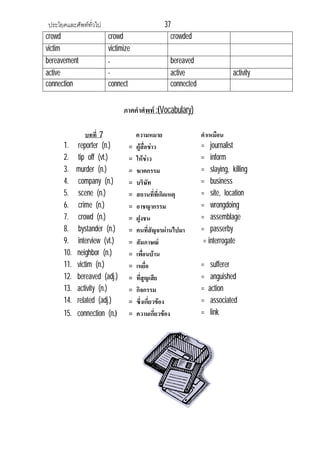
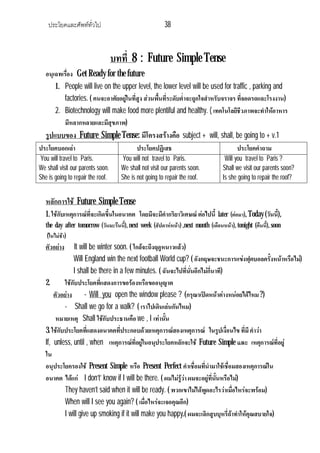
  • 78.
    ประโยคและศัพททั่วไป 78 บทที่ 3 1popular (adj.). = แพรหลาย, กวางขวาง = well – liked 2 famous (adj.). = มีชื่อเสียง = well – known, renowned 3. notorious (adj.) = มีชื่อเสียงในดานไมดี = infamous , ill – famed 4. exhibition (n.) = การแสดงนิทรรศการ = exposition 5. figure (n.) = บุคคลสําคัญ = character 6. inherit (vt. / vi) = ไดรับมรดก = acquire by succession 7. successful (adj.) = ประสบผลสําเร็จ = accomplished 8. mask (n.) = หนากาก = facial camouflage 9. collection (n.) = ของสะสม = assemblage 10. damage (vt.) = ทําใหเสียหาย = spoil 11. model (n.) = หุนปน = replica 12. mold (n.) = พิมพ (สําหรับทําขนมหรือปนรูป) = form 13. rescue (vt.) = ชวยเหลือจากอันตราย = save 14. artist (n.) = จิตรกร, ผูทํางานศิลปะ = painter 15. severed (adj.) = ขาดกระเด็น = cut บทที่ 4 1. pollute (vt.) = ทําใหสกปรก , ทําใหเกิดมลพิษ = taint, stain 2. manufacture (vt.) = ผลิต , ทํา = make, produce 3. process (n.) = ขบวนการ , กรรมวิธี = procedure, method 4. consumer (n.) = ผูบริโภค , ผูใช = user 5. environment (n.) = สิ่งแวดลอม , บริเวณรอบ ๆ = surroundings 6. demand (vt.) = เรียกรอง = ask, request, want 7. container (n.) = สิ่งที่ใชบรรจุ เชน กลอง = package, packet 8. recycle (vt.) = ผานกรรมวิธีเพื่อกลับมาใชใหม = reclaim 9. recent (adj.) = เมื่อเร็ว ๆ นี้ , เมื่อไมนาน = current, late 10. impossible (adj.) = เปนไปไมได , ทําไมได = unthinkable, unimaginable 11. emphasize (vt.) = ย้ํา , เนน = stress, intensify 12. advertise (vt.) = โฆษณา , ประกาศ = publish, announce 13. concern (n.) = ความกังวล, เอาเปนธุระ = worry 14. public (adj.) = ที่เปนสาธารณะ, ทั่วไป = social, societal, general 15. attitude (n.) = ทัศนคติ = mind, disposition
  • 79.
    ประโยคและศัพททั่วไป 79 บทที่ 5 1.edible (adj.) = รับประทานได = eatable 2. flesh (n.) = เนื้อ (ของคนหรือสัตว) = skin, meat 3. boon (n.) = ขอดี, ขอไดเปรียบ = advantage 4. garnish (n.) = สิ่งใชตกแตงอาหาร = decoration 5. association (n.) = สมาคม, องคการ = union, organization 6. nutritionally (adv.) = อยางถูกตองตามหลักโภชนาการ = healthfully 7. diet (n.) = อาหาร = food 8. orchard (n.) = สวนผลไม = fruit garden 9. mutation (n.) = การเปลี่ยนแปลงหรือกลายพันธุ = deviation 10. genetic (adj.) = เกี่ยวกับพันธุกรรม = hereditary 11. variations (n.) = ความหลากหลาย = changes, alterations 12. propagate (vt.) = ปลูก, ขยายพันธุ = breed 13. pollinate (vt.) = ผสมเกสร 14. experiment (vi.) = ทําการทดลอง = test 15. trigger (vt.) = ทําใหเกิด = set off, detonate บทที่ 6 1. abominable (adj.) = นาชัง = odious, disgusting 2. beast (n.) = สัตวโลก = creature 3. huge (adj.) = ใหญโต, ขนาดใหญ = immense, gigantic 4. cover (vt.) = ปกคลุม, ครอบ = extend, over 5. report (vt.) = รายงาน = account, record 6. native (adj.) = เกี่ยวกับพื้นเมือง = indigenous 7. claim (vi.) = กลาวอาง = allege 8. capture (vt.) = จับ = catch, take, arrest 9. occasion (n.) = โอกาส = opportunity 10. evidence (n.) = หลักฐาน = data, fact 11. continue (vi.) = ดําเนินตอไป = proceed, keep going,go on, advance 12. convince (vt.) = ทําใหเชื่อ = make to believe 13. expedition (n.) = การเดินทาง = voyage, excursion, trip, journey 14. enlarge (vt.) = ทําใหใหญขึ้น = increase, extend 15. ancestor (n.) = บรรพบุรุษ = forebear
  • 80.
    ประโยคและศัพททั่วไป 80 บทที่ 7 1.reporter (n.) = ผูสื่อขาว = journalist 2. tip off (vt.) = ใหขาว = inform 3. murder (n.) = ฆาตกรรม = slaying, killing 4. company (n.) = บริษัท = business 5. scene (n.) = สถานที่ที่เกิดเหตุ = site, location 6. crime (n.) = อาชญากรรม 7. crowd (n.) = ฝูงชน = assemblage 8. bystander (n.) = คนที่สัญจรผานไปมา = passerby 9. interview (vt.) = สัมภาษณ 10. neighbor (n.) = เพื่อนบาน 11. victim (n.) = เหยื่อ = sufferer 12. bereaved (adj.) = ที่สูญเสีย = anguished 13. activity (n.) = กิจกรรม 14. related (adj.) = ซึ่งเกี่ยวของ = associated 15. connection (n.) = ความเกี่ยวของ = link บทที่ 8 1. safe (adj.) = ปลอดภัย = secure, not dangerous 2. vehicle n.() = พาหนะ = conveyance 3. automatically (adv.) = โดยอัตโนมัติ 4. scarce (adj.) = หายาก, ขาดแคลน = insufficient 5. floating (adj.) = ลอยน้ํา = hovering, flying 6. plentiful (adj.) = มากมาย, อุดมสมบูรณ = abundant, plenty, in great supply 7. healthy (adj.) = สุขภาพแข็งแรงสมบูรณ = strong, vigorous 8. affect (vt.) = มีผลตอ = influence 9. disease (n.) = โรค, เชื้อโรค = illness 10. develop (vt.) = พัฒนา, ทําใหกาวหนา = extend 11. improve (vt.) = ทําใหดีขึ้น, แกไข = mend, reform 12. appliance (n.) = เครื่องมือ, เครื่องใช = instrument, apparatus 13. control (vt.) = ควบคุม, บังคับ = check, restrain 14. treatment (n.) = การรักษา = cure 15. appear (vi.) = ปรากฏ, แสดงตัว = show up
  • 81.
    ประโยคและศัพททั่วไป 81 บทที่ 9 1.imagine (vt. / vi.) = นึกคิด, นึกเอาเอง, คาดการณ = suppose, guess, think 2. choker (n,) = เครื่องประดับเพชรพลอยที่สวมติดคอ 3. galore (adv.) = จํานวนมาก, อุดมสมบูรณ = in abundance 4. don (vt.) = สวมเสื้อผาชนิดพิเศษ = put on 5. rare (adj.) = หายาก, ไมคอยมี, นอย = uncommon 6. tycoon (n.) = นักธุรกิจที่ร่ํารวยและมีอิทธิพล = magnate 7. remote (adj.) = ไกล, อยูหางออกไปจากชุมชน = distant 8. parlay (vt.) = ลงทุนลงแรงเพื่อสิ่งที่ตองการ 9. piddle (vt. / vi. ) = ทําเลน ๆ ไมจริงจัง, เกียจคราน = dawdle 10. discount (n.) = การลดราคา, การลดสวน = deduction 11. rustic (adj.) = มีลักษณะเปนชนบท, เซอซา = old – fashioned as if from a farm 12. opulent (adj.) = มั่งคั่ง, มากมาย, หรูหรา = sumptuous 13. romp (vi.) = วิ่งเลน, สนุกสนาน, ครื้นเครง = lively play 14. spy (vt.) = มองเห็น, สืบ, สอดแนม = spot 15. letdown (n.) = ผิดหวัง, ไมสบอารมณ = disappointment บทที่ 10 1. ruins (n.) = ซากปรักหักพัง = the remains of fallen buildings 2. gnarled (adj.) = มีปุมปม, ผิวหนังเหี่ยวยน = old and twisted 3. twisted (adj.) = คดงอ, โคง = warped 4. prehistoric (adj.) = สมัยกอนประวัติศาสตร 5. tendril (n.) = กิ่งกานที่เลื้อยของไมเลื้อย 6. grasp (vt.) = ยึด, จับ, กําแนน = hold 7. weathered (adj.) = ผุกรอนไปตามสภาพอากาศ = wear away , change color 8. carve (vt.) = แกะสลัก, ตัด, เฉือน 9. grip (n.) = การจับ, การยึด, เครื่องยึด = holding fast 10. crush (vt.) = บดขยี้ = break 11. crack (crack (vt. / vi.) = แตกออก, แยกออก = break 12. separate (vt.) = แยกออกจากกัน = divide 13. remains (n.) = สิ่งที่เหลืออยู, ซากหักพัง, ซากศพ = what is left after destruction 14. monument (n.) = อนุสาวรีย 15. legacy (n.) = มรดก
  • 82.
    ประโยคและศัพททั่วไป 82 บทที่ 11 1.discipline (n.) = วินัย , ระเบียบ , กฎ = rule 2. expert (n.) = ผูเชี่ยวชาญพิเศษ , ผูชํานาญพิเศษ 3. provide (vt.) = จัดหา , เตรียมไวให = support 4. appropriate (adj.) = เหมาะสม = suitable 5. particular (adj.) = โดยเฉพาะ , ที่เจาะจง = specific 6. sensible (adj.) = ที่มีเหตุผล , ที่มีสติ = reasonable 7. discrimination (n.) = การแบงชั้นวรรณะ , การแบงพวก = making differences 8. sufficient (adj.) = ที่พอเพียง = enough 9. consult (vt.) = ปรึกษา = ask advice 10. anxiety (n.) = ความกังวลใจ , ความเปนหวง = being worried 11. bound to (adj.) = ปฏิบัติหรือเปนไปตามกฎเกณฑ = likely to 12. rear (vt.) = เลี้ยงดู = bring to maturity 13. guidance (n.) = การแนะนํา , การแนะแนว = giving advice 14. accurate (adj.) = ถูกตอง , เที่ยงตรง แมนยํา = exact 15. mooring (n.) = หลักการที่เปนสิ่งยึดเหนี่ยว , เครื่องใชผูก เรือเมื่อจอด บทที่ 12 1. title (n.) = ตําแหนง , บรรดาศักดิ์ , ชื่อเรื่อง = rank of a person 2. overlook (vt.) = มองขาม , มองจากที่สูง = not notice something , look over 3. obviously (adj.) = อยางชัดเจน , อยางเขาใจไดงาย = clearly , vividly 4. dedicate (vt.) = อุทิศ , อุทิศตน = devote 5. reconciliation (n.) = การไกลเกลี่ย , การทําใหคืนดีกัน = making up , on good terms 6. site (n.) = แหลง , ที่ตั้ง , ทําเล = place , location 7. retribution (n.0 = การตอบแทน , การลงโทษ = punishment 8. hatred (n.) = ความเกลียดชัง = strong dislike 9. vow (vt.) = สาบาน , ใหคํามั่น , อธิษฐาน = promise , pledge 10. give up (vi.) = ยกเลิก , หมดหวัง ,ยอมแพ = stop trying , surrender 11. devote (vt.) = อุทิศตัว , สมัครใจ = dedicate 12. heal (vt. / vi.) = รักษา , หายเปนปกติ = cure 13. forgive (vt.) = ใหอภัย , ยกโทษ = pardon 14. create (vt.) = สรางสรรค , ทําขึ้น = produce , invent 15. legend (n.) = ตํานาน , เรื่องราว = old story