ประโยคและศัพททั่วไป 1
ไวยากรณภาษาอังกฤษเบื้องตน
พ.ท.หญิง วันดี โตสุวรรณ
๕ พ.ค.๔๙
ถึงแมวาการพูดภาษาอังกฤษอาจจะไมตองคํานึงถึงไวยากรณมากนัก แตหลักในการใชภาษาและ
การเขียนโครงสรางของประโยคภาษาอังกฤษที่ถูกตองก็ยังมีความสําคัญเชนกัน โดยเฉพาะในการ
เขียนจดหมายราชการ การเขียนรายงาน ขาวสารที่สําคัญๆ เปนตน ดิฉันไดอานหนังสือแบบเรียน
ภาษาอังกฤษของมหาวิทยาลัยรามคําแหงเกี่ยวกับประโยคและศัพททั่วไป ถือวาเปนหนังสือที่ดมากและ
ี
ราคาถูกดวย และเห็นขาราชการกลาโหมหลายคน กําลังศึกษาภาษาอังกฤษที่มหาวิทยาลัยรามคําแหง
ดิฉันจึงจัดทําสรุปงายๆ ในแตละบท พรอมแบบฝกหัดทายบท มาใหเพื่อนๆ ทหารมาทบทวนไวยากรณ
ภาษาอังกฤษเบื้องตน บางคนอาจจะเรียนมานานแลวและอาจจะลืมบางก็ลองมาทบทวนกันนะคะ
หากมีคําถามสงอีเมลมาถามไดนะคะ wandeeditc@yahoo.com
บทที่ 1 Article: a, an, the คําศัพท
บทที่ 2 Simple Present Tense กริยาชวย to be, to have, to do คําศัพท
บทที่ 3 Simple Pat Tense คําศัพท
บทที่ 4 Present Continuous Tense กริยาชวย should, ought to คําศัพท
บทที่ 5 Past Continuous Tense คําศัพท
บทที่ 6 Present Perfect Tense, Present Perfect Continuous Tense
กริยาชวย can, be able to, may คําศัพท
บทที่ 7 Past Perfect Tense , Past Perfect Continuous Tense คําศัพท
บทที่ 8 Future Simple Tense, กริยาชวย must, have to คําศัพท
บทที่ 9 Adjective คําศัพท
บทที่ 10 Comparison of Adjectives and Adverbs คําศัพท
บทที่ 11 Conditional Clauses คําศัพท
บทที่ 12 Subjunctive Clauses คําศัพท
บทที่ 13 Modals, Auxiliary Verbs, Helping Verbs
2.
ประโยคและศัพททั่วไป 2
บทที่ 1 : Article A , An , The
รูปแบบของการใช Article มีดังนี้ (a / an / the) + noun
หลักการใช Article “a , an” มีดังนี้
1. ใชกบคํานามนับได ( Countable nouns) ที่เปนรูป เอกพจน ( Singular ) เทานั้น
ั
ตัวอยาง - Would you like a cup of tea? ( ตองการน้ําชาไหมครับ)
- This is an old car. ( นี่เปนรถยนตคนเกา)
ั
หมายเหตุ เราใช a นําหนาคํานามที่ขน ดวยพยัญชนะ และใช an นําหนาคําที่ขนตนดวยสระ
ึ้ ึ้
(a , e , i , o , u) เชน an apple, an egg , an ink, an umbrella etc. และ ตัว h
ที่ออก เสียงสระ เชน an honor, an heir etc.
2. ใชคํานามทั่วไปไมซี้เฉพาะเจาะจง
ตัวอยาง - Wandee sat down on a bench. ( วันดีนั่งบนมานั่งยาว)
- A strange thing happened to me this morning. ( มีสิ่งแปลกๆ เกิดขึนกับฉันเมื่อเชานี)
้ ้
3. ใช Article a/ an ที่แสดงอาชีพ เชน an architect ( สถาปนิก) , an accountant (สมุหบญชี) ั
a soldier (ทหาร), a teacher (ครู) an engineer (วิศวกร), a janitor (ภารโรง) เปนตน
ตัวอยาง - Dr.Wanchai is a researcher. ( ดร.วันชัยเปนนักวิจัย)
4. ใช Article a/ an กับคํานามทีกลาวถึงเปนครังแรก
่ ้
ตัวอยาง - Have you had an accident? ( เธอไดรับอุบัตเิ หตุเหรอ)
- I am looking for a job. ( ฉันกําลังมองหางานอยู)
หมายเหตุ : เมื่อจะกลาวถึงคํานามนันเปนครั้งที่สองใหเปลี่ยน Article “a, an” เปน “the”
้
ตัวอยาง - The accident took place on Silom road. ( อุบัตเิ หตุเกิดขึนบนถนนสีลม)
้
- The job that I was looking for is interesting. ( งานที่ผมกําลังมองมาอยูนาสนใจ)
5. ใช Article a/ an นับไดที่มีความหมายวา “หนึ่ง”
ตัวอยาง - An iguana is an animal. ( ตัวอีกัวนาเปนสัตวชนิดหนึ่ง)
- Tony is a pessimist. ( โทนี่เปนคนมองโลกในแงราย)
6. ใช Article a/ an เอกพจนที่ตามหลัง v. to be
ตัวอยาง - That house is for sale. It is a bargain. ( บานหลังนันขาย ตอรองราคาได)
้
- The house needs painting. It is in a bad condition. ( บานนี่ตองทาสีใหม สภาพของ
บานแยมาก)
6. ใช Article a/ an กับอาการปวยทั่วไปเชน เชน a sore throat (เจ็บคอ), a fever (เปนไข)
a toothache ( ปวดฟน), a headache (ปวดศีรษะ), a cough (ไอ)
3.
ประโยคและศัพททั่วไป 3
ตัวอยาง - I’m not feeling well today. I have a sore throat. ( ฉันรูสึกไมคอยสบาย ฉันเจ็บ
คอ)
7. ใช Article a/ an กับสํานวนหรือวลีตางๆ เชน have a good time (สนุกสนาน) have a chat ( คุย)
it’s a pity (นาเสียดาย) in a hurry (เรงรีบ) it’s a shame (นาอาย)
ตัวอยาง - We had a chat while we were waiting a flight to London.
( เราหยุดคุยกันในระหวางคอยเทียวบินไปกรุงลอนดอน)
่
☺☺☺☺☺☺☺☺☺☺☺☺☺☺☺☺☺☺
แบบฝกหัดที่ 1 Complete each sentence with a/an
1. Sornram was……….actor.
2. Did Jack have………… old type of vase?
3. Weerasak is………………policeman like his father.
4. This morning my sister bought……….magazine and……….newspaper.
5. I stay at ……….guesthouse when I was on holiday.
6. My brothers have…………rabbit and ……….cat.
7. You live in…………….old house in the outskirt of Bangkok.
8. Henry saw……….accident this afternoon. A truck crashed into…………..wall.
9. Is Sorayuth…………….singer or………….journalist?
10. It was………….beautiful and sunny day.
************************************************************
หลักการใช Article “the” ดังนี้
1. ใช the กับคํานามที่ชี้เฉพาะเจาะจง
ตัวอยาง - This was a terrible journey. The plane was very crowded. ( นี่เปนการเดินทางที่
แยมากเครื่องบินแออัดมาก )
- Bangkok is the capital of Thailand. ( กรุงเทพฯเปนเมืองหลวงของประเทศไทย)
2. ใช the กับ คํานามทีนับได เอกพจนที่บอกชนิดหรือประเภท
่
ตัวอยาง - The orchid is Jane’s favorite flower. ( กลวยไมเปนดอกไมที่โปรดปรานของเจน)
- The violin is my favorite instrument. ( ไวโอลินเปนเครื่องดนตรีที่โปรดปรานของฉัน)
3. ใช the กับ คํานาม ที่เปนคําคุณศัพท ( adjective) เปรียบเทียบขันสุงสุด
้
ตัวอยาง - What is the longest road in Thailand? ( ถนนอะไรยาวที่สดในประเทศไทย)
ุ
- He is the tallest student in this class. (เขาเปนนักเรียนที่สงที่สุดในหองนี)
ู ้
4.
ประโยคและศัพททั่วไป 4
4. ใช the นําหนาคําคุณศัพท (adjective) ซึ่งทําหนาที่เปนคํานาม เชน the poor (คนจน), the rich
(คนรวย), the blind (คนตาบอด) , the disabled (คนพิการ) , the dark (ความมืด) , the wounded
(ผูบาดเจ็บ), the young (คนหนุมสาว), the dead (คนตาย) เปนตน
ตัวอยาง - This is the parking lot t for the disabled. ( นี่คือที่จอดรถของคนพิการ)
- The youth campaigned to stop smoking cigarettes.( เยาวชนรณรงคใหเลิกสูบบุหรี่)
5. ใช the กับคําทีแสดงเชือชาติ เชน the British (ชาวอังกฤษ), the Spanish (ชาวสเปน) , the Dutch
่ ้
(ชาวดัตช) the Japanese (ชาวญีปุน), the French (ชาวฝรั่งเศส), the Swiss (ชาวสวิส) เปนตน
่
ตัวอยาง - The Chinese and the Japanese are diligent. ( ชาวจีนและชาวญี่ปุนขยัน)
- The Spanish are famous for their spicy food. ( ชาวไทยมีชอเสียงเกี่ยวกับอาหารรสจัด)
่ื
หมายเหตุ : คํานามที่แสดงเชื้อชาติเหลานี้จะลงทายดวย s , sh , ch หรือ se ซึ่งเมื่อเติม the ขางหนา
จะมีความหมายเปนพหูพจน แตถาเปนคําที่ไมไดลงทายแบบนี้ เมื่อเติม the จะตองเติม s ดวย
เชน the Russians (ชาวรัสเซีย) the Italians (ชาวอิตาเลียน)
the Arabs (ชาวอาหรับ) the Thais (ชาวไทย)
6. ใช the กับคํานามที่กลาวถึงมาแลว หรือผูพดและผูฟงเขาใจถึงความหมาย
ู
ตัวอยาง - The student was late again yesterday. ( นักเรียนคนนั้นมาสายอีกแลวเมื่อวานนี) ้
- My mother went to see the doctor. ( แมฉนไปหาหมอคนเดิม)
ั
7. ใช the กับคํานามที่เปนชือทางภูมศาสตร
่ ิ
1) ชื่อประเทศบางประเทศ โดยเฉพาะประเทศที่มีคําวา republic, kingdom, states และที่ลงทาย
ดวย s เชน the German Federal Republic ( เยอรมันนี) , the Republic of Ireland
( ไอรแลนด) , the United Kingdom ( สหราชอาณาจักร) , the United Arab Emirates
( อาหรับอามิเรสต), the Netherlands ( เนเธอรแลนด, the Philippines ( ฟลิปปนส)
2) ชื่อเกาะหรือหมูเ กาะที่เปนพหูพจน เชน the Bahamas, the British Isles, the Canaries
3) ชื่อเทือกเขาหรือภูเขาที่เปนพหูพจน เชน the Andes, the Alps, the Rockies
4) ใชกบชือแมน้ํา ลําคลอง ทะเล ทะเลทราย แหลม อาว ชองแคบ มหาสมุทร คาบสมุทร เชน
ั ่
the Amazon, The Atlantic , the Bering Strait , the British Strait
the Chao Phraya (River), the Cape of Good Hope, the Caribbean Sea,
the Nile (River), the Mississippi (River), the Pacific Ocean
5) ใชกบชือ โรงแรม ภัตตาคาร ธนาคาร โรงละคร พิพิธภัณฑ หองสมุด เปนตน เชน
ั ่
the Oriental Hotel the Hilton Hotel
the National Theater the Central Library
the British Museum the Tate Gallery
5.
ประโยคและศัพททั่วไป 5
6.) ใชกบชืออาคารสถานที่ ที่มี of อยูในชื่อ เชน
ั ่
the Bank of England the House of Parliament
the Tower of London the Great Wall of China
7). ใชกบชือหนังสือพิมพ สํานักพิมพ เชน
ั ่
the Bangkok Post the Nation, The Bangkok Post
the Times the New York Tribune
8. ใช the กับคํานามที่มีเพียงสิ่งเดียว เชน the sun (ดวงอาทิตย), the moon (ดวงจันทร)
the world (โลก), the earth (โลก), the sea (ทะเล), the sky (ทองฟา), the universe (จักรวาล),
the ground (พื้นดิน), the country (ประเทศ) , the environment (สิ่งแวดลอม),
9. ใชกบคํานามทีเ่ ปนเครื่องดนตรี เชน the piano (เปยโน)
ั , the guitar (กีตาร), the violin
(ไวโอลิน)
the drum (กลอง), the flute (ฟรุท), the trumpet (ทรัมเปต) เปนตน
10. ใชกับการเปรียบเทียบขั้นกวาเพื่อแสดงวา 2 สิ่ง หรือ 2 เหตุการณเพิ่มขึ้นหรือลดลงไปในทํานองเดียวกัน
ตัวอยาง - The more we read, the more we know.
(ยิ่งเราอานมากเทาไร เราก็ยิ่งรูมากขึ้นเทานั้น)
- The more you eat. The fatter you will get.
(ยิ่งคุณกินมากเทาไร คุณก็ยิ่งจะอวนมากขึนเทานั้น)
้
11. ใชนําลําดับเลขที่ เชน the first (ลําดับที่ 1), the second (ที่สอง), the third (ที่สาม),
the fourth (ที่สี่) , the fifth (ที่หา), the twentieth ( ที่ยสิบ), the twenty-first ( ที่ยี่สิบเอ็ด)
ี่
12. ใชนําหนาสํานวนบอกเวลา เชน at noon (เที่ยงวัน), at night (เที่ยงคืน), the day after
tomorrow (มะรืนนี้), in the morning (ในตอนเชา) , in the afternoon (ในตอนบาย) ,in the
evening (ในตอนเย็น)
☺☺☺☺☺☺☺☺☺☺☺☺☺☺☺☺☺☺
แบบฝกหัดที่ 2 Complete each sentences
1. They want to sell ……………most expensive car.
2. Dara wrote her name at…………..top of the page.
3. ……………earth revolves around ………..sun.
4. Jack is …………….only person I met at the conference.
5. ………….sun shines brightly in …………sky.
6. The bodies of………………..dead were taken to the cemetery.
7. My father plays…………………piano very well.
8. ………….cheetah is…………..fastest of all animals.
9. …………….French like to drink tea.
10. Malaysia is ………….country in Southeast Asia and ………………capital is Kuala Lumpur.
6.
ประโยคและศัพททั่วไป 6
การละ Article
1. ไมใสหนา คํานามนับไมได (Uncountable Nouns) เชน silk ( ผาไหม)ม, tea ( น้ําชา ) , Paper (
กระดาษ) pepper (พริกไทย), blood (เลือด), money (เงิน), hair ( ผม), experience
( ประสพการณ) อยางไรก็ตาม สามารถใส the , some, any , much, this, his ได
ตัวอยาง - Jongin wanted to buy some gold. ( จงจินตตองการซื้อทอง)
- We bought some paper. ( พวกเราซื้อกระดาษ)
หมายเหตุ ในบางกรณี นามที่นบไมได อาจจะมี Article a,an นําหนา เพราะมีความหมายแตกตางกันออกไป
ั
เชน - a paper ( หนังสือพิมพ) # some paper ( กระดาษจํานวนหนึ่ง)
She bought a paper. # She bought some paper.
- a hair ( เสนผมเสนหนึ่ง) # hair ( ผมบนศรีษะ)
There was a hair in my porridge. # Jinny has beautiful hair.
( มีเสนผมอยูในขาวตมฉัน)
/ เจนนี่มีผมสวย
2. ไมใสหนา Article the หนาคํานามพหูพจนทกลาวถึงทั่ว ๆ ไป
ี่
ตัวอยาง - Children learn from playing and observing.( เด็กๆ เรียนรูจากการเลนและการสังเกต)
- Students should obey teachers and their parents. (นักเรียนควรเชื่อฟงครูและพอแม)
หมายเหตุ เปรียบเทียบในเมื่อมีการชี้เฉพาะ เจาะจง ตองใส the เชน
- The children in this community can speak English and Chinese fluently.
- ( เด็กๆ ในชุมชนนี้สามารถพูดภาษาอังกฤษและภาษาจีนไดอยางคลองแคลว
- The students in my class like playing tennis.
- ( นักเรียนในหองเรียนของผมชอบเลนเทนนิส)
3. ไมใส the นําหนาคํานามทีเ่ กี่ยวกับสถานที่ที่มีความหมายเพื่อกิจกรรมอันเปนปกติวิสย เชน
ั
hospital (ไปโรงพยาบาลเพือรักษาโรค) , prison , (ถูกจับขังคุก) , school ( ไปโรงเรียนเพือเรียนหนังสือ),
่ ่
college , university ไปวิทยาลัยหรือ มหาวิทยาลัยเพือศึกษา แตถามี “the” หนาคําเหลานีแสดงวาไมได
่ ้
มีความหมายตามกิจกรรมเฉพาะเหมือนความหมายทีกลาวมา ่
ตัวอยาง John goes to church on Sunday. ( จอหนไปโบสถเพือสวดมนตทกวันอาทิตย)
่ ุ
Somsri goes to the church to see her friends.( สมศรีไปที่โบสถเพื่อไปพบเพือนๆ) ่
4. ไมใส the หนาสํานวนตอไปนี้ go to (ไปนอน), be in bed (เขานอน), go to work (ไปทํางาน)
be at work ( อยูที่ทํางาน), start work (เริ่มงาน) , finish work (เลิกงาน), go home (ไปบาน),
get home (เขาบาน), stay at home (อยูบาน) be at home (อยูทบาน), go to sea ( ไปเทียวทะเล)
ี่ ่
ตัวอยาง - I am sleepy, I’m going to bed. ( ฉันงวงแลว ฉันจะไปนอน)
- My boss will be at work around 9 o’clock. ( เจานายของฉันจะอยูที่ทํางานประมาณ 9 โมง)
7.
ประโยคและศัพททั่วไป 7
หมายเหตุ: เราไมใส the หนามืออาหารหลัก
้ breakfast , lunch, brunch, dinner แตสามารถใส a
กับคําวา meal ( มื้ออาหารแตละมื้อ ได)
ตัวอยาง - Michael invited me to dinner. ( ไมเคิลเชิญฉันรับประทานอาหารเย็น)
แต - I had a wonderful meal in a restaurant. (เรารับประทานอาหารที่อรอยมากที่
รานแหงหนึ่ง)
5. ไมใส the หนาชื่อทางภูมิศาสตร
1) ชื่อ หมูบาน เมือง ประเทศ รัฐ ทวีป เชน Bangkok, New York, Paris, Thailand ยกเวน
The Hague, the Philippines เปนตน
2) ชื่อเกาะเดี่ยว ๆ เชน Phuket Sicily
3) ชื่อภูเขาเดี่ยว ๆ เชน Doi Inthanon Mount Everest
4) ชื่อทะเลสาบ เชน Lake Constance, Lake Superior
5) ชื่อถนน สี่แยก วงเวียน เชน Regent Street, Fifth Avenue, Silom Road,
6) ชื่อสนามบิน สถานีรถไฟ โรงเรียน มหาวิทยาลัย หรือสถานที่ที่เปนชือเฉพาะ เชน
่
Kennedy Airport Don Muang Airport Cambridge University
Chulalongkorn University Hyde Park London Zoo
7). ชื่อภัตตาคารหรือโรงแรมทีเ่ ปนชือเฉพาะ เชน
่
Krung Thai Bank, MacDonald’s , Harrods, Selfridges
6. ไมใสหนา คํานามที่ตามหลัง ‘s หรือ n. ที่แสดงความเปนเจาของ เชน
Mr. Somchai's house , my brother’s room, the city’s new theater
The world’s population, a good night’s sleep a week’s holiday
7. ไมใส the หนา คํานามที่มี แสดงความเปนเจาของ (my, your, our, her, his, its, their) หรือ
คํานาม ที่มี ‘s แสดงความเปนเจาของคําคุณศัพท ( adjective) นําหนาคํานาม (this, that, these,
those), some, any, few, a few, most ฯลฯ อยูขางหนา
ตัวอยาง - This room is dirty . ( หองนี้สกปรก)
- Could you find any students in the meeting room?
คุณเห็นนักเรียนสักคนในหองประชุมหรือไม
8. ไมใส the หนาชือเดือน – วัน นอกจากวา เดือน – วันนัน ๆ มีลกษณะชี้เฉพาะ
่ ้ ั
ตัวอยาง - James and Catharine were married in 2004. (เจมสและแคทรีนแตงงานไปในป 2547)
- James and Catharine married in the July of 2004.
( เจมสและแคทรีนแตงงานไปเมือเดือนกรกฏาคมในป 2547 ที่ผานมา)
่
8.
ประโยคและศัพททั่วไป 8
9. ไมใส the หนาชือเกมสหรือกีฬาตาง ๆ เชน
่ soccer (ฟุตบอล), football (ฟุตบอล)
tennis (เทนนิส), basketball (บาสเกตบอล), badminton (แบตมินตัน), chess (หมากรุก)
ตัวอยาง - Basketball is my favorite sports. ( [บาสเกตบอลเปนกีฬาทีฉันชอบ)่
10.ไมใส the ชื่อวิชา, ภาษา เชน
algebra (พีชคณิต), engineering (วิศวกรรมศาสตร) , mathematics (คณิตศาสตร),
history (ประวัติศาสตร), economics (เศรษฐศาสตร), English (ภาษาอังกฤษ), geometry (เรขาคณิต),
French (ภาษาฝรั่งเศส), linguistics (ภาษาศาสตร) , statistics (สถิต), arithmetic (เลขาคณิต),
ิ
science (วิทยาศาสตร), biology (ชีววิทยา) , physics (ฟสิกส)
หมายเหตุ : คํานามทีเ่ ปนชือภาษา ถานําไปใชเปนคําคุณศัพท ขยายคํานาม ตองมี “the” นําหนา
่
ตัวอยาง - The Thai language is more difficult than the English language.
(ภาษาไทยยากกวาภาษาอังกฤษ )
11. ไมใส the หนาชือโรค เชน
่
mumps (โรคคางทูม) cholera (อหิวาตกโรค) cancer (โรคมะเร็ง)
malaria (โรคไขจับสัน) epilepsy (โรคลมชัก)
่ influenza (ไขหวัด
ใหญ)
measles (โรคหัด) rheumatism (โรคปวด tuberculosis (วัณโรค)
ขอ)
ตัวอยาง - Most children in Africa died of cholera ( เด็กๆ สวนใหญในอัฟริกาเสียชีวิตดวยโรค
อหิวาตกโรค)
แบบฝกหัดที่ 3 Complete each sentences
1. Did he see the football match on ………………..television?
2. Boonchoo got……………..big feet.
3. Supan and Sopin have……………..lovely children.
4. Do you enjoy going to………………… Japanese concert?
5. My best friend is looking for…………………work.
***********************************************************************************************************
9.
ประโยคและศัพททั่วไป 9
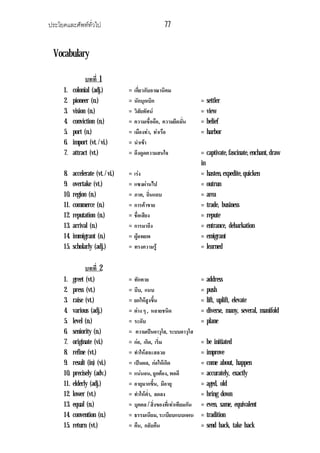
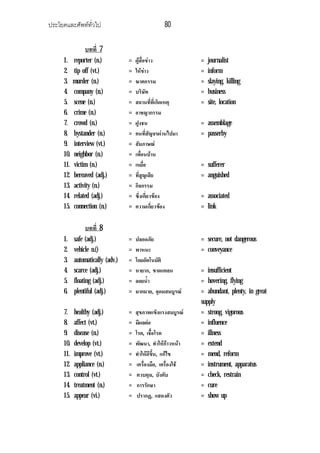
ภาคคําศัพท: (Vocabulary)
คําศัพท : ความหมาย คําเหมือน
บทที่ 1 (Meaning) ( Synonym)
1. colonial (adj.) = เกี่ยวกับอาณานิคม regal
2. pioneer (n.) = นักบุกเบิก settler
3. vision (n.) = วิสัยทัศน view
4. conviction (n.) = ความเชื่อถือ, ความยึดมั่น Belief, principle, faith
5. port (n.) = เมืองทา, ทาเรือ Harbor, docks, haven
6. import (vt. / vi.) = นําเขา Trade in
7. attract (vt.) = ดึงดูดความสนใจ Captivate , fascinate, enchant, draw in
8. accelerate (vt. / vi.) = เรง hasten, expedite, quicken
9. overtake (vt.) = แซงผานไป outrun
10. region (n.) = ภาค, ถิ่นแถบ area
11. commerce (n.) = การคาขาย trade, business
12. reputation (n.) = ชื่อเสียง repute
13. arrival (n.) = การมาถึง entrance, debarkation
14. immigrant (n.) = ผูอพยพ emigrant
15. scholarly (adj.) = ทรงความรู learned
แบบฝกหัดที่ 4: Translate into Thai
1. Her vision brings success to her country.
2. Her bright red skirt attracts the audiences.
3. Malaysia imports many goods from abroad.
4. Nobody respected Joey because his corruption destroyed his reputation.
5. The immigrants stayed in the temporary camp.
☻☺☻☺☻☺☻☺☻☺☻☺☻☺☻☺☻☺☻☺☻☺☻☺☻☺☻
☺
10.
ประโยคและศัพททั่วไป 10
บทที่ 2 : Simple Present Tense กาลในปจจุบัน
อนุเฉทเรื่อง “ การทักทายดวยการไหว (Greeting with a wai) ”
1. Sawasdi is the Thai word of greeting. ( สวัสดีคือคําในภาษาไทยใชสําหรับการทักทาย)
2. The wai originated in india but the Indians keep their wai to just one levels. ( การไหวมี
ตนกําเนิดมาจากประเทศอินเดีย แตชาวอินเดียจะไหวอยูในระดับเดียว)
3. It is a convention that a greeting must be returned. ( เปนธรรมเนียมที่จะตองทักทาย
กลับ)
4. To greet our equals, there is no need to bow the head. ( ในการทักทายคนระดับเดียวกัน
ไมจาเปนตองกมศรีษะ
ํ
( จากอนุเฉท Greeting with a wai. บทที่ ๒ ประโยคคําศัพท EN 102 มหาวิทยาลัยรามคําแหง)
รูปแบบของ Simple Present มีดังนี้ Subject + verb.1
ตาม s.)
1.ถาประธานเปนเอกพจนบุรุษที่ 3 ไดแก He, She, It, ชื่อคน สัตว หรือ สิ่งของเพียงหนึงเดียว เชน Suda,
่
Malee, the girl จะใชกริยาชองที่ และ เติม s. หรือ es กริยาที่ลงทายดวย ss, sh, ch, x, o และ y ที่
ตองเปลียนเปน i กอนจะเติม es
่
ตัวอยาง - He goes to university everyday. (เขาไปมหาวิทยาลัยทุกวัน)
- The dog barks almost every night. ( สุนัขเหาเกือบทุกคืน)
- John always watches television . (จอหนดูโทรทัศนเสมอ)
- Dellah copies a letter. ( เดลาหสาเนาจดหมาย)
ํ
2 .ถาประธานเปนพหูพจน คือ คน ๒ คน ขึ้นไป หรือหลายคน หลายสิ่ง คือ I , You, We, They กริยาจะไม
เติม s, หรือ es เชน
- Thomas and Francoise speak French. ( โทมัสและฟรองซัวรพูด
- You and I have a meeting at 10 o’clock.( คุณกับผมมีประชุมเวลา 10 นาฬิกา)
3. เมื่อใชกับกริยา Verb to be จะมีรูปเฉพาะคือ is ใชประธานเอกพจนบุรุษที่ 3 เชน He, She, It. Mary etc./
am ใชกับประธานเอกพจนบุรุษที่ 1 และ ใชกับประธานพหูพจนบุรุษที่ 1,2, 3 เชน You, We ,they
Jack and Jill เปนตน และเมื่อประโยคปฏิเสธใหใส not ขางหลังกริยา
ตัวอยาง - Thaksin is the prime minister of Thailand.( ทักษิณเปนนายกรัฐมนตรีของประเทศไทย)
- Henry is not working for the children foundation. ( เฮนรี่ไมไดทํางานอยูที่มลนิธิ
ู
เด็ก)
- My brothers and I are interested in politics. ( พี่ชายฉันและฉันสนใจในการเมือง)
11.
ประโยคและศัพททั่วไป 11
4. รูปแบบของ Simple Present Tense ในประโยค บอกเลา ปฏิเสธและ คําถาม
4.1.การทําประโยค Simple Present เปนประโยคปฏิเสธ
- ประโยคที่มปฏิเสธและประโยคคําถาม ประเภท Yes / No Question จะตองใชกริยา Verb to do
ี
มาชวยมี 2 รูป คือ do ใชกับประธานพหูพจนบุรุษที่ 1,2, 3, เชน I, We, You, They และ does ใชประธาน
เอกพจนบุรุษที่ 3 เชน He, She, It. Mary etc. มาสังเกตตามตารางตอไปนี้
ตัวอยางประโยค บอกเลา คําถาม ปฏิเสธของ Present simple Tense ( กาลปจจุบัน)
ประโยคบอกเลา ประโยคปฏิเสธ ประโยคคําถาม
I study English I don’t’ study English Do I study English?
(do not )
You carry some books You don’t’ carry some books. Do you carry any books?
(do not )
They obey the order. They don’t obey the order. Do they obey the order?
(do not )
He speaks Italian fluently. He doesn’t speak Italian fluently. Does he speaks Italian fluently.?
( does not)
She tries to study hard. She doesn’t try to study hard. Does she tryto study hard.
( does not)
หมายเหตุ เมื่อทําเปนประโยคปฏิเสธและคําถาม กริยาที่อยูหลังกริยาชวย คือ don’t , doesn’t , Do หรือ
Does จะไมเติม s
หลักการใช Simple Present
1. ใชกบขอความที่เปนจริงเสมอทั่วไปและตามธรรมชาติ รวมทั้งสุภาษิตและคําพังเพย
ั
ตัวอยาง - Water boils at 100 degree Celsius. ( น้ําเดือดในอุณหภูมิ ๑๐๐ องศาเซลเซียส
- Still water runs deep. (น้ํานิ่งไหลลึก)
2. ใชกบเหตุการณหรือกิจกรรมที่เปนปกติวิสย สม่ําเสมอ มักจะมีคาหรือกลุมคําตอไปนี้รวมอยูดวย
ั ั ํ
2.1 คําวิเศษณัที่วางหลังประธานมีดงนี้ always, regularly (เสมอ) , usually, generally (โดย
ั
ปกติ) often, frequently, continually (บอย), sometimes (บางครัง), naturally, habitually (เปน
้
ธรรมดา), seldom , hardly (นาน ๆ ครั้ง)
2.2 คําวิเศษณัที่วางทายประโยคมีดงนี้ every day, week, month, year (ทุกวัน, สัปดาห, เดือน. ป)
ั
once a day/ week, month, year (วัน สัปดาห เดือน ป ละครั้ง)/ twice a day/ week, month, year
(วัน สัปดาห เดือน ป ละ 2 ครั้ง), on Sundays (ทุกวันอาทิตย), on weekends (ทุกสุดสัปดาห),
on week days (ทุกวัน), on holidays (ทุกวันหยุด), over and over again (หลายหนหลายครั้ง)
12.
ประโยคและศัพททั่วไป 12
ตัวอยาง - She frequently visits her parents . (เธอจะเยี่ยมพอแมบอยๆ )
- Kanya goes to Pattaya twice a year. ( กัลยาจะไปพัทยาปละสองครั้ง)
3. ใชความเปนจริงในปจจุบัน
ตัวอยาง - Bangkok is the capital of Thailand. (เขาอาศัยอยูในชนบท)
- The position of the wai shows that your hands are empty of weapons.
( ตําแหนงของการไหวเปนการแสดงวามือคุณไมไดถออาวุธอยูในมือ)
ื
- Mostly Thais prefer to eat in groups. ( สวนใหญคนไทยชอบกินอาหารเปนกลุมๆ)
4. ใชกบประโยคอุทาน
ั
ตัวอยาง - Here comes the van! (รถตูมาแลว)
- Here is his luxury car ! ( นี่คือรถคันหรูของเขา)
5. ใชกบประโยคที่มบอกเวลา when, as soon as, before, after, until อยูขางหนา
ั ี
ตัวอยาง- We will talk to Jetsada about the party when he comes. ( เราจะคุยกับเจษฎาเมื่อเขามา)
- She goes straight to the kitchen as soon as she arrives home.
( หลอนตรงไปยังหองครัวทันทีเมื่อหลอนถึงบาน)
6. ใชกบประโยคทีแสดงเงือนไข If – Clause เชน If, Provided that ( ถามี) Unless ( ถาไม)
ั ่ ่
(1) เงื่อนไขทีอาจเปนไปไดในปจจุบนหรือเปนการดําเนินชีวิตประจําวัน โดยมีโครงสรางดังนี้
่ ั
If + Subject+ v1, subject +v1 หรือ Subject+ v1 if subject +v1
I have breakfast if I am hungry. หรือ If I am hungry, I have breakfast..
(2) เงื่อนไขทีอาจเปนไปไดในอนาคต
่
If + Subject+ v1, subject +will, shall +v1 หรือ Subject+will/shall+ v1 if subject +v1
ตัวอยาง - If it rains heavily, we will cancel the picnic. ( ถาฝนตกหนักเราจะยกเลิกปคนิค)
- I will lend you some money unless you tell me a lie.( ฉันจะใหคณยืมเงินถาคุณไม
ุ
พูดโกหก)
7. ใชกบประโยคเหตุการณในอนาคต มักจะเปนตารางเวลาหรือตารางอื่น ๆ มีคําบอกเวลา เชน
ั
ตัวอยาง - Panya leaves for Pattaya tonight. ( ปญญาจะไปพัทยาคืนนี) ้
- The train leaves in a few minutes.( รถเมลกาลังจะออกภายใน ๒-๓ นาที)
ํ
13.
ประโยคและศัพททั่วไป 13
แบบฝกหัด 1
1. Damrong usually ( drink)………………………a glass of orange juice.
2. This tank (contain)……………………about 4,000 litres.
3. My brothers frequently ( play)…………………….tennis every Saturday.
4. Today Sodsai (wear)………………………her new dress.
5. She had better go right now because she,(be),,,,,,,,,,,,,,,,,,,in a hurry.
6. Winai and Winit sometimes ( have)……………a long conversation.
7. Who (belong)…………this computer?
8. The last train ( leave)………………at 730 p.m.
9. Here ( be) …………our best friends.
10. Soldiers ( have) ………………to keep peace for the nation.
11. Kanya ( grow)………….plants in the garden.
12. Catholics often (go)………………..to church on Sundays.
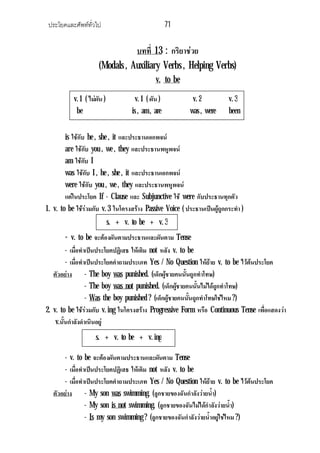
8. กริยาชวย Verb to be, to have , to do
Present Past Past Participle
be is,am,are was,were been
have have,has had had
do do,does did done
8.1 Verb to be: มีความหมายวา เปน อยู คือ หรือใชเปนกริยาแทและกริยาชวย เชน
Anna is a secretary. ( is เปนกริยาแท)/ Anna is working. ( is เปนกริยาชวย)/
8.1.1.ใชรวมกับ past participle ( Verb ชอง 3) ในรูป passive voice ประธานเปนผูถกกระทํา โดยใช
ู
โครงสรางดังนี้ Subject + Verb to be : is, am, are/was, were,/ had been+past participle+by
ตัวอยาง A bird was shot. / A bird was not shot. / Was a bird shot? ( นกถูก
ยิง )
The houses were built. /The houses were not built. / Were the houses built.? ( บานถูกสราง )
I was told a lie. /I wasn’t told a lie./ Were you told a lie? ( ฉันถูกบอกเรื่อง โกหก)
8.1.2. ใชกับกริยาทีลงทายดวย –ing ในรูป present continuous tense คือเหตุการณที่กําลังกระทําอยู
่
เชน The students are listening to the teacher. ( นักเรียนคือกําลังฟงคุณครู)
I am reading an interesting novel.( ฉันกําลังอานนวนิยายที่นาสนใจ)
8.2 Verb to do ใชประกอบกริยาแทในประโยชนคําถามประเภท Yes/NO Question โดย Verb to do
จะผันตามประธานและเวลา
14.
ประโยคและศัพททั่วไป 14
ตัวอยาง - He speaks French really fluently./ He does not speak Chinese fluently.
(เขาพูดภาษาฝรั่งเศสไดคลองแคลวมาก) (เขาพูดภาษาจีนไมคลอง)
- Does he speak French fluently? How does he speak French?
- Krit did his homework. / Krit did not do his homework/ Did he do his homework?
- Tom studied hard. / Tom did not study hard./ Did he study hard?
8.3. Verb to have: ใชเปนกริยาชวยประกอบกับ past participle ในรูป Perfect Tense โดย Verb to
have จะผันตามประธานและเวลา ( have ประธานพหูพจน และ has ประธานเอกพจน)
Peeraya has had her breakfast. / She hasn’t had her breakfast. / Has she had her
breakfast?
Ying and Chai have been married for a long time.
แบบฝกหัดที่ 2/ บทที่ 2
1. Kom………………stolen Dusit’s book.
2. They…………….met her before.
3. We………………..had lunch already.
4. Pramote…………………….want to go home.
5. The students ………………studying English at the moment.
6. The truck…………………repaired yesterday.
7. Anna and Greg…………………already seen this movie twice.
8. This song……………composed by Mr.Yod Rak.
9. What………………happened?
10. She………………have any money.
แบบฝกหัดที่ 3/ บทที่ 2: แปลประโยคตอไปนี้
1. Udom couldn’t lift that box because it is too heavy.
2. It’s a convention that children should pay respect to parents.
3. There are various ways of greeting.
4. What level of this program should I start with?
5. Some elderly people are still active.
ประโยคและศัพททั่วไป 16
บทที่ 3: Simple Past Tense
อนุเฉทเรื่อง Tussaud, Madame (1761 -1850): Swiss Founder waxworks Museum
1. Over many years she modeled many famous people.
( หลายปที่ผานมาหลอนไดปนหุนของคนมีชื่อเสียงมากมาย)
1. Seven years later she moved to London.
( เจ็ดปตอมา หลอยยายมาอยูทลอนดอน)
ี่
3. The exhibition was very successful. ( นิทรรศการประสบความสําเร็จมาก)
( จากอนุเฉทเรื่อง Tussaud, Madame (1761 -1850): บทที่ ๓ประโยคคําศัพท EN 102 มหาวิทยาลัยรามคําแหง)
รูปแบบของ Simple Past Subject . + Verb v.2
เปนการกลาวถึงเหตุการณในอดีตโดยคํากริยามี ๒ รูปแบบทั้ง แบบปกติ ( regular verb) และ แบบ
พิเศษ ( irregular verb) ดังนี้
1. คํากริยาที่มีการกระจายแบบปกติ ( regular verb)
1.1. เติม - ed ทายกริยาแททั่ว ๆ ไป เชน
walk walked walked (เดิน) looked looked looked ( ดู)
borrow borrowed borrowed ( ยืม) rain rained rained (ฝนตก)
1.2. กริยาที่ลงทายดวย e ใหเติม - d ทายคํากริยาชองที่ 2 และชองที่ 3 เชน
agree agreed agreed (ตกลง) like liked liked (ชอบ)
hope hoped hoped (หวัง) smile smiled smiled (ยิ้ม)
1.3. กริยาที่ลงทายดวย พยัญชนะ + y ใหเปลียน y เปน i กอนเติม - ed เชน
่
hurry hurried hurried (รีบเรง) cry cried cried (รองไห)
try tried tried (พยายาม) study studied studied (เรียน)
1.4. กริยาที่ลงทายดวย สระ + y ไมตองเปลียน เปน i แตเติม - ed ไดเลย เชน
่
stay stayed stayed (อาศัย, อยู) delay delayed delayed ลาชา
play played played (เลน) enjoy enjoyed enjoyed (สนุก, ราเริง)
1.5 กริยาที่ลงทายดวย พยัญชนะ – สระ – พยัญชนะ ใหซ้ําพยัญชนะตัวทายกอนเติม - ed เชน
plan planned planned (วางแผน) rob robbed robbed (จี,้ ปลน)
stop stopped stopped (หยุด) step stepped stepped (กาวเทา)
17.
ประโยคและศัพททั่วไป 17
1.6 กริยาที่มีมากกวา 1 พยางค และเนนเสียงหนักที่พยางคทาย ใหซ้ําพยัญชนะตัวทายกอนเติม - ed เชน
prefer preferred preferred (ชอบมากกวา) permit permitted permitted (อนุญาต)
regret regretted regretted (เสียใจ) refer referred referred (อางถึง)
แตถากริยานั้น มีมากกวา 1 พยางค แตพยางคทายนันไมไดเนนเสียงหนัก ก็ไมตองซ้ําพยัญชนะตัวทาย
้
แตเติม - ed ไดเลย เชน
visit visited visited (เยี่ยม) develop developed developed (พัฒนา)
listen listened listened (ฟง) borrow borrowed borrowed (ยืม)
ขอยกเวน ในภาษาอังกฤษแบบอังกฤษ ( British English)
1.7 กริยา ที่ลงทายดวย l ใหซ้ํา l อีก 1 ตัว กอนเติม – ed ไมวาพยางคทายจะลงเสียงเนนหนักหรือไม เชน
travel travelled travelled (ทองเที่ยว) cancel cancelled cancelled (ยกเลิก)
1.8. กริยาที่ลงทายดวยสระ 2 ตัว เชน - rt, - rn, ch เปนตน เติม – ed ไดเลยไมตองซ้ําพยัญชนะ เชน
start started started (เริ่มตน) turn turned turned (หมุน)
touch touched touched (สัมผัส) chart charted charted ทําแผนภูมิ
1.9 กริยาที่ลงทายดวยสระ 2 ตัว และตามดวยพยัญชนะ เชน - oil, - eed, - ain เปนตน เติม – ed ไดเลย
ไมตองซ้ําพยัญชนะตัวทาย เชน
boil boiled boiled (เดือด) need needed needed (ตองการ)
rain rained rained (ฝนตก) chain chained chained (ผูกมัด)
2. กริยาที่มีการกระจายแบบพิเศษ ( Irregular verb) ในชองที่ 2 และ ชองที่ 3
ชองที่ 1 ชองที่ 2 ชองที่ 3 ความหมาย ชองที่ 1 ชองที่ 2 ชองที่ 3 ความหมาย
break broke broken แตกหัก give gave given ให
begin began begun เริ่มตน have had had มี
build built built สราง know knew known รู
come came come มา leave left Left ออกจาก
drive drove driven ขับขี่ lay laid laid วาง
drink drank drunk ดื่ม make made made ทํา
eat ate eaten กิน meet met met พบ
find found found พบ pay paid Paid จาย
run ran run วิ่ง set set set จัด
ชองที่ 1 ชองที่ 2 ชองที่ 3 ความหมาย ชองที่ 1 ชองที่ 2 ชองที่ 3 ความหมาย
18.
ประโยคและศัพททั่วไป 18
ring rang rung สั่นกระดิ่ง take took taken นํา
say said said พูด tell told told บอก
swim swam swum วายน้ํา take took taken นํา
sing sang sung รองเพลง teach taught taught สอน
see saw seen ดู think thought thought คิด
รูปแบบของประโยคบอกเลา ปฏิเสธและคําถามของ Simple Past Tenses
ประโยคบอกเลา ประโยคปฏิเสธ ประโยคคําถาม
1. Su went shopping yesterday. Su didn’t go shopping. Did Su go shopping yesterday?
2. We left early last night. We didn’t leave early. Did you leave early last night?
3. That man ran fast. That man didn’t run fast. Did that man run fast?
4. I was late this morning. I wasn’t late this morning. Were you late this morning?
5. We were excited. We weren’t excited. Were you excited?
หมายเหตุ
1. ประโยคที่ใชรูปกริยาทั่วไป จะเติม did หนาประโยคและกริยาเดิมของ Simple tense ตองเปลี่ยนเปนกริยาชองที่ 1
2. ประโยคที่มี Verb to be ใหยายกริยา was หรือ were ไวหนาประโยค
3. ประโยคที่ใชรูปกริยาทั่วไป เติม did not หนากริยา ซึ่งเปลี่ยนไปเปนชองที่ 1
4. ประโยคที่มี Verb to be ใหเติม not หลัง was หรือ were
****************************************************************************************
หลักการใช Simple Past Tense มีดังนี้
1. ใชกบการบอกเลาเรื่องราวเหตุการณทเี่ กิดขึ้นมาในอดีต โดยไมจํากัดเวลา
ั
ตัวอยาง - I gave my sister some flowers. ( ฉันใหดอกไมแกพสาวของฉัน) ี่
- Somsri took the report to her boss. ( สมศรีไดนํารายงานใหเจานายของหลอน)
2. ใชกบการบอกเลาเรื่องราวความจริงหรือเหตุการณที่เกิดขึนในอดีต โดยมีคากริยาวิเศษณบอกเวลา เชน
ั ้ ํ
yesterday, last night, ( week or year ), a long time ago, other days, those day, the other day,
the day before yesterday, this morning, just now , a few minutes ago etc.
ตัวอยาง - My family went to London last summer. (เธอไปลอนดอนในชวงภาคฤดูรอนที่ผาน
มา)
- Sitichai worked in this company in 2003. ( สิทธิชยทํางานที่บริษัทนี้ตั้งแต ค.ศ.2003)
ั
- It happened in 1492. ( สิ่งนี้เกิดขึ้นในป ค.ศ. 1942)
19.
ประโยคและศัพททั่วไป 19
3. ใชกบประโยค Subjunctive ซึ่งมีโครงสรางประโยค ดังตอไปนี้
ั
3.1 ประโยค If – Clause ในเงือนไขทีเ่ ปนไปไมได หรือตรงขามความจริงในปจจุบัน
่
If + subject + v.2 / , subject + would + v.1 (ไมผัน)
ตัวอยาง - If Sakda didn’t drive the car by himself, he shouldn’t have an accident.
(ถาศักดาไมขบรถดวยตัวเอง เขาก็คงไมประสบอุบัตเิ หตุ)
ั
หมายเหตุ ถาเปน verb to be ใหใช were กับประธานทุกตัว เชน
If I were you, I would tell him the truth. ( ถาผมเปนคุณ ผมจะบอกความจริงเขา)
She would buy a diamond ring if she were rich. ( หลอนคงจะซื้อแหวนเพชร ถาหลอน
รวย)
If he were a doctor, he might suggest me to stay in bed. (ถาเขาเปนหมอ
เขาอาจจจะแนะนําใหฉันพักผอน)
3.2 ประโยคที่ใช wish เพื่อแสดงความปรารถนาในปจจุบนที่เปนไปได หรือตรงขามความจริงในปจจุบัน
ั
subject. + wish + (that) + subject. + v.2
ตัวอยาง - I wish I were wealthy. ( ผมปรารถนาทที่จะรวย)
- Mary wish she should have better life. ( แมรี่ปรารถนาที่จะมีชวิตทีดีขึ้น)
ี ่
3.3 ประโยคที่ใช as if / as though เพื่อแสดงการเปรียบเทียบที่เปนไปไมได หรือตรงขามความจริงในปจจุบัน
subject. + verb. + as if / as though + subject + v.2 /
ตัวอยาง- She talks as if she saw an accident. (เธอพูดราวกับวาเธอเห็นอุบัตเิ หตุดวยตนเอง)
- Jidratda acts as though she were a princess. ( จิตรดาทําตัวราวกับเปนเจาหญิง)
แบบฝกหัด 1/ บทที่ 3
1. It was really amazing that he……………………the examination.(pass)
2. She was disappointed with the movie; she………………..it be much more
informative. (expect)
3. Same ……………hungry, therefore he……………….some apples. (be) (buy)
4. Yod’s father……………..him how to speak Chinese since he was 14 years old. (
teach)
5. The villagers…………..some money to rebuild their houses. (need)
20.
ประโยคและศัพททั่วไป 20
6. Upin …………..her office and ……………to Malaysia yesterday. (
leave, go)
7. Jurai ……………………the dinner for her family. ( cook)
8. When his daughter ………………….., they ……………..dinner. (arrive,have)
9. I ………….Joey as he was running in the park. ( see)
10. Yesterday, Dee and Dang ……………badminton and ………….at 11o’clock.
(play,finish)
11. This morning Raul…………a letter in her room. ( write)
12. When we were sleeping, the doorbell…………………..(ring)
13. While my mother was cooking, it ……………….to rain heavily.( begin)
14. The teacher …………….(punish ) Jim because he…………..his assignment
yesterday.( submit)
15. I……………Sudarat at the HIV conference last week.(see)
16. Charlermpong has lived in Songkhla since he…………….born.(be)
17. I …………very surprised to hear the Tsunami disaster in the south.( be)
18. The classroom was very quiet when the teacher……………(come).
19. Sorn ………………Nui for a special dinner, nevertheless she couldn’t come. ( invite)
20. It ………my first time riding a horse. It was really exciting. ( be)
▲▼▲▼▲▼▲▼▲▼▲▼▲▼▲▼▲▼▲▼▲▼▲▼▲▼▲▼▲▼
แบบฝกหัดที่ 2 แปลประโยคตอไปนี้
1. That speaker is very popular with her audience.
2. Thailand is notorious for the drug problem.
3. The exhibition of the Science and Technology was amazing.
4. He was one of the leading architectural figures of Thailand.
21.
ประโยคและศัพททั่วไป 21
ภาคคําศัพท :(Vocabulary)
บทที่ 3 ความหมาย คําเหมือน
1 popular (adj.). แพรหลาย, กวางขวาง well – liked
2 famous (adj.). มีชื่อเสียง well – known, renowned
3. notorious (adj.) มีช่อเสียงในดานไมดี
ื infamous , ill – famed
4. exhibition (n.) การแสดงนิทรรศการ exposition
5. figure (n.) บุคคลสําคัญ character
6. inherit (vt. / vi) ไดรับมรดก acquire by succession
7. successful (adj.) ประสบผลสําเร็จ accomplished
8. mask (n.) หนากาก facial camouflage
9. collection (n.) ของสะสม assemblage
10. damage (vt.) ทําใหเสียหาย spoil
11. model (n.) หุนปน replica
12. mold (n.) พิมพ (สําหรับทําขนมหรือปน form
รูป)
13. rescue (vt.) ชวยเหลือจากอันตราย save
14. artist (n.) จิตรกร, ผูทํางานศิลปะ painter
15. severed (adj.) ขาดกระเด็น cut
แบบฝกหัดที่ 3 เติมคําศัพทใหเหมาะสม
1. The people who saw the accident attempted to………………the passengers.
2. Janny has a large art………………………………………………….………..
3. The garment factory was………………………..by explosion.
4. The poor girl did not notice the faces of the robbers clearly since they wore………
5. Visanu made a……………………of clay.
แบบฝกหัดที่ 4 แปลประโยคตอไปนี้
1. At the party last night he wore a mask , therefore nobody recognized him.
2. Since she has inherited a large sum of money from her mother, she is very
healthy.
3. She is a successful auther, she has written several novels.
4. At the art exhibition, there are many beautiful and expensive paintings.
5. Mr.Chaun Leakpai is a prominent political leader.
22.
ประโยคและศัพททั่วไป 22
บทที่ 4 : Present Continuous Tense
อนุเฉทเรื่อง Business Goes Green
1. More and more consumers are choosing “ green” and demanding that the products they buy are
safe for the environment. ( ผูบริโภคจํานวนมากขึนเลือกและตองการซื้อสินคาที่ปลอดภัยตอสภาพแวดลอม)
้ ้
2. The environment concern is making companies rethink how they do business. ( ความหวงใยตอ
สิ่งแวดลอมกําลังทําใหบริษทตางๆ ทบทวนเกี่ยวกับการธุรกิจ)
ั
3. The storm is approaching. ( พายุกําลังเขา)
รูปแบบของ Present Continuous subject + Verb to be( is / am / are) + v. ing
1. ประธานเปนเอกพจนบุรษที่ 3 เชน He, She,It, Apichart, Sinjai ใช is
ุ
He is driving a car. / He is not driving a car./ Is he driving a car?
2. ประธานเปนพหูพจนบุรษที่ 3 เชน They, Apichart and Pimporn ใช are
ุ
They are sleeping. / They are not sleeping. / Are they sleeping?
3. ประธานเปนเอกพจนบุรษที่ 1 คือ I ใช am: หรือ we ใช กับ are
ุ
I am listening to the radio./ I am not listening to the radio. / Am I listening to the radio?
We are working. / We are not working. / Are we working?
4. ประธานเปนพจนบุรุษที่ 2 คือ You ใช are:
You are studying. / You are not studying. / Are you studying?
หลักการเติม - ing ทาย v.
กริยาที่ลงทายดวย e ตัวเดียว ใหตด e ออก แลวเติม - ing เชน have – having, write –writing.
ั
forgive- forgiving, drive -driving แตมกริยาบางตัว แมลงทายดวย e สามารถใส – ing ไดเลย ไมตอง
ี
ตัด e ออก เพราะถาตัด e ออก ความหมายของคําจะเปลี่ยนไป เชน age – ageing / dye –dyeing
2. กริยาที่ลงทายดวย ee ใหเติม - ing ไดเลย เชน see –seeing/ agree - agreeing
3. กริยาพยางคเดียวทีลงทายดวย สระ + พยัญชนะ ใหซ้ําพยัญชนะทายกอนเติม - ing เชน sit –sitting,
่
stop-stopping,
4. กริยาตั้งแต 2 พยางคขึ้นไป โดยพยางคทายมีสระตัวเดียวและลงทายดวยพยัญชนะตัวเดียวใหเพิ่ม
พยัญชนะอีกตัวกอนเติม ing. ยกเวน กริยาที่ลงเสียงหนักทีพยางคแรก ให เติม ing ไดเลย เชน begin –
่
beginning/ prefer-preferring/ propel – propelling/ ยกเวน enjoy-enjoying / listen – listening/
5. กริยาที่ลงทายดวย y ใหเติม - ing ไดเลย เชน enjoy – enjoying, play – playing, study - studying
6. กริยาที่ลงทายดวย ie ตัด e ออก แลวเปลี่ยน i เปน y กอนเติม - ing เชน die –dying, lie -lying
23.
ประโยคและศัพททั่วไป 23
หลักการใช Present Continuous
ใชในเหตุการณที่กําลังกระทําอยูในขณะนั้น โดยอาจมีกริยาวิเศษณทบอกเวลา (Adverb of Time) ที่กําลัง
ี่
กระทําอยูเชน now (เดี๋ยวนี,้ ขณะนี), at the / this time (ในเวลานี), at the present (ปจจุบัน
้ ้
นี้) right now (เดียวนี), at the / this moment (ในขณะนี) , at the present time (ในชวงเวลา
๋ ้ ้
ปจจุบัน)
ตัวอยาง - We are studying EN102 right now. ( เรากําลังเรียน EN102 อยูตอนนี) ้
- At the moment, Jurairat is staring out of the window. She is daydreaming.
( ขณะนี้จุไรรัตนกําลังมองออกไปนอกหนาตาง หลอนกําลังฝนกลางวันอยู)
ใชในเหตุการณที่กําลังเกิดขึ้นแบบซ้ําแลวซ้ําเลา โดยมักจะมีคําวิเศษณทบอกเวลา (Adverb of Time)
ี่
อยางเชน always (เสมอ)
ตัวอยาง- Wanburin is always complaining on the food. ( วันบุรินทรมกจะบนเกี่ยวกับอาหาร)
ั
- My friends are always asking me about my job. ( เพื่อนชอบถามฉันเกี่ยวกับเรื่องงาน)
3. ใชในเหตุการณที่จะเกิดขึ้นในอนาคตอันใกลและคอนขางแนนอน
ตัวอยาง – Loy Krathong festival is coming soon. ( ประเพณีวันลอยกระทงใกลเขามาแลว)
- I am having an appointment with Yuthana today. ( ฉันมีนดกับคุณยุทธนาวันนี)
ั ้
4. .ใชแสดงความสัมพันธระหวางเหตุการณที่เขามาแทรกกับเหตุการณหนึงกําลังดําเนินอยูในปจจุบัน
่
- เหตุการณหนึ่งทีกําลังดําเนินอยู ใช Present Continuous และ เหตุการหนึ่งทีเ่ ขามาแทรกใช
่
Simple Present
ตัวอยาง - My mothe is cooking when the phone rings. ( แมกําลังทําอาหารเมื่อโทรศัพทดงขึ้น ) ั
- Preeraya is singing when we arrive. ( พีรญากําลังรองเพลงตอนที่เรามาถึง)
หมายเหตุ: มีกริยาจํานวนหนึงที่เราไมสามารถใชในรูปของ Present Continuous ได ไดแก
่
1. กริยาที่เกี่ยวกับการรับรู ความรูสึกทางใจและทางประสาท เชน feel (รูสึก), hear (ไดยน), notice
ิ
(สังเกต), recognize (จําได), see (เห็น), smell (ไดกลิน), taste (ชิมรส), observe (สังเกต), sound
่
(ออกเสียง), look (มอง, ดู), dislike (เกลียด), love (รัก), hate (เกลียด), prefer (ชอบ), seem (ดูเหมือน)
เปนตน เชน
- Tom Yum is originally Thai soup. It tastes really spicy. ( ตมยําเปนซุปดังเดิมของไทย รสชาดจัด
้
มาก)
2. กริยาที่เกี่ยวกับจิตใจ ( Verbs of mental activity) เชน agree (เห็นดวย) , appreciate (เขาใจ),
assume (สมบัต) believe (เชื่อ) consider (พิจารณา) doubt (สงสัย) expect (คาดคิด) forget (ลืม)
ิ
know (รู) perceive (เขาใจ) realize (สํานึก) recall (ระลึก) see (เขาใจ) เปนตน
- I appreciate the Brown’s hospitality. ( ฉันซาบซึ้งกับการตอนรับของครอบครัวบราวน)
กริยาที่แสดงความเปนเจาของ เชน have (มี) belong (เปนของ) owe (เปนหนี) own (เปนเจาของ)
้
possess (เปนเจาของ) เชน That white house belongs to Mr.Tawat. ( บานหลังนั้นเปนของคุณตะวัน)
24.
ประโยคและศัพททั่วไป 24
3. กริยายกเวนตัวอื่น ๆ เชน concern (กังวล) consist (ประกอบดวย), contain (บรรจุ) ,fit (ประกอบ)
hold (บรรจุ) ,keep (เก็บ, รักษา) ,matter (เกิดขึ้น) ,suit (ทําตาม) เปนตน
- The shocking news concerns my parents. ( ขาวที่นาตกใจทําใหพอแมฉนกังวล)
ั
☻☺☻☺☻☺☻☺☻☺☻☺☻☺☻☺☻☺☻☺☻☺☻☺☻☺☻
☺
แบบฝกหัดที่ 1
1. While Wanchai………………..to the radio, Wanna is singing. ( listen)
2. Listen, someone……………………….(cry)
3. Mary …………….for her sunglasses. ( look)
4. The sun………………(set) It wil get dark soon.
5. Next month my brother………..london. ( go)
6. Are you ready? The bus ……………..(come)
7. Sonthi is a boring person because he…………always………………about his routine life. (complain).
8. The new mall …………….tomorrow.( open)
9. Hurry up. The taxi ……………………for us at the moment. ( wait)
10. While Suchart……………..a cup ot coffee,he………………….to himself. ( make,sing)
11. Where are Charlie and Angina? ………………..they………..a meeting? (have)
12. I am afraid that we can’t go out right now. It……………(rain)
13. I ………………a newspaper in the living room. ( read)
14. Nakrob …………always………… Nobody wants to work with him. ( grumble)
15. Who ……………to this nice jacket? ( belong)
16. Thitinant ……………….me 2,000 baht. ( owe)
17. The sudden flood……………everybody. ( concern)
18. As Yodchai…………..his homework, Jack…………………(do, arrive)
19. This food……………………….great. I really like it. ( taste)
20. The brand new car……………………of leather seats. ( consist)
25.
ประโยคและศัพททั่วไป 25
ภาคคําศัพท : (Vocabulary)
บทที่ 4 ความหมาย คําเหมือน
1. pollute (vt.) = ทําใหสกปรก , ทําใหเกิดมลพิษ = taint, stain
2. manufacture (vt.) = ผลิต , ทํา = make, produce
3. process (n.) = ขบวนการ , กรรมวิธี = procedure, method
4. consumer (n.) = ผูบริโภค , ผูใช = user
5. environment (n.) = สิ่งแวดลอม , บริเวณรอบ ๆ = surroundings
6. demand (vt.) = เรียกรอง = ask, request, want
7. container (n.) = สิ่งที่ใชบรรจุ เชน กลอง = package, packet
8. recycle (vt.) = ผานกรรมวิธเี พื่อกลับมาใชใหม = reclaim
9. recent (adj.) = เมื่อเร็ว ๆ นี้ , เมื่อไมนาน = current, late
10. impossible (adj.) = เปนไปไมได , ทําไมได = unthinkable, unimaginable
11. emphasize (vt.) = ย้ํา , เนน = stress, intensify
12. advertise (vt.) = โฆษณา , ประกาศ = publish, announce
13. concern (n.) = ความกังวล, เอาเปนธุระ = worry
14. public (adj.) = ที่เปนสาธารณะ, ทั่วไป = social, societal, general
15. attitude (n.) = ทัศนคติ = mind, disposition
แบบฝกหัดที่ 2 เลือกคํามาเติมในชองวาง
Green manufacture polluted attitude advertisement concerns
concern public strike advertisement
1. At the present, a lot of companies begin to have …………….for a safer and cleaner
environment.
2. Too many areas around the world are now…………………………………………………………
3. We can search for a job in the Bangkok Post Classified…………………………………………
4. This is my own opinion, not a……………….one.
5. The German wil………………more products next year.
6. The ……………….. is informative. It can catch everyone’s attention.
7. Prompong has had a lof of …………….. He couldn’t sleep well.
8. Most of the workers of the autobile are asking for increasing salary. They are on …………….
9. Students have a negaitive……………………towards Thai. They ignored the lesson.
10. It is difficult to find………………..products nowadays.
26.
ประโยคและศัพททั่วไป 26
กริยาชวย Should, ought to
1. กริยาชวย should และ ought to มีความหมายวา “ ควรจะ “ มีการใชอยูในลักษณะ Present Simple Tense
ตามโครงสรางดังนี้
ประโยคบอกเลา ประโยคปฏิเสธ ประโยคคําถาม
I should go home now. I should not go home now. Should I go home now?
You ought to see the You ought not to see the doctor. Ought you see the doctor?
doctor. He should not study harder. Should he study harder?
He should study harder.
2. กริยาชวย should และ ought to เมื่อตามดวย have + กริยาชองที่ 3 จะเปนการกลาวถึงเหตุการณ
ในอดีตที่ตรงขามความเปนจริงในปจจุบน ตามโครงสรางดังนี้
ั
ประโยคบอกเลา ประโยคปฏิเสธ ประโยคคําถาม
You should have told me You should not have told me before. Should you have told me before?
before. He ought not to have worked hard. Ought you have worked hard. ?
He ought to have worked Joe should not have picked me up. Should Joe have picked me up?
hard.
Joe should have picked me up.
แบบฝกหัดที่ 3.
1. Jamrat………………..…..here but he didn’t make it. ( be)
2. This glass is very fragile, so it……………….…………break easily.
3. Than …………….see a doctor because he still has a fever.
4. …………………..…..children obey their parents?
5. King and Kay ……………….………………..seen their sons.
6. Since Greg and Anna were late, they………………………………….the plane.( miss)
7. …………………………you get a job soon?
8. Emy owes me some money, there fore she…………………….give it back to me.
9. Tony ……………………..here by now, but I haven’t seen him.
10. You …………. tell some of your friends not to interrupt me while I am working.
27.
ประโยคและศัพททั่วไป 27
บทที่ 5 : Past Continuous Tense
อนุเฉทเรื่อง Avocado
1. An avocado is like a kiwifruit which is ready to eat when slightly soft to the touch. ( ลูกอาโวเค
โดคลายกับผลไมกีวีที่สามารถกินไดเมื่อผิวของผลนุม)
2. Enzymes in the fruit even make it a good meat tenderizer. ( เอนไซนในผลไมจะทําใหเนื้อ
ผลไมนุม)
3. A kiwifruit is high in fiber, low in calories and has no cholesterol.( ลูกกีวมีเสนใยสูง แคลอรี่ตา
ี่ ่ํ
และไมมีคอเลสเตอรอล)
รูปแบบของ Past Continuous
Subject + was / were + v. ing
การใช was / were
1. ใช was กับประธานเอกพจน คือ I, he she, it และตามดวย กริยาเติม ing
2. ใช were กับประธานพหูพจน คือ You, We, they และตามดวย กริยาเติม ing
3. ประโยคคําถาม ยายเฉพาะ Verb to be ไปไวหนาประโยค และ กริยา ing อยูตําแหนงเดิม
4. ประโยคปฎิเสธ เติม not หลัง verb to be
ประโยคบอกเลา ประโยคปฏิเสธ ประโยคคําถาม
I was playing tennis. I was not playing tennis. Was I playing tennis?
You were having dinner You were not having dinner Were you having dinner?
He was studying English. He was not studying English. Was he studying English?
Henry was going to bed. Henry was not going to bed. Was Henry going to bed?
Henry and Jack were sleeping. Henry and Jack were not Were Henry and Jack
sleeping. sleeping?
หลักการใช Past Continuous
ใชในการบอกการกระทําที่กําลังดําเนินอยู ณ ชวงเวลาใดเวลาหนึ่งในอดีต เชน
- I was shopping in Melbourne, Australia this time last month.
( ฉันกําลังชอปปงอยูที่เมลเบริ์น ประเทศออสเตรเลีย ในเวลานี้เมือเดือนที่แลว)
่
- We were playing tennis at 9 o’clock yesterday morning ( เรากําลังเลนเทนนิสอยูใน
ตอนเชาเวลา 9 นาฬิกาเมื่อวานนี) ้
28.
ประโยคและศัพททั่วไป 28
2. ใชแสดงความสัมพันธระหวางเหตุการณสองเหตุการณที่เกิดขึ้นในอดีต
1. เหตุการณสองเหตุการณที่เกิดขึ้นพรอม ๆ กันในอดีตนิยมใช While หรือ As ในประโยค เชน
ตัวอยาง - I was doing my homework while my mother was cooking dinner
(ฉันกําลังทําการบานในขณะทีแมของฉันกําลังปรุงอาหารมื้อเย็น)
่
- The teacher was teaching as the students were listening to her attentively.
( ครูกําลังสอนในขณะที่นักเรียนกําลังตังใจฟงอยางตั้งใจ)
้
2. เหตุการณสองเหตุการณที่เกิดขึ้นไมพรอมกันในอดีต
- เหตุการณที่กําลังดําเนินอยูใช Past Continuous tense : Subject +was/were+ v.ing
- อีกเหตุการณหนึ่งทีเ่ กิดแทรกเขามาใช Simple Past: Subject + v2
ตัวอยาง - When I got up, my sister was having a shower. ( ตอนทีผมกลับบาน พี่สาวของ
่
ผม
กําลังอาบน้ําอยู)
-It rained heavily while we were playing football. ( ฝนตกอยางหนักในขณะทีเ่ รา
กําลังเลนฟุตบอลกันอยู)
ขอสังเกตุ การใช Simple Past Tense กับ Past Continuous Tense มีดังนี้
-When Joe arrived, we were having lunch. ( ตอนที่โจมาถึง เรากําลังรับประทานอาหารเที่ยงกันอยู)
-When Joe arrived, we had lunch. ( ตอนที่โจมาถึง เราจึงเริ่มรับประทานอาหารเที่ยงกัน)
แบบฝกหัดที่ 1 / บทที่ 5
1. What was Pin…………….at 10 o’clock yesterday evening.? ( do)
2. While Panya was watering the plants, Panida………………….a squirrel. ( see)
3. Ben………….dinner when I came home. ( have)
4. Fon was writing a report in the office when her boss……………..her.( call)
5. We ………..ready to leave when you phoned us. ( get)
6. While I ……………to the temple, it began to rain. ( walk)
7. Tommy………..an accident while he was driving back home. ( see)
8. The carpenter………….the ladder while he……………..the roof. (fall/paint)
9. Yesterday night, Pisit ………….to the hospital. (go)
10. …………..they sleeping when Suchart arrived? (be)
11. This time last year, Suda and Taksin……………….China.( visit)
12. Preaw …………….a bicycle when she met me. ( ride)
13. I……………….television when the doorbell rang.( watch)
14. My sister………………….her hand while she……………..the breakfast. ( burn. Cook)
15. I saw Jiab last night, she…………….in the library. ( read)
29.
ประโยคและศัพททั่วไป 29
ภาคคําศัพท : (Vocabulary)
บทที่ 5 ความหมาย คําเหมือน
1. edible (adj.) = รับประทานได = eatable
2. flesh (n.) = เนื้อ (ของคนหรือสัตว) = skin, meat
3. boon (n.) = ขอดี, ขอไดเปรียบ = advantage
4. garnish (n.) = สิ่งใชตกแตงอาหาร = decoration
5. association (n.) = สมาคม, องคการ = union, organization
6. nutritionally = อยางถูกตองตามหลักโภชนาการ = healthfully
(adv.)
7. diet (n.) = อาหาร = food
8. orchard (n.) = สวนผลไม = fruit garden
9. mutation (n.) = การเปลียนแปลงหรือกลายพันธุ
่ = deviation
10. genetic (adj.) = เกี่ยวกับพันธุกรรม = hereditary
11. variations (n.) = ความหลากหลาย = changes, alterations
12. propagate (vt.) = ปลูก, ขยายพันธุ = breed
13. pollinate (vt.) = ผสมเกสร =
14. experiment (vi.) = ทําการทดลอง = test
15. trigger (vt.) = ทําใหเกิด = set off, detonate
แบบฝกหัดที่ 2
1. There are a lot of orange …………….in the Nonthaburi.
2. We should eat a ………………..balanced diet.
3. Suebsak is a chairman of the Elder people ……………………..
4. A………..of mixed herbs smells tasty.
5. The knowledge Learning parks are a great…………….for Children in Bangkok.
6. This fruit is …………………
7. .Some illnesses are caused by a terrible ………….
8. The researcher used radiation in the ………………process.
9. Studying the ………….pattern fo the accused’s fingerprints is essential for the police.
10. Wilson has …………..on this paintings.
30.
ประโยคและศัพททั่วไป 30
บทที่ 6 : Present Perfect Tense
อนุเฉทเรื่อง The Abominable Snowman
1. He has been called the “ missing link ”. Half-man, half-beast. ( เขาถูกเรียกวาตัวเชือมที่หายไป
่
เปนสิงมีชวิตที่เปน ครึ่งคนครึ่งสัตว)
่ ี
His body is covered with long brown hair. (รางกายของเขาเต็มไปดวยขนยาวน้ําตาล)
The native people said they knew of this creature. ( คนพื้นเมืองพูดวาพวกเขารูจกเจาสัตวประหลาดตัวนี้)
ั
Over the years, the legend of the Yetis has continued. ( หลายปมาแลวที่ตานานเกี่ยวกับสัตวประหลาด
ํ
เยติยงคงเลาขานตอไป)
ั
รูปแบบของ Present Perfect subject + has / have + verb.3
การใช has/ have
1. ใช has กับประธานเอกพจน คือ he she, it , Janny etc. และตามดวยกริยาชองที่ 3
2. ใช have กับประธานพหูพจน คือ I, You, We, they และตามดวย กริยาชองที่ 3
3. ประโยคคําถาม ยายเฉพาะ Verb to have ไปไวหนาประโยค และ กริยาชองที่ 3 อยูตาแหนงเดิม
ํ
4. ประโยคปฎิเสธ เติม not หลัง verb to have และตามดวยกริยาชองที่ 3 อยูตําแหนงเดิม
ประโยคบอกเลา ประโยคปฏิเสธ ประโยคคําถาม
I have left home early. I have not left home early. Have I left home early?
You have studied French. You have not studied French. Have you studied French?
He has gone out. He has not gone out. Has he gone out?
Henry has been sick. Henry has not been sick. Has Henry been sick?
Henry and Jack have slept. Henry and Jack have not slept. Have Henry and Jack slept?
หลักการใช Present Perfect Tense สรุปไดดังนี้
1. ใชกบเหตุการณที่เกิดขึ้นติดตอกันตังแตอดีตจนถึงปจจุบัน มักจะใชกับ since แปลวาตั้งแต เชน since 2001
ั ้
และ for ตามดวยจํานวนเวลา แปลวา เปนเวลา เชน for a long time, for two years.etc
ตัวอยาง - Dan has lived in Bangkok since 1990. ( แดนอาศัยอยูในกรุงเทพฯตั้งแตป ค.ศ.1990.)
- We have studied English for 15 years.( เราเรียนภาษาอังกฤษมาเปนเวลา 15 ป)
ใชในเหตุการณที่เกิดขึนและสิ้นสุดลงไปแลว แตยงคงเห็นผลของการกระทําตอเนื่องจนถึงปจจุบัน
้ ั
ตัวอยางเชน - Candy has had a car accident. ( แคนดีไดรบอุบัตเิ หตุ)
้ ั
- Amy has seen the movie already. ( แอมมี่ดูหนังเรื่องนี้แลว)
31.
ประโยคและศัพททั่วไป 31
3. ใชในเหตุการณที๋เพิ่งเสร็จสิ้นใหมๆ มักจะมีคา
ํ วิเศษณเหลานีดวย just (เพิ่งจะ), recently (เมื่อเร็ว
้
ๆ นี)
้
lately (เมื่อเร็ว ๆ นี้)
ตัวอยาง - My brother has just arrived. (พี่ชายของผม เพิ่งมาถึง)
- He has lately visited Japan. ( เขาเพิงไปเที่ยวญีปุน)
่ ่
หมายเหตุ คําวิเศษณทใชกบ Perfect tense มีดังนี้ lately (ระยะนี) never (ไมเคย) ever (
ี่ ั ้
เคย)yet ( แต ), so far (เรื่อยมาจนถึงบัดนี), up to now (จนถึงเดี๋ยวนี้) , several (หลายครั้ง),
้
Present Perfect Continuous Tense
รูปแบบของ Present Perfect Continuous Tense ดังนี้
subject + has / have + been + v. ing
ประโยคบอกเลา ประโยคปฏิเสธ ประโยคคําถาม
I have been sleeping. I have not been sleeping. Have I been sleeping?
You have been studying. You have not been studying. Have you been studying?
He has been working. He has not been working. Has he been working?
หลักการใช Present Perfect Continuous Tense
1. ใชกบเหตุการณที่เกิดขึ้นในอดีตดําเนินจนถึงปจจุบัน และดําเนินตอเนือง ไปในอนาคต
ั ่
ตัวอยาง - Songwuth has been drinking for two hours. ( ทรงวุฒิดื่มมาสองชั่วโมงแลว)
- Thomas and Francoise have been working here for a long time.
( โทมัสและฟรังซัวรทํางานทีนี้มานานแลว)
่
2. ใชในการย้ําถึงเหตุการณทเี่ กิดขึ้นในอดีตและสิ้นสุดไปแลว แตเหตุการณนั้นไดเกิดติดตอกันตลอดเวลา
ตัวอยาง - The workers has been working all night to rescue the children. (เขาทํางานทังคืน ้
เพื่อชวยเหลือเด็กๆ )
แบบฝกหัด 1
1. Sombody …………………………….painted the gate black.
2. We…………..just………………this morning. ( arrive)
3. I……………already……………..my homework. ( do)
4. How long…………………you ……………….waiting for me?
5. Nanthida…………………………the outstanding singing award recently. ( win)
6. Recenlty Tavorn …………………abroad, he ………………….back yet. ( go, come)
32.
ประโยคและศัพททั่วไป 32
ภาคคําศัพท :(Vocabulary)
บทที่ 6 ความหมาย คําเหมือน
1. abominable = นาชัง = odious, disgusting
(adj.)
2. beast (n.) = สัตวโลก = creature
3. huge (adj.) = ใหญโต, ขนาดใหญ = immense, gigantic
4. cover (vt.) = ปกคลุม, ครอบ = extend, over
5. report (vt.) = รายงาน = account, record
6. native (adj.) = เกี่ยวกับพืนเมือง
้ = indigenous
7. claim (vi.) = กลาวอาง = allege
8. capture (vt.) = จับ = catch, take, arrest
9. occasion (n.) = โอกาส = opportunity
10. evidence (n.) = หลักฐาน = data, fact
11. continue (vi.) = ดําเนินตอไป = proceed, keep going, go on,
advance
12. convince (vt.) = ทําใหเชือ
่ = make to believe
13. expedition (n.) = การเดินทาง = voyage, excursion, trip,
journey
14. enlarge (vt.) = ทําใหใหญขึ้น = increase, extend
15. ancestor (n.) = บรรพบุรุษ = forebear
กริยาชวย can / be able to ( สามารถ ) และ may ( อาจจะ)
Can, may ในรูปของกริยา (ผัน) คือ can , may เหมือนเดิม ไมมการเปลี่ยนรูป ยกเวน be able to ตอง
ี
เปลียนVerb to be ตามประธาน คือ is,am , are able to + verb ชองที่
่
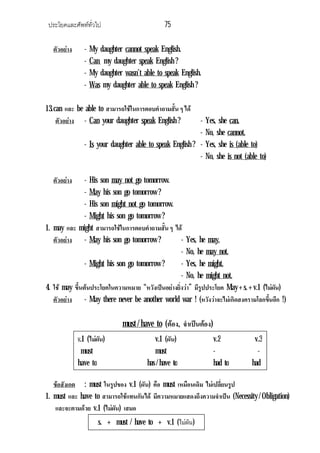
1. การใชกริยาชวย can (สามารถ) , be able to ( สามารถ) and may ( อาจจะ) สามารถใชแทนกันได
แปลวา สามารถ :ซึ่งจะตามหลังดวย v.1 (ไมผัน) เสมอ
s. + can / be able to + v.1 ( ไม
ประโยคบอกเลา ประโยคปฏิเสธ ประโยคคําถาม
My son can speak Spanish. My son can not speak Spanish. My son can speak Spanish.
Ron is able to speak Spanish. Ron is not able to speak Ron is able to speak Spanish.
Piggy may study Spanish. Spanish. Piggy may study Spanish.
Piggy may not study Spanish.
33.
ประโยคและศัพททั่วไป 33
แบบฝกหัด 2:
1. Lions are four-
footed……………………………………………………………………………………..
2. The cottage is ……………with snow.
3. Wanchai is not a Spanish ………………………..speaker.
4. Compared to other birds, ostriches are………………………………….
5. Everyone…………………….that Banharn had a right to apply for this election.
6. The prirates …………………..three Thai fishermen as hostages.
7. On this auspicious………………………….., we wish you all good luck.
8. We have to ……………………..to help women and youths affected from domestic violences.
9. I ……………………….Pokin to donate some money to the poor children.
10. During his long……………………….., Philip stopped to visit Thailand.
11. Thais are proud of our…………………who keep the territory and independence for our country.
12. I …………….the letter in order that my mother could read it easily.
13. We can use a magnifiying glass to ……………….this thing.
14. The photographers have made many………………….to pinpoint the Yetis.
15. The Abominable snowman is half-man, half………………………………………………………..
******************************************************************************************************************
แบบฝกหัด 3:
1………………Henry able to join the party tomorrow night?
2. Edward………………..pass the English test last year.
3. He………………………out this evening. He is not sure.
4. Sornram…………………marry Nuisri because he was not ready.
5. We…………………….university at 1700 this afternoon.
6. It seems to me that it…………………………rain tonight.
7. It…………………..be raining in Songkhla at the moment.
8. Miss Jackarine ……………swim, so she sunk.
9. ………………you ……………to play the piano?
10. ……………..the workers work out all night?
34.
ประโยคและศัพททั่วไป 34
บทที่ 7 : Past Perfect Tense
อนุเฉทเรือง A young reporter
่
1. A young reporter was tipped off about a murder. ( นักขาวหนุมไดรับการใหขาวเกียวกับฆาตกรรม)
่
2. The reporter interviewed several neighbors of the murder victim.( นักขาวสัมภาษณเพือนบาน
่
หลายคนเกียวกับเหยื่อทีถูกฆาตกรรม)
่ ่
3. When he arrived at the scene of the crime, a crowd had gathered.( มีคนมุงเมื่อเขามาถึง
บริเวณทีเกิดเหตุ )
่
รูปแบบของ Past Perfect
S. + had + v.3
ประโยคบอกเลา ประโยคปฏิเสธ ประโยคคําถาม
He had had breakfast. He had not had breakfast. Had he had breakfast?
I had worked hard. I had not worked hard. Had you worked hard?
Piggy had studied. Piggy had not studied. Had Piggy studied.?
หลักการใช Past Perfect Tense
ใชกบเหตุการณหรือการกระทําที่เกิดกอนหตุการณหนึงในอดีต เชน before ( กอน), after (หลัง) ,
ั ่
as soon as ( ตราบเทาที), until ( จนกระทั่ง)
่
ตัวอยาง - When I got home, someone had broken intor my room.
( เมื่อฉันมาถึงบาน ดูเหมือนวามีโครลอบเขามาในหองกอนหนานี้)
- My parents had already slept when I arrived home last night.
( พอแมของฉันนอนหลับแลวเมื่อฉันมาถึงมาบานเมื่อคืน)
- The crowd had left before the police came.
( ฝูงชนสลายตัวกอนตํารวจมา)
ขอสังเกตุ Past Perfect Tense มักจะใชคกบ Past Simple Tense เมื่อเราพูดกับเหตุการณในอดีต
ูั
Past Perfect Tense บอกถึงคําพูด ความคิด หรือเหตุการณในอดีต ( Reporting speech)
ตัวอยาง - I thought I had brought a physics book to the class .
(ผมคิดวาผมไดนาหนังสือฟสกสมา)
ํ ิ
- She said she had been sick yesterday (หลอนพูดวาหลอนปวยเมื่อวานนี) ้
35.
ประโยคและศัพททั่วไป 35
แบบฝกหัด 1
1. Jack and Jill were good friends. They…………………each other for a long time. ( know)
2. Hanna was so busy. She………………………away. ( go)
3. Wanna didn’t recognize Konvipa, She……………….a lot. ( change)
4. He didn’t have his own house. He……………………..it. ( sell)
5. When Linda arrived, Peter…………………………………..out ( go)
6. They went to the party late. The party …………………………………… ( begin)
7. When Ammy entered the house, her family………………….their lunch. ( have)
8. When I arrive home, everyone…………………………(leave)
9. The pick -up truck………………….down before he reached home. ( break)
10. She ………………….her report before she joined Jack’s birthday party. ( finish)
Past Perfect Continuous Tense
รูปแบบของ Past Perfect Continuous
s. + had + been + v.ing
ประโยคบอกเลา ประโยคปฏิเสธ ประโยคคําถาม
The students had been waiting. The students had not been waiting. Had the students been waiting?
I had been cutting wood all day. I had not been cutting wood all day. Had I been cutting wood all day?
She had been crying. She had not been crying. Had she been crying?
หลักการใช Past Perfect Continuous
1. ใชกบเหตุการณหรือการกระทําที่เกิดขึนตอเนื่องกันโดยไมขาดตอน ณ ชวงเวลาใดเวลาหนึ่งในอดีต
ั ้
(เนนถึงความตอเนื่องของเวลาไดดีกวา Past Perfect)
ตัวอยาง - The audience had been waiting for Brain for two hours before he appeared.
(ผูชมคอยไบรอันเปนเวลาสองชั่วโมงกอนที่เขาจะปรากฎตัว)
- Yuri and Jasmin had been talking to each other all night.
( ยูริและจัสมินคุยกัน ตลอดทั้งคืน)
2. ใชกบเหตุการณเกิดอยางตอเนื่องในอดีตกอนที่จะมีอีกเหตุการณหนึ่งเกิดขึ้นตามมา
ั
ตัวอยาง - Robert had been playing chess for an hour when it rained.
( โรเบริ์ตเลนหมากรุกเปนชั่วโมงจากนั้นฝนจึงตก)
- The students had been playing football when it rainedheavily.
( นักศึกษากําลังเลนฟุตบอลกอนทีฝนจะตกลงมาอยางหนัก)
่
36.
ประโยคและศัพททั่วไป 36
แบบฝกหัด 2
1.Riggy…………………..hard all day. ( study)
2.Somebody…………………………… here. There was a smell of cigarettes in the room.
(smoke)
3. Malee was tired. She……………………………..in the sun too long.( stay)
4. The boys………………………for an hour when the school bus came. ( wait)
5. The music band………………………for about twenty minutes when I arrived.( play)
6. We……………………..for 15 minutes when Suchinda called me. ( wait)
7. James was leading against the tree. He looked thirsty because he………………………..(run)
8. You looked out of the window yesterday. What……………you …………………….. that time?
9. We…………………………for an hour when the bus came. (walk)
10. John was wet. He……………………..in the rain. ( walk)
แบบฝกหัด 3
1. Andrew is famous……………………………….from the Nation.
2. The police were ………………….off about murder.
3. Many curious…………………………were watching the burning houses.
4. Our…………………………….are friendly.
5. He tried to comfort the ……………………………………….families.
6. She has had a long ………………… with the outstanding international university.
7. The old man was captured for committing……………………………………………………...
8. The export………………………..sends goods abroad.
9. The vendors sold the goods to the…………………………………….who walked past them.
10. The ……………………gathered in front of the Government House.
คําศัพท ( Part of Speech )
นาม กริยา คุณศัพท กริยาวิเศษณ
report report reported reportedly
murder murder murderous murderously
crime - crimimal criminally
interview interview interviewed
relation relate related
neighbor - neighboring neighborly
scence - scenic
ประโยคและศัพททั่วไป 38
บทที่ 8 : Future Simple Tense
อนุเฉทเรือง Get Ready for the future
่
1. People will live on the upper level, the lower level will be used for traffic , parking and
factories. ( คนจะอาศัยอยูในที่สูง สวนพื้นที่ระดับต่ําจะถูกใจสําหรับจราจร ที่จอดรถและโรงงาน)
2. Biotechnology will make food more plentiful and healthy. ( เทคโนโลยีชวภาพจะทําใหอาหาร
ี
มีหลากหลายและมีสุขภาพ)
รูปแบบของ Future Simple Tense: มีโครงสรางคือ subject + will, shall, be going to + v.1
ประโยคบอกเลา ประโยคปฏิเสธ ประโยคคําถาม
You will travel to Paris. You will not travel to Paris. Will you travel to Paris ?
We shall visit our parents soon. We shall not visit our parents soon. Shall we visit our parents soon?
She is going to repair the roof. She is not going to repair the roof. Is she going to repair the roof?
หลักการใช Future Simple Tense
1. ใชกบเหตุการณที่จะเกิดขึ้นในอนาคต โดยมีจะมีคากริยาวิเศษณ ตอไปนี้ later (ตอมา), Today (วันนี้),
ั ํ
the day after tomorrow (วันมะรืนนี), next week (สัปดาหหนา) ,next month (เดือนหนา), tonight (คืนนี้), soon
้
(ในไมชา)
ตัวอยาง It will be winter soon. ( ใกลจะถึงฤดูหนาวแลว)
Will England win the next football World cup? ( อังกฤษจะชนะการแขงฟุตบอลครั้งหนาหรือไม)
I shall be there in a few minutes. ( ฉันจะไปที่นนอีกไมกี่นาที)
ั่
2. ใชกบประโยคทีแสดงการขอรองหรือขออนุญาต
ั ่
ตัวอยาง - Will you open the window please ? (กรุณาเปดหนาตางหนอยไดไหม ?)
- Shall we go for a walk? ( เราไปเดินเลนกันไหม)
หมายเหตุ Shall ใชกับประธานคือ we , I เทานัน ้
3. ใชกบประโยคทีแสดงอนาคตที่ประกอบดวยเหตุการณสองเหตุการณ ในรูปเงื่อนไข ที่มี คําวา
ั ่
If, unless, until , when เหตุการณที่อยูในอนุประโยคหลักจะใช Future Simple และ เหตุการณที่อยู
ใน
อนุประโยครองใช Present Simple หรือ Present Perfect คําเชื่อมทีนํามาใชเชื่อมสองเหตุการณใน
่
อนาคต ไดแก I don’t’ know if I will be there. ( ผมไมรูวา ผมจะอยูที่นนหรือไม)
ั้
They haven’t said when it will be ready. ( พวกเขาไมไดพดอะไรวาเมื่อไหรจะพรอม)
ู
When will I see you again? ( เมื่อไหรจะเจอคุณอีก)
I will give up smoking if it will make you happy.( ผมจะเลิกสูบบุหรี่ถาทําใหคณสบายใจ)
ุ
39.
ประโยคและศัพททั่วไป 39
4. การใช verb to be + going +to จะใชกับเหตุการณที่มีการวางแผน หรือ กําหนดการดําเนินการที่ชดเจนวา
ั
จะทําสิ่งนั้นแนนอนในอนาคนอันใกล ( is, am,are + going + to + vชองที่ 1)
ตัวอยาง - I am going to enrol logistic management course this afternoon.
( ฉันตังใจจะลงทะเบียนวิชาบริหารการสงกําลังบํารุงบายนี)
้ ้
- The committee are going to launch the public and street lighting in the
community soon. ( คณะกรรมการจะเริ่มโครงการไฟฟาบนถนนและที่สาธารณะในชุมชนนีอีกไมนาน) ้
Future Continuous Tense
รูปแบบของ Future Continuous subject + will / shall + be + v. ing
ประโยคบอกเลา ประโยคปฏิเสธ ประโยคคําถาม
You will be travelling to Paris. You will not be travelling to Paris. Will you be travelling to Paris?
We shall be visiting our parents. We shall not be visiting our parents. Shall we be visiting our parents?
He will be teaching. He will not be teaching. Will he be teaching?
หลักการใช Future Continuous Tense
ใชกบเหตุการณที่กาลังจะเกิดขึ้นในอนาคตตามเวลาที่ระบุไวอยางชัดเจน เชน at this time tomorrow,
ั ํ
tomorrow evening , at nine o’clock tomorrow etc.
ตัวอยาง - At this time tomorrow I will be teaching at Ramkhamhaeng University.
(พรุงนี้เวลาเดียวกันนี้ ฉันจะมาสอนที่มหาวิทยาลัยรามคําแหง)
- Suthi will be studying History at nine o’clock tomorrow morning.
( สุทธิจะเรียนวิชาประวัติศาสตรในเวลา 9 โมงวันพรุงนี) ้
2. ใชกบเหตุการณที่จะเกิดขึ้นในอนาคต แตไมคอยมั่นใจนักวาจะเกิด
ั
ตัวอยาง - He will be calling us. (เขาอาจจะโทรมาหาเราก็ได)
- The rain will be coming soon. (ฝนจะตกในไมชานี้)
3. ใชกับการคาดหวังวาเหตุการณอยางหนึ่งซึ่งเกิดขึ้นเปนปกติเสมอมา และจะเกิดเปนประจํา
ตัวอยาง - Will you be backing home at 7 p.m. tomorrow ?
(คุณจะกลับมาถึงบานเวลา 7 โมงเย็นพรุงนีใชไหม ?)
้
40.
ประโยคและศัพททั่วไป 40
Future Perfect Tense
รูปแบบของ Future Perfect subject. + will / shall + have + v.3
ประโยคบอกเลา ประโยคปฏิเสธ ประโยคคําถาม
You will have travellied to Paris. You will not have travellied to Paris. Will you have travellied to Paris.?
We shall have visited our We shall not have visited our parents. Shall we have visited our parents.
parents. He will not have taught English. ?
He will have taught English. Will he have taught English.?
หลักการใช Future Perfect Tense
1. ใชแสดงเหตุการณที่จะเสร็จสมบูรณในอนาคตที่มเี วลาที่แนนอน ปรกติจะมีคากริยาวิเศษณ
ํ
Adverb of Time ที่เริ่มตนดวย “by” ( then, that time, eight o’clock, the end of next month etc.)
ตัวอยาง Supat will have stayed with his uncle for two years next month.
( สุพัฒนจะอยูกบลุงของเขาครบ 2 ป ในเดือนหนา)
ั
- The TG 707 flight will have landed by 8:45 o’clock.
( เที่ยวบิน ทีจ707 คงจะลงจอดเรียบรอยแลวในเวลา 8.45 นาฬิกา)
ี
2. ใชกบเหตุการณ เหตุการณหนึ่งจะเสร็จสิ้นสมบูรณกอนจะมีเหตุการณหนึงเขามาแทรกใน
ั ่
- เหตุการณที่เกิดกอนและจะเสร็จสิ้นสมบูรณกอนใช Future Perfect
- เหตุการที่เกิดขึนตามใช Simple Present
้
ตัวอยาง - Wattana will have finished his master’s degree when he is 25 years old.
( วัฒนาคงจะสําเร็จปริญญาโทแลว เมื่อเขาอายุ 25 ป)
- Don’t wait for Dave. We will have slept by the time he is back home.
( อยาคอยเดฟเลย เราคงจะนอนไปแลวตอนทีเ่ ขาจะมาถึงบาน)
Future Perfect Continuous Tense
รูปแบบของ Future Perfect Continuous
s. + will / shall + have + been + v. ing
หลักการใช Future Perfect Continuous Tense
ใชแสดง เหตุการณที่มีคําแสดงเวลาที่เริ่มตนดวย by เชนเดียวกับ Future Perfect Tense แต
เนนความตอเนื่องกันไป
ตัวอยาง By next year, Somchai will have been living in France for ten years.
( ประมาณปหนา สมชายจะอยูที่ประเทศฝรั่งเศสเปนเวลา 10 ป)
41.
ประโยคและศัพททั่วไป 41
At 9 o’clock in the morning, Pitak will have been waiting for his friend for two
hours.
( ประมาณเวลา 9 นาฬิกา พิทกษก็จะคอยเพื่อนของเขาเปนเวลาถึง 2 ชั่วโมง และคงจะคอยตอไป)
ั
แบบฝกหัดที่ 1:
1. By the time Usanee is twenty, her teacher ……………………………….for twelve years. ( teach)
2. ……………………you close the door, please?
3. When ……………..you……………………. for your electric bill? . ( pay)
4. When Suchart comes back, he…………………………….this parcel. ( see)
5. Our friends ………………………..to visit our teachers tomorrow.
6. …………………..you go the concert with me next week?
7. When Jane arrives, Pam……………..for you. ( wait)
8. Rob ……………………a blue shirt with a red necktie, So we can find him easily. ( wear)
9. By the next Sunday, the farmers …………………………..all the crops. ( harvest)
10. In thirty minutes’ time, a shuttle bus …………………..to take passengers to the airport. (come)
11. David……………………………..many miles by September next year.( travel)
12. By the dinner time, Joey…………………………….…..packing his camping stuff. ( finish)
13. In a few minutes, the opera………………………………………………( end)
14. By the time the students arrive at the library, it………………………………….(close)
15. By the end of this month, Yosawadee…………………………………for nine years. (act)
16. Next Christmas, we…………………………our wedding anniversary. ( celebrate)
17. If we don’t hurry up, we……………………………………the bus. ( miss)
18. …………………………I go with you?
19. Christmas ……………………again. ( come)
20. I…………………………….forty next month. ( be)
☻☻☻☻☻☻☻☻☻☻☻☻☻☻☻☻☻☻☻☻☻☻☻☻☻☻
☻☻
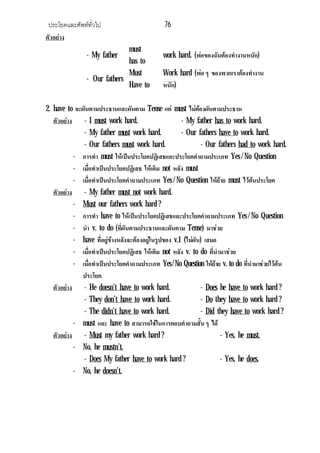
กริยาชวย Must, have to แปลวา “ ควรจะ หรือ ตอง”
Present Past Past Participle
Must Must - -
Have to have/has to had to had to
42.
ประโยคและศัพททั่วไป 42
1.รูปแบบ Must, have to มีดังนี้
ประโยคบอกเลา ประโยคปฏิเสธ ประโยคคําถาม
You must go immediately. You must not go immediately. Must go immediately.
I have to go now I don’t have to go now Do I have to go now
She has to leave now. She doesn’t have to leave now. Does she have to leave now.
2. การใช Must, have to จะใชแทนกันไดในลักษณะกริยาชวยถึงความจําเปน ( necessity/ obligation)
Must จะใชในกาลปจจุบันเทานั้นเมื่อใชกับประโยคในอดีตใหเปลี่ยน must เปน had to
ตัวอยาง We must stay here for a while because it is heavily raining.
( เราจะตองอยูที่นี้สกพักหนึ่งเพราะฝนกําลังตกหนัก)
ั
Yesterday we had to stay there because of the rain.
( เมื่อวานนี้ เราจะตองอยูที่นั้นพักหนึ่งเพราะฝนกําลังตกหนัก)
แบบฝกหัดที่ 2:
1. I………………….eat to live.
2. We…………………………now. ( leave)
3. Sue………………………not ignore her children.
4. …………………….Judy go to college?
5. It……………………….be cold tonight.
6. Workers……………………….go for strike. ( not)
7. You…………………………come and see what happened yesterday.
8. All my cats …………………be hungry now.
9. All creature……………………………die.
10. ……………………………Wandee have to go to Pattani tomorrow?
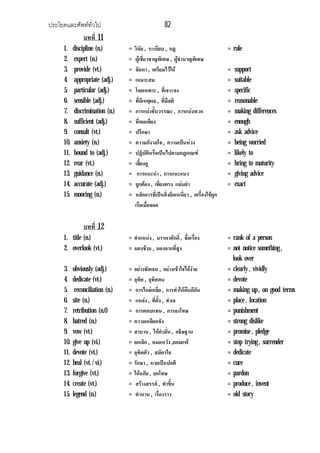
ภาคคําศํพท :(Vocabulary)
บทที่ 8 ความหมาย คําเหมือน
1. safe (adj.) = ปลอดภัย = secure, not dangerous
2. vehicle n.() = พาหนะ = conveyance
3. automatically = โดยอัตโนมัติ = mechanically
(adv.)
4. scarce (adj.) = หายาก, ขาดแคลน = insufficient
5. floating (adj.) = ลอยน้ํา = hovering, flying
6. plentiful (adj.) = มากมาย, อุดมสมบูรณ = abundant, plenty, in great supply
7. healthy (adj.) = สุขภาพแข็งแรง = strong, vigorous
สมบูรณ
8. affect (vt.) = มีผลตอ = influence
9. disease (n.) = โรค, เชื้อโรค = illness
10. develop (vt.) = พัฒนา, ทําใหกาวหนา = extend
ประโยคและศัพททั่วไป 44
บทที่ 9 : Adjective (คําคุณศัพท)
Adjective ( คําคุณศัพท ) คือ คําทีใ่ ชขยายนามหรือบอกลักษณะรูปราง ขนาด สี อายุ ของ นาม
Adjective หลายชนิดเมือใชในนําหนานามจะตองเรียงลําดั ชนิดตางๆ
่
1.โดยวางไวหนาคํานาม a conference hall ( หองประชุม ) , a brick building ( อาคารทําดวยอิฐ ),
a cold night ( คืนที่เหน็บหนาว), a beautiful woman ( ผูหญิงสวย), a black dog.( สุนัขตัวสีดํา)
ตัวอยาง - She is an intelligent student (เธอเปนเด็กผูหญิวทีฉลาด ) ่
- He is a famous actor. ( เขาเปนนักแสดงที่มีชอเสียง)
่ื
2. คําคณศัพทที่ขยายประธานของประโยค จะตองตามดวยกริยา Verb to be : is, am, are, was, were, been
หรือ Linking verb เชน look (มองดู), seem (ดูเหมือน) , appear (ปรากฏ) , grow (เติบโต),
prove (พิสูจน) , show (แสดง), become (กลายเปน) , keep (เก็บ, รักษา) , remain (คงอยู)
sound (ออกเสียง) , feel (รูสึก) , turn (หมุน, กลับ) , get (ไดรับ) make (ทําให ) , smell (ไดกลิน)
่
taste (ชิมรส)
ตัวอยาง - Kobsak is very generous. Kobsak looks generous. (กอบศักดิ์เปนคนโอบออมอารี)
- He is good at mathematics. ( เขาเกงในวิชาคณิตศาสตร)
- That policeman is so calm. That policeman remain so calm. ( ตํารวจคนนั้นสุขุม)
3. คําคุณศัพทจะไมวางอยูหนาบุรุษสรรพนาม ทั้งที่ทําหนาที่เปนประธาน เชน I , you , we, they, he.
She,it ยกเวนสรรพนาม one และ ones แตจะอยูหลังคําตอไปนี้ someone ,somebody (บางคน)
everyone,everybody ( ทุกคน), anyone , anybody (คนใดคนหนึง), no one, nobody(ไมมีใครสักคน)
่
something (บางสิง) everything (ทุกๆสิง), anything (สิ่งใดสิ่งหนึ่ง) , nothing (ไมมีอะไรเลย)
่ ่
ตัวอยาง - There are many sorts of books, the most interesting ones have been sold out.
(มีหนังสือที่อยูหลายประเภทแตหนังสือทีนาสนใจมากที่สดขายไปหมดแลว )
่ ุ
- The party today may have something special for the guests.
(งานเลี้ยงคืนนี้คงมีอะไรพิเศษสําหรับแขก)
4. คําคุณศัพทมีหลายชนิด จะไมเปลี่ยนพจนตามคํานามทีมันขยาย แตคณศัพททบอกจํานวนตอไปนี้จะตอง
่ ุ ี่
เลือกใชตามพจนของคํานามที่ขยาย
4.1. adj. บอกจํานวนเอกพจนทใชขยายคํานามนับไดเอกพจน กริยาที่ตามหลัง
ี่
ประธานจะเปนกริยาเอกพจน เชน is, was, has, had หรือ กริยาอื่นๆ เติม s/es เชน teaches, studies,
gives เปนตน หรือรูปอดีตกริยาชอง 2 กับทุกประธาน หรือ กริยารูป infinitive เชน will be, คําคุณศัพทที่
บอกจํานวนเอกพจน ไดแก a / an , this ( นี) / that (นั่น), another ( อีกอันหนึ่ง) each (แตละ),
่
every ( ทุกๆ), one (แตละคน)
ตัวอยาง - Each student likes studying Thai History. (เด็กนักเรียนแตละคนชอบเรียนวิชาประวัติศาสตรไทย
- Every person has a right to protect himself. (ทุกคนมีสิทธิ์ในการปกปองตนเอง)
45.
ประโยคและศัพททั่วไป 45
4.2.คําคุณศัพทที่บอกจํานวนพหูพจน ขยายเฉพาะคํานามที่นับไปพหูพจน กริยาที่ตามหลัง
ประธานจะเปนกริยาพหูพจน เชน are, were,have, had หรือ กริยาอืนๆ ไมเติม s/es เชน teach, study,
่
give เปนตนหรือรูปอดีตกริยาชอง 2 เชน taught, studied, gave คําคุณศัพทไดแก few ,a few
(2-3 ชิ้น), fewer than, these,those , two / three / four / five , a number of , a large
number of a great number of (จํานวนมาก)
ตัวอยาง - Those birds are from Australia. ( นกเหลานี้มาจากประเทศออสเตรเลีย)
- A large number of applicants are waiting for interview. ( ผูสมัครจํานวนมากําลังรอ
การสัมภาษณ)
4.3. คําคุณศัพทบอกจํานวนเอกพจนและจะใชขยายคํานามนับไมได ซึ่งเปนเอกพจนเสมอ
กริยาจะเปนเอกพจนเชน much, little , a little (เล็กนอย) , a great deal of, a good deal of,
a large amount เปนตน
ตัวอยาง - A great deal of rice is exported from Thailand.
( ขาวจํานวนมากสงออกจากประเทศไทย)
- There is a little sugar left in the bowl. (มีน้ําตาลเหลืออยูนดหนอยในถวย)
ิ
4.4 คําคุณศัพทบางคําใชขยายทั้งคํานามที่นบได ทั้งเอกพจนและพหูพจน และนามที่นบ
ั ั
ไมไดเอกพจน กริยาที่พจนสอดคลองกับพจนของประธาน คําคุณศัพทนี้ ไดแก a lot of, plenty of, the
any, some, some of , the none of the , any of the เปนตน
ตัวอยาง - Plenty of animals in the big cities are starving ( สัตวจํานวนมากในเมืองใหญๆ
อดตาย)
- A lot of milk is turning sour. (นมจํานวนมากเริ่มมีเปรี้ยว)
- Most of the chicken in this farm are killed. ( ไกจํานวนมากในฟารมนีถูกฆาทิง)
้ ้
4.5 กริยาในรูปทิ่เติม + ing (Present Participle) มักจะวางอยูหนาคํานามที่หมายถึง
กําลังกระทําเชน a crying baby , a runnin man, a standing boy, walking soldiers , a sleeping
princess เปนตน
ตัวอยาง - The crying girl wants to go home. ( เด็กผูหญิงที่กาลังรองไหตองการจะกลับบาน)
ํ
- I might have met that standing man somewhere I couldn’t remember.
(ฉันนาจะเจอผูชายคนทีกําลังยืนอยูตรงนั้นมากอนแตฉนนึกไมออก)
่ ั
นอกจากนี้ยงเปนการ แสดงถึงหนาที่หรือการใชทั่ว ๆ ไปของคํานามนั้น
ั
ตัวอยาง - My grandmother has to use a walking stick. ( ยาของฉันตองใชไมเทา)
- Baan Saen Saran has a lot of swimming pools. (บานแสนสราญมีสระวายน้ําหลายสระ )
4.6 กริยาชองที่ 3 (Past Participle) มีความหมายถึงประธาน ถูกกระทํา มักจะวางอยูหนาคํานาม ที่
46.
ประโยคและศัพททั่วไป 46
ขยาย เชน a broken glass ( แกวแตก) , a fallen tree ( ตนไมทโคนลม) , an injured passenger (
ี่
ผูโดยสารที่ไดรับบาดเจ็บ) , written paper ( กระดาษที่เขียน) เปนตน
ตัวอยาง - The injured passengers were taken to the hospital. ( ผูโดยสารทีไดรับบาดเจ็บถูกนําสง
่
โรงพยาบาล)
- It is necessary to submit the written letter to the court.
( มีความจําเปนอยางยิ่งที่จะตองสงหนังสือที่มีลายลักษณอกษรเสนอตอศาล
ั
4.7 กริยาพิเศษทีบอกลักษณะ แสดงความรูสึกทางอารมณและมีโครงสรางที่แตกตางกัน
่
โครงสรางในการใชประโยคจะใชกบ Verb to be : + past participle มีความหมายวา “ รูสึก ”
ั
ตัวอยาง - - I am bored. ( ฉันรูสกเบือ) The children were disappointed. (เด็กๆ รูสึกผิดหวัง)
ึ ่
acquainted คุนเคย (with) ,annoyed รําคาญ (with) amazed ประหลาดใจ (at)
amused เพลิดเพลิน (at / with /by) astonished พิศวง (at) bored เบื่อ (by)
confused สับสน (with) convinced เชื่อมั่น (of) delighted ดีใจ (by)
disturbed กวนใจ (by) disappointed ผิดหวัง (in / with) embarrassed ขวยเขิน (by)
excited ตื่นเตน (about) exhausted เหนือย (from)
่ fascinated หลงใหล (with / by)
interested สนใจ ( in) involved เกี่ยวของ (in) pleased พอใจ (with)
satisfied พอใจ (with) scared กลัว ( of, by) terrified ย่ําแย ( of, by)
tired เหนื่อย (of) worried (about) opposed คัดคาน (to)
4.8 กริยาพิเศษใชกบรูป present participle ( V.ing )จะเปนคําคุณศัพทบอกถึงลักษณะ
ั
ของคํานามตามความคิดของสวนบุคคล โดยทั่วไปนิยมแปลวา “ นา………………” เชน
ตัวอยาง - The film is amusing. (ภาพยนตรนาเพลิดเพลิน)
- This subject is confusing. (วิชานี้นาสับสน)
annoying รําคาญ amazing ประหลาดใจ amusing เพลิดเพลิน
astonishing พิศวง boring เบื่อ confusing สับสน convincing เชื่อมั่น
delighting ดีใจ disturbing กวนใจ disappointing ผิดหวัง embarrassing ขวยเขิน
exciting ตื่นเตน exhausting เหนื่อย fascinating หลงใหล interesting สนใจ
involving เกี่ยวของ pleasing พอใจ satisfying พอใจ scarying กลัว
terrifying ย่ําแย tiring เหนื่อย worrying กังวัล
47.
ประโยคและศัพททั่วไป 47
9. n. ประสม ( Compound Nouns ) และ n. ที่ทํานาที่เสมือน adj. ขยาย n. โดย n. ที่ทําหนาขยายนัน ้
จะมีรูปเปนเอกพจนเสมอ
n. ประสม (Compound Nouns) เชน
sunglasses (แวนกันแดด) raincoat (เสื้อกันฝน) trademark (เครื่องหมาย
การคา)
railway (ทางรถไฟ) businessman (นักธุรกิจ) birthday (วันเกิด)
bookstore (รานขาย drugstore (รานขายยา) wallpaper (กระดาษติดฝาผนัง)
หนังสือ)
lifeboat (เรือชวยชีวิต) mailbox (ตูรับจดหมาย) doorman (คนเฝาประตู)
ตัวอยาง - He looks like a countryman. (เขาดูเหมือนเปนคนชนบท)
- The moonlight makes me happy. (แสงจันทรทําใหฉันมีความสุข)
n. ที่ทําหนาทีเ่ สมือน adj. ขยาย n. เชน
picnic basket (ตะกราปกนิก) mango tree (ตนมะมวง) football game (กีฬา
ฟุตบอล)
leather wallet (กระเปาสตางคหนัง traffic sign (ปายจราจร) flower garden (สวนดอกไม)
garden flowers (ดอกไมจาก stone wall (กําแพงหิน) kitchen knife (มีดที่ใชใน
สวน) ครัว)
government official (ขาราชการ) soap factory (โรงงานทําสบู) beer bottle (ขวดเบียร)
chocolate milk (นมรส desk lamp (โคมไฟตั้งโตะ) sugar cane (ตนออย)
ช็อกโกแลต)
diamond chokers (สรอยคอ leather shoes (รองเทาหนัง) rose garden (สวนกุหลาบ)
เพชร)
football match (การแขงขัน street car (รถรางที่วิ่งตาม
ฟุตบอล) ถนน)
ตัวอยาง - Don’t cross that old railway bridge. ( อยาขามสะพานรถไฟเกา ๆ สะพานนัน ) ้
- The cat is sitting on the hot tin roof. ( แมวกําลังนั่งอยูบนหลังคาสังกะสีรอน ๆ )
10. รวมกันเปน adj. คําเดียว โดยมีเครื่องหมาย
Hyphen ( - ) ขีดคั้นกลาง
ถา adj. ประสมที่เกิดจากคําหลังเปน n. หรือเปนอวัยวะของรางกาย ตองเติม - d / - ed หลัง n. นั้น
a middle - aged man (ชายวัยกลางคน) an old - fashioned idea (ความคิดลาสมัย)
a black - haired boy (เด็กผูชายผมสี a short - sighted girl (เด็กผูหญิงสายตาสัน)
้
ดํา)
a broken - hearted man (ชายอกหัก) an absent - minded man (คนใจลอย)
a long - necked man (มนุษยคอยาว) long - legged dad (คุณพอขายาว)
48.
ประโยคและศัพททั่วไป 48
ถา adj. ประสมที่เกิดจากคําหลังเปน v. ในความหมายวา n. ที่ถูกขยายเปนผูกระทํา v. นั้นตองอยูใน
รูปของ v. ing
an ear - rising boy (เด็กผูชายที่นอนตื่นเชา)
a man - eating tiger (เสือที่กนคน)
ิ
rice - growing farmers (เกษตรกรที่ปลูกขาว)
a good - looking man (ผูชายที่ทาทางดูด) ี
a quickly - growing child (เด็กที่เจริญเติบโตเร็ว)
a well - learning student (นักเรียนเรียนดี)
ถา adj. ประสมที่เกิดจากคําหลังเปน v. ในความหมายวา n. ที่ถูกขยายเปนผูถูกกระทํา v. นั้นตองอยู
ในรูปของ v.3
hand - made silk (ผาไหมที่ทอดวยมือ)
snow - covered mountains (ภูเขาที่ปกคลุมดวยหิมะ)
a badly - written report (รายงานทีเ่ ขียนไมด) ี
a well - trained worker (คนงานที่ฝกฝนมาอยางดี)
a well - known teacher (ครูชึ่งเปนที่รูจักกันดี)
a Swiss - made watch (นาฬิกาที่ทําในประเทศสวิส)
adj. ผสมรูปอื่น ๆ ไดแก
an up - to - date radio (วิทยุที่ทันสมัย)
a fifty - page report (รายงานหาสิบหนา)
an eight - hour work / an eight hours’ work (การทํางาน8ชั่วโมง)
a two - week holiday / a two weeks’ holiday (ชวงวันหยุดนานสองสัปดาห)
a ten - minute conversation / a ten minutes’ conversation (การสนทนากินเวลา 10 นาที)
a dynasty - style mansion (คฤหาสนแบบราชวงศ)
a seven - story building (อาคาร 7 ชั้น)
a ranch - type house (บานแบบที่มีฟารมปศุสตว) ั
a five - minute walk (การเดิน 5 นาที)
49.
ประโยคและศัพททั่วไป 49
การเรียงลําดับ adj.
เมื่อมี adj. หลาย ๆ คําขยาย n. ตองวางเรียงตามลําดับดังนี้
กํากับนาม + จํานวน + ลักษณะ + ขนาด + สี + เชื้อชาติ + n. ขยาย + n.
หลัก
adj. กํากับ n. มีดั้งนี้ - Articles ไดแก a , an , the
- adj. แสดงความเปนเจาของ ไดแก my , your , our , his , her , its ,
their
- adj. ชี้เฉพาะ ไดแก this , that , these , those
- adj. แสดงจํานวนชี้เฉพาะ เชน
- one (of the / these / those) - all (of the / these / those)
- most (of the / these / those) - both (of the / these / those)
- some (of the / these / those) - any (of the / these / those)
- none (of the / these / those) - either (of the / these / those)
- neither (of the / these / those) - several (of the / these / those)
adj. แสดงลักษณะหรือคุณภาพ เชน old , young , good , bad , beautiful , rich , poor etc.
adj. แสดงขนาด เชน big , large , huge , tall , small , short , little etc.
adj. แสดงสี เชน purple , blue , green , yellow , orange , red etc.
adj. แสดงเชื้อชาติ เชน Thai , American , English , Japanese , French etc.
n. ที่ทําหนาทีเ่ สมือน adj. ขยาย n. เชน boy friend , dream team , sound engineer , office
boy , diamond ring , shop assistant etc.
ตัวอยางการเรียงลําดับ adj.
- My mother bought a beautiful flower vase yesterday afternoon.
[ article + adj. แสดงลักษณะ + n. ขยาย + n. หลัก ]
(บายวานนี้แมของฉันชื้อแจกันดอกไมสวยมาใบหนึ่ง)
- She does not like your black leather jacket.
[ adj. แสดงความเปนเจาของ + adj. แสดงสี + n. ขยาย + n. หลัก ]
(เธอไมชอบเสื้อแจ็คเก็ตหนังสีดําของคุณ)
- The beautiful Chinese flower vase is broken.
[ article + adj. แสดงลักษณะ + adj. แสดงเชือชาติ + n. ขยาย + n. หลัก ]
้
(แจกันดอกไมจากประเทศจีนที่สวยแตก)
- That green American T – shirt in my drawer is for your sister.
[ adj. กํากับนาม (that) +adj. แสดงสี + adj. แสดงเชื้อชาติ + n. หลัก ]
(เสื้อยืดอเมริกนสีเขียวในลิ้นชักฉันตัวนันสําหรับนองสาวของคุณ)
ั ้
50.
ประโยคและศัพททั่วไป 50
- I like her expensive red Persian carpet.
[ adj. แสดงความเปนเจาของ + adj. แสดงลักษณะ + adj. แสดงสี + adj. แสดงเชื้อชาติ +
n. หลัก ]
(ฉันชอบพรมเปอรเชียสีแดงราคาแพงของเธอ)
- We must do something for these three poor men.
[ adj. กํากับนาม (these) + adj. แสดงจํานวน + adj. แสดงลักษณะ + n. หลัก ]
(เราตองทําอะไรบางอยางใหกับผูชายทีนาสงสารสามคนนี)
่ ้
- Most of these twenty red apples are good.
[ adj. แสดงจํานวนชี้เฉพาะ (most of these) + adj. แสดงจํานวน + adj. แสดงสี + n. หลัก]
(สวนใหญของแอปเปลสีแดงยี่สบลูกเหลานีเ้ ปนแอปเปลทีด)
ิ ่ ี
บทที่ 9
1. imagine (vt. / vi.) = นึกคิด, นึกเอาเอง, คาดการณ = suppose, guess, think
2. choker (n,) = เครื่องประดับเพชรพลอยที่สวมติดคอ
3. galore (adv.) = จํานวนมาก, อุดมสมบูรณ = in abundance
4. don (vt.) = สวมเสื้อผาชนิดพิเศษ = put on
5. rare (adj.) = หายาก, ไมคอยมี, นอย = uncommon
6. tycoon (n.) = นักธุรกิจที่ร่ํารวยและมีอิทธิพล = magnate
7. remote (adj.) = ไกล, อยูหางออกไปจากชุมชน
= distant
8. parlay (vt.) = ลงทุนลงแรงเพือสิ่งที่ตองการ
่
9. piddle (vt. / vi. ) = ทําเลน ๆ ไมจริงจัง, เกียจคราน = dawdle
10. discount (n.) = การลดราคา, การลดสวน = deduction
11. rustic (adj.) = มีลักษณะเปนชนบท, เซอซา = old – fashioned as if
from a farm
12. opulent (adj.) = มั่งคั่ง, มากมาย, หรูหรา = sumptuous
13. romp (vi.) = วิ่งเลน, สนุกสนาน, ครื้นเครง = lively play
14. spy (vt.) = มองเห็น, สืบ, สอดแนม = spot
15. letdown (n.) = ผิดหวัง, ไมสบอารมณ = disappointment
51.
ประโยคและศัพททั่วไป 51
บทที่ 10 : การเปรียบเทียบคําคุณศัพทและคําวิเศษณ
( Comparison of Adjectives and Adverbs)
การเปรียบเทียบ adj. ( Comparison of Adjectives )
1. การเปรียบเทียบ adj. ขั้นเทากัน ( Positive Degree )
การเปรียบเทียบขันเทากันมีโครงสรางดังนี้
้
n.1 + be / linking v. + as + adj. + as + n.2
ตัวอยาง - I am not as rich as you are. (ผมไมรวยเทากับคุณ)
- Your house is not so large as mine. (บานคุณไมใหญโตเทากับบานฉัน)
หมายเหตุ : ประโยคทีใชโครงสรางการเปรียบเทียบขั้นเทากัน จะใช v. to be หรือ Linking
่
Verb เปน v. หลักของประโยค
: as as ใชไดทงประโยคบอกเลา , ปฏิเสธ และคําถาม
ั้
: so as ใชกบประโยคปฏิเสธเทานั้น (การเปรียบเทียบความไมเทากัน)
ั
2. การเปรียบเทียบ adj. ขั้นกวา (Comparative Degree) และขั้นสูงสุด (Superlative Degree)
1. adj. พยางคเดียว ใหเติม -er ในขั้นกวา และเติม -est ในขั้นสูงสุด และถามีสระเสียงสั้น ใหเพิ่ม
พยัญชนะสะกดอีก 1 ตัวกอนเติม -er หรือ -est ถา adj. นั้นลงทายดวย e ใหเติมเพียง -r ใน
ขั้นกวา และเติม -st ในขั้นสูงสุด เชน
Positive Comparative Superlative
short (สั้น) shorter shortest
large (กวาง) larger largest
big (ใหญ) bigger biggest
hot (รอน) hotter hottest
old (แก) older oldest
2. adj. 2พยางค ใหเติม - er ในขั้นกวา และเติม - est ในขันสูงสุด ถา adj. ลงทายดวย - e อยู
้
แลวใหเติมเฉพาะ - r ในขั้นกวา และเติม - st ในขันสูงสุด และถา adj. ลงทายดวย - y และหนา
้
- y เปนพยัญชนะ ใหเปลี่ยน - y เปน I เสียกอน แลวจึงเติม - er ในขั้นกวา และเติม - est ใน
ขั้นสูงสุด เชน
Positive Comparative Superlative
simple (งาย) simpler simplest
clever (ฉลาด) cleverer cleverest
narrow (แคบ) narrower narrowest
happy (มีความสุข) happier happiest
52.
ประโยคและศัพททั่วไป 52
merry (ราเริง) merrier merriest
friendly (เปนมิตร) friendlier friendliest
3. adj. ตั้งแต 3 พยางคขึ้นไป ใหเติม more ในขันกวา และ most ในขันสูงสุดหนา adj. นั้น โดย
้ ้
ไมตองเติม - er ทาคํา adj. ในขั้นกวา และไมตองเติม - est ทายคํา adj. ในขั้นสูงสุด เชน
Positive Comparative Superlative
Useful (เปนประโยชน) more useful most useful
Beautiful (สวย) more beautiful most beautiful
Expensive (แพง) more expensive most expensive
Dangerous (อันตราย) more dangerous most dangerous
Important (สําคัญ) more important most important
Diligent (ขยัน) more diligent most diligent
Severe (เขมงวด) more severe most severe
4. adj. ตอไปนี้ไมเติม -er ในขันกวา และไมเติม -est ในขันสูงสุด แตจะมีการเปลี่ยนแปลงรูปคํา
้ ้
แบบพิเศษ เชน
Positive Comparative Superlative
good / well (ดี) better best
bad (เลว) worse worst
many / much (มาก) more most
little (นอย) less least
far (ไกล) farther / further farthest / furthest
old (เกา, แก) older / elder oldest / eldest
3. adj. ที่ไมมีการเปรียบเทียบ เพราะมีความหมายสมบูรณในตัวเองแลว (Absolute Meaning) เชน
perfect (สมบูรณ) final (สิ้นสุด) correct (ถูกตอง)
right (ถูกตอง) dead (ตาย) true (จริง)
empty (วางเปลา) chief (สําคัญ) full (เต็ม)
unique (มีเอกลักษณ) infinite (ไมมีสิ้นสุด) circular (กลม)
wrong (ผิด) permanent (ถาวร) extreme (จัด, สุด)
supreme (สูงสุด) single (หนึ่งเดียว) preferable (ดียิ่ง
กวา)
universal (เปนสากล) square (เปนสี่เหลี่ยม)
53.
ประโยคและศัพททั่วไป 53
การเปรียบเทียบ adj. ในขั้นกวามีโครงสรางดังนี้
n. 1 + be / linking v. + adj. + er / more + adj. + than + n.
ตัวอยางประโยคการเปรียบเทียบ adj. ในขั้นกวา
- My homework is easier than yours. (การบานของฉันงายกวาการบานของคุณ)
- His car is more expensive than mine. (รถยนตของเขาราคาแพงกวารถยนตของผม)
ขอสังเกต : ในการเปรียบเทียบขั้นกวาจะมี than ระหวาง adj. ขั้นกวากับ n. ที่นํามาเปรียบเทียบ
: ไมใช more หนา adj. ขั้นกวาที่เติม - er อยูแลว
หมายเหตุ : ใช much นําหนา adj. ขั้นกวาไดในความหมายวา “(…กวา) มาก”
ตัวอยาง - New York is much larger than Bangkok. (นิวยอรกใหญกวากรุงเทพ ฯ มาก)
- That brown shirt is much more expensive than this gray shirt.
(เสื้อตัวสีน้ําตาลแพงกวาตัวสีเทามาก)
การเปรียบเทียบ adj. ในขั้นสูงสุด
n. 1 + be /linking v. + the + adj. + est / most + adj. + in
ตัวอยางประโยคการเปรียบเทียบ adj. ในขั้นสูงสุด
- His son is the wisest boy in that classroom. (ลูกชายเขาเปนเด็กทีฉลาดที่สดในชั้นเรียน
่ ุ
นั้น)
- It is the most dangerous to drive in this town. (มันอันตรายที่สุดที่จะขับรถในเมืองนี) ้
ขอสังเกต : จะมี the นําหนา adj. ที่เปนการเปรียบเทียบขั้นสูงสุดเสมอ
หมายเหตุ : ใช the กับการเปรียบเทียบขั้นกวาได เมือมีการเนนถึงบุคคล 2 คน หรือสิ่ง 2 สิ่งที่
่
ชัดเจนในขณะที่พูด หรือเปนที่เขาใจกันดีระหวางผูพดกับผูฟง โดยสิงหนึ่งหรือบุคคลหนึง
ู ่ ่
ที่ชดเจนนั้นแสดงการเปรียบเทียบขั้นกวากับอีกสิ่งหนึ่ง
ั
ตัวอยาง - Winai is the more intelligent of the two students.
(วินัยฉลาดกวาในบรรดาเด็กนักเรียนสองคนนี) ้
- Of these two books, the red one is the better for Winai.
(ในบรรดาหนังสือสองเลมนี้ เลมสีแดงดีกวาสําหรับวินัย)
: ใช the กับการเปรียบเทียบขั้นกวาได เพือแสดงวา 2 เหตุการณเพิ่มขึนหรือลดลงไปใน
่ ้
ทํานองเดียวกัน ดังมีโครงสรางดังนี้
The + ขั้นกวา ……, the + ขั้นกวา ……
54.
ประโยคและศัพททั่วไป 54
ตัวอยาง - The more he travels, the wiser he becomes.
(ยิ่งเขาเดินทางมากขึ้นเทาไร เขาก็ฉลาดมากขึ้นเทานัน)
้
- The quicker we finish, the sooner we will go home.
(เราเสร็จงานเร็วขึนเทาไร เราก็จะไดกลับบานเร็วขึ้นเทานั้น)
้
4. การเปรียบเทียบ adj. ในขันนอยกวาและขั้นนอยที่สุด
้
1. การเปรียบเทียบขันนอยกวามีโครงสราง 2 แบบ คือ
้
n.1 + v. to be + less + adj. + than + n.2
และ
n.1 + v. to be + not + so / as + adj. + as + n.2
ตัวอยาง - Our game is lese enjoyable than theirs. (เกมของเราสนุกนอยกวาของพวกเขา)
- Our game is not as enjoyable as theirs. (เกมของเราไมสนุกเทากับของพวกเขา)
2. การเปรียบเทียบขันนอยที่สดมีโครงสราง คือ
้ ุ
n.1 + v. to be + the lest + adj. + in place / in time
ตัวอยาง - Chai is the least smart boy in the class. (ชัยเปนเด็กผูชายทีฉลาดนอยที่สดใน
่ ุ
หอง)
- Chom is the least handsome in the class. (ชมหลอนอยที่สุดในหอง)
คําวิเศษณ (Adverbs)
หนาที่ของ adv.
1. ขยาย v.
ตัวอยาง - She works hard every day. (เธอทํางานหนักทุกวัน)
(v.) (adv.)
- He lived alone in a small town. (เขาอยูตามลําพังในเมืองเล็ก ๆ แหงหนึ่ง)
(v.) (adv.)
2. ขยาย adj.
ตัวอยาง - His house is very expensive. (บานของเขาราคาแพงมาก)
(adv.) (adj.)
- She is stupid enough to do something like that. (เธอไมฉลาดพอที่จะทําเชนนั้น)
(adj.) (adv.
55.
ประโยคและศัพททั่วไป 55
3. ขยาย adv. ดวยกันเอง
ตัวอยาง - My father droves very carefully. (พอของฉันขับรถระมัดระวังมาก)
- His friend speaks so rudely. (เพื่อนของเขาพูดจาหยาบคายเหลือเกิน)
หมายเหตุ : adv. ที่ขยาย adj. และ adv. เชน
very (มาก) so (เหลือเกิน) too (เกินไป, ดวย) almost (เกือบ)
rather quite (ทีเดียว) enough (เพียงพอ) somewhat (คอนขาง)
(คอนขาง)
nearly (เกือบ) extremely (อยางยิ่ง, อยางที่สุด) fairly (ทีเดียว)
ขอสังเกต : คําถามทีถามเกี่ยวกับ adv. พวกนี้คือ To what extent …… ? หรือ How …… ?
่
ตัวอยาง - To what extent was the man tired ? (ผูชายเหนือยอยางไร)
่
- How tired was the man ? (ผูชายเหนื่อยอยางไร)
- The man was extremely tired. (ผูชายเหนือยอยางทีสุด)
่ ่
ชนิดของ adv.
1. Adverb of Manner (adv. บอกอาการ) มีรูปมาจาก adj. โดยการเติม - ly หลัง adj. เชน
Adjective Adverb of Manner
bad badly
slow slowly
careful carefully
busy busily
happy happily
หมายเหตุ : adv. บอกอาการบางคํามีรูปเดียวกันกับ adj. กลาวคือ ไมเติม - ly เมื่อเปน adv. ไดแก
deep (ลึก) ill (ปวย) quick (เร็ว)
fair (สุภาพ) last (สุดทาย) right (ขวา)
fast (เร็ว) late (สาย) sharp (ฉลาด)
first (กอน) long (ยาว) very (มาก)
hard (หนัก) loud (ดัง) wide (กวาง)
high (สูง) low (ต่ํา) wrong (ผิด)
หรืออาจเปนกลุมคําโดยมีรูปมาจาก Preposition + n. เชน
by car (ทางรถยนต) by boat (ทางเรือ)
by train (ทางรถไฟ) by bicycle (ทางจักรยาน)
by tricycle (ทางรถ 3 ลอ) by plane (ทางเครื่องบิน)
by heart (ดวยหัวใจ) with a car (ดวยรถยนต)
with eagerness (ดวยความทะเยอทะยาน) with enthusiasm (ดวยความกระตือรือรน)
with a slow motion (ดวยภาพชา ๆ)
56.
ประโยคและศัพททั่วไป 56
ตําแหนงของ adv. บอกอาการจะอยูหนาหรือหลัง v. ที่ขยาย
ตัวอยาง - He wrote a letter quickly to his friend. (เขาเขียนจดหมายถึงเพือนอยางรวดเร็ว)
่
(v.) (adv.)
- He slowly wrote a letter to his friend. (เขาเขียนจดหมายถึงเพื่อนของเขาอยางชา ๆ)
(adv.) (v.)
2. Adverb of Place (adv. บอกสถานที) นอกจากจะเปนคําคําเดียวแลว ยังเปนกลุมคําทีเ่ กิดมาจาก
่
Preposition + n. ดวย เชน
here (ที่นี่) there (ที่นั้น)
inside (ขางใน) outside (ขางนอก)
upstairs (ชั้นบน) downstairs (ชั้นลาง)
abroad (บนเครื่องบิน) in the city (ในเมือง)
on the road (บนถนน) at the crossroads (ตรงทางแยก)
near my house (ใกลบานของฉัน) in front of the door (หนาประตู)
beside the window (ขางหนาตาง) between the two cars (ระหวางรถ 2 คัน)
by the river (ทางแมน้ํา) over the wall (เหนือกําแพง)
behind the mountain (หลังภูเขา) around the world (รอบโลก)
ตําแหนงของ Adverb of Place (adv. บอกสถานที) จะอยูตําแหนงใดของประโยคก็ได
่
ตัวอยาง - Here is the baby you are looking for. (เด็กนอยทีคณกําลังมองหาอยู อยูนไง)
ุ่ ่ี
(adv.) (v.)
- I want to leave it outside. (ฉันตองการจะทิ้งมันไวขางนอก)
(v.) (adv.)
ขอสังเกต : คําถามทีถามเกี่ยวกับ adv. บอกสถานที่ คือ Where …… ?
่
ตัวอยาง - Where does Joe live ? (โจอยูทไหน ?)
ี่
(adv.) (v.)
- Joe lives near my house. (โจอยูใกลบานของฉัน)
(v.) (adv.)
3. Adverb of Time (adv. บอกเวลา) เชน
now (เดี๋ยวนี้) lately (เมื่อเร็ว ๆ นี้) on Wednesday (ในวันพุธ)
then (จากนั้น) recently (เมื่อเร็ว ๆ นี)้ on my birthday (ในวันเกิดของฉัน)
soon (ในไมชา) previously (แตกอน) at eleven o’clock (เวลา 11 นาฬิกา)
today (วันนี้) in + ป (ในป ……) last year (ปที่แลว)
57.
ประโยคและศัพททั่วไป 57
tomorrow (พรุงนี)
้ in December (ในเดือน next month (เดือนหนา)
ธันวาคม)
yesterday (เมื่อวานนี้) in the evening (ในตอนเย็น) every Tuesday (ทุกวันอังคาร)
ตําแหนงของ adv. บอกเวลาจะอยูหนาหรือหลังประโยคก็ได
(adv.) (v.)
ตัวอยาง - Last year my uncle worked in America.
(v.) (adv.)
- My uncle worked in America last year.
(เมื่อปที่แลวลุงของผมทํางานอยูในอเมริกา)
ขอสังเกต : คําถามที่ถามเกี่ยวกับ adv. บอกเวลา คือ When…….?
ตัวอยาง - When were you born ? (คุณเกิดเมือไร ?) ่
- I was born in 1978. (ฉันเกิดในป ค. ศ. 1978)
4. Adverb of Frequency (adv. บอกความถี่ของเวลา) เชน
always (เสมอ) often (บอย ๆ) frequently (บอย ๆ) ever (เสมอมา)
never (ไมเคย) seldom (นาน ๆ ครั้ง) hardly (เกือบไม) rarely (ไมบอย)
scarcely (เกือบจะไม) generally (ปกติ) usually (โดยปกติ) sometimes (บางครั้ง)
occasionally (บางครั้งบางคราว) now and again (บางครั้งบางคราว)
now and then (บางครั้งบางคราว) on Sundays (ทุกวันอาทิตย)
every day (ทุกวัน) every week (ทุกสัปดาห) every month (ทุกเดือน) every year (ทุกป)
once a day (วันละครั้ง) once a week (สัปดาหละครั้ง)
once a month (เดือนละครั้ง) once a year (ปละครั้ง)
หมายเหตุ : never , hardly , scarcely , seldom มีความหมายเปนปฏิเสธ
ตําแหนงของ adv. บอกความถีของเวลา
่
1.วางหลัง v. to be 2. วางหนา v. แท
3. วางหลัง v. ชวย 4. ถาเปนวลีจะวางอยูทายประโยค
(v.) (adv.) (adv.)
ตัวอยาง - My mother is always at home on Saturdays. (แมของฉันจะอยูบานทุกวันเสาร
เสมอ)
(adv.) (v.)
- His sister often gives me a smile when she sees me.
(นองสาวของเขามักจะยิ้มใหผมบอย ๆ เมือเธอเห็นผม)
่
58.
ประโยคและศัพททั่วไป 58
(v.) (adv.)
- She can sometimes go to the cinema with me. (บางครั้งเธอก็สามารถไปดูหนังกับผม
ได)
(v.) (adv.)
- He goes to the North twice a month. (เขาไปภาคเหนือเดือนละสองครั้ง)
ขอสังเกต : คําถามที่ถามเกี่ยวกับ adv. บอกความถี่ของเวลา คือ How often…?
(adv.) (v.)
ตัวอยาง - How often do you get a cold ? (คุณเปนหวัดบอยแคไหน ?)
(adv.) (v.)
- I seldom get a cold. (ฉันเปนหวัดนาน ๆ ครัง)
้
การเรียงลําดับ adv. ในประโยค
1 2 3 4
Adv. บอกอาการ + adv. บอกสถานที่ + adv. บอกความถี่ของเวลา + adv.
บอกเวลา
(v.) 1 2 3
ตัวอยาง - My father works industriously in his factory every day.
(พอของผมทํางานอยางขยันขันแข็งอยูในโรงงานของเขาทุก ๆ วัน)
(v.) 1 2 3 4
- Bird sang his songs sweetly at the concert once a month last year.
(เบิรดรองบทเพลงของเขาอยางไพเราะที่คอนเสิรตเดือนละครั้งเมื่อปที่แลว)
(v.) 2 3 4
- I must go to see the doctor at his clinic many times this month.
(เดือนนี้ฉันตองไปหาหมอที่คลินิกของเขาหลายครั้ง)
การเปรียบเทียบ adv. (Comparison of Adverbs )
adv. ที่นํามาเปรียบเทียบจะเปน adv. บอกอาการ (Adverb of Manner) โดยมีโครงสรางการเปรียบ
เทียบเชนเดียวกันกับการเปรียบเทียบ adj.
1. การเปรียบเทียบ adv. ขั้นเทากัน (Positive Degree) มีโครงสรางดังนี้
n.1 + v. + as + adv. + as + n.2 (v.)
ตัวอยาง - She works as hard as him. (เธอทํางานหนักเทา ๆ กับเขา)
- He drives as carefully as you. (เขาขับรถระมัดระวังพอ ๆ กับคุณ)
2. การเปรียบเทียบ adv. ขั้นกวา (Comparative Degree) และขั้นสูงสุด (Superlative Degree)
59.
ประโยคและศัพททั่วไป 59
1. adv. บางคํามีการเปลียนแปลงรูปคํา โดยไมเติม - er เมื่อเปนการเปรียบเทียบขั้นกวา และไม
่
เติม
- est เมื่อเปนการเปรียบเทียบขั้นสูงสุด ไดแก
Positive Comparative Superlative
well (อยางดี) better best
badly (อยางเลว) worse worst
little (อยางเล็กนอย) less least
much (อยางมากมาย) more most
far (ไกล) father / further farthest / furthest
2. adv. ที่ไมลงทายดวย - ly ใหเติม - er เมื่อเปนการเปรียบเทียบขันกวา และใหเติม -est เมื่อ
้
เปนการเปรียบเทียบขั้นสูงสุด แตถา adv. นั้นลงทายดวย e ใหเติม – r ในขันกวา และเติม
้
- st ในขั้นสูงสุด
Positive Comparative Superlative
deep (อยางลึก) deeper deepest
fast (อยางเร็ว) faster fastest
hard (อยางหนัก) harder hardest
high (อยางสูง) higher highest
late (ชา , สาย) later latest
3. adv. ที่ลงทายดวย - ly ใหใช more เมื่อเปนการเปรียบเทียบขันกวา และ most เมื่อเปนการ
้
เปรียบเทียบขันสูงสุด ไดแก
้
Positive Comparative Superlative
bravely (อยางกลาหาญ) more bravely most bravely
actively (อยางกระตือรือรน) more actively most actively
beautifully (อยางสวยงาม) more most beautifully
beautifully
carefully (อยางระมัดระวัง) more carefully most carefully
happily (อยางมีความสุข) more happily most happily
การเปรียบเทียบ adv. ในขั้นกวา มีโครงสรางดังนี้
n.1 + v. + adv. + er / more + adv. + than + n.2 (v.)
60.
ประโยคและศัพททั่วไป 60
ตัวอยาง - She can speak English better than her brother.
(เธอพูดภาษาอังกฤษไดดกวานองชายของเธอ)
ี
- He answers the questions more carefully than he did before.
(เขาตอบคําถามรอบคอบมากกวาที่เขาเคยทํามากอน)
การเปรียบเทียบ adv. ในขั้นสูงสุด มีโครงสรางดังนี้
n.1 + v. + (the) + adv. + est / most + adv. + in place / in
time
ขอสังเกต : จะมี “the” นําหนา adv. ในการเปรียบเทียบขั้นสูงสุดหรือไมก็ได
ตัวอยาง - I work (the) best in the morning.
(ในตอนเชาผมจะทํางานไดดที่สุด)
ี
- He answers the questions (the) most carelessly of all the students in the class.
(เขาตอบคําถามไมรอบคอบมากที่สดในบรรดานักเรียนทังหลายในชั้นเรียนนี)
ุ ้ ้
3. การเปรียบเทียบ adv. ในขั้นนอยกวาและขั้นนอยที่สด
ุ
1. การเปรียบเทียบขันนอยกวามีโครงสราง 2 แบบ ดังนี้
้
n.1 + v. + less + adv. + than + n.2 (v.)
n.1 + v. to do / v. ชวย + not + v. + so / as + adv. + as +
ตัวอยาง - Vipa laughed less loudly than she did before.
(วิพาหัวเราะเสียงดังนอยกวาที่เธอเคยหัวเราะมากอน)
- I did not come to class so (as) early as Sila. (ฉันเขาหองเรียนไมเร็วเทาศิลา)
2. การเปรียบเทียบขันนอยที่สดมีโครงสราง ดังนี้
้ ุ
n.1 + v. + (the) + least + adv. + in place / in time
ตัวอยาง - Peter studies (the) least hard of all the students in the class.
(ปเตอรขยันเรียนนอยที่สุดในบรรดานักเรียนทั้งหมดในหองเรียน)
- Of all the member our family, my sister played (the) least carefully.
(ในบรรดาสมาชิกของครอบครัวเรา นองสาวของฉันเลนระมัดระวังนอยที่สด)
ุ
ขอสังเกต : จะมี “the” นําหนา adv. ในการเปรียบเทียบขั้นนอยทีสุดหรือไมกได
่ ็
ประโยคและศัพททั่วไป 62
บทที่ 11 : ประโยคเงื่อนไข (Conditional Clauses)
ประโยคเงือนไข (Conditional Clauses) ประกอบดวยประโยคหลัก (Main Clause) กับประโยค
่
ยอย
(Adverb Clause) ที่มี “if” เปนคําขึ้นตน Clause ดังมีโครงสรางดังนี้
แบบที่ 1 : If…………… , ……………
แบบที่ 2 : …………… if ……………
การใชประโยคเงื่อนไข (Conditional Clauses)
เงื่อนไขที่ 1 : แสดงถึงขอเท็จจริงทั่ว ๆ ไป แสดงถึงผลที่ไดจะตองเกิดขึ้นแนนอน หรือความเปนจริง
ที่อาจเปนไปไดในชีวิตประจําวัน
If + s. + v.1 (ผันตาม s.) , s. + v.1 (ผันตาม s.)
หรือ
s. + v.1 (ผันตาม s.) + if + s. + v.1 (ผันตาม s.)
ตัวอยาง - If water boils, it changes into stream. (ถาน้ําเดือด มันก็จะกลายเปนไอ)
- If she work hard, she gets good grades. (ถาเธอขยันเรียน เธอจะไดคะแนนดี)
เงื่อนไขที่ 2 : แสดงถึงความเปนไปไดที่จะเกิดขึ้นใสอนาคต โดยมีความหมายเปนปจจุบันหรือ
อนาคต
If + s. + v.1 (ผันตาม s.) , s. + will / shall / is, am, are going to +
หรือ
s. + will / shall / is, am, are going to + v.1 (ไมผัน) + if + s. +
ตัวอยาง - If Mary comes, I will be glad. (ถาแมรี่มา ฉันจะดีใจ)
- I’m going to sing a Thai song for you if you like to hear it.
(ฉันจะรองเพลงไทยใหคณ ถาคุณชอบฟง)
ุ
เงื่อนไขที่ 3 : แสดงถึงความเปนไปไดในปจจุบัน (ตรงขามกับความเปนจริงในปจจุบน) โดยมี
ั
มีความหมายเปนปจจุบนหรืออนาคต
ั
If + s. + v.2, s. + would + v.1 (ไมผัน)
63.
ประโยคและศัพททั่วไป 63
หรือ
s. + would + v.1 (ไมผัน) + if + s. + v.2
หมายเหตุ : ในตําแหนงของ v.2 ถาเปน v. to be ใหใช were กับประธานทุกตัวในความหมายวา
“เปน, อยู, คือ” และใช were to ในความหมายวา “จําเปนตอง” กับประธานทุกตัวเชนกัน
: ในตําแหนงของ would อาจใชกริยาชวยรูปอืน เชน should, could, might แทนได
่
ตัวอยาง - If I had enough money, I would go to study aboard.
(ถาผมมีเงินเพียงพอ ผมจะไปเรียนตางประเทศ)
- If my mother were rich, she could buy this expensive modern building.
(ถาแมของผมรวย ทานจะสามารถซื้อตึกสมัยใหมราคาแพงหลังนั้นได)
- If you were to answer that question, you might make a mistake.
(ถาคุณจําเปนตองตอบคําถามนั้น คุณอาจจะตอบผิด)
เงื่อนไขที่ 4 : แสดงถึงเหตุการณที่เปนไปไมไดในอดีต ทําใหไมบรรลุจุดมุงหมายที่วางไว (ตรง
ขามกับความเปนจริงในอดีต)
If + s. + had + v.3 , s. + would + have + v.3
หรือ
s. + would + have + v.3 + if + s. + had + v.3
หมายเหตุ : ในตําแหนงของ would อาจใช v. ชวยรูปอื่น เชน should, cloud, might แทนได
ตัวอยาง - If had known her address, I could have visited her.
(ถาผมทราบทีอยูของเธอ ผมคงจะสามารถไปเยี่ยมเธอได)
่
- If she had gone there yesterday, she would have seen you.
(ถาเธอไดไปที่นั่นเมื่อวานนี้ เธอคงจะไดพบคุณแลว)
การใช Unless
Unless มีความหมายเหมือนกับ if …… not (ถา …… ไม) (เขียนประโยคบอกเลา แตมีความหมาย
เปนปฏิเสธ) ดังนี้
เงื่อนไขที่ 1 : แสดงถึงขอเท็จจริงทั่ว ๆ ไป แสดงถึงผลทีไดจะตองเกิดขึนแนนอน หรือความเปน
่ ้
จริงที่อาจเปนไปไดในชีวิตประจําวัน
ตัวอยาง - Unless there is some rain, the crops die during the drought.
- If there is not some rain, the crops die during the drought.
(ถาฝนไมตก พืชผลจะตายในขณะที่เกิดความแหงแลง)
- You are healthy unless you smoke a cigarette.
- You are healthy if you do not smoke a cigarette.
64.
ประโยคและศัพททั่วไป 64
(คุณจะมีสุขภาพดี ถาคุณไมสูบบุหรี)
่
เงื่อนไขที่ 2 : แสดงถึงความเปนไปไดที่จะเกิดขึ้นในอนาคต โดยมีความหมายเปนปจจุบันหรือ
อนาคต
ตัวอยาง - Unless Praderm hurries, he will miss the train.
= If Praderm does not hurry, he will miss the train.
(ถาประเดิมไมรบ เขาจะพลาดรถไฟ)
ี
- I will not come unless I have time.
= I will not come if I do not have time.
(ผมจะไมมา ถาผมไมมเี วลา)
เงื่อนไขที่ 3 : แสดงถึงความเปนไปไมไดในปจจุบัน (ตรงขามกับความเปนจริงในปจจุบัน)
ตัวอยาง - Unless it were so late, she would telephone me.
= If it were not so late, she would telephone me.
(ถาไมสายเกินไป เธอก็คงโทรศัพทไปหาผมแลว)
- They would tell me unless they came here.
= They would tell me if they did not come here.
(พวกเขาคงบอกผม ถาพวกเขาไมมาที่น) ี่
เงื่อนไขที่ 4 : แสดงถึงเหตุการณที่เปนไปไมไดในอดีต ทําใหไมบรรลุจุดมุงหมายที่วางไว (ตรงขาม
กับความเปนจริงในอดีต)
ตัวอยาง - Unless the employees had been paid, they would have gone on a strike.
= If the employees had not been paid, they would have gone on a strike.
(ถาพวกลูกจางไมไดรบคาแรง พวกเขาจะนัดหยุดงาน)
ั
- He would have failed unless he had studied harder.
= He would have failed if he had not studied harder.
(เขาจะสอบตก ถาเขาไมขยันเรียนใหมากกวานี) ้
การละ If ในประโยค If – Clause
1. การละ If ในประโยคแสดงเงือนไขแบบที่ 3 (ตรงขามกับความเปนจริงในปจจุบน) โดยการใช Were
่ ั
(เปน อยู คือ) หรือ Were to (จําเปนตอง) ขึ้นตนในประโยคยอยแทน If
ตัวอยาง - If the house were to be burnt down, I would buy a new one.
= Were the house to be burnt down, I would buy a new one.
(ถาบานหลังนี้ตองถูกไฟไหม ฉันจะชื้อบานหลังใหม)
- If I were a bird, I would fly so far.
= Were I a bird, I would fly so far.
(ถาฉันเปนนก ฉันจะบินไปใหไกล)
65.
ประโยคและศัพททั่วไป 65
2. การละ If ในประโยคแสดงเงือนไขแบบที่ 4 (ตรงขามกับความเปนจริงในอดีต) โดยการใช Had
่
ขึ้นตนในประโยคยอยแทน If
ตัวอยาง - If I had gone to the party last night, I would have met Somchai.
= Had I gone to the party last night, I would have met Somchai.
(ถาฉันไปงานเลี้ยงเมื่อคืนนี้ ฉันคงจะพบสมชาย)
- If you had told the facts, you might have been able to help Nida.
= Had you told the facts, you might have been able to help Nida.
(ถาคุณพูดความจริง คุณคงจะสามารถชวยนิดาได)
บทที่ 11
1. discipline (n.) = วินัย , ระเบียบ , กฎ = rule
2. expert (n.) = ผูเชี่ยวชาญพิเศษ , ผูชํานาญพิเศษ
3. provide (vt.) = จัดหา , เตรียมไวให = support
4. appropriate = เหมาะสม = suitable
(adj.)
5. particular (adj.) = โดยเฉพาะ , ที่เจาะจง = specific
6. sensible (adj.) = ที่มีเหตุผล , ที่มีสติ = reasonable
7. discrimination = การแบงชั้นวรรณะ , การแบงพวก = making differences
(n.)
8. sufficient (adj.) = ที่พอเพียง = enough
9. consult (vt.) = ปรึกษา = ask advice
10. anxiety (n.) = ความกังวลใจ , ความเปนหวง = being worried
11. bound to (adj.) = ปฏิบัตหรือเปนไปตามกฎเกณฑ
ิ = likely to
12. rear (vt.) = เลี้ยงดู = bring to maturity
13. guidance (n.) = การแนะนํา , การแนะแนว = giving advice
14. accurate (adj.) = ถูกตอง , เที่ยงตรง แมนยํา = exact
15. mooring (n.) = หลักการที่เปนสิ่งยึดเหนี่ยว ,
เครื่องใชผก ู
เรือเมื่อจอด
66.
ประโยคและศัพททั่วไป 66
บทที่ 12 : Subjunctive Clauses
ประโยค Subjunctive ใชเพื่อสือความหมายที่ไมเปนความจริง การคาดคะเน การตั้ง
่
ความปรารถนา ความไมมั่นใจหรือสงสัย
โครงสรางของประโยค Subjunctive โดยสวนใหญจะประกอบดวย ประโยคหลัก (Main
Clause) และ ประโยคยอย (Subordinate Clause) ซึ่ง v. ในประโยคยอย (Subordinate Clause) มี
ความสําคัญสําหรับประโยคทีใชโครงสรางลักษณะนี้
่
ประโยคที่ใชโครงสราง Subjunctive มีดังนี้
1. ประโยคเงือนไข (If – Clause) ที่เปนการสมมุตเิ หตุการณที่เปนไปไมไดหรือไมไดเปนจริง
่
- ประโยคแสดงเงื่อนไขที่เปนไปไมไดในปจจุบัน (ตรงขามกับความเปนจริงในปจจุบน) โดยมี
ั
ความหมายเปนปจจุบนหรืออนาคต
ั
[v. ในประโยคยอยใช Past Simple (v.2 / were) ประโยคหลักใช would, could, might,
should + v.1 (ไมผัน)]
ตัวอยาง - If I were a thief, I would break into that big beautiful house.
(ถาผมเปนขโมย ผมจะไปในบานสวยหลังใหญหลังนัน) ้
- If I had time now, I would help you. (ถาตอนนันฉันมีเวลา ฉันจะชวยเหลือคุณ)
้
- ประโยคแสดงเงื่อนไขที่เปนไปไมไดในอดีต ทําใหไมบรรลุจุดมุงหมายที่วางไว (ตรงขามกับ
ความเปนจริงในอดีต)
[v. ในประโยคยอยใช Past Perfect (had + v.3) ประโยคหลักใช would, could, might,
should + have + v.3]
ตัวอยาง - If I had known her address, I could have visited her.
(ถาผมทราบทีอยูของเธอ ผมคงจะสามารถไปเยี่ยมเธอได)
่
- If she had gone there yesterday, she would have seen you.
(ถาเธอไดไปที่นั่นเมื่อวานนี้ เธอคงจะไดพบคุณแลว)
1. ประโยคที่ใช as if หรือ as though (ราวกับวา) แสดงการเปรียบเทียบที่ไมเปนจริง
- ประโยคแสดงการเปรียบเทียบทีไมเปนจริงในปจจุบน
่ ั
[v. ในประโยคยอยใช Past Simple (v.2 / were) หรือ past Continuous (were + v.ing)]
ตัวอยาง - She acts as though she knew him well. (เธอทําราวกับวาเธอรูจักเขาดี)
- She laughs as if she were watching cartoons. (เธอหัวเราะราวกับวาเห็นตัวตัว
การตูน)
- ประโยคแสดงการเปรียบเทียบทีไมเปนจริงในอดีต
่
[v. ในประโยคยอยใช Past Perfect (had + v.3) หรือ Past Simple (v.2 / were)]
67.
ประโยคและศัพททั่วไป 67
ตัวอยาง - He talked as if it had rained very hard yesterday.
(เขาพุดราวกับวาเมือวานนีฝนตกหนัก)
่ ้
- She talked to me as tough she had known me for years.
(เธอพูดกับผมราวกับวาเธอรูจกผมมาหลายปแลว)
ั
สรุปโครงสราง v. ในประโยคทีใช as it / as though :
่
ประโยคหลัก ประโยคยอย
ไมเปนจริงในปจจุบัน s. + v.1 (ผันตาม as if / s. + v.2 (were) / were + v. ing
s.)
ไมเปนจริงในอดีต s. + v.2 (were) as though s. + v.2 / had + v.3
Past Continuous และ Past Simple ที่เปน v. to be ใหใช “were” กับประธานทุกตัว
3. ประโยคที่ใช wish (ปรารถนา) แสดงความปรารถนาที่เปนไปไมได
- ประโยคที่แสดงความปรารถนาในปจจุบัน และอยากใหเกิดขึนในปจจุบันแตไมเปนจริง
้
[v. ในประโยคยอยใช Past Simple (v,2 /were)]
ตัวอยาง - I wish I were a policeman now. (ผมอยากจะใหผมเปนตํารวจเวลานี) ้
- He wishes he had a bigger house. (เขาปรารถนาจะมีบานที่ใหญกวาเดิมสักหลัง)
- ประโยคที่แสดงความปรารถนาในปจจุบัน แตอยากใหเหตุการณเปนจริงในอดีต เปนการแสดง
ความไมสมหวังตอเหตุการณในอดีต
[v. ในประโยคยอยใช Past Perfect (had + v.3)]
ตัวอยาง - He wishes his father had been here yesterday.
(เขาอยากจะใหัพอของเขาไดมาอยูทนี่เมือวานนี)
ี่ ่ ้
- She wishes she had not come to the party last night.
(เธออยากจะใหเธอไมไดมาในงานเลี้ยงเมื่อคืนนี)
้
- ประโยคที่แสดงความปรารถนาในอดีตที่อยากใหเหตุการณนั้นเกิดขึนในอดีต แตไมไดเกิดขึ้น
้
[v. ในประโยคยอยใช Perfect in the past (could / would / should / might + have + v.3)]
ตัวอยาง - I wished you would have called yesterday. (ผมหวังวาคุณจะโทรศัพทมาเมื่อวาน
นี้)
- They wished they could have arrived there in time.
(พวกเขาอยากไปถึงที่นนใหทันเวลา)
ั่
- ประโยคที่แสดงความปรารถนาในปจจุบัน และอยากใหเหตุการณเกิดขึ้นในอนาคต แตเปนไปไมได
[v. ในประโยคยอยใช Future in the past (could / would / should / might + v.1 (ไมผัน))]
ตัวอยาง - I wish I would be there tomorrow. (ฉันปรารถนาจะอยูที่นั่นในวันพรุงนี) ้
- She wished he could come next week. (เธอหวังวาเขาจะมาไดสปดาหหนา)
ั
68.
ประโยคและศัพททั่วไป 68
สรุปโครงสราง v. ในประโยคทีใช wish :
่
ปรารถนาในปจจุบัน และอยากใหปจจุบันเปนจริง s. + wish (es) + s. + v.2 (were)
ปรารถนาในปจจุบัน อยากใหอนาคตเปนจริง s. + wish (es) + s. + would / could / should / might + v.1 (ไม
ผัน)
ปรารถนาในปจจุบัน แตอยากใหอดีตเปนจริง s. + wish (es) + s + had + v.3
ปรารถนาในอดีต และอยากใหอดีตเปนจริง s. + wish (es) + s + would / could / should / might + have +
v.3
4. ใชโครงสราง Subjunctive กับคํา วลี หรือประโยคตอไปนี้ ทําให v. ในประโยคยอยเปน Past Simple
If only (ถา)
s. + would (d) rather (……อยากจะ)
It is time (that)
It is high time (that) (ถึงเวลาแลว) + s. + v.2 (were)
It is about time (that)
s. + think it would be a good idea if
(……คิดวาเปนสิ่งที่ดีถา)
ตัวอยาง - It is time you turned over a new leaf. (ถึงเวลาแลวที่คณจะกลับเนือกลับตัวเสีย
ุ ้
ใหม)
- It is about time I began to work. (ถึงเวลาแลวที่ฉนจะเริ่มทํางานเสียที)
ั
- I think it would be a good idea if you wore a uniform.
(ฉันคิดวาเปนสิงที่ดถาคุณสวมเครืองแบบ)
่ ี ่
หมายเหตุ : v.2 ถาเปน v.to be ใหใช “were” กับประธานทุกตัว
5. ใชโครงสราง Present Subjunctive (v.1 ไมผัน) เมื่อประโยคมีประธานเปน
God (พระเจา) The Lord (พระเจา) Heaven (สวรรค)
ตัวอยาง - Heaven forbid ! (สวรรคหามมิใหกระทําเชนนั้น !)
- God preserve us all. (พระเจาทรงคุมครองพวกเราทุกคน)
- The Lord bless and preserve thee. (พระเจาทรงใหพรและทรงคุมครองคุณ)
6. ใชโครงสราง Present Subjunctive (v.1 ไมผัน) กับความปรารถนาดีตอพระเจาแผนดินหรือความหวัง
ทั่ว ๆ ไป
ตัวอยาง - Long live the King. (ขอใหพระองคทรงพระเจริญ)
- Money be hanged ! (ขออยาใหเงินตราเปนพระเจาเลย)
69.
ประโยคและศัพททั่วไป 69
-
- ใชโครงสราง Present Subjunctive ในประโยคที่มี v. พิเศษตอไปนี้อยูในประโยคหลัก v. ใน
ประโยคยอย
จะอยูในรูปของ v.1 (ไมผัน)
ask (ขอรอง) suggest (แนะนํา) propose (เสนอ) beg (ขอรอง)
urge (แนะนํา) move (เสนอ) request (ขอรอง) recommend
(แนะนํา)
ordain (บัญชา) require (ขอรอง) advise (แนะนํา) order (สั่ง)
โครงสรางประโยค :
s. + v. พิเศษ + ( that ) + s. + (v. ชวย) + v. 1 (ไมผัน)
หมายเหตุ : v. ชวย เชน should , could , might
: that และ v. ชวย สามารถละออกได
: ถา v. ในประโยคยอยเปนปฏิเสธ ใหเติม not หนา v. 1 (ไมผน)
ั
ตัวอยาง - She required that I arrive at 8:00 a.m. (เธอเรียกรองวาผมควรจะมาถึง 8 โมง
เชา)
- He suggests she not go there alone. (ผมแนะนําวา เธอไมควรไปที่นนคนเดียว)
ั้
ขอสังเกต : v. พิเศษในประโยคหลักจะเปน tense อะไรก็ได
8. ใชโครงสราง Present Subjunctive ในประโยคที่มี adj. พิเศษตอไปนีอยูในประโยคหลัก v. ใน
้
ประโยคยอยจะอยูในรูปของ v. 1 (ไมผน)
ั
essential (จําเปน) urgent (จําเปน) crucial (สําคัญ)
necessary (จําเปน)
โครงสรางของประโยค :
It + is / was + adj. พิเศษ + ( that ) + s. + v. 1 ( ไมผัน )
)
หมายเหตุ : that สามารถละออกได
: ถา v. ในประโยคยอยเปนปฏิเสธ ใหเติม not หนา v. นั้น
ตัวอยาง - It is essential his son use more care. (จําเปนอยางยิ่งทีลูกชายเขาควรระวังใหมากขึ้น)
่
- It is important the students come on time. (มันสําคัญที่นกเรียนควรจะมาใหตรงเวลา)
ั
- It is imperative that everyone not violate laws.
(มันจําเปนที่ทุกคนไมควรฝาฝนกฎหมาย)
70.
ประโยคและศัพททั่วไป 70
9. การใช Suppose หรือ Supposing (สมมุติวา) ขึ้นตนประโยค
สมมุตเิ หตุการณในปจจุบัน Suppose / Supposing + s. + v. 2
(were)
สมมุตเิ หตุการณในอดีต Suppose / Supposing + s. + had + v. 3
ตัวอยาง - Suppose Ann were interested in this topic. (สมมุตวาแอนสนใจหัวขอเรื่องนี)
ิ ้
- Supposing John had not finished his his work. (สมมุตวาจอหนยังทํางานไม
ิ
เสร็จ)
บทที่ 12
1. title (n.) = ตําแหนง , บรรดาศักดิ์ , ชื่อเรือง
่ = rank of a person
2. overlook (vt.) = มองขาม , มองจากที่สูง = not notice something ,
look over
3. obviously (adj.) = อยางชัดเจน , อยางเขาใจไดงาย = clearly , vividly
4. dedicate (vt.) = อุทิศ , อุทิศตน = devote
5. reconciliation = การไกลเกลี่ย , การทําใหคนดีกน
ื ั = making up , on good
(n.) terms
6. site (n.) = แหลง , ที่ตั้ง , ทําเล = place , location
7. retribution (n.0 = การตอบแทน , การลงโทษ = punishment
8. hatred (n.) = ความเกลียดชัง = strong dislike
9. vow (vt.) = สาบาน , ใหคํามั่น , อธิษฐาน = promise , pledge
10. give up (vi.) = ยกเลิก , หมดหวัง ,ยอมแพ = stop trying , surrender
11. devote (vt.) = อุทิศตัว , สมัครใจ = dedicate
12. heal (vt. / vi.) = รักษา , หายเปนปกติ = cure
13. forgive (vt.) = ใหอภัย , ยกโทษ = pardon
14. create (vt.) = สรางสรรค , ทําขึ้น = produce , invent
15. legend (n.) = ตํานาน , เรื่องราว = old story
71.
ประโยคและศัพททั่วไป 71
บทที่ 13 : กริยาชวย
(Modals , Auxiliary Verbs , Helping Verbs)
v. to be
v. 1 ( ไมผน )
ั v. 1 ( ผัน ) v. 2 v. 3
be is , am , are was , were been
is ใชกับ he , she , it และประธานเอกพจน
are ใชกบ you , we , they และประธานพหูพจน
ั
am ใชกบ I
ั
was ใชกบ I , he , she , it และประธานเอกพจน
ั
were ใชกับ you , we , they และประธานพหูพจน
แตในประโยค If - Clause และ Subjunctive ใช were กับประธานทุกตัว
1. v. to be ใชรวมกับ v. 3 ในโครงสราง Passive Voice ( ประธานเปนผูถูกกระทํา )
s. + v. to be + v. 3
- v. to be จะตองผันตามประธานและผันตาม Tense
- เมื่อทําเปนประโยคปฏิเสธ ใหเติม not หลัง v. to be
- เมื่อทําเปนประโยคคําถามประเภท Yes / No Question ใหยาย v. to be ไวตนประโยค
ตัวอยาง - The boy was punished. (เด็กผูชายคนนั้นถูกทําโทษ)
- The boy was not punished. (เด็กผูชายคนนั้นไมไดถกทําโทษ)
ู
- Was the boy punished ? (เด็กผูชายคนนันถูกทําโทษใชไหม ?)
้
2. v. to be ใชรวมกับ v. ing ในโครงสราง Progressive Form หรือ Continuous Tense เพื่อแสดงวา
v.นั้นกําลังดําเนินอยู
s. + v. to be + v. ing
- v. to be จะตองผันตามประธานและผันตาม Tense
- เมื่อทําเปนประโยคปฏิเสธ ใหเติม not หลัง v. to be
- เมื่อทําเปนประโยคคําถามประเภท Yes / No Question ใหยาย v. to be ไวตนประโยค
ตัวอยาง - My son was swimming. (ลูกชายของฉันกําลังวายน้ํา)
- My son is not swimming. (ลูกชายของฉันไมไดกําลังวายน้ํา)
- Is my son swimming ? (ลูกชายของฉันกําลังวายน้ําอยูใชไหม ?)
72.
ประโยคและศัพททั่วไป 72
v. to do
v. ( ไมผน )
ั v. 1 ( ผัน ) v. 2 v. 3
do do , does did done
do ใชกับ I , you , we , they และประธานพหูพจน
does ใชกบ he , she , it และประธานเอกพจน
ั
1. v. to do ใชรวมกับ v. แท เพือทําใหเกิดประโยคปฏิเสธและประโยคคําถาม
่
- v. to do จะตองผันตามประธานและผันตาม Tense
- เมื่อทําเปนประโยคปฏิเสธ ใหเติม not หลัง v. to do
- เมื่อทําเปนประโยคคําถามประเภท Yes / No Question ใหยาย v. to do ไวตนประโยค
- เมื่อทําเปนประโยคคําถามประเภท Wh - Question ใหนํา v. to do ไวหนาประธาน
ตัวอยาง - She does not go to school. (เธอไมไปโรงเรียน)
- Does she go to school ? (เธอไปโรงเรียนหรือเปลา ?)
- Where does she go ? (เธอไปทีไหน ?)
่
- Why didn’t they go to school ? (ทําไมพวกเขาไมไปโรงเรียน ?)
2. v. to do ใชรวมกับ v. แท เพือแสดงการเนน (Emphasis) ซึ่งจะตองผันตามประธานและผันตาม Tense
่
s. + v. to do + v. แท ( v.1 ไมผัน)
ตัวอยาง - I do love you. (ฉันรักคุณ)
- He does love you. (เขารักคุณ)
- She did love you. (เธอเคยรักคุณ)
v.to have
v.1 ( ไมผน )
ั v.1 (ผัน) v.2 v.3
have has , have had had
have ใชกบ I , you , we , they ประธานพหูพจน
ั
has ใชกับ he , she , it และประธานเอกพจน
v.to have ใชรวมกับ v.3 เพื่อทําใหเกิดโครงสราง Present Perfect (has / have + v.3) และ
Past Perfect (had + v.3)
- v. to have จะตองผันตามประธานและผันตาม Tense
- เมื่อทําเปนประโยคปฏิเสธ ใหเติม not หลัง v. to have
- เมื่อทําเปนประโยคคําถามประเภท Yes / No Question ใหยาย v. to have ไวตนประโยค
73.
ประโยคและศัพททั่วไป 73
ตัวอยาง - I have studied hard. (ฉันเรียนหนังสืออยางหนักมาตลอด)
- She has not studied hard. (เธอไมเคยเรียนหนังสืออยางหนัก)
- They had studied hard. (พวกเขาเคยเรียนหนังสืออยางหนักมากอน)
- Have they studied hard ? (พวกเขาเคยเรียนหนังสืออยางหนักหรือเปลา ?)
Should / ought to (ควรจะ)
ปจจุบัน อดีต
should should
+ v.1 (ไมผน)
ั + have + v.3
ought to ought to
1. should และ ought to สามารถใชแทนกันได มีความหมายวา “ควรจะ” (การใหคําแนะนํา)
- การใช should และ ought to ในรูปปจจุบัน (should / ought to + v.1 (ไมผัน) เปนการให
คําแนะนําตอเหตุการณที่เกิดขึนในปจจุบันและเหตุการณที่จะเกิดขึนในอนาคต
้ ้
- การใช should และ ought to ในรูปอดีต (should / ought to + have + v.3) เปนการกลาวถึง
เหตุการณในอดีตที่ควรจะเกิดขึ้นแตไมไดเกิด หรือเหตุการณในอดีตที่ควรจะทําแตไมไดทํา
ตัวอยาง
shuld
- Araya study hard.
ought to
(อารยาควรจะขยันเรียนหนังสือ) - เปนการใหคาแนะนําถึงเหตุการณที่ควรจะเกิดขึ้น
ํ
ในปจจุบนหรืออนาคต
ั
shuld have studied
- Araya
Ought to hard.
(อารยานาจะขยันเรียนหนังสือ) - เหตุการณนี้ควรจะเกิดขึ้นในอดีต แตไมไดเกิด
(ความเปนจริง : ในอดีตอารยาไมไดขยันเรียนหนังสือ)
2. should และ ought to ใชรวมกับ v. แท เพื่อทําใหเกิดประโยคปฏิเสธและประโยคคําถาม
- เมื่อทําเปนประโยคปฏิเสธใหเติม not หลัง should และ ought
- เมื่อทําเปนประโยคคําถามประเภท Yes / No Question ใหยาย should และ ought ไวตน
ประโยค
ตัวอยาง - You should not eat too much.
(คุณไมควรกินมากเกินไป) - เปนการแนะนํา
- You ought not to have eaten too much.
(คุณไมนาจะกินมากเกินไป) - ไมควรทําแตทําไปแลว
- Should you not eat too much ?
(คุณไมควรกินมากเกินไปไมใชหรือ ?) - เปนการแนะนํา
74.
ประโยคและศัพททั่วไป 74
- Ought you not to have eaten too much ?
(คุณไมนาจะกินมากเกินไปไมใชหรือ ?) - ไมควรทําแตทําไปแลว
3. should หรือ ought to สามารถใชในการตอบคําถามสัน ๆ ได้
- ในกรณีที่เปนปจจุบันจะตอบคําถามสัน ๆ ดวย should / should not หรือ ought to / ought not
้
to
- ในกรณีที่เปนอดีตจะตอบคําถามสั้น ๆ ดวย should have / shouldn’t have
ตัวอยาง - Should she study hard ? - Yes, she should.
- No, she should not.
- Ought she to study hard ? - Yes, she ought to.
- No she ought not to.
- Should she have studied hard ? - Yes, she should have.
- No, she shouldn’t have.
can / be able to ( สามารถ )
v.1 ( ไมผน )
ั v.1 ( ผัน ) v.2 v.3
can can could -
be able to is / am / are able to was / were able to been able to
ขอสังเกต : can ในรูปของ v.1 (ผัน) คือ can เหมือนเดิม ไมมีการเปลี่ยนรูป
11. can และ be able to สามารถใชแทนกันได แปลวา สามารถ :ซึ่งจะตามหลังดวย v.1 (ไมผัน) เสมอ
s. + can / be able to + v.1 ( ไมผัน )
- can ใชในรูปปจจุบน สวนรูปอดีตใช could
ั
ตัวอยาง - My daughter can speak English.
( ลูกสาวของฉันสามารถพูดภาษาอังกฤษได ) ในปจจุบน ั
- My daughter could speak English.
(ลูกสาวของฉันสามารถพูดภาษาอังกฤษได) ในอดีต
- be able to ในรูปปจจุบันใช is / am / are + able to สวนรูปอดีตใช was / were + able to
ตัวอยาง - I am able to swim. (ฉันสามารถวายน้ําได) ในปจจุบัน
- I was able to swim. (ฉันสามารถวายน้ําได) ในอดีต
12. การทํา can และ be able to เปนประโยคคําถามและประโยคปฏิเสธ
- เมื่อทําเปนประโยคปฏิเสธ ใหเติม not หลัง can หรือ be
- เมื่อทําเปนประโยคคําถามประเภท Yes / No Question ใหยาย can หรือ be ไวตันประโยค
75.
ประโยคและศัพททั่วไป 75
ตัวอยาง - My daughter cannot speak English.
- Can my daughter speak English ?
- My daughter wasn’t able to speak English.
- Was my daughter able to speak English ?
13. can และ be able to สามารถใชในการตอบคําถามสั้น ๆ ได
ตัวอยาง - Can your daughter speak English ? - Yes, she can.
- No, she cannot.
- Is your daughter able to speak English ? - Yes, she is (able to)
- No, she is not (able to)
ตัวอยาง - His son may not go tomorrow.
- May his son go tomorrow ?
- His son might not go tomorrow.
- Might his son go tomorrow ?
1. may และ might สามารถใชในการตอบคําถามสั้น ๆ ได
ตัวอยาง - May his son go tomorrow ? - Yes, he may.
- No, he may not.
- Might his son go tomorrow ? - Yes, he might.
- No, he might not.
4. ใช may ขึ้นตนประโยคในความหมาย “หวังเปนอยางยิ่งวา” มีรูปประโยค May + s. + v.1 (ไมผน)
ั
ตัวอยาง - May there never be another world war ! (หวังวาจะไมเกิดสงครามโลกขึนอีก !)
้
must / have to (ตอง, จําเปนตอง)
v.1 (ไมผน)
ั v.1 (ผัน) v.2 v.3
must must - -
have to has / have to had to had
ขอสังเกต : must ในรูปของ v.1 (ผัน) คือ must เหมือนเดิม ไมเปลี่ยนรูป
1. must และ have to สามารถใชแทนกันได มีความหมายแสดงถึงความจําเปน (Necessity / Obligation)
และจะตามดวย v.1 (ไมผน) เสมอ
ั
s. + must / have to + v.1 (ไมผัน)
76.
ประโยคและศัพททั่วไป 76
ตัวอยาง
must
- My father work hard. (พอของฉันตองทํางานหนัก)
has to
Must Work hard (พอ ๆ ของพวกเราตองทํางาน
- Our fathers
Have to หนัก)
2. have to จะผันตามประธานและผันตาม Tense แต must ไมตองผันตามประธาน
ตัวอยาง - I must work hard. - My father has to work hard.
- My father must work hard. - Our fathers have to work hard.
- Our fathers must work hard. - Our fathers had to work hard.
- การทํา must ใหเปนประโยคปฏิเสธและประโยคคําถามประเภท Yes / No Question
- เมื่อทําเปนประโยคปฏิเสธ ใหเติม not หลัง must
- เมื่อทําเปนประโยคคําถามประเภท Yes / No Question ใหยาย must ไวตนประโยค
ตัวอยาง - My father must not work hard.
- Must our fathers work hard ?
- การทํา have to ใหเปนประโยคปฏิเสธและประโยคคําถามประเภท Yes / No Question
- นํา v. to do (ที่ผันตามประธานและผันตาม Tense) มาชวย
- have ที่อยูขางหลังจะตองอยูในรูปของ v.1 (ไมผัน) เสมอ
- เมื่อทําเปนประโยคปฏิเสธ ใหเติม not หลัง v. to do ที่นํามาชวย
- เมื่อทําเปนประโยคคําถามประเภท Yes / No Question ใหยาย v. to do ที่นํามาชวยไวตน
ประโยค
ตัวอยาง - He doesn’t have to work hard. - Does he have to work hard ?
- They don’t have to work hard. - Do they have to work hard ?
- The didn’t have to work hard. - Did they have to work hard ?
- must และ have to สามารถใชในการตอบคําถามสั้น ๆ ได
ตัวอยาง - Must my father work hard ? - Yes, he must.
- No, he mustn’t.
- Does My father have to work hard ? - Yes, he does.
- No, he doesn’t.

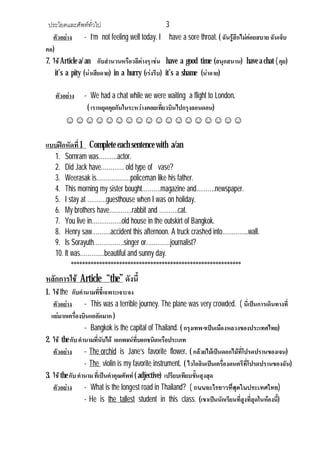
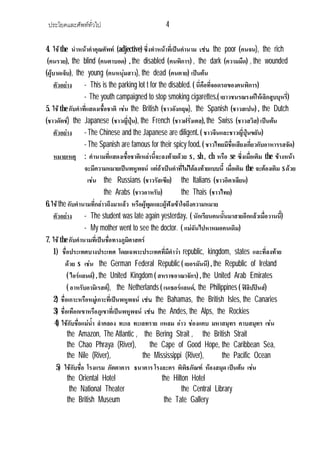


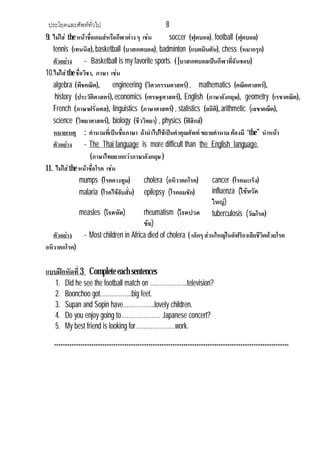


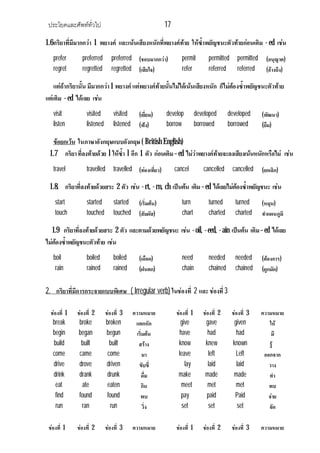


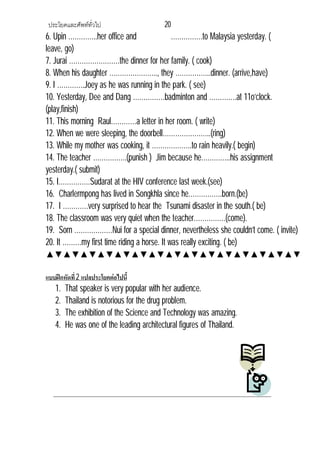


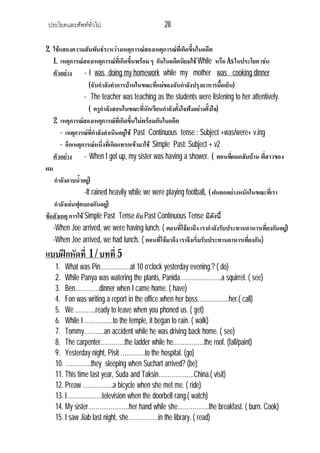
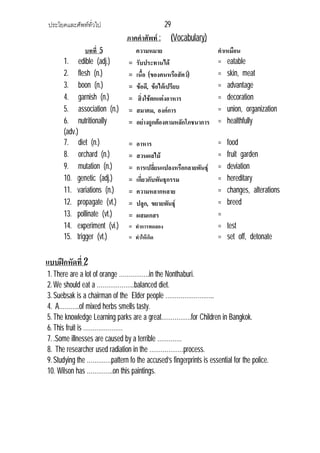

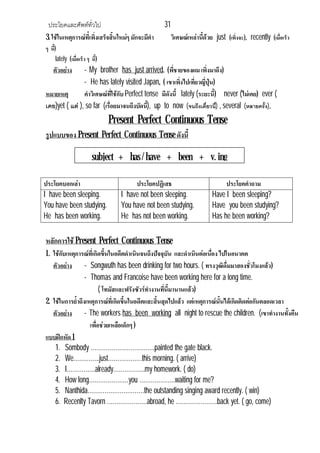
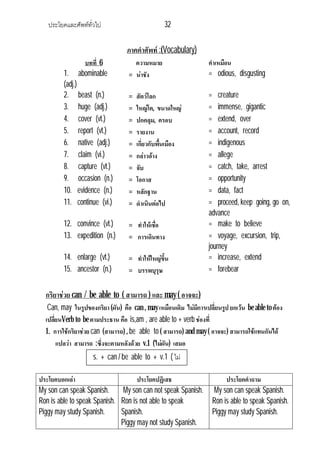

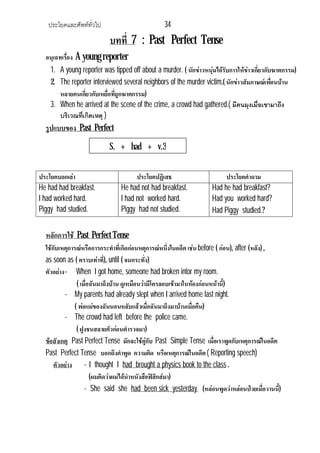


![ประโยคและศัพททั่วไป 49
การเรียงลําดับ adj.
เมื่อมี adj. หลาย ๆ คําขยาย n. ตองวางเรียงตามลําดับดังนี้
กํากับนาม + จํานวน + ลักษณะ + ขนาด + สี + เชื้อชาติ + n. ขยาย + n.
หลัก
adj. กํากับ n. มีดั้งนี้ - Articles ไดแก a , an , the
- adj. แสดงความเปนเจาของ ไดแก my , your , our , his , her , its ,
their
- adj. ชี้เฉพาะ ไดแก this , that , these , those
- adj. แสดงจํานวนชี้เฉพาะ เชน
- one (of the / these / those) - all (of the / these / those)
- most (of the / these / those) - both (of the / these / those)
- some (of the / these / those) - any (of the / these / those)
- none (of the / these / those) - either (of the / these / those)
- neither (of the / these / those) - several (of the / these / those)
adj. แสดงลักษณะหรือคุณภาพ เชน old , young , good , bad , beautiful , rich , poor etc.
adj. แสดงขนาด เชน big , large , huge , tall , small , short , little etc.
adj. แสดงสี เชน purple , blue , green , yellow , orange , red etc.
adj. แสดงเชื้อชาติ เชน Thai , American , English , Japanese , French etc.
n. ที่ทําหนาทีเ่ สมือน adj. ขยาย n. เชน boy friend , dream team , sound engineer , office
boy , diamond ring , shop assistant etc.
ตัวอยางการเรียงลําดับ adj.
- My mother bought a beautiful flower vase yesterday afternoon.
[ article + adj. แสดงลักษณะ + n. ขยาย + n. หลัก ]
(บายวานนี้แมของฉันชื้อแจกันดอกไมสวยมาใบหนึ่ง)
- She does not like your black leather jacket.
[ adj. แสดงความเปนเจาของ + adj. แสดงสี + n. ขยาย + n. หลัก ]
(เธอไมชอบเสื้อแจ็คเก็ตหนังสีดําของคุณ)
- The beautiful Chinese flower vase is broken.
[ article + adj. แสดงลักษณะ + adj. แสดงเชือชาติ + n. ขยาย + n. หลัก ]
้
(แจกันดอกไมจากประเทศจีนที่สวยแตก)
- That green American T – shirt in my drawer is for your sister.
[ adj. กํากับนาม (that) +adj. แสดงสี + adj. แสดงเชื้อชาติ + n. หลัก ]
(เสื้อยืดอเมริกนสีเขียวในลิ้นชักฉันตัวนันสําหรับนองสาวของคุณ)
ั ้](https://image.slidesharecdn.com/random-130217174255-phpapp01/85/AEC-Grammar-49-320.jpg)
![ประโยคและศัพททั่วไป 50
- I like her expensive red Persian carpet.
[ adj. แสดงความเปนเจาของ + adj. แสดงลักษณะ + adj. แสดงสี + adj. แสดงเชื้อชาติ +
n. หลัก ]
(ฉันชอบพรมเปอรเชียสีแดงราคาแพงของเธอ)
- We must do something for these three poor men.
[ adj. กํากับนาม (these) + adj. แสดงจํานวน + adj. แสดงลักษณะ + n. หลัก ]
(เราตองทําอะไรบางอยางใหกับผูชายทีนาสงสารสามคนนี)
่ ้
- Most of these twenty red apples are good.
[ adj. แสดงจํานวนชี้เฉพาะ (most of these) + adj. แสดงจํานวน + adj. แสดงสี + n. หลัก]
(สวนใหญของแอปเปลสีแดงยี่สบลูกเหลานีเ้ ปนแอปเปลทีด)
ิ ่ ี
บทที่ 9
1. imagine (vt. / vi.) = นึกคิด, นึกเอาเอง, คาดการณ = suppose, guess, think
2. choker (n,) = เครื่องประดับเพชรพลอยที่สวมติดคอ
3. galore (adv.) = จํานวนมาก, อุดมสมบูรณ = in abundance
4. don (vt.) = สวมเสื้อผาชนิดพิเศษ = put on
5. rare (adj.) = หายาก, ไมคอยมี, นอย = uncommon
6. tycoon (n.) = นักธุรกิจที่ร่ํารวยและมีอิทธิพล = magnate
7. remote (adj.) = ไกล, อยูหางออกไปจากชุมชน
= distant
8. parlay (vt.) = ลงทุนลงแรงเพือสิ่งที่ตองการ
่
9. piddle (vt. / vi. ) = ทําเลน ๆ ไมจริงจัง, เกียจคราน = dawdle
10. discount (n.) = การลดราคา, การลดสวน = deduction
11. rustic (adj.) = มีลักษณะเปนชนบท, เซอซา = old – fashioned as if
from a farm
12. opulent (adj.) = มั่งคั่ง, มากมาย, หรูหรา = sumptuous
13. romp (vi.) = วิ่งเลน, สนุกสนาน, ครื้นเครง = lively play
14. spy (vt.) = มองเห็น, สืบ, สอดแนม = spot
15. letdown (n.) = ผิดหวัง, ไมสบอารมณ = disappointment](https://image.slidesharecdn.com/random-130217174255-phpapp01/85/AEC-Grammar-50-320.jpg)
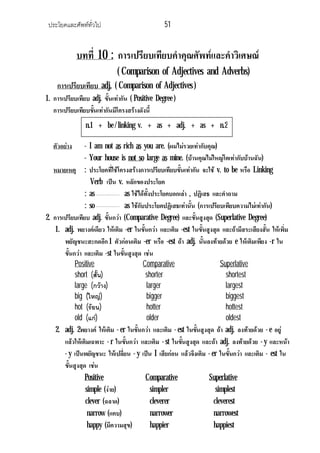


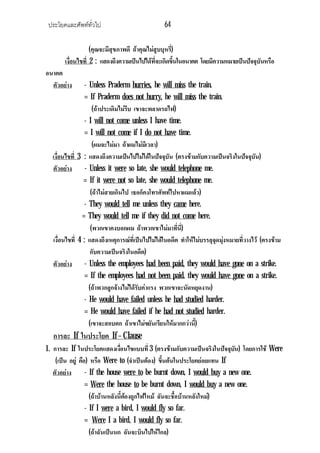

![ประโยคและศัพททั่วไป 66
บทที่ 12 : Subjunctive Clauses
ประโยค Subjunctive ใชเพื่อสือความหมายที่ไมเปนความจริง การคาดคะเน การตั้ง
่
ความปรารถนา ความไมมั่นใจหรือสงสัย
โครงสรางของประโยค Subjunctive โดยสวนใหญจะประกอบดวย ประโยคหลัก (Main
Clause) และ ประโยคยอย (Subordinate Clause) ซึ่ง v. ในประโยคยอย (Subordinate Clause) มี
ความสําคัญสําหรับประโยคทีใชโครงสรางลักษณะนี้
่
ประโยคที่ใชโครงสราง Subjunctive มีดังนี้
1. ประโยคเงือนไข (If – Clause) ที่เปนการสมมุตเิ หตุการณที่เปนไปไมไดหรือไมไดเปนจริง
่
- ประโยคแสดงเงื่อนไขที่เปนไปไมไดในปจจุบัน (ตรงขามกับความเปนจริงในปจจุบน) โดยมี
ั
ความหมายเปนปจจุบนหรืออนาคต
ั
[v. ในประโยคยอยใช Past Simple (v.2 / were) ประโยคหลักใช would, could, might,
should + v.1 (ไมผัน)]
ตัวอยาง - If I were a thief, I would break into that big beautiful house.
(ถาผมเปนขโมย ผมจะไปในบานสวยหลังใหญหลังนัน) ้
- If I had time now, I would help you. (ถาตอนนันฉันมีเวลา ฉันจะชวยเหลือคุณ)
้
- ประโยคแสดงเงื่อนไขที่เปนไปไมไดในอดีต ทําใหไมบรรลุจุดมุงหมายที่วางไว (ตรงขามกับ
ความเปนจริงในอดีต)
[v. ในประโยคยอยใช Past Perfect (had + v.3) ประโยคหลักใช would, could, might,
should + have + v.3]
ตัวอยาง - If I had known her address, I could have visited her.
(ถาผมทราบทีอยูของเธอ ผมคงจะสามารถไปเยี่ยมเธอได)
่
- If she had gone there yesterday, she would have seen you.
(ถาเธอไดไปที่นั่นเมื่อวานนี้ เธอคงจะไดพบคุณแลว)
1. ประโยคที่ใช as if หรือ as though (ราวกับวา) แสดงการเปรียบเทียบที่ไมเปนจริง
- ประโยคแสดงการเปรียบเทียบทีไมเปนจริงในปจจุบน
่ ั
[v. ในประโยคยอยใช Past Simple (v.2 / were) หรือ past Continuous (were + v.ing)]
ตัวอยาง - She acts as though she knew him well. (เธอทําราวกับวาเธอรูจักเขาดี)
- She laughs as if she were watching cartoons. (เธอหัวเราะราวกับวาเห็นตัวตัว
การตูน)
- ประโยคแสดงการเปรียบเทียบทีไมเปนจริงในอดีต
่
[v. ในประโยคยอยใช Past Perfect (had + v.3) หรือ Past Simple (v.2 / were)]](https://image.slidesharecdn.com/random-130217174255-phpapp01/85/AEC-Grammar-66-320.jpg)
![ประโยคและศัพททั่วไป 67
ตัวอยาง - He talked as if it had rained very hard yesterday.
(เขาพุดราวกับวาเมือวานนีฝนตกหนัก)
่ ้
- She talked to me as tough she had known me for years.
(เธอพูดกับผมราวกับวาเธอรูจกผมมาหลายปแลว)
ั
สรุปโครงสราง v. ในประโยคทีใช as it / as though :
่
ประโยคหลัก ประโยคยอย
ไมเปนจริงในปจจุบัน s. + v.1 (ผันตาม as if / s. + v.2 (were) / were + v. ing
s.)
ไมเปนจริงในอดีต s. + v.2 (were) as though s. + v.2 / had + v.3
Past Continuous และ Past Simple ที่เปน v. to be ใหใช “were” กับประธานทุกตัว
3. ประโยคที่ใช wish (ปรารถนา) แสดงความปรารถนาที่เปนไปไมได
- ประโยคที่แสดงความปรารถนาในปจจุบัน และอยากใหเกิดขึนในปจจุบันแตไมเปนจริง
้
[v. ในประโยคยอยใช Past Simple (v,2 /were)]
ตัวอยาง - I wish I were a policeman now. (ผมอยากจะใหผมเปนตํารวจเวลานี) ้
- He wishes he had a bigger house. (เขาปรารถนาจะมีบานที่ใหญกวาเดิมสักหลัง)
- ประโยคที่แสดงความปรารถนาในปจจุบัน แตอยากใหเหตุการณเปนจริงในอดีต เปนการแสดง
ความไมสมหวังตอเหตุการณในอดีต
[v. ในประโยคยอยใช Past Perfect (had + v.3)]
ตัวอยาง - He wishes his father had been here yesterday.
(เขาอยากจะใหัพอของเขาไดมาอยูทนี่เมือวานนี)
ี่ ่ ้
- She wishes she had not come to the party last night.
(เธออยากจะใหเธอไมไดมาในงานเลี้ยงเมื่อคืนนี)
้
- ประโยคที่แสดงความปรารถนาในอดีตที่อยากใหเหตุการณนั้นเกิดขึนในอดีต แตไมไดเกิดขึ้น
้
[v. ในประโยคยอยใช Perfect in the past (could / would / should / might + have + v.3)]
ตัวอยาง - I wished you would have called yesterday. (ผมหวังวาคุณจะโทรศัพทมาเมื่อวาน
นี้)
- They wished they could have arrived there in time.
(พวกเขาอยากไปถึงที่นนใหทันเวลา)
ั่
- ประโยคที่แสดงความปรารถนาในปจจุบัน และอยากใหเหตุการณเกิดขึ้นในอนาคต แตเปนไปไมได
[v. ในประโยคยอยใช Future in the past (could / would / should / might + v.1 (ไมผัน))]
ตัวอยาง - I wish I would be there tomorrow. (ฉันปรารถนาจะอยูที่นั่นในวันพรุงนี) ้
- She wished he could come next week. (เธอหวังวาเขาจะมาไดสปดาหหนา)
ั](https://image.slidesharecdn.com/random-130217174255-phpapp01/85/AEC-Grammar-67-320.jpg)