แผนการจัดการเรี ยนรู้ เพือพัฒนาทักษะการเขียนภาษาอังกฤษ
่
กลุ่มสาระการเรียนรู้ ภาษาต่ างประเทศ
วิชาภาษาอังกฤษ ชั้นมัธยมศึกษาปี ที่ 1

Unit: General information
Topic: Food

สมาชิ กในกลุ่ม มีดังนี้
1. นางสาวอุบลพรรณ สอนสกุล
53010513047
2. นางสาวจิราพร พรมสอน
53010513049
3. นางสาวภัททิรา กองแก้ว
53010513052
4. นางสาวศุนิษา ดอนเตาเหล็ก
53010513043

ส่ งครั้งที่ ….. วันที่ ……เดือนสิ งหาคม พ.ศ. 2556
แผนการจัดการเรี ยนรู้ เพือพัฒนาทักษะการเขียนภาษาอังกฤษ
่
กลุ่มสาระการเรียนรู้ ภาษาต่ างประเทศ
วิชาภาษาอังกฤษ ชั้นมัธยมศึกษาปี ที่ 1
Unit: General information
Topic: Food
วันทีสอน วันที่ .........เดือน............................ พ.ศ. .................
่
1. จุดประสงค์ การเรี ยนรู้
1.
เขียนประโยคที่สอดคล้องกับรู ปภาพที่กาหนดให้อย่างรวดเร็ วจากการใช้กระบวนกาคิดแบบคิดคล่อ
ง (While writing 1: Activity 1: make the sentences)
2.เขียนให้ขอมูลเกี่ยวกับรู ปภาพอาหารโดยใช้กระบวนการคิดคล่อง (While writing 2: Activity 2:
้
picture and writing)
3.เขียนให้ขอมูลเกี่ยวกับอาหารอย่างรวดเร็ วโดยใช้กระบวนการคิดริ เริ่ ม (Post writing 1: Activity 3:
้
What kind of cake?)
4. เขียนให้ขอมูลเกี่ยวกับเมนูอาหารที่ตนเองสร้างขึ้นมาใหม่อย่างสร้างสรรค์ (Post writing 2:
้
Activity 4: creative popular Thai food)
2. ตัวชี้วด
ั
ต 1.1.1.4/ม.1 รุ บุหวข้อเรื่ อง(topic) ใจความสาคัญ(main idea)
ั
และตอบคาถามจากการฟังและอ่านบทสนทนา นิทาน และเรื่ องสั้น(Act 1,3)
ต1.1.1.2.4/ม.1 พูดและเขียนเพื่อขอและให้ขอมูล
้
และแสดงความคิดเห็นเกี่ยวกับเรื่ องที่ฟังหรื ออ่านอย่างเหมาะสม (Act 2,3,4)
ต 1.1.2.5/ม.1
พูดและเขียนแสดงความรู ้สึกและความคิดเห็นของตนเองเกี่ยวกับเรื่ องราวต่างๆใกล้ตว
ั
กิจกรรมต่างๆพร้อมทั้งให้เหตุผลสั้นๆประกอบอย่างเหมาะสม (Act 3,4)
ต 1.1.3.3/ม.1
พูด/เขียนความคิดเห็นเกี่ยวกับกิจกรรมหรื อเรื่ องต่างๆใกล้ตวพร้อมทั้งให้เหตุผลสั้นๆประกอบ (Act
ั
3,4)
3. เนือหา
้
Vocabulary: shortening, encased, meringue, physicist, revolution, descendant, recipe, grain
StructureStructure: Present Simple Tense
Positive
Subject + Verb1 (s, es)+ Objects
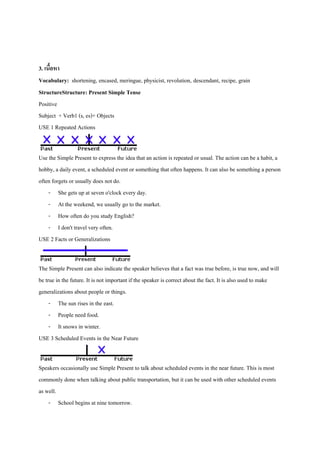
USE 1 Repeated Actions
Use the Simple Present to express the idea that an action is repeated or usual. The action can be a habit, a
hobby, a daily event, a scheduled event or something that often happens. It can also be something a person
often forgets or usually does not do.
- She gets up at seven o'clock every day.
- At the weekend, we usually go to the market.
- How often do you study English?
- I don't travel very often.
USE 2 Facts or Generalizations
The Simple Present can also indicate the speaker believes that a fact was true before, is true now, and will
be true in the future. It is not important if the speaker is correct about the fact. It is also used to make
generalizations about people or things.
- The sun rises in the east.
- People need food.
- It snows in winter.
USE 3 Scheduled Events in the Near Future
Speakers occasionally use Simple Present to talk about scheduled events in the near future. This is most
commonly done when talking about public transportation, but it can be used with other scheduled events
as well.
- School begins at nine tomorrow.
-

Our train leaves at eleven.
What time does the film start?
The plane doesn't arrive at seven, it arrives at seven thirty.
When does the class finish?
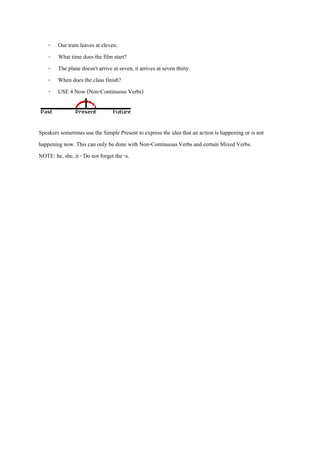
USE 4 Now (Non-Continuous Verbs)

Speakers sometimes use the Simple Present to express the idea that an action is happening or is not
happening now. This can only be done with Non-Continuous Verbs and certain Mixed Verbs.
NOTE: he, she, it - Do not forget the -s.
4. สื่ อการเรี ยนรู้
1. Power Point คาศัพท์ โครงสร้าง และกิจกรรม
2. วีดีโอ เกี่ยวกับอาหาร
3.ใบงานเรื่ อง Types of Cakes
4.ใบงาน Activity 1
5.ใบงาน Activity2
6. ใบงานActivity 3
7. ใบงาน Activity 4
8. กรดาษบรุ ้ฟ
9. กระดาษรี ยส
ู
10. สี สาหรับระบาย
11.สติ้กเกอร์ รูปดาว
5. กิจกรรมการเรี ยนรู้
ครู
แผนการสอน

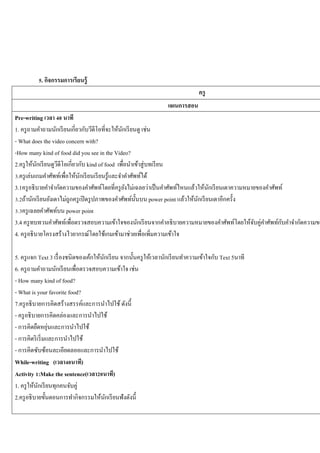
Pre-writing เวลา 40 นาที
1. ครู ถามคาถามนักเรี ยนเกี่ยวกับวีดีโอที่จะให้นกเรี ยนดู เช่น
ั
- What does the video concern with?
-How many kind of food did you see in the Video?
2.ครู ให้นกเรี ยนดูวดีโอเกี่ยวกับ kind of food เพื่อนาเข้าสู่ บทเรี ยน
ั
ี
3.ครู เล่นเกมคาศัพท์เพื่อให้นกเรี ยนเรี ยนรู ้และจาคาศัพท์ได้
ั
3.1ครู อธิ บายคาจากัดความของคาศัพท์โดยที่ครู ยงไม่เฉลยว่าเป็ นคาศัพท์ไหนแล้วให้นกเรี ยนเดาความหมายของคาศัพท์
ั
ั
3.2ถ้านักเรี ยนยังเดาไม่ถูกครู เปิ ดรู ปภาพของคาศัพท์น้ นบน power point แล้วให้นกเรี ยนเดาอีกครั้ง
ั
ั
3.3ครู เฉลยคาศัพท์บน power point
ั
3.4 ครู ทบทวนคาศัพท์เพื่อตรวจสอบความเข้าใจของนักเรี ยนจากคาอธิบายความหมายของคาศัพท์โดยให้จบคู่คาศัพท์กบคาจากัดความขอ
ั
4. ครู อธิบายโครงสร้างไวยากรณ์โดยใช้เกมเข้ามาช่วยเพื่อเพิ่มความเข้าใจ
5. ครู แจก Text 3 เรื่ องชนิ ดของเค้กให้นกเรี ยน จากนั้นครู ให้เวลานักเรี ยนทาความเข้าใจกับ Text 5นาที
ั
6. ครู ถามคาถามนักเรี ยนเพื่อตรวจสอบความเข้าใจ เช่น
- How many kind of food?
- What is your favorite food?
7.ครู อธิบายการคิดสร้างสรรค์และการนาไปใช้ ดังนี้
- ครู อธิ บายการคิดคล่องและการนาไปใช้
่
- การคิดยืดหยุนและการนาไปใช้
- การคิดริ เริ่ มและการนาไปใช้
- การคิดซับซ้อนละเอียดลออและการนาไปใช้
While-writing (เวลา40นาที)
Activity 1:Make the sentence(เวลา20นาที)
1. ครู ให้นกเรี ยนทุกคนจับคู่
ั
2.ครู อธิ บายขั้นตอนการทากิจกรรมให้นกเรี ยนฟังดังนี้
ั
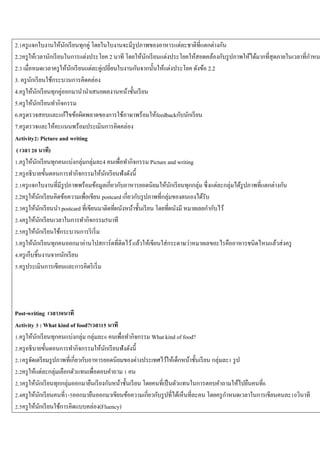
2.1ครู แจกใบงานให้นกเรี ยนทุกคู่ โดยในใบงานจะมีรูปภาพของอาหารแต่ละชาติที่แตกต่างกัน
ั
2.2ครู ให้เวลานักเรี ยนในการแต่งประโยค 2 นาที โดยให้นกเรี ยนแต่งประโยคให้สอดคล้องกับรู ปภาพให้ได้มากที่สุดภายในเวลาที่กาหน
ั
2.3 เมื่อหมดเวลาครู ให้นกเรี ยนแต่ละคู่เปลี่ยนใบงานกันจากนั้นให้แต่งประโยค ดังข้อ 2.2
ั
3. ครู นกเรี ยนใช้กระบวนการคิดคล่อง
ั
4.ครู ให้นกเรี ยนทุกคู่ออกมานานาเสนอผลงานหน้าชั้นเรี ยน
ั
5.ครู ให้นกเรี ยนทากิจกรรม
ั
6.ครู ตรวจสอบและแก้ไขข้อผิดพลาดของการใช้ภาษาพร้อมให้feedbackกับนักเรี ยน
7.ครู ตรวจและให้คะแนนพร้อมประเมินการคิดคล่อง
Activity2: Picture and writing
( เวลา 20 นาที)
1.ครู ให้นกเรี ยนทุกคนแบ่งกลุ่มกลุ่มละ4 คนเพื่อทากิจกรรม Picture and writing
ั
2.ครู อธิ บายขั้นตอนการทากิจกรรมให้นกเรี ยนฟังดังนี้
ั
2.1ครู แจกใบงานที่มีรูปภาพพร้อมข้อมูลเกี่ยวกับอาหารยอดนิยมให้นกเรี ยนทุกกลุ่ม ซึ่ งแต่ละกลุ่มได้รูปภาพที่แตกต่างกัน
ั
2.2ครู ให้นกเรี ยนคิดข้อความเพื่อเขียน postcard เกี่ยวกับรู ปภาพที่กลุ่มของตนเองได้รับ
ั
2.3ครู ให้นกเรี ยนนา postcard ที่เขียนมาติดที่ผนังหน้าชั้นเรี ยน โดยที่ผนังมี หมายเลยกากับไว้
ั
2.4ครู ให้นกเรี ยนเวลาในการทากิจกรรม5นาที
ั
2.5ครู ให้นกเรี ยนใช้กระบวนการริ เริ่ ม
ั
3.ครู ให้นกเรี ยนทุกคนออกมาอ่านโปสการ์ ดที่ติดไว้ แล้วให้เขียนใส่ กระดาษว่าหมายเลขอะไรคืออาหารชนิดไหนแล้วส่ งครู
ั
4.ครู เก็บชิ้นงานจากนักเรี ยน
5.ครู ประเมินการเขียนและการคิดริ เริ่ ม

Post-writing เวลา30นาที
Activity 3 : What kind of food?เวลา15 นาที
1.ครู ให้นกเรี ยนทุกคนแบ่งกลุ่ม กลุ่มละ6 คนเพื่อทากิจกรรม What kind of food?
ั
2.ครู อธิ บายขั้นตอนการทากิจกรรมให้นกเรี ยนฟังดังนี้
ั
2.1ครู จดเตรี ยมรู ปภาพที่เกี่ยวกับอาหารยอดนิยมของต่างประเทศไว้ให้เด็กหน้าชั้นเรี ยน กลุ่มละ1 รู ป
ั
2.2ครู ให้แต่ละกลุ่มเลือกตัวแทนเพื่อตอบคาถาม 1 คน
2.3ครู ให้นกเรี ยนทุกกลุ่มออกมายืนเรี ยงกันหน้าชั้นเรี ยน โดยคนที่เป็ นตัวแทนในการตอบคาถามให้ไปยืนคนที่6
ั
2.4ครู ให้นกเรี ยนคนที่1-5ออกมายืนออกมาเขียนข้อความเกี่ยวกับรู ปที่ได้เห็นที่ละคน โดยครู กาหนดเวลาในการเขียนคนละ10วินาที
ั
2.5ครู ให้นกเรี ยนใช้การคิดแบบคล่อง(Fluency)
ั
2.6ครู เก็บรู ปภาพคืน
2.7ครู ให้นกเรี ยนคนที่5ออกมาเขียนตอบคาถามว่าอาหารชนิดนี้ชื่ออะไร จากนั้นนากระดาษคาตอบส่ งครู
ั
4.ครู ให้นกเรี ยนทากิจกรรม What kind of cake?
ั
5.ครู เฉลยคาตอบพร้อมตรวจสอบและแก้ไขความถูกต้องของภาษาพร้อมอธิ บายให้นกเรี ยนในห้องฟัง
ั
6.ครู ให้คะแนน1คะแนน กับกลุ่มที่ตอบถูกต้อง
7.ครู ให้นกเรี ยนทากิจกรรมแบบนี้ไปเรื่ อยๆจนครบทุกคน
ั
8.ครู ประเมินทักษะการเขียนและการคิดแบบคล่อง
Post-writing (เวลา15 นาที)
Activity 4 :creative popular Thai food เวลา 25 นาที
1.ครู ให้นกเรี ยนทุกคนแบ่งกลุ่ม กลุ่มละ 3 คน
ั
2.ครู อธิ บายขั้นตอนการทากิจกรรม creative popular Thai food ให้นกเรี ยนทุกคนฟัง ดังนี้
ั
2.1ครู แจกกระดาษบรู๊ ฟให้นกเรี ยนแต่ละกลุ่ม
ั
2.2ครู เปิ ดตัวอย่างทากิจกรรมพร้อมอธิ บายให้นกเรี ยนฟังดังนี้
ั
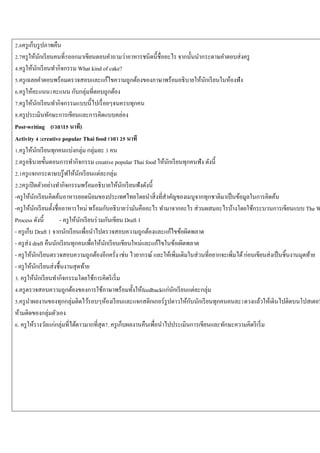
-ครู ให้นกเรี ยนคิดค้นอาหารยอดนิยมของประเทศไทยโดยนาสิ่ งที่สาคัญของเมนูจากทุกชาติมาเป็ นข้อมูลในการคิดค้น
ั
-ครู ให้นกเรี ยนตั้งชื่ออาหารใหม่ พร้อมกับอธิ บายว่ามันคืออะไร ทามาจากอะไร ส่ วนผสมอะไรบ้างโดยใช้กระบวนการเขียนแบบ The W
ั
Process ดังนี้
- ครู ให้นกเรี ยนร่ วมกันเขียน Draft 1
ั
- ครู เก็บ Draft 1 จากนักเรี ยนเพื่อนาไปตรวจสอบความถูกต้องและแก้ไขข้อผิดพลาด
- ครู ส่ง draft คืนนักเรี ยนทุกคนเพื่อให้นกเรี ยนเขียนใหม่และแก้ไขในข้อเผิดพลาด
ั
- ครู ให้นกเรี ยนตรวจสอบความถูกต้องอีกครั่ง เช่น ไวยากรณ์ และให้เพิ่มเติมในส่ วนที่อยากจะเพิ่มได้ ก่อนเขียนส่ งเป็ นชิ้นงานมุดท้าย
ั
- ครู ให้นกเรี ยนส่ งชื้นงานสุ ดท้าย
ั
3. ครู ให้นกเรี ยนทากิจกรรมโดยใช้การคิดริ เริ่ ม
ั
4.ครู ตรวจสอบความถูกต้องของการใช้ภาษาพร้อมทั้งให้feedbackแก่นกเรี ยนแต่ละกลุ่ม
ั
ั
5.ครู นาผลงานของทุกกลุ่มติดไว้รอบๆห้องเรี ยนและแจกสติกเกอร์ รูปดาวให้กบนักเรี ยนทุกคนคนละ1ดวงแล้วให้เดินไปติดบนโปสเตอร
ห้ามติดของกลุ่มตัวเอง
6. ครู ให้รางวัลแก่กลุ่มที่ได้ดาวมากที่สุด7. ครู เก็บผลงานคืนเพื่อนาไปประเมินการเขียนและทักษะความคิดริ เริ่ ม
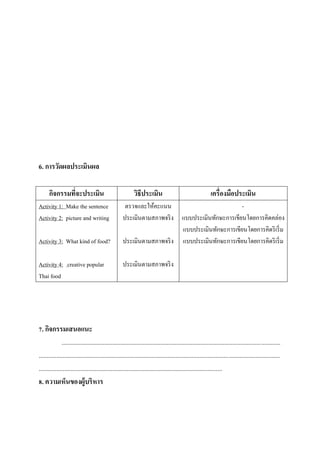
6. การวัดผลประเมินผล
กิจกรรมทีจะประเมิน
่
Activity 1: Make the sentence
Activity 2: picture and writing
Activity 3: What kind of food?
Activity 4: creative popular
Thai food

วิธีประเมิน

เครื่องมือประเมิน

ตรวจและให้คะแนน
ประเมินตามสภาพจริ ง แบบประเมินทักษะการเขียนโดยการคิดคล่อง
แบบประเมินทักษะการเขียนโดยการคิดริ เริ่ ม
ประเมินตามสภาพจริ ง แบบประเมินทักษะการเขียนโดยการคิดริ เริ่ ม
ประเมินตามสภาพจริ ง

7. กิจกรรมเสนอแนะ
.........................................................................................................................................
.......................................................................................................................................................
...................................................................................................................
8. ความเห็นของผู้บริหาร
.........................................................................................................................................
.......................................................................................................................................................
...................................................................................................................
9. บันทึกหลังการจัดกิจกรรมการเรียนรู้
9.1 ผลการจัดกิจกรรมการเรียนรู้
.............................................................................................................................
.......................................................................................................................................................
..............................................................................................................................

9.2 ปัญหาและอุปสรรค
...........................................................................................................................................
.......................................................................................................................................................
...................................................................................................................
9.3 ข้ อเสนอแนะ
...........................................................................................................................................
.......................................................................................................................................................
.................................................................................................................
Vocabulary
Pictures

Meaning
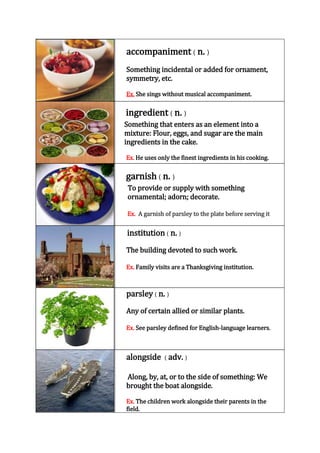
accompaniment ( n. )
Something incidental or added for ornament,
symmetry, etc.
Ex. She sings without musical accompaniment.

ingredient ( n. )
Something that enters as an element into a
mixture: Flour, eggs, and sugar are the main
ingredients in the cake.
Ex. He uses only the finest ingredients in his cooking.

garnish ( n. )
To provide or supply with something
ornamental; adorn; decorate.
Ex. A garnish of parsley to the plate before serving it

institution ( n. )
The building devoted to such work.
Ex. Family visits are a Thanksgiving institution.

parsley ( n. )
Any of certain allied or similar plants.
Ex. See parsley defined for English-language learners.

alongside ( adv. )
Along, by, at, or to the side of something: We
brought the boat alongside.
Ex. The children work alongside their parents in the
field.
Pictures

Meaning
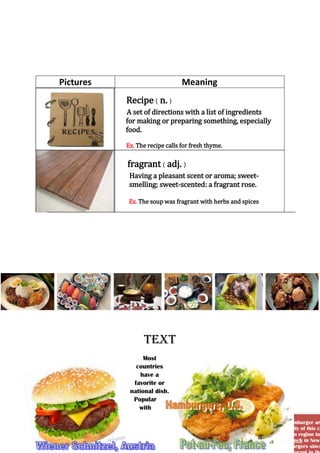
Recipe ( n. )
A set of directions with a list of ingredients
for making or preparing something, especially
food.
Ex. The recipe calls for fresh thyme.

fragrant ( adj. )
Having a pleasant scent or aroma; sweetsmelling; sweet-scented: a fragrant rose.
Ex. The soup was fragrant with herbs and spices

Text
Most
countries
have a
favorite or
national dish.
Popular
with

Although the origins of the hamburger ar
no argument over the popularity of this cl
and accompaniments vary from region to
original version visit Louis’ Lunch in New
which has been serving hamburgers since
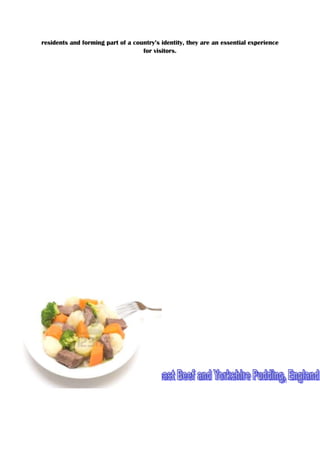
residents and forming part of a country’s identity, they are an essential experience
for visitors.
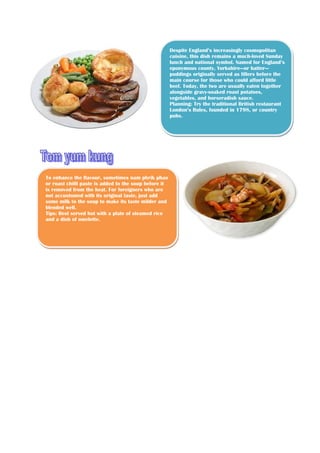
Despite England’s increasingly cosmopolitan
cuisine, this dish remains a much-loved Sunday
lunch and national symbol. Named for England’s
eponymous county, Yorkshire—or batter—
puddings originally served as fillers before the
main course for those who could afford little
beef. Today, the two are usually eaten together
alongside gravy-soaked roast potatoes,
vegetables, and horseradish sauce.
Planning: Try the traditional British restaurant
London’s Rules, founded in 1798, or country
pubs.

To enhance the flavour, sometimes nam phrik phao
or roast chilli paste is added to the soup before it
is removed from the heat. For foreigners who are
not accustomed with its original taste, just add
some milk to the soup to make its taste milder and
blended well.
Tips: Best served hot with a plate of steamed rice
and a dish of omelette.
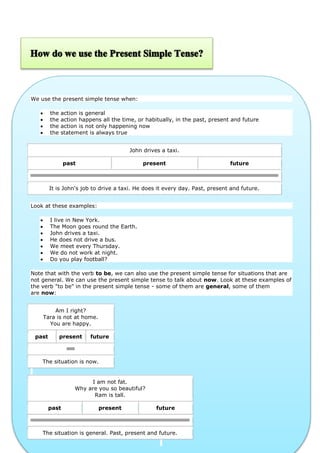
We use the present simple tense when:





the
the
the
the

action is general
action happens all the time, or habitually, in the past, present and future
action is not only happening now
statement is always true
John drives a taxi.
past

present

future

It is John's job to drive a taxi. He does it every day. Past, present and future.
Look at these examples:








I live in New York.
The Moon goes round the Earth.
John drives a taxi.
He does not drive a bus.
We meet every Thursday.
We do not work at night.
Do you play football?

Note that with the verb to be, we can also use the present simple tense for situations that are
not general. We can use the present simple tense to talk about now. Look at these examples of
the verb "to be" in the present simple tense - some of them are general, some of them
are now:
Am I right?
Tara is not at home.
You are happy.
past

present

future

The situation is now.

I am not fat.
Why are you so beautiful?
Ram is tall.
past

present

future

The situation is general. Past, present and future.
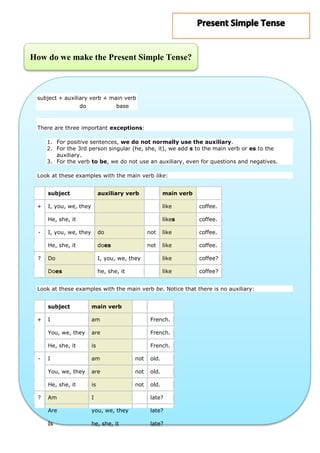
How do we make the Present Simple Tense?

subject + auxiliary verb + main verb
do

base

There are three important exceptions:
1. For positive sentences, we do not normally use the auxiliary.
2. For the 3rd person singular (he, she, it), we add s to the main verb or es to the
auxiliary.
3. For the verb to be, we do not use an auxiliary, even for questions and negatives.
Look at these examples with the main verb like:
subject
+

auxiliary verb

main verb
like

coffee.

He, she, it
-

I, you, we, they

likes

coffee.

do

not

like

coffee.

He, she, it

does

not

like

coffee.

Do

I, you, we, they

like

coffee?

Does

?

I, you, we, they

he, she, it

like

coffee?

Look at these examples with the main verb be. Notice that there is no auxiliary:
subject

French.

are

French.

is

French.

I

am

not

old.

You, we, they

are

not

old.

He, she, it
?

am

He, she, it
-

I
You, we, they

+

main verb

is

not

old.

Am

I

late?

Are

you, we, they

late?

Is

he, she, it

late?
Task1
Making sentences
- Choose a paper that teacher sticks around the class.
- Write the sentences about the picture. Using Present Simple Tense with
provided vocabularies from teacher.
- Come to present in front of class.
For example:

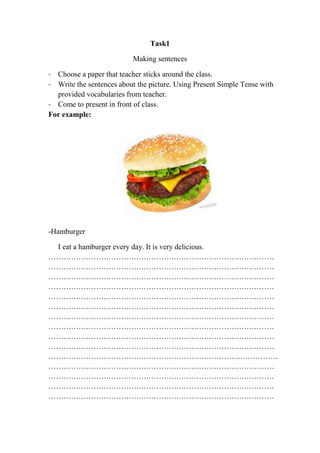
-Hamburger
I eat a hamburger every day. It is very delicious.
………………………………………………………………………………
………………………………………………………………………………
………………………………………………………………………………
………………………………………………………………………………
………………………………………………………………………………
………………………………………………………………………………
………………………………………………………………………………
………………………………………………………………………………
………………………………………………………………………………
………………………………………………………………………………
…………………………………………………………………..……………
………………………………………………………………………………
………………………………………………………………………………
………………………………………………………………………………
………………………………………………………………………………
Task3
Go for your cake!
- Make a group of five to six people.
- Choose one representative from your team to be a respondent.
- Then make a line in front of the class. The representative stands at the
back.
- First person from each line comes in front of the picture of cake and
writes information about it to hint for the representative. You have ten
seconds to write.
- Next person does the same until the fifth person.
- Teacher will keep the picture back and the representative have to write
the answer.
- If you are correct, you will get one point per one picture.
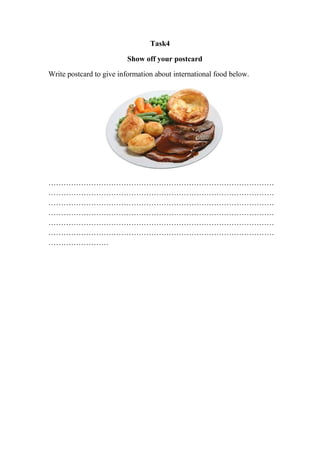
Task4
Show off your postcard
Write postcard to give information about international food below.

………………………………………………………………………………
………………………………………………………………………………
………………………………………………………………………………
………………………………………………………………………………
………………………………………………………………………………
………………………………………………………………………………
……………………
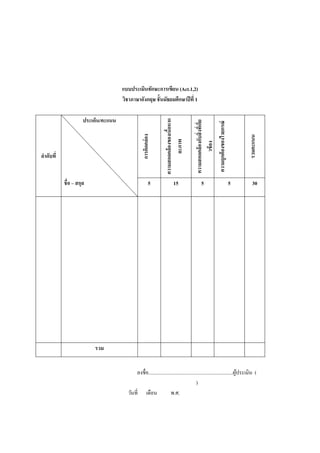
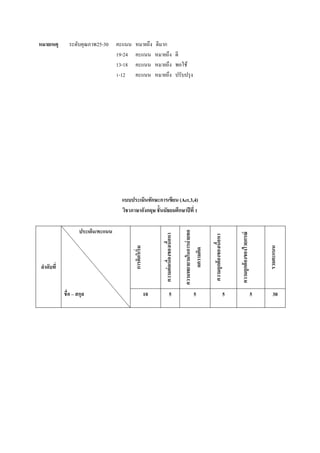
ชื่อ – สกุล

5

5

รวมคะแนน

15

ความถูกต้ องของไวยกรณ์

ลาดับที่

ความสอดคล้ องกับสิ่งทีเ่ กีย
่
วข้ อง

การคิดคล่ อง

ประเด็น/คะแนน

ความสอดคล้ องของเนือหาแ
้
ละภาพ

แบบประเมินทักษะการเขียน (Act.1,2)
วิชาภาษาอังกฤษ ชั้นมัธยมศึกษาปี ที่ 1

5

30

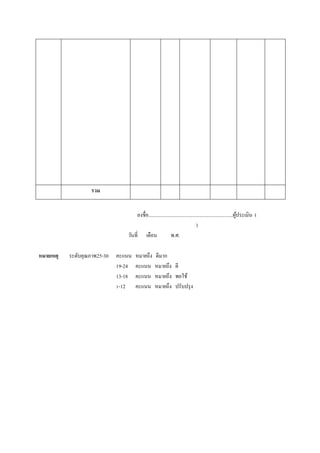
รวม
ลงชื่อ....................................................................ผูประเมิน (
้
)
วันที่ เดือน
พ.ศ.
หมายเหตุ

ระดับคุณภาพ25-30

คะแนน
19-24
13-18
1-12

หมายถึง
คะแนน
คะแนน
คะแนน

ดีมาก
หมายถึง ดี
หมายถึง พอใช้
หมายถึง ปรับปรุ ง

ชื่อ – สกุล

10

5

5

รวมคะแนน

5

ความถูกต้ องของไวยกรณ์

ลาดับที่

ความถูกต้ องของเนือหา
้

การคิดริเริ่ม

ความต่ อเนื่องของเนือหา
้

ประเด็น/คะแนน

ความพยายามในการถ่ ายทอ
ดความคิด

แบบประเมินทักษะการเขียน (Act.3,4)
วิชาภาษาอังกฤษ ชั้นมัธยมศึกษาปี ที่ 1

5

30
รวม
ลงชื่อ....................................................................ผูประเมิน (
้
)
วันที่ เดือน
พ.ศ.
หมายเหตุ

ระดับคุณภาพ25-30

คะแนน
19-24
13-18
1-12

หมายถึง
คะแนน
คะแนน
คะแนน

ดีมาก
หมายถึง ดี
หมายถึง พอใช้
หมายถึง ปรับปรุ ง

แผนการเขียน

  • 1.
    แผนการจัดการเรี ยนรู้ เพือพัฒนาทักษะการเขียนภาษาอังกฤษ ่ กลุ่มสาระการเรียนรู้ภาษาต่ างประเทศ วิชาภาษาอังกฤษ ชั้นมัธยมศึกษาปี ที่ 1 Unit: General information Topic: Food สมาชิ กในกลุ่ม มีดังนี้ 1. นางสาวอุบลพรรณ สอนสกุล 53010513047 2. นางสาวจิราพร พรมสอน 53010513049 3. นางสาวภัททิรา กองแก้ว 53010513052 4. นางสาวศุนิษา ดอนเตาเหล็ก 53010513043 ส่ งครั้งที่ ….. วันที่ ……เดือนสิ งหาคม พ.ศ. 2556
  • 2.
    แผนการจัดการเรี ยนรู้ เพือพัฒนาทักษะการเขียนภาษาอังกฤษ ่ กลุ่มสาระการเรียนรู้ภาษาต่ างประเทศ วิชาภาษาอังกฤษ ชั้นมัธยมศึกษาปี ที่ 1 Unit: General information Topic: Food วันทีสอน วันที่ .........เดือน............................ พ.ศ. ................. ่ 1. จุดประสงค์ การเรี ยนรู้ 1. เขียนประโยคที่สอดคล้องกับรู ปภาพที่กาหนดให้อย่างรวดเร็ วจากการใช้กระบวนกาคิดแบบคิดคล่อ ง (While writing 1: Activity 1: make the sentences) 2.เขียนให้ขอมูลเกี่ยวกับรู ปภาพอาหารโดยใช้กระบวนการคิดคล่อง (While writing 2: Activity 2: ้ picture and writing) 3.เขียนให้ขอมูลเกี่ยวกับอาหารอย่างรวดเร็ วโดยใช้กระบวนการคิดริ เริ่ ม (Post writing 1: Activity 3: ้ What kind of cake?) 4. เขียนให้ขอมูลเกี่ยวกับเมนูอาหารที่ตนเองสร้างขึ้นมาใหม่อย่างสร้างสรรค์ (Post writing 2: ้ Activity 4: creative popular Thai food) 2. ตัวชี้วด ั ต 1.1.1.4/ม.1 รุ บุหวข้อเรื่ อง(topic) ใจความสาคัญ(main idea) ั และตอบคาถามจากการฟังและอ่านบทสนทนา นิทาน และเรื่ องสั้น(Act 1,3) ต1.1.1.2.4/ม.1 พูดและเขียนเพื่อขอและให้ขอมูล ้ และแสดงความคิดเห็นเกี่ยวกับเรื่ องที่ฟังหรื ออ่านอย่างเหมาะสม (Act 2,3,4) ต 1.1.2.5/ม.1 พูดและเขียนแสดงความรู ้สึกและความคิดเห็นของตนเองเกี่ยวกับเรื่ องราวต่างๆใกล้ตว ั กิจกรรมต่างๆพร้อมทั้งให้เหตุผลสั้นๆประกอบอย่างเหมาะสม (Act 3,4) ต 1.1.3.3/ม.1 พูด/เขียนความคิดเห็นเกี่ยวกับกิจกรรมหรื อเรื่ องต่างๆใกล้ตวพร้อมทั้งให้เหตุผลสั้นๆประกอบ (Act ั 3,4)
  • 3.
    3. เนือหา ้ Vocabulary: shortening,encased, meringue, physicist, revolution, descendant, recipe, grain StructureStructure: Present Simple Tense Positive Subject + Verb1 (s, es)+ Objects USE 1 Repeated Actions Use the Simple Present to express the idea that an action is repeated or usual. The action can be a habit, a hobby, a daily event, a scheduled event or something that often happens. It can also be something a person often forgets or usually does not do. - She gets up at seven o'clock every day. - At the weekend, we usually go to the market. - How often do you study English? - I don't travel very often. USE 2 Facts or Generalizations The Simple Present can also indicate the speaker believes that a fact was true before, is true now, and will be true in the future. It is not important if the speaker is correct about the fact. It is also used to make generalizations about people or things. - The sun rises in the east. - People need food. - It snows in winter. USE 3 Scheduled Events in the Near Future Speakers occasionally use Simple Present to talk about scheduled events in the near future. This is most commonly done when talking about public transportation, but it can be used with other scheduled events as well. - School begins at nine tomorrow.
  • 4.
    - Our train leavesat eleven. What time does the film start? The plane doesn't arrive at seven, it arrives at seven thirty. When does the class finish? USE 4 Now (Non-Continuous Verbs) Speakers sometimes use the Simple Present to express the idea that an action is happening or is not happening now. This can only be done with Non-Continuous Verbs and certain Mixed Verbs. NOTE: he, she, it - Do not forget the -s.
  • 5.
    4. สื่ อการเรียนรู้ 1. Power Point คาศัพท์ โครงสร้าง และกิจกรรม 2. วีดีโอ เกี่ยวกับอาหาร 3.ใบงานเรื่ อง Types of Cakes 4.ใบงาน Activity 1 5.ใบงาน Activity2 6. ใบงานActivity 3 7. ใบงาน Activity 4 8. กรดาษบรุ ้ฟ 9. กระดาษรี ยส ู 10. สี สาหรับระบาย 11.สติ้กเกอร์ รูปดาว
  • 6.
    5. กิจกรรมการเรี ยนรู้ ครู แผนการสอน Pre-writingเวลา 40 นาที 1. ครู ถามคาถามนักเรี ยนเกี่ยวกับวีดีโอที่จะให้นกเรี ยนดู เช่น ั - What does the video concern with? -How many kind of food did you see in the Video? 2.ครู ให้นกเรี ยนดูวดีโอเกี่ยวกับ kind of food เพื่อนาเข้าสู่ บทเรี ยน ั ี 3.ครู เล่นเกมคาศัพท์เพื่อให้นกเรี ยนเรี ยนรู ้และจาคาศัพท์ได้ ั 3.1ครู อธิ บายคาจากัดความของคาศัพท์โดยที่ครู ยงไม่เฉลยว่าเป็ นคาศัพท์ไหนแล้วให้นกเรี ยนเดาความหมายของคาศัพท์ ั ั 3.2ถ้านักเรี ยนยังเดาไม่ถูกครู เปิ ดรู ปภาพของคาศัพท์น้ นบน power point แล้วให้นกเรี ยนเดาอีกครั้ง ั ั 3.3ครู เฉลยคาศัพท์บน power point ั 3.4 ครู ทบทวนคาศัพท์เพื่อตรวจสอบความเข้าใจของนักเรี ยนจากคาอธิบายความหมายของคาศัพท์โดยให้จบคู่คาศัพท์กบคาจากัดความขอ ั 4. ครู อธิบายโครงสร้างไวยากรณ์โดยใช้เกมเข้ามาช่วยเพื่อเพิ่มความเข้าใจ 5. ครู แจก Text 3 เรื่ องชนิ ดของเค้กให้นกเรี ยน จากนั้นครู ให้เวลานักเรี ยนทาความเข้าใจกับ Text 5นาที ั 6. ครู ถามคาถามนักเรี ยนเพื่อตรวจสอบความเข้าใจ เช่น - How many kind of food? - What is your favorite food? 7.ครู อธิบายการคิดสร้างสรรค์และการนาไปใช้ ดังนี้ - ครู อธิ บายการคิดคล่องและการนาไปใช้ ่ - การคิดยืดหยุนและการนาไปใช้ - การคิดริ เริ่ มและการนาไปใช้ - การคิดซับซ้อนละเอียดลออและการนาไปใช้ While-writing (เวลา40นาที) Activity 1:Make the sentence(เวลา20นาที) 1. ครู ให้นกเรี ยนทุกคนจับคู่ ั 2.ครู อธิ บายขั้นตอนการทากิจกรรมให้นกเรี ยนฟังดังนี้ ั
  • 7.
    2.1ครู แจกใบงานให้นกเรี ยนทุกคู่โดยในใบงานจะมีรูปภาพของอาหารแต่ละชาติที่แตกต่างกัน ั 2.2ครู ให้เวลานักเรี ยนในการแต่งประโยค 2 นาที โดยให้นกเรี ยนแต่งประโยคให้สอดคล้องกับรู ปภาพให้ได้มากที่สุดภายในเวลาที่กาหน ั 2.3 เมื่อหมดเวลาครู ให้นกเรี ยนแต่ละคู่เปลี่ยนใบงานกันจากนั้นให้แต่งประโยค ดังข้อ 2.2 ั 3. ครู นกเรี ยนใช้กระบวนการคิดคล่อง ั 4.ครู ให้นกเรี ยนทุกคู่ออกมานานาเสนอผลงานหน้าชั้นเรี ยน ั 5.ครู ให้นกเรี ยนทากิจกรรม ั 6.ครู ตรวจสอบและแก้ไขข้อผิดพลาดของการใช้ภาษาพร้อมให้feedbackกับนักเรี ยน 7.ครู ตรวจและให้คะแนนพร้อมประเมินการคิดคล่อง Activity2: Picture and writing ( เวลา 20 นาที) 1.ครู ให้นกเรี ยนทุกคนแบ่งกลุ่มกลุ่มละ4 คนเพื่อทากิจกรรม Picture and writing ั 2.ครู อธิ บายขั้นตอนการทากิจกรรมให้นกเรี ยนฟังดังนี้ ั 2.1ครู แจกใบงานที่มีรูปภาพพร้อมข้อมูลเกี่ยวกับอาหารยอดนิยมให้นกเรี ยนทุกกลุ่ม ซึ่ งแต่ละกลุ่มได้รูปภาพที่แตกต่างกัน ั 2.2ครู ให้นกเรี ยนคิดข้อความเพื่อเขียน postcard เกี่ยวกับรู ปภาพที่กลุ่มของตนเองได้รับ ั 2.3ครู ให้นกเรี ยนนา postcard ที่เขียนมาติดที่ผนังหน้าชั้นเรี ยน โดยที่ผนังมี หมายเลยกากับไว้ ั 2.4ครู ให้นกเรี ยนเวลาในการทากิจกรรม5นาที ั 2.5ครู ให้นกเรี ยนใช้กระบวนการริ เริ่ ม ั 3.ครู ให้นกเรี ยนทุกคนออกมาอ่านโปสการ์ ดที่ติดไว้ แล้วให้เขียนใส่ กระดาษว่าหมายเลขอะไรคืออาหารชนิดไหนแล้วส่ งครู ั 4.ครู เก็บชิ้นงานจากนักเรี ยน 5.ครู ประเมินการเขียนและการคิดริ เริ่ ม Post-writing เวลา30นาที Activity 3 : What kind of food?เวลา15 นาที 1.ครู ให้นกเรี ยนทุกคนแบ่งกลุ่ม กลุ่มละ6 คนเพื่อทากิจกรรม What kind of food? ั 2.ครู อธิ บายขั้นตอนการทากิจกรรมให้นกเรี ยนฟังดังนี้ ั 2.1ครู จดเตรี ยมรู ปภาพที่เกี่ยวกับอาหารยอดนิยมของต่างประเทศไว้ให้เด็กหน้าชั้นเรี ยน กลุ่มละ1 รู ป ั 2.2ครู ให้แต่ละกลุ่มเลือกตัวแทนเพื่อตอบคาถาม 1 คน 2.3ครู ให้นกเรี ยนทุกกลุ่มออกมายืนเรี ยงกันหน้าชั้นเรี ยน โดยคนที่เป็ นตัวแทนในการตอบคาถามให้ไปยืนคนที่6 ั 2.4ครู ให้นกเรี ยนคนที่1-5ออกมายืนออกมาเขียนข้อความเกี่ยวกับรู ปที่ได้เห็นที่ละคน โดยครู กาหนดเวลาในการเขียนคนละ10วินาที ั 2.5ครู ให้นกเรี ยนใช้การคิดแบบคล่อง(Fluency) ั
  • 8.
    2.6ครู เก็บรู ปภาพคืน 2.7ครูให้นกเรี ยนคนที่5ออกมาเขียนตอบคาถามว่าอาหารชนิดนี้ชื่ออะไร จากนั้นนากระดาษคาตอบส่ งครู ั 4.ครู ให้นกเรี ยนทากิจกรรม What kind of cake? ั 5.ครู เฉลยคาตอบพร้อมตรวจสอบและแก้ไขความถูกต้องของภาษาพร้อมอธิ บายให้นกเรี ยนในห้องฟัง ั 6.ครู ให้คะแนน1คะแนน กับกลุ่มที่ตอบถูกต้อง 7.ครู ให้นกเรี ยนทากิจกรรมแบบนี้ไปเรื่ อยๆจนครบทุกคน ั 8.ครู ประเมินทักษะการเขียนและการคิดแบบคล่อง Post-writing (เวลา15 นาที) Activity 4 :creative popular Thai food เวลา 25 นาที 1.ครู ให้นกเรี ยนทุกคนแบ่งกลุ่ม กลุ่มละ 3 คน ั 2.ครู อธิ บายขั้นตอนการทากิจกรรม creative popular Thai food ให้นกเรี ยนทุกคนฟัง ดังนี้ ั 2.1ครู แจกกระดาษบรู๊ ฟให้นกเรี ยนแต่ละกลุ่ม ั 2.2ครู เปิ ดตัวอย่างทากิจกรรมพร้อมอธิ บายให้นกเรี ยนฟังดังนี้ ั -ครู ให้นกเรี ยนคิดค้นอาหารยอดนิยมของประเทศไทยโดยนาสิ่ งที่สาคัญของเมนูจากทุกชาติมาเป็ นข้อมูลในการคิดค้น ั -ครู ให้นกเรี ยนตั้งชื่ออาหารใหม่ พร้อมกับอธิ บายว่ามันคืออะไร ทามาจากอะไร ส่ วนผสมอะไรบ้างโดยใช้กระบวนการเขียนแบบ The W ั Process ดังนี้ - ครู ให้นกเรี ยนร่ วมกันเขียน Draft 1 ั - ครู เก็บ Draft 1 จากนักเรี ยนเพื่อนาไปตรวจสอบความถูกต้องและแก้ไขข้อผิดพลาด - ครู ส่ง draft คืนนักเรี ยนทุกคนเพื่อให้นกเรี ยนเขียนใหม่และแก้ไขในข้อเผิดพลาด ั - ครู ให้นกเรี ยนตรวจสอบความถูกต้องอีกครั่ง เช่น ไวยากรณ์ และให้เพิ่มเติมในส่ วนที่อยากจะเพิ่มได้ ก่อนเขียนส่ งเป็ นชิ้นงานมุดท้าย ั - ครู ให้นกเรี ยนส่ งชื้นงานสุ ดท้าย ั 3. ครู ให้นกเรี ยนทากิจกรรมโดยใช้การคิดริ เริ่ ม ั 4.ครู ตรวจสอบความถูกต้องของการใช้ภาษาพร้อมทั้งให้feedbackแก่นกเรี ยนแต่ละกลุ่ม ั ั 5.ครู นาผลงานของทุกกลุ่มติดไว้รอบๆห้องเรี ยนและแจกสติกเกอร์ รูปดาวให้กบนักเรี ยนทุกคนคนละ1ดวงแล้วให้เดินไปติดบนโปสเตอร ห้ามติดของกลุ่มตัวเอง 6. ครู ให้รางวัลแก่กลุ่มที่ได้ดาวมากที่สุด7. ครู เก็บผลงานคืนเพื่อนาไปประเมินการเขียนและทักษะความคิดริ เริ่ ม
  • 12.
    6. การวัดผลประเมินผล กิจกรรมทีจะประเมิน ่ Activity 1:Make the sentence Activity 2: picture and writing Activity 3: What kind of food? Activity 4: creative popular Thai food วิธีประเมิน เครื่องมือประเมิน ตรวจและให้คะแนน ประเมินตามสภาพจริ ง แบบประเมินทักษะการเขียนโดยการคิดคล่อง แบบประเมินทักษะการเขียนโดยการคิดริ เริ่ ม ประเมินตามสภาพจริ ง แบบประเมินทักษะการเขียนโดยการคิดริ เริ่ ม ประเมินตามสภาพจริ ง 7. กิจกรรมเสนอแนะ ......................................................................................................................................... ....................................................................................................................................................... ................................................................................................................... 8. ความเห็นของผู้บริหาร
  • 13.
    ......................................................................................................................................... ....................................................................................................................................................... ................................................................................................................... 9. บันทึกหลังการจัดกิจกรรมการเรียนรู้ 9.1 ผลการจัดกิจกรรมการเรียนรู้ ............................................................................................................................. ....................................................................................................................................................... .............................................................................................................................. 9.2ปัญหาและอุปสรรค ........................................................................................................................................... ....................................................................................................................................................... ................................................................................................................... 9.3 ข้ อเสนอแนะ ........................................................................................................................................... ....................................................................................................................................................... .................................................................................................................
  • 14.
  • 15.
    accompaniment ( n.) Something incidental or added for ornament, symmetry, etc. Ex. She sings without musical accompaniment. ingredient ( n. ) Something that enters as an element into a mixture: Flour, eggs, and sugar are the main ingredients in the cake. Ex. He uses only the finest ingredients in his cooking. garnish ( n. ) To provide or supply with something ornamental; adorn; decorate. Ex. A garnish of parsley to the plate before serving it institution ( n. ) The building devoted to such work. Ex. Family visits are a Thanksgiving institution. parsley ( n. ) Any of certain allied or similar plants. Ex. See parsley defined for English-language learners. alongside ( adv. ) Along, by, at, or to the side of something: We brought the boat alongside. Ex. The children work alongside their parents in the field.
  • 16.
    Pictures Meaning Recipe ( n.) A set of directions with a list of ingredients for making or preparing something, especially food. Ex. The recipe calls for fresh thyme. fragrant ( adj. ) Having a pleasant scent or aroma; sweetsmelling; sweet-scented: a fragrant rose. Ex. The soup was fragrant with herbs and spices Text Most countries have a favorite or national dish. Popular with Although the origins of the hamburger ar no argument over the popularity of this cl and accompaniments vary from region to original version visit Louis’ Lunch in New which has been serving hamburgers since
  • 17.
    residents and formingpart of a country’s identity, they are an essential experience for visitors.
  • 18.
    Despite England’s increasinglycosmopolitan cuisine, this dish remains a much-loved Sunday lunch and national symbol. Named for England’s eponymous county, Yorkshire—or batter— puddings originally served as fillers before the main course for those who could afford little beef. Today, the two are usually eaten together alongside gravy-soaked roast potatoes, vegetables, and horseradish sauce. Planning: Try the traditional British restaurant London’s Rules, founded in 1798, or country pubs. To enhance the flavour, sometimes nam phrik phao or roast chilli paste is added to the soup before it is removed from the heat. For foreigners who are not accustomed with its original taste, just add some milk to the soup to make its taste milder and blended well. Tips: Best served hot with a plate of steamed rice and a dish of omelette.
  • 19.
    We use thepresent simple tense when:     the the the the action is general action happens all the time, or habitually, in the past, present and future action is not only happening now statement is always true John drives a taxi. past present future It is John's job to drive a taxi. He does it every day. Past, present and future. Look at these examples:        I live in New York. The Moon goes round the Earth. John drives a taxi. He does not drive a bus. We meet every Thursday. We do not work at night. Do you play football? Note that with the verb to be, we can also use the present simple tense for situations that are not general. We can use the present simple tense to talk about now. Look at these examples of the verb "to be" in the present simple tense - some of them are general, some of them are now: Am I right? Tara is not at home. You are happy. past present future The situation is now. I am not fat. Why are you so beautiful? Ram is tall. past present future The situation is general. Past, present and future.
  • 20.
    How do wemake the Present Simple Tense? subject + auxiliary verb + main verb do base There are three important exceptions: 1. For positive sentences, we do not normally use the auxiliary. 2. For the 3rd person singular (he, she, it), we add s to the main verb or es to the auxiliary. 3. For the verb to be, we do not use an auxiliary, even for questions and negatives. Look at these examples with the main verb like: subject + auxiliary verb main verb like coffee. He, she, it - I, you, we, they likes coffee. do not like coffee. He, she, it does not like coffee. Do I, you, we, they like coffee? Does ? I, you, we, they he, she, it like coffee? Look at these examples with the main verb be. Notice that there is no auxiliary: subject French. are French. is French. I am not old. You, we, they are not old. He, she, it ? am He, she, it - I You, we, they + main verb is not old. Am I late? Are you, we, they late? Is he, she, it late?
  • 21.
    Task1 Making sentences - Choosea paper that teacher sticks around the class. - Write the sentences about the picture. Using Present Simple Tense with provided vocabularies from teacher. - Come to present in front of class. For example: -Hamburger I eat a hamburger every day. It is very delicious. ……………………………………………………………………………… ……………………………………………………………………………… ……………………………………………………………………………… ……………………………………………………………………………… ……………………………………………………………………………… ……………………………………………………………………………… ……………………………………………………………………………… ……………………………………………………………………………… ……………………………………………………………………………… ……………………………………………………………………………… …………………………………………………………………..…………… ……………………………………………………………………………… ……………………………………………………………………………… ……………………………………………………………………………… ………………………………………………………………………………
  • 23.
    Task3 Go for yourcake! - Make a group of five to six people. - Choose one representative from your team to be a respondent. - Then make a line in front of the class. The representative stands at the back. - First person from each line comes in front of the picture of cake and writes information about it to hint for the representative. You have ten seconds to write. - Next person does the same until the fifth person. - Teacher will keep the picture back and the representative have to write the answer. - If you are correct, you will get one point per one picture.
  • 24.
    Task4 Show off yourpostcard Write postcard to give information about international food below. ……………………………………………………………………………… ……………………………………………………………………………… ……………………………………………………………………………… ……………………………………………………………………………… ……………………………………………………………………………… ……………………………………………………………………………… ……………………
  • 26.
    ชื่อ – สกุล 5 5 รวมคะแนน 15 ความถูกต้องของไวยกรณ์ ลาดับที่ ความสอดคล้ องกับสิ่งทีเ่ กีย ่ วข้ อง การคิดคล่ อง ประเด็น/คะแนน ความสอดคล้ องของเนือหาแ ้ ละภาพ แบบประเมินทักษะการเขียน (Act.1,2) วิชาภาษาอังกฤษ ชั้นมัธยมศึกษาปี ที่ 1 5 30 รวม ลงชื่อ....................................................................ผูประเมิน ( ้ ) วันที่ เดือน พ.ศ.
  • 27.
    หมายเหตุ ระดับคุณภาพ25-30 คะแนน 19-24 13-18 1-12 หมายถึง คะแนน คะแนน คะแนน ดีมาก หมายถึง ดี หมายถึง พอใช้ หมายถึงปรับปรุ ง ชื่อ – สกุล 10 5 5 รวมคะแนน 5 ความถูกต้ องของไวยกรณ์ ลาดับที่ ความถูกต้ องของเนือหา ้ การคิดริเริ่ม ความต่ อเนื่องของเนือหา ้ ประเด็น/คะแนน ความพยายามในการถ่ ายทอ ดความคิด แบบประเมินทักษะการเขียน (Act.3,4) วิชาภาษาอังกฤษ ชั้นมัธยมศึกษาปี ที่ 1 5 30
  • 28.