Pundra University of Science & Technology
Rangpur Road, Gokul, Bogura
Click icon to add picture
Welcome To My Presentation
Name: Md. Soumik Ahmmed
Department: Computer Science & Engineering
Course Code: CSE-313
1/12
Presentation topic:
Structure Query Language (SQL)
WHAT IS SQL ?
 SQL (Structured Query Language) is a computer language
aimed to store, manipulate, and retrieve data stored in
relational databases.
3/12
Types of SQL Command:
1. Data definition language (DDL).
2. Data Manipulation Language.
3. Data Control Language.
4. Transaction Control Language.
5. Data Query Language.
4/12
Types of SQL Command:
 Data definition language (DDL): Data-definition language (DDL) provides
commands for defining relation schemas, deleting relations, and modifying
relation schemas.
Here are some commands that come under DDL:
 CREATE
 ALTER
 DROP
 TRUNCATE
5/12
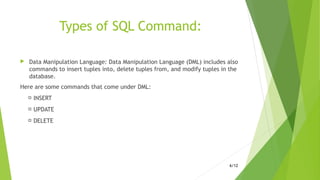
Types of SQL Command:
 Data Manipulation Language: Data Manipulation Language (DML) includes also
commands to insert tuples into, delete tuples from, and modify tuples in the
database.
Here are some commands that come under DML:
 INSERT
 UPDATE
 DELETE
6/12
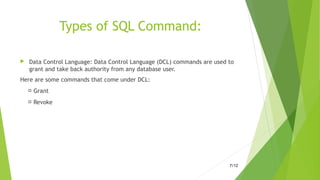
Types of SQL Command:
 Data Control Language: Data Control Language (DCL) commands are used to
grant and take back authority from any database user.
Here are some commands that come under DCL:
 Grant
 Revoke
7/12
Types of SQL Command:
 Transaction Control Language: Transaction Control Language (TCL) commands
can only use with DML commands like INSERT, DELETE and UPDATE only.
 These operations are automatically committed in the database that's why
they cannot be used while creating tables or dropping them.
Here are some commands that come under TCL:
 COMMIT
 ROLLBACK
 SAVEPOINT
8/12
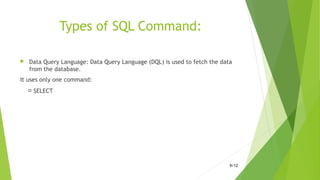
Types of SQL Command:
 Data Query Language: Data Query Language (DQL) is used to fetch the data
from the database.
It uses only one command:
 SELECT
9/12
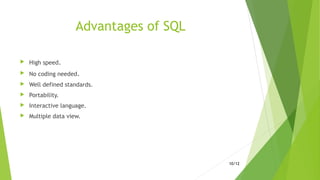
Advantages of SQL
 High speed.
 No coding needed.
 Well defined standards.
 Portability.
 Interactive language.
 Multiple data view.
10/12
Disadvantages of SQL
 Interfaces.
 Complex Interface.
 Implementation.
 Only Partial Control.
 Expense.
11/12
Thank You
12/12

SQL

  • 1.
    Pundra University ofScience & Technology Rangpur Road, Gokul, Bogura Click icon to add picture Welcome To My Presentation Name: Md. Soumik Ahmmed Department: Computer Science & Engineering Course Code: CSE-313 1/12
  • 2.
  • 3.
    WHAT IS SQL?  SQL (Structured Query Language) is a computer language aimed to store, manipulate, and retrieve data stored in relational databases. 3/12
  • 4.
    Types of SQLCommand: 1. Data definition language (DDL). 2. Data Manipulation Language. 3. Data Control Language. 4. Transaction Control Language. 5. Data Query Language. 4/12
  • 5.
    Types of SQLCommand:  Data definition language (DDL): Data-definition language (DDL) provides commands for defining relation schemas, deleting relations, and modifying relation schemas. Here are some commands that come under DDL:  CREATE  ALTER  DROP  TRUNCATE 5/12
  • 6.
    Types of SQLCommand:  Data Manipulation Language: Data Manipulation Language (DML) includes also commands to insert tuples into, delete tuples from, and modify tuples in the database. Here are some commands that come under DML:  INSERT  UPDATE  DELETE 6/12
  • 7.
    Types of SQLCommand:  Data Control Language: Data Control Language (DCL) commands are used to grant and take back authority from any database user. Here are some commands that come under DCL:  Grant  Revoke 7/12
  • 8.
    Types of SQLCommand:  Transaction Control Language: Transaction Control Language (TCL) commands can only use with DML commands like INSERT, DELETE and UPDATE only.  These operations are automatically committed in the database that's why they cannot be used while creating tables or dropping them. Here are some commands that come under TCL:  COMMIT  ROLLBACK  SAVEPOINT 8/12
  • 9.
    Types of SQLCommand:  Data Query Language: Data Query Language (DQL) is used to fetch the data from the database. It uses only one command:  SELECT 9/12
  • 10.
    Advantages of SQL High speed.  No coding needed.  Well defined standards.  Portability.  Interactive language.  Multiple data view. 10/12
  • 11.
    Disadvantages of SQL Interfaces.  Complex Interface.  Implementation.  Only Partial Control.  Expense. 11/12
  • 12.

Editor's Notes

  • #2 <number>