INTRODUCTION
TO SQL
Contact Us
+91-9212172602
www.cetpainfotech.com
query@cetpainfotech.com
CONTENT
What isSQL?
SQL Commands
DDL Commands
DMLCommands
DCL Commands
DQL Commands
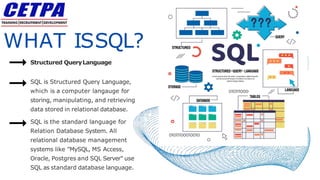
WHAT ISSQL?
Structured QueryLanguage
SQL is Structured Query Language,
which is a computer langauge for
storing, manipulating, and retrieving
data stored in relational database.
SQL is the standard language for
Relation Database System. All
relational database management
systems like "MySQL, MS Access,
Oracle, Postgres and SQL Server" use
SQL as standard database language.
SQL
COMMANDS
DDL - Data Definition Language
DML - Data Manipulation Language
DCL - Data Control Language
DQL - Data Query Language
DATA DEFINITIONLANGUAGE
(DDL) COMMANDS
DDL(Data Definition Language): To make/perform changes to the
physical structure of any table residing inside a database, DDL is
used. These commands when executed are auto-commit in
nature and all the changes in the table are reflected and saved
immediately.
In SQL DDL commands are used to create and modify the
structure of a database and database objects. These commands
are CREATE, DROP, ALTER, TRUNCATE, and RENAME. Let us
discuss these commands one at a time.
DATA MANIPULATION
LANGUAGE (DML)COMMANDS
DML(Data Manipulation Language): Once the tables are created
and the database is generated using DDL commands,
manipulation inside those tables and databases is done using
DML commands. The advantage of using DML commands is, that
if in case any wrong changes or values are made, they can be
changed and rolled back easily.
DML is used for inserting, deleting, and updating data in a
database. It is used to retrieve and manipulate data in a
relational database. It includes INSERT, UPDATE, and DELETE.
Let's discuss these commands one at a time.
DATA CONTROL LANGUAGE
(DCL) COMMANDS
DCL(Data Control Language): DCL commands as the name
suggests manage the matters and issues related to the data
controller in any database. DCL includes commands such as
GRANT and REVOKE which mainly deal with the rights,
permissions, and other controls of the database system.
DCL is used to access the stored data. It is used to revoke and
grant the user the required access to a database. In the
database, this language does not have the feature of rollback. It
is a part of the structured query language (SQL).
DATA QUERY LANGUAGE
(DQL) COMMANDS
DQL(Data Query Language): Data query language consists of only
one command upon which data selection in SQL relies. The
SELECT command in combination with other SQL clauses is
used to retrieve and fetch data from databases/tables based on
certain conditions applied by the user.
DQL commands are used for fetching data from a relational
database. They perform read-only queries of data. The only
command, 'SELECT' is equivalent to the projection operation in
relational algebra. It command selects the attribute based on
the condition described by the WHERE clause and returns them.
LET'SCONNECT
WITHUS!
+91-9212172602
query@cetpainfotech.com
www.cetpainfotech.com
THANKYOU!

Introduction to SQL.pptx

  • 1.
  • 2.
    CONTENT What isSQL? SQL Commands DDLCommands DMLCommands DCL Commands DQL Commands
  • 3.
    WHAT ISSQL? Structured QueryLanguage SQLis Structured Query Language, which is a computer langauge for storing, manipulating, and retrieving data stored in relational database. SQL is the standard language for Relation Database System. All relational database management systems like "MySQL, MS Access, Oracle, Postgres and SQL Server" use SQL as standard database language.
  • 4.
    SQL COMMANDS DDL - DataDefinition Language DML - Data Manipulation Language DCL - Data Control Language DQL - Data Query Language
  • 5.
    DATA DEFINITIONLANGUAGE (DDL) COMMANDS DDL(DataDefinition Language): To make/perform changes to the physical structure of any table residing inside a database, DDL is used. These commands when executed are auto-commit in nature and all the changes in the table are reflected and saved immediately. In SQL DDL commands are used to create and modify the structure of a database and database objects. These commands are CREATE, DROP, ALTER, TRUNCATE, and RENAME. Let us discuss these commands one at a time.
  • 6.
    DATA MANIPULATION LANGUAGE (DML)COMMANDS DML(DataManipulation Language): Once the tables are created and the database is generated using DDL commands, manipulation inside those tables and databases is done using DML commands. The advantage of using DML commands is, that if in case any wrong changes or values are made, they can be changed and rolled back easily. DML is used for inserting, deleting, and updating data in a database. It is used to retrieve and manipulate data in a relational database. It includes INSERT, UPDATE, and DELETE. Let's discuss these commands one at a time.
  • 7.
    DATA CONTROL LANGUAGE (DCL)COMMANDS DCL(Data Control Language): DCL commands as the name suggests manage the matters and issues related to the data controller in any database. DCL includes commands such as GRANT and REVOKE which mainly deal with the rights, permissions, and other controls of the database system. DCL is used to access the stored data. It is used to revoke and grant the user the required access to a database. In the database, this language does not have the feature of rollback. It is a part of the structured query language (SQL).
  • 8.
    DATA QUERY LANGUAGE (DQL)COMMANDS DQL(Data Query Language): Data query language consists of only one command upon which data selection in SQL relies. The SELECT command in combination with other SQL clauses is used to retrieve and fetch data from databases/tables based on certain conditions applied by the user. DQL commands are used for fetching data from a relational database. They perform read-only queries of data. The only command, 'SELECT' is equivalent to the projection operation in relational algebra. It command selects the attribute based on the condition described by the WHERE clause and returns them.
  • 9.