Introduction to SQL:-
•Structured query language (SQL) is a
programming language for storing and
processing information in a relational database.
•-> A relational database stores information in
tabular form, with rows and columns
representing different data attributes and the
various relationships between the data values..
VARIOUS TYPES OF SQL COMMANDS:-
1.Data Definition Language(DDL)
2.Data Manipulation Language(DML)
3.Data Control Language(DCL)
4.Transaction Control Language(TCL)
5.Data Query Language(DCL)
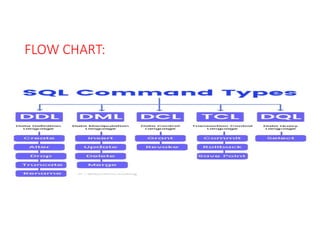
FLOW CHART:
Data Definition Language:-
• DDL (Data Definition Language) is a type of SQL command used
to define data structures and modify data. These commands
are used to create or modify the tables in SQL.
• DDL COMMANDS:
1.Create
2.Alter
3.Truncate
4.Drop
5.Rename
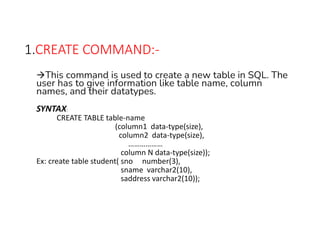
1.CREATE COMMAND:-
This command is used to create a new table in SQL. The
user has to give information like table name, column
names, and their datatypes.
SYNTAX:
CREATE TABLE table-name
(column1 data-type(size),
column2 data-type(size),
………………
column N data-type(size));
Ex: create table student( sno number(3),
sname varchar2(10),
saddress varchar2(10));
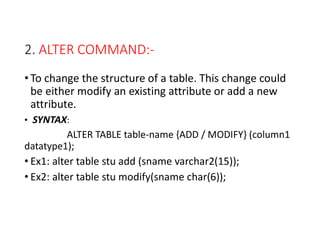
2. ALTER COMMAND:-
• To change the structure of a table. This change could
be either modify an existing attribute or add a new
attribute.
• SYNTAX:
ALTER TABLE table-name {ADD / MODIFY} (column1
datatype1);
• Ex1: alter table stu add (sname varchar2(15));
• Ex2: alter table stu modify(sname char(6));
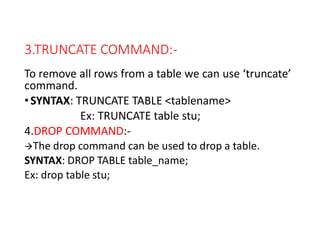
3.TRUNCATE COMMAND:-
To remove all rows from a table we can use ‘truncate’
command.
•SYNTAX: TRUNCATE TABLE <tablename>
Ex: TRUNCATE table stu;
4.DROP COMMAND:-
The drop command can be used to drop a table.
SYNTAX: DROP TABLE table_name;
Ex: drop table stu;
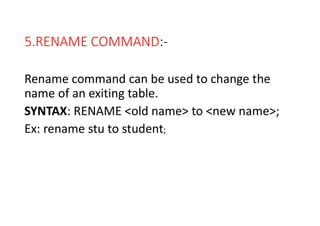
5.RENAME COMMAND:-
Rename command can be used to change the
name of an exiting table.
SYNTAX: RENAME <old name> to <new name>;
Ex: rename stu to student;
DATA MANIPULATION LANGUAGE:-
• A data manipulation language (DML) is a computer
programming language used for adding , deleting, and
modifying data in a database.
• DML COMMANDS:
• 1.Insert
• 2.Update
• 3.Delete
• 4.Merge
INSERT COMMAND:-
The insert command is used to add rows to a table .
SYNTAX: insert into <tablename> values(a list of data values):
Ex: insert into student values (101, ‘brahmam’, ‘gnt’);
2.UPDATE COMMAND:-
An update statement changes the data of one or more records in a
table.
SYNTAX: update table_name SET column1 = value1, column2 =
value2,… WHERE condition;
Ex: UPDATE customers SET contact name = ‘Vishnu’, city = ‘viz’
WHERE customer id =1;
DELETE COMMAND:-
• The delete statement is used to remove one or more
records from a table.
• SYNTAX:
DELETE FROM table_name WHERE condition;
• Ex:
delete from customer where customer name = ‘Vishnu’;
DATA CONTROL LANGUAGE (DCL):-
• DCL commands are used to enforce database security in a
multiple user database environment.
• Only Database Administrator’s or owners of the database
object can provide /remove privileges on a database object.
• Two types of DCL commands. They are,
GRANT COMMAND
 REVOKE COMMAND
GRANT COMMAND:-
• GRANT is a command used to provide access or privileges on
the database objects to the users.
• SYNTAX: grant privileges on <object name> to <user name>;
Ex:GRANT SELECT, UPDATE ON MY_TABLE TO SOME_USER, ANOTHER_USER
;
•  REVOKE COMMAND:- The REVOKE command user access
rights or privileges to the database objects.
• SYNTAX: revoke privileges on <object name> from <user
name>;
• Ex: REVOKE SELECT, UPDATE ON MY_TABLE FROM USER1, USER2;
TRANSACTION CONTROL LANGUAGE(TCL):-
• Transaction changes can be made permanent to a database
only if they are committed. A transaction executable
statements and end explicitly with their rollback or commit
statement and implicity.
Commit
Rollback
Save point
CON…
• COMMIT:- Commit command is used to save all the
transactions to the database.
• SYNTAX: COMMIT;
• Rollback:- Rollback command is used to undo transactions
that have not already been saved to the database.
• SYNTAX: ROLLBACK;
• Ex: delete from customers where age =25;
• ROLLBACK;
• SAVEPOINT:- It is used to roll the transaction back to a
certain point without rolling back the entire transaction.
• SYNTAX: SAVEPOINT savepoint_name;
DATA QUERY LANGUAGE(DQL):-DQL is used to
fetch the data from the database
• It uses only one command i.e, SELECT
• SELECT: This is the same as the projection operation of
relational algebra. It is used to select the attribute based
on the condition described by WHERE clause.
1.SYNTAX:SELECT expressions
2.FROM TABLES
3.WHERE conditions;
Ex: SELECT emp_name
FROM employee
WHERE age > 20;
ppt.pdf

ppt.pdf

  • 2.
    Introduction to SQL:- •Structuredquery language (SQL) is a programming language for storing and processing information in a relational database. •-> A relational database stores information in tabular form, with rows and columns representing different data attributes and the various relationships between the data values..
  • 3.
    VARIOUS TYPES OFSQL COMMANDS:- 1.Data Definition Language(DDL) 2.Data Manipulation Language(DML) 3.Data Control Language(DCL) 4.Transaction Control Language(TCL) 5.Data Query Language(DCL)
  • 4.
  • 5.
    Data Definition Language:- •DDL (Data Definition Language) is a type of SQL command used to define data structures and modify data. These commands are used to create or modify the tables in SQL. • DDL COMMANDS: 1.Create 2.Alter 3.Truncate 4.Drop 5.Rename
  • 6.
    1.CREATE COMMAND:- This commandis used to create a new table in SQL. The user has to give information like table name, column names, and their datatypes. SYNTAX: CREATE TABLE table-name (column1 data-type(size), column2 data-type(size), ……………… column N data-type(size)); Ex: create table student( sno number(3), sname varchar2(10), saddress varchar2(10));
  • 7.
    2. ALTER COMMAND:- •To change the structure of a table. This change could be either modify an existing attribute or add a new attribute. • SYNTAX: ALTER TABLE table-name {ADD / MODIFY} (column1 datatype1); • Ex1: alter table stu add (sname varchar2(15)); • Ex2: alter table stu modify(sname char(6));
  • 8.
    3.TRUNCATE COMMAND:- To removeall rows from a table we can use ‘truncate’ command. •SYNTAX: TRUNCATE TABLE <tablename> Ex: TRUNCATE table stu; 4.DROP COMMAND:- The drop command can be used to drop a table. SYNTAX: DROP TABLE table_name; Ex: drop table stu;
  • 9.
    5.RENAME COMMAND:- Rename commandcan be used to change the name of an exiting table. SYNTAX: RENAME <old name> to <new name>; Ex: rename stu to student;
  • 10.
    DATA MANIPULATION LANGUAGE:- •A data manipulation language (DML) is a computer programming language used for adding , deleting, and modifying data in a database. • DML COMMANDS: • 1.Insert • 2.Update • 3.Delete • 4.Merge
  • 11.
    INSERT COMMAND:- The insertcommand is used to add rows to a table . SYNTAX: insert into <tablename> values(a list of data values): Ex: insert into student values (101, ‘brahmam’, ‘gnt’); 2.UPDATE COMMAND:- An update statement changes the data of one or more records in a table. SYNTAX: update table_name SET column1 = value1, column2 = value2,… WHERE condition; Ex: UPDATE customers SET contact name = ‘Vishnu’, city = ‘viz’ WHERE customer id =1;
  • 12.
    DELETE COMMAND:- • Thedelete statement is used to remove one or more records from a table. • SYNTAX: DELETE FROM table_name WHERE condition; • Ex: delete from customer where customer name = ‘Vishnu’;
  • 13.
    DATA CONTROL LANGUAGE(DCL):- • DCL commands are used to enforce database security in a multiple user database environment. • Only Database Administrator’s or owners of the database object can provide /remove privileges on a database object. • Two types of DCL commands. They are, GRANT COMMAND  REVOKE COMMAND
  • 14.
    GRANT COMMAND:- • GRANTis a command used to provide access or privileges on the database objects to the users. • SYNTAX: grant privileges on <object name> to <user name>; Ex:GRANT SELECT, UPDATE ON MY_TABLE TO SOME_USER, ANOTHER_USER ; •  REVOKE COMMAND:- The REVOKE command user access rights or privileges to the database objects. • SYNTAX: revoke privileges on <object name> from <user name>; • Ex: REVOKE SELECT, UPDATE ON MY_TABLE FROM USER1, USER2;
  • 15.
    TRANSACTION CONTROL LANGUAGE(TCL):- •Transaction changes can be made permanent to a database only if they are committed. A transaction executable statements and end explicitly with their rollback or commit statement and implicity. Commit Rollback Save point
  • 16.
    CON… • COMMIT:- Commitcommand is used to save all the transactions to the database. • SYNTAX: COMMIT; • Rollback:- Rollback command is used to undo transactions that have not already been saved to the database. • SYNTAX: ROLLBACK; • Ex: delete from customers where age =25; • ROLLBACK; • SAVEPOINT:- It is used to roll the transaction back to a certain point without rolling back the entire transaction. • SYNTAX: SAVEPOINT savepoint_name;
  • 17.
    DATA QUERY LANGUAGE(DQL):-DQLis used to fetch the data from the database • It uses only one command i.e, SELECT • SELECT: This is the same as the projection operation of relational algebra. It is used to select the attribute based on the condition described by WHERE clause. 1.SYNTAX:SELECT expressions 2.FROM TABLES 3.WHERE conditions; Ex: SELECT emp_name FROM employee WHERE age > 20;