About Me
Md. Selim Hossain
Lecturer
Dept. of CSE
UTTARA UNIVERSITY
House#05, Section#06,
Road#15, Uttara, Dhaka-1230.
Md. Selim Hossain 1
Database
Management
System
(DBMS)
Md. Selim Hossain 2
Topics for Today
Md. Selim Hossain 3
Data Definition Language (DDL)
Data Manipulation Language
(DML)
Md. Selim Hossain 4
SQL statements are divided into two major
categories:
Data Definition Language (DDL) and
Data Manipulation Language (DML).
Md. Selim Hossain 5
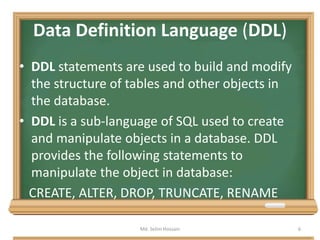
Data Definition Language (DDL)
• DDL statements are used to build and modify
the structure of tables and other objects in
the database.
• DDL is a sub-language of SQL used to create
and manipulate objects in a database. DDL
provides the following statements to
manipulate the object in database:
CREATE, ALTER, DROP, TRUNCATE, RENAME
Md. Selim Hossain 6
Data Definition Language (DDL)
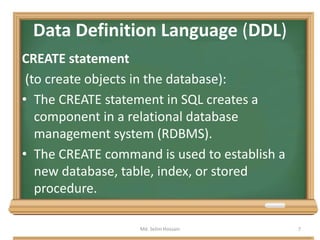
CREATE statement
(to create objects in the database):
• The CREATE statement in SQL creates a
component in a relational database
management system (RDBMS).
• The CREATE command is used to establish a
new database, table, index, or stored
procedure.
Md. Selim Hossain 7
CREATE TABLE statement
• A commonly used CREATE command is the
CREATE TABLE command. The typical usage is:
CREATE TABLE [table name] ( [column
definitions] ) [table parameters]
Md. Selim Hossain 8
CREATE TABLE statement
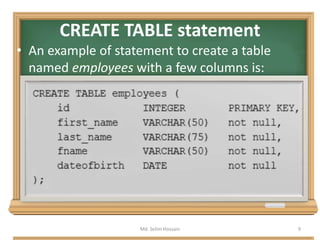
• An example of statement to create a table
named employees with a few columns is:
Md. Selim Hossain 9
CREATE TABLE statement
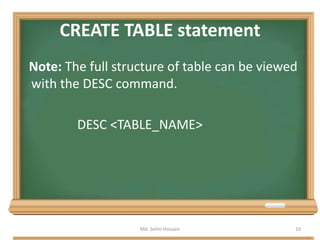
Note: The full structure of table can be viewed
with the DESC command.
DESC <TABLE_NAME>
Md. Selim Hossain 10
DROP statement
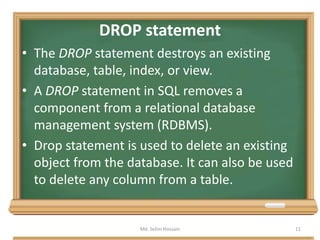
• The DROP statement destroys an existing
database, table, index, or view.
• A DROP statement in SQL removes a
component from a relational database
management system (RDBMS).
• Drop statement is used to delete an existing
object from the database. It can also be used
to delete any column from a table.
Md. Selim Hossain 11
DROP statement
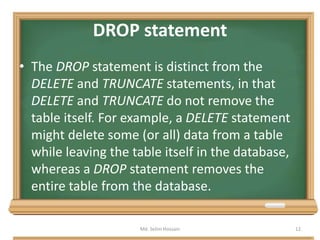
• The DROP statement is distinct from the
DELETE and TRUNCATE statements, in that
DELETE and TRUNCATE do not remove the
table itself. For example, a DELETE statement
might delete some (or all) data from a table
while leaving the table itself in the database,
whereas a DROP statement removes the
entire table from the database.
Md. Selim Hossain 12
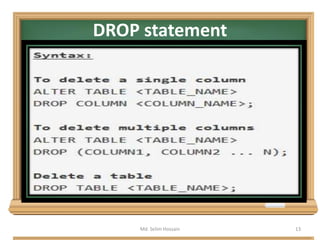
DROP statement
Md. Selim Hossain 13
DROP statement
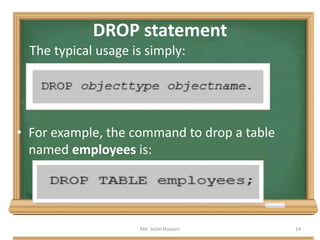
The typical usage is simply:
• For example, the command to drop a table
named employees is:
Md. Selim Hossain 14
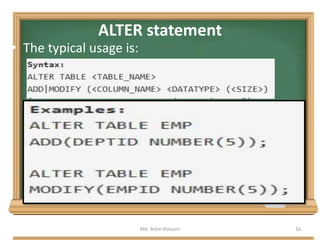
ALTER statement
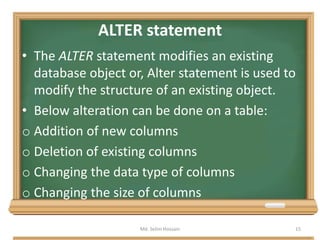
• The ALTER statement modifies an existing
database object or, Alter statement is used to
modify the structure of an existing object.
• Below alteration can be done on a table:
o Addition of new columns
o Deletion of existing columns
o Changing the data type of columns
o Changing the size of columns
Md. Selim Hossain 15
ALTER statement
• The typical usage is:
Md. Selim Hossain 16
ALTER statement
Note: To change the data type of a column,
the column must be empty.
Md. Selim Hossain 17
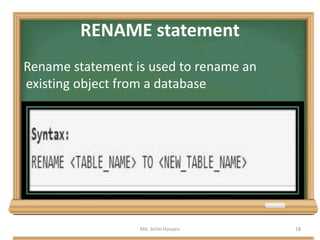
RENAME statement
Rename statement is used to rename an
existing object from a database
Md. Selim Hossain 18
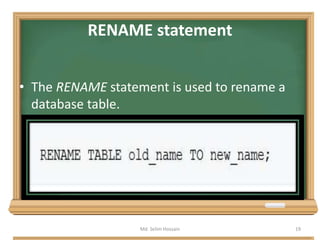
RENAME statement
• The RENAME statement is used to rename a
database table.
Md. Selim Hossain 19
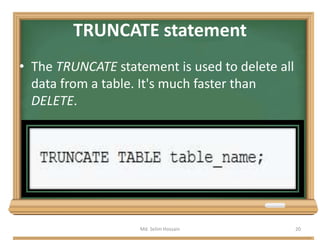
TRUNCATE statement
• The TRUNCATE statement is used to delete all
data from a table. It's much faster than
DELETE.
Md. Selim Hossain 20
Data Manipulation Language (DML)
• A data manipulation language (DML) is a
family of syntax elements similar to a
computer programming language used for
selecting, inserting, deleting and updating
data in a database.
Md. Selim Hossain 21
Data Manipulation Language (DML)
 DML also known as query language
Two classes of languages
 Procedural – user specifies what data is
required and how to get those data
 Nonprocedural – user specifies what data is
required without specifying how to get
those data
Md. Selim Hossain 22
Data Manipulation Language (DML)
• DML is a sub-language of SQL. It is used to
manipulate the data stored in a table.
• DML provides the following statements for
data manipulation:
INSERT
UPDATE
DELETE
Md. Selim Hossain 23
Data Manipulation Language (DML)
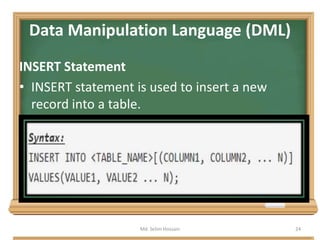
INSERT Statement
• INSERT statement is used to insert a new
record into a table.
Md. Selim Hossain 24
Data Manipulation Language (DML)
INSERT Statement
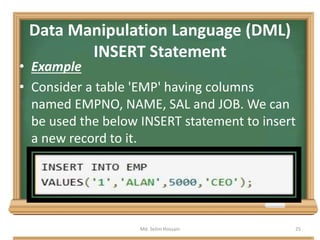
• Example
• Consider a table 'EMP' having columns
named EMPNO, NAME, SAL and JOB. We can
be used the below INSERT statement to insert
a new record to it.
Md. Selim Hossain 25
UPDATE Statement
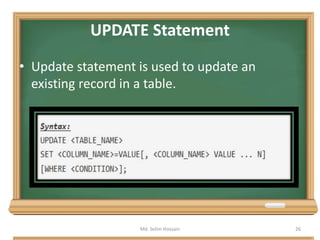
• Update statement is used to update an
existing record in a table.
Md. Selim Hossain 26
UPDATE Statement
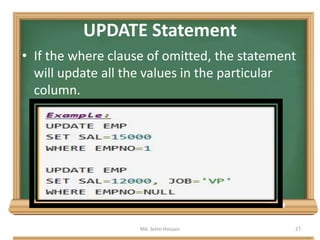
• If the where clause of omitted, the statement
will update all the values in the particular
column.
Md. Selim Hossain 27
UPDATE Statement
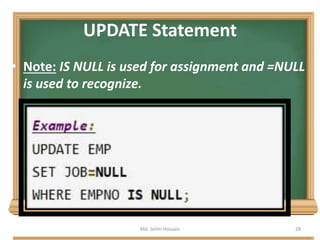
• Note: IS NULL is used for assignment and =NULL
is used to recognize.
Md. Selim Hossain 28
DELETE Statement
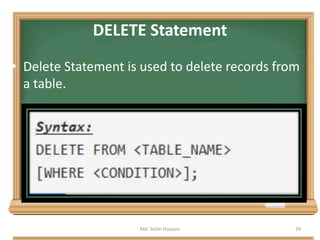
• Delete Statement is used to delete records from
a table.
Md. Selim Hossain 29
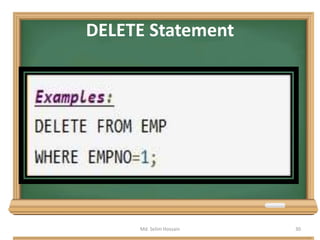
DELETE Statement
Md. Selim Hossain 30
DELETE Statement
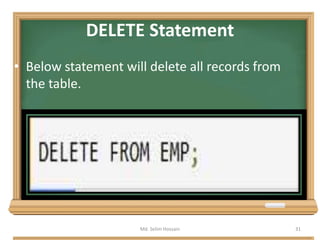
• Below statement will delete all records from
the table.
Md. Selim Hossain 31
Md. Selim Hossain
Thank you
32

Data Definition and Data Manipulation Language-DDL & DML

  • 1.
    About Me Md. SelimHossain Lecturer Dept. of CSE UTTARA UNIVERSITY House#05, Section#06, Road#15, Uttara, Dhaka-1230. Md. Selim Hossain 1
  • 2.
  • 3.
    Topics for Today Md.Selim Hossain 3
  • 4.
    Data Definition Language(DDL) Data Manipulation Language (DML) Md. Selim Hossain 4
  • 5.
    SQL statements aredivided into two major categories: Data Definition Language (DDL) and Data Manipulation Language (DML). Md. Selim Hossain 5
  • 6.
    Data Definition Language(DDL) • DDL statements are used to build and modify the structure of tables and other objects in the database. • DDL is a sub-language of SQL used to create and manipulate objects in a database. DDL provides the following statements to manipulate the object in database: CREATE, ALTER, DROP, TRUNCATE, RENAME Md. Selim Hossain 6
  • 7.
    Data Definition Language(DDL) CREATE statement (to create objects in the database): • The CREATE statement in SQL creates a component in a relational database management system (RDBMS). • The CREATE command is used to establish a new database, table, index, or stored procedure. Md. Selim Hossain 7
  • 8.
    CREATE TABLE statement •A commonly used CREATE command is the CREATE TABLE command. The typical usage is: CREATE TABLE [table name] ( [column definitions] ) [table parameters] Md. Selim Hossain 8
  • 9.
    CREATE TABLE statement •An example of statement to create a table named employees with a few columns is: Md. Selim Hossain 9
  • 10.
    CREATE TABLE statement Note:The full structure of table can be viewed with the DESC command. DESC <TABLE_NAME> Md. Selim Hossain 10
  • 11.
    DROP statement • TheDROP statement destroys an existing database, table, index, or view. • A DROP statement in SQL removes a component from a relational database management system (RDBMS). • Drop statement is used to delete an existing object from the database. It can also be used to delete any column from a table. Md. Selim Hossain 11
  • 12.
    DROP statement • TheDROP statement is distinct from the DELETE and TRUNCATE statements, in that DELETE and TRUNCATE do not remove the table itself. For example, a DELETE statement might delete some (or all) data from a table while leaving the table itself in the database, whereas a DROP statement removes the entire table from the database. Md. Selim Hossain 12
  • 13.
  • 14.
    DROP statement The typicalusage is simply: • For example, the command to drop a table named employees is: Md. Selim Hossain 14
  • 15.
    ALTER statement • TheALTER statement modifies an existing database object or, Alter statement is used to modify the structure of an existing object. • Below alteration can be done on a table: o Addition of new columns o Deletion of existing columns o Changing the data type of columns o Changing the size of columns Md. Selim Hossain 15
  • 16.
    ALTER statement • Thetypical usage is: Md. Selim Hossain 16
  • 17.
    ALTER statement Note: Tochange the data type of a column, the column must be empty. Md. Selim Hossain 17
  • 18.
    RENAME statement Rename statementis used to rename an existing object from a database Md. Selim Hossain 18
  • 19.
    RENAME statement • TheRENAME statement is used to rename a database table. Md. Selim Hossain 19
  • 20.
    TRUNCATE statement • TheTRUNCATE statement is used to delete all data from a table. It's much faster than DELETE. Md. Selim Hossain 20
  • 21.
    Data Manipulation Language(DML) • A data manipulation language (DML) is a family of syntax elements similar to a computer programming language used for selecting, inserting, deleting and updating data in a database. Md. Selim Hossain 21
  • 22.
    Data Manipulation Language(DML)  DML also known as query language Two classes of languages  Procedural – user specifies what data is required and how to get those data  Nonprocedural – user specifies what data is required without specifying how to get those data Md. Selim Hossain 22
  • 23.
    Data Manipulation Language(DML) • DML is a sub-language of SQL. It is used to manipulate the data stored in a table. • DML provides the following statements for data manipulation: INSERT UPDATE DELETE Md. Selim Hossain 23
  • 24.
    Data Manipulation Language(DML) INSERT Statement • INSERT statement is used to insert a new record into a table. Md. Selim Hossain 24
  • 25.
    Data Manipulation Language(DML) INSERT Statement • Example • Consider a table 'EMP' having columns named EMPNO, NAME, SAL and JOB. We can be used the below INSERT statement to insert a new record to it. Md. Selim Hossain 25
  • 26.
    UPDATE Statement • Updatestatement is used to update an existing record in a table. Md. Selim Hossain 26
  • 27.
    UPDATE Statement • Ifthe where clause of omitted, the statement will update all the values in the particular column. Md. Selim Hossain 27
  • 28.
    UPDATE Statement • Note:IS NULL is used for assignment and =NULL is used to recognize. Md. Selim Hossain 28
  • 29.
    DELETE Statement • DeleteStatement is used to delete records from a table. Md. Selim Hossain 29
  • 30.
  • 31.
    DELETE Statement • Belowstatement will delete all records from the table. Md. Selim Hossain 31
  • 32.