University of Wisconsin – Madison
                                 Computer Sciences Department


                     CS 760 - Machine Learning
                                             Spring 2003

                                                Exam
                                      7:15-9:15pm, May 6, 2003
                                     Room 3345 Engineering Hall

                                            CLOSED BOOK
                              (one sheet of notes and a calculator allowed)


Write your answers on these pages and show your work. If you feel that a question is not fully
specified, state any assumptions that you need to make in order to solve the problem. You may
use the backs of these sheets for scratch work.

Write your name on this and all other pages of this exam. Make sure your exam contains
5 problems on 10 pages.


       Name           ________________________________________________________________


       Student ID     ________________________________________________________________


                      Problem                   Score           Max Score


                          1                     ______               40

                          2                     ______               17

                          3                     ______               10

                          4                     ______               12

                          5                     ______               21


                      TOTAL                     ______              100
Name: _______________________________________


Problem 1 – Learning from Labeled Examples (40 points)

Imagine that you are given the following set of training examples.
Feature F1 can take on the values a, b, or c; Feature F2 is Boolean-valued;
and Feature F3 is always a real-valued number in [0,1].

                               F1    F2        F3       Category

               Example 1       a      T        0.2         +
               Example 2       b      F        0.5         +
               Example 3       b      F        0.9         +
               Example 4       b      T        0.6         –
               Example 5       a      F        0.1         –
               Example 6       a      T        0.7         –

a) How might a Naive Bayes system classify the following test example?
   Be sure to show your work. (Discretize the numeric feature into three equal-width bins.)

               F1 = c      F2 = T   F3 = 0.8


b) Describe how a 2-nearest-neighbor algorithm might classify Part a’s test example.


                                           Page 2 of 10
Name: _______________________________________


c) Show the calculations that ID3 would perform to determine the root node of a decision tree
     using the above training examples.


d) Using the “decision stump” learner as boosting’s weak learner, what would the weights be on
     each of the six training examples after one (1) round of AdaBoost? Show your work.

        Weight on Example 1:   _________
        Weight on Example 2:   _________
        Weight on Example 3:   _________
        Weight on Example 4:   _________
        Weight on Example 5:   _________
        Weight on Example 6:   _________


e)   Show the feature space for this training set. Use only features F2 and F3 (ie, for this part,
     ignore F1). Show what a linear support-vector machine might learn from this training set.
     Briefly explain your answer.


                                             Page 3 of 10
Name: _______________________________________


f) Create a neural network with no hidden units and a sigmoidal output unit. Initialize all the
   free parameters to 2 and use a learning rate of 0.1. Use squared error is the error function.

       i. Draw a picture of this neural network before training.


       ii. Calculate ∂ Error / ∂ weighti for this network. Recall that the derivative of the
         sigmoid is output × (1 – output).


       iii. Show how the free parameters would change after backpropagating on the first
         training example in the table above. Indicate the weight changes on the neural network
         you drew above and show your work below.


       iv. According to Rumelhart, which error function should one use on classification tasks
         such as this one? And how should one interpret the neural network’s output?


                                             Page 4 of 10
Name: _______________________________________


Problem 2 – Reinforcement Learning (17 points)

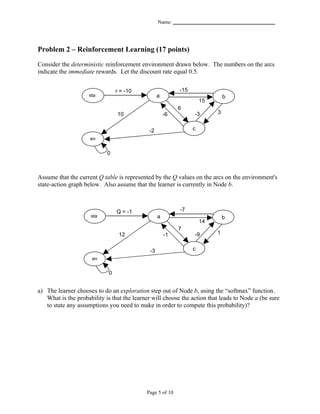
Consider the deterministic reinforcement environment drawn below. The numbers on the arcs
indicate the immediate rewards. Let the discount rate equal 0.5.


                                 r = -10                    -15
                     sta                           a                          b
                     rt                                            15
                                                            6
                                 10                    -6         -3      3


                                             -2                   c 5
                     en
                     d
                            0


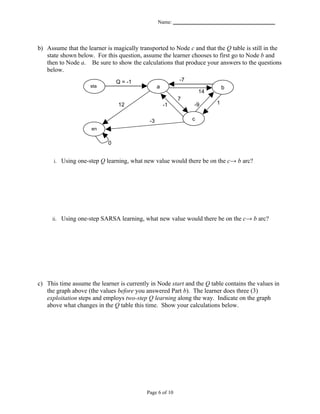
Assume that the current Q table is represented by the Q values on the arcs on the environment's
state-action graph below. Also assume that the learner is currently in Node b.


                                 Q = -1                     -7
                     sta                           a                          b
                     rt                                            14
                                                            7
                                  12                   -1         -9     1


                                              -3                  c 5
                      en
                      d
                             0


a) The learner chooses to do an exploration step out of Node b, using the “softmax” function.
   What is the probability is that the learner will choose the action that leads to Node a (be sure
   to state any assumptions you need to make in order to compute this probability)?


                                            Page 5 of 10
Name: _______________________________________


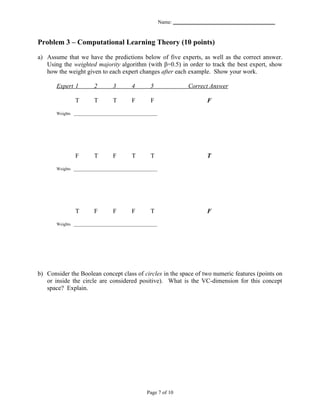
b) Assume that the learner is magically transported to Node c and that the Q table is still in the
   state shown below. For this question, assume the learner chooses to first go to Node b and
   then to Node a. Be sure to show the calculations that produce your answers to the questions
   below.
                                Q = -1                     -7
                     sta                          a                         b
                     rt                                          14
                                                           7
                                12                    -1        -9      1


                                             -3                 c 5
                     en
                     d
                            0


      i. Using one-step Q learning, what new value would there be on the c→ b arc?


     ii. Using one-step SARSA learning, what new value would there be on the c→ b arc?


c) This time assume the learner is currently in Node start and the Q table contains the values in
   the graph above (the values before you answered Part b). The learner does three (3)
   exploitation steps and employs two-step Q learning along the way. Indicate on the graph
   above what changes in the Q table this time. Show your calculations below.


                                           Page 6 of 10
Name: _______________________________________


Problem 3 – Computational Learning Theory (10 points)

a) Assume that we have the predictions below of five experts, as well as the correct answer.
   Using the weighted majority algorithm (with β=0.5) in order to track the best expert, show
   how the weight given to each expert changes after each example. Show your work.

       Expert 1         2        3        4        5                 Correct Answer

               T        T        T        F        F                        F
       Weights ________________________________________


               F        T        F        T        T                        T
       Weights ________________________________________


               T        F        F        F        T                        F
       Weights ________________________________________


b) Consider the Boolean concept class of circles in the space of two numeric features (points on
   or inside the circle are considered positive). What is the VC-dimension for this concept
   space? Explain.


                                                  Page 7 of 10
Name: _______________________________________


Problem 4 – Overfitting Avoidance (12 points)
a) Use a Venn diagram of feature space to illustrate how a decision tree might overfit a training
   set. Briefly explain your answer.


b) Briefly describe how one can choose the number of hidden units to use in a neural network in
   order to reduce the chances of overfitting.


c) Informally (i.e., verbally or pictorially) explain how using a kernel might lead to overfitting
   in a support-vector machine.


d) Outline a methodology where an experimenter incorrectly uses cross validation to set
   parameters and estimate future accuracy.


                                            Page 8 of 10
Name: _______________________________________


Problem 5 – Short Discussion Questions (21 points)

a)   Using a Venn diagram, qualitatively illustrate how 1-NN (one nearest-neighbor) partitions
     feature space. Assume a Boolean classification task. Briefly explain your answer.


b) Consider creating an ensemble of eleven support-vector machines (SVM’s) using bagging
     and a standard linear SVM. Dataset A has 100 support vectors and Dataset B has 1000
     support vectors (when run on all the data); both datasets contain 10,000 examples and on
     both datasets the 10-fold cross-validation accuracy of a single SVM is 80%. On which
     dataset would you expect bagging to improve accuracy the most? Why?


c) What does transduction mean in machine learning?


                                            Page 9 of 10
Name: _______________________________________


d) Explain the role of slack variables in support vector machines.


e)   What do you feel is the most important improvement that PAC learning offers over learning
     in the limit? Explain your answer.


f)   Noah Taul does a proper 10-fold cross-validation of his new algorithm compared to
     backprop. A paired t-test shows he cannot disregard the null hypothesis.
     What is the null hypothesis? And how does a t-test allow one to address this hypothesis?


                                         Have a good vacation!


                                           Page 10 of 10

Spring 2003

  • 1.
    University of Wisconsin– Madison Computer Sciences Department CS 760 - Machine Learning Spring 2003 Exam 7:15-9:15pm, May 6, 2003 Room 3345 Engineering Hall CLOSED BOOK (one sheet of notes and a calculator allowed) Write your answers on these pages and show your work. If you feel that a question is not fully specified, state any assumptions that you need to make in order to solve the problem. You may use the backs of these sheets for scratch work. Write your name on this and all other pages of this exam. Make sure your exam contains 5 problems on 10 pages. Name ________________________________________________________________ Student ID ________________________________________________________________ Problem Score Max Score 1 ______ 40 2 ______ 17 3 ______ 10 4 ______ 12 5 ______ 21 TOTAL ______ 100
  • 2.
    Name: _______________________________________ Problem 1– Learning from Labeled Examples (40 points) Imagine that you are given the following set of training examples. Feature F1 can take on the values a, b, or c; Feature F2 is Boolean-valued; and Feature F3 is always a real-valued number in [0,1]. F1 F2 F3 Category Example 1 a T 0.2 + Example 2 b F 0.5 + Example 3 b F 0.9 + Example 4 b T 0.6 – Example 5 a F 0.1 – Example 6 a T 0.7 – a) How might a Naive Bayes system classify the following test example? Be sure to show your work. (Discretize the numeric feature into three equal-width bins.) F1 = c F2 = T F3 = 0.8 b) Describe how a 2-nearest-neighbor algorithm might classify Part a’s test example. Page 2 of 10
  • 3.
    Name: _______________________________________ c) Showthe calculations that ID3 would perform to determine the root node of a decision tree using the above training examples. d) Using the “decision stump” learner as boosting’s weak learner, what would the weights be on each of the six training examples after one (1) round of AdaBoost? Show your work. Weight on Example 1: _________ Weight on Example 2: _________ Weight on Example 3: _________ Weight on Example 4: _________ Weight on Example 5: _________ Weight on Example 6: _________ e) Show the feature space for this training set. Use only features F2 and F3 (ie, for this part, ignore F1). Show what a linear support-vector machine might learn from this training set. Briefly explain your answer. Page 3 of 10
  • 4.
    Name: _______________________________________ f) Createa neural network with no hidden units and a sigmoidal output unit. Initialize all the free parameters to 2 and use a learning rate of 0.1. Use squared error is the error function. i. Draw a picture of this neural network before training. ii. Calculate ∂ Error / ∂ weighti for this network. Recall that the derivative of the sigmoid is output × (1 – output). iii. Show how the free parameters would change after backpropagating on the first training example in the table above. Indicate the weight changes on the neural network you drew above and show your work below. iv. According to Rumelhart, which error function should one use on classification tasks such as this one? And how should one interpret the neural network’s output? Page 4 of 10
  • 5.
    Name: _______________________________________ Problem 2– Reinforcement Learning (17 points) Consider the deterministic reinforcement environment drawn below. The numbers on the arcs indicate the immediate rewards. Let the discount rate equal 0.5. r = -10 -15 sta a b rt 15 6 10 -6 -3 3 -2 c 5 en d 0 Assume that the current Q table is represented by the Q values on the arcs on the environment's state-action graph below. Also assume that the learner is currently in Node b. Q = -1 -7 sta a b rt 14 7 12 -1 -9 1 -3 c 5 en d 0 a) The learner chooses to do an exploration step out of Node b, using the “softmax” function. What is the probability is that the learner will choose the action that leads to Node a (be sure to state any assumptions you need to make in order to compute this probability)? Page 5 of 10
  • 6.
    Name: _______________________________________ b) Assumethat the learner is magically transported to Node c and that the Q table is still in the state shown below. For this question, assume the learner chooses to first go to Node b and then to Node a. Be sure to show the calculations that produce your answers to the questions below. Q = -1 -7 sta a b rt 14 7 12 -1 -9 1 -3 c 5 en d 0 i. Using one-step Q learning, what new value would there be on the c→ b arc? ii. Using one-step SARSA learning, what new value would there be on the c→ b arc? c) This time assume the learner is currently in Node start and the Q table contains the values in the graph above (the values before you answered Part b). The learner does three (3) exploitation steps and employs two-step Q learning along the way. Indicate on the graph above what changes in the Q table this time. Show your calculations below. Page 6 of 10
  • 7.
    Name: _______________________________________ Problem 3– Computational Learning Theory (10 points) a) Assume that we have the predictions below of five experts, as well as the correct answer. Using the weighted majority algorithm (with β=0.5) in order to track the best expert, show how the weight given to each expert changes after each example. Show your work. Expert 1 2 3 4 5 Correct Answer T T T F F F Weights ________________________________________ F T F T T T Weights ________________________________________ T F F F T F Weights ________________________________________ b) Consider the Boolean concept class of circles in the space of two numeric features (points on or inside the circle are considered positive). What is the VC-dimension for this concept space? Explain. Page 7 of 10
  • 8.
    Name: _______________________________________ Problem 4– Overfitting Avoidance (12 points) a) Use a Venn diagram of feature space to illustrate how a decision tree might overfit a training set. Briefly explain your answer. b) Briefly describe how one can choose the number of hidden units to use in a neural network in order to reduce the chances of overfitting. c) Informally (i.e., verbally or pictorially) explain how using a kernel might lead to overfitting in a support-vector machine. d) Outline a methodology where an experimenter incorrectly uses cross validation to set parameters and estimate future accuracy. Page 8 of 10
  • 9.
    Name: _______________________________________ Problem 5– Short Discussion Questions (21 points) a) Using a Venn diagram, qualitatively illustrate how 1-NN (one nearest-neighbor) partitions feature space. Assume a Boolean classification task. Briefly explain your answer. b) Consider creating an ensemble of eleven support-vector machines (SVM’s) using bagging and a standard linear SVM. Dataset A has 100 support vectors and Dataset B has 1000 support vectors (when run on all the data); both datasets contain 10,000 examples and on both datasets the 10-fold cross-validation accuracy of a single SVM is 80%. On which dataset would you expect bagging to improve accuracy the most? Why? c) What does transduction mean in machine learning? Page 9 of 10
  • 10.
    Name: _______________________________________ d) Explainthe role of slack variables in support vector machines. e) What do you feel is the most important improvement that PAC learning offers over learning in the limit? Explain your answer. f) Noah Taul does a proper 10-fold cross-validation of his new algorithm compared to backprop. A paired t-test shows he cannot disregard the null hypothesis. What is the null hypothesis? And how does a t-test allow one to address this hypothesis? Have a good vacation! Page 10 of 10