
Kriti Puniyani
Carnegie Mellon University
      kriti@cmu.edu
About me
  Graduate student at Carnegie Mellon University
  Statistical machine learning
    Topic models
    Sparse network learning
    Optimization
  Domains of interest
    Social media analysis
    Systems biology
    Genetics
    Sentiment analysis
    Text processing


                                                    4/15/11   2
Machine learning
  Computers to “learn with experience”
  Learn : to be able to predict “unseen” things.


  Many applications
    Search
    Machine translation
    Speech recognition
    Vision : identify cars, people, sky, apples
    Robot control


  Introductions :
    http://www.cs.cmu.edu/~tom/pubs/MachineLearning.pdf
    http://videolectures.net/mlss2010_lawrence_mlfcs/
                                                         4/15/11   3
Classification

  Is this the digit “9” ?   ρ

  Will this patient survive ?


  Will this user click on my ad ?


                                     4/15/11   4
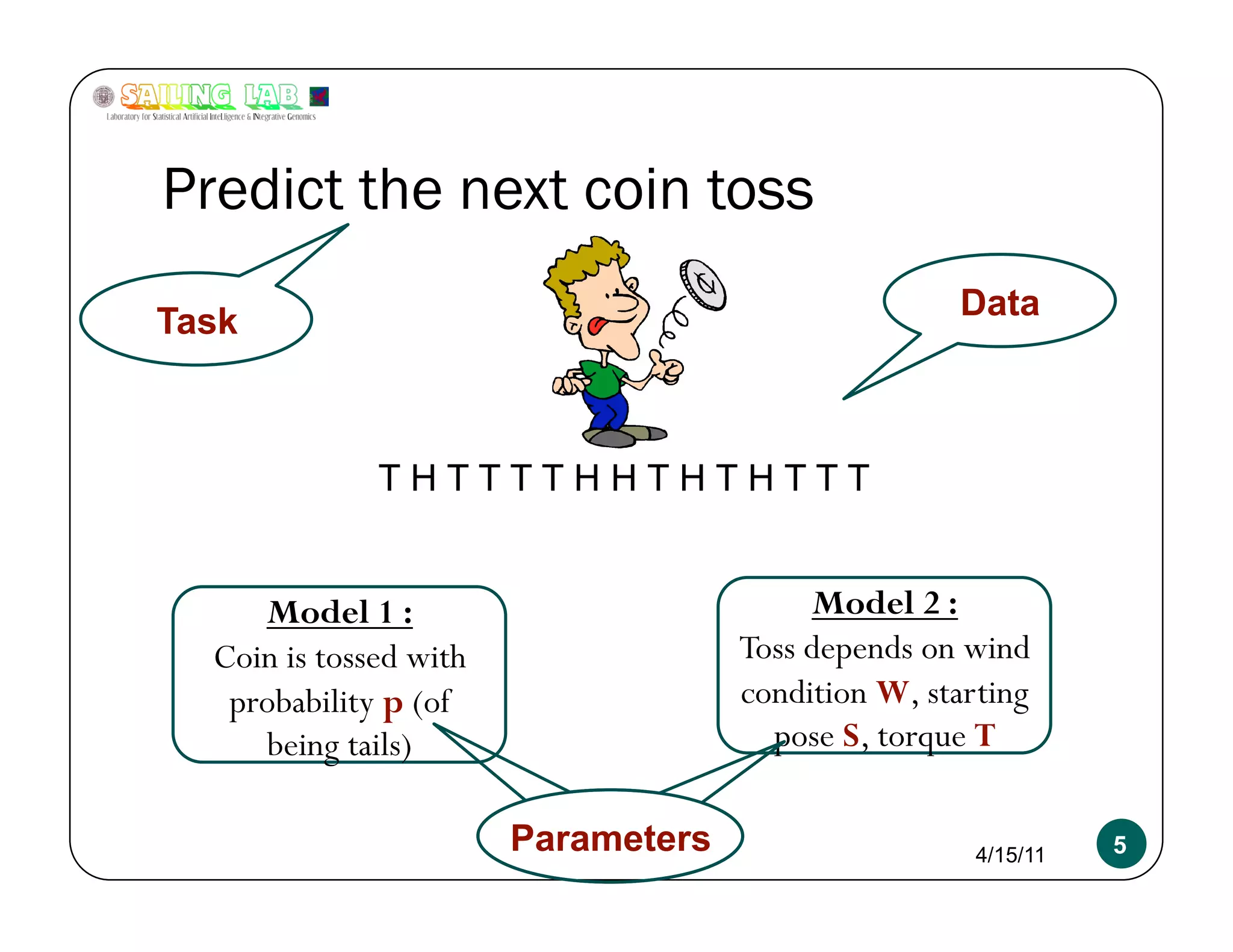
Predict the next coin toss
                                                    Data
Task


              THTTTTHHTHTHTTT


     Model 1 :                            Model 2 :
  Coin is tossed with                Toss depends on wind
   probability p (of                 condition W, starting
     being tails)                      pose S, torque T

                        Parameters                    4/15/11   5
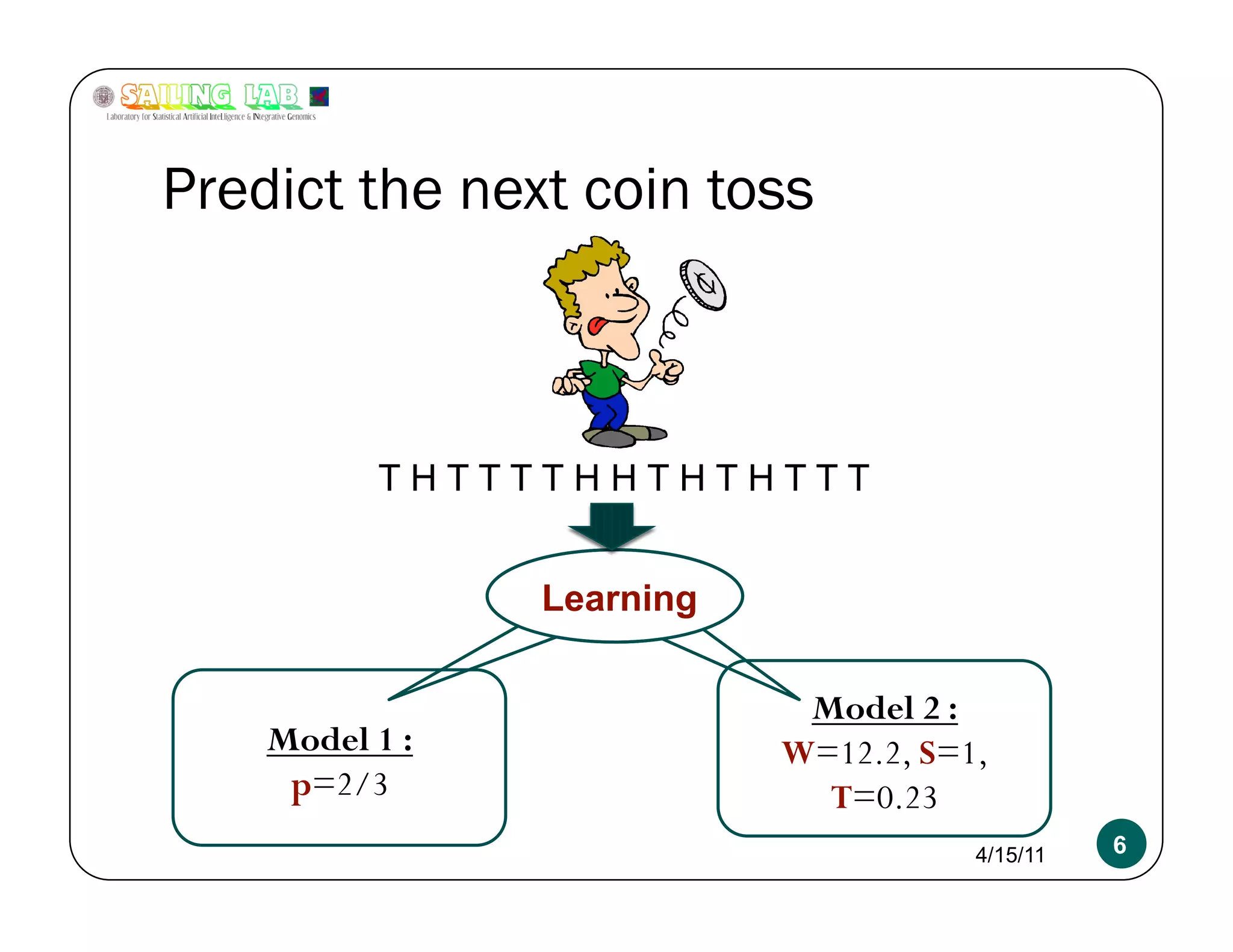
Predict the next coin toss


          THTTTTHHTHTHTTT


                Learning

                            Model 2 :
    Model 1 :              W=12.2, S=1,
     p=2/3                   T=0.23
                                      4/15/11   6
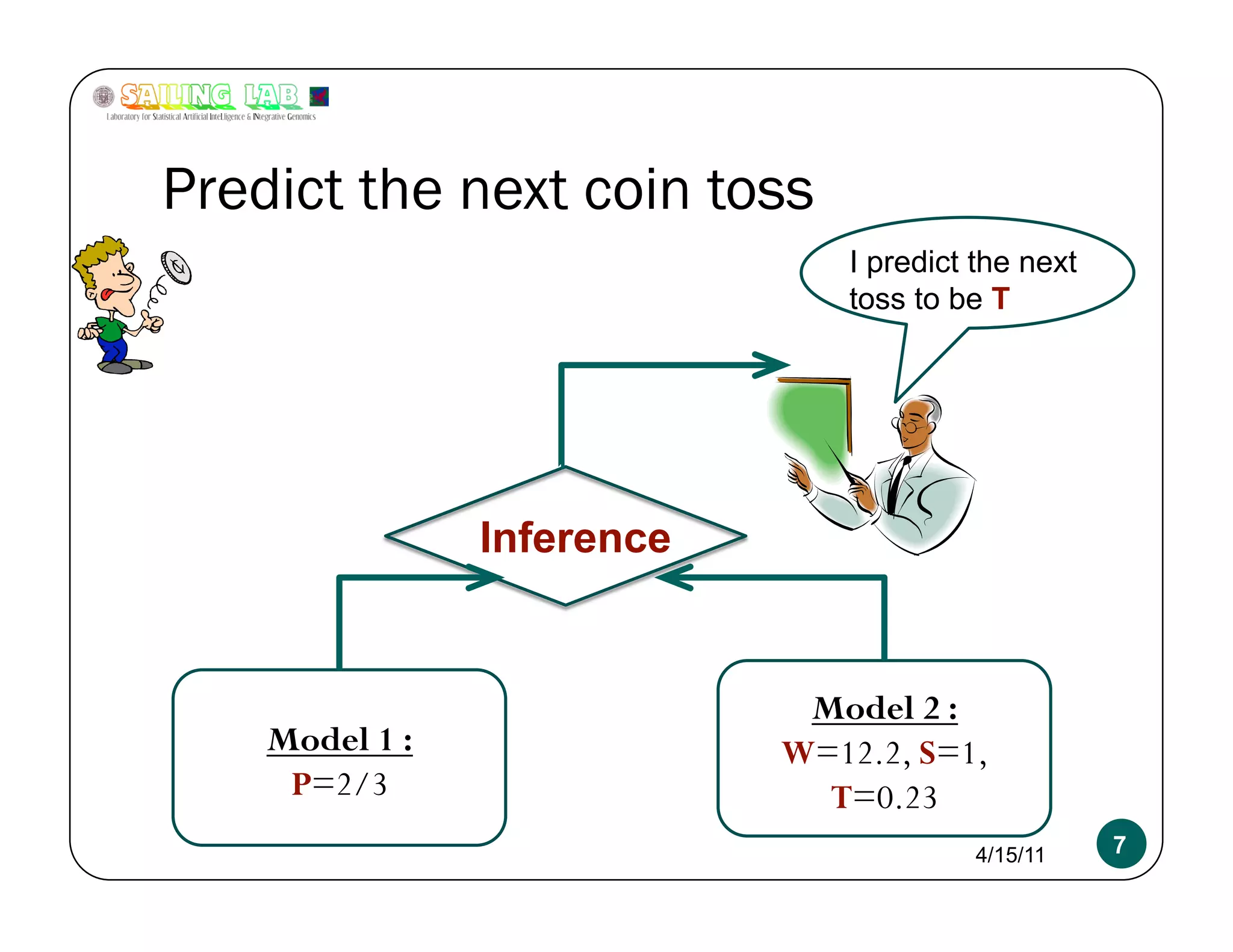
Predict the next coin toss
                               I predict the next
                               toss to be T


                Inference


                             Model 2 :
    Model 1 :               W=12.2, S=1,
     P=2/3                    T=0.23
                                        4/15/11     7
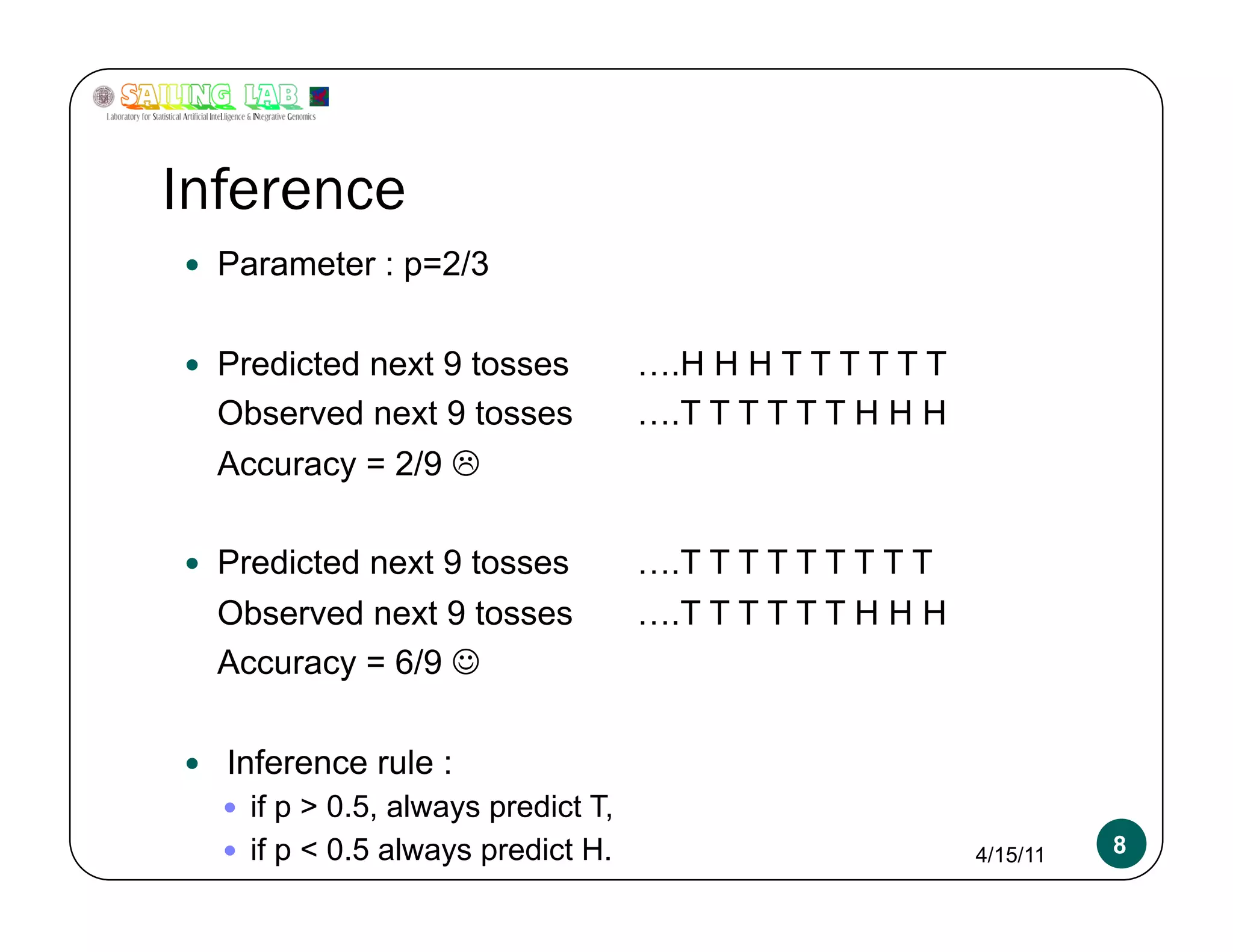
Inference
  Parameter : p=2/3


  Predicted next 9 tosses           ….H H H T T T T T T
  Observed next 9 tosses             ….T T T T T T H H H
  Accuracy = 2/9 

  Predicted next 9 tosses           ….T T T T T T T T T
  Observed next 9 tosses             ….T T T T T T H H H
  Accuracy = 6/9 

  Inference rule :
    if p > 0.5, always predict T,
    if p < 0.5 always predict H.                          4/15/11   8
The anatomy of classification
     1.  What is the data (features X, label y) ? ★★★
     2.  What is the model ? Model parameterization (w)
     3.  Inference : Given X, w, predict the label.
     4.  Learning    : Given (X,y) pairs, learn the “best” w
            Define “best” – maximize an objective function


(X,Y) pairs    train time
                               Learning
                                              w

                test time
     (X, ? )                    Inference         predicted Y
                                                                9
Logistic Regression


                      4/15/11   10
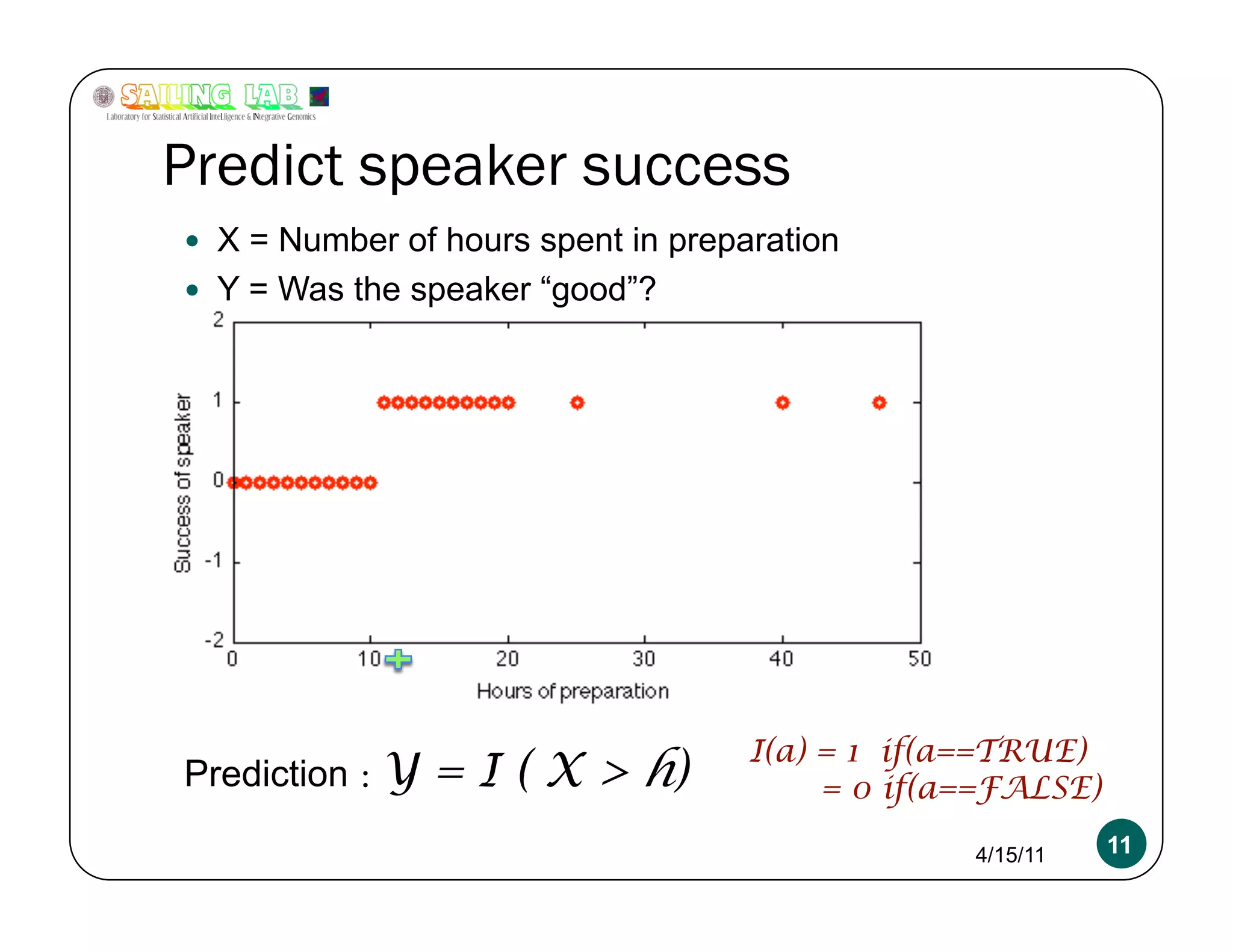
Predict speaker success
  X = Number of hours spent in preparation
  Y = Was the speaker “good”?


                                     I(a) = 1 if(a==TRUE)
Prediction : Y   = I ( X > h)             = 0 if(a==FALSE)

                                                  4/15/11    11
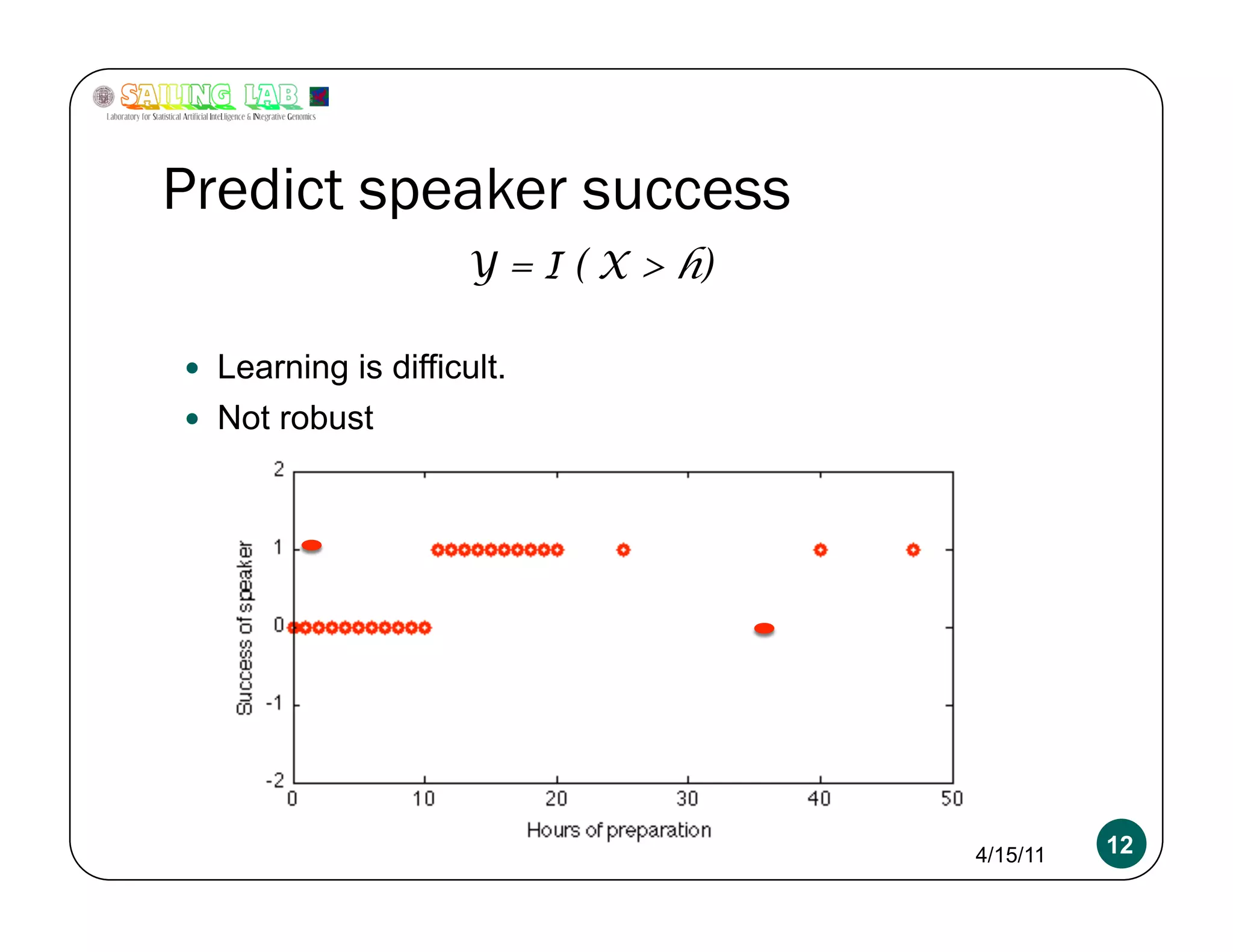
Predict speaker success
                     Y = I ( X > h)

  Learning is difficult.
  Not robust


                                      4/15/11   12
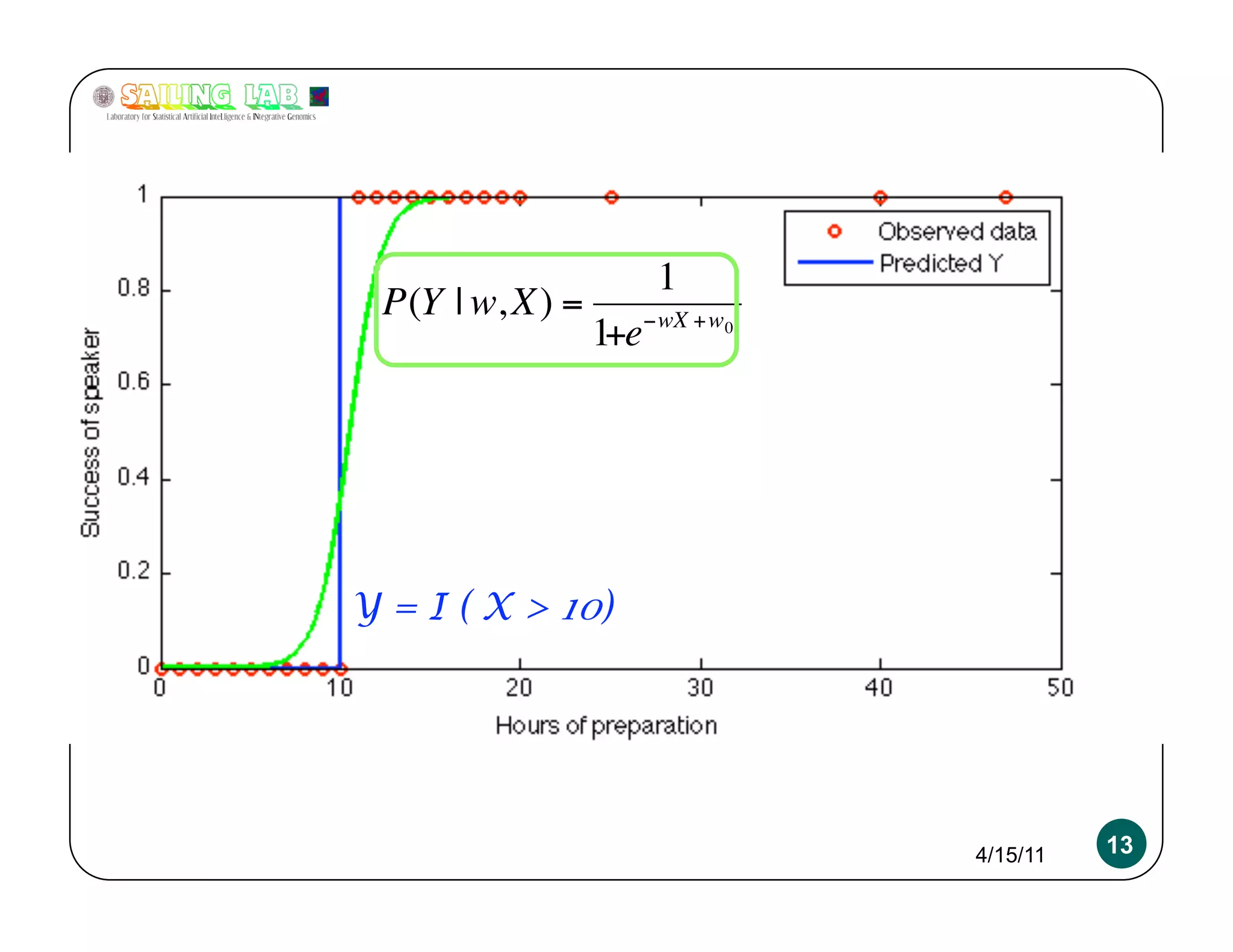
1
     P(Y | w, X) =
                     1+e−wX +w0


€

    Y = I ( X > 10)


                                  4/15/11   13
Logistic (sigmoidal) function


                                4/15/11   14
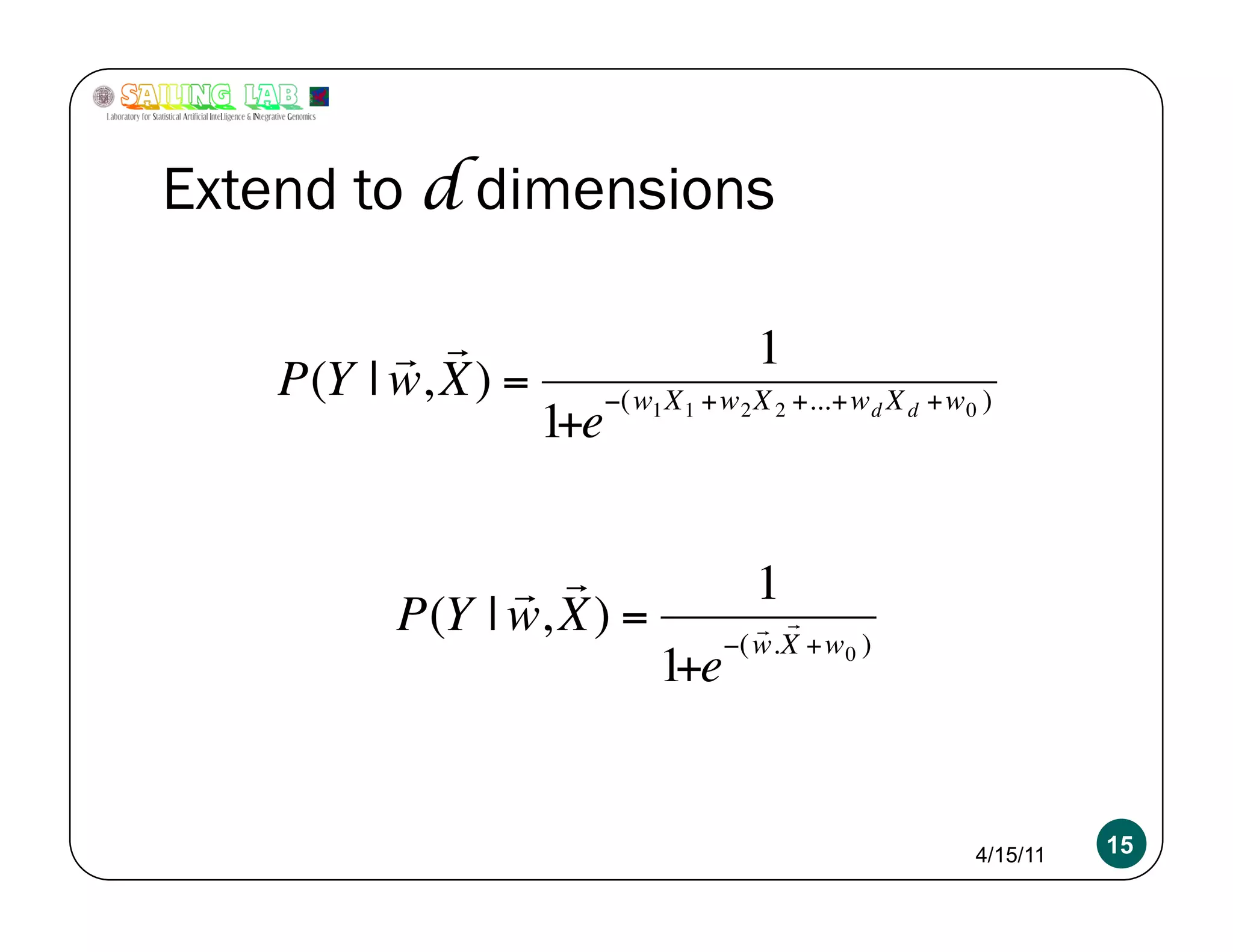
Extend to d dimensions

                                           1
        P(Y | w, X ) =         −( w1 X 1 +w 2 X 2 +...+w d X d +w 0 )
                         1+e


                                           1
              P(Y | w, X ) =                  
€                                   1+e
                                          −( w. X +w 0 )


                                                                   4/15/11   15
    €
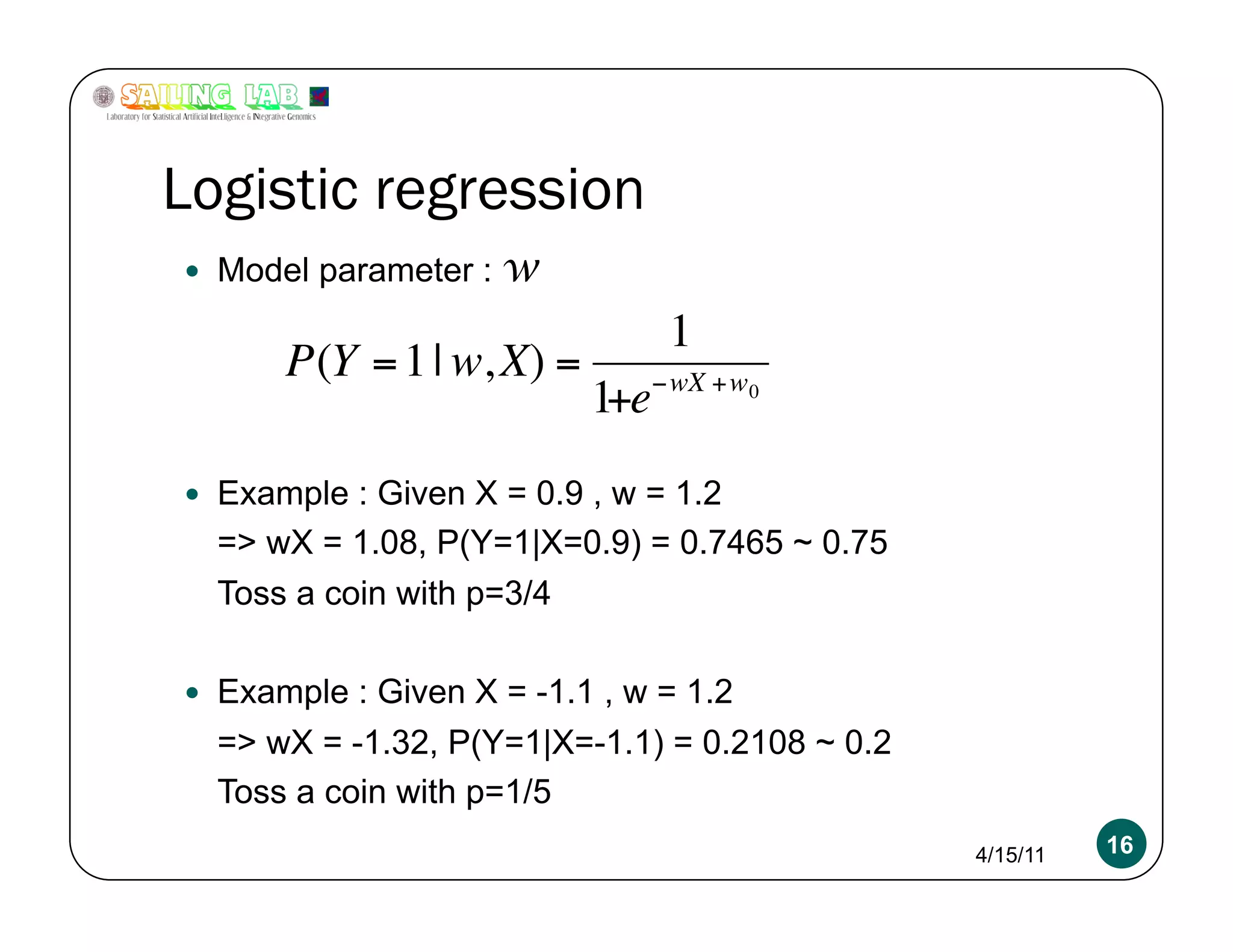
Logistic regression
      Model parameter :   w
                                      1
          P(Y = 1 | w, X) =          −wX +w 0
                               1+e
      Example : Given X = 0.9 , w = 1.2
      => wX = 1.08, P(Y=1|X=0.9) = 0.7465 ~ 0.75
€     Toss a coin with p=3/4

      Example : Given X = -1.1 , w = 1.2
      => wX = -1.32, P(Y=1|X=-1.1) = 0.2108 ~ 0.2
      Toss a coin with p=1/5
                                                    4/15/11   16
Another view of logistic regression
  Log odds : ln [ p/(1-p) ] = wX + ε

  p / (1-p) = ewX

  p = (1-p) ewX

  p (1 + ewX) = ewX

  p = ewX / (1 + ewX) = 1/(e-wX+1)


  Logistic regression is a “linear regression” between log-
  odds of an event and features (X)


                                                       4/15/11   17
The anatomy of classification
1.  What is the data (features X, label y) ?                ✔
2.  What is the model ? Model parameterization (w)          ✔
3.  Inference :Given X, w, predict the label.               ✔
4.  Learning : Given (X,y) pairs, learn the “best” w
      Define “best” – maximize an objective function


                                                  4/15/11       18
Learning : Finding the best w
Expressing…(X , Y )
   Data : (X , Y ),
             1   1
                     Conditional Log Likelihood
                         n   n


   If yi == 1, max P(yi=1| xi, w)
   If yi == 0, max P(yi=0| xi, w)


   Maximize Log-likelihood


                                     4/15/11   19
Learning : Example


             Data : (5, 0), (11, 1), (25,1)

    l(w)= ln P(y = 0 | x = 5,w) + ln P(y = 1 | x = 11,w) + ln P(y = 1 | x = 25,w)


             P(Y=1|X,w) is a logistic function

                                  1                               1
                                           ©Carlos Guestrin 2005-2009               1             !
             l(w)= ln(1−          −5w +w 0
                                           ) + ln                       + ln
                           1+ e                      1+ e−11w +w 0             1+ e−25w +w 0


      P(y=1|x) + P(y=0|x) = 1                                                           4/15/11   20
€
Optimization : Pick the “best” w


1.    Weka
2.    Matlab : w = mnrfit(X,Y)
3.    R : w <- glm(Y~X, family=binomial(link="logit"))
4.    IRLS : http://www.cs.cmu.edu/~ggordon/IRLS-example/logistic.m
5.    Implement your own                                             4/15/11   21
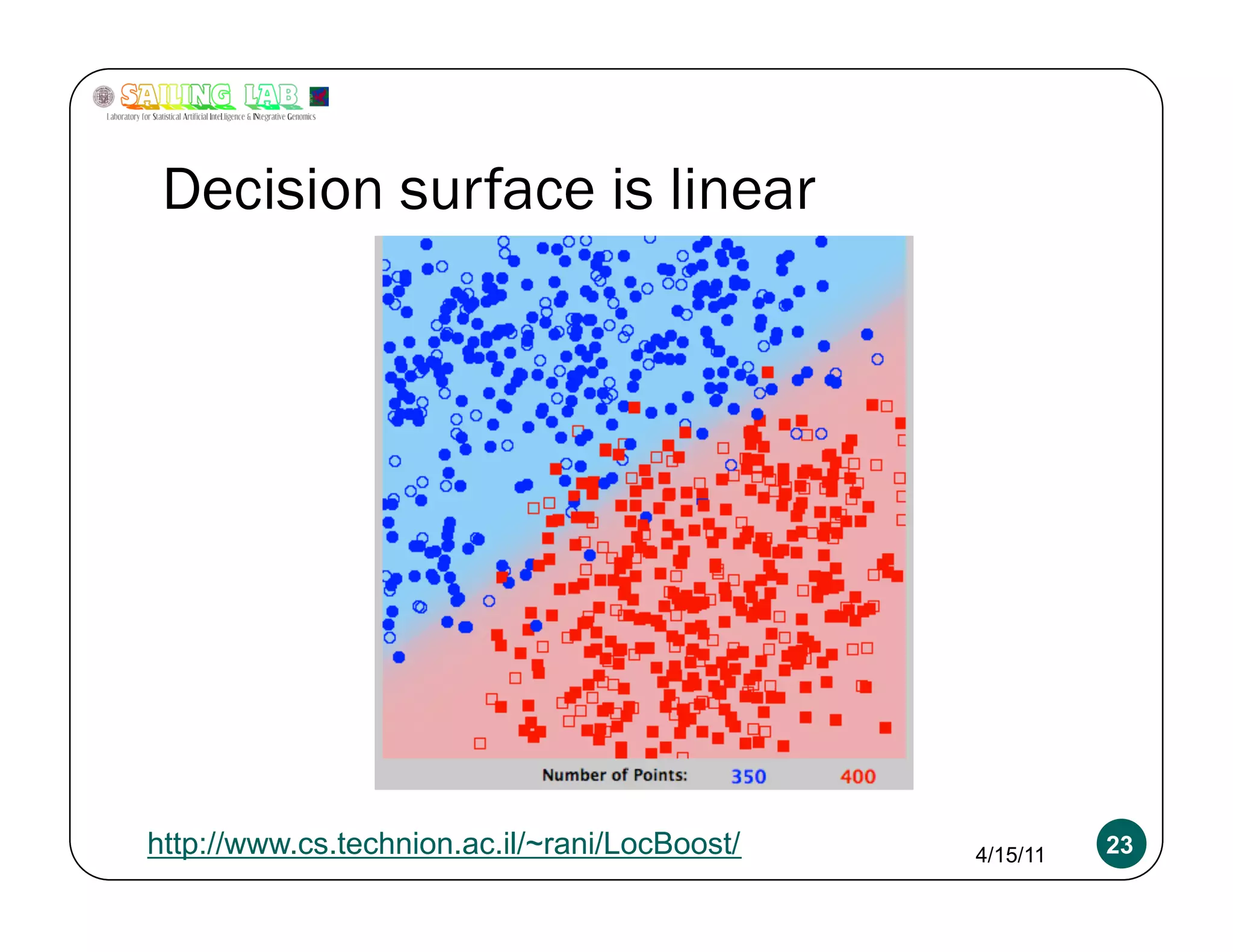
Decision surface is linear


                             Errors

    Y=0          Y=1


                              4/15/11   22
Decision surface is linear


http://www.cs.technion.ac.il/~rani/LocBoost/   4/15/11   23
So far..
  Logistic regression is a binary classifier (multinomial
   version exists)
  P(Y=1|X,w) is a logistic function
  Inference : Compute P(Y=1|X,w), and do “rounding”.
  Parameter learnt by maximizing log-likelihood of data.
  Decision surface is linear (kernelized version exists)


                                                        4/15/11   24
Improvements in the model
  Prevent over-fitting          Regularization
  Maximize accuracy directly    SVMs
  Non-linear decision surface   Kernel Trick
  Multi-label data


                                         4/15/11   25
Occam’s razor


The simplest explanation is most likely the correct
one


                                                  4/15/11   26
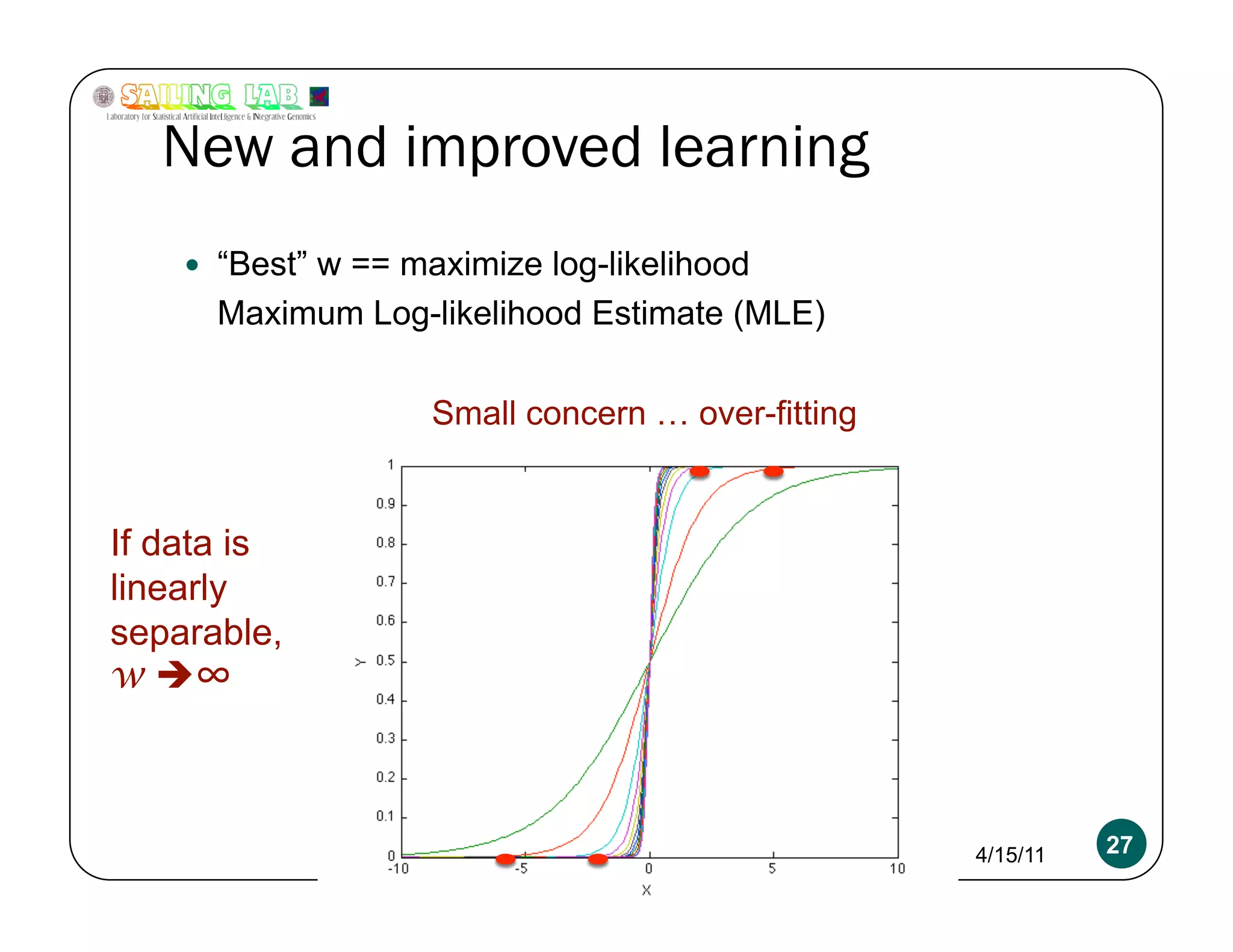
New and improved learning
      “Best” w == maximize log-likelihood
      Maximum Log-likelihood Estimate (MLE)

                    Small concern … over-fitting


If data is
linearly
separable,
w


                                                   4/15/11   27
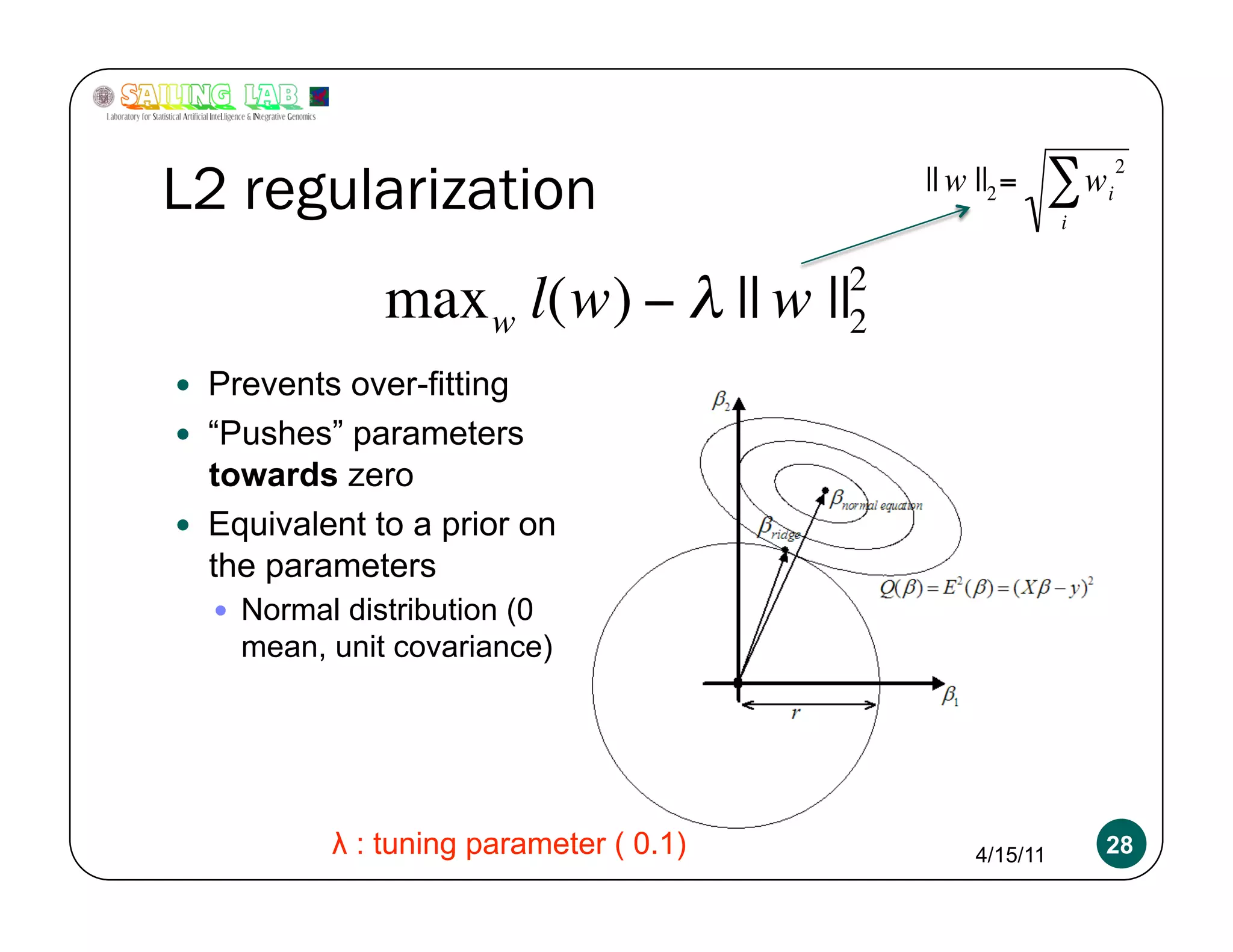
L2 regularization
                                                                         2
                                                   || w ||2 =     ∑ wi
                                                                  i

                                               2
                 max w l(w) − λ || w ||        2
  Prevents over-fitting
                                           €
  “Pushes” parameters
   towards zero
  Equivalent to a prior on
€  the parameters
      Normal distribution (0
      mean, unit covariance)


             λ : tuning parameter ( 0.1)                4/15/11       28
Patient Diagnosis
  Y = disease
  X = [age, weight, BP, blood sugar, MRI, genetic tests …]


  Don’t want all “features” to be relevant.


  Weight vector w should be “mostly zeros”.


                                                     4/15/11   29
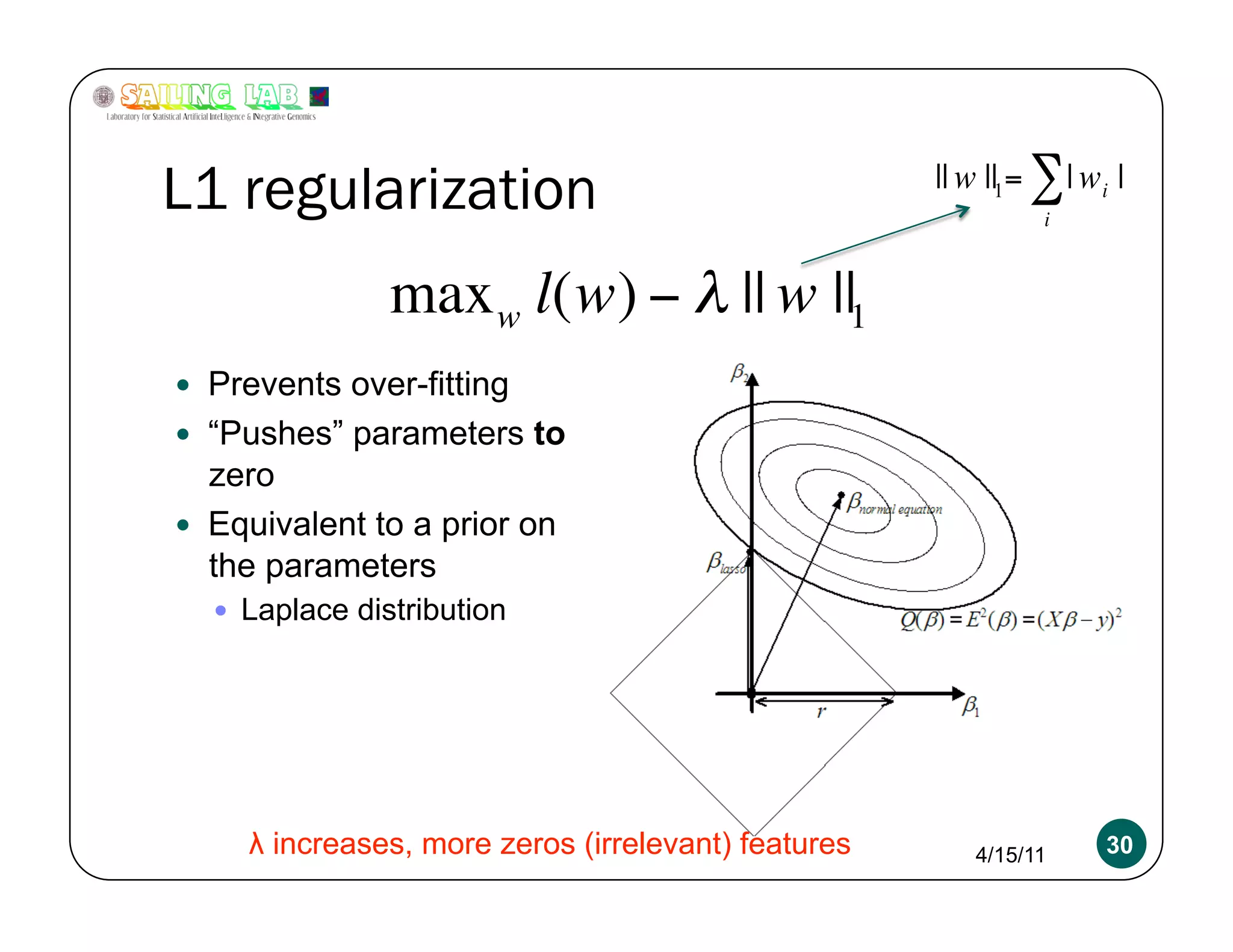
L1 regularization                                     || w ||1= ∑ | w i |
                                                                i


                 max w l(w) − λ || w ||1
                                               €
  Prevents over-fitting
  “Pushes” parameters to
   zero
  Equivalent to a prior on
€  the parameters
      Laplace distribution


      λ increases, more zeros (irrelevant) features       4/15/11      30
L1 v/s L2 example
  MLE estimate         : [ 11 0.8 ]

  L2 estimate          : [ 10 0.6 ]      shrinkage

  L1 estimate          : [ 10.2 0 ]     sparsity

  Mini-conclusion :
    L2 optimization is fast, L1 tends to be slower. If you have the
     computational resources, try both (at the same time) !
    ALWAYS run logistic regression with at least some
     regularization.
    Corollary : ALWAYS run logistic regression on features that
     have been standardized (zero mean, unit variance)
                                                            4/15/11    31
So far …
  Logistic regression
    Model
    Inference
    Learning via maximum likelihood
    L1 and L2 regularization


  Next …. SVMs !


                                       4/15/11   32
Why did we use probability again?
  Aim : Maximize “accuracy”


  Logistic regression : Indirect method that maximizes
  likelihood of data.

  A much more direct approach is to directly maximize
  accuracy.


        Support Vector Machines (SVMs)


                                                     4/15/11   33
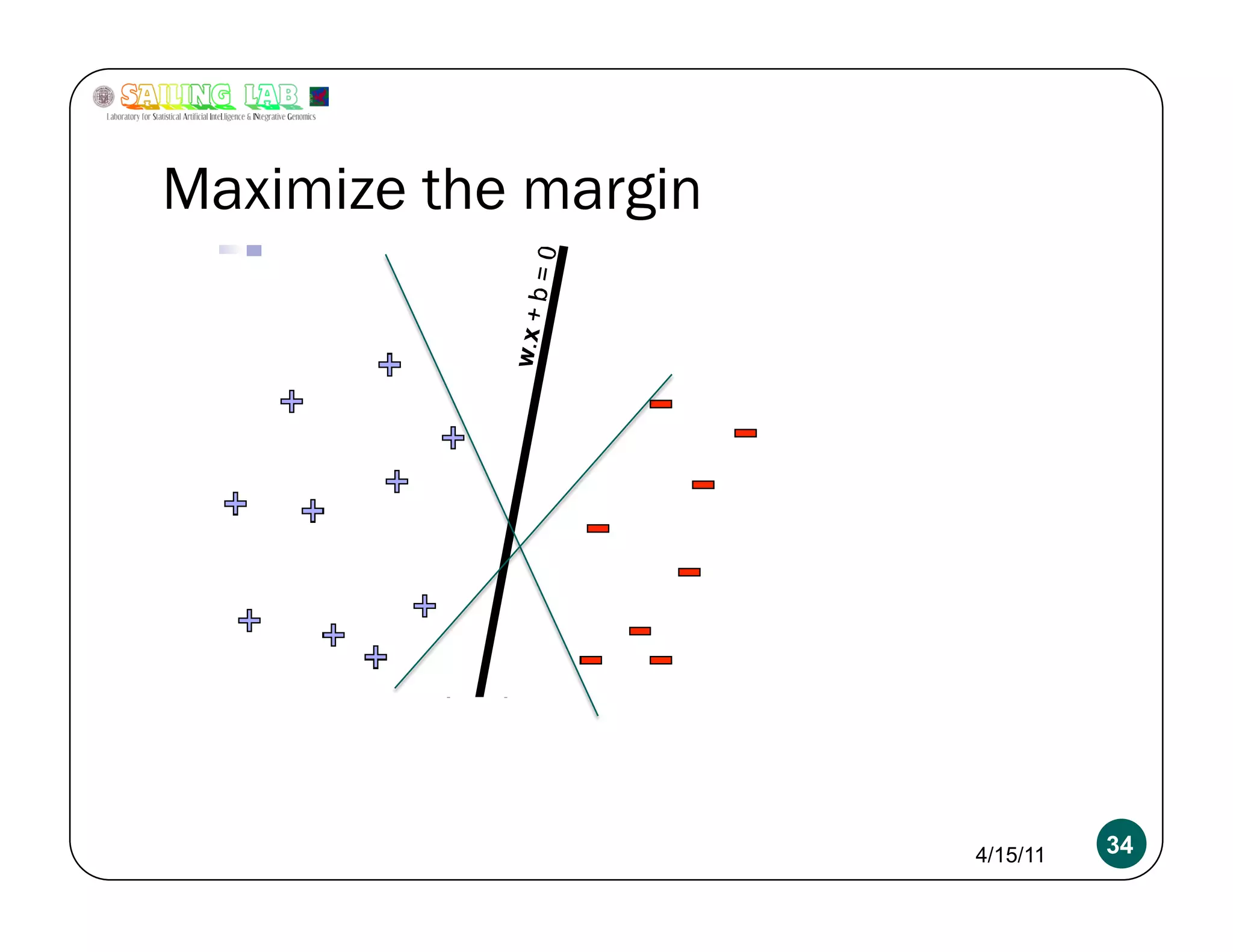
Maximize the margin
Maximize the margin


               ! 2005-2007 Carlos Guestrin                  "


                                             4/15/11   34
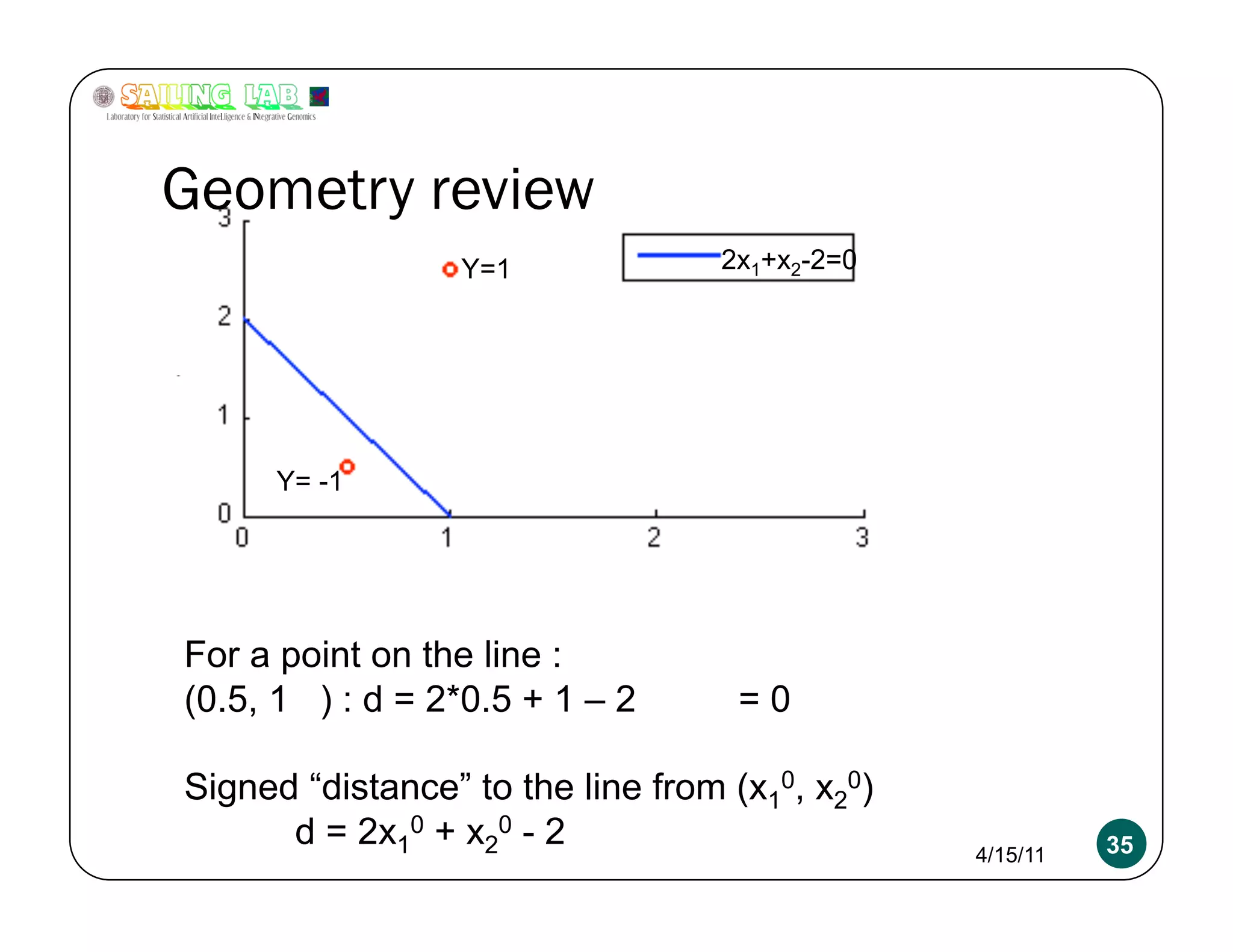
Geometry review
                  Y=1              2x1+x2-2=0


      Y= -1


For a point on the line :
(0.5, 1 ) : d = 2*0.5 + 1 – 2       =0

Signed “distance” to the line from (x10, x20)
      d = 2x10 + x20 - 2                        4/15/11   35
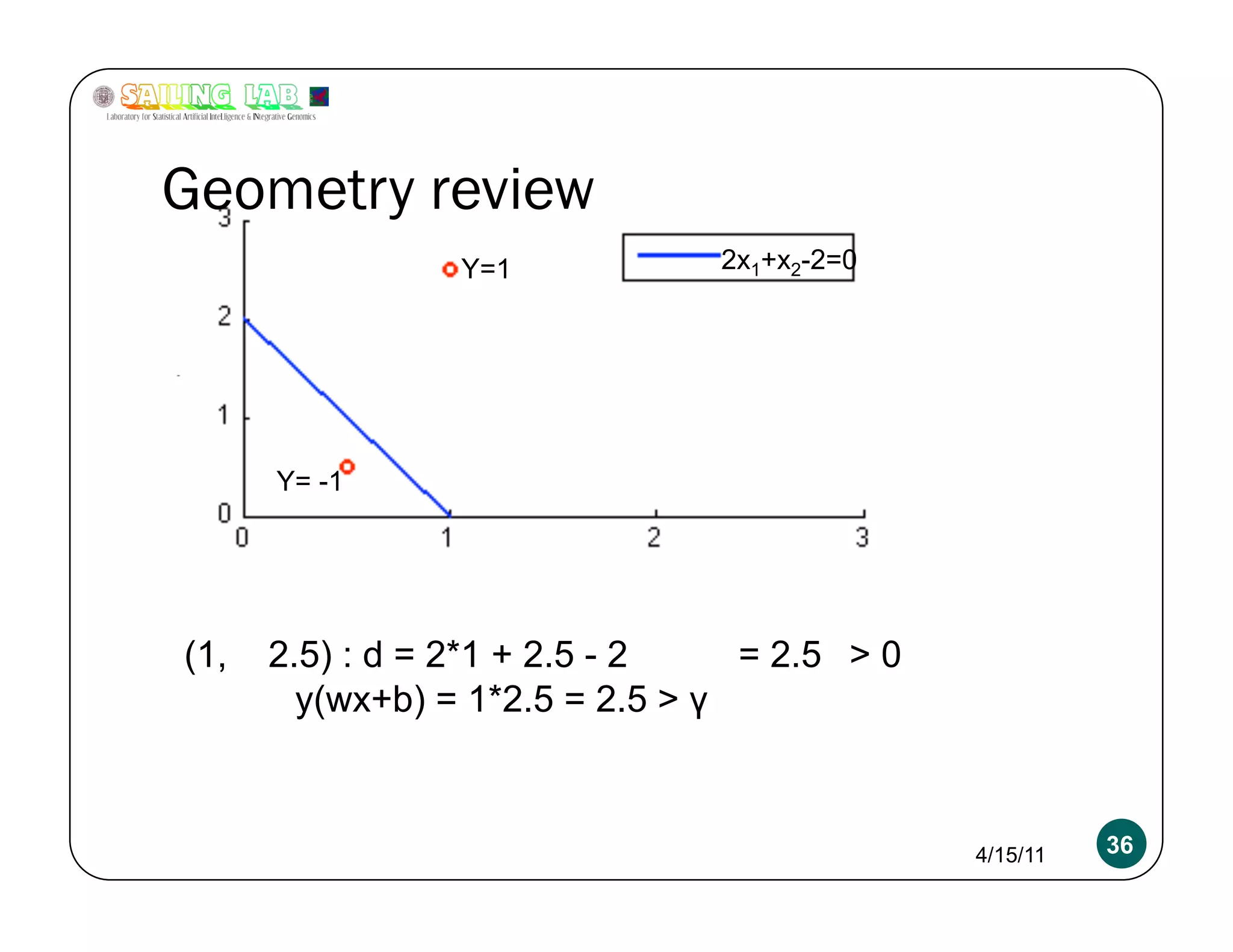
Geometry review
                 Y=1            2x1+x2-2=0


      Y= -1


(1,   2.5) : d = 2*1 + 2.5 - 2    = 2.5 > 0
        y(wx+b) = 1*2.5 = 2.5 > γ


                                              4/15/11   36
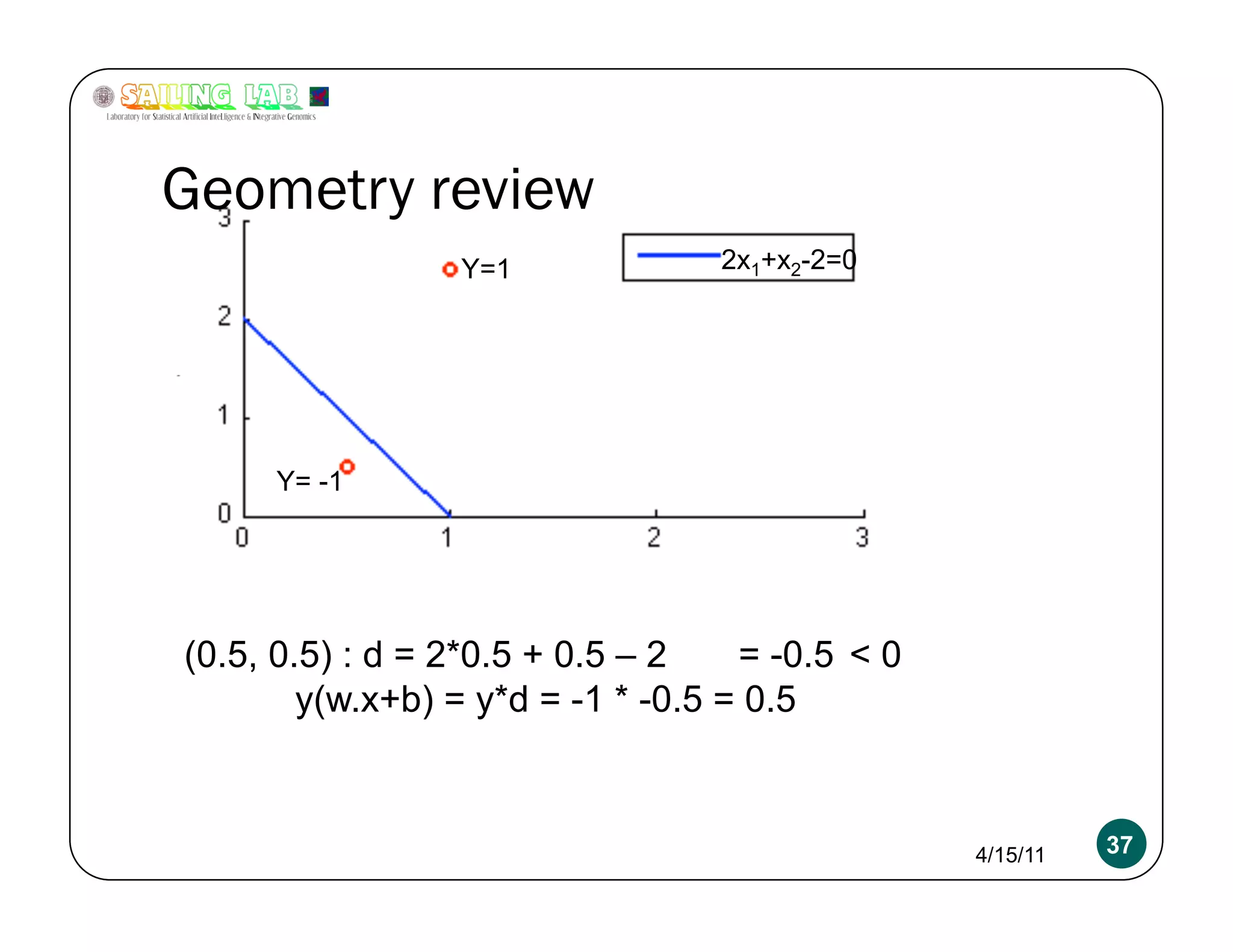
Geometry review
                 Y=1              2x1+x2-2=0


     Y= -1


(0.5, 0.5) : d = 2*0.5 + 0.5 – 2    = -0.5 < 0
        y(w.x+b) = y*d = -1 * -0.5 = 0.5


                                                 4/15/11   37
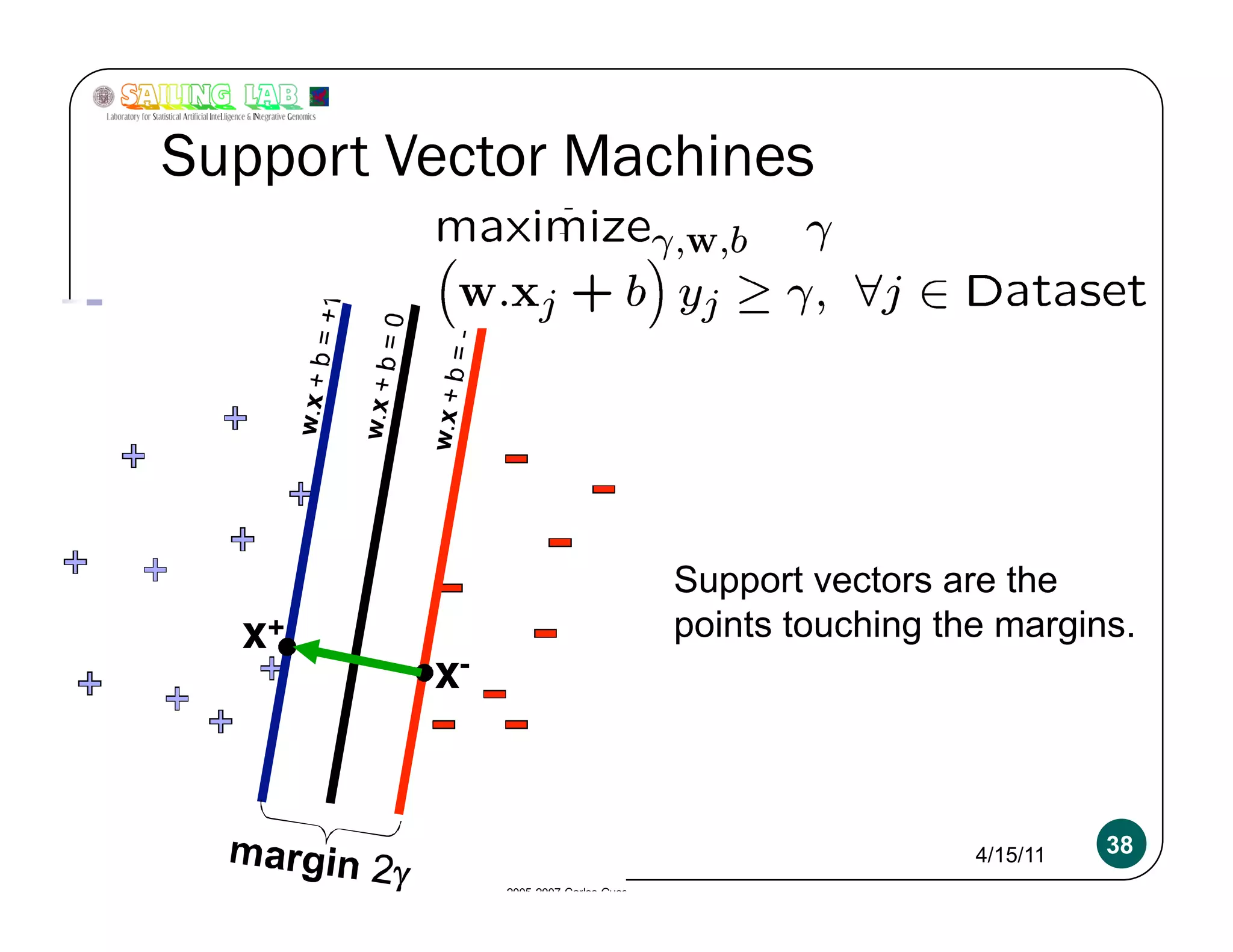
Support Vector Machines
Normalized margin – Canonical
hyperplanes
                                               ! 2005-2007 Carlos Guestrin                  "


                                            Support vectors are the
  x+                                        points touching the margins.
         x-


                                                                             4/15/11   38
              ! 2005-2007 Carlos Guestrin                                       !
= !j w(j) x(j)
                      ! 2005-2007 Carlos Guestrin                                      !


          w.x = !j w(j) x(j)
                                                    w.x = !j w(j) x(j)
                                                         ! 2005-2007 Carlos Guestrin                                 !


            Slack variables                                                            ! 2005-2007 Carlos Guestrin


                   SVMs are made robust by adding “slack variables” that
                   allow training error to be non-zero
ximize the margin point. Slack variable ==0 for correctly
         One for each data
     Maximizepoints. margin
          classified the
                      Maximize the−C∑ξ i
                             max γ margin


                                                     €


                                                                                                                     4/15/11   39
Slack variables
           max γ −C ∑ξ i


€
Need to tune C :
          high C == minimize mis-classifications
          low C == maximize margin


                                              4/15/11   40
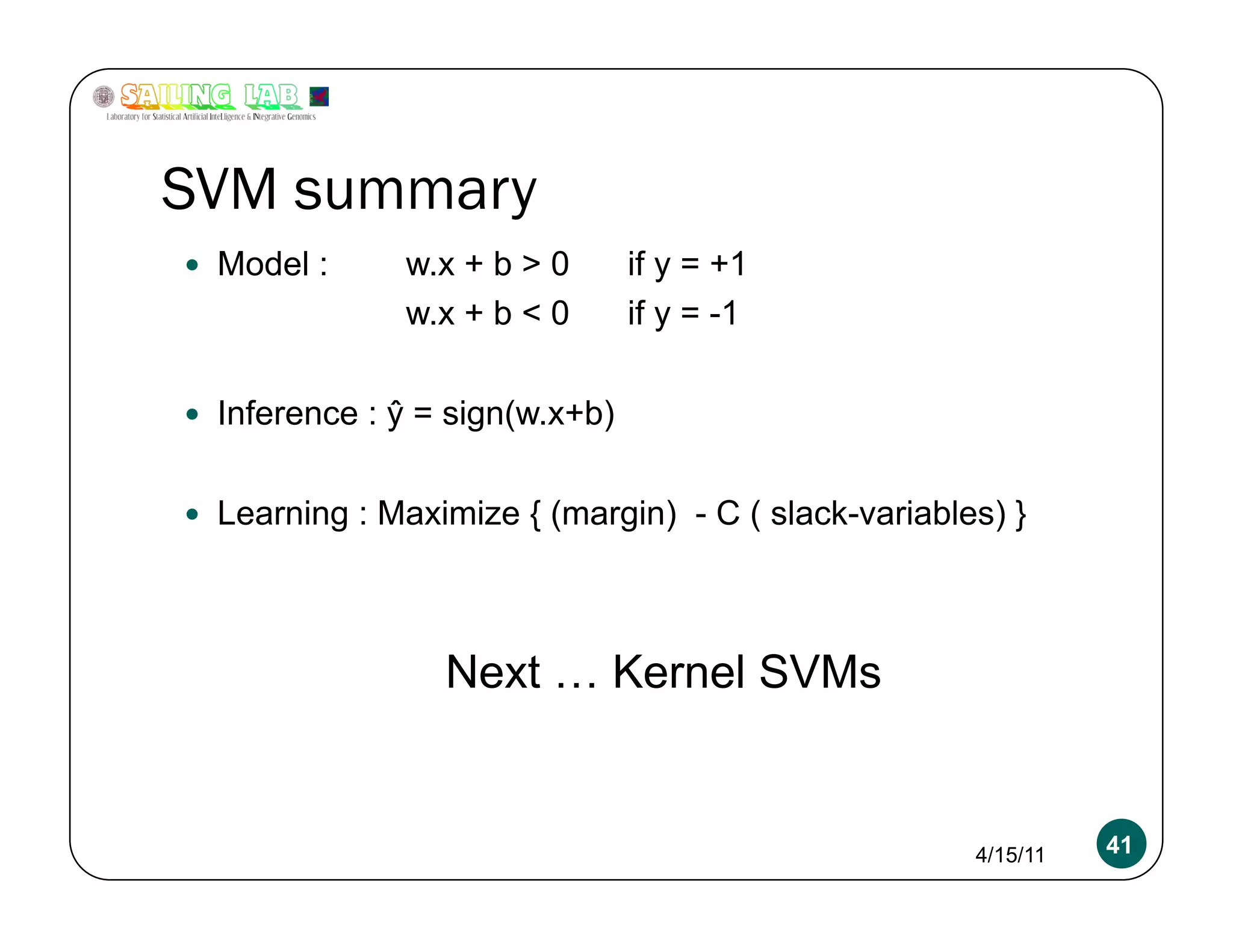
SVM summary
  Model :     w.x + b > 0       if y = +1
               w.x + b < 0       if y = -1

  Inference : ŷ = sign(w.x+b)


  Learning : Maximize { (margin) - C ( slack-variables) }


                  Next … Kernel SVMs


                                                      4/15/11   41
The kernel trick
  Why linear separator ? What if data looks like below ?

                                          The kernel trick
                                          allows you to use
                                          SVMs with non-
                                          linear separators.

                                          Different kernels
                                          1.  Polynomial
                                          2.  Gaussian
                                          3.  exponential


                                                     4/15/11   42
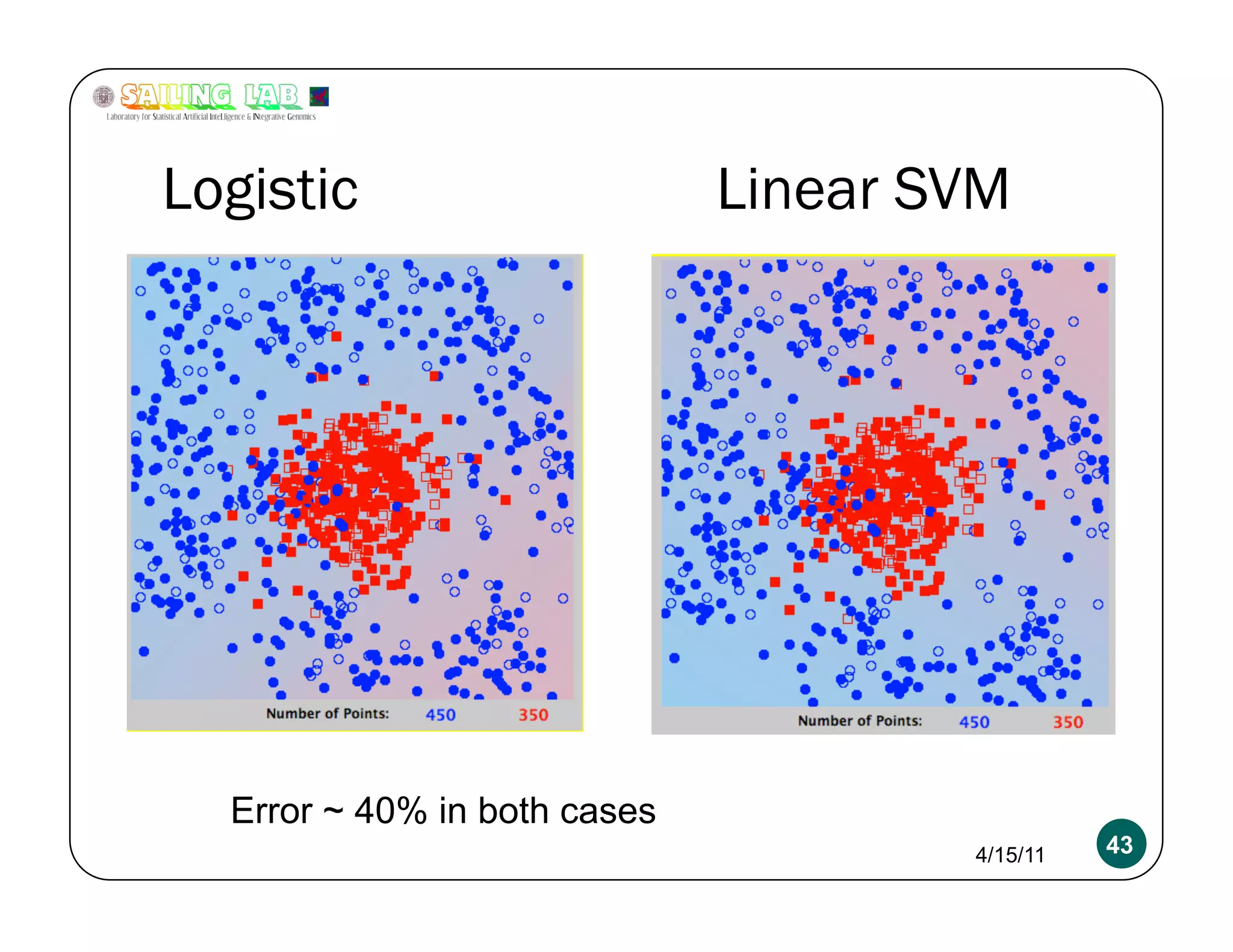
Logistic                      Linear SVM


  Error ~ 40% in both cases
                                      4/15/11   43
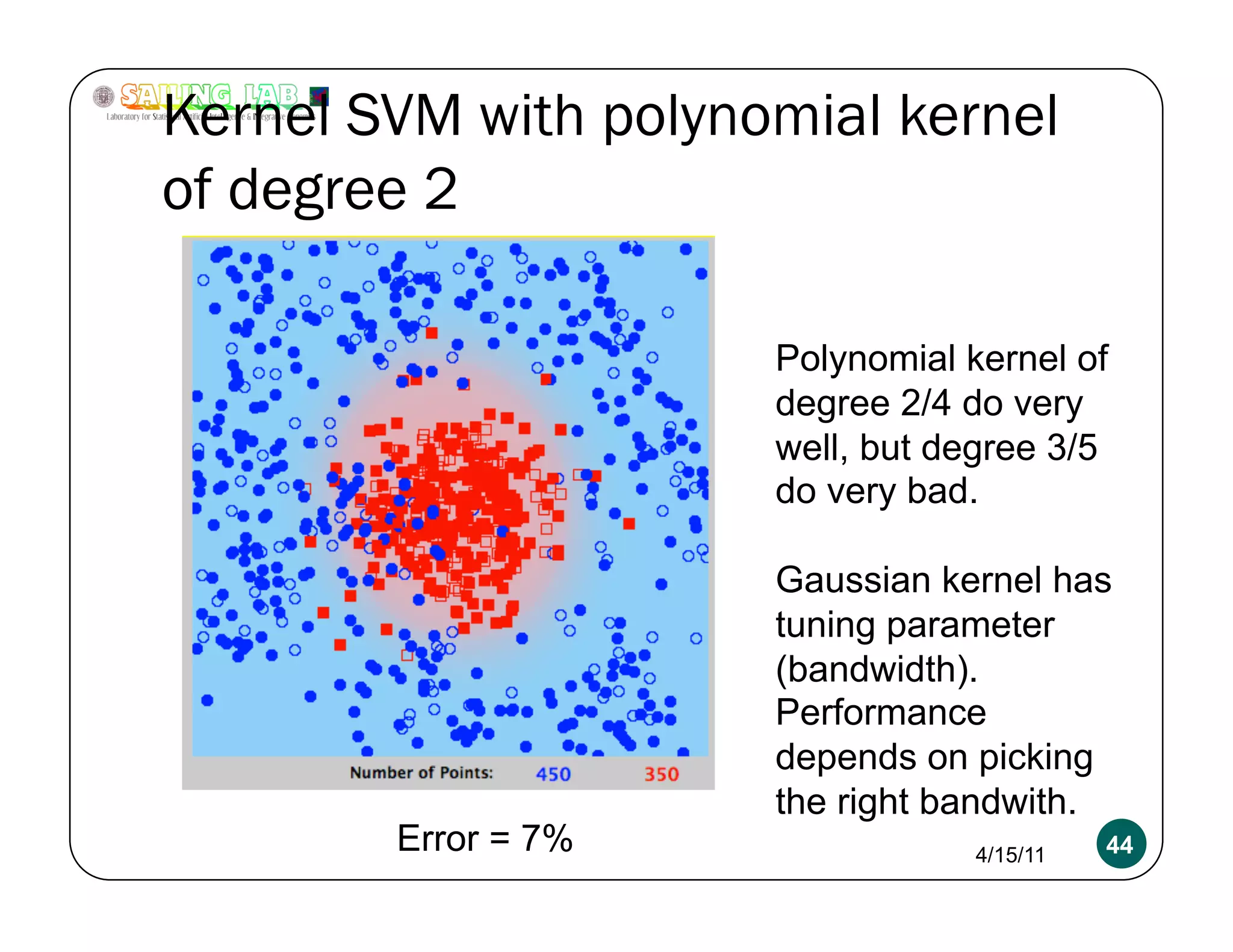
Kernel SVM with polynomial kernel
of degree 2

                      Polynomial kernel of
                      degree 2/4 do very
                      well, but degree 3/5
                      do very bad.

                      Gaussian kernel has
                      tuning parameter
                      (bandwidth).
                      Performance
                      depends on picking
                      the right bandwith.
        Error = 7%                4/15/11   44
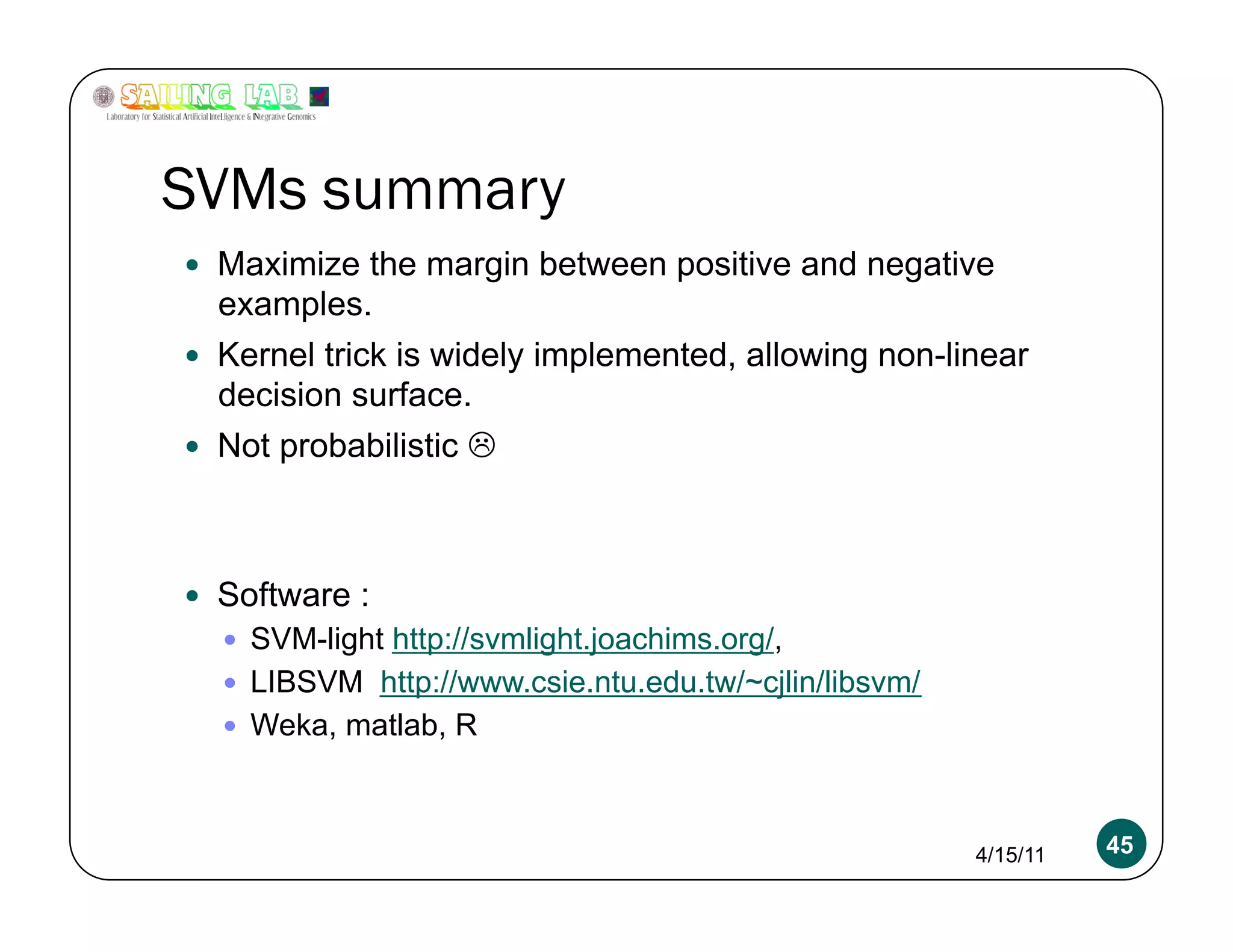
SVMs summary
  Maximize the margin between positive and negative
   examples.
  Kernel trick is widely implemented, allowing non-linear
   decision surface.
  Not probabilistic 


  Software :
    SVM-light http://svmlight.joachims.org/,
    LIBSVM http://www.csie.ntu.edu.tw/~cjlin/libsvm/
    Weka, matlab, R


                                                        4/15/11   45
Demo


       http://www.cs.technion.ac.il/~rani/LocBoost


                                                     4/15/11   46
Which to use ?
  Linear SVMs and logistic regression work very similar in
   most cases.
  Kernelized SVMs work better than linear SVMs (mostly)
  Kernelized logistic regression is possible, but
   implementations are not available easily.


                                                     4/15/11   47
Recommendations
1.  First, try logistic regression. Easy, fast, stable. No “tuning”
    parameters.
2.  Equivalently, you can first try linear SVMs, but you need
    to tune “C”
3.  If results are “good enough”, stop.
4.  Else try SVMs with Gaussian kernels.
     Need to tune bandwidth, C – by using validation data.

If you have more time/computational resources, try random
     forests as well.


** Recommendations are opinions of the presenter, and not known facts.

                                                                         4/15/11   48
In conclusion …


    Logistic Regression
    Support Vector Machines


       Other classification approaches …

    Random forests / decision trees
    Naïve Bayes
    Nearest Neighbors
    Boosting (Adaboost)
                                       4/15/11   49
Thank you
Questions?


             4/15/11   50
Kriti Puniyani
Carnegie Mellon University
      kriti@cmu.edu
Is this athlete doing drugs ?
  X = Blood-test-to-detect-drugs
  Y = Doped athlete ?


  Two types of errors :
    Athlete is doped, we predict “NO” : false negative
    Athlete is NOT doped, we predict “YES” : false positive


  Penalize false positives more than false negatives


                                                          4/15/11   52
Outline
  What is classification ?
     Parameters, data, inference, learning
     Predicting coin tosses (0-dimensional X)
  Logistic Regression
     Predicting “speaker success” (1-dimensional X)
     Formulation, optimizatiob
     Decision surface is linear
     Interpreting coefficients
     Hypothesis testing
     Evaluating the performance of the model
     Why is it called “regression” : log-odds
     L2 regularization
     Patient survival (d-dimensional X)
     L1 regularization
  Support Vector Machines
     Linear SVMs + formulation
     What are “support vectors”
     The kernel trick
  Demo : logistic regression v/s SVMs v/s kernel tricks   4/15/11   53
Overfitting a more serious problem


2x+y-2 = 0               w = [2 1 -2]
4x+2y-4 = 0              w = [4 2 -4]
400x+200y-400 = 0        w = [400 200 -400]

 Absolutely need L2 regularization           4/15/11   54

Intro to Classification: Logistic Regression & SVM

  • 1.
    Kriti Puniyani Carnegie MellonUniversity kriti@cmu.edu
  • 2.
    About me   Graduatestudent at Carnegie Mellon University   Statistical machine learning   Topic models   Sparse network learning   Optimization   Domains of interest   Social media analysis   Systems biology   Genetics   Sentiment analysis   Text processing 4/15/11 2
  • 3.
    Machine learning   Computersto “learn with experience”   Learn : to be able to predict “unseen” things.   Many applications   Search   Machine translation   Speech recognition   Vision : identify cars, people, sky, apples   Robot control   Introductions :   http://www.cs.cmu.edu/~tom/pubs/MachineLearning.pdf   http://videolectures.net/mlss2010_lawrence_mlfcs/ 4/15/11 3
  • 4.
    Classification   Is thisthe digit “9” ? ρ   Will this patient survive ?   Will this user click on my ad ? 4/15/11 4
  • 5.
    Predict the nextcoin toss Data Task THTTTTHHTHTHTTT Model 1 : Model 2 : Coin is tossed with Toss depends on wind probability p (of condition W, starting being tails) pose S, torque T Parameters 4/15/11 5
  • 6.
    Predict the nextcoin toss THTTTTHHTHTHTTT Learning Model 2 : Model 1 : W=12.2, S=1, p=2/3 T=0.23 4/15/11 6
  • 7.
    Predict the nextcoin toss I predict the next toss to be T Inference Model 2 : Model 1 : W=12.2, S=1, P=2/3 T=0.23 4/15/11 7
  • 8.
    Inference   Parameter :p=2/3   Predicted next 9 tosses ….H H H T T T T T T Observed next 9 tosses ….T T T T T T H H H Accuracy = 2/9    Predicted next 9 tosses ….T T T T T T T T T Observed next 9 tosses ….T T T T T T H H H Accuracy = 6/9    Inference rule :   if p > 0.5, always predict T,   if p < 0.5 always predict H. 4/15/11 8
  • 9.
    The anatomy ofclassification 1.  What is the data (features X, label y) ? ★★★ 2.  What is the model ? Model parameterization (w) 3.  Inference : Given X, w, predict the label. 4.  Learning : Given (X,y) pairs, learn the “best” w   Define “best” – maximize an objective function (X,Y) pairs train time Learning w test time (X, ? ) Inference predicted Y 9
  • 10.
  • 11.
    Predict speaker success  X = Number of hours spent in preparation   Y = Was the speaker “good”? I(a) = 1 if(a==TRUE) Prediction : Y = I ( X > h) = 0 if(a==FALSE) 4/15/11 11
  • 12.
    Predict speaker success Y = I ( X > h)   Learning is difficult.   Not robust 4/15/11 12
  • 13.
    1 P(Y | w, X) = 1+e−wX +w0 € Y = I ( X > 10) 4/15/11 13
  • 14.
  • 15.
    Extend to ddimensions   1 P(Y | w, X ) = −( w1 X 1 +w 2 X 2 +...+w d X d +w 0 ) 1+e   1 P(Y | w, X ) =   € 1+e −( w. X +w 0 ) 4/15/11 15 €
  • 16.
    Logistic regression   Model parameter : w 1 P(Y = 1 | w, X) = −wX +w 0 1+e   Example : Given X = 0.9 , w = 1.2 => wX = 1.08, P(Y=1|X=0.9) = 0.7465 ~ 0.75 € Toss a coin with p=3/4   Example : Given X = -1.1 , w = 1.2 => wX = -1.32, P(Y=1|X=-1.1) = 0.2108 ~ 0.2 Toss a coin with p=1/5 4/15/11 16
  • 17.
    Another view oflogistic regression   Log odds : ln [ p/(1-p) ] = wX + ε   p / (1-p) = ewX   p = (1-p) ewX   p (1 + ewX) = ewX   p = ewX / (1 + ewX) = 1/(e-wX+1)   Logistic regression is a “linear regression” between log- odds of an event and features (X) 4/15/11 17
  • 18.
    The anatomy ofclassification 1.  What is the data (features X, label y) ? ✔ 2.  What is the model ? Model parameterization (w) ✔ 3.  Inference :Given X, w, predict the label. ✔ 4.  Learning : Given (X,y) pairs, learn the “best” w   Define “best” – maximize an objective function 4/15/11 18
  • 19.
    Learning : Findingthe best w Expressing…(X , Y )   Data : (X , Y ), 1 1 Conditional Log Likelihood n n   If yi == 1, max P(yi=1| xi, w)   If yi == 0, max P(yi=0| xi, w)   Maximize Log-likelihood 4/15/11 19
  • 20.
    Learning : Example   Data : (5, 0), (11, 1), (25,1) l(w)= ln P(y = 0 | x = 5,w) + ln P(y = 1 | x = 11,w) + ln P(y = 1 | x = 25,w)   P(Y=1|X,w) is a logistic function 1 1 ©Carlos Guestrin 2005-2009 1 ! l(w)= ln(1− −5w +w 0 ) + ln + ln 1+ e 1+ e−11w +w 0 1+ e−25w +w 0 P(y=1|x) + P(y=0|x) = 1 4/15/11 20 €
  • 21.
    Optimization : Pickthe “best” w 1.  Weka 2.  Matlab : w = mnrfit(X,Y) 3.  R : w <- glm(Y~X, family=binomial(link="logit")) 4.  IRLS : http://www.cs.cmu.edu/~ggordon/IRLS-example/logistic.m 5.  Implement your own  4/15/11 21
  • 22.
    Decision surface islinear Errors Y=0 Y=1 4/15/11 22
  • 23.
    Decision surface islinear http://www.cs.technion.ac.il/~rani/LocBoost/ 4/15/11 23
  • 24.
    So far..   Logisticregression is a binary classifier (multinomial version exists)   P(Y=1|X,w) is a logistic function   Inference : Compute P(Y=1|X,w), and do “rounding”.   Parameter learnt by maximizing log-likelihood of data.   Decision surface is linear (kernelized version exists) 4/15/11 24
  • 25.
    Improvements in themodel   Prevent over-fitting Regularization   Maximize accuracy directly SVMs   Non-linear decision surface Kernel Trick   Multi-label data 4/15/11 25
  • 26.
    Occam’s razor The simplestexplanation is most likely the correct one 4/15/11 26
  • 27.
    New and improvedlearning   “Best” w == maximize log-likelihood Maximum Log-likelihood Estimate (MLE) Small concern … over-fitting If data is linearly separable, w 4/15/11 27
  • 28.
    L2 regularization 2 || w ||2 = ∑ wi i 2 max w l(w) − λ || w || 2   Prevents over-fitting €   “Pushes” parameters towards zero   Equivalent to a prior on € the parameters   Normal distribution (0 mean, unit covariance) λ : tuning parameter ( 0.1) 4/15/11 28
  • 29.
    Patient Diagnosis   Y= disease   X = [age, weight, BP, blood sugar, MRI, genetic tests …]   Don’t want all “features” to be relevant.   Weight vector w should be “mostly zeros”. 4/15/11 29
  • 30.
    L1 regularization || w ||1= ∑ | w i | i max w l(w) − λ || w ||1 €   Prevents over-fitting   “Pushes” parameters to zero   Equivalent to a prior on € the parameters   Laplace distribution λ increases, more zeros (irrelevant) features 4/15/11 30
  • 31.
    L1 v/s L2example   MLE estimate : [ 11 0.8 ]   L2 estimate : [ 10 0.6 ] shrinkage   L1 estimate : [ 10.2 0 ] sparsity   Mini-conclusion :   L2 optimization is fast, L1 tends to be slower. If you have the computational resources, try both (at the same time) !   ALWAYS run logistic regression with at least some regularization.   Corollary : ALWAYS run logistic regression on features that have been standardized (zero mean, unit variance) 4/15/11 31
  • 32.
    So far …  Logistic regression   Model   Inference   Learning via maximum likelihood   L1 and L2 regularization Next …. SVMs ! 4/15/11 32
  • 33.
    Why did weuse probability again?   Aim : Maximize “accuracy”   Logistic regression : Indirect method that maximizes likelihood of data.   A much more direct approach is to directly maximize accuracy. Support Vector Machines (SVMs) 4/15/11 33
  • 34.
    Maximize the margin Maximizethe margin ! 2005-2007 Carlos Guestrin " 4/15/11 34
  • 35.
    Geometry review Y=1 2x1+x2-2=0 Y= -1 For a point on the line : (0.5, 1 ) : d = 2*0.5 + 1 – 2 =0 Signed “distance” to the line from (x10, x20) d = 2x10 + x20 - 2 4/15/11 35
  • 36.
    Geometry review Y=1 2x1+x2-2=0 Y= -1 (1, 2.5) : d = 2*1 + 2.5 - 2 = 2.5 > 0 y(wx+b) = 1*2.5 = 2.5 > γ 4/15/11 36
  • 37.
    Geometry review Y=1 2x1+x2-2=0 Y= -1 (0.5, 0.5) : d = 2*0.5 + 0.5 – 2 = -0.5 < 0 y(w.x+b) = y*d = -1 * -0.5 = 0.5 4/15/11 37
  • 38.
    Support Vector Machines Normalizedmargin – Canonical hyperplanes ! 2005-2007 Carlos Guestrin " Support vectors are the x+ points touching the margins. x- 4/15/11 38 ! 2005-2007 Carlos Guestrin !
  • 39.
    = !j w(j)x(j) ! 2005-2007 Carlos Guestrin ! w.x = !j w(j) x(j) w.x = !j w(j) x(j) ! 2005-2007 Carlos Guestrin ! Slack variables ! 2005-2007 Carlos Guestrin   SVMs are made robust by adding “slack variables” that allow training error to be non-zero ximize the margin point. Slack variable ==0 for correctly   One for each data Maximizepoints. margin classified the Maximize the−C∑ξ i max γ margin € 4/15/11 39
  • 40.
    Slack variables max γ −C ∑ξ i € Need to tune C : high C == minimize mis-classifications low C == maximize margin 4/15/11 40
  • 41.
    SVM summary   Model: w.x + b > 0 if y = +1 w.x + b < 0 if y = -1   Inference : ŷ = sign(w.x+b)   Learning : Maximize { (margin) - C ( slack-variables) } Next … Kernel SVMs 4/15/11 41
  • 42.
    The kernel trick  Why linear separator ? What if data looks like below ? The kernel trick allows you to use SVMs with non- linear separators. Different kernels 1.  Polynomial 2.  Gaussian 3.  exponential 4/15/11 42
  • 43.
    Logistic Linear SVM Error ~ 40% in both cases 4/15/11 43
  • 44.
    Kernel SVM withpolynomial kernel of degree 2 Polynomial kernel of degree 2/4 do very well, but degree 3/5 do very bad. Gaussian kernel has tuning parameter (bandwidth). Performance depends on picking the right bandwith. Error = 7% 4/15/11 44
  • 45.
    SVMs summary   Maximizethe margin between positive and negative examples.   Kernel trick is widely implemented, allowing non-linear decision surface.   Not probabilistic    Software :   SVM-light http://svmlight.joachims.org/,   LIBSVM http://www.csie.ntu.edu.tw/~cjlin/libsvm/   Weka, matlab, R 4/15/11 45
  • 46.
    Demo http://www.cs.technion.ac.il/~rani/LocBoost 4/15/11 46
  • 47.
    Which to use?   Linear SVMs and logistic regression work very similar in most cases.   Kernelized SVMs work better than linear SVMs (mostly)   Kernelized logistic regression is possible, but implementations are not available easily. 4/15/11 47
  • 48.
    Recommendations 1.  First, trylogistic regression. Easy, fast, stable. No “tuning” parameters. 2.  Equivalently, you can first try linear SVMs, but you need to tune “C” 3.  If results are “good enough”, stop. 4.  Else try SVMs with Gaussian kernels. Need to tune bandwidth, C – by using validation data. If you have more time/computational resources, try random forests as well. ** Recommendations are opinions of the presenter, and not known facts. 4/15/11 48
  • 49.
    In conclusion …   Logistic Regression   Support Vector Machines Other classification approaches …   Random forests / decision trees   Naïve Bayes   Nearest Neighbors   Boosting (Adaboost) 4/15/11 49
  • 50.
  • 51.
    Kriti Puniyani Carnegie MellonUniversity kriti@cmu.edu
  • 52.
    Is this athletedoing drugs ?   X = Blood-test-to-detect-drugs   Y = Doped athlete ?   Two types of errors :   Athlete is doped, we predict “NO” : false negative   Athlete is NOT doped, we predict “YES” : false positive   Penalize false positives more than false negatives 4/15/11 52
  • 53.
    Outline   What isclassification ?   Parameters, data, inference, learning   Predicting coin tosses (0-dimensional X)   Logistic Regression   Predicting “speaker success” (1-dimensional X)   Formulation, optimizatiob   Decision surface is linear   Interpreting coefficients   Hypothesis testing   Evaluating the performance of the model   Why is it called “regression” : log-odds   L2 regularization   Patient survival (d-dimensional X)   L1 regularization   Support Vector Machines   Linear SVMs + formulation   What are “support vectors”   The kernel trick   Demo : logistic regression v/s SVMs v/s kernel tricks 4/15/11 53
  • 54.
    Overfitting a moreserious problem 2x+y-2 = 0 w = [2 1 -2] 4x+2y-4 = 0 w = [4 2 -4] 400x+200y-400 = 0 w = [400 200 -400]  Absolutely need L2 regularization 4/15/11 54