Introduction to Neural Networks
        By. Ruchi Sharma
             BVCOE
             DELHI


02/13/13
What are connectionist neural
                    networks?
• Connectionism refers to a computer modeling
  approach to computation that is loosely based
  upon the architecture of the brain.
• Many different models, but all include:
     – Multiple, individual “nodes” or “units” that operate at
       the same time (in parallel)
     – A network that connects the nodes together
     – Information is stored in a distributed fashion among the
       links that connect the nodes
     – Learning can occur with gradual changes in connection
       strength

02/13/13
Neural Network History
• History traces back to the 50’s but became popular in the 80’s
  with work by Rumelhart, Hinton, and Mclelland
    – A General Framework for Parallel Distributed Processing in Parallel
      Distributed Processing: Explorations in the Microstructure of
      Cognition
• Peaked in the 90’s. Today:
    – Hundreds of variants
    – Less a model of the actual brain than a useful tool, but still some
      debate
• Numerous applications
    – Handwriting, face, speech recognition
    – Vehicles that drive themselves
    – Models of reading, sentence production, dreaming
• Debate for philosophers and cognitive scientists
    – Can human consciousness or cognitive abilities be explained by a
      connectionist model or does it require the manipulation of symbols?
 02/13/13
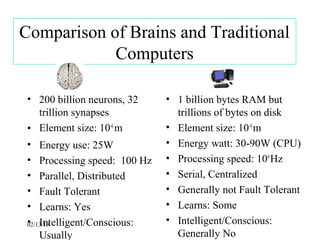
Comparison of Brains and Traditional
            Computers

 • 200 billion neurons, 32    • 1 billion bytes RAM but
   trillion synapses            trillions of bytes on disk
 • Element size: 10-6 m       • Element size: 10-9 m
 • Energy use: 25W            • Energy watt: 30-90W (CPU)
 • Processing speed: 100 Hz   • Processing speed: 109 Hz
 • Parallel, Distributed      • Serial, Centralized
 • Fault Tolerant             • Generally not Fault Tolerant
 • Learns: Yes                • Learns: Some
 • Intelligent/Conscious:
 02/13/13
                              • Intelligent/Conscious:
     Usually                    Generally No
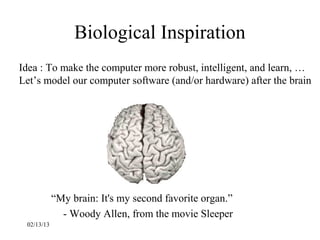
Biological Inspiration
Idea : To make the computer more robust, intelligent, and learn, …
Let’s model our computer software (and/or hardware) after the brain


            “My brain: It's my second favorite organ.”
              - Woody Allen, from the movie Sleeper
 02/13/13
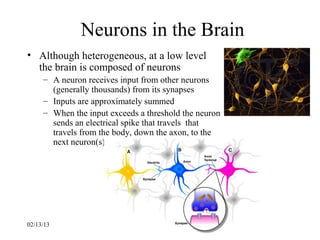
Neurons in the Brain
• Although heterogeneous, at a low level
  the brain is composed of neurons
     – A neuron receives input from other neurons
       (generally thousands) from its synapses
     – Inputs are approximately summed
     – When the input exceeds a threshold the neuron
       sends an electrical spike that travels that
       travels from the body, down the axon, to the
       next neuron(s)


02/13/13
Learning in the Brain
• Brains learn
   – Altering strength between neurons
   – Creating/deleting connections
• Hebb’s Postulate (Hebbian Learning)
   – When an axon of cell A is near enough to excite a cell B and repeatedly
     or persistently takes part in firing it, some growth process or metabolic
     change takes place in one or both cells such that A's efficiency, as one
     of the cells firing B, is increased.
• Long Term Potentiation (LTP)
   – Cellular basis for learning and memory
   – LTP is the long-lasting strengthening of the connection between two
     nerve cells in response to stimulation
   – Discovered in many regions of the cortex

 02/13/13
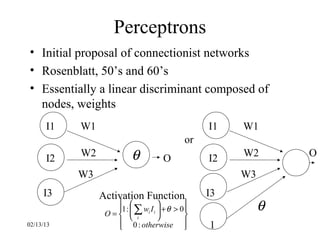
Perceptrons
• Initial proposal of connectionist networks
• Rosenblatt, 50’s and 60’s
• Essentially a linear discriminant composed of
  nodes, weights
      I1   W1                                   I1   W1
                                           or
      I2   W2             θ         O           I2   W2       O

           W3                                        W3
     I3         Activation Function             I3
                    
                 O=  i
                                           
                   1 :  ∑ wi I i  + θ > 0
                                            
                                                          θ
                                   
02/13/13            0 : otherwise             1
                                           
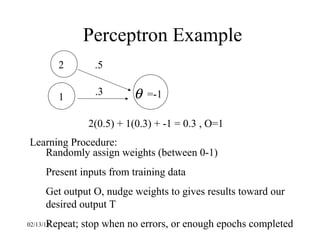
Perceptron Example
           2     .5


           1     .3       θ   =-1

                2(0.5) + 1(0.3) + -1 = 0.3 , O=1
Learning Procedure:
   Randomly assign weights (between 0-1)
      Present inputs from training data
      Get output O, nudge weights to gives results toward our
      desired output T
      Repeat; stop when no errors, or enough epochs completed
02/13/13
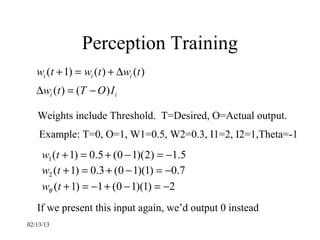
Perception Training
   wi (t + 1) = wi (t ) + ∆wi (t )
   ∆wi (t ) = (T − O ) I i

   Weights include Threshold. T=Desired, O=Actual output.
    Example: T=0, O=1, W1=0.5, W2=0.3, I1=2, I2=1,Theta=-1
     w1 (t + 1) = 0.5 + (0 − 1)( 2) = −1.5
     w2 (t + 1) = 0.3 + (0 − 1)(1) = −0.7
     wθ (t + 1) = −1 + (0 − 1)(1) = −2
   If we present this input again, we’d output 0 instead
02/13/13
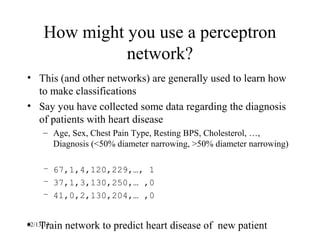
How might you use a perceptron
               network?
• This (and other networks) are generally used to learn how
  to make classifications
• Say you have collected some data regarding the diagnosis
  of patients with heart disease
     – Age, Sex, Chest Pain Type, Resting BPS, Cholesterol, …,
       Diagnosis (<50% diameter narrowing, >50% diameter narrowing)

     – 67,1,4,120,229,…, 1
     – 37,1,3,130,250,… ,0
     – 41,0,2,130,204,… ,0


• Train network to predict heart disease of new patient
02/13/13
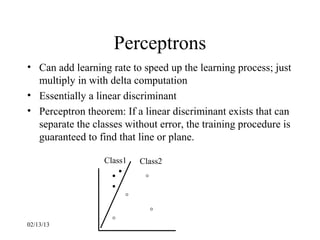
Perceptrons
• Can add learning rate to speed up the learning process; just
  multiply in with delta computation
• Essentially a linear discriminant
• Perceptron theorem: If a linear discriminant exists that can
  separate the classes without error, the training procedure is
  guaranteed to find that line or plane.

                  Class1   Class2


02/13/13
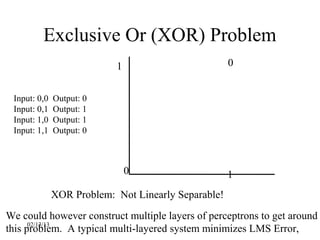
Exclusive Or (XOR) Problem
                           1                         0


 Input: 0,0   Output: 0
 Input: 0,1   Output: 1
 Input: 1,0   Output: 1
 Input: 1,1   Output: 0


                               0                     1
              XOR Problem: Not Linearly Separable!
We could however construct multiple layers of perceptrons to get around
      02/13/13
this problem. A typical multi-layered system minimizes LMS Error,
LMS Learning
LMS = Least Mean Square learning Systems, more general than the
previous perceptron learning rule. The concept is to minimize the total
error, as measured over all training examples, P. O is the raw output,
as calculated by ∑ wi I i + θ
                  i
                                  1
               Dis tan ce( LMS ) = ∑ ( TP − OP )
                                                 2

                                  2 P
E.g. if we have two patterns and
T1=1, O1=0.8, T2=0, O2=0.5 then D=(0.5)[(1-0.8) 2+(0-0.5)2]=.145

We want to minimize the LMS:
                                     C-learning rate

           E                                           W(old)
                                               W(new)


02/13/13
                                                       W
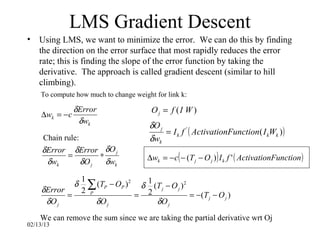
LMS Gradient Descent
•   Using LMS, we want to minimize the error. We can do this by finding
    the direction on the error surface that most rapidly reduces the error
    rate; this is finding the slope of the error function by taking the
    derivative. The approach is called gradient descent (similar to hill
    climbing).
    To compute how much to change weight for link k:

                 δError                     Oj = f (I W )
     ∆wk = − c
                  δwk
                                            δO j
                                                 = I k f ' ( ActivationFunction ( I kWk ) )
     Chain rule:                            δwk
     δError δError δO j
      δwk
           =
             δO j
                  ∗
                    δwk                    ∆wk = −c ( − (T j − O j ) ) I k f ' ( ActivationFunction )

                     1
                 δ     ∑ (TP − OP ) 2 δ 1 (T j − O j ) 2
     δError          2 P
            =                        = 2                 = −(T j − O j )
      δO j               δO j              δO j
    We can remove the sum since we are taking the partial derivative wrt Oj
02/13/13
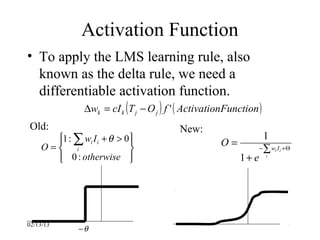
Activation Function
• To apply the LMS learning rule, also
  known as the delta rule, we need a
  differentiable activation function.
          ∆wk = cI k (T j − O j ) f ' ( ActivationFunction )
Old:                                   New:
      1 : ∑ wi I i + θ > 0
                                               O=
                                                               1
    O= i                                                   − ∑ wi I i + Θ
       0 : otherwise 
                                                    1+ e     i


02/13/13
             −θ
LMS vs. Limiting Threshold
• With the new sigmoidal function that is differentiable, we
  can apply the delta rule toward learning.
• Perceptron Method
     – Forced output to 0 or 1, while LMS uses the net output
     – Guaranteed to separate, if no error and is linearly separable
           • Otherwise it may not converge
• Gradient Descent Method:
     – May oscillate and not converge
     – May converge to wrong answer
     – Will converge to some minimum even if the classes are not
       linearly separable, unlike the earlier perceptron training method


02/13/13
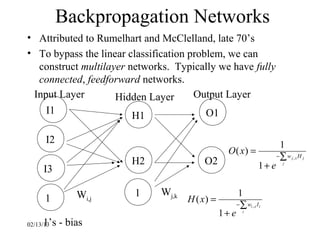
Backpropagation Networks
• Attributed to Rumelhart and McClelland, late 70’s
• To bypass the linear classification problem, we can
  construct multilayer networks. Typically we have fully
  connected, feedforward networks.
 Input Layer        Hidden Layer       Output Layer
    I1                                    O1
                        H1

      I2                                                                   1
                                                  O( x) =                 −∑ w j , x H j
                       H2                O2                        1+ e      j
     I3

             Wi,j       1     Wj,k                     1
      1                              H ( x) =          − ∑ wi , x I i
                                                1+ e      i


     1’s - bias
02/13/13
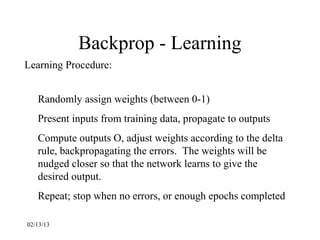
Backprop - Learning
Learning Procedure:


   Randomly assign weights (between 0-1)
   Present inputs from training data, propagate to outputs
   Compute outputs O, adjust weights according to the delta
   rule, backpropagating the errors. The weights will be
   nudged closer so that the network learns to give the
   desired output.
   Repeat; stop when no errors, or enough epochs completed

02/13/13
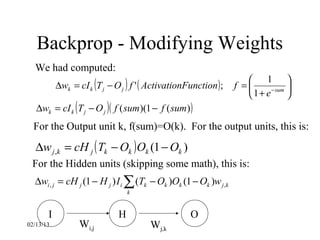
Backprop - Modifying Weights
  We had computed:
           ∆wk = cI k (T j − O j ) f ' ( ActivationFunction ) ;
                                                                      1 
                                                                  f =     −sum 
                                                                     1+ e      
   ∆wk = cI k ( T j − O j ) ( f ( sum )(1 − f ( sum) )
  For the Output unit k, f(sum)=O(k). For the output units, this is:
   ∆w j ,k = cH j ( Tk − Ok ) Ok (1 − Ok )
 For the Hidden units (skipping some math), this is:
  ∆wi , j = cH j (1 − H j ) I i ∑ (Tk − Ok )Ok (1 − Ok )w j ,k
                                  k


       I                      H                      O
02/13/13          Wi,j                  Wj,k
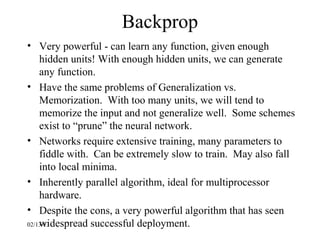
Backprop
• Very powerful - can learn any function, given enough
    hidden units! With enough hidden units, we can generate
    any function.
• Have the same problems of Generalization vs.
    Memorization. With too many units, we will tend to
    memorize the input and not generalize well. Some schemes
    exist to “prune” the neural network.
• Networks require extensive training, many parameters to
    fiddle with. Can be extremely slow to train. May also fall
    into local minima.
• Inherently parallel algorithm, ideal for multiprocessor
    hardware.
• Despite the cons, a very powerful algorithm that has seen
    widespread successful deployment.
02/13/13
Backprop Demo
• QwikNet
     – Learning XOR, Sin/Cos functions


02/13/13
Unsupervised Learning
• We just discussed a form of supervised learning
     – A “teacher” tells the network what the correct output is
       based on the input until the network learns the target
       concept
• We can also train networks where there is no
  teacher. This is called unsupervised learning.
  The network learns a prototype based on the
  distribution of patterns in the training data. Such
  networks allow us to:
     – Discover underlying structure of the data
     – Encode or compress the data
     – Transform the data
02/13/13
Unsupervised Learning – Hopfield
              Networks
• A Hopfield network is a type of content-
  addressable memory
     – Non-linear system with attractor points that
       represent concepts
     – Given a fuzzy input the system converges to the
       nearest attractor
           • Possibility to have “spurious” attractors that is a blend
             of multiple stored patterns
           • Also possible to have chaotic patterns that never
             converge
02/13/13
Standard Binary Hopfield Network
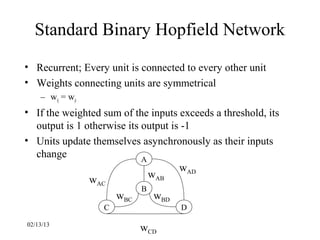
• Recurrent; Every unit is connected to every other unit
• Weights connecting units are symmetrical
    – wij = wji
• If the weighted sum of the inputs exceeds a threshold, its
  output is 1 otherwise its output is -1
• Units update themselves asynchronously as their inputs
  change                    A
                                     wAD
                              wAB
               wAC
                            B
                     wBC       wBD
                  C                 D

02/13/13
                           wCD
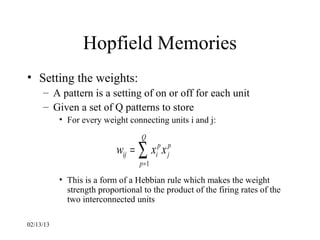
Hopfield Memories
• Setting the weights:
     – A pattern is a setting of on or off for each unit
     – Given a set of Q patterns to store
           • For every weight connecting units i and j:
                                   Q
                           wij = ∑ xip x jp
                                  p =1

           • This is a form of a Hebbian rule which makes the weight
             strength proportional to the product of the firing rates of the
             two interconnected units

02/13/13
Hopfield Network Demo
• http://www.cbu.edu/~pong/ai/hopfield/hopfieldap
  plet.html

• Properties
     – Settles into a minimal energy state
     – Storage capacity low, only 13% of number of units
     – Can retrieve information even in the presence of noisy
       data, similar to associative memory of humans


02/13/13
Unsupervised Learning – Self
                Organizing Maps
• Self-organizing maps (SOMs) are a data
  visualization technique invented by Professor
  Teuvo Kohonen
     – Also called Kohonen Networks, Competitive Learning,
       Winner-Take-All Learning
     – Generally reduces the dimensions of data through the
       use of self-organizing neural networks
     – Useful for data visualization; humans cannot visualize
       high dimensional data so this is often a useful technique
       to make sense of large data sets

02/13/13
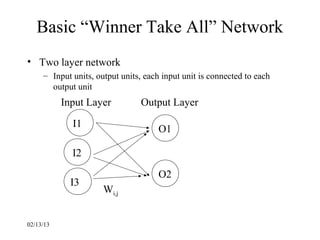
Basic “Winner Take All” Network
• Two layer network
     – Input units, output units, each input unit is connected to each
       output unit
           Input Layer           Output Layer

             I1                       O1

             I2

                                      O2
             I3
                      Wi,j


02/13/13
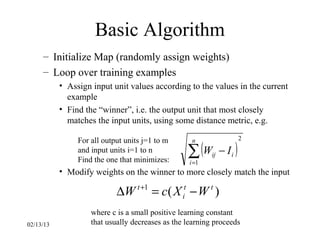
Basic Algorithm
     – Initialize Map (randomly assign weights)
     – Loop over training examples
           • Assign input unit values according to the values in the current
             example
           • Find the “winner”, i.e. the output unit that most closely
             matches the input units, using some distance metric, e.g.

                For all output units j=1 to m                           2

                                                  ∑ (W         − Ii )
                                                    n
                and input units i=1 to n
                                                          ij
                Find the one that minimizes:       i =1
           • Modify weights on the winner to more closely match the input

                            ∆W t +1 = c( X it − W t )
                    where c is a small positive learning constant
02/13/13            that usually decreases as the learning proceeds
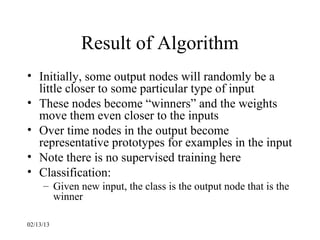
Result of Algorithm
• Initially, some output nodes will randomly be a
  little closer to some particular type of input
• These nodes become “winners” and the weights
  move them even closer to the inputs
• Over time nodes in the output become
  representative prototypes for examples in the input
• Note there is no supervised training here
• Classification:
     – Given new input, the class is the output node that is the
       winner

02/13/13
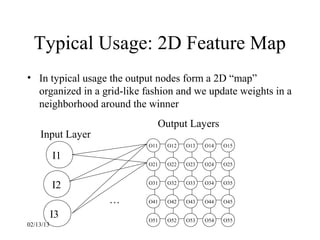
Typical Usage: 2D Feature Map
• In typical usage the output nodes form a 2D “map”
  organized in a grid-like fashion and we update weights in a
  neighborhood around the winner
                              Output Layers
    Input Layer
                            O11   O12   O13   O14   O15

           I1
                            O21   O22   O23   O24   O25


           I2               O31   O32   O33   O34   O35


                  …         O41   O42   O43   O44   O45

           I3               O51   O52   O53   O54   O55
02/13/13
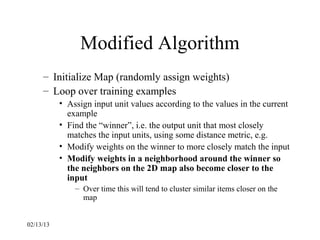
Modified Algorithm
     – Initialize Map (randomly assign weights)
     – Loop over training examples
           • Assign input unit values according to the values in the current
             example
           • Find the “winner”, i.e. the output unit that most closely
             matches the input units, using some distance metric, e.g.
           • Modify weights on the winner to more closely match the input
           • Modify weights in a neighborhood around the winner so
             the neighbors on the 2D map also become closer to the
             input
               – Over time this will tend to cluster similar items closer on the
                 map


02/13/13
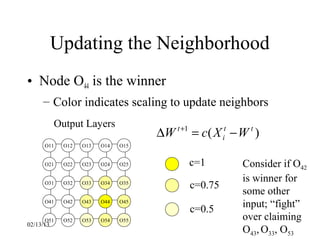
Updating the Neighborhood
• Node O44 is the winner
     – Color indicates scaling to update neighbors
           Output Layers
                                     ∆W t +1 = c( X it − W t )
      O11    O12   O13   O14   O15


      O21    O22   O23   O24   O25          c=1          Consider if O42
                                                         is winner for
      O31    O32   O33   O34   O35
                                             c=0.75
                                                         some other
      O41    O42   O43   O44   O45
                                             c=0.5       input; “fight”
      O51    O52   O53   O54   O55                       over claiming
02/13/13
                                                         O43, O33, O53
Selecting the Neighborhood
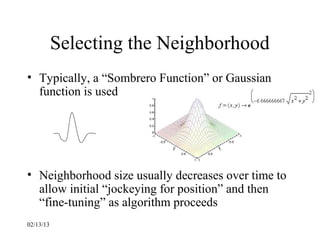
• Typically, a “Sombrero Function” or Gaussian
  function is used


• Neighborhood size usually decreases over time to
  allow initial “jockeying for position” and then
  “fine-tuning” as algorithm proceeds
02/13/13
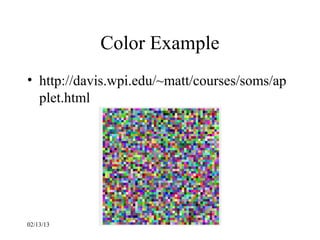
Color Example
• http://davis.wpi.edu/~matt/courses/soms/ap
  plet.html


02/13/13
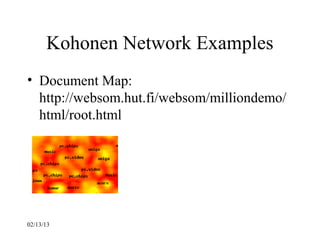
Kohonen Network Examples
• Document Map:
  http://websom.hut.fi/websom/milliondemo/
  html/root.html


02/13/13
Poverty Map
                    http://www.cis.hut.fi/rese
                    arch/som-
                    research/worldmap.html


02/13/13
SOM for Classification
• A generated map can also be used for classification
• Human can assign a class to a data point, or use the
  strongest weight as the prototype for the data point
• For a new test case, calculate the winning node and
  classify it as the class it is closest to
• Handwriting recognition example: http://fbim.fh-
    regensburg.de/~saj39122/begrolu/kohonen.html


02/13/13
Psychological and Biological
    Considerations of Neural Networks
• Psychological
   – Neural network models learn, exhibit some behavior similar to
     humans, based loosely on brains
   – Create their own algorithms instead of being explicitly programmed
   – Operate under noisy data
   – Fault tolerant and graceful degradation
   – Knowledge is distributed, yet still some localization
         • Lashley’s search for engrams
• Biological
   – Learning in the visual cortex shortly after birth seems to correlate
     with the pattern discrimination that emerges from Kohonen Networks
   – Criticisms of the mechanism to update weights; mathematically
     driven; feedforward supervised network unrealistic
  02/13/13
Connectionism
• What’s hard for neural networks? Activities beyond
  recognition, e.g.:
   –   Variable binding
   –   Recursion
   –   Reflection
   –   Structured representations
• Connectionist and Symbolic Models
    – The Central Paradox of Cognition (Smolensky et al., 1992):
    – "Formal theories of logical reasoning, grammar, and other higher
        mental faculties compel us to think of the mind as a machine for rule-
        based manipulation of highly structured arrays of symbols. What we
        know of the brain compels us to think of human information
        processing in terms of manipulation of a large unstructured set of
        numbers, the activity levels of interconnected neurons. Finally, the full
        richness of human behavior, both in everyday environments and in the
        controlled environments of the psychological laboratory, seems to defy
        rule-based description, displaying strong sensitivity to subtle statistical
        factors in experience, as well as to structural properties of information.
        To solve the Central Paradox of Cognition is to resolve these
        contradictions with a unified theory of the organization of the mind, of
 02/13/13
        the brain, of behavior, and of the environment."
Possible Relationships?
• Symbolic systems implemented via
  connectionism
     – Possible to create hierarchies of networks with
       subnetworks to implement symbolic systems
• Hybrid model
     – System consists of two separate components;
       low-level tasks via connectionism, high-level
       tasks via symbols
02/13/13
Proposed Hierarchical Model
•   Jeff Hawkins
•   Founder: Palm Computing, Handspring
•   Deep interest in the brain all his life
•   Book: “On Intelligence”
     – Variety of neuroscience research as input
     – Includes his own ideas, theories, guesses
     – Increasingly accepted view of the brain

02/13/13
The Cortex
• Hawkins’s point of interest in the brain
     – “Where the magic happens”
• Hierarchically-arranged in regions
• Communication up the hierarchy
     – Regions classify patterns of their inputs
     – Regions output a ‘named’ pattern up the hierarchy
• Communication down the hierarchy
     – A high-level region has made a prediction
     – Alerts lower-level regions what to expect

02/13/13
Hawkins Quotes
“The human cortex is particularly large and
  therefore has a massive memory capacity.
  It is constantly predicting what you will see,
  hear and feel, mostly in ways you are
  unconscious of. These predictions are our
  thoughts, and when combined with sensory
  inputs, they are our perceptions. I call this
  view of the brain the memory-prediction
  framework of intelligence.”
02/13/13
Hawkins Quotes
“Your brain constantly makes predictions
  about the very fabric of the world we live
  in, and it does so in a parallel fashion. It
  will just as readily detect an odd texture, a
  misshapen nose, or an unusual motion. It
  isn’t obvious how pervasive these mostly
  unconscious predictions are, which is
  perhaps why we missed their importance.”
02/13/13
Hawkins Quotes
“Your brain constantly makes predictions
  about the very fabric of the world we live
  in, and it does so in a parallel fashion. It
  will just as readily detect an odd texture, a
  misshapen nose, or an unusual motion. It
  isn’t obvious how pervasive these mostly
  unconscious predictions are, which is
  perhaps why we missed their importance.”
02/13/13
Hawkins Quotes
“Suppose when you are out, I sneak over to
  your home and change something about
  your door. It could be almost anything. I
  could move the knob over by and inch,
  change a round knob into a thumb latch, or
  turn it from brass to chrome…. When you
  come home that day and attempt to open the
  door, you will quickly detect that
  something is wrong.”

02/13/13
Prediction
• Prediction means that the neurons involved
  in sensing your door become active in
  advance of them actually receiving sensory
  input.
     – When the sensory input does arrive, it is
       compared with what is expected.
     – Two way communication; classification up the
       hierarchy, prediction down the hierarchy
02/13/13
Prediction
• Prediction is not limited to patterns of low-level
  sensory information like hearing and seeing
• Mountcastle’s principle : we have lots of
  different neurons, but they basically do the
  same thing (particularly in the neocortex)
  – What is true of low-level sensory areas must be true
    for all cortical areas. The human brain is more
    intelligent than that of other animals because it can
    make predictions about more abstract kinds of
    patterns and longer temporal pattern sequences.”
 02/13/13
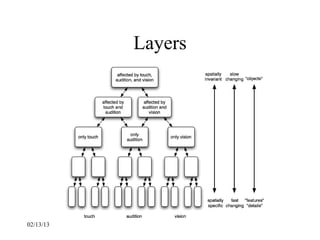
Visual Hierarchies
• Lowest visual level inputs pixels
• Second level recognizes edges, lines, etc
  from known patterns of pixels
• Third level recognizes shapes from known
  patterns of edges, lines, etc
• Fourth level recognizes objects from known
  patterns of shapes
02/13/13
Layers


02/13/13
Not there yet…
• Many issues remain to be addressed by
  Hawkins’ model
     – Missing lots of details on how his model could
       be implemented in a computer
     – Creativity?
     – Evolution?
     – Planning?
     – Rest of the brain, not just neocortex?
02/13/13

Nn ppt

  • 1.
    Introduction to NeuralNetworks By. Ruchi Sharma BVCOE DELHI 02/13/13
  • 2.
    What are connectionistneural networks? • Connectionism refers to a computer modeling approach to computation that is loosely based upon the architecture of the brain. • Many different models, but all include: – Multiple, individual “nodes” or “units” that operate at the same time (in parallel) – A network that connects the nodes together – Information is stored in a distributed fashion among the links that connect the nodes – Learning can occur with gradual changes in connection strength 02/13/13
  • 3.
    Neural Network History •History traces back to the 50’s but became popular in the 80’s with work by Rumelhart, Hinton, and Mclelland – A General Framework for Parallel Distributed Processing in Parallel Distributed Processing: Explorations in the Microstructure of Cognition • Peaked in the 90’s. Today: – Hundreds of variants – Less a model of the actual brain than a useful tool, but still some debate • Numerous applications – Handwriting, face, speech recognition – Vehicles that drive themselves – Models of reading, sentence production, dreaming • Debate for philosophers and cognitive scientists – Can human consciousness or cognitive abilities be explained by a connectionist model or does it require the manipulation of symbols? 02/13/13
  • 4.
    Comparison of Brainsand Traditional Computers • 200 billion neurons, 32 • 1 billion bytes RAM but trillion synapses trillions of bytes on disk • Element size: 10-6 m • Element size: 10-9 m • Energy use: 25W • Energy watt: 30-90W (CPU) • Processing speed: 100 Hz • Processing speed: 109 Hz • Parallel, Distributed • Serial, Centralized • Fault Tolerant • Generally not Fault Tolerant • Learns: Yes • Learns: Some • Intelligent/Conscious: 02/13/13 • Intelligent/Conscious: Usually Generally No
  • 5.
    Biological Inspiration Idea :To make the computer more robust, intelligent, and learn, … Let’s model our computer software (and/or hardware) after the brain “My brain: It's my second favorite organ.” - Woody Allen, from the movie Sleeper 02/13/13
  • 6.
    Neurons in theBrain • Although heterogeneous, at a low level the brain is composed of neurons – A neuron receives input from other neurons (generally thousands) from its synapses – Inputs are approximately summed – When the input exceeds a threshold the neuron sends an electrical spike that travels that travels from the body, down the axon, to the next neuron(s) 02/13/13
  • 7.
    Learning in theBrain • Brains learn – Altering strength between neurons – Creating/deleting connections • Hebb’s Postulate (Hebbian Learning) – When an axon of cell A is near enough to excite a cell B and repeatedly or persistently takes part in firing it, some growth process or metabolic change takes place in one or both cells such that A's efficiency, as one of the cells firing B, is increased. • Long Term Potentiation (LTP) – Cellular basis for learning and memory – LTP is the long-lasting strengthening of the connection between two nerve cells in response to stimulation – Discovered in many regions of the cortex 02/13/13
  • 8.
    Perceptrons • Initial proposalof connectionist networks • Rosenblatt, 50’s and 60’s • Essentially a linear discriminant composed of nodes, weights I1 W1 I1 W1 or I2 W2 θ O I2 W2 O W3 W3 I3 Activation Function I3   O=  i   1 :  ∑ wi I i  + θ > 0  θ  02/13/13  0 : otherwise  1  
  • 9.
    Perceptron Example 2 .5 1 .3 θ =-1 2(0.5) + 1(0.3) + -1 = 0.3 , O=1 Learning Procedure: Randomly assign weights (between 0-1) Present inputs from training data Get output O, nudge weights to gives results toward our desired output T Repeat; stop when no errors, or enough epochs completed 02/13/13
  • 10.
    Perception Training wi (t + 1) = wi (t ) + ∆wi (t ) ∆wi (t ) = (T − O ) I i Weights include Threshold. T=Desired, O=Actual output. Example: T=0, O=1, W1=0.5, W2=0.3, I1=2, I2=1,Theta=-1 w1 (t + 1) = 0.5 + (0 − 1)( 2) = −1.5 w2 (t + 1) = 0.3 + (0 − 1)(1) = −0.7 wθ (t + 1) = −1 + (0 − 1)(1) = −2 If we present this input again, we’d output 0 instead 02/13/13
  • 11.
    How might youuse a perceptron network? • This (and other networks) are generally used to learn how to make classifications • Say you have collected some data regarding the diagnosis of patients with heart disease – Age, Sex, Chest Pain Type, Resting BPS, Cholesterol, …, Diagnosis (<50% diameter narrowing, >50% diameter narrowing) – 67,1,4,120,229,…, 1 – 37,1,3,130,250,… ,0 – 41,0,2,130,204,… ,0 • Train network to predict heart disease of new patient 02/13/13
  • 12.
    Perceptrons • Can addlearning rate to speed up the learning process; just multiply in with delta computation • Essentially a linear discriminant • Perceptron theorem: If a linear discriminant exists that can separate the classes without error, the training procedure is guaranteed to find that line or plane. Class1 Class2 02/13/13
  • 13.
    Exclusive Or (XOR)Problem 1 0 Input: 0,0 Output: 0 Input: 0,1 Output: 1 Input: 1,0 Output: 1 Input: 1,1 Output: 0 0 1 XOR Problem: Not Linearly Separable! We could however construct multiple layers of perceptrons to get around 02/13/13 this problem. A typical multi-layered system minimizes LMS Error,
  • 14.
    LMS Learning LMS =Least Mean Square learning Systems, more general than the previous perceptron learning rule. The concept is to minimize the total error, as measured over all training examples, P. O is the raw output, as calculated by ∑ wi I i + θ i 1 Dis tan ce( LMS ) = ∑ ( TP − OP ) 2 2 P E.g. if we have two patterns and T1=1, O1=0.8, T2=0, O2=0.5 then D=(0.5)[(1-0.8) 2+(0-0.5)2]=.145 We want to minimize the LMS: C-learning rate E W(old) W(new) 02/13/13 W
  • 15.
    LMS Gradient Descent • Using LMS, we want to minimize the error. We can do this by finding the direction on the error surface that most rapidly reduces the error rate; this is finding the slope of the error function by taking the derivative. The approach is called gradient descent (similar to hill climbing). To compute how much to change weight for link k: δError Oj = f (I W ) ∆wk = − c δwk δO j = I k f ' ( ActivationFunction ( I kWk ) ) Chain rule: δwk δError δError δO j δwk = δO j ∗ δwk ∆wk = −c ( − (T j − O j ) ) I k f ' ( ActivationFunction ) 1 δ ∑ (TP − OP ) 2 δ 1 (T j − O j ) 2 δError 2 P = = 2 = −(T j − O j ) δO j δO j δO j We can remove the sum since we are taking the partial derivative wrt Oj 02/13/13
  • 16.
    Activation Function • Toapply the LMS learning rule, also known as the delta rule, we need a differentiable activation function. ∆wk = cI k (T j − O j ) f ' ( ActivationFunction ) Old: New: 1 : ∑ wi I i + θ > 0   O= 1 O= i  − ∑ wi I i + Θ  0 : otherwise    1+ e i 02/13/13 −θ
  • 17.
    LMS vs. LimitingThreshold • With the new sigmoidal function that is differentiable, we can apply the delta rule toward learning. • Perceptron Method – Forced output to 0 or 1, while LMS uses the net output – Guaranteed to separate, if no error and is linearly separable • Otherwise it may not converge • Gradient Descent Method: – May oscillate and not converge – May converge to wrong answer – Will converge to some minimum even if the classes are not linearly separable, unlike the earlier perceptron training method 02/13/13
  • 18.
    Backpropagation Networks • Attributedto Rumelhart and McClelland, late 70’s • To bypass the linear classification problem, we can construct multilayer networks. Typically we have fully connected, feedforward networks. Input Layer Hidden Layer Output Layer I1 O1 H1 I2 1 O( x) = −∑ w j , x H j H2 O2 1+ e j I3 Wi,j 1 Wj,k 1 1 H ( x) = − ∑ wi , x I i 1+ e i 1’s - bias 02/13/13
  • 19.
    Backprop - Learning LearningProcedure: Randomly assign weights (between 0-1) Present inputs from training data, propagate to outputs Compute outputs O, adjust weights according to the delta rule, backpropagating the errors. The weights will be nudged closer so that the network learns to give the desired output. Repeat; stop when no errors, or enough epochs completed 02/13/13
  • 20.
    Backprop - ModifyingWeights We had computed: ∆wk = cI k (T j − O j ) f ' ( ActivationFunction ) ;  1  f = −sum  1+ e  ∆wk = cI k ( T j − O j ) ( f ( sum )(1 − f ( sum) ) For the Output unit k, f(sum)=O(k). For the output units, this is: ∆w j ,k = cH j ( Tk − Ok ) Ok (1 − Ok ) For the Hidden units (skipping some math), this is: ∆wi , j = cH j (1 − H j ) I i ∑ (Tk − Ok )Ok (1 − Ok )w j ,k k I H O 02/13/13 Wi,j Wj,k
  • 21.
    Backprop • Very powerful- can learn any function, given enough hidden units! With enough hidden units, we can generate any function. • Have the same problems of Generalization vs. Memorization. With too many units, we will tend to memorize the input and not generalize well. Some schemes exist to “prune” the neural network. • Networks require extensive training, many parameters to fiddle with. Can be extremely slow to train. May also fall into local minima. • Inherently parallel algorithm, ideal for multiprocessor hardware. • Despite the cons, a very powerful algorithm that has seen widespread successful deployment. 02/13/13
  • 22.
    Backprop Demo • QwikNet – Learning XOR, Sin/Cos functions 02/13/13
  • 23.
    Unsupervised Learning • Wejust discussed a form of supervised learning – A “teacher” tells the network what the correct output is based on the input until the network learns the target concept • We can also train networks where there is no teacher. This is called unsupervised learning. The network learns a prototype based on the distribution of patterns in the training data. Such networks allow us to: – Discover underlying structure of the data – Encode or compress the data – Transform the data 02/13/13
  • 24.
    Unsupervised Learning –Hopfield Networks • A Hopfield network is a type of content- addressable memory – Non-linear system with attractor points that represent concepts – Given a fuzzy input the system converges to the nearest attractor • Possibility to have “spurious” attractors that is a blend of multiple stored patterns • Also possible to have chaotic patterns that never converge 02/13/13
  • 25.
    Standard Binary HopfieldNetwork • Recurrent; Every unit is connected to every other unit • Weights connecting units are symmetrical – wij = wji • If the weighted sum of the inputs exceeds a threshold, its output is 1 otherwise its output is -1 • Units update themselves asynchronously as their inputs change A wAD wAB wAC B wBC wBD C D 02/13/13 wCD
  • 26.
    Hopfield Memories • Settingthe weights: – A pattern is a setting of on or off for each unit – Given a set of Q patterns to store • For every weight connecting units i and j: Q wij = ∑ xip x jp p =1 • This is a form of a Hebbian rule which makes the weight strength proportional to the product of the firing rates of the two interconnected units 02/13/13
  • 27.
    Hopfield Network Demo •http://www.cbu.edu/~pong/ai/hopfield/hopfieldap plet.html • Properties – Settles into a minimal energy state – Storage capacity low, only 13% of number of units – Can retrieve information even in the presence of noisy data, similar to associative memory of humans 02/13/13
  • 28.
    Unsupervised Learning –Self Organizing Maps • Self-organizing maps (SOMs) are a data visualization technique invented by Professor Teuvo Kohonen – Also called Kohonen Networks, Competitive Learning, Winner-Take-All Learning – Generally reduces the dimensions of data through the use of self-organizing neural networks – Useful for data visualization; humans cannot visualize high dimensional data so this is often a useful technique to make sense of large data sets 02/13/13
  • 29.
    Basic “Winner TakeAll” Network • Two layer network – Input units, output units, each input unit is connected to each output unit Input Layer Output Layer I1 O1 I2 O2 I3 Wi,j 02/13/13
  • 30.
    Basic Algorithm – Initialize Map (randomly assign weights) – Loop over training examples • Assign input unit values according to the values in the current example • Find the “winner”, i.e. the output unit that most closely matches the input units, using some distance metric, e.g. For all output units j=1 to m 2 ∑ (W − Ii ) n and input units i=1 to n ij Find the one that minimizes: i =1 • Modify weights on the winner to more closely match the input ∆W t +1 = c( X it − W t ) where c is a small positive learning constant 02/13/13 that usually decreases as the learning proceeds
  • 31.
    Result of Algorithm •Initially, some output nodes will randomly be a little closer to some particular type of input • These nodes become “winners” and the weights move them even closer to the inputs • Over time nodes in the output become representative prototypes for examples in the input • Note there is no supervised training here • Classification: – Given new input, the class is the output node that is the winner 02/13/13
  • 32.
    Typical Usage: 2DFeature Map • In typical usage the output nodes form a 2D “map” organized in a grid-like fashion and we update weights in a neighborhood around the winner Output Layers Input Layer O11 O12 O13 O14 O15 I1 O21 O22 O23 O24 O25 I2 O31 O32 O33 O34 O35 … O41 O42 O43 O44 O45 I3 O51 O52 O53 O54 O55 02/13/13
  • 33.
    Modified Algorithm – Initialize Map (randomly assign weights) – Loop over training examples • Assign input unit values according to the values in the current example • Find the “winner”, i.e. the output unit that most closely matches the input units, using some distance metric, e.g. • Modify weights on the winner to more closely match the input • Modify weights in a neighborhood around the winner so the neighbors on the 2D map also become closer to the input – Over time this will tend to cluster similar items closer on the map 02/13/13
  • 34.
    Updating the Neighborhood •Node O44 is the winner – Color indicates scaling to update neighbors Output Layers ∆W t +1 = c( X it − W t ) O11 O12 O13 O14 O15 O21 O22 O23 O24 O25 c=1 Consider if O42 is winner for O31 O32 O33 O34 O35 c=0.75 some other O41 O42 O43 O44 O45 c=0.5 input; “fight” O51 O52 O53 O54 O55 over claiming 02/13/13 O43, O33, O53
  • 35.
    Selecting the Neighborhood •Typically, a “Sombrero Function” or Gaussian function is used • Neighborhood size usually decreases over time to allow initial “jockeying for position” and then “fine-tuning” as algorithm proceeds 02/13/13
  • 36.
  • 37.
    Kohonen Network Examples •Document Map: http://websom.hut.fi/websom/milliondemo/ html/root.html 02/13/13
  • 38.
    Poverty Map http://www.cis.hut.fi/rese arch/som- research/worldmap.html 02/13/13
  • 39.
    SOM for Classification •A generated map can also be used for classification • Human can assign a class to a data point, or use the strongest weight as the prototype for the data point • For a new test case, calculate the winning node and classify it as the class it is closest to • Handwriting recognition example: http://fbim.fh- regensburg.de/~saj39122/begrolu/kohonen.html 02/13/13
  • 40.
    Psychological and Biological Considerations of Neural Networks • Psychological – Neural network models learn, exhibit some behavior similar to humans, based loosely on brains – Create their own algorithms instead of being explicitly programmed – Operate under noisy data – Fault tolerant and graceful degradation – Knowledge is distributed, yet still some localization • Lashley’s search for engrams • Biological – Learning in the visual cortex shortly after birth seems to correlate with the pattern discrimination that emerges from Kohonen Networks – Criticisms of the mechanism to update weights; mathematically driven; feedforward supervised network unrealistic 02/13/13
  • 41.
    Connectionism • What’s hardfor neural networks? Activities beyond recognition, e.g.: – Variable binding – Recursion – Reflection – Structured representations • Connectionist and Symbolic Models – The Central Paradox of Cognition (Smolensky et al., 1992): – "Formal theories of logical reasoning, grammar, and other higher mental faculties compel us to think of the mind as a machine for rule- based manipulation of highly structured arrays of symbols. What we know of the brain compels us to think of human information processing in terms of manipulation of a large unstructured set of numbers, the activity levels of interconnected neurons. Finally, the full richness of human behavior, both in everyday environments and in the controlled environments of the psychological laboratory, seems to defy rule-based description, displaying strong sensitivity to subtle statistical factors in experience, as well as to structural properties of information. To solve the Central Paradox of Cognition is to resolve these contradictions with a unified theory of the organization of the mind, of 02/13/13 the brain, of behavior, and of the environment."
  • 42.
    Possible Relationships? • Symbolicsystems implemented via connectionism – Possible to create hierarchies of networks with subnetworks to implement symbolic systems • Hybrid model – System consists of two separate components; low-level tasks via connectionism, high-level tasks via symbols 02/13/13
  • 43.
    Proposed Hierarchical Model • Jeff Hawkins • Founder: Palm Computing, Handspring • Deep interest in the brain all his life • Book: “On Intelligence” – Variety of neuroscience research as input – Includes his own ideas, theories, guesses – Increasingly accepted view of the brain 02/13/13
  • 44.
    The Cortex • Hawkins’spoint of interest in the brain – “Where the magic happens” • Hierarchically-arranged in regions • Communication up the hierarchy – Regions classify patterns of their inputs – Regions output a ‘named’ pattern up the hierarchy • Communication down the hierarchy – A high-level region has made a prediction – Alerts lower-level regions what to expect 02/13/13
  • 45.
    Hawkins Quotes “The humancortex is particularly large and therefore has a massive memory capacity. It is constantly predicting what you will see, hear and feel, mostly in ways you are unconscious of. These predictions are our thoughts, and when combined with sensory inputs, they are our perceptions. I call this view of the brain the memory-prediction framework of intelligence.” 02/13/13
  • 46.
    Hawkins Quotes “Your brainconstantly makes predictions about the very fabric of the world we live in, and it does so in a parallel fashion. It will just as readily detect an odd texture, a misshapen nose, or an unusual motion. It isn’t obvious how pervasive these mostly unconscious predictions are, which is perhaps why we missed their importance.” 02/13/13
  • 47.
    Hawkins Quotes “Your brainconstantly makes predictions about the very fabric of the world we live in, and it does so in a parallel fashion. It will just as readily detect an odd texture, a misshapen nose, or an unusual motion. It isn’t obvious how pervasive these mostly unconscious predictions are, which is perhaps why we missed their importance.” 02/13/13
  • 48.
    Hawkins Quotes “Suppose whenyou are out, I sneak over to your home and change something about your door. It could be almost anything. I could move the knob over by and inch, change a round knob into a thumb latch, or turn it from brass to chrome…. When you come home that day and attempt to open the door, you will quickly detect that something is wrong.” 02/13/13
  • 49.
    Prediction • Prediction meansthat the neurons involved in sensing your door become active in advance of them actually receiving sensory input. – When the sensory input does arrive, it is compared with what is expected. – Two way communication; classification up the hierarchy, prediction down the hierarchy 02/13/13
  • 50.
    Prediction • Prediction isnot limited to patterns of low-level sensory information like hearing and seeing • Mountcastle’s principle : we have lots of different neurons, but they basically do the same thing (particularly in the neocortex) – What is true of low-level sensory areas must be true for all cortical areas. The human brain is more intelligent than that of other animals because it can make predictions about more abstract kinds of patterns and longer temporal pattern sequences.” 02/13/13
  • 51.
    Visual Hierarchies • Lowestvisual level inputs pixels • Second level recognizes edges, lines, etc from known patterns of pixels • Third level recognizes shapes from known patterns of edges, lines, etc • Fourth level recognizes objects from known patterns of shapes 02/13/13
  • 52.
  • 53.
    Not there yet… •Many issues remain to be addressed by Hawkins’ model – Missing lots of details on how his model could be implemented in a computer – Creativity? – Evolution? – Planning? – Rest of the brain, not just neocortex? 02/13/13

Editor's Notes

  • #45 Recognizing pictures, making decisions, functioning with motor skills in reaction to environment, etc… Most abstract concepts at the top (the big ideas, concepts, etc) and the features, details, pixels of images at the bottom More on the naming shortly