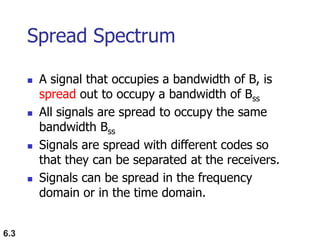
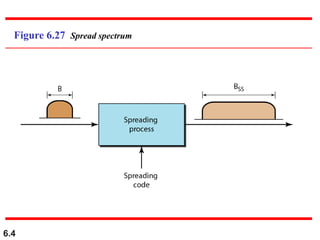
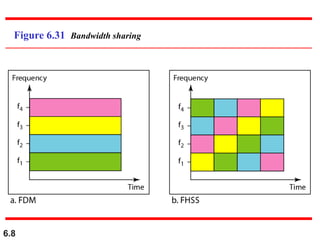
This document discusses spread spectrum techniques for bandwidth utilization. Spread spectrum combines signals from different sources to fit into a larger bandwidth in order to prevent eavesdropping and jamming. There are two main types of spread spectrum: frequency hopping spread spectrum (FHSS) and direct sequence spread spectrum (DSSS). FHSS works by rapidly switching a carrier among many frequency channels, while DSSS spreads the signal across a very wide band by using a code sequence to modulate the signal.