Downloaded 541 times
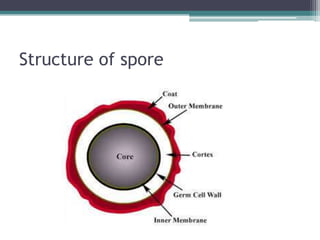

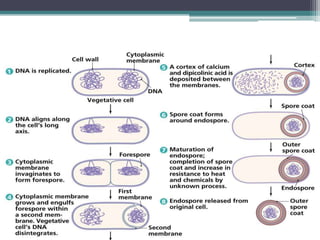





This document summarizes the process of sporulation in microorganisms. It describes that spores form as a protective structure during unfavorable conditions and can survive without nutrients. There are two main types of spores - endospores, which form inside the cell, and exospores, which form on the surface. Spores have protective coats, cortex, germ cell wall, and a central core containing DNA. Sporulation is the process where a single cell forms an endospore or exospore, which can later germinate into a new cell under favorable conditions. Key factors like sigma factors regulate genes involved in sporulation and returning to the vegetative state.


