1THERMOCHEMISTRYTHERMOCHEMISTRY
ThermodynamicsThermodynamics
The study of Heat and WorkThe study of Heat and Work
and State Functionsand State Functions
2
Energy & ChemistryEnergy & ChemistryEnergy & ChemistryEnergy & Chemistry
ENERGYENERGY is the capacity tois the capacity to
do work or transfer heat.do work or transfer heat.
HEATHEAT is the form of energyis the form of energy
that flows between 2that flows between 2
objects because of theirobjects because of their
difference in temperature.difference in temperature.
Other forms of energy —Other forms of energy —
• lightlight
• electricalelectrical
• kinetic and potentialkinetic and potential
3
Energy & ChemistryEnergy & Chemistry
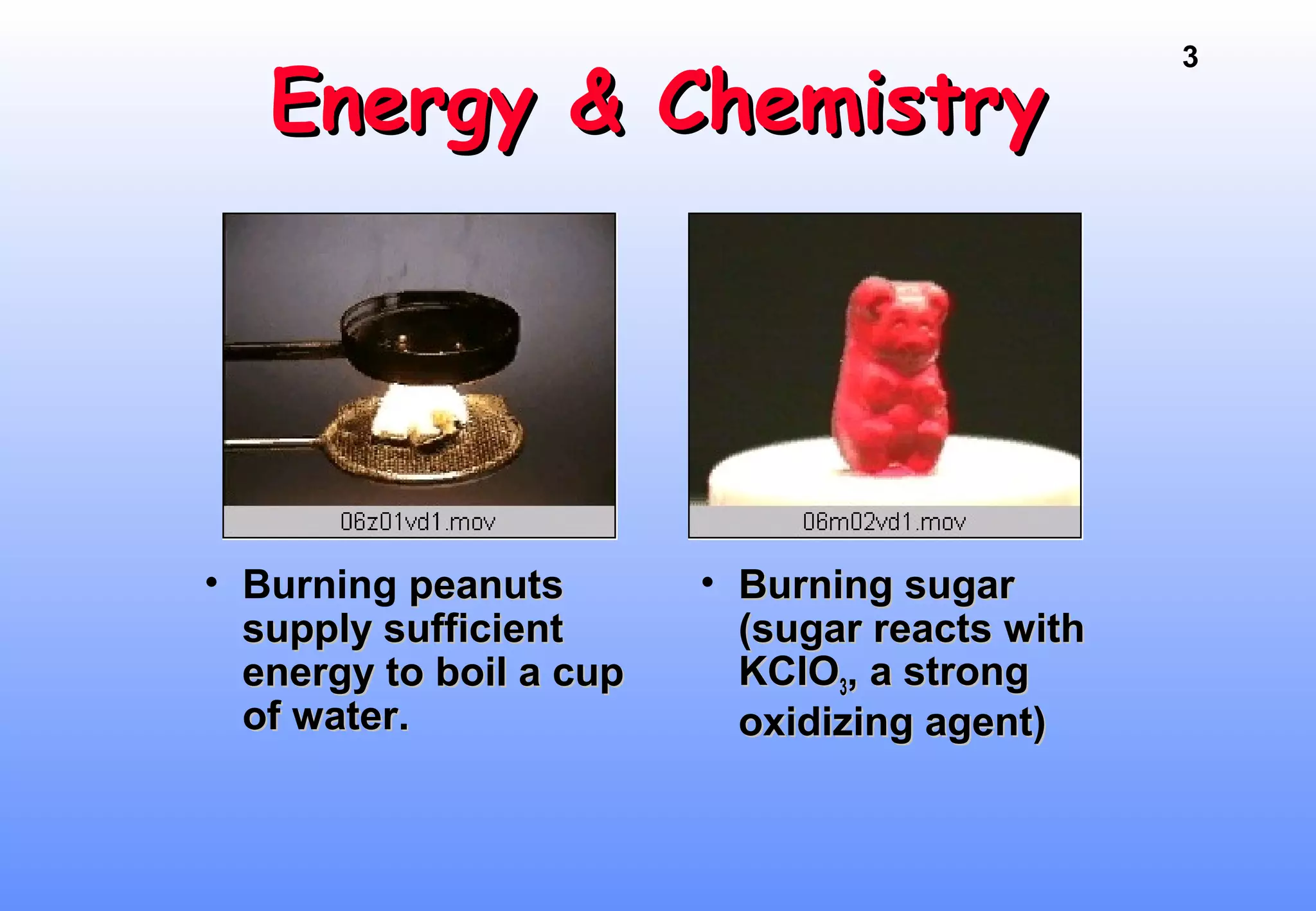
• Burning peanutspeanuts
supply sufficientsupply sufficient
energy to boil a cupenergy to boil a cup
of water.of water.
• Burning sugarBurning sugar
(sugar reacts with(sugar reacts with
KClOKClO33, a strong, a strong
oxidizing agent)oxidizing agent)
4
Energy & ChemistryEnergy & Chemistry
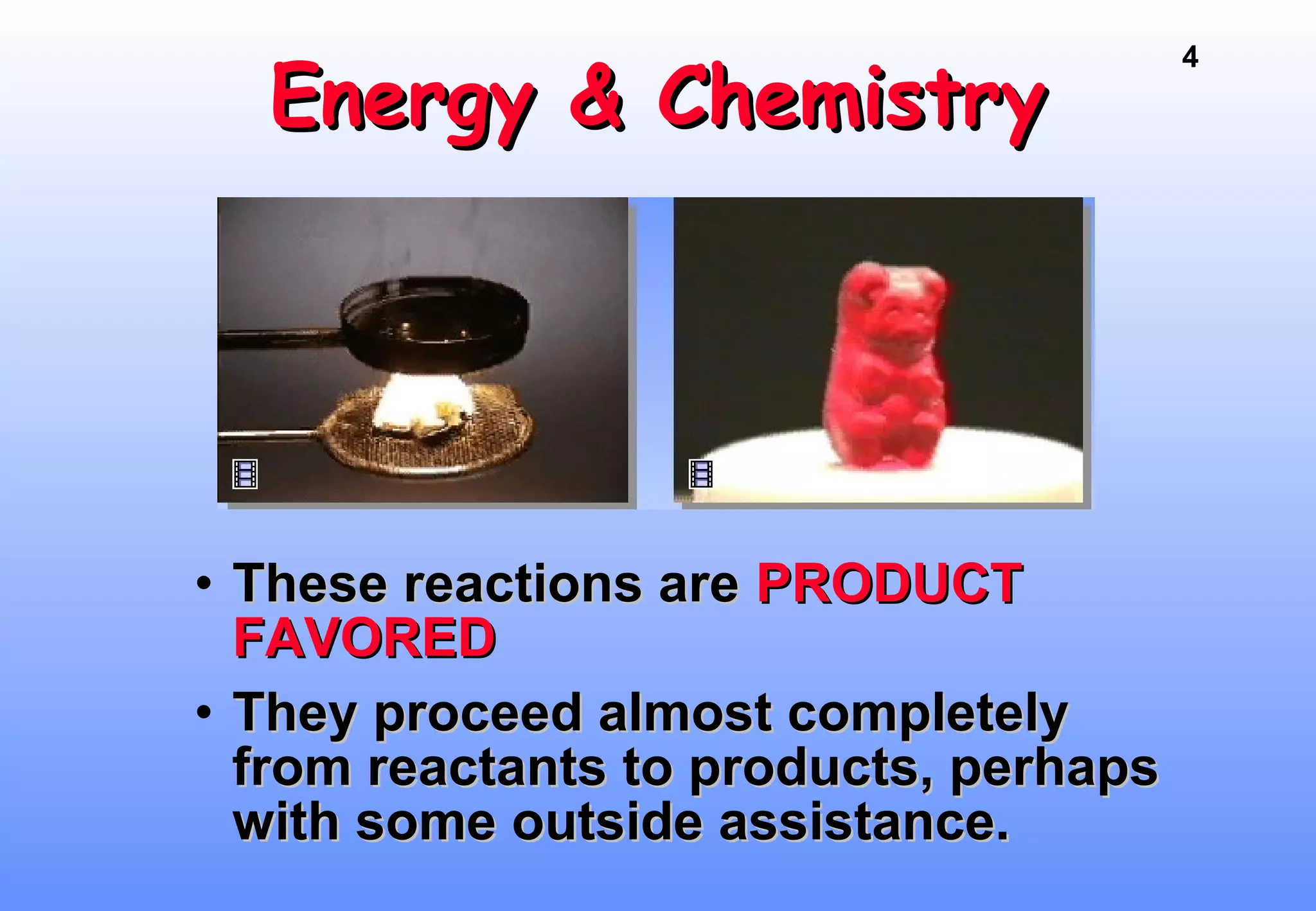
• These reactions areThese reactions are PRODUCTPRODUCT
FAVOREDFAVORED
• They proceed almost completelyThey proceed almost completely
from reactants to products, perhapsfrom reactants to products, perhaps
with some outside assistance.with some outside assistance.
5
Energy & ChemistryEnergy & Chemistry
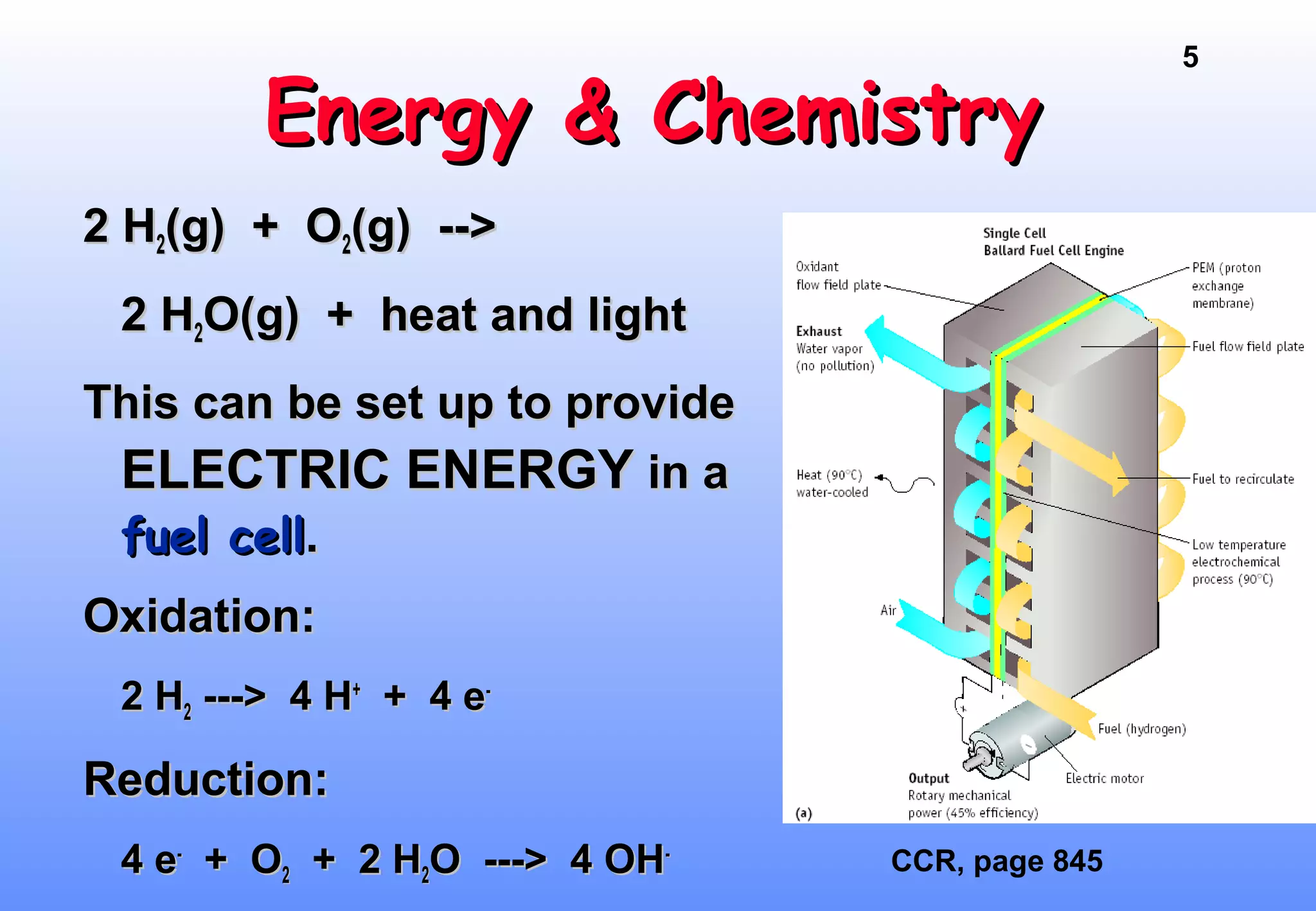
2 H2 H22(g) + O(g) + O22(g) -->(g) -->
2 H2 H22O(g) + heat and lightO(g) + heat and light
This can be set up to provideThis can be set up to provide
ELECTRIC ENERGYELECTRIC ENERGY in ain a
fuel cellfuel cell..
Oxidation:Oxidation:
2 H2 H22 ---> 4 H---> 4 H++
+ 4 e+ 4 e--
Reduction:Reduction:
4 e4 e--
+ O+ O22 + 2 H+ 2 H22O ---> 4 OHO ---> 4 OH-- CCR, page 845
6
Potential & Kinetic EnergyPotential & Kinetic EnergyPotential & Kinetic EnergyPotential & Kinetic Energy
PotentialPotential
energyenergy ——
energy aenergy a
motionlessmotionless
body has bybody has by
virtue of itsvirtue of its
position.position.
7
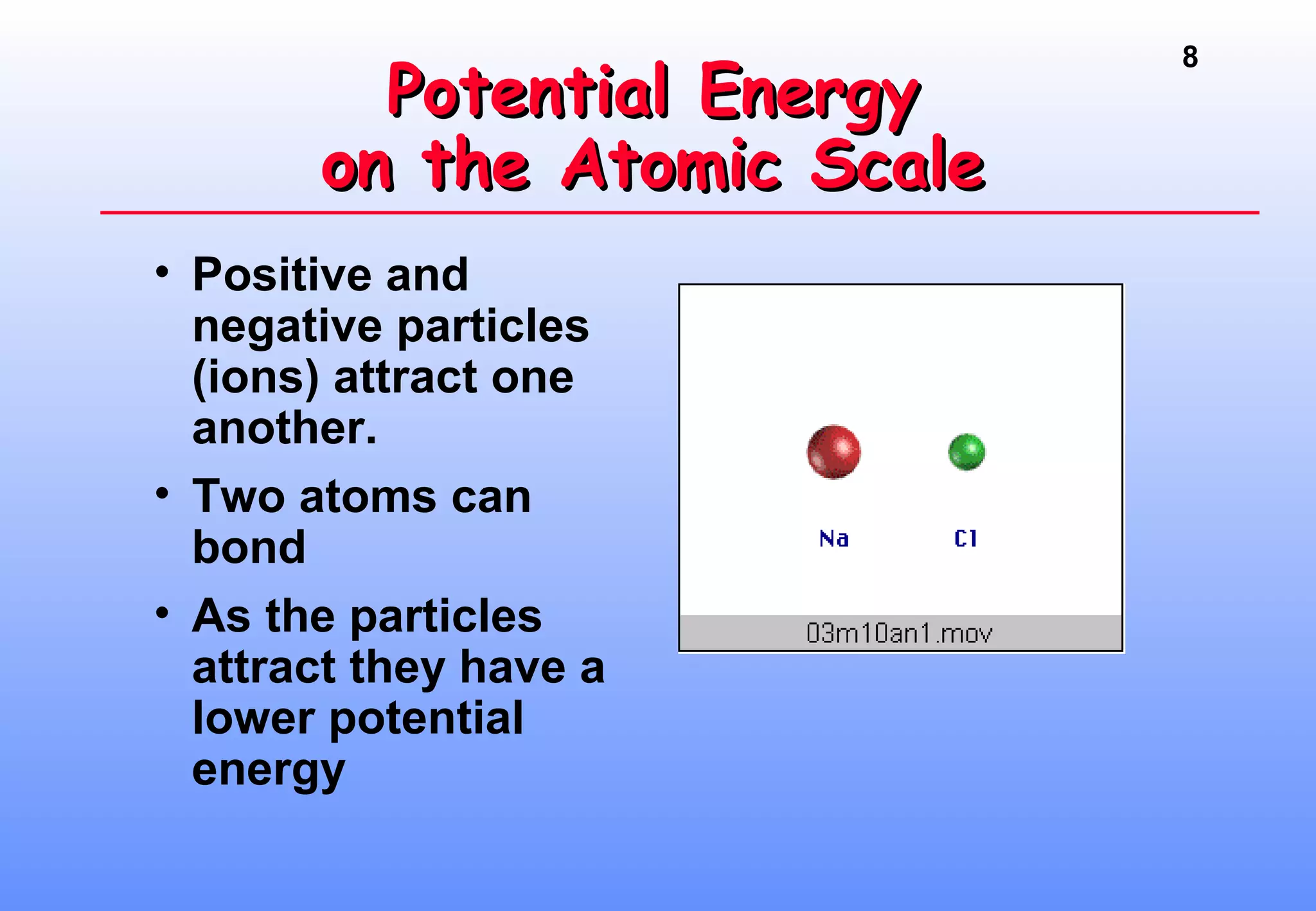
• Positive and
negative particles
(ions) attract one
another.
• Two atoms can
bond
• As the particles
attract they have a
lower potential
energy
Potential EnergyPotential Energy
on the Atomic Scaleon the Atomic Scale
NaCl — composed ofNaCl — composed of
NaNa++
and Cland Cl--
ions.ions.
8
• Positive and
negative particles
(ions) attract one
another.
• Two atoms can
bond
• As the particles
attract they have a
lower potential
energy
Potential EnergyPotential Energy
on the Atomic Scaleon the Atomic Scale
9
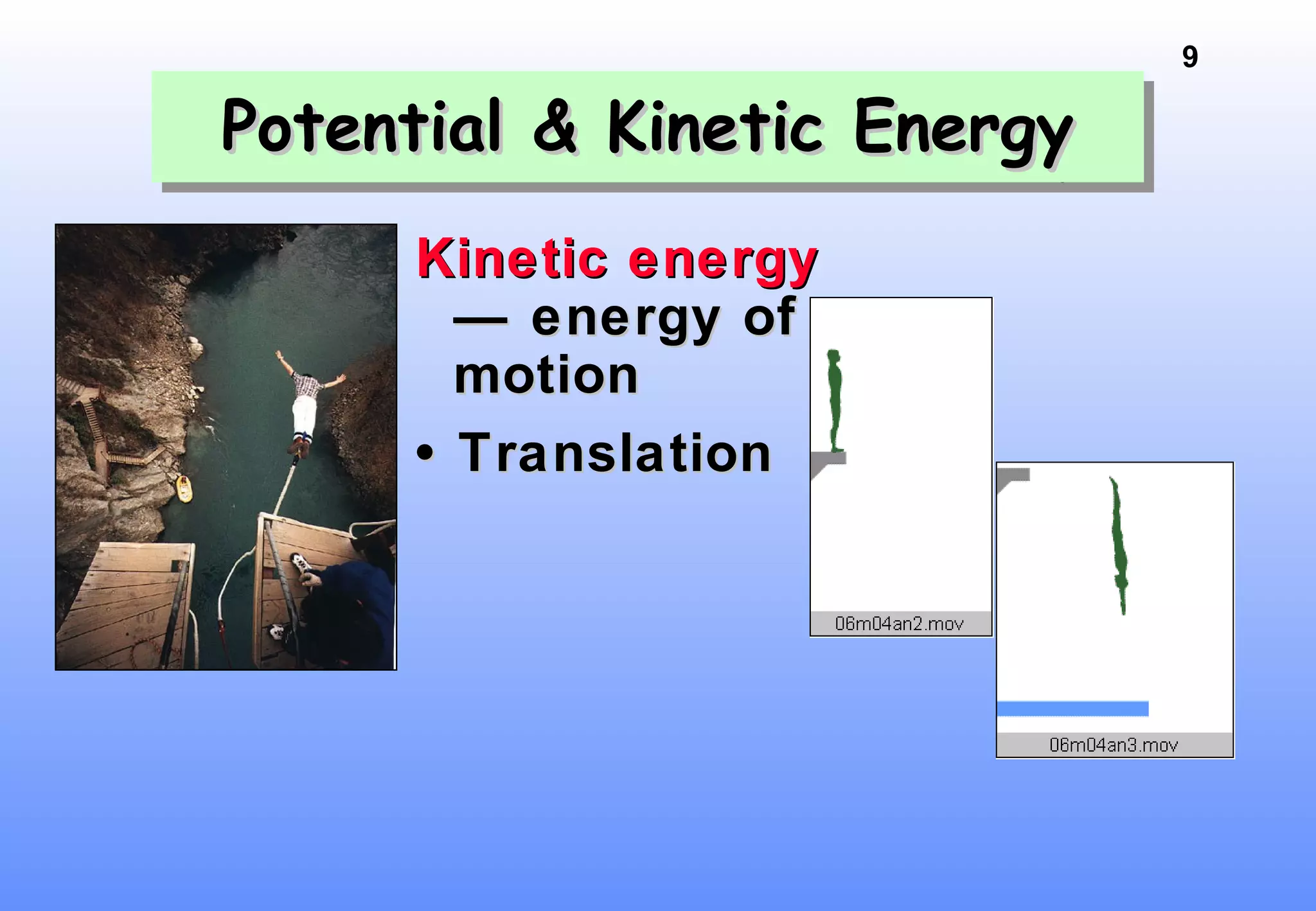
Potential & Kinetic EnergyPotential & Kinetic EnergyPotential & Kinetic EnergyPotential & Kinetic Energy
Kinetic energyKinetic energy
— energy of— energy of
motionmotion
•• TranslationTranslation
10
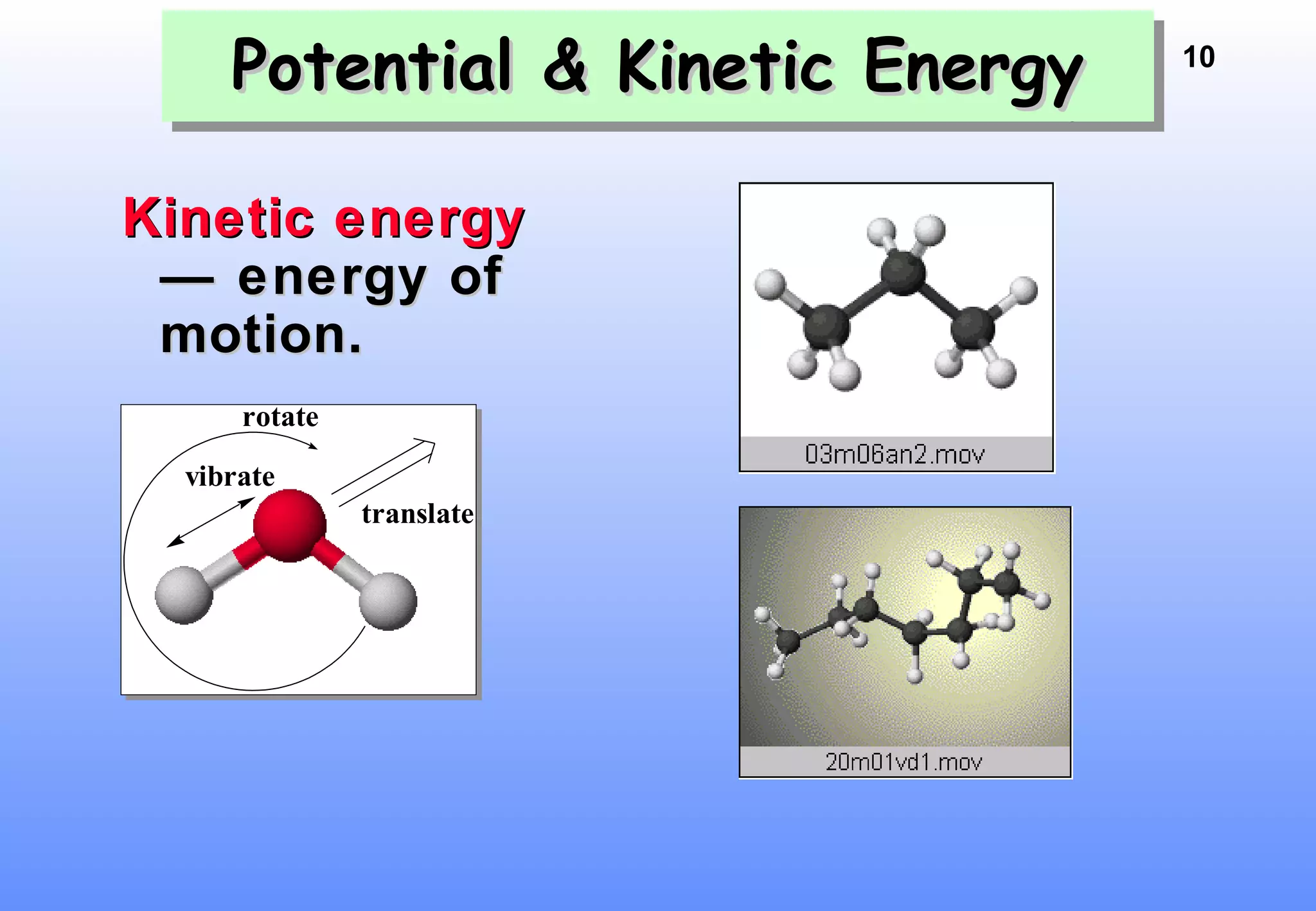
Potential & Kinetic EnergyPotential & Kinetic EnergyPotential & Kinetic EnergyPotential & Kinetic Energy
Kinetic energyKinetic energy
— energy of— energy of
motion.motion.
translate
rotate
vibrate
translate
rotate
vibrate
11
Internal Energy (E)Internal Energy (E)
• PE + KE = Internal energy (E or U)PE + KE = Internal energy (E or U)
• Int. E of a chemical systemInt. E of a chemical system
depends ondepends on
• number of particlesnumber of particles
• type of particlestype of particles
• temperaturetemperature
12
Internal Energy (E)Internal Energy (E)
• PE + KE = Internal energy (E or U)PE + KE = Internal energy (E or U)
QuickTime™ and a
Graphics decompressor
are needed to see this picture.
13
Internal Energy (E)Internal Energy (E)
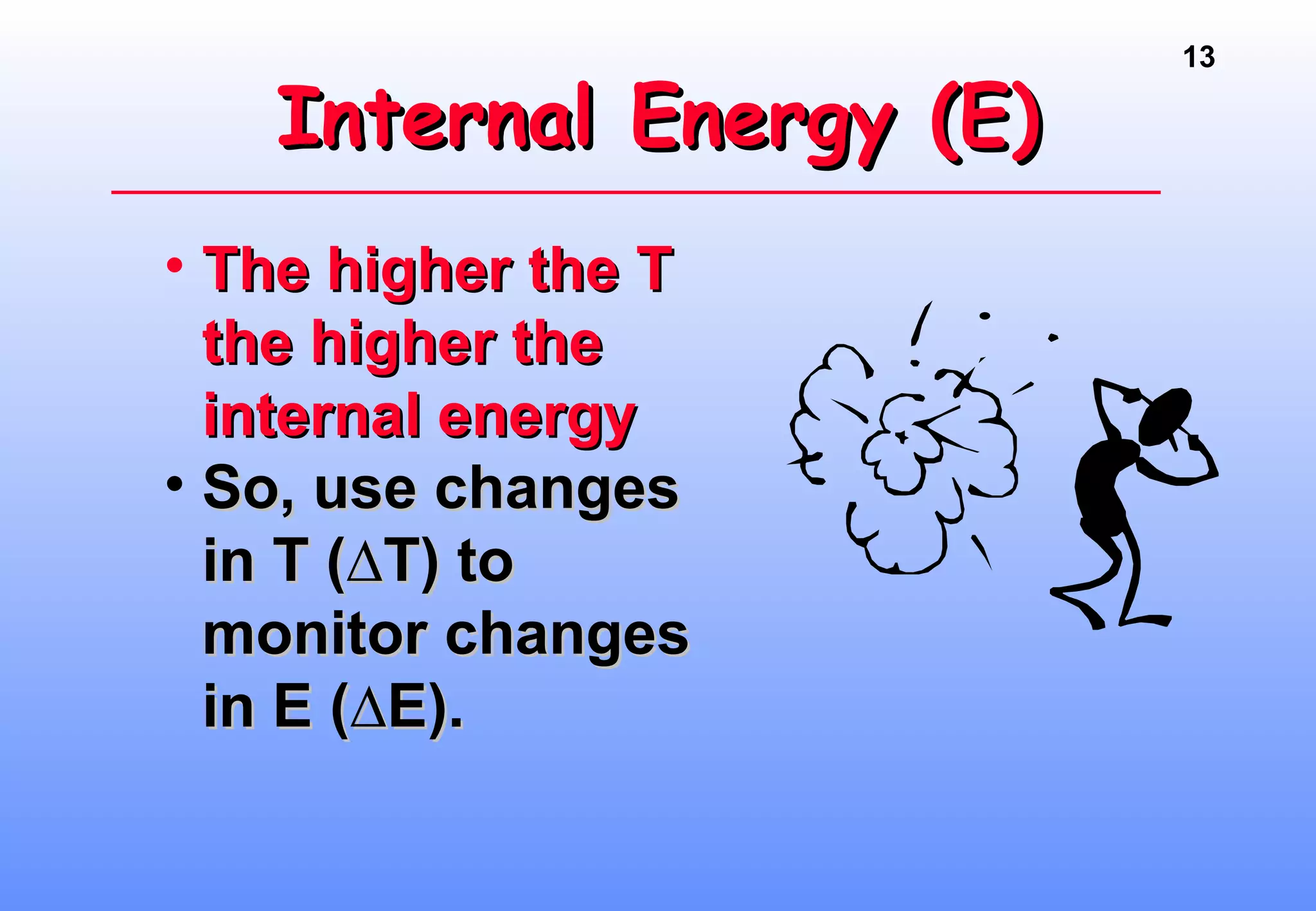
• The higher the TThe higher the T
the higher thethe higher the
internal energyinternal energy
• So, use changesSo, use changes
in T (∆T) toin T (∆T) to
monitor changesmonitor changes
in E (∆E).in E (∆E).
14
ThermodynamicsThermodynamics
• Thermodynamics is the science of heat
(energy) transfer.
Heat energy is associatedHeat energy is associated
with molecular motions.with molecular motions.
Heat transfers until thermal equilibrium is
established.
15
Directionality of Heat TransferDirectionality of Heat Transfer
• Heat always transfer from hotter object to
cooler one.
• EXOthermic: heat transfers from SYSTEM to
SURROUNDINGS.
T(system) goes downT(system) goes down
T(surr) goes upT(surr) goes up
16
Directionality of Heat TransferDirectionality of Heat Transfer
• Heat always transfer from hotter object to
cooler one.
• ENDOthermic: heat transfers from
SURROUNDINGS to the SYSTEM.
T(system) goes upT(system) goes up
T (surr) goes downT (surr) goes down
17
Energy & ChemistryEnergy & Chemistry
All of thermodynamics dependsAll of thermodynamics depends
on the law ofon the law of
CONSERVATION OF ENERGYCONSERVATION OF ENERGY..
• The total energy is unchangedThe total energy is unchanged
in a chemical reaction.in a chemical reaction.
• If PE of products is less thanIf PE of products is less than
reactants, the difference mustreactants, the difference must
be released as KE.be released as KE.
18
Energy Change inEnergy Change in
Chemical ProcessesChemical Processes
Reactants
Products
Kinetic
Energy
PE
PE of system dropped. KE increased. Therefore,PE of system dropped. KE increased. Therefore,
you often feel a T increase.you often feel a T increase.
19
UNITS OF ENERGYUNITS OF ENERGYUNITS OF ENERGYUNITS OF ENERGY
1 calorie = heat required to1 calorie = heat required to
raise temp. of 1.00 g ofraise temp. of 1.00 g of
HH22O by 1.0O by 1.0 oo
C.C.
1000 cal = 1 kilocalorie = 11000 cal = 1 kilocalorie = 1
kcalkcal
1 kcal = 1 Calorie (a food1 kcal = 1 Calorie (a food
“calorie”)“calorie”)
But we use the unit calledBut we use the unit called
thethe JOULEJOULE
1 cal = 4.184 joules1 cal = 4.184 joules
James JouleJames Joule
1818-18891818-1889
20
HEAT CAPACITYHEAT CAPACITY
The heat required to raise an
object’s T by 1 ˚C.
Which has the larger heat capacity?Which has the larger heat capacity?
21
SpecificSpecific Heat CapacityHeat CapacitySpecificSpecific Heat CapacityHeat Capacity
How much energy isHow much energy is
transferred due to Ttransferred due to T
difference?difference?
The heatThe heat (q)(q) “lost” or “gained”“lost” or “gained”
is related tois related to
a)a) sample masssample mass
b)b) change in T andchange in T and
c)c) specific heat capacityspecific heat capacity
Specific heat capacity=
heat lost or gained by substance (J)
(mass, g)(T change,K)
22
Specific Heat CapacitySpecific Heat CapacitySpecific Heat CapacitySpecific Heat Capacity
SubstanceSubstance Spec. Heat (J/g•K)Spec. Heat (J/g•K)
HH22OO 4.1844.184
Ethylene glycolEthylene glycol 2.392.39
AlAl 0.8970.897
glassglass 0.840.84
AluminumAluminum
23
Specific Heat CapacitySpecific Heat CapacitySpecific Heat CapacitySpecific Heat Capacity
If 25.0 g of Al cool fromIf 25.0 g of Al cool from
310310 oo
C to 37C to 37 oo
C, howC, how
many joules of heatmany joules of heat
energy are lost byenergy are lost by
the Al?the Al?
Specific heat capacity=
heat lost or gained by substance (J)
(mass, g)(T change,K)
24
Specific Heat CapacitySpecific Heat CapacitySpecific Heat CapacitySpecific Heat Capacity
If 25.0 g of Al cool from 310If 25.0 g of Al cool from 310 oo
C to 37C to 37 oo
C, how manyC, how many
joules of heat energy are lost by the Al?joules of heat energy are lost by the Al?
heat gain/lose = q = (sp. ht.)(mass)(∆T)
where ∆T = Twhere ∆T = Tfinalfinal - T- Tinitialinitial
q = (0.897 J/g•K)(25.0 g)(37 - 310)Kq = (0.897 J/g•K)(25.0 g)(37 - 310)K
q = - 6120 Jq = - 6120 J
Notice that the negative sign on q signalsNotice that the negative sign on q signals
heat “lost by” or transferred OUT of Al.heat “lost by” or transferred OUT of Al.
Notice that the negative sign on q signalsNotice that the negative sign on q signals
heat “lost by” or transferred OUT of Al.heat “lost by” or transferred OUT of Al.
25
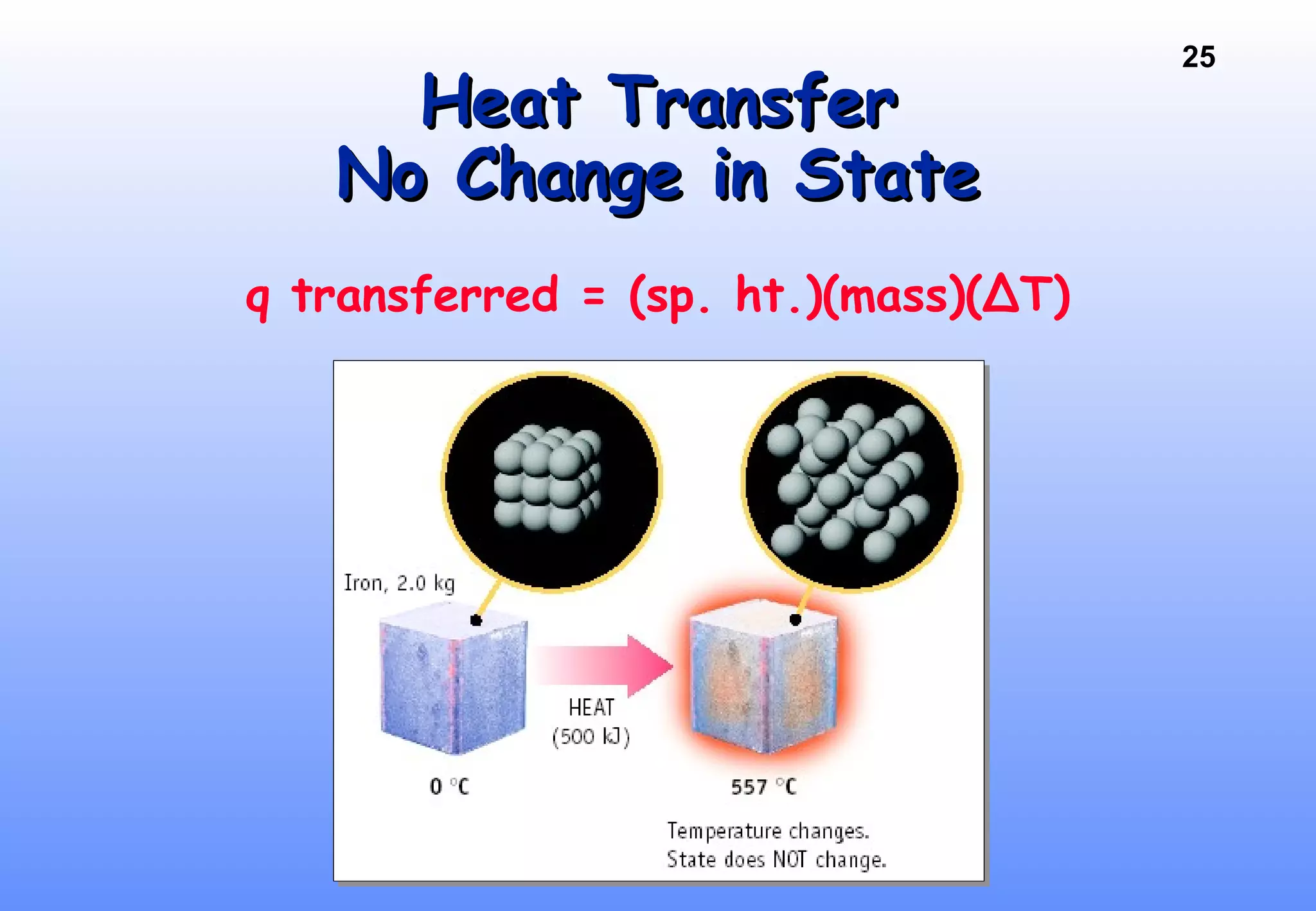
Heat TransferHeat Transfer
No Change in StateNo Change in State
q transferred = (sp. ht.)(mass)(∆T)
26Heat Transfer withHeat Transfer with
Change of StateChange of State
Heat Transfer withHeat Transfer with
Change of StateChange of State
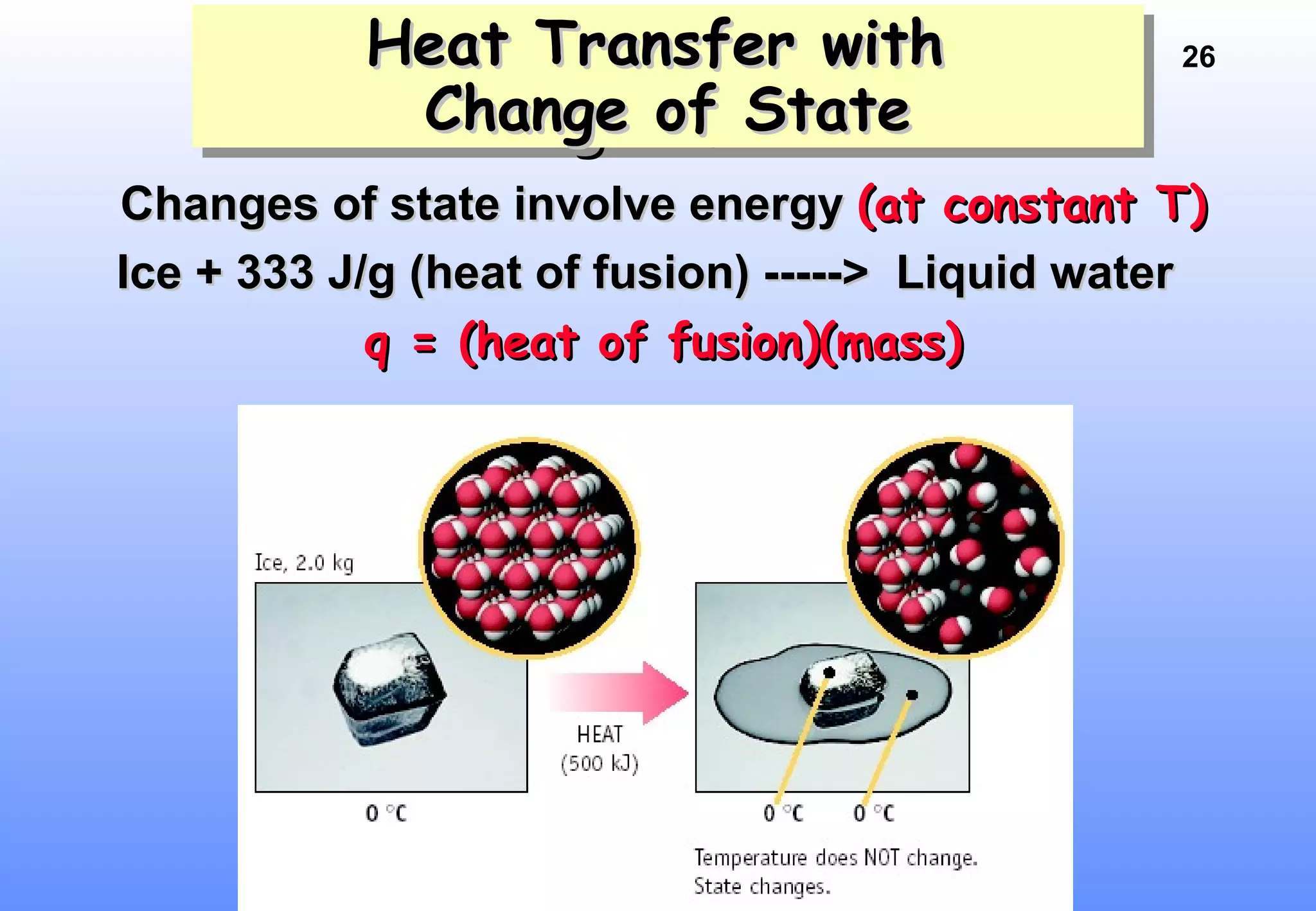
Changes of state involve energyChanges of state involve energy (at constant T)(at constant T)
Ice + 333 J/g (heat of fusion) -----> Liquid waterIce + 333 J/g (heat of fusion) -----> Liquid water
q = (heat of fusion)(mass)q = (heat of fusion)(mass)
27
Heat Transfer andHeat Transfer and
Changes of StateChanges of State
Heat Transfer andHeat Transfer and
Changes of StateChanges of State
Requires energyRequires energy
(heat).(heat).
This is the reasonThis is the reason
a)a) you cool down afteryou cool down after
swimmingswimming
b)b) you use water to putyou use water to put
out a fire.out a fire.
+ energy
Liquid ---> VaporLiquid ---> Vapor
28
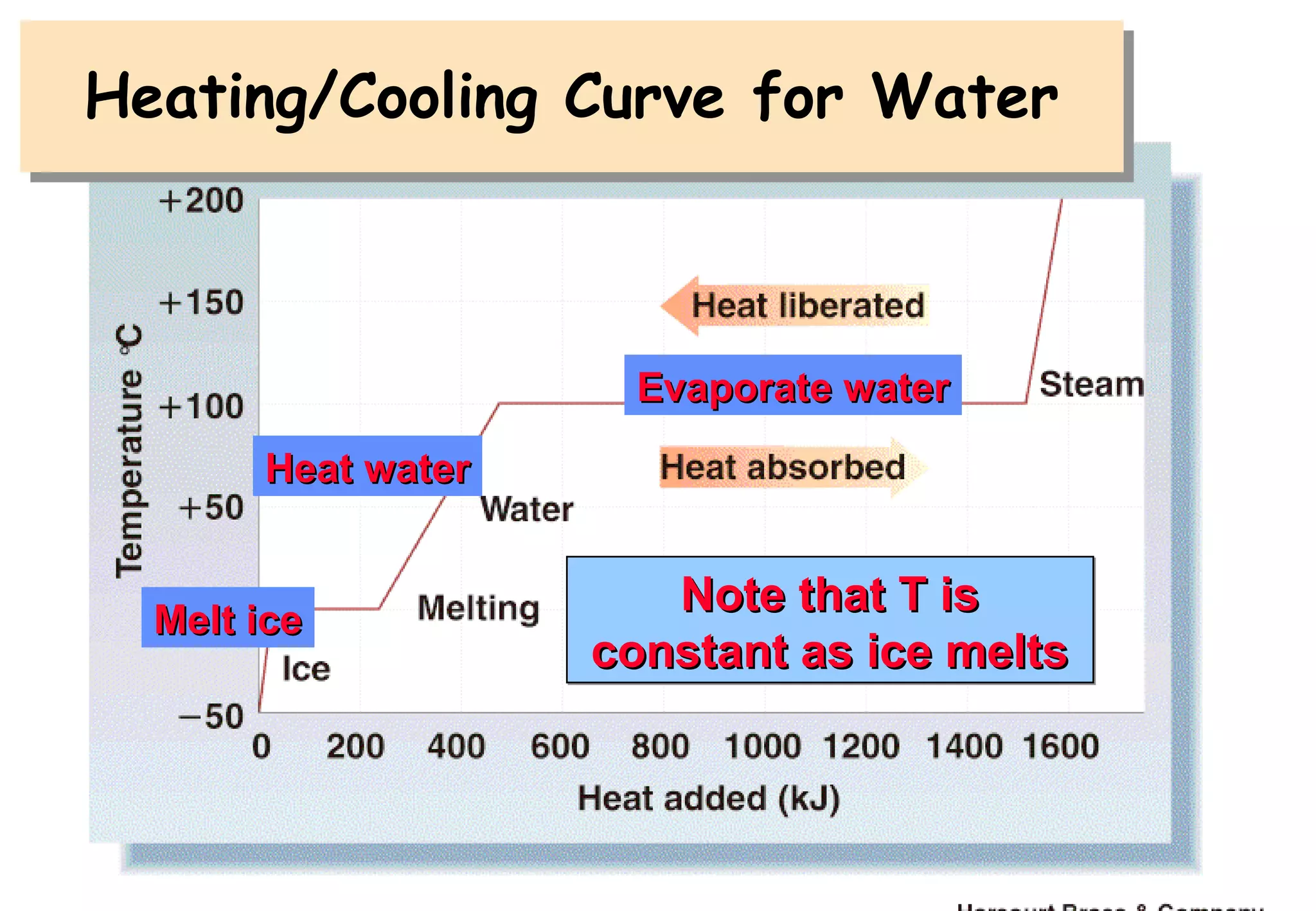
Heat waterHeat water
Evaporate waterEvaporate water
Melt iceMelt ice
Heating/Cooling Curve for WaterHeating/Cooling Curve for Water
Note that T isNote that T is
constant as ice meltsconstant as ice melts
Note that T isNote that T is
constant as ice meltsconstant as ice melts
29
Heat of fusion of ice = 333 J/gHeat of fusion of ice = 333 J/g
Specific heat of water = 4.2 J/g•KSpecific heat of water = 4.2 J/g•K
Heat of vaporization = 2260 J/gHeat of vaporization = 2260 J/g
Heat of fusion of ice = 333 J/gHeat of fusion of ice = 333 J/g
Specific heat of water = 4.2 J/g•KSpecific heat of water = 4.2 J/g•K
Heat of vaporization = 2260 J/gHeat of vaporization = 2260 J/g
What quantity of heat is required toWhat quantity of heat is required to
melt 500. g ofmelt 500. g of iceice and heat theand heat the
water towater to steamsteam at 100at 100 oo
C?C?
Heat & Changes of StateHeat & Changes of StateHeat & Changes of StateHeat & Changes of State
+333 J/g+333 J/g +2260 J/g+2260 J/g
30
How much heat is required to melt 500. g ofHow much heat is required to melt 500. g of
ice and heat the water to steam at 100ice and heat the water to steam at 100 oo
C?C?
1.1. To melt iceTo melt ice
q = (500. g)(333 J/g) = 1.67 x 10q = (500. g)(333 J/g) = 1.67 x 1055
JJ
2.2. To raise water from 0To raise water from 0 oo
C to 100C to 100 oo
CC
q = (500. g)(4.2 J/g•K)(100 - 0)K = 2.1 xq = (500. g)(4.2 J/g•K)(100 - 0)K = 2.1 x
101055
JJ
3.3. To evaporate water at 100To evaporate water at 100 oo
CC
q = (500. g)(2260 J/g) = 1.13 x 10q = (500. g)(2260 J/g) = 1.13 x 1066
JJ
4.4. Total heat energy = 1.51 x 10Total heat energy = 1.51 x 1066
J =J =
Heat & Changes of StateHeat & Changes of StateHeat & Changes of StateHeat & Changes of State
31
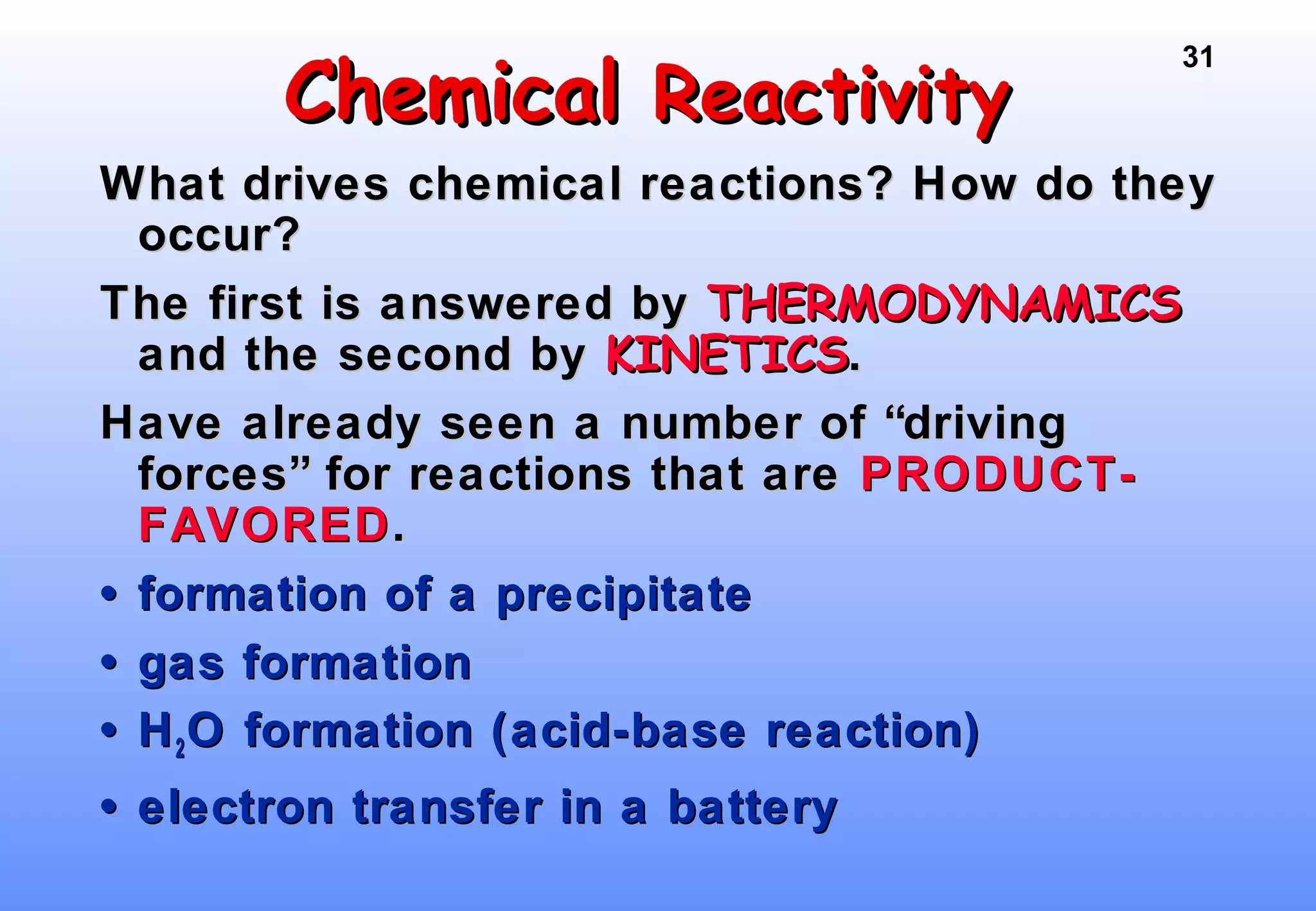
ChemicalChemical ReactivityReactivity
What drives chemical reactions? How do theyWhat drives chemical reactions? How do they
occur?occur?
The first is answered byThe first is answered by THERMODYNAMICSTHERMODYNAMICS
and the second byand the second by KINETICSKINETICS..
Have already seen a number of “drivingHave already seen a number of “driving
forces” for reactions that areforces” for reactions that are PRODUCT-PRODUCT-
FAVOREDFAVORED..
•• formation of a precipitateformation of a precipitate
•• gas formationgas formation
•• HH22O formation (acid-base reaction)O formation (acid-base reaction)
•• electron transfer in a batteryelectron transfer in a battery
32
ChemicalChemical ReactivityReactivity
But energy transfer also allows us to predictBut energy transfer also allows us to predict
reactivity.reactivity.
In general, reactions that transfer energyIn general, reactions that transfer energy
to their surroundings are product-to their surroundings are product-
favored.favored.
So, let us consider heat transfer in chemical processes.So, let us consider heat transfer in chemical processes.
33
Heat Energy Transfer inHeat Energy Transfer in
a Physical Processa Physical Process
COCO22 (s, -78(s, -78 oo
C) ---> COC) ---> CO22 (g, -78(g, -78 oo
C)C)
Heat transfers from surroundings to system in endothermic process.
34
Heat Energy Transfer inHeat Energy Transfer in
a Physical Processa Physical Process
• COCO22 (s, -78(s, -78 oo
C) --->C) --->
COCO22 (g, -78(g, -78 oo
C)C)
• A regular array ofA regular array of
molecules in amolecules in a
solidsolid
-----> gas phase-----> gas phase
molecules.molecules.
• Gas moleculesGas molecules
have higher kinetichave higher kinetic
energy.energy.
35
Energy Level DiagramEnergy Level Diagram
for Heat Energyfor Heat Energy
TransferTransfer
∆E = E(final) - E(initial)
= E(gas) - E(solid)
COCO22 solidsolid
COCO22 gasgas
36
Heat Energy Transfer inHeat Energy Transfer in
Physical ChangePhysical Change
• Gas molecules have higherGas molecules have higher
kinetic energy.kinetic energy.
• Also,Also, WORKWORK is done by theis done by the
system in pushing aside thesystem in pushing aside the
atmosphere.atmosphere.
COCO22 (s, -78(s, -78 oo
C) ---> COC) ---> CO22 (g, -78(g, -78 oo
C)C)
Two things have happened!Two things have happened!
37
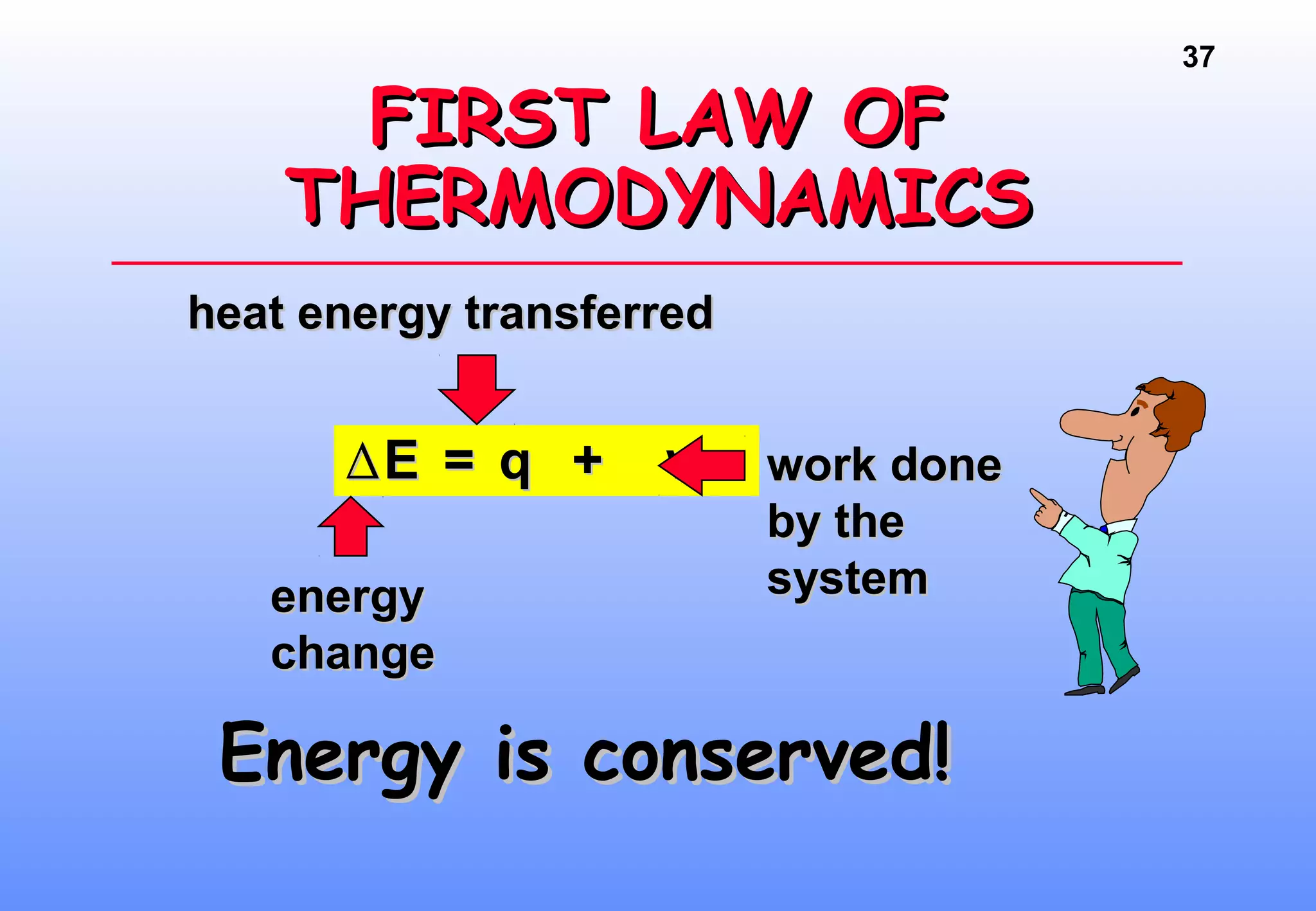
FIRST LAW OFFIRST LAW OF
THERMODYNAMICSTHERMODYNAMICS
∆∆E = q + wE = q + w
heat energy transferredheat energy transferred
energyenergy
changechange
work donework done
by theby the
systemsystem
Energy is conserved!Energy is conserved!
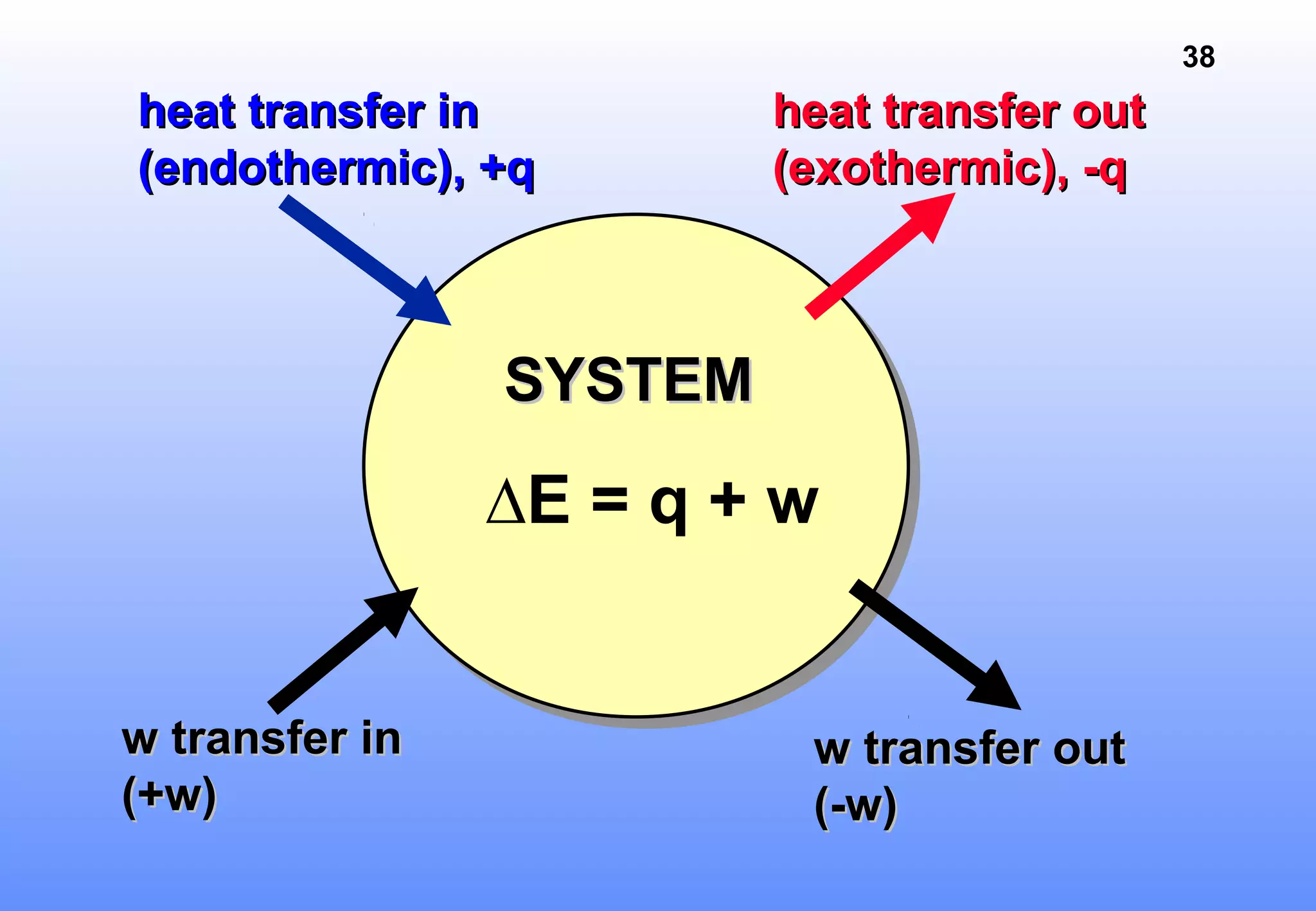
38
heat transfer outheat transfer out
(exothermic), -q(exothermic), -q
heat transfer inheat transfer in
(endothermic), +q(endothermic), +q
SYSTEMSYSTEM
∆E = q + w
w transfer inw transfer in
(+w)(+w)
w transfer outw transfer out
(-w)(-w)
39
ENTHALPYENTHALPY
Most chemical reactions occur at constant P, soMost chemical reactions occur at constant P, so
and so ∆E = ∆H + w (and w is usually small)and so ∆E = ∆H + w (and w is usually small)
∆∆H = heat transferred at constant P ≈ ∆EH = heat transferred at constant P ≈ ∆E
∆∆H = change inH = change in heat contentheat content of the systemof the system
∆∆H = HH = Hfinalfinal - H- Hinitialinitial
and so ∆E = ∆H + w (and w is usually small)and so ∆E = ∆H + w (and w is usually small)
∆∆H = heat transferred at constant P ≈ ∆EH = heat transferred at constant P ≈ ∆E
∆∆H = change inH = change in heat contentheat content of the systemof the system
∆∆H = HH = Hfinalfinal - H- Hinitialinitial
Heat transferred at constant P = qHeat transferred at constant P = qpp
qqpp == H∆H∆ wherewhere H = enthalpyH = enthalpy
Heat transferred at constant P = qHeat transferred at constant P = qpp
qqpp == H∆H∆ wherewhere H = enthalpyH = enthalpy
40
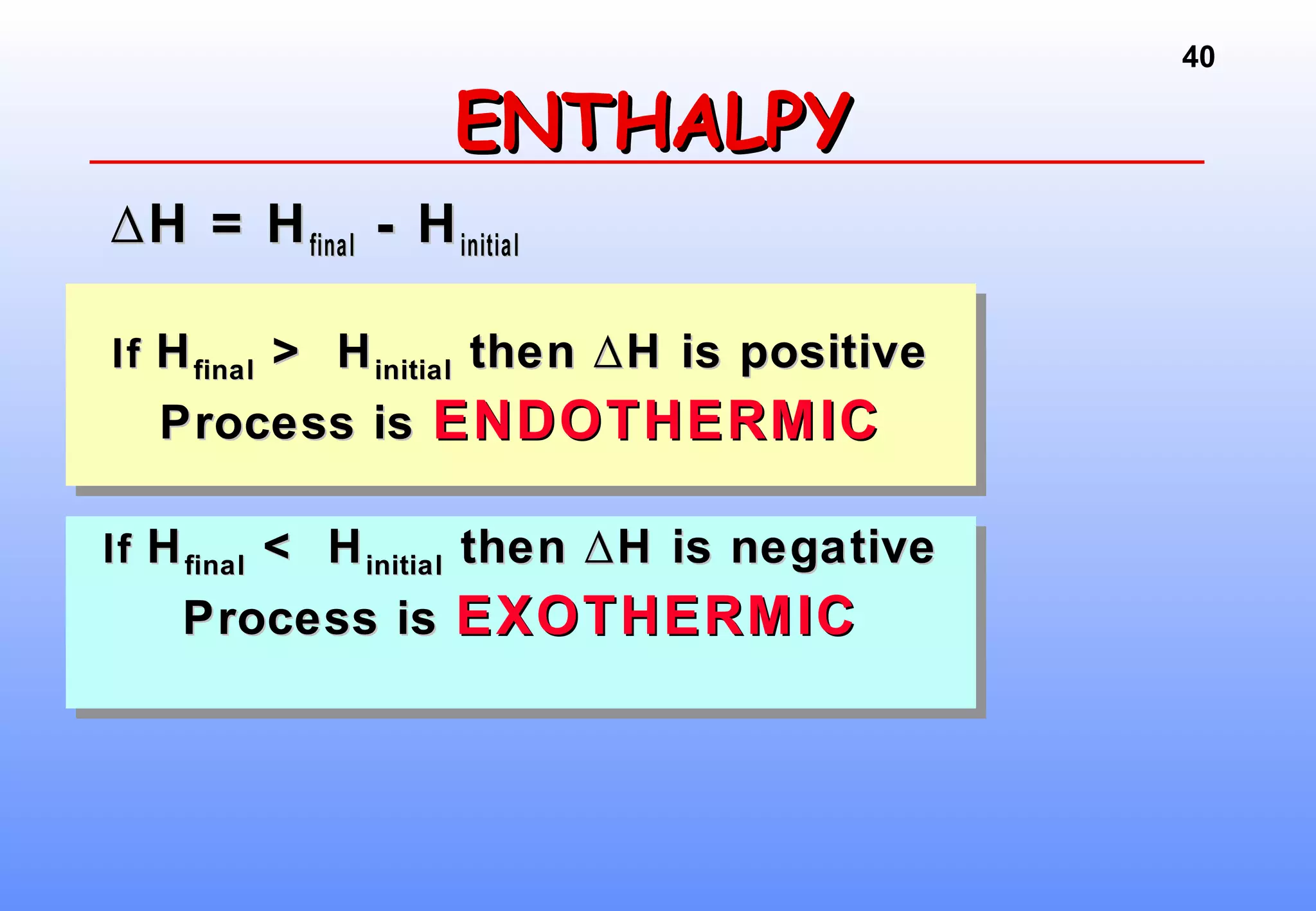
IfIf HHfinalfinal < H< Hinitialinitial then H is negative∆then H is negative∆
Process isProcess is EXOTHERMICEXOTHERMIC
IfIf HHfinalfinal < H< Hinitialinitial then H is negative∆then H is negative∆
Process isProcess is EXOTHERMICEXOTHERMIC
IfIf HHfinalfinal > H> Hinitialinitial then H is positive∆then H is positive∆
Process isProcess is ENDOTHERMICENDOTHERMIC
IfIf HHfinalfinal > H> Hinitialinitial then H is positive∆then H is positive∆
Process isProcess is ENDOTHERMICENDOTHERMIC
ENTHALPYENTHALPY
∆∆H = HH = Hfinalfinal - H- Hinitialinitial
41
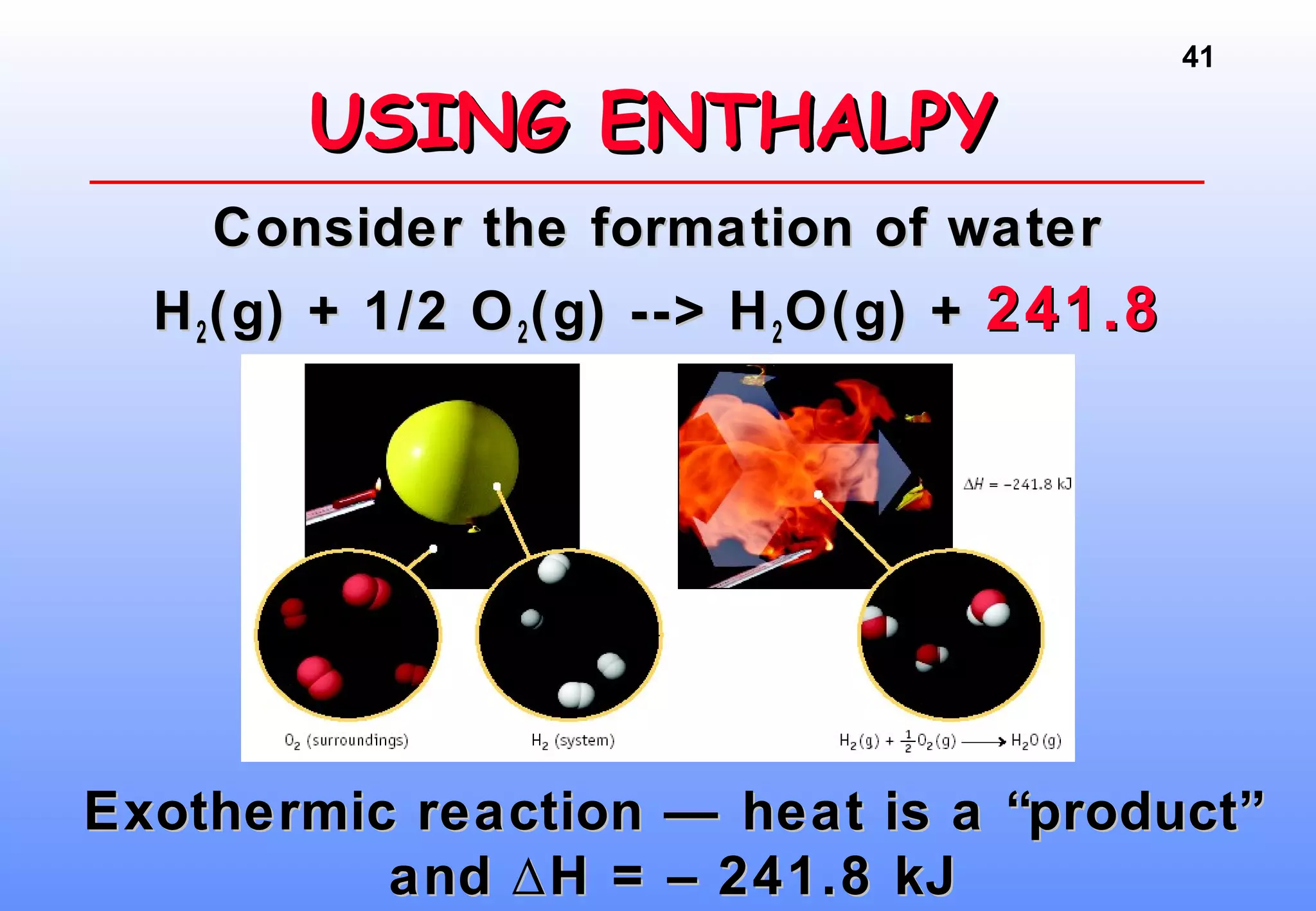
Consider the formation of waterConsider the formation of water
HH22(g) + 1/2 O(g) + 1/2 O22(g) --> H(g) --> H22O(g) +O(g) + 241.8241.8
kJkJ
USING ENTHALPYUSING ENTHALPY
Exothermic reaction — heat is a “product”Exothermic reaction — heat is a “product”
and H = – 241.8 kJ∆and H = – 241.8 kJ∆
42
MakingMaking liquidliquid HH22O from HO from H22
+ O+ O22 involvesinvolves twotwo
exoexothermic steps.thermic steps.
USING ENTHALPYUSING ENTHALPY
H2 + O2 gas
Liquid H2OH2O vapor
43
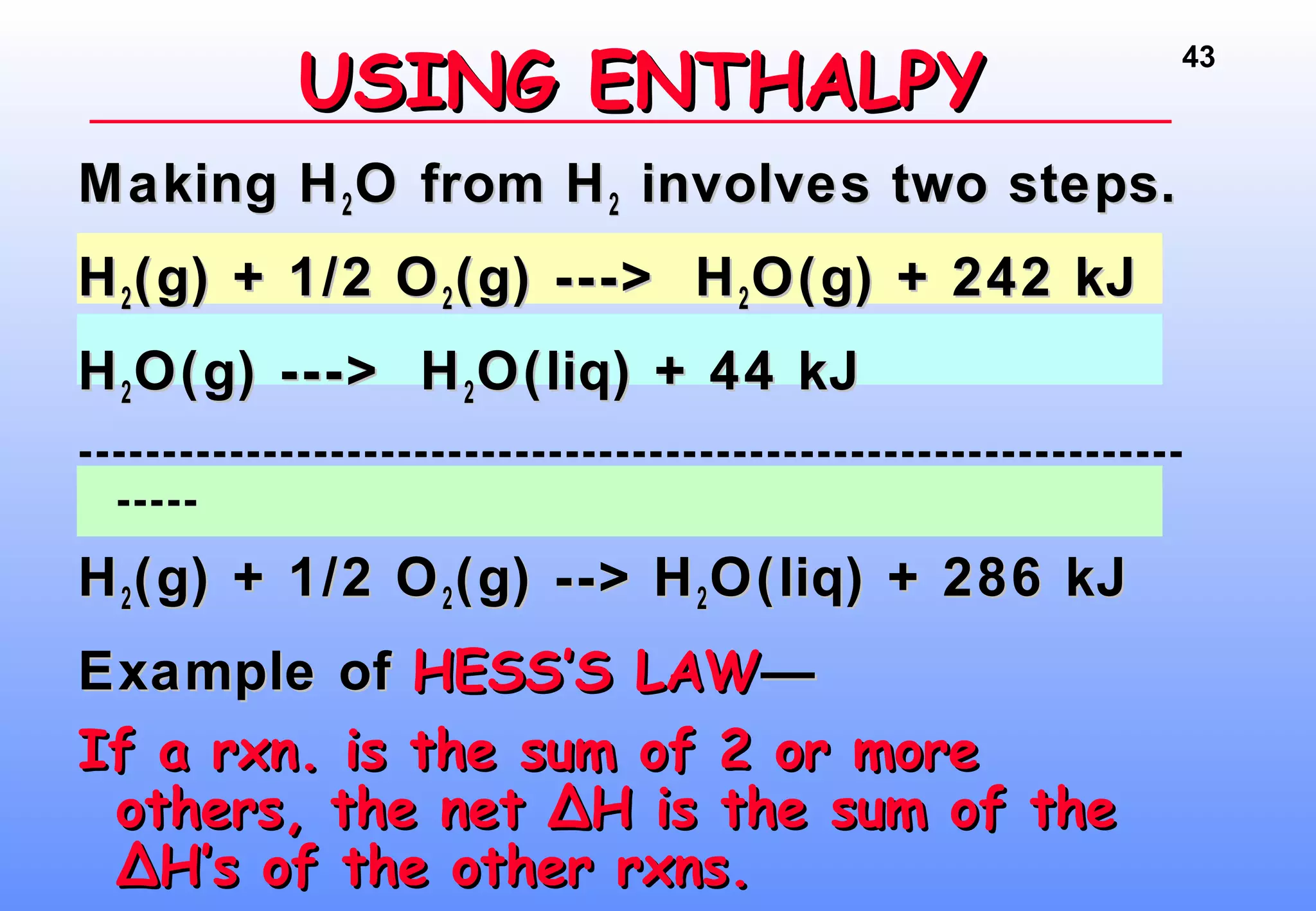
Making HMaking H22O from HO from H22 involves two steps.involves two steps.
HH22(g) + 1/2 O(g) + 1/2 O22(g) ---> H(g) ---> H22O(g) + 242 kJO(g) + 242 kJ
HH22O(g) ---> HO(g) ---> H22O(liq) + 44 kJO(liq) + 44 kJ
------------------------------------------------------------------
-----
HH22(g) + 1/2 O(g) + 1/2 O22(g) --> H(g) --> H22O(liq) + 286 kJO(liq) + 286 kJ
Example ofExample of HESS’S LAWHESS’S LAW——
If a rxn. is the sum of 2 or moreIf a rxn. is the sum of 2 or more
others, the net ∆H is the sum of theothers, the net ∆H is the sum of the
∆H’s of the other rxns.∆H’s of the other rxns.
USING ENTHALPYUSING ENTHALPY
44
Hess’s LawHess’s Law
& Energy Level Diagrams& Energy Level Diagrams
Forming H2O can occur in a
single step or in a two
steps.
∆Htotal is the same no matter
which path is followed.
45
Hess’s LawHess’s Law
& Energy Level Diagrams& Energy Level Diagrams
Forming CO2 can occur in a
single step or in a two steps.
∆Htotal is the same no matter
which path is followed.
46
• This equation is valid becauseThis equation is valid because
∆H is a∆H is a STATE FUNCTIONSTATE FUNCTION
• These depend only on the stateThese depend only on the state
of the system andof the system and notnot on howon how
the system got there.the system got there.
• V, T, P, energy — and your bankV, T, P, energy — and your bank
account!account!
• Unlike V, T, and P, one cannotUnlike V, T, and P, one cannot
measure absolute H. Can onlymeasure absolute H. Can only
measure ∆H.measure ∆H.
ΣΣ ∆∆H along one path =H along one path =
ΣΣ ∆∆H along another pathH along another path
ΣΣ ∆∆H along one path =H along one path =
ΣΣ ∆∆H along another pathH along another path
47
Standard Enthalpy ValuesStandard Enthalpy Values
Most H values are labeled∆Most H values are labeled∆ H∆H∆ oo
Measured underMeasured under standard conditionsstandard conditions
P = 1 bar = 10P = 1 bar = 1055
Pa = 1 atm /Pa = 1 atm /
1.013251.01325 Concentration = 1Concentration = 1
mol/Lmol/L
T = usually 25T = usually 25 oo
CC
with all species in standard stateswith all species in standard states
e.g., C = graphite and Oe.g., C = graphite and O22 = gas= gas
48
Enthalpy ValuesEnthalpy Values
HH22(g) + 1/2 O(g) + 1/2 O22(g) --> H(g) --> H22O(g)O(g)
∆∆H˚ = -242 kJH˚ = -242 kJ
2 H2 H22(g) + O(g) + O22(g) --> 2 H(g) --> 2 H22O(g)O(g)
∆∆H˚ = -484 kJH˚ = -484 kJ
HH22O(g) ---> HO(g) ---> H22(g) + 1/2 O(g) + 1/2 O22(g)(g)
∆∆H˚ = +242 kJH˚ = +242 kJ
HH22(g) + 1/2 O(g) + 1/2 O22(g) --> H(g) --> H22O(liquid)O(liquid)
Depend onDepend on how the reaction is writtenhow the reaction is written and on phasesand on phases
of reactants and productsof reactants and products
Depend onDepend on how the reaction is writtenhow the reaction is written and on phasesand on phases
of reactants and productsof reactants and products
49
Standard Enthalpy ValuesStandard Enthalpy Values
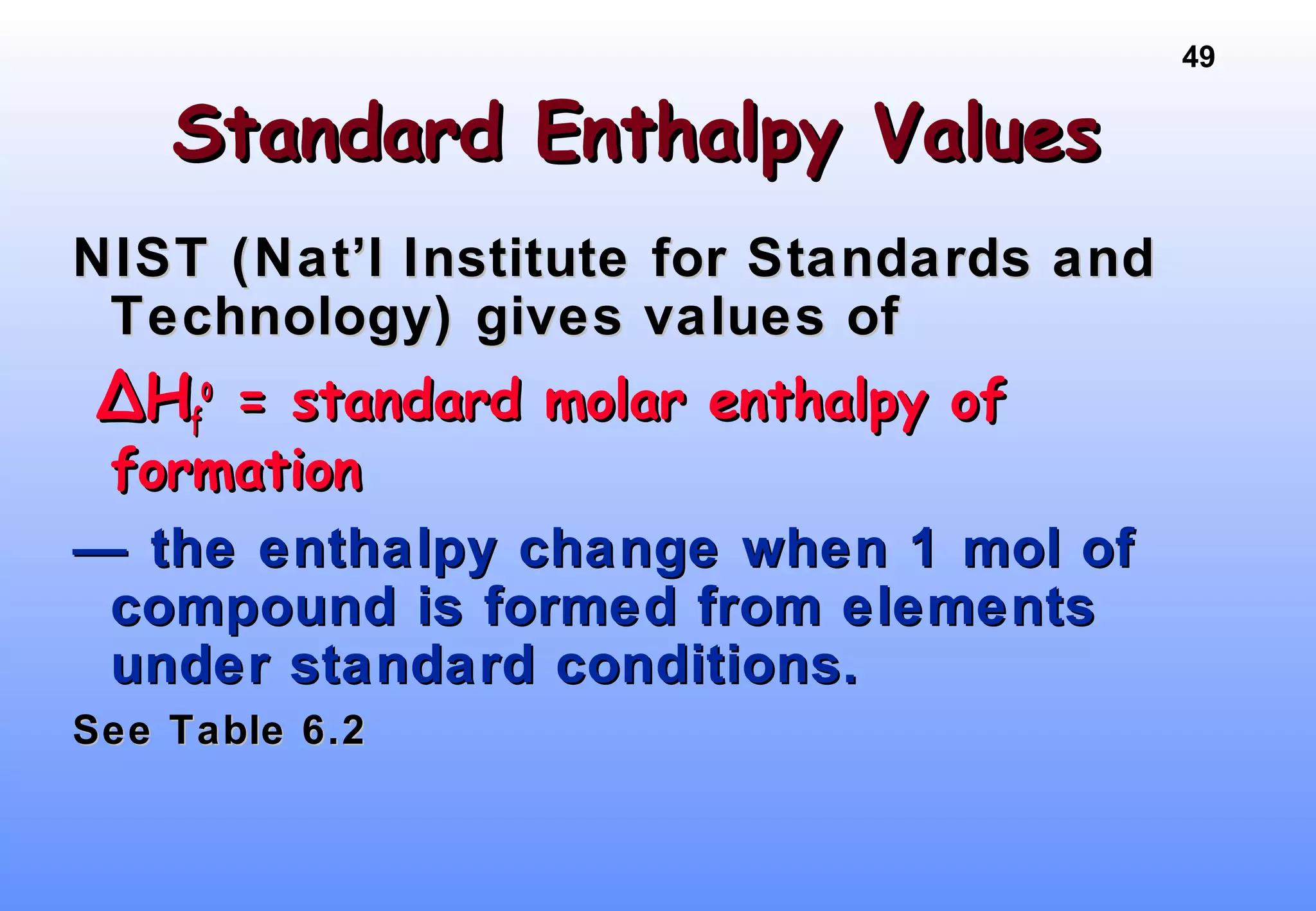
NIST (Nat’l Institute for Standards andNIST (Nat’l Institute for Standards and
Technology) gives values ofTechnology) gives values of
∆∆HHff
oo
= standard molar enthalpy of= standard molar enthalpy of
formationformation
—— the enthalpy change when 1 mol ofthe enthalpy change when 1 mol of
compound is formed from elementscompound is formed from elements
under standard conditions.under standard conditions.
See Table 6.2See Table 6.2
50
∆∆HHff
oo
, standard molar, standard molar
enthalpy of formationenthalpy of formation
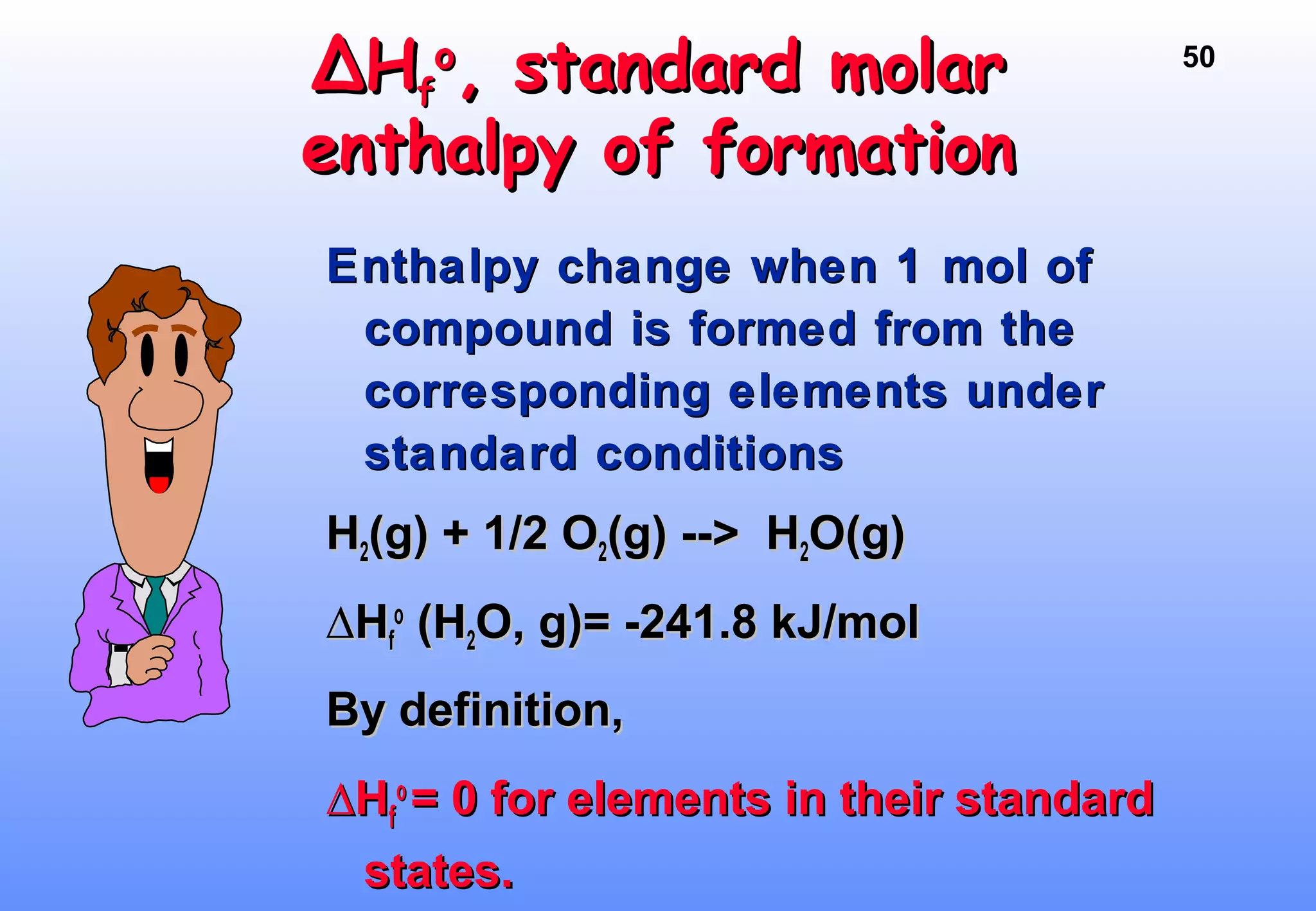
Enthalpy change when 1 mol ofEnthalpy change when 1 mol of
compound is formed from thecompound is formed from the
corresponding elements undercorresponding elements under
standard conditionsstandard conditions
HH22(g) + 1/2 O(g) + 1/2 O22(g) --> H(g) --> H22O(g)O(g)
∆∆HHff
oo
(H(H22O, g)= -241.8 kJ/molO, g)= -241.8 kJ/mol
By definition,By definition,
∆∆HHff
oo
= 0 for elements in their standard= 0 for elements in their standard
states.states.
51
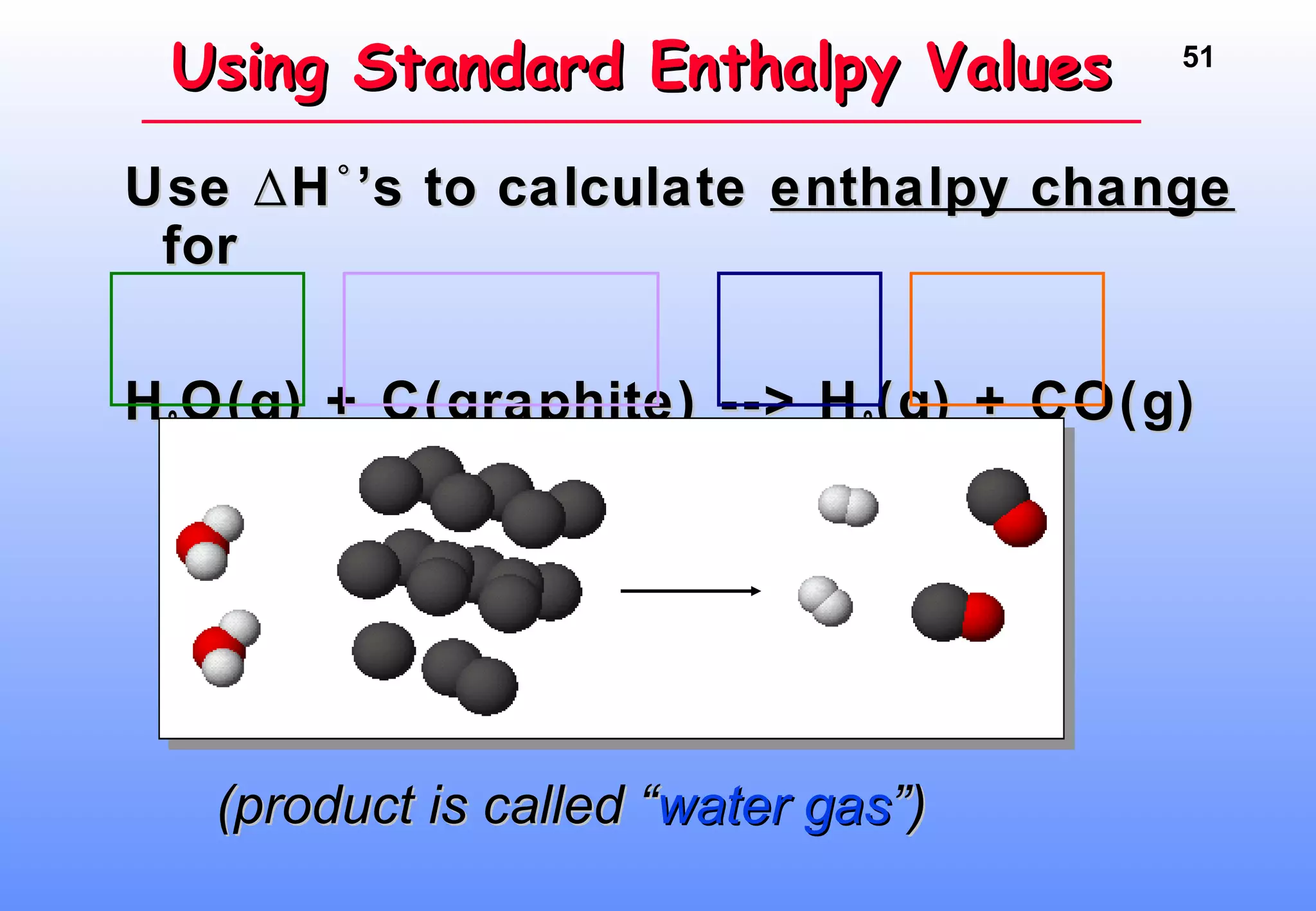
Using Standard Enthalpy ValuesUsing Standard Enthalpy Values
Use H ’s to calculate∆ ˚Use H ’s to calculate∆ ˚ enthalpy changeenthalpy change
forfor
HH22O(g) + C(graphite) --> HO(g) + C(graphite) --> H22(g) + CO(g)(g) + CO(g)
(product is called “(product is called “water gaswater gas”)”)
52
Using Standard Enthalpy ValuesUsing Standard Enthalpy Values
HH22O(g) + C(graphite) --> HO(g) + C(graphite) --> H22(g) + CO(g)(g) + CO(g)
From reference books we findFrom reference books we find
• HH22(g) + 1/2 O(g) + 1/2 O22(g) --> H(g) --> H22O(g) H∆O(g) H∆ ff = - 242˚ = - 242˚
kJ/molkJ/mol
• C(s) + 1/2 OC(s) + 1/2 O22(g) --> CO(g)(g) --> CO(g) H∆H∆ ff = - 111˚ = - 111˚
kJ/molkJ/mol
53
Using Standard Enthalpy ValuesUsing Standard Enthalpy Values
HH22O(g) --> HO(g) --> H22(g) + 1/2 O(g) + 1/2 O22(g) H∆(g) H∆ oo
= +242= +242
kJkJ
C(s) + 1/2 OC(s) + 1/2 O22(g) --> CO(g)(g) --> CO(g) H∆H∆ oo
= -111= -111
kJkJ
-----------------------------------------------------------------------
---------
To convert 1 mol of water to 1 mol eachTo convert 1 mol of water to 1 mol each
of Hof H22 and COand CO requiresrequires 131 kJ of energy.131 kJ of energy.
The “water gas” reaction isThe “water gas” reaction is ENDOENDOthermic.thermic.
HH22O(g) + C(graphite) --> HO(g) + C(graphite) --> H22(g) + CO(g)(g) + CO(g)
∆∆HHoo
netnet = +131 kJ= +131 kJ
HH22O(g) + C(graphite) --> HO(g) + C(graphite) --> H22(g) + CO(g)(g) + CO(g)
∆∆HHoo
netnet = +131 kJ= +131 kJ
54
Using Standard Enthalpy ValuesUsing Standard Enthalpy Values
In general, whenIn general, when ALLALL
enthalpies of formation areenthalpies of formation are
known:known:
Calculate ∆H ofCalculate ∆H of
reaction?reaction?
∆∆HHoo
rxnrxn == ΣΣ H∆H∆ ff
oo
(products) -(products) - ΣΣ H∆H∆ ff
oo
(reactants)(reactants)∆∆HHoo
rxnrxn == ΣΣ H∆H∆ ff
oo
(products) -(products) - ΣΣ H∆H∆ ff
oo
(reactants)(reactants)
Remember that ∆ always = final – initial
55
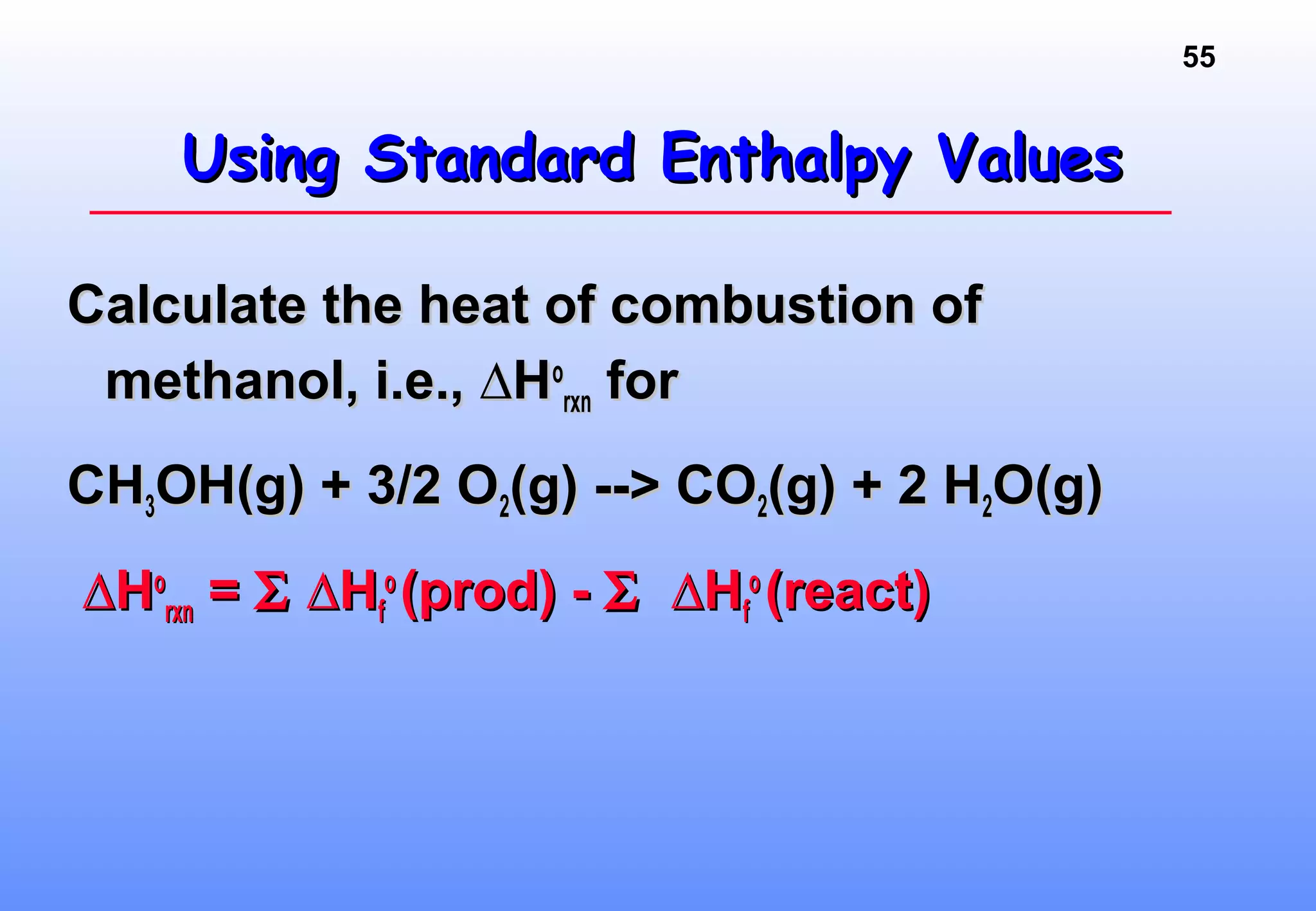
Using Standard Enthalpy ValuesUsing Standard Enthalpy Values
Calculate the heat of combustion ofCalculate the heat of combustion of
methanol, i.e., ∆Hmethanol, i.e., ∆Hoo
rxnrxn forfor
CHCH33OH(g) + 3/2 OOH(g) + 3/2 O22(g) --> CO(g) --> CO22(g) + 2 H(g) + 2 H22O(g)O(g)
∆∆HHoo
rxnrxn == ΣΣ ∆H∆Hff
oo
(prod) -(prod) - ΣΣ ∆H∆Hff
oo
(react)(react)
56
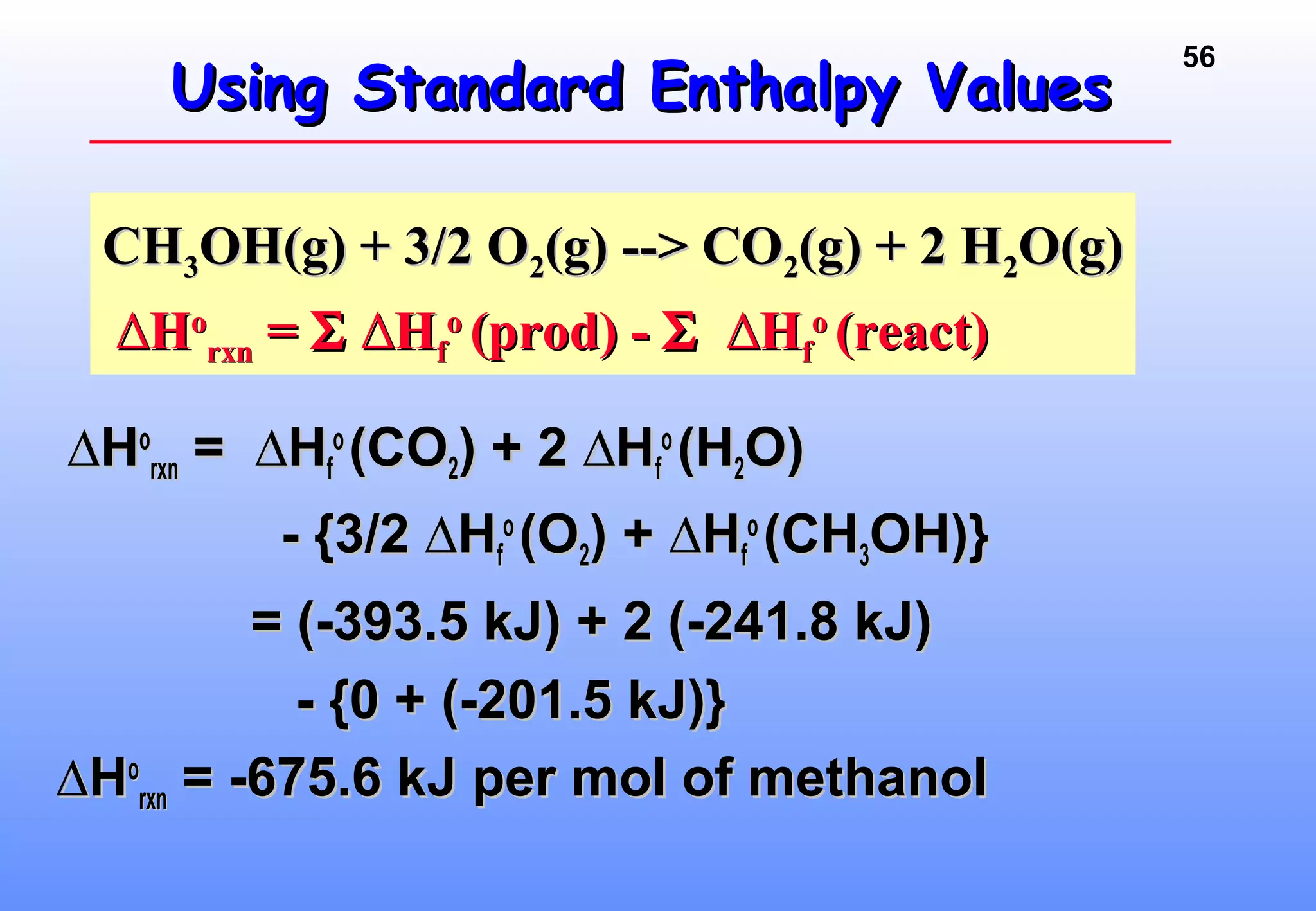
Using Standard Enthalpy ValuesUsing Standard Enthalpy Values
∆∆HHoo
rxnrxn = ∆H= ∆Hff
oo
(CO(CO22) + 2 ∆H) + 2 ∆Hff
oo
(H(H22O)O)
- {3/2 ∆H- {3/2 ∆Hff
oo
(O(O22) + ∆H) + ∆Hff
oo
(CH(CH33OH)}OH)}
= (-393.5 kJ) + 2 (-241.8 kJ)= (-393.5 kJ) + 2 (-241.8 kJ)
- {0 + (-201.5 kJ)}- {0 + (-201.5 kJ)}
∆∆HHoo
rxnrxn = -675.6 kJ per mol of methanol= -675.6 kJ per mol of methanol
CHCH33OH(g) + 3/2 OOH(g) + 3/2 O22(g) --> CO(g) --> CO22(g) + 2 H(g) + 2 H22O(g)O(g)
∆∆HHoo
rxnrxn == ΣΣ H∆H∆ ff
oo
(prod) -(prod) - ΣΣ H∆H∆ ff
oo
(react)(react)
57
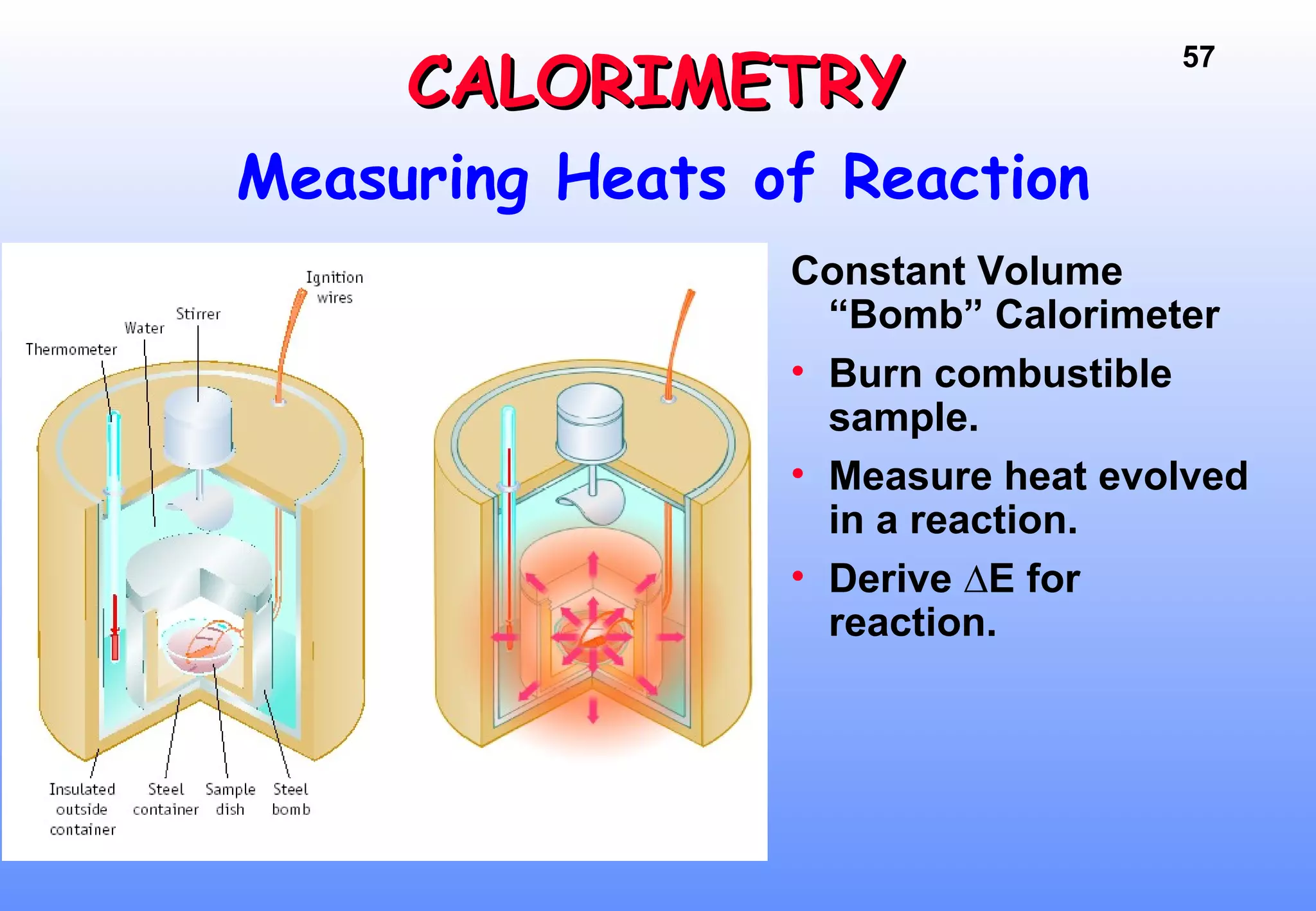
Measuring Heats of Reaction
CALORIMETRYCALORIMETRY
Constant Volume
“Bomb” Calorimeter
• Burn combustible
sample.
• Measure heat evolved
in a reaction.
• Derive ∆E for
reaction.
58
CalorimetryCalorimetry
Some heat from reaction warms
water
qwater = (sp. ht.)(water mass)(∆T)
Some heat from reaction warms
“bomb”
qbomb = (heat capacity, J/K)(∆T)
Total heat evolved = qtotal = qwater + qbomb
59
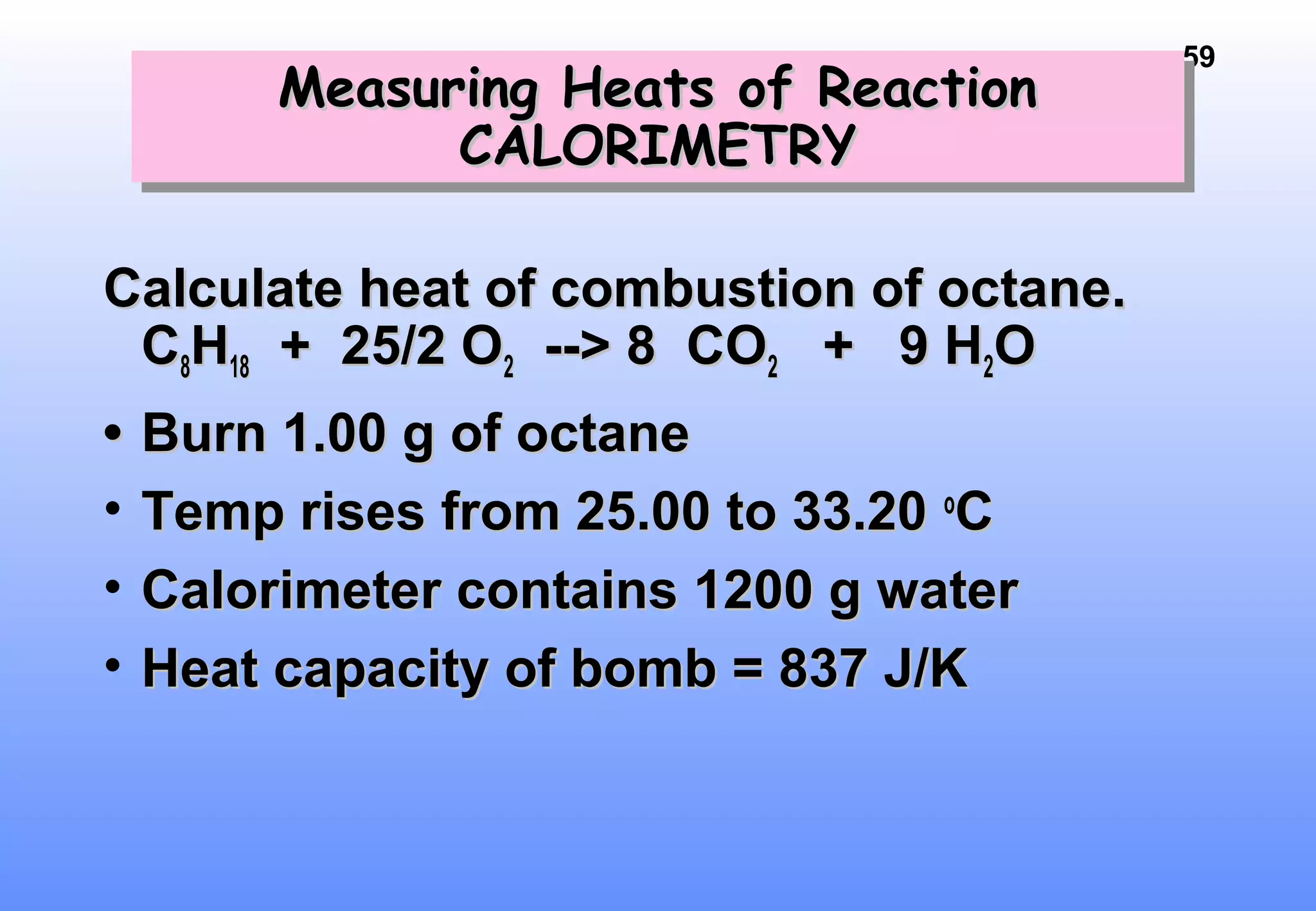
Calculate heat of combustion of octane.Calculate heat of combustion of octane.
CC88HH1818 + 25/2 O+ 25/2 O22 --> 8 CO--> 8 CO22 + 9 H+ 9 H22OO
•• Burn 1.00 g of octaneBurn 1.00 g of octane
• Temp rises from 25.00 to 33.20Temp rises from 25.00 to 33.20 oo
CC
• Calorimeter contains 1200 g waterCalorimeter contains 1200 g water
• Heat capacity of bomb = 837 J/KHeat capacity of bomb = 837 J/K
Measuring Heats of ReactionMeasuring Heats of Reaction
CALORIMETRYCALORIMETRY
Measuring Heats of ReactionMeasuring Heats of Reaction
CALORIMETRYCALORIMETRY
60
Step 1Step 1 Calc. heat transferred from reaction toCalc. heat transferred from reaction to
water.water.
q = (4.184 J/g•K)(1200 g)(8.20 K) = 41,170 Jq = (4.184 J/g•K)(1200 g)(8.20 K) = 41,170 J
Step 2Step 2 Calc. heat transferred from reaction toCalc. heat transferred from reaction to
bomb.bomb.
q = (bomb heat capacity)( T)∆q = (bomb heat capacity)( T)∆
= (837 J/K)(8.20 K) = 6860 J= (837 J/K)(8.20 K) = 6860 J
Step 3Step 3 Total heat evolvedTotal heat evolved
41,170 J + 6860 J = 48,030 J41,170 J + 6860 J = 48,030 J
Heat of combustion of 1.00 g of octane = - 48.0 kJHeat of combustion of 1.00 g of octane = - 48.0 kJ
Measuring Heats of ReactionMeasuring Heats of Reaction
CALORIMETRYCALORIMETRY
Measuring Heats of ReactionMeasuring Heats of Reaction
CALORIMETRYCALORIMETRY

Thermochem

  • 1.
    1THERMOCHEMISTRYTHERMOCHEMISTRY ThermodynamicsThermodynamics The study ofHeat and WorkThe study of Heat and Work and State Functionsand State Functions
  • 2.
    2 Energy & ChemistryEnergy& ChemistryEnergy & ChemistryEnergy & Chemistry ENERGYENERGY is the capacity tois the capacity to do work or transfer heat.do work or transfer heat. HEATHEAT is the form of energyis the form of energy that flows between 2that flows between 2 objects because of theirobjects because of their difference in temperature.difference in temperature. Other forms of energy —Other forms of energy — • lightlight • electricalelectrical • kinetic and potentialkinetic and potential
  • 3.
    3 Energy & ChemistryEnergy& Chemistry • Burning peanutspeanuts supply sufficientsupply sufficient energy to boil a cupenergy to boil a cup of water.of water. • Burning sugarBurning sugar (sugar reacts with(sugar reacts with KClOKClO33, a strong, a strong oxidizing agent)oxidizing agent)
  • 4.
    4 Energy & ChemistryEnergy& Chemistry • These reactions areThese reactions are PRODUCTPRODUCT FAVOREDFAVORED • They proceed almost completelyThey proceed almost completely from reactants to products, perhapsfrom reactants to products, perhaps with some outside assistance.with some outside assistance.
  • 5.
    5 Energy & ChemistryEnergy& Chemistry 2 H2 H22(g) + O(g) + O22(g) -->(g) --> 2 H2 H22O(g) + heat and lightO(g) + heat and light This can be set up to provideThis can be set up to provide ELECTRIC ENERGYELECTRIC ENERGY in ain a fuel cellfuel cell.. Oxidation:Oxidation: 2 H2 H22 ---> 4 H---> 4 H++ + 4 e+ 4 e-- Reduction:Reduction: 4 e4 e-- + O+ O22 + 2 H+ 2 H22O ---> 4 OHO ---> 4 OH-- CCR, page 845
  • 6.
    6 Potential & KineticEnergyPotential & Kinetic EnergyPotential & Kinetic EnergyPotential & Kinetic Energy PotentialPotential energyenergy —— energy aenergy a motionlessmotionless body has bybody has by virtue of itsvirtue of its position.position.
  • 7.
    7 • Positive and negativeparticles (ions) attract one another. • Two atoms can bond • As the particles attract they have a lower potential energy Potential EnergyPotential Energy on the Atomic Scaleon the Atomic Scale NaCl — composed ofNaCl — composed of NaNa++ and Cland Cl-- ions.ions.
  • 8.
    8 • Positive and negativeparticles (ions) attract one another. • Two atoms can bond • As the particles attract they have a lower potential energy Potential EnergyPotential Energy on the Atomic Scaleon the Atomic Scale
  • 9.
    9 Potential & KineticEnergyPotential & Kinetic EnergyPotential & Kinetic EnergyPotential & Kinetic Energy Kinetic energyKinetic energy — energy of— energy of motionmotion •• TranslationTranslation
  • 10.
    10 Potential & KineticEnergyPotential & Kinetic EnergyPotential & Kinetic EnergyPotential & Kinetic Energy Kinetic energyKinetic energy — energy of— energy of motion.motion. translate rotate vibrate translate rotate vibrate
  • 11.
    11 Internal Energy (E)InternalEnergy (E) • PE + KE = Internal energy (E or U)PE + KE = Internal energy (E or U) • Int. E of a chemical systemInt. E of a chemical system depends ondepends on • number of particlesnumber of particles • type of particlestype of particles • temperaturetemperature
  • 12.
    12 Internal Energy (E)InternalEnergy (E) • PE + KE = Internal energy (E or U)PE + KE = Internal energy (E or U) QuickTime™ and a Graphics decompressor are needed to see this picture.
  • 13.
    13 Internal Energy (E)InternalEnergy (E) • The higher the TThe higher the T the higher thethe higher the internal energyinternal energy • So, use changesSo, use changes in T (∆T) toin T (∆T) to monitor changesmonitor changes in E (∆E).in E (∆E).
  • 14.
    14 ThermodynamicsThermodynamics • Thermodynamics isthe science of heat (energy) transfer. Heat energy is associatedHeat energy is associated with molecular motions.with molecular motions. Heat transfers until thermal equilibrium is established.
  • 15.
    15 Directionality of HeatTransferDirectionality of Heat Transfer • Heat always transfer from hotter object to cooler one. • EXOthermic: heat transfers from SYSTEM to SURROUNDINGS. T(system) goes downT(system) goes down T(surr) goes upT(surr) goes up
  • 16.
    16 Directionality of HeatTransferDirectionality of Heat Transfer • Heat always transfer from hotter object to cooler one. • ENDOthermic: heat transfers from SURROUNDINGS to the SYSTEM. T(system) goes upT(system) goes up T (surr) goes downT (surr) goes down
  • 17.
    17 Energy & ChemistryEnergy& Chemistry All of thermodynamics dependsAll of thermodynamics depends on the law ofon the law of CONSERVATION OF ENERGYCONSERVATION OF ENERGY.. • The total energy is unchangedThe total energy is unchanged in a chemical reaction.in a chemical reaction. • If PE of products is less thanIf PE of products is less than reactants, the difference mustreactants, the difference must be released as KE.be released as KE.
  • 18.
    18 Energy Change inEnergyChange in Chemical ProcessesChemical Processes Reactants Products Kinetic Energy PE PE of system dropped. KE increased. Therefore,PE of system dropped. KE increased. Therefore, you often feel a T increase.you often feel a T increase.
  • 19.
    19 UNITS OF ENERGYUNITSOF ENERGYUNITS OF ENERGYUNITS OF ENERGY 1 calorie = heat required to1 calorie = heat required to raise temp. of 1.00 g ofraise temp. of 1.00 g of HH22O by 1.0O by 1.0 oo C.C. 1000 cal = 1 kilocalorie = 11000 cal = 1 kilocalorie = 1 kcalkcal 1 kcal = 1 Calorie (a food1 kcal = 1 Calorie (a food “calorie”)“calorie”) But we use the unit calledBut we use the unit called thethe JOULEJOULE 1 cal = 4.184 joules1 cal = 4.184 joules James JouleJames Joule 1818-18891818-1889
  • 20.
    20 HEAT CAPACITYHEAT CAPACITY Theheat required to raise an object’s T by 1 ˚C. Which has the larger heat capacity?Which has the larger heat capacity?
  • 21.
    21 SpecificSpecific Heat CapacityHeatCapacitySpecificSpecific Heat CapacityHeat Capacity How much energy isHow much energy is transferred due to Ttransferred due to T difference?difference? The heatThe heat (q)(q) “lost” or “gained”“lost” or “gained” is related tois related to a)a) sample masssample mass b)b) change in T andchange in T and c)c) specific heat capacityspecific heat capacity Specific heat capacity= heat lost or gained by substance (J) (mass, g)(T change,K)
  • 22.
    22 Specific Heat CapacitySpecificHeat CapacitySpecific Heat CapacitySpecific Heat Capacity SubstanceSubstance Spec. Heat (J/g•K)Spec. Heat (J/g•K) HH22OO 4.1844.184 Ethylene glycolEthylene glycol 2.392.39 AlAl 0.8970.897 glassglass 0.840.84 AluminumAluminum
  • 23.
    23 Specific Heat CapacitySpecificHeat CapacitySpecific Heat CapacitySpecific Heat Capacity If 25.0 g of Al cool fromIf 25.0 g of Al cool from 310310 oo C to 37C to 37 oo C, howC, how many joules of heatmany joules of heat energy are lost byenergy are lost by the Al?the Al? Specific heat capacity= heat lost or gained by substance (J) (mass, g)(T change,K)
  • 24.
    24 Specific Heat CapacitySpecificHeat CapacitySpecific Heat CapacitySpecific Heat Capacity If 25.0 g of Al cool from 310If 25.0 g of Al cool from 310 oo C to 37C to 37 oo C, how manyC, how many joules of heat energy are lost by the Al?joules of heat energy are lost by the Al? heat gain/lose = q = (sp. ht.)(mass)(∆T) where ∆T = Twhere ∆T = Tfinalfinal - T- Tinitialinitial q = (0.897 J/g•K)(25.0 g)(37 - 310)Kq = (0.897 J/g•K)(25.0 g)(37 - 310)K q = - 6120 Jq = - 6120 J Notice that the negative sign on q signalsNotice that the negative sign on q signals heat “lost by” or transferred OUT of Al.heat “lost by” or transferred OUT of Al. Notice that the negative sign on q signalsNotice that the negative sign on q signals heat “lost by” or transferred OUT of Al.heat “lost by” or transferred OUT of Al.
  • 25.
    25 Heat TransferHeat Transfer NoChange in StateNo Change in State q transferred = (sp. ht.)(mass)(∆T)
  • 26.
    26Heat Transfer withHeatTransfer with Change of StateChange of State Heat Transfer withHeat Transfer with Change of StateChange of State Changes of state involve energyChanges of state involve energy (at constant T)(at constant T) Ice + 333 J/g (heat of fusion) -----> Liquid waterIce + 333 J/g (heat of fusion) -----> Liquid water q = (heat of fusion)(mass)q = (heat of fusion)(mass)
  • 27.
    27 Heat Transfer andHeatTransfer and Changes of StateChanges of State Heat Transfer andHeat Transfer and Changes of StateChanges of State Requires energyRequires energy (heat).(heat). This is the reasonThis is the reason a)a) you cool down afteryou cool down after swimmingswimming b)b) you use water to putyou use water to put out a fire.out a fire. + energy Liquid ---> VaporLiquid ---> Vapor
  • 28.
    28 Heat waterHeat water EvaporatewaterEvaporate water Melt iceMelt ice Heating/Cooling Curve for WaterHeating/Cooling Curve for Water Note that T isNote that T is constant as ice meltsconstant as ice melts Note that T isNote that T is constant as ice meltsconstant as ice melts
  • 29.
    29 Heat of fusionof ice = 333 J/gHeat of fusion of ice = 333 J/g Specific heat of water = 4.2 J/g•KSpecific heat of water = 4.2 J/g•K Heat of vaporization = 2260 J/gHeat of vaporization = 2260 J/g Heat of fusion of ice = 333 J/gHeat of fusion of ice = 333 J/g Specific heat of water = 4.2 J/g•KSpecific heat of water = 4.2 J/g•K Heat of vaporization = 2260 J/gHeat of vaporization = 2260 J/g What quantity of heat is required toWhat quantity of heat is required to melt 500. g ofmelt 500. g of iceice and heat theand heat the water towater to steamsteam at 100at 100 oo C?C? Heat & Changes of StateHeat & Changes of StateHeat & Changes of StateHeat & Changes of State +333 J/g+333 J/g +2260 J/g+2260 J/g
  • 30.
    30 How much heatis required to melt 500. g ofHow much heat is required to melt 500. g of ice and heat the water to steam at 100ice and heat the water to steam at 100 oo C?C? 1.1. To melt iceTo melt ice q = (500. g)(333 J/g) = 1.67 x 10q = (500. g)(333 J/g) = 1.67 x 1055 JJ 2.2. To raise water from 0To raise water from 0 oo C to 100C to 100 oo CC q = (500. g)(4.2 J/g•K)(100 - 0)K = 2.1 xq = (500. g)(4.2 J/g•K)(100 - 0)K = 2.1 x 101055 JJ 3.3. To evaporate water at 100To evaporate water at 100 oo CC q = (500. g)(2260 J/g) = 1.13 x 10q = (500. g)(2260 J/g) = 1.13 x 1066 JJ 4.4. Total heat energy = 1.51 x 10Total heat energy = 1.51 x 1066 J =J = Heat & Changes of StateHeat & Changes of StateHeat & Changes of StateHeat & Changes of State
  • 31.
    31 ChemicalChemical ReactivityReactivity What driveschemical reactions? How do theyWhat drives chemical reactions? How do they occur?occur? The first is answered byThe first is answered by THERMODYNAMICSTHERMODYNAMICS and the second byand the second by KINETICSKINETICS.. Have already seen a number of “drivingHave already seen a number of “driving forces” for reactions that areforces” for reactions that are PRODUCT-PRODUCT- FAVOREDFAVORED.. •• formation of a precipitateformation of a precipitate •• gas formationgas formation •• HH22O formation (acid-base reaction)O formation (acid-base reaction) •• electron transfer in a batteryelectron transfer in a battery
  • 32.
    32 ChemicalChemical ReactivityReactivity But energytransfer also allows us to predictBut energy transfer also allows us to predict reactivity.reactivity. In general, reactions that transfer energyIn general, reactions that transfer energy to their surroundings are product-to their surroundings are product- favored.favored. So, let us consider heat transfer in chemical processes.So, let us consider heat transfer in chemical processes.
  • 33.
    33 Heat Energy TransferinHeat Energy Transfer in a Physical Processa Physical Process COCO22 (s, -78(s, -78 oo C) ---> COC) ---> CO22 (g, -78(g, -78 oo C)C) Heat transfers from surroundings to system in endothermic process.
  • 34.
    34 Heat Energy TransferinHeat Energy Transfer in a Physical Processa Physical Process • COCO22 (s, -78(s, -78 oo C) --->C) ---> COCO22 (g, -78(g, -78 oo C)C) • A regular array ofA regular array of molecules in amolecules in a solidsolid -----> gas phase-----> gas phase molecules.molecules. • Gas moleculesGas molecules have higher kinetichave higher kinetic energy.energy.
  • 35.
    35 Energy Level DiagramEnergyLevel Diagram for Heat Energyfor Heat Energy TransferTransfer ∆E = E(final) - E(initial) = E(gas) - E(solid) COCO22 solidsolid COCO22 gasgas
  • 36.
    36 Heat Energy TransferinHeat Energy Transfer in Physical ChangePhysical Change • Gas molecules have higherGas molecules have higher kinetic energy.kinetic energy. • Also,Also, WORKWORK is done by theis done by the system in pushing aside thesystem in pushing aside the atmosphere.atmosphere. COCO22 (s, -78(s, -78 oo C) ---> COC) ---> CO22 (g, -78(g, -78 oo C)C) Two things have happened!Two things have happened!
  • 37.
    37 FIRST LAW OFFIRSTLAW OF THERMODYNAMICSTHERMODYNAMICS ∆∆E = q + wE = q + w heat energy transferredheat energy transferred energyenergy changechange work donework done by theby the systemsystem Energy is conserved!Energy is conserved!
  • 38.
    38 heat transfer outheattransfer out (exothermic), -q(exothermic), -q heat transfer inheat transfer in (endothermic), +q(endothermic), +q SYSTEMSYSTEM ∆E = q + w w transfer inw transfer in (+w)(+w) w transfer outw transfer out (-w)(-w)
  • 39.
    39 ENTHALPYENTHALPY Most chemical reactionsoccur at constant P, soMost chemical reactions occur at constant P, so and so ∆E = ∆H + w (and w is usually small)and so ∆E = ∆H + w (and w is usually small) ∆∆H = heat transferred at constant P ≈ ∆EH = heat transferred at constant P ≈ ∆E ∆∆H = change inH = change in heat contentheat content of the systemof the system ∆∆H = HH = Hfinalfinal - H- Hinitialinitial and so ∆E = ∆H + w (and w is usually small)and so ∆E = ∆H + w (and w is usually small) ∆∆H = heat transferred at constant P ≈ ∆EH = heat transferred at constant P ≈ ∆E ∆∆H = change inH = change in heat contentheat content of the systemof the system ∆∆H = HH = Hfinalfinal - H- Hinitialinitial Heat transferred at constant P = qHeat transferred at constant P = qpp qqpp == H∆H∆ wherewhere H = enthalpyH = enthalpy Heat transferred at constant P = qHeat transferred at constant P = qpp qqpp == H∆H∆ wherewhere H = enthalpyH = enthalpy
  • 40.
    40 IfIf HHfinalfinal <H< Hinitialinitial then H is negative∆then H is negative∆ Process isProcess is EXOTHERMICEXOTHERMIC IfIf HHfinalfinal < H< Hinitialinitial then H is negative∆then H is negative∆ Process isProcess is EXOTHERMICEXOTHERMIC IfIf HHfinalfinal > H> Hinitialinitial then H is positive∆then H is positive∆ Process isProcess is ENDOTHERMICENDOTHERMIC IfIf HHfinalfinal > H> Hinitialinitial then H is positive∆then H is positive∆ Process isProcess is ENDOTHERMICENDOTHERMIC ENTHALPYENTHALPY ∆∆H = HH = Hfinalfinal - H- Hinitialinitial
  • 41.
    41 Consider the formationof waterConsider the formation of water HH22(g) + 1/2 O(g) + 1/2 O22(g) --> H(g) --> H22O(g) +O(g) + 241.8241.8 kJkJ USING ENTHALPYUSING ENTHALPY Exothermic reaction — heat is a “product”Exothermic reaction — heat is a “product” and H = – 241.8 kJ∆and H = – 241.8 kJ∆
  • 42.
    42 MakingMaking liquidliquid HH22Ofrom HO from H22 + O+ O22 involvesinvolves twotwo exoexothermic steps.thermic steps. USING ENTHALPYUSING ENTHALPY H2 + O2 gas Liquid H2OH2O vapor
  • 43.
    43 Making HMaking H22Ofrom HO from H22 involves two steps.involves two steps. HH22(g) + 1/2 O(g) + 1/2 O22(g) ---> H(g) ---> H22O(g) + 242 kJO(g) + 242 kJ HH22O(g) ---> HO(g) ---> H22O(liq) + 44 kJO(liq) + 44 kJ ------------------------------------------------------------------ ----- HH22(g) + 1/2 O(g) + 1/2 O22(g) --> H(g) --> H22O(liq) + 286 kJO(liq) + 286 kJ Example ofExample of HESS’S LAWHESS’S LAW—— If a rxn. is the sum of 2 or moreIf a rxn. is the sum of 2 or more others, the net ∆H is the sum of theothers, the net ∆H is the sum of the ∆H’s of the other rxns.∆H’s of the other rxns. USING ENTHALPYUSING ENTHALPY
  • 44.
    44 Hess’s LawHess’s Law &Energy Level Diagrams& Energy Level Diagrams Forming H2O can occur in a single step or in a two steps. ∆Htotal is the same no matter which path is followed.
  • 45.
    45 Hess’s LawHess’s Law &Energy Level Diagrams& Energy Level Diagrams Forming CO2 can occur in a single step or in a two steps. ∆Htotal is the same no matter which path is followed.
  • 46.
    46 • This equationis valid becauseThis equation is valid because ∆H is a∆H is a STATE FUNCTIONSTATE FUNCTION • These depend only on the stateThese depend only on the state of the system andof the system and notnot on howon how the system got there.the system got there. • V, T, P, energy — and your bankV, T, P, energy — and your bank account!account! • Unlike V, T, and P, one cannotUnlike V, T, and P, one cannot measure absolute H. Can onlymeasure absolute H. Can only measure ∆H.measure ∆H. ΣΣ ∆∆H along one path =H along one path = ΣΣ ∆∆H along another pathH along another path ΣΣ ∆∆H along one path =H along one path = ΣΣ ∆∆H along another pathH along another path
  • 47.
    47 Standard Enthalpy ValuesStandardEnthalpy Values Most H values are labeled∆Most H values are labeled∆ H∆H∆ oo Measured underMeasured under standard conditionsstandard conditions P = 1 bar = 10P = 1 bar = 1055 Pa = 1 atm /Pa = 1 atm / 1.013251.01325 Concentration = 1Concentration = 1 mol/Lmol/L T = usually 25T = usually 25 oo CC with all species in standard stateswith all species in standard states e.g., C = graphite and Oe.g., C = graphite and O22 = gas= gas
  • 48.
    48 Enthalpy ValuesEnthalpy Values HH22(g)+ 1/2 O(g) + 1/2 O22(g) --> H(g) --> H22O(g)O(g) ∆∆H˚ = -242 kJH˚ = -242 kJ 2 H2 H22(g) + O(g) + O22(g) --> 2 H(g) --> 2 H22O(g)O(g) ∆∆H˚ = -484 kJH˚ = -484 kJ HH22O(g) ---> HO(g) ---> H22(g) + 1/2 O(g) + 1/2 O22(g)(g) ∆∆H˚ = +242 kJH˚ = +242 kJ HH22(g) + 1/2 O(g) + 1/2 O22(g) --> H(g) --> H22O(liquid)O(liquid) Depend onDepend on how the reaction is writtenhow the reaction is written and on phasesand on phases of reactants and productsof reactants and products Depend onDepend on how the reaction is writtenhow the reaction is written and on phasesand on phases of reactants and productsof reactants and products
  • 49.
    49 Standard Enthalpy ValuesStandardEnthalpy Values NIST (Nat’l Institute for Standards andNIST (Nat’l Institute for Standards and Technology) gives values ofTechnology) gives values of ∆∆HHff oo = standard molar enthalpy of= standard molar enthalpy of formationformation —— the enthalpy change when 1 mol ofthe enthalpy change when 1 mol of compound is formed from elementscompound is formed from elements under standard conditions.under standard conditions. See Table 6.2See Table 6.2
  • 50.
    50 ∆∆HHff oo , standard molar,standard molar enthalpy of formationenthalpy of formation Enthalpy change when 1 mol ofEnthalpy change when 1 mol of compound is formed from thecompound is formed from the corresponding elements undercorresponding elements under standard conditionsstandard conditions HH22(g) + 1/2 O(g) + 1/2 O22(g) --> H(g) --> H22O(g)O(g) ∆∆HHff oo (H(H22O, g)= -241.8 kJ/molO, g)= -241.8 kJ/mol By definition,By definition, ∆∆HHff oo = 0 for elements in their standard= 0 for elements in their standard states.states.
  • 51.
    51 Using Standard EnthalpyValuesUsing Standard Enthalpy Values Use H ’s to calculate∆ ˚Use H ’s to calculate∆ ˚ enthalpy changeenthalpy change forfor HH22O(g) + C(graphite) --> HO(g) + C(graphite) --> H22(g) + CO(g)(g) + CO(g) (product is called “(product is called “water gaswater gas”)”)
  • 52.
    52 Using Standard EnthalpyValuesUsing Standard Enthalpy Values HH22O(g) + C(graphite) --> HO(g) + C(graphite) --> H22(g) + CO(g)(g) + CO(g) From reference books we findFrom reference books we find • HH22(g) + 1/2 O(g) + 1/2 O22(g) --> H(g) --> H22O(g) H∆O(g) H∆ ff = - 242˚ = - 242˚ kJ/molkJ/mol • C(s) + 1/2 OC(s) + 1/2 O22(g) --> CO(g)(g) --> CO(g) H∆H∆ ff = - 111˚ = - 111˚ kJ/molkJ/mol
  • 53.
    53 Using Standard EnthalpyValuesUsing Standard Enthalpy Values HH22O(g) --> HO(g) --> H22(g) + 1/2 O(g) + 1/2 O22(g) H∆(g) H∆ oo = +242= +242 kJkJ C(s) + 1/2 OC(s) + 1/2 O22(g) --> CO(g)(g) --> CO(g) H∆H∆ oo = -111= -111 kJkJ ----------------------------------------------------------------------- --------- To convert 1 mol of water to 1 mol eachTo convert 1 mol of water to 1 mol each of Hof H22 and COand CO requiresrequires 131 kJ of energy.131 kJ of energy. The “water gas” reaction isThe “water gas” reaction is ENDOENDOthermic.thermic. HH22O(g) + C(graphite) --> HO(g) + C(graphite) --> H22(g) + CO(g)(g) + CO(g) ∆∆HHoo netnet = +131 kJ= +131 kJ HH22O(g) + C(graphite) --> HO(g) + C(graphite) --> H22(g) + CO(g)(g) + CO(g) ∆∆HHoo netnet = +131 kJ= +131 kJ
  • 54.
    54 Using Standard EnthalpyValuesUsing Standard Enthalpy Values In general, whenIn general, when ALLALL enthalpies of formation areenthalpies of formation are known:known: Calculate ∆H ofCalculate ∆H of reaction?reaction? ∆∆HHoo rxnrxn == ΣΣ H∆H∆ ff oo (products) -(products) - ΣΣ H∆H∆ ff oo (reactants)(reactants)∆∆HHoo rxnrxn == ΣΣ H∆H∆ ff oo (products) -(products) - ΣΣ H∆H∆ ff oo (reactants)(reactants) Remember that ∆ always = final – initial
  • 55.
    55 Using Standard EnthalpyValuesUsing Standard Enthalpy Values Calculate the heat of combustion ofCalculate the heat of combustion of methanol, i.e., ∆Hmethanol, i.e., ∆Hoo rxnrxn forfor CHCH33OH(g) + 3/2 OOH(g) + 3/2 O22(g) --> CO(g) --> CO22(g) + 2 H(g) + 2 H22O(g)O(g) ∆∆HHoo rxnrxn == ΣΣ ∆H∆Hff oo (prod) -(prod) - ΣΣ ∆H∆Hff oo (react)(react)
  • 56.
    56 Using Standard EnthalpyValuesUsing Standard Enthalpy Values ∆∆HHoo rxnrxn = ∆H= ∆Hff oo (CO(CO22) + 2 ∆H) + 2 ∆Hff oo (H(H22O)O) - {3/2 ∆H- {3/2 ∆Hff oo (O(O22) + ∆H) + ∆Hff oo (CH(CH33OH)}OH)} = (-393.5 kJ) + 2 (-241.8 kJ)= (-393.5 kJ) + 2 (-241.8 kJ) - {0 + (-201.5 kJ)}- {0 + (-201.5 kJ)} ∆∆HHoo rxnrxn = -675.6 kJ per mol of methanol= -675.6 kJ per mol of methanol CHCH33OH(g) + 3/2 OOH(g) + 3/2 O22(g) --> CO(g) --> CO22(g) + 2 H(g) + 2 H22O(g)O(g) ∆∆HHoo rxnrxn == ΣΣ H∆H∆ ff oo (prod) -(prod) - ΣΣ H∆H∆ ff oo (react)(react)
  • 57.
    57 Measuring Heats ofReaction CALORIMETRYCALORIMETRY Constant Volume “Bomb” Calorimeter • Burn combustible sample. • Measure heat evolved in a reaction. • Derive ∆E for reaction.
  • 58.
    58 CalorimetryCalorimetry Some heat fromreaction warms water qwater = (sp. ht.)(water mass)(∆T) Some heat from reaction warms “bomb” qbomb = (heat capacity, J/K)(∆T) Total heat evolved = qtotal = qwater + qbomb
  • 59.
    59 Calculate heat ofcombustion of octane.Calculate heat of combustion of octane. CC88HH1818 + 25/2 O+ 25/2 O22 --> 8 CO--> 8 CO22 + 9 H+ 9 H22OO •• Burn 1.00 g of octaneBurn 1.00 g of octane • Temp rises from 25.00 to 33.20Temp rises from 25.00 to 33.20 oo CC • Calorimeter contains 1200 g waterCalorimeter contains 1200 g water • Heat capacity of bomb = 837 J/KHeat capacity of bomb = 837 J/K Measuring Heats of ReactionMeasuring Heats of Reaction CALORIMETRYCALORIMETRY Measuring Heats of ReactionMeasuring Heats of Reaction CALORIMETRYCALORIMETRY
  • 60.
    60 Step 1Step 1Calc. heat transferred from reaction toCalc. heat transferred from reaction to water.water. q = (4.184 J/g•K)(1200 g)(8.20 K) = 41,170 Jq = (4.184 J/g•K)(1200 g)(8.20 K) = 41,170 J Step 2Step 2 Calc. heat transferred from reaction toCalc. heat transferred from reaction to bomb.bomb. q = (bomb heat capacity)( T)∆q = (bomb heat capacity)( T)∆ = (837 J/K)(8.20 K) = 6860 J= (837 J/K)(8.20 K) = 6860 J Step 3Step 3 Total heat evolvedTotal heat evolved 41,170 J + 6860 J = 48,030 J41,170 J + 6860 J = 48,030 J Heat of combustion of 1.00 g of octane = - 48.0 kJHeat of combustion of 1.00 g of octane = - 48.0 kJ Measuring Heats of ReactionMeasuring Heats of Reaction CALORIMETRYCALORIMETRY Measuring Heats of ReactionMeasuring Heats of Reaction CALORIMETRYCALORIMETRY

Editor's Notes

  • #2 To play the movies and simulations included, view the presentation in Slide Show Mode.