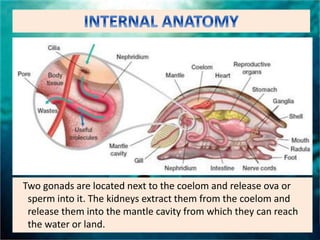
Two gonads are located next to the coelom and release ova or
sperm into it. The kidneys extract them from the coelom and
release them into the mantle cavity from which they can reach
the water or land.
• If we will study the reproductive biology of
some gastropods, we can find that some
gastropods use internal fertilization and/or are
hermaphrodites, functioning as both sexes
and some are external fertilization.
• The marine gastropods are commonly dioecius
i.e.-both the sexes are separated(except-
family onchidiidae and siphonnidae). But the
terrestrial gastropods are generally
hermophrodites.
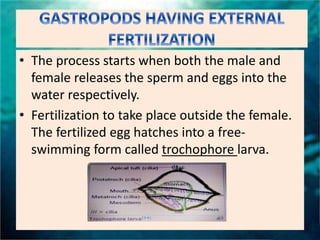
• The process starts when both the male and
female releases the sperm and eggs into the
water respectively.
• Fertilization to take place outside the female.
The fertilized egg hatches into a free-
swimming form called trochophore larva.
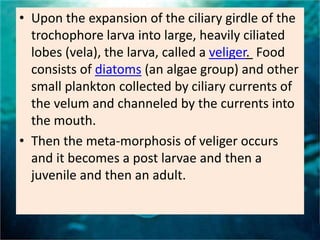
• Upon the expansion of the ciliary girdle of the
trochophore larva into large, heavily ciliated
lobes (vela), the larva, called a veliger. Food
consists of diatoms (an algae group) and other
small plankton collected by ciliary currents of
the velum and channeled by the currents into
the mouth.
• Then the meta-morphosis of veliger occurs
and it becomes a post larvae and then a
juvenile and then an adult.
• In simultaneous hermaphrodites, each animal performs only
one role in a given mating, with role preferences varying
within and between individuals. After completing one
unilateral sperm donation, the partners often switch roles in a
second mating.
E.g- opisthobranchs (Aplysia, Cliona, Cavolina, Doris, etc) and
The pond snail(Lymnaea ).
• Animals such as Aplysia californica, which have their male and
female genitalia located on different parts of the body and
normally mate unilaterally, can form daisy chains which may
contain as many as six mating individuals. The first individual
in the chain acts only as a male, the last individual acts only as
a female, and all animals in between act as female to one
partner and male to a second partner.
• Numerous species of freshwater gastropods contain
hermaphroditic individuals that lack penes (aphally). Such
animals reproduce either by outcrossing as females or by
using their own sperm to fertilize their own eggs (selfing).
• Potential mates must be located and identified
using the chemical senses (olfaction and contact
sensations) because gastropods have no sense of
hearing and little or no vision. Sea slugs in the
genus Aplysia release a bouquet of pheromones
when laying eggs, and these substances attract
conspecifics that may then mate with the egg-
laying individual. Several of these pheromones
have been identified and sequenced; they have
been given the names “attractin”, “seducin”,
"enticin", etc. (Painter et al., 2004).
• The receiver, receives sperm and can
store for many months to years before it
is used to fertilize eggs. Meanwhile, the
receiving individual may mate with
additional sperm donors. When the
multiply mated individual eventually
fertilizes its eggs, it will generally select
sperm at random (as in a raffle) from the
stored pool.
• The “ ” is a phenomena seen in
terrestrial gastropods where the donor expel the
dart (solid and has a sharp tip; it is made of pure
calcium carbonate crystals) from the genital pore
in the later stages of courtship and it often, but
not always, penetrates into the flesh of the mate.
It is observed that more of the shooter’s sperm
becoming stored by the receiving mate compared
to cases where the dart misses. This is because of
the mucus that clings to the surface of the dart.
This mucus contain a peptide and enhance the
survival of the shooter's sperm.
• Aquatic gastropods generally deposit their eggs in
gelatinous masses that are attached to a hard
surface. Opisthobranchs lay huge numbers of
fertilized eggs. For example, a single specimen
of Aplysia californica was observed depositing
one mass that contained 140,000 eggs (Kandel,
1979). Moreover, during the spawning season, an
individual Aplysia californica will typically lay eggs
at intervals of 1 or 2 days.
• In such species the trochophore and veliger
stages are passed within an egg and it releases a
crawling gastropod after hatching.
ENVIRONMENTAL CONDITION INTERNAL
STATES
CENTRAL NERVOUS SYSTEM
BAG CELLS
EGG LAYING HORMONE (E.L.H)
OVULATION
Gastropods reproductive system

Gastropods reproductive system

  • 2.
    Two gonads arelocated next to the coelom and release ova or sperm into it. The kidneys extract them from the coelom and release them into the mantle cavity from which they can reach the water or land.
  • 3.
    • If wewill study the reproductive biology of some gastropods, we can find that some gastropods use internal fertilization and/or are hermaphrodites, functioning as both sexes and some are external fertilization. • The marine gastropods are commonly dioecius i.e.-both the sexes are separated(except- family onchidiidae and siphonnidae). But the terrestrial gastropods are generally hermophrodites.
  • 4.
    • The processstarts when both the male and female releases the sperm and eggs into the water respectively. • Fertilization to take place outside the female. The fertilized egg hatches into a free- swimming form called trochophore larva.
  • 5.
    • Upon theexpansion of the ciliary girdle of the trochophore larva into large, heavily ciliated lobes (vela), the larva, called a veliger. Food consists of diatoms (an algae group) and other small plankton collected by ciliary currents of the velum and channeled by the currents into the mouth. • Then the meta-morphosis of veliger occurs and it becomes a post larvae and then a juvenile and then an adult.
  • 7.
    • In simultaneoushermaphrodites, each animal performs only one role in a given mating, with role preferences varying within and between individuals. After completing one unilateral sperm donation, the partners often switch roles in a second mating. E.g- opisthobranchs (Aplysia, Cliona, Cavolina, Doris, etc) and The pond snail(Lymnaea ).
  • 8.
    • Animals suchas Aplysia californica, which have their male and female genitalia located on different parts of the body and normally mate unilaterally, can form daisy chains which may contain as many as six mating individuals. The first individual in the chain acts only as a male, the last individual acts only as a female, and all animals in between act as female to one partner and male to a second partner. • Numerous species of freshwater gastropods contain hermaphroditic individuals that lack penes (aphally). Such animals reproduce either by outcrossing as females or by using their own sperm to fertilize their own eggs (selfing).
  • 9.
    • Potential matesmust be located and identified using the chemical senses (olfaction and contact sensations) because gastropods have no sense of hearing and little or no vision. Sea slugs in the genus Aplysia release a bouquet of pheromones when laying eggs, and these substances attract conspecifics that may then mate with the egg- laying individual. Several of these pheromones have been identified and sequenced; they have been given the names “attractin”, “seducin”, "enticin", etc. (Painter et al., 2004).
  • 10.
    • The receiver,receives sperm and can store for many months to years before it is used to fertilize eggs. Meanwhile, the receiving individual may mate with additional sperm donors. When the multiply mated individual eventually fertilizes its eggs, it will generally select sperm at random (as in a raffle) from the stored pool.
  • 11.
    • The “” is a phenomena seen in terrestrial gastropods where the donor expel the dart (solid and has a sharp tip; it is made of pure calcium carbonate crystals) from the genital pore in the later stages of courtship and it often, but not always, penetrates into the flesh of the mate. It is observed that more of the shooter’s sperm becoming stored by the receiving mate compared to cases where the dart misses. This is because of the mucus that clings to the surface of the dart. This mucus contain a peptide and enhance the survival of the shooter's sperm.
  • 13.
    • Aquatic gastropodsgenerally deposit their eggs in gelatinous masses that are attached to a hard surface. Opisthobranchs lay huge numbers of fertilized eggs. For example, a single specimen of Aplysia californica was observed depositing one mass that contained 140,000 eggs (Kandel, 1979). Moreover, during the spawning season, an individual Aplysia californica will typically lay eggs at intervals of 1 or 2 days. • In such species the trochophore and veliger stages are passed within an egg and it releases a crawling gastropod after hatching.
  • 14.
    ENVIRONMENTAL CONDITION INTERNAL STATES CENTRALNERVOUS SYSTEM BAG CELLS EGG LAYING HORMONE (E.L.H) OVULATION