Phase Gate Review
Development Model
Dave Litwiller
August 8, 2017
Purpose
 Create co-ordinated overall framework into which departmental
processes can be further developed and refined
 Signal that product development is a company-wide endeavor
 Support the goal that doing product development well is a critical
skill for our R&D intensive business
 Detail down-stream deliverables for information and qualification,
in order to drive up-stream care and communication where the
cost is lowest and optionality is highest
Scope
The phase gate review development
model would be used for:
 Major software releases (left of decimal place,
where major new architecture, frameworks
and components will be adopted with
significant changes to scalability, extensibility,
maintainability), and,
 Hardware developments spanning greater
than 12 weeks on the calendar and
development costs >$100K
Review Gates
 Each review gate includes an update and change review
of go forward specifications, schedule, budget and
business case as part of the decision to proceed
 Go/NoGo decision to proceed variants:
 Proceed as planned
 Proceed with modifications
 Loop-back upstream prior to proceeding
 Stop or wholly reform program
 Review gate meetings should be 60 minutes or less
 Major issues are to be worked out among team members and
sub-teams in advance of the full team review meetings
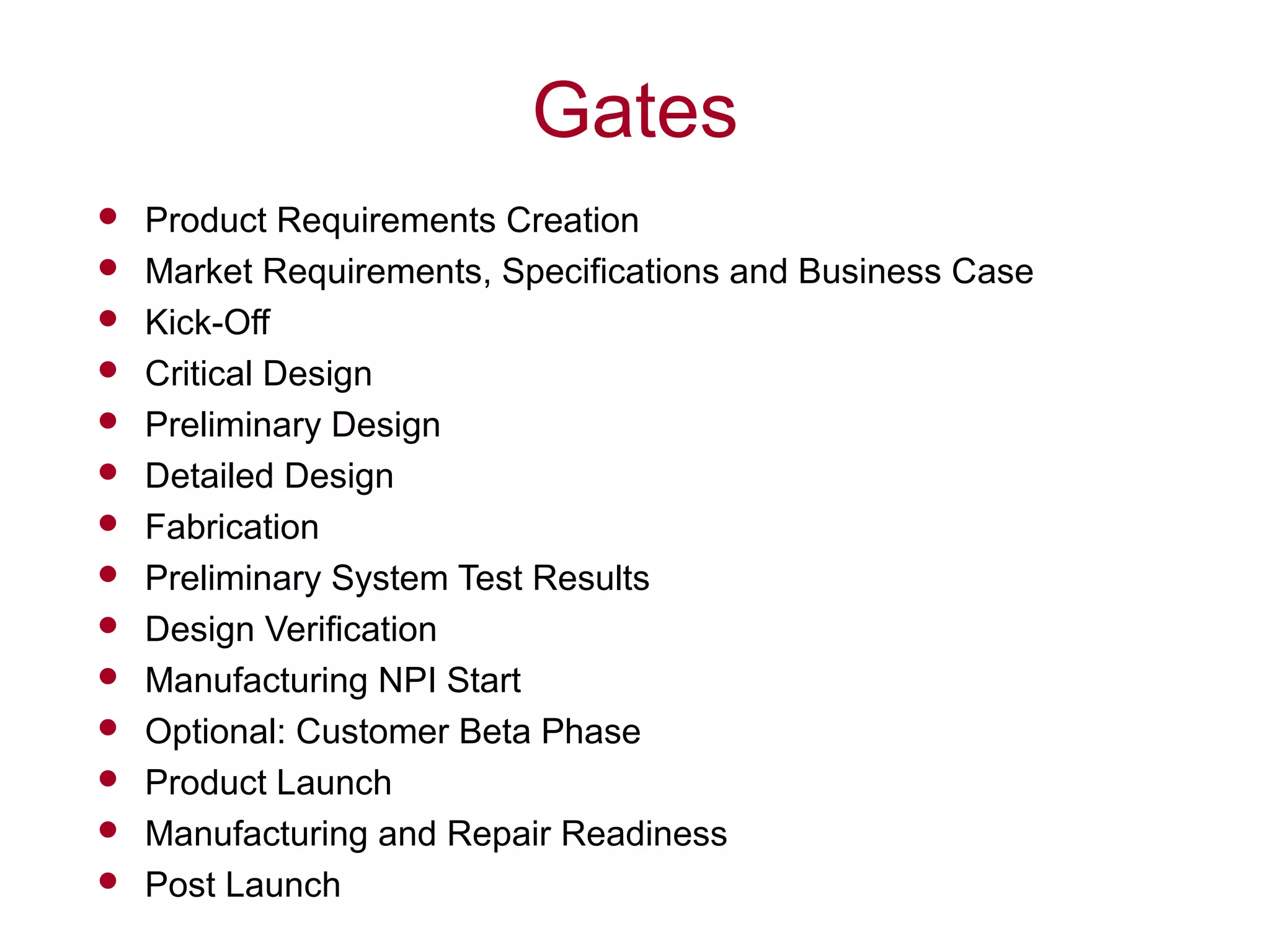
Gates
 Product Requirements Creation
 Market Requirements, Specifications and Business Case
 Kick-Off
 Critical Design
 Preliminary Design
 Detailed Design
 Fabrication
 Preliminary System Test Results
 Design Verification
 Manufacturing NPI Start
 Optional: Customer Beta Phase
 Product Launch
 Manufacturing and Repair Readiness
 Post Launch
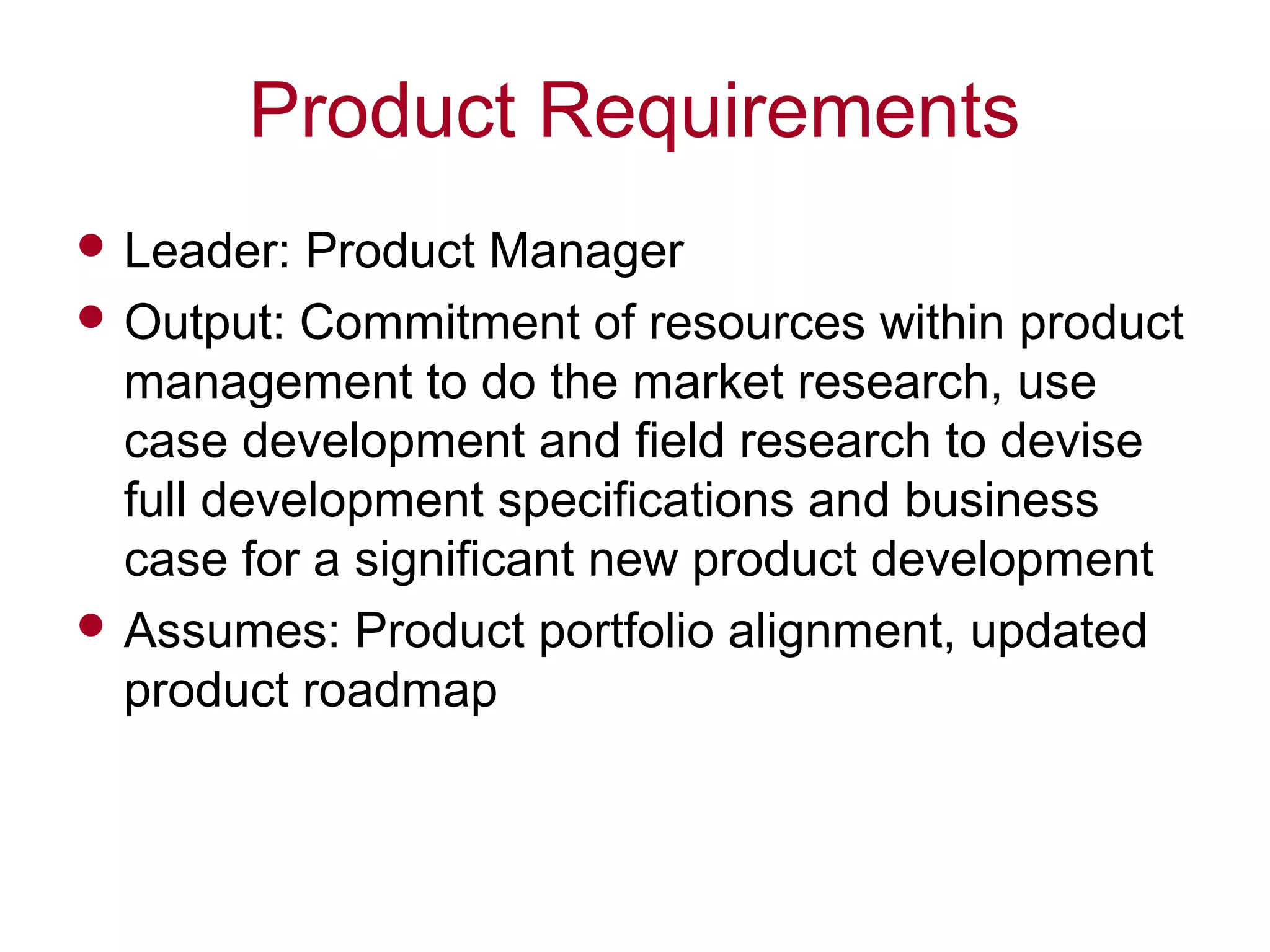
Product Requirements
 Leader: Product Manager
 Output: Commitment of resources within product
management to do the market research, use
case development and field research to devise
full development specifications and business
case for a significant new product development
 Assumes: Product portfolio alignment, updated
product roadmap
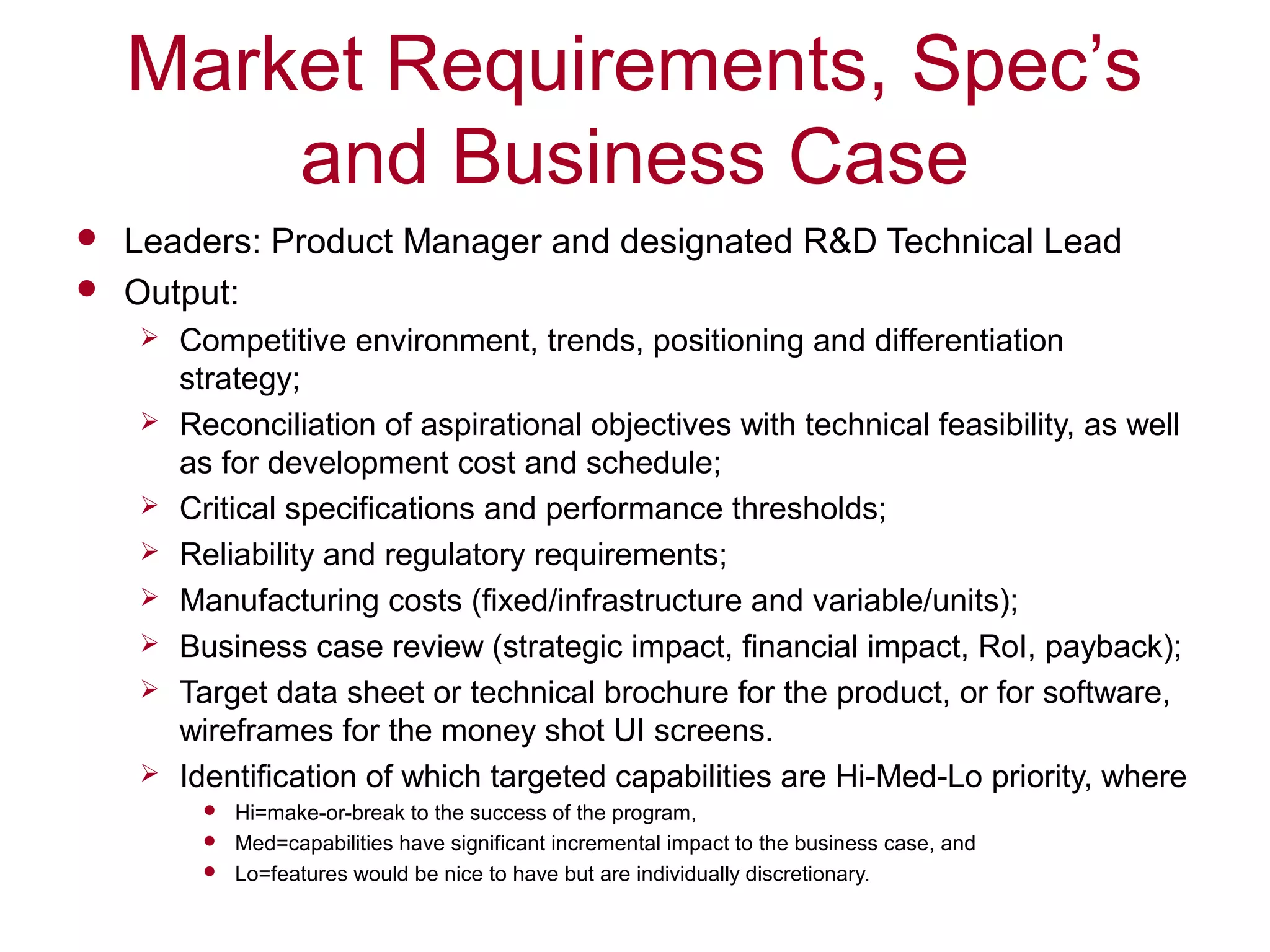
Market Requirements, Spec’s
and Business Case
 Leaders: Product Manager and designated R&D Technical Lead
 Output:
 Competitive environment, trends, positioning and differentiation
strategy;
 Reconciliation of aspirational objectives with technical feasibility, as well
as for development cost and schedule;
 Critical specifications and performance thresholds;
 Reliability and regulatory requirements;
 Manufacturing costs (fixed/infrastructure and variable/units);
 Business case review (strategic impact, financial impact, RoI, payback);
 Target data sheet or technical brochure for the product, or for software,
wireframes for the money shot UI screens.
 Identification of which targeted capabilities are Hi-Med-Lo priority, where
 Hi=make-or-break to the success of the program,
 Med=capabilities have significant incremental impact to the business case, and
 Lo=features would be nice to have but are individually discretionary.
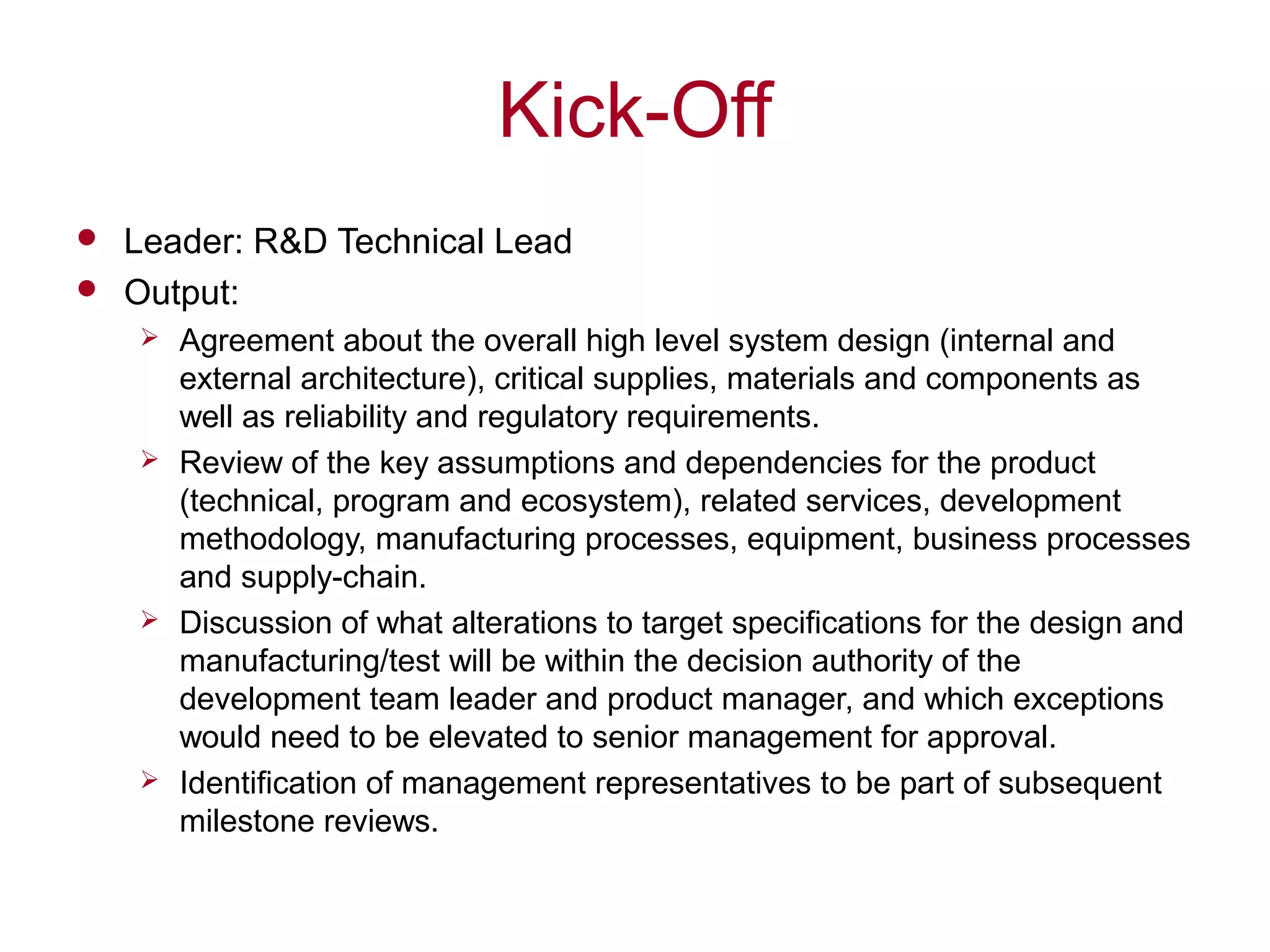
Kick-Off
 Leader: R&D Technical Lead
 Output:
 Agreement about the overall high level system design (internal and
external architecture), critical supplies, materials and components as
well as reliability and regulatory requirements.
 Review of the key assumptions and dependencies for the product
(technical, program and ecosystem), related services, development
methodology, manufacturing processes, equipment, business processes
and supply-chain.
 Discussion of what alterations to target specifications for the design and
manufacturing/test will be within the decision authority of the
development team leader and product manager, and which exceptions
would need to be elevated to senior management for approval.
 Identification of management representatives to be part of subsequent
milestone reviews.
Critical Design Review
 Leader: R&D Technical Lead
 Output:
 Agreement on the selected technical approach for the critical design techniques, materials,
components and their interactions for the attributes of the intended design which will have
the most leverage over cost, reliability and performance.
 Design margin analysis for the most cost or performance limiting design elements. Design
budget for power, noise, code space (if limited), weight, latency, vibration, drift, etc.
 Discussion of the way that functionality has been partitioned to limit the propagation of likely
change as the design progresses, and, where all-out pursuit of performance or minimum
size or mass requires tightly coupled integration.
 Identification of where the intended design will be required to perform beyond the limits of
the present simulation or modeling environment prior to implementation and test.
 Discussion about ways that earlier prototyping can be done of essential functionality rather
than waiting for the main line development process to unfold and reveal as-built
performance capabilities.
 Discussion about the technical risk profile of the development program, along with likelihood
of shipping on time and any recommended risk mitigation techniques to increase confidence
of doing so
Preliminary Design Review
 Leader: R&D Technical Lead
 Output: Presentation of the full preliminary
design (pseudo-code level s/w, macro circuit,
RF, mech and aerodynamics hardware design)
 Technical peer walk-through of the roughed-in
design and identification of opportunities for
improvement or optionality
Detailed Design Review
Leader: R&D Technical Lead
Output:
 Full peer review of candidate final schematics,
drawings and code.
 Release for tooling and fabrication.
 Equal consideration of performance as for
manufacturing, repair and support.
Fabrication Review
Leaders: R&D Technical Lead and
Manufacturing Engineer
Output: Assessment of the suitability of the
design based on the initial fabrication and
test of components; sub-system test; and,
assembly of first units
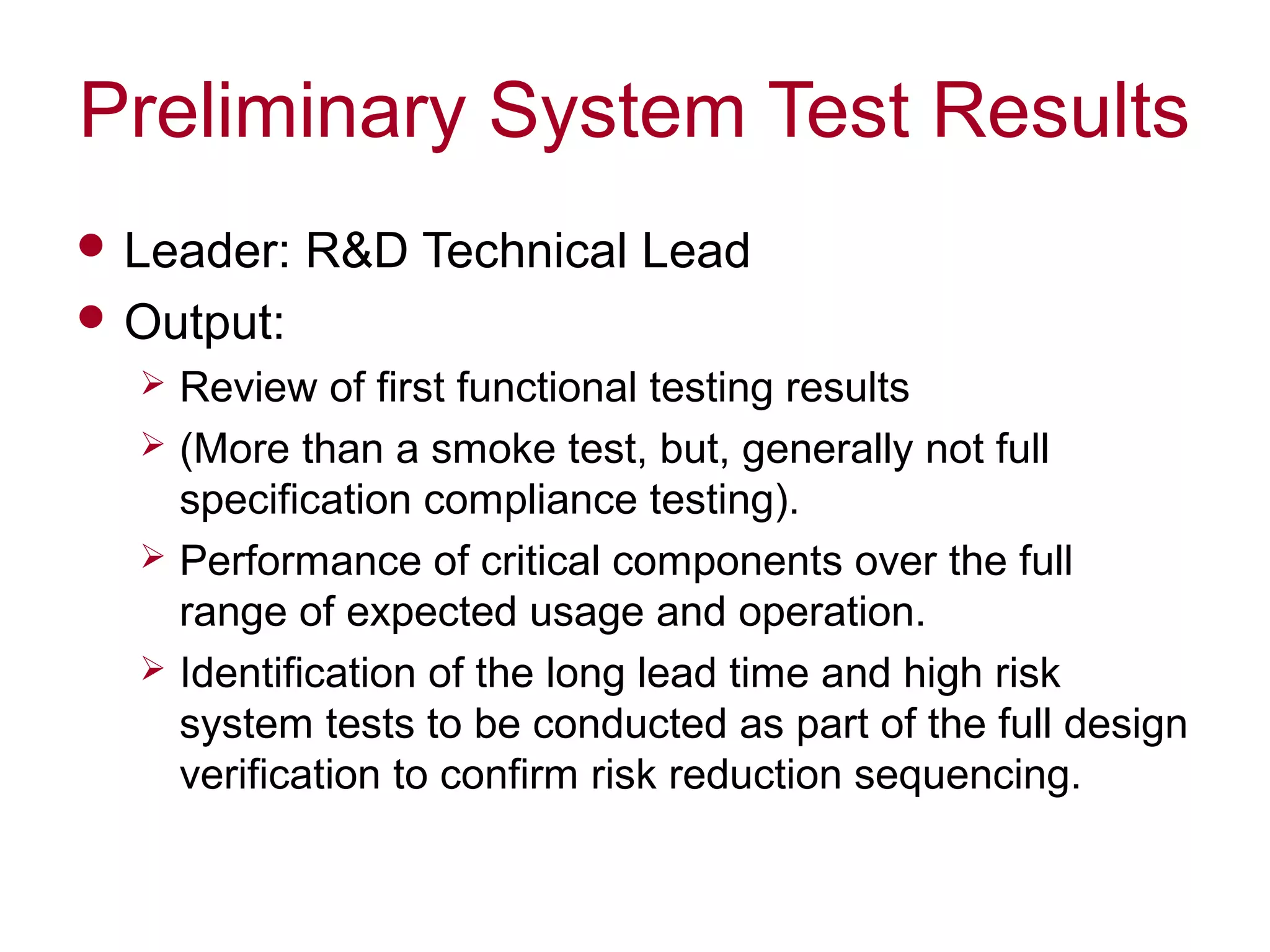
Preliminary System Test Results
 Leader: R&D Technical Lead
 Output:
 Review of first functional testing results
 (More than a smoke test, but, generally not full
specification compliance testing).
 Performance of critical components over the full
range of expected usage and operation.
 Identification of the long lead time and high risk
system tests to be conducted as part of the full design
verification to confirm risk reduction sequencing.
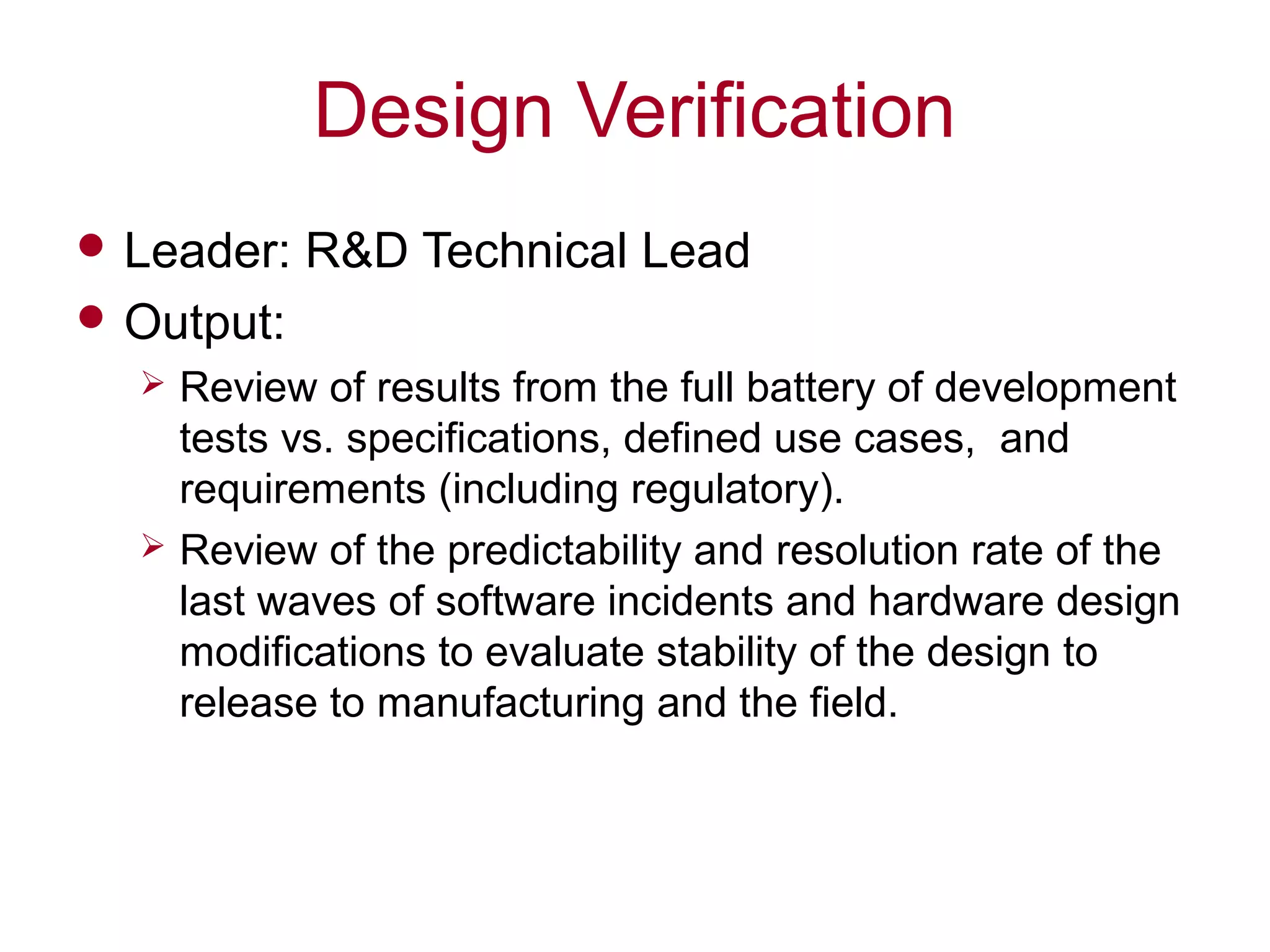
Design Verification
 Leader: R&D Technical Lead
 Output:
 Review of results from the full battery of development
tests vs. specifications, defined use cases, and
requirements (including regulatory).
 Review of the predictability and resolution rate of the
last waves of software incidents and hardware design
modifications to evaluate stability of the design to
release to manufacturing and the field.
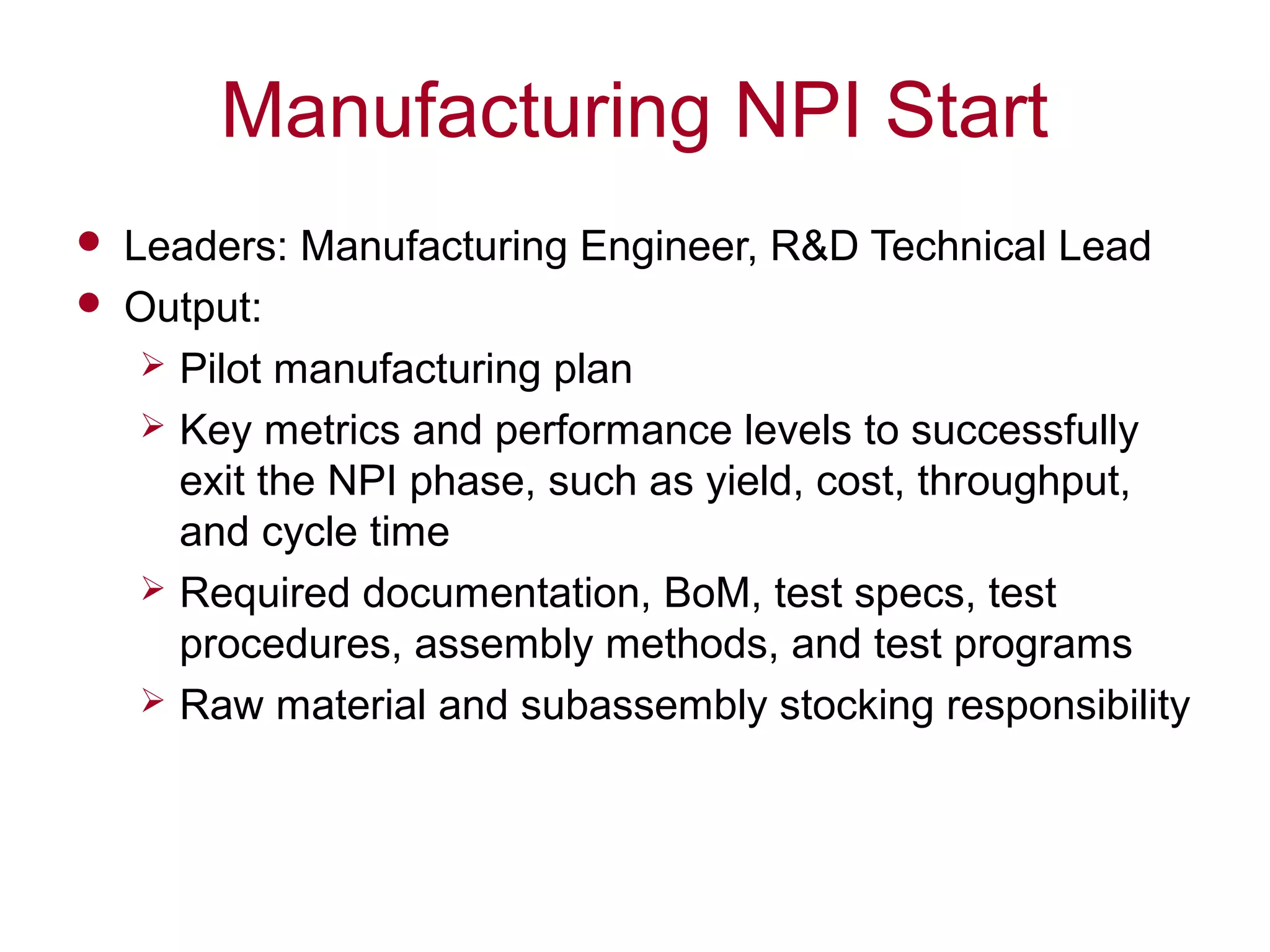
Manufacturing NPI Start
 Leaders: Manufacturing Engineer, R&D Technical Lead
 Output:
 Pilot manufacturing plan
 Key metrics and performance levels to successfully
exit the NPI phase, such as yield, cost, throughput,
and cycle time
 Required documentation, BoM, test specs, test
procedures, assembly methods, and test programs
 Raw material and subassembly stocking responsibility
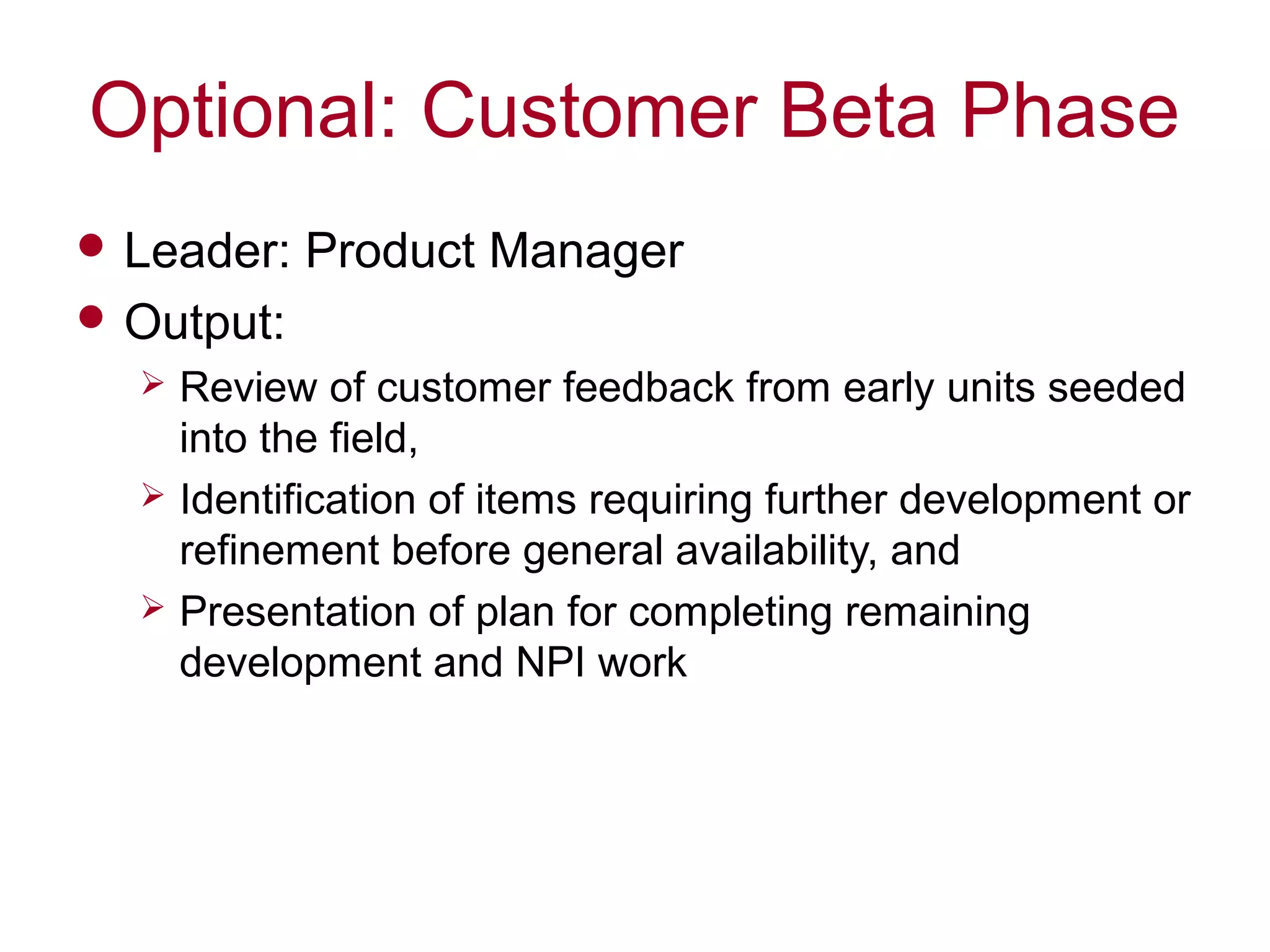
Optional: Customer Beta Phase
 Leader: Product Manager
 Output:
 Review of customer feedback from early units seeded
into the field,
 Identification of items requiring further development or
refinement before general availability, and
 Presentation of plan for completing remaining
development and NPI work
Product Launch
Leader: Product Manager
Output:
 Pricing, distribution, launch collaterals, launch
events, press and social media, internal and
channel training, first wave of demos,
schedule for GA launch, shipping and logistics
preparations, as well as internal training
Manufacturing and Repair
Readiness
 Leaders: Manufacturing Engineer and R&D Technical
Lead
 Output:
 Review of the results from one (or more) pilot manufacturing runs,
efforts to expose the variability expected in subsequent component and
sub-system lots as well as second source suppliers.
 Completion of assembly drawings, bills-of-materials, test specifications,
test procedures, test programs
 Review of yield, cost, throughput and cycle time vs. plan
 Identification of gaps remaining to undertake volume production under
standard operating methods, and plan to close out those gaps
 Repair and rework training
 Acceptance of the product into manufacturing and standard operating
procedures
Post-Launch Review
 Leader: Product Manager
 Output:
 Post-launch review of OOBFs and early customer experience
 Channel behavior and competitor responses to-date
 Comparison vs. plan for yield, costs, and demand volume vs.
earlier forecast
 Evaluation of design stability during early life. (rate of ECNs and
issue tracking system incidents)
 Identification of ongoing requirements for further product
development, process refinement or equipment/test
enhancement
 Lessons learned reflections and action item assignment to
improve similar future development projects, as well as to modify
the development process

Phase gate review development model august 8 2017 - dave litwiller

  • 1.
    Phase Gate Review DevelopmentModel Dave Litwiller August 8, 2017
  • 2.
    Purpose  Create co-ordinatedoverall framework into which departmental processes can be further developed and refined  Signal that product development is a company-wide endeavor  Support the goal that doing product development well is a critical skill for our R&D intensive business  Detail down-stream deliverables for information and qualification, in order to drive up-stream care and communication where the cost is lowest and optionality is highest
  • 3.
    Scope The phase gatereview development model would be used for:  Major software releases (left of decimal place, where major new architecture, frameworks and components will be adopted with significant changes to scalability, extensibility, maintainability), and,  Hardware developments spanning greater than 12 weeks on the calendar and development costs >$100K
  • 4.
    Review Gates  Eachreview gate includes an update and change review of go forward specifications, schedule, budget and business case as part of the decision to proceed  Go/NoGo decision to proceed variants:  Proceed as planned  Proceed with modifications  Loop-back upstream prior to proceeding  Stop or wholly reform program  Review gate meetings should be 60 minutes or less  Major issues are to be worked out among team members and sub-teams in advance of the full team review meetings
  • 5.
    Gates  Product RequirementsCreation  Market Requirements, Specifications and Business Case  Kick-Off  Critical Design  Preliminary Design  Detailed Design  Fabrication  Preliminary System Test Results  Design Verification  Manufacturing NPI Start  Optional: Customer Beta Phase  Product Launch  Manufacturing and Repair Readiness  Post Launch
  • 6.
    Product Requirements  Leader:Product Manager  Output: Commitment of resources within product management to do the market research, use case development and field research to devise full development specifications and business case for a significant new product development  Assumes: Product portfolio alignment, updated product roadmap
  • 7.
    Market Requirements, Spec’s andBusiness Case  Leaders: Product Manager and designated R&D Technical Lead  Output:  Competitive environment, trends, positioning and differentiation strategy;  Reconciliation of aspirational objectives with technical feasibility, as well as for development cost and schedule;  Critical specifications and performance thresholds;  Reliability and regulatory requirements;  Manufacturing costs (fixed/infrastructure and variable/units);  Business case review (strategic impact, financial impact, RoI, payback);  Target data sheet or technical brochure for the product, or for software, wireframes for the money shot UI screens.  Identification of which targeted capabilities are Hi-Med-Lo priority, where  Hi=make-or-break to the success of the program,  Med=capabilities have significant incremental impact to the business case, and  Lo=features would be nice to have but are individually discretionary.
  • 8.
    Kick-Off  Leader: R&DTechnical Lead  Output:  Agreement about the overall high level system design (internal and external architecture), critical supplies, materials and components as well as reliability and regulatory requirements.  Review of the key assumptions and dependencies for the product (technical, program and ecosystem), related services, development methodology, manufacturing processes, equipment, business processes and supply-chain.  Discussion of what alterations to target specifications for the design and manufacturing/test will be within the decision authority of the development team leader and product manager, and which exceptions would need to be elevated to senior management for approval.  Identification of management representatives to be part of subsequent milestone reviews.
  • 9.
    Critical Design Review Leader: R&D Technical Lead  Output:  Agreement on the selected technical approach for the critical design techniques, materials, components and their interactions for the attributes of the intended design which will have the most leverage over cost, reliability and performance.  Design margin analysis for the most cost or performance limiting design elements. Design budget for power, noise, code space (if limited), weight, latency, vibration, drift, etc.  Discussion of the way that functionality has been partitioned to limit the propagation of likely change as the design progresses, and, where all-out pursuit of performance or minimum size or mass requires tightly coupled integration.  Identification of where the intended design will be required to perform beyond the limits of the present simulation or modeling environment prior to implementation and test.  Discussion about ways that earlier prototyping can be done of essential functionality rather than waiting for the main line development process to unfold and reveal as-built performance capabilities.  Discussion about the technical risk profile of the development program, along with likelihood of shipping on time and any recommended risk mitigation techniques to increase confidence of doing so
  • 10.
    Preliminary Design Review Leader: R&D Technical Lead  Output: Presentation of the full preliminary design (pseudo-code level s/w, macro circuit, RF, mech and aerodynamics hardware design)  Technical peer walk-through of the roughed-in design and identification of opportunities for improvement or optionality
  • 11.
    Detailed Design Review Leader:R&D Technical Lead Output:  Full peer review of candidate final schematics, drawings and code.  Release for tooling and fabrication.  Equal consideration of performance as for manufacturing, repair and support.
  • 12.
    Fabrication Review Leaders: R&DTechnical Lead and Manufacturing Engineer Output: Assessment of the suitability of the design based on the initial fabrication and test of components; sub-system test; and, assembly of first units
  • 13.
    Preliminary System TestResults  Leader: R&D Technical Lead  Output:  Review of first functional testing results  (More than a smoke test, but, generally not full specification compliance testing).  Performance of critical components over the full range of expected usage and operation.  Identification of the long lead time and high risk system tests to be conducted as part of the full design verification to confirm risk reduction sequencing.
  • 14.
    Design Verification  Leader:R&D Technical Lead  Output:  Review of results from the full battery of development tests vs. specifications, defined use cases, and requirements (including regulatory).  Review of the predictability and resolution rate of the last waves of software incidents and hardware design modifications to evaluate stability of the design to release to manufacturing and the field.
  • 15.
    Manufacturing NPI Start Leaders: Manufacturing Engineer, R&D Technical Lead  Output:  Pilot manufacturing plan  Key metrics and performance levels to successfully exit the NPI phase, such as yield, cost, throughput, and cycle time  Required documentation, BoM, test specs, test procedures, assembly methods, and test programs  Raw material and subassembly stocking responsibility
  • 16.
    Optional: Customer BetaPhase  Leader: Product Manager  Output:  Review of customer feedback from early units seeded into the field,  Identification of items requiring further development or refinement before general availability, and  Presentation of plan for completing remaining development and NPI work
  • 17.
    Product Launch Leader: ProductManager Output:  Pricing, distribution, launch collaterals, launch events, press and social media, internal and channel training, first wave of demos, schedule for GA launch, shipping and logistics preparations, as well as internal training
  • 18.
    Manufacturing and Repair Readiness Leaders: Manufacturing Engineer and R&D Technical Lead  Output:  Review of the results from one (or more) pilot manufacturing runs, efforts to expose the variability expected in subsequent component and sub-system lots as well as second source suppliers.  Completion of assembly drawings, bills-of-materials, test specifications, test procedures, test programs  Review of yield, cost, throughput and cycle time vs. plan  Identification of gaps remaining to undertake volume production under standard operating methods, and plan to close out those gaps  Repair and rework training  Acceptance of the product into manufacturing and standard operating procedures
  • 19.
    Post-Launch Review  Leader:Product Manager  Output:  Post-launch review of OOBFs and early customer experience  Channel behavior and competitor responses to-date  Comparison vs. plan for yield, costs, and demand volume vs. earlier forecast  Evaluation of design stability during early life. (rate of ECNs and issue tracking system incidents)  Identification of ongoing requirements for further product development, process refinement or equipment/test enhancement  Lessons learned reflections and action item assignment to improve similar future development projects, as well as to modify the development process