NMR Spectroscopy
Lecture 3
Prepared by Ashar
Outline :
1.1 Spin Spin Coupling
1.2 Spin spin Splitting
1.3 Multiplicity
1.4 (n+1) Rule
1.5 Pascal Triangle
1.6 Coupling Constant and its Types
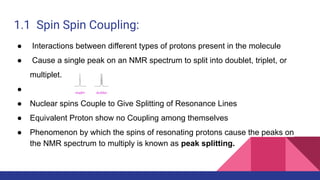
1.1 Spin Spin Coupling:
● Interactions between different types of protons present in the molecule
● Cause a single peak on an NMR spectrum to split into doublet, triplet, or
multiplet.
●
● Nuclear spins Couple to Give Splitting of Resonance Lines
● Equivalent Proton show no Coupling among themselves
● Phenomenon by which the spins of resonating protons cause the peaks on
the NMR spectrum to multiply is known as peak splitting.
1.2 Spin spin splitting
● Interaction of magnetic fields between two or more nuclei.
● Occurs through connecting bonds and space.
● Involves the magnetic moments of adjacent nuclei.
● Results in the splitting of NMR signals.
● Signals appear as multiplets.
● Examples include doublets, triplets, etc.
● Causes PMR signals to split.
● Each split component represents a different magnetic environment.
1.3 Multiplicity:
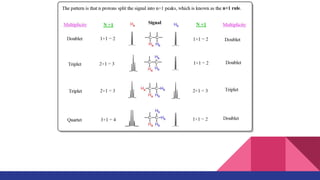
● Refers to the number of split peaks in a signal.
● Reflects the number of neighboring nuclei.
● Tells how many hydrogen atoms are immediately next door to the hydrogens
producing that peak
● The simplest signal consists of one line and is called a singlet, followed by the
doublet, triplet, etc.
● A signal with more than seven lines is referred to as a multiplet.
Examples:
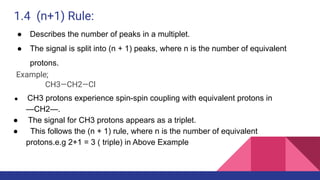
1.4 (n+1) Rule:
● Describes the number of peaks in a multiplet.
● The signal is split into (n + 1) peaks, where n is the number of equivalent
protons.
Example;
CH3—CH2—Cl
● CH3 protons experience spin-spin coupling with equivalent protons in
—CH2—.
● The signal for CH3 protons appears as a triplet.
● This follows the (n + 1) rule, where n is the number of equivalent
protons.e.g 2+1 = 3 ( triple) in Above Example
1.5 Pascal Triangle:
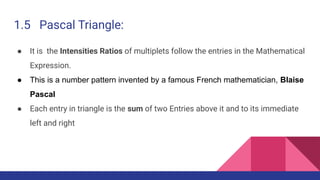
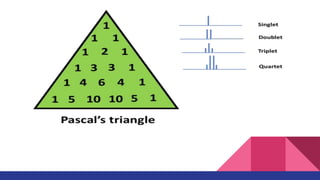
● It is the Intensities Ratios of multiplets follow the entries in the Mathematical
Expression.
● This is a number pattern invented by a famous French mathematician, Blaise
Pascal
● Each entry in triangle is the sum of two Entries above it and to its immediate
left and right
1.6 Coupling Constant (J):
● The distance between the centres of the two adjacent peaks in a multiplet is
usually constant and is called the coupling constant.
● The value of the coupling constant is independent of the external ïŹeld.
● It is denoted by the letter J.
● The value of ‘J’ generally lies between 0 and 20 Hz.
● It is measured in Hertz (Hz) or in cps (cycles per second).
● From the value of coupling constant, one can distinguish between the two
singlets and one doublet and also a quartet from two doublets.
● It measure the Effectiveness of Coupling i.e Bond Distance
● Magnitude of Coupling Constant Give important structural information.
Example
● In this compound two signals are expected in the nmr spectrum
● Under the inïŹ‚uence of two equivalent protons ‘a’, the signal for proton ‘b’ will
appear as a triplet.
● The distance between any two adjacent peaks in a multiplet will be exactly the
same
● The triplet formed due to spin-spin coupling is shown as;
a)
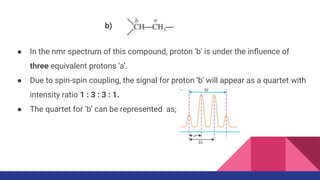
● In the nmr spectrum of this compound, proton ‘b’ is under the inïŹ‚uence of
three equivalent protons ‘a’.
● Due to spin-spin coupling, the signal for proton ‘b’ will appear as a quartet with
intensity ratio 1 : 3 : 3 : 1.
● The quartet for ‘b’ can be represented as;
b)
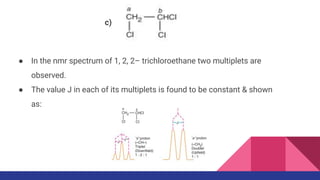
● In the nmr spectrum of 1, 2, 2– trichloroethane two multiplets are
observed.
● The value J in each of its multiplets is found to be constant & shown
as:
c)
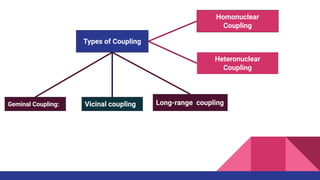
Types of Coupling
Homonuclear
Coupling
Heteronuclear
Coupling
Geminal Coupling: Vicinal coupling Long-range coupling
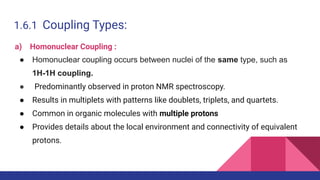
1.6.1 Coupling Types:
● Homonuclear coupling occurs between nuclei of the same type, such as
1H-1H coupling.
● Predominantly observed in proton NMR spectroscopy.
● Results in multiplets with patterns like doublets, triplets, and quartets.
● Common in organic molecules with multiple protons
● Provides details about the local environment and connectivity of equivalent
protons.
a) Homonuclear Coupling :
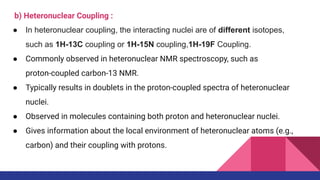
● In heteronuclear coupling, the interacting nuclei are of different isotopes,
such as 1H-13C coupling or 1H-15N coupling,1H-19F Coupling.
● Commonly observed in heteronuclear NMR spectroscopy, such as
proton-coupled carbon-13 NMR.
● Typically results in doublets in the proton-coupled spectra of heteronuclear
nuclei.
● Observed in molecules containing both proton and heteronuclear nuclei.
● Gives information about the local environment of heteronuclear atoms (e.g.,
carbon) and their coupling with protons.
b) Heteronuclear Coupling :
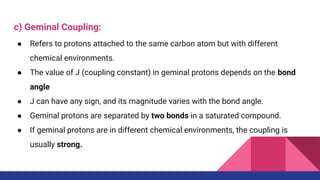
c) Geminal Coupling:
● Refers to protons attached to the same carbon atom but with different
chemical environments.
● The value of J (coupling constant) in geminal protons depends on the bond
angle
● J can have any sign, and its magnitude varies with the bond angle.
● Geminal protons are separated by two bonds in a saturated compound.
● If geminal protons are in different chemical environments, the coupling is
usually strong.
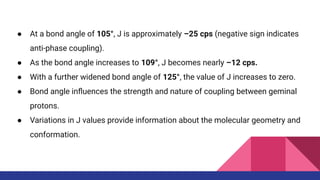
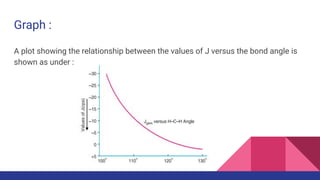
● At a bond angle of 105°, J is approximately –25 cps (negative sign indicates
anti-phase coupling).
● As the bond angle increases to 109°, J becomes nearly –12 cps.
● With a further widened bond angle of 125°, the value of J increases to zero.
● Bond angle inïŹ‚uences the strength and nature of coupling between geminal
protons.
● Variations in J values provide information about the molecular geometry and
conformation.
Graph :
A plot showing the relationship between the values of J versus the bond angle is
shown as under :
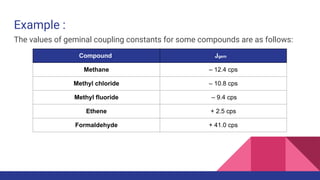
Example :
The values of geminal coupling constants for some compounds are as follows:
Compound Jgem
Methane – 12.4 cps
Methyl chloride – 10.8 cps
Methyl fluoride – 9.4 cps
Ethene + 2.5 cps
Formaldehyde + 41.0 cps
d) Vicinal coupling :
● For vicinal protons, the value of coupling constant varies with the dihedral
angle.
● Vicinal protons are the protons which are separated by three bonds.
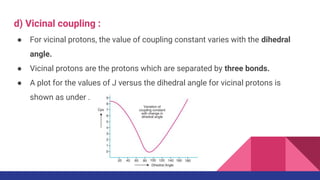
● A plot for the values of J versus the dihedral angle for vicinal protons is
shown as under :
The Graph shows :
● When the dihedral angle is 0° or 180°, we observe largest values for the
coupling constants.
● The value of ‘J’ is slightly negative when the dihedral angle is 90°
Example :
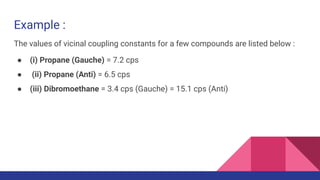
The values of vicinal coupling constants for a few compounds are listed below :
● (i) Propane (Gauche) = 7.2 cps
● (ii) Propane (Anti) = 6.5 cps
● (iii) Dibromoethane = 3.4 cps (Gauche) = 15.1 cps (Anti)
e) Long-range coupling:
● Long-range coupling refers to observable coupling when the nuclei are more
than three bonds apart.
● Long-range coupling refers to the indirect interaction between nuclear spins
that are not directly bonded to each other.
● It arises from a mechanism involving virtual transitions of electrons through
the molecular framework.
Example :
The values of long range coupling constants in compounds which involve
coupling are as follows:
● (i) CH3—CH = CH2 = – 1.7 cps
● (ii) H2C = C—CH2—CH3 = – 2.3 cps
● (iii) CH3—C = C(CH3)—COOH = – 1.2 cp

NMR Spectroscopy - Spin spin Coupling-Splitting ,Multiplicity, (n+1) rule, Pascal Triangle, Coupling Constant.pdf

  • 1.
  • 2.
    Outline : 1.1 SpinSpin Coupling 1.2 Spin spin Splitting 1.3 Multiplicity 1.4 (n+1) Rule 1.5 Pascal Triangle 1.6 Coupling Constant and its Types
  • 3.
    1.1 Spin SpinCoupling: ● Interactions between different types of protons present in the molecule ● Cause a single peak on an NMR spectrum to split into doublet, triplet, or multiplet. ● ● Nuclear spins Couple to Give Splitting of Resonance Lines ● Equivalent Proton show no Coupling among themselves ● Phenomenon by which the spins of resonating protons cause the peaks on the NMR spectrum to multiply is known as peak splitting.
  • 4.
    1.2 Spin spinsplitting ● Interaction of magnetic fields between two or more nuclei. ● Occurs through connecting bonds and space. ● Involves the magnetic moments of adjacent nuclei. ● Results in the splitting of NMR signals. ● Signals appear as multiplets. ● Examples include doublets, triplets, etc. ● Causes PMR signals to split. ● Each split component represents a different magnetic environment.
  • 5.
    1.3 Multiplicity: ● Refersto the number of split peaks in a signal. ● Reflects the number of neighboring nuclei. ● Tells how many hydrogen atoms are immediately next door to the hydrogens producing that peak ● The simplest signal consists of one line and is called a singlet, followed by the doublet, triplet, etc. ● A signal with more than seven lines is referred to as a multiplet.
  • 6.
  • 7.
    1.4 (n+1) Rule: ●Describes the number of peaks in a multiplet. ● The signal is split into (n + 1) peaks, where n is the number of equivalent protons. Example; CH3—CH2—Cl ● CH3 protons experience spin-spin coupling with equivalent protons in —CH2—. ● The signal for CH3 protons appears as a triplet. ● This follows the (n + 1) rule, where n is the number of equivalent protons.e.g 2+1 = 3 ( triple) in Above Example
  • 9.
    1.5 Pascal Triangle: ●It is the Intensities Ratios of multiplets follow the entries in the Mathematical Expression. ● This is a number pattern invented by a famous French mathematician, Blaise Pascal ● Each entry in triangle is the sum of two Entries above it and to its immediate left and right
  • 11.
    1.6 Coupling Constant(J): ● The distance between the centres of the two adjacent peaks in a multiplet is usually constant and is called the coupling constant. ● The value of the coupling constant is independent of the external ïŹeld. ● It is denoted by the letter J. ● The value of ‘J’ generally lies between 0 and 20 Hz. ● It is measured in Hertz (Hz) or in cps (cycles per second).
  • 12.
    ● From thevalue of coupling constant, one can distinguish between the two singlets and one doublet and also a quartet from two doublets. ● It measure the Effectiveness of Coupling i.e Bond Distance ● Magnitude of Coupling Constant Give important structural information.
  • 13.
    Example ● In thiscompound two signals are expected in the nmr spectrum ● Under the inïŹ‚uence of two equivalent protons ‘a’, the signal for proton ‘b’ will appear as a triplet. ● The distance between any two adjacent peaks in a multiplet will be exactly the same ● The triplet formed due to spin-spin coupling is shown as; a)
  • 14.
    ● In thenmr spectrum of this compound, proton ‘b’ is under the inïŹ‚uence of three equivalent protons ‘a’. ● Due to spin-spin coupling, the signal for proton ‘b’ will appear as a quartet with intensity ratio 1 : 3 : 3 : 1. ● The quartet for ‘b’ can be represented as; b)
  • 15.
    ● In thenmr spectrum of 1, 2, 2– trichloroethane two multiplets are observed. ● The value J in each of its multiplets is found to be constant & shown as: c)
  • 16.
    Types of Coupling Homonuclear Coupling Heteronuclear Coupling GeminalCoupling: Vicinal coupling Long-range coupling
  • 17.
    1.6.1 Coupling Types: ●Homonuclear coupling occurs between nuclei of the same type, such as 1H-1H coupling. ● Predominantly observed in proton NMR spectroscopy. ● Results in multiplets with patterns like doublets, triplets, and quartets. ● Common in organic molecules with multiple protons ● Provides details about the local environment and connectivity of equivalent protons. a) Homonuclear Coupling :
  • 18.
    ● In heteronuclearcoupling, the interacting nuclei are of different isotopes, such as 1H-13C coupling or 1H-15N coupling,1H-19F Coupling. ● Commonly observed in heteronuclear NMR spectroscopy, such as proton-coupled carbon-13 NMR. ● Typically results in doublets in the proton-coupled spectra of heteronuclear nuclei. ● Observed in molecules containing both proton and heteronuclear nuclei. ● Gives information about the local environment of heteronuclear atoms (e.g., carbon) and their coupling with protons. b) Heteronuclear Coupling :
  • 19.
    c) Geminal Coupling: ●Refers to protons attached to the same carbon atom but with different chemical environments. ● The value of J (coupling constant) in geminal protons depends on the bond angle ● J can have any sign, and its magnitude varies with the bond angle. ● Geminal protons are separated by two bonds in a saturated compound. ● If geminal protons are in different chemical environments, the coupling is usually strong.
  • 20.
    ● At abond angle of 105°, J is approximately –25 cps (negative sign indicates anti-phase coupling). ● As the bond angle increases to 109°, J becomes nearly –12 cps. ● With a further widened bond angle of 125°, the value of J increases to zero. ● Bond angle inïŹ‚uences the strength and nature of coupling between geminal protons. ● Variations in J values provide information about the molecular geometry and conformation.
  • 21.
    Graph : A plotshowing the relationship between the values of J versus the bond angle is shown as under :
  • 22.
    Example : The valuesof geminal coupling constants for some compounds are as follows: Compound Jgem Methane – 12.4 cps Methyl chloride – 10.8 cps Methyl fluoride – 9.4 cps Ethene + 2.5 cps Formaldehyde + 41.0 cps
  • 23.
    d) Vicinal coupling: ● For vicinal protons, the value of coupling constant varies with the dihedral angle. ● Vicinal protons are the protons which are separated by three bonds. ● A plot for the values of J versus the dihedral angle for vicinal protons is shown as under :
  • 24.
    The Graph shows: ● When the dihedral angle is 0° or 180°, we observe largest values for the coupling constants. ● The value of ‘J’ is slightly negative when the dihedral angle is 90°
  • 25.
    Example : The valuesof vicinal coupling constants for a few compounds are listed below : ● (i) Propane (Gauche) = 7.2 cps ● (ii) Propane (Anti) = 6.5 cps ● (iii) Dibromoethane = 3.4 cps (Gauche) = 15.1 cps (Anti)
  • 26.
    e) Long-range coupling: ●Long-range coupling refers to observable coupling when the nuclei are more than three bonds apart. ● Long-range coupling refers to the indirect interaction between nuclear spins that are not directly bonded to each other. ● It arises from a mechanism involving virtual transitions of electrons through the molecular framework.
  • 27.
    Example : The valuesof long range coupling constants in compounds which involve coupling are as follows: ● (i) CH3—CH = CH2 = – 1.7 cps ● (ii) H2C = C—CH2—CH3 = – 2.3 cps ● (iii) CH3—C = C(CH3)—COOH = – 1.2 cp