Contents
 What is AGN?
 What differentiates a Quasar?
 Our Source
 Charge Couple Device (CCD)
 Spectroscopy
 Image Cleaning
 Wavelength calibration
 Flux calibration
 Results
 Conclusions
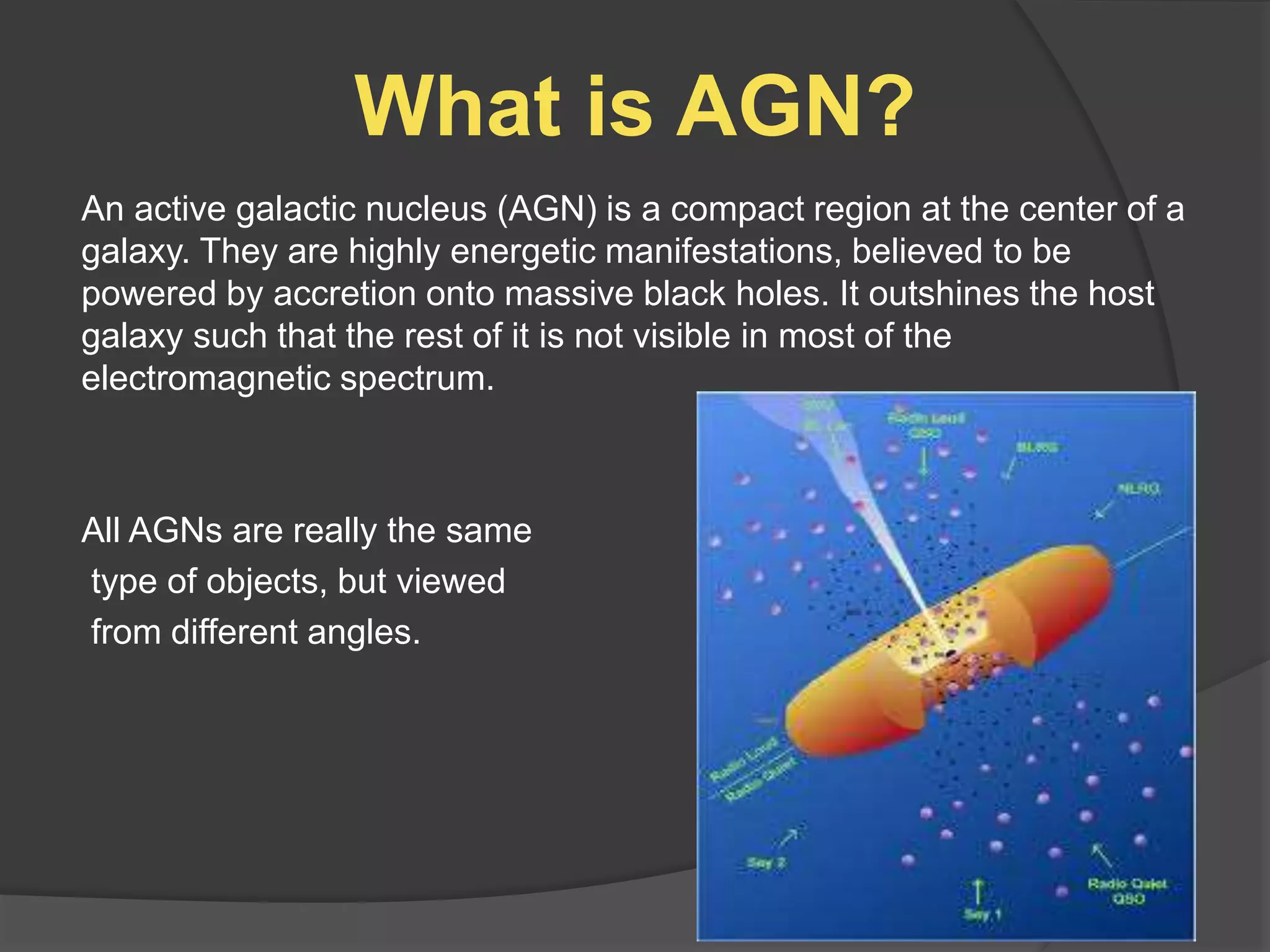
What is AGN?
An active galactic nucleus (AGN) is a compact region at the center of a
galaxy. They are highly energetic manifestations, believed to be
powered by accretion onto massive black holes. It outshines the host
galaxy such that the rest of it is not visible in most of the
electromagnetic spectrum.
All AGNs are really the same
type of objects, but viewed
from different angles.
Quasars
What are QUASARS?
## A class of AGNs with following characteristics:
● star-like object identified with a radio source,
● variable light,
● broad emission lines in the spectra with absorption lines
in some cases,
● large redshift.
Properties: 1. Most powerful object
2. Multi wavelength astronomy
3. Large distances z<0.1 to z>7
4. Help us to peep into past
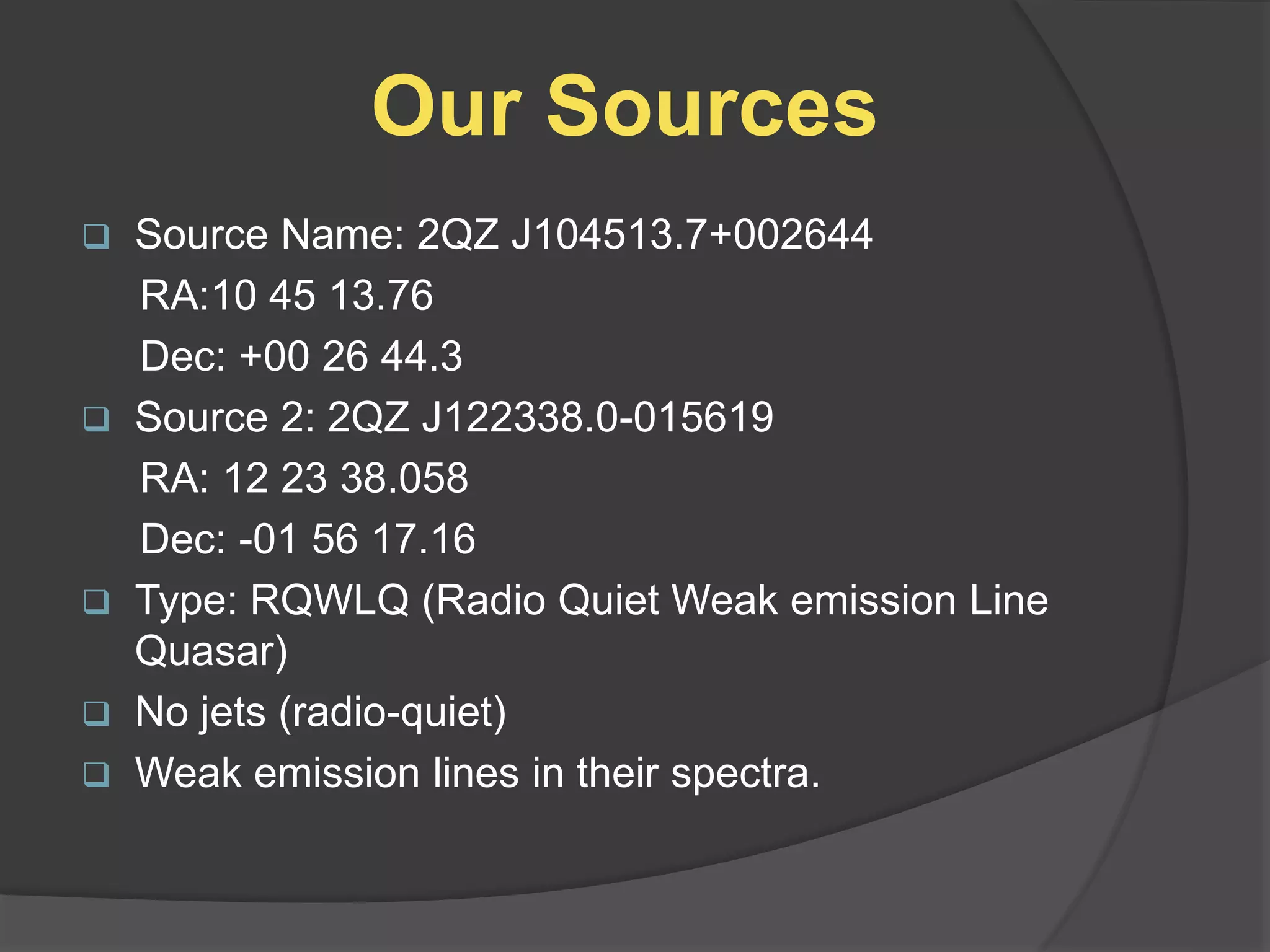
Our Sources
 Source Name: 2QZ J104513.7+002644
RA:10 45 13.76
Dec: +00 26 44.3
 Source 2: 2QZ J122338.0-015619
RA: 12 23 38.058
Dec: -01 56 17.16
 Type: RQWLQ (Radio Quiet Weak emission Line
Quasar)
 No jets (radio-quiet)
 Weak emission lines in their spectra.
Charge Coupled Device (CCD)
 Working
 Quantum Efficiency
 Linearity
 Noise :
1. Dark Current
2. Read Out Noise
 Gain
Spectroscopy
 Difference between Photometry and Spectroscopy
 Definition: Response of Matter to EM Radiation
 Importance
 Spectrum Types: 1. Continuous
2. Emission
3. Absorption
Image Cleaning
Noise
 Biasing
 Pixel to pixel sensitivity
variation
Corrections
 Bias correction
 Flat correction
Noises
 Dark-current
 Cosmic ray
Corrections
 CCD cooling
 Cosmic ray removal
Wavelength Calibration
In Wavelength calibration, IRAF follows given tasks
 apall: (To extract the spectrum from dispersion axis to
in form of pixel and pixel count )
 identify: to give the wavelength values to pixels,
 hedit: to update this information to our OBJ and
STD star,
 dispcor: to apply this wavelength calibration
to our OBJ and STD star spectrum.
Flux Calibration
 The process of determining the continuum flux at
each wavelength from the measured pixel counts.
 IRAF commands for flux calibration:
standard: tabulate the observed pixel counts of
standard star with flux
sensfunc: calculate the sensitivity curve and fit
calibrate: apply the sensitivity curve to the
observed object.
Results
Conclusions
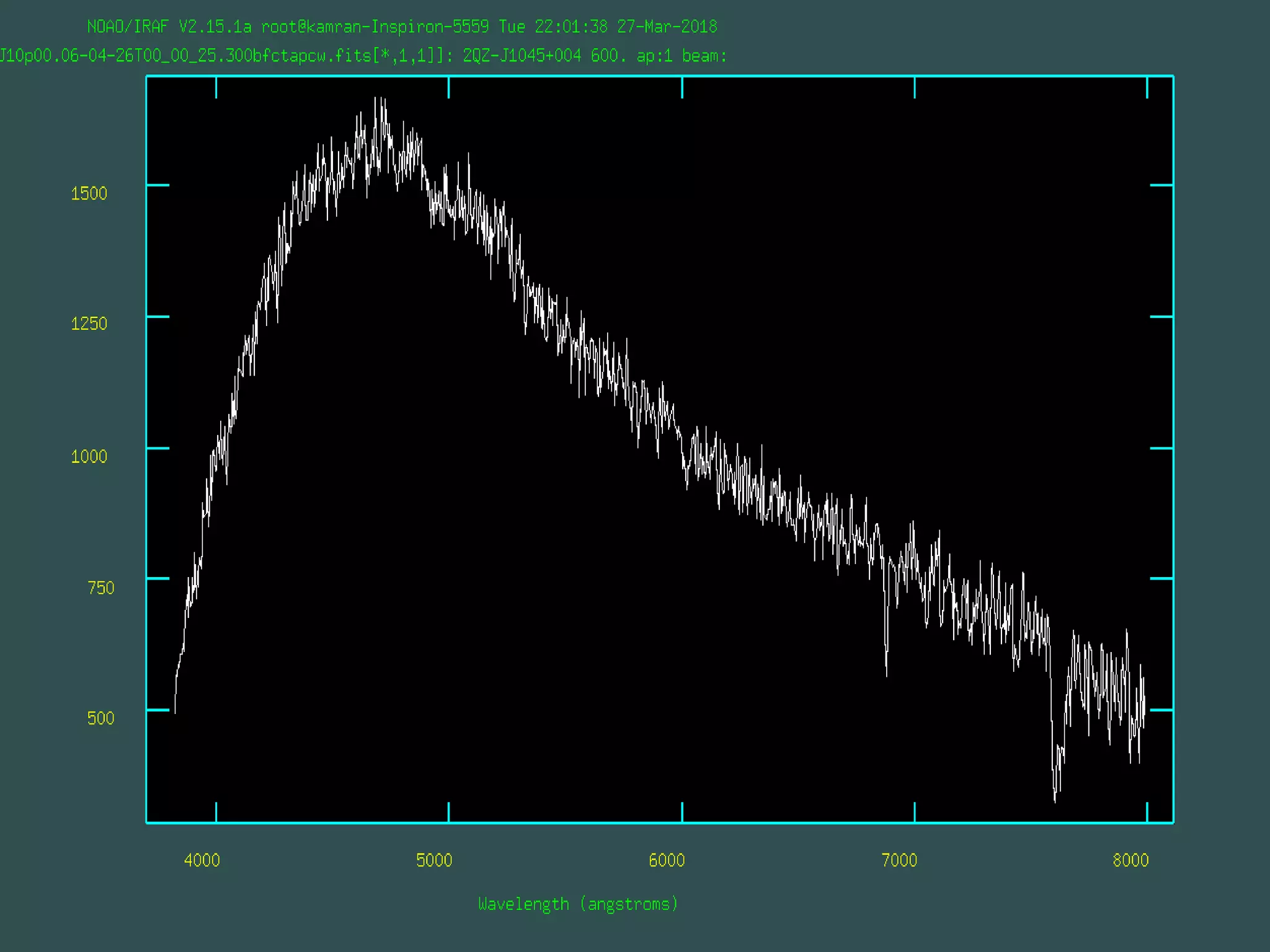
 As stars are known to have black body spectrum, but we
got a power law spectrum. So our Source can not be a Star.
It could be an AGN.
 The spectrum looks like that of BLAZARs (no strong
emission or absorption lines) but the source is radio quiet in
nature. Therefore, these sources could be long debated
radio quiet BLAZARs.
THANK YOU

Spectroscopic analysis of quasar by iraf

  • 2.
    Contents  What isAGN?  What differentiates a Quasar?  Our Source  Charge Couple Device (CCD)  Spectroscopy  Image Cleaning  Wavelength calibration  Flux calibration  Results  Conclusions
  • 3.
    What is AGN? Anactive galactic nucleus (AGN) is a compact region at the center of a galaxy. They are highly energetic manifestations, believed to be powered by accretion onto massive black holes. It outshines the host galaxy such that the rest of it is not visible in most of the electromagnetic spectrum. All AGNs are really the same type of objects, but viewed from different angles.
  • 4.
    Quasars What are QUASARS? ##A class of AGNs with following characteristics: ● star-like object identified with a radio source, ● variable light, ● broad emission lines in the spectra with absorption lines in some cases, ● large redshift. Properties: 1. Most powerful object 2. Multi wavelength astronomy 3. Large distances z<0.1 to z>7 4. Help us to peep into past
  • 5.
    Our Sources  SourceName: 2QZ J104513.7+002644 RA:10 45 13.76 Dec: +00 26 44.3  Source 2: 2QZ J122338.0-015619 RA: 12 23 38.058 Dec: -01 56 17.16  Type: RQWLQ (Radio Quiet Weak emission Line Quasar)  No jets (radio-quiet)  Weak emission lines in their spectra.
  • 6.
    Charge Coupled Device(CCD)  Working  Quantum Efficiency  Linearity  Noise : 1. Dark Current 2. Read Out Noise  Gain
  • 7.
    Spectroscopy  Difference betweenPhotometry and Spectroscopy  Definition: Response of Matter to EM Radiation  Importance  Spectrum Types: 1. Continuous 2. Emission 3. Absorption
  • 8.
    Image Cleaning Noise  Biasing Pixel to pixel sensitivity variation Corrections  Bias correction  Flat correction
  • 9.
    Noises  Dark-current  Cosmicray Corrections  CCD cooling  Cosmic ray removal
  • 10.
    Wavelength Calibration In Wavelengthcalibration, IRAF follows given tasks  apall: (To extract the spectrum from dispersion axis to in form of pixel and pixel count )
  • 11.
     identify: togive the wavelength values to pixels,  hedit: to update this information to our OBJ and STD star,  dispcor: to apply this wavelength calibration to our OBJ and STD star spectrum.
  • 13.
    Flux Calibration  Theprocess of determining the continuum flux at each wavelength from the measured pixel counts.  IRAF commands for flux calibration: standard: tabulate the observed pixel counts of standard star with flux sensfunc: calculate the sensitivity curve and fit calibrate: apply the sensitivity curve to the observed object.
  • 14.
  • 17.
    Conclusions  As starsare known to have black body spectrum, but we got a power law spectrum. So our Source can not be a Star. It could be an AGN.  The spectrum looks like that of BLAZARs (no strong emission or absorption lines) but the source is radio quiet in nature. Therefore, these sources could be long debated radio quiet BLAZARs.
  • 18.