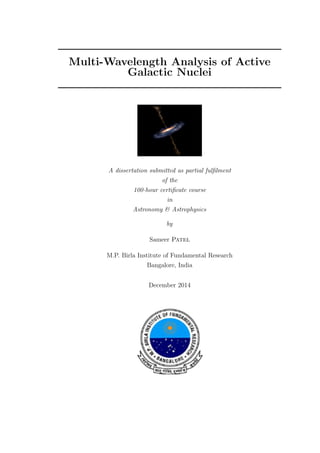

Multi-Wavelength Analysis of Active 
Galactic Nuclei 
A dissertation submitted as partial ful
lment 
of the 
100-hour certi
cate course 
in 
Astronomy & Astrophysics 
by 
Sameer Patel 
M.P. Birla Institute of Fundamental Research 
Bangalore, India 
December 2014
Declaration 
I, Sameer Patel, student of M.P. Birla Institute of Fundamental Research, Bangalore, 
hereby declare that the matter embodied in this dissertation has been compiled and 
prepared by me on the basis of available literature on the topic titled, 
Multi-Wavelength Analysis of Active Galactic Nuclei 
as a partial ful
llment of the 100 Hour Certi
cate Course in Astronomy and Astro-physics, 
2014. This dissertation has not been submitted either partially or fully to any 
university or institute for the award of any degree, diploma or fellowship. 
Date: 
Place: 
Signature 
Director, 
M.P. Birla Institute of Fundamental Research, 
Bangalore 
i
M.P. Birla Institute of Fundamental Research 
Bangalore, India 
Abstract 
Multi-Wavelength Analysis of Active Galactic Nuclei 
by Sameer Patel 
This dissertation explores the current research methods and analysis adopted for the 
study of Active Galactic Nuclei in all wavelengths of the electromagnetic radiation. 
Being the most violent objects that one can see in the present Universe, AGNs have been 
attributed to emitting radiation in all wavelengths and still exhibit various unexplained 
phenomena, alongside with being the probes to the very early Universe. The uni
cation 
of the AGN model is also included for completeness, albeit not con
rmed in its entirety.
Acknowledgements 
I would never have been able to
nish my dissertation without help from friends, and 
support from the team at MPBIFR, Bangalore. 
I would also like to thank Dr. Babu for constantly reminding us to complete the dis-sertation 
timely, and Ms. Komala for guiding me to coast through countless papers 
online for reference. I would like to thank Rishi Dua, who as a good friend, was always 
willing to help me and give his best suggestions, and Aakash Masand, who helped me 
correct typographical errors and grammatical mistakes after painfully proofreading the
nal draft. 
I would also like to thank my parents. They were always supporting me and encouraging 
me with their best wishes. 
iii
Contents 
Declaration i 
Abstract ii 
Acknowledgements iii 
List of Figures vii 
List of Tables ix 
Abbreviations x 
1 Introduction 1 
1.1 The History of AGNs . . . . . . . . . . . . . . . . . . . . . . . . . . . . . . 1 
1.2 Active Galactic Nuclei . . . . . . . . . . . . . . . . . . . . . . . . . . . . . 1 
1.3 The Taxonomy of AGNs . . . . . . . . . . . . . . . . . . . . . . . . . . . . 2 
1.3.1 Seyferts . . . . . . . . . . . . . . . . . . . . . . . . . . . . . . . . . 3 
1.3.2 Quasars and QSOs . . . . . . . . . . . . . . . . . . . . . . . . . . . 3 
1.3.3 Radio Galaxies . . . . . . . . . . . . . . . . . . . . . . . . . . . . . 5 
1.3.3.1 Radio Quiet . . . . . . . . . . . . . . . . . . . . . . . . . 6 
1.3.3.2 Radio Loud . . . . . . . . . . . . . . . . . . . . . . . . . . 6 
1.3.4 Blazars . . . . . . . . . . . . . . . . . . . . . . . . . . . . . . . . . 8 
1.3.4.1 BL Lacerate Objects . . . . . . . . . . . . . . . . . . . . . 8 
1.3.4.2 Optically Violent Variable Quasars . . . . . . . . . . . . . 9 
1.3.5 LINERs . . . . . . . . . . . . . . . . . . . . . . . . . . . . . . . . . 9 
2 Non-Thermal Processes 12 
2.1 Basic Radiative Transfer . . . . . . . . . . . . . . . . . . . . . . . . . . . . 12 
2.2 Synchrotron Radiation . . . . . . . . . . . . . . . . . . . . . . . . . . . . . 13 
2.2.1 Emission by a Single Electron in a Magnetic Field . . . . . . . . . 13 
2.2.2 Synchrotron Emission by a Power Law Distribution of Electrons . 14 
2.2.3 Synchrotron Self-Absorption . . . . . . . . . . . . . . . . . . . . . 15 
2.2.4 Polarization . . . . . . . . . . . . . . . . . . . . . . . . . . . . . . . 15 
2.2.5 Synchrotron Sources in AGNs . . . . . . . . . . . . . . . . . . . . . 16 
2.2.6 Faraday Rotation . . . . . . . . . . . . . . . . . . . . . . . . . . . . 17 
2.3 Thomson Scattering . . . . . . . . . . . . . . . . . . . . . . . . . . . . . . 18 
iv
Contents 
2.4 Compton Scattering . . . . . . . . . . . . . . . . . . . . . . . . . . . . . . 19 
2.4.1 Comptonization . . . . . . . . . . . . . . . . . . . . . . . . . . . . 20 
2.4.2 The Compton Parameter . . . . . . . . . . . . . . . . . . . . . . . 21 
2.4.3 Inverse Compton Emission . . . . . . . . . . . . . . . . . . . . . . 22 
2.4.4 Synchrotron Self-Compton . . . . . . . . . . . . . . . . . . . . . . . 23 
2.5 Annihilation and Pair-Production . . . . . . . . . . . . . . . . . . . . . . . 24 
2.6 Bremsstrahlung (Free-Free) Radiation . . . . . . . . . . . . . . . . . . . . 26 
3 The IR and Sub-mm Regime 27 
3.1 History . . . . . . . . . . . . . . . . . . . . . . . . . . . . . . . . . . . . . 27 
3.2 Observations and Detection . . . . . . . . . . . . . . . . . . . . . . . . . . 28 
3.3 The Dusty Torus . . . . . . . . . . . . . . . . . . . . . . . . . . . . . . . . 29 
3.4 IR Spectra . . . . . . . . . . . . . . . . . . . . . . . . . . . . . . . . . . . . 31 
3.4.1 The 1 m Minimum . . . . . . . . . . . . . . . . . . . . . . . . . . 32 
3.4.2 IR Continuum Variability . . . . . . . . . . . . . . . . . . . . . . . 33 
3.4.3 The Submillimeter Break . . . . . . . . . . . . . . . . . . . . . . . 33 
4 The Radio Regime 34 
4.1 History . . . . . . . . . . . . . . . . . . . . . . . . . . . . . . . . . . . . . 34 
4.2 The Loudness of AGNs . . . . . . . . . . . . . . . . . . . . . . . . . . . 35 
4.3 The Fanaro-Riley Classi
cation . . . . . . . . . . . . . . . . . . . . . . . 36 
4.3.1 Fanaro-Riley Class I (FR-I) . . . . . . . . . . . . . . . . . . . . . 36 
4.3.2 Fanaro-Riley Class II (FR-II) . . . . . . . . . . . . . . . . . . . . 37 
4.4 Radio Lobes and Jets . . . . . . . . . . . . . . . . . . . . . . . . . . . . . 39 
4.4.1 The Generation of Jets . . . . . . . . . . . . . . . . . . . . . . . . 40 
4.4.2 The Formation of Radio Lobes . . . . . . . . . . . . . . . . . . . . 40 
4.4.3 Accelerating the Charged Particles in the Jets . . . . . . . . . . . . 42 
4.4.4 Superluminal Velocities . . . . . . . . . . . . . . . . . . . . . . . . 43 
5 The Optical-UV Regime 44 
5.1 History . . . . . . . . . . . . . . . . . . . . . . . . . . . . . . . . . . . . . 44 
5.2 Spectrum . . . . . . . . . . . . . . . . . . . . . . . . . . . . . . . . . . . . 44 
5.2.1 The Optical-UV Continuum and the Accretion Disk . . . . . . . . 45 
5.3 Observations in the Optical-UV Region . . . . . . . . . . . . . . . . . . . 47 
5.4 Discovery by Optical-UV Properties . . . . . . . . . . . . . . . . . . . . . 51 
6 The X-Ray Regime 54 
6.1 History . . . . . . . . . . . . . . . . . . . . . . . . . . . . . . . . . . . . . 54 
6.2 Probing the Innermost Regions . . . . . . . . . . . . . . . . . . . . . . . . 55 
6.3 The X-Ray Spectrum of AGNs . . . . . . . . . . . . . . . . . . . . . . . . 56 
6.4 Lineless AGNs . . . . . . . . . . . . . . . . . . . . . . . . . . . . . . . . . 59 
6.5 The Central Obscuration . . . . . . . . . . . . . . . . . . . . . . . . . . . 61 
6.6 Detection and Observations of AGN in X-Rays . . . . . . . . . . . . . . . 62 
6.6.1 X-Ray Observations of AGNs . . . . . . . . . . . . . . . . . . . . . 62 
6.6.2 Discovery by X-Ray Properties . . . . . . . . . . . . . . . . . . . . 62 
7 The 
-Ray Regime 64 
7.1 History . . . . . . . . . . . . . . . . . . . . . . . . . . . . . . . . . . . . . 64
Contents 
7.2 Gamma-Ray Loud AGNs . . . . . . . . . . . . . . . . . . . . . . . . . . . 67 
7.3 
-Ray Properties of Blazars . . . . . . . . . . . . . . . . . . . . . . . . . . 67 
8 The Uni
ed Model of AGNs 70 
8.1 The Uni
cation . . . . . . . . . . . . . . . . . . . . . . . . . . . . . . . . . 70 
8.2 Absorbed Versus Unabsorbed AGN . . . . . . . . . . . . . . . . . . . . . . 72 
8.3 Radio-Loud Versus Radio-Quiet . . . . . . . . . . . . . . . . . . . . . . . . 78 
8.4 Breaking the Uni
cation . . . . . . . . . . . . . . . . . . . . . . . . . . . . 83
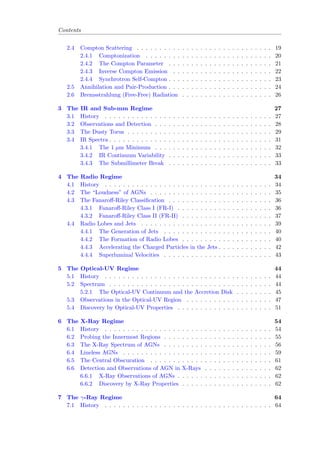
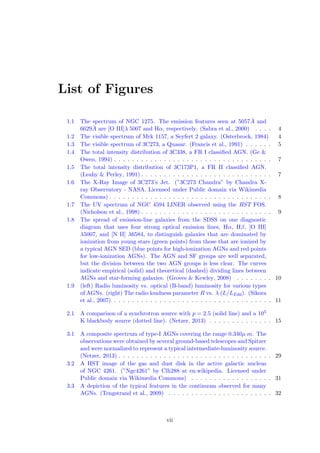
List of Figures 
1.1 The spectrum of NGC 1275 . . . . . . . . . . . . . . . . . . . . . . . . . . 4 
1.2 The visible spectrum of Mrk 1157 . . . . . . . . . . . . . . . . . . . . . . . 4 
1.3 The visible spectrum of 3C 273 . . . . . . . . . . . . . . . . . . . . . . . . 5 
1.4 The total intensity distribution of 3C 338 . . . . . . . . . . . . . . . . . . 7 
1.5 The total intensity distribution of 3C 173P1 . . . . . . . . . . . . . . . . . 7 
1.6 The X-ray image of 3C 273's jet . . . . . . . . . . . . . . . . . . . . . . . 8 
1.7 The UV spectrum of NGC 4594 . . . . . . . . . . . . . . . . . . . . . . . . 9 
1.8 The spread of emission-line galaxies from the SDSS . . . . . . . . . . . . . 10 
1.9 Radio luminosity vs. optical luminosity . . . . . . . . . . . . . . . . . . . 11 
2.1 Comparison of a synchrotron source with a blackbody source . . . . . . . 15 
3.1 Composite spectrum of Type I AGNs . . . . . . . . . . . . . . . . . . . . . 29 
3.2 HST image of NGC 4261 . . . . . . . . . . . . . . . . . . . . . . . . . . . 31 
3.3 AGN spectrum continuum . . . . . . . . . . . . . . . . . . . . . . . . . . . 32 
4.1 VLA map of 3C 449 . . . . . . . . . . . . . . . . . . . . . . . . . . . . . . 38 
4.2 VLA map of 3C 47 . . . . . . . . . . . . . . . . . . . . . . . . . . . . . . . 39 
4.3 Electromagnetic out
ows from an accretion disk . . . . . . . . . . . . . . 41 
4.4 Contour images of Cygnus A's jet . . . . . . . . . . . . . . . . . . . . . . . 42 
4.5 Superluminal motion of M87's jet . . . . . . . . . . . . . . . . . . . . . . . 43 
5.1 Composite optical-UV spectra of AGNs . . . . . . . . . . . . . . . . . . . 46 
5.2 General view of a typical optical-UV SED of AGNs . . . . . . . . . . . . . 46 
5.3 Broadband SEDs of AGNs . . . . . . . . . . . . . . . . . . . . . . . . . . . 48 
5.4 Average optical-UV SED for Type I AGNs . . . . . . . . . . . . . . . . . 48 
5.5 Spectrum of LLAGN NGC 5252 . . . . . . . . . . . . . . . . . . . . . . . 49 
5.6 Comparison of dierent broad-line pro
les in Type I AGNs . . . . . . . . 50 
5.7 u-g color of a large number of SDSS AGNs with various redshifts . . . . . 52 
5.8 Discovering AGNs by their broadband colours . . . . . . . . . . . . . . . . 53 
6.1 Composite AGN spectrum in extreme UV based on FUSE data . . . . . . 57 
6.2 Soft X-ray spectrum of NLS1 Arkelian 564 . . . . . . . . . . . . . . . . . . 58 
6.3 Composite spectrum of 15 lineless AGNs with large X-ray-to-optical lu-minosity 
. . . . . . . . . . . . . . . . . . . . . . . . . . . . . . . . . . . . . 60 
7.1 Multiepoch, multiwavelength spectrum of 3C 279 . . . . . . . . . . . . . . 66 
8.1 Schematic representation of uni
ed BL Lac phenomenon . . . . . . . . . . 71 
8.2 Schematic representation of the uni
ed AGN model . . . . . . . . . . . . 82 
vii
List of Figures 
8.3 Anticorrelation between X-ray variability amplitude and black hole mass . 84
List of Tables 
2.1 Synchrotron sources in AGNs . . . . . . . . . . . . . . . . . . . . . . . . . 16 
8.1 The general uni
cation scheme of AGNs . . . . . . . . . . . . . . . . . . . 83 
ix
Abbreviations 
AGN Active Galactic Nuclei 
SMBH Super Massive Black Hole 
QSO Quasi Stellar Objects 
IRAS Infrared Astronomical Satellite 
NLRG Narrow Line Radio Galaxies 
BLRG Broad Line Radio Galaxies 
WLRG Weak-Emission Line Radio Galaxies 
BLR Broad Line Region 
SSRQ Steep Spectrum Radio Quasars 
FSRQ Flat Spectrum Radio Quasars 
FR-I Fanaro Riley Type I 
FR-II Fanaro Riley Type II 
BL Lac BL Lacertae 
OVV Optically Violently Variable Quasars 
LINER Low Ionization Nuclear Emission-Line Region 
LLAGN Low Luminosity Active Galactic Nuclei 
SED Spectral Energy Distribution 
SF Star Formation 
RIAF Radiatively Inaccurate Accretion Flow 
SSC Synchrotron Self Compton 
BH Black Hole 
NIR Near Infrared 
MIR Mid Infrared 
FIR Far Infrared 
RM Rotation Measure 
x
Abbreviations 
IC Inverse Compton 
UV Ultra-Violet 
HST Hubble Space Telescope 
MHD Magnetohydrodynamics 
FWHM Full Width at Half Maximum 
S/N Signal to Noise Ratio 
NLS1 Narrow Line Seyfert Type I 
SDSS Sloan Digital Sky Survey 
BAL Broad Absorption Line 
BEL Broad Emission Line 
XRB X-Ray Binary 
SAS Small Astronomy Satellite 
OSO Observing Solar Observatory 
HEAO High Energy Astronomy Observatory 
2MASS 2 Micron All Sky Survey 
XMM X-Ray Multi-Mirror Mission 
RGS Re
ecting Grating Spectrometer 
CCD Charge Coupled Device 
ESA European Space Agency 
NASA National Aeronautics and Space Agency 
COSMOS Cosmic Evolution Survey 
EW Equivalent Width 
HIG Highly Ionized Gas 
BAT Burst Alert Telescope 
ROSAT Roentgen Satellite 
INTEGRAL International Gamma-Ray Astrophysics Laboratory 
CGRO Compton Gamma-Ray Observatory 
LAT Large Area Telescope 
VLBI Very Long Baseline Interferometry 
HESS High Energy Spectroscopic System 
MERLIN Multi-Element Radio Linked Interferometer Network 
VLA Very Large Array 
HBLR Hidden Broad Line Region
Abbreviations 
OSSE Oriented Scintillation Spectrometer Experiment 
EXOSAT European X-Ray Observatory Satellite 
PDS Planetary Data System 
HBL High-Frequency Peaked BL Lac Objects 
LBL Low-Frequency Peaked BL Lac Objects 
RMS Root Mean Squared
Chapter 1 
Introduction 
1.1 The History of AGNs 
Unusual activity in the nuclei of galaxies was
rst recognised by Minkowski and Humason 
(Mount Wilson Observatory), when in 1943 they asked a graduate student Carl Seyfert 
to study a class of galaxy with an emission spectrum from the compact bright nucleus. 
Most normal galaxies show a continuum with absorption lines, but the emission in the 
Seyfert galaxies betrayed the presence of hot tenuous gas. In some cases the emission 
lines were broad (Type 1 Seyferts) indicating gas moving with high velocities and in 
other objects, the emission lines were narrow (Type 2 Seyferts) indicating that the gas 
was moving more slowly. In the 1950s, as radio astronomy became a rapidly developing 
science a whole new range of discoveries were made in astronomy. Amongst these were 
the Radio Galaxies, which appeared to be elliptical galaxies that were inconspicuous at 
optical wavelengths but were shown to have dramatically large, prominent lobes at radio 
frequencies, stretching for millions of light years from the main galaxy 
1.2 Active Galactic Nuclei 
The names active galaxies and active galactic nuclei (AGNs) are related to the main 
feature that distinguishes these objects from inactive (normal or regular) galaxies |the 
presence of accreting supermassive black holes (SMBHs) in their centers. As of 2011, 
there are approximately a million known sources of this type selected by their color and 
1
Chapter 1. Introduction 
several hundred thousand by basic spectroscopy and accurate redshifts. It is estimated 
that in the local universe, at z  0.1, about 1 out of 50 galaxies contains a fast-accreting 
SMBH, and about 1 in 3 contains a slowly accreting SMBH. Detailed studies of large 
samples of AGNs, and the understanding of their connection with inactive galaxies and 
their redshift evolution, started in the late 1970s, long after the discovery of the
rst 
quasi-stellar objects in the early 1960s. Although all objects containing active SMBH 
are now referred to as AGNs, various other names, relics from the 1960s, 1970s, and 
even now, are still being used. 
The most powerful active galaxies were discovered with radio telescopes in the 1960's 
and named `Quasi-Stellar Radio Sources', later shortened to QSOs or quasars. Their 
huge luminosities ( 104246 erg s1) could not be attributed to starlight alone, and the 
rapid variability observed (from months down to days) implied that the radiation was 
emitted from very small volumes with characteristic linear size of the order of light days. 
At the time, it was proving dicult to reconcile these two properties. As more detailed 
observations were performed it became clear that AGNs were most likely powered by 
accretion of matter onto a central SMBH (105 M
). 
It is considerable to add that not all galaxies are active. Our Milky-Way is one of the 
numerous galaxies that hosts a SMBH at its galactic center (Schodel et al., 2002), with 
MSMBH  4:6  0:7  106M
, but is not considered to be an active galaxy due to 
the fact that there is no apparent accretion on to the SMBH. On contrary, the central 
regions of an AGN are likely not static, but very dynamic and violent. 
1.3 The Taxonomy of AGNs 
The observational classi
cation of AGNs is not so clear because of observational limi-tations, 
heavy source obscuration (in most cases) and usually varying accretion rate on 
many orders of magnitude. Classically, an object is classi
ed as an AGN if :- 
 It contains a compact nuclear region emitting signi
cantly beyond what is expected 
from stellar processes typical of this type of galaxy. 
 It shows the clear signature of a non-stellar continuum emitting process in its 
center. 
2
Chapter 1. Introduction 
 Its spectrum contains strong emission lines with line ratios that are typical of 
excitation by a non-stellar radiation
eld. 
 It shows line and/or continuum variations. 
1.3.1 Seyferts 
Owing the name to Seyfert (1943) who was the
rst to discover these types, the major-ity 
of AGN with visible host galaxies fall under this class, known as Seyfert Galaxies. 
Seyfert, in his
rst observation, had reported a small percentage of galaxies had very 
bright nuclei that were the source of broad emission lines produced by atoms in a wide 
range of ionization states. These nuclei were nearly stellar in appearance (no powerful 
telescopes at that time were available). 
Today, these are further divided into two more subcategories :- 
 Type I Seyferts: Spectra contain very broad emission lines that include both 
allowed lines (H I, He I, He II) and narrower forbidden lines (O [III]). They 
generally also have narrow allowed lines albeit being comparatively broader than 
those exhibited by non-active galaxies. The width of these lines is attributed to 
Doppler broadening, indicating that the allowed lines originate from sources with 
speeds typically between 1000 and 5000 km s1 
 Type II Seyferts: Spectra contain only narrow lines (both permitted and forbid-den), 
with characteristic speeds of about 500 km s1 
1.3.2 Quasars and QSOs 
The terms Quasar (Quasi Stellar Radio Source) and QSO (Quasi Stellar Object), often 
used interchangeably, are scaled up versions of a Type I Seyfert, where the nucleus has 
a luminosity MB  21:5 + 5 log h0 Schmidt  Green (1983). Maarten Schmidt 
recognized that the pattern of the broad emission lines of 3C 273 (the
rst detected 
quasar) was the same as the pattern of the Balmer lines of Hydrogen, but were 
severely redshifted to z = 0.158 to unfamiliar wavelengths, thus alluding astronomers 
from understanding it. 
3
Chapter 1. Introduction 
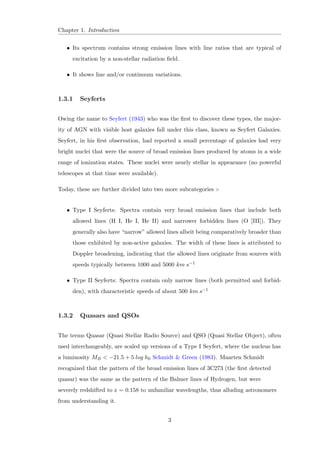
Figure 1.1: The spectrum of NGC 1275. The emission features seen at 5057 A 
and 
6629 A 
are [O III] 5007 and H, respectively. 
(Sabra et al., 2000) 
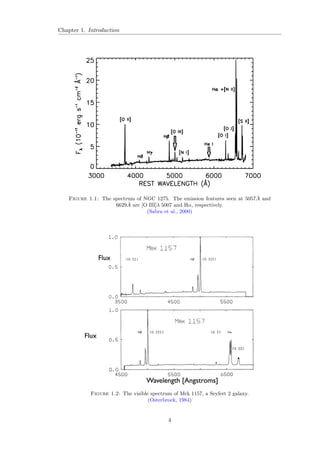
Figure 1.2: The visible spectrum of Mrk 1157, a Seyfert 2 galaxy. 
(Osterbrock, 1984) 
4
Chapter 1. Introduction 
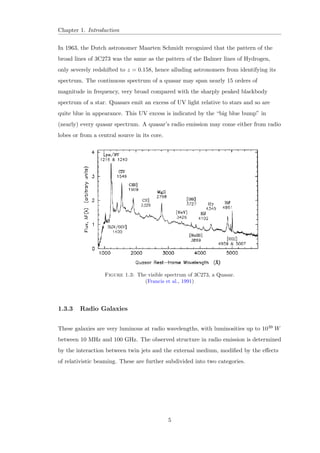
In 1963, the Dutch astronomer Maarten Schmidt recognized that the pattern of the 
broad lines of 3C 273 was the same as the pattern of the Balmer lines of Hydrogen, 
only severely redshifted to z = 0:158, hence alluding astronomers from identifying its 
spectrum. The continuous spectrum of a quasar may span nearly 15 orders of 
magnitude in frequency, very broad compared with the sharply peaked blackbody 
spectrum of a star. Quasars emit an excess of UV light relative to stars and so are 
quite blue in appearance. This UV excess is indicated by the big blue bump in 
(nearly) every quasar spectrum. A quasar's radio emission may come either from radio 
lobes or from a central source in its core. 
Figure 1.3: The visible spectrum of 3C 273, a Quasar. 
(Francis et al., 1991) 
1.3.3 Radio Galaxies 
These galaxies are very luminous at radio wavelengths, with luminosities up to 1039 W 
between 10 MHz and 100 GHz. The observed structure in radio emission is determined 
by the interaction between twin jets and the external medium, modi
ed by the eects 
of relativistic beaming. These are further subdivided into two categories. 
5
Chapter 1. Introduction 
1.3.3.1 Radio Quiet 
Similar in many aspects to Type I Seyferts, these galaxies show both broad and narrow 
lines, the only dierence being that they are much more luminous than Type I 
Seyferts. They are observed in the absence of relativistic jets, which contribute the 
most energies in the radio wavelength spectrum. 
 Radio Quiet Type I AGNs: These have relatively low-luminosities and therefore 
are seen only nearby, where the host galaxy can be resolved, and the 
higher-luminosity radio-quiet quasars, which are typically seen at greater 
distances because of their relative rarity locally and thus rarely show an obvious 
galaxy surrounding the bright central source. 
 Radio Quiet Type II AGNs: These include Seyfert II galaxies at low luminosities, 
as well as the narrow-emission-line X-ray galaxies (Mushotzky, 1982). The 
high-luminosity counterparts are not clearly identi
ed at this point but likely 
candidates are the infrared-luminous IRAS AGN (Hough et al., 1991, Sanders 
et al., 1989, Wills et al., 1992), which may show a predominance of Type II 
optical spectra. 
1.3.3.2 Radio Loud 
Usually attributed to AGNs with unipolar/bipolar, relativistic jets beaming out of 
their centers, the radio emission from radio-loud active galaxies is synchrotron 
emission, as inferred from its very smooth, broad-band nature and strong polarization. 
This implies that the radio-emitting plasma contains, at least, electrons with 
relativistic speeds (Lorentz factors of  104) and magnetic
elds. However, 
synchrotron radiation not being unique to radio wavelengths, if the radio source can 
accelerate particles to high enough energies, features which are detected in the radio 
may also be seen in the infrared, optical, ultraviolet or even X-ray. 
 Radio Loud Type I AGNs: These are called Broad-Line Radio Galaxies (BLRG) 
at low luminosities and radio-loud quasars at high luminosities, either Steep 
Spectrum Radio Quasars (SSRQ) or Flat Spectrum Radio Quasars (FSRQ) 
depending on radio continuum shape. 
6
Chapter 1. Introduction 
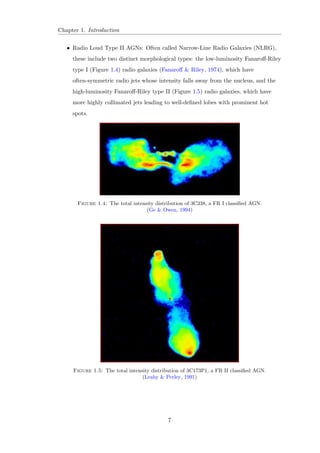
 Radio Loud Type II AGNs: Often called Narrow-Line Radio Galaxies (NLRG), 
these include two distinct morphological types: the low-luminosity Fanaro-Riley 
type I (Figure 1.4) radio galaxies (Fanaro  Riley, 1974), which have 
often-symmetric radio jets whose intensity falls away from the nucleus, and the 
high-luminosity Fanaro-Riley type II (Figure 1.5) radio galaxies, which have 
more highly collimated jets leading to well-de
ned lobes with prominent hot 
spots. 
Figure 1.4: The total intensity distribution of 3C 338, a FR I classi
ed AGN. 
(Ge  Owen, 1994) 
Figure 1.5: The total intensity distribution of 3C 173P1, a FR II classi
ed AGN. 
(Leahy  Perley, 1991) 
7
Chapter 1. Introduction 
1.3.4 Blazars 
Originally named after what was thought to be an irregular, variable star BL Lacertae, 
these are AGNs which are characterized by rapid and large-amplitude 
ux variability 
and signi
cant optical polarization. When compared to quasars with strong emission 
lines, blazars have spectra dominated by a featureless non-thermal continuum. The 
most well known object in this class is the BL Lacertae. Joining the BL Lac objects in 
the blazar classi
cation are the optically violently variable quasars (OVVs), which are 
similar to the BL Lacs except that they are typically much more luminous, and their 
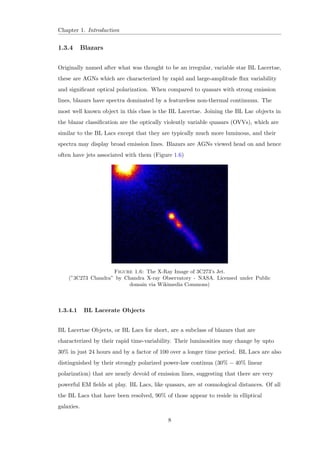
spectra may display broad emission lines. Blazars are AGNs viewed head on and hence 
often have jets associated with them (Figure 1.6) 
Figure 1.6: The X-ray image of 3C 273's jet. 
(3C273 Chandra by Chandra X-ray Observatory - NASA. Licensed under Public 
domain via Wikimedia Commons) 
1.3.4.1 BL Lacerate Objects 
BL Lacertae Objects, or BL Lacs for short, are a subclass of blazars that are 
characterized by their rapid time-variability. Their luminosities may change by upto 
30% in just 24 hours and by a factor of 100 over a longer time period. BL Lacs are also 
distinguished by their strongly polarized power-law continua (30%  40% linear 
polarization) that are nearly devoid of emission lines, suggesting that there are very 
powerful EM
elds at play. BL Lacs, like quasars, are at cosmological distances. Of all 
the BL Lacs that have been resolved, 90% of those appear to reside in elliptical 
galaxies. 
8
Chapter 1. Introduction 
1.3.4.2 Optically Violent Variable Quasars 
Almost similar to BL Lacs, OVVs are typically much more luminous and may display 
broad emission lines in their spectra. The currently best known example of an OVV is 
3C 279. 
1.3.5 LINERs 
LINERs (Low Ionization Nuclear Emission-line Regions) are types of active galaxies 
that have very low luminosities in their nuclei, but with fairly strong emission lines of 
low-ionization species, such as the forbidden lines of [O I] and [N II]. The Spectra of 
LINERs seem similar to the low-luminosity end of the Seyfert II class, and LINER 
signatures are detected in many (most of) spiral galaxies in high-sensivity studies. 
These low-ionization lines are also detectable in starburst galaxies and in H II regions 
and hence it is sometimes dicult to distinguish between LINERs and starburst 
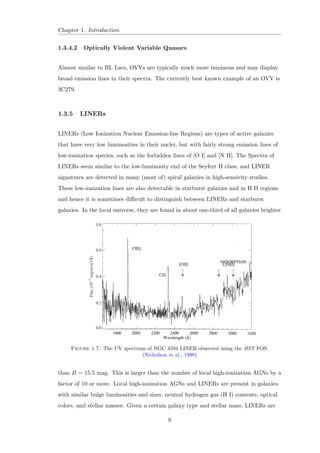
galaxies. In the local universe, they are found in about one-third of all galaxies brighter 
Figure 1.7: The UV spectrum of NGC 4594 LINER observed using the HST FOS. 
(Nicholson et al., 1998) 
than B = 15.5 mag. This is larger than the number of local high-ionization AGNs by a 
factor of 10 or more. Local high-ionization AGNs and LINERs are present in galaxies 
with similar bulge luminosities and sizes, neutral hydrogen gas (H I) contents, optical 
colors, and stellar masses. Given a certain galaxy type and stellar mass, LINERs are 
9
Chapter 1. Introduction 
usually the lowest-luminosity AGNs, with nuclear luminosity that can be smaller than 
the luminosity of high-ionization AGNs by 1-5 orders of magnitude. An alternative 
name for this class of objects is low-luminosity AGNs (LLAGNs). The strongest 
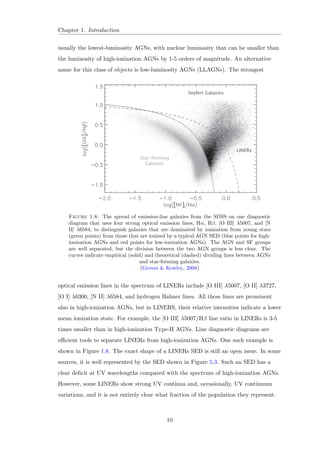
Figure 1.8: The spread of emission-line galaxies from the SDSS on one diagnostic 
diagram that uses four strong optical emission lines, H, H
, [O III] 5007, and [N 
II] 6584, to distinguish galaxies that are dominated by ionization from young stars 
(green points) from those that are ionized by a typical AGN SED (blue points for high-ionization 
AGNs and red points for low-ionization AGNs). The AGN and SF groups 
are well separated, but the division between the two AGN groups is less clear. The 
curves indicate empirical (solid) and theoretical (dashed) dividing lines between AGNs 
and star-forming galaxies. 
(Groves  Kewley, 2008) 
optical emission lines in the spectrum of LINERs include [O III] 5007, [O II] 3727, 
[O I] 6300, [N II] 6584, and hydrogen Balmer lines. All these lines are prominent 
also in high-ionization AGNs, but in LINERS, their relative intensities indicate a lower 
mean ionization state. For example, the [O III] 5007/H
line ratio in LINERs is 3-5 
times smaller than in high-ionization Type-II AGNs. Line diagnostic diagrams are 
ecient tools to separate LINERs from high-ionization AGNs. One such example is 
shown in Figure 1.8. The exact shape of a LINERs SED is still an open issue. In some 
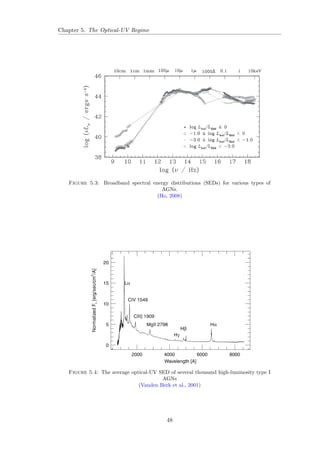
sources, it is well represented by the SED shown in Figure 5.3. Such an SED has a 
clear de
cit at UV wavelengths compared with the spectrum of high-ionization AGNs. 
However, some LINERs show strong UV continua and, occasionally, UV continuum 
variations, and it is not entirely clear what fraction of the population they represent. 
10
Chapter 1. Introduction 
Figure 1.9: (left) Radio luminosity vs. optical (B-band) luminosity for various types 
of AGNs. (right) The radio loudness parameter R vs.  (L=LEdd). 
(Sikora et al., 2007) 
This is related to the issue of Radiatively Inecient Accretion Flows (RIAFs) and the 
relationship between the mass-accretion rate onto the BH and the emitted radiation. 
Point-like X-ray sources have been observed in a large number of LINERs. These 
nuclear hard X-ray sources are more luminous than expected for a normal population 
of X-ray binaries and must be related to the central source. Many LINERs also 
contain compact nuclear radio sources similar to those seen in radio-loud 
high-ionization AGNs but with lower luminosity comparable to WLRGs (Figure 1.9). 
The UV-to-X-ray luminosity ratio in LINERs is, again, not very well known. In 
LINERs with strong UV continua, ox is smaller than in low-redshift, high-ionization 
AGNs, consistent with the general trend between ox and Lbol. However, ox is not 
known for most LINERs because of the diculty in measuring the UV continuum. 
Like other AGNs, LINERs can be classi
ed into Type-I (broad emission lines) and 
Type-II (only narrow lines) sources. The broad lines, when observed, are seen almost 
exclusively in H and hardly ever in H
. This is most likely due to the weakness of the 
broad wings of the Balmer lines that are dicult to observe against a strong stellar 
continuum. Some, perhaps many, LINERs may belong to the category of real Type-II 
AGNs |those AGNs with no BLR. The phenomenon is expected to be more common 
among low-luminosity sources and hence to be seen in LINERs. Because of all this, the 
classi
cation of LINERs is ambiguous, and the relative number of Type-I and Type-II 
objects of this class is uncertain even at very low redshift. 
11
Chapter 2 
Non-Thermal Processes 
Much of the electromagnetic radiation emitted by AGNs is very dierent from a simple 
blackbody emission or a stellar radiation source. The general name adopted here for 
such processes is non-stellar emission, but the term non-thermal emission is commonly 
used to describe such sources. There are several types of non-stellar radiation 
processes. 
2.1 Basic Radiative Transfer 
Describing the interaction of radiation with matter requires the use of three basic 
quantities: the
rst is the speci
c intensity I, which gives the local 
ux per unit time, 
frequency, area, and solid angle everywhere in the source. The second quantity is the 
monochromatic absorption cross section,  (cm1), which combines all loss 
(absorption and scattering) processes. The third quantity is the volume emission 
coecient, j, which gives the locally emitted 
ux per unit volume, time, frequency, 
and solid angle. The three are combined into the equation of radiative transfer, 
dI 
ds = I + j; 
where ds is a path length interval. The
rst term on the right in this equation 
describes the radiation loss due to absorption, and the second gives the radiation gain 
due to local emission processes. One usually de
nes the optical depth element, 
d = ds. Hence, 
12
Chapter 2. Non-Thermal Processes 
dI 
d 
= I + S; 
where S = j= is the source function. The formal solution of the equation of 
transfer depends on geometry. For a slab of thickness  in a direction perpendicular 
to the slab, it is 
I() = I(0)e + 
 R 
0 
e(t)S(t)dt: 
For any other direction , both  and dt must be divided by cos . 
The general equation of radiative transfer is dicult to solve and requires numerical 
techniques. However, there are simple cases in which the solution is straightforward. 
In particular, the case of a slab and a constant source function that is independent of 
 allows a direct integration and gives the following solution: 
I = I(0)e + S(1  e ): 
For an opaque source in full thermodynamic equilibrium (TE), the optical depth is 
large, and both I and S approach the Planck function 
B(T) = 2h3=c2 
eh=kT1 
2.2 Synchrotron Radiation 
2.2.1 Emission by a Single Electron in a Magnetic Field 
Considering an electron of energy E that is moving in a uniform magnetic
eld B of 
energy density uB = B2=8, the energy loss rate, dE=dt, which is also the power 
emitted by the electron, P, is given by 
P = 2T c
2
2uB sin2 ; 
where T is the Thomson cross section, 
c is the speed of light, 
13
Chapter 2. Non-Thermal Processes 

 = E=mc2 is the Lorentz factor,
= v=c, and 
v is the speed of the electron. 
The angular term sin2  re
ects the direction of motion, where  is the pitch angle 
between the direction of the motion and the magnetic
eld. Averaging over isotropic 
pitch angles gives 
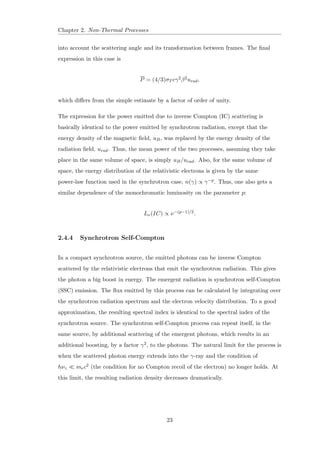
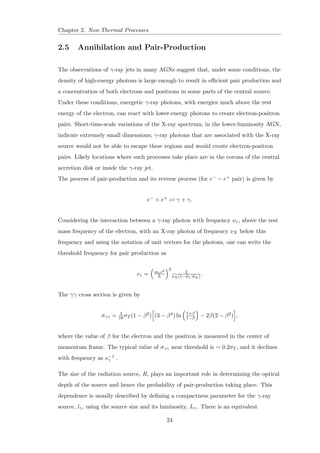
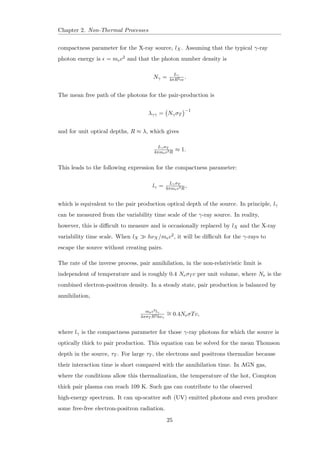
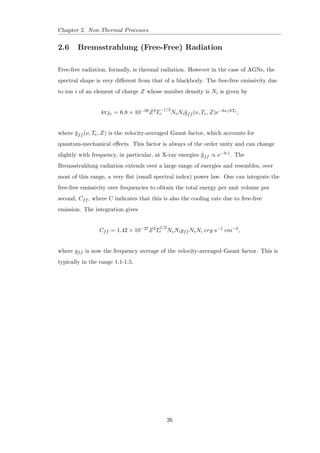
P = (4=3)T c
2
2uB: 
The radiation emitted by a single electron is beamed in the direction of motion. The 
spectral energy distribution (SED) of this radiation is obtained by considering the gyro 
frequency of the electrons around the
eld lines (!B = eB=
mec) and the mean interval 
between pulses (2=!B). The calculation of the pulse width is obtained by considering 
the relativistic time transformation between the electron frame and the observer frame. 
This involves an additional factor of 
2. Thus, the pulse width is proportional to 
3 
or, expressed with the Larmor angular frequency, !L = eB=mec (which diers from !B 
by a factor of 
), to 
2. Fourier transforming these expressions gives the mean 
emitted spectrum of a single electron, P
, which peaks at a frequency near 
2!L. 
2.2.2 Synchrotron Emission by a Power Law Distribution of Electrons 
Assuming now a collection of electrons with an energy distribution n(
)d
 that gives 
the number of electrons per unit volume with 
 in the range 
  (
 + d
), the emission 
coecient due to the electrons is obtained by summing P
(
) over all energies: 
j = 1 
4 
1 R 
1 
P(
)n(
)d
: 
There is no general analytical solution to this expression since n(
) can take various 
dierent forms. However, there are several cases of interest where n(
) can be 
presented as a power law in energy: 
n(
)d
 = n0
pd
: 
The additional assumption that all the radiation peaks around a characteristic 
frequency, 
2L, where L is the Larmor frequency, gives the following solution for j: 
14
Chapter 2. Non-Thermal Processes 
3T n0uB1 
4j = 2 
L 
 
 
L 
p1 
2 : 
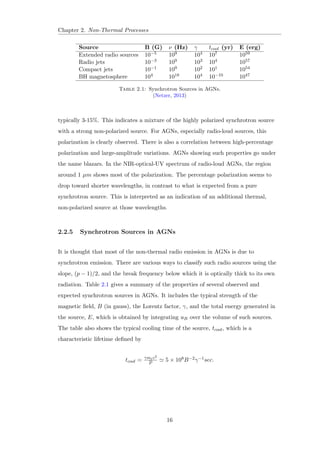
Figure 2.1: A comparison of a synchrotron source with p = 2:5 (solid line) and a 105 
K blackbody source (dotted line). 
(Netzer, 2013) 
2.2.3 Synchrotron Self-Absorption 
The source of fast electrons can be opaque to its own radiation. This results in a 
signi
cant modi
cation of the emergent spectrum especially at low frequencies, where 
the opacity is the largest. It can be shown that in this case, 
 / p+4 
2 ; 
that is, the largest absorption is at the lowest frequencies. Using the equation of 
radiative transfer for a uniform homogeneous medium, we get the solution at the large 
optical depth limit, I / 5=2, which describes the synchrotron SED at low energies. 
This function drops faster toward low energies than the low-energy drop of a blackbody 
spectrum (I / 2). The overall shape of such a source is shown in Figure 2.1. 
2.2.4 Polarization 
Synchrotron radiation is highly linearly polarized. The intrinsic polarization can reach 
70%. However, what is normally observed is a much smaller level of polarization, 
15
Chapter 2. Non-Thermal Processes 
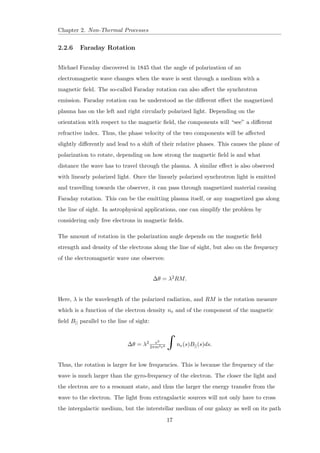
Source B (G)  (Hz) 
 tcool (yr) E (erg) 
Extended radio sources 105 109 104 107 1059 
Radio jets 103 109 103 104 1057 
Compact jets 101 109 102 101 1054 
BH magnetosphere 104 1018 104 1010 1047 
Table 2.1: Synchrotron Sources in AGNs. 
(Netzer, 2013) 
typically 3-15%. This indicates a mixture of the highly polarized synchrotron source 
with a strong non-polarized source. For AGNs, especially radio-loud sources, this 
polarization is clearly observed. There is also a correlation between high-percentage 
polarization and large-amplitude variations. AGNs showing such properties go under 
the name blazars. In the NIR-optical-UV spectrum of radio-loud AGNs, the region 
around 1 m shows most of the polarization. The percentage polarization seems to 
drop toward shorter wavelengths, in contrast to what is expected from a pure 
synchrotron source. This is interpreted as an indication of an additional thermal, 
non-polarized source at those wavelengths. 
2.2.5 Synchrotron Sources in AGNs 
It is thought that most of the non-thermal radio emission in AGNs is due to 
synchrotron emission. There are various ways to classify such radio sources using the 
slope, (p  1)=2, and the break frequency below which it is optically thick to its own 
radiation. Table 2.1 gives a summary of the properties of several observed and 
expected synchrotron sources in AGNs. It includes the typical strength of the 
magnetic
eld, B (in gauss), the Lorentz factor, 
, and the total energy generated in 
the source, E, which is obtained by integrating uB over the volume of such sources. 
The table also shows the typical cooling time of the source, tcool, which is a 
characteristic lifetime de
ned by 
tcool = 
mec2 
P 
' 5  108B2
1sec: 
16
Chapter 2. Non-Thermal Processes 
2.2.6 Faraday Rotation 
Michael Faraday discovered in 1845 that the angle of polarization of an 
electromagnetic wave changes when the wave is sent through a medium with a 
magnetic
eld. The so-called Faraday rotation can also aect the synchrotron 
emission. Faraday rotation can be understood as the dierent eect the magnetized 
plasma has on the left and right circularly polarized light. Depending on the 
orientation with respect to the magnetic
eld, the components will see a dierent 
refractive index. Thus, the phase velocity of the two components will be aected 
slightly dierently and lead to a shift of their relative phases. This causes the plane of 
polarization to rotate, depending on how strong the magnetic
eld is and what 
distance the wave has to travel through the plasma. A similar eect is also observed 
with linearly polarized light. Once the linearly polarized synchrotron light is emitted 
and travelling towards the observer, it can pass through magnetized material causing 
Faraday rotation. This can be the emitting plasma itself, or any magnetized gas along 
the line of sight. In astrophysical applications, one can simplify the problem by 
considering only free electrons in magnetic
elds. 
The amount of rotation in the polarization angle depends on the magnetic
eld 
strength and density of the electrons along the line of sight, but also on the frequency 
of the electromagnetic wave one observes: 
 = 2RM: 
Here,  is the wavelength of the polarized radiation, and RM is the rotation measure 
which is a function of the electron density ne and of the component of the magnetic
eld Bjj parallel to the line of sight: 
 = 2 e3 
2m2c4 
R 
ne(s)Bjj(s)ds: 
Thus, the rotation is larger for low frequencies. This is because the frequency of the 
wave is much larger than the gyro-frequency of the electron. The closer the light and 
the electron are to a resonant state, and thus the larger the energy transfer from the 
wave to the electron. The light from extragalactic sources will not only have to cross 
the intergalactic medium, but the interstellar medium of our galaxy as well on its path 
17
Chapter 2. Non-Thermal Processes 
to the observer. The magnetic
eld along the line of sight will not be constant, and 
importantly, it will not be of the same orientation throughout the path of light. To 
determine the net eect of Faraday rotation, it is necessary to measure polarization at 
closely spaced frequency interval over many frequencies. Because the rotation aects 
the high frequency the least, the best way to get an estimate of the intrinsic 
polarization of a synchrotron source is to measure at high frequencies. 
2.3 Thomson Scattering 
Thomson scattering describes the non-relativistic case of an interaction between an 
electromagnetic wave and a free charged particle. The eect was
rst describe by Sir 
Joseph John Thomson, who discovered the electron when studying cathode rays in the 
late nineteenth century. The process can be understood as elastic or coherent 
scattering, as the photon and the particle will have the same energy after the 
interaction as before. For this process of the energy E of the photon has to be much 
smaller than the rest energy of the particle: 
E = h  mc2: 
Another requirement for Thomson scattering is that the particle must be moving at 
non-relativistic speed (v  c). In the classical view of this process, the incoming 
photon is absorbed by the particle with charge q, which is set into motion and then 
re-emits a photon of the same energy. 
Using the classical electron radius r0 = q2=mc2 (Bohr radius), the dierential 
cross-section of this elastic scattering process can be written as 
d 
d
 = 1 
2(1 + cos2 )r2 
0: 
This is symmetric with respect to the angle , thus the amount of radiation scattered 
in the forward and backward direction is equal. The total cross-section is then given by 
T = 2 
 R 
0 
d 
d
 sin d = 8 
3 r2 
0 = 8 
3 
 
q2 
mc2 
2 
: 
18
Chapter 2. Non-Thermal Processes 
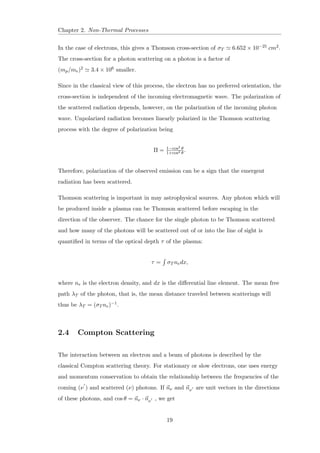
In the case of electrons, this gives a Thomson cross-section of T ' 6:652  1025 cm2. 
The cross-section for a photon scattering on a photon is a factor of 
(mp=me)2 ' 3:4  106 smaller. 
Since in the classical view of this process, the electron has no preferred orientation, the 
cross-section is independent of the incoming electromagnetic wave. The polarization of 
the scattered radiation depends, however, on the polarization of the incoming photon 
wave. Unpolarized radiation becomes linearly polarized in the Thomson scattering 
process with the degree of polarization being 
 = 1cos2  
1+cos2  : 
Therefore, polarization of the observed emission can be a sign that the emergent 
radiation has been scattered. 
Thomson scattering is important in may astrophysical sources. Any photon which will 
be produced inside a plasma can be Thomson scattered before escaping in the 
direction of the observer. The chance for the single photon to be Thomson scattered 
and how many of the photons will be scattered out of or into the line of sight is 
quanti
ed in terms of the optical depth  of the plasma: 
 = 
R 
T nedx; 
where ne is the electron density, and dx is the dierential line element. The mean free 
path T of the photon, that is, the mean distance traveled between scatterings will 
thus be T = (T ne)1. 
2.4 Compton Scattering 
The interaction between an electron and a beam of photons is described by the 
classical Compton scattering theory. For stationary or slow electrons, one uses energy 
and momentum conservation to obtain the relationship between the frequencies of the 
coming ( 
0 
) and scattered () photons. If ~n and ~n0 are unit vectors in the directions 
of these photons, and cos  = ~n  ~n0 , we get 
19
Chapter 2. Non-Thermal Processes 
 = mec2 
0 
mec2+h0 (1cos ) 
: 
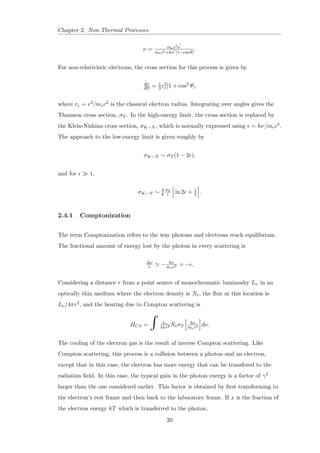
For non-relativistic electrons, the cross section for this process is given by 
d 
d
 = 1 
2r2 
e [1 + cos2 ]; 
where re = e2=mec2 is the classical electron radius. Integrating over angles gives the 
Thomson cross section, T . In the high-energy limit, the cross section is replaced by 
the Klein-Nishina cross section, KN, which is normally expressed using  = h=mec2. 
The approach to the low-energy limit is given roughly by 
KN  T (1  2); 
and for   1, 
KN  3 
8 
T 
 
h 
ln 2 + 1 
2 
i 
: 
2.4.1 Comptonization 
The term Comptonization refers to the way photons and electrons reach equilibrium. 
The fractional amount of energy lost by the photon in every scattering is 
 
 '  h 
mec2 = : 
Considering a distance r from a point source of monochromatic luminosity L in an 
optically thin medium where the electron density is Ne, the 
ux at this location is 
L=4r2, and the heating due to Compton scattering is 
HCS = 
R 
L 
4r2NeT 
h 
h 
mec2 
i 
d: 
The cooling of the electron gas is the result of inverse Compton scattering. Like 
Compton scattering, this process is a collision between a photon and an electron, 
except that in this case, the electron has more energy that can be transfered to the 
radiation
eld. In this case, the typical gain in the photon energy is a factor of 
2 
larger than the one considered earlier. This factor is obtained by
rst transforming to 
the electron's rest frame and then back to the laboratory frame. If x is the fraction of 
the electron energy kT which is transferred to the photon, 
20
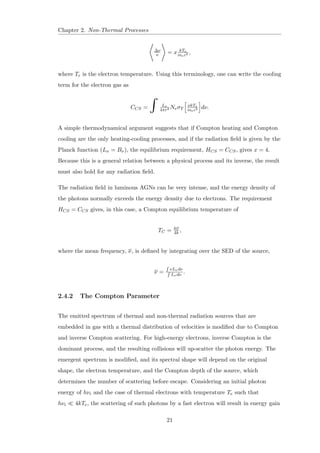
Chapter 2. Non-Thermal Processes 
* 
 
 
+ 
= x kTe 
mec2 ; 
where Te is the electron temperature. Using this terminology, one can write the cooling 
term for the electron gas as 
CCS = 
R 
L 
4r2NeT 
h 
xkTe 
mec2 
i 
d: 
A simple thermodynamical argument suggests that if Compton heating and Compton 
cooling are the only heating-cooling processes, and if the radiation
eld is given by the 
Planck function (L = B), the equilibrium requirement, HCS = CCS, gives x = 4. 
Because this is a general relation between a physical process and its inverse, the result 
must also hold for any radiation
eld. 
The radiation
eld in luminous AGNs can be very intense, and the energy density of 
the photons normally exceeds the energy density due to electrons. The requirement 
HCS = CCS gives, in this case, a Compton equilibrium temperature of 
TC = h 
4k ; 
where the mean frequency, , is de
ned by integrating over the SED of the source, 
 = 
R 
RLd 
Ld : 
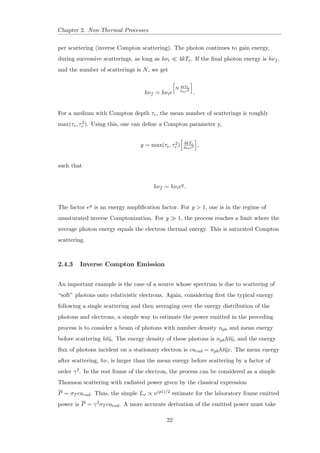
2.4.2 The Compton Parameter 
The emitted spectrum of thermal and non-thermal radiation sources that are 
embedded in gas with a thermal distribution of velocities is modi
ed due to Compton 
and inverse Compton scattering. For high-energy electrons, inverse Compton is the 
dominant process, and the resulting collisions will up-scatter the photon energy. The 
emergent spectrum is modi
ed, and its spectral shape will depend on the original 
shape, the electron temperature, and the Compton depth of the source, which 
determines the number of scattering before escape. Considering an initial photon 
energy of hi and the case of thermal electrons with temperature Te such that 
hi  4kTe, the scattering of such photons by a fast electron will result in energy gain 
21

Multi-Wavelength Analysis of Active Galactic Nuclei

  • 1.
    Multi-Wavelength Analysis ofActive Galactic Nuclei A dissertation submitted as partial ful
  • 2.
    lment of the 100-hour certi
  • 3.
    cate course in Astronomy & Astrophysics by Sameer Patel M.P. Birla Institute of Fundamental Research Bangalore, India December 2014
  • 4.
    Declaration I, SameerPatel, student of M.P. Birla Institute of Fundamental Research, Bangalore, hereby declare that the matter embodied in this dissertation has been compiled and prepared by me on the basis of available literature on the topic titled, Multi-Wavelength Analysis of Active Galactic Nuclei as a partial ful
  • 5.
    llment of the100 Hour Certi
  • 6.
    cate Course inAstronomy and Astro-physics, 2014. This dissertation has not been submitted either partially or fully to any university or institute for the award of any degree, diploma or fellowship. Date: Place: Signature Director, M.P. Birla Institute of Fundamental Research, Bangalore i
  • 7.
    M.P. Birla Instituteof Fundamental Research Bangalore, India Abstract Multi-Wavelength Analysis of Active Galactic Nuclei by Sameer Patel This dissertation explores the current research methods and analysis adopted for the study of Active Galactic Nuclei in all wavelengths of the electromagnetic radiation. Being the most violent objects that one can see in the present Universe, AGNs have been attributed to emitting radiation in all wavelengths and still exhibit various unexplained phenomena, alongside with being the probes to the very early Universe. The uni
  • 8.
    cation of theAGN model is also included for completeness, albeit not con
  • 9.
    rmed in itsentirety.
  • 10.
    Acknowledgements I wouldnever have been able to
  • 11.
    nish my dissertationwithout help from friends, and support from the team at MPBIFR, Bangalore. I would also like to thank Dr. Babu for constantly reminding us to complete the dis-sertation timely, and Ms. Komala for guiding me to coast through countless papers online for reference. I would like to thank Rishi Dua, who as a good friend, was always willing to help me and give his best suggestions, and Aakash Masand, who helped me correct typographical errors and grammatical mistakes after painfully proofreading the
  • 12.
    nal draft. Iwould also like to thank my parents. They were always supporting me and encouraging me with their best wishes. iii
  • 13.
    Contents Declaration i Abstract ii Acknowledgements iii List of Figures vii List of Tables ix Abbreviations x 1 Introduction 1 1.1 The History of AGNs . . . . . . . . . . . . . . . . . . . . . . . . . . . . . . 1 1.2 Active Galactic Nuclei . . . . . . . . . . . . . . . . . . . . . . . . . . . . . 1 1.3 The Taxonomy of AGNs . . . . . . . . . . . . . . . . . . . . . . . . . . . . 2 1.3.1 Seyferts . . . . . . . . . . . . . . . . . . . . . . . . . . . . . . . . . 3 1.3.2 Quasars and QSOs . . . . . . . . . . . . . . . . . . . . . . . . . . . 3 1.3.3 Radio Galaxies . . . . . . . . . . . . . . . . . . . . . . . . . . . . . 5 1.3.3.1 Radio Quiet . . . . . . . . . . . . . . . . . . . . . . . . . 6 1.3.3.2 Radio Loud . . . . . . . . . . . . . . . . . . . . . . . . . . 6 1.3.4 Blazars . . . . . . . . . . . . . . . . . . . . . . . . . . . . . . . . . 8 1.3.4.1 BL Lacerate Objects . . . . . . . . . . . . . . . . . . . . . 8 1.3.4.2 Optically Violent Variable Quasars . . . . . . . . . . . . . 9 1.3.5 LINERs . . . . . . . . . . . . . . . . . . . . . . . . . . . . . . . . . 9 2 Non-Thermal Processes 12 2.1 Basic Radiative Transfer . . . . . . . . . . . . . . . . . . . . . . . . . . . . 12 2.2 Synchrotron Radiation . . . . . . . . . . . . . . . . . . . . . . . . . . . . . 13 2.2.1 Emission by a Single Electron in a Magnetic Field . . . . . . . . . 13 2.2.2 Synchrotron Emission by a Power Law Distribution of Electrons . 14 2.2.3 Synchrotron Self-Absorption . . . . . . . . . . . . . . . . . . . . . 15 2.2.4 Polarization . . . . . . . . . . . . . . . . . . . . . . . . . . . . . . . 15 2.2.5 Synchrotron Sources in AGNs . . . . . . . . . . . . . . . . . . . . . 16 2.2.6 Faraday Rotation . . . . . . . . . . . . . . . . . . . . . . . . . . . . 17 2.3 Thomson Scattering . . . . . . . . . . . . . . . . . . . . . . . . . . . . . . 18 iv
  • 14.
    Contents 2.4 ComptonScattering . . . . . . . . . . . . . . . . . . . . . . . . . . . . . . 19 2.4.1 Comptonization . . . . . . . . . . . . . . . . . . . . . . . . . . . . 20 2.4.2 The Compton Parameter . . . . . . . . . . . . . . . . . . . . . . . 21 2.4.3 Inverse Compton Emission . . . . . . . . . . . . . . . . . . . . . . 22 2.4.4 Synchrotron Self-Compton . . . . . . . . . . . . . . . . . . . . . . . 23 2.5 Annihilation and Pair-Production . . . . . . . . . . . . . . . . . . . . . . . 24 2.6 Bremsstrahlung (Free-Free) Radiation . . . . . . . . . . . . . . . . . . . . 26 3 The IR and Sub-mm Regime 27 3.1 History . . . . . . . . . . . . . . . . . . . . . . . . . . . . . . . . . . . . . 27 3.2 Observations and Detection . . . . . . . . . . . . . . . . . . . . . . . . . . 28 3.3 The Dusty Torus . . . . . . . . . . . . . . . . . . . . . . . . . . . . . . . . 29 3.4 IR Spectra . . . . . . . . . . . . . . . . . . . . . . . . . . . . . . . . . . . . 31 3.4.1 The 1 m Minimum . . . . . . . . . . . . . . . . . . . . . . . . . . 32 3.4.2 IR Continuum Variability . . . . . . . . . . . . . . . . . . . . . . . 33 3.4.3 The Submillimeter Break . . . . . . . . . . . . . . . . . . . . . . . 33 4 The Radio Regime 34 4.1 History . . . . . . . . . . . . . . . . . . . . . . . . . . . . . . . . . . . . . 34 4.2 The Loudness of AGNs . . . . . . . . . . . . . . . . . . . . . . . . . . . 35 4.3 The Fanaro-Riley Classi
  • 15.
    cation . .. . . . . . . . . . . . . . . . . . . . . 36 4.3.1 Fanaro-Riley Class I (FR-I) . . . . . . . . . . . . . . . . . . . . . 36 4.3.2 Fanaro-Riley Class II (FR-II) . . . . . . . . . . . . . . . . . . . . 37 4.4 Radio Lobes and Jets . . . . . . . . . . . . . . . . . . . . . . . . . . . . . 39 4.4.1 The Generation of Jets . . . . . . . . . . . . . . . . . . . . . . . . 40 4.4.2 The Formation of Radio Lobes . . . . . . . . . . . . . . . . . . . . 40 4.4.3 Accelerating the Charged Particles in the Jets . . . . . . . . . . . . 42 4.4.4 Superluminal Velocities . . . . . . . . . . . . . . . . . . . . . . . . 43 5 The Optical-UV Regime 44 5.1 History . . . . . . . . . . . . . . . . . . . . . . . . . . . . . . . . . . . . . 44 5.2 Spectrum . . . . . . . . . . . . . . . . . . . . . . . . . . . . . . . . . . . . 44 5.2.1 The Optical-UV Continuum and the Accretion Disk . . . . . . . . 45 5.3 Observations in the Optical-UV Region . . . . . . . . . . . . . . . . . . . 47 5.4 Discovery by Optical-UV Properties . . . . . . . . . . . . . . . . . . . . . 51 6 The X-Ray Regime 54 6.1 History . . . . . . . . . . . . . . . . . . . . . . . . . . . . . . . . . . . . . 54 6.2 Probing the Innermost Regions . . . . . . . . . . . . . . . . . . . . . . . . 55 6.3 The X-Ray Spectrum of AGNs . . . . . . . . . . . . . . . . . . . . . . . . 56 6.4 Lineless AGNs . . . . . . . . . . . . . . . . . . . . . . . . . . . . . . . . . 59 6.5 The Central Obscuration . . . . . . . . . . . . . . . . . . . . . . . . . . . 61 6.6 Detection and Observations of AGN in X-Rays . . . . . . . . . . . . . . . 62 6.6.1 X-Ray Observations of AGNs . . . . . . . . . . . . . . . . . . . . . 62 6.6.2 Discovery by X-Ray Properties . . . . . . . . . . . . . . . . . . . . 62 7 The -Ray Regime 64 7.1 History . . . . . . . . . . . . . . . . . . . . . . . . . . . . . . . . . . . . . 64
  • 16.
    Contents 7.2 Gamma-RayLoud AGNs . . . . . . . . . . . . . . . . . . . . . . . . . . . 67 7.3 -Ray Properties of Blazars . . . . . . . . . . . . . . . . . . . . . . . . . . 67 8 The Uni
  • 17.
    ed Model ofAGNs 70 8.1 The Uni
  • 18.
    cation . .. . . . . . . . . . . . . . . . . . . . . . . . . . . . . . . 70 8.2 Absorbed Versus Unabsorbed AGN . . . . . . . . . . . . . . . . . . . . . . 72 8.3 Radio-Loud Versus Radio-Quiet . . . . . . . . . . . . . . . . . . . . . . . . 78 8.4 Breaking the Uni
  • 19.
    cation . .. . . . . . . . . . . . . . . . . . . . . . . . . . 83
  • 20.
    List of Figures 1.1 The spectrum of NGC 1275 . . . . . . . . . . . . . . . . . . . . . . . . . . 4 1.2 The visible spectrum of Mrk 1157 . . . . . . . . . . . . . . . . . . . . . . . 4 1.3 The visible spectrum of 3C 273 . . . . . . . . . . . . . . . . . . . . . . . . 5 1.4 The total intensity distribution of 3C 338 . . . . . . . . . . . . . . . . . . 7 1.5 The total intensity distribution of 3C 173P1 . . . . . . . . . . . . . . . . . 7 1.6 The X-ray image of 3C 273's jet . . . . . . . . . . . . . . . . . . . . . . . 8 1.7 The UV spectrum of NGC 4594 . . . . . . . . . . . . . . . . . . . . . . . . 9 1.8 The spread of emission-line galaxies from the SDSS . . . . . . . . . . . . . 10 1.9 Radio luminosity vs. optical luminosity . . . . . . . . . . . . . . . . . . . 11 2.1 Comparison of a synchrotron source with a blackbody source . . . . . . . 15 3.1 Composite spectrum of Type I AGNs . . . . . . . . . . . . . . . . . . . . . 29 3.2 HST image of NGC 4261 . . . . . . . . . . . . . . . . . . . . . . . . . . . 31 3.3 AGN spectrum continuum . . . . . . . . . . . . . . . . . . . . . . . . . . . 32 4.1 VLA map of 3C 449 . . . . . . . . . . . . . . . . . . . . . . . . . . . . . . 38 4.2 VLA map of 3C 47 . . . . . . . . . . . . . . . . . . . . . . . . . . . . . . . 39 4.3 Electromagnetic out ows from an accretion disk . . . . . . . . . . . . . . 41 4.4 Contour images of Cygnus A's jet . . . . . . . . . . . . . . . . . . . . . . . 42 4.5 Superluminal motion of M87's jet . . . . . . . . . . . . . . . . . . . . . . . 43 5.1 Composite optical-UV spectra of AGNs . . . . . . . . . . . . . . . . . . . 46 5.2 General view of a typical optical-UV SED of AGNs . . . . . . . . . . . . . 46 5.3 Broadband SEDs of AGNs . . . . . . . . . . . . . . . . . . . . . . . . . . . 48 5.4 Average optical-UV SED for Type I AGNs . . . . . . . . . . . . . . . . . 48 5.5 Spectrum of LLAGN NGC 5252 . . . . . . . . . . . . . . . . . . . . . . . 49 5.6 Comparison of dierent broad-line pro
  • 21.
    les in TypeI AGNs . . . . . . . . 50 5.7 u-g color of a large number of SDSS AGNs with various redshifts . . . . . 52 5.8 Discovering AGNs by their broadband colours . . . . . . . . . . . . . . . . 53 6.1 Composite AGN spectrum in extreme UV based on FUSE data . . . . . . 57 6.2 Soft X-ray spectrum of NLS1 Arkelian 564 . . . . . . . . . . . . . . . . . . 58 6.3 Composite spectrum of 15 lineless AGNs with large X-ray-to-optical lu-minosity . . . . . . . . . . . . . . . . . . . . . . . . . . . . . . . . . . . . . 60 7.1 Multiepoch, multiwavelength spectrum of 3C 279 . . . . . . . . . . . . . . 66 8.1 Schematic representation of uni
  • 22.
    ed BL Lacphenomenon . . . . . . . . . . 71 8.2 Schematic representation of the uni
  • 23.
    ed AGN model. . . . . . . . . . . . 82 vii
  • 24.
    List of Figures 8.3 Anticorrelation between X-ray variability amplitude and black hole mass . 84
  • 25.
    List of Tables 2.1 Synchrotron sources in AGNs . . . . . . . . . . . . . . . . . . . . . . . . . 16 8.1 The general uni
  • 26.
    cation scheme ofAGNs . . . . . . . . . . . . . . . . . . . 83 ix
  • 27.
    Abbreviations AGN ActiveGalactic Nuclei SMBH Super Massive Black Hole QSO Quasi Stellar Objects IRAS Infrared Astronomical Satellite NLRG Narrow Line Radio Galaxies BLRG Broad Line Radio Galaxies WLRG Weak-Emission Line Radio Galaxies BLR Broad Line Region SSRQ Steep Spectrum Radio Quasars FSRQ Flat Spectrum Radio Quasars FR-I Fanaro Riley Type I FR-II Fanaro Riley Type II BL Lac BL Lacertae OVV Optically Violently Variable Quasars LINER Low Ionization Nuclear Emission-Line Region LLAGN Low Luminosity Active Galactic Nuclei SED Spectral Energy Distribution SF Star Formation RIAF Radiatively Inaccurate Accretion Flow SSC Synchrotron Self Compton BH Black Hole NIR Near Infrared MIR Mid Infrared FIR Far Infrared RM Rotation Measure x
  • 28.
    Abbreviations IC InverseCompton UV Ultra-Violet HST Hubble Space Telescope MHD Magnetohydrodynamics FWHM Full Width at Half Maximum S/N Signal to Noise Ratio NLS1 Narrow Line Seyfert Type I SDSS Sloan Digital Sky Survey BAL Broad Absorption Line BEL Broad Emission Line XRB X-Ray Binary SAS Small Astronomy Satellite OSO Observing Solar Observatory HEAO High Energy Astronomy Observatory 2MASS 2 Micron All Sky Survey XMM X-Ray Multi-Mirror Mission RGS Re ecting Grating Spectrometer CCD Charge Coupled Device ESA European Space Agency NASA National Aeronautics and Space Agency COSMOS Cosmic Evolution Survey EW Equivalent Width HIG Highly Ionized Gas BAT Burst Alert Telescope ROSAT Roentgen Satellite INTEGRAL International Gamma-Ray Astrophysics Laboratory CGRO Compton Gamma-Ray Observatory LAT Large Area Telescope VLBI Very Long Baseline Interferometry HESS High Energy Spectroscopic System MERLIN Multi-Element Radio Linked Interferometer Network VLA Very Large Array HBLR Hidden Broad Line Region
  • 29.
    Abbreviations OSSE OrientedScintillation Spectrometer Experiment EXOSAT European X-Ray Observatory Satellite PDS Planetary Data System HBL High-Frequency Peaked BL Lac Objects LBL Low-Frequency Peaked BL Lac Objects RMS Root Mean Squared
  • 30.
    Chapter 1 Introduction 1.1 The History of AGNs Unusual activity in the nuclei of galaxies was
  • 31.
    rst recognised byMinkowski and Humason (Mount Wilson Observatory), when in 1943 they asked a graduate student Carl Seyfert to study a class of galaxy with an emission spectrum from the compact bright nucleus. Most normal galaxies show a continuum with absorption lines, but the emission in the Seyfert galaxies betrayed the presence of hot tenuous gas. In some cases the emission lines were broad (Type 1 Seyferts) indicating gas moving with high velocities and in other objects, the emission lines were narrow (Type 2 Seyferts) indicating that the gas was moving more slowly. In the 1950s, as radio astronomy became a rapidly developing science a whole new range of discoveries were made in astronomy. Amongst these were the Radio Galaxies, which appeared to be elliptical galaxies that were inconspicuous at optical wavelengths but were shown to have dramatically large, prominent lobes at radio frequencies, stretching for millions of light years from the main galaxy 1.2 Active Galactic Nuclei The names active galaxies and active galactic nuclei (AGNs) are related to the main feature that distinguishes these objects from inactive (normal or regular) galaxies |the presence of accreting supermassive black holes (SMBHs) in their centers. As of 2011, there are approximately a million known sources of this type selected by their color and 1
  • 32.
    Chapter 1. Introduction several hundred thousand by basic spectroscopy and accurate redshifts. It is estimated that in the local universe, at z 0.1, about 1 out of 50 galaxies contains a fast-accreting SMBH, and about 1 in 3 contains a slowly accreting SMBH. Detailed studies of large samples of AGNs, and the understanding of their connection with inactive galaxies and their redshift evolution, started in the late 1970s, long after the discovery of the
  • 33.
    rst quasi-stellar objectsin the early 1960s. Although all objects containing active SMBH are now referred to as AGNs, various other names, relics from the 1960s, 1970s, and even now, are still being used. The most powerful active galaxies were discovered with radio telescopes in the 1960's and named `Quasi-Stellar Radio Sources', later shortened to QSOs or quasars. Their huge luminosities ( 104246 erg s1) could not be attributed to starlight alone, and the rapid variability observed (from months down to days) implied that the radiation was emitted from very small volumes with characteristic linear size of the order of light days. At the time, it was proving dicult to reconcile these two properties. As more detailed observations were performed it became clear that AGNs were most likely powered by accretion of matter onto a central SMBH (105 M
  • 34.
    ). It isconsiderable to add that not all galaxies are active. Our Milky-Way is one of the numerous galaxies that hosts a SMBH at its galactic center (Schodel et al., 2002), with MSMBH 4:6 0:7 106M
  • 35.
    , but isnot considered to be an active galaxy due to the fact that there is no apparent accretion on to the SMBH. On contrary, the central regions of an AGN are likely not static, but very dynamic and violent. 1.3 The Taxonomy of AGNs The observational classi
  • 36.
    cation of AGNsis not so clear because of observational limi-tations, heavy source obscuration (in most cases) and usually varying accretion rate on many orders of magnitude. Classically, an object is classi
  • 37.
    ed as anAGN if :- It contains a compact nuclear region emitting signi
  • 38.
    cantly beyond whatis expected from stellar processes typical of this type of galaxy. It shows the clear signature of a non-stellar continuum emitting process in its center. 2
  • 39.
    Chapter 1. Introduction Its spectrum contains strong emission lines with line ratios that are typical of excitation by a non-stellar radiation
  • 40.
    eld. Itshows line and/or continuum variations. 1.3.1 Seyferts Owing the name to Seyfert (1943) who was the
  • 41.
    rst to discoverthese types, the major-ity of AGN with visible host galaxies fall under this class, known as Seyfert Galaxies. Seyfert, in his
  • 42.
    rst observation, hadreported a small percentage of galaxies had very bright nuclei that were the source of broad emission lines produced by atoms in a wide range of ionization states. These nuclei were nearly stellar in appearance (no powerful telescopes at that time were available). Today, these are further divided into two more subcategories :- Type I Seyferts: Spectra contain very broad emission lines that include both allowed lines (H I, He I, He II) and narrower forbidden lines (O [III]). They generally also have narrow allowed lines albeit being comparatively broader than those exhibited by non-active galaxies. The width of these lines is attributed to Doppler broadening, indicating that the allowed lines originate from sources with speeds typically between 1000 and 5000 km s1 Type II Seyferts: Spectra contain only narrow lines (both permitted and forbid-den), with characteristic speeds of about 500 km s1 1.3.2 Quasars and QSOs The terms Quasar (Quasi Stellar Radio Source) and QSO (Quasi Stellar Object), often used interchangeably, are scaled up versions of a Type I Seyfert, where the nucleus has a luminosity MB 21:5 + 5 log h0 Schmidt Green (1983). Maarten Schmidt recognized that the pattern of the broad emission lines of 3C 273 (the
  • 43.
    rst detected quasar)was the same as the pattern of the Balmer lines of Hydrogen, but were severely redshifted to z = 0.158 to unfamiliar wavelengths, thus alluding astronomers from understanding it. 3
  • 44.
    Chapter 1. Introduction Figure 1.1: The spectrum of NGC 1275. The emission features seen at 5057 A and 6629 A are [O III] 5007 and H, respectively. (Sabra et al., 2000) Figure 1.2: The visible spectrum of Mrk 1157, a Seyfert 2 galaxy. (Osterbrock, 1984) 4
  • 45.
    Chapter 1. Introduction In 1963, the Dutch astronomer Maarten Schmidt recognized that the pattern of the broad lines of 3C 273 was the same as the pattern of the Balmer lines of Hydrogen, only severely redshifted to z = 0:158, hence alluding astronomers from identifying its spectrum. The continuous spectrum of a quasar may span nearly 15 orders of magnitude in frequency, very broad compared with the sharply peaked blackbody spectrum of a star. Quasars emit an excess of UV light relative to stars and so are quite blue in appearance. This UV excess is indicated by the big blue bump in (nearly) every quasar spectrum. A quasar's radio emission may come either from radio lobes or from a central source in its core. Figure 1.3: The visible spectrum of 3C 273, a Quasar. (Francis et al., 1991) 1.3.3 Radio Galaxies These galaxies are very luminous at radio wavelengths, with luminosities up to 1039 W between 10 MHz and 100 GHz. The observed structure in radio emission is determined by the interaction between twin jets and the external medium, modi
  • 46.
    ed by theeects of relativistic beaming. These are further subdivided into two categories. 5
  • 47.
    Chapter 1. Introduction 1.3.3.1 Radio Quiet Similar in many aspects to Type I Seyferts, these galaxies show both broad and narrow lines, the only dierence being that they are much more luminous than Type I Seyferts. They are observed in the absence of relativistic jets, which contribute the most energies in the radio wavelength spectrum. Radio Quiet Type I AGNs: These have relatively low-luminosities and therefore are seen only nearby, where the host galaxy can be resolved, and the higher-luminosity radio-quiet quasars, which are typically seen at greater distances because of their relative rarity locally and thus rarely show an obvious galaxy surrounding the bright central source. Radio Quiet Type II AGNs: These include Seyfert II galaxies at low luminosities, as well as the narrow-emission-line X-ray galaxies (Mushotzky, 1982). The high-luminosity counterparts are not clearly identi
  • 48.
    ed at thispoint but likely candidates are the infrared-luminous IRAS AGN (Hough et al., 1991, Sanders et al., 1989, Wills et al., 1992), which may show a predominance of Type II optical spectra. 1.3.3.2 Radio Loud Usually attributed to AGNs with unipolar/bipolar, relativistic jets beaming out of their centers, the radio emission from radio-loud active galaxies is synchrotron emission, as inferred from its very smooth, broad-band nature and strong polarization. This implies that the radio-emitting plasma contains, at least, electrons with relativistic speeds (Lorentz factors of 104) and magnetic
  • 49.
    elds. However, synchrotronradiation not being unique to radio wavelengths, if the radio source can accelerate particles to high enough energies, features which are detected in the radio may also be seen in the infrared, optical, ultraviolet or even X-ray. Radio Loud Type I AGNs: These are called Broad-Line Radio Galaxies (BLRG) at low luminosities and radio-loud quasars at high luminosities, either Steep Spectrum Radio Quasars (SSRQ) or Flat Spectrum Radio Quasars (FSRQ) depending on radio continuum shape. 6
  • 50.
    Chapter 1. Introduction Radio Loud Type II AGNs: Often called Narrow-Line Radio Galaxies (NLRG), these include two distinct morphological types: the low-luminosity Fanaro-Riley type I (Figure 1.4) radio galaxies (Fanaro Riley, 1974), which have often-symmetric radio jets whose intensity falls away from the nucleus, and the high-luminosity Fanaro-Riley type II (Figure 1.5) radio galaxies, which have more highly collimated jets leading to well-de
  • 51.
    ned lobes withprominent hot spots. Figure 1.4: The total intensity distribution of 3C 338, a FR I classi
  • 52.
    ed AGN. (Ge Owen, 1994) Figure 1.5: The total intensity distribution of 3C 173P1, a FR II classi
  • 53.
    ed AGN. (Leahy Perley, 1991) 7
  • 54.
    Chapter 1. Introduction 1.3.4 Blazars Originally named after what was thought to be an irregular, variable star BL Lacertae, these are AGNs which are characterized by rapid and large-amplitude ux variability and signi
  • 55.
    cant optical polarization.When compared to quasars with strong emission lines, blazars have spectra dominated by a featureless non-thermal continuum. The most well known object in this class is the BL Lacertae. Joining the BL Lac objects in the blazar classi
  • 56.
    cation are theoptically violently variable quasars (OVVs), which are similar to the BL Lacs except that they are typically much more luminous, and their spectra may display broad emission lines. Blazars are AGNs viewed head on and hence often have jets associated with them (Figure 1.6) Figure 1.6: The X-ray image of 3C 273's jet. (3C273 Chandra by Chandra X-ray Observatory - NASA. Licensed under Public domain via Wikimedia Commons) 1.3.4.1 BL Lacerate Objects BL Lacertae Objects, or BL Lacs for short, are a subclass of blazars that are characterized by their rapid time-variability. Their luminosities may change by upto 30% in just 24 hours and by a factor of 100 over a longer time period. BL Lacs are also distinguished by their strongly polarized power-law continua (30% 40% linear polarization) that are nearly devoid of emission lines, suggesting that there are very powerful EM
  • 57.
    elds at play.BL Lacs, like quasars, are at cosmological distances. Of all the BL Lacs that have been resolved, 90% of those appear to reside in elliptical galaxies. 8
  • 58.
    Chapter 1. Introduction 1.3.4.2 Optically Violent Variable Quasars Almost similar to BL Lacs, OVVs are typically much more luminous and may display broad emission lines in their spectra. The currently best known example of an OVV is 3C 279. 1.3.5 LINERs LINERs (Low Ionization Nuclear Emission-line Regions) are types of active galaxies that have very low luminosities in their nuclei, but with fairly strong emission lines of low-ionization species, such as the forbidden lines of [O I] and [N II]. The Spectra of LINERs seem similar to the low-luminosity end of the Seyfert II class, and LINER signatures are detected in many (most of) spiral galaxies in high-sensivity studies. These low-ionization lines are also detectable in starburst galaxies and in H II regions and hence it is sometimes dicult to distinguish between LINERs and starburst galaxies. In the local universe, they are found in about one-third of all galaxies brighter Figure 1.7: The UV spectrum of NGC 4594 LINER observed using the HST FOS. (Nicholson et al., 1998) than B = 15.5 mag. This is larger than the number of local high-ionization AGNs by a factor of 10 or more. Local high-ionization AGNs and LINERs are present in galaxies with similar bulge luminosities and sizes, neutral hydrogen gas (H I) contents, optical colors, and stellar masses. Given a certain galaxy type and stellar mass, LINERs are 9
  • 59.
    Chapter 1. Introduction usually the lowest-luminosity AGNs, with nuclear luminosity that can be smaller than the luminosity of high-ionization AGNs by 1-5 orders of magnitude. An alternative name for this class of objects is low-luminosity AGNs (LLAGNs). The strongest Figure 1.8: The spread of emission-line galaxies from the SDSS on one diagnostic diagram that uses four strong optical emission lines, H, H
  • 60.
    , [O III]5007, and [N II] 6584, to distinguish galaxies that are dominated by ionization from young stars (green points) from those that are ionized by a typical AGN SED (blue points for high-ionization AGNs and red points for low-ionization AGNs). The AGN and SF groups are well separated, but the division between the two AGN groups is less clear. The curves indicate empirical (solid) and theoretical (dashed) dividing lines between AGNs and star-forming galaxies. (Groves Kewley, 2008) optical emission lines in the spectrum of LINERs include [O III] 5007, [O II] 3727, [O I] 6300, [N II] 6584, and hydrogen Balmer lines. All these lines are prominent also in high-ionization AGNs, but in LINERS, their relative intensities indicate a lower mean ionization state. For example, the [O III] 5007/H
  • 61.
    line ratio inLINERs is 3-5 times smaller than in high-ionization Type-II AGNs. Line diagnostic diagrams are ecient tools to separate LINERs from high-ionization AGNs. One such example is shown in Figure 1.8. The exact shape of a LINERs SED is still an open issue. In some sources, it is well represented by the SED shown in Figure 5.3. Such an SED has a clear de
  • 62.
    cit at UVwavelengths compared with the spectrum of high-ionization AGNs. However, some LINERs show strong UV continua and, occasionally, UV continuum variations, and it is not entirely clear what fraction of the population they represent. 10
  • 63.
    Chapter 1. Introduction Figure 1.9: (left) Radio luminosity vs. optical (B-band) luminosity for various types of AGNs. (right) The radio loudness parameter R vs. (L=LEdd). (Sikora et al., 2007) This is related to the issue of Radiatively Inecient Accretion Flows (RIAFs) and the relationship between the mass-accretion rate onto the BH and the emitted radiation. Point-like X-ray sources have been observed in a large number of LINERs. These nuclear hard X-ray sources are more luminous than expected for a normal population of X-ray binaries and must be related to the central source. Many LINERs also contain compact nuclear radio sources similar to those seen in radio-loud high-ionization AGNs but with lower luminosity comparable to WLRGs (Figure 1.9). The UV-to-X-ray luminosity ratio in LINERs is, again, not very well known. In LINERs with strong UV continua, ox is smaller than in low-redshift, high-ionization AGNs, consistent with the general trend between ox and Lbol. However, ox is not known for most LINERs because of the diculty in measuring the UV continuum. Like other AGNs, LINERs can be classi
  • 64.
    ed into Type-I(broad emission lines) and Type-II (only narrow lines) sources. The broad lines, when observed, are seen almost exclusively in H and hardly ever in H
  • 65.
    . This ismost likely due to the weakness of the broad wings of the Balmer lines that are dicult to observe against a strong stellar continuum. Some, perhaps many, LINERs may belong to the category of real Type-II AGNs |those AGNs with no BLR. The phenomenon is expected to be more common among low-luminosity sources and hence to be seen in LINERs. Because of all this, the classi
  • 66.
    cation of LINERsis ambiguous, and the relative number of Type-I and Type-II objects of this class is uncertain even at very low redshift. 11
  • 67.
    Chapter 2 Non-ThermalProcesses Much of the electromagnetic radiation emitted by AGNs is very dierent from a simple blackbody emission or a stellar radiation source. The general name adopted here for such processes is non-stellar emission, but the term non-thermal emission is commonly used to describe such sources. There are several types of non-stellar radiation processes. 2.1 Basic Radiative Transfer Describing the interaction of radiation with matter requires the use of three basic quantities: the
  • 68.
  • 69.
    c intensity I,which gives the local ux per unit time, frequency, area, and solid angle everywhere in the source. The second quantity is the monochromatic absorption cross section, (cm1), which combines all loss (absorption and scattering) processes. The third quantity is the volume emission coecient, j, which gives the locally emitted ux per unit volume, time, frequency, and solid angle. The three are combined into the equation of radiative transfer, dI ds = I + j; where ds is a path length interval. The
  • 70.
    rst term onthe right in this equation describes the radiation loss due to absorption, and the second gives the radiation gain due to local emission processes. One usually de
  • 71.
    nes the opticaldepth element, d = ds. Hence, 12
  • 72.
    Chapter 2. Non-ThermalProcesses dI d = I + S; where S = j= is the source function. The formal solution of the equation of transfer depends on geometry. For a slab of thickness in a direction perpendicular to the slab, it is I() = I(0)e + R 0 e(t)S(t)dt: For any other direction , both and dt must be divided by cos . The general equation of radiative transfer is dicult to solve and requires numerical techniques. However, there are simple cases in which the solution is straightforward. In particular, the case of a slab and a constant source function that is independent of allows a direct integration and gives the following solution: I = I(0)e + S(1 e ): For an opaque source in full thermodynamic equilibrium (TE), the optical depth is large, and both I and S approach the Planck function B(T) = 2h3=c2 eh=kT1 2.2 Synchrotron Radiation 2.2.1 Emission by a Single Electron in a Magnetic Field Considering an electron of energy E that is moving in a uniform magnetic
  • 73.
    eld B of energy density uB = B2=8, the energy loss rate, dE=dt, which is also the power emitted by the electron, P, is given by P = 2T c 2
  • 74.
    2uB sin2 ; where T is the Thomson cross section, c is the speed of light, 13
  • 75.
    Chapter 2. Non-ThermalProcesses = E=mc2 is the Lorentz factor,
  • 76.
    = v=c, and v is the speed of the electron. The angular term sin2 re ects the direction of motion, where is the pitch angle between the direction of the motion and the magnetic
  • 77.
    eld. Averaging overisotropic pitch angles gives P = (4=3)T c 2
  • 78.
    2uB: The radiationemitted by a single electron is beamed in the direction of motion. The spectral energy distribution (SED) of this radiation is obtained by considering the gyro frequency of the electrons around the
  • 79.
    eld lines (!B= eB= mec) and the mean interval between pulses (2=!B). The calculation of the pulse width is obtained by considering the relativistic time transformation between the electron frame and the observer frame. This involves an additional factor of 2. Thus, the pulse width is proportional to 3 or, expressed with the Larmor angular frequency, !L = eB=mec (which diers from !B by a factor of ), to 2. Fourier transforming these expressions gives the mean emitted spectrum of a single electron, P , which peaks at a frequency near 2!L. 2.2.2 Synchrotron Emission by a Power Law Distribution of Electrons Assuming now a collection of electrons with an energy distribution n( )d that gives the number of electrons per unit volume with in the range ( + d ), the emission coecient due to the electrons is obtained by summing P ( ) over all energies: j = 1 4 1 R 1 P( )n( )d : There is no general analytical solution to this expression since n( ) can take various dierent forms. However, there are several cases of interest where n( ) can be presented as a power law in energy: n( )d = n0 pd : The additional assumption that all the radiation peaks around a characteristic frequency, 2L, where L is the Larmor frequency, gives the following solution for j: 14
  • 80.
    Chapter 2. Non-ThermalProcesses 3T n0uB1 4j = 2 L L p1 2 : Figure 2.1: A comparison of a synchrotron source with p = 2:5 (solid line) and a 105 K blackbody source (dotted line). (Netzer, 2013) 2.2.3 Synchrotron Self-Absorption The source of fast electrons can be opaque to its own radiation. This results in a signi
  • 81.
  • 82.
    cation of theemergent spectrum especially at low frequencies, where the opacity is the largest. It can be shown that in this case, / p+4 2 ; that is, the largest absorption is at the lowest frequencies. Using the equation of radiative transfer for a uniform homogeneous medium, we get the solution at the large optical depth limit, I / 5=2, which describes the synchrotron SED at low energies. This function drops faster toward low energies than the low-energy drop of a blackbody spectrum (I / 2). The overall shape of such a source is shown in Figure 2.1. 2.2.4 Polarization Synchrotron radiation is highly linearly polarized. The intrinsic polarization can reach 70%. However, what is normally observed is a much smaller level of polarization, 15
  • 83.
    Chapter 2. Non-ThermalProcesses Source B (G) (Hz) tcool (yr) E (erg) Extended radio sources 105 109 104 107 1059 Radio jets 103 109 103 104 1057 Compact jets 101 109 102 101 1054 BH magnetosphere 104 1018 104 1010 1047 Table 2.1: Synchrotron Sources in AGNs. (Netzer, 2013) typically 3-15%. This indicates a mixture of the highly polarized synchrotron source with a strong non-polarized source. For AGNs, especially radio-loud sources, this polarization is clearly observed. There is also a correlation between high-percentage polarization and large-amplitude variations. AGNs showing such properties go under the name blazars. In the NIR-optical-UV spectrum of radio-loud AGNs, the region around 1 m shows most of the polarization. The percentage polarization seems to drop toward shorter wavelengths, in contrast to what is expected from a pure synchrotron source. This is interpreted as an indication of an additional thermal, non-polarized source at those wavelengths. 2.2.5 Synchrotron Sources in AGNs It is thought that most of the non-thermal radio emission in AGNs is due to synchrotron emission. There are various ways to classify such radio sources using the slope, (p 1)=2, and the break frequency below which it is optically thick to its own radiation. Table 2.1 gives a summary of the properties of several observed and expected synchrotron sources in AGNs. It includes the typical strength of the magnetic
  • 84.
    eld, B (ingauss), the Lorentz factor, , and the total energy generated in the source, E, which is obtained by integrating uB over the volume of such sources. The table also shows the typical cooling time of the source, tcool, which is a characteristic lifetime de
  • 85.
    ned by tcool= mec2 P ' 5 108B2 1sec: 16
  • 86.
    Chapter 2. Non-ThermalProcesses 2.2.6 Faraday Rotation Michael Faraday discovered in 1845 that the angle of polarization of an electromagnetic wave changes when the wave is sent through a medium with a magnetic
  • 87.
    eld. The so-calledFaraday rotation can also aect the synchrotron emission. Faraday rotation can be understood as the dierent eect the magnetized plasma has on the left and right circularly polarized light. Depending on the orientation with respect to the magnetic
  • 88.
    eld, the componentswill see a dierent refractive index. Thus, the phase velocity of the two components will be aected slightly dierently and lead to a shift of their relative phases. This causes the plane of polarization to rotate, depending on how strong the magnetic
  • 89.
    eld is andwhat distance the wave has to travel through the plasma. A similar eect is also observed with linearly polarized light. Once the linearly polarized synchrotron light is emitted and travelling towards the observer, it can pass through magnetized material causing Faraday rotation. This can be the emitting plasma itself, or any magnetized gas along the line of sight. In astrophysical applications, one can simplify the problem by considering only free electrons in magnetic
  • 90.
    elds. The amountof rotation in the polarization angle depends on the magnetic
  • 91.
    eld strength anddensity of the electrons along the line of sight, but also on the frequency of the electromagnetic wave one observes: = 2RM: Here, is the wavelength of the polarized radiation, and RM is the rotation measure which is a function of the electron density ne and of the component of the magnetic
  • 92.
    eld Bjj parallelto the line of sight: = 2 e3 2m2c4 R ne(s)Bjj(s)ds: Thus, the rotation is larger for low frequencies. This is because the frequency of the wave is much larger than the gyro-frequency of the electron. The closer the light and the electron are to a resonant state, and thus the larger the energy transfer from the wave to the electron. The light from extragalactic sources will not only have to cross the intergalactic medium, but the interstellar medium of our galaxy as well on its path 17
  • 93.
    Chapter 2. Non-ThermalProcesses to the observer. The magnetic
  • 94.
    eld along theline of sight will not be constant, and importantly, it will not be of the same orientation throughout the path of light. To determine the net eect of Faraday rotation, it is necessary to measure polarization at closely spaced frequency interval over many frequencies. Because the rotation aects the high frequency the least, the best way to get an estimate of the intrinsic polarization of a synchrotron source is to measure at high frequencies. 2.3 Thomson Scattering Thomson scattering describes the non-relativistic case of an interaction between an electromagnetic wave and a free charged particle. The eect was
  • 95.
    rst describe bySir Joseph John Thomson, who discovered the electron when studying cathode rays in the late nineteenth century. The process can be understood as elastic or coherent scattering, as the photon and the particle will have the same energy after the interaction as before. For this process of the energy E of the photon has to be much smaller than the rest energy of the particle: E = h mc2: Another requirement for Thomson scattering is that the particle must be moving at non-relativistic speed (v c). In the classical view of this process, the incoming photon is absorbed by the particle with charge q, which is set into motion and then re-emits a photon of the same energy. Using the classical electron radius r0 = q2=mc2 (Bohr radius), the dierential cross-section of this elastic scattering process can be written as d d = 1 2(1 + cos2 )r2 0: This is symmetric with respect to the angle , thus the amount of radiation scattered in the forward and backward direction is equal. The total cross-section is then given by T = 2 R 0 d d sin d = 8 3 r2 0 = 8 3 q2 mc2 2 : 18
  • 96.
    Chapter 2. Non-ThermalProcesses In the case of electrons, this gives a Thomson cross-section of T ' 6:652 1025 cm2. The cross-section for a photon scattering on a photon is a factor of (mp=me)2 ' 3:4 106 smaller. Since in the classical view of this process, the electron has no preferred orientation, the cross-section is independent of the incoming electromagnetic wave. The polarization of the scattered radiation depends, however, on the polarization of the incoming photon wave. Unpolarized radiation becomes linearly polarized in the Thomson scattering process with the degree of polarization being = 1cos2 1+cos2 : Therefore, polarization of the observed emission can be a sign that the emergent radiation has been scattered. Thomson scattering is important in may astrophysical sources. Any photon which will be produced inside a plasma can be Thomson scattered before escaping in the direction of the observer. The chance for the single photon to be Thomson scattered and how many of the photons will be scattered out of or into the line of sight is quanti
  • 97.
    ed in termsof the optical depth of the plasma: = R T nedx; where ne is the electron density, and dx is the dierential line element. The mean free path T of the photon, that is, the mean distance traveled between scatterings will thus be T = (T ne)1. 2.4 Compton Scattering The interaction between an electron and a beam of photons is described by the classical Compton scattering theory. For stationary or slow electrons, one uses energy and momentum conservation to obtain the relationship between the frequencies of the coming ( 0 ) and scattered () photons. If ~n and ~n0 are unit vectors in the directions of these photons, and cos = ~n ~n0 , we get 19
  • 98.
    Chapter 2. Non-ThermalProcesses = mec2 0 mec2+h0 (1cos ) : For non-relativistic electrons, the cross section for this process is given by d d = 1 2r2 e [1 + cos2 ]; where re = e2=mec2 is the classical electron radius. Integrating over angles gives the Thomson cross section, T . In the high-energy limit, the cross section is replaced by the Klein-Nishina cross section, KN, which is normally expressed using = h=mec2. The approach to the low-energy limit is given roughly by KN T (1 2); and for 1, KN 3 8 T h ln 2 + 1 2 i : 2.4.1 Comptonization The term Comptonization refers to the way photons and electrons reach equilibrium. The fractional amount of energy lost by the photon in every scattering is ' h mec2 = : Considering a distance r from a point source of monochromatic luminosity L in an optically thin medium where the electron density is Ne, the ux at this location is L=4r2, and the heating due to Compton scattering is HCS = R L 4r2NeT h h mec2 i d: The cooling of the electron gas is the result of inverse Compton scattering. Like Compton scattering, this process is a collision between a photon and an electron, except that in this case, the electron has more energy that can be transfered to the radiation
  • 99.
    eld. In thiscase, the typical gain in the photon energy is a factor of 2 larger than the one considered earlier. This factor is obtained by
  • 100.
    rst transforming to the electron's rest frame and then back to the laboratory frame. If x is the fraction of the electron energy kT which is transferred to the photon, 20
  • 101.
    Chapter 2. Non-ThermalProcesses * + = x kTe mec2 ; where Te is the electron temperature. Using this terminology, one can write the cooling term for the electron gas as CCS = R L 4r2NeT h xkTe mec2 i d: A simple thermodynamical argument suggests that if Compton heating and Compton cooling are the only heating-cooling processes, and if the radiation
  • 102.
    eld is givenby the Planck function (L = B), the equilibrium requirement, HCS = CCS, gives x = 4. Because this is a general relation between a physical process and its inverse, the result must also hold for any radiation
  • 103.
  • 104.
    eld in luminousAGNs can be very intense, and the energy density of the photons normally exceeds the energy density due to electrons. The requirement HCS = CCS gives, in this case, a Compton equilibrium temperature of TC = h 4k ; where the mean frequency, , is de
  • 105.
    ned by integratingover the SED of the source, = R RLd Ld : 2.4.2 The Compton Parameter The emitted spectrum of thermal and non-thermal radiation sources that are embedded in gas with a thermal distribution of velocities is modi
  • 106.
    ed due toCompton and inverse Compton scattering. For high-energy electrons, inverse Compton is the dominant process, and the resulting collisions will up-scatter the photon energy. The emergent spectrum is modi
  • 107.
    ed, and itsspectral shape will depend on the original shape, the electron temperature, and the Compton depth of the source, which determines the number of scattering before escape. Considering an initial photon energy of hi and the case of thermal electrons with temperature Te such that hi 4kTe, the scattering of such photons by a fast electron will result in energy gain 21