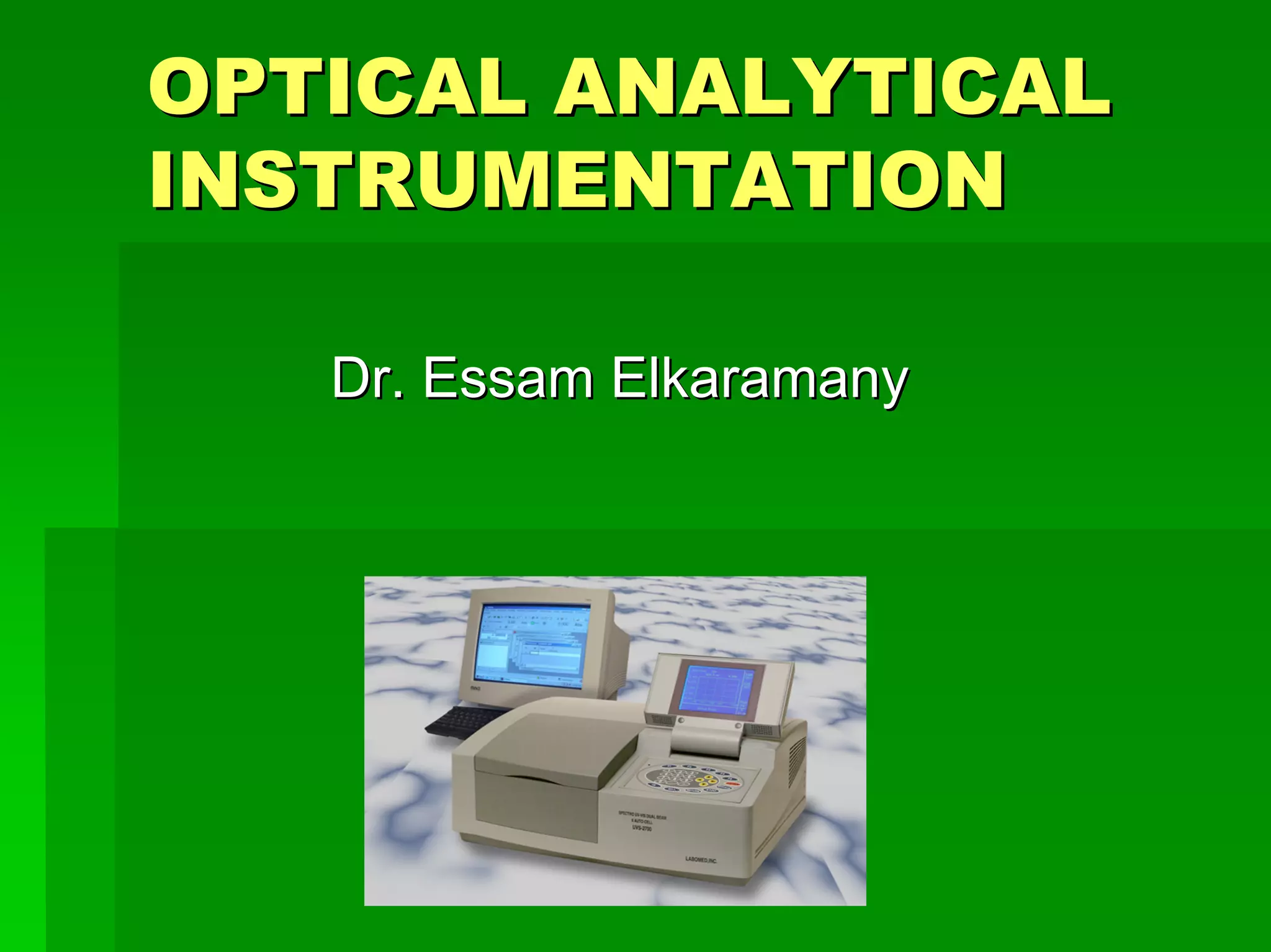
OPTICAL ANALYTICALOPTICAL ANALYTICAL
INSTRUMENTATIONINSTRUMENTATION
Dr. Essam ElkaramanyDr. Essam Elkaramany
Interaction of EM Radiation withInteraction of EM Radiation with
MediaMedia
Different Forms of Spectra:Different Forms of Spectra:
AbsorptionAbsorption –– EmissionEmission-- FluorescenceFluorescence
PolarizationPolarization
ScatteringScattering
Rayleigh TypeRayleigh Type
Tyndal TypeTyndal Type
A major class of analytical instruments isA major class of analytical instruments is
based on the interaction of radiation withbased on the interaction of radiation with
mattermatter
ExamplesExamples::
SpectrophotometersSpectrophotometers
UV and Vis.UV and Vis.
IRIR
RamanRaman
SpectrofluorometersSpectrofluorometers
PolarimeterPolarimeter
TurbidimeterTurbidimeter –– NephelometerNephelometer
LASERLASER
CHAPTER ONECHAPTER ONE
PROPERTIES OFPROPERTIES OF
ELECTROMAGNETIC RADIATIONELECTROMAGNETIC RADIATION
ANDAND MATTERMATTER
1.1 Nature of EM Radiation1.1 Nature of EM Radiation
EM RADIATIONEM RADIATION has double naturehas double nature
11-- WaveWave NatureNature
22-- QuantumQuantum (Particle)(Particle) NatureNature
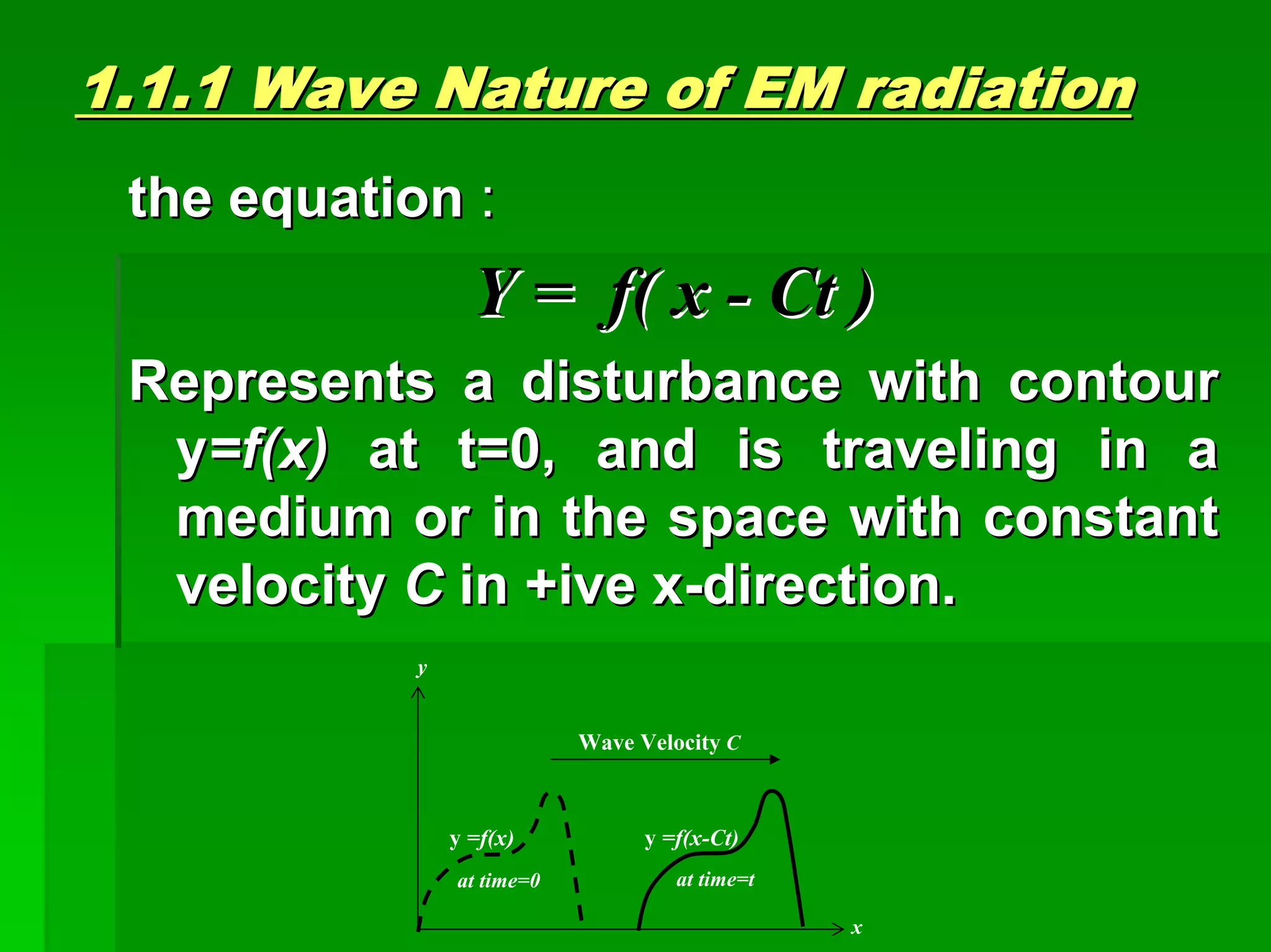
1.1.1 Wave1.1.1 Wave Nature ofNature of EM radiationEM radiation
the equationthe equation ::
Y = f( xY = f( x -- CtCt ))
Represents a disturbance with contourRepresents a disturbance with contour
yy=f(x)=f(x) at t=0, and is traveling in aat t=0, and is traveling in a
medium or in the space with constantmedium or in the space with constant
velocityvelocity CC in +ive xin +ive x--direction.direction.
Wave Velocity C
y =f(x)
y
x
at time=0 at time=t
y =f(x-Ct)
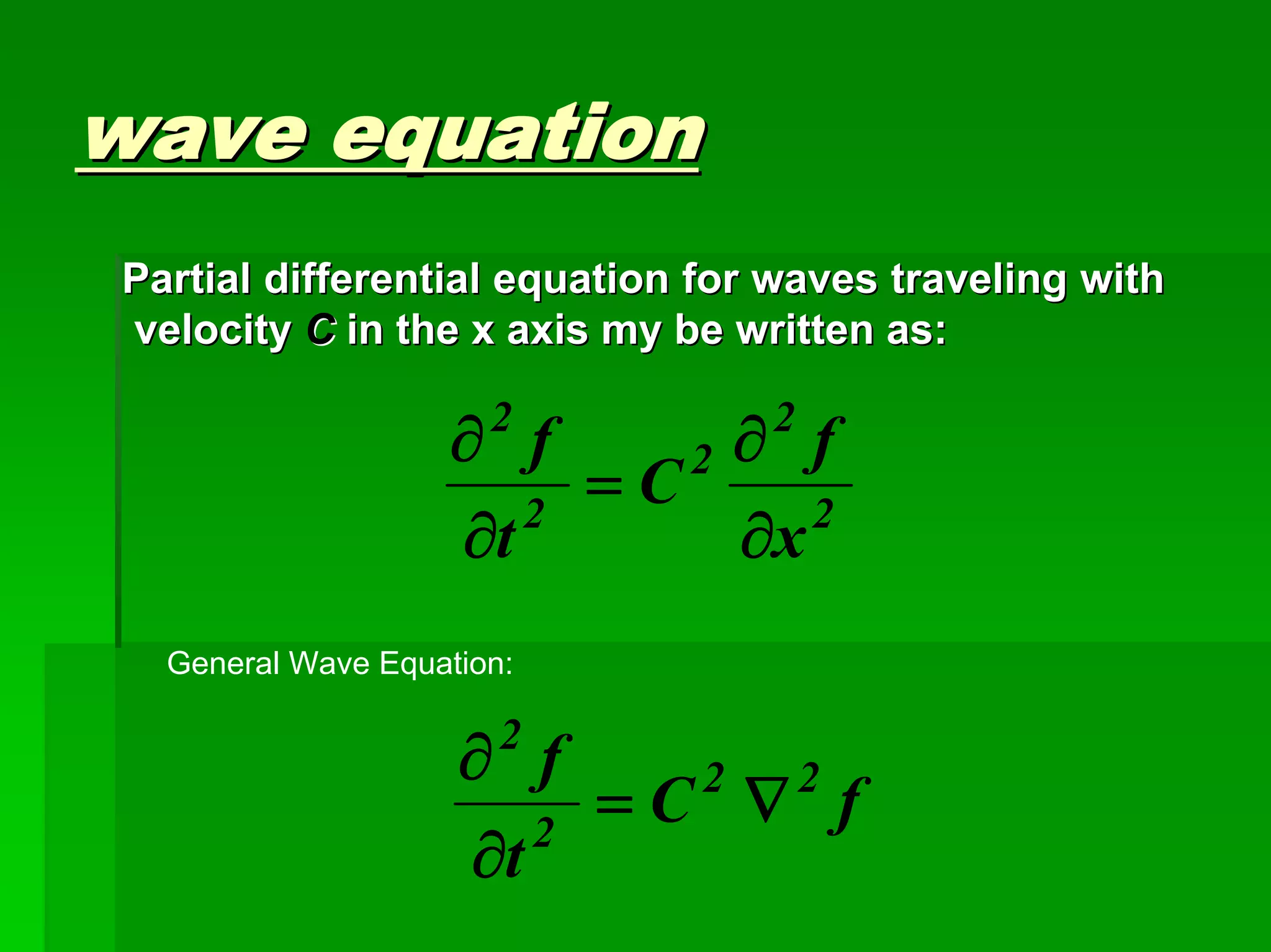
wave equationwave equation
2
2
2
2
2
x
f
C
t
f
∂
∂
=
∂
∂
Partial differential equation for waves traveling withPartial differential equation for waves traveling with
velocityvelocity CC in the x axis my be written as:in the x axis my be written as:
General Wave Equation:
fC
t
f 22
2
2
∇=
∂
∂
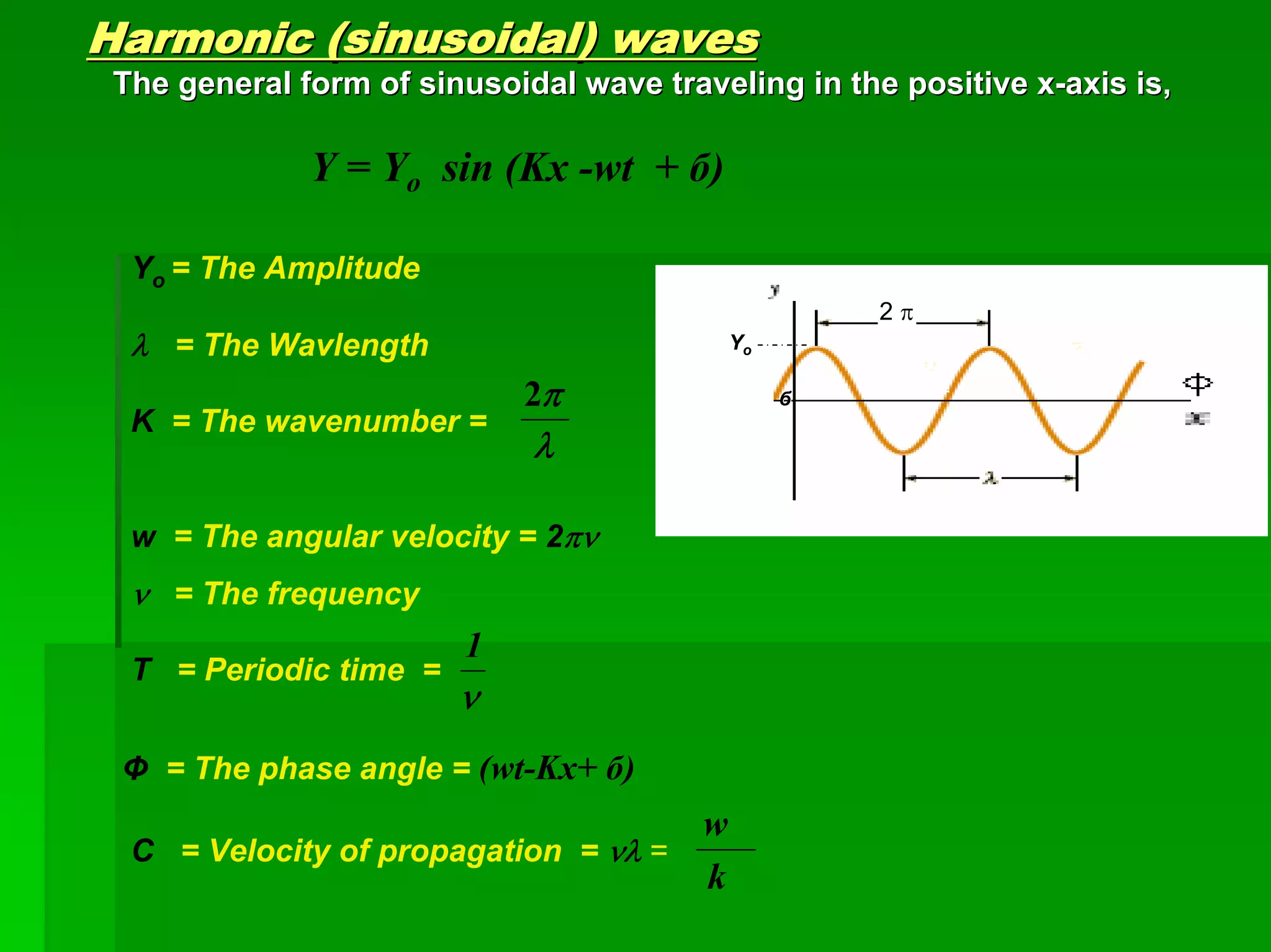
Harmonic (sinusoidal) wavesHarmonic (sinusoidal) waves
The general form of sinusoidal wave traveling in the positiveThe general form of sinusoidal wave traveling in the positive xx--axis is,axis is,
Y = Yo sin (Kx -wt + б)
Yo = The Amplitude
λ = The Wavlength
K = The wavenumber =
w = The angular velocity = 2πν
ν = The frequency
T = Periodic time =
Φ = The phase angle = (wt-Kx+ б)
C = Velocity of propagation = νλ =
2 π
Yo
бб
λ
π2
ν
1
k
w
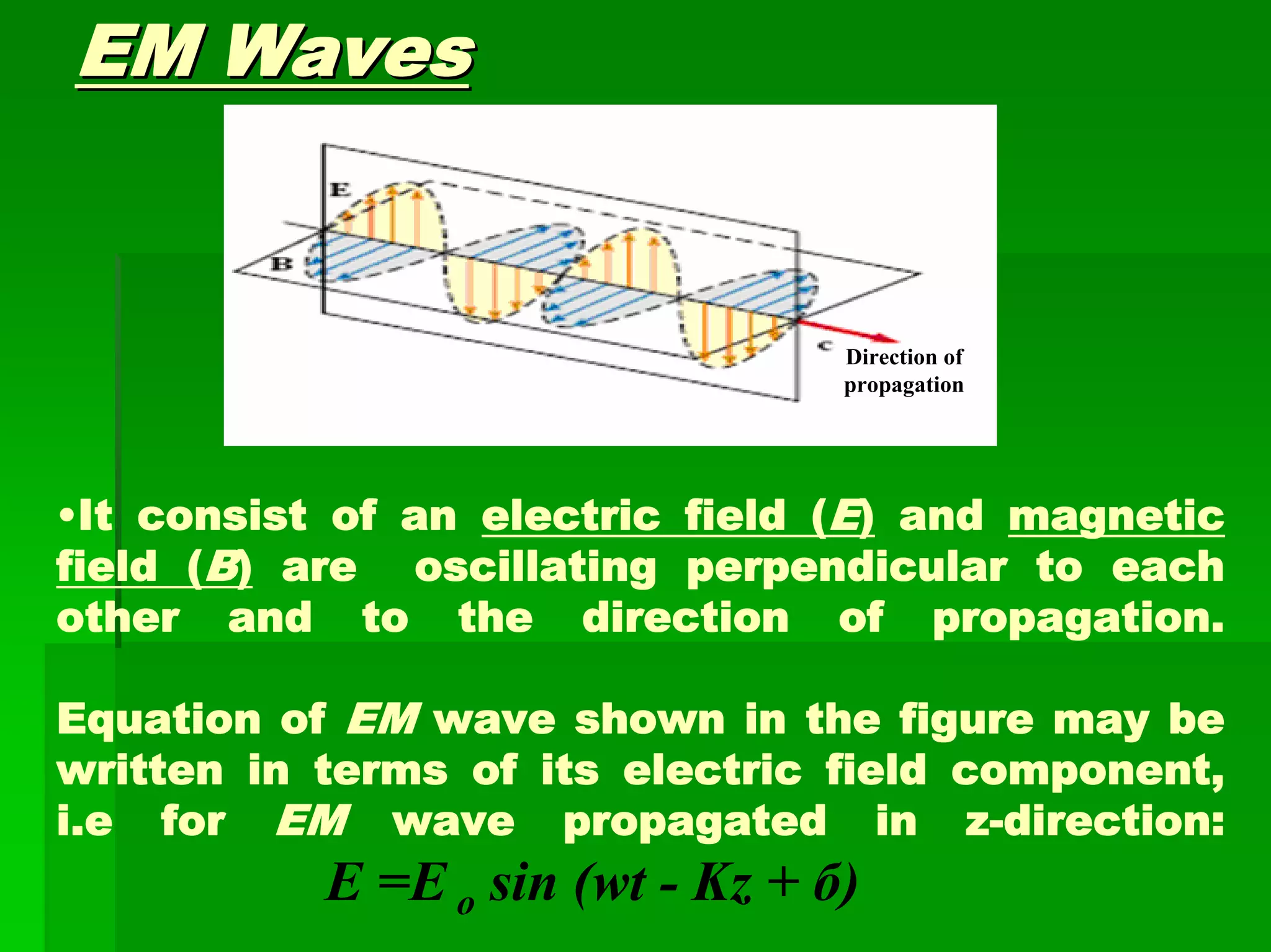
EM WavesEM Waves
Direction of
propagation
•It consist of an electric field (E) and magnetic
field (B) are oscillating perpendicular to each
other and to the direction of propagation.
Equation of EM wave shown in the figure may be
written in terms of its electric field component,
i.e for EM wave propagated in z-direction:
E =E o sin (wt - Kz + б)
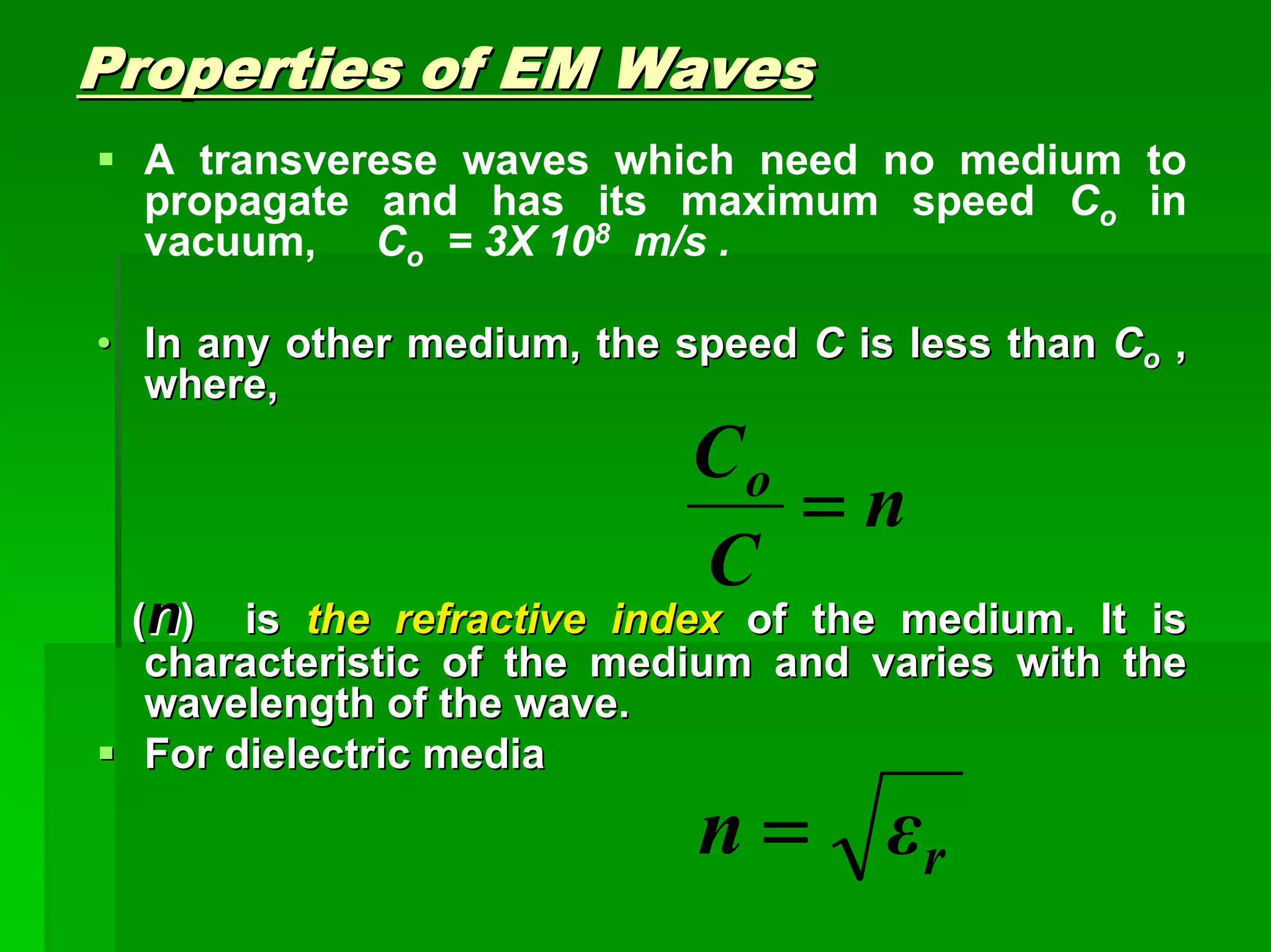
Properties of EM WavesProperties of EM Waves
A transverese waves which need no medium to
propagate and has its maximum speed Co in
vacuum, Co = 3X 10⁸ m/s .
•• In any other medium, the speedIn any other medium, the speed CC is less thanis less than CCoo ,,
where,where,
((nn) is) is the refractive indexthe refractive index of the medium. It isof the medium. It is
characteristic of the medium and varies with thecharacteristic of the medium and varies with the
wavelength of the wave.wavelength of the wave.
For dielectric mediaFor dielectric media
n
C
Co
=
rεn =
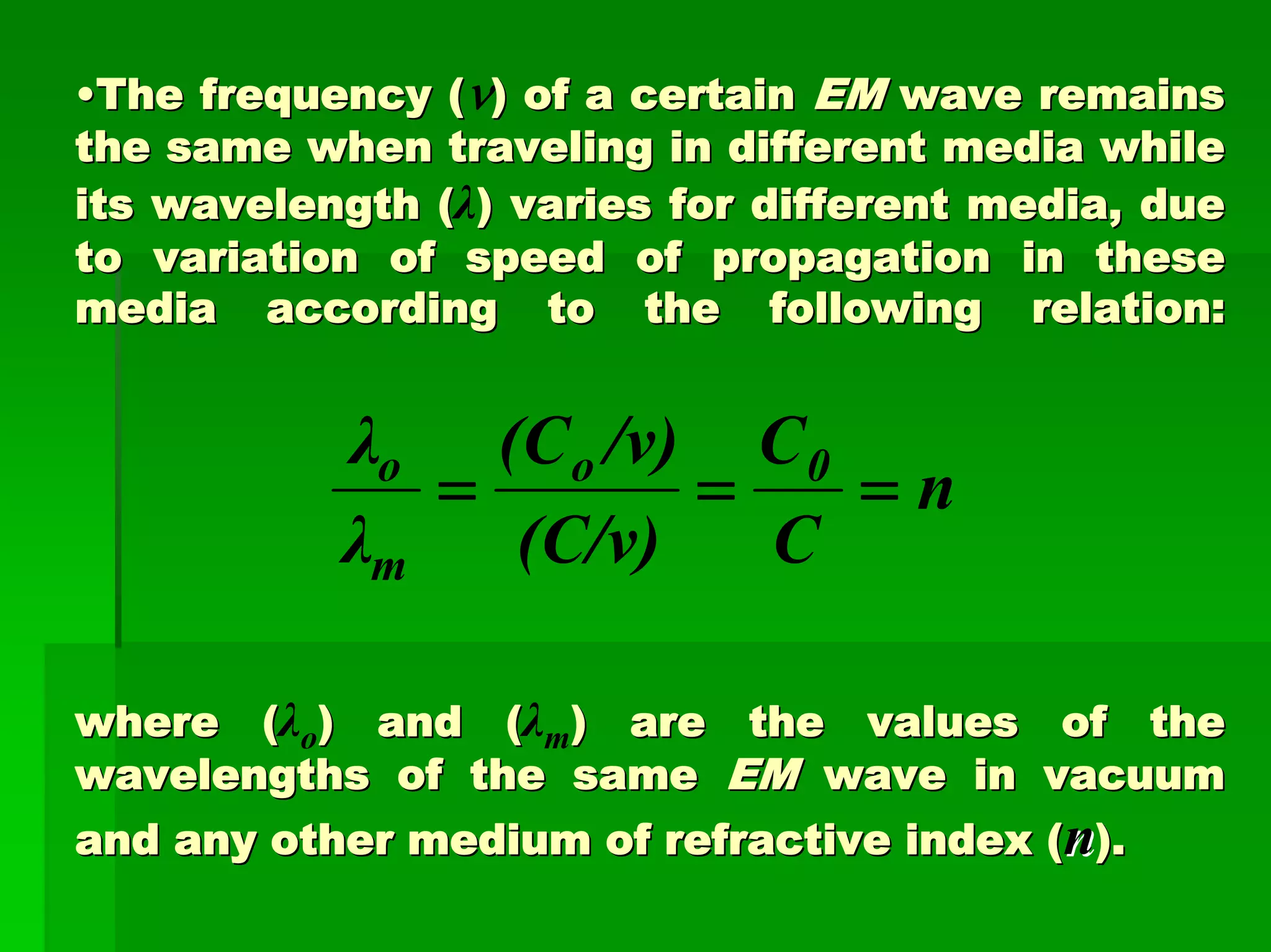
••The frequency (The frequency (ν) of a certain) of a certain EMEM wave remainswave remains
the same when traveling in different media whilethe same when traveling in different media while
its wavelength (its wavelength (λ) varies for different media, due) varies for different media, due
to variation of speed of propagation in theseto variation of speed of propagation in these
media according to the following relation:media according to the following relation:
where (where (λo) and () and (λm) are the values of the) are the values of the
wavelengths of the samewavelengths of the same EMEM wave in vacuumwave in vacuum
and any other medium of refractive index (and any other medium of refractive index (nn).).
n
C
C
(C/v)
/v)(C
λ
λ 0o
m
o
===
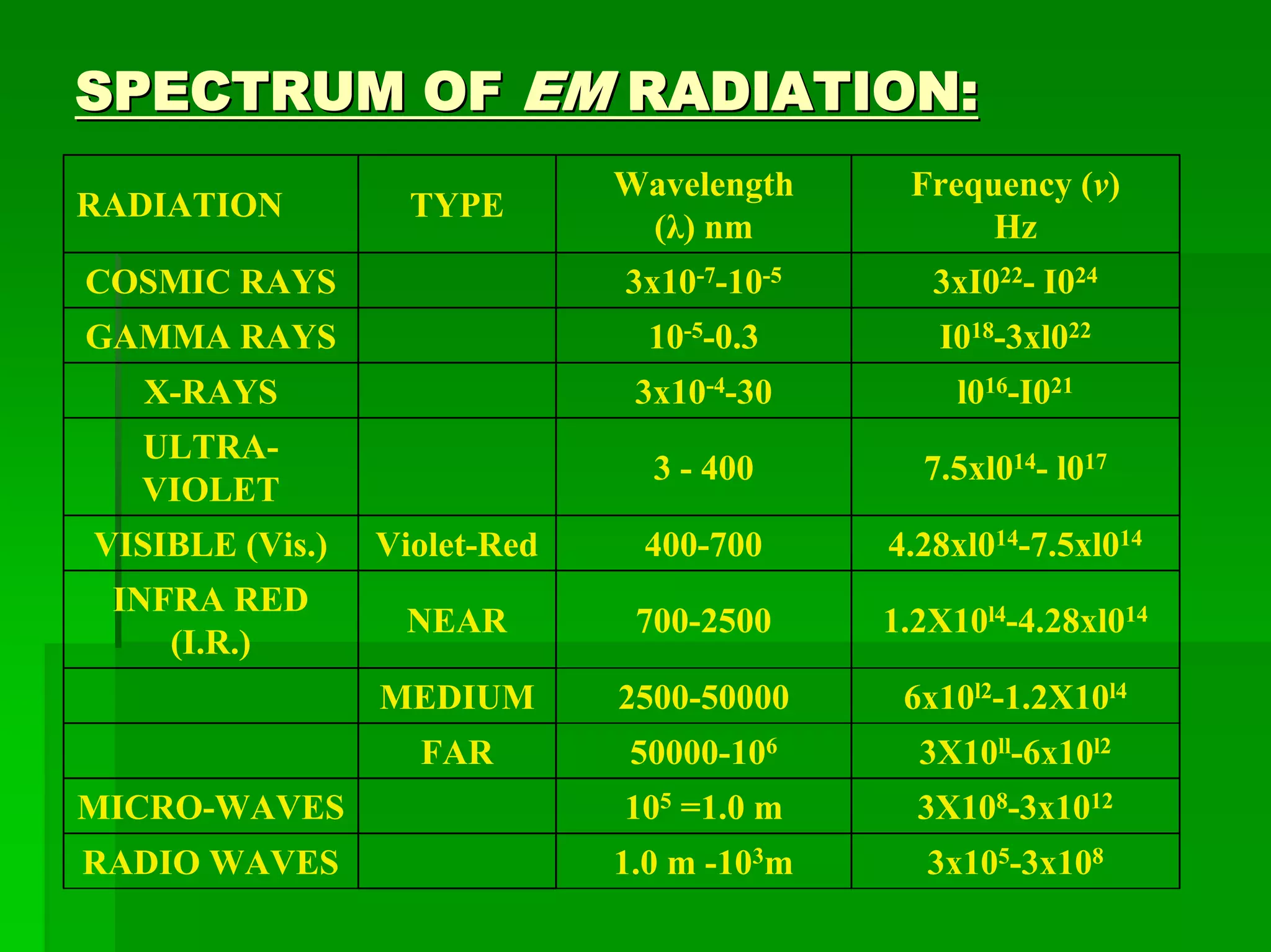
SPECTRUM OFSPECTRUM OF EMEM RADIATION:RADIATION:
RADIATION TYPE
Wavelength
(λ) nm
Frequency (v)
Hz
COSMIC RAYS 3x10⁻⁷-10-5 3xI022- I024
GAMMA RAYS 10-5-0.3 I018-3xl022
X-RAYS 3x10⁻⁴-30 l016-I021
ULTRA-
VIOLET
3 - 400 7.5xl014- l017
VISIBLE (Vis.) Violet-Red 400-700 4.28xl014-7.5xl014
INFRA RED
(I.R.)
NEAR 700-2500 1.2X10l4-4.28xl014
MEDIUM 2500-50000 6x10l2-1.2X10l4
FAR 50000-106 3X10ll-6x10l2
MICRO-WAVES 105 =1.0 m 3X10⁸-3x10¹²
RADIO WAVES 1.0 m -103m 3x10⁵-3x10⁸
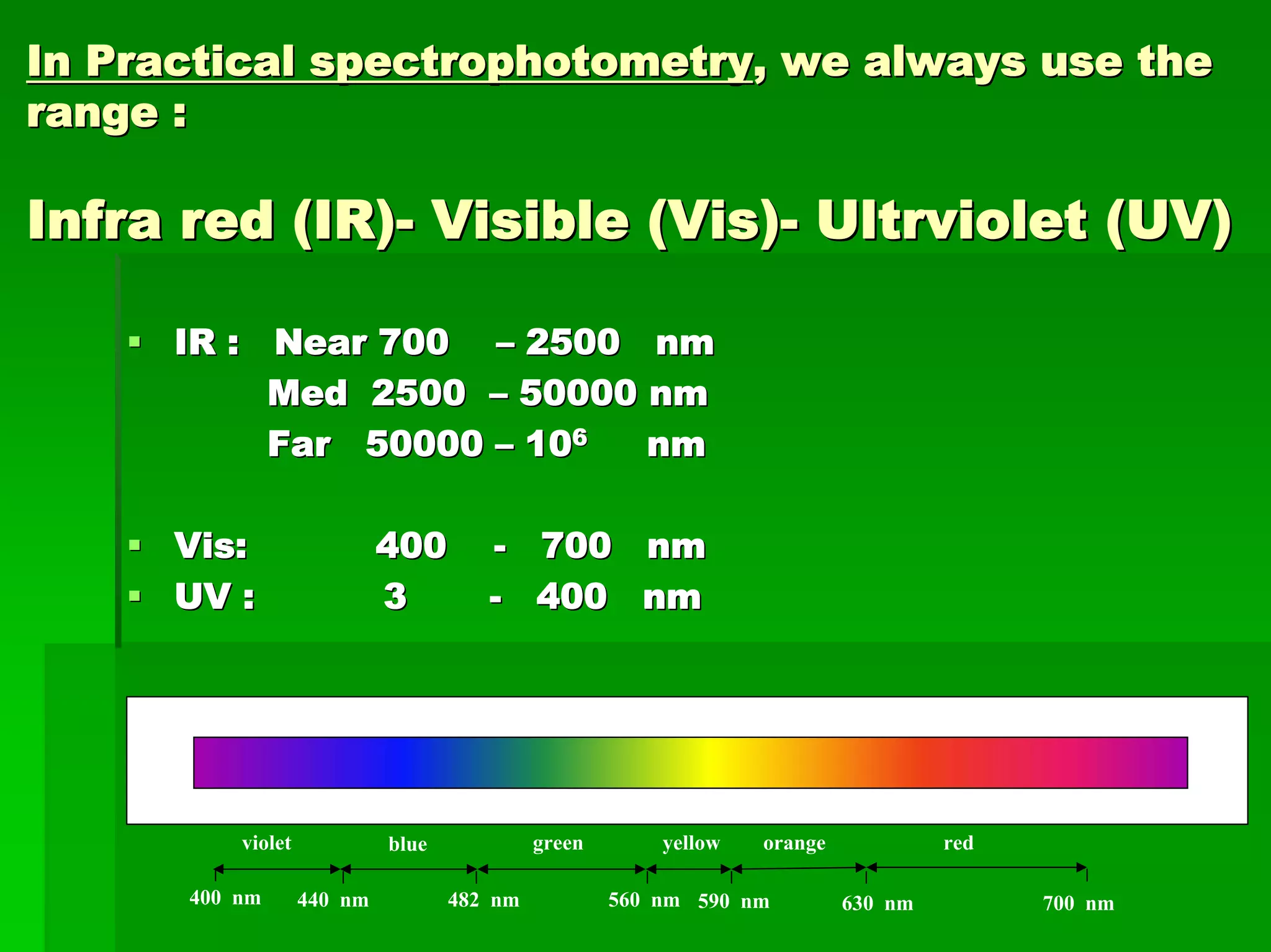
In PracticalIn Practical spectrophotometryspectrophotometry, we always use the, we always use the
range :range :
Infra red (IR)Infra red (IR)-- Visible (Vis)Visible (Vis)-- UltrvioletUltrviolet (UV)(UV)
IR : Near 700IR : Near 700 –– 2500 nm2500 nm
Med 2500Med 2500 –– 50000 nm50000 nm
Far 50000Far 50000 –– 101066
nmnm
Vis: 400Vis: 400 -- 700 nm700 nm
UV : 3UV : 3 -- 400 nm400 nm
700 nm630 nm590 nm560 nm482 nm440 nm400 nm
redorangeyellowgreenblueviolet
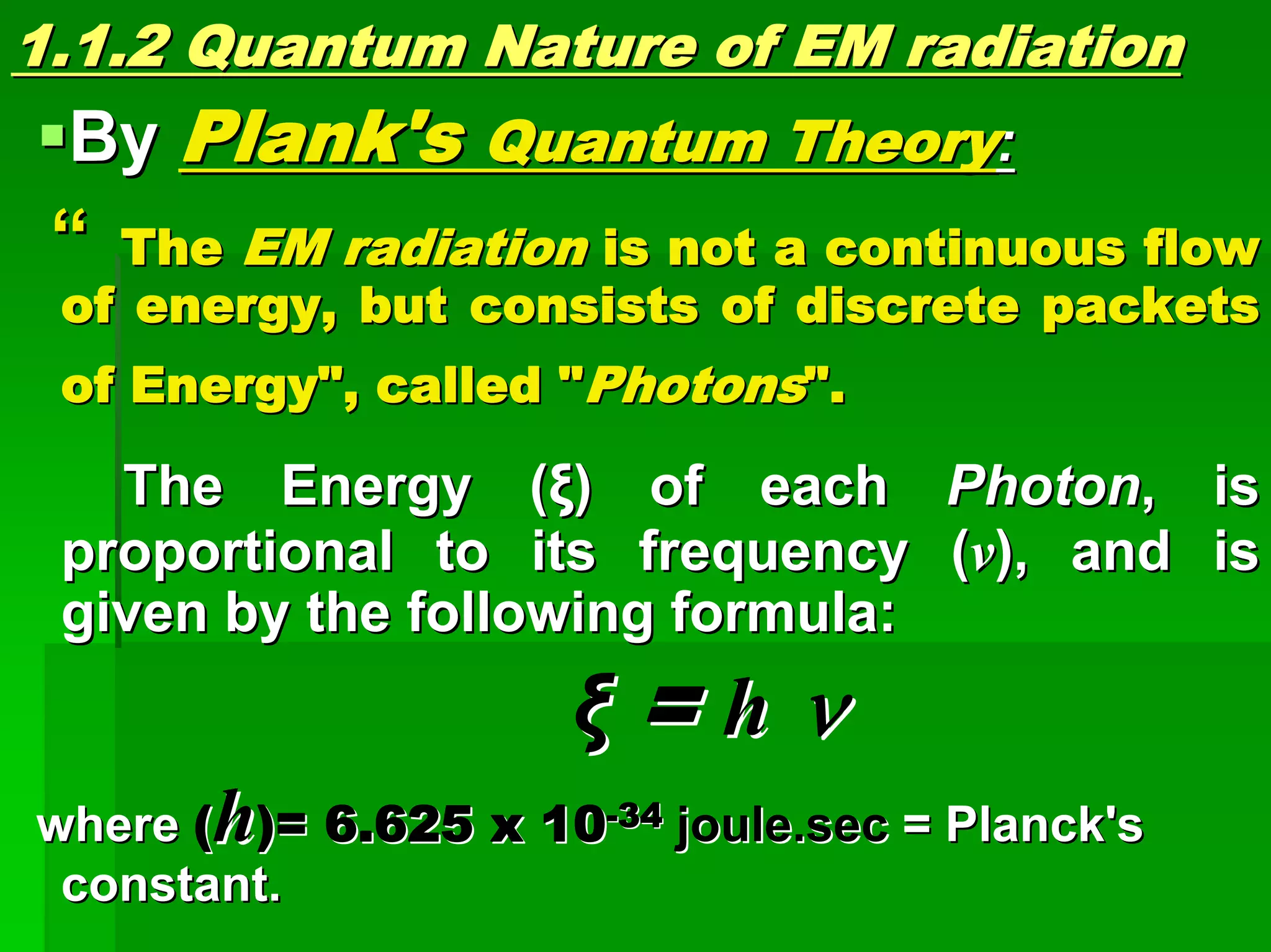
1.1.2 Quantum1.1.2 Quantum Nature ofNature of EM radiationEM radiation
ByBy Plank'sPlank's Quantum TheoryQuantum Theory::
““ TheThe EMEM radiationradiation is not a continuous flowis not a continuous flow
of energy, but consists of discrete packetsof energy, but consists of discrete packets
of Energy", called "of Energy", called "PhotonsPhotons".".
The Energy (The Energy (ξξ) of each) of each PhotonPhoton, is, is
proportional to its frequency (proportional to its frequency (vv), and is), and is
given by the following formula:given by the following formula:
ξξ == hh νν
wherewhere ((hh)=)= 6.625 x 106.625 x 10--3434 joule.secjoule.sec = Planck's= Planck's
constant.constant.
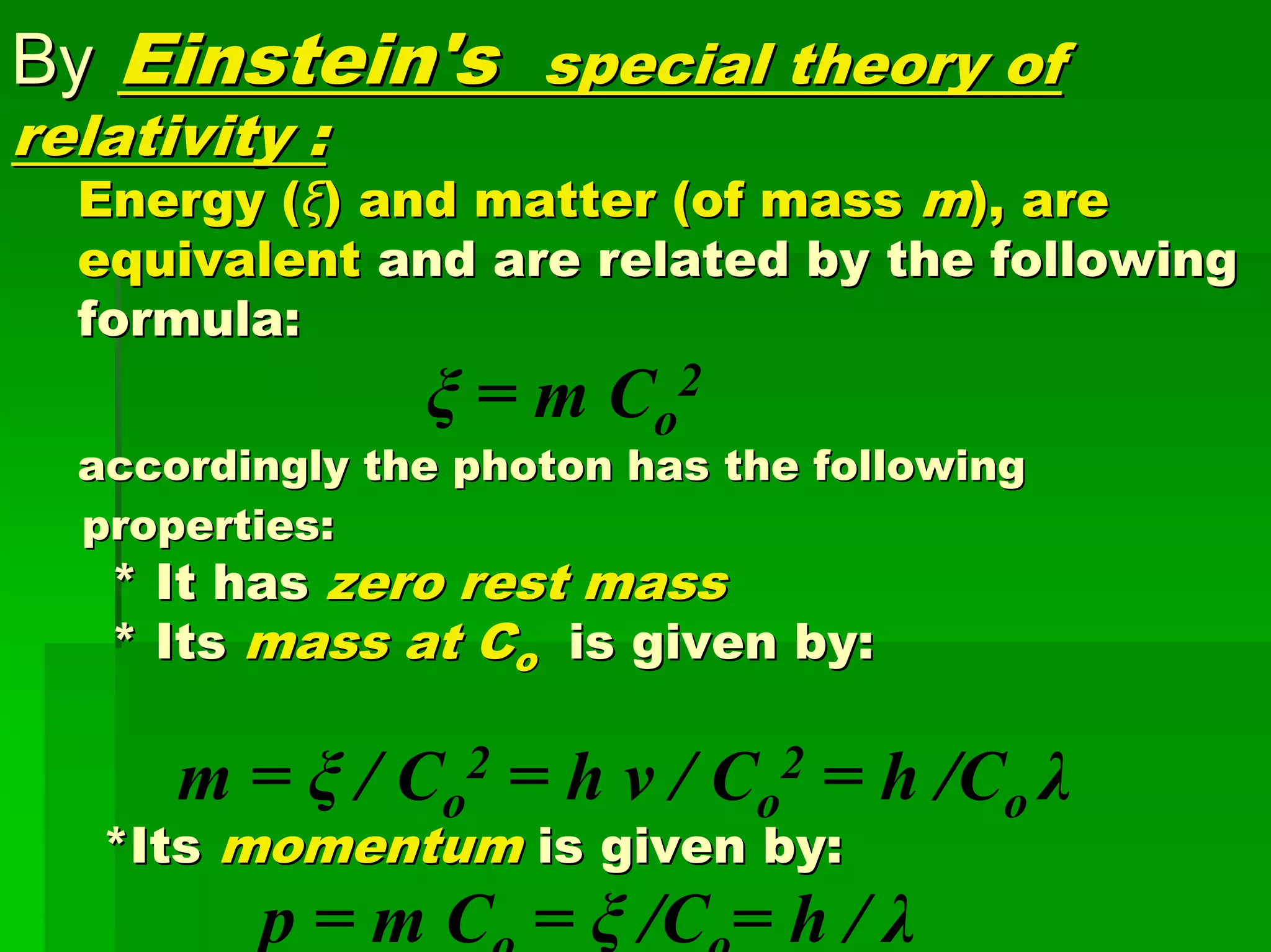
ByBy Einstein'sEinstein's special theory ofspecial theory of
relativity :relativity :
Energy (Energy (ξξ) and matter (of mass) and matter (of mass mm), are), are
equivalentequivalent and are related by the followingand are related by the following
formula:formula:
ξ = m Co
2
accordingly the photon has the followingaccordingly the photon has the following
properties:properties:
* It has* It has zero rest masszero rest mass
* Its* Its mass at Cmass at Coo is given by:is given by:
m = ξ / Co
2 = h v / Co
2 = h /Co λ
*Its*Its momentummomentum is given by:is given by:
p = m Co = ξ /Co= h / λ
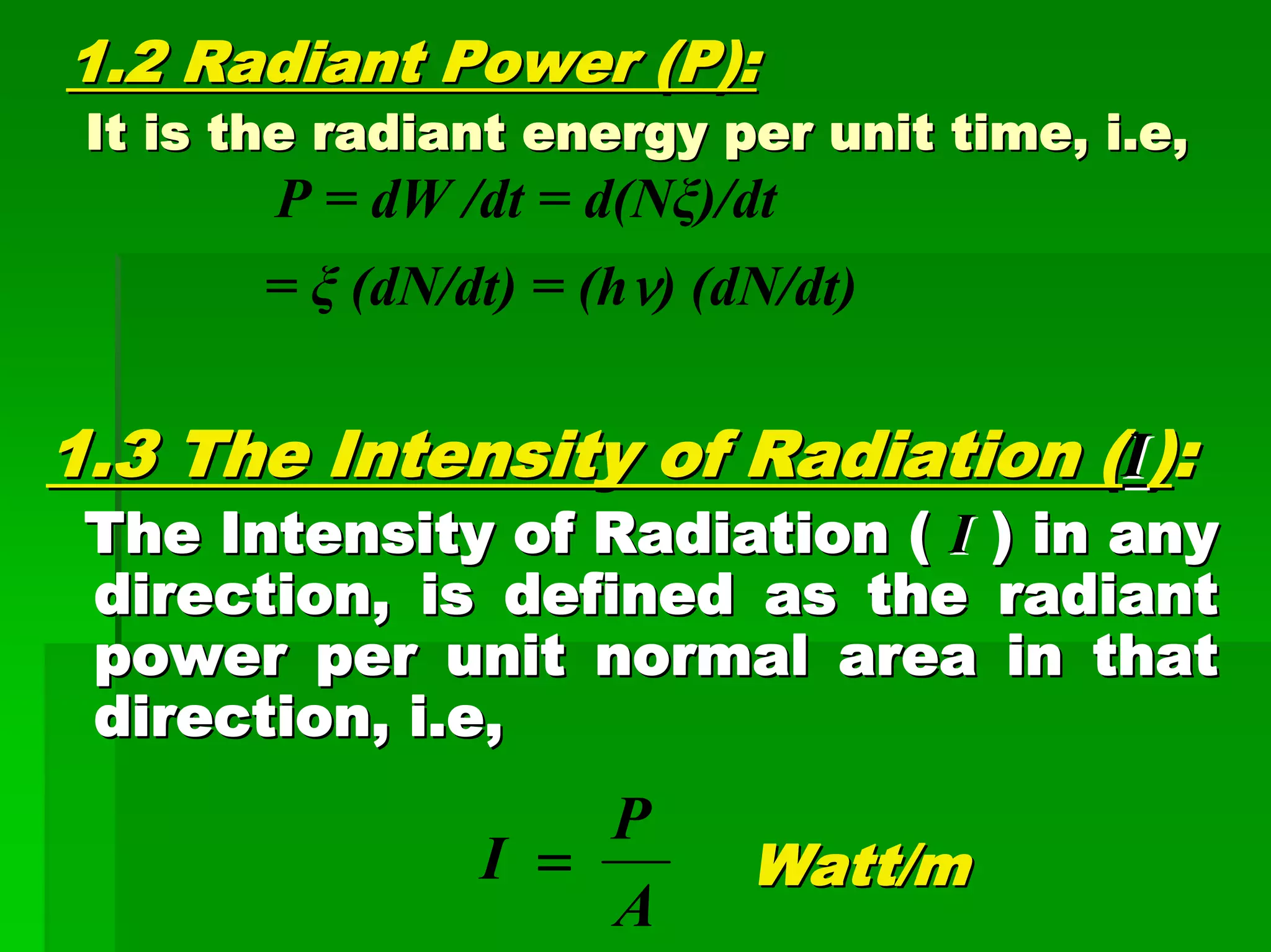
1.2 Radiant Power (P):1.2 Radiant Power (P):
It is the radiant energy per unit time, i.e,It is the radiant energy per unit time, i.e,
P = dW /dt = d(Nξ)/dt
= ξ (dN/dt) = (hν) (dN/dt)
1.3 The Intensity of Radiation (1.3 The Intensity of Radiation (II))::
The Intensity of Radiation (The Intensity of Radiation ( II ) in any) in any
direction, is defined as the radiantdirection, is defined as the radiant
power per unit normal area in thatpower per unit normal area in that
direction, i.e,direction, i.e,
Watt/mWatt/m
A
P
I =
1.4 SOURCES OF RADIATION:1.4 SOURCES OF RADIATION:
1.4.1 Sources of1.4.1 Sources of Continuous SpectrumContinuous Spectrum ::
11--Black Body (B.B.)Black Body (B.B.)
22--Tungsten LampTungsten Lamp
33-- Gas Filled Electric Discharge LampGas Filled Electric Discharge Lamp
** High Pressure Xenon lampHigh Pressure Xenon lamp
* High pressure Mercury vapor Lamp* High pressure Mercury vapor Lamp
* High pressure Sodium vapor Lamp* High pressure Sodium vapor Lamp
* Fluorescent Lamp* Fluorescent Lamp
1.4.2 Sources of1.4.2 Sources of Discontinuous SpectrumDiscontinuous Spectrum ::
11-- Gas Filled Electric Discharge LampGas Filled Electric Discharge Lamp
* Low pressure Mercury vapor Lamp* Low pressure Mercury vapor Lamp
* Low pressure Sodium vapor Lamp* Low pressure Sodium vapor Lamp
* Neon lamp* Neon lamp
22-- Hydrogen or Deuterium lampHydrogen or Deuterium lamp
33-- LEDLED
44-- LASER sourcesLASER sources
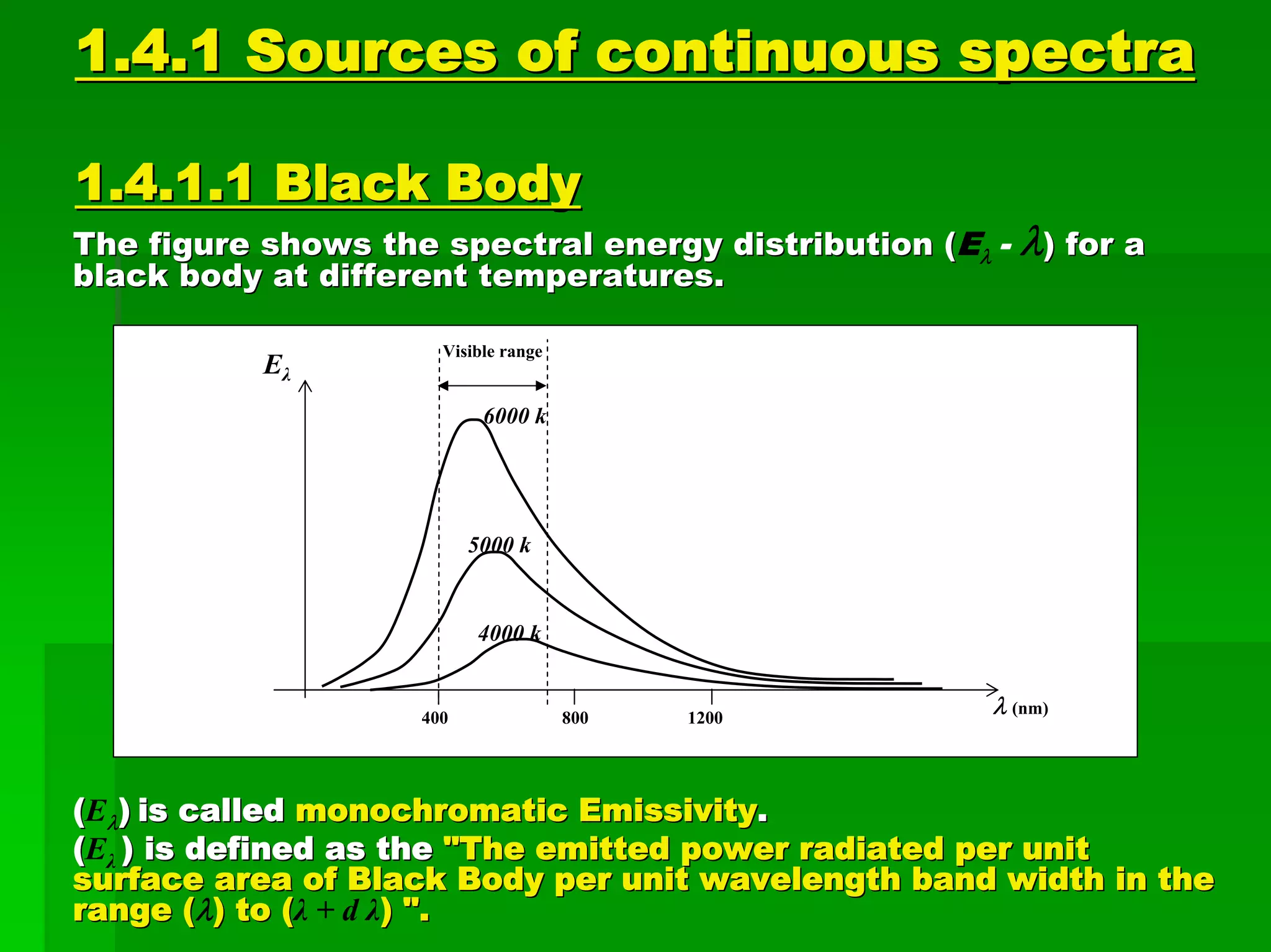
1.4.1 Sources of continuous spectra1.4.1 Sources of continuous spectra
1.4.1.1 Black Body1.4.1.1 Black Body
The figure shows the spectral energy distribution (The figure shows the spectral energy distribution (Eλ - λ) for a) for a
black body at different temperatures.black body at different temperatures.
((Eλ)) is calledis called monochromatic Emissivitymonochromatic Emissivity..
((Eλ ) is defined as the) is defined as the "The emitted power radiated per unit"The emitted power radiated per unit
surface area of Black Body per unit wavelength band width in thesurface area of Black Body per unit wavelength band width in the
range (range (λ) to () to (λ + d λ) ".) ".
λ (nm)
Eλ
6000 k
5000 k
4000 k
400 800 1200
Visible range
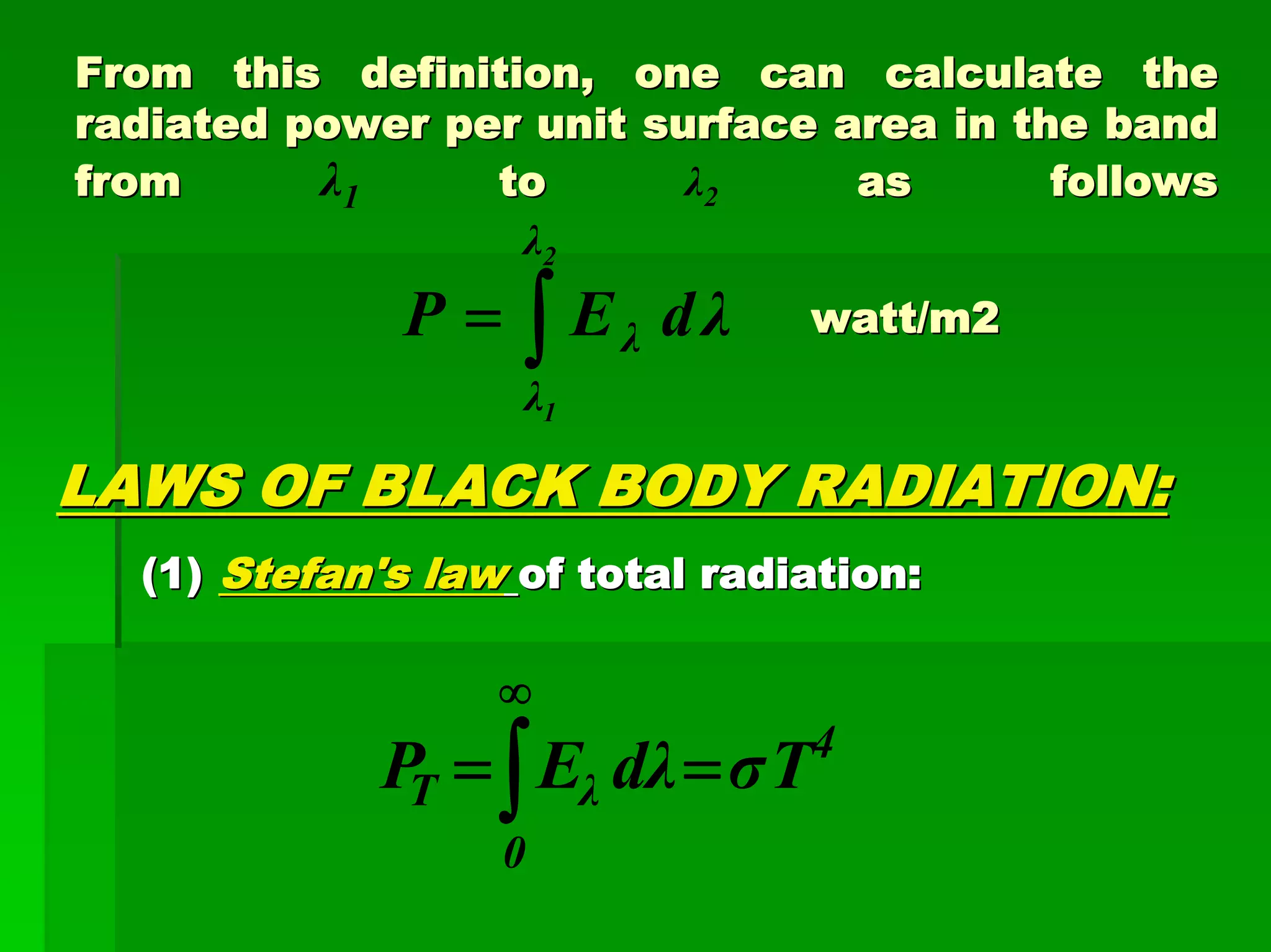
From this definition, one can calculate theFrom this definition, one can calculate the
radiated power per unit surface area in the bandradiated power per unit surface area in the band
fromfrom λ1 toto λ2 as followsas follows
watt/m2watt/m2
LAWS OF BLACK BODY RADIATION:LAWS OF BLACK BODY RADIATION:
(1)(1) Stefan's lawStefan's law of total radiation:of total radiation:
λdEP
2
1
λ
λ
λ∫=
4
0
λT TσλdEP ==∫
∞
(2)(2) Wien'sWien's Displacement LawDisplacement Law::
λmax T = Constant = 2.93 x 10⁻³ m.oK
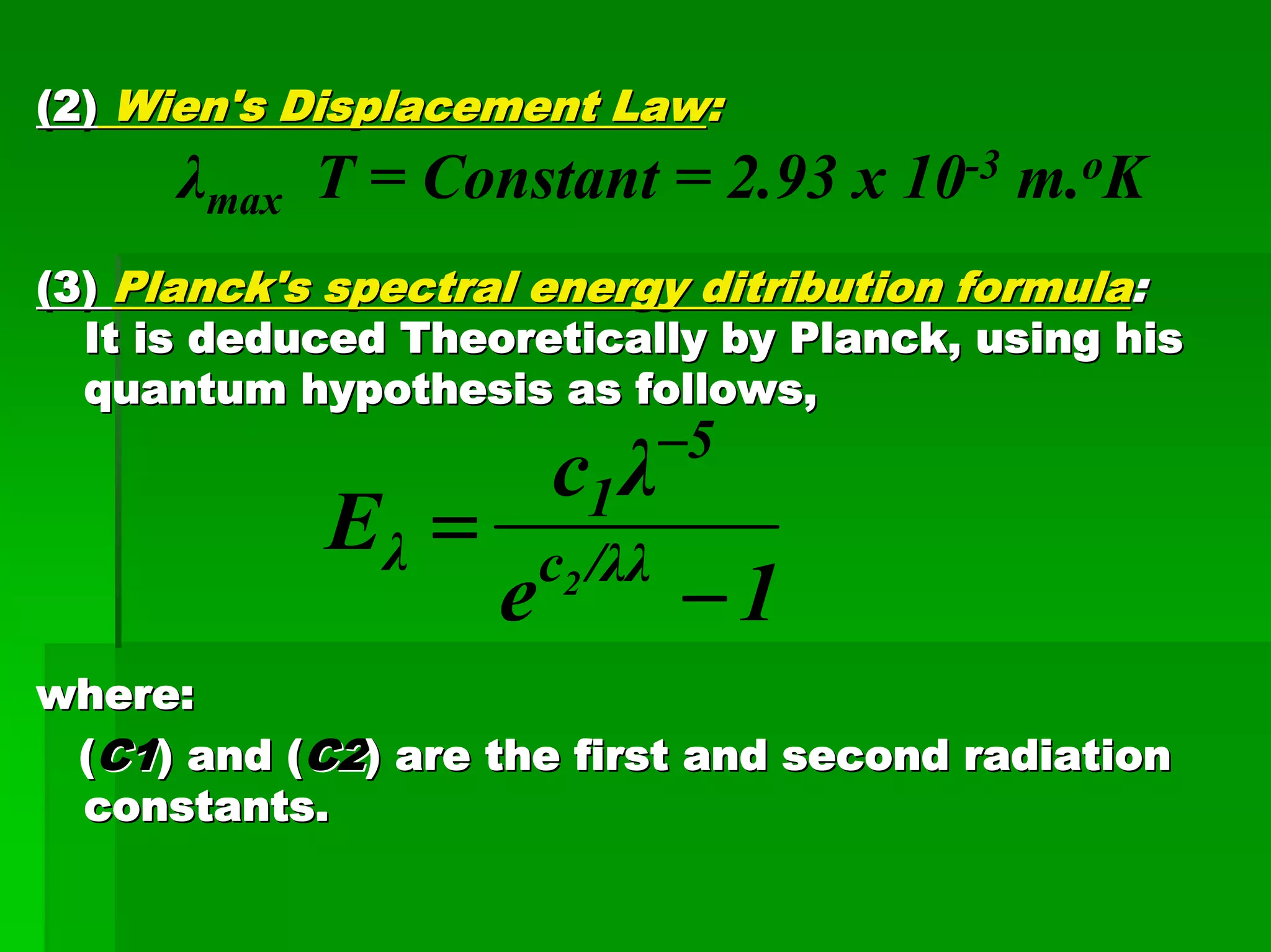
(3)(3) Planck's spectral energyPlanck's spectral energy ditributionditribution formulaformula::
It is deduced Theoretically by Planck, using hisIt is deduced Theoretically by Planck, using his
quantum hypothesisquantum hypothesis as follows,as follows,
where:where:
((C1C1) and () and (C2C2) are the first and second radiation) are the first and second radiation
constants.constants.
1e
λc
E /λλc
5
1
λ 2
−
=
−
1.4.1.2 Tungsten Lamp:1.4.1.2 Tungsten Lamp:
ItIt IIs ans an incandescent lamp typeincandescent lamp type giving, when heated, radiationgiving, when heated, radiation
of continuous spectrum ranging betweenof continuous spectrum ranging between 320 to 3500 nm i.e.i.e.
consisting mainly ofconsisting mainly of VIS andand NEAR IR spectral regions.spectral regions.
It can be considered as aIt can be considered as a Gray body.Gray body.
i.e. may be approximated by black body radiation.i.e. may be approximated by black body radiation.
1.4.1.3 High pressure gas discharge Lamp:1.4.1.3 High pressure gas discharge Lamp:
Xenon lampXenon lamp
ItIt gives, when excited by suitable potential differencegives, when excited by suitable potential difference
between its electrodes, radiation of continuous spectrumbetween its electrodes, radiation of continuous spectrum
ranging betweenranging between 250 to 1000 nm i.e. consisting ofi.e. consisting of UV, VIS
andand NEAR IR spectral regions.spectral regions.
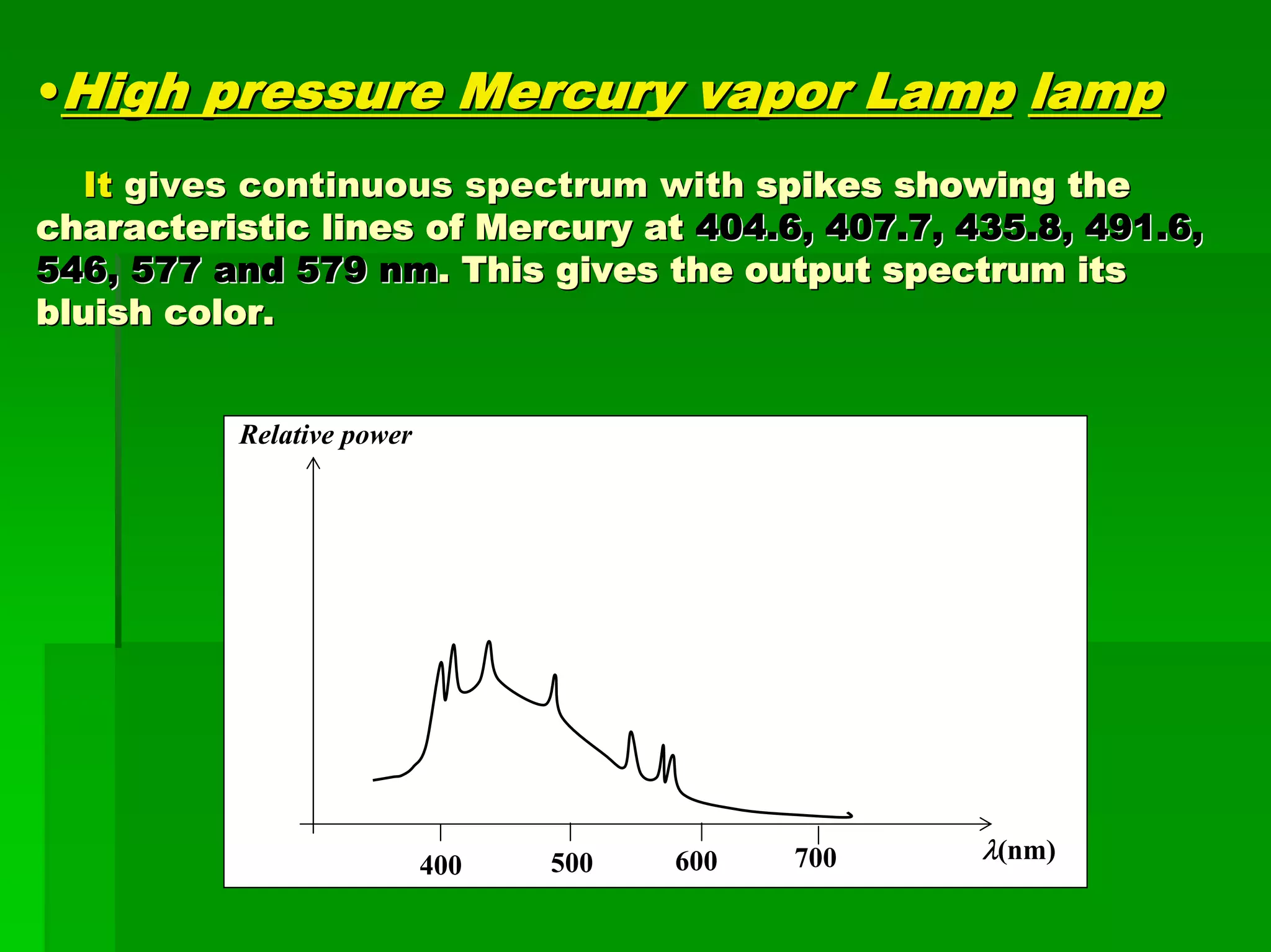
••High pressure Mercury vapor LampHigh pressure Mercury vapor Lamp lamplamp
ItIt gives continuous spectrum withgives continuous spectrum with spikes showing thespikes showing the
characteristic lines of Mercury atcharacteristic lines of Mercury at 404.6, 407.7, 435.8, 491.6,404.6, 407.7, 435.8, 491.6,
546, 577 and 579 nm546, 577 and 579 nm. This gives the output spectrum its. This gives the output spectrum its
bluish color.bluish color.
λ(nm)
Relative power
500400 600 700
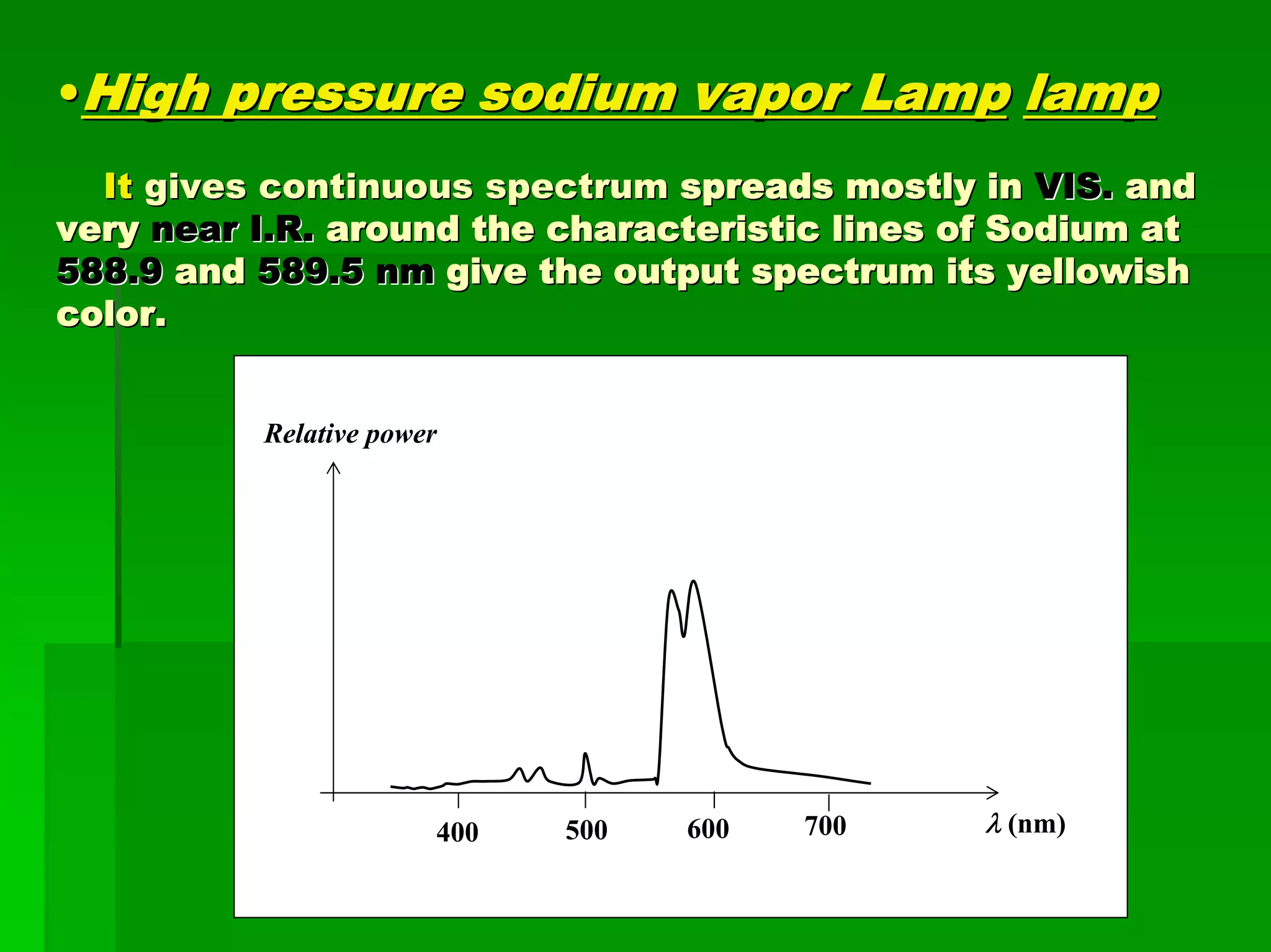
••High pressure sodium vapor LampHigh pressure sodium vapor Lamp lamplamp
ItIt gives continuous spectrumgives continuous spectrum spreads mostly inspreads mostly in VIS.VIS. andand
veryvery near I.R.near I.R. around the characteristic lines of Sodium ataround the characteristic lines of Sodium at
588.9588.9 andand 589.5 nm589.5 nm give the output spectrum its yellowishgive the output spectrum its yellowish
color.color.
λ (nm)
Relative power
500400 600 700
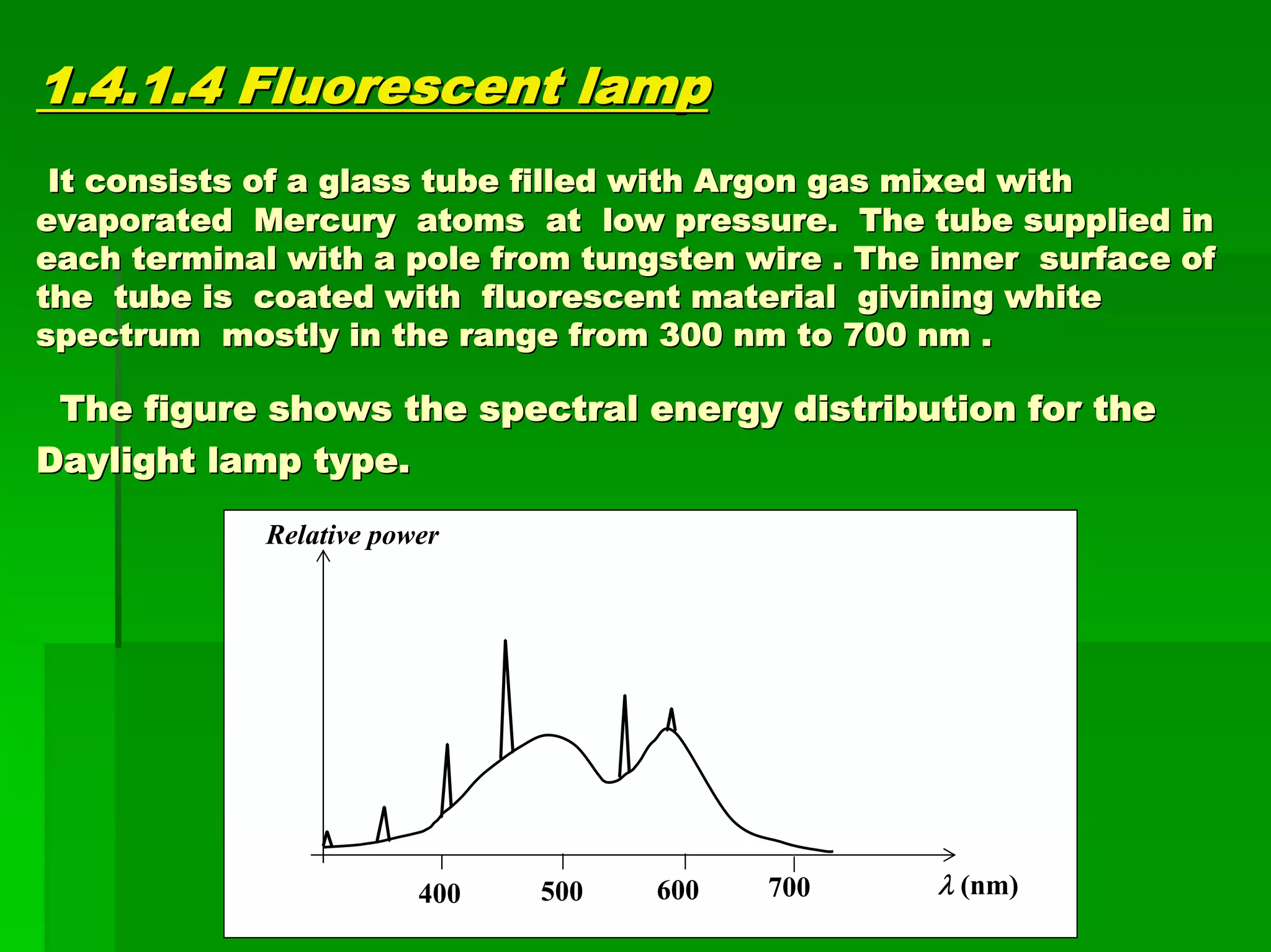
1.4.1.4 Fluorescent lamp1.4.1.4 Fluorescent lamp
It consists of a glass tube filled with Argon gas mixed withIt consists of a glass tube filled with Argon gas mixed with
evaporated Mercury atoms at low pressure. The tube suppliedevaporated Mercury atoms at low pressure. The tube supplied inin
each terminal with a pole from tungsten wire . The inner surfaceach terminal with a pole from tungsten wire . The inner surface ofe of
the tube is coated with fluorescent materialthe tube is coated with fluorescent material givininggivining whitewhite
spectrum mostly in the range from 300 nm to 700 nm .spectrum mostly in the range from 300 nm to 700 nm .
The figure shows the spectral energy distribution for theThe figure shows the spectral energy distribution for the
Daylight lamp type.Daylight lamp type.
λ (nm)
Relative power
500400 600 700
1.4.2 Sources of1.4.2 Sources of Discontinuous SpectrumDiscontinuous Spectrum ::
1.4.2.11.4.2.1 Low Pressure Gas Filled ElectricLow Pressure Gas Filled Electric
Discharge LampDischarge Lamp::
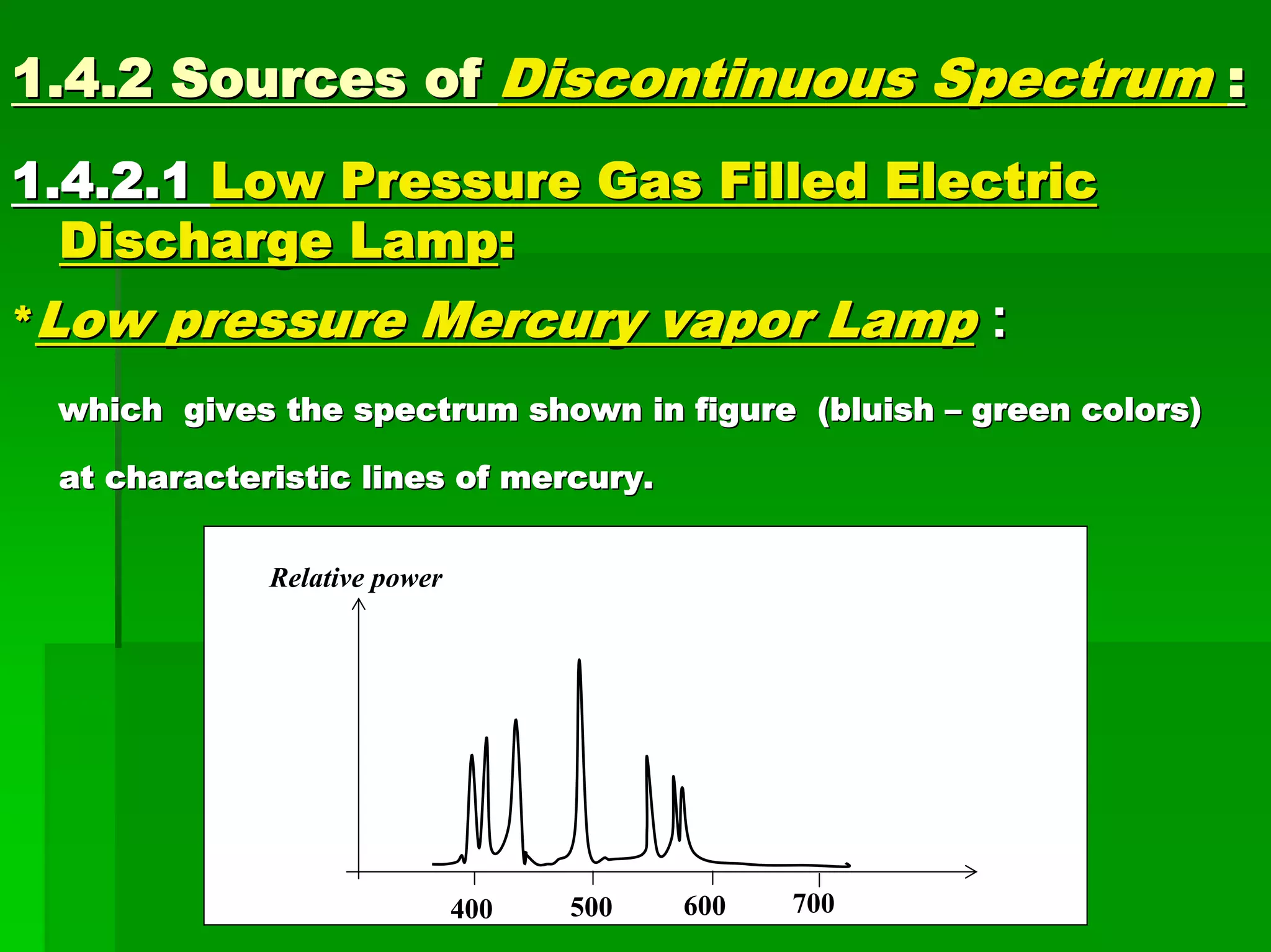
**Low pressure Mercury vapor LampLow pressure Mercury vapor Lamp ::
which gives the spectrum shown in figure (bluishwhich gives the spectrum shown in figure (bluish –– green colors)green colors)
at characteristic lines of mercury.at characteristic lines of mercury.
λ (nm)
Relative power
500400 600 700
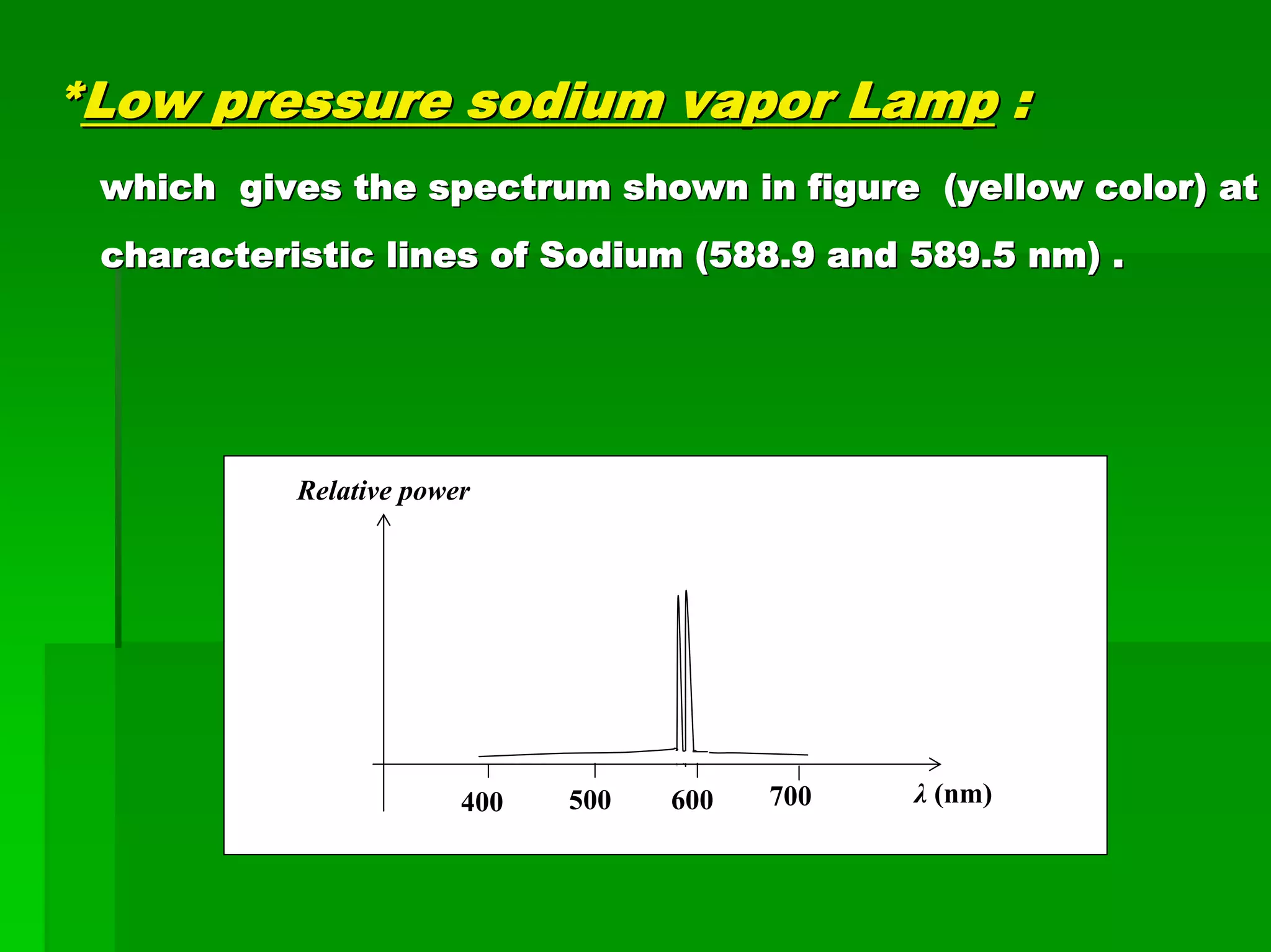
**Low pressure sodium vapor LampLow pressure sodium vapor Lamp ::
which gives the spectrum shown in figure (yellow color) atwhich gives the spectrum shown in figure (yellow color) at
characteristic lines of Sodium (588.9 and 589.5 nm)characteristic lines of Sodium (588.9 and 589.5 nm) ..
λ (nm)
Relative power
500400 600 700
**Neon lamp:Neon lamp:
gives characteristic line at 633 nm .gives characteristic line at 633 nm .
**Hydrogen or Deuterium lampHydrogen or Deuterium lamp::
It is used as a source of U.V. radiation (160 to 365 nm )It is used as a source of U.V. radiation (160 to 365 nm )
in the instruments of the spectral analysis due to itsin the instruments of the spectral analysis due to its
high intensity and its long live.high intensity and its long live.
1.4.2.2 LED1.4.2.2 LED
which is awhich is a PP--N junctionN junction
Silicon LED (1100 nm at near IR)Silicon LED (1100 nm at near IR)
GalliumGallium--Arsenide LED (Ga As) (900 nm at near I.R.)Arsenide LED (Ga As) (900 nm at near I.R.)
GalliumGallium--Phosphorus LED (700 nm)Phosphorus LED (700 nm)
GalliumGallium——Arsenide with phosphor coating (green 540 nm)Arsenide with phosphor coating (green 540 nm)
1.4.2.3 LASER sources1.4.2.3 LASER sources
which are highly monochromatic, collimated and coherentwhich are highly monochromatic, collimated and coherent
sources.sources.
Examples of LASER sources are:Examples of LASER sources are:
Ruby LASER (693 nm).Ruby LASER (693 nm).
Argon LASER (515 nm).Argon LASER (515 nm).
HeliumHelium--Neon LASER (633 nm ).Neon LASER (633 nm ).
COCO22 LASER (Gaseous LASER) (10600 nm).LASER (Gaseous LASER) (10600 nm).
1.7 METHODS OF1.7 METHODS OF
EXCITATION OF MATIER:EXCITATION OF MATIER:
(1)(1) Thermal excitationThermal excitation : by absorbing heat: by absorbing heat
energy.energy.
(2)(2) Electrical excitationElectrical excitation : by applying potential: by applying potential
difference or a strong electric field.difference or a strong electric field.
(3) Excitation by(3) Excitation by Electron BombardmentElectron Bombardment : a beam: a beam
of accelerated electrons is applied to atomsof accelerated electrons is applied to atoms
of matter to gain kinetic energy.of matter to gain kinetic energy.
(4) Excitation by(4) Excitation by IrradiationIrradiation : with a beam of: with a beam of
radiation of continuous spectrum from anradiation of continuous spectrum from an
external Sourceexternal Source

Lec (1 2-3) ch one- optical analytical instrumentation

  • 1.
  • 2.
    Interaction of EMRadiation withInteraction of EM Radiation with MediaMedia Different Forms of Spectra:Different Forms of Spectra: AbsorptionAbsorption –– EmissionEmission-- FluorescenceFluorescence PolarizationPolarization ScatteringScattering Rayleigh TypeRayleigh Type Tyndal TypeTyndal Type A major class of analytical instruments isA major class of analytical instruments is based on the interaction of radiation withbased on the interaction of radiation with mattermatter
  • 3.
    ExamplesExamples:: SpectrophotometersSpectrophotometers UV and Vis.UVand Vis. IRIR RamanRaman SpectrofluorometersSpectrofluorometers PolarimeterPolarimeter TurbidimeterTurbidimeter –– NephelometerNephelometer LASERLASER
  • 4.
    CHAPTER ONECHAPTER ONE PROPERTIESOFPROPERTIES OF ELECTROMAGNETIC RADIATIONELECTROMAGNETIC RADIATION ANDAND MATTERMATTER
  • 5.
    1.1 Nature ofEM Radiation1.1 Nature of EM Radiation EM RADIATIONEM RADIATION has double naturehas double nature 11-- WaveWave NatureNature 22-- QuantumQuantum (Particle)(Particle) NatureNature
  • 6.
    1.1.1 Wave1.1.1 WaveNature ofNature of EM radiationEM radiation the equationthe equation :: Y = f( xY = f( x -- CtCt )) Represents a disturbance with contourRepresents a disturbance with contour yy=f(x)=f(x) at t=0, and is traveling in aat t=0, and is traveling in a medium or in the space with constantmedium or in the space with constant velocityvelocity CC in +ive xin +ive x--direction.direction. Wave Velocity C y =f(x) y x at time=0 at time=t y =f(x-Ct)
  • 7.
    wave equationwave equation 2 2 2 2 2 x f C t f ∂ ∂ = ∂ ∂ Partialdifferential equation for waves traveling withPartial differential equation for waves traveling with velocityvelocity CC in the x axis my be written as:in the x axis my be written as: General Wave Equation: fC t f 22 2 2 ∇= ∂ ∂
  • 8.
    Harmonic (sinusoidal) wavesHarmonic(sinusoidal) waves The general form of sinusoidal wave traveling in the positiveThe general form of sinusoidal wave traveling in the positive xx--axis is,axis is, Y = Yo sin (Kx -wt + б) Yo = The Amplitude λ = The Wavlength K = The wavenumber = w = The angular velocity = 2πν ν = The frequency T = Periodic time = Φ = The phase angle = (wt-Kx+ б) C = Velocity of propagation = νλ = 2 π Yo бб λ π2 ν 1 k w
  • 9.
    EM WavesEM Waves Directionof propagation •It consist of an electric field (E) and magnetic field (B) are oscillating perpendicular to each other and to the direction of propagation. Equation of EM wave shown in the figure may be written in terms of its electric field component, i.e for EM wave propagated in z-direction: E =E o sin (wt - Kz + б)
  • 10.
    Properties of EMWavesProperties of EM Waves A transverese waves which need no medium to propagate and has its maximum speed Co in vacuum, Co = 3X 10⁸ m/s . •• In any other medium, the speedIn any other medium, the speed CC is less thanis less than CCoo ,, where,where, ((nn) is) is the refractive indexthe refractive index of the medium. It isof the medium. It is characteristic of the medium and varies with thecharacteristic of the medium and varies with the wavelength of the wave.wavelength of the wave. For dielectric mediaFor dielectric media n C Co = rεn =
  • 11.
    ••The frequency (Thefrequency (ν) of a certain) of a certain EMEM wave remainswave remains the same when traveling in different media whilethe same when traveling in different media while its wavelength (its wavelength (λ) varies for different media, due) varies for different media, due to variation of speed of propagation in theseto variation of speed of propagation in these media according to the following relation:media according to the following relation: where (where (λo) and () and (λm) are the values of the) are the values of the wavelengths of the samewavelengths of the same EMEM wave in vacuumwave in vacuum and any other medium of refractive index (and any other medium of refractive index (nn).). n C C (C/v) /v)(C λ λ 0o m o ===
  • 12.
    SPECTRUM OFSPECTRUM OFEMEM RADIATION:RADIATION: RADIATION TYPE Wavelength (λ) nm Frequency (v) Hz COSMIC RAYS 3x10⁻⁷-10-5 3xI022- I024 GAMMA RAYS 10-5-0.3 I018-3xl022 X-RAYS 3x10⁻⁴-30 l016-I021 ULTRA- VIOLET 3 - 400 7.5xl014- l017 VISIBLE (Vis.) Violet-Red 400-700 4.28xl014-7.5xl014 INFRA RED (I.R.) NEAR 700-2500 1.2X10l4-4.28xl014 MEDIUM 2500-50000 6x10l2-1.2X10l4 FAR 50000-106 3X10ll-6x10l2 MICRO-WAVES 105 =1.0 m 3X10⁸-3x10¹² RADIO WAVES 1.0 m -103m 3x10⁵-3x10⁸
  • 13.
    In PracticalIn Practicalspectrophotometryspectrophotometry, we always use the, we always use the range :range : Infra red (IR)Infra red (IR)-- Visible (Vis)Visible (Vis)-- UltrvioletUltrviolet (UV)(UV) IR : Near 700IR : Near 700 –– 2500 nm2500 nm Med 2500Med 2500 –– 50000 nm50000 nm Far 50000Far 50000 –– 101066 nmnm Vis: 400Vis: 400 -- 700 nm700 nm UV : 3UV : 3 -- 400 nm400 nm 700 nm630 nm590 nm560 nm482 nm440 nm400 nm redorangeyellowgreenblueviolet
  • 14.
    1.1.2 Quantum1.1.2 QuantumNature ofNature of EM radiationEM radiation ByBy Plank'sPlank's Quantum TheoryQuantum Theory:: ““ TheThe EMEM radiationradiation is not a continuous flowis not a continuous flow of energy, but consists of discrete packetsof energy, but consists of discrete packets of Energy", called "of Energy", called "PhotonsPhotons".". The Energy (The Energy (ξξ) of each) of each PhotonPhoton, is, is proportional to its frequency (proportional to its frequency (vv), and is), and is given by the following formula:given by the following formula: ξξ == hh νν wherewhere ((hh)=)= 6.625 x 106.625 x 10--3434 joule.secjoule.sec = Planck's= Planck's constant.constant.
  • 15.
    ByBy Einstein'sEinstein's specialtheory ofspecial theory of relativity :relativity : Energy (Energy (ξξ) and matter (of mass) and matter (of mass mm), are), are equivalentequivalent and are related by the followingand are related by the following formula:formula: ξ = m Co 2 accordingly the photon has the followingaccordingly the photon has the following properties:properties: * It has* It has zero rest masszero rest mass * Its* Its mass at Cmass at Coo is given by:is given by: m = ξ / Co 2 = h v / Co 2 = h /Co λ *Its*Its momentummomentum is given by:is given by: p = m Co = ξ /Co= h / λ
  • 16.
    1.2 Radiant Power(P):1.2 Radiant Power (P): It is the radiant energy per unit time, i.e,It is the radiant energy per unit time, i.e, P = dW /dt = d(Nξ)/dt = ξ (dN/dt) = (hν) (dN/dt) 1.3 The Intensity of Radiation (1.3 The Intensity of Radiation (II)):: The Intensity of Radiation (The Intensity of Radiation ( II ) in any) in any direction, is defined as the radiantdirection, is defined as the radiant power per unit normal area in thatpower per unit normal area in that direction, i.e,direction, i.e, Watt/mWatt/m A P I =
  • 17.
    1.4 SOURCES OFRADIATION:1.4 SOURCES OF RADIATION: 1.4.1 Sources of1.4.1 Sources of Continuous SpectrumContinuous Spectrum :: 11--Black Body (B.B.)Black Body (B.B.) 22--Tungsten LampTungsten Lamp 33-- Gas Filled Electric Discharge LampGas Filled Electric Discharge Lamp ** High Pressure Xenon lampHigh Pressure Xenon lamp * High pressure Mercury vapor Lamp* High pressure Mercury vapor Lamp * High pressure Sodium vapor Lamp* High pressure Sodium vapor Lamp * Fluorescent Lamp* Fluorescent Lamp 1.4.2 Sources of1.4.2 Sources of Discontinuous SpectrumDiscontinuous Spectrum :: 11-- Gas Filled Electric Discharge LampGas Filled Electric Discharge Lamp * Low pressure Mercury vapor Lamp* Low pressure Mercury vapor Lamp * Low pressure Sodium vapor Lamp* Low pressure Sodium vapor Lamp * Neon lamp* Neon lamp 22-- Hydrogen or Deuterium lampHydrogen or Deuterium lamp 33-- LEDLED 44-- LASER sourcesLASER sources
  • 18.
    1.4.1 Sources ofcontinuous spectra1.4.1 Sources of continuous spectra 1.4.1.1 Black Body1.4.1.1 Black Body The figure shows the spectral energy distribution (The figure shows the spectral energy distribution (Eλ - λ) for a) for a black body at different temperatures.black body at different temperatures. ((Eλ)) is calledis called monochromatic Emissivitymonochromatic Emissivity.. ((Eλ ) is defined as the) is defined as the "The emitted power radiated per unit"The emitted power radiated per unit surface area of Black Body per unit wavelength band width in thesurface area of Black Body per unit wavelength band width in the range (range (λ) to () to (λ + d λ) ".) ". λ (nm) Eλ 6000 k 5000 k 4000 k 400 800 1200 Visible range
  • 19.
    From this definition,one can calculate theFrom this definition, one can calculate the radiated power per unit surface area in the bandradiated power per unit surface area in the band fromfrom λ1 toto λ2 as followsas follows watt/m2watt/m2 LAWS OF BLACK BODY RADIATION:LAWS OF BLACK BODY RADIATION: (1)(1) Stefan's lawStefan's law of total radiation:of total radiation: λdEP 2 1 λ λ λ∫= 4 0 λT TσλdEP ==∫ ∞
  • 20.
    (2)(2) Wien'sWien's DisplacementLawDisplacement Law:: λmax T = Constant = 2.93 x 10⁻³ m.oK (3)(3) Planck's spectral energyPlanck's spectral energy ditributionditribution formulaformula:: It is deduced Theoretically by Planck, using hisIt is deduced Theoretically by Planck, using his quantum hypothesisquantum hypothesis as follows,as follows, where:where: ((C1C1) and () and (C2C2) are the first and second radiation) are the first and second radiation constants.constants. 1e λc E /λλc 5 1 λ 2 − = −
  • 21.
    1.4.1.2 Tungsten Lamp:1.4.1.2Tungsten Lamp: ItIt IIs ans an incandescent lamp typeincandescent lamp type giving, when heated, radiationgiving, when heated, radiation of continuous spectrum ranging betweenof continuous spectrum ranging between 320 to 3500 nm i.e.i.e. consisting mainly ofconsisting mainly of VIS andand NEAR IR spectral regions.spectral regions. It can be considered as aIt can be considered as a Gray body.Gray body. i.e. may be approximated by black body radiation.i.e. may be approximated by black body radiation. 1.4.1.3 High pressure gas discharge Lamp:1.4.1.3 High pressure gas discharge Lamp: Xenon lampXenon lamp ItIt gives, when excited by suitable potential differencegives, when excited by suitable potential difference between its electrodes, radiation of continuous spectrumbetween its electrodes, radiation of continuous spectrum ranging betweenranging between 250 to 1000 nm i.e. consisting ofi.e. consisting of UV, VIS andand NEAR IR spectral regions.spectral regions.
  • 22.
    ••High pressure Mercuryvapor LampHigh pressure Mercury vapor Lamp lamplamp ItIt gives continuous spectrum withgives continuous spectrum with spikes showing thespikes showing the characteristic lines of Mercury atcharacteristic lines of Mercury at 404.6, 407.7, 435.8, 491.6,404.6, 407.7, 435.8, 491.6, 546, 577 and 579 nm546, 577 and 579 nm. This gives the output spectrum its. This gives the output spectrum its bluish color.bluish color. λ(nm) Relative power 500400 600 700
  • 23.
    ••High pressure sodiumvapor LampHigh pressure sodium vapor Lamp lamplamp ItIt gives continuous spectrumgives continuous spectrum spreads mostly inspreads mostly in VIS.VIS. andand veryvery near I.R.near I.R. around the characteristic lines of Sodium ataround the characteristic lines of Sodium at 588.9588.9 andand 589.5 nm589.5 nm give the output spectrum its yellowishgive the output spectrum its yellowish color.color. λ (nm) Relative power 500400 600 700
  • 24.
    1.4.1.4 Fluorescent lamp1.4.1.4Fluorescent lamp It consists of a glass tube filled with Argon gas mixed withIt consists of a glass tube filled with Argon gas mixed with evaporated Mercury atoms at low pressure. The tube suppliedevaporated Mercury atoms at low pressure. The tube supplied inin each terminal with a pole from tungsten wire . The inner surfaceach terminal with a pole from tungsten wire . The inner surface ofe of the tube is coated with fluorescent materialthe tube is coated with fluorescent material givininggivining whitewhite spectrum mostly in the range from 300 nm to 700 nm .spectrum mostly in the range from 300 nm to 700 nm . The figure shows the spectral energy distribution for theThe figure shows the spectral energy distribution for the Daylight lamp type.Daylight lamp type. λ (nm) Relative power 500400 600 700
  • 25.
    1.4.2 Sources of1.4.2Sources of Discontinuous SpectrumDiscontinuous Spectrum :: 1.4.2.11.4.2.1 Low Pressure Gas Filled ElectricLow Pressure Gas Filled Electric Discharge LampDischarge Lamp:: **Low pressure Mercury vapor LampLow pressure Mercury vapor Lamp :: which gives the spectrum shown in figure (bluishwhich gives the spectrum shown in figure (bluish –– green colors)green colors) at characteristic lines of mercury.at characteristic lines of mercury. λ (nm) Relative power 500400 600 700
  • 26.
    **Low pressure sodiumvapor LampLow pressure sodium vapor Lamp :: which gives the spectrum shown in figure (yellow color) atwhich gives the spectrum shown in figure (yellow color) at characteristic lines of Sodium (588.9 and 589.5 nm)characteristic lines of Sodium (588.9 and 589.5 nm) .. λ (nm) Relative power 500400 600 700
  • 27.
    **Neon lamp:Neon lamp: givescharacteristic line at 633 nm .gives characteristic line at 633 nm . **Hydrogen or Deuterium lampHydrogen or Deuterium lamp:: It is used as a source of U.V. radiation (160 to 365 nm )It is used as a source of U.V. radiation (160 to 365 nm ) in the instruments of the spectral analysis due to itsin the instruments of the spectral analysis due to its high intensity and its long live.high intensity and its long live. 1.4.2.2 LED1.4.2.2 LED which is awhich is a PP--N junctionN junction Silicon LED (1100 nm at near IR)Silicon LED (1100 nm at near IR) GalliumGallium--Arsenide LED (Ga As) (900 nm at near I.R.)Arsenide LED (Ga As) (900 nm at near I.R.) GalliumGallium--Phosphorus LED (700 nm)Phosphorus LED (700 nm) GalliumGallium——Arsenide with phosphor coating (green 540 nm)Arsenide with phosphor coating (green 540 nm)
  • 28.
    1.4.2.3 LASER sources1.4.2.3LASER sources which are highly monochromatic, collimated and coherentwhich are highly monochromatic, collimated and coherent sources.sources. Examples of LASER sources are:Examples of LASER sources are: Ruby LASER (693 nm).Ruby LASER (693 nm). Argon LASER (515 nm).Argon LASER (515 nm). HeliumHelium--Neon LASER (633 nm ).Neon LASER (633 nm ). COCO22 LASER (Gaseous LASER) (10600 nm).LASER (Gaseous LASER) (10600 nm).
  • 29.
    1.7 METHODS OF1.7METHODS OF EXCITATION OF MATIER:EXCITATION OF MATIER: (1)(1) Thermal excitationThermal excitation : by absorbing heat: by absorbing heat energy.energy. (2)(2) Electrical excitationElectrical excitation : by applying potential: by applying potential difference or a strong electric field.difference or a strong electric field. (3) Excitation by(3) Excitation by Electron BombardmentElectron Bombardment : a beam: a beam of accelerated electrons is applied to atomsof accelerated electrons is applied to atoms of matter to gain kinetic energy.of matter to gain kinetic energy. (4) Excitation by(4) Excitation by IrradiationIrradiation : with a beam of: with a beam of radiation of continuous spectrum from anradiation of continuous spectrum from an external Sourceexternal Source