Specialized
Cells
Specialized Cells
Plant’s and animal’s cells are specialized to
carry their job efficiently.
 Specialized cells are cells that have a
particular adaptation to preform a special
task.
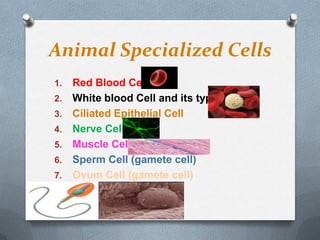
Animal Specialized Cells
1.
2.
3.
4.

5.
6.
7.

Red Blood Cell
White blood Cell and its types
Ciliated Epithelial Cell
Nerve Cell
Muscle Cell
Sperm Cell (gamete cell)
Ovum Cell (gamete cell)
Red Blood Cells
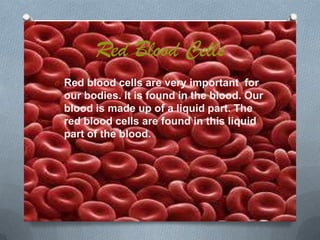
O Red blood cells are very important for

our bodies. It is found in the blood. Our
blood is made up of a liquid part. The
red blood cells are found in this liquid
part of the blood.
Place of Red Blood Cell
O Where is it found?

It’s found in the blood.
Adaptation of the Red Blood
Cell
o What is its adaptation?
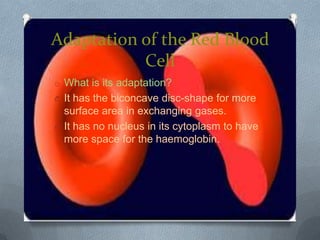
O It has the biconcave disc-shape for more

surface area in exchanging gases.
O It has no nucleus in its cytoplasm to have
more space for the haemoglobin.
Function of the Red
Blood Cell
o What is the function of this cell?
O It carries the oxygen.
O It makes the blood red because it has

haemoglobin.
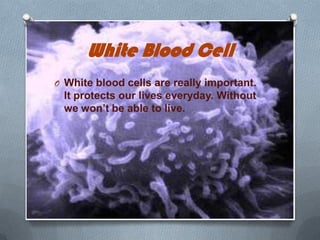
White Blood Cell
O White blood cells are really important.

It protects our lives everyday. Without
we won’t be able to live.
Place of White Blood
Cells
O Where is it found?

It is found in the blood.
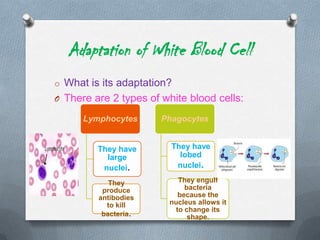
Adaptation of White Blood Cell
o What is its adaptation?
O There are 2 types of white blood cells:
Lymphocytes

Phagocytes

They have
large
nuclei.

They have
lobed
nuclei.

They
produce
antibodies
to kill
bacteria.

They engulf
bacteria
because the
nucleus allows it
to change its
shape.
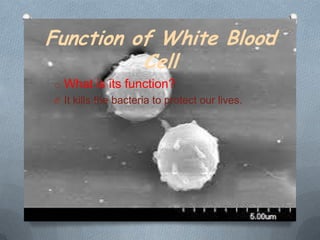
Function of White Blood
Cell
o What is its function?
O It kills the bacteria to protect our lives.
Ciliated Epithelial
Cells
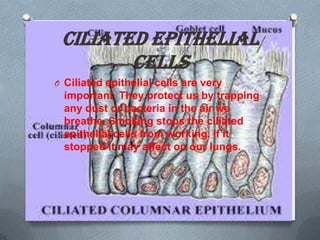
O Ciliated epithelial cells are very

important. They protect us by trapping
any dust or bacteria in the air we
breathe. Smoking stops the ciliated
epithelial cells from working. If it
stopped it may affect on our lungs.
Place of the Ciliated
Epithelial Cells
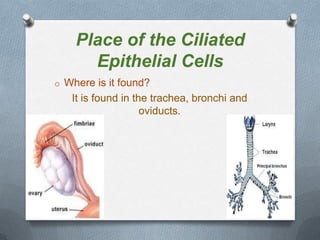
o Where is it found?

It is found in the trachea, bronchi and
oviducts.
Adaptation of Ciliated
Epithelial Cells
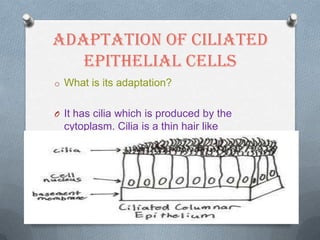
o What is its adaptation?
O It has cilia which is produced by the

cytoplasm. Cilia is a thin hair like
structure.
Function of the Ciliated
Epithelial Cells
o What is its function?
O Mucus traps the dust particles, then the

cilia beats in a rhythm to move this mucus
out of the body.
O It helps the ovum to move.
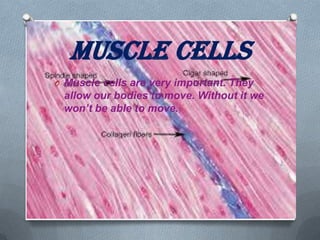
Muscle Cells
O Muscle cells are very important. They

allow our bodies to move. Without it we
won’t be able to move.
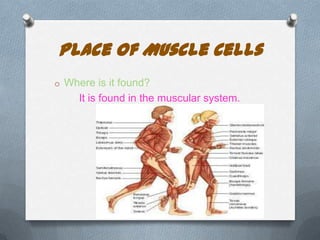
Place of Muscle Cells
o Where is it found?

It is found in the muscular system.
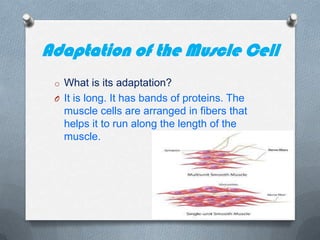
Adaptation of the Muscle Cell
o What is its adaptation?
O It is long. It has bands of proteins. The

muscle cells are arranged in fibers that
helps it to run along the length of the
muscle.
Function of Muscle Cells
o What are their functions?
O They contract which helps the muscle to

move.
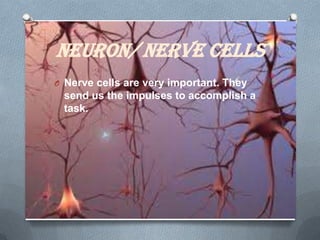
Neuron/ Nerve Cells
O Nerve cells are very important. They

send us the impulses to accomplish a
task.
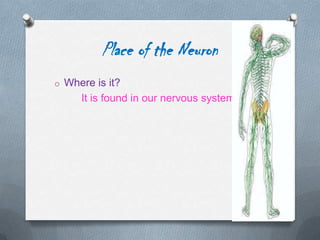
Place of the Neuron
o Where is it?

It is found in our nervous system.
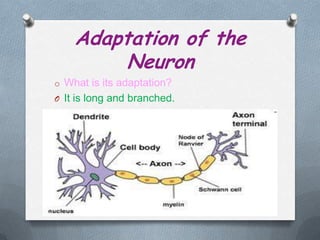
Adaptation of the
Neuron
o What is its adaptation?
O It is long and branched.
Function of the Neuron
o What is the function of it?
O It carries the impulses. The way it is

branched allows the impulses to be
conducted and co-ordinated. It carries
the impulses long distances without
getting interrupted.
Gametes or Sex Cells
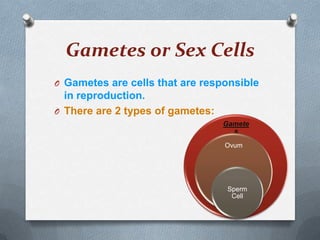
O Gametes are cells that are responsible

in reproduction.
O There are 2 types of gametes:
Gamete
s
Ovum

Sperm
Cell
Sperm Cell
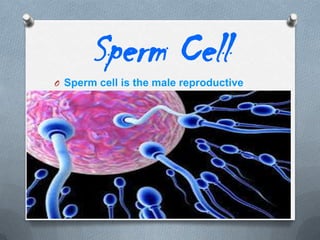
O Sperm cell is the male reproductive

cell.
Place of Sperm Cell
o Where is it?

It in the male reproductive system.
Adaptation of Sperm Cell
o How does it look like?
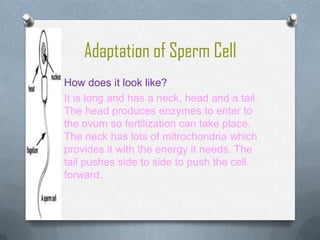
O It is long and has a neck, head and a tail.

The head produces enzymes to enter to
the ovum so fertilization can take place.
The neck has lots of mitrochondria which
provides it with the energy it needs. The
tail pushes side to side to push the cell
forward.
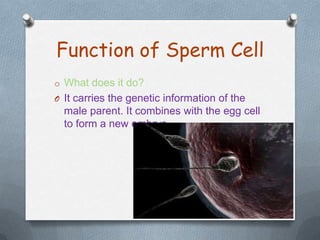
Function of Sperm Cell
o What does it do?
O It carries the genetic information of the

male parent. It combines with the egg cell
to form a new embryo.
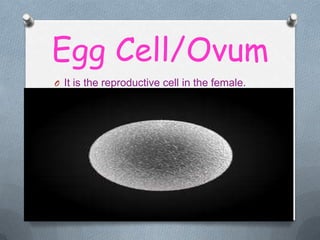
Egg Cell/Ovum
O It is the reproductive cell in the female.
Place of Ovum
o Where is it?

It is in the female reproductive system.
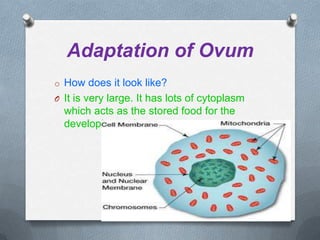
Adaptation of Ovum
o How does it look like?
O It is very large. It has lots of cytoplasm

which acts as the stored food for the
developing embryo.
Function of Ovum
o What does it do?
O It provides food for the growing

embryo. It stores the genetic
information of the female part.
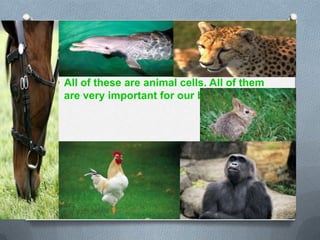
O All of these are animal cells. All of them

are very important for our bodies.
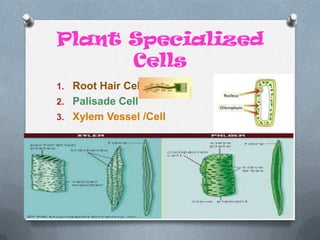
Plant Specialized
Cells
1. Root Hair Cell
2. Palisade Cell
3. Xylem Vessel /Cell
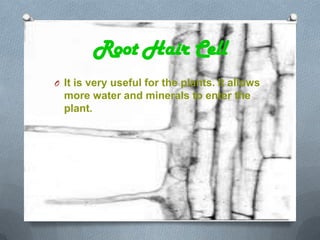
Root Hair Cell
O It is very useful for the plants. It allows

more water and minerals to enter the
plant.
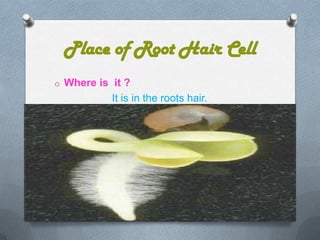
Place of Root Hair Cell
o Where is it ?

It is in the roots hair.
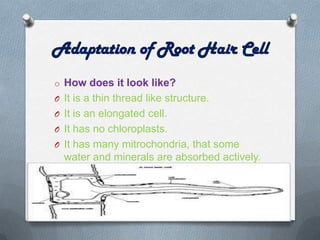
Adaptation of Root Hair Cell
o How does it look like?
O It is a thin thread like structure.
O It is an elongated cell.
O It has no chloroplasts.

O It has many mitrochondria, that some

water and minerals are absorbed actively.
Function of Root Hair Cell
o What is its function?
O Its absorbs some water and minerals

actively.
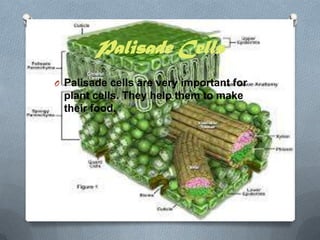
Palisade Cells
O Palisade cells are very important for

plant cells. They help them to make
their food.
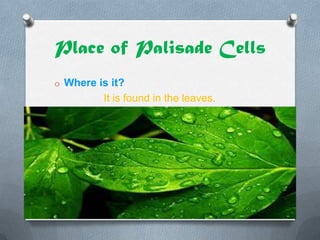
Place of Palisade Cells
o Where is it?

It is found in the leaves.
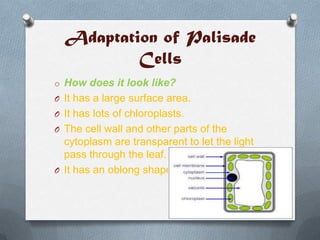
Adaptation of Palisade
Cells
o How does it look like?
O It has a large surface area.
O It has lots of chloroplasts.
O The cell wall and other parts of the

cytoplasm are transparent to let the light
pass through the leaf.
O It has an oblong shape.
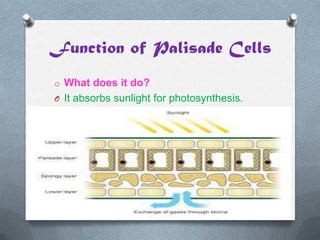
Function of Palisade Cells
o What does it do?
O It absorbs sunlight for photosynthesis.
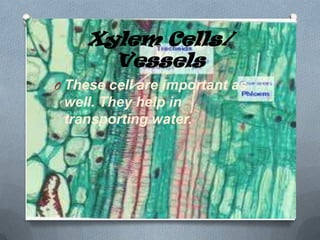
Xylem Cells/
Vessels
O These cell are important as

well. They help in
transporting water.
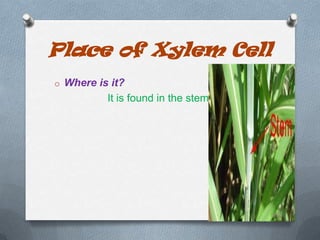
Place of Xylem Cell
o Where is it?

It is found in the stem.
Adaptation of
Xylem Cell
o How does it look like?
O It is long , thin hollow tube for

uninterrupted flow of water.
O The vessels are formed of column of cells
with no end walls, nucleus and cytoplasm.
Function of Xylem
Cells
o What does it do?
O It helps to transport water and also

provide support.
 Plant’s specialized cells are very

important for the plant’s cells. Without
these cells the plant won’t be able to
live.
O Specialized cells for plants and animals

are very important. Without them they
won’t be able to live. As each of these
cells preform a special function without
them this function won’t be accomplished.
Made by: Fatima AlZahraa Abdullah
Grade: 7.A
Subject: Biology

Teacher: Ashraf

Specialized cells,BIOLOGY,HUMANBODY

  • 1.
  • 2.
    Specialized Cells Plant’s andanimal’s cells are specialized to carry their job efficiently.  Specialized cells are cells that have a particular adaptation to preform a special task.
  • 3.
    Animal Specialized Cells 1. 2. 3. 4. 5. 6. 7. RedBlood Cell White blood Cell and its types Ciliated Epithelial Cell Nerve Cell Muscle Cell Sperm Cell (gamete cell) Ovum Cell (gamete cell)
  • 4.
    Red Blood Cells ORed blood cells are very important for our bodies. It is found in the blood. Our blood is made up of a liquid part. The red blood cells are found in this liquid part of the blood.
  • 5.
    Place of RedBlood Cell O Where is it found? It’s found in the blood.
  • 6.
    Adaptation of theRed Blood Cell o What is its adaptation? O It has the biconcave disc-shape for more surface area in exchanging gases. O It has no nucleus in its cytoplasm to have more space for the haemoglobin.
  • 7.
    Function of theRed Blood Cell o What is the function of this cell? O It carries the oxygen. O It makes the blood red because it has haemoglobin.
  • 8.
    White Blood Cell OWhite blood cells are really important. It protects our lives everyday. Without we won’t be able to live.
  • 9.
    Place of WhiteBlood Cells O Where is it found? It is found in the blood.
  • 10.
    Adaptation of WhiteBlood Cell o What is its adaptation? O There are 2 types of white blood cells: Lymphocytes Phagocytes They have large nuclei. They have lobed nuclei. They produce antibodies to kill bacteria. They engulf bacteria because the nucleus allows it to change its shape.
  • 11.
    Function of WhiteBlood Cell o What is its function? O It kills the bacteria to protect our lives.
  • 12.
    Ciliated Epithelial Cells O Ciliatedepithelial cells are very important. They protect us by trapping any dust or bacteria in the air we breathe. Smoking stops the ciliated epithelial cells from working. If it stopped it may affect on our lungs.
  • 13.
    Place of theCiliated Epithelial Cells o Where is it found? It is found in the trachea, bronchi and oviducts.
  • 14.
    Adaptation of Ciliated EpithelialCells o What is its adaptation? O It has cilia which is produced by the cytoplasm. Cilia is a thin hair like structure.
  • 15.
    Function of theCiliated Epithelial Cells o What is its function? O Mucus traps the dust particles, then the cilia beats in a rhythm to move this mucus out of the body. O It helps the ovum to move.
  • 16.
    Muscle Cells O Musclecells are very important. They allow our bodies to move. Without it we won’t be able to move.
  • 17.
    Place of MuscleCells o Where is it found? It is found in the muscular system.
  • 18.
    Adaptation of theMuscle Cell o What is its adaptation? O It is long. It has bands of proteins. The muscle cells are arranged in fibers that helps it to run along the length of the muscle.
  • 19.
    Function of MuscleCells o What are their functions? O They contract which helps the muscle to move.
  • 20.
    Neuron/ Nerve Cells ONerve cells are very important. They send us the impulses to accomplish a task.
  • 21.
    Place of theNeuron o Where is it? It is found in our nervous system.
  • 22.
    Adaptation of the Neuron oWhat is its adaptation? O It is long and branched.
  • 23.
    Function of theNeuron o What is the function of it? O It carries the impulses. The way it is branched allows the impulses to be conducted and co-ordinated. It carries the impulses long distances without getting interrupted.
  • 24.
    Gametes or SexCells O Gametes are cells that are responsible in reproduction. O There are 2 types of gametes: Gamete s Ovum Sperm Cell
  • 25.
    Sperm Cell O Spermcell is the male reproductive cell.
  • 26.
    Place of SpermCell o Where is it? It in the male reproductive system.
  • 27.
    Adaptation of SpermCell o How does it look like? O It is long and has a neck, head and a tail. The head produces enzymes to enter to the ovum so fertilization can take place. The neck has lots of mitrochondria which provides it with the energy it needs. The tail pushes side to side to push the cell forward.
  • 28.
    Function of SpermCell o What does it do? O It carries the genetic information of the male parent. It combines with the egg cell to form a new embryo.
  • 29.
    Egg Cell/Ovum O Itis the reproductive cell in the female.
  • 30.
    Place of Ovum oWhere is it? It is in the female reproductive system.
  • 31.
    Adaptation of Ovum oHow does it look like? O It is very large. It has lots of cytoplasm which acts as the stored food for the developing embryo.
  • 32.
    Function of Ovum oWhat does it do? O It provides food for the growing embryo. It stores the genetic information of the female part.
  • 33.
    O All ofthese are animal cells. All of them are very important for our bodies.
  • 34.
    Plant Specialized Cells 1. RootHair Cell 2. Palisade Cell 3. Xylem Vessel /Cell
  • 35.
    Root Hair Cell OIt is very useful for the plants. It allows more water and minerals to enter the plant.
  • 36.
    Place of RootHair Cell o Where is it ? It is in the roots hair.
  • 37.
    Adaptation of RootHair Cell o How does it look like? O It is a thin thread like structure. O It is an elongated cell. O It has no chloroplasts. O It has many mitrochondria, that some water and minerals are absorbed actively.
  • 38.
    Function of RootHair Cell o What is its function? O Its absorbs some water and minerals actively.
  • 39.
    Palisade Cells O Palisadecells are very important for plant cells. They help them to make their food.
  • 40.
    Place of PalisadeCells o Where is it? It is found in the leaves.
  • 41.
    Adaptation of Palisade Cells oHow does it look like? O It has a large surface area. O It has lots of chloroplasts. O The cell wall and other parts of the cytoplasm are transparent to let the light pass through the leaf. O It has an oblong shape.
  • 42.
    Function of PalisadeCells o What does it do? O It absorbs sunlight for photosynthesis.
  • 43.
    Xylem Cells/ Vessels O Thesecell are important as well. They help in transporting water.
  • 44.
    Place of XylemCell o Where is it? It is found in the stem.
  • 45.
    Adaptation of Xylem Cell oHow does it look like? O It is long , thin hollow tube for uninterrupted flow of water. O The vessels are formed of column of cells with no end walls, nucleus and cytoplasm.
  • 46.
    Function of Xylem Cells oWhat does it do? O It helps to transport water and also provide support.
  • 47.
     Plant’s specializedcells are very important for the plant’s cells. Without these cells the plant won’t be able to live.
  • 48.
    O Specialized cellsfor plants and animals are very important. Without them they won’t be able to live. As each of these cells preform a special function without them this function won’t be accomplished.
  • 49.
    Made by: FatimaAlZahraa Abdullah Grade: 7.A Subject: Biology Teacher: Ashraf