Cells W Richards Worthing High School Please note – some of the animation effects used here only work in PP XP
Using a microscope 1. Eyepiece 3. Focus adjustor 2. Arm 4. Base 5. Mirror 6. Stage 7. Lenses
Plant cells vs. Animal cells Both types of cell have these: Only plant cells have these: Cell wall   – provides support Large Vacuole –  contains sap Chloroplasts –  contain chlorophyll Cell Membrane –  holds the cell together Cytoplasm -  this is where the reactions happen Nucleus –  The “brain” of the cell 4) 1) 5) 6) 2) 3)
Specialised cells Consider the root hair cell: It is “suited” to its job of taking in water and nutrients in 2 ways: It has a large surface area It has a thin cell membrane The sperm cell is another example of a specialised cell: Strong tail for swimming Vacuole containing enzymes
More specialised animal cells Red Blood Cell Carries oxygen around the body No nucleus and large surface area I.D: Function: Features: White blood cell Egg cell (ovum) Ciliated epithelial cell Nerve cell (neurone)
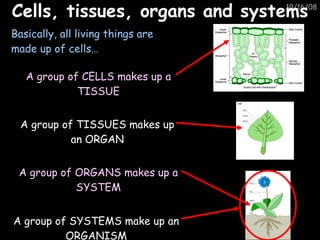
Cells, tissues, organs and systems Basically, all living things are made up of cells… A group of CELLS makes up a TISSUE A group of TISSUES makes up an ORGAN A group of ORGANS makes up a SYSTEM A group of SYSTEMS make up an ORGANISM
Another example Here’s another example in humans: Muscle cells Muscle tissue Organ System Organism
Cell growth Animal cells: Plant cells:
Plant reproduction For a plant to reproduce two stages must happen: Stage 1: Pollination – pollen from one plant is taken to another by insects or the wind:
Plant reproduction Stage 2: Fertilisation – a pollen tube grows down through the style and the pollen grain (which contains the male sex cell) travels down the tube to fertilise the female egg cell: Ovaries

7 A Cells

  • 1.
    Cells W RichardsWorthing High School Please note – some of the animation effects used here only work in PP XP
  • 2.
    Using a microscope1. Eyepiece 3. Focus adjustor 2. Arm 4. Base 5. Mirror 6. Stage 7. Lenses
  • 3.
    Plant cells vs.Animal cells Both types of cell have these: Only plant cells have these: Cell wall – provides support Large Vacuole – contains sap Chloroplasts – contain chlorophyll Cell Membrane – holds the cell together Cytoplasm - this is where the reactions happen Nucleus – The “brain” of the cell 4) 1) 5) 6) 2) 3)
  • 4.
    Specialised cells Considerthe root hair cell: It is “suited” to its job of taking in water and nutrients in 2 ways: It has a large surface area It has a thin cell membrane The sperm cell is another example of a specialised cell: Strong tail for swimming Vacuole containing enzymes
  • 5.
    More specialised animalcells Red Blood Cell Carries oxygen around the body No nucleus and large surface area I.D: Function: Features: White blood cell Egg cell (ovum) Ciliated epithelial cell Nerve cell (neurone)
  • 6.
    Cells, tissues, organsand systems Basically, all living things are made up of cells… A group of CELLS makes up a TISSUE A group of TISSUES makes up an ORGAN A group of ORGANS makes up a SYSTEM A group of SYSTEMS make up an ORGANISM
  • 7.
    Another example Here’sanother example in humans: Muscle cells Muscle tissue Organ System Organism
  • 8.
    Cell growth Animalcells: Plant cells:
  • 9.
    Plant reproduction Fora plant to reproduce two stages must happen: Stage 1: Pollination – pollen from one plant is taken to another by insects or the wind:
  • 10.
    Plant reproduction Stage2: Fertilisation – a pollen tube grows down through the style and the pollen grain (which contains the male sex cell) travels down the tube to fertilise the female egg cell: Ovaries