In Viewpoints 1, 2, 3 BGU, three Test Training sections have been prepared
to promote continuous evaluation and to have a more accurate picture of
students’ progress throughout the book. The format of the tests resembles
the one used in diverse international examinations. This decision is based
on different reasons. First, it has been widely recognized that international
tests measure the levels of the CEF performance descriptors appropriately;
second, by providing an international examination format and linking it to
the CEF standards, both teachers and students will have a consistent point
of reference concerning foreign language achievement; finally, by using
this format students will have the opportunity to become familiar with and
develop the strategies needed to take an international exam for evaluating
foreign or second language proficiency.
These tests can serve two purposes: a) as an opportunity for teachers to work
on ongoing assessment practices; b) as summative or cumulative evaluations
to get a sense of the CEF standards consolidated through the program and
what areas need further practice.
The editors
Viewpoints 1, 2, 3 BGU
TestTrainingSections–RubricsandGrading
257
For grading the speaking and writing tasks, the following rubrics should be
used. Each rubric corresponds to a different aspect of the tasks and to a score
that has been specified on top of each column.The sum of the corresponding
scores per rubric, including all aspects, should yield the final score.
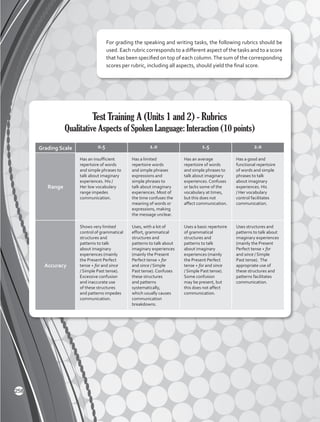
Test Training A (Units 1 and 2) - Rubrics
Qualitative Aspects of Spoken Language: Interaction (10 points)
Grading Scale 0.5 1.0 1.5 2.0
Range
Has an insufficient
repertoire of words
and simple phrases to
talk about imaginary
experiences. His /
Her low vocabulary
range impedes
communication.
Has a limited
repertoire words
and simple phrases
expressions and
simple phrases to
talk about imaginary
experiences. Most of
the time confuses the
meaning of words or
expressions, making
the message unclear.
Has an average
repertoire of words
and simple phrases to
talk about imaginary
experiences. Confuses
or lacks some of the
vocabulary at times,
but this does not
affect communication.
Has a good and
functional repertoire
of words and simple
phrases to talk
about imaginary
experiences. His
/ Her vocabulary
control facilitates
communication.
Accuracy
Shows very limited
control of grammatical
structures and
patterns to talk
about imaginary
experiences (mainly
the Present Perfect
tense + for and since
/ Simple Past tense).
Excessive confusion
and inaccurate use
of these structures
and patterns impedes
communication.
Uses, with a lot of
effort, grammatical
structures and
patterns to talk about
imaginary experiences
(mainly the Present
Perfect tense + for
and since / Simple
Past tense). Confuses
these structures
and patterns
systematically,
which usually causes
communication
breakdowns.
Uses a basic repertoire
of grammatical
structures and
patterns to talk
about imaginary
experiences (mainly
the Present Perfect
tense + for and since
/ Simple Past tense).
Some confusion
may be present, but
this does not affect
communication.
Uses structures and
patterns to talk about
imaginary experiences
(mainly the Present
Perfect tense + for
and since / Simple
Past tense). The
appropriate use of
these structures and
patterns facilitates
communication.
258
Fluency
Speech is hesitant
because he / she
can only manage
very short, isolated,
mainly pre-packaged
utterances with a lot
of pausing to search
for expressions to
articulate less familiar
words.
Can make himself /
herself understood
through very short
utterances, even
though pauses,
false starts and
reformulation are
very evident. Hesitant
speech is recurrent.
Has enough language
to keep going
comprehensively,
even though pauses
for grammatical and
lexical planning.
Repair is evident,
especially in
longer stretches of
production.
Has an outstanding
language command
to keep going
comprehensively
even though pauses
for grammatical and
lexical planning.
Interaction
Fails to initiate,
maintain and close
the discussion. In spite
of repetition of the
message delivered
by the other speaker,
interaction is not
successful.
Can, with a lot of
effort, respond to
simple statements.
However, cannot
maintain the
discussion.Very
rarely understands
enough to keep the
conversation going, so
his / her participation
seems out of place
almost all of the time.
Can, with some
hesitation, initiate,
maintain and close the
discussion. Responses
are adequate in the
ongoing conversation
most of the time.
Can successfully
initiate, maintain and
close the discussion. Is
able to provide extra
details spontaneously
in the ongoing
conversation.
Coherence
Presents the required
information (based
on a suggested plan)
in a very inconsistent
way. Finds it very
difficult to organize
his / her ideas. Basic
connectors such as
and, but, so, because
or also are not used or
used inappropriately.
The message is too
short and confusing.
Task input is not
covered. Meaning is
not conveyed.
Presents the required
information (based
on a suggested plan)
with inconsistencies.
Sometimes, neither
words nor expressions
are properly arranged.
The use of connectors
such as and, but, so,
because or also is
inappropriate.Task
input is inadequately
covered or omitted.
Meaning is usually
lost.
Presents the required
information (based
on a suggested plan)
in a consistent way.
Ideas are organized
although sometimes
confuses the use of
and, but, so, because
or also to connect
them.There are a few
organization mistakes
present, but the
message is conveyed.
Task input is used.
Presents the required
information (based on
a suggested plan) in a
very consistent way.
Is able to organize
his / her ideas and
link them with basic
connectors such as
and, but, so, because
or also successfully.
The message is clear
and concrete and task
input is fully used.
259
Test Training A (Units 1 and 2) - Rubrics
Qualitative Aspects of Writing (10 points)
Grading Scale 0.5 1.5 0.5 2.0
Content
The topic and the task are
not developed. It lacks the
intended message or it is
not related to it. Does not
provide enough arguments
to support his / her ideas
on the cause he / she
would like to join.
The topic and
the task are
not completely
developed. It
lacks the intended
message or it is
poorly related to it.
Does not provide
enough arguments
to support his / her
ideas on the cause
he / she would like
to join.
The topic and the
task are developed,
but it lacks part
of the intended
message or it is not
completely related
to it. Provides
arguments to
support his / her
ideas on the cause
he / she would like
to join, but misses
some relevant
details.
The topic and
the task are
well developed.
It achieves the
intended message.
Provides strong
arguments to
support his / her
ideas on the cause
he / she would like
to join.
Grammatical
accuracy
Inappropriate use of
structures (tenses) and
verb patterns (gerunds
and infinitives) to express
his / her ideas on how to
support the cause he /
she is intended to join.
Little demonstration or no
understanding of their use.
Attempts to
use structures
(tenses) and verb
patterns (gerunds
and infinitives)
to express his /
her ideas on how
to support the
cause he / she is
intended to join.
Many mistakes
are present, which
makes the message
confusing at times.
Appropriate use
of structures
(tenses) and verb
patterns (gerunds
and infinitives) to
express his / her
ideas on how to
support the cause
he / she is intended
to join. A few
mistakes may be
present, but this
does not impede
conveying a clear
message.
Structures (tenses)
and verb patterns
(gerunds and
infinitives) to
express his / her
ideas on how to
support the cause
he / she is intended
to join are used
consistently.The
message is very
clear.
260
Vocabulary
range
The range of vocabulary
to talk about future
plans and interests is
poor. Permanent use
of inappropriate words
related to environmental
problems impedes
communication.
Limited range of
vocabulary to talk
about future plans
and interests.
Lexical limitations
may distort
communication.
Shows control and
an average range of
vocabulary to talk
about future plans
and interests. Some
circumlocutions
might be present
but they do not
greatly impede
communication.
Shows sufficient
range and
accurate control
of vocabulary to
talk about future
plans and interests.
Has incorporated
a good range of
words related to
environmental
issues.
Organization
and
cohesion
Does not provide a main
statement, arguments or
a conclusion. Incorrect use
of connectors of cause and
effect (so, because, because
of, due to, as a result)
obscures the message.
There is no logical
connection between ideas.
Does not include
one or two of these:
a main statement,
arguments and
a conclusion.
Incorrect use of
connectors of cause
and effect (so,
because, because of,
due to, as a result)
causes transitional
problems among
ideas.
Writes a text
following the
suggested
indications. Good
use of connectors
of cause and
effect (so, because,
because of, due
to, as a result)
establishes
transition among
ideas. However,
cohesion and
coherence can be
improved.
Excellent
completion of
the suggested
indications to write
the text required.
Properly handles
connectors of cause
and effect (so,
because, because of,
due to, as a result).
The message is
clear and easily
understandable.
Appropriateness
of register and
format
The text’s register
(formal) and format
(mainly journalistic)
are inappropriate or
inconsistent for a cause-
effect relation text.
The text’s register
(formal) and format
(mainly journalistic)
are inappropriate
throughout most
of the text. Formal
treatment of
language is still
poor.
The text has a
formal register and
well-structured
sentences,
which are usually
appropriate for
writing a cause-
effect relation text.
Generally, uses a
formal tone and a
journalistic style.
The text has a
formal register and
well-structured
sentences which
are consistently
appropriate for
a cause-effect
relation text.
261
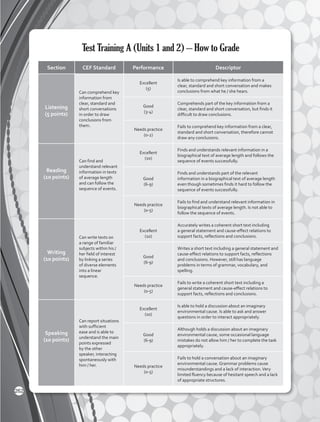
Test Training A (Units 1 and 2) – How to Grade
Section CEF Standard Performance Descriptor
Listening
(5 points)
Can comprehend key
information from
clear, standard and
short conversations
in order to draw
conclusions from
them.
Excellent
(5)
Is able to comprehend key information from a
clear, standard and short conversation and makes
conclusions from what he / she hears.
Good
(3-4)
Comprehends part of the key information from a
clear, standard and short conversation, but finds it
difficult to draw conclusions.
Needs practice
(0-2)
Fails to comprehend key information from a clear,
standard and short conversation, therefore cannot
draw any conclusions.
Reading
(10 points)
Can find and
understand relevant
information in texts
of average length
and can follow the
sequence of events.
Excellent
(10)
Finds and understands relevant information in a
biographical text of average length and follows the
sequence of events successfully.
Good
(6-9)
Finds and understands part of the relevant
information in a biographical text of average length
even though sometimes finds it hard to follow the
sequence of events successfully.
Needs practice
(0-5)
Fails to find and understand relevant information in
biographical texts of average length. Is not able to
follow the sequence of events.
Writing
(10 points)
Can write texts on
a range of familiar
subjects within his /
her field of interest
by linking a series
of diverse elements
into a linear
sequence.
Excellent
(10)
Accurately writes a coherent short text including
a general statement and cause-effect relations to
support facts, reflections and conclusions.
Good
(6-9)
Writes a short text including a general statement and
cause-effect relations to support facts, reflections
and conclusions. However, still has language
problems in terms of grammar, vocabulary, and
spelling.
Needs practice
(0-5)
Fails to write a coherent short text including a
general statement and cause-effect relations to
support facts, reflections and conclusions.
Speaking
(10 points)
Can report situations
with sufficient
ease and is able to
understand the main
points expressed
by the other
speaker, interacting
spontaneously with
him / her.
Excellent
(10)
Is able to hold a discussion about an imaginary
environmental cause. Is able to ask and answer
questions in order to interact appropriately.
Good
(6-9)
Although holds a discussion about an imaginary
environmental cause, some occasional language
mistakes do not allow him / her to complete the task
appropriately.
Needs practice
(0-5)
Fails to hold a conversation about an imaginary
environmental cause. Grammar problems cause
misunderstandings and a lack of interaction.Very
limited fluency because of hesitant speech and a lack
of appropriate structures.
262
Test Training B (Units 3 and 4) - Rubrics
Qualitative Aspects of Spoken Language: Interaction (10 points)
Grading Scale 0.5 1.0 1.5 2.0
Range
Has an insufficient
command of words
and simple phrases
to hold a discussion
about a tour around
a city.
Has a limited
command of words
and simple phrases
to hold a discussion
about a tour around
a city. Confuses or
lacks the appropriate
words most of the
time so the message
is obscured.
Has an average
repertoire of words
and simple phrases
to hold a discussion
about a tour around
a city. Although
confuses or lacks some
of the vocabulary,
this does not affect
communication.
Has a good
and functional
repertoire of
words and simple
phrases to hold
a discussion
about a tour
around a city. His
/ Her vocabulary
control facilitates
communication.
Accuracy
Shows insufficient
control of simple
grammatical
structures (mainly
indirect questions /
the first conditional)
and patterns to hold
a discussion about
a tour around a city.
Excessive confusion
and inaccurate use
of these structures
and patterns impedes
communication.
Uses, with a lot
of effort, simple
grammatical (mainly
indirect questions /
the first conditional)
and patterns to
hold a discussion
about a tour around
a city. Confuses
these structures
and patterns
systematically,
which causes
communication
breakdowns.
Uses a basic repertoire
of simple grammatical
structures (mainly
indirect questions /
the first conditional)
and patterns to hold
a discussion about
a tour around a city.
Some confusion may
be present, but this
does not impede
communication.
Uses simple
grammatical
structures
(mainly indirect
questions / the first
conditional) and
patterns to hold a
discussion about a
tour around a city.
The appropriate
use of these
structures and
patterns facilitates
communication.
Fluency
Manages only short,
mainly pre-packaged
utterances to make
arrangements and
decisions at the
moment of speaking.
Pauses are too long
and hinder the flow
of the conversation.
No repair is present
and false starts are
continuous, impeding
communication.
Shows difficulty to
utterances to make
arrangements and
decisions at the
moment of speaking.
Repeated false starts,
long pauses and too
much hesitation are
present and make
the conversation
difficult to follow.
No communication
repair is present.
Is able to make
arrangements and
decisions at the
moment of speaking.
False starts, short
pauses to search for
expressions, and
communication repair
are present, but do not
affect the flow of his /
her conversation.
Has an outstanding
language
command to
keep going
comprehensively,
even though
pauses for
grammatical and
lexical planning.
263
Interaction
Fails to initiate,
maintain and close
the discussion. In
spite of repetition
of the message
delivered by the other
speaker, interaction is
not successful.
Can, with a lot of
effort, respond to
simple statements.
However, cannot
maintain the
discussion.Very
rarely understands
enough to keep
the conversation
going, so his / her
participation seems
out of place almost all
of the time.
Can, with some
hesitation, initiate,
maintain and close the
discussion. Responses
are adequate in the
ongoing conversation
most of the time.
Can successfully
initiate, maintain
and close the
discussion. Is
able to provide
extra details
spontaneously
in the ongoing
conversation.
Coherence
Does not organize his
/ her ideas, especially
when talking about
possible results in
the future.Total or
notable omission of
task input. Meaning is
not conveyed.
Connects ideas
inappropriately,
especially when
talking about
possible results in the
future.Task input is
inadequately covered
or omitted and the
meaning usually gets
lost.
Can organize, with
some sufficiency,
his / her ideas when
talking about possible
results in the future.
The message is
clear although there
are some hesitant
sentences.Task input
is used to a certain
extent.
Is able to organize
his / her ideas
successfully when
talking about
possible results
in the future.The
message is clear
and concrete and
task input is fully
used.
264
Test Training B (Units 3 and 4) - Rubrics
Qualitative Aspects of Writing (10 points )
Grading Scale 0.5 1.0 1.5 2.0
Content
The text largely
lacks data or is
hardly related to the
information required
by the task (describing
a campsite and the
directions to get there
from a specific point).
Reduced writing.
The information
included in the
text is sometimes
unclear and
confusing. At
least half of the
information
required by the
task (describing a
campsite and the
directions to get
there from a specific
point) is missing.
The text presents
the intended
message.Task
input is used. Some
parts of the text
may be confusing,
but overall the
required message is
conveyed.
The text clearly
presents the
information
required by the
task (describing a
campsite and the
directions to get
there from a specific
point). Task input is
fully used and ideas
are kept short and
simple.
Accuracy
Inappropriate use of
the verb to be, the
Simple Present tense
and prepositions of
place (in front of, next
to, between, behind).
Little demonstration
or no understanding
of their use.
Attempts to
use the verb to
be, the Simple
Present tense and
prepositions of place
(in front of, next to,
between, behind).
Many mistakes are
still present, which
makes the message
confusing.
Appropriate use
of the verb to
be, the Simple
Present tense and
prepositions of place
(in front of, next to,
between, behind). A
few mistakes may
be present, but they
do not impede a
clear message.
Excellent use
of the verb to
be, the Simple
Present tense and
prepositions of place
(in front of, next to,
between, behind),
which makes the
message very clear.
Vocabulary range
Very limited control
of the vocabulary
required by the task
(places, outdoor
activities). Frequent
confusion of words
makes the intended
message mostly
incomprehensible.
Limited control
of the vocabulary
required by the
task (places,
outdoor activities).
Frequent confusion
or misuse of words
may obscure the
message of the text.
Shows average
control of the
vocabulary required
by the task (places,
outdoor activities).
Some errors may
be present, but
they do not impede
communication.
Sufficient control
of the vocabulary
required by the task
(places, outdoor
activities).
265
Organization and
cohesion
The text lacks
punctuation (periods
and commas) and
capitals.The message
consists mostly
of unconnected
sentences, which
are not properly
organized.The
limited organization
and cohesion make
the message mostly
incomprehensible.
Too far below the
number of words
required by the task.
The text shows
some attempts to
capitalize and use
punctuation (periods
and commas),
but most of the
time this is done
incorrectly. Shows
some attempts
at connecting
sentences with basic
connectors such as
and, but, also and so,
but this is not done
consistently. Only a
few of the sentences
are organized
appropriately.
The message is
much shorter than
suggested in the
task.
Capitals and
punctuation (periods
and commas) are
used appropriately
most of the time.
Sentences are
often correctly
linked using basic
connectors such as
and, but, also and so.
The text covers at
least two-thirds of
the words asked for
in the task.
Capitals and periods
are used when
necessary.
Sentences are
linked using basic
connectors such as
and, but, also and so
and are organized
correctly.The
message is clear,
precise, and within
the number of
words required.
Appropriateness
of register and
format
The expressions and
the layout used make
the text’s register
(informal) and format
(a letter) mostly
inappropriate to or
inconsistent with the
task and its audience.
The expressions
and the layout used
make the text’s
register (informal)
and format (a
letter) somewhat
inappropriate to or
inconsistent with
the task and its
audience.
The expressions
and the layout used
make the text’s
register (informal)
and format (a letter)
usually appropriate
to the task and its
audience. Some
mistakes may be
present, but they
do not impede
communication.
The expressions
and the layout used
make the text’s
register (informal)
and format (a
letter) consistently
appropriate to
the task and
its audience.
Communication is
easily achieved.
266
Test Training B (Units 3 and 4) – How to Grade
Section CEF Standard Performance Descriptor
Listening
(5 points)
Can comprehend key
information from
clear, standard and
short conversations
in order to draw
conclusions from
them.
Excellent
(5)
Is able to comprehend key information from a
clear, standard and short conversation and makes
conclusions from what he / she hears.
Good
(3-4)
Comprehends part of the key information from a
clear, standard and short conversation, but finds it
difficult to draw conclusions.
Needs practice
(0-2)
Fails to comprehend key information from a clear,
standard and short conversation, therefore cannot
draw any conclusions.
Reading
(8 points)
Can understand
short, simple texts
on familiar matters
of a concrete type
which consist of high
frequency everyday
language.
Excellent
(8)
Easily identifies relevant aspects and extracts key
information from a narrative text.
Good
(5-7)
Is partially able to identify relevant aspects and
extract part of the key information from a narrative
text.
Needs practice
(0-4)
Shows great difficulty to identify relevant aspects and
extract key information from a narrative text.
Writing
(10 points)
Can write about
everyday aspects of
his / her environment
in linked sentences.
Excellent
(10)
Accurately describes a specific place and gives
simple directions to find its location.The use of basic
sentence patterns and connectors is accurate and
facilitates communication.
Good
(6-9)
Is able to describe a specific place and gives simple
directions to find its location. A few mistakes may be
present (use of connectors or sentence patterns), but
the message is still clear.
Needs practice
(0-5)
Has difficulty to describe a specific place and gives
simple directions to find its location. Too many
mistakes in basic sentence patterns and the use of
connectors impede communication.
Speaking
(10 points)
Can give short, basic
descriptions of events
and activities.
Excellent
(10)
Successfully describes people, actions and places in
basic terms.
Good
(6-9)
Describes people, actions and places in basic
terms. Some lexical and grammatical mistakes and
hesitations may be present, but these do not greatly
affect communication.
Needs practice
(0-5)
Shows difficulty to describe people, actions and
places in basic terms.Very often uses inappropriate
vocabulary and patterns to express ideas, which may
cause communication failure.
267
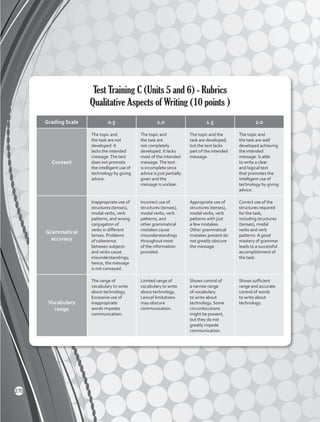
Test Training C (Units 5 and 6) - Rubrics
Qualitative Aspects of Spoken Language: Interaction (10 points)
Grading
Scale
0.5 1.0 1.5 2.0
Range
Has a very limited
repertoire of words
and expressions to ask
and answer questions
about an imaginary
futuristic gadget.
Has a limited
repertoire of words
and expressions
to ask and answer
questions about an
imaginary futuristic
gadget. Confuses
words and expressions
systematically,
which may cause
communication
failure.
Has a good
repertoire of words
and expressions
to ask and answer
questions about an
imaginary futuristic
gadget.
Has an outstanding
repertoire of words
and expressions
to ask and answer
questions about an
imaginary futuristic
gadget.
Accuracy
Shows insufficient
control of grammatical
structures and
patterns to ask and
answer questions
about an imaginary
futuristic gadget.
Excessive confusion
and inaccurate use
of these structures
and patterns impedes
communication.
Uses, with a lot of
effort, grammatical
structures and
patterns to ask
and answer
questions about an
imaginary futuristic
gadget. Confuses
these structures
and patterns
systematically, which
causes communication
breakdowns.
Uses a basic
repertoire of
grammatical
structures and
patterns to ask and
answer questions
about an imaginary
futuristic gadget.
Some confusion may
be present, but this
does not impede
communication.
Uses grammatical
structures and
patterns to ask and
answer questions
about an imaginary
futuristic gadget.
The appropriate
use of these
structures and
patterns facilitates
communication.
Fluency
Manages only very
short, isolated
sentences and
fragmented speech.
Utterances are mainly
pre-packaged, with
a lot of pausing to
search for expressions.
Speech is slow and
hesitant.
Can make himself /
herself understood in
very short utterances,
even though pauses,
false starts and
reformulation are
evident. Speech is
slow and hesitant and
takes time to complete
sentences with
appropriate fluency.
Has enough
language to
keep going
comprehensively,
even though pauses
for grammatical and
lexical planning.
Repair is evident,
especially in
longer stretches
of production.
However, this dtoes
not greatly affect
communication.
Has an outstanding
language command
to keep going
comprehensively,
even though
occasionally pauses
for grammatical and
lexical planning.
268
Interaction
Has great difficulty
asking or responding
to simple statements.
Finds it hard to begin
and hold a face-to-
face conversation
about an imaginary
futuristic gadget. In
spite of repetition and
paraphrasing by the
other speaker, lack
of comprehension
causes communication
failure.
Can, with a lot
of effort, ask or
respond to simple
statements. Hardly
begins, maintains, and
closes a face-to-face
conversation about an
imaginary futuristic
gadget. Rarely
understands enough
to keep a conversation
going of his / her own
accord. Repetition
on part of the other
speaker is required.
Can, with some
hesitation, ask or
respond to simple
statements. Also,
can begin, maintain
and close a face-to-
face conversation
about an imaginary
futuristic gadget.
Responses are
adequate in
the ongoing
conversation most of
the time.
Can successfully
ask and respond to
simple statements
and can begin,
maintain and
close a face-to-
face conversation
about an imaginary
futuristic gadget.
Is able to provide
extra details
spontaneously
in the ongoing
conversation. Elicits
information and
monitors himself /
herself.
Coherence
Does not organize his
/ her ideas, especially
when asking or
answering specific
questions.Total or
notable omission of
task input. Meaning is
not conveyed.
Connects ideas
inappropriately,
especially when asking
or answering specific
questions.Task input is
inadequately covered
or omitted and the
meaning usually gets
lost.
Can organize, with
some sufficiency,
his / her ideas when
talking about an
imaginary natural
disaster.The
message is clear
although there
are some hesitant
sentences.Task
input is used to a
certain extent.
Is able to organize
his / her ideas
successfully when
talking about an
imaginary natural
disaster.The
message is clear and
concrete and task
input is fully used.
269
Test Training C (Units 5 and 6) - Rubrics
Qualitative Aspects of Writing (10 points )
Grading Scale 0.5 1.0 1.5 2.0
Content
The topic and
the task are not
developed. It
lacks the intended
message.The text
does not promote
the intelligent use of
technology by giving
advice.
The topic and
the task are
not completely
developed. It lacks
most of the intended
message.The text
is incomplete since
advice is just partially
given and the
message is unclear.
The topic and the
task are developed,
but the text lacks
part of the intended
message.
The topic and
the task are well
developed achieving
the intended
message. Is able
to write a clear
and logical text
that promotes the
intelligent use of
technology by giving
advice.
Grammatical
accuracy
Inappropriate use of
structures (tenses),
modal verbs, verb
patterns, and wrong
conjugation of
verbs in different
tenses. Problems
of coherence
between subjects
and verbs cause
misunderstandings;
hence, the message
is not conveyed.
Incorrect use of
structures (tenses),
modal verbs, verb
patterns, and
other grammatical
mistakes cause
misunderstandings
throughout most
of the information
provided.
Appropriate use of
structures (tenses),
modal verbs, verb
patterns with just
a few mistakes.
Other grammatical
mistakes present do
not greatly obscure
the message.
Correct use of the
structures required
for the task,
including structures
(tenses), modal
verbs and verb
patterns. A good
mastery of grammar
leads to a successful
accomplishment of
the task.
Vocabulary
range
The range of
vocabulary to write
about technology.
Excessive use of
inappropriate
words impedes
communication.
Limited range of
vocabulary to write
about technology.
Lexical limitations
may obscure
communication.
Shows control of
a narrow range
of vocabulary
to write about
technology. Some
circumlocutions
might be present,
but they do not
greatly impede
communication.
Shows sufficient
range and accurate
control of words
to write about
technology.
270
Organization
and
cohesion
Does not provide
a main statement,
arguments or a
conclusion. Incorrect
use of connectors of
contrast (however,
on the contrary, but)
and addition (also,
besides, in addition)
causes transitional
problems among
ideas.
Does not include
one or two of these:
a main statement,
arguments and
a conclusion.
Recurrent incorrect
use of connectors of
contrast (however,
on the contrary, but)
and addition (also,
besides, in addition)
causes transitional
problems among
ideas.
Writes a text
following most
of the suggested
indications. Most of
the time connectors
of contrast (however,
on the contrary, but)
and addition (also,
besides, in addition)
are used correctly.
This makes the
transition among
ideas clear.
Excellent completion
of the suggested
indications for
writing the type
of text required.
Correct use of
connectors of
contrast (however,
on the contrary,
but) addition (also,
besides, in addition)
makes the message
clear and easily
understandable.
Appropriateness
of register and
format
The register
(informal) and
format are
inappropriate or
inconsistent for
giving advice.
The register
(informal) and
format are
sometimes
inappropriate or
inconsistent for
giving advice.
The text has an
informal register
and well-structured
sentences, which
are, most of the
time, appropriate for
giving advice.
The text has an
informal register
and well-structured
sentences, which
are consistently
appropriate for
giving advice.
271
Test Training C (Units 5 and 6) – How to Grade
Section CEF Standard Performance Descriptor
Listening
Part 1
(6 points)
Can understand
and extract
essential
information from
short, recorded
passages dealing
with common
everyday matters.
Excellent
(6)
Successfully understands the general meaning and specific information
from a short narrative dealing with an event in the past.
Good
(4-5)
Understands the general meaning and some specific information from
a short narrative dealing with an event in the past. Although there is
still some misunderstanding, comprehension is not affected.
Needs practice
(0-3)
Fails to understand the general meaning and specific information from
a short narrative dealing with an event in the past.
Listening
Part 2
(5 points)
Can understand the
topic of discussion
and specific
information from a
conversation.
Excellent
(5)
Understands the topic of discussion and specific information from a
conversation about tech-devices.
Good
(3-4)
Understands part of the topic of discussion and part of the specific
information from a conversation about tech-devices.
Needs practice
(0-2)
Fails to understand the main points and specific information from a
conversation about tech-devices.
Reading
Part 1
(5 points)
Can identify
specific
information in
simple written
material that he
/ she encounters
such as magazine
articles.
Excellent
(5)
Easily finds and accurately understands the who (people) and the what
(activities) described in simple, short informative texts.
Good
(3-4)
Finds and understands the who (people) and the what (activities)
described in simple, short informative texts, but gets confused at
times, affecting comprehension.
Needs practice
(0-2)
Shows great difficulty to find and understand the who (people) and
the what (activities) described in simple, short informative texts.This
clearly indicates that comprehension has not occurred.
Reading
Part 2
(4 points)
Can understand
short, simple texts
on familiar matters
of a concrete type
which consist of
high frequency
everyday language.
Excellent
(4)
Easily extracts key information from an informative text.
Good
(3)
Is partially able to identify relevant aspects and extract part of the key
information from an informative text.
Needs practice
(0-2)
Shows great difficulty to identify relevant aspects and extract key
information from an informative text.
Writing
(10
points)
Can write
straightforward
connected texts on
a range of familiar
subjects within his
field of interest,
by linking a series
of shorter discrete
elements into a
linear sequence.
Excellent
(10)
Accurately writes a text to give advice to others regarding the use of
technology, including connectors of addition and contrast to link ideas
appropriately. Follows instructions thoroughly to complete the task.
Good
(6-9)
Writes a blog entry to give advice to others. However, misuses
connectors of addition and contrast to link ideas appropriately.
Problems in terms of grammar, cohesion, vocabulary and spelling do
not greatly obscure meaning, but need to be improved.
Needs practice
(0-5)
Fails to write a blog entry to give advice to others regarding the use of
technology. Has a very limited command of connectors of addition and
contrast to link ideas appropriately, and is unable to follow instructions
thoroughly to complete the task.
Speaking
(10
points)
Can reasonably
sustain a
straightforward
description of
one of a variety of
subjects within his/
her field of interest,
presenting it as a
linear sequence of
points.
Excellent
(10)
Successfully expresses himself / herself with ease in structured
situations that deal with imaginary events.
Good
(6-9)
Expresses himself / herself with reasonable ease in structured situations
that deal with imaginary events. Has sporadic problems, but they do
not greatly affect communication.
Needs practice
(0-5)
Fails to express himself / herself in structured situations dealing with
imaginary events. Has constant problems with fluency, accuracy, and
pronunciation, obscuring meaning.
272

Level 4 rubrics

  • 1.
    In Viewpoints 1,2, 3 BGU, three Test Training sections have been prepared to promote continuous evaluation and to have a more accurate picture of students’ progress throughout the book. The format of the tests resembles the one used in diverse international examinations. This decision is based on different reasons. First, it has been widely recognized that international tests measure the levels of the CEF performance descriptors appropriately; second, by providing an international examination format and linking it to the CEF standards, both teachers and students will have a consistent point of reference concerning foreign language achievement; finally, by using this format students will have the opportunity to become familiar with and develop the strategies needed to take an international exam for evaluating foreign or second language proficiency. These tests can serve two purposes: a) as an opportunity for teachers to work on ongoing assessment practices; b) as summative or cumulative evaluations to get a sense of the CEF standards consolidated through the program and what areas need further practice. The editors Viewpoints 1, 2, 3 BGU TestTrainingSections–RubricsandGrading 257
  • 2.
    For grading thespeaking and writing tasks, the following rubrics should be used. Each rubric corresponds to a different aspect of the tasks and to a score that has been specified on top of each column.The sum of the corresponding scores per rubric, including all aspects, should yield the final score. Test Training A (Units 1 and 2) - Rubrics Qualitative Aspects of Spoken Language: Interaction (10 points) Grading Scale 0.5 1.0 1.5 2.0 Range Has an insufficient repertoire of words and simple phrases to talk about imaginary experiences. His / Her low vocabulary range impedes communication. Has a limited repertoire words and simple phrases expressions and simple phrases to talk about imaginary experiences. Most of the time confuses the meaning of words or expressions, making the message unclear. Has an average repertoire of words and simple phrases to talk about imaginary experiences. Confuses or lacks some of the vocabulary at times, but this does not affect communication. Has a good and functional repertoire of words and simple phrases to talk about imaginary experiences. His / Her vocabulary control facilitates communication. Accuracy Shows very limited control of grammatical structures and patterns to talk about imaginary experiences (mainly the Present Perfect tense + for and since / Simple Past tense). Excessive confusion and inaccurate use of these structures and patterns impedes communication. Uses, with a lot of effort, grammatical structures and patterns to talk about imaginary experiences (mainly the Present Perfect tense + for and since / Simple Past tense). Confuses these structures and patterns systematically, which usually causes communication breakdowns. Uses a basic repertoire of grammatical structures and patterns to talk about imaginary experiences (mainly the Present Perfect tense + for and since / Simple Past tense). Some confusion may be present, but this does not affect communication. Uses structures and patterns to talk about imaginary experiences (mainly the Present Perfect tense + for and since / Simple Past tense). The appropriate use of these structures and patterns facilitates communication. 258
  • 3.
    Fluency Speech is hesitant becausehe / she can only manage very short, isolated, mainly pre-packaged utterances with a lot of pausing to search for expressions to articulate less familiar words. Can make himself / herself understood through very short utterances, even though pauses, false starts and reformulation are very evident. Hesitant speech is recurrent. Has enough language to keep going comprehensively, even though pauses for grammatical and lexical planning. Repair is evident, especially in longer stretches of production. Has an outstanding language command to keep going comprehensively even though pauses for grammatical and lexical planning. Interaction Fails to initiate, maintain and close the discussion. In spite of repetition of the message delivered by the other speaker, interaction is not successful. Can, with a lot of effort, respond to simple statements. However, cannot maintain the discussion.Very rarely understands enough to keep the conversation going, so his / her participation seems out of place almost all of the time. Can, with some hesitation, initiate, maintain and close the discussion. Responses are adequate in the ongoing conversation most of the time. Can successfully initiate, maintain and close the discussion. Is able to provide extra details spontaneously in the ongoing conversation. Coherence Presents the required information (based on a suggested plan) in a very inconsistent way. Finds it very difficult to organize his / her ideas. Basic connectors such as and, but, so, because or also are not used or used inappropriately. The message is too short and confusing. Task input is not covered. Meaning is not conveyed. Presents the required information (based on a suggested plan) with inconsistencies. Sometimes, neither words nor expressions are properly arranged. The use of connectors such as and, but, so, because or also is inappropriate.Task input is inadequately covered or omitted. Meaning is usually lost. Presents the required information (based on a suggested plan) in a consistent way. Ideas are organized although sometimes confuses the use of and, but, so, because or also to connect them.There are a few organization mistakes present, but the message is conveyed. Task input is used. Presents the required information (based on a suggested plan) in a very consistent way. Is able to organize his / her ideas and link them with basic connectors such as and, but, so, because or also successfully. The message is clear and concrete and task input is fully used. 259
  • 4.
    Test Training A(Units 1 and 2) - Rubrics Qualitative Aspects of Writing (10 points) Grading Scale 0.5 1.5 0.5 2.0 Content The topic and the task are not developed. It lacks the intended message or it is not related to it. Does not provide enough arguments to support his / her ideas on the cause he / she would like to join. The topic and the task are not completely developed. It lacks the intended message or it is poorly related to it. Does not provide enough arguments to support his / her ideas on the cause he / she would like to join. The topic and the task are developed, but it lacks part of the intended message or it is not completely related to it. Provides arguments to support his / her ideas on the cause he / she would like to join, but misses some relevant details. The topic and the task are well developed. It achieves the intended message. Provides strong arguments to support his / her ideas on the cause he / she would like to join. Grammatical accuracy Inappropriate use of structures (tenses) and verb patterns (gerunds and infinitives) to express his / her ideas on how to support the cause he / she is intended to join. Little demonstration or no understanding of their use. Attempts to use structures (tenses) and verb patterns (gerunds and infinitives) to express his / her ideas on how to support the cause he / she is intended to join. Many mistakes are present, which makes the message confusing at times. Appropriate use of structures (tenses) and verb patterns (gerunds and infinitives) to express his / her ideas on how to support the cause he / she is intended to join. A few mistakes may be present, but this does not impede conveying a clear message. Structures (tenses) and verb patterns (gerunds and infinitives) to express his / her ideas on how to support the cause he / she is intended to join are used consistently.The message is very clear. 260
  • 5.
    Vocabulary range The range ofvocabulary to talk about future plans and interests is poor. Permanent use of inappropriate words related to environmental problems impedes communication. Limited range of vocabulary to talk about future plans and interests. Lexical limitations may distort communication. Shows control and an average range of vocabulary to talk about future plans and interests. Some circumlocutions might be present but they do not greatly impede communication. Shows sufficient range and accurate control of vocabulary to talk about future plans and interests. Has incorporated a good range of words related to environmental issues. Organization and cohesion Does not provide a main statement, arguments or a conclusion. Incorrect use of connectors of cause and effect (so, because, because of, due to, as a result) obscures the message. There is no logical connection between ideas. Does not include one or two of these: a main statement, arguments and a conclusion. Incorrect use of connectors of cause and effect (so, because, because of, due to, as a result) causes transitional problems among ideas. Writes a text following the suggested indications. Good use of connectors of cause and effect (so, because, because of, due to, as a result) establishes transition among ideas. However, cohesion and coherence can be improved. Excellent completion of the suggested indications to write the text required. Properly handles connectors of cause and effect (so, because, because of, due to, as a result). The message is clear and easily understandable. Appropriateness of register and format The text’s register (formal) and format (mainly journalistic) are inappropriate or inconsistent for a cause- effect relation text. The text’s register (formal) and format (mainly journalistic) are inappropriate throughout most of the text. Formal treatment of language is still poor. The text has a formal register and well-structured sentences, which are usually appropriate for writing a cause- effect relation text. Generally, uses a formal tone and a journalistic style. The text has a formal register and well-structured sentences which are consistently appropriate for a cause-effect relation text. 261
  • 6.
    Test Training A(Units 1 and 2) – How to Grade Section CEF Standard Performance Descriptor Listening (5 points) Can comprehend key information from clear, standard and short conversations in order to draw conclusions from them. Excellent (5) Is able to comprehend key information from a clear, standard and short conversation and makes conclusions from what he / she hears. Good (3-4) Comprehends part of the key information from a clear, standard and short conversation, but finds it difficult to draw conclusions. Needs practice (0-2) Fails to comprehend key information from a clear, standard and short conversation, therefore cannot draw any conclusions. Reading (10 points) Can find and understand relevant information in texts of average length and can follow the sequence of events. Excellent (10) Finds and understands relevant information in a biographical text of average length and follows the sequence of events successfully. Good (6-9) Finds and understands part of the relevant information in a biographical text of average length even though sometimes finds it hard to follow the sequence of events successfully. Needs practice (0-5) Fails to find and understand relevant information in biographical texts of average length. Is not able to follow the sequence of events. Writing (10 points) Can write texts on a range of familiar subjects within his / her field of interest by linking a series of diverse elements into a linear sequence. Excellent (10) Accurately writes a coherent short text including a general statement and cause-effect relations to support facts, reflections and conclusions. Good (6-9) Writes a short text including a general statement and cause-effect relations to support facts, reflections and conclusions. However, still has language problems in terms of grammar, vocabulary, and spelling. Needs practice (0-5) Fails to write a coherent short text including a general statement and cause-effect relations to support facts, reflections and conclusions. Speaking (10 points) Can report situations with sufficient ease and is able to understand the main points expressed by the other speaker, interacting spontaneously with him / her. Excellent (10) Is able to hold a discussion about an imaginary environmental cause. Is able to ask and answer questions in order to interact appropriately. Good (6-9) Although holds a discussion about an imaginary environmental cause, some occasional language mistakes do not allow him / her to complete the task appropriately. Needs practice (0-5) Fails to hold a conversation about an imaginary environmental cause. Grammar problems cause misunderstandings and a lack of interaction.Very limited fluency because of hesitant speech and a lack of appropriate structures. 262
  • 7.
    Test Training B(Units 3 and 4) - Rubrics Qualitative Aspects of Spoken Language: Interaction (10 points) Grading Scale 0.5 1.0 1.5 2.0 Range Has an insufficient command of words and simple phrases to hold a discussion about a tour around a city. Has a limited command of words and simple phrases to hold a discussion about a tour around a city. Confuses or lacks the appropriate words most of the time so the message is obscured. Has an average repertoire of words and simple phrases to hold a discussion about a tour around a city. Although confuses or lacks some of the vocabulary, this does not affect communication. Has a good and functional repertoire of words and simple phrases to hold a discussion about a tour around a city. His / Her vocabulary control facilitates communication. Accuracy Shows insufficient control of simple grammatical structures (mainly indirect questions / the first conditional) and patterns to hold a discussion about a tour around a city. Excessive confusion and inaccurate use of these structures and patterns impedes communication. Uses, with a lot of effort, simple grammatical (mainly indirect questions / the first conditional) and patterns to hold a discussion about a tour around a city. Confuses these structures and patterns systematically, which causes communication breakdowns. Uses a basic repertoire of simple grammatical structures (mainly indirect questions / the first conditional) and patterns to hold a discussion about a tour around a city. Some confusion may be present, but this does not impede communication. Uses simple grammatical structures (mainly indirect questions / the first conditional) and patterns to hold a discussion about a tour around a city. The appropriate use of these structures and patterns facilitates communication. Fluency Manages only short, mainly pre-packaged utterances to make arrangements and decisions at the moment of speaking. Pauses are too long and hinder the flow of the conversation. No repair is present and false starts are continuous, impeding communication. Shows difficulty to utterances to make arrangements and decisions at the moment of speaking. Repeated false starts, long pauses and too much hesitation are present and make the conversation difficult to follow. No communication repair is present. Is able to make arrangements and decisions at the moment of speaking. False starts, short pauses to search for expressions, and communication repair are present, but do not affect the flow of his / her conversation. Has an outstanding language command to keep going comprehensively, even though pauses for grammatical and lexical planning. 263
  • 8.
    Interaction Fails to initiate, maintainand close the discussion. In spite of repetition of the message delivered by the other speaker, interaction is not successful. Can, with a lot of effort, respond to simple statements. However, cannot maintain the discussion.Very rarely understands enough to keep the conversation going, so his / her participation seems out of place almost all of the time. Can, with some hesitation, initiate, maintain and close the discussion. Responses are adequate in the ongoing conversation most of the time. Can successfully initiate, maintain and close the discussion. Is able to provide extra details spontaneously in the ongoing conversation. Coherence Does not organize his / her ideas, especially when talking about possible results in the future.Total or notable omission of task input. Meaning is not conveyed. Connects ideas inappropriately, especially when talking about possible results in the future.Task input is inadequately covered or omitted and the meaning usually gets lost. Can organize, with some sufficiency, his / her ideas when talking about possible results in the future. The message is clear although there are some hesitant sentences.Task input is used to a certain extent. Is able to organize his / her ideas successfully when talking about possible results in the future.The message is clear and concrete and task input is fully used. 264
  • 9.
    Test Training B(Units 3 and 4) - Rubrics Qualitative Aspects of Writing (10 points ) Grading Scale 0.5 1.0 1.5 2.0 Content The text largely lacks data or is hardly related to the information required by the task (describing a campsite and the directions to get there from a specific point). Reduced writing. The information included in the text is sometimes unclear and confusing. At least half of the information required by the task (describing a campsite and the directions to get there from a specific point) is missing. The text presents the intended message.Task input is used. Some parts of the text may be confusing, but overall the required message is conveyed. The text clearly presents the information required by the task (describing a campsite and the directions to get there from a specific point). Task input is fully used and ideas are kept short and simple. Accuracy Inappropriate use of the verb to be, the Simple Present tense and prepositions of place (in front of, next to, between, behind). Little demonstration or no understanding of their use. Attempts to use the verb to be, the Simple Present tense and prepositions of place (in front of, next to, between, behind). Many mistakes are still present, which makes the message confusing. Appropriate use of the verb to be, the Simple Present tense and prepositions of place (in front of, next to, between, behind). A few mistakes may be present, but they do not impede a clear message. Excellent use of the verb to be, the Simple Present tense and prepositions of place (in front of, next to, between, behind), which makes the message very clear. Vocabulary range Very limited control of the vocabulary required by the task (places, outdoor activities). Frequent confusion of words makes the intended message mostly incomprehensible. Limited control of the vocabulary required by the task (places, outdoor activities). Frequent confusion or misuse of words may obscure the message of the text. Shows average control of the vocabulary required by the task (places, outdoor activities). Some errors may be present, but they do not impede communication. Sufficient control of the vocabulary required by the task (places, outdoor activities). 265
  • 10.
    Organization and cohesion The textlacks punctuation (periods and commas) and capitals.The message consists mostly of unconnected sentences, which are not properly organized.The limited organization and cohesion make the message mostly incomprehensible. Too far below the number of words required by the task. The text shows some attempts to capitalize and use punctuation (periods and commas), but most of the time this is done incorrectly. Shows some attempts at connecting sentences with basic connectors such as and, but, also and so, but this is not done consistently. Only a few of the sentences are organized appropriately. The message is much shorter than suggested in the task. Capitals and punctuation (periods and commas) are used appropriately most of the time. Sentences are often correctly linked using basic connectors such as and, but, also and so. The text covers at least two-thirds of the words asked for in the task. Capitals and periods are used when necessary. Sentences are linked using basic connectors such as and, but, also and so and are organized correctly.The message is clear, precise, and within the number of words required. Appropriateness of register and format The expressions and the layout used make the text’s register (informal) and format (a letter) mostly inappropriate to or inconsistent with the task and its audience. The expressions and the layout used make the text’s register (informal) and format (a letter) somewhat inappropriate to or inconsistent with the task and its audience. The expressions and the layout used make the text’s register (informal) and format (a letter) usually appropriate to the task and its audience. Some mistakes may be present, but they do not impede communication. The expressions and the layout used make the text’s register (informal) and format (a letter) consistently appropriate to the task and its audience. Communication is easily achieved. 266
  • 11.
    Test Training B(Units 3 and 4) – How to Grade Section CEF Standard Performance Descriptor Listening (5 points) Can comprehend key information from clear, standard and short conversations in order to draw conclusions from them. Excellent (5) Is able to comprehend key information from a clear, standard and short conversation and makes conclusions from what he / she hears. Good (3-4) Comprehends part of the key information from a clear, standard and short conversation, but finds it difficult to draw conclusions. Needs practice (0-2) Fails to comprehend key information from a clear, standard and short conversation, therefore cannot draw any conclusions. Reading (8 points) Can understand short, simple texts on familiar matters of a concrete type which consist of high frequency everyday language. Excellent (8) Easily identifies relevant aspects and extracts key information from a narrative text. Good (5-7) Is partially able to identify relevant aspects and extract part of the key information from a narrative text. Needs practice (0-4) Shows great difficulty to identify relevant aspects and extract key information from a narrative text. Writing (10 points) Can write about everyday aspects of his / her environment in linked sentences. Excellent (10) Accurately describes a specific place and gives simple directions to find its location.The use of basic sentence patterns and connectors is accurate and facilitates communication. Good (6-9) Is able to describe a specific place and gives simple directions to find its location. A few mistakes may be present (use of connectors or sentence patterns), but the message is still clear. Needs practice (0-5) Has difficulty to describe a specific place and gives simple directions to find its location. Too many mistakes in basic sentence patterns and the use of connectors impede communication. Speaking (10 points) Can give short, basic descriptions of events and activities. Excellent (10) Successfully describes people, actions and places in basic terms. Good (6-9) Describes people, actions and places in basic terms. Some lexical and grammatical mistakes and hesitations may be present, but these do not greatly affect communication. Needs practice (0-5) Shows difficulty to describe people, actions and places in basic terms.Very often uses inappropriate vocabulary and patterns to express ideas, which may cause communication failure. 267
  • 12.
    Test Training C(Units 5 and 6) - Rubrics Qualitative Aspects of Spoken Language: Interaction (10 points) Grading Scale 0.5 1.0 1.5 2.0 Range Has a very limited repertoire of words and expressions to ask and answer questions about an imaginary futuristic gadget. Has a limited repertoire of words and expressions to ask and answer questions about an imaginary futuristic gadget. Confuses words and expressions systematically, which may cause communication failure. Has a good repertoire of words and expressions to ask and answer questions about an imaginary futuristic gadget. Has an outstanding repertoire of words and expressions to ask and answer questions about an imaginary futuristic gadget. Accuracy Shows insufficient control of grammatical structures and patterns to ask and answer questions about an imaginary futuristic gadget. Excessive confusion and inaccurate use of these structures and patterns impedes communication. Uses, with a lot of effort, grammatical structures and patterns to ask and answer questions about an imaginary futuristic gadget. Confuses these structures and patterns systematically, which causes communication breakdowns. Uses a basic repertoire of grammatical structures and patterns to ask and answer questions about an imaginary futuristic gadget. Some confusion may be present, but this does not impede communication. Uses grammatical structures and patterns to ask and answer questions about an imaginary futuristic gadget. The appropriate use of these structures and patterns facilitates communication. Fluency Manages only very short, isolated sentences and fragmented speech. Utterances are mainly pre-packaged, with a lot of pausing to search for expressions. Speech is slow and hesitant. Can make himself / herself understood in very short utterances, even though pauses, false starts and reformulation are evident. Speech is slow and hesitant and takes time to complete sentences with appropriate fluency. Has enough language to keep going comprehensively, even though pauses for grammatical and lexical planning. Repair is evident, especially in longer stretches of production. However, this dtoes not greatly affect communication. Has an outstanding language command to keep going comprehensively, even though occasionally pauses for grammatical and lexical planning. 268
  • 13.
    Interaction Has great difficulty askingor responding to simple statements. Finds it hard to begin and hold a face-to- face conversation about an imaginary futuristic gadget. In spite of repetition and paraphrasing by the other speaker, lack of comprehension causes communication failure. Can, with a lot of effort, ask or respond to simple statements. Hardly begins, maintains, and closes a face-to-face conversation about an imaginary futuristic gadget. Rarely understands enough to keep a conversation going of his / her own accord. Repetition on part of the other speaker is required. Can, with some hesitation, ask or respond to simple statements. Also, can begin, maintain and close a face-to- face conversation about an imaginary futuristic gadget. Responses are adequate in the ongoing conversation most of the time. Can successfully ask and respond to simple statements and can begin, maintain and close a face-to- face conversation about an imaginary futuristic gadget. Is able to provide extra details spontaneously in the ongoing conversation. Elicits information and monitors himself / herself. Coherence Does not organize his / her ideas, especially when asking or answering specific questions.Total or notable omission of task input. Meaning is not conveyed. Connects ideas inappropriately, especially when asking or answering specific questions.Task input is inadequately covered or omitted and the meaning usually gets lost. Can organize, with some sufficiency, his / her ideas when talking about an imaginary natural disaster.The message is clear although there are some hesitant sentences.Task input is used to a certain extent. Is able to organize his / her ideas successfully when talking about an imaginary natural disaster.The message is clear and concrete and task input is fully used. 269
  • 14.
    Test Training C(Units 5 and 6) - Rubrics Qualitative Aspects of Writing (10 points ) Grading Scale 0.5 1.0 1.5 2.0 Content The topic and the task are not developed. It lacks the intended message.The text does not promote the intelligent use of technology by giving advice. The topic and the task are not completely developed. It lacks most of the intended message.The text is incomplete since advice is just partially given and the message is unclear. The topic and the task are developed, but the text lacks part of the intended message. The topic and the task are well developed achieving the intended message. Is able to write a clear and logical text that promotes the intelligent use of technology by giving advice. Grammatical accuracy Inappropriate use of structures (tenses), modal verbs, verb patterns, and wrong conjugation of verbs in different tenses. Problems of coherence between subjects and verbs cause misunderstandings; hence, the message is not conveyed. Incorrect use of structures (tenses), modal verbs, verb patterns, and other grammatical mistakes cause misunderstandings throughout most of the information provided. Appropriate use of structures (tenses), modal verbs, verb patterns with just a few mistakes. Other grammatical mistakes present do not greatly obscure the message. Correct use of the structures required for the task, including structures (tenses), modal verbs and verb patterns. A good mastery of grammar leads to a successful accomplishment of the task. Vocabulary range The range of vocabulary to write about technology. Excessive use of inappropriate words impedes communication. Limited range of vocabulary to write about technology. Lexical limitations may obscure communication. Shows control of a narrow range of vocabulary to write about technology. Some circumlocutions might be present, but they do not greatly impede communication. Shows sufficient range and accurate control of words to write about technology. 270
  • 15.
    Organization and cohesion Does not provide amain statement, arguments or a conclusion. Incorrect use of connectors of contrast (however, on the contrary, but) and addition (also, besides, in addition) causes transitional problems among ideas. Does not include one or two of these: a main statement, arguments and a conclusion. Recurrent incorrect use of connectors of contrast (however, on the contrary, but) and addition (also, besides, in addition) causes transitional problems among ideas. Writes a text following most of the suggested indications. Most of the time connectors of contrast (however, on the contrary, but) and addition (also, besides, in addition) are used correctly. This makes the transition among ideas clear. Excellent completion of the suggested indications for writing the type of text required. Correct use of connectors of contrast (however, on the contrary, but) addition (also, besides, in addition) makes the message clear and easily understandable. Appropriateness of register and format The register (informal) and format are inappropriate or inconsistent for giving advice. The register (informal) and format are sometimes inappropriate or inconsistent for giving advice. The text has an informal register and well-structured sentences, which are, most of the time, appropriate for giving advice. The text has an informal register and well-structured sentences, which are consistently appropriate for giving advice. 271
  • 16.
    Test Training C(Units 5 and 6) – How to Grade Section CEF Standard Performance Descriptor Listening Part 1 (6 points) Can understand and extract essential information from short, recorded passages dealing with common everyday matters. Excellent (6) Successfully understands the general meaning and specific information from a short narrative dealing with an event in the past. Good (4-5) Understands the general meaning and some specific information from a short narrative dealing with an event in the past. Although there is still some misunderstanding, comprehension is not affected. Needs practice (0-3) Fails to understand the general meaning and specific information from a short narrative dealing with an event in the past. Listening Part 2 (5 points) Can understand the topic of discussion and specific information from a conversation. Excellent (5) Understands the topic of discussion and specific information from a conversation about tech-devices. Good (3-4) Understands part of the topic of discussion and part of the specific information from a conversation about tech-devices. Needs practice (0-2) Fails to understand the main points and specific information from a conversation about tech-devices. Reading Part 1 (5 points) Can identify specific information in simple written material that he / she encounters such as magazine articles. Excellent (5) Easily finds and accurately understands the who (people) and the what (activities) described in simple, short informative texts. Good (3-4) Finds and understands the who (people) and the what (activities) described in simple, short informative texts, but gets confused at times, affecting comprehension. Needs practice (0-2) Shows great difficulty to find and understand the who (people) and the what (activities) described in simple, short informative texts.This clearly indicates that comprehension has not occurred. Reading Part 2 (4 points) Can understand short, simple texts on familiar matters of a concrete type which consist of high frequency everyday language. Excellent (4) Easily extracts key information from an informative text. Good (3) Is partially able to identify relevant aspects and extract part of the key information from an informative text. Needs practice (0-2) Shows great difficulty to identify relevant aspects and extract key information from an informative text. Writing (10 points) Can write straightforward connected texts on a range of familiar subjects within his field of interest, by linking a series of shorter discrete elements into a linear sequence. Excellent (10) Accurately writes a text to give advice to others regarding the use of technology, including connectors of addition and contrast to link ideas appropriately. Follows instructions thoroughly to complete the task. Good (6-9) Writes a blog entry to give advice to others. However, misuses connectors of addition and contrast to link ideas appropriately. Problems in terms of grammar, cohesion, vocabulary and spelling do not greatly obscure meaning, but need to be improved. Needs practice (0-5) Fails to write a blog entry to give advice to others regarding the use of technology. Has a very limited command of connectors of addition and contrast to link ideas appropriately, and is unable to follow instructions thoroughly to complete the task. Speaking (10 points) Can reasonably sustain a straightforward description of one of a variety of subjects within his/ her field of interest, presenting it as a linear sequence of points. Excellent (10) Successfully expresses himself / herself with ease in structured situations that deal with imaginary events. Good (6-9) Expresses himself / herself with reasonable ease in structured situations that deal with imaginary events. Has sporadic problems, but they do not greatly affect communication. Needs practice (0-5) Fails to express himself / herself in structured situations dealing with imaginary events. Has constant problems with fluency, accuracy, and pronunciation, obscuring meaning. 272