Communicative
Language Teaching (CLT)
& Desuggestopedia
(DESU)
Teaching Methodology Part 2: a series of TPD
Briton English Education
AL
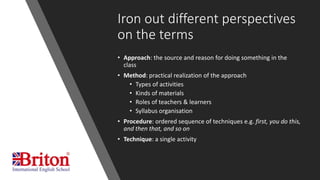
Iron out different perspectives
on the terms
• Approach: the source and reason for doing something in the
class
• Method: practical realization of the approach
• Types of activities
• Kinds of materials
• Roles of teachers & learners
• Syllabus organisation
• Procedure: ordered sequence of techniques e.g. first, you do this,
and then that, and so on
• Technique: a single activity
Challenge 1
Order the observation notes in 7 minutes!
Challenge 1
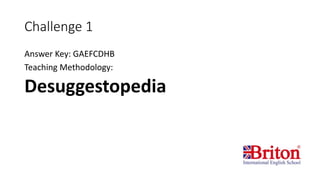
Answer Key: GAEFCDHB
Teaching Methodology:
Desuggestopedia
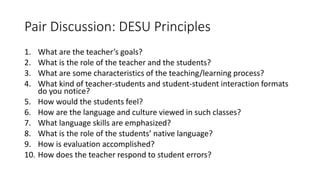
Pair Discussion: DESU Principles
1. What are the teacher’s goals?
2. What is the role of the teacher and the students?
3. What are some characteristics of the teaching/learning process?
4. What kind of teacher-students and student-student interaction formats
do you notice?
5. How would the students feel?
6. How are the language and culture viewed in such classes?
7. What language skills are emphasized?
8. What is the role of the students’ native language?
9. How is evaluation accomplished?
10. How does the teacher respond to student errors?
Challenge 2
Order the observation notes in 7 minutes!
Challenge 2
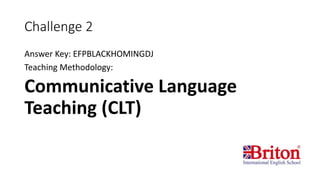
Answer Key: EFPBLACKHOMINGDJ
Teaching Methodology:
Communicative Language
Teaching (CLT)
Foursome Discussion: CLT Principles
1. What are the teacher’s goals?
2. What is the role of the teacher and the students?
3. What are some characteristics of the teaching/learning process?
4. What kind of teacher-students and student-student interaction formats
do you notice?
5. How would the students feel?
6. How are the language and culture viewed in such classes?
7. What language skills are emphasized?
8. What is the role of the students’ native language?
9. How is evaluation accomplished?
10. How does the teacher respond to student errors?
Quiz Time
With your dynamic duo, on your phone browser go to this address:
https://goo.gl/forms/bcgyruArCPolaGlX2
And follow the instructions to complete the quiz.
Reflection and Takeaways
• What kinds of CLT and DESU techniques are common in the methods?
• When to use these methods best?
• (With your foursome; come up with a ‘real’ question)
Application Session
• Adorn one of your lesson with 1 Desu-and 1 CLT-based technique
No time? Well, it’s homework, then.
Thank you & happy teaching!
“Cheat sheet:” Larsen-Freeman, D. (2010). Techniques and Principles in Language Teaching. Oxford: Oxford University Press.
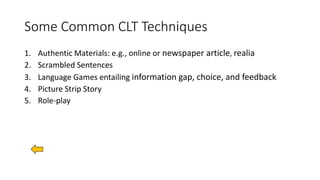
Some Common CLT Techniques
1. Authentic Materials: e.g., online or newspaper article, realia
2. Scrambled Sentences
3. Language Games entailing information gap, choice, and feedback
4. Picture Strip Story
5. Role-play
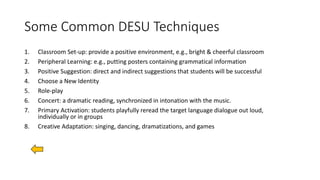
Some Common DESU Techniques
1. Classroom Set-up: provide a positive environment, e.g., bright & cheerful classroom
2. Peripheral Learning: e.g., putting posters containing grammatical information
3. Positive Suggestion: direct and indirect suggestions that students will be successful
4. Choose a New Identity
5. Role-play
6. Concert: a dramatic reading, synchronized in intonation with the music.
7. Primary Activation: students playfully reread the target language dialogue out loud,
individually or in groups
8. Creative Adaptation: singing, dancing, dramatizations, and games

Teaching methodology clt Vs desu

  • 1.
    Communicative Language Teaching (CLT) &Desuggestopedia (DESU) Teaching Methodology Part 2: a series of TPD Briton English Education AL
  • 2.
    Iron out differentperspectives on the terms • Approach: the source and reason for doing something in the class • Method: practical realization of the approach • Types of activities • Kinds of materials • Roles of teachers & learners • Syllabus organisation • Procedure: ordered sequence of techniques e.g. first, you do this, and then that, and so on • Technique: a single activity
  • 3.
    Challenge 1 Order theobservation notes in 7 minutes!
  • 4.
    Challenge 1 Answer Key:GAEFCDHB Teaching Methodology: Desuggestopedia
  • 5.
    Pair Discussion: DESUPrinciples 1. What are the teacher’s goals? 2. What is the role of the teacher and the students? 3. What are some characteristics of the teaching/learning process? 4. What kind of teacher-students and student-student interaction formats do you notice? 5. How would the students feel? 6. How are the language and culture viewed in such classes? 7. What language skills are emphasized? 8. What is the role of the students’ native language? 9. How is evaluation accomplished? 10. How does the teacher respond to student errors?
  • 6.
    Challenge 2 Order theobservation notes in 7 minutes!
  • 7.
    Challenge 2 Answer Key:EFPBLACKHOMINGDJ Teaching Methodology: Communicative Language Teaching (CLT)
  • 8.
    Foursome Discussion: CLTPrinciples 1. What are the teacher’s goals? 2. What is the role of the teacher and the students? 3. What are some characteristics of the teaching/learning process? 4. What kind of teacher-students and student-student interaction formats do you notice? 5. How would the students feel? 6. How are the language and culture viewed in such classes? 7. What language skills are emphasized? 8. What is the role of the students’ native language? 9. How is evaluation accomplished? 10. How does the teacher respond to student errors?
  • 9.
    Quiz Time With yourdynamic duo, on your phone browser go to this address: https://goo.gl/forms/bcgyruArCPolaGlX2 And follow the instructions to complete the quiz.
  • 10.
    Reflection and Takeaways •What kinds of CLT and DESU techniques are common in the methods? • When to use these methods best? • (With your foursome; come up with a ‘real’ question)
  • 11.
    Application Session • Adornone of your lesson with 1 Desu-and 1 CLT-based technique No time? Well, it’s homework, then.
  • 12.
    Thank you &happy teaching! “Cheat sheet:” Larsen-Freeman, D. (2010). Techniques and Principles in Language Teaching. Oxford: Oxford University Press.
  • 13.
    Some Common CLTTechniques 1. Authentic Materials: e.g., online or newspaper article, realia 2. Scrambled Sentences 3. Language Games entailing information gap, choice, and feedback 4. Picture Strip Story 5. Role-play
  • 14.
    Some Common DESUTechniques 1. Classroom Set-up: provide a positive environment, e.g., bright & cheerful classroom 2. Peripheral Learning: e.g., putting posters containing grammatical information 3. Positive Suggestion: direct and indirect suggestions that students will be successful 4. Choose a New Identity 5. Role-play 6. Concert: a dramatic reading, synchronized in intonation with the music. 7. Primary Activation: students playfully reread the target language dialogue out loud, individually or in groups 8. Creative Adaptation: singing, dancing, dramatizations, and games