
Sample AAssessment
Rubrics
101
102
Introduction
The following sample assessment rubrics can be modified by the teacher to match the
unit activities of LOTE Checkpoint C. The sample rubrics define expectations for
speaking and writing.
Assessment rubrics should accomplish three goals:
• inform the students of standards and expectations
• inform the students about levels of achievement
• inform the students about specific areas in need of improvement.
Since the LOTE Checkpoint C level does not have formal standardized assessments, it is
important that the teacher create some form of evaluation so that students are informed
about their progress. Teachers are encouraged to modify the enclosed rubrics or create
their own, so that grades are not the only form of student assessment.
Checkpoint C classroom teachers may prefer to distribute assessment rubrics at the
beginning of a unit, so that students are aware of expectations and understand how their
work will be evaluated.
The following rubrics, guidelines, and checklist are used in conjunction with the New York
State LOTE assessments:
• Informal Speaking Rubric
• Guidelines for Speaking
• Checkpoint C Writing Rubric
• Word Count Guidelines
• Writing Checklist.
103
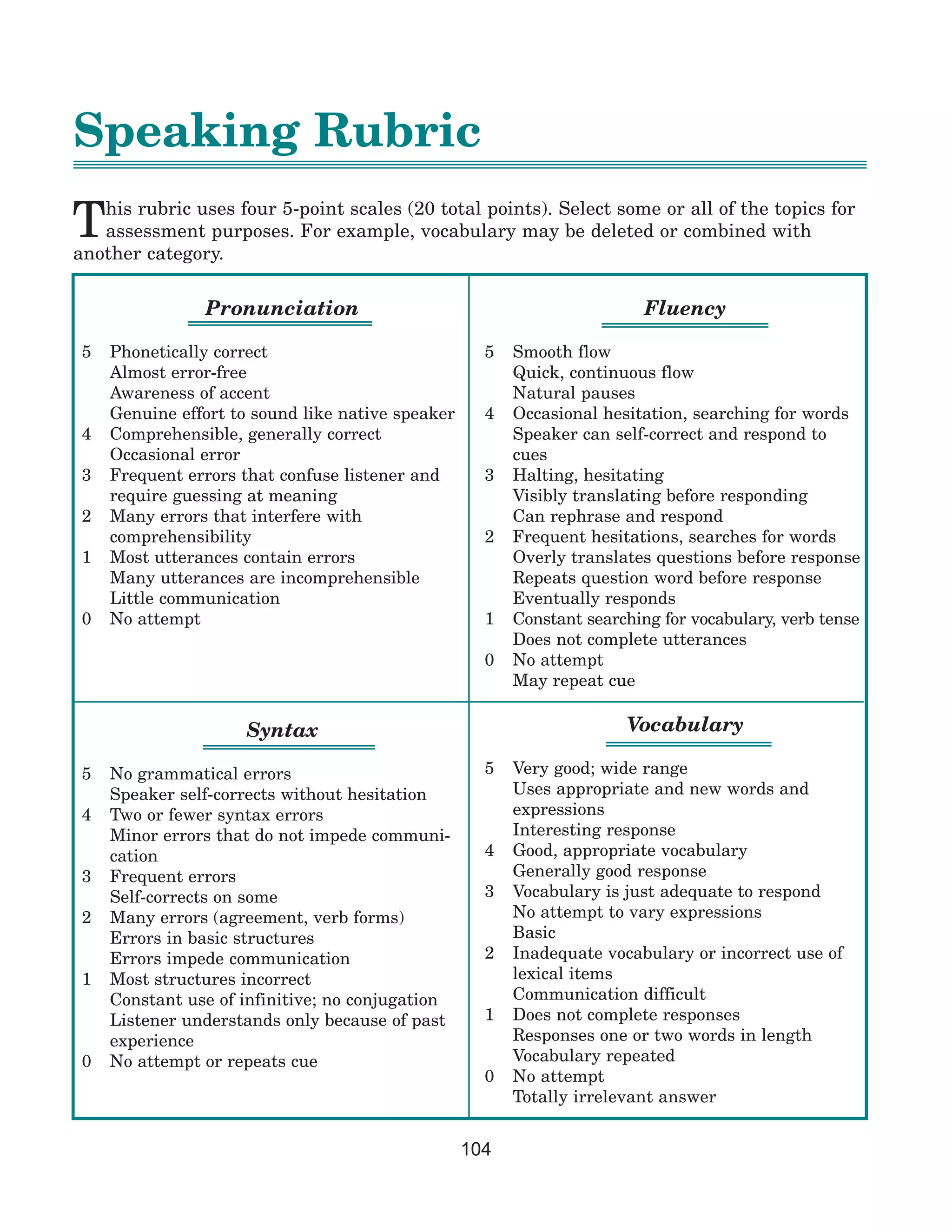
Speaking Rubric
This rubric uses four 5-point scales (20 total points). Select some or all of the topics for
assessment purposes. For example, vocabulary may be deleted or combined with
another category.
104
Pronunciation
5 Phonetically correct
Almost error-free
Awareness of accent
Genuine effort to sound like native speaker
4 Comprehensible, generally correct
Occasional error
3 Frequent errors that confuse listener and
require guessing at meaning
2 Many errors that interfere with
comprehensibility
1 Most utterances contain errors
Many utterances are incomprehensible
Little communication
0 No attempt
Syntax
5 No grammatical errors
Speaker self-corrects without hesitation
4 Two or fewer syntax errors
Minor errors that do not impede communi-
cation
3 Frequent errors
Self-corrects on some
2 Many errors (agreement, verb forms)
Errors in basic structures
Errors impede communication
1 Most structures incorrect
Constant use of infinitive; no conjugation
Listener understands only because of past
experience
0 No attempt or repeats cue
Fluency
5 Smooth flow
Quick, continuous flow
Natural pauses
4 Occasional hesitation, searching for words
Speaker can self-correct and respond to
cues
3 Halting, hesitating
Visibly translating before responding
Can rephrase and respond
2 Frequent hesitations, searches for words
Overly translates questions before response
Repeats question word before response
Eventually responds
1 Constant searching for vocabulary, verb tense
Does not complete utterances
0 No attempt
May repeat cue
Vocabulary
5 Very good; wide range
Uses appropriate and new words and
expressions
Interesting response
4 Good, appropriate vocabulary
Generally good response
3 Vocabulary is just adequate to respond
No attempt to vary expressions
Basic
2 Inadequate vocabulary or incorrect use of
lexical items
Communication difficult
1 Does not complete responses
Responses one or two words in length
Vocabulary repeated
0 No attempt
Totally irrelevant answer
Informal Speaking Rubric
105
The student: 4
Eagerly initiates speech, uti-
lizing appropriate attention-
getting devices. Easily asks
questions and speaks
spontaneously.
Almost always responds
appropriately to
questions/statements.
Clarifies and continues con-
versation, using all or some
of the following strategies:
• circumlocution
• survival strategies
• intonation
• self-correction
• verbal cues
• Incorporates a variety of
old and new vocabulary.
• Uses idiomatic expres-
sions appropriate to topic.
• Speaks clearly and
imitates accurate
pronunciation.
Makes few errors in the fol-
lowing areas:
• verbs in utterances when
necessary with appropri-
ate subject-verb agreement
• noun and adjective
agreement
• correct word order and
article adjectives
Errors do not hinder
comprehensibility.
Almost always uses/inter-
prets cultural manifestations
when appropriate to the task
(e.g., greeting, leave taking,
gestures, proximity, etc.).
3
Is willing to initiate speech,
utilizing appropriate
attention-getting devices.
Asks questions and speaks
evenly.
Frequently responds
appropriately to
questions/statements.
Uses all or some strategies,
but may need occasional
prompting.
• Utilizes a variety of old and
limited new vocabulary.
• Attempts to use idiomatic
expressions appropriate to
topic.
• Speaks clearly and
attempts accurate
pronunciation.
Makes several errors in
structure that do not affect
overall comprehensibility.
Frequently uses/interprets
cultural manifestations when
appropriate to the task.
2
Sometimes initiates speech,
using attention-getting
devices. Sometimes asks
questions and speaks
hesitantly.
Sometimes responds
appropriately to
questions/statements.
Uses some strategies and
needs frequent prompting to
further the conversation.
• Relies on basic vocabulary.
• Speech is comprehensible
in spite of
mispronunciations.
Makes several errors that
may interfere with
comprehensibility.
Sometimes uses/interprets
cultural manifestations when
appropriate to the task.
1
Is reluctant to initiate speech
and struggles to ask
questions. Speech is halting.
Rarely responds appropriately
to questions/statements.
Uses few strategies. Relies
heavily on conversation part-
ner to sustain conversation.
Rarely responds even with
frequent prompting.
• Uses limited vocabulary.
• Mispronunciations impede
comprehensibility.
Makes utterances that are so
brief that there is little
evidence of structure and
comprehensibility is impeded.
Rarely uses/interprets
cultural manifestations when
appropriate to the task.
Dimension
Initiation
Response
Conversational
Strategies
Vocabulary
Structure
Cultural
Appropriateness
A zero can be given in any of the above dimen-
sions when the student’s performance falls below
the criteria described for a score of “1.”
Conversion Chart
22-24 10 12-13 6 3-4 2
19-21 9 10-11 5 1-2 1
17-18 8 7-9 4
14-16 7 5-6 3
Guidelines for Speaking
Each utterance receives
In order to be scored, a student utterance at Checkpoint C must be:
• Comprehensible: Utterance makes sense to native speakers who know no English, but who are
accustomed to speaking with non-native speakers;
AND
• Appropriate: Utterance contributes to the completion of the task.
In order to receive TWO POINTS, a student utterance:
Contains a preponderance of the following attributes AND IS NOT a single, short, discrete utterance:
• Initiates and/or sustains and/or advances the conversation, but may contain repetition,
hesitation, or circumlocution.
• Uses common verb tense forms (including past, present, future), but may contain minor
errors in formation and selection.
• Uses accurate structure in simple constructions, but may contain errors in more complex ones.
• Is articulated comprehensibly, but with difficulty for certain sounds, or in certain positions or com-
binations.
• Uses a variety of vocabulary that is appropriate to the situation and may expand or
clarify meaning, but there may be minor inaccuracies.
• Is extended, but may contain short, discrete responses.
• Uses culturally correct gestures, social conventions, and/or idiomatic expressions when
appropriate.
Note: Each utterance does not have to satisfy all of the criteria articulated above in order to score two points. The quality of the utterance
should be predominantly characterized by these descriptors.
106
2 Points (Checkpoint C) if it is...
Comprehensible
AND
Appropriate
AND
Contains a preponderance of the
following Checkpoint C attributes:
• Initiates and/or sustains and/or
advances the conversation
• Uses common verb tense forms
(including, past, present, future)
• Uses accurate structure
• Is articulated comprehensibly
• Uses a variety of vocabulary that
may expand or clarify meaning
• Is extended (may contain more
than one short, discrete utterance)
• Uses culturally correct gestures,
social conventions, and/or
idiomatic expressions.
1 Point (Checkpoint B/C) if it is...
Comprehensible
AND
Appropriate
BUT
Is a single, short, discrete utter-
ance consisting exclusively of
Checkpoint B vocabulary/structures
OR
Contains little or no evidence of
Checkpoint C attributes (see
Checkpoint C)
0 Points if it is...
Incomprehensible
AND/OR
Inappropriate
Disregard if it is a...
• Yes/No response
• Socializing device
• Restatement of all or essential
parts of what the teacher said
• Proper noun(s) in isolation
107
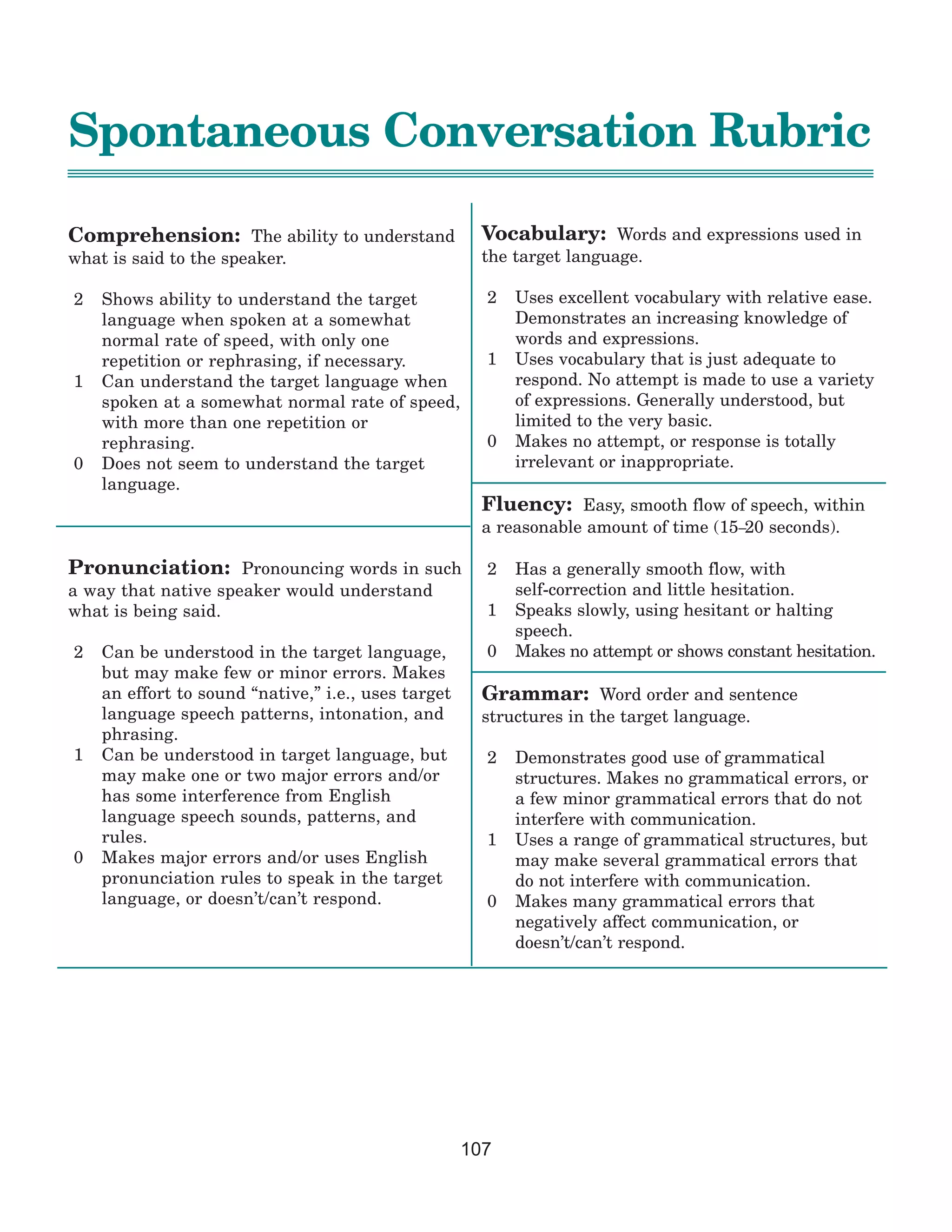
Spontaneous Conversation Rubric
Comprehension: The ability to understand
what is said to the speaker.
2 Shows ability to understand the target
language when spoken at a somewhat
normal rate of speed, with only one
repetition or rephrasing, if necessary.
1 Can understand the target language when
spoken at a somewhat normal rate of speed,
with more than one repetition or
rephrasing.
0 Does not seem to understand the target
language.
Pronunciation: Pronouncing words in such
a way that native speaker would understand
what is being said.
2 Can be understood in the target language,
but may make few or minor errors. Makes
an effort to sound “native,” i.e., uses target
language speech patterns, intonation, and
phrasing.
1 Can be understood in target language, but
may make one or two major errors and/or
has some interference from English
language speech sounds, patterns, and
rules.
0 Makes major errors and/or uses English
pronunciation rules to speak in the target
language, or doesn’t/can’t respond.
Vocabulary: Words and expressions used in
the target language.
2 Uses excellent vocabulary with relative ease.
Demonstrates an increasing knowledge of
words and expressions.
1 Uses vocabulary that is just adequate to
respond. No attempt is made to use a variety
of expressions. Generally understood, but
limited to the very basic.
0 Makes no attempt, or response is totally
irrelevant or inappropriate.
Fluency: Easy, smooth flow of speech, within
a reasonable amount of time (15–20 seconds).
2 Has a generally smooth flow, with
self-correction and little hesitation.
1 Speaks slowly, using hesitant or halting
speech.
0 Makes no attempt or shows constant hesitation.
Grammar: Word order and sentence
structures in the target language.
2 Demonstrates good use of grammatical
structures. Makes no grammatical errors, or
a few minor grammatical errors that do not
interfere with communication.
1 Uses a range of grammatical structures, but
may make several grammatical errors that
do not interfere with communication.
0 Makes many grammatical errors that
negatively affect communication, or
doesn’t/can’t respond.
108
Speaking Situations Rubric
Place a check next to the appropriate statement that accurately reflects the student’s
performance. Circle the overall rate that represents the student’s performance.
A. Pronunciation and Comprehension
1 Pronunciation Consistently interferes with comprehension of the message
Fluency Even with extraordinary effort on the part of the listener, understanding is difficult
2 Comprehension The student consistently fails to understand what is being said/asked
3 Pronunciation Often interferes with comprehension of the message
Fluency An effort is required on the part of the listener to understand what is being said
4 Comprehension The student understands less than half of what is said/asked; repetition and
rephrasing are often needed
5 Pronunciation Only occasionally interferes with comprehension of the message
Fluency Ideas are expressed without excessive pauses at a speed that may occasionally
distract the listener
6 Comprehension The student understands most of what is said/asked
7 Pronunciation Seldom interferes with comprehension of the message
Fluency Ideas are expressed with few pauses at a speed that rarely distracts the listener
8 Comprehension The student has a good overall understanding of what is said/asked
9 Pronunciation Very rarely interferes with comprehension of the message
Fluency Ideas are expressed without unnatural pauses and at a natural speed
10 Comprehension The student understands virtually everything that is said/asked
B. Vocabulary and Grammar
1 Vocabulary The vocabulary is inadequate; there is no idiomatic feel
2 Accuracy Errors often interfere with the message
3 Vocabulary Uses a limited range of vocabulary; there are very few idiomatic expressions
4 Accuracy Errors at times interfere with message
5 Vocabulary Uses a range of vocabulary appropriate to the theme under discussion; uses some
idiomatic expressions
6 Accuracy Errors seldom interfere with the message
7 Vocabulary Uses a wide range of vocabulary appropriate to the theme under discussion; most
expressions have an idiomatic feel to them
8 Accuracy Errors never interfere with the message
Score A Score B Final Score:
rate
check
rate
check
109
Storytelling Rubric
Place a check next to the appropriate statement that accurately reflects the student’s
performance. Circle the overall rate that represents the student’s performance.
A. Pronunciation and Comprehension
1 Pronunciation Consistently interferes with comprehension of the message
Fluency/pace Even with extraordinary effort on the part of the listener, understanding is difficult
2 Comprehension The student consistently fails to understand what is being read
3 Pronunciation Often interferes with comprehension of the message
Fluency/pace An effort is required on the part of the listener to understand what is being said
4 Comprehension The student understands less than half of what is read; stops and repetitions are often
needed
5 Pronunciation Only occasionally interferes with comprehension of the message
Fluency/pace Sentences are read without excessive pauses at a speed that may occasionally distract
the listener
6 Comprehension The student understands most of what is read
7 Pronunciation Seldom interferes with comprehension of the message
Fluency/pace Sentences are read with few pauses at a speed that rarely distracts the listener
8 Comprehension The student has a good overall understanding of what is read
9 Pronunciation Very rarely interferes with comprehension of the message
Fluency/pace Sentences are read without unnatural pauses and at a natural speed
10 Comprehension The student understands virtually everything that is read
B. Expression and Response
1 Tone of voice Monochord, no expression
2 Audience’s response Nonexistent, no eye contact, unresponsive/fidgety
3 Tone of voice Limited variations of expression
4 Audience’s response Limited eye contact, somewhat responsive
5 Tone of voice Varied/appropriate expression
6 Audience’s response Eye contact, audience is responsive
7 Tone of voice Wide range of expression
8 Audience’s response Very responsive, anticipating, participating
Score A Score B Final Score:
rate
check
rate
check
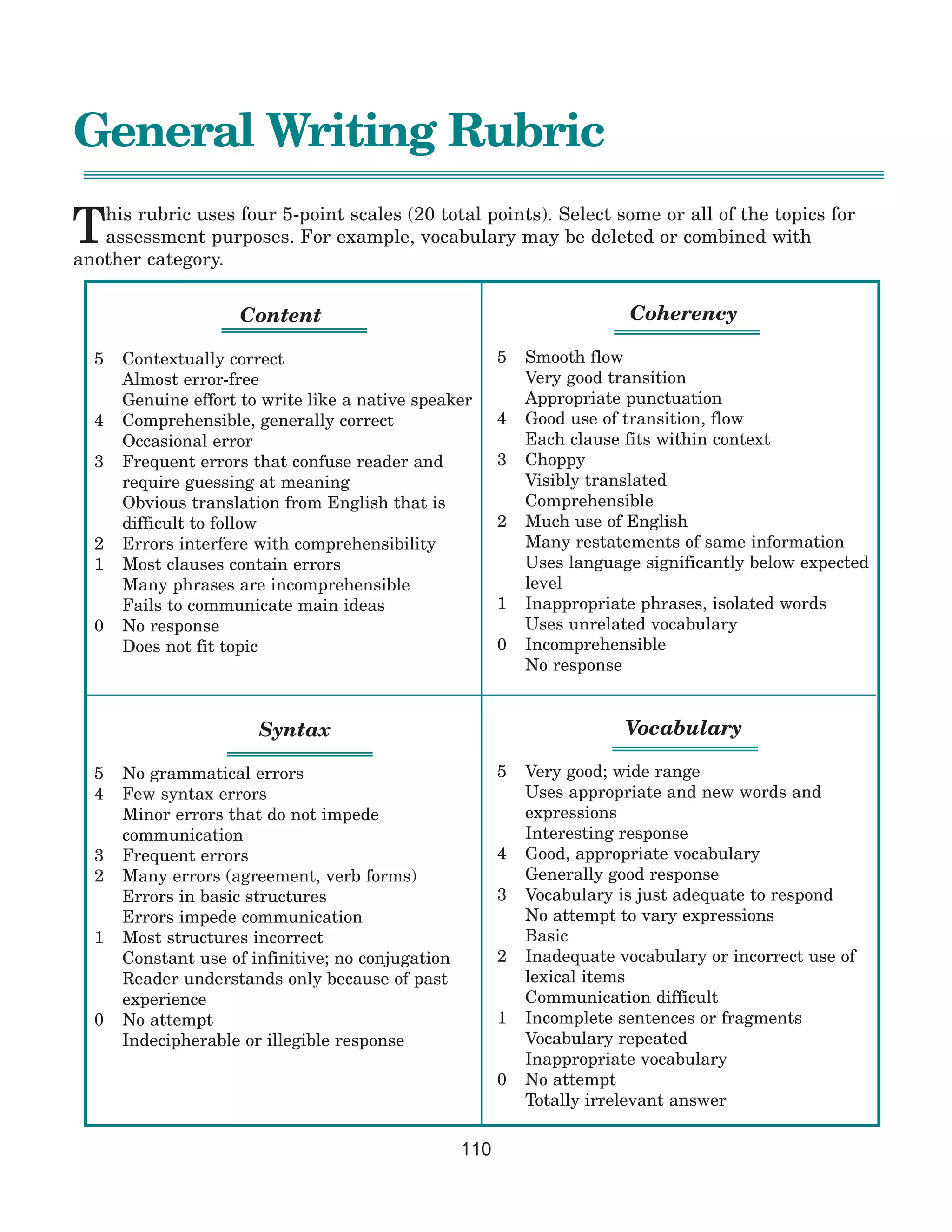
General Writing Rubric
This rubric uses four 5-point scales (20 total points). Select some or all of the topics for
assessment purposes. For example, vocabulary may be deleted or combined with
another category.
110
Content
5 Contextually correct
Almost error-free
Genuine effort to write like a native speaker
4 Comprehensible, generally correct
Occasional error
3 Frequent errors that confuse reader and
require guessing at meaning
Obvious translation from English that is
difficult to follow
2 Errors interfere with comprehensibility
1 Most clauses contain errors
Many phrases are incomprehensible
Fails to communicate main ideas
0 No response
Does not fit topic
Syntax
5 No grammatical errors
4 Few syntax errors
Minor errors that do not impede
communication
3 Frequent errors
2 Many errors (agreement, verb forms)
Errors in basic structures
Errors impede communication
1 Most structures incorrect
Constant use of infinitive; no conjugation
Reader understands only because of past
experience
0 No attempt
Indecipherable or illegible response
Coherency
5 Smooth flow
Very good transition
Appropriate punctuation
4 Good use of transition, flow
Each clause fits within context
3 Choppy
Visibly translated
Comprehensible
2 Much use of English
Many restatements of same information
Uses language significantly below expected
level
1 Inappropriate phrases, isolated words
Uses unrelated vocabulary
0 Incomprehensible
No response
Vocabulary
5 Very good; wide range
Uses appropriate and new words and
expressions
Interesting response
4 Good, appropriate vocabulary
Generally good response
3 Vocabulary is just adequate to respond
No attempt to vary expressions
Basic
2 Inadequate vocabulary or incorrect use of
lexical items
Communication difficult
1 Incomplete sentences or fragments
Vocabulary repeated
Inappropriate vocabulary
0 No attempt
Totally irrelevant answer
Writing Rubric
Essays, Compositions, Letters, Journals, Stories, Reactions, Summaries
5 Well-organized and articulated. Most of this written piece is appropriate and comprehensible.
Shows subject-verb agreement, noun-adjective agreement (number and gender), makes a
conscious effort to use accents, very few spelling errors. Makes use of new vocabulary and
structures. Attempts to use a wide range of vocabulary. Interesting to read.
4 Well-organized. Appropriate and comprehensible in most parts. Communication is not affected
by interference from English. This piece contains more than a few grammatical errors in
agreement, tense, accents, etc. Good use of vocabulary and structures.
3 Expresses some ideas on the topic. Elements are appropriate and comprehensible. Contains
more than a few grammatical errors. No conscious effort to use accents. Adequate use of
vocabulary but could use more new words and structures.
2 Not very well-organized and ideas are poorly expressed even though it may be comprehensible.
Communication may be hindered by inadequate vocabulary and lack of proper use of irregular
verb forms, spelling errors (accents lacking), and other basic errors.
1 This piece is not acceptable for Checkpoint C level.
Vocabulary
5 Very good vocabulary. Uses a wide range. Makes use of appropriate and new words and
expressions. Interesting, creative response.
4 Good vocabulary. Makes use of appropriate words and some new lexical items. Generally good
response.
3 Vocabulary is just adequate to respond. No attempt made to use a variety of expressions.
Generally understood but limited to the very basic.
2 Inadequate vocabulary or incorrect use of lexical items, leading to a lack of communication.
1 Does not complete answers due to the lack of vocabulary. Answers tend to be one or two words
in length.
Syntax
5 No grammatical errors.
4 One or two errors in structure. They are very minor and do not interfere with communication.
3 More than a few grammatical errors
2 Many errors in agreement (noun-adjective and number and gender), inappropriate verb forms
used. These errors occur in structures that are basic at this level. Errors affect communication.
1 Most structures are incorrect. Constant use of the infinitive form of the verb, no evidence of
knowledge of conjugation.
111
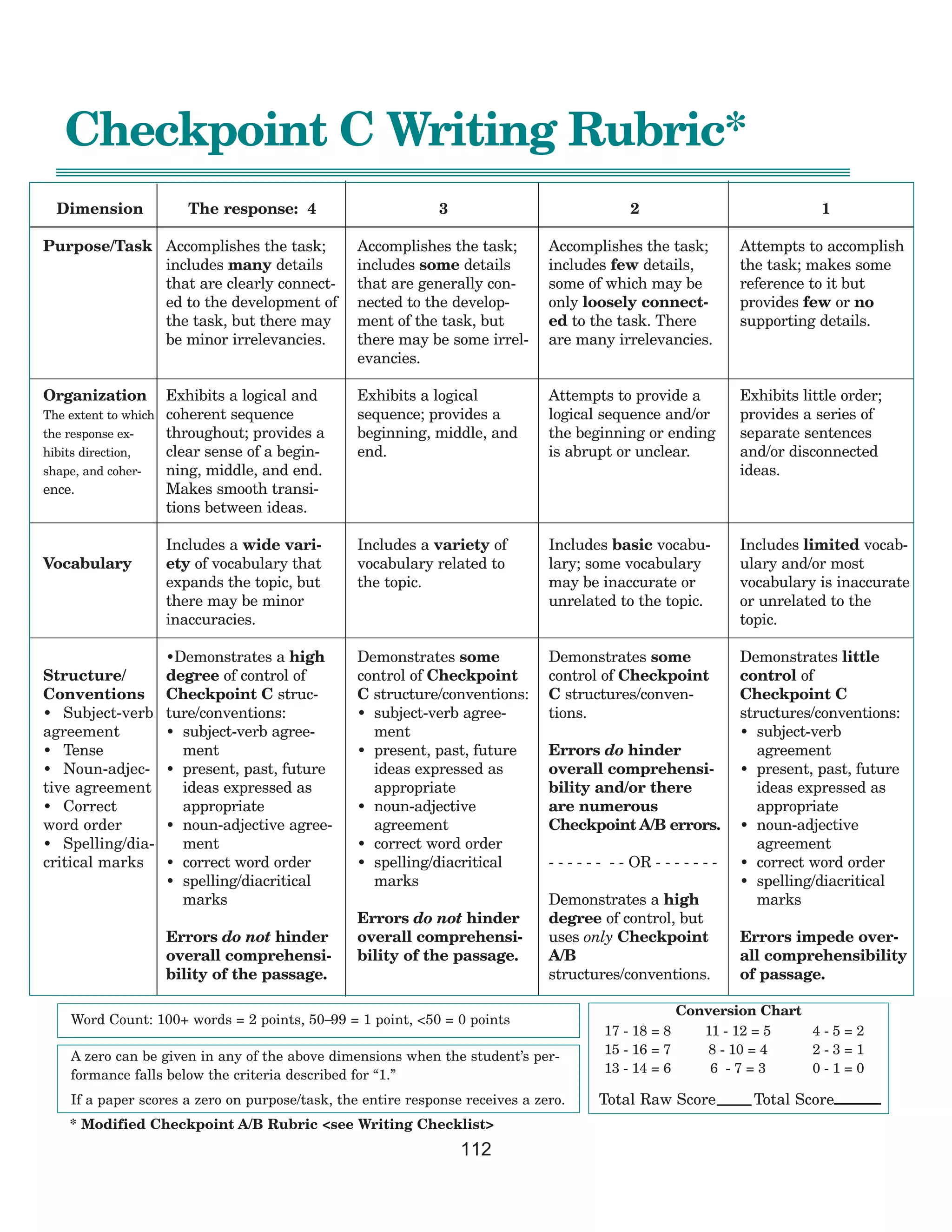
112
* Modified Checkpoint A/B Rubric <see Writing Checklist>
Checkpoint C Writing Rubric*
The response: 4
Accomplishes the task;
includes many details
that are clearly connect-
ed to the development of
the task, but there may
be minor irrelevancies.
Exhibits a logical and
coherent sequence
throughout; provides a
clear sense of a begin-
ning, middle, and end.
Makes smooth transi-
tions between ideas.
Includes a wide vari-
ety of vocabulary that
expands the topic, but
there may be minor
inaccuracies.
•Demonstrates a high
degree of control of
Checkpoint C struc-
ture/conventions:
• subject-verb agree-
ment
• present, past, future
ideas expressed as
appropriate
• noun-adjective agree-
ment
• correct word order
• spelling/diacritical
marks
Errors do not hinder
overall comprehensi-
bility of the passage.
3
Accomplishes the task;
includes some details
that are generally con-
nected to the develop-
ment of the task, but
there may be some irrel-
evancies.
Exhibits a logical
sequence; provides a
beginning, middle, and
end.
Includes a variety of
vocabulary related to
the topic.
Demonstrates some
control of Checkpoint
C structure/conventions:
• subject-verb agree-
ment
• present, past, future
ideas expressed as
appropriate
• noun-adjective
agreement
• correct word order
• spelling/diacritical
marks
Errors do not hinder
overall comprehensi-
bility of the passage.
2
Accomplishes the task;
includes few details,
some of which may be
only loosely connect-
ed to the task. There
are many irrelevancies.
Attempts to provide a
logical sequence and/or
the beginning or ending
is abrupt or unclear.
Includes basic vocabu-
lary; some vocabulary
may be inaccurate or
unrelated to the topic.
Demonstrates some
control of Checkpoint
C structures/conven-
tions.
Errors do hinder
overall comprehensi-
bility and/or there
are numerous
Checkpoint A/B errors.
- - - - - - - - OR - - - - - - -
Demonstrates a high
degree of control, but
uses only Checkpoint
A/B
structures/conventions.
1
Attempts to accomplish
the task; makes some
reference to it but
provides few or no
supporting details.
Exhibits little order;
provides a series of
separate sentences
and/or disconnected
ideas.
Includes limited vocab-
ulary and/or most
vocabulary is inaccurate
or unrelated to the
topic.
Demonstrates little
control of
Checkpoint C
structures/conventions:
• subject-verb
agreement
• present, past, future
ideas expressed as
appropriate
• noun-adjective
agreement
• correct word order
• spelling/diacritical
marks
Errors impede over-
all comprehensibility
of passage.
Dimension
Purpose/Task
Organization
The extent to which
the response ex-
hibits direction,
shape, and coher-
ence.
Vocabulary
Structure/
Conventions
• Subject-verb
agreement
• Tense
• Noun-adjec-
tive agreement
• Correct
word order
• Spelling/dia-
critical marks
A zero can be given in any of the above dimensions when the student’s per-
formance falls below the criteria described for “1.”
If a paper scores a zero on purpose/task, the entire response receives a zero.
Word Count: 100+ words = 2 points, 50–99 = 1 point, <50 = 0 points
Conversion Chart
17 - 18 = 8
15 - 16 = 7
13 - 14 = 6
11 - 12 = 5
8 - 10 = 4
6 - 7 = 3
4 - 5 = 2
2 - 3 = 1
0 - 1 = 0
Total Raw Score Total Score
113
French
Île St. Louis = 3 words
La Tour Eiffel = 3 words
La Eiffel Tower = 2
words
Paris = 1 word
L’hôpital = 1 word
Jacques = 0 words
des États-Unis = 2 words
les Galleries Lafayettes =
3 words
J’ai = 1 word (verb con-
tractions = 1 word)
German
Josef = 0 words
Auf Wiedersehen = 2
words
Wie geht’s = 2 words
Deutschland = 1 word
München = 1 word
Marktplatz = 1 word
Fanta = 1 word
Sprite = 0 words
Italian
Giuseppe = 0 words
Il Colosseo = 2 words
Venezia = 1 word
nell ’aula = 1 word
la Coca-cola = 1 word
fare lo shopping = 3
words
all ’una = 1 word
alle tre = 2 words
d’estate = 1 word
in primavera = 2 words
Spanish
Nueva York = 2 words
el Corte Inglés = 3 words
La Universidad de
Salamanca = 4 words
José = 0 words
La Torre Pendente = 3
words
Word Count Guidelines
• Names of people do not count.
• Place names and brand names from the target culture count as words; all other places (K-Mart) and brand
names (Coke, Pepsi) are disregarded.
• Contractions are one word.
• Salutations and closings in notes written in the target language are counted. (There is no penalty if stu-
dents do not use salutations or closings.)
• Commonly used abbreviations in target language are counted.
Definition: A word is a letter or collection of letters, surrounded by space, which in the
target language is comprehensible, and contributes to the development of the task. This defi-
nition holds even when words are grammatically incorrect.
Example: à le (French) = 2 words; de el (Spanish) = 2 words
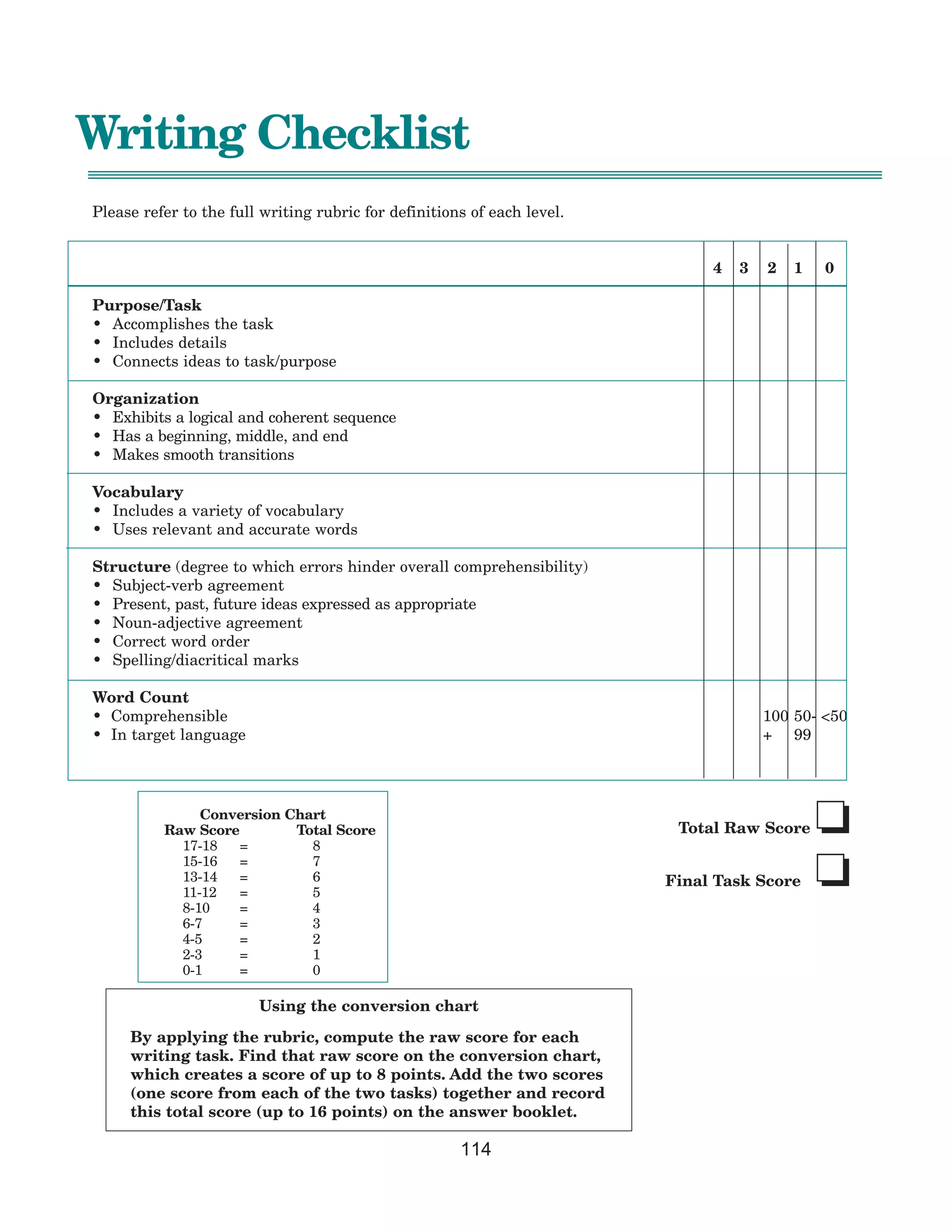
114
Please refer to the full writing rubric for definitions of each level.
4 3 2 1 0
Purpose/Task
• Accomplishes the task
• Includes details
• Connects ideas to task/purpose
Organization
• Exhibits a logical and coherent sequence
• Has a beginning, middle, and end
• Makes smooth transitions
Vocabulary
• Includes a variety of vocabulary
• Uses relevant and accurate words
Structure (degree to which errors hinder overall comprehensibility)
• Subject-verb agreement
• Present, past, future ideas expressed as appropriate
• Noun-adjective agreement
• Correct word order
• Spelling/diacritical marks
Word Count
• Comprehensible 100 50- <50
• In target language + 99
Total Raw Score ❏
Final Task Score ❏
Conversion Chart
Raw Score Total Score
17-18 = 8
15-16 = 7
13-14 = 6
11-12 = 5
8-10 = 4
6-7 = 3
4-5 = 2
2-3 = 1
0-1 = 0
Using the conversion chart
By applying the rubric, compute the raw score for each
writing task. Find that raw score on the conversion chart,
which creates a score of up to 8 points. Add the two scores
(one score from each of the two tasks) together and record
this total score (up to 16 points) on the answer booklet.
Writing Checklist

Dave

  • 1.
  • 2.
  • 3.
    Introduction The following sampleassessment rubrics can be modified by the teacher to match the unit activities of LOTE Checkpoint C. The sample rubrics define expectations for speaking and writing. Assessment rubrics should accomplish three goals: • inform the students of standards and expectations • inform the students about levels of achievement • inform the students about specific areas in need of improvement. Since the LOTE Checkpoint C level does not have formal standardized assessments, it is important that the teacher create some form of evaluation so that students are informed about their progress. Teachers are encouraged to modify the enclosed rubrics or create their own, so that grades are not the only form of student assessment. Checkpoint C classroom teachers may prefer to distribute assessment rubrics at the beginning of a unit, so that students are aware of expectations and understand how their work will be evaluated. The following rubrics, guidelines, and checklist are used in conjunction with the New York State LOTE assessments: • Informal Speaking Rubric • Guidelines for Speaking • Checkpoint C Writing Rubric • Word Count Guidelines • Writing Checklist. 103
  • 4.
    Speaking Rubric This rubricuses four 5-point scales (20 total points). Select some or all of the topics for assessment purposes. For example, vocabulary may be deleted or combined with another category. 104 Pronunciation 5 Phonetically correct Almost error-free Awareness of accent Genuine effort to sound like native speaker 4 Comprehensible, generally correct Occasional error 3 Frequent errors that confuse listener and require guessing at meaning 2 Many errors that interfere with comprehensibility 1 Most utterances contain errors Many utterances are incomprehensible Little communication 0 No attempt Syntax 5 No grammatical errors Speaker self-corrects without hesitation 4 Two or fewer syntax errors Minor errors that do not impede communi- cation 3 Frequent errors Self-corrects on some 2 Many errors (agreement, verb forms) Errors in basic structures Errors impede communication 1 Most structures incorrect Constant use of infinitive; no conjugation Listener understands only because of past experience 0 No attempt or repeats cue Fluency 5 Smooth flow Quick, continuous flow Natural pauses 4 Occasional hesitation, searching for words Speaker can self-correct and respond to cues 3 Halting, hesitating Visibly translating before responding Can rephrase and respond 2 Frequent hesitations, searches for words Overly translates questions before response Repeats question word before response Eventually responds 1 Constant searching for vocabulary, verb tense Does not complete utterances 0 No attempt May repeat cue Vocabulary 5 Very good; wide range Uses appropriate and new words and expressions Interesting response 4 Good, appropriate vocabulary Generally good response 3 Vocabulary is just adequate to respond No attempt to vary expressions Basic 2 Inadequate vocabulary or incorrect use of lexical items Communication difficult 1 Does not complete responses Responses one or two words in length Vocabulary repeated 0 No attempt Totally irrelevant answer
  • 5.
    Informal Speaking Rubric 105 Thestudent: 4 Eagerly initiates speech, uti- lizing appropriate attention- getting devices. Easily asks questions and speaks spontaneously. Almost always responds appropriately to questions/statements. Clarifies and continues con- versation, using all or some of the following strategies: • circumlocution • survival strategies • intonation • self-correction • verbal cues • Incorporates a variety of old and new vocabulary. • Uses idiomatic expres- sions appropriate to topic. • Speaks clearly and imitates accurate pronunciation. Makes few errors in the fol- lowing areas: • verbs in utterances when necessary with appropri- ate subject-verb agreement • noun and adjective agreement • correct word order and article adjectives Errors do not hinder comprehensibility. Almost always uses/inter- prets cultural manifestations when appropriate to the task (e.g., greeting, leave taking, gestures, proximity, etc.). 3 Is willing to initiate speech, utilizing appropriate attention-getting devices. Asks questions and speaks evenly. Frequently responds appropriately to questions/statements. Uses all or some strategies, but may need occasional prompting. • Utilizes a variety of old and limited new vocabulary. • Attempts to use idiomatic expressions appropriate to topic. • Speaks clearly and attempts accurate pronunciation. Makes several errors in structure that do not affect overall comprehensibility. Frequently uses/interprets cultural manifestations when appropriate to the task. 2 Sometimes initiates speech, using attention-getting devices. Sometimes asks questions and speaks hesitantly. Sometimes responds appropriately to questions/statements. Uses some strategies and needs frequent prompting to further the conversation. • Relies on basic vocabulary. • Speech is comprehensible in spite of mispronunciations. Makes several errors that may interfere with comprehensibility. Sometimes uses/interprets cultural manifestations when appropriate to the task. 1 Is reluctant to initiate speech and struggles to ask questions. Speech is halting. Rarely responds appropriately to questions/statements. Uses few strategies. Relies heavily on conversation part- ner to sustain conversation. Rarely responds even with frequent prompting. • Uses limited vocabulary. • Mispronunciations impede comprehensibility. Makes utterances that are so brief that there is little evidence of structure and comprehensibility is impeded. Rarely uses/interprets cultural manifestations when appropriate to the task. Dimension Initiation Response Conversational Strategies Vocabulary Structure Cultural Appropriateness A zero can be given in any of the above dimen- sions when the student’s performance falls below the criteria described for a score of “1.” Conversion Chart 22-24 10 12-13 6 3-4 2 19-21 9 10-11 5 1-2 1 17-18 8 7-9 4 14-16 7 5-6 3
  • 6.
    Guidelines for Speaking Eachutterance receives In order to be scored, a student utterance at Checkpoint C must be: • Comprehensible: Utterance makes sense to native speakers who know no English, but who are accustomed to speaking with non-native speakers; AND • Appropriate: Utterance contributes to the completion of the task. In order to receive TWO POINTS, a student utterance: Contains a preponderance of the following attributes AND IS NOT a single, short, discrete utterance: • Initiates and/or sustains and/or advances the conversation, but may contain repetition, hesitation, or circumlocution. • Uses common verb tense forms (including past, present, future), but may contain minor errors in formation and selection. • Uses accurate structure in simple constructions, but may contain errors in more complex ones. • Is articulated comprehensibly, but with difficulty for certain sounds, or in certain positions or com- binations. • Uses a variety of vocabulary that is appropriate to the situation and may expand or clarify meaning, but there may be minor inaccuracies. • Is extended, but may contain short, discrete responses. • Uses culturally correct gestures, social conventions, and/or idiomatic expressions when appropriate. Note: Each utterance does not have to satisfy all of the criteria articulated above in order to score two points. The quality of the utterance should be predominantly characterized by these descriptors. 106 2 Points (Checkpoint C) if it is... Comprehensible AND Appropriate AND Contains a preponderance of the following Checkpoint C attributes: • Initiates and/or sustains and/or advances the conversation • Uses common verb tense forms (including, past, present, future) • Uses accurate structure • Is articulated comprehensibly • Uses a variety of vocabulary that may expand or clarify meaning • Is extended (may contain more than one short, discrete utterance) • Uses culturally correct gestures, social conventions, and/or idiomatic expressions. 1 Point (Checkpoint B/C) if it is... Comprehensible AND Appropriate BUT Is a single, short, discrete utter- ance consisting exclusively of Checkpoint B vocabulary/structures OR Contains little or no evidence of Checkpoint C attributes (see Checkpoint C) 0 Points if it is... Incomprehensible AND/OR Inappropriate Disregard if it is a... • Yes/No response • Socializing device • Restatement of all or essential parts of what the teacher said • Proper noun(s) in isolation
  • 7.
    107 Spontaneous Conversation Rubric Comprehension:The ability to understand what is said to the speaker. 2 Shows ability to understand the target language when spoken at a somewhat normal rate of speed, with only one repetition or rephrasing, if necessary. 1 Can understand the target language when spoken at a somewhat normal rate of speed, with more than one repetition or rephrasing. 0 Does not seem to understand the target language. Pronunciation: Pronouncing words in such a way that native speaker would understand what is being said. 2 Can be understood in the target language, but may make few or minor errors. Makes an effort to sound “native,” i.e., uses target language speech patterns, intonation, and phrasing. 1 Can be understood in target language, but may make one or two major errors and/or has some interference from English language speech sounds, patterns, and rules. 0 Makes major errors and/or uses English pronunciation rules to speak in the target language, or doesn’t/can’t respond. Vocabulary: Words and expressions used in the target language. 2 Uses excellent vocabulary with relative ease. Demonstrates an increasing knowledge of words and expressions. 1 Uses vocabulary that is just adequate to respond. No attempt is made to use a variety of expressions. Generally understood, but limited to the very basic. 0 Makes no attempt, or response is totally irrelevant or inappropriate. Fluency: Easy, smooth flow of speech, within a reasonable amount of time (15–20 seconds). 2 Has a generally smooth flow, with self-correction and little hesitation. 1 Speaks slowly, using hesitant or halting speech. 0 Makes no attempt or shows constant hesitation. Grammar: Word order and sentence structures in the target language. 2 Demonstrates good use of grammatical structures. Makes no grammatical errors, or a few minor grammatical errors that do not interfere with communication. 1 Uses a range of grammatical structures, but may make several grammatical errors that do not interfere with communication. 0 Makes many grammatical errors that negatively affect communication, or doesn’t/can’t respond.
  • 8.
    108 Speaking Situations Rubric Placea check next to the appropriate statement that accurately reflects the student’s performance. Circle the overall rate that represents the student’s performance. A. Pronunciation and Comprehension 1 Pronunciation Consistently interferes with comprehension of the message Fluency Even with extraordinary effort on the part of the listener, understanding is difficult 2 Comprehension The student consistently fails to understand what is being said/asked 3 Pronunciation Often interferes with comprehension of the message Fluency An effort is required on the part of the listener to understand what is being said 4 Comprehension The student understands less than half of what is said/asked; repetition and rephrasing are often needed 5 Pronunciation Only occasionally interferes with comprehension of the message Fluency Ideas are expressed without excessive pauses at a speed that may occasionally distract the listener 6 Comprehension The student understands most of what is said/asked 7 Pronunciation Seldom interferes with comprehension of the message Fluency Ideas are expressed with few pauses at a speed that rarely distracts the listener 8 Comprehension The student has a good overall understanding of what is said/asked 9 Pronunciation Very rarely interferes with comprehension of the message Fluency Ideas are expressed without unnatural pauses and at a natural speed 10 Comprehension The student understands virtually everything that is said/asked B. Vocabulary and Grammar 1 Vocabulary The vocabulary is inadequate; there is no idiomatic feel 2 Accuracy Errors often interfere with the message 3 Vocabulary Uses a limited range of vocabulary; there are very few idiomatic expressions 4 Accuracy Errors at times interfere with message 5 Vocabulary Uses a range of vocabulary appropriate to the theme under discussion; uses some idiomatic expressions 6 Accuracy Errors seldom interfere with the message 7 Vocabulary Uses a wide range of vocabulary appropriate to the theme under discussion; most expressions have an idiomatic feel to them 8 Accuracy Errors never interfere with the message Score A Score B Final Score: rate check rate check
  • 9.
    109 Storytelling Rubric Place acheck next to the appropriate statement that accurately reflects the student’s performance. Circle the overall rate that represents the student’s performance. A. Pronunciation and Comprehension 1 Pronunciation Consistently interferes with comprehension of the message Fluency/pace Even with extraordinary effort on the part of the listener, understanding is difficult 2 Comprehension The student consistently fails to understand what is being read 3 Pronunciation Often interferes with comprehension of the message Fluency/pace An effort is required on the part of the listener to understand what is being said 4 Comprehension The student understands less than half of what is read; stops and repetitions are often needed 5 Pronunciation Only occasionally interferes with comprehension of the message Fluency/pace Sentences are read without excessive pauses at a speed that may occasionally distract the listener 6 Comprehension The student understands most of what is read 7 Pronunciation Seldom interferes with comprehension of the message Fluency/pace Sentences are read with few pauses at a speed that rarely distracts the listener 8 Comprehension The student has a good overall understanding of what is read 9 Pronunciation Very rarely interferes with comprehension of the message Fluency/pace Sentences are read without unnatural pauses and at a natural speed 10 Comprehension The student understands virtually everything that is read B. Expression and Response 1 Tone of voice Monochord, no expression 2 Audience’s response Nonexistent, no eye contact, unresponsive/fidgety 3 Tone of voice Limited variations of expression 4 Audience’s response Limited eye contact, somewhat responsive 5 Tone of voice Varied/appropriate expression 6 Audience’s response Eye contact, audience is responsive 7 Tone of voice Wide range of expression 8 Audience’s response Very responsive, anticipating, participating Score A Score B Final Score: rate check rate check
  • 10.
    General Writing Rubric Thisrubric uses four 5-point scales (20 total points). Select some or all of the topics for assessment purposes. For example, vocabulary may be deleted or combined with another category. 110 Content 5 Contextually correct Almost error-free Genuine effort to write like a native speaker 4 Comprehensible, generally correct Occasional error 3 Frequent errors that confuse reader and require guessing at meaning Obvious translation from English that is difficult to follow 2 Errors interfere with comprehensibility 1 Most clauses contain errors Many phrases are incomprehensible Fails to communicate main ideas 0 No response Does not fit topic Syntax 5 No grammatical errors 4 Few syntax errors Minor errors that do not impede communication 3 Frequent errors 2 Many errors (agreement, verb forms) Errors in basic structures Errors impede communication 1 Most structures incorrect Constant use of infinitive; no conjugation Reader understands only because of past experience 0 No attempt Indecipherable or illegible response Coherency 5 Smooth flow Very good transition Appropriate punctuation 4 Good use of transition, flow Each clause fits within context 3 Choppy Visibly translated Comprehensible 2 Much use of English Many restatements of same information Uses language significantly below expected level 1 Inappropriate phrases, isolated words Uses unrelated vocabulary 0 Incomprehensible No response Vocabulary 5 Very good; wide range Uses appropriate and new words and expressions Interesting response 4 Good, appropriate vocabulary Generally good response 3 Vocabulary is just adequate to respond No attempt to vary expressions Basic 2 Inadequate vocabulary or incorrect use of lexical items Communication difficult 1 Incomplete sentences or fragments Vocabulary repeated Inappropriate vocabulary 0 No attempt Totally irrelevant answer
  • 11.
    Writing Rubric Essays, Compositions,Letters, Journals, Stories, Reactions, Summaries 5 Well-organized and articulated. Most of this written piece is appropriate and comprehensible. Shows subject-verb agreement, noun-adjective agreement (number and gender), makes a conscious effort to use accents, very few spelling errors. Makes use of new vocabulary and structures. Attempts to use a wide range of vocabulary. Interesting to read. 4 Well-organized. Appropriate and comprehensible in most parts. Communication is not affected by interference from English. This piece contains more than a few grammatical errors in agreement, tense, accents, etc. Good use of vocabulary and structures. 3 Expresses some ideas on the topic. Elements are appropriate and comprehensible. Contains more than a few grammatical errors. No conscious effort to use accents. Adequate use of vocabulary but could use more new words and structures. 2 Not very well-organized and ideas are poorly expressed even though it may be comprehensible. Communication may be hindered by inadequate vocabulary and lack of proper use of irregular verb forms, spelling errors (accents lacking), and other basic errors. 1 This piece is not acceptable for Checkpoint C level. Vocabulary 5 Very good vocabulary. Uses a wide range. Makes use of appropriate and new words and expressions. Interesting, creative response. 4 Good vocabulary. Makes use of appropriate words and some new lexical items. Generally good response. 3 Vocabulary is just adequate to respond. No attempt made to use a variety of expressions. Generally understood but limited to the very basic. 2 Inadequate vocabulary or incorrect use of lexical items, leading to a lack of communication. 1 Does not complete answers due to the lack of vocabulary. Answers tend to be one or two words in length. Syntax 5 No grammatical errors. 4 One or two errors in structure. They are very minor and do not interfere with communication. 3 More than a few grammatical errors 2 Many errors in agreement (noun-adjective and number and gender), inappropriate verb forms used. These errors occur in structures that are basic at this level. Errors affect communication. 1 Most structures are incorrect. Constant use of the infinitive form of the verb, no evidence of knowledge of conjugation. 111
  • 12.
    112 * Modified CheckpointA/B Rubric <see Writing Checklist> Checkpoint C Writing Rubric* The response: 4 Accomplishes the task; includes many details that are clearly connect- ed to the development of the task, but there may be minor irrelevancies. Exhibits a logical and coherent sequence throughout; provides a clear sense of a begin- ning, middle, and end. Makes smooth transi- tions between ideas. Includes a wide vari- ety of vocabulary that expands the topic, but there may be minor inaccuracies. •Demonstrates a high degree of control of Checkpoint C struc- ture/conventions: • subject-verb agree- ment • present, past, future ideas expressed as appropriate • noun-adjective agree- ment • correct word order • spelling/diacritical marks Errors do not hinder overall comprehensi- bility of the passage. 3 Accomplishes the task; includes some details that are generally con- nected to the develop- ment of the task, but there may be some irrel- evancies. Exhibits a logical sequence; provides a beginning, middle, and end. Includes a variety of vocabulary related to the topic. Demonstrates some control of Checkpoint C structure/conventions: • subject-verb agree- ment • present, past, future ideas expressed as appropriate • noun-adjective agreement • correct word order • spelling/diacritical marks Errors do not hinder overall comprehensi- bility of the passage. 2 Accomplishes the task; includes few details, some of which may be only loosely connect- ed to the task. There are many irrelevancies. Attempts to provide a logical sequence and/or the beginning or ending is abrupt or unclear. Includes basic vocabu- lary; some vocabulary may be inaccurate or unrelated to the topic. Demonstrates some control of Checkpoint C structures/conven- tions. Errors do hinder overall comprehensi- bility and/or there are numerous Checkpoint A/B errors. - - - - - - - - OR - - - - - - - Demonstrates a high degree of control, but uses only Checkpoint A/B structures/conventions. 1 Attempts to accomplish the task; makes some reference to it but provides few or no supporting details. Exhibits little order; provides a series of separate sentences and/or disconnected ideas. Includes limited vocab- ulary and/or most vocabulary is inaccurate or unrelated to the topic. Demonstrates little control of Checkpoint C structures/conventions: • subject-verb agreement • present, past, future ideas expressed as appropriate • noun-adjective agreement • correct word order • spelling/diacritical marks Errors impede over- all comprehensibility of passage. Dimension Purpose/Task Organization The extent to which the response ex- hibits direction, shape, and coher- ence. Vocabulary Structure/ Conventions • Subject-verb agreement • Tense • Noun-adjec- tive agreement • Correct word order • Spelling/dia- critical marks A zero can be given in any of the above dimensions when the student’s per- formance falls below the criteria described for “1.” If a paper scores a zero on purpose/task, the entire response receives a zero. Word Count: 100+ words = 2 points, 50–99 = 1 point, <50 = 0 points Conversion Chart 17 - 18 = 8 15 - 16 = 7 13 - 14 = 6 11 - 12 = 5 8 - 10 = 4 6 - 7 = 3 4 - 5 = 2 2 - 3 = 1 0 - 1 = 0 Total Raw Score Total Score
  • 13.
    113 French Île St. Louis= 3 words La Tour Eiffel = 3 words La Eiffel Tower = 2 words Paris = 1 word L’hôpital = 1 word Jacques = 0 words des États-Unis = 2 words les Galleries Lafayettes = 3 words J’ai = 1 word (verb con- tractions = 1 word) German Josef = 0 words Auf Wiedersehen = 2 words Wie geht’s = 2 words Deutschland = 1 word München = 1 word Marktplatz = 1 word Fanta = 1 word Sprite = 0 words Italian Giuseppe = 0 words Il Colosseo = 2 words Venezia = 1 word nell ’aula = 1 word la Coca-cola = 1 word fare lo shopping = 3 words all ’una = 1 word alle tre = 2 words d’estate = 1 word in primavera = 2 words Spanish Nueva York = 2 words el Corte Inglés = 3 words La Universidad de Salamanca = 4 words José = 0 words La Torre Pendente = 3 words Word Count Guidelines • Names of people do not count. • Place names and brand names from the target culture count as words; all other places (K-Mart) and brand names (Coke, Pepsi) are disregarded. • Contractions are one word. • Salutations and closings in notes written in the target language are counted. (There is no penalty if stu- dents do not use salutations or closings.) • Commonly used abbreviations in target language are counted. Definition: A word is a letter or collection of letters, surrounded by space, which in the target language is comprehensible, and contributes to the development of the task. This defi- nition holds even when words are grammatically incorrect. Example: à le (French) = 2 words; de el (Spanish) = 2 words
  • 14.
    114 Please refer tothe full writing rubric for definitions of each level. 4 3 2 1 0 Purpose/Task • Accomplishes the task • Includes details • Connects ideas to task/purpose Organization • Exhibits a logical and coherent sequence • Has a beginning, middle, and end • Makes smooth transitions Vocabulary • Includes a variety of vocabulary • Uses relevant and accurate words Structure (degree to which errors hinder overall comprehensibility) • Subject-verb agreement • Present, past, future ideas expressed as appropriate • Noun-adjective agreement • Correct word order • Spelling/diacritical marks Word Count • Comprehensible 100 50- <50 • In target language + 99 Total Raw Score ❏ Final Task Score ❏ Conversion Chart Raw Score Total Score 17-18 = 8 15-16 = 7 13-14 = 6 11-12 = 5 8-10 = 4 6-7 = 3 4-5 = 2 2-3 = 1 0-1 = 0 Using the conversion chart By applying the rubric, compute the raw score for each writing task. Find that raw score on the conversion chart, which creates a score of up to 8 points. Add the two scores (one score from each of the two tasks) together and record this total score (up to 16 points) on the answer booklet. Writing Checklist