Spain after 1492
WHERE WE ARE IN PLACE AND TIME
The reign of Catholic Monarchs
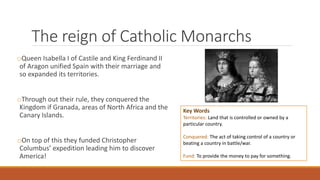
oQueen Isabella I of Castile and King Ferdinand II
of Aragon unified Spain with their marriage and
so expanded its territories.
oThrough out their rule, they conquered the
Kingdom if Granada, areas of North Africa and the
Canary Islands.
oOn top of this they funded Christopher
Columbus’ expedition leading him to discover
America!
Key Words
Territories: Land that is controlled or owned by a
particular country.
Conquered: The act of taking control of a country or
beating a country in battle/war.
Fund: To provide the money to pay for something.
The Spanish empire 1516
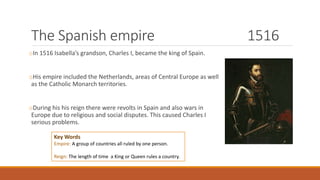
oIn 1516 Isabella’s grandson, Charles I, became the king of Spain.
oHis empire included the Netherlands, areas of Central Europe as well
as the Catholic Monarch territories.
oDuring his his reign there were revolts in Spain and also wars in
Europe due to religious and social disputes. This caused Charles I
serious problems.
Key Words
Empire: A group of countries all ruled by one person.
Reign: The length of time a King or Queen rules a country.
The Spanish empire 1556
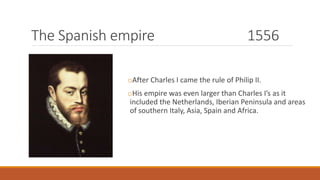
oAfter Charles I came the rule of Philip II.
oHis empire was even larger than Charles I’s as it
included the Netherlands, Iberian Peninsula and areas
of southern Italy, Asia, Spain and Africa.
The Spanish empire 1556
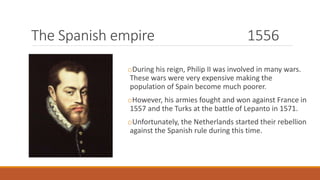
oDuring his reign, Philip II was involved in many wars.
These wars were very expensive making the
population of Spain become much poorer.
oHowever, his armies fought and won against France in
1557 and the Turks at the battle of Lepanto in 1571.
oUnfortunately, the Netherlands started their rebellion
against the Spanish rule during this time.
The Culture of the Golden Age
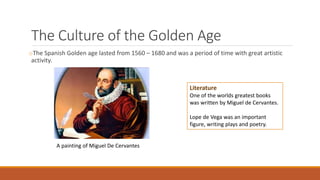
oThe Spanish Golden age lasted from 1560 – 1680 and was a period of time with great artistic
activity.
Literature
One of the worlds greatest books
was written by Miguel de Cervantes.
Lope de Vega was an important
figure, writing plays and poetry.
A painting of Miguel De Cervantes
The Culture of the Golden Age
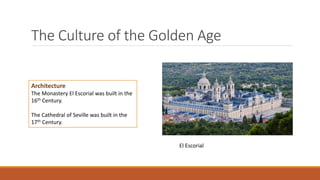
Architecture
The Monastery El Escorial was built in the
16th Century.
The Cathedral of Seville was built in the
17th Century.
El Escorial
The Culture of the Golden Age
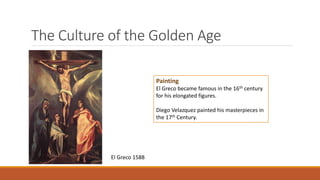
Painting
El Greco became famous in the 16th century
for his elongated figures.
Diego Velazquez painted his masterpieces in
the 17th Century.
El Greco 1588
The 17th century crisis
oIn the 17th Century, there were three Habsburg Kings;
o Philip III (1598-1621)
o Philip IV (1621-1665)
o Charles II (1665-1700)
oAll of these kings chose ministers. These ministers became extremely powerful.
oThis was a time of military and political decline. Spain lost the Netherlands and Portugal and
there were also revolts in Catalonia.
Key Words
Minister: A politician who holds an
important position of power.
Bourbon Spain
oCharles II died in 1700 with no children, and so no heir to the throne.
oThere was a dispute about who should become king or queen by two royal families: the French
Bourbons and the Austrian Habsburgs.
oBetween 1701 and 1714 countries in Europe fought in the Spanish War of Succession. At the
end of this war the Philip V the French Bourbon became King of Spain.
Key Words
Heir: Someone who will get another persons money or
belongings (in this case the throne) once that person dies.
The Bourbon Monarchy
oPhilip V established an absolute monarchy. This is when the government holds all the power.
oMany changes were made during this time by Philip V, Charles III and Charles IV who were the
first Bourbon kings.
oThese changes included allocating secretaries of state, who would help the king with
government related activities like tax collecting and the organisation of armies.
Science and culture in the 18th Century
oIn the 18th century, interest in culture
and science increased.
oDaily newspapers appeared
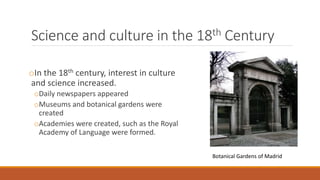
oMuseums and botanical gardens were
created
oAcademies were created, such as the Royal
Academy of Language were formed.
Botanical Gardens of Madrid
The 19th Century- Spanish war of
independence.
oNapoleon Bonaparte, the Emperor of France, invaded Spain in 1808.
oAfter a victory, Napoleons brother Joseph Bonaparte became king. Opposition
to his reign led to the Spanish war of independence.
oDuring this war, members of the Spanish parliament wrote the Constitution of
Cadiz which limited the Kings power and established the rights of citizens
including the right to vote for men aged 25 or older.
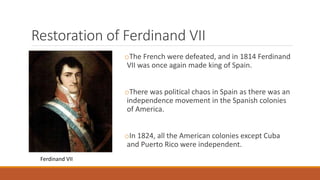
Restoration of Ferdinand VII
oThe French were defeated, and in 1814 Ferdinand
VII was once again made king of Spain.
oThere was political chaos in Spain as there was an
independence movement in the Spanish colonies
of America.
oIn 1824, all the American colonies except Cuba
and Puerto Rico were independent.
Ferdinand VII
Conservatism and Liberalism
oIsabella II, Ferdinand’s daughter, came to the throne in 1833.
During her reign there were conflicts between the conservatives and
liberals.
oConservatives are individuals with traditional values, and wanted an absolute
monarchy.
oLiberals wanted to modernise the country. They wanted limitations on the
powers of the monarch.
oIn 1873 the First Spanish Republic was made but it lasted less than a
year. Finally in 1874 the monarchy was restored under Isabella’s son,
Alfonso XII.
Resources
www.Dictionary.com
Essential Science 6 (Richmond Publishing).

Spain after 1492

  • 1.
    Spain after 1492 WHEREWE ARE IN PLACE AND TIME
  • 2.
    The reign ofCatholic Monarchs oQueen Isabella I of Castile and King Ferdinand II of Aragon unified Spain with their marriage and so expanded its territories. oThrough out their rule, they conquered the Kingdom if Granada, areas of North Africa and the Canary Islands. oOn top of this they funded Christopher Columbus’ expedition leading him to discover America! Key Words Territories: Land that is controlled or owned by a particular country. Conquered: The act of taking control of a country or beating a country in battle/war. Fund: To provide the money to pay for something.
  • 3.
    The Spanish empire1516 oIn 1516 Isabella’s grandson, Charles I, became the king of Spain. oHis empire included the Netherlands, areas of Central Europe as well as the Catholic Monarch territories. oDuring his his reign there were revolts in Spain and also wars in Europe due to religious and social disputes. This caused Charles I serious problems. Key Words Empire: A group of countries all ruled by one person. Reign: The length of time a King or Queen rules a country.
  • 4.
    The Spanish empire1556 oAfter Charles I came the rule of Philip II. oHis empire was even larger than Charles I’s as it included the Netherlands, Iberian Peninsula and areas of southern Italy, Asia, Spain and Africa.
  • 5.
    The Spanish empire1556 oDuring his reign, Philip II was involved in many wars. These wars were very expensive making the population of Spain become much poorer. oHowever, his armies fought and won against France in 1557 and the Turks at the battle of Lepanto in 1571. oUnfortunately, the Netherlands started their rebellion against the Spanish rule during this time.
  • 6.
    The Culture ofthe Golden Age oThe Spanish Golden age lasted from 1560 – 1680 and was a period of time with great artistic activity. Literature One of the worlds greatest books was written by Miguel de Cervantes. Lope de Vega was an important figure, writing plays and poetry. A painting of Miguel De Cervantes
  • 7.
    The Culture ofthe Golden Age Architecture The Monastery El Escorial was built in the 16th Century. The Cathedral of Seville was built in the 17th Century. El Escorial
  • 8.
    The Culture ofthe Golden Age Painting El Greco became famous in the 16th century for his elongated figures. Diego Velazquez painted his masterpieces in the 17th Century. El Greco 1588
  • 9.
    The 17th centurycrisis oIn the 17th Century, there were three Habsburg Kings; o Philip III (1598-1621) o Philip IV (1621-1665) o Charles II (1665-1700) oAll of these kings chose ministers. These ministers became extremely powerful. oThis was a time of military and political decline. Spain lost the Netherlands and Portugal and there were also revolts in Catalonia. Key Words Minister: A politician who holds an important position of power.
  • 10.
    Bourbon Spain oCharles IIdied in 1700 with no children, and so no heir to the throne. oThere was a dispute about who should become king or queen by two royal families: the French Bourbons and the Austrian Habsburgs. oBetween 1701 and 1714 countries in Europe fought in the Spanish War of Succession. At the end of this war the Philip V the French Bourbon became King of Spain. Key Words Heir: Someone who will get another persons money or belongings (in this case the throne) once that person dies.
  • 11.
    The Bourbon Monarchy oPhilipV established an absolute monarchy. This is when the government holds all the power. oMany changes were made during this time by Philip V, Charles III and Charles IV who were the first Bourbon kings. oThese changes included allocating secretaries of state, who would help the king with government related activities like tax collecting and the organisation of armies.
  • 12.
    Science and culturein the 18th Century oIn the 18th century, interest in culture and science increased. oDaily newspapers appeared oMuseums and botanical gardens were created oAcademies were created, such as the Royal Academy of Language were formed. Botanical Gardens of Madrid
  • 13.
    The 19th Century-Spanish war of independence. oNapoleon Bonaparte, the Emperor of France, invaded Spain in 1808. oAfter a victory, Napoleons brother Joseph Bonaparte became king. Opposition to his reign led to the Spanish war of independence. oDuring this war, members of the Spanish parliament wrote the Constitution of Cadiz which limited the Kings power and established the rights of citizens including the right to vote for men aged 25 or older.
  • 14.
    Restoration of FerdinandVII oThe French were defeated, and in 1814 Ferdinand VII was once again made king of Spain. oThere was political chaos in Spain as there was an independence movement in the Spanish colonies of America. oIn 1824, all the American colonies except Cuba and Puerto Rico were independent. Ferdinand VII
  • 15.
    Conservatism and Liberalism oIsabellaII, Ferdinand’s daughter, came to the throne in 1833. During her reign there were conflicts between the conservatives and liberals. oConservatives are individuals with traditional values, and wanted an absolute monarchy. oLiberals wanted to modernise the country. They wanted limitations on the powers of the monarch. oIn 1873 the First Spanish Republic was made but it lasted less than a year. Finally in 1874 the monarchy was restored under Isabella’s son, Alfonso XII.
  • 16.