Contemporary Age:
XIX Century
CEIP ALMIRANTE LAULHÉ
1.
The War of Independence
◉ In 1808, Napoleon Bonaparte, the Emperor of
France, decided to occupy Portugal.
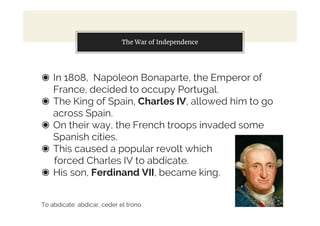
◉ The King of Spain, Charles IV, allowed him to go
across Spain.
◉ On their way, the French troops invaded some
Spanish cities.
◉ This caused a popular revolt which
forced Charles IV to abdicate.
◉ His son, Ferdinand VII, became king.
To abdicate: abdicar, ceder el trono
The War of Independence
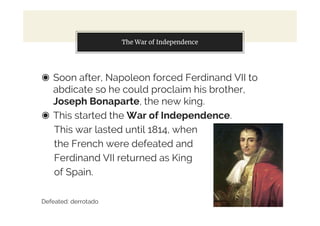
◉ Soon after, Napoleon forced Ferdinand VII to
abdicate so he could proclaim his brother,
Joseph Bonaparte, the new king.
◉ This started the War of Independence.
This war lasted until 1814, when
the French were defeated and
Ferdinand VII returned as King
of Spain.
Defeated: derrotado
The War of Independence
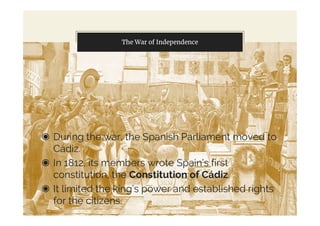
◉ During the war, the Spanish Parliament moved to
Cádiz.
◉ In 1812, its members wrote Spain’s first
constitution, the Constitution of Cádiz.
◉ It limited the king’s power and established rights
for the citizens.
2.
The reign of Ferdinand VII
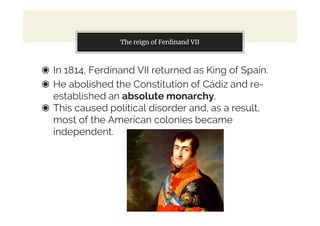
◉ In 1814, Ferdinand VII returned as King of Spain.
◉ He abolished the Constitution of Cádiz and re-
established an absolute monarchy.
◉ This caused political disorder and, as a result,
most of the American colonies became
independent.
3.
The reign of Isabella II
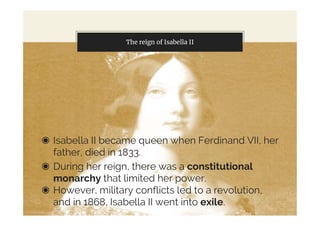
◉ Isabella II became queen when Ferdinand VII, her
father, died in 1833.
◉ During her reign, there was a constitutional
monarchy that limited her power.
◉ However, military conflicts led to a revolution,
and in 1868, Isabella II went into exile.
4.
The First Spanish Republic
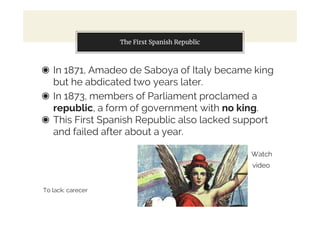
◉ In 1871, Amadeo de Saboya of Italy became king
but he abdicated two years later.
◉ In 1873, members of Parliament proclamed a
republic, a form of government with no king.
◉ This First Spanish Republic also lacked support
and failed after about a year.
Watch
video
To lack: carecer
5.
The Spanish Restoration
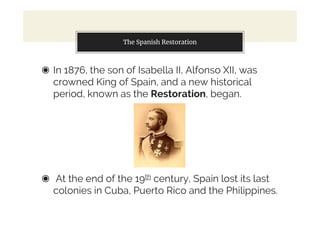
◉ In 1876, the son of Isabella II, Alfonso XII, was
crowned King of Spain, and a new historical
period, known as the Restoration, began.
◉ At the end of the 19th century, Spain lost its last
colonies in Cuba, Puerto Rico and the Philippines.
NOW IT’S YOUR TURN!
Make a timeline of Spanish monarchs in
the 19th century. Include the years they
ruled and important events.
This is an example of timeline.
6.
Life in the 19th century
The Industrial Revolution
originated in Great Britain at
the end of the 18th century,
and then it extended to other
countries. In Spain, the
Industrial Revolution took
place in the 19th century.
Factories were built mainly
in Catalonia and the Basque
Country.
You can also split your content
Small craftsmen’s workshops
were replaced by factories
with machines operated by
workers. The steam engine
was invented and a new
energy source, coal, was
used. Thanks to the steam
engine, trains and
steamboats were
developed, and new
machines allowed the textile
and metal industries to
advance dramatically.
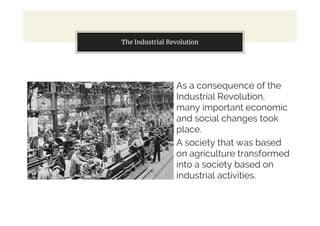
The Industrial Revolution
As a consequence of the
Industrial Revolution,
many important economic
and social changes took
place.
A society that was based
on agriculture transformed
into a society based on
industrial activities.
You can also split your contentThe Industrial Revolution
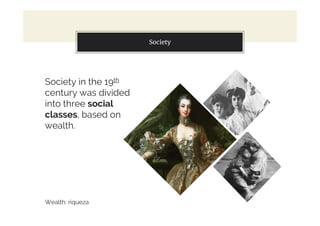
Society
Society in the 19th
century was divided
into three social
classes, based on
wealth.
Wealth: riqueza
In two or three columns
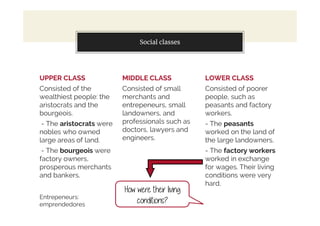
UPPER CLASS
Consisted of the
wealthiest people: the
aristocrats and the
bourgeois.
- The aristocrats were
nobles who owned
large areas of land.
- The bourgeois were
factory owners,
prosperous merchants
and bankers.
Entrepeneurs:
emprendedores
MIDDLE CLASS
Consisted of small
merchants and
entrepeneurs, small
landowners, and
professionals such as
doctors, lawyers and
engineers.
LOWER CLASS
Consisted of poorer
people, such as
peasants and factory
workers.
- The peasants
worked on the land of
the large landowners.
- The factory workers
worked in exchange
for wages. Their living
conditions were very
hard.
Social classes
How were their living
conditions?
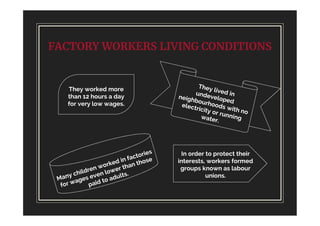
FACTORY WORKERS LIVING CONDITIONS
They worked more
than 12 hours a day
for very low wages.
In order to protect their
interests, workers formed
groups known as labour
unions.
Do you
realize how
lucky you
are?
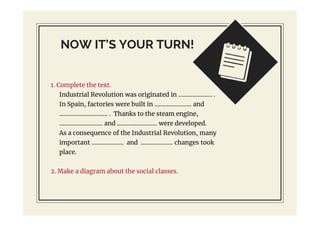
NOW IT’S YOUR TURN!
1. Complete the text.
Industrial Revolution was originated in ..................... .
In Spain, factories were built in ....................... and
.............................. . Thanks to the steam engine,
........................... and ......................... were developed.
As a consequence of the Industrial Revolution, many
important .................... and .................... changes took
place.
2. Make a diagram about the social classes.

Contemporary age

  • 1.
  • 2.
    1. The War ofIndependence
  • 3.
    The War ofIndependence ◉ In 1808, Napoleon Bonaparte, the Emperor of France, decided to occupy Portugal. ◉ The King of Spain, Charles IV, allowed him to go across Spain. ◉ On their way, the French troops invaded some Spanish cities. ◉ This caused a popular revolt which forced Charles IV to abdicate. ◉ His son, Ferdinand VII, became king. To abdicate: abdicar, ceder el trono
  • 4.
    The War ofIndependence ◉ Soon after, Napoleon forced Ferdinand VII to abdicate so he could proclaim his brother, Joseph Bonaparte, the new king. ◉ This started the War of Independence. This war lasted until 1814, when the French were defeated and Ferdinand VII returned as King of Spain. Defeated: derrotado
  • 5.
    The War ofIndependence ◉ During the war, the Spanish Parliament moved to Cádiz. ◉ In 1812, its members wrote Spain’s first constitution, the Constitution of Cádiz. ◉ It limited the king’s power and established rights for the citizens.
  • 6.
    2. The reign ofFerdinand VII
  • 7.
    The reign ofFerdinand VII ◉ In 1814, Ferdinand VII returned as King of Spain. ◉ He abolished the Constitution of Cádiz and re- established an absolute monarchy. ◉ This caused political disorder and, as a result, most of the American colonies became independent.
  • 8.
    3. The reign ofIsabella II
  • 9.
    The reign ofIsabella II ◉ Isabella II became queen when Ferdinand VII, her father, died in 1833. ◉ During her reign, there was a constitutional monarchy that limited her power. ◉ However, military conflicts led to a revolution, and in 1868, Isabella II went into exile.
  • 10.
  • 11.
    The First SpanishRepublic ◉ In 1871, Amadeo de Saboya of Italy became king but he abdicated two years later. ◉ In 1873, members of Parliament proclamed a republic, a form of government with no king. ◉ This First Spanish Republic also lacked support and failed after about a year. Watch video To lack: carecer
  • 12.
  • 13.
    The Spanish Restoration ◉In 1876, the son of Isabella II, Alfonso XII, was crowned King of Spain, and a new historical period, known as the Restoration, began. ◉ At the end of the 19th century, Spain lost its last colonies in Cuba, Puerto Rico and the Philippines.
  • 14.
    NOW IT’S YOURTURN! Make a timeline of Spanish monarchs in the 19th century. Include the years they ruled and important events.
  • 15.
    This is anexample of timeline.
  • 16.
    6. Life in the19th century
  • 17.
    The Industrial Revolution originatedin Great Britain at the end of the 18th century, and then it extended to other countries. In Spain, the Industrial Revolution took place in the 19th century. Factories were built mainly in Catalonia and the Basque Country. You can also split your content Small craftsmen’s workshops were replaced by factories with machines operated by workers. The steam engine was invented and a new energy source, coal, was used. Thanks to the steam engine, trains and steamboats were developed, and new machines allowed the textile and metal industries to advance dramatically. The Industrial Revolution
  • 18.
    As a consequenceof the Industrial Revolution, many important economic and social changes took place. A society that was based on agriculture transformed into a society based on industrial activities. You can also split your contentThe Industrial Revolution
  • 19.
    Society Society in the19th century was divided into three social classes, based on wealth. Wealth: riqueza
  • 20.
    In two orthree columns UPPER CLASS Consisted of the wealthiest people: the aristocrats and the bourgeois. - The aristocrats were nobles who owned large areas of land. - The bourgeois were factory owners, prosperous merchants and bankers. Entrepeneurs: emprendedores MIDDLE CLASS Consisted of small merchants and entrepeneurs, small landowners, and professionals such as doctors, lawyers and engineers. LOWER CLASS Consisted of poorer people, such as peasants and factory workers. - The peasants worked on the land of the large landowners. - The factory workers worked in exchange for wages. Their living conditions were very hard. Social classes How were their living conditions?
  • 21.
    FACTORY WORKERS LIVINGCONDITIONS They worked more than 12 hours a day for very low wages. In order to protect their interests, workers formed groups known as labour unions.
  • 22.
  • 23.
    NOW IT’S YOURTURN! 1. Complete the text. Industrial Revolution was originated in ..................... . In Spain, factories were built in ....................... and .............................. . Thanks to the steam engine, ........................... and ......................... were developed. As a consequence of the Industrial Revolution, many important .................... and .................... changes took place. 2. Make a diagram about the social classes.