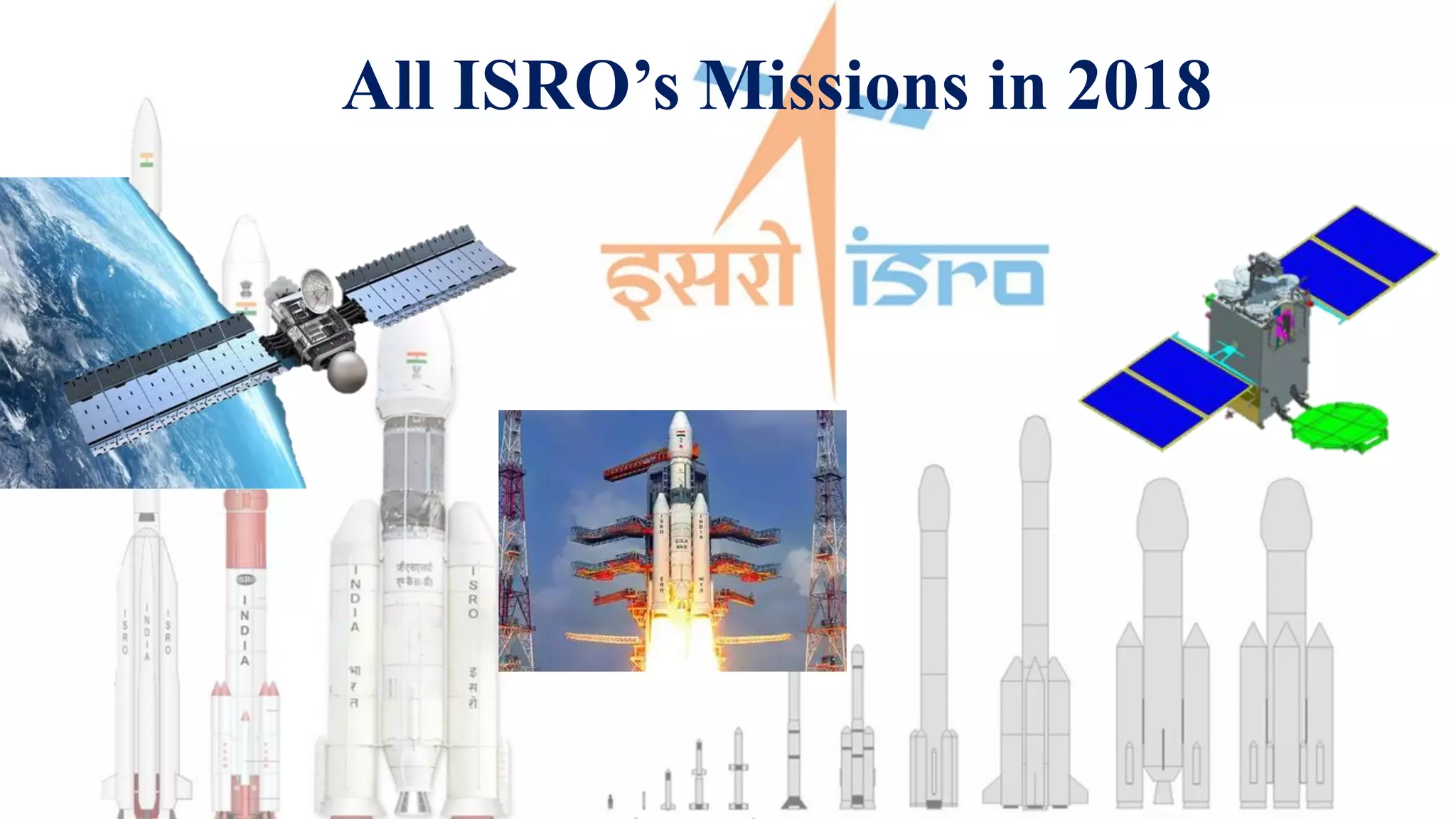
All ISRO’s Missions in 2018
Indian Space Research Organisation abbreviated as ISRO is the Space Agency of Government of India.
Founded on 15 August,1969 and is the only Government Space Organisation of India. It stands with its vision
to "harness space technology for national development while pursuing space science research and planetary
exploration."
From launching its first satellite “Aryabhata” from a Russian Spacecraft “C1-Intercosmos” in 1975 to becoming
the First Space Agency to launch 104 satellites from its “PSLV-C37” in one go in 2017, the ISRO has made its
name.
ISRO has so far conducted 110 missions with the help of its 71 Spacecrafts. Out of the 110, 9 missions were
concluded in 2018.
Lets have a look at all the missions in 2018.
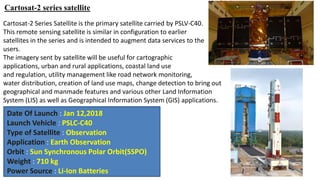
Cartosat-2 series satellite
Cartosat-2 Series Satellite is the primary satellite carried by PSLV-C40.
This remote sensing satellite is similar in configuration to earlier
satellites in the series and is intended to augment data services to the
users.
The imagery sent by satellite will be useful for cartographic
applications, urban and rural applications, coastal land use
and regulation, utility management like road network monitoring,
water distribution, creation of land use maps, change detection to bring out
geographical and manmade features and various other Land Information
System (LIS) as well as Geographical Information System (GIS) applications.
Date Of Launch : Jan 12,2018
Launch Vehicle : PSLC-C40
Type of Satellite : Observation
Application : Earth Observation
Orbit : Sun Synchronous Polar Orbit(SSPO)
Weight : 710 kg
Power Source : Li-Ion Batteries
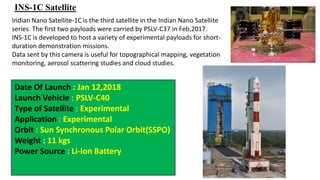
INS-1C Satellite
Indian Nano Satellite-1C is the third satellite in the Indian Nano Satellite
series. The first two payloads were carried by PSLV-C37 in Feb,2017.
INS-1C is developed to host a variety of experimental payloads for short-
duration demonstration missions.
Data sent by this camera is useful for topographical mapping, vegetation
monitoring, aerosol scattering studies and cloud studies.
Date Of Launch : Jan 12,2018
Launch Vehicle : PSLV-C40
Type of Satellite : Experimental
Application : Experimental
Orbit : Sun Synchronous Polar Orbit(SSPO)
Weight : 11 kgs
Power Source : Li-Ion Battery
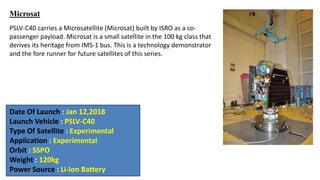
Microsat
PSLV-C40 carries a Microsatellite (Microsat) built by ISRO as a co-
passenger payload. Microsat is a small satellite in the 100 kg class that
derives its heritage from IMS-1 bus. This is a technology demonstrator
and the fore runner for future satellites of this series.
Date Of Launch : Jan 12,2018
Launch Vehicle : PSLV-C40
Type Of Satellite : Experimental
Application : Experimental
Orbit : SSPO
Weight : 120kg
Power Source : Li-Ion Battery
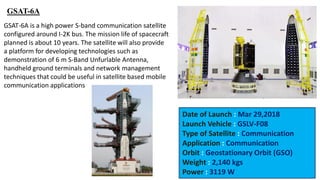
GSAT-6A
GSAT-6A is a high power S-band communication satellite
configured around I-2K bus. The mission life of spacecraft
planned is about 10 years. The satellite will also provide
a platform for developing technologies such as
demonstration of 6 m S-Band Unfurlable Antenna,
handheld ground terminals and network management
techniques that could be useful in satellite based mobile
communication applications
Date of Launch : Mar 29,2018
Launch Vehicle : GSLV-F08
Type of Satellite : Communication
Application : Communication
Orbit : Geostationary Orbit (GSO)
Weight : 2,140 kgs
Power : 3119 W
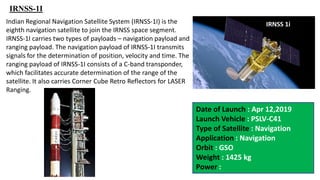
IRNSS-1I
Indian Regional Navigation Satellite System (IRNSS-1I) is the
eighth navigation satellite to join the IRNSS space segment.
IRNSS-1I carries two types of payloads – navigation payload and
ranging payload. The navigation payload of IRNSS-1I transmits
signals for the determination of position, velocity and time. The
ranging payload of IRNSS-1I consists of a C-band transponder,
which facilitates accurate determination of the range of the
satellite. It also carries Corner Cube Retro Reflectors for LASER
Ranging.
Date of Launch : Apr 12,2019
Launch Vehicle : PSLV-C41
Type of Satellite : Navigation
Application : Navigation
Orbit : GSO
Weight : 1425 kg
Power :
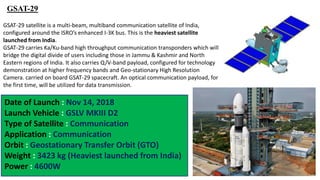
GSAT-29
GSAT-29 satellite is a multi-beam, multiband communication satellite of India,
configured around the ISRO’s enhanced I-3K bus. This is the heaviest satellite
launched from India.
GSAT-29 carries Ka/Ku-band high throughput communication transponders which will
bridge the digital divide of users including those in Jammu & Kashmir and North
Eastern regions of India. It also carries Q/V-band payload, configured for technology
demonstration at higher frequency bands and Geo-stationary High Resolution
Camera. carried on board GSAT-29 spacecraft. An optical communication payload, for
the first time, will be utilized for data transmission.
Date of Launch : Nov 14, 2018
Launch Vehicle : GSLV MKIII D2
Type of Satellite : Communication
Application : Communication
Orbit : Geostationary Transfer Orbit (GTO)
Weight : 3423 kg (Heaviest launched from India)
Power : 4600W
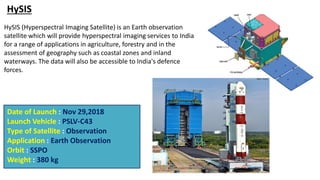
HySIS
HySIS (Hyperspectral Imaging Satellite) is an Earth observation
satellite which will provide hyperspectral imaging services to India
for a range of applications in agriculture, forestry and in the
assessment of geography such as coastal zones and inland
waterways. The data will also be accessible to India's defence
forces.
Date of Launch : Nov 29,2018
Launch Vehicle : PSLV-C43
Type of Satellite : Observation
Application : Earth Observation
Orbit : SSPO
Weight : 380 kg
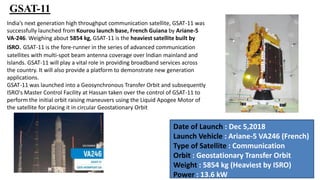
GSAT-11
India’s next generation high throughput communication satellite, GSAT-11 was
successfully launched from Kourou launch base, French Guiana by Ariane-5
VA-246. Weighing about 5854 kg, GSAT-11 is the heaviest satellite built by
ISRO. GSAT-11 is the fore-runner in the series of advanced communication
satellites with multi-spot beam antenna coverage over Indian mainland and
Islands. GSAT-11 will play a vital role in providing broadband services across
the country. It will also provide a platform to demonstrate new generation
applications.
GSAT-11 was launched into a Geosynchronous Transfer Orbit and subsequently
ISRO's Master Control Facility at Hassan taken over the control of GSAT-11 to
perform the initial orbit raising maneuvers using the Liquid Apogee Motor of
the satellite for placing it in circular Geostationary Orbit
Date of Launch : Dec 5,2018
Launch Vehicle : Ariane-5 VA246 (French)
Type of Satellite : Communication
Orbit : Geostationary Transfer Orbit
Weight : 5854 kg (Heaviest by ISRO)
Power : 13.6 kW
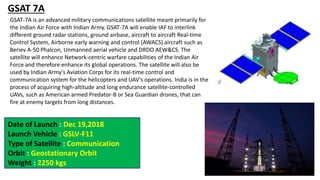
GSAT 7A
GSAT-7A is an advanced military communications satellite meant primarily for
the Indian Air Force with Indian Army. GSAT-7A will enable IAF to interlink
different ground radar stations, ground airbase, aircraft to aircraft Real-time
Control System, Airborne early warning and control (AWACS) aircraft such as
Beriev A-50 Phalcon, Unmanned aerial vehicle and DRDO AEW&CS. The
satellite will enhance Network-centric warfare capabilities of the Indian Air
Force and therefore enhance its global operations. The satellite will also be
used by Indian Army's Aviation Corps for its real-time control and
communication system for the helicopters and UAV's operations. India is in the
process of acquiring high-altitude and long endurance satellite-controlled
UAVs, such as American armed Predator-B or Sea Guardian drones, that can
fire at enemy targets from long distances.
Date of Launch : Dec 19,2018
Launch Vehicle : GSLV-F11
Type of Satellite : Communication
Orbit : Geostationary Orbit
Weight : 2250 kgs

All Missions by ISRO in 2018.

  • 1.
  • 2.
    Indian Space ResearchOrganisation abbreviated as ISRO is the Space Agency of Government of India. Founded on 15 August,1969 and is the only Government Space Organisation of India. It stands with its vision to "harness space technology for national development while pursuing space science research and planetary exploration." From launching its first satellite “Aryabhata” from a Russian Spacecraft “C1-Intercosmos” in 1975 to becoming the First Space Agency to launch 104 satellites from its “PSLV-C37” in one go in 2017, the ISRO has made its name. ISRO has so far conducted 110 missions with the help of its 71 Spacecrafts. Out of the 110, 9 missions were concluded in 2018. Lets have a look at all the missions in 2018.
  • 3.
    Cartosat-2 series satellite Cartosat-2Series Satellite is the primary satellite carried by PSLV-C40. This remote sensing satellite is similar in configuration to earlier satellites in the series and is intended to augment data services to the users. The imagery sent by satellite will be useful for cartographic applications, urban and rural applications, coastal land use and regulation, utility management like road network monitoring, water distribution, creation of land use maps, change detection to bring out geographical and manmade features and various other Land Information System (LIS) as well as Geographical Information System (GIS) applications. Date Of Launch : Jan 12,2018 Launch Vehicle : PSLC-C40 Type of Satellite : Observation Application : Earth Observation Orbit : Sun Synchronous Polar Orbit(SSPO) Weight : 710 kg Power Source : Li-Ion Batteries
  • 4.
    INS-1C Satellite Indian NanoSatellite-1C is the third satellite in the Indian Nano Satellite series. The first two payloads were carried by PSLV-C37 in Feb,2017. INS-1C is developed to host a variety of experimental payloads for short- duration demonstration missions. Data sent by this camera is useful for topographical mapping, vegetation monitoring, aerosol scattering studies and cloud studies. Date Of Launch : Jan 12,2018 Launch Vehicle : PSLV-C40 Type of Satellite : Experimental Application : Experimental Orbit : Sun Synchronous Polar Orbit(SSPO) Weight : 11 kgs Power Source : Li-Ion Battery
  • 5.
    Microsat PSLV-C40 carries aMicrosatellite (Microsat) built by ISRO as a co- passenger payload. Microsat is a small satellite in the 100 kg class that derives its heritage from IMS-1 bus. This is a technology demonstrator and the fore runner for future satellites of this series. Date Of Launch : Jan 12,2018 Launch Vehicle : PSLV-C40 Type Of Satellite : Experimental Application : Experimental Orbit : SSPO Weight : 120kg Power Source : Li-Ion Battery
  • 6.
    GSAT-6A GSAT-6A is ahigh power S-band communication satellite configured around I-2K bus. The mission life of spacecraft planned is about 10 years. The satellite will also provide a platform for developing technologies such as demonstration of 6 m S-Band Unfurlable Antenna, handheld ground terminals and network management techniques that could be useful in satellite based mobile communication applications Date of Launch : Mar 29,2018 Launch Vehicle : GSLV-F08 Type of Satellite : Communication Application : Communication Orbit : Geostationary Orbit (GSO) Weight : 2,140 kgs Power : 3119 W
  • 7.
    IRNSS-1I Indian Regional NavigationSatellite System (IRNSS-1I) is the eighth navigation satellite to join the IRNSS space segment. IRNSS-1I carries two types of payloads – navigation payload and ranging payload. The navigation payload of IRNSS-1I transmits signals for the determination of position, velocity and time. The ranging payload of IRNSS-1I consists of a C-band transponder, which facilitates accurate determination of the range of the satellite. It also carries Corner Cube Retro Reflectors for LASER Ranging. Date of Launch : Apr 12,2019 Launch Vehicle : PSLV-C41 Type of Satellite : Navigation Application : Navigation Orbit : GSO Weight : 1425 kg Power :
  • 8.
    GSAT-29 GSAT-29 satellite isa multi-beam, multiband communication satellite of India, configured around the ISRO’s enhanced I-3K bus. This is the heaviest satellite launched from India. GSAT-29 carries Ka/Ku-band high throughput communication transponders which will bridge the digital divide of users including those in Jammu & Kashmir and North Eastern regions of India. It also carries Q/V-band payload, configured for technology demonstration at higher frequency bands and Geo-stationary High Resolution Camera. carried on board GSAT-29 spacecraft. An optical communication payload, for the first time, will be utilized for data transmission. Date of Launch : Nov 14, 2018 Launch Vehicle : GSLV MKIII D2 Type of Satellite : Communication Application : Communication Orbit : Geostationary Transfer Orbit (GTO) Weight : 3423 kg (Heaviest launched from India) Power : 4600W
  • 9.
    HySIS HySIS (Hyperspectral ImagingSatellite) is an Earth observation satellite which will provide hyperspectral imaging services to India for a range of applications in agriculture, forestry and in the assessment of geography such as coastal zones and inland waterways. The data will also be accessible to India's defence forces. Date of Launch : Nov 29,2018 Launch Vehicle : PSLV-C43 Type of Satellite : Observation Application : Earth Observation Orbit : SSPO Weight : 380 kg
  • 10.
    GSAT-11 India’s next generationhigh throughput communication satellite, GSAT-11 was successfully launched from Kourou launch base, French Guiana by Ariane-5 VA-246. Weighing about 5854 kg, GSAT-11 is the heaviest satellite built by ISRO. GSAT-11 is the fore-runner in the series of advanced communication satellites with multi-spot beam antenna coverage over Indian mainland and Islands. GSAT-11 will play a vital role in providing broadband services across the country. It will also provide a platform to demonstrate new generation applications. GSAT-11 was launched into a Geosynchronous Transfer Orbit and subsequently ISRO's Master Control Facility at Hassan taken over the control of GSAT-11 to perform the initial orbit raising maneuvers using the Liquid Apogee Motor of the satellite for placing it in circular Geostationary Orbit Date of Launch : Dec 5,2018 Launch Vehicle : Ariane-5 VA246 (French) Type of Satellite : Communication Orbit : Geostationary Transfer Orbit Weight : 5854 kg (Heaviest by ISRO) Power : 13.6 kW
  • 11.
    GSAT 7A GSAT-7A isan advanced military communications satellite meant primarily for the Indian Air Force with Indian Army. GSAT-7A will enable IAF to interlink different ground radar stations, ground airbase, aircraft to aircraft Real-time Control System, Airborne early warning and control (AWACS) aircraft such as Beriev A-50 Phalcon, Unmanned aerial vehicle and DRDO AEW&CS. The satellite will enhance Network-centric warfare capabilities of the Indian Air Force and therefore enhance its global operations. The satellite will also be used by Indian Army's Aviation Corps for its real-time control and communication system for the helicopters and UAV's operations. India is in the process of acquiring high-altitude and long endurance satellite-controlled UAVs, such as American armed Predator-B or Sea Guardian drones, that can fire at enemy targets from long distances. Date of Launch : Dec 19,2018 Launch Vehicle : GSLV-F11 Type of Satellite : Communication Orbit : Geostationary Orbit Weight : 2250 kgs