Digital Learning
For All, Now
Southington Public Schools
Jonathan P. Costa, Sr.
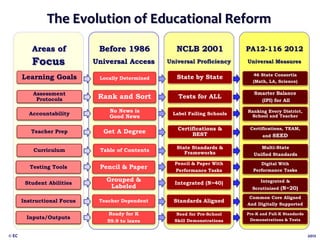
The Evolution of Educational Reform
© EC 2012
Focus
Learning Goals
Assessment
Protocols
Accountability
Teacher Prep
Curriculum
Testing Tools
Student Abilities
Instructional Focus
Inputs/Outputs
Universal Access
Locally Determined
Rank and Sort
No News is
Good News
Get A Degree
Table of Contents
Pencil & Paper
Grouped &
Labeled
Teacher Dependent
Ready for K
59.9 to leave
Universal Proficiency
State by State
Tests for ALL
Label Failing Schools
Certifications &
BEST
State Standards &
Frameworks
Pencil & Paper With
Performance Tasks
Integrated (N=40)
Standards Aligned
Need for Pre-School
Skill Demonstrations
Universal Measures
46 State Consortia
(Math, LA, Science)
Smarter Balance
(IPI) for All
Ranking Every District,
School and Teacher
Certifications, TEAM,
and SEED
Multi-State
Unified Standards
Digital With
Performance Tasks
Integrated &
Scrutinized (N=20)
Common Core Aligned
And Digitally Supported
Pre-K and Full-K Standards
Demonstrations & Tests
Areas of Before 1986 NCLB 2001 PA12-116 2012
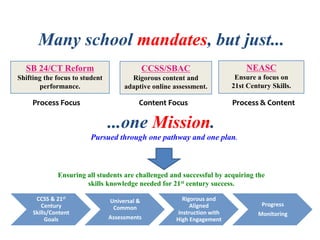
SB 24/CT Reform
Shifting the focus to student
performance.
NEASC
Ensure a focus on
21st Century Skills.
Many school mandates, but just...
...one Mission.
Ensuring all students are challenged and successful by acquiring the
skills knowledge needed for 21st century success.
Pursued through one pathway and one plan.
CCSS & 21st
Century
Skills/Content
Goals
Universal &
Common
Assessments
Rigorous and
Aligned
Instruction with
High Engagement
Progress
Monitoring
CCSS/SBAC
Rigorous content and
adaptive online assessment.
Process Focus Content Focus Process & Content
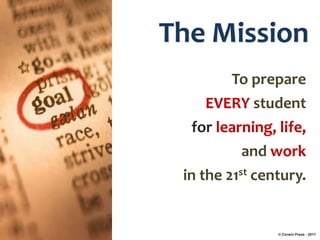
The Mission
To prepare
EVERY student
for learning, life,
and work
in the 21st century.
© Corwin Press - 2011
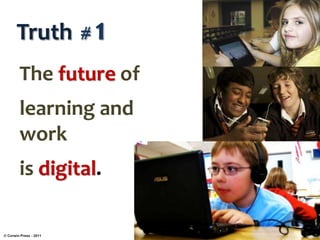
Truth # 1
The future of
learning and
work
is digital.
© Corwin Press - 2011
“Work will be dominated by fast-
moving, geographically diverse, free-
agent teams of workers connected via
socially mediating technologies.”
Fred Stutzman, Carnegie Mellon
“The replacement of memorization by
analysis will be the biggest boon to
society since the coming of mass
literacy.”
Paul Jones, UNC- Chapel Hill
“There is no doubt that brains are being
rewired.”
Danah Boyd, Microsoft Research
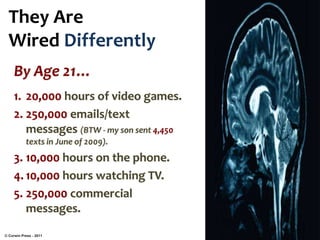
They Are
Wired Differently
By Age 21…
1. 20,000 hours of video games.
2. 250,000 emails/text
messages (BTW - my son sent 4,450
texts in June of 2009).
3. 10,000 hours on the phone.
4. 10,000 hours watching TV.
5. 250,000 commercial
messages.
© Corwin Press - 2011
In Less Than
A Generation…
• From isolation to
communication as the
norm.
• From going out of your
way to communicate to
going out of your way
not to.
© Corwin Press - 2011
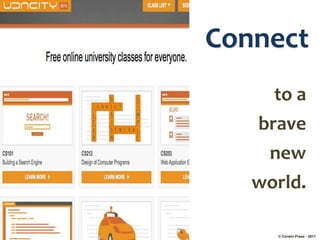
Connect
to a
brave
new
world.
© Corwin Press - 2011
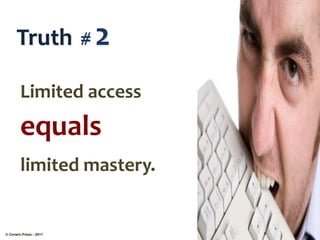
Truth # 2
Limited access
equals
limited mastery.
© Corwin Press - 2011
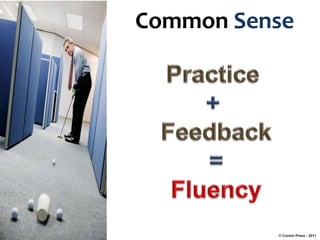
Common Sense
© Corwin Press - 2011
Truth # 3
Every
printed page
is a
waste.
© Corwin Press - 2011
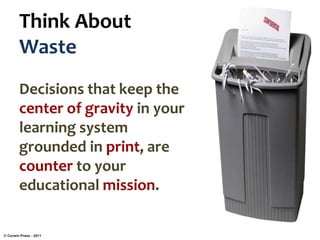
Think About
Waste
Decisions that keep the
center of gravity in your
learning system
grounded in print, are
counter to your
educational mission.
© Corwin Press - 2011
Get to
1:1
What could you
do if everyone
had a digital
device?
© Corwin Press - 2011
The Resource Equation
BYOD
plus
Open Source
plus
Digital Materials
equals
Digital Learning for All
© Corwin Press - 2011
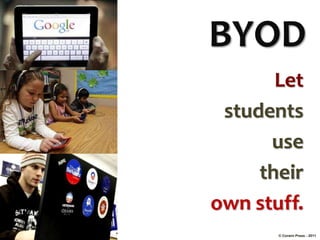
Let
students
use
their
own stuff.
BYOD
© Corwin Press - 2011
Leveraging a
Community Asset
Several already have
them.
Many more would get
them.
Some cannot or will not.
Most districts can
finance the gap.
© Corwin Press - 2011
All agree the biggest
benefit has been the
shift from talking
about which device
to talking about
what they will do
with the devices.
BYOD - Crowd
Sourcing in Practice
© Corwin Press - 2011
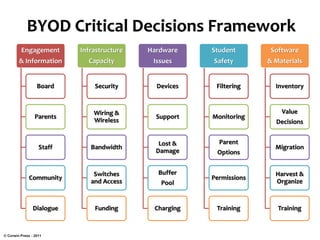
BYOD Critical Decisions Framework
Engagement
& Information
Board
Parents
Staff
Community
Dialogue
Infrastructure
Capacity
Security
Wiring &
Wireless
Bandwidth
Switches
and Access
Funding
Hardware
Issues
Devices
Support
Lost &
Damage
Buffer
Pool
Charging
Student
Safety
Filtering
Monitoring
Parent
Options
Permissions
Training
Software
& Materials
Inventory
Value
Decisions
Migration
Harvest &
Organize
Training
© Corwin Press - 2011
Equity
Concerns
Until everyone can
have the same thing,
no one can have
anything.
Equitably deficient.
© Corwin Press - 2011
The Real
Equity Problem
Equity through denial
supports the
development of a
digital
achievement
gap.
© Corwin Press - 2011
Equity
Equation
A device gap is
less
objectionable
than an
access gap.
© Corwin Press - 2011
Your
Browser
is an
equalizer.
© Corwin Press - 2011
The
Cloud
is a
liberator.
© Corwin Press - 2011
The Engagement
Purchase Equation
Degree of Student Control
times
Flexibility & Adaptability
divided by
Per Unit Cost
equals
Best Value Choice
© Corwin Press - 2011
Goals for
Learning
The commitment you
have made to a small
and focused number of
essential skills and
learning outcomes.
© Corwin Press - 2011
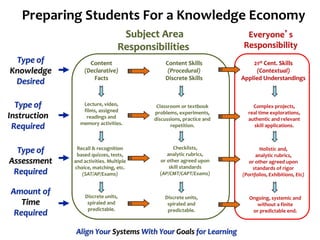
Preparing Students For a Knowledge Economy
Align Your Systems With Your Goals for Learning
Type of
Assessment
Required
Subject Area
Responsibilities
Everyone’s
Responsibility
Content
(Declarative)
Facts
Content Skills
(Procedural)
Discrete Skills
21st Cent. Skills
(Contextual)
Applied Understandings
Type of
Knowledge
Desired
Type of
Instruction
Required
Lecture, video,
films, assigned
readings and
memory activities.
Classroom or textbook
problems, experiments,
discussions, practice and
repetition.
Complex projects,
real time explorations,
authentic and relevant
skill applications.
Amount of
Time
Required
Discrete units,
spiraled and
predictable.
Ongoing, systemic and
without a finite
or predictable end.
Discrete units,
spiraled and
predictable.
Recall & recognition
based quizzes, tests,
and activities. Multiple
choice, matching, etc.
(SAT/AP/Exams)
Checklists,
analytic rubrics,
or other agreed upon
skill standards
(AP/CMT/CAPT/Exams)
Holistic and,
analytic rubrics,
or other agreed upon
standards of rigor
(Portfolios, Exhibitions, Etc)
© JPC Sr. 2012
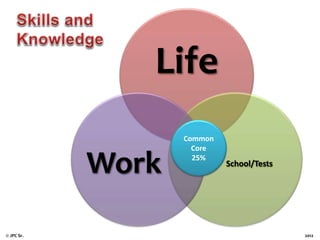
Life
School/Tests
Work
Common
Core
25%
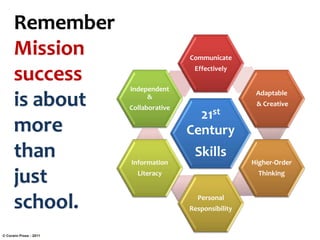
21st
Century
Skills
Communicate
Effectively
Adaptable
& Creative
Higher-Order
Thinking
Personal
Responsibility
Information
Literacy
Independent
&
Collaborative
Remember
Mission
success
is about
more
than
just
school.
© Corwin Press - 2011
© JPC Sr. 2012
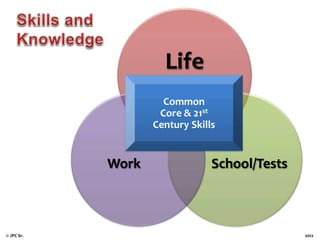
Life
School/Tests
Work
Common
Core & 21st
Century Skills
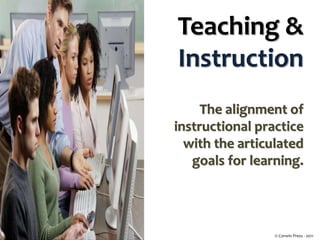
Teaching &
Instruction
The alignment of
instructional practice
with the articulated
goals for learning.
© Corwin Press - 2011
The Engagement
& Learning Equation
Degree of Student Control
times
Order of Conceptual Difficulty
plus
Content Fluency
equals
Instructional Value
© Corwin Press - 2011
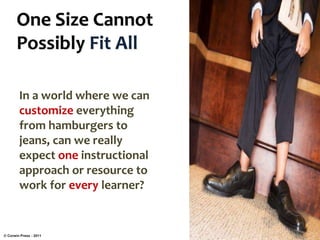
One Size Cannot
Possibly Fit All
© Corwin Press - 2011
In a world where we can
customize everything
from hamburgers to
jeans, can we really
expect one instructional
approach or resource to
work for every learner?
Assessment
& Data
How well the
accountability systems
align with the stated
goals for learning and
inform continuous
improvement of
teaching and
performance.
© Corwin Press - 2011
Assessment
& Data
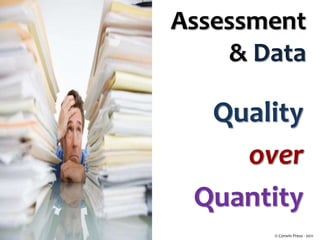
Quality
over
Quantity
© Corwin Press - 2011
Essential
Engagement
© Corwin Press - 2011
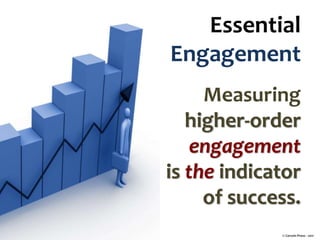
Measuring
higher-order
engagement
is the indicator
of success.
All Risks are Not
Created Equal
We will fail in our
mission to give children
the tools they need for
the future if we forget
the balance between
protection and
preparation.
© Corwin Press - 2011
The Risk of
Doing Nothing
A lack of adequate
preparation is more
of a systemic risk
than any special-
cause potential
event.
© Corwin Press - 2011
If your plan is to wait
until there are
satisfactory answers
to all of your
questions before you
start the process, you
should be prepared
to wait forever.
New
Beginnings
at the End
of an
Endless
Road
Monique Crichlow-Moise
© Corwin Press - 2011
Resource Information
Jonathan P. Costa, Sr.
Director, School/Program Services
EDUCATION CONNECTION
costa@educationconnection.org
860-567-0863
To view slides:
www.slideshare.net/jpcostasr
Southington Share
Southington Follow Up
Book Questions:
info@digitallearningforallnow.com
Book Web Page:
www.digitallearningforallnow.com
© Corwin Press - 2011

Southington Share

  • 1.
    Digital Learning For All,Now Southington Public Schools Jonathan P. Costa, Sr.
  • 2.
    The Evolution ofEducational Reform © EC 2012 Focus Learning Goals Assessment Protocols Accountability Teacher Prep Curriculum Testing Tools Student Abilities Instructional Focus Inputs/Outputs Universal Access Locally Determined Rank and Sort No News is Good News Get A Degree Table of Contents Pencil & Paper Grouped & Labeled Teacher Dependent Ready for K 59.9 to leave Universal Proficiency State by State Tests for ALL Label Failing Schools Certifications & BEST State Standards & Frameworks Pencil & Paper With Performance Tasks Integrated (N=40) Standards Aligned Need for Pre-School Skill Demonstrations Universal Measures 46 State Consortia (Math, LA, Science) Smarter Balance (IPI) for All Ranking Every District, School and Teacher Certifications, TEAM, and SEED Multi-State Unified Standards Digital With Performance Tasks Integrated & Scrutinized (N=20) Common Core Aligned And Digitally Supported Pre-K and Full-K Standards Demonstrations & Tests Areas of Before 1986 NCLB 2001 PA12-116 2012
  • 3.
    SB 24/CT Reform Shiftingthe focus to student performance. NEASC Ensure a focus on 21st Century Skills. Many school mandates, but just... ...one Mission. Ensuring all students are challenged and successful by acquiring the skills knowledge needed for 21st century success. Pursued through one pathway and one plan. CCSS & 21st Century Skills/Content Goals Universal & Common Assessments Rigorous and Aligned Instruction with High Engagement Progress Monitoring CCSS/SBAC Rigorous content and adaptive online assessment. Process Focus Content Focus Process & Content
  • 4.
    The Mission To prepare EVERYstudent for learning, life, and work in the 21st century. © Corwin Press - 2011
  • 5.
    Truth # 1 Thefuture of learning and work is digital. © Corwin Press - 2011
  • 6.
    “Work will bedominated by fast- moving, geographically diverse, free- agent teams of workers connected via socially mediating technologies.” Fred Stutzman, Carnegie Mellon “The replacement of memorization by analysis will be the biggest boon to society since the coming of mass literacy.” Paul Jones, UNC- Chapel Hill “There is no doubt that brains are being rewired.” Danah Boyd, Microsoft Research
  • 7.
    They Are Wired Differently ByAge 21… 1. 20,000 hours of video games. 2. 250,000 emails/text messages (BTW - my son sent 4,450 texts in June of 2009). 3. 10,000 hours on the phone. 4. 10,000 hours watching TV. 5. 250,000 commercial messages. © Corwin Press - 2011
  • 8.
    In Less Than AGeneration… • From isolation to communication as the norm. • From going out of your way to communicate to going out of your way not to. © Corwin Press - 2011
  • 9.
  • 10.
    Truth # 2 Limitedaccess equals limited mastery. © Corwin Press - 2011
  • 11.
  • 12.
    Truth # 3 Every printedpage is a waste. © Corwin Press - 2011
  • 13.
    Think About Waste Decisions thatkeep the center of gravity in your learning system grounded in print, are counter to your educational mission. © Corwin Press - 2011
  • 14.
    Get to 1:1 What couldyou do if everyone had a digital device? © Corwin Press - 2011
  • 15.
    The Resource Equation BYOD plus OpenSource plus Digital Materials equals Digital Learning for All © Corwin Press - 2011
  • 16.
  • 17.
    Leveraging a Community Asset Severalalready have them. Many more would get them. Some cannot or will not. Most districts can finance the gap. © Corwin Press - 2011
  • 18.
    All agree thebiggest benefit has been the shift from talking about which device to talking about what they will do with the devices. BYOD - Crowd Sourcing in Practice © Corwin Press - 2011
  • 19.
    BYOD Critical DecisionsFramework Engagement & Information Board Parents Staff Community Dialogue Infrastructure Capacity Security Wiring & Wireless Bandwidth Switches and Access Funding Hardware Issues Devices Support Lost & Damage Buffer Pool Charging Student Safety Filtering Monitoring Parent Options Permissions Training Software & Materials Inventory Value Decisions Migration Harvest & Organize Training © Corwin Press - 2011
  • 20.
    Equity Concerns Until everyone can havethe same thing, no one can have anything. Equitably deficient. © Corwin Press - 2011
  • 21.
    The Real Equity Problem Equitythrough denial supports the development of a digital achievement gap. © Corwin Press - 2011
  • 22.
    Equity Equation A device gapis less objectionable than an access gap. © Corwin Press - 2011
  • 23.
  • 24.
  • 25.
    The Engagement Purchase Equation Degreeof Student Control times Flexibility & Adaptability divided by Per Unit Cost equals Best Value Choice © Corwin Press - 2011
  • 26.
    Goals for Learning The commitmentyou have made to a small and focused number of essential skills and learning outcomes. © Corwin Press - 2011
  • 27.
    Preparing Students Fora Knowledge Economy Align Your Systems With Your Goals for Learning Type of Assessment Required Subject Area Responsibilities Everyone’s Responsibility Content (Declarative) Facts Content Skills (Procedural) Discrete Skills 21st Cent. Skills (Contextual) Applied Understandings Type of Knowledge Desired Type of Instruction Required Lecture, video, films, assigned readings and memory activities. Classroom or textbook problems, experiments, discussions, practice and repetition. Complex projects, real time explorations, authentic and relevant skill applications. Amount of Time Required Discrete units, spiraled and predictable. Ongoing, systemic and without a finite or predictable end. Discrete units, spiraled and predictable. Recall & recognition based quizzes, tests, and activities. Multiple choice, matching, etc. (SAT/AP/Exams) Checklists, analytic rubrics, or other agreed upon skill standards (AP/CMT/CAPT/Exams) Holistic and, analytic rubrics, or other agreed upon standards of rigor (Portfolios, Exhibitions, Etc)
  • 28.
    © JPC Sr.2012 Life School/Tests Work Common Core 25%
  • 29.
  • 30.
    © JPC Sr.2012 Life School/Tests Work Common Core & 21st Century Skills
  • 31.
    Teaching & Instruction The alignmentof instructional practice with the articulated goals for learning. © Corwin Press - 2011
  • 32.
    The Engagement & LearningEquation Degree of Student Control times Order of Conceptual Difficulty plus Content Fluency equals Instructional Value © Corwin Press - 2011
  • 33.
    One Size Cannot PossiblyFit All © Corwin Press - 2011 In a world where we can customize everything from hamburgers to jeans, can we really expect one instructional approach or resource to work for every learner?
  • 34.
    Assessment & Data How wellthe accountability systems align with the stated goals for learning and inform continuous improvement of teaching and performance. © Corwin Press - 2011
  • 35.
  • 36.
    Essential Engagement © Corwin Press- 2011 Measuring higher-order engagement is the indicator of success.
  • 37.
    All Risks areNot Created Equal We will fail in our mission to give children the tools they need for the future if we forget the balance between protection and preparation. © Corwin Press - 2011
  • 38.
    The Risk of DoingNothing A lack of adequate preparation is more of a systemic risk than any special- cause potential event. © Corwin Press - 2011
  • 39.
    If your planis to wait until there are satisfactory answers to all of your questions before you start the process, you should be prepared to wait forever. New Beginnings at the End of an Endless Road Monique Crichlow-Moise © Corwin Press - 2011
  • 40.
    Resource Information Jonathan P.Costa, Sr. Director, School/Program Services EDUCATION CONNECTION costa@educationconnection.org 860-567-0863 To view slides: www.slideshare.net/jpcostasr Southington Share Southington Follow Up Book Questions: info@digitallearningforallnow.com Book Web Page: www.digitallearningforallnow.com © Corwin Press - 2011

Editor's Notes

  • #5 This is the defining challenge of our times in public school.
  • #6 This inescapable truth sets the direction
  • #10 This is the defining challenge of our times in public school.
  • #11 Adequate preparation for a higher order thinking digital environment requires one-to-one access by staff and students.Not equipment competency here – we are talking about the ability to use devices in authentic environments to solve important problems through critical and creative thinking.
  • #13 Continued investment in a print-based infrastructure and the lack of strategic transitional planning for a complete move to digital are ultimately counter-productiveboth educationally and fiscally.
  • #15 With that accomplished, all else is possible.Without it, your future is your print-based past.
  • #17 Crowd Source the HardwareThe print capacity model dictates that for everything we use we must provide a copy to ensure equity.What if we allowed students to use their own equipment and only provided for those who could not afford it?
  • #18 Manydevices that get this job done cost little more than the graphing calculators we have been requiring them to buy for years anyway.MostConnecticut districts will go from a 100% capacity problem to a 20% capacity problem.With the affordability of these devices, if you add up what you saved by going digital and using open source, for most, that money will pay for the gap.
  • #21 The only solution then is to wait – wait until that day when we can afford to buy every student the same device.Is it really more equitable to say that no one has access to technology until everyone can have the same thing?It’s not about the device, its about what we do with it.The only solution then is to wait – wait until that day when we can afford to buy every student the same device.Is it really more equitable to say that no one has access to technology until everyone can have the same thing?It’s not about the device, its about what we do with it.The only solution then is to wait – wait until that day when we can afford to buy every student the same device.Is it really more equitable to say that no one has access to technology until everyone can have the same thing?It’s not about the device, its about what we do with it.The only solution then is to wait – wait until that day when we can afford to buy every student the same device.Is it really more equitable to say that no one has access to technology until everyone can have the same thing?It’s not about the device, its about what we do with it.
  • #22 How does denying children access to technology in the name of equity serve their needs?Without access they will never have the opportunity to develop the skills that their more appropriately resourced peers have at home every day.
  • #23 What is worse?